

Next Article in Journal
Leptospirosis in Southeast Asia: Investigating Seroprevalence, Transmission Patterns, and Diagnostic Challenges
Previous Article in Journal
Application of a One-Health Approach for Dermatophyte Infections
Previous Article in Special Issue
Evaluation of Hospitalizations for Tick-Borne Diseases in the United States from 2002 to 2021
error_outline You can access the new MDPI.com website here. Explore and share your feedback with us.
 
 
Article

Brucella, Coxiella, and Theileria Species DNA in Haemaphysalis qinghaiensis Ticks Collected from Goats and Sheep in Qinghai Province, Northwest China

1
National Key Laboratory of Intelligent Tracing and Forecasting for Infectious Diseases, National Institute for Communicable Disease Control and Prevention, Chinese Center for Disease Control and Prevention, Changping District, Beijing 102206, China
2
Qinghai Center for Disease Control and Prevention, Xining 810007, China
3
Daxing Center for Disease Control and Prevention, Daxing District, Beijing 102600, China
4
Menyuan Center for Disease Control and Prevention, Haibei Tibetan Autonomous Prefecture 810399, China
*
Authors to whom correspondence should be addressed.
These authors contributed equally to this work.
Trop. Med. Infect. Dis. 2026, 11(1), 17; https://doi.org/10.3390/tropicalmed11010017
Submission received: 15 October 2025 / Revised: 9 December 2025 / Accepted: 5 January 2026 / Published: 7 January 2026
(This article belongs to the Special Issue The Distribution and Diversity of Tick-Borne Zoonotic Pathogens)

Abstract

Haemaphysalis qinghaiensis is an endemic tick species distributed in the western plateau areas of China. Although they are three-host ticks, infesting multiple animals (including humans), the occurrence of various tick-borne agents has barely been investigated. In this study, we collected 136 H. qinghaiensis specimens from sheep and goats in Menyuan County in Qinghai Province, northwest China. The Brucella, Coxiella, and Theileria/Babesia species’ DNA were detected by nested or hemi-nested PCR and further identified by amplifying their key genes. Brucella abortus and B. melitensis DNA were detected, with positive rates of 3.68% and 4.41%, respectively. This may be the first report that suggests that H. qinghaiensis harbors Brucella spp., the agents of human brucellosis. The Coxiella endosymbiont of Haemaphysalis qinghaiensis, a non-pathogenic Coxiella, was identified with an extremely high positive rate of 97.06%. In addition, two Theileria species, Theileria luwenshuni (75.00%) and Theileria uilenbergi (16.18%), were detected. Our results suggest the circulation of Brucella spp. and Theileria spp. in goats and sheep in the study area. Whether H. qinghaiensis ticks play a role in the maintenance and transmission of these agents has yet to be determined. Due to their human pathogenicity and their high positive rates in ticks, surveillance in local populations with relative symptoms is necessary.

1. Introduction

Tick-borne pathogens have been a global health concern in recent years. As the primary vectors for animal pathogens and the second vectors for human pathogens, ticks (Acari: Ixodida) include 896 species and are globally distributed [1]. They play a key role in the transmission/conservation of numerous human and animal pathogens, such as Borrelia burgdorferi sensu lato, Coxiella burnetii, Rickettsia spp., tick-borne encephalitis virus, severe fever with thrombocytopenia syndrome virus, etc. [2]. It has been reported that tick-borne pathogens are responsible for more than 100,000 human cases worldwide, posing a great threat to public health [3].
Haemaphysalis qinghaiensis Teng, 1980 (genus Haemaphysalis, family Ixodidae) is endemic to China. It is widely distributed in the western plateau of China, including the Qinghai, Gansu, and Sichuan provinces [4]. It usually infests domestic animals (such as sheep, goats, yaks, and cattle) and wild animals (such as hares) [5]. Occasionally, it also bites humans. As a three-host tick, it switches hosts during its development, thus possibly transmitting multiple pathogens between animals and humans. Many studies have been performed on H. qinghaiensis-vectored pathogens in China [5,6,7,8]. It has been reported that H. qinghaiensis harbors a large variety of pathogens of humans and animals, including spotted fever group Rickettsia, Anaplasma bovis, Anaplasma phagocytophilum, Borrelia burgdorferi sensu lato, Theileria sinensis, and Theileria uilenbergi [5,6,7,8].
Despite the wide distribution of H. qinghaiensis in China and its high prevalence in certain areas, studies on the tick-borne pathogens harbored by H. qinghaiensis are still relatively rare. In fact, the role of this species as a vector is still somewhat neglected. Meanwhile, some pathogens are rarely investigated in this tick species in most areas. Of those, Brucella, Coxiella, and Theileria are zoonotic pathogens widely circulated in northwest China [9]. They pose a great threat to husbandry, result in remarkable economic losses, and are becoming a risk to public health. However, to date, these pathogens are still rarely reported in H. qinghaiensis in China.
The aim of this study is to investigate the prevalence and perform genetic characterization of Brucella, Coxiella, and Theileria species in Haemaphysalis qinghaiensis ticks collected from Qinghai Province, China, to better understand their role as carriers of zoonotic and veterinary pathogens.

2. Methods

2.1. Sample Collection and DNA Extraction

In April and May 2025, parasitic ticks were collected from domestic animals in Menyuan County in Haibei Tibetan Autonomous Prefecture, Qinghai Province, northwest China. All animals in the sheepfolds in the sampling location, including nine free-ranging goats (Capra hircus) and four free-ranging sheep (Ovis aries), were manually restrained and examined. Half-body tick collections were made. All the ticks were carefully removed from the body (ear, face, groin, etc.) of domestic animals using tweezers. A total of 136 ticks were collected. Of those, 90 ticks were collected from goats, and 46 ticks were from sheep. After morphological identification by observing the basis capitula, anal groove, cervical groove, and palp [10], the tick species was first determined and then washed using Phosphate-Buffered Saline (PBS) (Thermo Scientific, Waltham, MA, USA) before DNA extraction to exclude contamination. The ticks were individually ground into homogenate with PBS (100 μL) in a mortar. The DNA was extracted using Omega Mollusc DNA extraction kits (Omega Bio-Tek, Norcross, GA, USA). ddH2O was used as a negative control. The DNA was eluted in 100 μL elution buffer. The concentration and quality of the DNA were measured using a NanoDrop 2000 spectrophotometer (Thermo Scientific, Waltham, MA, USA). The DNA was stored in a −80 °C refrigerator before molecular detection of the pathogens. The tick species were molecularly confirmed by amplifying and analyzing the COI gene using primers [11].

2.2. Molecular Identification of Brucella spp., Coxiella sp., and Theileria/Babesia

All the DNA samples were screened for Brucella spp. by semi-nested PCR amplifying a unique repeat sequence on chromosome 1 of Brucella spp. according to reference [12], generating approximately 310–330 bp PCR products. For further identification of the Brucella species, partial sequences of the omp25 (635 bp), bcsp31 (737 bp), and rpoB (424 bp) genes, which were usually used for Brucella species identification, were obtained by nested PCR and sequencing (primers shown in references Li et al. [13], Li et al. [14], and Table 1). PCR was performed using 2× Easy Taq PCR Supermix (TransGen Biotech, Beijing, China) in a SensoQuest Labcycler (40 cycles) (SensoQuest, Göttingen, Germany). The DNA of B. melitensis 16M was set as a positive control and ddH2O as a negative control.
Coxiella sp. was detected using a set of nested primers amplifying a partial sequence of the rpoB gene, yielding approximately 500 bp PCR products (primers shown in Duron et al. [14]). The DNA of C. burnetii was set as a positive control and ddH2O was set as a negative control. For confirmation and further identification, the partial DnaK sequence of detected strains were recovered using nested primers [17]. Protozoan (mainly Theileria and Babesia) pathogens were detected using nested primers amplifying the 18S sequence (approximately 700 bp) (primers shown in Zhang et al. [18]). The DNA of Babesia orientalis was set as a positive control and ddH2O was set as a negative control. All the PCR products were electrophoresed in 1.0% agarose gels, and the PCR products that met the expected length were subjected to Sanger sequencing.

2.3. Phylogenetic Analysis

All the recovered sequences were assembled and manually edited using BioEdit software (Ver7.2.5). The recovered sequences were aligned with reference sequences in the GenBank Database using BLASTn (https://blast.ncbi.nlm.nih.gov/Blast.cgi (accessed on 4 January 2026)) to determine the species of the detected bacteria or protozoan as well as the nucleotide similarities. For phylogenetic analysis, all the recovered sequences were locally aligned with downloaded reference sequences using the ClustalW method in the MEGA program [19]. Maximum Likelihood (ML) trees were constructed in the GTR model using PhyML based on the aligned DNA sequences [20]. All the phylogenetic trees were mid-point rooted.

3. Results

3.1. Collection of Tick Samples

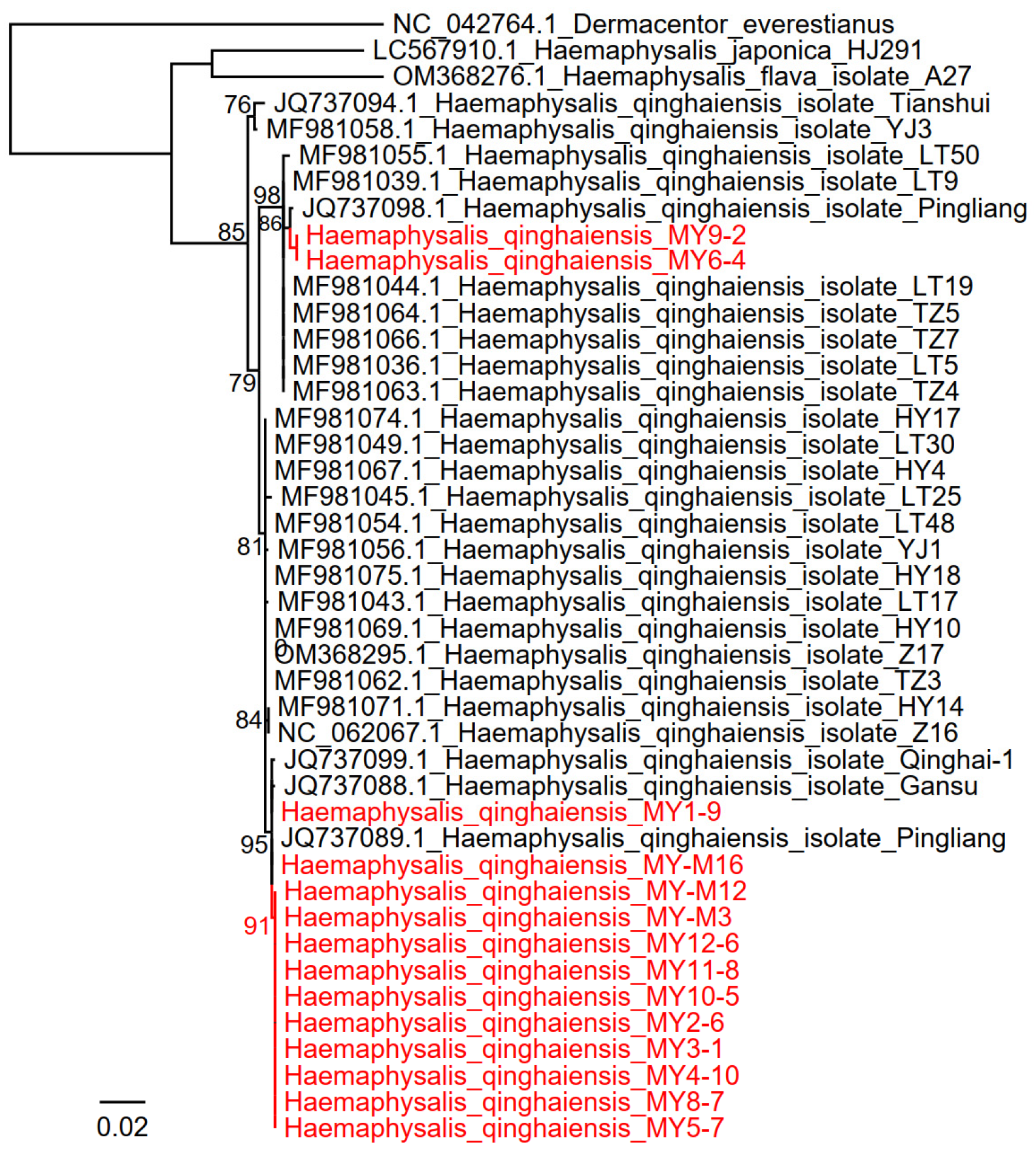
All the 136 ticks were morphologically identified to be H. qinghaiensis by observing the basis capitula, anal groove, cervical groove, and palp. All these 136 ticks were fully or partially engorged. The tick species were confirmed by PCR amplifying and sequencing the partial Cytochrome coxidase subunit I (COI) gene (691 bp) of randomly selected ticks. All the obtained COI gene sequences have >99% identities to H. qinghaiensis, confirming that all these 136 ticks are H. qinghaiensis. Phylogenetic analysis of the COI genes showed that the ticks formed three clades in the phylogenetic tree, indicating the high genetic diversity of H. qinghaiensis in Qinghai Province (Figure 1).

3.2. Detection and Analysis of the Brucella spp.

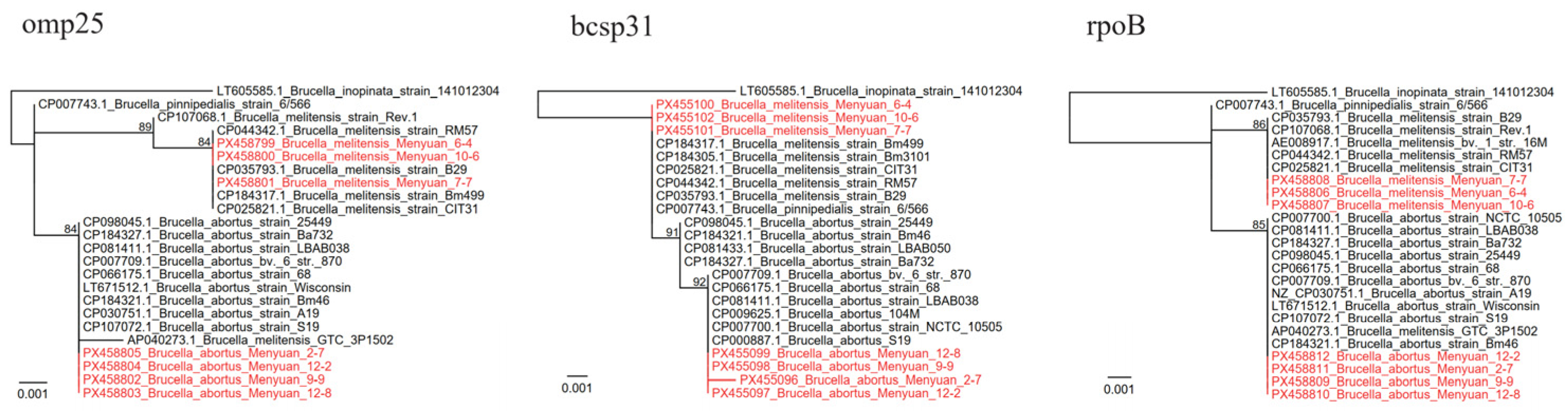
PCR results showed that two Brucella species were identified in H. qinghaiensis ticks: B. melitensis and B. abortus, with positive rates of 4.41% (6/136) and 3.68% (5/136), respectively (Table 1). Notably, the samples that were positive for B. melitensis and B. abortus were distributed in ticks collected from both goats and sheep. For further identification, three key genes of Brucella spp., the bcsp31, rpoB, and omp25 genes, were recovered and analyzed from seven randomly selected samples. All the bcsp31, rpoB, and omp25 sequences of B. melitensis were 100% identical to those of B. melitensis strain B29 (CP035793.1, from China), B. melitensis strain RM57 (CP044342.1, from China), B. melitensis strain BM499 (CP184317.1, from Kazakhstan), etc. For the B. abortus strains, their omp25 and rpoB sequences were both 100% identical to the B. abortus_bv. 6 str. 870 (CP007709.1, from the USA), B. abortus strain 25,449 (CP098045.1, from Italy), B. abortus strain LBAB038 (CP081411.1, from Brazil), and B. abortus strain S19 (CP107072.1, from China), etc. (Figure 2). Interestingly, for the bcsp31 gene, there are some differences. The sequences of B. abortus Menyuan-9-9, B. abortus Menyuan-12-2, and B. abortus Menyuan-12-8 are also 100% identical to these above reference strains, while the sequence of B. abortus Menyuan-2-7 is only 99.86% identical to the above strains. In the phylogenetic tree, it also forms a different branch (Figure 2).

3.3. Detection and Analysis of the Coxiella

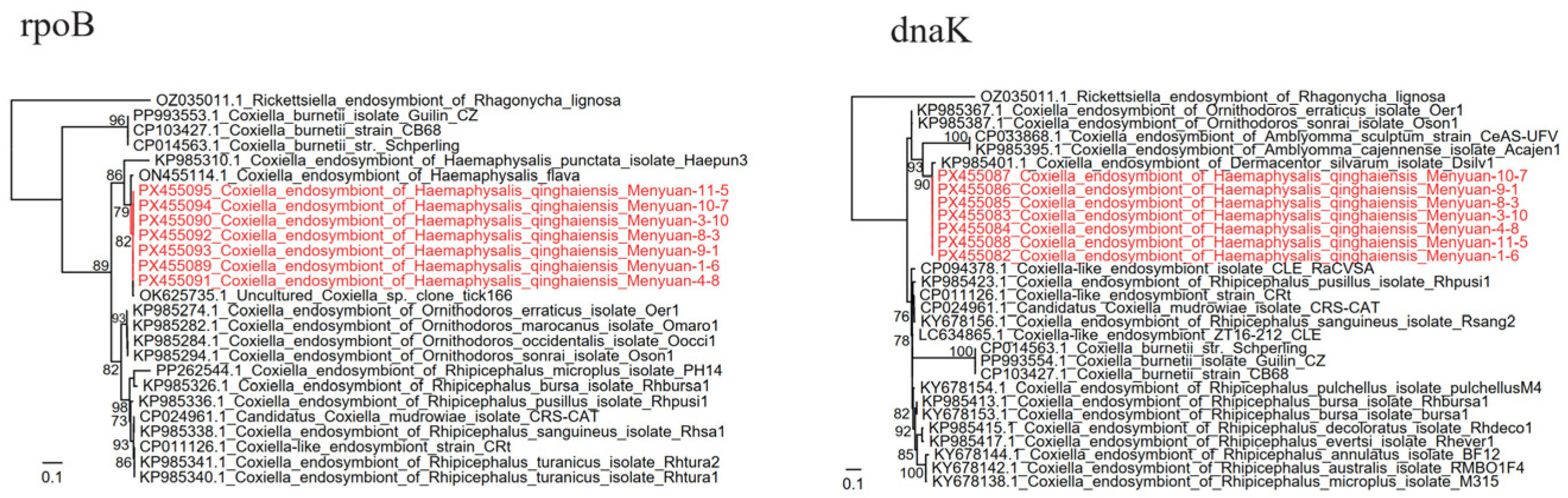
Coxiella was detected in H. qinghaiensis with an extremely high positive rate of 97.06% (132/136) (Table 2). The rpoB sequences from the randomly selected strains were 100% identical or had one different nucleotide (99.79%) from each other. BLASTN showed that they have highest similarity, 99.16–99.37%, to the uncultured Coxiella sp. clone tick166 (OK625735.1) and the uncultured Coxiella sp. clone tick103 (OK625734.1), both of which were from H. qinghaiensis ticks in Ngawa Prefecture, Sichuan Province, China. In the phylogenetic tree, they are divided into two closely related clades. Interestingly, all the DnaK sequences were identical, and they are only 97.61% identical to the Coxiella endosymbiont of Dermacentor silvarum isolate Dsilv1 (KP985401.1) and 97.45% identical to the Coxiella endosymbiont of Haemaphysalis flava. In both phylogenetic trees, the detected strains were closely related to the Coxiella endosymbiont of ticks but distant from the human pathogenic C. burnetii. Therefore, we suppose that all the strains are the Coxiella endosymbiont of H. qinghaiensis.

3.4. Detection and Analysis of the Theileria/Babesia

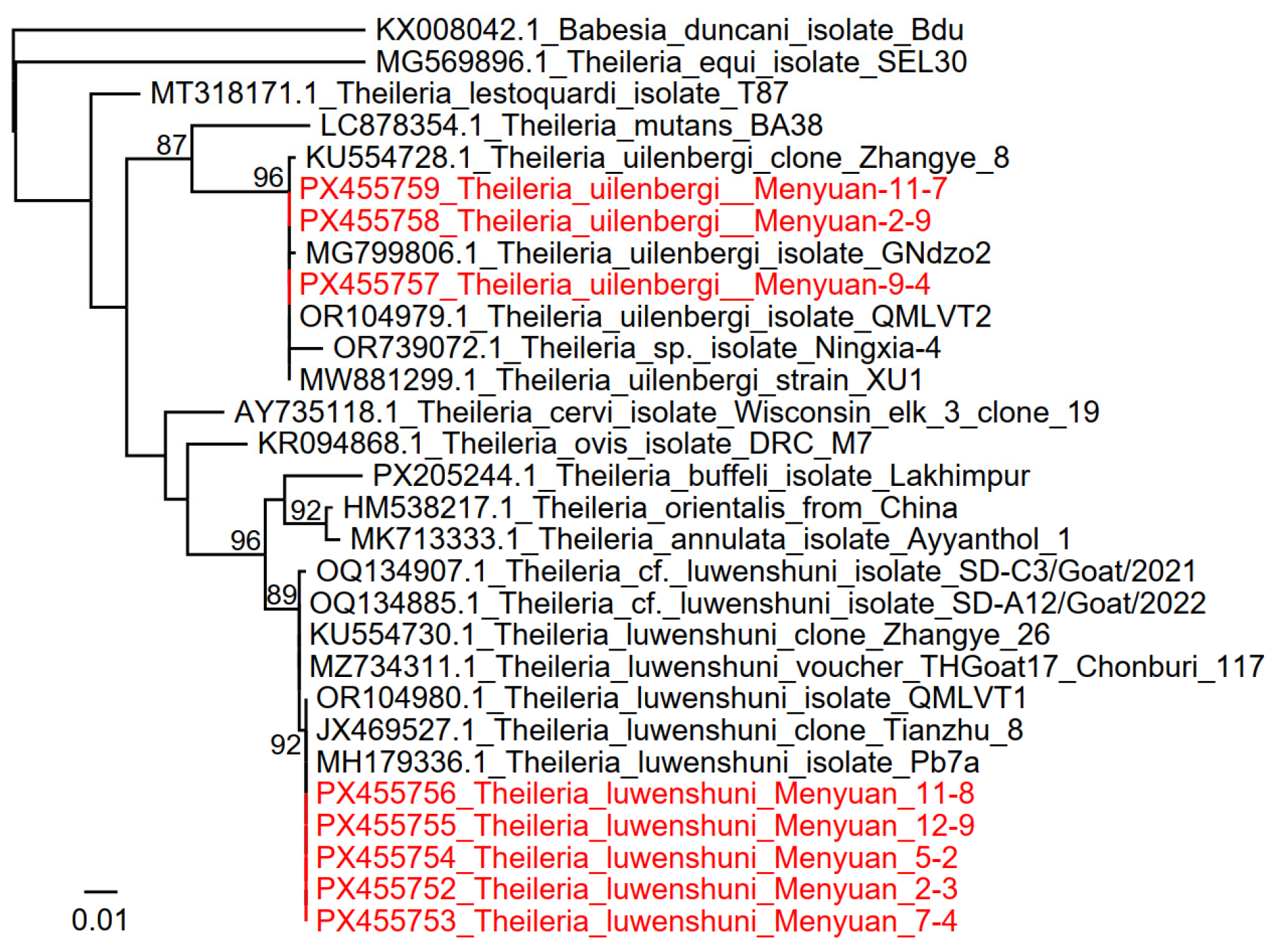
Two protozoan species were identified in the ticks. Both of them belong to the genus Theileria: T. luwenshuni and T. uilenbergi. They were detected in ticks collected from both goats and sheep. Theileria luwenshuni was detected with a higher positive rate of 75.00% (102/136), while T. uilenbergi was detected in 16.18% (22/136) of the ticks. Genetic and phylogenetic analysis indicated that all the T. luwenshuni sequences were identical to each other, and they were 100% identical to T. luwenshuni strains (JF719832.1, JX469527.1, MH179336.1, etc.) previously detected in ticks or small ruminants from the Sichuan, Qinghai, and Gansu provinces in China. Similarly, all the DNA sequences of T. uilenbergi strains were identical to each other, and they were 100% identical to voles, goats, or ticks from China.
All the obtained sequences have been submitted to the GenBank Database (accession numbers shown in Table S1).

4. Discussion

Haemaphysalis qinghaiensis is an endemic tick species distributed in the western plateau areas of China, such as in the Qinghai, Gansu, Sichuan, and Yunnan provinces [4]. It has a wide range of hosts, including goats, sheep, cattle, yaks, and horses. As a three-host tick, H. qinghaiensis changes its host during its development and it also occasionally bites humans [5]. However, compared to other tick species, the human and animal pathogens carried by H. qinghaiensis are still rarely studied.
Brucellosis caused by Brucella spp. is considered one of the most common zoonotic diseases worldwide and it has been designated as one of the world’s most important “neglected zoonotic diseases” by the World Health Organization (WHO) [21,22]. Numerous humans and animals have been infected, with an estimated 2,100,000 human cases annually worldwide [23]. The infection of humans with brucellosis usually occurs due to direct or indirect inhalation of infected animals’ infectious materials, or consumption of unpasteurized animal products (milk, meat, etc.) [24]. Although the role of ticks in the transmission of brucellosis is still unclear, B. melitensis and B. abortus have been detected in the eggs and larvae of Dermacentor marginatus, suggesting the transovarial transmission of Brucella spp. in D. marginatus ticks [25]. Some other studies also reported the presence of Brucella spp. in various tick species, including Haemaphysalis longicornis, Ornithodoros lahorensis, etc. [26,27,28]. However, Brucella spp. have never been reported in H. qinghaiensis ticks. This may be the first report that shows that H. qinghaiensis harbors Brucella spp. Qinghai Province is an endemic area of brucellosis. Brucella melitensis, B. abortus, and B. suis have been reported in domestic and wild animals in Qinghai [29]. In this study, although we identified B. melitensis and B. abortus in ticks (Table 2), it is possible that the DNA of Brucella was from the blood of sheep or goats due to the fact that the ticks were collected from them and were engorged. Whether H. qinghaiensis ticks play a role in the maintenance and transmission of Brucella spp. is still to be determined.
Coxiella burnetii, the agent of Q fever, is an important zoonotic pathogen with a worldwide distribution. Ticks have been proven to be the hosts and vectors of C. burnetii. In this study, we tried to detect C. burnetii in ticks from Qinghai Province. However, the results indicated that H. qinghaiensis ticks have an extremely high positive rate of the Coxiella endosymbiont instead of C. burnetii. Although some studies reported the pathogenicity of certain Coxiella endosymbionts in animals [15], most of the Coxiella endosymbionts of ticks were considered non-pathogenic. Furthermore, the Coxiella endosymbiont of H. qinghaiensis strains are genetically distant from pathogenic C. burnetiid (Figure 3), which also suggests its non-pathogenicity. This result indicates that this area may not be an endemic area with Q fever.
Theileria and Babesia (usually called piroplasmids) are parasitic protozoa belonging to the class Piroplasmea, order Piroplasmorida [16]. They are tick-borne pathogens which infect multiple domestic and wild animals, causing piroplasmosis. Infected animals usually present with fever, anemia, malaise, lethargy, and anorexia [30]. In China, various piroplasmids have been reported in ticks and animals, including B. bigemina, B. bovis, T. equi, T. annulata, T. orientalis, etc. [18,31,32]. These piroplasmids cause significant economic losses in animal husbandry and have a significant effect on veterinary medicine. Occasionally, some of them (mainly Babesia spp.) may infect humans [33]. In this study, we reported T. luwenshuni and T. uilenbergi in ticks from Qinghai with high positive rates (Table 2, Figure 4). Our results may reflect the high prevalence of Theileria spp. in goats and sheep in this area. Although the animals from which the ticks were collected appeared to be healthy, they may act as infection sources of piroplasmosis. Control measures should be taken to prevent their spreading. Moreover, as recent as in 2025, T. luwenshuni was reported to infect humans, with 13 patients diagnosed in Yunnan Province, China [9]. This report suggests that Theileria might be a neglected or underestimated zoonotic pathogen. Due to the high positive rate of Theileria in ticks from this area, surveillance in local populations with relative symptoms is necessary.
There are some limitations in this study. First, all ticks were collected from domestic animals. This means that some microorganisms may not be maintained by the ticks but are just from their blood meals. Second, the sampling location is in only one county. Therefore, the results may not be representative of Qinghai Province. In future studies, surveillance in free-living ticks from more locations are needed.

5. Conclusions

In conclusion, we identified Brucella melitensis, Brucella abortus, the Coxiella endosymbiont of Haemaphysalis qinghaiensis, Theileria luwenshuni and Theileria uilenbergi in Haemaphysalis qinghaiensis ticks from Qinghai Province. Our results indicated that H. qinghaiensis harbors an extensive diversity of important zoonotic pathogens, and it may play important role in te maintenance and transmission of these pathogens. More surveillance is needed to determine their circulation in domestic animals and local populations.

Supplementary Materials

The following supporting information can be downloaded at https://www.mdpi.com/article/10.3390/tropicalmed11010017/s1, Table S1. Accession numbers of the obtained sequences of Brucella, Coxiella and Theileria strains in this study in the GenBank Database; Table S2. The primers used for molecular detection and identification of the Brucella strains by hemi-nested PCR.

Author Contributions

Conceptualization, K.L., J.L. and H.J.; methodology, K.L.; formal analysis, K.L.; investigation, X.Y., J.W., S.L., L.W., X.Z., Q.X., Y.F., H.Z. and D.P.; resources, S.C. and G.A.; writing—original draft preparation, K.L.; writing—review and editing, H.J.; project administration, H.J.; funding acquisition, K.L. and H.J. All authors have read and agreed to the published version of the manuscript.

Funding

This work was funded by the National Nature Science Foundation of China (Grant No. 82361148725) and the Youth Fund for Enhancing Capability of Infectious Disease Surveillance and Prevention (No. 102393240020020000003).

Institutional Review Board Statement

Not applicable.

Informed Consent Statement

Not applicable.

Data Availability Statement

The original data presented in the study are openly available in the GenBank Database (accession numbers shown in Table S1).

Conflicts of Interest

The authors declare no conflict of interest.

References

  1. Guglielmone, A.A.; Robbins, R.G.; Apanaskevich, D.A.; Petney, T.N.; Estrada-Peña, A.; Horak, I.G. Comments on controversial tick (Acari: Ixodida) species names and species described or resurrected from 2003 to 2008. Exp. Appl. Acarol. 2009, 48, 311–327. [Google Scholar] [CrossRef]
  2. Gray, J.; Kahl, O.; Zintl, A. Pathogens transmitted by Ixodes ricinus. Ticks Tick Borne Dis. 2024, 15, 102402. [Google Scholar] [CrossRef] [PubMed]
  3. de la Fuente, J.; Estrada-Pena, A.; Venzal, J.M.; Kocan, K.M.; Sonenshine, D.E. Overview: Ticks as vectors of pathogens that cause disease in humans and animals. Front. Biosci. 2008, 13, 6938–6946. [Google Scholar] [CrossRef] [PubMed]
  4. Ma, H.; Galon, E.M.; Lao, Y.; Kang, M.; Xuan, X.; Li, J.; Sun, Y. De novo assembled transcriptomics assisted label-free quantitative proteomics analysis reveals sex-specific proteins in the intestinal tissue of Haemaphysalis qinghaiensis. Infect. Genet. Evol. 2023, 109, 105409. [Google Scholar] [CrossRef] [PubMed]
  5. Lu, M.; Tian, J.; Zhao, H.; Jiang, H.; Qin, X.; Wang, W.; Li, K. Molecular survey of vector-borne pathogens in ticks, sheep keds, and domestic animals from Ngawa, Southwest China. Pathogens 2022, 11, 606. [Google Scholar] [CrossRef]
  6. Yang, J.; Tian, Z.; Liu, Z.; Niu, Q.; Han, R.; Li, Y.; Guan, G.; Liu, J.; Liu, G.; Luo, J.; et al. Novel spotted fever group rickettsiae in Haemaphysalis qinghaiensis ticks from Gansu, Northwest China. Parasit. Vectors 2016, 9, 146. [Google Scholar] [CrossRef]
  7. Sun, C.; Liu, Z.; Gao, J.; Guan, G.; Ma, M.; Luo, J.; Yin, H. Investigations into the natural infection rate of Haemaphysalis qinghaiensis with piroplasma using a nested PCR. Exp. Appl. Acarol. 2008, 44, 107–114. [Google Scholar] [CrossRef]
  8. Yin, H.; Guan, G.; Ma, M.; Luo, J.; Lu, B.; Yuan, G.; Bai, Q.; Lu, C.; Yuan, Z.; Preston, P. Haemaphysalis qinghaiensis ticks transmit at least two different Theileria species: One is infective to yaks, one is infective to sheep. Vet. Parasitol. 2002, 107, 29–35. [Google Scholar] [CrossRef]
  9. Xiang, R.; Du, C.H.; Zhao, Y.L.; Luo, Z.; Li, M.; Zeng, D.N.; Wang, F.; Du, C.B.; Sun, Y.; Chang, Q.C.; et al. Theileria luwenshuni and Novel Babesia spp. Infections in Humans, Yunnan Province, China. Emerg. Infect. Dis. 2025, 31, 1764–1773. [Google Scholar] [CrossRef]
  10. Huang, B.; Shen, J. Classific Atlas of Parasites for Livestock and Poultry in China; China Agricultural Science and Technology Press: Beijing, China, 2006. (In Chinese) [Google Scholar]
  11. Leray, M.; Yang, J.Y.; Meyer, C.P.; Mills, S.C.; Agudelo, N.; Ranwez, V.; Boehm, J.T.; Machida, R.J. A new versatile primer set targeting a short fragment of the mitochondrial COI region for metabarcoding metazoan diversity: Application for characterizing coral reef fish gut contents. Front. Zool. 2013, 10, 34. [Google Scholar] [CrossRef]
  12. Alamian, S.; Esmaelizad, M.; Zahraei, T.; Etemadi, A.; Mohammadi, M.; Afshar, D.; Ghaderi, S. A Novel PCR Assay for detecting Brucella abortus and Brucella melitensis. Osong Public Health Res. Perspect. 2017, 8, 65–70. [Google Scholar] [CrossRef] [PubMed]
  13. Li, K.; Cheng, D.; Xing, Z.; Fan, Y.; Xu, Q.; Chen, X.; Li, M.; Zhao, H.; Piao, D.; Jiang, H. A family cluster of Brucella abortus infections possibly due to contact with a sika deer in Northeast China. Future Microbiol. 2025, 20, 391–394. [Google Scholar] [CrossRef] [PubMed]
  14. Li, K.; Cheng, D.; Sun, X.; Zhang, H.; Zhang, B.; Zheng, T.; Zhou, X.; Jiang, W.; Tursun, B.; Jiang, H. The clinical manifestations and laboratory test results of Brucella melitensis and Brucella abortus in acute brucellosis patients. J. Infect. Public Health 2025, 19, 103031. [Google Scholar] [CrossRef]
  15. Seo, M.G.; Lee, S.H.; VanBik, D.; Ouh, I.O.; Yun, S.H.; Choi, E.; Park, Y.S.; Lee, S.E.; Kim, J.W.; Cho, G.J.; et al. Detection and genotyping of Coxiella burnetii and Coxiella-like bacteria in horses in South Korea. PLoS ONE 2016, 11, e0156710. [Google Scholar] [CrossRef]
  16. Falagas, M.E.; Klempner, M.S. Babesiosis in patients with AIDS: A chronic infection presenting as fever of unknown origin. Clin. Infect. Dis. 1996, 22, 809–812. [Google Scholar] [CrossRef]
  17. Duron, O.; Noël, V.; McCoy, K.D.; Bonazzi, M.; Sidi-Boumedine, K.; Morel, O.; Vavre, F.; Zenner, L.; Jourdain, E.; Durand, P.; et al. The recent evolution of a maternally-inherited endosymbiont of ticks led to the emergence of the Q fever pathogen, Coxiella burnetii. PLoS Pathog. 2015, 11, e1004892. [Google Scholar] [CrossRef]
  18. Zhang, B.; Zhang, N.; Gao, C.; Liu, M.; Jie, R.; Lu, M.; Ma, Y.; Meng, F.; Huang, J.; Wang, X.; et al. Investigation of Babesia spp. and Theileria spp. in ticks from Western China and identification of a novel genotype of Babesia caballi. BMC Vet. Res. 2024, 20, 302. [Google Scholar] [CrossRef]
  19. Kumar, S.; Stecher, G.; Tamura, K. MEGA7: Molecular Evolutionary Genetics Analysis Version 7.0 for Bigger Datasets. Mol. Biol. Evol. 2016, 33, 1870–1874. [Google Scholar] [CrossRef] [PubMed]
  20. Guindon, S.; Delsuc, F.; Dufayard, J.F.; Gascuel, O. Estimating maximum likelihood phylogenies with PhyML. Methods Mol. Biol. 2009, 537, 113–137. [Google Scholar]
  21. Lindahl-Rajala, E.; Hoffman, T.; Fretin, D.; Godfroid, J.; Sattorov, N.; Boqvist, S.; Lundkvist, Å.; Magnusson, U. Detection and characterization of Brucella spp. in bovine milk in small-scale urban and peri-urban farming in Tajikistan. PLoS Negl. Trop. Dis. 2017, 11, e0005367. [Google Scholar] [CrossRef]
  22. Bundle, D.R.; McGiven, J. Brucellosis: Improved diagnostics and vaccine insights from synthetic glycans. Acc. Chem. Res. 2017, 50, 2958–2967. [Google Scholar] [CrossRef]
  23. Laine, C.G.; Johnson, V.E.; Scott, H.M.; Arenas-Gamboa, A.M. Global estimate of human brucellosis incidence. Emerg. Infect. Dis. 2023, 29, 1789–1797. [Google Scholar] [CrossRef]
  24. Guzmán-Bracho, C.; Salgado-Jiménez, B.; Beltrán-Parra, L.G.; Hernández-Monroy, I.; Vargas-Pino, F.; Rodríguez, D.; López-Martínez, I.; Pastén-Sánchez, S.; González-Roldán, J.F.; Membrillo-Hernández, J.; et al. Evaluation of serological diagnostic tests of human brucellosis for prevention and control in Mexico. Eur. J. Clin. Microbiol. Infect. Dis. 2020, 39, 575–581. [Google Scholar] [CrossRef]
  25. Wang, Q.; Zhao, S.; Wureli, H.; Xie, S.; Chen, C.; Wei, Q.; Cui, B.; Tu, C.; Wang, Y. Brucella melitensis and B. abortus in eggs, larvae and engorged females of Dermacentor marginatus. Ticks Tick Borne Dis. 2018, 9, 1045–1048. [Google Scholar] [CrossRef] [PubMed]
  26. Zhang, K.; Li, A.; Wang, Y.; Zhang, J.; Chen, Y.; Wang, H.; Shi, R.; Qiu, Y. Investigation of the presence of Ochrobactrum spp. and Brucella spp. in Haemaphysalis longicornis. Ticks Tick Borne Dis. 2021, 12, 101588. [Google Scholar] [CrossRef] [PubMed]
  27. Li, Y.; Wen, X.; Li, M.; Moumouni, P.F.A.; Galon, E.M.; Guo, Q.; Rizk, M.A.; Liu, M.; Li, J.; Ji, S.; et al. Molecular detection of tick-borne pathogens harbored by ticks collected from livestock in the Xinjiang Uygur Autonomous Region, China. Ticks Tick Borne Dis. 2020, 11, 101478. [Google Scholar] [CrossRef] [PubMed]
  28. Liu, D.; Wang, J.; Liu, Y.; Wang, S.; Zhu, H.; Jiang, B.; Li, Y.; Zhang, Y.; Chahan, B.; Zhang, W. Molecular analysis of Anaplasma ovis, Theileria ovis and Brucella abortus in adult Ornithodoros lahorensis soft ticks (Acari: Ixodida: Argasidae) isolated from the Xinjiang Uygur Autonomous Region, China. J. Vet. Res. 2024, 68, 355–361. [Google Scholar] [CrossRef]
  29. Ma, J.Y.; Wang, H.; Zhang, X.F.; Xu, L.Q.; Hu, G.Y.; Jiang, H.; Zhao, F.; Zhao, H.Y.; Piao, D.R.; Qin, Y.M.; et al. MLVA and MLST typing of Brucella from Qinghai, China. Infect. Dis. Poverty 2016, 5, 26. [Google Scholar] [CrossRef]
  30. Kumar, B.; Maharana, B.R.; Thakre, B.; Brahmbhatt, N.N.; Joseph, J.P. 18S rRNA Gene-Based Piroplasmid PCR: An Assay for Rapid and Precise Molecular Screening of Theileria and Babesia Species in Animals. Acta Parasitol. 2022, 67, 1697–1707. [Google Scholar] [CrossRef]
  31. Zhou, J.; Li, Z.; Zhou, Z.; Ma, Y.; Hu, J.; Dan, X.; Zhao, H. Epidemiological and Molecular Characteristics of Piroplasmids and Anaplasma spp. in Tan Sheep, Ningxia, Northwest China. Transbound. Emerg. Dis. 2024, 2024, 2529855. [Google Scholar] [CrossRef]
  32. Li, E.; Wu, X.; Tang, L.; Yang, M.; Hornok, S.; Zhang, C.; Zhang, Y.; Zhao, G.; Wang, Y. Molecular-phylogenetic analyses of Babesia and Theileria species from small mammals and their ticks in northern China suggest new reservoirs of bovine and equine piroplasms. Vet. Parasitol. 2024, 332, 110304. [Google Scholar] [CrossRef] [PubMed]
  33. Asquith, M.; Prior, S.; Brüning-Richardson, A. Human babesiosis: The past, present and future. Expert. Rev. Mol. Med. 2025, 27, e30. [Google Scholar] [CrossRef] [PubMed]
Figure 1. Phylogenetic trees based on the COI sequences of Haemaphysalis qinghaiensis ticks from Menyuan County in Qinghai Province, China.
Tropicalmed 11 00017 g001
Figure 2. Phylogenetic trees based on the nucleotide sequences of the omp25, bcsp31, and rpoB genes of Brucella strains.
Tropicalmed 11 00017 g002
Figure 3. Phylogenetic trees based on the nucleotide sequences of the rpoB, and dnaK genes of Coxiella strains.
Tropicalmed 11 00017 g003
Figure 4. Phylogenetic trees based on the nucleotide sequences of COI genes of Theileria strains.
Tropicalmed 11 00017 g004
Table 1. The primers used for molecular detection and identification of the Brucella strains by hemi-nested PCR.
Primer NameTargeted GeneRoundSequenceAnnealing TemperatureAmplicon LengthReference
BruRbin5-ForwardrpoB1, 25-CGAGTTCGATTCCAAGGACATCG-355 °C450 bp[15]
BruRbex3-ReverserpoB15-ATATTGACATGGTCGATATCGAGAAC-355 °C
BruRbin3-ReverserpoB25-AACCTTTTCATCGATTTCGTCACC-355 °C
Osong-F234-ForwardA unique repeat sequence1, 25-ACTGCATGGCATTTTTCGCCC-353 °C320–340 bp[16]
Osong-R609-ReverseA unique repeat sequence15-GGGAAGAGCGTTACAGGCGT-353 °C
Osong-inR-ReverseA unique repeat sequence25-CGCAAAGTGACGCCACAGAG -353 °C
Bcspex5-ForwardBcsp3115-ATGACCTGGCATTCTTCACATC-353 °C800 bp[15]
Bcspin5-ForwardBcsp3125-CTGCGTTTTTAATCGTTTCAGTC-353 °C
Bcsp3-ReverseBcsp311, 25-AGATCGGAACGAGCGAAATA-353 °C
Table 2. Positive rates of detected pathogens in H. qinghaiensis in Qinghai Province.
SpeciesGoat TicksSheep TicksTotal
CoxiellaCoxiella endosymbiont of H. qinghaiensis88/90 (97.78%)44/46 (95.65%)132/136 (97.06%)
BrucellaBrucella melitensis5/90 (5.56%)1/46 (2.17%)6/136 (4.41%)
 Brucellaabortus3/90 (3.33%)2/46 (4.35%)5/136 (3.68%)
TheileriaTheileria luwenshuni79/90 (87.78%)23/46 (50.00%)102/136 (75.00%)
 Theileria uilenbergi6/90 (6.67%)16/46 (34.78%)22/136 (16.18%)
Disclaimer/Publisher’s Note: The statements, opinions and data contained in all publications are solely those of the individual author(s) and contributor(s) and not of MDPI and/or the editor(s). MDPI and/or the editor(s) disclaim responsibility for any injury to people or property resulting from any ideas, methods, instructions or products referred to in the content.