

From Prompt to Play: Examining Computational Thinking Through Vibe Coding in Game Making for Pre-Service Teacher Education


Abstract
1. Introduction
- RQ1: To what extent do PSTs exhibit changes in their attitudes toward AI-mediated (vibe coding) game making, as reflected in their perceptions of digital technology use, game-making contexts, and self-efficacy?
- RQ2: How do PSTs engage in core CT practices during game making, as reflected in their accounts of natural language interactions with AI chatbots and in their open-ended reflective responses?
2. Background
2.1. Vibe Coding
2.2. Constructionism as a Theoretical Framework in Game Making
2.3. CT Learning Through AI-Assisted Programming
2.4. Game Making as a Context for Vibe Coding and CT Development
2.5. PSTs’ Attitudes Toward Coding and CT
3. Research Method
3.1. The “Vibe Coding in Game Making” Course
3.1.1. Rationale and Course Design
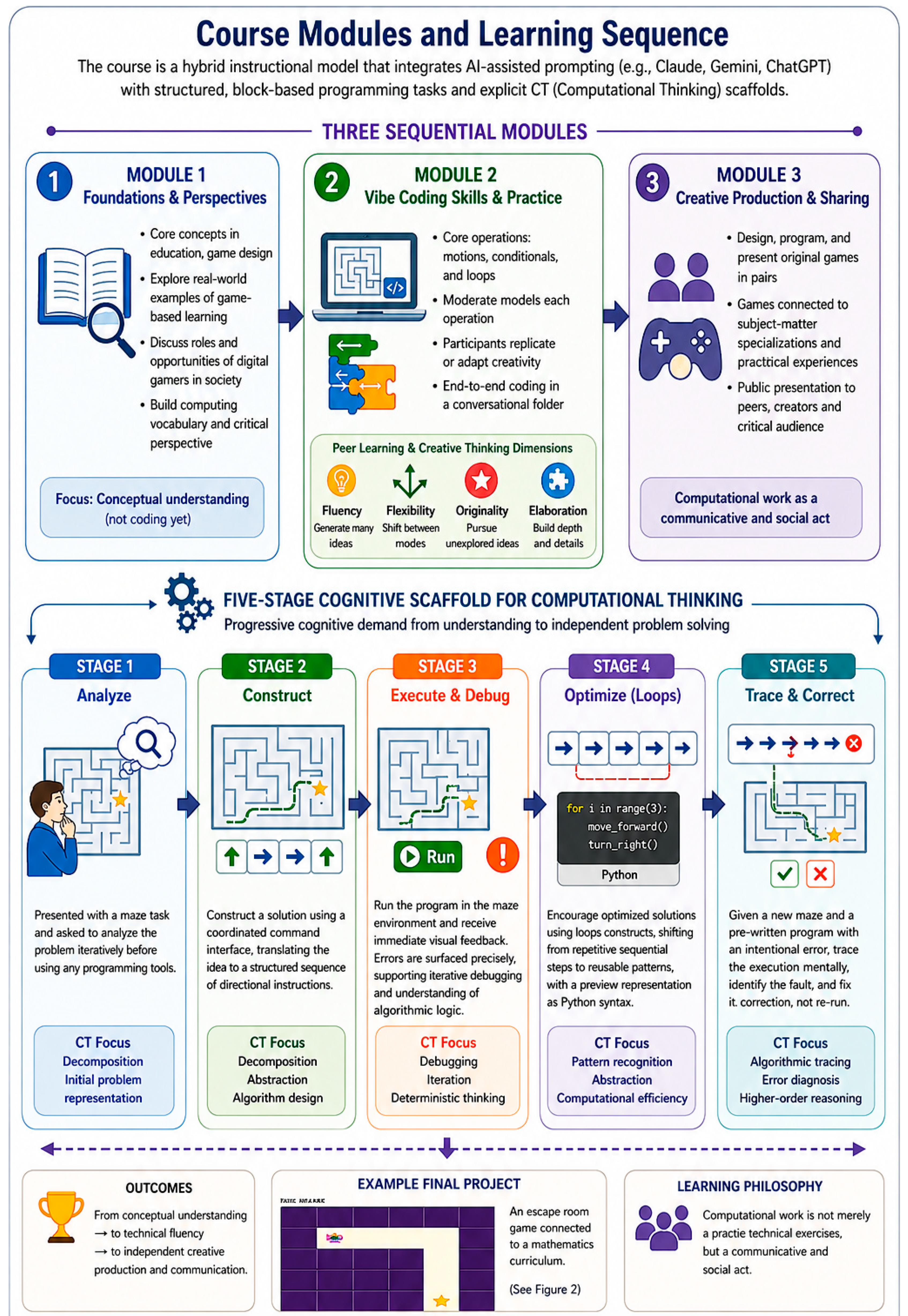
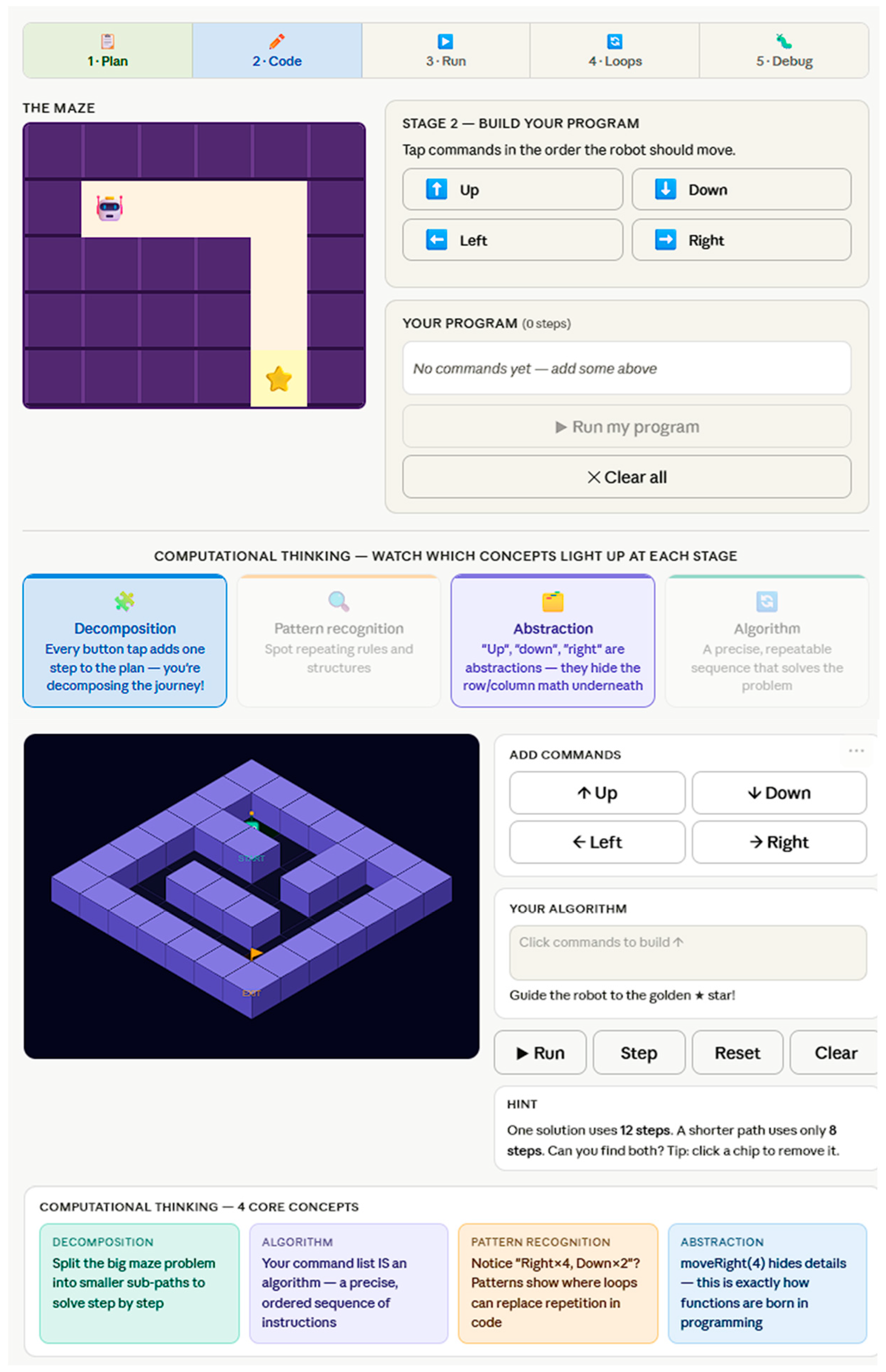
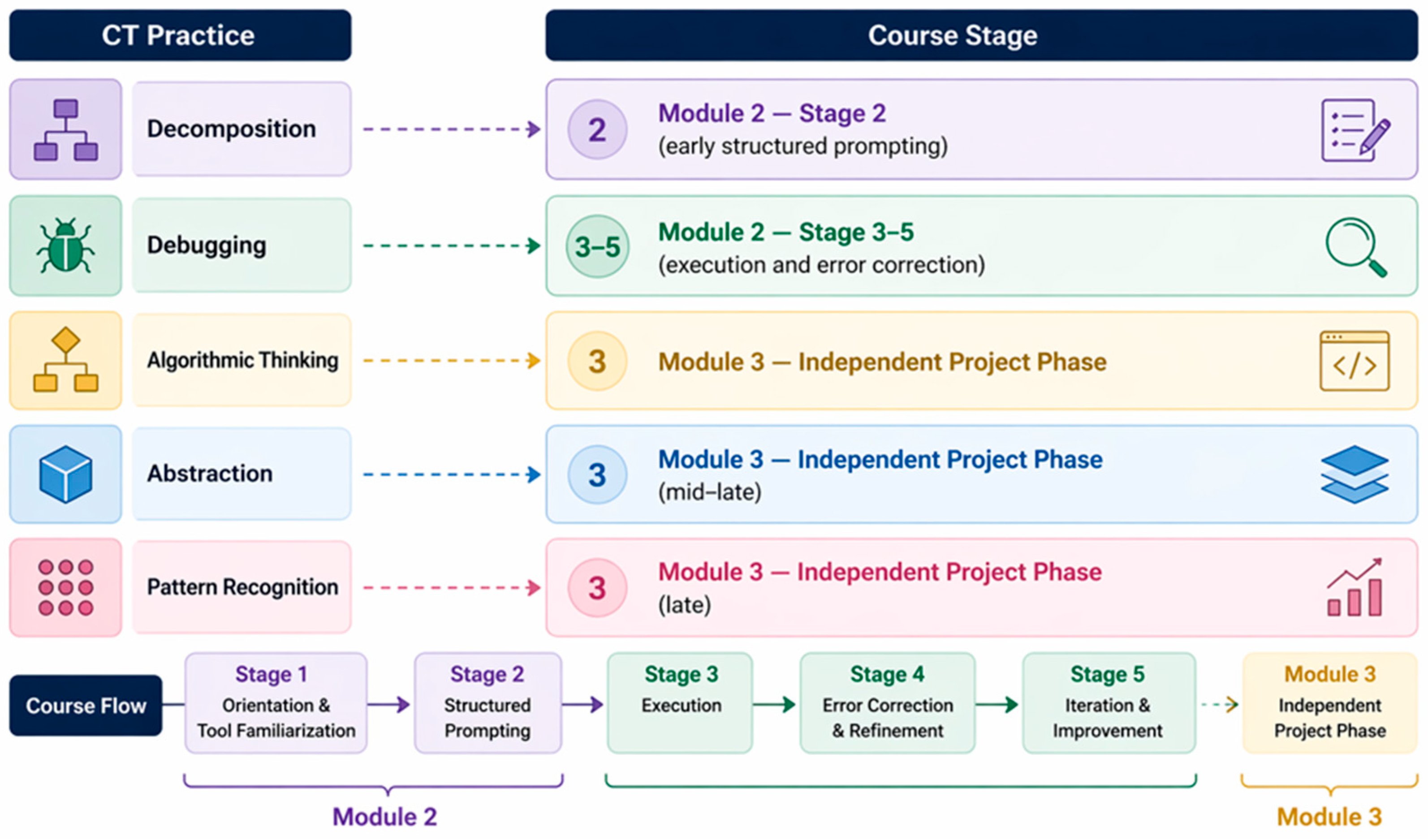
3.1.2. Course Modules and Learning Sequence
3.2. Participants
3.3. Sampling Procedure and Ethical Considerations
3.4. Research Instruments

| Statement | Pre-M (SD) | Post-M (SD) | t(23) | p | d | Interpretation |
|---|---|---|---|---|---|---|
| 1. I tend to adapt quickly to new software or hardware tools. | 3.4 (1.22) | 3.0 (1.31) | 0.82 | 0.420 | 0.17 | Negligible |
| 2. I feel adequately prepared to manage computer-based academic tasks. | 3.0 (1.24) | 3.4 (1.33) | 0.52 | 0.610 | 0.11 | Negligible |
| 3. The prospect of teaching coding to primary students makes me feel uneasy. † | 2.1 (1.26) | 2.3 (1.32) | 0.32 | 0.750 | 0.07 | Negligible |
| 4. I am open to adopting innovative digital tools to enrich my instructional practice. | 4.0 (1.23) | 3.9 (1.31) | 0.15 | 0.880 | 0.03 | Negligible |
| 5. Engaging with computer interfaces often feels inefficient and overly tedious. † | 2.2 (1.21) | 3.1 (1.33) | 1.00 | 0.330 | 0.20 | Small |
| 6. I am confident in my capacity to acquire unfamiliar computer applications. | 3.9 (1.22) | 3.9 (1.31) | 0.24 | 0.810 | 0.05 | Negligible |
| 7. I generally have an aversion to computer-based technologies. † | 1.5 (1.27) | 1.9 (1.32) | 0.76 | 0.450 | 0.16 | Negligible |
| 8. Facilitating programming lessons should be reserved exclusively for STEM specialists. | 1.3 (1.22) | 1.4 (1.32) | 0.36 | 0.720 | 0.07 | Negligible |
| Theme | Percentage (%) |
|---|---|
| (a) Learning how to use vibe coding | 9% |
| (b) Nurturing divergent and creative ideation | 14% |
| (c) Promoting autonomous, student-directed inquiry | 20% |
| (d) Implementing digital play-based instructional design | 24% |
| (e) Integrating visual programming (block-based operations) | 33% |
| Statement | Pre-M (SD) | Post-M (SD) | t(23) | p | d | Interpretation |
|---|---|---|---|---|---|---|
| 1. Integrating computer games can meaningfully elevate my teaching practice. | 4.8 (1.22) | 5.6 (1.24) | 2.51 | 0.020 * | 0.51 | Medium |
| 2. Using games in the classroom may create emotional distance between the instructor and the learner. † | 2.4 (1.24) | 2.1 (1.23) | 0.43 | 0.670 | 0.09 | Negligible |
| 3. Digital game-making tasks tend to increase peer-to-peer cooperation. | 5.1 (1.24) | 5.5 (1.22) | 1.34 | 0.190 | 0.27 | Small |
| 4. The deployment of digital games conflicts with my professional identity as an educator. † | 2.5 (1.25) | 2.1 (1.22) | 0.63 | 0.530 | 0.13 | Negligible |
| 5. Incorporating games fundamentally transforms the traditional instructional role of the teacher. | 3.5 (1.26) | 4.0 (1.21) | 0.78 | 0.440 | 0.16 | Negligible |
| 6. It is pedagogically unsound to embed digital games within my subject area. † | 1.7 (1.24) | 1.4 (1.21) | 0.89 | 0.380 | 0.18 | Negligible |
| 7. Digital games are predominantly recreational tools with limited academic merit. † | 2.3 (1.23) | 1.5 (1.22) | 1.45 | 0.160 | 0.30 | Small |
| Statement | Pre-M (SD) | Post-M (SD) | t(23) | p | d | Interpretation |
|---|---|---|---|---|---|---|
| 1. I believe I can resolve challenging problems through sustained effort. | 3.6 (1.22) | 3.8 (1.23) | 1.26 | 0.220 | 0.26 | Small |
| 2. I trust my ability to navigate unforeseen or ambiguous situations. | 3.4 (1.22) | 3.6 (1.22) | 0.40 | 0.690 | 0.08 | Negligible |
| 3. I find it relatively uncomplicated to maintain focus and realize my objectives. | 3.2 (1.23) | 3.6 (1.22) | 1.64 | 0.110 | 0.33 | Small |
| 4. I can stay composed under pressure because I have confidence in my coping strategies. | 3.1 (1.22) | 3.3 (1.24) | 0.84 | 0.410 | 0.17 | Negligible |
| 5. When confronting a hurdle, I typically generate several alternative approaches. | 3.4 (1.22) | 3.7 (1.24) | 0.89 | 0.380 | 0.18 | Negligible |
| 6. Given adequate investment in energy, I am capable of devising a solution for most issues. | 3.4 (1.21) | 3.6 (1.22) | 0.63 | 0.530 | 0.13 | Negligible |
3.5. Data Analysis
3.6. Validity and Reliability
4. Results
4.1. Pre-Service Teachers’ Orientations Toward Pre- and Post-Intervention
4.1.1. General Disposition Toward Digital Technology
4.1.2. Perspectives on Game-Making Contexts
4.1.3. Shifts in General Perceived Self-Competence
4.2. Qualitative Insights
Participant D: “The course taught me the value of perseverance in the face of ambiguity. When confronting an unfamiliar coding structure that seemed insurmountable, I learned to deconstruct the problem, seek out supplementary resources, and rely on peer consultation rather than immediate capitulation.” [Abstraction and Pattern Recognition]
Participant L: “I discovered that productive struggle can be a catalyst for deeper engagement. The cycle of debugging—despite the temporary frustration of malfunctioning scripts—was immensely satisfying. That friction forced a level of analytical scrutiny that I wouldn’t have applied otherwise.”
Participant R: “The construction process was iterative and often painstaking; I spent extended periods isolating logic errors. However, the tangible outcome of a fully functional, interactive artifact rendered the prior frustration inconsequential. It redefined my perception of my own technical ceiling.”
Participant J: “The platform provided a scaffold, yet the potential for particular design was immense. Once I realized the project was a canvas for my own creative sensibilities rather than a rigid exercise, the development process shifted from drudgery to discovery.”
Participant N: “The ‘guess and check’ method—manipulating parameters and observing the real-time output from prompts—became an efficient diagnostic tool, particularly when navigating complex, layered scripts late in the design phase.”
Participant A: “When my sequence logic failed, I immediately sought out a peer to act as a second pair of eyes. Verbalizing my intended steps and comparing notes often revealed the missing link in my algorithm.”
Participant G: “My final project was a product of genuine construction. While minor disagreements emerged regarding the narrative and question formulation, consensus was reached efficiently. The transition from the storyboard phase to the actual coding was streamlined because we shared a unified, clearly articulated vision from the outset.”
5. Discussion
5.1. Addressing RQ1: Changes in Attitudes Toward Digital Technology Use, Game-Making Contexts, and Self-Efficacy
5.1.1. Attitudes Toward Digital Technology Use
5.1.2. Game-Making Contexts
5.1.3. Self-Efficacy
5.2. Addressing RQ2: Navigating Computational Challenges in Vibe Coding Environments
5.2.1. Navigating Difficulties in AI-Mediated Game-Making Contexts
5.2.2. The Developmental Gradient of CT Practices in Vibe Coding
5.2.3. AI-Assisted Programming
6. Conclusions
7. Implications for Design and Practice
- Sequencing technical and pedagogical demands: A key implication is the need to decouple, at least initially, the technical and pedagogical dimensions of CT learning. When PSTs are simultaneously required to acquire programming fluency and develop a pedagogical framework for teaching that fluency, the cognitive load generated by these parallel demands can undermine progress in both. A staged design—one that establishes a functional baseline of technical competence before introducing higher-order pedagogical reflection—would allow each strand to develop with greater depth and without competing for the same limited cognitive resources. · This outcome supports Laurillard’s assertion that effective technology-integrated pedagogy requires educators to first experience the learning process as students before designing their own instruction [9].
- Preserving productive difficulty: This implication should not be misread as an argument for simplifying the CT experience. The data are unambiguous on this point: what PSTs most valued, and most wished to extend, was precisely the challenge. A course redesign that removes difficulty in order to protect confidence would misread both the findings and the literature. Kapur’s [46] productive failure framework is directly applicable here: the cognitive struggle encountered in vibe coding environments is not a design flaw to be corrected but a generative mechanism to be preserved and scaffolded. The design challenge is not to reduce difficulty but to ensure that learners have sufficient support—instructional, social, and technical— to sustain productive engagement with it rather than retreating from it. Practically, this means future courses should include an explicit ‘workflow literacy’ component. This can be a dedicated early activity in which learners are introduced to the “prompt–evaluate–refine” cycle as a named and valued process. Giving the cycle a name (for instance, ‘the vibe coding loop’), explaining its relationship to CT practices, and setting a deliberate expectation that multiple refinement cycles are the norm rather than a sign of failure would help PSTs develop a constructive relationship with the friction before it begins to accumulate into frustration.
- Leveraging AI-assisted environments as reasoning scaffolds: The vibe coding paradigm introduces a specific pedagogical opportunity that traditional programming courses do not. It also positions a chatbot as a reasoning partner whose outputs must be interrogated, evaluated, and revised rather than simply executed. This shifts the focus of CT from code production to code interpretation—from writing algorithms to reading, testing, and debugging them. For PSTs, who will ultimately need to facilitate similar interpretive processes in their students, this is pedagogically significant. Instructional designers should make this interpretive dimension explicit by building in structured activities that require learners to articulate why a generated program does or does not behave as expected and to trace the relationship between their prompts, the system’s outputs, and the computational logic underlying both [11,47]. For instance, within the Creative Production module, micro-presentations could include asking the AI to generate a purposeful error and then requiring the pre-service teacher to explain that error to a peer as if teaching a student, to write a student-friendly hint, or to present a two-minute mini-lesson tracing how a prompt became a working game mechanic. These activities would connect computational reasoning to pedagogical explanation and help bridge the gap between knowing CT and teaching CT.
- Addressing the teaching-readiness gap through graduated exposure: The finding that experiencing CT did not directly translate into perceived readiness to teach is consistent with prior research and points to a structural challenge in teacher education: single-course interventions, however well designed, are insufficient to bridge the gap between personal competence and professional confidence. Future programs should consider embedding CT experiences across multiple courses and field placements—creating opportunities for PSTs to encounter CT first as learners, then as observers of others teaching it, and finally as practitioners themselves. This graduated trajectory would more closely mirror the kind of extended, contextually varied exposure that the literature identifies as necessary for the development of durable pedagogical competence [3,7]. A more proximal bridge between technical engagement and pedagogical readiness can be created within the vibe coding course itself through the integration of structured micro-teaching activities in the Creative Production module (Module 3). One practical design is an AI-generated error explanation task, in which participants use a chatbot to deliberately produce a broken Scratch script—for example, prompting Claude or ChatGPT to introduce a specific logical error such as an off-by-one loop boundary, an incorrect conditional, or a missing reset event—and then practice explaining to a peer what the error is, why it occurs, and how a primary school student might be guided toward diagnosing it. This task asks PSTs to inhabit two cognitive positions simultaneously: the programmer who understands execution logic and the teacher who can make that logic accessible. A second micro-teaching activity could involve having participants design a ‘deliberate challenge’—an intentionally difficult game section—and subsequently write a brief pedagogical script outlining how they would guide a student through it. Both activities move PSTs from doing CT to teaching CT within the same course structure, without requiring an additional field placement, and could be evaluated using the same rubric (Appendix A) extended to include a pedagogical communication dimension.
- Connecting CT to subject matter identity: The vibe coding approach adopted in this course, which required PSTs to design games connected to their own disciplinary specializations, proved particularly effective in sustaining motivation and deepening engagement. This finding suggests a broader design principle: CT integration in teacher education is most effective when it is not positioned as a generic digital literacy requirement but as a domain-specific pedagogical tool with direct relevance to what PSTs care about and intend to teach. The digital competence frameworks articulated in policy contexts [26,27] increasingly recognize this domain-specific dimension, but teacher preparation programs have been slower to operationalize it in their course designs. Vibe coding, with its capacity to rapidly generate domain-relevant interactive content through natural language prompting, offers a practical pathway for doing so.
8. Limitations and Directions for Future Research
- The findings are institutionally situated and should not be interpreted as globally representative of PST populations. Replication across universities, national contexts, and teacher-specialization pathways is required before broader claims can be made. This limits the generalizability of the findings, particularly as voluntary participation likely produced a participant group more favorably disposed toward technology than the broader PST population. Consequently, future studies should deliberately recruit across a wider range of technology orientations, including technology-averse participants. This would allow researchers to examine whether AI-mediated ‘vibe coding’ environments can effectively scaffold CT engagement for learners who approach programming with greater initial resistance. Future research should also recruit samples of at least 80–100 to achieve adequate statistical power (>0.80) for detecting medium effects (d = 0.50) using paired t-tests, enabling confirmation or disconfirmation of the directional patterns observed here.
- The absence of a comparison group means that the attitude shifts and CT engagement patterns observed cannot be causally attributed to the intervention. Plausible alternative explanations include general maturation over a 12-week semester, the novelty effect of AI tools, and the motivational priming created by voluntary enrolment in an unusual elective. A quasi-experimental design incorporating a comparison group—either a parallel cohort receiving a conventional block-based programming course without AI mediation, or a waitlist control receiving the course in a subsequent semester—would substantially strengthen causal inference and is identified as the highest priority for follow-up research. Additionally, a comparative replication using English prompts may reveal whether some debugging behaviors observed here derive from computational reasoning itself or from language-specific ambiguities in prompt interpretation. Replication studies should recruit approximately 80–100 participants to achieve adequate statistical power (>0.80) for detecting medium effects with paired t-tests, thereby allowing future studies to confirm or disconfirm the directional patterns observed here. This remains an important direction for future cross-linguistic validation. A cross-linguistic comparative study represents one of the most tractable and theoretically informative extensions of this work. Such a study would deploy the same course design, the same scaffolding sequence, and the same instruments with two groups: one prompting in Greek and one prompting in English. Differences in debugging frequency, prompt refinement cycles, and CT tier distributions between the groups would provide direct empirical evidence of how much the linguistic mediation variable contributes to the patterns observed in the present study and would help determine whether the findings are specific to Greek language implementations or generalizable to AI-mediated vibe coding contexts more broadly.
- An additional limitation concerns the potential over-reliance on AI-generated solutions. While AI assistance lowers barriers to entry, it may also reduce opportunities for independent algorithmic construction and deeper engagement with underlying computational logic. Future work should investigate how different levels of AI support influence the balance between efficiency and conceptual understanding.
- This study is also limited by its reliance on self-reported and reflective data as proxies for CT engagement. Although these measures provide valuable insight into participants’ experiences and reasoning processes, they do not constitute direct evidence of computational proficiency. The absence of performance-based assessment means that this study’s claims about CT engagement should be understood as evidence of observable reasoning practices in discourse rather than as validated gains in computational competence. The analytical rubric (Appendix A) was developed to make this distinction explicit, but it cannot substitute for the direct measurement that artifact analysis or standardized task performance would provide. Future research should incorporate performance-based assessments, artifact analysis, or trace data (e.g., prompt iterations and debugging sequences) to provide a more robust and objective account of CT practices.
- The findings of this research are primarily grounded in reflective and qualitative indicators, as no formal objective instrument was utilized to measure gains in programming competence. To increase the internal validity of future investigations, it is essential to triangulate these reflective insights with empirical performance metrics. Integrating objective assessments, such as rubric-based artifact analysis or controlled debugging simulations, would offer a more precise evaluation of how iterative cycles of AI-assisted learning translate into tangible CT skills.
- An additional methodological consideration concerns the nature of the qualitative data sources. While the study was situated within an AI-mediated vibe coding environment, the qualitative analysis drew primarily on participants’ prompts and open-ended survey responses rather than on direct analysis of the natural language prompts they submitted to AI chatbots or the iterative sequences of AI-generated outputs. Consequently, the exemplar prompts presented in Appendix B, while grounded in participant accounts, should be understood as analytically reconstructed illustrations rather than verbatim transcriptions; their function is to render observable CT reasoning patterns visible, not to serve as raw data in themselves. Future research should capture live prompt–output sequences to enable direct, granular analysis of learner–AI interaction. Future research should incorporate log-based analysis of learner–AI interactions to provide a more granular, process-level account of how decomposition, debugging, and iterative refinement are enacted within the prompting workflow itself.
- The use of Greek as the primary language for instruction and prompting introduces a critical layer of linguistic mediation between user intent and AI output. This linguistic variable may have influenced the structural quality of the generated code and dictated participants’ specific interaction patterns. Future studies should investigate whether the nuances of non-English prompt formulation impact CT engagement differently from English-dominant contexts, where LLM training data are more robust. To mitigate the limitations of reconstructed accounts, future research must implement systematic interaction logging from the study’s inception. This could be operationalized through three distinct mechanisms: (a) requiring participants to embed prompt–output sequences within their reflective logs, (b) utilizing interfaces with native conversation export features (e.g., Claude), or (c) deploying a bespoke intermediary logging platform for server-side recording. Such granular data would facilitate rigorous analysis of decomposition specificity, debugging cycle latency, and prompt refinement trajectories, providing the empirical weight necessary to substantiate claims regarding CT enactment that self-reported data alone cannot provide.
- Finally, it is important to recognize that computational fluency—particularly the level required to teach CT with confidence and pedagogical clarity—cannot be developed within a single semester. This study represents a deliberate but modest first step. While it demonstrates that integrating AI-mediated game making into teacher education is both feasible and pedagogically valuable, it also highlights that one course is insufficient to bridge the gap between exposure and instructional readiness. Longitudinal research tracking PSTs across multiple CT-integrated experiences, and into their early years of professional practice, would provide a far richer account of how initial engagement develops into durable teaching capacity. The development of computationally confident and pedagogically reflective educators is not a short-term outcome but a sustained trajectory that teacher education programs must support over time.
Funding
Institutional Review Board Statement
Informed Consent Statement
Data Availability Statement
Acknowledgments
Conflicts of Interest
Abbreviations
| AI | Artificial Intelligence |
| CT | Computational Thinking |
| PST | Pre-Service Teacher |
| DBR | Design-Based Research |
| LLM | Large Language Model |
| STEM | Science, Technology, Engineering and Mathematics |
| RQ | Research Question |
| SD | Standard Deviation |
| CSTA | Computer Science Teachers Association |
Appendix A. Analytical Rubric for Identifying CT Engagement in AI-Mediated Prompting
Appendix A.1. Purpose of Rubric
Appendix A.2. Structure of the Rubric
- (1)
- CT Practice Type
- Decomposition;
- Debugging;
- Algorithmic thinking;
- Abstraction;
- Pattern recognition.
- (2)
- CT Engagement Level (0–3 scale)
Appendix A.3. CT Engagement Levels
| Level | Label | Description | Indicators in Data |
|---|---|---|---|
| 0 | No CT Evidence | No evidence of computational reasoning | Vague descriptions; no logic reference |
| 1 | Surface Interaction | Problem described but not analytically structured | “It doesn’t work”; general complaints with no causal reasoning |
| 2 | Structured Reasoning | Clear logical structuring of the problem | Conditions, sequences, or variables explicitly mentioned |
| 3 | Generative/Transfer Reasoning | Generalization, reuse, or cross-context transfer | Reusable logic, abstraction, or transferable structures proposed |
Appendix A.4. Operational Indicators by CT Practice
| CT Practice | Level 1 | Level 2 | Level 3 |
|---|---|---|---|
| Decomposition | Identifies problem vaguely | Breaks problem into discrete components | Defines relationships between components |
| Debugging | Reports error without explanation | Identifies probable cause | Formulates testable hypothesis about system behavior |
| Algorithmic Thinking | Describes desired outcome only | Specifies ordered steps or rules | Defines constraints, variables, or conditional logic |
| Abstraction | Notices repetition | Suggests simplification (e.g., a loop) | Constructs generalized, reusable logic |
| Pattern Recognition | Recognizes similarity | Reuses a known structure | Transfers logic across different contexts |
Appendix A.5. Coding Procedure
- Reflective entries and reconstructed prompts were segmented into meaning units.
- Each unit was:
- ○
- Assigned a CT practice category,
- ○
- Rated on the 0–3 engagement scale.
- Ambiguous cases were resolved through iterative comparison across dataset.
Appendix A.6. Interpretive Use
- Identification of CT engagement patterns;
- Comparison across course stages;
- Differentiation between:
- ○
- superficial AI use and
- ○
- structured computational reasoning.
Appendix B. CT Practices and Levels of Engagement in AI-Mediated Prompting
| CT Practice | Course Stage | CT Tier | Exemplar Prompt | CT Engagement Level | Analytical Rationale | n (Participants) |
|---|---|---|---|---|---|---|
| Decomposition | Module 2 (Stage 1) | Foundational | “Break the maze solution into smaller steps and specify what the character should do at each point.” | Level 2—Structured Reasoning | Participant explicitly partitions the task into discrete components and defines stepwise logic. Reflects Level 2 decomposition; does not yet model relationships at a system level. | n = 18.14 (58%) |
| Debugging | Module 2 (Stage 3) | Foundational | “Check why the character stops before reaching the goal and correct the movement sequence so it completes the path.” | Level 3—Generative Reasoning | Participant hypothesizes system behavior and directs targeted correction, moving beyond simple error identification. Aligns with Level 3 hypothesis-driven debugging. | n = 22.19 (79%) |
| Algorithmic Thinking | Module 2 (Stage 3) | Intermediate | “I want the game to become harder… speed starts at 2, increases every 30 s, but stops at 10…” | Level 3—Generative Reasoning | Participant defines variables, temporal conditions, and constraints prior to implementation. Reflects generative algorithmic structuring (Level 3). | n = 11.9 (38%) |
| Abstraction | Module 3 (Stage 4) | Advanced | “Identify repeated sequences… use a loop instead of repeating commands.” | Level 3—Generative Reasoning | Participant recognizes redundancy and proposes a generalized solution (loop). Reflects abstraction as reusable logic construction (Level 3). | n = 7.6 (25%) |
| Pattern Recognition | Module 3 (Stage 4) | Advanced | “The player-solving maze logic could be reused for the opponent…” | Level 3—Generative Reasoning | Participant identifies structural similarity across contexts and proposes logic transfer. Aligns with Level 3 pattern recognition (cross-context transfer). | n = 9.8 (33%) |
Appendix C. Design Principles for Supporting CT in AI-Mediated Game-Making Environments
| DP | Title and Description | Implementation | Rationale |
|---|---|---|---|
| DP1 | Preserve Computational Visibility AI assistance must not obscure underlying logic; learners should remain able to inspect and manipulate computational structures. | Block-based programming (Scratch) used alongside AI prompting; maze tasks require explicit step-by-step logic before any AI generation. | Prevents black box interaction; maintains the scaffolding essential for debugging and decomposition. |
| DP2 | Require Pre-Generation Articulation of Logic Learners should define intended behavior in writing before requesting AI-generated solutions. | Prompting tasks required explicit written problem descriptions; reflective logs captured intended logic prior to each AI interaction. | Ensures CT occurs before AI delegation, preserving conceptual ownership over generated code. |
| DP3 | Scaffold Debugging as a Core Activity Debugging should be explicitly structured as a core course activity, not treated as incidental. | Stage 5 maze activity required identification and correction of a pre-built error; prompt-based debugging was embedded in reflective logs. | Debugging was the most consistently observed CT practice (79% of participants), confirming its centrality to vibe coding engagement. |
| DP4 | Use Constrained Problem Spaces Early Early tasks should limit complexity to foreground core CT processes before open-ended design begins. | Maze tasks with directional primitives (move forward, turn left, turn right) constrained the problem space in Modules 1–2. | Supports decomposition and algorithmic thinking before learners encounter the full ambiguity of open-ended game design. |
| DP5 | Gradually Transition to Open-Ended Creation Learners should move from structured tasks to independent design as CT competencies consolidate. | Module 2 provided scaffolded maze tasks; Module 3 required fully independent, subject-aligned game projects. | Enables transfer from guided to generative CT practices, mirroring the constructionist progression from structured to open-ended making. |
| DP6 | Integrate Reflection as a Computational Activity Reflection should explicitly target reasoning processes, not merely experiential satisfaction. | Structured reflective prompts asked participants to describe obstacles, strategies, and debugging processes at the close of each session. | Supports metacognitive awareness of CT practices and provides the qualitative data stream necessary for process-level analysis. |
References
- Wing, J.M. Computational thinking. Commun. ACM 2006, 49, 33–35. [Google Scholar] [CrossRef]
- Brennan, K.; Resnick, M. New frameworks for studying and assessing the development of computational thinking. In Proceedings of the 2012 Annual Meeting of the American Educational Research Association, Vancouver, BC, Canada, 13–17 April 2012. [Google Scholar]
- Yadav, A.; Gretter, S.; Good, J.; McLean, T. Computational thinking in teacher education. In Emerging Research, Practice, and Policy on Computational Thinking; Rich, P.J., Hodges, C.B., Eds.; Springer: Cham, Switzerland, 2017; pp. 205–220. [Google Scholar]
- Kafai, Y.B.; Burke, Q. Connected Gaming: What Making Video Games Can Teach Us About Learning and Literacy; MIT Press: Cambridge, MA, USA, 2016. [Google Scholar]
- Butler, D.; Leahy, M. Developing pre-service teachers’ understanding of computational thinking through constructionist game design. Br. J. Educ. Technol. 2021, 52, 1060–1077. [Google Scholar] [CrossRef]
- Gleasman, C.; Kim, C. Pre-service teacher’s use of block-based programming and computational thinking to teach elementary mathematics. Digit. Exp. Math. Educ. 2020, 6, 52–90. [Google Scholar] [CrossRef]
- Gudmundsdóttir, G.B.; Gassó, H.H.; Rubio, J.C.C.; Hatlevik, O.E. Student teachers’ responsible use of ICT: Examining two samples in Norway and Spain. Comput. Educ. 2020, 152, 103877. [Google Scholar] [CrossRef]
- Kafai, Y.B.; Burke, Q. Constructionist gaming: Understanding the benefits of making games for learning. Educ. Psychol. 2015, 50, 313–334. [Google Scholar] [CrossRef] [PubMed]
- Laurillard, D. Teaching as a Design Science: Building Pedagogical Patterns for Learning and Technology; Routledge: New York, NY, USA, 2012. [Google Scholar]
- Royal, C. Integrating vibe coding and flow theory: A student-centered model for AI-augmented coding education. J. Mass Commun. Educ. 2026. advance online publication. [Google Scholar]
- Lyu, W.; Wang, Y.; Sun, Y.; Zhang, Y. Will Your Next Pair Programming Partner Be Human? An Empirical Evaluation of Generative AI as a Collaborative Teammate in a Semester-Long Classroom Setting. In Proceedings of the ACM Conference on Learning @ Scale (L@S ‘25); ACM: New York, NY, USA, 2025. [Google Scholar] [CrossRef]
- Si, J.J.; Li, D.; Wang, Q.; Liu, A.W.; Lin, X.; Zhu, Y.; Zhou, X.; Wang, A.Y.; Wang, K.Y. Exploring the impacts and challenges of vibe coding paradigm to children’s programming learning and practices. In Proceedings of the 2026 CHI Conference on Human Factors in Computing Systems; ACM: New York, NY, USA, 2026; pp. 1–24. [Google Scholar]
- Grover, S.; Pea, R. Computational thinking in K–12: A review of the state of the field. Educ. Res. 2013, 42, 38–43. [Google Scholar] [CrossRef]
- Lachner, A.; Fabian, A.; Franke, U.; Preiß, J.; Jacob, L.; Führer, C.; Küchler, U.; Paravicini, W.; Randler, C.; Thomas, P. Fostering pre-service teachers’ technological pedagogical content knowledge (TPACK): A quasi-experimental field study. Comput. Educ. 2021, 174, 104304. [Google Scholar] [CrossRef]
- Sáez-López, J.M.; Sevillano-García, M.L.; Vazquez-Cano, E. The effect of programming on primary school students’ mathematical and scientific understanding: Educational use of mBot. Educ. Technol. Res. Dev. 2020, 67, 1405–1425. [Google Scholar] [CrossRef]
- Jansen, T.; Horbach, A.; Meyer, J. Feedback from Generative AI: Correlates of Student Engagement in Text Revision from 655 Classes from Primary and Secondary School. In Proceedings of the 15th International Learning Analytics and Knowledge Conference (LAK ‘25), Dublin, Ireland, 3–7 March 2025; ACM: New York, NY, USA, 2025; pp. 831–836. [Google Scholar] [CrossRef]
- Kazemitabaar, M.; Chow, J.; Ma, C.K.T.; Ericson, B.J.; Weintrop, D.; Grossman, T. Studying the effect of AI code generators on supporting novice learners in introductory programming. In Proceedings of the 2023 CHI Conference on Human Factors in Computing Systems, Hamburg, Germany, 23–28 April 2023. Article 455. [Google Scholar]
- Luo, J.; Qu, L.; Wang, M.; Li, H. Cultivating Pre-Service Teachers’ Design Thinking and Generative Artificial Intelligence Literacy through an LLM-Based Educational Website Design Task. Interact. Learn. Environ. 2026, 1–20. [Google Scholar] [CrossRef]
- Fortes-Ferreira, M.; Alam, M.S.; Bazilinskyy, P. Vibe coding in practice: Building a driving simulator without expert programming skills. In Proceedings of the 17th International Conference on Automotive User Interfaces and Interactive Vehicular Applications (AutomotiveUI Adjunct ‘25); ACM: New York, NY, USA, 2025; pp. 60–66. [Google Scholar]
- Thorgeirsson, S.; Weidmann, T.B.; Su, Z. Computer science achievement and writing skills predict vibe coding proficiency. In Proceedings of the 2026 CHI Conference on Human Factors in Computing Systems (CHI ‘26); ACM: New York, NY, USA, 2026. [Google Scholar]
- Papert, S. Mindstorms: Children, Computers and Powerful Ideas; Basic Books: New York, NY, USA, 1980. [Google Scholar]
- Harel, I.; Papert, S. (Eds.) Constructionism; Ablex Publishing: Norwood, NJ, USA, 1991. [Google Scholar]
- Resnick, M. Lifelong Kindergarten: Cultivating Creativity Through Projects, Passion, Peers, and Play; MIT Press: Cambridge, MA, USA, 2017. [Google Scholar]
- Shute, V.J.; Sun, C.; Asbell-Clarke, J. Demystifying computational thinking. Educ. Res. Rev. 2017, 22, 142–158. [Google Scholar] [CrossRef]
- Lee, C.; Zheng, Q.; Xiong, J. From visual to multimodal programming: Designing an interface to externalize decomposition thinking for novice learners. In Proceedings of the 31st International Conference on Intelligent User Interfaces (IUI ‘26); ACM: New York, NY, USA, 2026; pp. 1202–1217. [Google Scholar]
- Computer Science Teachers Association (CSTA). CSTA K–12 Computer Science Standards; CSTA: Chicago, IL, USA, 2022. [Google Scholar]
- European Commission. DigComp 2.2: The Digital Competence Framework for Citizens; Publications Office of the European Union: Luxembourg, 2023. [Google Scholar]
- Kusper, G.; Szabó, C. Vibe Coding in Education. In Proceedings of the 2025 International Conference on Emerging eLearning Technologies and Applications (ICETA); IEEE: New York, NY, USA, 2025; pp. 506–511. [Google Scholar]
- Hsu, H.-P. From programming to prompting: Developing computational thinking through large language model-based generative artificial intelligence. TechTrends 2025, 69, 485–506. [Google Scholar] [CrossRef]
- Runco, M.A.; Acar, S. Divergent thinking as an indicator of creative potential. Creat. Res. J. 2012, 24, 66–75. [Google Scholar] [CrossRef]
- Tashakkori, A.; Teddlie, C. SAGE Handbook of Mixed Methods in Social and Behavioral Research, 2nd ed.; SAGE Publications: Thousand Oaks, CA, USA, 2010. [Google Scholar]
- Andersen, T.; Shattuck, J. Design-based research: A decade of progress in education research? Educ. Res. 2012, 41, 16–25. [Google Scholar] [CrossRef]
- Sandoval, W. Conjecture mapping: An approach to systematic educational design research. J. Learn. Sci. 2014, 23, 18–36. [Google Scholar] [CrossRef]
- Pintrich, P.R. A motivational science perspective on the role of student motivation in learning and teaching contexts. J. Educ. Psychol. 2003, 95, 667–686. [Google Scholar] [CrossRef]
- Tondeur, J.; van Braak, J.; Ertmer, P.A.; Ottenbreit-Leftwich, A. Understanding the relationship between teachers’ pedagogical beliefs and technology use in education. Educ. Technol. Res. Dev. 2017, 65, 555–575. [Google Scholar] [CrossRef]
- Dörnyei, Z.; Taguchi, T. Questionnaires in Second Language Research: Construction, Administration, and Processing, 2nd ed.; Routledge: New York, NY, USA, 2009. [Google Scholar]
- Brislin, R.W. Back-translation for cross-cultural research. J. Cross-Cult. Psychol. 1970, 1, 185–216. [Google Scholar] [CrossRef]
- Joshi, A.; Kale, S.; Chandel, S.; Pal, D.K. Likert scale: Explored and explained. Br. J. Appl. Sci. Technol. 2015, 7, 396–403. [Google Scholar] [CrossRef]
- Bandura, A. Self-Efficacy: The Exercise of Control; W.H. Freeman: New York, NY, USA, 1997. [Google Scholar]
- Schwarzer, R. Self-Efficacy: Thought Control of Action; Hemisphere Publishing Corp: Washington, DC, USA, 1992. [Google Scholar]
- Zeichner, K.; Liston, D. Reflective Teaching: An Introduction, 2nd ed.; Routledge: New York, NY, USA, 2014. [Google Scholar]
- Field, A. Discovering Statistics Using IBM SPSS Statistics, 5th ed.; SAGE Publications: London, UK, 2018. [Google Scholar]
- Braun, V.; Clarke, V. Using thematic analysis in psychology. Qual. Res. Psychol. 2006, 3, 77–101. [Google Scholar] [CrossRef]
- Creswell, J.W.; Plano Clark, V.L. Designing and Conducting Mixed Methods Research, 3rd ed.; SAGE Publications: Thousand Oaks, CA, USA, 2017. [Google Scholar]
- Kruger, J.; Dunning, D. Unskilled and unaware of it: How difficulties in recognizing one’s own incompetence lead to inflated self-assessments. J. Pers. Soc. Psychol. 1999, 77, 1121–1134. [Google Scholar] [CrossRef]
- Kapur, M. Examining productive failure, productive success, unproductive failure, and unproductive success in learning. Educ. Psychol. 2016, 51, 289–299. [Google Scholar] [CrossRef]
- Lau, S.; Guo, P.J. Adapting to AI code generation tools. In Proceedings of the ACM Conference on International Computing Education Research (ICER); ACM: New York, NY, USA, 2023; pp. 106–120. [Google Scholar]


| CT Practice | Level 1 n (%) | Level 2 n (%) | Level 3 n (%) | Total Instances |
|---|---|---|---|---|
| Debugging | 6 (27%) | 9 (41%) | 7 (32%) | 22 |
| Decomposition | 3 (17%) | 12 (67%) | 3 (17%) | 18 |
| Algorithmic thinking | 1 (9%) | 8 (73%) | 2 (18%) | 11 |
| Pattern recognition | 0 (0%) | 4 (44%) | 5 (56%) | 9 |
| Abstraction | 0 (0%) | 2 (29%) | 5 (71%) | 7 |
| Theme | Percentage (%) |
|---|---|
| Content Knowledge: Retain current CT and vibe coding content | 9% |
| Extension: Increase in depth and duration of CT exploration | 14% |
| Pedagogy of Play: Preserve focus on game making and active engagement | 20% |
| Creative Freedom: Maintain open-ended, project-based final tasks | 24% |
| Vibe Coding Structures: Retain debugging and planning sessions | 33% |
Disclaimer/Publisher’s Note: The statements, opinions and data contained in all publications are solely those of the individual author(s) and contributor(s) and not of MDPI and/or the editor(s). MDPI and/or the editor(s) disclaim responsibility for any injury to people or property resulting from any ideas, methods, instructions or products referred to in the content. |
© 2026 by the author. Licensee MDPI, Basel, Switzerland. This article is an open access article distributed under the terms and conditions of the Creative Commons Attribution (CC BY) license.
Share and Cite
Pellas, N. From Prompt to Play: Examining Computational Thinking Through Vibe Coding in Game Making for Pre-Service Teacher Education. Multimodal Technol. Interact. 2026, 10, 57. https://doi.org/10.3390/mti10050057
Pellas N. From Prompt to Play: Examining Computational Thinking Through Vibe Coding in Game Making for Pre-Service Teacher Education. Multimodal Technologies and Interaction. 2026; 10(5):57. https://doi.org/10.3390/mti10050057
Chicago/Turabian StylePellas, Nikolaos. 2026. "From Prompt to Play: Examining Computational Thinking Through Vibe Coding in Game Making for Pre-Service Teacher Education" Multimodal Technologies and Interaction 10, no. 5: 57. https://doi.org/10.3390/mti10050057
APA StylePellas, N. (2026). From Prompt to Play: Examining Computational Thinking Through Vibe Coding in Game Making for Pre-Service Teacher Education. Multimodal Technologies and Interaction, 10(5), 57. https://doi.org/10.3390/mti10050057