
Neuroplasticity-Informed Learning Under Cognitive Load: A Systematic Review of Functional Imaging, Brain Stimulation, and Educational Technology Applications

 ,
,  ,
,  and
and 
Abstract
1. Introduction
1.1. Defining Cognitive Load in Learning Contexts
1.2. Neuroplasticity-Informed Learning Under Cognitive Demand
1.3. Functional Imaging and Brain Stimulation in Neuroplasticity Research
1.4. Educational Technology Applications: Bridging Neuroscience and Practice
1.5. Research Objectives and Systematic Approach
1.6. Significance and Innovation
2. Literature Review
2.1. Neuroplasticity: Foundations for Learning Under Cognitive Load
2.2. Cognitive Load: Neural Implementation and Functional Imaging Insights
2.3. Neuroplasticity and Cognitive Load: Integration Through Functional Imaging and Brain Stimulation
2.4. Functional Imaging Evidence for Neuroplasticity-Informed Learning
2.5. Brain Stimulation Methods in Neuroplasticity-Informed Learning Research
2.6. Individual Differences in Neuroplasticity-Informed Learning Applications
3. Materials and Methods
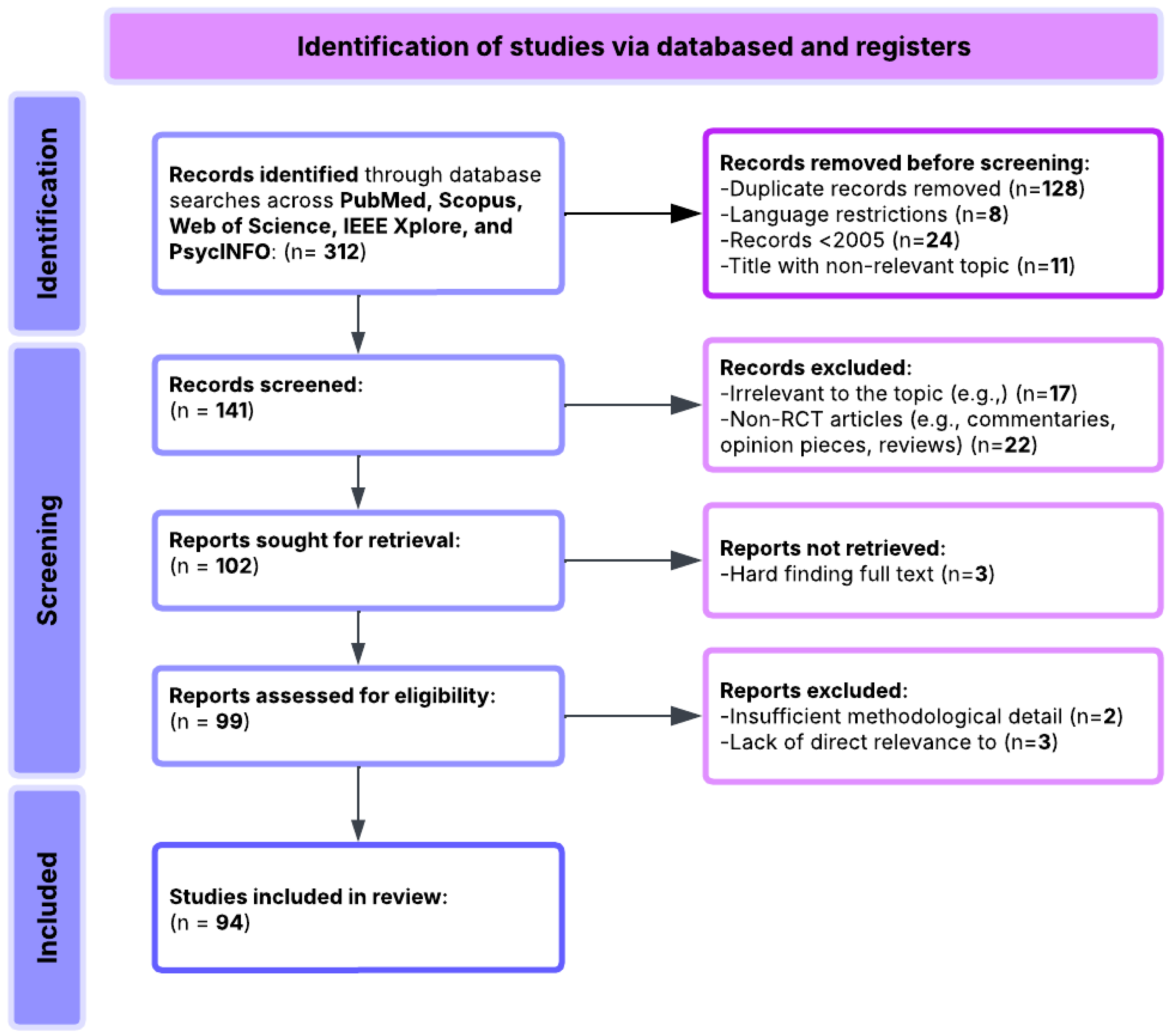
3.1. Analytical Search Process
- 156 duplicate records were removed.
- 18 records were excluded based on language (non-English).
- 14 records were excluded from being published before 2005.
- 30 records were excluded based on irrelevant or vague titles.
3.2. Search Strategy
- “Neuroplasticity” OR “Brain Plasticity”
- “Cognitive Load” OR “Cognitive Demand” OR “Mental Effort”
- “Learning” OR “Learning Performance”
- “Functional Imaging” OR “fMRI” OR “EEG”
- “Brain Stimulation” OR “tDCS” OR “TMS”
- “Educational Technology” OR “Adaptive Learning” OR “Personalized Learning”
- “Inclusion” OR “Neurodiversity” OR “Individual Differences”
3.3. Inclusion and Exclusion Criteria
- Empirical studies investigating neuroplasticity-informed learning in contexts under cognitive load.
- Studies employing functional imaging (e.g., fMRI, EEG), brain stimulation (e.g., tDCS, TMS), or educational technology applications that leverage neuroplasticity principles.
- Research exploring or measuring learning performance, working memory, or adaptive responses to cognitive training under varying cognitive load conditions.
- Studies published in peer-reviewed journals from 2005 onward.
- Studies written in English with full-text availability.
- Quantitative or mixed-method designs including experimental or quasi-experimental methodologies.
- Theoretical papers, opinion pieces, the literature reviews, or meta-analyses.
- Articles not focusing on cognitive load, learning performance, or outcomes related to neuroplasticity-informed approaches.
- Non-English language publications.
- Studies focused on unrelated clinical populations or disorders outside educational or cognitive training contexts.
- Insufficient methodological detail, lack of outcome data, or unclear relevance to neuroplasticity-informed learning under cognitive load research questions.
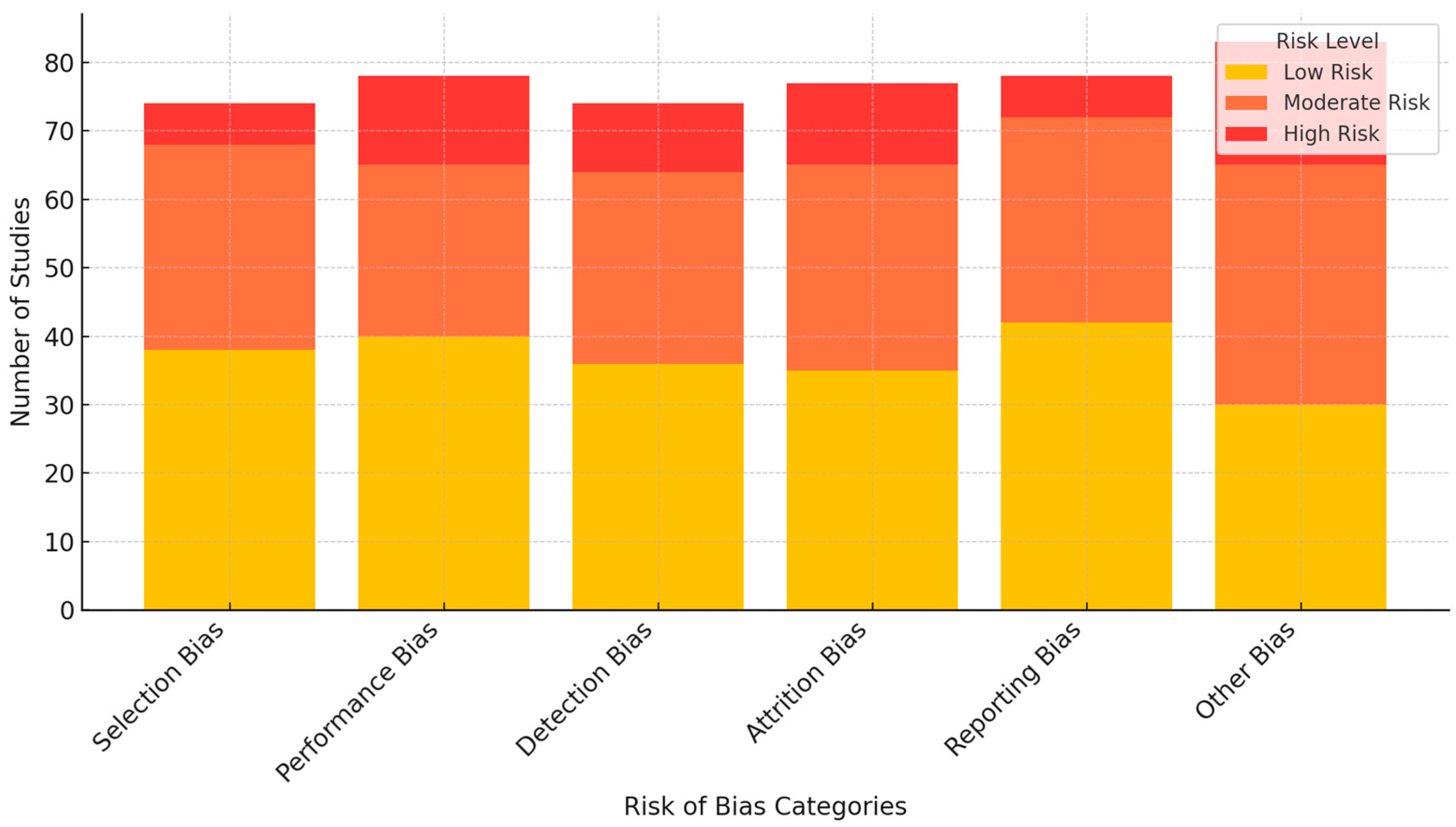
3.4. Risk of Bias Assessment
- Selection Bias: Mostly low risk, with clear random assignment methods in most studies examining neuroplasticity-informed learning, though some lacked detailed randomization protocols.
- Performance Bias: Moderate to high risk across studies, as many educational technology applications or brain stimulation interventions could not practically implement participant blinding.
- Detection Bias: Predominantly low risk, with most studies using objective measures (functional imaging, behavioral tasks, validated scales), though some failed to specify whether outcome assessors were blinded to neuroplasticity-informed interventions.
- Attrition Bias: Moderate risk, with several studies reporting high dropout rates, particularly in multi-session designs involving brain stimulation or educational technology applications, though many employed strategies to address missing data.
- Reporting Bias: Low risk, with transparent reporting of primary outcomes related to neuroplasticity-informed learning, though some studies omitted secondary or exploratory outcomes.
- Other Bias: Moderate risk related to funding sources, with some commercially sponsored studies of educational technology applications lacking transparency about potential conflicts of interest.
4. Results
4.1. [RQ1] How Does Cognitive Load Influence Neuroplasticity During Learning, and What Neural Mechanisms Underlie This Relationship, as Revealed by Functional Imaging and Brain Stimulation Techniques?
4.2. [RQ2] in What Ways Can Non-Invasive Brain Stimulation (e.g., tDCS) Be Used to Enhance Learning Outcomes and Neuroplastic Responses Under Varying Levels of Cognitive Load?
4.3. [RQ3] What Roles Do Specific Brain Regions—Such as the Prefrontal Cortex—Play in Mediating Learning and Working Memory Performance Under Cognitive Load, and How Does This Relate to Functional and Structural Connectivity?
4.4. [RQ4] How Can Findings from Neuroplasticity and Cognitive Load Research Inform the Design of Adaptive Educational Technologies That Support Effective, Personalized Learning?
4.5. [RQ5] How Do Individual Differences (e.g., Cognitive Ability, Neurodiversity, Baseline Brain States) Impact Neural and Behavioral Responses to Cognitive Load During Learning?
4.6. [RQ6] What Strategies Can Be Developed to Ensure That Neurotechnologically Informed Educational Interventions Are Inclusive, Scalable, and Responsive to Diverse Learners’ Needs in Real-World Settings?
5. Discussion
5.1. Neuroplastic Mechanisms in Learning Under Cognitive Load
5.2. Brain Stimulation Enhancement in Neuroplasticity-Informed Learning Applications
5.3. Prefrontal Cortex as a Hub for Neuroplasticity-Informed Learning Under Load
5.4. Educational Technology Applications Informed by Neuroplasticity Research
5.5. Implementation Challenges for Inclusive Neuroplasticity-Informed Educational Technology
5.6. Limitations and Future Directions for Neuroplasticity-Informed Educational Technology
6. Conclusions
Supplementary Materials
Funding
Data Availability Statement
Conflicts of Interest
References
- Chen, O.; Paas, F.; Sweller, J. A cognitive load theory approach to defining and measuring task complexity through element interactivity. Educ. Psychol. Rev. 2023, 35, 63. [Google Scholar] [CrossRef]
- Skulmowski, A.; Xu, K.M. Understanding cognitive load in digital and online learning: A new perspective on extraneous cognitive load. Educ. Psychol. Rev. 2022, 34, 171–196. [Google Scholar] [CrossRef]
- Buchner, J.; Buntins, K.; Kerres, M. The impact of augmented reality on cognitive load and performance: A systematic review. J. Comput. Assist. Learn. 2022, 38, 285–303. [Google Scholar] [CrossRef]
- Vanneste, P.; Raes, A.; Morton, J.; Bombeke, K.; Van Acker, B.B.; Larmuseau, C.; Depaepe, F.; Van den Noortgate, W. Towards measuring cognitive load through multimodal physiological data. Cogn. Technol. Work 2021, 23, 567–585. [Google Scholar] [CrossRef]
- Xu, K.M.; Koorn, P.; De Koning, B.; Skuballa, I.T.; Lin, L.; Henderikx, M.; Marsh, H.W.; Sweller, J.; Paas, F. A growth mindset lowers perceived cognitive load and improves learning: Integrating motivation to cognitive load. J. Educ. Psychol. 2021, 113, 1177–1191. [Google Scholar] [CrossRef]
- Ayres, P.; Lee, J.Y.; Paas, F.; Van Merrienboer, J.J. The validity of physiological measures to identify differences in intrinsic cognitive load. Front. Psychol. 2021, 12, 702538. [Google Scholar] [CrossRef]
- Wu, C.H.; Liu, C.H.; Huang, Y.M. The exploration of continuous learning intention in STEAM education through attitude, motivation, and cognitive load. Int. J. STEM Educ. 2022, 9, 35. [Google Scholar] [CrossRef]
- Zou, L.; Zhang, Z.; Mavilidi, M.; Chen, Y.; Herold, F.; Ouwehand, K.; Paas, F. The synergy of embodied cognition and cognitive load theory for optimized learning. Nat. Hum. Behav. 2025, 9, 877–885. [Google Scholar] [CrossRef]
- Holley, S.; Miller, M. Effects of cognitive loading on pilots and air traffic controller performance: Implications for neural dynamics and cognitive flow. Proc. Hum. Factors Ergon. Soc. Annu. Meet. 2022, 66, 2256–2260. [Google Scholar] [CrossRef]
- Zhang, J.; Tan, T.; Jiang, Y.; Tan, C.; Hu, L.; Xiong, D.; Ding, Y.; Huang, G.; Qin, J.; Tian, Y. Working-memory load decoding model inspired by brain cognition based on cross-frequency coupling. Brain Res. Bull. 2025, 221, 111206. [Google Scholar] [CrossRef]
- Suryani, M.; Santoso, H.B.; Schrepp, M.; Aji, R.F.; Hadi, S.; Sensuse, D.I.; Suryono, R.R. Role, methodology, and measurement of cognitive load in computer science and information systems research. IEEE Access 2024, 12, 190007–190024. [Google Scholar] [CrossRef]
- Mo, C.Y.; Wang, C.; Dai, J.; Jin, P. Video playback speed influence on learning effect from the perspective of personalized adaptive learning: A study based on cognitive load theory. Front. Psychol. 2022, 13, 947209. [Google Scholar] [CrossRef]
- Suryani, M.; Sensuse, D.I.; Santoso, H.B.; Aji, R.F.; Hadi, S.; Suryono, R.R.; Kautsarina. An initial user model design for adaptive interface development in learning management system based on cognitive load. Cogn. Technol. Work 2024, 26, 653–672. [Google Scholar] [CrossRef]
- Wang, T.; Lajoie, S.P. How does cognitive load interact with self-regulated learning? A dynamic and integrative model. Educ. Psychol. Rev. 2023, 35, 69. [Google Scholar] [CrossRef]
- Castro-Alonso, J.C.; de Koning, B.B.; Fiorella, L.; Paas, F. Five strategies for optimizing instructional materials: Instructor- and learner-managed cognitive load. Educ. Psychol. Rev. 2021, 33, 1379–1407. [Google Scholar] [CrossRef]
- Halkiopoulos, C.; Gkintoni, E. Leveraging AI in e-learning: Personalized learning and adaptive assessment through cognitive neuropsychology—A systematic analysis. Electronics 2024, 13, 3762. [Google Scholar] [CrossRef]
- Faulconer, E.K.; Bolch, C.; Wood, B. Cognitive load in asynchronous discussions of an online undergraduate STEM course. J. Res. Innov. Teach. Learn. 2023, 16, 268–280. [Google Scholar] [CrossRef]
- Wang, F.; Huang, J.; Zheng, X.L.; Wu, J.Q.; Zhao, A.P. STEM activities for boosting pupils’ computational thinking and reducing their cognitive load: Roles of argumentation scaffolding and mental rotation. J. Res. Technol. Educ. 2024, 1–20. [Google Scholar] [CrossRef]
- Rathnayaka, C.M.; Ganapathi, J.; Kickbusch, S.; Dawes, L.; Brown, R. Preparative pre-laboratory online resources for effectively managing cognitive load of engineering students. Eur. J. Eng. Educ. 2024, 49, 113–138. [Google Scholar] [CrossRef]
- Sari, R.C.; Pranesti, A.; Solikhatun, I.; Nurbaiti, N.; Yuniarti, N. Cognitive overload in immersive virtual reality in education: More presence but less learnt? Educ. Inf. Technol. 2024, 29, 12887–12909. [Google Scholar] [CrossRef]
- Goldberg, H. Growing brains, nurturing minds—Neuroscience as an educational tool to support students’ development as life-long learners. Brain Sci. 2022, 12, 1622. [Google Scholar] [CrossRef] [PubMed]
- Tokuhama-Espinosa, T. Bringing the Neuroscience of Learning to Online Teaching: An Educator’s Handbook; Teachers College Press: New York, NY, USA, 2021. [Google Scholar]
- Zhumabayeva, Z.; Bazarbekova, R.; Nurzhanova, S.; Stambekova, A.; Kalbergenova, S.B. Development of neuro-didactic content aimed at developing the intelligence of younger schoolchildren. Front. Educ. 2025, 10, 1584490. [Google Scholar] [CrossRef]
- Teleanu, R.I.; Niculescu, A.G.; Roza, E.; Vladâcenco, O.; Grumezescu, A.M.; Teleanu, D.M. Neurotransmitters—Key factors in neurological and neurodegenerative disorders of the central nervous system. Int. J. Mol. Sci. 2022, 23, 5954. [Google Scholar] [CrossRef]
- Gkintoni, E.; Skokou, M.; Gourzis, P. Integrating Clinical Neuropsychology and Psychotic Spectrum Disorders: A Systematic Analysis of Cognitive Dynamics, Interventions, and Underlying Mechanisms. Medicina 2024, 60, 645. [Google Scholar] [CrossRef]
- Yang, Z.; Zou, Y.; Wang, L. Neurotransmitters in prevention and treatment of Alzheimer’s disease. Int. J. Mol. Sci. 2023, 24, 3841. [Google Scholar] [CrossRef]
- Davis, S.E.; Cirincione, A.B.; Jimenez-Torres, A.C.; Zhu, J. The impact of neurotransmitters on the neurobiology of neurodegenerative diseases. Int. J. Mol. Sci. 2023, 24, 15340. [Google Scholar] [CrossRef]
- Sisakhti, M.; Sachdev, P.S.; Batouli, S.A.H. The effect of cognitive load on the retrieval of long-term memory: An fMRI study. Front. Hum. Neurosci. 2021, 15, 700146. [Google Scholar] [CrossRef] [PubMed]
- Fernández, A.; Pinal, D.; Díaz, F.; Zurrón, M. Working memory load modulates oscillatory activity and the distribution of fast frequencies across frontal theta phase during working memory maintenance. Neurobiol. Learn. Mem. 2021, 183, 107476. [Google Scholar] [CrossRef]
- Lasogga, L.; Gramegna, C.; Müller, D.; Habel, U.; Mehler, D.M.A.; Gur, R.C.; Weidler, C. Meta-analysis of variance in tDCS effects on response inhibition. Sci. Rep. 2024, 14, 19197. [Google Scholar] [CrossRef]
- Shine, J.M.; Lewis, L.D.; Garrett, D.D.; Hwang, K. The impact of the human thalamus on brain-wide information processing. Nat. Rev. Neurosci. 2023, 24, 416–430. [Google Scholar] [CrossRef] [PubMed]
- Braun, U.; Harneit, A.; Pergola, G.; Menara, T.; Schäfer, A.; Betzel, R.F.; Zang, Z.; Schweiger, J.I.; Zhang, X.; Schwarz, K.; et al. Brain network dynamics during working memory are modulated by dopamine and diminished in schizophrenia. Nat. Commun. 2021, 12, 3478. [Google Scholar] [CrossRef] [PubMed]
- Ranchod, S.; Rakobowchuk, M.; Gonzalez, C. Distinct age-related brain activity patterns in the prefrontal cortex when increasing cognitive load: A functional near-infrared spectroscopy study. PLoS ONE 2023, 18, e0293394. [Google Scholar] [CrossRef] [PubMed]
- Webler, R.D.; Fox, J.; McTeague, L.M.; Burton, P.C.; Dowdle, L.; Short, E.B.; Borckardt, J.J.; Li, X.; George, M.S.; Nahas, Z. DLPFC stimulation alters working memory related activations and performance: An interleaved TMS-fMRI study. Brain Stimul. 2022, 15, 823–832. [Google Scholar] [CrossRef]
- Figeys, M.; Loucks, T.M.; Leung, A.W.S.; Kim, E.S. Direct current stimulation over the right dorsolateral prefrontal cortex increases oxyhemoglobin concentration and cognitive performance dependent on cognitive load. Behav. Brain Res. 2023, 443, 114343. [Google Scholar] [CrossRef]
- Le Cunff, A.L.; Dommett, E.; Giampietro, V. Neurophysiological measures and correlates of cognitive load in attention-deficit/hyperactivity disorder (ADHD), autism spectrum disorder (ASD) and dyslexia: A scoping review and research recommendations. Eur. J. Neurosci. 2024, 59, 256–282. [Google Scholar] [CrossRef]
- Smucny, J.; Dienel, S.J.; Lewis, D.A.; Carter, C.S. Mechanisms underlying dorsolateral prefrontal cortex contributions to cognitive dysfunction in schizophrenia. Neuropsychopharmacology 2022, 47, 292–308. [Google Scholar] [CrossRef]
- Bandeira, I.D.; Lins-Silva, D.H.; Barouh, J.L.; Faria-Guimarães, D.; Dorea-Bandeira, I.; Souza, L.S.; Alves, G.S.; Brunoni, A.R.; Nitsche, M.; Fregni, F.; et al. Neuroplasticity and non-invasive brain stimulation in the developing brain. Prog. Brain Res. 2021, 264, 57–89. [Google Scholar] [CrossRef]
- Reddy, K.J. Neuroplasticity and technology. In Innovations in Neurocognitive Rehabilitation: Harnessing Technology for Effective Therapy; Springer Nature: Cham, Switzerland, 2025; pp. 137–169. [Google Scholar] [CrossRef]
- Antal, A.; Luber, B.; Brem, A.-K.; Bikson, M.; Brunoni, A.R.; Cohen Kadosh, R.; Dubljević, V.; Fecteau, S.; Ferreri, F.; Flöel, A.; et al. Non-invasive brain stimulation and neuroenhancement. Clin. Neurophysiol. Pract. 2022, 7, 146–165. [Google Scholar] [CrossRef]
- Halkiopoulos, C.; Gkintoni, E.; Aroutzidis, A.; Antonopoulou, H. Advances in Neuroimaging and Deep Learning for Emotion Detection: A Systematic Review of Cognitive Neuroscience and Algorithmic Innovations. Diagnostics 2025, 15, 456. [Google Scholar] [CrossRef]
- Chen, R.; Huang, L.; Wang, R.; Fei, J.; Wang, H.; Wang, J. Advances in non-invasive neuromodulation techniques for improving cognitive function: A review. Brain Sci. 2024, 14, 354. [Google Scholar] [CrossRef] [PubMed]
- Liu, S.; Liu, S.; Liu, Z.; Peng, X.; Yang, Z. Automated detection of emotional and cognitive engagement in MOOC discussions to predict learning achievement. Comput. Educ. 2022, 190, 104461. [Google Scholar] [CrossRef]
- Dai, C.P.; Ke, F. Educational applications of artificial intelligence in simulation-based learning: A systematic mapping review. Comput. Educ. Artif. Intell. 2022, 3, 100087. [Google Scholar] [CrossRef]
- Dubovi, I. Cognitive and emotional engagement while learning with VR: The perspective of multimodal methodology. Comput. Educ. 2022, 188, 104495. [Google Scholar] [CrossRef]
- Molenaar, I.; de Mooij, S.; Azevedo, R.; Bannert, M.; Järvelä, S.; Gašević, D. Measuring self-regulated learning and the role of AI: Five years of research using multimodal multichannel data. Comput. Hum. Behav. 2023, 139, 107540. [Google Scholar] [CrossRef]
- Gkintoni, E.; Vantaraki, F.; Skoulidi, C.; Anastassopoulos, P.; Vantarakis, A. Promoting Physical and Mental Health among Children and Adolescents via Gamification—A Conceptual Systematic Review. Behav. Sci. 2024, 14, 102. [Google Scholar] [CrossRef] [PubMed]
- Jin, S.H.; Im, K.; Yoo, M.; Roll, I.; Seo, K. Supporting students’ self-regulated learning in online learning using artificial intelligence applications. Int. J. Educ. Technol. High. Educ. 2023, 20, 37. [Google Scholar] [CrossRef]
- Rackerby, R.; Lukosch, S.; Munro, D. Understanding and measuring the cognitive load of amputees for rehabilitation and prosthesis development. Arch. Rehabil. Res. Clin. Transl. 2022, 4, 100216. [Google Scholar] [CrossRef]
- Zhang, T.; Zhang, X.; Zhu, W.; Lu, Z.; Wang, Y.; Zhang, Y. Study on the diversity of mental states and neuroplasticity of the brain during human-machine interaction. Front. Neurosci. 2022, 16, 921058. [Google Scholar] [CrossRef]
- Wu, J.; Qiu, P.; Lv, S.; Chen, M.; Li, Y. The effects of cognitive-motor dual-task training on athletes’ cognition and motor performance. Front. Psychol. 2024, 15, 1284787. [Google Scholar] [CrossRef]
- Jayathilake, N.J.; Phan, T.T.; Kim, J.; Lee, K.P.; Park, J.M. Modulating neuroplasticity for chronic pain relief: Noninvasive neuromodulation as a promising approach. Exp. Mol. Med. 2025, 57, 501–514. [Google Scholar] [CrossRef]
- Liang, L.B.; Wang, S.; Li, K.P.; Wu, C.Q. Comparative efficacy of cognitive training modalities in cognitive impairment: A systematic review and network meta-analysis. J. Prev. Alzheimer’s Dis. 2025, 12, 100207. [Google Scholar] [CrossRef] [PubMed]
- Sweller, J. Cognitive load theory and individual differences. Learn. Individ. Differ. 2024, 106, 102423. [Google Scholar] [CrossRef]
- Katmah, R.; Awad, M.I.; Al-Ani, F.; Khan, M.; Alskafi, F.A.; Hussain, I.; Jelinek, H.F.; Khalaf, K. Adaptation Robotics and Cognitive Load: Use of a Supernumerary Finger for Activities of Daily Living. IEEE Trans. Neural Syst. Rehabil. Eng. 2025, 33, 2064–2075. [Google Scholar] [CrossRef] [PubMed]
- Vassoler, F.M.; Budge, K.E.; Isgate, S.B.; Gildawie, K.R.; Byrnes, E.M. Neuroplasticity-related genes correlate with individual differences in distinct phases of oxycodone self-administration in male rats. Neuropharmacology 2024, 254, 109972. [Google Scholar] [CrossRef]
- Qiao, Y.; Gao, X.; Liao, W.; Chen, D. Assessment of dynamic cognitive performance under different thermal conditions by multiple physiological signals. J. Build. Eng. 2024, 91, 109325. [Google Scholar] [CrossRef]
- Janssen, T.W.P.; Grammer, J.K.; Bleichner, M.G.; Bulgarelli, C.; Davidesco, I.; Dikker, S.; Jasińska, K.K.; Siugzdaite, R.; Vassena, E.; Vatakis, A.; et al. Opportunities and Limitations of Mobile Neuroimaging Technologies in Educational Neuroscience. Mind Brain Educ. 2021, 15, 354–370. [Google Scholar] [CrossRef]
- Sortwell, A.; Evgenia, G.; Zagarella, S.; Granacher, U.; Forte, P.; Ferraz, R.; Ramirez-Campillo, R.; Carter-Thuillier, B.; Konukman, F.; Nouri, A.; et al. Making neuroscience a priority in Initial Teacher Education curricula: A call for bridging the gap between research and future practices in the classroom. Neurosci. Res. Notes 2023, 6, 266.1–266.7. [Google Scholar] [CrossRef]
- Kellmeyer, P. Big brain data: On the responsible use of brain data from clinical and consumer-directed neurotechnological devices. Neuroethics 2021, 14, 329–340. [Google Scholar] [CrossRef]
- Gkintoni, E.; Vantaraki, F.; Skoulidi, C.; Anastassopoulos, P.; Vantarakis, A. Gamified Health Promotion in Schools: The Integration of Neuropsychological Aspects and CBT—A Systematic Review. Medicina 2024, 60, 2085. [Google Scholar] [CrossRef]
- Klimova, B.; Pikhart, M.; Benites, A.D.; Lehr, C.; Sanchez-Stockhammer, C. Neural machine translation in foreign language teaching and learning: A systematic review. Educ. Inf. Technol. 2023, 28, 663–682. [Google Scholar] [CrossRef]
- Gkintoni, E.; Michou, E. Advancing Neuropsychological Rehabilitation in Primary Progressive Aphasia Based on Principles of Cognitive Neuroscience: A Scoping Review and Systematic Analysis of the Data. Brain Sci. 2024, 14, 1234. [Google Scholar] [CrossRef]
- Drigas, A.; Sideraki, A. Brain neuroplasticity leveraging virtual reality and brain-computer interface technologies. Sensors 2024, 24, 5725. [Google Scholar] [CrossRef]
- Heck, N.; Santos, M.D. Dendritic spines in learning and memory: From first discoveries to current insights. In Dendritic Spines: Structure; Springer: Berlin/Heidelberg, Germany, 2023. [Google Scholar]
- Mahalakshmi, A.M.; Ray, B.; Tuladhar, S.; Hediyal, T.A.; Raj, P.; Rathipriya, A.G.; Qoronfleh, M.W.; Essa, M.M.; Chidambaram, S.B. Impact of pharmacological and non-pharmacological modulators on dendritic spines structure and functions in brain. Cells 2021, 10, 3405. [Google Scholar] [CrossRef]
- Qiao, Q.; Wu, C.; Ma, L.; Zhang, H.; Li, M.; Wu, X.; Gan, W.B. Motor learning-induced new dendritic spines are preferentially involved in the learned task than existing spines. Cell Rep. 2022, 39, 111229. [Google Scholar] [CrossRef] [PubMed]
- Karbowski, J.; Urban, P. Information encoded in volumes and areas of dendritic spines is nearly maximal across mammalian brains. Sci. Rep. 2023, 13, 49321. [Google Scholar] [CrossRef] [PubMed]
- Appelbaum, L.G.; Shenasa, M.A.; Stolz, L.; Daskalakis, Z. Synaptic plasticity and mental health: Methods, challenges and opportunities. Neuropsychopharmacology 2023, 48, 113–120. [Google Scholar] [CrossRef] [PubMed]
- Spani, F.; Carducci, F.; Piervincenzi, C.; Ben-Soussan, T.D.; Mallio, C.A.; Quattrocchi, C.C. Assessing brain neuroplasticity: Surface morphometric analysis of cortical changes induced by Quadrato motor training. J. Anat. 2025, 246, 757–769. [Google Scholar] [CrossRef]
- Marzola, P.; Melzer, T.; Pavesi, E.; Gil-Mohapel, J.; Brocardo, P.S. Exploring the role of neuroplasticity in development, aging, and neurodegeneration. Brain Sci. 2023, 13, 1610. [Google Scholar] [CrossRef]
- Diniz, C.R.A.F.; Crestani, A.P. The times they are a-changin’: A proposal on how brain flexibility goes beyond the obvious to include the concepts of “upward” and “downward” to neuroplasticity. Mol. Psychiatry 2022, 28, 977–992. [Google Scholar] [CrossRef]
- Olszewska, A.M.; Gaca, M.; Herman, A.M.; Jednoróg, K.; Marchewka, A. How musical training shapes the adult brain: Predispositions and neuroplasticity. Front. Neurosci. 2021, 15, 630829. [Google Scholar] [CrossRef]
- Jog, M.A.; Anderson, C.; Kubicki, A.; Boucher, M.; Leaver, A.; Hellemann, G.; Iacoboni, M.; Woods, R.; Narr, K. Transcranial direct current stimulation (tDCS) in depression induces structural plasticity. Sci. Rep. 2023, 13, 2841. [Google Scholar] [CrossRef]
- Reed, M.B.; Klöbl, M.; Godbersen, G.M.; Handschuh, P.A.; Ritter, V.; Spurny-Dworak, B.; Unterholzner, J.; Kraus, C.; Gryglewski, G.; Winkler, D.; et al. Serotonergic modulation of effective connectivity in an associative relearning network during task and rest. NeuroImage 2022, 249, 118887. [Google Scholar] [CrossRef]
- Barbati, S.A.; Podda, M.V.; Grassi, C. Tuning brain networks: The emerging role of transcranial direct current stimulation on structural plasticity. Front. Cell. Neurosci. 2022, 16, 945777. [Google Scholar] [CrossRef] [PubMed]
- He, Y.; Zeng, D.; Li, Q.; Chu, L.; Dong, X.; Liang, X.; Sun, L.; Liao, X.; Zhao, T.; Chen, X.; et al. The multiscale brain structural re-organization that occurs from childhood to adolescence correlates with cortical morphology maturation and functional specialization. PLoS Biol. 2025, 23, e3002710. [Google Scholar] [CrossRef]
- Tilton-Bolowsky, V.; Stockbridge, M.D.; Hillis, A.E. Remapping and reconnecting the language network after stroke. Brain Sci. 2024, 14, 419. [Google Scholar] [CrossRef] [PubMed]
- Kalyuga, S. Evolutionary perspective on human cognitive architecture in cognitive load theory: A dynamic, emerging principle approach. Educ. Psychol. Rev. 2023, 35, 91. [Google Scholar] [CrossRef]
- Sweller, J. The role of evolutionary psychology in our understanding of human cognition: Consequences for cognitive load theory and instructional procedures. Educ. Psychol. Rev. 2021, 34, 2229–2241. [Google Scholar] [CrossRef]
- Evans, P.; Vansteenkiste, M.; Parker, P.; Kingsford-Smith, A.; Zhou, S. Cognitive load theory and its relationships with motivation: A self-determination theory perspective. Educ. Psychol. Rev. 2024, 36, 7. [Google Scholar] [CrossRef]
- Ashtiani, S.N.M.; Daliri, M.R. Identification of cognitive load-dependent activation patterns using working memory task-based fMRI at various levels of difficulty. Sci. Rep. 2023, 13, 16476. [Google Scholar] [CrossRef] [PubMed]
- Gkintoni, E.; Dimakos, I.; Nikolaou, G. Cognitive Insights from Emotional Intelligence: A Systematic Review of EI Models in Educational Achievement. Emerg. Sci. J. 2025, 8, 262–297. [Google Scholar] [CrossRef]
- Cai, W.; Ryali, S.; Pasumarthy, R.; Talasila, V.; Menon, V. Dynamic causal brain circuits during working memory and their functional controllability. Nat. Commun. 2021, 12, 3314. [Google Scholar] [CrossRef] [PubMed]
- Zucchelli, M.M.; Matteucci Armandi Avogli Trotti, N.; Pavan, A.; Piccardi, L.; Nori, R. The Dual Process model: The effect of cognitive load on the ascription of intentionality. Front. Psychol. 2025, 16, 1451590. [Google Scholar] [CrossRef]
- Sieg, L.; Eismann, H.; Schneider, B.; Karsten, J.; Darici, D. How distractions undermine attentional synchronisation in work-based learning: A randomised controlled study using dual mobile eye-tracking. J. Comput. Assist. Learn. 2025, 41, e70059. [Google Scholar] [CrossRef]
- Greenberg, K.; Zheng, R. Revisiting the debate on germane cognitive load versus germane resources. J. Cogn. Psychol. 2022, 35, 295–314. [Google Scholar] [CrossRef]
- Broadbent, D.P.; D’Innocenzo, G.; Ellmers, T.J.; Parsler, J.; Szameitat, A.J.; Bishop, D.T. Cognitive load, working memory capacity and driving performance: A preliminary fNIRS and eye tracking study. Transp. Res. Part F Traffic Psychol. Behav. 2023, 92, 121–132. [Google Scholar] [CrossRef]
- Andreassen, O.A.; Hindley, G.F.; Frei, O.; Smeland, O.B. New insights from the last decade of research in psychiatric genetics: Discoveries, challenges and clinical implications. World Psychiatry 2023, 22, 4–24. [Google Scholar] [CrossRef]
- Li, P.; Lan, Y.J. Digital language learning (DLL): Insights from behavior, cognition, and the brain. Biling. Lang. Cogn. 2021, 25, 361–378. [Google Scholar] [CrossRef]
- Wang, G.; Tian, L.; Liu, J.; Nie, S.; Yu, S. Neural mechanisms of cognitive load in multimedia learning: A meta-analysis of EEG frequency band modulation. Curr. Psychol. 2024, 43, 29316–29332. [Google Scholar] [CrossRef]
- Lyu, C.; Deng, S. Effectiveness of embodied learning on learning performance: A meta-analysis based on the cognitive load theory perspective. Learn. Individ. Differ. 2024, 116, 102564. [Google Scholar] [CrossRef]
- Nim, C.; Aspinall, S.L.; Cook, C.E.; Corrêa, L.A.; Donaldson, M.; Downie, A.S.; Harsted, S.; Hansen, S.; Jenkins, H.J.; McNaughton, D.; et al. The effectiveness of spinal manipulative therapy in treating spinal pain does not depend on the application procedures: A systematic review and network meta-analysis. J. Orthop. Sports Phys. Ther. 2025, 55, 109–122. [Google Scholar] [CrossRef]
- Kora, P.; Meenakshi, K.; Swaraja, K.; Rajani, A.; Raju, M.S. EEG based interpretation of human brain activity during yoga and meditation using machine learning: A systematic review. Complement. Ther. Clin. Pract. 2021, 43, 101329. [Google Scholar] [CrossRef] [PubMed]
- Nord, C.L.; Garfinkel, S.N. Interoceptive pathways to understand and treat mental health conditions. Trends Cogn. Sci. 2022, 26, 499–513. [Google Scholar] [CrossRef] [PubMed]
- Gkintoni, E.; Aroutzidis, A.; Antonopoulou, H.; Halkiopoulos, C. From neural networks to emotional networks: A systematic review of EEG-based emotion recognition in cognitive neuroscience and real-world applications. Brain Sci. 2025, 15, 220. [Google Scholar] [CrossRef]
- Deery, H.A.; Di Paolo, R.; Moran, C.; Egan, G.F.; Jamadar, S.D. The older adult brain is less modular, more integrated, and less efficient at rest: A systematic review of large-scale resting-state functional brain networks in aging. Psychophysiology 2023, 60, e14159. [Google Scholar] [CrossRef]
- Kay, K.; Bonnen, K.; Denison, R.N.; Arcaro, M.J.; Barack, D.L. Tasks and their role in visual neuroscience. Neuron 2023, 111, 1697–1713. [Google Scholar] [CrossRef]
- Pei, L.; Northoff, G.; Ouyang, G. Comparative analysis of multifaceted neural effects associated with varying endogenous cognitive load. Commun. Biol. 2023, 6, 795. [Google Scholar] [CrossRef]
- Pei, L.; Zhou, X.; Leung, F.K.S.; Ouyang, G. Differential associations between scale-free neural dynamics and different levels of cognitive ability. Psychophysiology 2023, 60, e14259. [Google Scholar] [CrossRef]
- Lu, R. Linking the multiple-demand cognitive control system to human electrophysiological activity. Neuropsychologia 2025, 210, 109096. [Google Scholar] [CrossRef]
- Habibollahi, F.; Kagan, B.J.; Burkitt, A.N.; French, C. Critical dynamics arise during structured information presentation within embodied in vitro neuronal networks. Nat. Commun. 2023, 14, 5287. [Google Scholar] [CrossRef]
- Khalil, M.H. Green environments for sustainable brains: Parameters shaping adaptive neuroplasticity and lifespan neurosustainability—A systematic review and future directions. Int. J. Environ. Res. Public Health 2025, 22, 690. [Google Scholar] [CrossRef] [PubMed]
- Ho, T.C.; King, L.S. Mechanisms of neuroplasticity linking early adversity to depression: Developmental considerations. Transl. Psychiatry 2021, 11, 517. [Google Scholar] [CrossRef] [PubMed]
- Leisman, G. On the application of developmental cognitive neuroscience in educational environments. Brain Sci. 2022, 12, 1501. [Google Scholar] [CrossRef]
- Martins, L.A.; Schiavo, A.; Paz, L.V.; Xavier, L.L.; Mestriner, R.G. Neural underpinnings of fine motor skills under stress and anxiety: A review. Physiol. Behavior. 2024, 282, 114593. [Google Scholar] [CrossRef]
- Makanadar, A. Neuro-adaptive architecture: Buildings and city design that respond to human emotions, cognitive states. Res. Glob. 2024, 8, 100222. [Google Scholar] [CrossRef]
- Osei, P.C.; Bjorklund, D.F. Motivating the learning process: Integrating self-determination theory into a dynamical systems framework. Educ. Psychol. Rev. 2024, 36, 89. [Google Scholar] [CrossRef]
- Corriveau-Lecavalier, N.; Rajah, M.N.; Mellah, S.; Belleville, S. Latent patterns of task-related functional connectivity in relation to regions of hyperactivation in individuals at risk of Alzheimer’s disease. NeuroImage Clin. 2021, 30, 102643. [Google Scholar] [CrossRef]
- Carrasco-Gómez, M.; García-Colomo, A.; Cabrera-Álvarez, J.; del Cerro-León, A.; Gómez-Ariza, C.J.; Santos, A.; Maestú, F. Individual alpha frequency tACS reduces static functional connectivity across the default mode network. Front. Hum. Neurosci. 2025, 19, 1534321. [Google Scholar] [CrossRef]
- Ruppert, M.C.; Greuel, A.; Freigang, J.; Tahmasian, M.; Maier, F.; Hammes, J.; van Eimeren, T.; Timmermann, L.; Tittgemeyer, M.; Drzezga, A.; et al. The default mode network and cognition in Parkinson’s disease: A multimodal resting-state network approach. Hum. Brain Mapp. 2021, 42, 2623–2641. [Google Scholar] [CrossRef]
- Pitsik, E. Recurrence quantification analysis and theta-band functional networks detect age-related changes in brain sensorimotor system: VR-based approach. Eur. Phys. J. Spec. Top. 2025, 1–7. [Google Scholar] [CrossRef]
- Draheim, C.; Pak, R.; Draheim, A.A.; Engle, R.W. The role of attention control in complex real-world tasks. Psychon. Bull. Rev. 2022, 29, 1143–1197. [Google Scholar] [CrossRef]
- Draschkow, D.; Kallmayer, M.; Nobre, A.C. When natural behavior engages working memory. Curr. Biol. 2021, 31, 869–874.e5. [Google Scholar] [CrossRef]
- Yang, S.; Gao, T.; Wang, J.; Deng, B.; Azghadi, M.R.; Lei, T.; Linares-Barranco, B. SAM: A unified self-adaptive multicompartmental spiking neuron model for learning with working memory. Front. Neurosci. 2022, 16, 850945. [Google Scholar] [CrossRef] [PubMed]
- Chikhi, S.; Matton, N.; Blanchet, S. EEG power spectral measures of cognitive workload: A meta-analysis. Psychophysiology 2022, 59, e14009. [Google Scholar] [CrossRef]
- Zhu, Y.; Wang, Q.; Zhang, L. Study of EEG characteristics while solving scientific problems with different mental effort. Sci. Rep. 2021, 11, 23783. [Google Scholar] [CrossRef]
- Halkiopoulos, C.; Gkintoni, E. The Role of Machine Learning in AR/VR-Based Cognitive Therapies: A Systematic Review for Mental Health Disorders. Electronics 2025, 14, 1110. [Google Scholar] [CrossRef]
- Taheri Gorji, H.; Wilson, N.; VanBree, J.; Hoffmann, B.; Petros, T.; Tavakolian, K. Using machine learning methods and EEG to discriminate aircraft pilot cognitive workload during flight. Sci. Rep. 2023, 13, 2507. [Google Scholar] [CrossRef]
- Antonenko, D.; Fromm, A.E.; Thams, F.; Kuzmina, A.; Backhaus, M.; Knochenhauer, E.; Li, S.-C.; Grittner, U.; Flöel, A. Cognitive training and brain stimulation in patients with cognitive impairment: A randomized controlled trial. Alzheimer’s Res. Ther. 2024, 16, 6. [Google Scholar] [CrossRef] [PubMed]
- Ríos, A.S.; Oxenford, S.; Neudorfer, C.; Butenko, K.; Li, N.; Rajamani, N.; Boutet, A.; Elias, G.J.B.; Germann, J.; Loh, A.; et al. Optimal deep brain stimulation sites and networks for stimulation of the fornix in Alzheimer’s disease. Nat. Commun. 2022, 13, 7707. [Google Scholar] [CrossRef] [PubMed]
- von Bastian, C.C.; Belleville, S.; Udale, R.C.; Reinhartz, A.; Essounni, M.; Strobach, T. Mechanisms underlying training-induced cognitive change. Nat. Rev. Psychol. 2022, 1, 30–41. [Google Scholar] [CrossRef]
- Vinogradov, S.; Chafee, M.V.; Lee, E.; Morishita, H. Psychosis spectrum illnesses as disorders of prefrontal critical period plasticity. Neuropsychopharmacology 2023, 48, 168–185. [Google Scholar] [CrossRef]
- Meccia, J.; Lopez, J.; Bagot, R.C. Probing the antidepressant potential of psilocybin: Integrating insight from human research and animal models towards an understanding of neural circuit mechanisms. Psychopharmacology 2022, 240, 27–40. [Google Scholar] [CrossRef]
- Sengupta, A.; Banerjee, S.; Ganesh, S.; Grover, S.; Sridharan, D. The right posterior parietal cortex mediates spatial reorienting of attentional choice bias. Nat. Commun. 2024, 15, 6938. [Google Scholar] [CrossRef]
- Hou, W.; Zhou, F.; Wang, Q.; Li, H.; Qin, X.; Ding, Y.; Dong, F.; Bo, Q.; Li, A.; Zhang, L.; et al. Effect of transcranial direct current stimulation with concurrent cognitive performance targeting posterior parietal cortex vs prefrontal cortex on working memory in schizophrenia: A randomized clinical trial. Transl. Psychiatry 2024, 14, 279. [Google Scholar] [CrossRef]
- Martin, S.; Frieling, R.; Saur, D.; Hartwigsen, G. TMS over the pre-SMA enhances semantic cognition via remote network effects on task-based activity and connectivity. Brain Stimul. 2023, 16, 1346–1357. [Google Scholar] [CrossRef]
- Galoyan, T.; Betts, K.; Abramian, H.; Reddy, P.; Izzetoglu, K.; Shewokis, P.A. Examining mental workload in a spatial navigation transfer game via functional near infrared spectroscopy. Brain Sci. 2021, 11, 45. [Google Scholar] [CrossRef] [PubMed]
- da Silva Soares, R., Jr.; Ambriola Oku, A.Y.; Barreto, C.S.; Ricardo Sato, J. Applying functional near-infrared spectroscopy and eye-tracking in a naturalistic educational environment to investigate physiological aspects that underlie the cognitive effort of children during mental rotation tests. Front. Hum. Neurosci. 2022, 16, 889806. [Google Scholar] [CrossRef] [PubMed]
- Khanam, F.; Hossain, A.B.M.A.; Ahmad, M. Statistical valuation of cognitive load level hemodynamics from functional near-infrared spectroscopy signals. Neurosci. Inform. 2022, 2, 100042. [Google Scholar] [CrossRef]
- Liu, T.; Xu, Z.; Cao, L.; Tan, G. Evolutionary multitasking-based multiobjective optimization algorithm for channel selection in hybrid brain computer interfacing systems. Front. Neurosci. 2021, 15, 749232. [Google Scholar] [CrossRef]
- Beltrán, E.T.M.; Pérez, M.Q.; Bernal, S.L.; Pérez, G.M.; Celdrán, A.H. SAFECAR: A brain-computer interface and intelligent framework to detect drivers’ distractions. Expert. Syst. Appl. 2022, 203, 117402. [Google Scholar] [CrossRef]
- Yasuhara, M.; Nambu, I. Error-related potentials during multitasking involving sensorimotor control: An ERP and offline decoding study for brain-computer interface. Front. Hum. Neurosci. 2025, 19, 1516721. [Google Scholar] [CrossRef]
- Chen, J.; Tam, A.; Kebets, V.; Orban, C.; Ooi, L.Q.R.; Asplund, C.L.; Marek, S.; Dosenbach, N.U.F.; Eickhoff, S.B.; Bzdok, D.; et al. Shared and unique brain network features predict cognitive, personality, and mental health scores in the ABCD study. Nat. Commun. 2022, 13, 2217. [Google Scholar] [CrossRef] [PubMed]
- Williamson, B.; Pykett, J.; Kotouza, D. Learning brains: Educational neuroscience, neurotechnology and neuropedagogy. Pedagog. Cult. Soc. 2025, 1–21. [Google Scholar] [CrossRef]
- Haddaway, N.R.; Page, M.J.; Pritchard, C.C.; McGuinness, L.A. PRISMA2020: An R package and Shiny app for producing PRISMA 2020-compliant flow diagrams, with interactivity for optimised digital transparency and Open Synthesis. Campbell Syst. Rev. 2022, 18, e1230. [Google Scholar] [CrossRef]
- van den Akker, O.R.; Peters, G.-J.Y.; Bakker, C.J.; Carlsson, R.; Coles, N.A.; Corker, K.S.; Feldman, G.; Moreau, D.; Nordström, T.; Pickering, J.S.; et al. Increasing the transparency of systematic reviews: Presenting a generalized registration form. Syst. Rev. 2023, 12, 170. [Google Scholar] [CrossRef]
- Adcock, R.; Dale, C.; Fisher, M.; Aldebot, S.; Genevsky, A.; Simpson, G.V.; Nagarajan, S.; Vinogradov, S. When top-down meets bottom-up: Auditory training enhances verbal memory in schizophrenia. Schizophr. Bull. 2009, 35, 1132–1141. [Google Scholar] [CrossRef]
- Afify, M. Effect of Interactive Video Length Within E-learning Environments on Cognitive Load, Cognitive Achievement and Retention of Learning. Turk. Online J. Distance Educ. 2020, 21, 68–89. [Google Scholar] [CrossRef]
- Andrade, S.M.; Fernández-Calvo, B.; Boggio, P.S.; de Oliveira, E.A.; Gomes, L.F.; Júnior, J.E.G.P.; Rodrigues, R.M.; de Almeida, N.L.; Moreira, G.M.d.S.; Alves, N.T. Neurostimulation for cognitive rehabilitation in stroke (NeuroCog): Study protocol for a randomized controlled trial. Trials 2015, 16, 435. [Google Scholar] [CrossRef][Green Version]
- Anguera, J.A.; Boccanfuso, J.; Rintoul, J.L.; Al-Hashimi, O.; Faraji, F.; Janowich, J.; Kong, E.; Larraburo, Y.; Rolle, C.E.; Johnston, E.R.; et al. Video game training enhances cognitive control in older adults. Nature 2013, 501, 97–101. [Google Scholar] [CrossRef]
- Antonenko, D.; Fromm, A.; Thams, F.; Grittner, U.; Meinzer, M.; Flöel, A. Microstructural and functional plasticity following repeated brain stimulation during cognitive training in older adults. Nat. Commun. 2023, 14, 3184. [Google Scholar] [CrossRef]
- Assecondi, S.; Shapiro, K. The benefits of combined brain stimulation and cognitive training: A pilot study. J. Vis. 2018, 18, 119. [Google Scholar] [CrossRef]
- Au, J.; Katz, B.; Buschkuehl, M.; Bunarjo, K.; Senger, T.; Zabel, C.; Jaeggi, S.M.; Jonides, J. Enhancing Working Memory Training with Transcranial Direct Current Stimulation. J. Cogn. Neurosci. 2016, 28, 1419–1432. [Google Scholar] [CrossRef]
- Bentham, C.; Marco, M.D.; Venneri, A. The Modulatory Effect of Cerebrovascular Burden in Response to Cognitive Stimulation in Healthy Ageing and Mild Cognitive Impairment. Neural Plast. 2019, 2019, 2305318. [Google Scholar] [CrossRef]
- Brehmer, Y.; Rieckmann, A.; Bellander, M.; Westerberg, H.; Fischer, H.; Bäckman, L. Neural correlates of training-related working-memory gains in old age. NeuroImage 2011, 58, 1110–1120. [Google Scholar] [CrossRef]
- Bubbico, G.; Chiacchiaretta, P.; Parenti, M.; di Marco, M.; Panara, V.; Sepede, G.; Ferretti, A.; Perrucci, M.G. Effects of Second Language Learning on the Plastic Aging Brain: Functional Connectivity, Cognitive Decline, and Reorganization. Front. Neurosci. 2019, 13, 423. [Google Scholar] [CrossRef]
- Chen, Q.; Baran, T.; Turnbull, A.; Zhang, Z.; Rebok, G.; Lin, F. Increased segregation of structural brain networks underpins enhanced broad cognitive abilities of cognitive training. Hum. Brain Mapp. 2021, 42, 3202–3215. [Google Scholar] [CrossRef]
- Cohen Kadosh, R. T007 Neural predictors of the effect of transcranial electrical stimulation on learning. Clin. Neurophysiol. 2017, 128, e3. [Google Scholar] [CrossRef]
- Erickson, K.; Colcombe, S.; Wadhwa, R.; Bherer, L.; Peterson, M.; Scalf, P.E.; Kim, J.S.; Alvarado, M.; Kramer, A. Training-induced plasticity in older adults: Effects of training on hemispheric asymmetry. Aging 2007, 28, 272–283. [Google Scholar] [CrossRef] [PubMed]
- Faber, T.; Dankbaar, M.; Van den Broek, W.W.; Bruinink, L.J.; Hogeveen, M.; van Merriënboer, J.J.G. Effects of adaptive scaffolding on performance, cognitive load and engagement in game-based learning: A randomized controlled trial. BMC Med. Educ. 2024, 24, 943. [Google Scholar] [CrossRef]
- Falcone, B.; Wada, A.; Parasuraman, R.; Callan, D. Individual differences in learning correlate with modulation of brain activity induced by transcranial direct current stimulation. PLoS ONE 2018, 13, e0197192. [Google Scholar] [CrossRef] [PubMed]
- Fang, P.; Gao, Y.; Li, Y.; Li, C.; Zhang, T.; Wu, L.; Zhu, Y.; Xie, Y. Effects of computerized working memory training on neuroplasticity in healthy individuals: A combined neuroimaging and neurotransmitter study. NeuroImage 2024, 298, 120785. [Google Scholar] [CrossRef] [PubMed]
- Fatima, Z.; Kovacevic, N.; Mišić, B.; Mcintosh, A. Dynamic functional connectivity shapes individual differences in associative learning. Hum. Brain Mapp. 2016, 37, 3911–3928. [Google Scholar] [CrossRef]
- Fehring, D.J.; Illipparampil, R.; Acevedo, N.; Jaberzadeh, S.; Fitzgerald, P.; Mansouri, F. Interaction of task-related learning and transcranial direct current stimulation of the prefrontal cortex in modulating executive functions. Neuropsychologia 2019, 131, 148–159. [Google Scholar] [CrossRef]
- Filippi, M.; Riccitelli, G.; Mattioli, F.; Capra, R.; Stampatori, C.; Pagani, E.; Valsasina, P.; Copetti, M.; Falini, A.; Comi, G.; et al. Multiple Sclerosis: Effects of Cognitive Rehabilitation on Structural and Functional MR Imaging Measures—An Explorative Study. Radiology 2012, 262, 932–940. [Google Scholar] [CrossRef]
- Frank, B.; Harty, S.; Kluge, A.; Cohen Kadosh, R. Learning while multitasking: Short and long-term benefits of brain stimulation. Ergonomics 2018, 61, 1454–1463. [Google Scholar] [CrossRef]
- Fujino, J.; Tei, S.; Itahashi, T.; Aoki, Y.Y.; Ohta, H.; Izuno, T.; Nakamura, H.; Shimizu, M.; Hashimoto, R.-I.; Takahashi, H.; et al. A single session of navigation-guided repetitive transcranial magnetic stimulation over the right anterior temporoparietal junction in autism spectrum disorder. Brain Stimul. 2021, 14, 682–684. [Google Scholar] [CrossRef]
- Gajewski, P.D.; Falkenstein, M. Training-Induced Improvement of Response Selection and Error Detection in Aging Assessed by Task Switching: Effects of Cognitive, Physical, and Relaxation Training. Front. Hum. Neurosci. 2012, 6, 130. [Google Scholar] [CrossRef]
- Gallen, C.L.; Baniqued, P.L.; Chapman, S.B.; Aslan, S.; Keebler, M.; Didehbani, N.; D’eSposito, M.; Hayasaka, S. Modular Brain Network Organization Predicts Response to Cognitive Training in Older Adults. PLoS ONE 2016, 11, e0169015. [Google Scholar] [CrossRef]
- Gangemi, A.; De Luca, R.; Fabio, R.A.; Lauria, P.; Rifici, C.; Pollicino, P.; Marra, A.; Olivo, A.; Quartarone, A.; Calabrò, R.S. Effects of Virtual Reality Cognitive Training on Neuroplasticity: A Quasi-Randomized Clinical Trial in Patients with Stroke. Biomedicines 2023, 11, 3225. [Google Scholar] [CrossRef] [PubMed]
- Ha, J.; Fang, Y.; Cron, G.O.; Heo, J.; Jung, E.; Lee, D.; Kim, H.; Kim, E.; Park, J.Y.; Lee, J.H. In patients with late-life depression and cognitive decline, adding tDCS to cognitive training does not significantly affect depressive symptoms but shows potential benefits on cognition as measured by fMRI. Brain Stimul. 2024, 17, 202–204. [Google Scholar] [CrossRef] [PubMed]
- Hadie, S.N.H.; Tan, V.P.S.; Omar, N.; Alwi, N.A.N.M.; Lim, H.L.; Marsilla, K.I.K. COVID-19 Disruptions in Health Professional Education: Use of Cognitive Load Theory on Students’ Comprehension, Cognitive Load, Engagement, and Motivation. Front. Med. 2021, 8, 739238. [Google Scholar] [CrossRef] [PubMed]
- Hauser, T.U.; Rütsche, B.; Wurmitzer, K.; Brem, S.; Ruff, C.C.; Grabner, R.H. Neurocognitive Effects of Transcranial Direct Current Stimulation in Arithmetic Learning and Performance: A Simultaneous tDCS-fMRI Study. Brain Stimul. 2016, 9, 850–858. [Google Scholar] [CrossRef]
- Haut, K.M.; Lim, K.O.; MacDonald, A. Prefrontal Cortical Changes Following Cognitive Training in Patients with Chronic Schizophrenia: Effects of Practice, Generalization, and Specificity. Neuropsychopharmacology 2010, 35, 1850–1859. [Google Scholar] [CrossRef]
- Henssen, D.J.; Heuvel, L.v.D.; De Jong, G.; Vorstenbosch, M.A.; Walsum, A.v.C.v.; Hurk, M.M.V.D.; Kooloos, J.G.; Bartels, R.H. Neuroanatomy Learning: Augmented Reality vs. Cross-Sections. Anat. Sci. Educ. 2019, 13, 353–365. [Google Scholar] [CrossRef] [PubMed]
- Jaeggi, S. Maximizing Cognitive Training Outcomes with Simultaneous Brain Stimulation. Innov. Aging 2024, 8, 670. [Google Scholar] [CrossRef]
- Jian, Y.; Abu Bakar, J.A. Comparing cognitive load in learning spatial ability: Immersive learning environment vs. digital learning media. Discov. Sustain. 2024, 5, 111. [Google Scholar] [CrossRef]
- Jones, K.T.; Stephens, J.A.; Alam, M.; Bikson, M.; Berryhill, M.E.; Antal, A. Longitudinal Neurostimulation in Older Adults Improves Working Memory. PLoS ONE 2015, 10, e0121904. [Google Scholar] [CrossRef]
- Kadir, M.S.; Yeung, A.S.; Caleon, I.S.; Diallo, T.M.O.; Forbes, A.; Koh, W.X. The effects of load reduction instruction on educational outcomes: An intervention study on hands-on inquiry-based learning in science. Appl. Cogn. Psychol. 2023, 37, 814–829. [Google Scholar] [CrossRef]
- Kelly, C.E.; Thompson, D.K.; Chen, J.; Josev, E.K.; Pascoe, L.; Spencer-Smith, M.M.; Adamson, C.; Nosarti, C.; Gathercole, S.; Roberts, G.; et al. Working memory training and brain structure and function in extremely preterm or extremely low birth weight children. Hum. Brain Mapp. 2019, 41, 684–696. [Google Scholar] [CrossRef]
- Khalil, R.; Godde, B.; Karim, A. P093 Transcranial cortex stimulation, neuroplasticity and learning: An experimental and computational study. Clin. Neurophysiol. 2017, 128, e53–e54. [Google Scholar] [CrossRef]
- Kober, S.E.; Witte, M.; Stangl, M.; Väljamäe, A.; Neuper, C.; Wood, G. Shutting down sensorimotor interference unblocks the networks for stimulus processing: An SMR neurofeedback training study. Clin. Neurophysiol. 2015, 126, 82–95. [Google Scholar] [CrossRef]
- Küçük, S.; Kapakin, S.; Göktaş, Y. Learning anatomy via mobile augmented reality: Effects on achievement and cognitive load. Anat. Sci. Educ. 2016, 9, 411–421. [Google Scholar] [CrossRef]
- Lampit, A.; Hallock, H.; Suo, C.; Naismith, S.L.; Valenzuela, M. Cognitive training-induced short-term functional and long-term structural plastic change is related to gains in global cognition in healthy older adults: A pilot study. Front. Aging Neurosci. 2015, 7, 14. [Google Scholar] [CrossRef]
- Lee, D.R.; Kim, Y.H.; Kim, D.A.; Lee, J.A.; Hwang, P.W.; Lee, M.J.; You, S. Innovative strength training-induced neuroplasticity and increased muscle size and strength in children with spastic cerebral palsy: An experimenter-blind case study–three-month follow-up. NeuroRehabilitation 2014, 35, 131–136. [Google Scholar] [CrossRef] [PubMed]
- Lee, H.; Voss, M.W.; Prakash, R.S.; Boot, W.R.; Vo, L.T.; Basak, C.; VanPatter, M.; Gratton, G.; Fabiani, M.; Kramer, A.F. Videogame training strategy-induced change in brain function during a complex visuomotor task. Behav. Brain Res. 2012, 232, 348–357. [Google Scholar] [CrossRef]
- Leung, N.T.Y.; Tam, H.M.K.; Chu, L.W.; Kwok, T.C.Y.; Chan, F.; Lam, L.C.W.; Woo, J.; Lee, T.M.C. Neural Plastic Effects of Cognitive Training on Aging Brain. Neural Plast. 2015, 2015, 535618. [Google Scholar] [CrossRef]
- Lin, C.-C.; Kao, S.-C.; Hung, C.-L.; Tsai, C.-L.; Huang, C.-J.; Chang, Y.-K.; Hung, T.-M. The Effects of Gymnastics Programs with Different Cognitive Loads on Working Memory and Prefrontal Cortex Oxygenation: A Randomized Controlled Trial. Med. Sci. Sports Exerc. 2025, 57, 1123–1136. [Google Scholar] [CrossRef] [PubMed]
- Liu, X.L.; Reder, L.M. fMRI exploration of pedagogical benefits of repeated testing: When more is not always better. Brain Behav. 2016, 6, e00476. [Google Scholar] [CrossRef] [PubMed]
- Looi, C.Y.; Duta, M.; Brem, A.-K.; Huber, S.; Nuerk, H.-C.; Kadosh, R.C. Combining brain stimulation and video game to promote long-term transfer of learning and cognitive enhancement. Sci. Rep. 2016, 6, 22003. [Google Scholar] [CrossRef]
- Looi, C.Y.; Lim, J.; Sella, F.; Lolliot, S.; Duta, M.; Avramenko, A.A.; Cohen Kadosh, R. Transcranial random noise stimulation and cognitive training to improve learning and cognition of the atypically developing brain: A pilot study. Sci. Rep. 2017, 7, 4633. [Google Scholar] [CrossRef]
- Novakova, L.; Gajdos, M.; Rektorova, I. Theta-burst transcranial magnetic stimulation induced cognitive task-related decrease in activity of default mode network: An exploratory study. Brain Stimul. 2020, 13, 597–599. [Google Scholar] [CrossRef]
- Ludyga, S.; Gerber, M.; Schwarz, A.; Greco, A.; Müller, T.; Pühse, U.; Hanke, M. Effects of Cognitive and Physical Load of Acute Exercise on Inhibitory Control and Prefrontal Cortex Hemodynamics in Children. Med. Sci. Sports Exerc. 2024, 56, 1328–1336. [Google Scholar] [CrossRef]
- MacInnes, J.J.; Dickerson, K.C.; Chen, N.-K.; Adcock, R.A. Cognitive Neurostimulation: Learning to Volitionally Sustain Ventral Tegmental Area Activation. Neuron 2016, 89, 1331–1342. [Google Scholar] [CrossRef]
- Mahncke, H.W.; DeGutis, J.; Levin, H.; Newsome, M.R.; Bell, M.D.; Grills, C.; French, L.M.; Sullivan, K.W.; Kim, S.-J.; Rose, A.; et al. A randomized clinical trial of plasticity-based cognitive training in mild traumatic brain injury. Brain 2021, 144, 1994–2008. [Google Scholar] [CrossRef]
- Mark, J.; Kraft, A.; Casebeer, W.D.; Ziegler, M.D.; Ayaz, H. Neuroimaging-guided Adaptive Training in Flight Simulators. Front. Hum. Neurosci. 2018, 12. [Google Scholar] [CrossRef]
- Mattioli, F.; Bellomi, F.; Stampatori, C.; Capra, R.; Miniussi, C. Neuroenhancement through cognitive training and anodal tDCS in multiple sclerosis. Mult. Scler. J. 2015, 22, 222–230. [Google Scholar] [CrossRef]
- McKendrick, R.; Ayaz, H.; Olmstead, R.; Parasuraman, R. Enhancing dual-task performance with verbal and spatial working memory training: Continuous monitoring of cerebral hemodynamics with NIRS. NeuroImage 2014, 85, 1014–1026. [Google Scholar] [CrossRef] [PubMed]
- Nikolaidis, A.; Voss, M.W.; Elee, H.; Vo, L.T.K.; Kramer, A.F. Parietal plasticity after training with a complex video game is associated with individual differences in improvements in an untrained working memory task. Front. Hum. Neurosci. 2014, 8, 169. [Google Scholar] [CrossRef] [PubMed]
- Nishiguchi, S.; Yamada, M.; Tanigawa, T.; Sekiyama, K.; Kawagoe, T.; Suzuki, M.; Yoshikawa, S.; Abe, N.; Otsuka, Y.; Nakai, R.; et al. A 12-Week Physical and Cognitive Exercise Program Can Improve Cognitive Function and Neural Efficiency in Community-Dwelling Older Adults: A Randomized Controlled Trial. J. Am. Geriatr. Soc. 2015, 63, 1355–1363. [Google Scholar] [CrossRef]
- Nissim, N.R.; O’sHea, A.; Indahlastari, A.; Kraft, J.N.; von Mering, O.; Aksu, S.; Porges, E.; Cohen, R.; Woods, A.J. Effects of Transcranial Direct Current Stimulation Paired With Cognitive Training on Functional Connectivity of the Working Memory Network in Older Adults. Front. Aging Neurosci. 2019, 11, 340. [Google Scholar] [CrossRef]
- Parmar, D.; Enticott, P.G.; Albein-Urios, N. Anodal HD-tDCS for cognitive inflexibility in autism spectrum disorder: A pilot study. Brain Stimul. 2021, 14, 1298–1300. [Google Scholar] [CrossRef] [PubMed]
- Parsons, B.; Faubert, J. Enhancing learning in a perceptual-cognitive training paradigm using EEG-neurofeedback. Sci. Rep. 2021, 11, 4061. [Google Scholar] [CrossRef]
- Perlini, C. The Impact of cognitive remediation combined with mindfulness and social skills training on social functioning and neural plasticity in early psychosis: Preliminary results from a randomized clinical multicentric trial in Italy. Eur. Psychiatry 2024, 67, S33. [Google Scholar] [CrossRef]
- Pietto, M.L.; Giovannetti, F.; Segretin, M.S.; Kamienkowski, J.E.; Lipina, S.J. Increased integration of functional connectivity after cognitive intervention in preschoolers from low socioeconomic status. Dev. Psychol. 2023, 59, 1823–1838. [Google Scholar] [CrossRef] [PubMed]
- Pozuelos, J.P.; Combita, L.M.; Abundis, A.; Paz-Alonso, P.M.; Conejero, Á.; Guerra, S.; Rueda, M.R. Metacognitive scaffolding boosts cognitive and neural benefits following executive attention training in children. Dev. Sci. 2018, 22, e12756. [Google Scholar] [CrossRef] [PubMed]
- Rebok, G.W.; Ball, K.; Guey, L.T.; ScD, R.N.J.; DrPH, H.K.; King, J.W.; Marsiske, M.; Morris, J.N.; Tennstedt, S.L.; Unverzagt, F.W.; et al. Ten-Year Effects of the Advanced Cognitive Training for Independent and Vital Elderly Cognitive Training Trial on Cognition and Everyday Functioning in Older Adults. J. Am. Geriatr. Soc. 2014, 62, 16–24. [Google Scholar] [CrossRef]
- Richmond, L.L.; Wolk, D.; Chein, J.; Olson, I.R. Transcranial Direct Current Stimulation Enhances Verbal Working Memory Training Performance over Time and Near Transfer Outcomes. J. Cogn. Neurosci. 2014, 26, 2443–2454. [Google Scholar] [CrossRef]
- Rischer, K.M.; Anton, F.; González-Roldán, A.M.; Montoya, P.; van der Meulen, M. Better Executive Functions Are Associated With More Efficient Cognitive Pain Modulation in Older Adults: An fMRI Study. Front. Aging Neurosci. 2022, 14, 828742. [Google Scholar] [CrossRef]
- Roe, J.M.; Nesheim, M.; Mathiesen, N.C.; Moberget, T.; Alnæs, D.; Sneve, M.H. The effects of tDCS upon sustained visual attention are dependent on cognitive load. Neuropsychologia 2016, 80, 1–8. [Google Scholar] [CrossRef]
- Román, F.J.; Iturria-Medina, Y.; Martínez, K.; Karama, S.; Burgaleta, M.; Evans, A.C.; Jaeggi, S.M.; Colom, R. Enhanced structural connectivity within a brain sub-network supporting working memory and engagement processes after cognitive training. Neurobiol. Learn. Mem. 2017, 141, 33–43. [Google Scholar] [CrossRef]
- Romeo, R.R.; Leonard, J.A.; Grotzinger, H.M.; Robinson, S.T.; Takada, M.E.; Mackey, A.P.; Scherer, E.; Rowe, M.L.; West, M.R.; Gabrieli, J.D. Neuroplasticity associated with changes in conversational turn-taking following a family-based intervention. Dev. Cogn. Neurosci. 2021, 49, 100967. [Google Scholar] [CrossRef]
- Rosa, V.d.O.; Franco, A.R.; Júnior, G.A.S.; Moreira-Maia, C.R.; Wagner, F.; Simioni, A.; Bassotto, C.d.F.; Moritz, G.R.; Aguzzoli, C.S.; Buchweitz, A.; et al. Effects of computerized cognitive training as add-on treatment to stimulants in ADHD: A pilot fMRI study. Brain Imaging Behav. 2019, 14, 1933–1944. [Google Scholar] [CrossRef] [PubMed]
- Saiote, C.; Polanía, R.; Rosenberger, K.; Paulus, W.; Antal, A.; Avenanti, A. High-Frequency TRNS Reduces BOLD Activity during Visuomotor Learning. PLoS ONE 2013, 8, e59669. [Google Scholar] [CrossRef] [PubMed]
- Sánchez-Pérez, N.; Inuggi, A.; Castillo, A.; Campoy, G.; García-Santos, J.M.; González-Salinas, C.; Fuentes, L.J. Computer-Based Cognitive Training Improves Brain Functional Connectivity in the Attentional Networks: A Study With Primary School-Aged Children. Front. Behav. Neurosci. 2019, 13, 247. [Google Scholar] [CrossRef]
- Sankaranarayanan, G.; Odlozil, C.A.; Wells, K.O.; Leeds, S.G.; Chauhan, S.; Fleshman, J.W.; Jones, D.B.; De, S. Training with cognitive load improves performance under similar conditions in a real surgical task. Am. J. Surg. 2020, 220, 620–629. [Google Scholar] [CrossRef]
- Schroder, H.S.; Moran, T.P.; Donnellan, M.B.; Moser, J.S. Mindset induction effects on cognitive control: A neurobehavioral investigation. Biol. Psychol. 2014, 103, 27–37. [Google Scholar] [CrossRef]
- Sehatpour, P.; Dondé, C.; Adair, D.; Kreither, J.; Lopez-Calderon, J.; Avissar, M.; Bikson, M.; Javitt, D.C. Comparison of cortical network effects of high-definition and conventional tDCS during visuomotor processing. Brain Stimul. 2021, 14, 33–35. [Google Scholar] [CrossRef] [PubMed]
- Smith, G.E.; Housen, P.; Yaffe, K.; Ruff, R.; Kennison, R.F.; Mahncke, H.W.; Zelinski, E.M. A Cognitive Training Program Based on Principles of Brain Plasticity: Results from the Improvement in Memory with Plasticity-based Adaptive Cognitive Training (IMPACT) Study. J. Am. Geriatr. Soc. 2009, 57, 594–603. [Google Scholar] [CrossRef]
- Stephens, J.A.; Berryhill, M.E. Older Adults Improve on Everyday Tasks after Working Memory Training and Neurostimulation. Brain Stimul. 2016, 9, 553–559. [Google Scholar] [CrossRef]
- Styliadis, C.; Kartsidis, P.; Paraskevopoulos, E.; Ioannides, A.A.; Bamidis, P.D. Neuroplastic Effects of Combined Computerized Physical and Cognitive Training in Elderly Individuals at Risk for Dementia: An eLORETA Controlled Study on Resting States. Neural Plast. 2015, 2015, 172192. [Google Scholar] [CrossRef]
- Sun, J.C.-Y.; Yu, S.-J.; Chao, C.-H. Effects of intelligent feedback on online learners’ engagement and cognitive load: The case of research ethics education. Educ. Psychol. 2018, 39, 1293–1310. [Google Scholar] [CrossRef]
- Tai, H.-C.; Chen, C.-M.; Tsai, Y.-H.; Lee, B.-O.; Dewi, Y.S. Is Instructional Scaffolding a Better Strategy for Teaching Writing to EFL Learners? A Functional MRI Study in Healthy Young Adults. Brain Sci. 2021, 11, 1378. [Google Scholar] [CrossRef]
- Tatti, E.; Golemme, M.; Chrisostomou, L.; Panozzo, G.; Grande, G.; Di Bernardi, C.L.; Cappelletti, M. P255 Electrophysiological and behavioral monitoring of learning: An EEG and tRNS combined study. Clin. Neurophysiol. 2017, 128, e138. [Google Scholar] [CrossRef]
- Trypke, M.; Stebner, F.; Wirth, J. The More, the Better? Exploring the Effects of Modal and Codal Redundancy on Learning and Cognitive Load: An Experimental Study. Educ. Sci. 2024, 14, 872. [Google Scholar] [CrossRef]
- Tyagi, O.; Hopko, S.; Kang, J.; Shi, Y.; Du, J.; Mehta, R.K. Modeling Brain Dynamics During Virtual Reality-Based Emergency Response Learning Under Stress. Hum. Factors J. Hum. Factors Ergon. Soc. 2021, 65, 1804–1820. [Google Scholar] [CrossRef]
- Valk, S.L.; Bernhardt, B.C.; Trautwein, F.-M.; Böckler, A.; Kanske, P.; Guizard, N.; Collins, D.L.; Singer, T. Structural plasticity of the social brain: Differential change after socio-affective and cognitive mental training. Sci. Adv. 2017, 3, e1700489. [Google Scholar] [CrossRef]
- van Paasschen, J.; Clare, L.; Yuen, K.S.L.; Woods, R.T.; Evans, S.J.; Parkinson, C.H.; Rugg, M.D.; Linden, D.E.J. Cognitive Rehabilitation Changes Memory-Related Brain Activity in People With Alzheimer Disease. Neurorehabilit. Neural Repair 2013, 27, 448–459. [Google Scholar] [CrossRef] [PubMed]
- Vieira, L.; Marques, D.; Melo, L.; Marques, R.C.; Monte-Silva, K.; Cantilino, A. Transcranial direct current stimulation effects on cognitive reappraisal: An unexpected result? Brain Stimul. 2020, 13, 650–652. [Google Scholar] [CrossRef]
- Voss, M.W.; Prakash, R.S.; Erickson, K.I.; Boot, W.R.; Basak, C.; Neider, M.B.; Simons, D.J.; Fabiani, M.; Gratton, G.; Kramer, A.F. Effects of training strategies implemented in a complex videogame on functional connectivity of attentional networks. NeuroImage 2012, 59, 138–148. [Google Scholar] [CrossRef] [PubMed]
- Wang, J.X.; Voss, J.L. Long-lasting enhancements of memory and hippocampal-cortical functional connectivity following multiple-day targeted noninvasive stimulation. Hippocampus 2015, 25, 877–883. [Google Scholar] [CrossRef] [PubMed]
- Wang, J.; Antonenko, P.; Keil, A.; Dawson, K. Converging Subjective and Psychophysiological Measures of Cognitive Load to Study the Effects of Instructor-Present Video. Mind Brain Educ. 2020, 14, 279–291. [Google Scholar] [CrossRef]
- Ward, N.; Paul, E.; Watson, P.; Cooke, G.E.; Hillman, C.H.; Cohen, N.J.; Kramer, A.F.; Barbey, A.K. Enhanced Learning through Multimodal Training: Evidence from a Comprehensive Cognitive, Physical Fitness, and Neuroscience Intervention. Sci. Rep. 2017, 7, 5808. [Google Scholar] [CrossRef]
- Wards, Y.; Ehrhardt, S.E.; Filmer, H.L.; Mattingley, J.B.; Garner, K.G.; Dux, P.E. Neural substrates of individual differences in learning generalization via combined brain stimulation and multitasking training. Cereb. Cortex 2023, 33, 11679–11694. [Google Scholar] [CrossRef]
- Weiss, M.; Lavidor, M. When Less Is More: Evidence for a Facilitative Cathodal tDCS Effect in Attentional Abilities. J. Cogn. Neurosci. 2012, 24, 1826–1833. [Google Scholar] [CrossRef]
- Wild-Wall, N.; Falkenstein, M.; Gajewski, P.D. Neural Correlates of Changes in a Visual Search Task due to Cognitive Training in Seniors. Neural Plast. 2012, 2012, 529057. [Google Scholar] [CrossRef]
- Woods, A.J.; Cohen, R.; Marsiske, M.; Alexander, G.E.; Czaja, S.J.; Wu, S. Augmenting cognitive training in older adults (The ACT Study): Design and Methods of a Phase III tDCS and cognitive training trial. Contemp. Clin. Trials 2018, 65, 19–32. [Google Scholar] [CrossRef]
- Yang, H.-Y. Does multimedia support individual differences?–EFL learners’ listening comprehension and cognitive load. Australas. J. Educ. Technol. 2014, 30. [Google Scholar] [CrossRef]
- Yoon, M.; Zheng, H.; Jung, E.; Li, T. Effects of Segmentation and Self-Explanation Designs on Cognitive Load in Instructional Videos. Contemp. Educ. Technol. 2022, 14, ep347. [Google Scholar] [CrossRef] [PubMed]
- Zondo, S.; Cockcroft, K.; Ferreira-Correia, A. Brain plasticity and adolescent HIV: A randomised controlled trial protocol investigating behavioural and hemodynamic responses in attention cognitive rehabilitation therapy. MethodsX 2024, 13, 102808. [Google Scholar] [CrossRef] [PubMed]
- Zurita-Ortega, F.; González-Valero, G.; Ubago-Jiménez, J.L.; Melguizo-Ibáñez, E. Analysis of cognitively loaded physical tasks and active breaks for the improvement of executive functions in the school context. A systematic review and meta-analysis. In Revista de Psicodidáctica, English ed.; Elsevier: Amsterdam, The Netherlands, 2025. [Google Scholar] [CrossRef]
- Kaur, V. The neurosocial alchemy of entrepreneurial transformation: A deep dive into extended mirror neuron system and neuroplasticity. Entrep. Reg. Dev. 2025, 1–15. [Google Scholar] [CrossRef]
- Swerdloff, M.M. Measurement of Cognitive Load in Lower Limb Prosthesis Wearers: The P3 Event-Related Potential in Sitting, Standing, and Walking; Northwestern University: Evanston, IL, USA, 2024. [Google Scholar]
- Humble, G.; Geddes, H.; Baell, O.; Payne, J.E.; Hill, A.T.; Chung, S.W.; Emonson, M.; Osborn, M.; Caldwell, B.; Fitzgerald, P.B.; et al. TMS-EEG shows mindfulness meditation is associated with a different excitation/inhibition balance in the dorsolateral prefrontal cortex. Mindfulness 2025, 16, 347–365. [Google Scholar] [CrossRef]
- Nguyen, Q.N.; Michon, K.J.; Vesia, M.; Lee, T.G. Dissociable Causal Roles of Dorsolateral Prefrontal Cortex and Primary Motor Cortex over the Course of Motor Skill Development. J. Neurosci. 2025, 45, e2015232025. [Google Scholar] [CrossRef]
- van Hell, J.G. The neurocognitive underpinnings of second language processing: Knowledge gains from the past and future outlook. Lang. Learn. 2023, 73, 172–181. [Google Scholar] [CrossRef]
- Chmiel, J.; Stępień-Słodkowska, M.; Ramik-Mażewska, I. Efficacy of Transcranial Direct Current Stimulation (tDCS) on Neuropsychiatric Symptoms in Substance Use Disorder (SUD)—A review and insights into possible mechanisms of action. J. Clin. Med. 2025, 14, 1337. [Google Scholar] [CrossRef]
- Haccou, G.L. Polarity Effects of HD-tDCS in a Gaming Setting: Investigating the Effect of Cathodal and Anodal Stimulation in a Visuospatial Working-Memory Task. Master’s Thesis, University of Twente, Enschede, The Netherlands, 2024. [Google Scholar]
- Contò, F.; Ellena, G.; Edwards, G.; Battelli, L. Modulation of learning-dependent plasticity in the attention network. bioRxiv 2024. [Google Scholar] [CrossRef]
- Meinzer, M.; Shahbabaie, A.; Antonenko, D.; Blankenburg, F.; Fischer, R.; Hartwigsen, G.; Nitsche, M.A.; Li, S.-C.; Thielscher, A.; Timmann, D.; et al. Investigating the neural mechanisms of transcranial direct current stimulation effects on human cognition: Current issues and potential solutions. Front. Neurosci. 2024, 18, 1389651. [Google Scholar] [CrossRef]
- Bradley, C.; Nydam, A.S.; Dux, P.E.; Mattingley, J.B. State-dependent effects of neural stimulation on brain function and cognition. Nat. Rev. Neurosci. 2022, 23, 459–475. [Google Scholar] [CrossRef]
- Tseng, P.-T.; Zeng, B.-S.; Hung, C.-M.; Liang, C.-S.; Stubbs, B.; Carvalho, A.F.; Brunoni, A.R.; Su, K.-P.; Tu, Y.-K.; Wu, Y.-C.; et al. Assessment of Noninvasive Brain Stimulation Interventions for Negative Symptoms of Schizophrenia. JAMA Psychiatry 2022, 79, 770. [Google Scholar] [CrossRef] [PubMed]
- Vergallito, A.; Feroldi, S.; Pisoni, A.; Lauro, L.J.R. Inter-individual variability in tDCS effects: A narrative review on the contribution of stable, variable, and contextual factors. Brain Sci. 2022, 12, 522. [Google Scholar] [CrossRef]
- Ojha, A.; Jones, N.P.; Henry, T.; Versace, A.; Gnagy, E.M.; Joseph, H.M.; Molina, B.S.G.; Ladouceur, C.D. Altered Lateral Prefrontal Cortex Functioning During Emotional Interference Resistance Is Associated With Affect Lability in Adults With Persisting Symptoms of Attention-Deficit/Hyperactivity Disorder From Childhood. Biol. Psychiatry Cogn. Neurosci. Neuroimaging 2024, 9, 588–596. [Google Scholar] [CrossRef] [PubMed]
- Pengelley, J.; Whipp, P.R.; Malpique, A. A testing load: A review of cognitive load in computer and paper-based learning and assessment. Technol. Pedagog. Educ. 2025, 34, 1–17. [Google Scholar] [CrossRef]
- Kakaria, S.; Saffari, F.; Ramsøy, T.Z.; Bigné, E. Cognitive load during planned and unplanned virtual shopping: Evidence from a neurophysiological perspective. Int. J. Inf. Manag. 2023, 72, 102667. [Google Scholar] [CrossRef]
- Kalisch, R.; Russo, S.J.; Müller, M.B. Neurobiology and systems biology of stress resilience. Physiol. Rev. 2024, 104, 1205–1263. [Google Scholar] [CrossRef]
- Wang, Z.; Donahue, E.K.; Guo, Y.; Renteln, M.; Petzinger, G.M.; Jakowec, M.W.; Holschneider, D.P. Exercise alters cortico-basal ganglia network metabolic connectivity: A mesoscopic level analysis informed by anatomic parcellation defined in the mouse brain connectome. Brain Struct. Funct. 2023, 228, 1865–1884. [Google Scholar] [CrossRef] [PubMed]
- Roth, R.H.; Ding, J.B. Cortico-basal ganglia plasticity in motor learning. Neuron 2024, 112, 2486–2502. [Google Scholar] [CrossRef] [PubMed]
- Gkintoni, E.; Antonopoulou, H.; Sortwell, A.; Halkiopoulos, C. Challenging Cognitive Load Theory: The Role of Educational Neuroscience and Artificial Intelligence in Redefining Learning Efficacy. Brain Sci. 2025, 15, 203. [Google Scholar] [CrossRef] [PubMed]
- Zammouri, A.; Moussa, A.A.; Chevallier, S. Use of cognitive load measurements to design a new architecture of intelligent learning systems. Expert Syst. Appl. 2024, 237, 121253. [Google Scholar] [CrossRef]
- Pradeep, K.; Sulur Anbalagan, R.; Thangavelu, A.P.; Aswathy, S.; Jisha, V.G.; Vaisakhi, V.S. Neuroeducation: Understanding neural dynamics in learning and teaching. Front. Educ. 2024, 9, 1437418. [Google Scholar] [CrossRef]
- Khan, N.A.N.; Naheeda Tharannum, B.; Hassan, K.L.; Hussain, H. Proposed Framework to Map Virtual Reality with Ancient Indian Education System to Increase Neuroplasticity for Autistic Spectrum Disorder Children. In Transforming Education with Virtual Reality; Wiley-Scrivener: Beverly, MA, USA, 2024; pp. 351–378. [Google Scholar] [CrossRef]
- Bassi, M.; Patti, L.; Silvestrini, I.; Strati, M.F.; Ponzano, M.; Minuto, N.; Maggi, D. One-year follow-up comparison of two hybrid closed-loop systems in Italian children and adults with type 1 diabetes. Front. Endocrinol. 2023, 14, 1099024. [Google Scholar] [CrossRef]
- Grewlewicz, P.; Nowak, P.; Khuat, T.T.; Czeczot, J.; Klopot, T.; Gabrys, B. Practical implementation of computationally-efficient machine learning-based control performance assessment system for a class of closed loop systems. Appl. Soft Comput. 2023, 146, 110690. [Google Scholar] [CrossRef]
- Gkintoni, E.; Vassilopoulos, S.P.; Nikolaou, G. Next-Generation Cognitive-Behavioral Therapy for Depression: Integrating Digital Tools, Teletherapy, and Personalization for Enhanced Mental Health Outcomes. Medicina 2025, 61, 431. [Google Scholar] [CrossRef]
- Bruand, A.; Reatto, A.; Brossard, M.; Jouquet, P.; de Souza Martins, É. Long-term activity of social insects responsible for the physical fertility of soils in the tropics. Sci. Rep. 2023, 13, 12337. [Google Scholar] [CrossRef] [PubMed]
- Forget, M.; Le Pertel, N. Enhancing neuroplasticity and promoting brain health at work: The role of learning and memory in workplace performance. In Learning and Memory—From Molecules and Cells to Mind and Behavior; IntechOpen: Rijeka, Croatia, 2024. [Google Scholar] [CrossRef]
- Song, Y.-T.; Xiang, M.-Q.; Zhong, P. Differences in brain activation during working memory tasks between badminton athletes and non-athletes: An fNIRS study. Brain Cogn. 2024, 175, 106133. [Google Scholar] [CrossRef] [PubMed]
- Bomyea, J.; Caudle, M.M.; Dugas, N.; Moore, R.C.; Simmons, A.N.; Thomas, M.L. A randomized controlled trial of computerized cognitive training to improve working memory in individuals with elevated repetitive negative thinking: Behavioral and neural outcomes. J. Mood Anxiety Disord. 2025, 9, 100095. [Google Scholar] [CrossRef] [PubMed]
- Krishnamurthy, R.; Schultz, D.H.; Wang, Y.; Natarajan, S.K.; Barlow, S.M.; Dietsch, A.M. Multimodal Adaptations to Expiratory Musculature-Targeted Resistance Training: A Preliminary Study in Healthy Young Adults. J. Speech Lang. Hear. Res. 2025, 68, 987–1005. [Google Scholar] [CrossRef]
- Gkintoni, E.; Vassilopoulos, S.P.; Nikolaou, G.; Boutsinas, B. Digital and AI-Enhanced Cognitive Behavioral Therapy for Insomnia: Neurocognitive Mechanisms and Clinical Outcomes. J. Clin. Med. 2025, 14, 2265. [Google Scholar] [CrossRef]
- Wagenblast, F.; Läubli, T.; Seibt, R.; Rieger, M.A.; Steinhilber, B. Wrist extensor muscle fatigue during a dual task with two muscular and cognitive load levels in younger and older adults. Hum. Factors 2024, 66, 2433–2450. [Google Scholar] [CrossRef]
- Crivelli, D.; Angioletti, L.; Balconi, M. Neurocognitive empowerment, embodied practices, and peak performance in sports: Case studies and future challenges. Neuropsychol. Trends 2024, 35, 85–96. [Google Scholar] [CrossRef]
- Saha, R. The exciting frontier of neuroplasticity: Innovations in brain health and recovery. J. Behav. Brain Sci. 2025, 15, 47–80. [Google Scholar] [CrossRef]
- Gkintoni, E.; Vassilopoulos, S.P.; Nikolaou, G. Mindfulness-Based Cognitive Therapy in Clinical Practice: A Systematic Review of Neurocognitive Outcomes and Applications for Mental Health and Well-Being. J. Clin. Med. 2025, 14, 1703. [Google Scholar] [CrossRef]
- Jurgina, L.Q.; Aquini, L.G.; de Aguiar, M.S.; da Rosa, L.S.; Lopes, J.P.; Mackedanz, T.D.; Klein, A.I.; Primo, T.T.; Iankowski, R.S. Neuroplasticity-Based Literacy Rescue: A Multisensory and Tangible Learning Methodology for Children at Risk. In Proceedings of the 2024 IEEE Global Engineering Education Conference (EDUCON), Kos Island, Greece, 8–11 May 2024; pp. 1–10. [Google Scholar] [CrossRef]
- Olegário, R.L.; Goulart, C. Unravelling cognitive shifts: Neuroscience-based strategies in mathematics education. Educ. Gerontol. 2024, 1–13. [Google Scholar] [CrossRef]
- Vázquez-Guardado, A.; Yang, Y.; Bandodkar, A.J.; Rogers, J.A. Recent advances in neurotechnologies with broad potential for neuroscience research. Nat. Neurosci. 2020, 23, 1522–1536. [Google Scholar] [CrossRef] [PubMed]
- Kourtesis, P.; MacPherson, S.E. An ecologically valid examination of event-based and time-based prospective memory using immersive virtual reality: The influence of attention, memory, and executive function processes on real-world prospective memory. Neuropsychol. Rehabil. 2021, 33, 255–280. [Google Scholar] [CrossRef] [PubMed]
- Stangl, M.; Maoz, S.L.; Suthana, N. Mobile cognition: Imaging the human brain in the ‘real world’. Nat. Rev. Neurosci. 2023, 24, 347–362. [Google Scholar] [CrossRef]
- Chang, M.; Büchel, D.; Reinecke, K.; Lehmann, T.; Baumeister, J. Ecological validity in exercise neuroscience research: A systematic investigation. Eur. J. Neurosci. 2022, 55, 487–509. [Google Scholar] [CrossRef] [PubMed]
- Prasad, S.M.; Khan, M.N.A.; Tariq, U.; Al-Nashash, H. Impact of electrical stimulation on mental stress, depression, and anxiety: A systematic review. Sensors 2025, 25, 2133. [Google Scholar] [CrossRef]
- Soleimani, G.; Nitsche, M.A.; Bergmann, T.O.; Towhidkhah, F.; Violante, I.R.; Lorenz, R.; Kuplicki, R.; Tsuchiyagaito, A.; Mulyana, B.; Mayeli, A.; et al. Closing the loop between brain and electrical stimulation: Towards precision neuromodulation treatments. Transl. Psychiatry 2023, 13, 279. [Google Scholar] [CrossRef]
- Bernabei, L.; Leone, B.; Hirsch, D.; Mentuccia, V.; Panzera, A.; Riggio, F.; Sangiovanni, L.; Piserchia, V.; Nicolò, G.; Pompili, E. Neuromodulation Strategies in Lifelong Bipolar Disorder: A Narrative Review. Behav. Sci. 2024, 14, 1176. [Google Scholar] [CrossRef]
- Cheng, M.-Y.; Yu, C.-L.; An, X.; Wang, L.; Tsai, C.-L.; Qi, F.; Wang, K.-P. Evaluating EEG neurofeedback in sport psychology: A systematic review of RCT studies for insights into mechanisms and performance improvement. Front. Psychol. 2024, 15, 1331997. [Google Scholar] [CrossRef]
- Roozbeh, M.; Pakdaman, H.; Naderi, N.; Roozbeh, M. Enhancing cognitive function and neuroplasticity assessed by diffusion tensor imaging in multiple sclerosis: The efficacy of combined transcranial direct current stimulation and application-assisted cognitive rehabilitation. Mult. Scler. Relat. Disord. 2024, 92, 105985. [Google Scholar] [CrossRef]
- Qian, Y.; Schwartz, A.; Jung, A.; Zhang, Y.; Seitz, U.; Wilds, G.; Kim, M.; Kramer, A.F.; Chukoskie, L. The Influence of Separate and Combined Exercise and Foreign Language Acquisition on Learning and Cognition. Brain Sci. 2024, 14, 572. [Google Scholar] [CrossRef]
- Gkintoni, E.; Dimakos, I.; Halkiopoulos, C.; Antonopoulou, H. Contributions of Neuroscience to Educational Praxis: A Systematic Review. Emerg. Sci. J. 2023, 7, 146–158. [Google Scholar] [CrossRef]
- Yuan, X.; Li, H.; Feng, S.; Sun, M. Enhancing action recognition in educational settings through exercise-induced neuroplasticity. Front. Neurosci. 2025, 19, 1588570. [Google Scholar] [CrossRef]
- Antonopoulou, H.; Halkiopoulos, C.; Gkintoni, E.; Katsimpelis, A. Application of Gamification Tools for Identification of Neurocognitive and Social Function in Distance Learning Education. Int. J. Learn. Teach. Educ. Res. 2022, 21, 367–400. [Google Scholar] [CrossRef]
- Chang, C.; Chen, J.E. Multimodal EEG-fMRI: Advancing insight into large-scale human brain dynamics. Curr. Opin. Biomed. Eng. 2021, 18, 100279. [Google Scholar] [CrossRef]
- Gkintoni, E.; Vassilopoulos, S.P.; Nikolaou, G. Brain-Inspired Multisensory Learning: A Systematic Review of Neuroplasticity and Cognitive Outcomes in Adult Multicultural and Second Language Acquisition. Biomimetics 2025, 10, 397. [Google Scholar] [CrossRef]
- Sortwell, A.; Trimble, K.; Ferraz, R.; Geelan, D.R.; Hine, G.; Ramirez-Campillo, R.; Carter-Thuiller, B.; Gkintoni, E.; Xuan, Q. A Systematic Review of Meta-Analyses on the Impact of Formative Assessment on K-12 Students’ Learning: Toward Sustainable Quality Education. Sustainability 2024, 16, 7826. [Google Scholar] [CrossRef]
- Niering, M.; Seifert, J. The effects of visual skills training on cognitive and executive functions in stroke patients: A systematic review with meta-analysis. J. Neuroeng. Rehabil. 2024, 21, 41. [Google Scholar] [CrossRef] [PubMed]



| Authors | Study Objectives | Methods |
|---|---|---|
| Adcock et al. (2009) [138] | Auditory processing/working memory enhancement in schizophrenia through neuroplasticity-based training | Auditory training, biomarkers |
| Afify et al. (2020) [139] | Interactive video length effects on learning performance and cognitive load | Video intervention, CLT |
| Andrade et al. (2015) [140] | Long-term tDCS effects on cognitive regions in chronic stroke patients | tDCS, neuropsychological battery |
| Anguera et al. (2013) [141] | Multitasking video game training for cognitive control in aging | fMRI, EEG, video game training |
| Antonenko et al. (2023) [142] | Neural mechanisms of cognitive training + tDCS combination | tDCS, multimodal MRI |
| Assecondi et al. (2018) [143] | tDCS + cognitive training benefits on working memory | tDCS, N-back training |
| Au et al. (2016) [144] | tDCS efficacy in enhancing working memory training effects | tDCS, working memory training |
| Bentham et al. (2019) [145] | Cognitive stimulation response in healthy aging and MCI | fMRI, cognitive stimulation |
| Brehmer et al. (2011) [146] | Intensive working memory training effects in older adults | fMRI, adaptive WM training |
| Bubbico et al. (2019) [147] | Second language learning effects on cognition and brain connectivity | Second language, rs-fMRI |
| Chen et al. (2021) [148] | Neural mechanisms of vision-based speed training in MCI | fMRI, speed training |
| Cohen Kadosh et al. (2017) [149] | tRNS effects on arithmetic and executive function training | tRNS, cognitive training |
| Erickson et al. (2007) [150] | Training-induced plasticity retention in aging | fMRI, dual-task training |
| Faber et al. (2024) [151] | Adaptive scaffolding in medical emergency game-based learning | Game-based learning, scaffolding |
| Falcone et al. (2018) [152] | Individual differences in tDCS-induced brain changes | tDCS + fMRI, visual search |
| Fang et al. (2024) [153] | 8-week working memory training neuroplasticity effects | WM training, neuroimaging |
| Fatima et al. (2016) [154] | Individual differences in novel association learning | MEG, associative learning |
| Fehring et al. (2019) [155] | tDCS effects on response inhibition and learning interactions | tDCS, Stop Signal task |
| Filippi et al. (2012) [156] | Cognitive rehabilitation and brain changes in multiple sclerosis | fMRI, cognitive rehabilitation |
| Frank et al. (2018) [157] | tRNS immediate and long-term effects on dual-task performance | tRNS, dual-task learning |
| Fujino et al. (2021) [158] | TBS effects on cognitive functions in autism spectrum disorder | iTBS/cTBS, neuropsychological tests |
| Gajewski et al. (2012) [159] | Training type effects on task switching in older adults | EEG, ERPs, multiple training types |
| Gallen et al. (2016) [160] | Brain network modularity and cognitive training gains | fMRI, cognitive training |
| Gangemi et al. (2023) [161] | VR-based cognitive rehabilitation neurophysiological effects | EEG, VR training |
| Ha et al. (2024) [162] | tDCS + cognitive training in late-life depression | tDCS, cognitive training, BDNF |
| Hadie et al. (2021) [163] | CLT-based online lectures impact on learning and cognitive load | Online lectures, CLT principles |
| Hauser et al. (2016) [164] | tDCS neural mechanisms in arithmetic processing | tDCS + fMRI, arithmetic tasks |
| Haut et al. (2010) [165] | Cognitive training neuroanatomical changes in schizophrenia | fMRI, cognitive training |
| Henssen et al. (2019) [166] | Augmented reality vs. traditional methods in neuroanatomy | AR technology, cognitive load |
| Jaeggi et al. (2024) [167] | Cognitive training + tDCS combined effects meta-analysis | tDCS, meta-analysis |
| Jian et al. (2024) [168] | VR immersive learning vs. digital media comparison | VR technology, learning performance |
| Jones et al. (2015) [169] | Longitudinal tDCS-linked working memory training | tDCS + fMRI, WM training |
| Kadir et al. (2023) [170] | Load Reduction Instruction in inquiry-based learning | Load reduction framework |
| Kelly et al. (2019) [171] | Cogmed training brain changes in extremely preterm children | fMRI, DTI, Cogmed training |
| Khalil et al. (2017) [172] | rTMS + operant learning long-lasting effects | rTMS, operant learning |
| Kober et al. (2015) [173] | Sensorimotor rhythm neurofeedback cognitive effects | EEG, neurofeedback training |
| Küçük et al. (2016) [174] | Mobile AR effects on anatomy learning and cognitive load | Mobile AR, medical education |
| Lampit et al. (2015) [175] | Training-induced neurobiological changes: temporal dynamics | Multimodal MRI, cognitive training |
| Lee et al. (2012) [176] | Space Fortress training brain function changes | fMRI, video game training |
| Lee et al. (2014) [177] | Hand training neuroplasticity in cerebral palsy children | fMRI, intensive motor training |
| Leung et al. (2015) [178] | Cognitive training effects on attention and working memory | Cognitive training, at-risk elderly |
| Lin et al. (2025) [179] | Gymnastics cognitive load effects on visuospatial working memory | fNIRS, gymnastics programs |
| Liu et al. (2016) [180] | Retrieval vs. re-encoding processes in testing effect | fMRI, word-pair learning |
| Looi et al. (2016) [181] | tDCS + cognitive training performance and transfer | tDCS, mathematics training |
| Looi et al. (2017) [182] | tRNS learning enhancement in mathematical learning disabilities | tRNS, arithmetic training |
| Lubomira et al. (2020) [183] | rTMS effects on task-related brain networks | rTMS + fMRI, Stroop task |
| Ludyga et al. (2024) [184] | Exercise cognitive load effects on inhibitory control | fNIRS, exercise intervention |
| MacInnes et al. (2016) [185] | VTA activation using neurofeedback training | Real-time fMRI neurofeedback |
| Mahncke et al. (2021) [186] | Computerized cognitive training in mild TBI | Self-administered training |
| Mark et al. (2018) [187] | Prefrontal activity measures for training efficiency | fNIRS, flight simulator |
| Mattioli et al. (2016) [188] | Attention training + anodal tDCS efficacy | tDCS, attention training |
| McKendrick et al. (2014) [189] | Working memory training with cerebral monitoring | fNIRS, dual WM task |
| Nikolaidis et al. (2014) [190] | Training brain changes and untrained task transfer | fMRI, Space Fortress training |
| Nishiguchi et al. (2015) [191] | Physical + cognitive exercise in older adults | Combined training, fNIRS |
| Nissim et al. (2019) [192] | tDCS + cognitive training on WM network connectivity | tDCS + fMRI, N-Back task |
| Parmar et al. (2021) [193] | HD-tDCS effects on cognitive flexibility in ASD | HD-tDCS, cognitive flexibility |
| Parsons et al. (2021) [194] | Closed-loop brain activity learning paradigm | BCI, 3D object tracking |
| Perlini et al. (2024) [195] | Cognitive remediation + mindfulness/social skills in psychosis | CR, neuroimaging, RCT |
| Pietto et al. (2023) [196] | Cognitive interventions brain connectivity in low-SES preschoolers | EEG, cognitive intervention |
| Pozuelos et al. (2018) [197] | Metacognitive scaffolding + executive attention training | EEG, executive training |
| Rebok et al. (2014) [198] | 10-year cognitive training durability | Large-scale RCT, ACTIVE study |
| Richmond et al. (2014) [199] | tDCS working memory training enhancement | tDCS, WM training |
| Rischer et al. (2022) [200] | Age-related cognitive pain distraction changes | fMRI, pain modulation |
| Roe et al. (2016) [201] | tDCS effects on multiple object tracking | tDCS, attentional tracking |
| Román et al. (2017) [202] | Network-based structural brain changes from cognitive training | DTI, graph theory, WM training |
| Romeo et al. (2021) [203] | Language intervention neuroplasticity mechanisms | Family intervention, structural MRI |
| Rosa et al. (2019) [204] | Cognitive training + medication brain activation in ADHD | fMRI, cognitive training |
| Saiote et al. (2013) [205] | tDCS/tRNS effects on visuomotor learning dynamics | tDCS/tRNS + fMRI, motor learning |
| Sánchez-Pérez et al. (2019) [206] | Cognitive training brain connectivity changes | fMRI, attentional networks |
| Sankaranarayanan et al. (2020) [207] | Cognitive load enhancement in surgical training | VR surgical training |
| Schroder et al. (2014) [208] | Growth vs. fixed mindset neurocognitive mechanisms | EEG, mindset manipulation |
| Sehatpour et al. (2020) [209] | HD-tDCS vs. conventional tDCS motor learning comparison | HD-tDCS + EEG, motor learning |
| Smith et al. (2009) [210] | Brain plasticity-based cognitive training in older adults | Computerized training, large RCT |
| Stephens et al. (2016) [211] | tDCS-WM training ecologically valid transfer | tDCS, home-based assessment |
| Styliadis et al. (2015) [212] | Combined cognitive-physical training EEG changes in MCI | EEG, combined training |
| Sun et al. (2018) [213] | Intelligent feedback effects on engagement and cognitive load | Intelligent learning environment |
| Tai et al. (2021) [214] | Scaffolding theory in English writing + brain activity | Scaffolding + fMRI |
| Tatti et al. (2017) [215] | tRNS behavioral and oscillatory training correlates | tRNS + EEG, WM training |
| Trypke et al. (2024) [216] | Modal/codal redundancy effects on learning and cognitive load | Redundancy manipulation |
| Tyagi et al. (2021) [217] | Stress-related neural dynamics in VR emergency training | VR training + fNIRS |
| Valk et al. (2017) [218] | Mental training brain morphology changes | Mental training, cortical thickness |
| van Paasschen et al. (2013) [219] | Cognitive rehabilitation memory activation in early Alzheimer’s | fMRI, cognitive rehabilitation |
| Vieira et al. (2020) [220] | tDCS effects on cognitive reappraisal of negative emotions | tDCS, emotion regulation |
| Voss et al. (2012) [221] | Learning-induced plasticity of interacting brain networks | fMRI, network connectivity |
| Wang et al. (2015) [222] | Multi-day rTMS long-lasting hippocampal-cortical effects | rTMS + fMRI, memory |
| Wang et al. (2020) [223] | Instructor presence effects on cognitive load | fMRI + EEG, instructional video |
| Ward et al. (2017) [224] | Multimodal intervention synergistic cognitive enhancement | Combined interventions, RCT |
| Wards et al. (2023) [225] | tDCS + multitasking training transfer mechanisms | tDCS + fMRI, transfer training |
| Weiss et al. (2012) [226] | Cathodal stimulation performance enhancement | tDCS, attentional processing |
| Wild-Wall et al. (2012) [227] | Multidomain cognitive training transfers neural sources | EEG, ERPs, visual search |
| Woods et al. (2018) [228] | tDCS cognitive training enhancement in aging | tDCS, large-scale RCT |
| Yang et al. (2014) [229] | Display model effects on EFL listening and cognitive load | Single/dual coding comparison |
| Yoon et al. (2022) [230] | Segmentation/self-explanation effects on cognitive load types | Video design, cognitive load |
| Zondo et al. (2024) [231] | Attention-based cognitive rehabilitation in adolescents with HIV | fNIRS, cognitive rehabilitation |
Disclaimer/Publisher’s Note: The statements, opinions and data contained in all publications are solely those of the individual author(s) and contributor(s) and not of MDPI and/or the editor(s). MDPI and/or the editor(s) disclaim responsibility for any injury to people or property resulting from any ideas, methods, instructions or products referred to in the content. |
© 2025 by the authors. Licensee MDPI, Basel, Switzerland. This article is an open access article distributed under the terms and conditions of the Creative Commons Attribution (CC BY) license.
Share and Cite
Gkintoni, E.; Sortwell, A.; Vassilopoulos, S.P.; Nikolaou, G. Neuroplasticity-Informed Learning Under Cognitive Load: A Systematic Review of Functional Imaging, Brain Stimulation, and Educational Technology Applications. Multimodal Technol. Interact. 2026, 10, 5. https://doi.org/10.3390/mti10010005
Gkintoni E, Sortwell A, Vassilopoulos SP, Nikolaou G. Neuroplasticity-Informed Learning Under Cognitive Load: A Systematic Review of Functional Imaging, Brain Stimulation, and Educational Technology Applications. Multimodal Technologies and Interaction. 2026; 10(1):5. https://doi.org/10.3390/mti10010005
Chicago/Turabian StyleGkintoni, Evgenia, Andrew Sortwell, Stephanos P. Vassilopoulos, and Georgios Nikolaou. 2026. "Neuroplasticity-Informed Learning Under Cognitive Load: A Systematic Review of Functional Imaging, Brain Stimulation, and Educational Technology Applications" Multimodal Technologies and Interaction 10, no. 1: 5. https://doi.org/10.3390/mti10010005
APA StyleGkintoni, E., Sortwell, A., Vassilopoulos, S. P., & Nikolaou, G. (2026). Neuroplasticity-Informed Learning Under Cognitive Load: A Systematic Review of Functional Imaging, Brain Stimulation, and Educational Technology Applications. Multimodal Technologies and Interaction, 10(1), 5. https://doi.org/10.3390/mti10010005