1. Introduction
The Anthropocene has witnessed extensive human modification of land, progressively reshaping ecosystem patterns and processes across much of the terrestrial biosphere, with profound potential consequences for both humanity and the biosphere [
1,
2]. Resource-based regions, serving as strategic bases for national energy and raw material supply, play an indispensable role in global industrialization and urbanization [
3,
4]. However, intensive and large-scale natural resource extraction—particularly mining—often triggers drastic land use/cover change (LUCC) [
5]. This leads to a series of “resource curse” phenomena, including cropland destruction, degradation of ecological functions, and deterioration of human settlements [
5,
6,
7]. Against this backdrop, reconciling resource exploitation, economic development, and ecological protection to steer land use systems towards sustainability has become a critical issue for achieving high-quality development in resource-based regions [
8,
9,
10].
Land use/cover change is both a major driver and a direct consequence of global environmental change, profoundly influencing regional sustainable development pathways [
11,
12]. Since the 1990s, LUCC research has evolved from describing spatiotemporal patterns to analyzing driving mechanisms and simulating dynamic processes. Significant progress has been made in the Yellow River Basin, an area characterized by coexisting ecological fragility and intensive human activities. Research foci have primarily centered on three aspects: the evolution and transformation of land use systems as a whole [
13,
14,
15]; the changing characteristics and utilization efficiency of specific land types (e.g., cropland, construction land) [
16,
17,
18]; and the evolution of specific dimensions of land use, such as efficiency or landscape patterns [
19,
20,
21]. Studies concentrating on a single land use type or a specific aspect of its change allow for a detailed examination of that type’s transformation, enabling researchers to focus precisely on their particular interests [
17,
18]. This category includes approaches that classify the Production–Living–Ecological (PLE) functions based solely on dominant land cover, which, while practical, often oversimplifies the multifunctional reality of land systems [
14,
22,
23]. However, this approach risks overlooking interrelationships between different land use types or missing more critical, systemic land use issues within the study area. In contrast, research focusing on the overall land use change in a region can reveal the spatial patterns of land conversion, underlying driving mechanisms, and the resultant socio-economic and eco-environmental impacts, providing a solid theoretical and methodological foundation for this study.
Nevertheless, important limitations persist in existing research. First, many studies tend to emphasize either quantitative changes in single land types or the overall regional pattern, often failing to adequately reveal the synergistic transformation mechanisms and internal logic linking “elements–structure–function” within the land use system. Second, regarding the assessment of land use functions themselves, while the PLE framework is well-established, its application has often relied on discrete categorization (e.g., classifying land into production, living, or ecological types, or their hybrid complexes) rather than capturing the continuous intensity of each function [
20,
22]. This limits the ability to quantify the complex trade-offs and synergies among functions. This gap hinders a holistic understanding of how structural changes translate into functional outcomes and trade-offs, which is crucial for effective spatial governance. Furthermore, significant spatial heterogeneity exists within the Yellow River Basin [
10,
20,
24]. In resource-based regions dominated by energy development, the drivers of land use transition differ fundamentally from those in typical agricultural or urban areas. Yet, case studies targeting these specific functional regions remain relatively scarce [
22]. Shenmu City, a crucial coal-rich area and a typical resource-based city in China, located in the transitional and ecologically sensitive zone of the Loess Plateau, presents an ideal case study. Its land use system has undergone a complex and dramatic transition, driven by the interplay of rapid industrialization, urbanization, and ecological restoration policies, offering a valuable sample for investigating human–environment interactions in resource-based regions.
Against this backdrop, this study takes Shenmu City in Shaanxi Province as a case study. Grounded in social–ecological system theory, it systematically analyzes the characteristics and driving mechanisms of land use function transitions from 2000 to 2020. By constructing an integrated “elements–structure–function” analytical framework and employing a comprehensive methodology—including land use transfer matrices, a multi-indicator system for quantitatively evaluating PLE function intensities, and machine learning techniques—this research moves beyond merely quantifying changes in land use areas and discrete functional categorization. This study addresses this gap by constructing an integrated ‘elements–structure–function’ analytical framework It specifically aims to identify the pathways of functional transformation and the interactions between different land uses, thereby seeking to reveal the underlying mechanisms of land use transition in resource-based areas. The findings are intended to provide a scientific basis for territorial spatial optimization and ecological restoration management in Shenmu and similar regions, while also contributing to the academic exploration of LUCC in specific regional contexts.
2. Materials and Methods
2.1. Study Area Overview
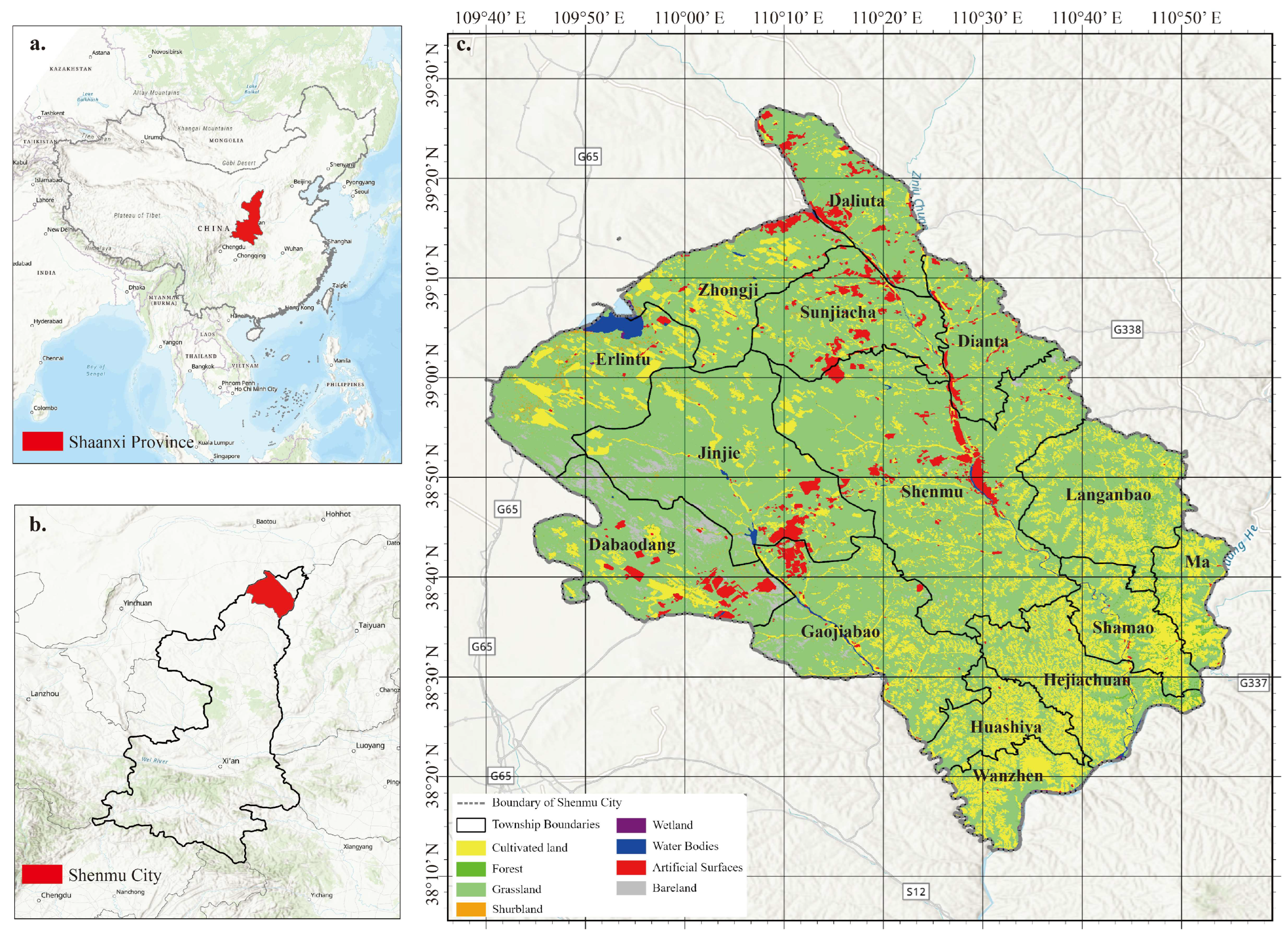
Shenmu City is located in Northern Shaanxi Province, within the transitional zone between the Loess Plateau and the Mu Us Sandy Land (
Figure 1). It represents a typical area where ecological fragility overlaps with rich resource endowments [
22]. With an average elevation of 1000–1300 m and a semi-arid continental monsoon climate, the region receives an average annual precipitation of approximately 400 mm. While its ecological baseline is fragile, Shenmu is abundant in coal resources. These distinctive physical geographical conditions make it an ideal case for studying land-use change in resource-based regions. The land use structure is dominated by medium- and low-coverage grassland, which forms the landscape matrix. Meanwhile, the diversity of land use types is relatively low, and land use exhibits a high degree of spatial concentration, reflecting clear transitional zonal characteristics.
The uniqueness of Shenmu is manifested in three main aspects. First, as a key national energy and chemical industry base, large-scale coal mining has driven rapid expansion of industrial and mining land, intensifying the conflict between human activities and ecological conservation in an already vulnerable environment. Second, the region exhibits pronounced internal spatial differentiation: the northwestern part consists of windy sandy grasslands, while the southeastern area is characterized by hilly and gully terrain. These two sub-regions differ significantly in natural conditions and land use patterns, resulting in a spatial gradient of ecological vulnerability that is higher in the southeast and lower in the northwest. Furthermore, between 2000 and 2020, Shenmu underwent a remarkable land use transition, with rapid conversion among land types and a noticeable reduction in the intensity of certain uses. All major land categories experienced significant changes, leading to structural shifts in the value of ecosystem services.
Selecting Shenmu as a case study is of considerable representative significance. The city exemplifies the transformation challenges faced by resource-based cities—including land use changes induced by mineral extraction, reclamation of abandoned mining sites, development of reserve cropland resources, and ecological restoration—which are common across the Shanxi–Shaanxi–Inner Mongolia energy zone and similar regions nationwide. As an ecologically fragile area, it is also highly sensitive to land use changes. Findings from ecological vulnerability assessments and environmental impact evaluations of land-use planning in Shenmu can provide valuable references for other comparable regions. Moreover, the city has implemented multiple innovative practices in sustainable land use, such as policy pilots for rehabilitating abandoned industrial and mining land, offering valuable experience in exploring pathways for harmonizing human–environment relationships in resource-dependent areas. These attributes establish Shenmu as a representative case for investigating land use transitions and their environmental effects in resource-based regions, with findings that hold important implications for other analogous areas.
2.2. Land Use Structure Change
The land use transfer matrix serves as a core analytical tool for revealing the direction, rate, and sources of regional land use change [
23,
25]. By constructing an
n ×
n transition matrix, this method systematically characterizes the land use structure at the beginning and end of the study period, precisely quantifying the conversion pathways and magnitudes between different land use types. In studies of resource-based cities, the transfer matrix can effectively identify the evolution patterns of land systems driven by typical processes such as mining activities and ecological restoration. The specific calculation involves first establishing an area transfer matrix based on land use data from two time points, which is then normalized into a transition probability matrix. This approach not only elucidates historical trajectories of land use change but also provides essential data and parameters for simulating and projecting future land use evolution under different development scenarios.
The land use data utilized for this analysis were derived from the GlobeLand30 dataset (versions 2000, 2010, and 2020), a globally recognized 30-m resolution land cover product developed by the National Geomatics Center of China. To ensure the analysis was tailored to the regional context of Shenmu City, the original 10-class classification system of GlobeLand30 was reclassified into eight consolidated types: cultivated land, forest, grassland, shrubland, wetland, water bodies, artificial surfaces, and bareland (for detailed reclassification rules, see
Table 1). The consistent production methodology employed across all three epochs of the GlobeLand30 dataset guarantees high temporal comparability, which is fundamental for conducting reliable change detection and transition analysis.
2.3. Evaluation of Land Use Functions
As an integrated social–ecological system, land embodies its core value through three primary functional dimensions: production, living, and ecology [
26,
27]. The production function represents the capacity of land to supply agricultural and industrial outputs, which is directly linked to regional food security and economic development. The living function reflects the social carrying capacity of land in providing space for residence, employment, and development, serving as a fundamental basis for fulfilling human material and spiritual needs. The ecological function captures the multiple values of ecosystems, including provisioning products, regulating environments, supporting life, and providing cultural services.
Guided by the principles of scientific relevance, representativeness, and data availability, this study establishes a comprehensive evaluation indicator system for land use functions (
Table 2). The production function is assessed using two key indicators: gross regional product and grain yield, representing regional economic output efficiency and fundamental agricultural production capacity, respectively. The living function is measured by population density and the nighttime light index—the former directly reflecting the spatial intensity of human habitation and activities, and the latter serving as an effective proxy for socioeconomic activity and urbanization level. The ecological function is comprehensively evaluated in terms of its provisioning, regulation, and support services, using four key indicators: water yield, soil retention, carbon sequestration, and ecological environmental quality, which systematically characterize core ecosystem services such as water supply, soil and water conservation, and climate regulation.
The detailed implementation methods for each functional indicator assessment are systematically described in
Table 2. For all spatial analyses conducted in ArcGIS Pro 3.0, we employed standardized geoprocessing workflows with consistent coordinate systems (WGS_1984_UTM_Zone_49N) and spatial resolution (30 m). The InVEST model applications utilized version 3.13.0 with parameterization specific to the semi-arid conditions of the Loess Plateau. All models were calibrated using local field data and validated against independent measurements to ensure accuracy and reliability.
2.4. Analysis of Interactions Among Land Use Functions
To deeply investigate the interactions among land use functions, this study employs Spearman correlation analysis to systematically examine the trade-offs and synergies between production, living, and ecological functions in Shenmu City for the years 2000, 2010, and 2020. As a non-parametric statistical method, Spearman correlation does not assume normal data distribution and is robust to outliers, making it particularly suitable for analyzing relationships between land use function indicators [
20,
24].
In the analytical process, based on the constructed land use function evaluation system, Spearman correlation coefficients were calculated between indicators of production, living, and ecological functions. By establishing correlation matrices between functions, the strength and direction of interactions across different functional dimensions were quantified. Positive correlation coefficients indicate synergistic relationships, reflecting simultaneous enhancement or decline of functions, while negative coefficients signify trade-off relationships, indicating a competitive pattern where one function increases at the expense of another. The analysis was implemented in a Python programming environment, utilizing scientific computing libraries such as pandas and scipy. By calculating correlation coefficient matrices for each period and incorporating significance tests (p < 0.05), this study provides a statistically robust quantification of the strength and direction of land use function interactions in Shenmu. This approach effectively identifies the dominant quantitative relationships between functions, providing important insights into the internal mechanisms of land use systems in resource-based cities.
To address the multifunctional nature of land systems and avoid the bias of using single indicator pairs, we calculated composite scores for each functional dimension (Production, Living, Ecological) using an equal-weight summation of all normalized indicators within each dimension. The composite Production function score integrated GDP and food production; the Living function score combined population density and nighttime light index; and the Ecological function score incorporated water yield, soil conservation, carbon sequestration, and comprehensive habitat quality. Spearman correlation analysis was then performed on these composite indices to quantify the trade-offs and synergies among the three functional dimensions.
2.5. Analysis of Land Use Function Transition
The transition of land use functions is operationalized and quantified through a spatiotemporal comparative analysis based on the evaluated function scores. First, the spatial patterns and intensity of production, living, and ecological functions for each time period (2000, 2010, 2020) are compared to reveal the trajectories and hotspots of functional change across the landscape. Second, the dynamic evolution of the relationships between these functions—specifically, the trade-offs and synergies—is quantitatively assessed using the Spearman correlation analysis detailed in
Section 2.4. This integrated approach allows us to move beyond a static description and truly capture the process of functional transition in Shenmu City.
2.6. Analysis of Driving Mechanisms
As a critical link between socioeconomic and natural ecological systems, land use transition profoundly reflects the overall evolution of regional social–ecological systems, driven by a combination of natural baseline conditions, socioeconomic factors, and policy instruments [
26,
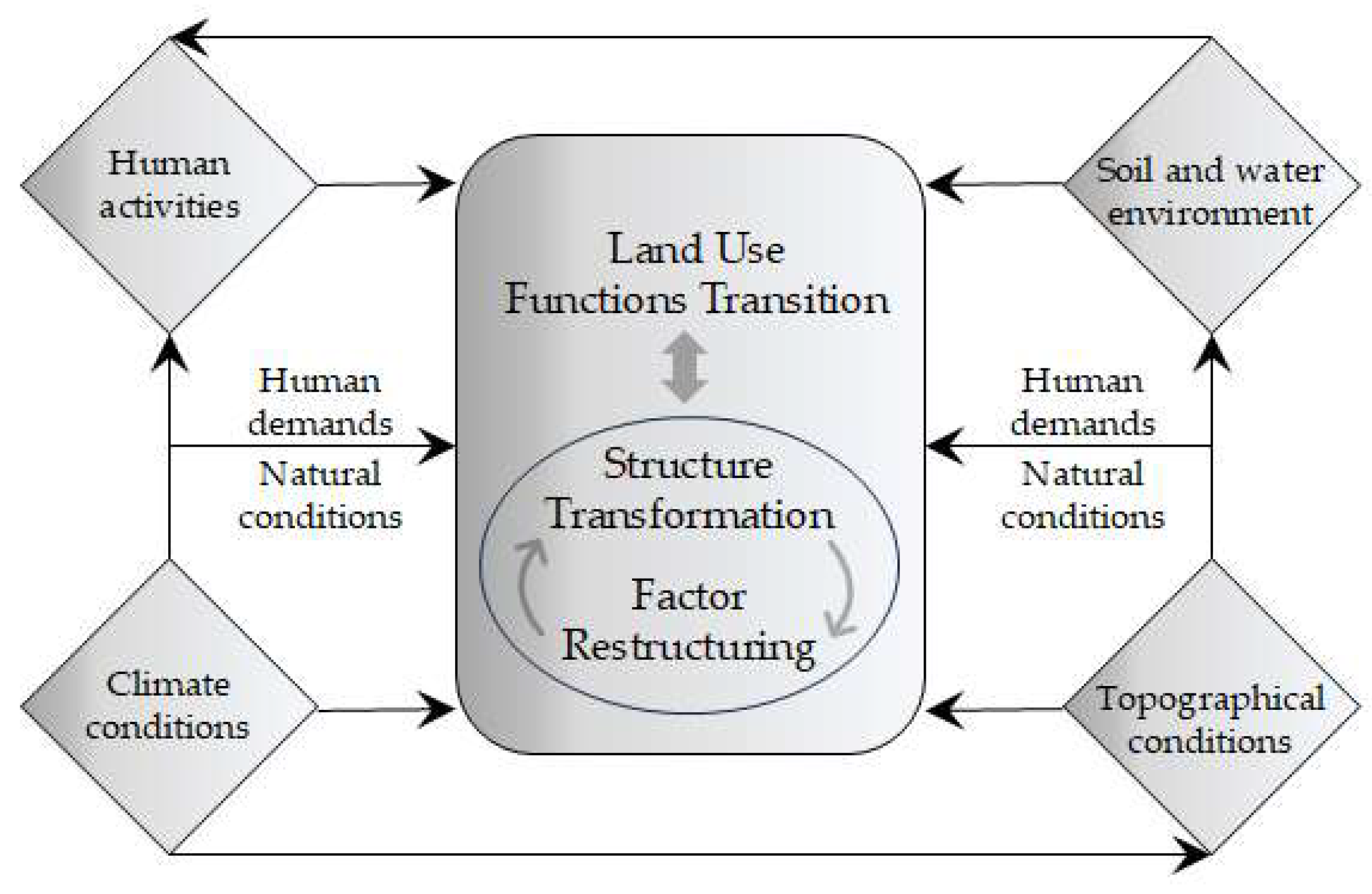
28]. To systematically analyze the driving mechanisms behind land use function transitions in Shenmu, this study constructs a comprehensive analytical framework encompassing natural ecology, socioeconomic factors, and policy response. Specific indicators were selected, including accumulated temperature ≥ 10 °C (GDD), annual precipitation (PRE), elevation (DEM), slope (SLOPE), soil erodibility (SK), surface water frequency (UW), human activity intensity index (HFP), and road network density (RD), to represent multiple influences such as climatic conditions, topographic constraints, water and soil resources, and human activity intensity. Although policy factors are difficult to quantify directly, their effects are indirectly reflected through spatiotemporal changes in the aforementioned factors (
Figure 2).
In terms of analytical methods, this study adopts an approach combining the Random Forest model with the SHAP interpretation framework. Random Forest is a machine learning algorithm based on an ensemble of multiple decision trees [
29]. It constructs numerous tree models through bootstrap sampling and uses the average of their outputs as the final prediction, offering excellent resistance to overfitting and high interpretability. The model evaluates feature importance by calculating the average decrease in node impurity brought by each feature across all decision trees.
To further reveal both local and global influences of variables on predictions, this study introduces SHAP analysis. Based on the Shapley value concept from cooperative game theory, this method fairly decomposes each sample’s predicted value into the marginal contributions of individual features. SHAP values, computed by considering all possible feature combinations, clearly reflect whether each feature promotes or inhibits the prediction outcome [
29].
Using the Python platform and libraries such as scikit-learn and SHAP, this study constructs Random Forest regression models for production, living, and ecological functions, respectively. By calculating the SHAP values of each driving factor, it systematically analysis the key driving mechanisms and nonlinear effects underlying land use function transitions in Shenmu, providing a reliable quantitative basis for understanding the co-evolution of human–environment systems in resource-based cities.
2.7. Data Sources
A multi-source dataset was employed for the assessment of Land use functions and the identification of influencing factors.
Table 2 provides an overview of the data sources utilized in the study. To ensure consistency in data resolution and scale, all raster data were resampled to a consistent spatial resolution (30 × 30 m) and uniformly projected as WGS_1984_UTM_Zone_49N.
Based on the multi-source dataset presented in
Table 3, we quantified the land use structure and functions in Shenmu City using the InVEST model and a series of statistical analyses. The spatiotemporal patterns of land use structure and functional changes were examined through land use transfer matrices and geospatial analysis techniques. We then applied Spearman correlation analysis to further investigate the spatiotemporal dynamics of trade-offs and synergies among land use functions. Building on this, we employed Random Forest modeling combined with SHAP analysis to assess the driving mechanisms behind the land use function transitions in the region. Through this integrated analytical framework, we aim to elucidate the spatiotemporal heterogeneity in land use function intensity and their interrelationships, as well as the underlying drivers, thereby providing insights to support effective spatial planning and management.
3. Results
3.1. Spatiotemporal Dynamics of Land Use in Shenmu City
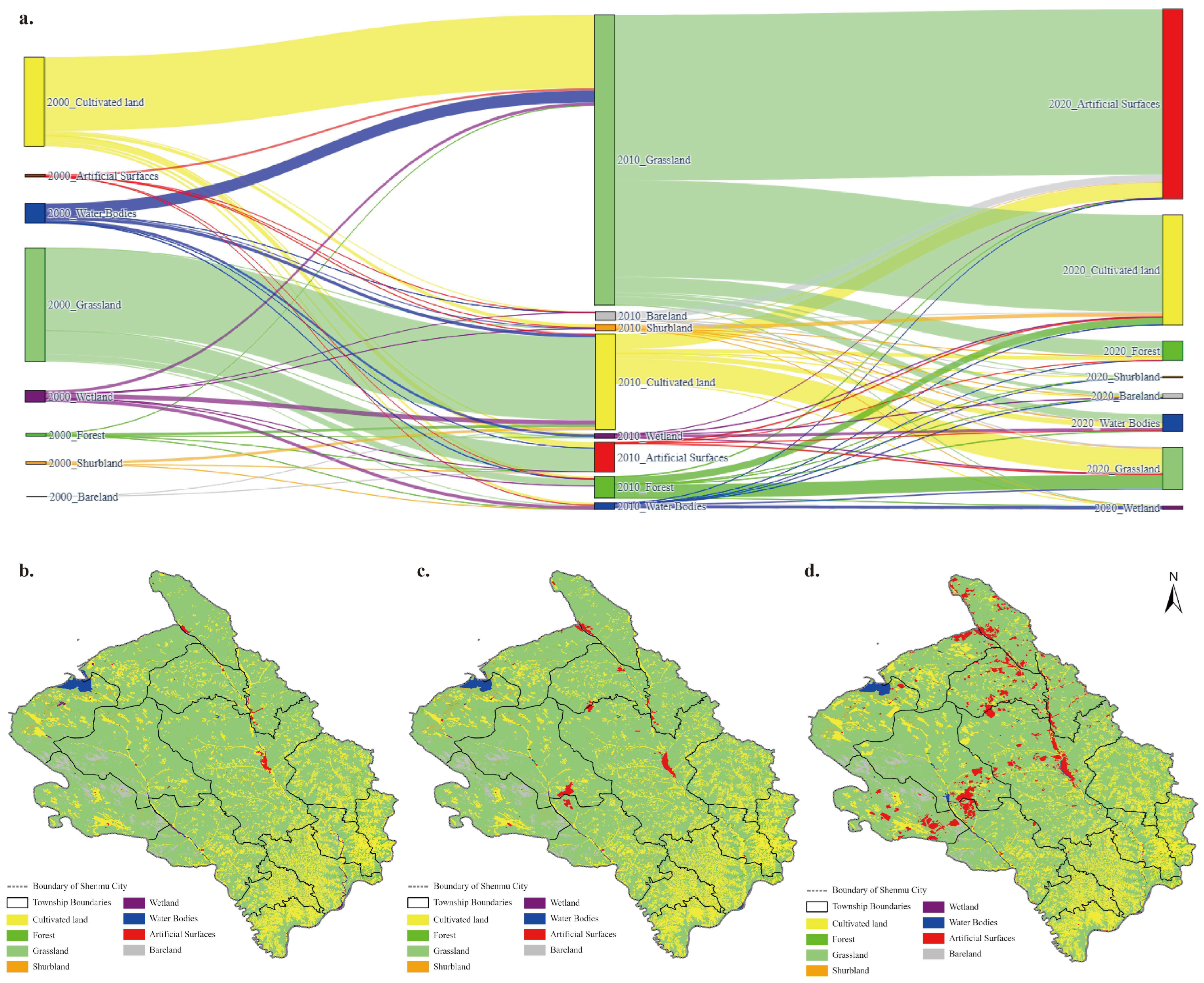
Land use transfer analysis from 2000 to 2020 reveals that Shenmu City has undergone a complex and pronounced process of land use change (
Table 4). Overall, the scale of land use conversion showed a marked increasing trend. The converted area amounted to 27,394.11 hectares during 2000–2010, which increased sharply to 43,890.21 hectares in 2010–2020—a rise of 60.2%. Over the entire study period (2000–2020), the total converted area reached 63,717.39 hectares, representing a 132.6% increase compared to the first decade, indicating that Shenmu’s land use system is undergoing a rapid transition.
In terms of conversion sources, grassland consistently remained the primary origin, contributing 47.0%, 74.8%, and 66.5% of the total converted area across the three periods, underscoring its central role in regional land use change. Meanwhile, cropland, as the second largest source, experienced a decline in its proportion of converted area—from 36.7% in 2000–2010 to 12.7% in 2010–2020—suggesting a certain alleviation of conversion pressure on cropland. As for conversion destinations, built-up land emerged as the dominant target. The share of converted area received by built-up land rose sharply from 12.4% in 2000–2010 to 48.9% in 2010–2020, reflecting the profound impact of rapid urbanization on the land use pattern.
From the perspective of temporal evolution in conversion types, land use changes in Shenmu exhibited clear phased characteristics (
Figure 3). During 2000–2010, the main conversion types were bidirectional transitions between grassland and cropland. Specifically, “grassland → cropland” (9346.2 ha, 34.1%) and “cropland → grassland” (8317.5 ha, 30.4%) together accounted for 64.5% of the total converted area, reflecting the effects of agricultural restructuring and the implementation of the Grain for Green policy.
Between 2010 and 2020, however, the conversion pattern underwent a fundamental shift. “Grassland → built-up land” became the dominant conversion type, covering 18,704.2 hectares (42.6%), while “grassland → cropland” remained substantial (10,956.1 ha, 25.0%). In contrast, “cropland → grassland” decreased significantly to just 2784.6 hectares (6.3%). This shift reflects Shenmu’s transition from a phase dominated by agricultural adjustment to one led by urban expansion.
It is worth noting that five major conversion types—between cropland and built-up land, cropland and grassland, grassland and built-up land, grassland and cropland, and grassland and forest—persisted throughout all three periods. This consistency indicates that these transitions are systematic and stable, providing clear targets for the formulation of targeted land use management policies.
3.2. Spatiotemporal Transition of Land Use Functions
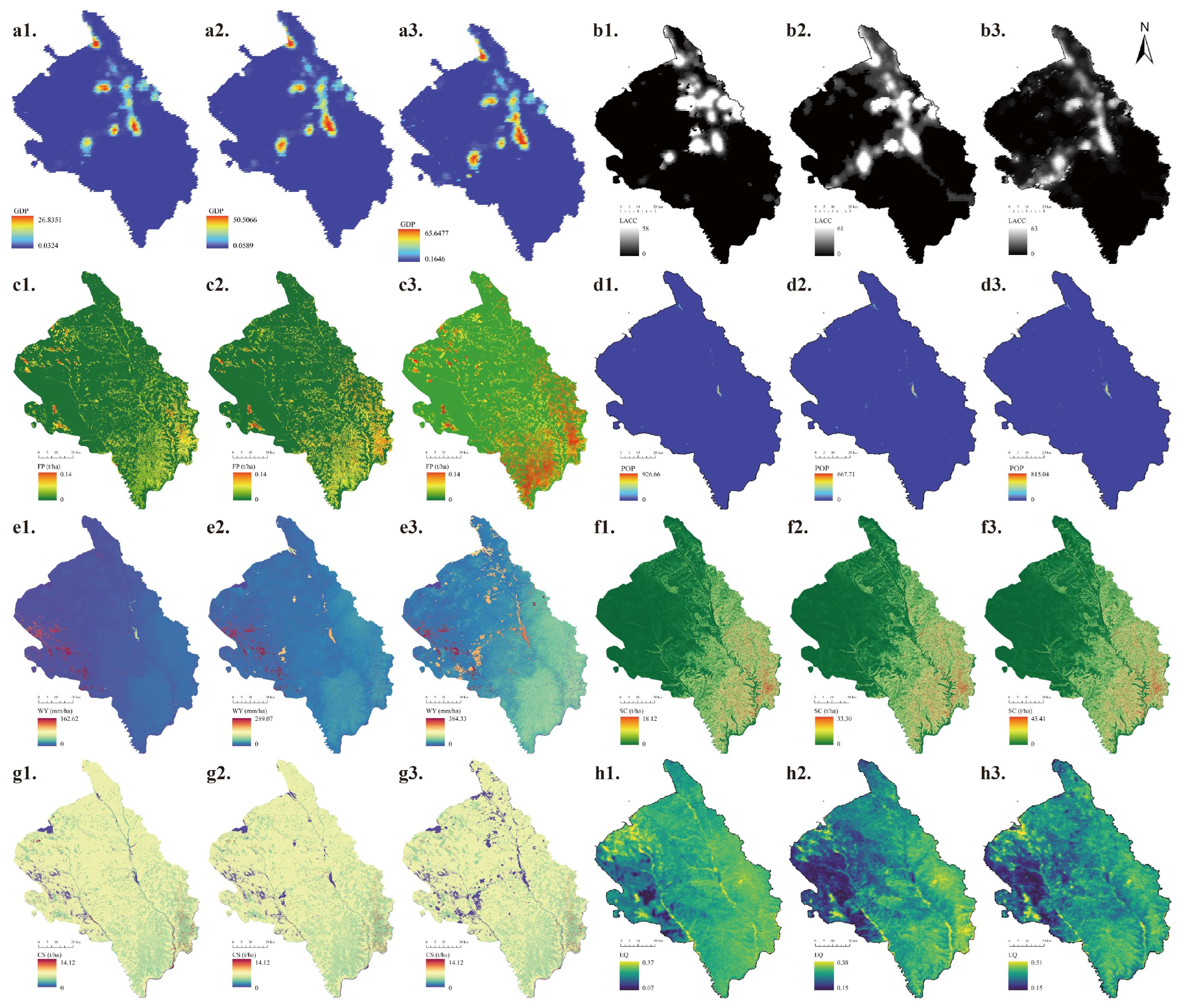
The quantitative analysis of land use function transition reveals pronounced spatiotemporal differentiation and evolving trajectories in Shenmu City from 2000 to 2020 (
Figure 4). Against the backdrop of rapid urbanization and industrialization, significant spatial reorganization occurred among production functions (represented by GDP and food production), living functions (represented by population density and living accessibility), and ecological functions (including soil conservation, carbon storage, water yield, and comprehensive habitat quality). The spatial pattern of production functions notably shifted towards areas adjacent to transportation corridors and energy bases, while living functions became increasingly concentrated in urban centers and towns. Ecological functions underwent clear spatial redistribution, with key ecosystem service zones gradually retreating from mining-intensive areas and consolidating in the southeastern hilly region and other areas with favorable natural endowments. This functional reconfiguration reflects the profound interplay between socioeconomic drivers and the natural landscape, highlighting the ongoing transition and optimization of the human-land system in this typical resource-based city.
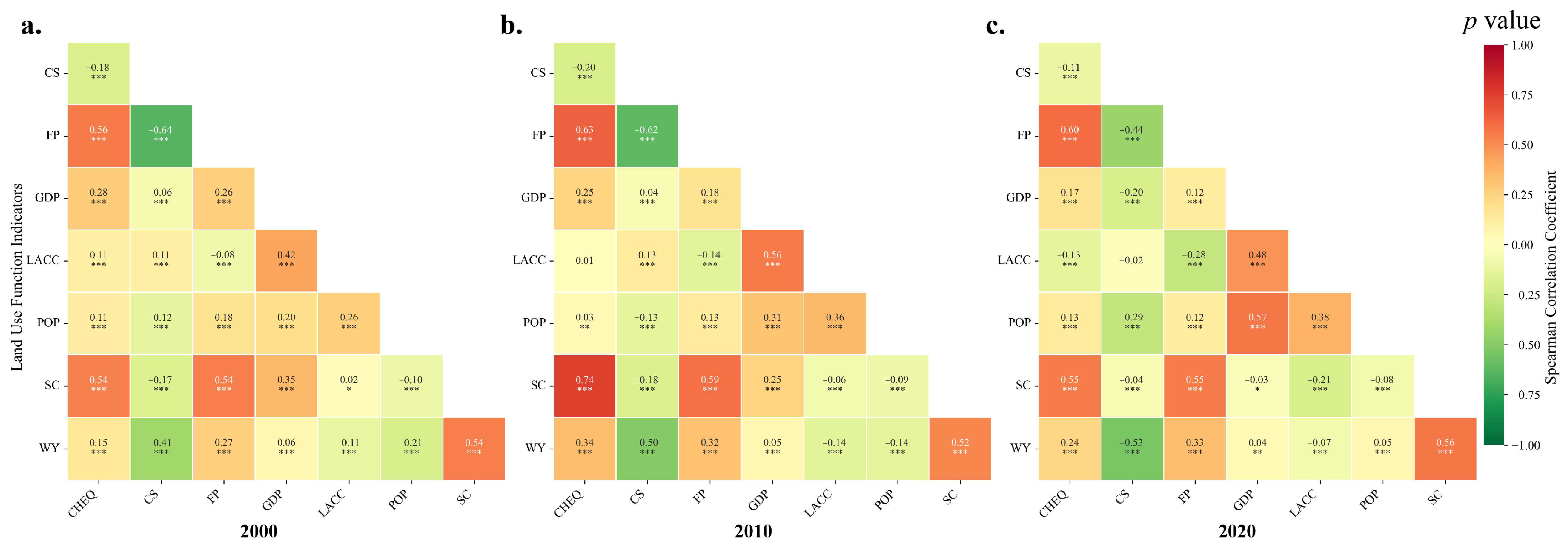
Based on the analysis of trade-offs and synergies among land use functions in Shenmu City from 2000 to 2020, the land use system exhibits a complex and dynamic pattern of interrelationships (
Figure 5). Overall, a high proportion of statistically significant correlations (96.4–100%) was observed across all three years, indicating a widespread and stable network of interactions among land use functions. However, these interactions were predominantly characterized by moderate and weak synergistic relationships. Only one strong synergy was identified in 2010, while no strong trade-offs were detected throughout the study period, reflecting a generally coordinated state in the land use system of Shenmu.
From a temporal perspective, the structure of functional relationships showed clear dynamic changes. Between 2000 and 2010, the number of moderate synergies increased from 6 to 8, accompanied by the emergence of one strong synergy, suggesting an enhancement in the coordinated development of land use functions during this stage. From 2010 to 2020, however, the strong synergy disappeared, moderate synergies remained at 8, and weak trade-offs increased from 9 to 10, indicating a slight decline in systemic coordination in the later period.
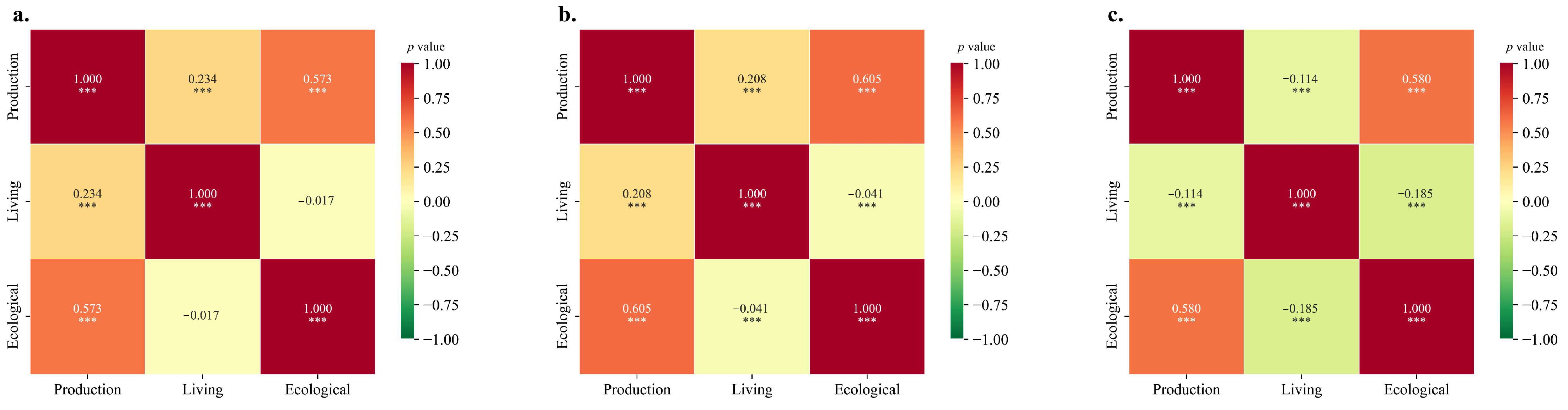
Particularly noteworthy are the evolving relationships among the three composite functional dimensions (calculated as equal-weight composite indices of all indicators within each dimension). A consistently negative correlation was maintained between ecological and living functions, with the correlation coefficient strengthening from −0.017 (not significant) in 2000 to −0.041 (
p < 0.001) in 2010 and further to −0.185 (
p < 0.001) in 2020, indicating an intensifying trade-off between ecological conservation and human settlement activities. The synergy between ecological and production functions remained strong throughout the study period, peaking at 0.605 (
p < 0.001) in 2010 before declining slightly to 0.580 (
p < 0.001) in 2020. Notably, the relationship between living and production functions underwent a fundamental shift, changing from significant synergy (0.234 in 2000, 0.208 in 2010; both
p < 0.001) to a significant trade-off (−0.114,
p < 0.001) in 2020, reflecting the complex dynamics between urbanization and economic development in this resource-based city (
Figure 6).
These evolving trends highlight both challenges and opportunities faced by the land use system of Shenmu against the backdrop of rapid urbanization, providing an important scientific basis for regional sustainable development planning.
3.3. Driving Factors of Land Use Transition in Shenmu City
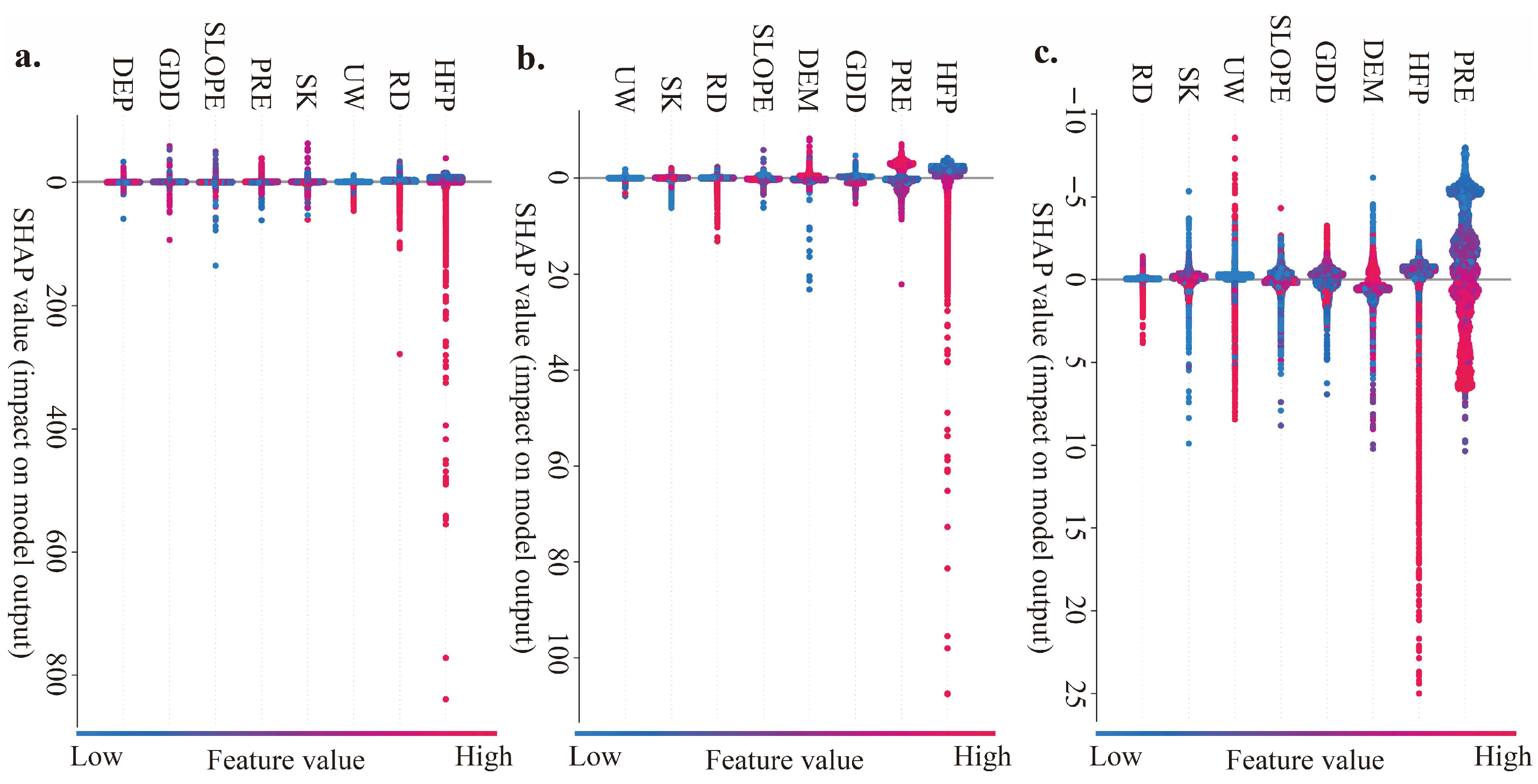
SHAP analysis clearly reveals the complexity of the spatial differentiation mechanisms and driving factors for various land use functions in Shenmu City (
Figure 7). In terms of model performance, the average R
2 of the individual function models reached 0.621, indicating that the selected eight driving factors reasonably explain the spatial variation in land use functions. Among them, the soil conservation (SC) function achieved the highest model fit (R
2 = 0.939), suggesting its spatial distribution pattern is highly predictable and primarily controlled strongly by topographic and climatic factors. In contrast, the carbon storage (CS) and water yield (WY) functions showed relatively lower explainability (R
2 = 0.461 and 0.467, respectively), implying these functions might be influenced by other factors not included in the model, such as soil type or vegetation community structure.
Regarding influencing factors, the Human Footprint Index (HFP) ranked first with a mean importance value of 4.011, establishing it as the core driver shaping the spatial pattern of land use functions, which reflects the profound restructuring of Shenmu’s land use system by human activities. The ‘environmental influencing’ mechanism, proxied by precipitation (PRE, importance = 2.025), constituted the second most critical driver. This mechanism functions by setting the biophysical ceiling for ecological productivity and service provision in this semi-arid region, wherein water scarcity inherently limits the potential of ecological functions. Notably, the response of different functions to the same factor varied significantly. For instance, The ‘accessibility and spatial proximity’ mechanism is evident in the role of road density (RD). This mechanism works by lowering transportation costs and attracting investment, thereby catalyzing agglomeration economies that boost production functions. Conversely, the same mechanism intensifies the ‘encroachment’ pressure on ecological lands adjacent to infrastructure corridors, crystallizing the development-conservation conflict. These differential response patterns uncover the complex underlying mechanisms among land use functions and provide a scientific basis for formulating targeted spatial governance strategies. Model dependency plots further revealed that most influencing factors exhibit nonlinear relationships with the functions. For example, HFP had a weak effect on ecological functions at lower values, but its inhibitory effect strengthened significantly beyond a specific threshold. Identifying such critical effects is highly significant for delineating ecological protection redlines.
At the comprehensive functional dimension level, SHAP analysis uncovered a complex network of interactions and trade-off/synergy relationships among the ecological–living–production systems (
Figure 8). The composite ecological function score was primarily controlled by precipitation (PRE), whose SHAP importance reached 2.888, significantly higher than other factors. This reflects that in a semi-arid region like Shenmu, water availability is the primary limiting factor for maintaining ecological functions. Through its integrated effects on vegetation growth, soil formation, and hydrological processes, precipitation directly determines the region’s ecological carrying capacity. The composite living function score was mainly dominated by the Human Footprint Index (HFP; importance = 2.555), illustrating how urbanization and human activity intensity shape the distribution of residential environments and public service facilities. Similarly, HFP was also the most important factor for the composite production function, but with a markedly higher importance value of 10.380, far exceeding those for other functional dimensions, indicating an exceptionally strong driving effect of human economic activity on production functions. This differentiated pattern of dominant factors reveals the intrinsic driving mechanisms of different functional dimensions: ecological functions are more constrained by natural baseline conditions, whereas living and production functions are more influenced by socioeconomic factors.
Regarding the direction of influence, HFP positively promoted both living and production functions, forming a “development synergy”. However, it likely exerted an inhibitory effect on ecological functions, constituting a typical “development-conservation” trade-off. This contradiction necessitates differentiated governance strategies across spatial units: in ecologically sensitive areas, human activity intensity should be strictly controlled to prioritize ecological functions; in urban development zones, development intensity could be appropriately enhanced to promote the synergistic improvement of living and production functions. Road Density (RD) and Distance to Urban Center (UW) ranked third and fifth in importance, respectively, reflecting the fundamental role of locational conditions in functional allocation. Based on these findings, we recommend establishing a “zonal and categorical” precision governance system: strengthening ecological protection in the precipitation-sufficient southern mountainous areas, while optimizing the spatial layout for living and production around urban areas with good transport access, thereby achieving an optimal overall configuration of the three functional dimensions.
4. Discussion
Synthesizing the spatiotemporal patterns of land use change with our driving force analysis, we identify three statistically robust mechanisms that collectively underpin the functional transitions in Shenmu City. First, anthropogenic forcing emerges as the dominant driver of systemic change and the primary source of trade-offs. Second, the natural environmental baseline, particularly water availability, acts as a critical conditioning factor that constrains and modulates these changes. Third, the temporal sequence of these transitions is best explained by the shifting focus of policy interventions. The following discussion elaborates on each of these key points.
4.1. Policy Driving Forces of Land Use Function Transition in Shenmu City
Land use or land management policies serve as significant drivers of regional land use change, a factor that has been widely incorporated in existing studies on LUCC [
31,
32,
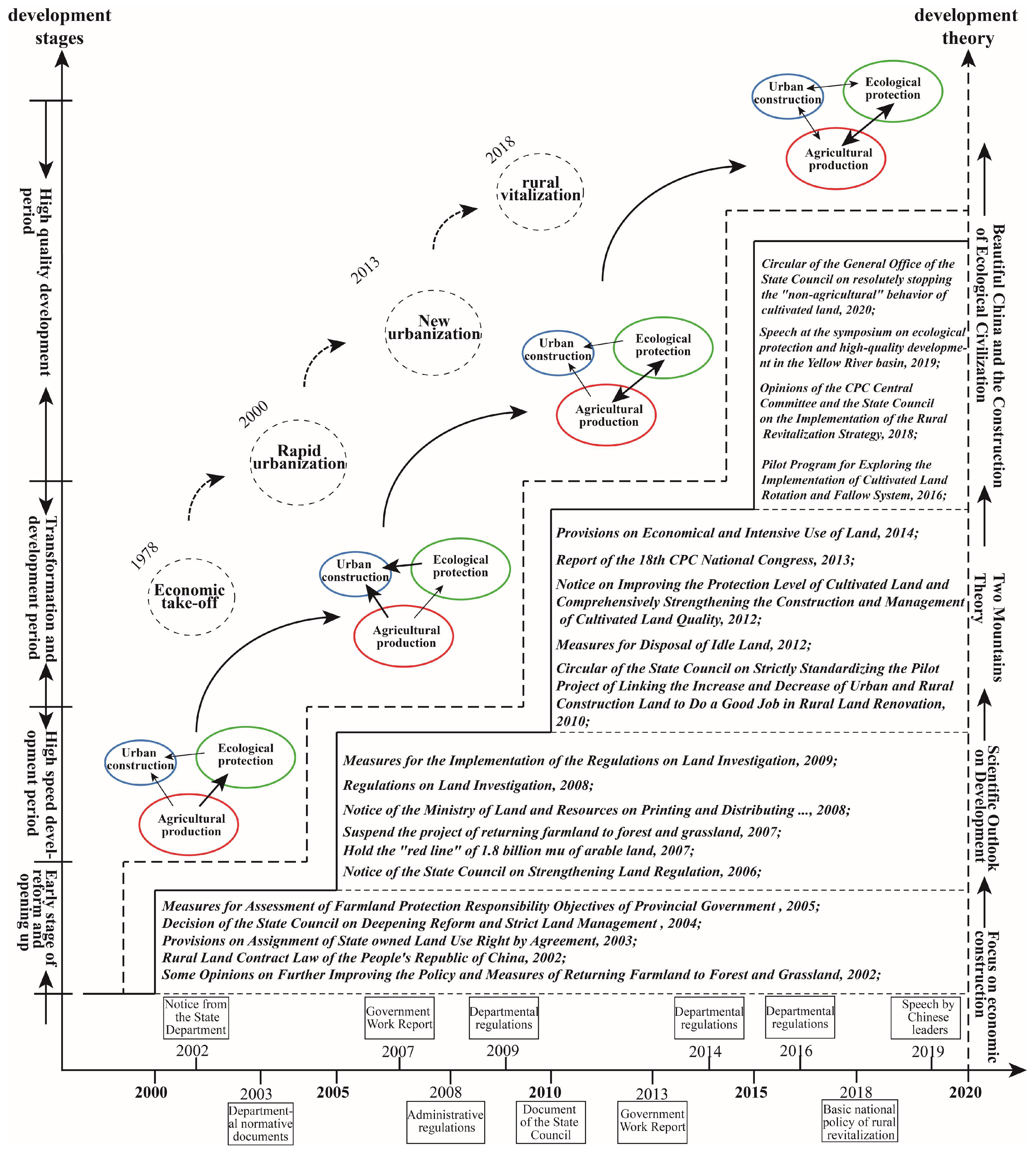
33]. Between 2000 and 2020, the land use transition in Shenmu City was profoundly shaped by a multi-level and multi-dimensional policy system. National macro-strategies and local implementation practices interacted to shape a distinctive trajectory of land use change (
Figure 9).
The ‘policy-led urbanization and resource development’ mechanism was the principal driver during 2000–2010. National strategies acted as a top-down directive that funneled investments into energy infrastructure and urban construction, directly triggering the rapid expansion of built-up land. Although the central government had introduced cropland protection policies during this period, local governments—motivated by both “land finance” and resource exploitation—facilitated swift built-up land expansion [
34]. This development model directly contributed to a sharp increase in the area of land use conversion, from 27,394.11 hectares in 2000–2010 to 43,890.21 hectares in 2010–2020, representing a rise of 60.2%. Notably, grassland, as the largest conversion source during this phase, was mainly transformed into cropland and built-up land, reflecting a pattern of simultaneous agricultural development and urbanization.
In the 2010–2020 period, the concept of ecological civilization construction was progressively integrated into local governance, shifting the policy orientation from a singular focus on economic growth toward high-quality development [
35]. Guided by the “Two Mountains theory” and the national land spatial ecological restoration policy during the 12th and 13th Five-Year Plan periods [
36], Shenmu underwent a notable transformation in land use patterns. Local governments actively promoted the reclamation of abandoned industrial and mining land, the development of green mines, and land ecological restoration projects, which facilitated the conversion of some mining and industrial land into forest, grassland, or cropland.
This policy shift was reflected in land use changes, as seen in the conversion from grassland to built-up land, which increased sharply from 9.8% in 2000–2010 to 42.6% in 2010–2020. Concurrently, the conversion of grassland to forest also rose (from 2.6% to 3.9%). The policy of linking construction land increase with decrease elsewhere, implemented in Shenmu, not only improved rural living environments but also enhanced the quality and stability of ecosystems through the reclamation of abandoned mining sites. This series of policy transitions illustrates Shenmu’s efforts, as a typical resource-based city, to balance the reliance on “land finance” with the constraints of the “ecological protection red line.”
4.2. Socio-Ecological Driving Mechanisms of Land Use Function Transition in Shenmu City
The integrated interpretation of our quantitative findings on functional interactions (
Figure 5 and
Figure 6) and their driving mechanisms (
Figure 7 and
Figure 8) provides a compelling explanation for the observed trade-offs and synergies, directly realizing the reasoning framework of this study. For instance, the persistent but weakening synergy between ecological and production functions after 2010 can be mechanistically understood by the divergent effects of the dominant driver, the Human Footprint Index (HFP). While HFP strongly promotes production functions (
Figure 8a), its expansion exerts a suppressing effect on ecological functions (
Figure 8c). This creates a ‘push-and-pull’ dynamic that quantitatively manifests as a weakened positive correlation. Similarly, the strengthening synergy between living and production functions is a direct consequence of their shared and strong positive response to HFP and road density (RD), indicating that urbanization and economic development in Shenmu are driven by a common set of socioeconomic forces. Thus, the spatiotemporal dynamics of functional interactions are not random but are the emergent, quantifiable outcomes of the differential responses of each function to the same set of core drivers.
The transition of land use functions in Shenmu City results from complex interactions between social and ecological systems, with driving mechanisms exhibiting significant spatiotemporal heterogeneity (
Figure 7 and
Figure 8). From a socioeconomic perspective, energy development, urbanization, and agricultural restructuring constituted the three core drivers. As a national energy and chemical base, Shenmu experienced large-scale coal mining that directly led to the expansion of industrial and mining land, while urbanization drove continuous growth of built-up land through population agglomeration and infrastructure expansion. Between 2000 and 2010, land use change was dominated by agricultural structural adjustment, characterized by bidirectional conversion between grassland and cropland. However, from 2010 to 2020, the dominant driver shifted fundamentally from agricultural development to urbanization.
These socioeconomic drivers were clearly reflected in the SHAP analysis (
Figure 7). Our analysis identifies ‘anthropogenic forcing’ as the dominant mechanism driving land use functional transitions, with the Human Footprint Index (HFP) serving as its powerful proxy (mean importance = 4.011). This mechanism operates primarily through the direct physical conversion of natural landscapes for mining, industrial, and urban uses, leading to a fundamental restructuring of the land system. Road density (RD) showed strong positive effects on production functions (GDP), indicating how transport accessibility promotes economic development, while potentially suppressing ecological functions like carbon storage (CS), revealing a typical “development-conservation” trade-off. Concurrently, agricultural modernization altered cultivated land use efficiency and spatial distribution through technological advances and industrial restructuring, forming a differentiated land development pattern of “soil management in the south and desert control in the north.”
From an ecological perspective, land use changes in Shenmu exhibited response characteristics typical of ecologically fragile areas. The spatial distribution of ecological vulnerability showed a “high in the southeast, low in the northwest” pattern, closely aligned with the spatial distribution of land use conversion intensity. Although overall ecological vulnerability showed a declining trend from 2010 to 2020, the ecological environment quality continued to deteriorate during the same period, with the RSEI index decreasing by 12.47%. This suggests complex time-lag effects and threshold responses in the ecological impacts of land use change [
37,
38].
Precipitation (PRE), ranking second in importance (value = 2.025) in the SHAP analysis, served as the dominant factor controlling composite ecological function (importance = 2.888), emphasizing the critical constraint of water availability on ecological functions in this semi-arid region [
38,
39]. Vegetation coverage, identified as the explanatory factor with the highest contribution (reaching 62.4%), was closely related to land use conversion—large-scale conversion of grassland to built-up land directly reduced regional vegetation coverage, thereby exacerbating ecological risks. Meanwhile, significant differences in ecological vulnerability existed among different land use types, with cultivated land, forest land, and grassland maintaining high proportions of severe and extreme vulnerability, further amplifying ecosystem sensitivity through land use conversion.
The ecological response mechanisms to land use change in Shenmu reflect complex multi-scale interactions between human activities and natural systems. They also explain why, despite the implementation of numerous ecological projects, regional ecological environmental quality continues to face severe challenges, highlighting the need for spatially differentiated governance strategies that address the heterogeneous driving mechanisms across the region.
4.3. Sustainable Development Risks and Response Strategies
The sustainable development risks arising from land use transition in Shenmu City are mainly manifested in two aspects: ecological security pattern risks and socio-economic transformation risks. The identified risks are direct outcomes of the dominant mechanisms. The ecological security risks stem from the pervasive ‘fragmentation and habitat loss mechanism’ set in motion by anthropogenic forcing, which severs ecological connectivity and degrades ecosystem services [
20,
40]. Research indicates that between 2000 and 2010, the heterogeneity of landscape structure in Shenmu declined, showing a trend toward landscape type simplification, which directly weakens ecosystem stability and resilience. Concurrently, land use conversion significantly impacted ecosystem service value (ESV): although the ecological value of forest and grassland increased by 347 million yuan and 192 million yuan, respectively, the ecological value of cropland decreased by 395 million yuan, resulting in a structural imbalance in ESV. More critically, the ecological environment quality in Shenmu continued to deteriorate, with the RSEI (Remote Sensing Ecological Index) dropping by 12.47% between 2010 and 2020, and the area classified as having very poor or poor ecological quality increasing by 15.29%.
Regarding socio-economic transformation risks, given its location in the Loess hully-gully region and its resource-based economy, Shenmu faces dual challenges of resource dependency and ecological constraints [
41]. As a resource-based city, Shenmu’s economic development heavily relies on coal mining, leading to continuous expansion of industrial and mining land with high reclamation difficulty [
22]. Meanwhile, the irreversibility of certain land use changes results in high ecological restoration costs, while traditional development path dependency creates significant resistance to industrial restructuring [
42]. Additionally, land acquisition and demolition processes involve substantial compensation and resettlement issues, which can easily trigger social conflicts, necessitating the establishment of a fairer interest distribution mechanism [
43]. In response to these risks, the following differentiated governance strategies are proposed.
Constructing an optimal allocation model for “ecological–living–production spaces” is key to mitigating ecological security risks [
26,
44]. Based on the resource endowment and ecological conditions of different areas in Shenmu, ecological protection redlines should be scientifically demarcated, and zonal management implemented. Specifically, in the northwestern sandy area, land development intensity should be strictly controlled, focusing on implementing windbreaking and sand-fixing projects. In the southeastern region with high ecological vulnerability, large-scale industrial and mining development should be restricted, while vegetation restoration and soil-water conservation should be strengthened. In the central urban development zone, the layout of construction land should be optimized to improve land use efficiency.
Innovating land management institutions and ecological compensation mechanisms is essential for reconciling conflicts between protection and development [
13,
33]. The cropland protection system should be improved to further consolidate responsibility for cropland conservation and promote a shift in the “balance of occupation and compensation” from a quantitative focus to a trinity of “quantity-quality-ecology” [
32,
45]. Ecological compensation standards should be refined to accurately reflect changes in ecosystem service value. An incentive mechanism for land reclamation should also be established, providing additional rewards for concentrated reclamation areas to enhance stakeholder enthusiasm for ecological protection.
Promoting industrial ecological transformation and green development is a fundamental pathway to addressing socio-economic transition risks [
46,
47]. Intensive use of industrial and mining land should be encouraged, requiring mineral resource development to strictly adhere to green mine standards, and promoting advanced technologies to improve resource recovery rates while reducing land occupation and ecological damage [
48]. Simultaneously, active development of eco-agriculture and circular agriculture should be pursued to reduce non-point source agricultural pollution and enhance the ecological value of cropland [
49]. Furthermore, exploring integrated “ecology + industry” development models—utilizing Shenmu’s unique natural and cultural resources to appropriately develop eco-tourism and leisure agriculture—can achieve a win-win outcome for both ecological and economic benefits. Through these comprehensive measures, Shenmu can achieve sustainable land use and coordinated socio-economic development while ensuring ecological security.
5. Conclusions
This study provides a systematic investigation into the transition characteristics and underlying driving mechanisms of land use functions in Shenmu City, a representative resource-based region in China, during the 2000–2020 period. The results reveal three distinctive patterns of land use transformation: first, a substantial expansion in transition scale, with the total transition area increasing by 60.2% between 2000–2010 and 2010–2020; second, a consistent pattern of grassland serving as the primary transition source while artificial surfaces emerged as the main transition destination, highlighting the profound impact of urbanization processes; third, evident phase characteristics in transition modes, shifting from agricultural restructuring dominated by bidirectional grassland–cropland conversions to urbanization-driven development characterized by grassland–artificial surface transformations.
Analysis of functional interactions within Shenmu’s land use system demonstrates complex and dynamically evolving relationships. While synergistic relationships predominated throughout the study period, their intensity exhibited a weakening trend in recent years. Particularly significant are the divergent trajectories among the three functional dimensions: ecological–living functions maintained a weak but intensifying negative correlation, ecological–production functions displayed fluctuating coordination patterns, and living–production functions demonstrated consistently strengthening synergy. These relationship dynamics reflect the complex challenges and emerging opportunities within Shenmu’s land use system amidst rapid urbanization.
The driving mechanism analysis identifies the complex interplay of multiple factors shaping land use functional transitions. The human footprint index (SHAP importance: 4.011) and precipitation (2.025) emerged as the most influential drivers, indicating the combined effects of anthropogenic activities and natural conditions on land use functional patterns. Different functional dimensions exhibited distinct dominant drivers: ecological functions were primarily constrained by natural environmental conditions, whereas living and production functions were more strongly influenced by socioeconomic factors. The identified nonlinear relationships and threshold effects between driving factors and land use functions offer crucial insights for establishing ecological protection boundaries and implementing targeted spatial governance strategies.
This research contributes to both theoretical advancement and practical applications in several significant aspects. Theoretically, it extends the land use transition research framework by explicitly incorporating functional perspectives and their interaction mechanisms under the integrated ‘element–structure–function’ paradigm, which is particularly applicable to regions undergoing rapid and intensive land transformation. Methodologically, it demonstrates the efficacy of integrating conventional spatial analysis with machine learning techniques (e.g., Random Forest with SHAP interpretation) in deciphering the complex, non-linear driving mechanisms of human–environment interactions, an approach that can be replicated in other socio-ecological systems. Practically, the identification of dominant drivers (e.g., human footprint and precipitation) and their threshold effects offers evidence-based guidance for developing differentiated land space optimization strategies. For policymakers in Shenmu and similar resource-based cities (e.g., across the Shanxi–Shaanxi–Inner Mongolia energy belt), our findings suggest the following: (1) Implementing zonal management: Strictly controlling development intensity in ecologically sensitive areas (southeastern hills) identified as key for ecological functions, while promoting synergistic agglomeration of living and production functions in areas with high road accessibility. (2) Utilizing threshold values: The critical points identified in SHAP dependency plots can inform the scientific delineation of ecological protection redlines and urban growth boundaries. This helps in addressing the sustainable development challenges, such as ecological security risks and socio-economic transformation pitfalls, common to resource-based cities. Future research should incorporate longer temporal sequences and higher-resolution data to validate the transition patterns identified in this study, while enhancing the understanding of coupling mechanisms between land use transition processes and regional sustainable development pathways.