Previous Article in Journal
Enhancing Pilot ‘Mission’ Projection Through a Virtual Reality Flight Simulator: A Quasi-Transfer of Training Study
 
 
Due to scheduled maintenance work on our servers, there may be short service disruptions on this website between 11:00 and 12:00 CEST on March 28th.
Review

Efficiency and Sustainability in Industrial Biogas Plants: Bibliometric Review of Key Operating Parameters and Emerging Process Metrics


by
Yoisdel Castillo Alvarez
1,*,
Johan Joel Cordero Noa
1,
Gerald Vasco Quispe Soto
1 and
Reinier Jiménez Borges
2
1
Department of Mechanical Engineering, Universidad Tecnológica del Perú, Lima 15046, Peru
2
Department of Mechanical Engineering, Faculty of Engineering, Universidad de Cienfuegos “Carlos Rafael Rodríguez”, Cienfuegos 59430, Cuba
*
Author to whom correspondence should be addressed.
Submission received: 5 January 2026 / Revised: 15 March 2026 / Accepted: 24 March 2026 / Published: 26 March 2026
(This article belongs to the Section Environmental and Earth Science)

Abstract

Industrial-scale Anaerobic Digestion (AD) is a key technology for the energy recovery of agro-industrial and municipal waste and for the mitigation of greenhouse gas emissions; however, the actual operational performance of industrial biodigesters continues to show significant discrepancies with respect to the theoretical values reported in the scientific literature. In this context, there is still a lack of systematic analysis to identify which operating parameters are consistently monitored in industrial settings and which remain insufficiently explored, particularly those that describe the overall state of the digestion environment. To address this gap, a systematic literature review was conducted in the Scopus database for the period 2000–2026, complemented by a bibliometric analysis using VOSviewer software v1.6.18. 3. After applying inclusion criteria focused exclusively on industrial-scale and pilot systems, 1327 documents corresponding to the category of operating parameters were selected and analyzed using keyword co-occurrence networks and evaluation of occurrence frequencies and total link intensities. The analysis shows a marked concentration of the literature on a small set of classic parameters, highlighting pH (154 occurrences, 3667 link intensities), temperature (147 occurrences, 3255 link intensities), and ammonia (131 occurrences, 2824 link intensities) as the most recurrent variables in the industrial operation of anaerobic digesters. Complementarily, parameters such as chemical oxygen demand, total and volatile solids, and hydrogen sulfide have progressively increased their presence since 2015, mainly associated with effluent quality assessment, nutrient recovery, and overall process sustainability. In contrast, variables that integrate the state of the environment, such as electrical conductivity, oxidation-reduction potential, and the rheological properties of digestate, appear in less than 5 % of the studies analyzed, despite their ability to integrate information on stability, buffer capacity, and overall operating conditions. Taken together, these findings highlight an imbalance between the intensive use of traditional parameters and the limited incorporation of integrative indicators in industrial monitoring, suggesting that their systematic inclusion, together with the development of soft sensors and predictive models, could contribute to improving operational control and reducing the gap between the theoretical performance and actual behavior of industrial biodigesters.

1. Introduction

The growing pressure on natural resources has intensified air, water, and soil pollution—particularly in densely populated regions of Asia and Latin America—undermining environmental sustainability and public health [1]. In this context, anaerobic digestion emerges as a renewable alternative for waste treatment and biogas production. Asia hosts more than 45 million digesters, mostly household-scale units, although many have been abandoned due to technical limitations and lack of economic support [2]. Global Municipal Solid Waste (MSW) generation currently exceeds 2 billion tonnes per year, reflecting the growing environmental footprint associated with human activities [3]. In developing countries, where over 90% of waste is landfilled or incinerated, inadequate management exacerbates environmental impacts. If current trends persist, global waste generation is projected to reach 3.4 billion tonnes by 2050, significantly increasing GreenHouse Gas (GHG) emissions [4,5].
In response, biogas digesters enable the valorization of organic waste into energy and biofertilizers, contributing to the Sustainable Development Goals (SDGs) on clean energy and climate action [6]. However, system efficiency depends heavily on substrate characteristics, necessitating evaluation of both availability and composition to ensure stable performance. Cattle manure is widely used due to its accessibility, yet its low nutrient content limits biogas yield. Co-digestion with sheep manure improves the Carbon-to-Nitrogen (C/N) ratio and enhances process stability [7,8]. Similarly, co-digestion with lignocellulosic residues—such as flax, beet pulp, and wheat straw—has achieved methane yields of up to 351 mL CH4/g VS (at standard temperature and pressure) and volatile solids (VS) removal efficiencies exceeding 70% of the initial VS content under controlled mesophilic batch digestion conditions [9,10].
Anaerobic reactors can be classified by digestion volume into small-, medium-, and large-scale systems [11]. Small-scale digesters are widely deployed in rural and domestic settings, though their sustainability relies on a consistent waste supply [12]. Medium-scale systems offer higher efficiency but require rigorous operational control [13]. Large-scale digesters are more effective for complex effluents but demand advanced technical planning and strict monitoring of critical operational parameters [12,13].
Among the operational parameters, Temperature (T) is critical because it regulates microbial activity and defines the operational regime. Low values (20–27 °C) reduce biogas yield [14,15], whereas thermophilic conditions have led to inhibition due to accumulation of Volatile Fatty Acids (VFAs) (13.6 g/L) and ammonia (1.2–1.9 g/L) [16]. In Brazil and Ghana, solar heating combined with adequate control has enabled biomass stabilization around 30 °C—close to the mesophilic range [14,16,17,18,19,20,21,22].
Anaerobic digestion (AD) reactors generally operate at neutral to slightly alkaline pH (6.8–8.0), with an optimal range of 7.0–8.0 for methanogenesis stability. However, values below 6.6 significantly reduce microbial activity. Likewise, highly acidic conditions (pH < 5), reported in MSW digesters in Iraq, delayed methane (CH4) production [23,24].
The Organic Loading Rate (OLR) establishes acceptable degradation limits. Stability is generally ensured within 0.5–4.7 kg VS/m3·d. In contrast, overloading at 5–8.5 kg VS/m3·d in industrial reactors has triggered inhibition phenomena [25,26]. Consequently, some plants operate at lower loads—e.g., 0.3–0.9 kg VS/m3·d in Brazil and 0.81 kg BOD5/m3·d in Ghana—to avoid failures [14,16,21].
The Organic Loading Rate (OLR) and Hydraulic Retention Time (HRT) depend strongly on both the physical nature and chemical composition of the substrate. For liquid substrates in UASB reactors, HRT can be reduced to 24 h, while high-solids systems require 30–60 days. Likewise, substrate biodegradability varies dramatically: rapidly hydrolyzable starch achieves OLR of 4–8 kg COD/m3d, compared to 1–2 kg COD/m3d for slowly hydrolyzable cellulose [27,28], practical observations show high variability: 24 days in covered lagoons [14], 37–66 days in high-solid systems [16,29], and as low as tens of hours in Upflow Anaerobic Sludge Blanket (UASB) reactors (47.6 h) [21]. These differences reflect distinct COD solubilization kinetics and process stability patterns, directly linked to lignocellulosic content and biodegradable organic matter composition.
The VFA/Total Alkalinity (TA) balance also reflects process stability. A VFA/TA ratio between 0.2–0.4 is considered safe, while values above 0.6 signal acidification risk [30,31]. Industrial-scale operations have reported VFA accumulations > 10 g/L [16], whereas co-digestion trials maintained levels < 5 g/L [32,33,34], highlighting the importance of control.
Substrate composition is another key factor: a C/N ratio of 20:1–30:1 ensures efficient methanogenesis, with 25:1 being the most favorable. Adjustments within this range have doubled biogas production compared to uncorrected digestions [35,36,37].
Hydrogen sulfide (H2S) is one of the main biogas contaminants. While the recommended limit is <3000 ppm for engine protection [38], raw biogas from industrial plants frequently records 1500–10,000 ppm, with peaks up to 6500 ppm depending on several interrelated factors: the sulfur and protein content of the substrate, competition between sulfate-reducing bacteria and methanogenic archaea for common substrates, the temperature regime, and the type of reactor content [38,39,39]. Strategies such as microaeration can reduce H2S to <100 ppm under lab conditions [40,41,42], though full-scale reductions are often partial (e.g., 68% in a 338 m3 reactor) [43]. In contrast, some industrial UASB reactors have maintained much lower concentrations (78–314 ppm) [21].
Finally, Chemical Oxygen Demand (COD) serves as a reliable indicator of treatment efficiency. Reductions > 85% have been achieved under controlled conditions [44,45], whereas industrial plants report wide variability (12–75%), depending on applied load and season [14,21,46,47].
At the industrial scale, three critical knowledge gaps persist: (1) no systematic quantitative analysis documents which operational parameters are routinely monitored in industrial plants versus those recommended in theory; (2) emerging integrative parameters (EC, ORP, rheology) are discussed sporadically but their actual adoption rate in industrial monitoring schemes remains unquantified; (3) the gap between established and emerging monitoring variables has not been bibliometrically characterized. These discrepancies between theoretical recommendations and real-world implementation hinder design standardization [16,48]. Instability in pilot plants and the use of costly inputs limit scalability [49,50], while aspects such as redox potential, effluent recirculation, and acid–base balance control remain underexplored [38,47,51]. Moreover, machine learning algorithms are emerging as a promising alternative to optimize prediction and control in anaerobic digesters [21,38,51,52,53].
The specialized software VOSviewer will be employed to conduct a bibliometric analysis of anaerobic digestion research, enabling the identification of scientific trends, collaboration networks, and research gaps. Through a comparative approach, this work seeks to enhance the energy efficiency and technical viability of anaerobic digesters, contributing to the development of sustainable technologies for organic waste treatment in agro-industrial contexts.
In this context, the present bibliometric review is explicitly guided by the following questions: Which operational parameters currently dominate monitoring practices in industrial and pilot-scale biogas plants, and how are they interconnected in the scientific literature? Which potentially relevant variables remain underrepresented, and what technical gap does this underreporting reveal in terms of medium-state characterization and process control? To what extent is there evidence of operational standardization across industrial plants with respect to key indicators such as HRT, OLR, C/N ratio and stability thresholds (e.g., VFA/alkalinity)? How is the production of evidence on industrial anaerobic digestion geographically distributed, and what do these territorial patterns imply for the transferability and generalization of operational guidelines?
To address these gaps, this study provides three novel contributions:
  • First systematic bibliometric quantification of operational parameter monitoring frequency and interconnections in industrial-scale biodigesters, distinguishing between industrial/pilot operations and laboratory studies.
  • Quantitative mapping of parameter adoption patterns, identifying a ‘core’ of established variables (pH, temperature, VFA, HRT, OLR) versus ‘peripheral’ underutilized metrics (EC, ORP, rheology) through co-occurrence network analysis.
  • Evidence-based framework distinguishing consolidated monitoring variables from emerging parameters with integrative diagnostic potential, guiding future research toward robust industrial control strategies.
This article is structured as follows: Section 2 describes the research strategy, detailing the systematic search in Scopus, inclusion and exclusion criteria, and the bibliometric analysis procedure using VOSviewer. Section 3 presents the main results, including the general overview of scientific production on industrial biodigesters and the detailed analysis of the identified technological-operational parameters. In Section 4, these findings are critically discussed, compared with previous literature, and their implications for the design, monitoring, and control of industrial-scale biodigesters are analyzed, with special emphasis on emerging and underexplored parameters. Finally, Section 5 summarizes the most relevant conclusions and outlines future research lines derived from this study.

2. Materials and Methods

2.1. Research Strategy

This study was carried out using a qualitative approach through a systematic literature review, aimed at identifying, analyzing, and synthesizing the technological and operational factors that influence the sustainability of industrial-scale anaerobic digesters. The literature search was conducted exclusively in the Scopus database, owing to its extensive coverage of peer-reviewed scientific literature and its relevance in the fields of environmental and energy engineering.
Search strings were constructed using Boolean operators (“AND”, “OR”) along with quotation marks and truncation symbols, to minimize bias, exclude irrelevant results, and ensuring that the selected articles aligned with the study’s objective. The analysis period spanned from 2000 to 2026, with an emphasis on recent publications that reflect the most significant technological advances in industrial-scale anaerobic digestion.
The search strategy was structured around thematic strings grouped into three main categories: technology, operational parameters, and sustainability (Table 1).
A total of 5899, 1327, and 3455 articles were identified corresponding to the categories of technology, operational parameters, and sustainability, respectively. All documents were published in English and subsequently filtered using inclusion criteria to ensure their relevance to the study: (a) peer-reviewed publications indexed in the Scopus database; (b) studies specifically focused on industrial-scale anaerobic digesters; and (c) articles addressing technological, operational, or sustainability-related variables associated with these systems.
Complementarily, exclusion criteria were applied to guarantee the pertinence of the selected documents, removing: (a) studies exclusively focused on household, rural, or laboratory-scale digesters; (b) research lacking technical information or operational parameters; and (c) publications addressing only economic, political, or social analyses without providing data applicable to the research objective (Figure 1).
Operational definition of scale: Studies were classified as industrial/pilot-scale if they explicitly reported: (a) reactor volume > 100 L, (b) operation in commercial biogas plants, or (c) pilot plants processing > 50 kg substrate/day. Articles were independently screened by two reviewers (initials), with disagreements resolved through consensus discussion ({ κ = X.XX).
The retrieved metadata were exported to Microsoft Excel 2023, where they were organized and categorized by: year of publication, country of origin of the authors, thematic category, and the scientific journal in which they were published. Subsequently, this dataset was analyzed using VOSviewer software, enabling the visualization of keyword, author, and country co-occurrence networks, and facilitating the identification of major thematic trends and research gaps [54].

2.2. Bibliometric Analysis

The analysis focused on several aspects related to scientific production on industrial-scale anaerobic digesters, including geographic area of study, publication frequency, academic journals, and the thematic evolution of keywords. Initial data organization and visualization were performed using Microsoft Excel (version 2023), while co-occurrence keyword networks were analyzed using VOSviewer software (version 1.6.18) [55].

2.2.1. Geographic Distribution, Publication Frequency, and Journal Analysis

To identify regions with the highest scientific output, the collected articles were classified according to the country or geographic area reported in each study. Separate cartographic visualizations were created for each of the three search categories, enabling the identification of publication concentration patterns and facilitating a comparative assessment of the global geographic distribution of scientific production.
Regarding publication frequency, the results spanning from 2000 to 2026 reveal an increasing trend across all three analyzed categories. The notable rise in the most recent years reflects sustained scientific interest in optimizing the technological performance of industrial-scale anaerobic digesters, improving the control of operational parameters, and strengthening their role in energy transition strategies, circular economy frameworks, and environmental sustainability.
Finally, an analysis of the academic journals with the highest number of publications in each category was conducted. Journals specializing in renewable energy, environmental engineering, and applied biotechnology stood out as the primary channels for scientific dissemination in this field and play a significant role in consolidating knowledge on industrial anaerobic digesters.

2.2.2. Co-Word Analysis

Keywords extracted from the selected articles were analyzed and visualized using VOSviewer, a freely available bibliometric software widely used to generate co-occurrence maps [56]. This type of analysis enables the identification of thematic clusters, highlights conceptual interconnections, and reveals the most frequent and influential terms within the research domain [57]. In these maps, the size of each node or label reflects the frequency of occurrence of a keyword in the literature, such that larger nodes indicate higher recurrence and scientific relevance [58].
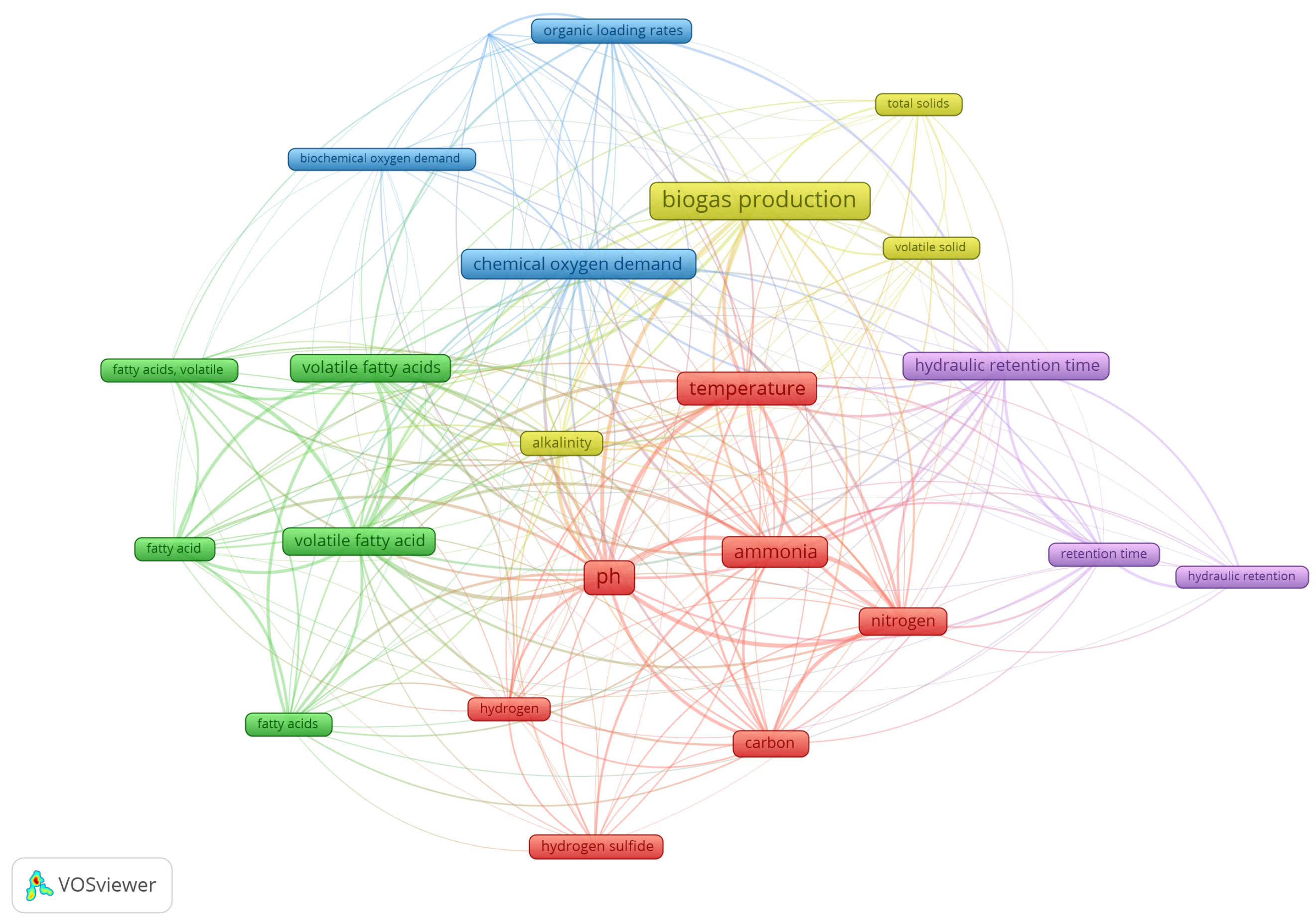
The analysis was performed independently for each of the three categories defined in this study, using an author keyword co-occurrence approach with a minimum occurrence threshold of 4 appearances, normalization method: association strength, clustering algorithm: Louvain (resolution = 1.0), visualization: network and density views to ensure statistical significance. The resulting bibliometric maps revealed a well-established structure, with four to five main clusters and high link density in the technology and sustainability categories, indicating the presence of mature and interconnected thematic cores. In contrast, the operational parameters category exhibited a more specialized and less dense network, composed of five clusters, 23 nodes, and 222 links, reflecting its technical nature and focus on control variables within industrial digesters.
To avoid redundancies and terminological biases, a keyword normalization process was carried out within each conceptual category. For instance, in the operational parameters category, synonymous terms referring to the same concept—such as “C/N ratio”, “carbon-to-nitrogen ratio”, and “carbon and nitrogen balance”—were unified. Similarly, variants like “hydraulic retention time” and “HRT”, “chemical oxygen demand” and “COD”, or “volatile fatty acids” and “VFA” were standardized. This process ensured a consistent representation of the most recurrent indicators in the literature and yielded a more accurate and representative conceptual network of technological and operational factors in industrial anaerobic digesters.
Keyword normalization was performed manually and documented in Supplementary Table S1. For reproducibility, the final keyword groupings and VOSviewer input files are available in the Supplementary Materials.
Overall, the results reflect a robust bibliometric structure that allows for the identification of both well-established and emerging research lines, providing a solid foundation for the detailed analysis of the operational parameters category presented in the following section.

2.2.3. Thematic Focus Area

The bibliographic search was structured around three broad categories. However, this study adopts the technological–operational parameters category as its central analytical focus, due to its direct relationship with functional stability, anaerobic digestion process efficiency, and the sustainability of industrial-scale biogas production.
The categories related to technology and sustainability are used only complementarily—to contextualize the global state of knowledge and illustrate bibliometric trends—but are not subjected to exhaustive technical evaluation within the scope of this research.
Consequently, the detailed analysis concentrates on the parameters that determine the performance of industrial anaerobic digesters. Among these, the following stand out: ratio C/N, temperature, pH, TAN, VFA, alkalinity/VFA ratio, OLR, HRT, TS, Total Suspended Solids (TSS), COD, Hydrogen Sulfide (H2S), and Electrical Conductivity (EC). These indicators represent the critical variables that enable comparison across studies, assessment of operational control levels, and determination of the degree of standardization present in the scientific literature. This thematic delimitation facilitates the identification of trends, dispersion of results, and research gaps.

2.2.4. Limitations

This review has several limitations: (1) exclusive reliance on Scopus may underrepresent gray literature and industry reports; (2) English-language restriction may exclude relevant research in Chinese, German, or other languages; (3) keyword-based search may miss studies using alternative terminology; (4) bibliometric co-occurrence reflects publication patterns rather than actual industrial implementation rates.

3. Results

The bibliometric analysis was structured around the three thematic axes defined in the methodology. The geographical distribution of studies, the annual evolution of publications, and the leading scientific journals associated with the topic were evaluated.
Although all three categories contribute to understanding the global research landscape on industrial-scale anaerobic digesters, the detailed analysis in this section focuses on Category 2 (operational parameters), as it constitutes the core thematic focus of this study. The other categories are presented only as contextual and comparative frameworks.

3.1. Geographical Distribution, Publication Trends, and Journal Analysis

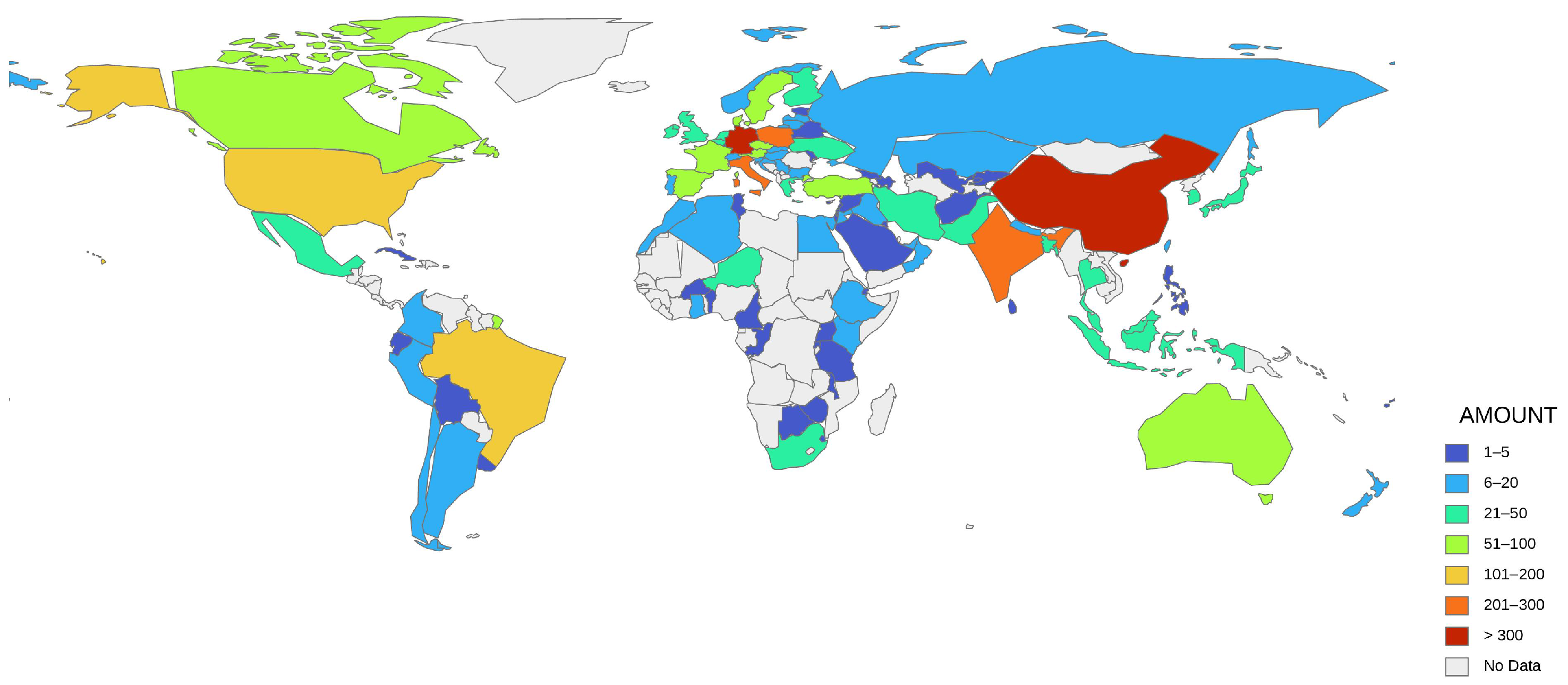
In the technology category, results show that China is the leading contributor in scientific output, with approximately 775 publications, followed by Germany, India, Italy, and the United States as significant players. As illustrated in Figure 2, this distribution reveals a marked geographical concentration, with Europe exhibiting the highest continental research activity, followed by Asia. In contrast, Africa and Latin America demonstrate considerably lower participation in the technological development of industrial anaerobic digesters, highlighting a significant gap in specialized knowledge generation.
Notably, China’s dominance in technology publications (775 articles, 13.1% of total) contrasts with Germany’s leadership in operational parameters (205 articles, 15.4% of category total), suggesting different research priorities: technological development in Asia versus process optimization in Europe. Statistical analysis (Chi-square test, p < 0.001) confirms significant geographic specialization across categories.

3.2. Bibliometric Analysis

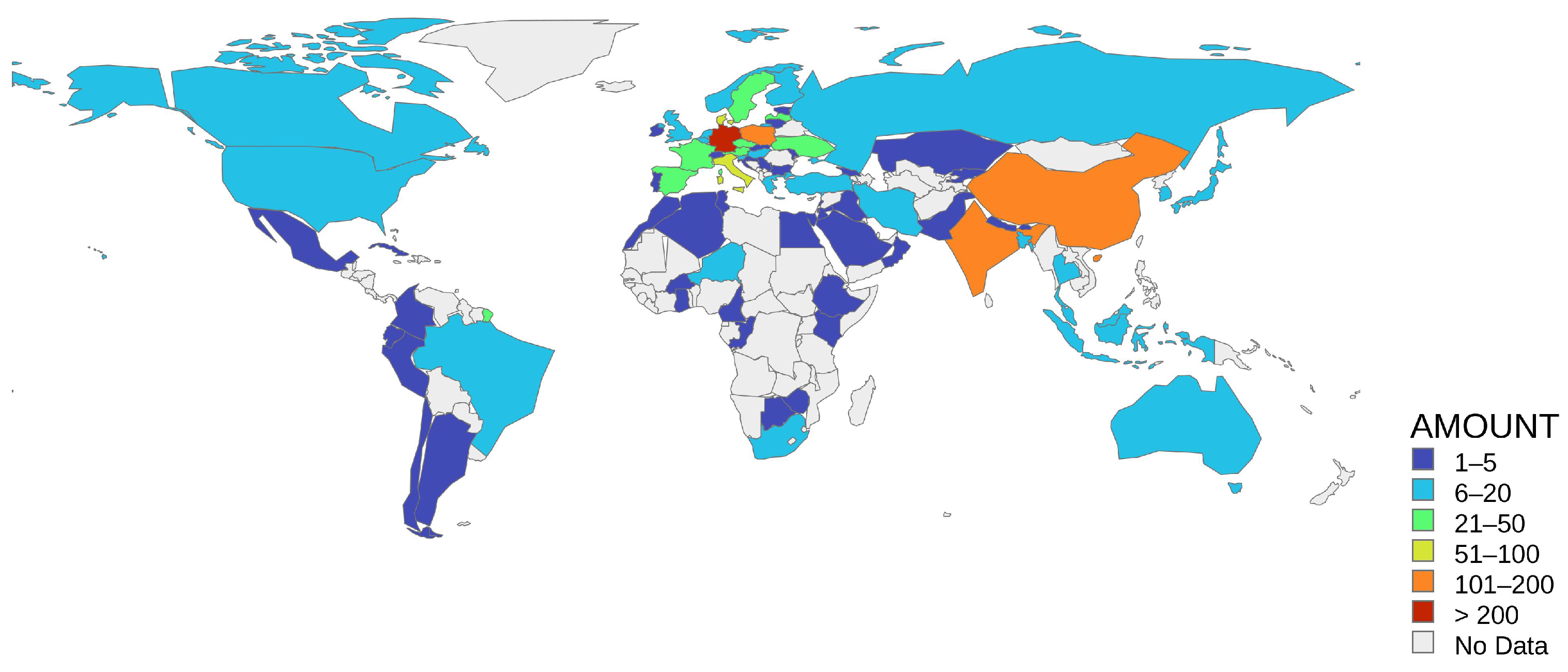
In the operational parameters category, results indicate that Germany leads scientific production with 205 studies, followed by China and India. As shown in Figure 3, the geographical distribution reveals a significant concentration in Europe, which—once again—emerges as the continent with the highest research activity in this area, while Oceania shows the lowest representation. This trend confirms the persistence of regional disparities in knowledge generation, suggesting the need for strategies to promote research in regions with limited participation.
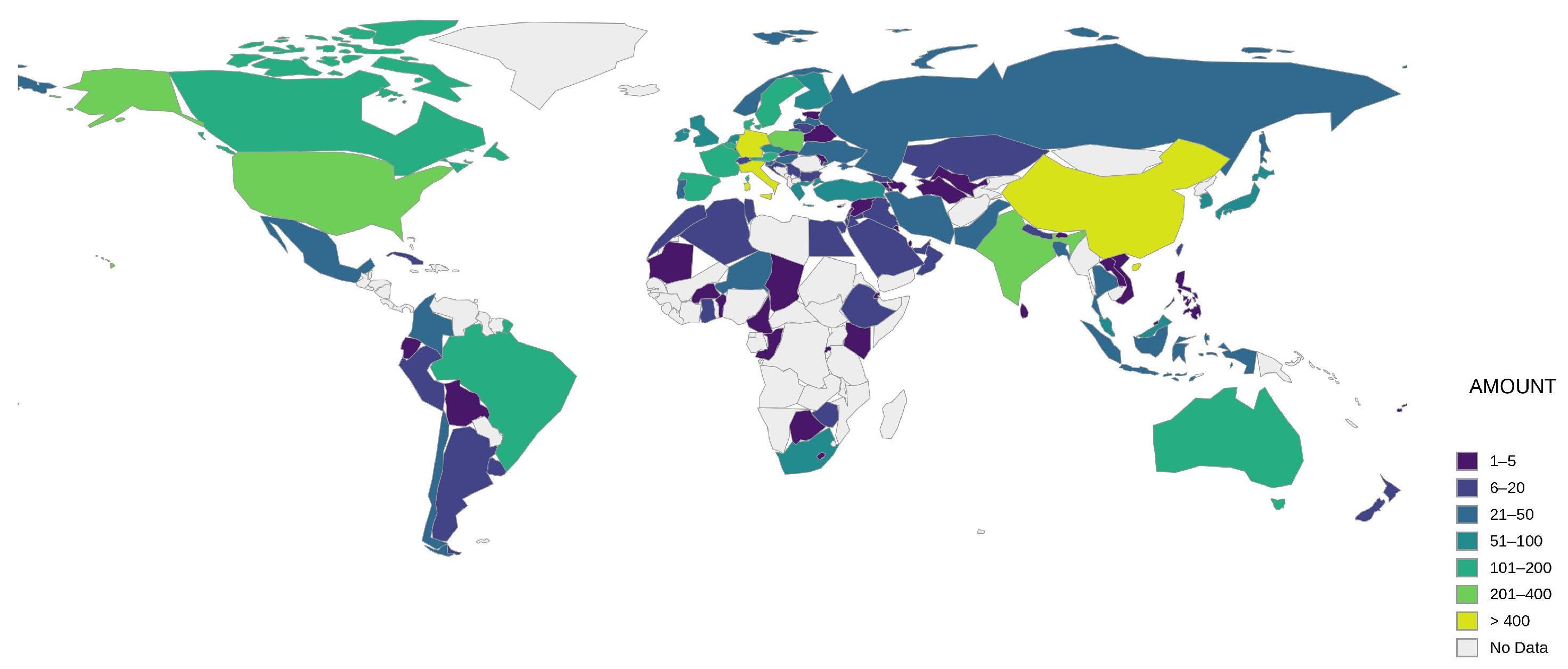
In the sustainability and industrial biogas application category, results show that Germany again leads scientific production with 370 publications, followed by China and India. As illustrated in Figure 4, the geographical distribution follows the same trend observed in previous categories: Europe concentrates the highest research activity, while Oceania shows the lowest representation in this research area. This pattern highlights a concentration of knowledge in specific regions, underscoring the need to promote studies in underrepresented areas to achieve a more balanced global development in the sustainability of industrial anaerobic digesters.
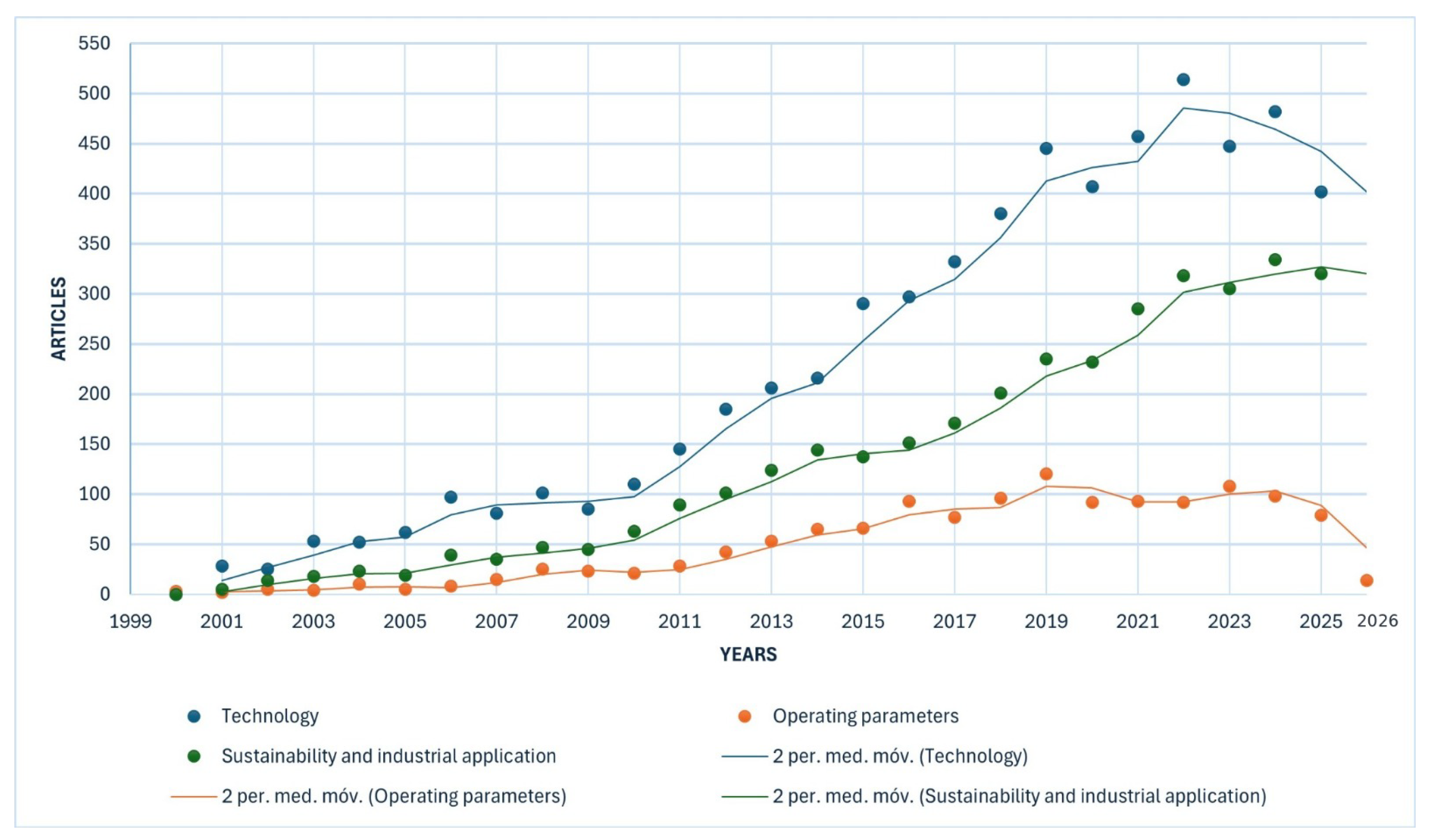
The analysis of publication frequency Figure 5 reveals a growing trend in scientific output related to industrial-scale anaerobic digesters over the period 2000–2026. Across all three evaluated categories—technology, operational parameters, and sustainability—a progressive increase is observed since 2010, peaking between 2019 and 2025. The technology category exhibits the highest publication volume, reflecting the consolidation of research focused on the development and optimization of large-scale anaerobic digestion systems.
The sustainability category shows sustained growth in recent years, driven by global interest in energy transition and waste valorization. In contrast, the operational parameters category maintains a significantly lower publication volume, yet displays a stable trend, suggesting the existence of a research field with considerable potential for further experimental exploration and development.
Overall, more than half of the identified articles were published in the last decade, confirming that research on industrial anaerobic digesters remains expansive and represents an area of increasing interest within the scientific community.
Regarding information sources, the results reveal that ten journals concentrate the majority of publications related to industrial-scale anaerobic digesters, highlighting their central role in disseminating scientific knowledge in this field. As shown in Table 2, Bioresource Technology stands out significantly with 528 articles, followed by Energies (343 articles) and Water Science and Technology (342 articles), underscoring their leading role in publishing technical and experimental research on anaerobic digestion.
In terms of impact, the most cited journals were Bioresource Technology (23,970 citations) and Renewable and Sustainable Energy Reviews (21,616 citations), both with citation rates exceeding 18%, which reflects their high relevance in the fields of energy and biotechnology. Likewise, Water Research and Water Science and Technology also demonstrate considerable academic influence, each accumulating over 12,000 citations.
These journals—specialized in renewable energy, waste management, and biotechnological processes—serve as the primary platforms for scientific dissemination on the development and optimization of industrial anaerobic digesters, covering topics ranging from technological innovations to sustainability assessments and operational efficiency evaluations.
Quantitative analysis shows a marked disparity in the frequency of reporting of operational parameters. Classic variables such as pH and temperature are reported in approximately 11–12% of the studies analyzed, while parameters such as ammonium and chemical oxygen demand (COD) appear in around 9–10%. In contrast, integrative variables such as electrical conductivity (EC) and oxidation-reduction potential (ORP) are significantly less prevalent, being reported in less than 2% of the total 1327 studies analyzed. This quantitative difference objectively supports the existence of a significant gap in the monitoring and reporting of these parameters in the scientific literature.
Table 3 presents the most relevant operational parameters identified through the bibliometric analysis, considering two indicators: the number of occurrences and the total link strength in the co-occurrence network. The results show that pH (154 occurrences, 3667 total link strength), temperature (147 occurrences, 3255 total link strength), and ammonia (131 occurrences, 2824 total link strength) are the most frequent terms and exhibit the highest connectivity, confirming their central role in the stability and efficiency of the anaerobic digestion process.
Interpretation of co-occurrence patterns:
The high link strength of pH (3667) and temperature (3255) confirms their role as fundamental control variables consistently reported alongside other parameters. However, the relatively low occurrence of ‘electrical conductivity’ (not in top 23) and absence of ‘oxidation-reduction potential’ as independent keywords reveals a significant monitoring gap, despite their potential to provide integrative information on ionic strength and microbial activity. The dispersion of VFA-related terms (#12–16, combined occurrences: 300) into five variants reflects terminological inconsistency in the field, suggesting need for standardized nomenclature.

3.3. Co-Word Analysis

The co-word analysis performed enabled the identification of thematic patterns and conceptual relationships across the three categories considered: Technology, Operational Parameters, and Sustainability and Industrial Application. Collectively, these networks reveal how the specialized literature addresses anaerobic digestion through complementary perspectives encompassing technical, biological, environmental, and managerial aspects.
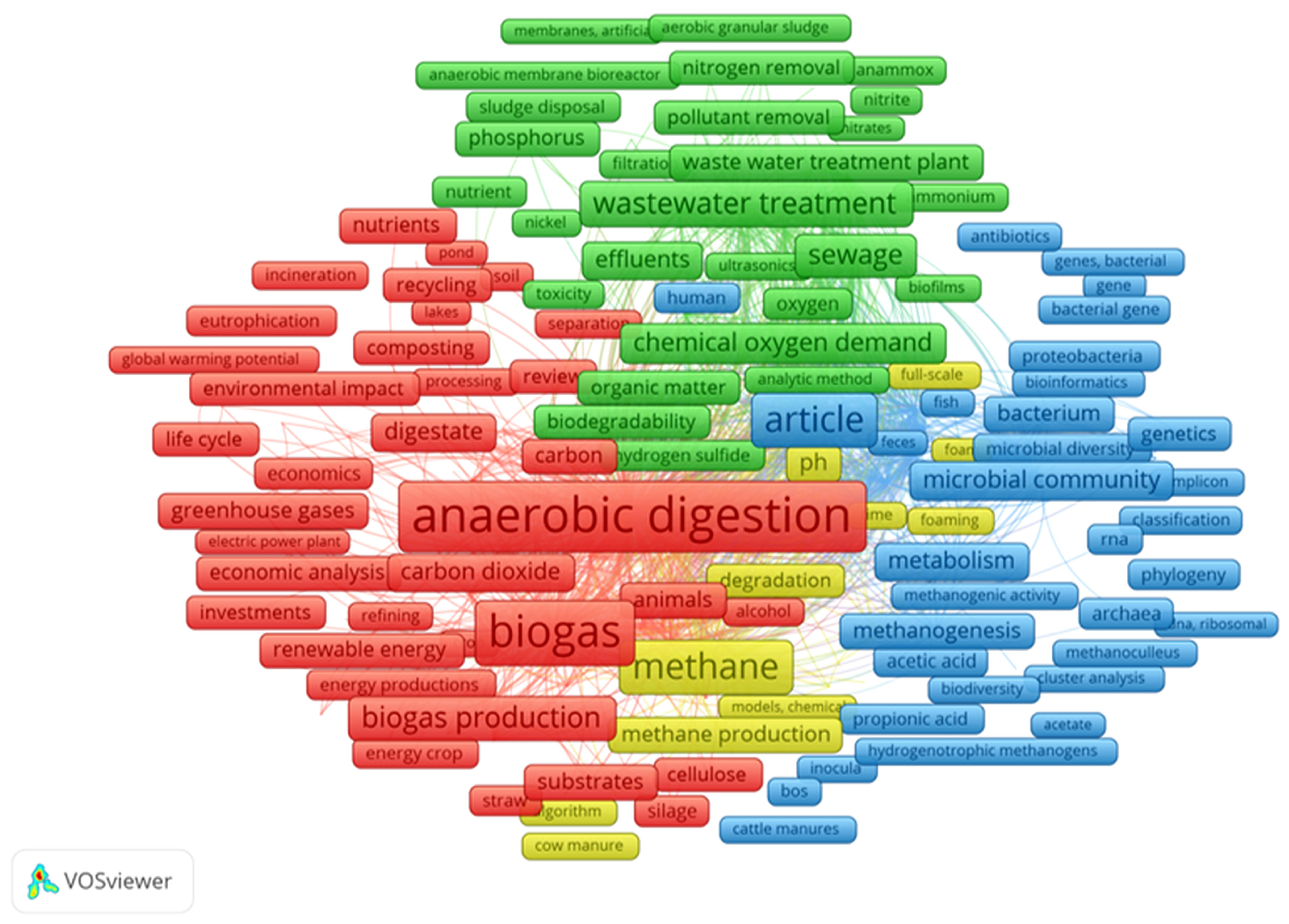
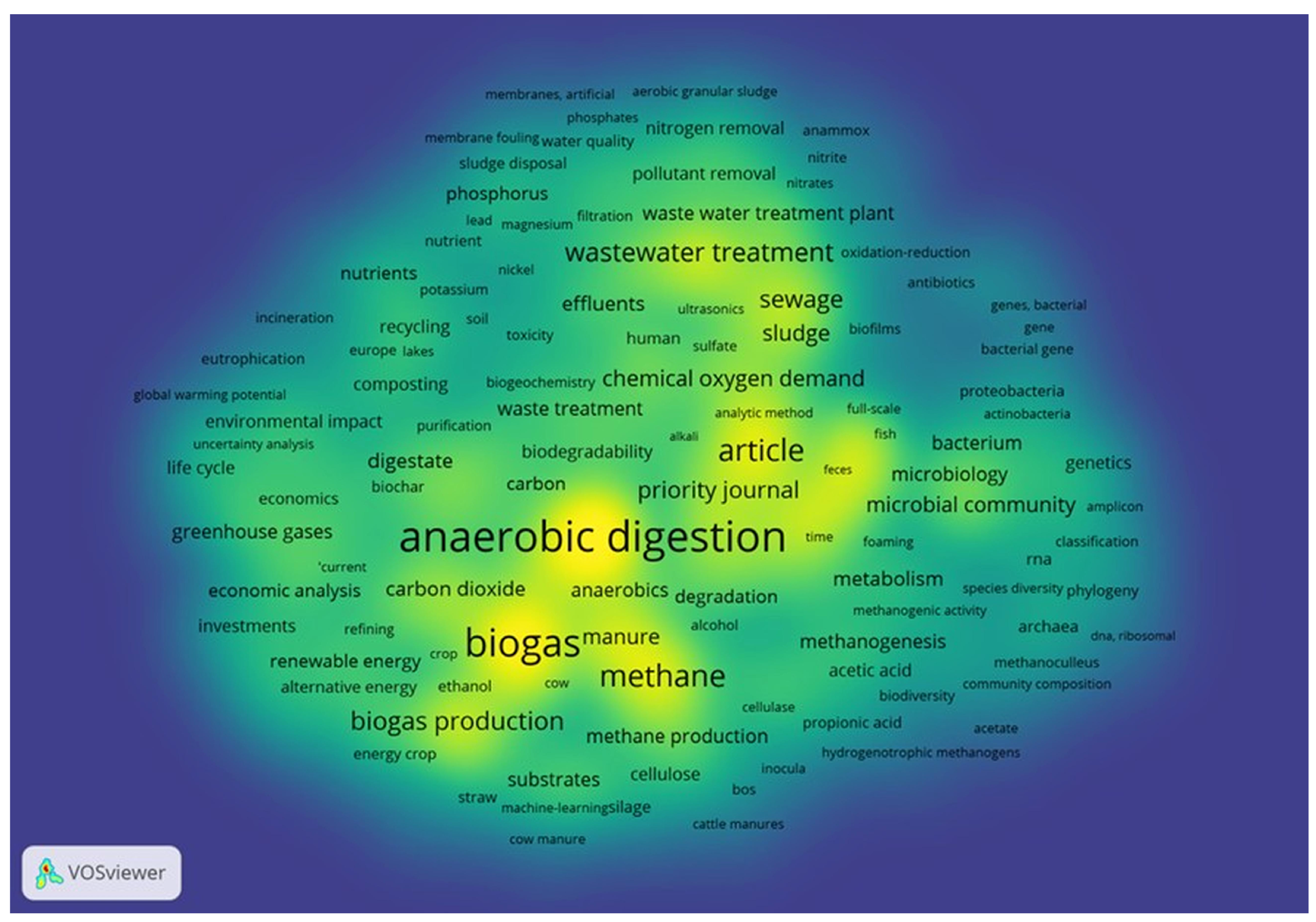
Category 1, associated with the Technology axis, is illustrated in Figure 6 and depicts the conceptual organization of the technological field of anaerobic digestion. The red cluster represents the technological core of the process, integrating terms such as anaerobic digestion, biogas, methane, and biogas production, alongside environmental concepts like carbon dioxide and greenhouse gases. The green cluster groups terms related to wastewater treatment—e.g., wastewater treatment, sewage, effluents, and chemical oxygen demand—highlighting the integration of anaerobic digestion into sanitation systems. The blue cluster comprises microbiological terms (microbial community, metabolism, methanogenesis, bacterium, archaea), underscoring the importance of biological knowledge for optimizing reactor efficiency. The yellow cluster relates to substrate composition (substrates, cellulose, acetic acid, propionic acid, volatile solids), while the light blue cluster includes methodological terms such as article, review, and full-scale. Altogether, this category provides an integrated view of the technical aspects underpinning the design and optimization of anaerobic digestion–based technologies.
Figure 7 presents a heatmap that reinforces the concentration of studies around anaerobic digestion and biogas production. The most intense zones indicate terms with the highest frequency and relevance, highlighting the thematic areas prioritized in technological development.
In Category 2, corresponding to Operational Parameters, the network shown in Figure 8 reveals five thematic clusters representing the most frequently cited variables in the operation of industrial anaerobic digesters. The red cluster groups the core parameters: pH, ammonia, nitrogen, carbon, and hydrogen, whose interactions determine system stability and microbial behavior. The green cluster encompasses terms related to the accumulation and degradation of intermediates, particularly volatile fatty acids and alkalinity—key indicators of the reactor’s chemical equilibrium. The blue cluster includes variables associated with organic loading, notably organic loading rate, chemical oxygen demand, and biochemical oxygen demand. The purple cluster covers hydraulic parameters, such as hydraulic retention time. Finally, the yellow cluster links biogas production with total solids and volatile solids, reflecting the energetic dimension of the process. This network highlights the strong interdependence among control parameters and confirms the central role of pH, temperature, ammonia, and volatile fatty acids as critical nodes for operational stability.
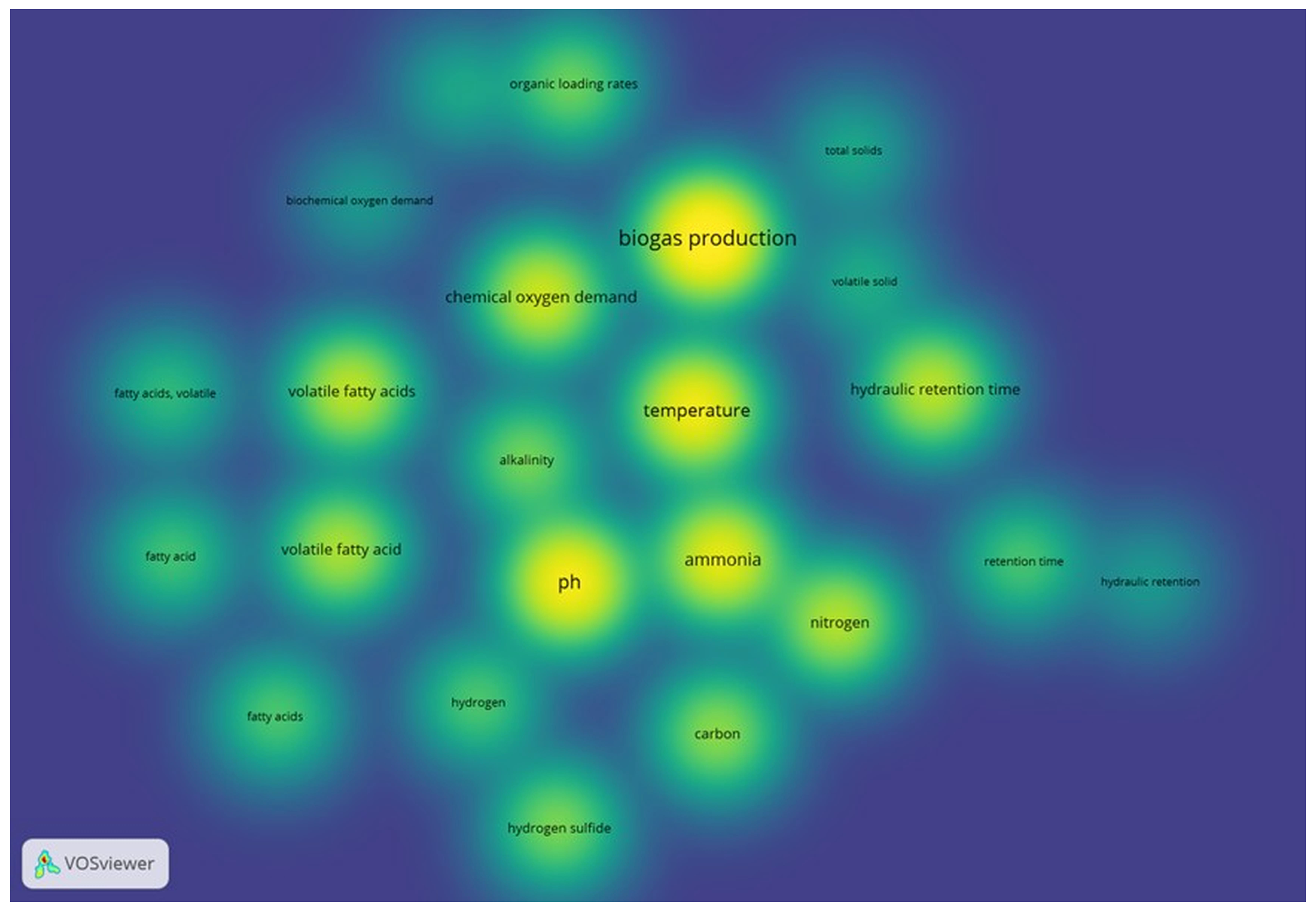
Likewise, Figure 9 presents a heatmap that highlights the concentration of studies around the most relevant operational parameters in anaerobic digestion processes. The most intense zones reflect terms with the highest frequency and relevance, with biogas production, pH, temperature, and ammonia emerging as the most extensively studied factors.
The heatmap concentration around biogas production, pH, temperature, and ammonia (deepest red zones) confirms these as the ‘inner circle’ of routine monitoring. The cooler zones (blue/green) surrounding parameters like electrical conductivity, rheology, and ORP indicate their peripheral status in current industrial practice, representing the primary knowledge gap this review identifies.
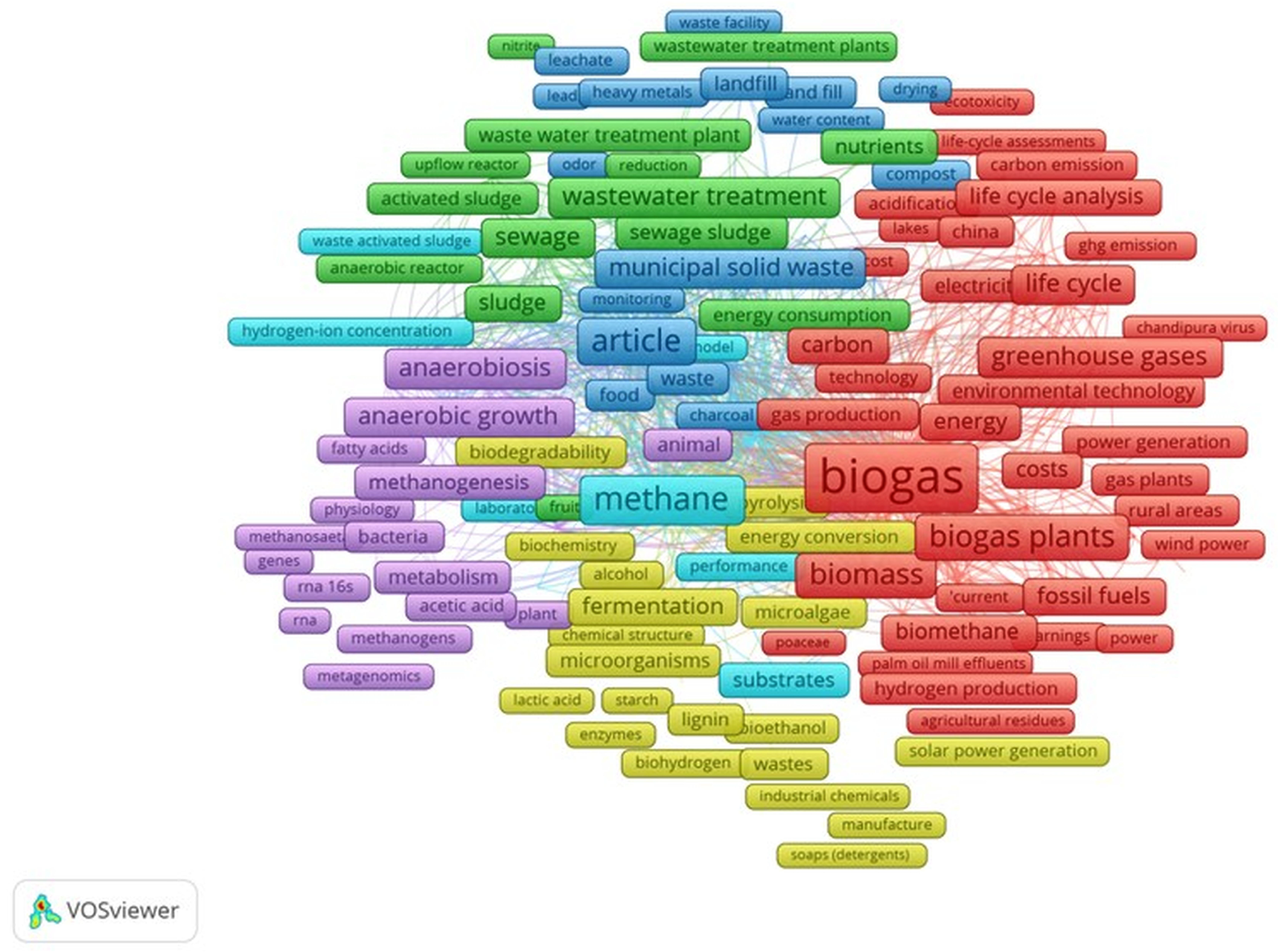
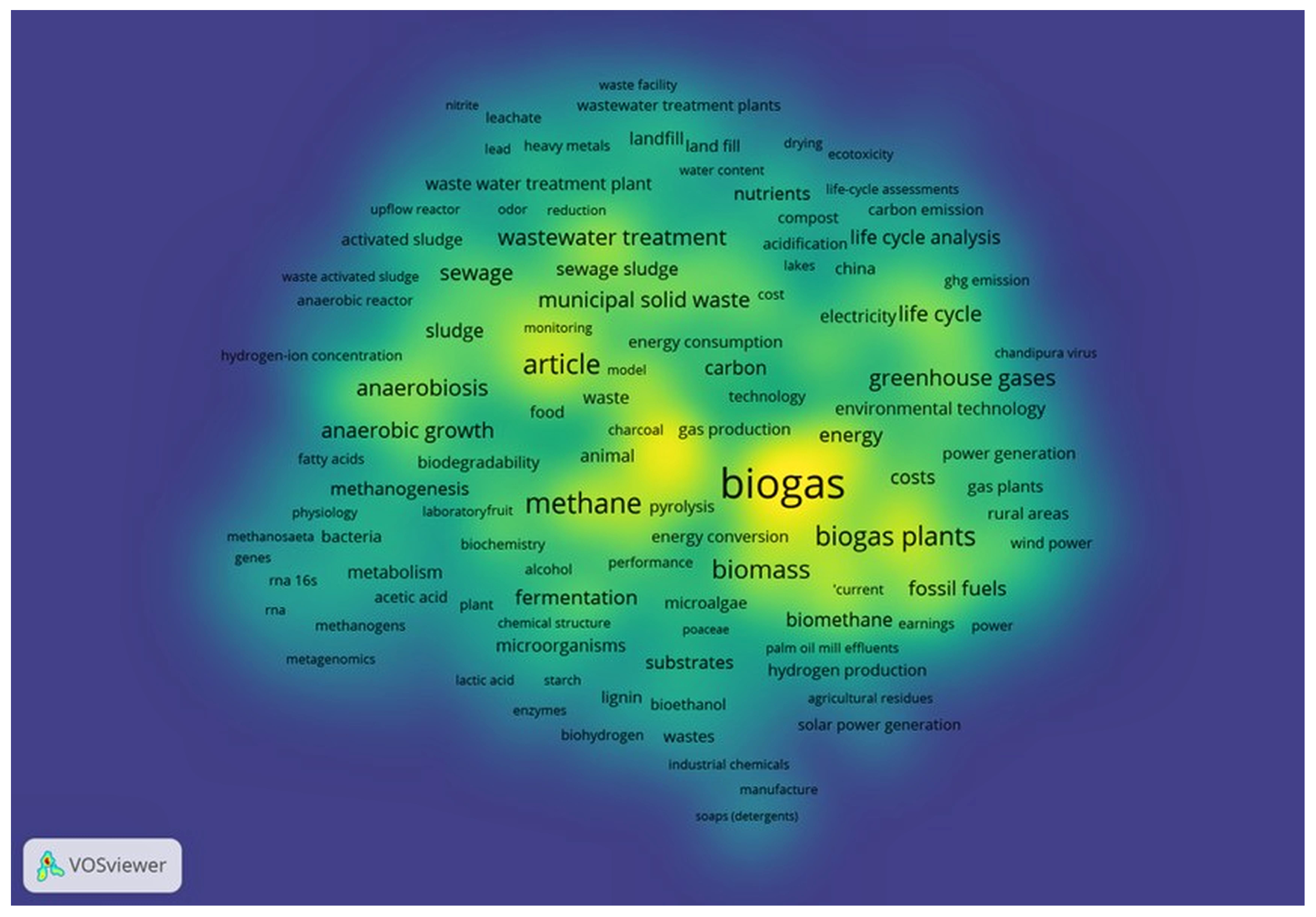
Finally, Category 3, corresponding to Sustainability and Industrial Application, is shown in Figure 10 and illustrates the interaction between anaerobic digestion and large-scale environmental and energy objectives. The red cluster links terms such as biogas, biogas plants, greenhouse gases, energy, life cycle, and environmental technology, reflecting a predominant focus on environmental assessment and the energy potential of biogas in industrial settings. The green cluster integrates municipal waste management concepts—e.g., solid waste, wastewater treatment, sewage sludge, landfill, and leachate—highlighting the relevance of anaerobic digestion as a strategy for waste valorization and emission mitigation. The blue cluster includes fundamental biological processes (anaerobiosis, anaerobic growth, methanogenesis, metabolism), while the yellow cluster encompasses substrate composition and conversion pathways such as biomass, substrates, fermentation, lignin, microalgae, and bioethanol. The light blue cluster groups methodological terms (article, model, monitoring) used in the analysis and optimization of real-scale plants. Altogether, this category demonstrates the growing consolidation of anaerobic digestion as a key technology in sustainability strategies, energy efficiency, and environmental management.
Similarly, Figure 11 presents a heatmap that highlights the concentration of studies related to sustainability and industrial application in the context of anaerobic digestion. The most intense zones reflect the terms with the highest frequency and relevance, with biogas, biogas plants, methane, and biomass emerging as central concepts in the literature.

4. Discussion of Technological and Operational Parameters

4.1. Integration of Bibliometric and Technical Findings

The bibliometric analysis (Section 3) revealed that operational parameters form distinct clusters with varying research maturity: Cluster 1—Established core (pH, temperature, ammonia, VFA): High occurrence (>130) + high link strength (>2800) Cluster 2—Emerging characterization (COD, TS/VS, H2S): Moderate occurrence (60–110) + growing trend Cluster 3—Underexplored integrative (EC, ORP, rheology): Minimal occurrence (<10) despite theoretical importance The following subsections analyze each cluster in depth, connecting bibliometric patterns with operational implications.

4.2. Focus Areas

As indicated in Section 2, this review focuses on the technological–operational parameters category due to its direct relationship with functional stability, anaerobic digestion efficiency, and the sustainability of industrial-scale biogas production. The following subsections describe each of these parameters, addressing their importance, role within the process, recommended operational ranges, and their impact on system stability and efficiency.

4.3. Established Parameters: Implementation Evidence

4.3.1. Temperature

Among the operational parameters, temperature (T) is critical because it regulates microbial activity and community structure, while also influencing the physicochemical properties of the substrate and the medium, including the solubility of organic compounds, gas transfer, viscosity, and ammonia speciation (NH3/ NH 4 + ) Low values (20–27 °C) reduce biogas yield due to limitations in hydrolysis and mass transfer, whereas thermophilic conditions (>50 °C) can cause inhibition through the accumulation of volatile fatty acids (VFAs), since acidogenic bacteria convert substrates to VFAs at a higher rate than methanogenesis can consume them [59]. In systems co-digesting nitrogen-rich substrates, such as poultry manure, it has been shown that the transition from mesophilic to thermophilic conditions increases free ammonia to inhibitory levels (0.4–0.7 g NH3/L), causing VFA accumulation of up to 2 g/L and a reduction in the specific methane potential [60]. Abrupt thermal changes are particularly detrimental: a sudden transition of 20 °C·d−1 markedly reduces methane production, whereas a gradual transition of 1 °C·d−1 limits the decrease, demonstrating that progressive acclimation preserves microbial syntrophic interactions and methanogenic activity [61]. Likewise, temperature increases in fed-batch systems can lead to sharp reductions in CH4 production, associated with the displacement of acetoclastic methanogenic archaea and the proliferation of sulfate-reducing bacteria that compete for common substrates [62]. Taken together, these findings confirm that the selection and maintenance of a stable thermal regime are essential to maximize substrate conversion and ensure operational robustness in industrial systems.
These results are consistent with the bibliometric analysis, which identifies “temperature” as the second most frequent keyword (147 occurrences), reflecting the broad recognition of its importance. However, the analysis also revealed that the terms “thermal stability” and “temperature control strategies” appear in only 23 documents, suggesting that knowledge about their practical implementation is still less developed than the awareness of their importance.

4.3.2. pH

pH is one of the most critical operational parameters in anaerobic digestion, as it regulates enzymatic activity and the stability of the microbial consortium responsible for hydrolysis, acidogenesis, and methanogenesis. An optimal near-neutral range (7.0–8.0) [63,64] favors methanogenic archaea, while significant deviations can inhibit the process and lead to VFA accumulation, thereby reducing biogas production [65]. Studies have shown that maximum methane generation occurs in digesters maintained at pH 7, with notable declines observed below pH 6.5 or above pH 8.0 [66,67]. Recent research confirms that dynamic pH control—through automated alkaline or acid dosing systems—is essential to maintain process resilience against organic loading fluctuations [68]. Moreover, extremely alkaline conditions (pH > 9) have been reported to alter microbial composition and reduce conversion efficiency, although some industrial applications explore elevated pH ranges to enhance ammonia release and biogas upgrading [69]. Altogether, these results demonstrate that pH management not only ensures digester stability but also directly influences the quantity and quality of biogas produced.
These findings are consistent with the bibliometric results of this study, which identify ‘pH’ as the most frequent operational keyword, with 154 occurrences and the highest total link strength in the co-occurrence network (Table 3), underscoring its central role as a primary stability indicator in industrial and pilot-scale digesters. At the same time, terms explicitly related to ‘pH control’ and ‘alkalinity management’ appear in a much smaller subset of documents, indicating that practical knowledge on advanced control and buffering strategies is still less developed than the general awareness of pH importance.

4.3.3. Volatile Fatty Acids (VFAs)

Practical monitoring of VFAs in industrial digesters is typically based on the VFA/TA ratio determined by titration (0.2–0.4 safe zone; >0.6–0.8 alarm zone) or on the titration/alkalinity alpha-factor (optimal 0.6–0.8), which correlates VFA accumulation with the bicarbonate buffering capacity without requiring gas chromatography. These rapid titration methods (15–30 min) enable operators to implement corrective actions—such as reducing the organic loading rate (OLR) or dosing alkalinity—before instability propagates. During the acidogenic phase of anaerobic digestion—subsequent to hydrolysis—the degradation of hydrolyzed products generates VFAs, including acetic acid, which are key metabolic intermediates closely linked to the chemo-microbial stability of the reactor. These compounds form the basis of the metabolic pathways leading to methanogenesis, as they are subsequently consumed by methanogenic archaea to produce methane and carbon dioxide, underscoring their essential role in substrate conversion efficiency [70,71]. However, VFA accumulation can trigger acidification episodes—particularly under pH disturbances or microbial stress—representing a critical source of operational instability and an early-warning indicator of process inhibition [72]. In large-scale applications, controlled operational conditions—such as pH around 6, short (HRT), and high (OLR)—have been shown to promote VFA accumulation, particularly acetic and butyric acids, reaching concentrations up to 48 g/L and highlighting their potential as valuable biochemicals in digestion systems oriented toward chemical valorization [73]. Overall, VFA dynamics reflect the internal reactor state and serve as a key diagnostic tool for anticipating imbalances and optimizing system stability.
These patterns are also reflected in the bibliometric results, where VFA-related terms appear fragmented into multiple variants—‘volatile fatty acid’, ‘volatile fatty acids’, ‘fatty acids, volatile’, ‘fatty acids’, and ‘fatty acid’—that together account for a high number of occurrences and link strengths (Table 3). This terminological split dilutes the apparent weight of VFAs in the co-occurrence network and partly explains why they may seem less central than other parameters when each variant is treated independently. Our normalization step, which grouped these five labels under a single VFA concept, confirms that VFAs form one of the core operational indicators in industrial digesters, even if the original keyword indexing is inconsistent across studies.
Complementarily, resistome evaluations in 90 industrial digesters under environmental, mesophilic, and thermophilic conditions show that higher temperature regimes significantly reduce the abundance, diversity, and mobility of antimicrobial resistance genes, highlighting the role of thermal control as an additional strategy to mitigate operational risks associated with the resistome in full-scale plants [74].
Consistently, staged digestion configurations have demonstrated that applying differentiated thermal regimes increases overall process efficiency, since elevated temperatures favor hydrolysis and acidogenesis, while methanogenesis maintains a more stable behavior under mesophilic conditions, allowing more precise metabolic control and higher operational stability [75].
It has also been observed that during abrupt temperature increases under high organic loads, biogas production immediately decreases due to the impact on hydrolytic and methanogenic activity; nevertheless, thermal recovery allows rapid restoration of performance without altering the microbial structure, indicating that industrial digesters tolerate short-term thermal deviations [76].
Thus, operation in thermophilic regime (55 °C) has shown to increase process efficiency by producing 20–28% more biogas and 5–10% more methane compared to mesophilic regime (35 °C), besides reducing stabilization time to 7–8 days and improving biogas quality by lowering CO2 and H2S, reinforcing its potential for high productivity industrial applications [77].
The C/N ratio constitutes a decisive factor in anaerobic digestion, as it regulates the balance between carbon availability as energy source and nitrogen as essential nutrient, influencing process stability and methane production.
Several studies have demonstrated that maintaining optimal ratios between 20 and 30 favors methanogenic activity and prevents acidification phenomena, which is confirmed by models validated in continuous digestion [78].
Furthermore, reviews on co-digestion of food waste and poultry manure demonstrate that manipulating C/N by mixing heterogeneous substrates increases energy efficiency and reduces greenhouse gas emissions, contributing to sustainability [79].
Likewise, modeling and simulation tools have been developed to predict digester behavior under different C/N scenarios, optimizing operation [80], while analyses on digestion of agricultural and food by-products highlight their role in circular economy by generating biofertilizers with improved nutritional profiles [81].
On the other hand, the incorporation of natural adsorbents such as Ecuadorian zeolite has demonstrated to reduce ammonia concentration in nitrogen-rich waste systems, stabilizing the process and enhancing methane production [82], and studies on algae digestion confirm that controlling C/N, along with parameters like temperature and organic load, is key to maximizing biochemical conversion [83].
Moreover, investigations on thermochemical pretreatments applied to lignocellulosic residues reveal that modifying C/N through pretreatment processes increases substrate biodegradability and boosts biogas generation [84], while reviews on volatile fatty acid production in acidogenic fermentation demonstrate that this parameter affects not only methanogenesis but also accumulation of compounds of industrial interest, opening opportunities for their valorization in biorefinery schemes [85].
Ammonia has consolidated as a critical parameter in industrial anaerobic digestion due to its dual role as essential nutrient and inhibitor at high concentrations.
Studies show that excessive ammoniacal nitrogen levels can be toxic to methanogenic archaea, reducing methane production and compromising process stability; however, strategies such as gradual microbiome domestication have been proposed to improve tolerance to high ammonium loads, representing significant progress in biodigester operation [86].
Additionally, optimizing reactor design and integrating hybrid technologies mitigate ammonia inhibition, enhancing energy efficiency and nutrient recovery [87,88].
At the microbiological level, shifts in methanogenic community structure under high ammonia concentrations have been identified, which opens opportunities to design more resilient and adaptive consortia [89].
Complementary processes such as co-production of biomethane and ammonia, as well as nitrogen valorization in fertilizer form, contribute to system sustainability [90,91,92,93].
The application of microaeration improves process stability by reducing the accumulation of sulfur compounds and attenuating metabolic imbalances associated with variations in volatile fatty acid generation in anaerobic reactors [94].
Directed production of acetic and butyric acids under acidogenic conditions favors specific metabolic pathways and enables the valorization of these compounds within biorefinery schemes [95].
In industrial systems, the molecular composition of the dissolved organic fraction shows a direct correlation with the microbial structure responsible for VFA formation, relating changes in its profile to transformations in the microbiome and episodes of chemical instability [96].
At pilot scale, operational adjustment including pH close to 6, reduced hydraulic retention times, and inhibition of methanogenesis allows achieving high concentrations of carboxylic acids (40–48 g/L), demonstrating the technical feasibility of promoting VFA accumulation for valorization purposes [97].
The study demonstrates that intermittent mixing operation in industrial reactors reduces VFA accumulation by improving biomass–substrate contact, avoiding acidogenic overloads and favoring efficient transition to methanogenesis, resulting in a more stable and resilient process against operational fluctuations [98].
VFA variations reflect with high sensitivity changes in reactor metabolic stability, since their monitoring, along with organic loading and methane production, allows early identification of deviations in microbial activity under temperature and substrate composition fluctuations in industrial systems [99].
In industrial sludge co-digestion, VFAs reflect acidogenic efficiency, evidenced by lactic acid conversion to C4 VFAs under optimal conditions. Total VFA levels between 22.5 and 30.2 g/L confirm their value as an operational indicator to adjust mixtures and avoid overloads that compromise transition to methanogenesis. These results support the use of VFAs as a control tool in industrial two-stage systems [100].
In industrial dry digesters, VFA accumulation functions as a highly sensitive indicator of operational instability, especially under high loads and nitrogen-rich substrates. It was identified that increases in the VFA/TA ratio (above 0.8–1.0) anticipate drops in biogas production, offering an early warning tool to adjust mixtures and avoid overload-related inhibitions. These results highlight the potential of VFAs as a key parameter to optimize process control and resilience in full-scale operation [101].
Alkalinity acts as a buffer system against pH variations, ensuring process stability and preventing inhibition due to volatile fatty acid accumulation. Research has demonstrated that supplementation with innovative technologies, such as the use of nanobubble water, improves microbial dynamics and contributes to maintaining the system’s buffering capacity, resulting in greater resilience against perturbations [102].
Complementarily, studies on the incorporation of conductive materials, such as graphene oxide and iron-loaded biochar, have shown that these not only increase electron transfer but also influence the chemical stability of the medium, favoring alkalinity and electrical conductivity regulation, parameters closely related to methanogenic community activity. Furthermore, these materials can act as enzyme cofactors for key microbial groups involved in acetogenesis and methanogenesis, enhancing their metabolic activity and contributing to greater process stability [103,104,105].
Likewise, characterization of the aqueous phase in processes such as hydrothermal liquefaction confirms that adequate alkalinity is key to biodegradability [106], and in poultry waste it has been proven to prevent ammonia accumulation [107].
On the other hand, stable operation of thermophilic co-digestion with reduced HRT confirms that maintaining adequate alkalinity is determinant to avoid acidification episodes and ensure sustained methane production [23].
Chemical pretreatments applied to biomass such as sugar beet pulp—characterized by its high carbohydrate content and low nitrogen concentration—can lead to the release of organic acids as a result of the chemical solubilization of lignocellulosic material. This phenomenon is intrinsic to the physicochemical pretreatment and should not be confused with the biological hydrolysis stage within anaerobic digestion, during which macromolecules are enzymatically depolymerized but short-chain fatty acids are not yet formed. The generation of volatile fatty acids (VFAs) occurs strictly during the acidogenic phase, which follows biological hydrolysis. In this context, alkalinity adjustments are necessary to compensate for the acidity generated during pretreatments and to ensure process stability during acidogenesis. Electrical conductivity (EC) serves in this scenario as a complementary indicator to assess ionic balance, salt accumulation, and to anticipate operational deviations resulting from the dosing of alkalinizing agents [108].
Reduced HRT allowed identifying critical stability limits, showing that values below 30 days generate abrupt VFA accumulation, alkalinity loss, and methanogen washout, while an HRT of 30 days maximizes COD conversion to methane and maintains a stable microbial community in industrial-scale mesophilic CSTR reactors [109].
In plants processing agricultural waste, prolonged HRT (67–94 days) combined with mechanical pretreatment improves lignocellulosic substrate degradation, increases methanogenic yield, and reduces operational problems, ensuring stability against feed variations and allowing positive energy balance [110].
Microbial acclimation of thermophilic digestate enabled processing Polylactic Acid (PLA) together with Municipal Solid Waste Organic Fraction (MSWOF) within industrial HRTs, increasing biogas yield (152% in mono-digestion and 69% in PLA + MSWOF) and reducing conversion times, constituting an economical alternative to integrate bioplastics without additional pretreatments [111].
In industrial digesters treating palm oil mill effluent, HRTs close to 22 days optimize degradation and energy yield without requiring larger reactor volume, confirming as an efficient operational window through advanced simulation [112].
In source-separated industrial effluents, their high biodegradability allows operation with short HRTs, increasing volumetric biogas productivity and reducing costs, observing that excessive HRTs do not provide additional conversion improvements [113].
Likewise, in biogas plants, longer HRTs favor complete transformation of organic nitrogen to available ammoniacal forms and define digestate agronomic quality, highlighting their relevance in overall system efficiency [114].
At full scale, even HRTs of (13–130) days leave fermentable fractions in the digestate; however, there is a negative correlation between HRT and residual methane, demonstrating that extending it improves degradation and can be profitable by recovering additional methane [115].
Additionally, the interaction between HRT and substrate elemental composition conditions residual methanogenic potential and micronutrient availability, confirming that operating with appropriate HRTs maximizes energy utilization and ensures complete digestion in industrial plants [116].
COD consolidates as a central stability indicator in industrial anaerobic digesters, showing high removals (84–86%) even under temperatures between 0 and 15 °C and strong influent variations, provided pH and alkalinity control is adequate [117]. Its utility is also confirmed in thermophilic digestion with complex streams, where soluble COD increases allow identifying volatile fatty acid accumulation, inhibition episodes, and the need to adjust alkalinity to sustain methanogenic activity [118].
In systems such as Membrane Anaerobic Bioreactor (MABR), the combination of bioprocess and membrane separation maintains low COD effluents and avoids microbial washout, ensuring stability even in temperate climates [119].
During acidogenesis, COD reflects hydrolytic efficiency according to inoculum and protein type, modulating intermediate generation and providing criteria for selecting robust consortia in early stages [120].
In Internal Multifase Ascending Flow Reactors (IMFA) for paper mill effluents, its monitoring through soft sensors allows anticipating load fluctuations and preventing operational overloads [121].
Similarly, in industrial UASB reactors, influent and effluent COD is closely linked to methanogenic structure and reactor performance, functioning as an early diagnosis of imbalances [122].
At design level, COD measurements under representative operating conditions, including real particle sizes and industry-compatible alkalinity, allow estimating more accurate methanogenic yields and reducing uncertainty in energy planning [123]. Finally, in plants with aerobic granular sludge, identifying organic fractions with residual degradable COD opens opportunities to increase biogas production without expanding existing infrastructure, positioning COD as a strategic parameter to integrate and optimize industrial-scale energy valorization schemes [124].
While integrative variables such as EC and oxidation-reduction potential (ORP) appear in <5% of studies, alkalinity remains a cornerstone parameter for buffering capacity assessment, with optimal levels of 2500–5000 mg CaCO3/L ensuring VFA neutralization. The authors have previously implemented combined EC-pH-alkalinity monitoring in operational small-scale digesters, demonstrating that this integrative approach enables early detection of ionic imbalances and process instability 24–48 h before pH deviation, validating the need for expanded adoption of these parameters in industrial settings. These studies showed that EC responds sensitively to variations in process stability, buffer capacity, and biogas productivity, which made it possible to define optimal operating ranges and anticipate system deviations. However, these experiences were limited to small-scale facilities, so the systematic validation of EC and associated redox parameters in industrial-scale anaerobic digestion plants remains a significant gap that this review identifies as a priority for future research [31].

4.3.4. Operational Parameters in Industrial Biodigesters

The bibliometric results obtained confirm that the operation of industrial-scale biodigesters has been built around a relatively limited set of operational parameters. The high frequency of appearance and strong link intensity of variables such as biogas or methane production, pH, temperature, ammoniacal nitrogen, VFA, alkalinity, HRT, and OLR show that these indicators constitute the “hard core” of monitoring in industrial plants. This pattern has been consistent over the last 25 years and aligns with the classical recommendations of manuals and operational guides, suggesting that the technical community has reached a reasonable consensus on which variables are essential for evaluating process stability.
However, the review also reveals that, even within this core set, relevant discrepancies persist when knowledge is transferred from the laboratory to the industrial scale. The reported ranges for HRT, OLR, or C/N ratio in case studies show considerable dispersion, conditioned by the type of substrate, thermal regime, reactor configuration, and operational constraints of each plant. This reinforces the idea that, although the core parameters are well identified, their practical application in industrial biodigesters continues to depend heavily on empirical criteria and the local experience of operators.

4.4. Needs, Prospects, Limitations, and Future Directions

4.4.1. Bibliometric Analysis

The bibliometric analysis identified a well-established scientific structure around industrial anaerobic digestion, highlighting a marked geographical concentration of knowledge in Europe and Asia, particularly in countries such as Germany and China, which lead publications on technology, operational parameters, and sustainability. Temporal trends show steady growth since 2010, peaking between 2019 and 2025, confirming the increasing interest in optimizing industrial biodigesters and their integration into energy transition. Co-occurrence networks revealed robust thematic cores, notably anaerobic digestion, biogas production, wastewater treatment, and microbial stability. Parameters such as pH, temperature, ammonia, VFAs, COD, and HRT exhibit the highest connectivity and recurrence in the literature, reflecting their central role in process operation and diagnosis. Collectively, these results indicate global research orientation toward anaerobic process refinement and consolidate the foundations to understand technical and operational gaps addressed in this review.

4.4.2. Focus Area

The analysis centered on technological-operational parameters confirms that the stability and efficiency of industrial biodigesters depend on a closely interrelated set of variables. Parameters such as pH, temperature, C/N ratio, ammonia, VFAs, alkalinity, COD, and HRT directly determine microbial balance, process resilience, and methane production, standing out as the most critical indicators identified both in literature and observed dynamics in real systems. The analyzed studies show that proper adjustment of these parameters not only optimizes biochemical conversion and reduces inhibition episodes but also enables integrating emerging strategies such as VFA valorization, inhibitor mitigation through natural adsorbents, enhanced microbial activity via pretreatments, and staged operation with thermal differentiation. Overall, findings show industrial efficiency depends more on fine management of these variables than on reactor type, emphasizing the need for robust and adaptive operational control to sustain productivity at large scale.

4.4.3. Emerging Parameters and Sustainability Focus

A second group of variables shows lower frequency of appearance but a growing trend over the last decade. Among them stand out COD, total and volatile solids, nitrogen and organic carbon, as well as hydrogen sulfide in biogas. Their role is clearly distinct from that of the core classical parameters: rather than direct indicators of stability, they are used as metrics for effluent quality, nutrient recovery, and environmental impact associated with emissions and digestate use.
This behavior is consistent with the conceptual transition from an approach centered solely on energy production toward a vision of overall system efficiency and sustainability. The increase in studies analyzing simultaneously energy efficiency, emission reduction, digestate valorization, and regulatory compliance explains why variables such as COD, TS/VS, or H2S have gained weight in recent years. Nevertheless, their relatively lower presence indicates that they are still mainly reported as characterization results rather than active control variables in the daily operation of biodigesters.

4.4.4. Medium State Variables: A Critical Gap in Industrial Monitoring

Perhaps the most relevant finding of this review is the extremely scarce presence of parameters describing the global state of the digestion medium, such as EC, ORP, or the rheological properties of the digestate. Despite their direct relationship with ionic strength, buffering capacity, micronutrient availability, and the system’s mixing behavior, these variables barely appear as keywords in the analyzed literature and are rarely mentioned as part of routine monitoring schemes in industrial plants.
Specific searches focused on EC confirm this gap: the number of articles reporting it in the context of anaerobic digestion is small, and most use it to characterize digestates, soils, or conductive materials (such as biochars), rather than as an operational parameter in the reactor. A similar situation occurs with ORP and rheology, which usually appear sporadically in laboratory studies but rarely in real plant reports. In other words, the biogas industry measures in great detail point variables (pH, VFA, NH 4 + , COD) but largely ignores metrics that capture the integral state of the reaction medium.
This absence is especially striking considering that industrial operations increasingly depend on continuous monitoring systems, automation, and advanced control. From that perspective, parameters like EC and ORP have high potential to function as integrative variables in soft sensing schemes, enabling indirect inference of VFA evolution, free ammonia accumulation, or changes in the system’s buffering capacity.
From a practical point of view, the results of this review indicate that industrial biogas plants operate with a well-defined but relatively limited set of parameters, and that there is considerable scope to strengthen monitoring robustness by incorporating medium state variables. Integrating EC, ORP, or rheological indicators into plant instrumentation would make it possible to build predictive models that combine fast and easy-to-measure information with classical stability parameters, thereby reducing reliance on slow or discontinuous laboratory analyses.
For the design of new facilities, this implies that sizing criteria for HRT, OLR, C/N ratio, and mixing systems could be complemented with recommended operational windows of EC or ORP associated with different substrate types and thermal regimes. At the control level, the combination of EC sensors with measurements of pH, temperature, and biogas production opens the door to the development of supervisory strategies capable of anticipating failures, detecting inhibition by VFAs or ammonia, and optimizing digestate recirculation or the dosing of alkalizing agents.
In this context, the research agenda arising from this work–which guides subsequent experimental and modeling studies–focuses precisely on validating, quantifying, and exploiting the potential of EC and other emerging metrics as reference variables for the advanced control of industrial biodigesters.

5. Conclusions

The bibliometric review of 1327 publications on industrial and pilot-scale biodigesters confirms that large-scale anaerobic digestion is conceptually a mature technology today, but still far from achieving operational standardization that guarantees robust and reproducible performance in real plants. Co-occurrence maps and the temporal evolution of keywords reveal a well-defined scientific structure, with consolidated thematic cores around biogas production, microbiological stability, and the integration of AD into circular economy and energy transition frameworks.
The evidence confirms a consolidated core of control variables: pH, temperature, ammonium/TAN, AGV, alkalinity, TRH, and VOC. The bibliometric centrality of pH (154 occurrences; 3667 links) and temperature (147; 3255), followed by ammonium (131; 2824), demonstrates international consensus on their critical role in process stability and performance.
A systematic underrepresentation of integrative variables of the state of the environment (CE), ORP, and rheology of the digestate is confirmed, with a presence of < 5 % in the studies analyzed. This asymmetry indicates that industrial monitoring continues to focus on specific variables rather than on global indicators with high potential for continuous sensing, early diagnosis of instability, and advanced control.
The comparative synthesis shows high dispersion of reported ranges for TRH, COV, C/N ratio, temperature, and AGV thresholds, even among similar reactor types. This heterogeneity reflects not only differences in substrate and context, but also the absence of harmonized operating windows and validated protocols for operation with real, complex, and dynamic flows.
Industrial anaerobic digestion is a mature technology in terms of its conceptual basis, but its monitoring and control architecture is still incomplete. The main obstacle is not the lack of classic variables, but rather the low integration of global environmental metrics and the absence of robust operational standardization. Closing this gap is the technical condition for moving from “functional” plants to highly efficient, highly reliable, and highly reproducible plants within circular economy and decarbonization frameworks.
Altogether, the review provides a structured map of what the scientific community solidly knows about industrial biodigester operation and, above all, what is still not being measured or modeled with the necessary depth. Addressing this gap—especially through integrating medium global parameters and advanced monitoring tools—will be crucial for industrial biogas plants to evolve from “tolerated” systems due to their renewable contribution into true high-efficiency, high-reliability technologies within global-scale circular economy and decarbonization models.

Supplementary Materials

The following supporting information can be downloaded at: https://www.mdpi.com/article/10.3390/sci8040071/s1.

Author Contributions

Conceptualization, Y.C.A., J.J.C.N., G.V.Q.S. and R.J.B.; Methodology, Y.C.A., J.J.C.N., G.V.Q.S. and R.J.B.; Software, J.J.C.N. and G.V.Q.S.; Validation, R.J.B., Y.C.A., J.J.C.N. and G.V.Q.S.; Formal analysis, Y.C.A., J.J.C.N., G.V.Q.S. and R.J.B.; Investigation, Y.C.A., J.J.C.N., G.V.Q.S. and R.J.B.; Resources, Y.C.A., J.J.C.N., G.V.Q.S. and R.J.B.; Data curation, Y.C.A., J.J.C.N., G.V.Q.S. and R.J.B.; Writing original draft preparation, review, and editing, Y.C.A., J.J.C.N., G.V.Q.S. and R.J.B. All authors have read and agreed to the published version of the manuscript.

Funding

This research received no external funding.

Informed Consent Statement

Not applicable.

Data Availability Statement

The original contributions presented in this study are included in the article/Supplementary Materials. Further inquiries can be directed to the corresponding author.

Conflicts of Interest

The authors declare no conflicts of interest.

References

  1. Javan, K.; Altaee, A.; BaniHashemi, S.; Darestani, M.; Zhou, J.; Pignatta, G. A review of interconnected challenges in the water–energy–food nexus: Urban pollution perspective towards sustainable development. Sci. Total Environ. 2024, 912, 169319. [Google Scholar] [CrossRef] [PubMed]
  2. Ni, J.Q. A review of household and industrial anaerobic digestion in Asia: Biogas development and safety incidents. Renew. Sustain. Energy Rev. 2024, 197, 114371. [Google Scholar] [CrossRef]
  3. Samsuri, I.A.; Yusoff, M.Z.M.; Hassan, M.A.; Sharaai, A.H.; Ramli, N.; Farid, M.A.A.; Abd Hamid, M.A.; Maeda, T. Evaluating greenhouse gas reduction in Seremban, Malaysia: A pilot study on biogas production from organic municipal solid waste. Energy Sustain. Dev. 2025, 86, 101718. [Google Scholar] [CrossRef]
  4. Patinvoh, R.J.; Taherzadeh, M.J. Challenges of biogas implementation in developing countries. Curr. Opin. Environ. Sci. Health 2019, 12, 30–37. [Google Scholar] [CrossRef]
  5. Yuan, T.; Zhang, Z.; Lei, Z.; Shimizu, K.; Lee, D.J. A review on biogas upgrading in anaerobic digestion systems treating organic solids and wastewaters via biogas recirculation. Bioresour. Technol. 2022, 344, 126412. [Google Scholar] [CrossRef]
  6. Qamar, S.; Zhang, Q.; Ahmad, M.; Pinzon, S.; Ahmed, N.; Işık, C. Roadmap to green future: Biodigester technology acceptance to upscale rural energy access. Energy 2025, 315, 134437. [Google Scholar] [CrossRef]
  7. Li, Y.; Achinas, S.; Zhao, J.; Geurkink, B.; Krooneman, J.; Euverink, G.J.W. Co-digestion of cow and sheep manure: Performance evaluation and relative microbial activity. Renew. Energy 2020, 153, 553–563. [Google Scholar] [CrossRef]
  8. Glivin, G.; Mariappan, V.; Premalatha, M.; Krishnan, H.H.; Sekhar, S.J. Comparative study of biogas production with cow dung and kitchen waste in Fiber-Reinforced Plastic (FRP) biodigesters. Mater. Today Proc. 2022, 52, 2264–2267. [Google Scholar] [CrossRef]
  9. Elsayed, M.; Andres, Y.; Blel, W. Anaerobic co-digestion of linen, sugar beet pulp, and wheat straw with cow manure: Effects of mixing ratio and transient change of co-substrate. Biomass Convers. Biorefin. 2023, 13, 11831–11840. [Google Scholar] [CrossRef]
  10. Elsayed, M.; Diab, A.; Soliman, M. Methane production from anaerobic co-digestion of sludge with fruit and vegetable wastes: Effect of mixing ratio and inoculum type. Biomass Convers. Biorefin. 2021, 11, 989–998. [Google Scholar] [CrossRef]
  11. European Commission, DG Energy C2; European Biogas Association; Common Futures. BIP Work Programme. Document Adopted by the Governing Board on 24 October 2022, Updated in February 2024, 2024. Biomethane Industrial Partnership Work Programme. Available online: https://www.europeanbiogas.eu/wp-content/uploads/2025/06/EBA-Roadmap-towards-2040-09.05.25-1.pdf (accessed on 23 March 2026).
  12. Gomes de Jesus, R.H.; Taveira de Souza, J.; Puglieri, F.N.; Piekarski, C.M.; de Francisco, A.C. Biodigester location problems, its economic–environmental–social aspects and techniques: Areas yet to be explored. Energy Rep. 2021, 7, 3998–4008. [Google Scholar] [CrossRef]
  13. Uludag-Demirer, S.; Xu, M.; Marks, A.; Liu, Y.; Saffron, C.; Liao, W. Influence of biochar on microbial communities and anaerobic digestion of aqueous pyrolysis liquid (APL). Biomass Bioenergy 2025, 198, 107891. [Google Scholar] [CrossRef]
  14. Rosa, A.P.; Lopes, J.O.; Carlo, J.C.; Borges, A.C.; Maradini, P.d.S. Thermal exchanges in a covered lagoon biodigester treating pig farm effluent heated by solar energy. Energy Agric. 2023, 43, e20220130. [Google Scholar] [CrossRef]
  15. Achuka, O.; Chijindu, I.; Ogwo, V.; Nkem, N. Kinetic analysis of mud insulation’s impact on fixed dome biogas digester performance. Energy Rep. 2024, 12, 3743–3769. [Google Scholar] [CrossRef]
  16. Westerholm, M.; Liu, T.; Schn"urer, A. Comparative study of industrial-scale high-solid biogas production from food waste: Process operation and microbiology. Bioresour. Technol. 2020, 304, 122981. [Google Scholar] [CrossRef] [PubMed]
  17. El-Mashad, H.M.; van Loon, W.K.P.; Zeeman, G.; Bot, G.P.A.; Lettinga, G. Design of a Solar Thermophilic Anaerobic Reactor for Small Farms. Biosyst. Eng. 2004, 87, 345–353. [Google Scholar] [CrossRef]
  18. Gómez-Quiroga, X.; Aboudi, K.; Álvarez-Gallego, C.J.; Romero-García, L.I. Successful and stable operation of anaerobic thermophilic co-digestion of sun-dried sugar beet pulp and cow manure under short hydraulic retention time. Chemosphere 2022, 293, 133484. [Google Scholar] [CrossRef]
  19. Hajizadeh, A. Biogas Production by Psychrophilic Anaerobic Digestion and Biogas-to-Hydrogen Through Methane Reforming: Experimental Study and Process Simulation. Master’s Thesis, Memorial University of Newfoundland, Norris Point, NL, Canada, 2021. [Google Scholar]
  20. Pečar, D.; Pohleven, F.; Goršek, A. Kinetics of methane production during anaerobic fermentation of chicken manure with sawdust and fungi pre-treated wheat straw. Waste Manag. 2020, 102, 170–178. [Google Scholar] [CrossRef]
  21. Arthur, P.M.A.; Konaté, Y.; Sawadogo, B.; Sagoe, G.; Dwumfour-Asare, B.; Ahmed, I.; Bayitse, R.; Ampomah-Benefo, K. Evaluating the Potential of Renewable Energy Sources in a Full-Scale Upflow Anaerobic Sludge Blanket Reactor Treating Municipal Wastewater in Ghana. Sustainability 2023, 15, 3743. [Google Scholar] [CrossRef]
  22. Sousa, I.P.; Rosa, A.P.; Lopes, J.O.; Magos, B.R.; Cecon, P.R.; Perez, R.; Borges, A.C. Study of internal and external temperatures and their influence on covered lagoon digester performance. Biomass Bioenergy 2022, 159, 106380. [Google Scholar] [CrossRef]
  23. Diniz, B.C.; Wilfert, P.; Sorokin, D.Y.; van Loosdrecht, M.C. Anaerobic digestion at high-pH and alkalinity for biomethane production: Insights into methane yield, biomethane purity, and process performance. Bioresour. Technol. 2025, 429, 132505. [Google Scholar] [CrossRef]
  24. Mohamed, Z.; Fattah, M.; Shamkhy, A. Investigation of solid waste generation rate and biogas production. Results Eng. 2024, 23, 102531. [Google Scholar] [CrossRef]
  25. Obileke, K.; Nwokolo, N.; Makaka, G.; Mukumba, P.; Onyeaka, H. Anaerobic digestion: Technology for biogas production as a source of renewable energy—A review. Energy Environ. 2020, 32, 191–225. [Google Scholar] [CrossRef]
  26. Wang, Z.; Hud, Y.; Wang, S.; Wu, G.; Zhan, X. A critical review on dry anaerobic digestion of organic waste: Characteristics, operational conditions, and improvement strategies. Renew. Sustain. Energy Rev. 2023, 176, 113208. [Google Scholar] [CrossRef]
  27. Omondi, E.A. Anaerobic Co-Digestion of Water Hyacinth Eichhornia crassipes with Ruminal Slaughterhouse Waste Under Mesophilic Conditions. Ph.D. Thesis, University of Nairobi, Nairobi, Kenya, 2020. [Google Scholar] [CrossRef]
  28. Filer, J.; Ding, H.; Chang, S. Biochemical Methane Potential (BMP) Assay Method for Anaerobic Digestion Research. Water 2019, 11, 921. [Google Scholar] [CrossRef]
  29. Zou, H.; Jiang, Q.; Zhu, R.; Chen, Y.; Sun, T.; Li, M.; Zhai, J.; Shi, D.; Ai, H.; Gu, L.; et al. Enhanced hydrolysis of lignocellulose in corn cob by using food waste pretreatment to improve anaerobic digestion performance. J. Environ. Manag. 2019, 254, 109830. [Google Scholar] [CrossRef]
  30. Kesharwani, N.; Bajpai, S. Pilot scale anaerobic co-digestion at tropical ambient temperature of India: Digester performance and techno-economic assessment. Bioresour. Technol. Rep. 2021, 15, 100715. [Google Scholar] [CrossRef]
  31. Camacho Alvarez, D.G.; Chávez García, J.A.; Castillo Alvarez, Y.; Jiménez Borges, R. Sustainable Valorization of Bovine–Guinea Pig Waste: Co-Optimization of pH and EC in Biodigesters. Recycling 2025, 10, 190. [Google Scholar] [CrossRef]
  32. Uma, S.; Thalla, A.K.; Devatha, C.P. Co-digestion of Food Waste and Switchgrass for Biogas Potential: Effects of Process Parameters. Waste Biomass Valorization 2020, 11, 827–839. [Google Scholar] [CrossRef]
  33. Guo, Z.; Usman, M.; Alsareii, S.A.; Harraz, F.A.; Al-Assiri, M.; Jalalah, M.; Li, X.; Salama, E.S. Synergistic ammonia and fatty acids inhibition of microbial communities during slaughterhouse waste digestion for biogas production. Bioresour. Technol. 2021, 337, 125383. [Google Scholar] [CrossRef]
  34. Shrestha, S.; Pandey, R.; Aryal, N.; Lohani, S.P. Recent advances in co-digestion conjugates for anaerobic digestion of food waste. J. Environ. Manag. 2023, 345, 118785. [Google Scholar] [CrossRef]
  35. Ghaleb, A.; Kutty, S.; Salih, G.; Jagaba, A.; Noor, A.; Kumar, V.; Almahbashi, N.; Saeed, A.; Al-Dhawi, B.S. Sugarcane Bagasse as a Co-Substrate with Oil-Refinery Biological Sludge for Biogas Production Using Batch Mesophilic Anaerobic Co-Digestion Technology: Effect of Carbon/Nitrogen Ratio. Water 2021, 13, 590. [Google Scholar] [CrossRef]
  36. Kainthola, J.; Kalamdhad, A.S.; Goud, V.V. Enhanced methane production from anaerobic co-digestion of rice straw and Hydrilla verticillata and its kinetic analysis. Biomass Bioenergy 2019, 125, 8–16. [Google Scholar] [CrossRef]
  37. Sumantri, I.; Kumoro, A.; Kusnadi, P.; Handoyo, G. Enhancement of Biogas Production from Mixed Organic Substrates Containing Cow Manure and Delignified Spent Coffee Grounds (SCG) by Addition of Effective Microorganism-4. Res. Sq. 2021. [Google Scholar] [CrossRef]
  38. Rahimieh, A.; Mehriar, M.; Zamir, S.M.; Nosrati, M. Fuzzy-decision tree modeling for H2S production management. Biochem. Eng. J. 2024, 208, 109380. [Google Scholar] [CrossRef]
  39. Hin, L.; Lor, L.; Theng, D.; Mean, C.M.; Yut, S.; Kim, M.; Hitzler, G. Fabrication and Performance Assessment of Desulfurizing Systems. Appl. Eng. 2023, 7, 19–26. [Google Scholar] [CrossRef]
  40. Nghiem, L.D.; Manassa, P.; Dawson, M.; Fitzgerald, S.K. Potencial de reducción-oxidación como parámetro para regular la inyección de microoxígeno en digestores anaerobios para reducir la concentración de sulfuro de hidrógeno en el biogás. Bioresour. Technol. 2014, 173, 443–447. [Google Scholar] [CrossRef]
  41. Pokorna-Krayzelova, L.; Bartacek, J.; Theuri, S.N.; Segura González, C.A.; Prochazka, J.; Volcke, E.I.P.; Jenicek, P. Microaeration through biomembrane for biogas desulfurization: Lab-scale and pilot-scale experiences. Environ. Sci. Water Res. Technol. 2018, 4, 1190–1200. [Google Scholar] [CrossRef]
  42. Fdz-Polanco, M.; Díaz, I.; Pérez, S.I.; Lopes, A.C.; Fdz-Polanco, F. Hydrogen sulphide removal in the anaerobic digestion of sludge by micro-aerobic processes: Pilot plant experience. Water Sci. Technol. 2009, 60, 3045–3050. [Google Scholar] [CrossRef]
  43. Kobayashi, T.; Li, Y.Y.; Kubota, K.; Harada, H.; Maeda, T.; Yu, H.Q. Characterization of sulfide-oxidizing microbial mats developed inside a full-scale anaerobic digester employing biological desulfurization. Appl. Microbiol. Biotechnol. 2012, 93, 847–857. [Google Scholar] [CrossRef]
  44. Elango, D.; Pulikesi, M.; Baskaralingam, P.; Ramamurthi, V.; Sivanesan, S. Production of biogas from municipal solid waste with domestic sewage. J. Hazard. Mater. 2007, 141, 301–304. [Google Scholar] [CrossRef] [PubMed]
  45. Jiang, L.M.; Zhou, Z.; Cheng, C.; Li, J.; Huang, C.; Niu, T. Sludge reduction by a micro-aerobic hydrolysis process: A full-scale application and sludge reduction mechanisms. Bioresour. Technol. 2018, 268, 684–691. [Google Scholar] [CrossRef] [PubMed]
  46. Kalaiselvan, N.; Glivin, G.; Bakthavatsalam, A.K.; Mariappan, V.; Premalatha, M.; Raveendran, P.S.; Jayaraj, S.; Sekhar, S.J. A waste to energy technology for Enrichment of biomethane generation: A review on operating parameters, types of biodigesters, solar assisted heating systems, socio economic benefits and challenges. Chemosphere 2022, 293, 133486. [Google Scholar] [CrossRef] [PubMed]
  47. Koo, T.; Yulisa, A.; Hwang, S. Microbial community structure in full scale anaerobic mono- and co-digesters treating food waste and animal waste. Bioresour. Technol. 2019, 282, 439–446. [Google Scholar] [CrossRef]
  48. Jenicek, P.; Horejs, J.; Pokorna-Krayzelova, L.; Bindzar, J.; Bartacek, J. Simple biogas desulfurization by microaeration–Full scale experience. Anaerobe 2017, 46, 41–45. [Google Scholar] [CrossRef]
  49. Rodero, M.; Herrero, R.; Pérez, V.; Muñoz, R. Influencia de las condiciones operativas en el desempeño de la bioconversión de biogás en ectoínas en biorreactores piloto de columna de burbujas. Bioresour. Technol. 2022, 358, 127398. [Google Scholar] [CrossRef]
  50. González, J.; Parralejo, A.; González, J.; Álvarez, A.; Sabio, E. Optimization of the production and quality of biogas in the anaerobic digestion of different types of biomass in a batch laboratory biodigester and pilot plant: Numerical modeling, kinetic study and hydrogen potential. Int. J. Hydrogen Energy 2022, 47, 39386–39403. [Google Scholar] [CrossRef]
  51. Nascimento, L.A.; Oliveira, R.R.M.; Sousa, I.P.; Maradini, P.S.; Rosa, A.P. Insights to Improve Covered Lagoon Biodigesters Through By-Products Recovery in Pig Farms. Environ. Res. Technol. 2021, 4, 284–292. [Google Scholar] [CrossRef]
  52. Bouallagui, H.; Touhami, Y.; Ben Cheikh, R.; Hamdi, M. Bioreactor performance in anaerobic digestion of fruit and vegetable wastes. Process Biochem. 2005, 40, 989–995. [Google Scholar] [CrossRef]
  53. Salano, L.; Vallerio, M.; Moioli, E.; Manenti, F. Industrial scale biogas reforming modelling and validation. Chem. Eng. J. 2025, 510, 160871. [Google Scholar] [CrossRef]
  54. Grieco, R.; Cervelli, E.; Bovo, M.; Pindozzi, S.; Scotto di Perta, E.; Tassinari, P.; Torreggiani, D. The role of geospatial technologies for sustainable livestock manure management: A systematic review. Sci. Total Environ. 2024, 954, 176687. [Google Scholar] [CrossRef]
  55. Abd, A.A.; Kim, J.; Othman, M. Bibliometric guide to future biogas technology for sustainable energy need and agricultural development. Clean Technol. Environ. Policy 2025, 27, 6031–6065. [Google Scholar] [CrossRef]
  56. Catumba, B.D.; Sales, M.B.; Borges, P.T.; Ribeiro Filho, M.N.; Lopes, A.A.S.; de Sousa Rios, M.A.; Desai, A.S.; Bilal, M.; dos Santos, J.C.S. Sustainability and challenges in hydrogen production: An advanced bibliometric analysis. Int. J. Hydrogen Energy 2023, 48, 7975–7992. [Google Scholar] [CrossRef]
  57. Donthu, N.; Kumar, S.; Mukherjee, D.; Pandey, N.; Lim, W.M. How to conduct a bibliometric analysis: An overview and guidelines. J. Bus. Res. 2021, 133, 285–296. [Google Scholar] [CrossRef]
  58. Van Eck, N.J.; Waltman, L. Manual de VOSviewer, versión 1.6.18; Universidad de Leiden: Leiden, The Netherlands, 2022. [Google Scholar]
  59. Hu, Y.; Shen, C. Thermophilic-mesophilic temperature phase anaerobic co-digestion compared with single phase co-digestion of sewage sludge and food waste. Sci. Rep. 2024, 14, 11967. [Google Scholar] [CrossRef]
  60. Ahlberg-Eliasson, K.; Westerholm, M.; Isaksson, S.; Schnürer, A. Anaerobic digestion of animal manure and influence of organic loading rate and temperature on process performance, microbiology, and methane emission from digestates. Front. Energy Res. 2021, 9, 740314. [Google Scholar] [CrossRef]
  61. Zhang, X.; Jiao, P.; Wang, Y.; Dai, Y.; Zhang, M.; Wu, P.; Ma, L. Optimizing anaerobic digestion: Benefits of mild temperature transition from thermophilic to mesophilic conditions. Environ. Sci. Ecotechnol. 2024, 21, 100440. [Google Scholar] [CrossRef]
  62. Sudiartha, G.A.W.; Imai, T.; Mamimin, C.; Reungsang, A. Effects of temperature shifts on microbial communities and biogas production: An in-depth comparison. Fermentation 2023, 9, 642. [Google Scholar] [CrossRef]
  63. Chen, Y.; Jiang, S.; Yuan, H.; Zhou, Q.; Gu, G. Hydrolysis and acidification of waste activated sludge at different pHs. Water Res. 2007, 41, 683–689. [Google Scholar] [CrossRef]
  64. Inanc, B.; Matsui, S.; Ide, S. Propionic acid accumulation and controlling factors in anaerobic treatment of carbohydrate: Effects of H2 and pH. Water Sci. Technol. 1996, 34, 317–325. [Google Scholar] [CrossRef]
  65. Zhang, Y.; Sun, H.; Huang, Q.; Zhang, L.; Zou, X.; Liu, Y. Anaerobic Digestion Performance and Microbial Community Structures in a Pilot-Scale Up-Flow Anaerobic Sludge Blanket (UASB) Treating Distillery Wastewater. Water Environ. Res. 2025, 97, 70153. [Google Scholar] [CrossRef]
  66. Sharma, S.; Meena, P.K.; Nayak, C.; Singh, L.; Shelare, S.; Wagle, C.S. Optimizing two-stage anaerobic digestion for circular economy: Bioenergy production and waste valorization. Environ. Prog. Sustain. Energy 2025, 44, 70082. [Google Scholar] [CrossRef]
  67. Lay, J.J.; Li, Y.Y.; Noike, T. Influences of pH and moisture content on the methane production in high-solids sludge digestion. Water Res. 1997, 31, 1518–1524. [Google Scholar] [CrossRef]
  68. Karanasiou, A.C.; Tsaridou, C.K.; Sioutopoulos, D.C.; Tzioumaklis, C.; Patsikas, N.; Patsios, S.I.; Plakas, K.V.; Karabelas, A.J. Valorization of Anaerobic Liquid Digestates Through Membrane Processing and Struvite Recovery—The Case of Dairy Effluents. Membranes 2025, 15, 189. [Google Scholar] [CrossRef]
  69. Gadirli, G.; Pilarska, A.A.; Dach, J.; Pilarski, K.; Kolasa-Więcek, A.; Borowiak, K. Fundamentals, Operation and Global Prospects for the Development of Biogas Plants—A Review. Energies 2024, 17, 568. [Google Scholar] [CrossRef]
  70. Nie, E.; He, P.; Zhang, H.; Lü, F. Genome-centric metagenomic analysis unveils the influence of temperature on the microbiome in anaerobic digestion. J. Environ. Sci. 2025, 158, 516–526. [Google Scholar] [CrossRef] [PubMed]
  71. Nnorom, M.A.; Avery, L.; Hough, R.; Saroj, D.; Guo, B. Anaerobic digestion at hyper-mesophilic temperatures: Microbiome and antibiotic resistome in full-scale agricultural biogas plants. J. Hazard. Mater. 2025, 491, 137922. [Google Scholar] [CrossRef]
  72. Li, C.; Wang, B.; Li, K.; Sun, C.; Xue, H. Enhancing reactor performance and microbiota dynamics in liquid additives-assisted solid-state anaerobic digestion. Results Eng. 2025, 28, 107318. [Google Scholar] [CrossRef]
  73. Gonçalves, M.J.A.; González-Fernández, C.; Greses, S. Exploring anaerobic fermentation stability against a temperature perturbation: Process indicators and recovery strategies. Chemosphere 2025, 387, 144669. [Google Scholar] [CrossRef]
  74. Zhu, X.; Angelidaki, I.; Zhang, T.; Ju, F. Metagenomics Disentangles Differential Resistome Traits and Risks in Full-Scale Anaerobic Digestion Plants under Ambient, Mesophilic, and Thermophilic Conditions. ACS Environ. Au 2024, 5, 183–196. [Google Scholar] [CrossRef]
  75. Tang, S.; Wang, Z.; Lu, H.; Si, B.; Wang, C.; Jiang, W. Design of stage-separated anaerobic digestion: Principles, applications, and prospects. Renew. Sustain. Energy Rev. 2023, 187, 113702. [Google Scholar] [CrossRef]
  76. Choi, G.; Kim, J.; Lee, S.; Lee, C. Anaerobic co-digestion of high-strength organic wastes pretreated by thermal hydrolysis. Bioresour. Technol. 2018, 256, 421–428. [Google Scholar] [CrossRef]
  77. Dymchuk, A.; Shcherbatiuk, N.; Pustova, N.; Ponko, L.; Yamborak, R. Bioconversion of livestock by-products into biogas: Experimental study of optimal fermentation conditions. Sci. Horizons 2025, 28, 80–89. [Google Scholar] [CrossRef]
  78. Schultz, J.; Scherzinger, M.; Elbanhawy, A.Y.; Kaltschmitt, M. Long-Term Continuous Anaerobic Co-digestion of Residual Biomass—Model Validation and Model-Based Investigation of Different Carbon-to-Nitrogen Ratios. BioEnergy Res. 2025, 18, 58. [Google Scholar] [CrossRef]
  79. Ayantokun, A.S.; Matambo, T.S.; Rashama, C.; van der Merwe, I.; van Niekerk, J.A. A critical review of food waste and poultry manure anaerobic co-digestion: An eco-friendly valorization for sustainable waste management and biogas production. Front. Sustain. Food Syst. 2025, 9, 1695945. [Google Scholar] [CrossRef]
  80. Ibro, M.; Ancha, V.; Beyene Lemma, D. Biogas Production Optimization in the Anaerobic Codigestion Process: A Critical Review on Process Parameters Modeling and Simulation Tools. J. Energy 2024, 2024, 4599371. [Google Scholar] [CrossRef]
  81. Neri, A.; Bernardi, B.; Zimbalatti, G.; Benalia, S. An Overview of Anaerobic Digestion of Agricultural By-Products and Food Waste for Biomethane Production. Energies 2023, 16, 6851. [Google Scholar] [CrossRef]
  82. Ruíz-Bastidas, R.C.; Turnes Palomino, G.; Palacio, E.; Cadavid-Rodríguez, L.S. Natural Ecuadorian zeolite: An effective ammonia adsorbent to enhance methane production from swine waste. Chemosphere 2023, 336, 139098. [Google Scholar] [CrossRef]
  83. Abusweireh, R.S.; Natarajan, N.; Sonne, C.; Vasseghian, Y. Algae biogas production focusing on operating conditions and conversion mechanisms—A review. Heliyon 2023, 9, e17757. [Google Scholar] [CrossRef]
  84. Onu, C.E.; Nweke, C.N.; Nwabanne, J.T. Modeling of thermo-chemical pretreatment of yam peel substrate for biogas energy production: RSM, ANN, and ANFIS comparative approach. Appl. Surf. Sci. Adv. 2022, 11, 100299. [Google Scholar] [CrossRef]
  85. Sun, J.; Zhang, L.; Loh, K.C. Review and perspectives of enhanced volatile fatty acids production from acidogenic fermentation of lignocellulosic biomass wastes. Bioresour. Bioprocess. 2021, 8, 68. [Google Scholar] [CrossRef] [PubMed]
  86. Yang, J.; Zhang, J.; Du, X.; Gao, T.; Cheng, Z.; Fu, W.; Wang, S. Ammonia inhibition in anaerobic digestion of organic waste: A review. Int. J. Environ. Sci. Technol. 2025, 22, 3927–3942. [Google Scholar] [CrossRef]
  87. Yi, M.; Blanco, E.; Borrion, A. Investigating the influence of feedstock feeding frequency and carbon-to-nitrogen ratio on anaerobic digestion of food waste in lab-scale mesophilic reactors. Renew. Energy 2025, 254, 123731. [Google Scholar] [CrossRef]
  88. Xu, M.; Moe, S.T.; Aasen, I.M.; Hillestad, M. Design optimization of low-solids anaerobic digestion: Increasing solids retention time through effluent recirculation. Bioresour. Technol. Rep. 2025, 31, 102209. [Google Scholar] [CrossRef]
  89. Lucia, U.; Grisolia, G. Preliminary Considerations on the Co-Production of Biomethane and Ammonia from Algae and Bacteria. Inventions 2025, 10, 47. [Google Scholar] [CrossRef]
  90. Wu, H.M.; Li, X.; Chen, J.N.; Yan, Y.J.; Kobayashi, T.; Hu, Y.; Zhang, X. Food Waste Anaerobic Digestion Under High Organic Loading Rate: Inhibiting Factors, Mechanisms, and Mitigation Strategies. Processes 2025, 13, 2090. [Google Scholar] [CrossRef]
  91. Wu, H.; Zhang, H.; Dong, T.; Li, Z.; Guo, X.; Chen, H.; Yao, Y. Overcoming Extreme Ammonia Inhibition on Methanogenesis by Artificially Constructing a Synergistically Community with Acidogenic Bacteria and Hydrogenotrophic Archaea. Adv. Sci. 2025, 12, 2743. [Google Scholar] [CrossRef]
  92. Zhang, H.; Kou, Y.; Baeyens, J.; Yang, M.; Deng, Y. Methanol Production from Biogas-derived Syngas. In E3S Web of Conferences; EDP Sciences: Les Ulis, France, 2025; Volume 635, p. 02003. [Google Scholar] [CrossRef]
  93. Khalid, H.; Garcia, V.F.; Infante Cuan, J.E.; Zavala, E.H.; Ribeiro, T.M.; Rúa Orozco, D.J.; Ensinas, A.V. Technical, Economic, and Environmental Optimization of the Renewable Hydrogen Production Chain for Use in Ammonia Production: A Case Study. Processes 2025, 13, 2211. [Google Scholar] [CrossRef]
  94. Ullah, U.; Alkorbi, A.S.; Jalalah, M.; Harraz, F.A.; Alalawy, A.I.; Hassan, S.H.A.; Salama, E. Lab to large-scale applications of microaeration in anaerobic digestion: Biowaste digestibility, microbiome nexus, and reactor stability. J. Environ. Chem. Eng. 2025, 13, 117766. [Google Scholar] [CrossRef]
  95. Tenci, N.A.; Austen, N.; Martin, L.K.; Smith, J.A.C.; Thompson, I.P. Biorefinery for a circular carbon paradigm: Process benefits to the use of dryland CAM crops for anaerobic volatile fatty acid production. Biotechnol. Biofuels Bioprod. 2025, 18, 85. [Google Scholar] [CrossRef]
  96. Hu, J.; Zeng, Y.; Hu, A.; Wang, X. Exploring the Molecular Composition of Dissolved Organic Matter and Its Connection to Microbial Communities in Industrial-Scale Anaerobic Digestion of Chicken Manure. Toxics 2025, 13, 49. [Google Scholar] [CrossRef]
  97. Wu, H.; Scheve, T.; Dalke, R.; Holtzapple, M.; Urgun-Demirtas, M. Scaling up carboxylic acid production from cheese whey and brewery wastewater via methane-arrested anaerobic digestion. Chem. Eng. J. 2023, 459, 140080. [Google Scholar] [CrossRef]
  98. Niaze, A.A.; Sharma, A.; Ghosh, R.; Upadhyayula, S. A data-driven approach for the comprehensive analysis of process parameter effects on industrial methane production. Biochem. Eng. J. 2025, 222, 109828. [Google Scholar] [CrossRef]
  99. Piercy, E.; Sun, X.; Ellis, P.R.; Taylor, M.; Guo, M. Temporal dynamics of microbial communities in anaerobic digestion: Influence of temperature and feedstock composition on reactor performance and stability. Water Res. 2025, 284, 123974. [Google Scholar] [CrossRef] [PubMed]
  100. Nammana, B.; Racho, P.; Nawong, S.; Wichitsathian, B.; Tantrakarnapa, K. Feasibility of anaerobic co-digestion for biogas production from recycled paper industry sludge: Optimization of mixing ratios and application in two-stage CSTR system design. Water Sci. Technol. 2025, 92, 683–703. [Google Scholar] [CrossRef]
  101. Musluoğlu, A.; Dereli, R.K.; Arıkan, O.A.; Övez, S.S. Comprehensive experiences on the operation of a full-scale continuous dry anaerobic digestion plant treating mechanically sorted OFMSW. Water Sci. Technol. 2025, 91, 1157–1171. [Google Scholar] [CrossRef]
  102. Khaskheli, S.; Chakrabarty, A.A.; Sali, S.; Chung, T.H.; Ismail, S.; Dhar, B.R. Improving high-solids anaerobic digestion of source-separated organics with nanobubble water supplementation: Significance of microbial community dynamics. Bioresour. Technol. Rep. 2025, 2025, 102415. [Google Scholar] [CrossRef]
  103. Goodarzi, M.; Arjmand, M.; Eskicioğlu, C. Trace concentrations of graphene oxide and magnetic graphene oxide rescue anaerobic municipal sludge digesters under stress. Bioresour. Technol. 2024, 418, 131936. [Google Scholar] [CrossRef]
  104. Deng, G.; Zhang, T.; Wang, W.; Lv, Y.; Deng, H.; Lu, W.; Cheng, X. Enhancement from Anaerobic Digestion of Food Waste by Conductive Materials: Performance and Mechanism. ACS Omega 2022, 7, 40782–40788. [Google Scholar] [CrossRef]
  105. Lu, W.; Deng, G.; Cheng, X.; Wang, W. Effects of Iron-Loaded Biochar on the Anaerobic Co-Digestion of Food Waste and Sewage Sludge and Elucidating the Mechanism Thereof. Sustainability 2022, 14, 9442. [Google Scholar] [CrossRef]
  106. Başar, I.A.; Liu, H.; Eskicioğlu, C. Effects of municipal sludge composition on hydrothermal liquefaction products: Aqueous phase characterization and biodegradability assessment. Bioresour. Technol. 2024, 400, 130671. [Google Scholar] [CrossRef] [PubMed]
  107. Rhandouriate, S.; Saghir, M.; Naimi, Y.; Tahiri, M. Assessment of Methane Production Features and Kinetics from Poultry Dropping Waste under Mesophilic Conditions. J. Ecol. Eng. 2023, 25, 186–195. [Google Scholar] [CrossRef] [PubMed]
  108. Pawłowska, M.; Zdeb, M.; Nieścioruk, M. Efficiency of Chemical Pretreatment of Sugar Beet Pulp Biomass Intended to Energy Production via Biological Processes. Energies 2023, 16, 574. [Google Scholar] [CrossRef]
  109. Zhu, M.; Song, L.; Li, W.; Qin, Y.; Li, Y.-Y. Hydraulic Retention Times as Key Parameter Governing Biomethanation of Brewery Spent Grain and System Stability in Long-Term Continuously-Feeding Anaerobic Digestion. Bioresour. Technol. 2025, 425, 132331. [Google Scholar] [CrossRef]
  110. Heller, R.; Hülsemann, B.; Lemmer, A.; Oechsner, H. Enhancing methane yield from agricultural feedstocks including horse manure and residues: Ball mill pretreatment in full-scale biogas plant. Bioresour. Technol. 2025, 435, 132866. [Google Scholar] [CrossRef]
  111. Elboghdady, H.G.E.; Clagnan, E.; De Franceschi, V.; Cucina, M.; Dell’Orto, M.; De Nisi, P.; Goglio, A.; Adani, F. Microbial acclimation of thermophilic anaerobic digestate enhances biogas production and biodegradation of polylactic acid in combination with the organic fraction of municipal solid waste (OFMSW). Waste Manag. 2025, 203, 114895. [Google Scholar] [CrossRef]
  112. Kan, K.W.; Chan, Y.J.; Tiong, T.J.; Lim, J.W. Maximizing biogas yield from palm oil mill effluent (POME) through advanced simulation and optimisation techniques on an industrial scale. Chem. Eng. Sci. 2024, 285, 119644. [Google Scholar] [CrossRef]
  113. Elliott, J.A.K.; Krohn, C.; Ball, A.S. Source-separated industrial wastewater is a candidate for biogas production through anaerobic digestion. Fermentation 2024, 10, 165. [Google Scholar] [CrossRef]
  114. Nyang’au, J.O.; Sørensen, P.; Møller, H.B. Nitrogen availability in digestates from full-scale biogas plants following soil application as affected by operation parameters and input feedstocks. Bioresour. Technol. Rep. 2023, 24, 101675. [Google Scholar] [CrossRef]
  115. Romio, C.; Kofoed, M.V.W.; Møller, H.B. Exploring increased hydraulic retention time as a cost-efficient way of valorizing residual biogas potential. Bioresour. Technol. 2023, 387, 129646. [Google Scholar] [CrossRef]
  116. Garuti, M.; Sinisgalli, E.; Soldano, M.; Rodriguez, A.J.; Fermoso, F.G. Biochemical conditions for anaerobic digestion of agricultural feedstocks: A full-scale study linking elements concentration and residual methane potential. Biomass Bioenergy 2023, 176, 106899. [Google Scholar] [CrossRef]
  117. Paulo, L.M.; Liu, Y.C.; Castilla-Archilla, J.; Ramiro-Garcia, J.; Hughes, D.; Mahony, T.; Holohan, B.C.; Wilmes, P.; O’Flaherty, V. Full-scale study on high-rate low-temperature anaerobic digestion of agro-food wastewater: Process performances and microbial community. Water Sci. Technol. 2024, 90, 1239–1249. [Google Scholar] [CrossRef]
  118. Hämäläinen, A.; Kokko, M.; Chatterjee, P.; Kinnunen, V.; Rintala, J. The effects of digestate pyrolysis liquid on the thermophilic anaerobic digestion of sewage sludge—Perspective for a centralized biogas plant using thermal hydrolysis pre-treatment. Waste Manag. 2022, 147, 73–82. [Google Scholar] [CrossRef]
  119. Robles, Á.; Durán, F.; Giménez, J.B.; Jiménez, E.; Ribes, J.; Serralta, J.; Seco, A.; Ferrer, J.; Rogalla, F. Anaerobic membrane bioreactors (AnMBR) treating urban wastewater in mild climates. Bioresour. Technol. 2020, 314, 123763. [Google Scholar] [CrossRef] [PubMed]
  120. Kim, S.I.; Kim, E.; Aghasa, A.; Hwang, S. Shift in bacterial diversity in acidogenesis of gelatin and gluten seeded with various anaerobic digester inocula. Bioresour. Technol. 2020, 314, 123158. [Google Scholar] [CrossRef] [PubMed]
  121. Xing, Y.; Cheng, Z.; Shan, S. Dynamic soft sensing of organic pollutants in effluent from UMIC anaerobic reactor for industrial papermaking wastewater. In IOP Conference Series: Materials Science and Engineering; IOP Publishing Ltd: Bristol, UK, 2019; Volume 490, p. 062027. [Google Scholar] [CrossRef]
  122. Enitan, A.M.; Kumari, S.; Odiyo, J.O.; Bux, F.; Swalaha, F.M. Principal component analysis and characterization of methane community in a full-scale bioenergy producing UASB reactor treating brewery wastewater. Phys. Chem. Earth 2018, 108, 17–26. [Google Scholar] [CrossRef]
  123. Kolbl, S.; Paloczi, A.; Panjan, J.; Stres, B. Addressing case specific biogas plant tasks: Industry oriented methane yields derived from 5 L Automatic Methane Potential Test Systems in batch or semi-continuous tests using realistic inocula, substrate particle sizes and organic loading. Bioresour. Technol. 2014, 169, 141–149. [Google Scholar] [CrossRef]
  124. Bahgat, N.T.; Wilfert, P.; Korving, L.; van Loosdrecht, M. Integrated resource recovery from aerobic granular sludge plants. Water Res. 2023, 238, 120166. [Google Scholar] [CrossRef]
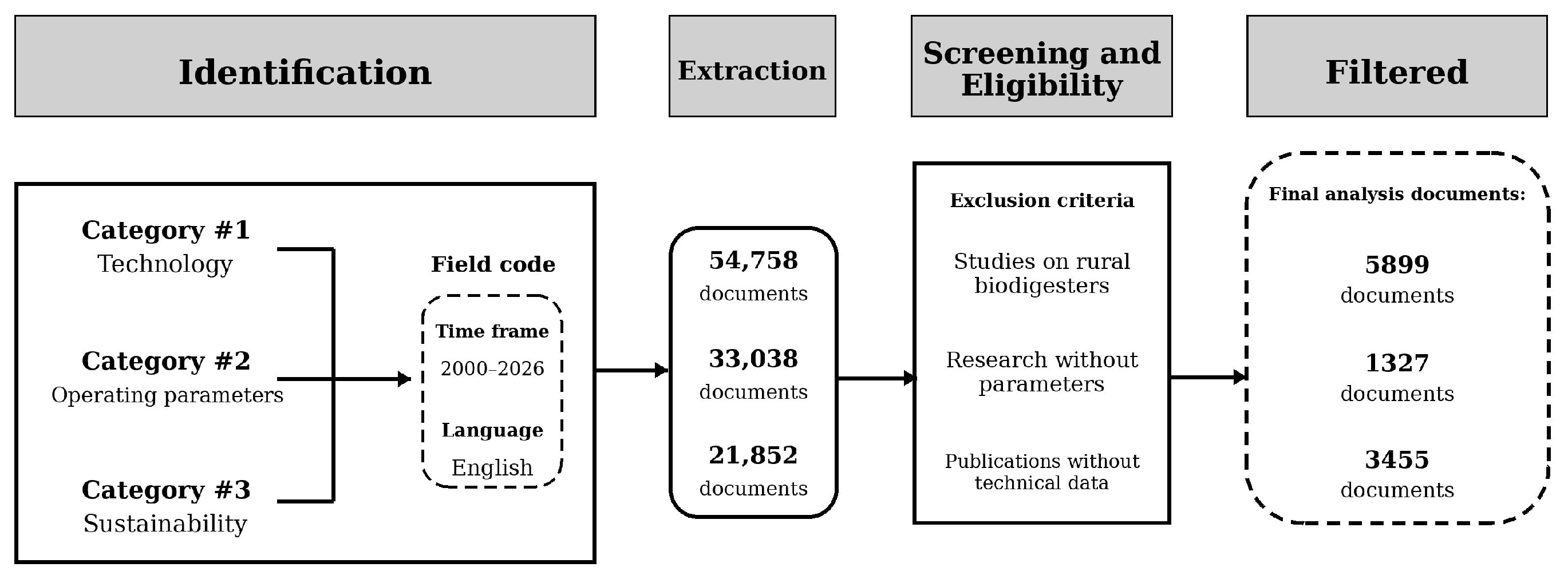
Figure 1. Hierarchical structure for document selection (Scopus, 2000–2026; initial total n = 109,648; final n = 10,681).
Sci 08 00071 g001
Figure 2. Geographic distribution of publications by country in the Technology category (Scopus, 2000–2026; n = 5899 documents).
Sci 08 00071 g002
Figure 3. Distribution of Publications by Country–Operational Parameters (Scopus, 2000–2026; n = 1327).
Sci 08 00071 g003
Figure 4. Distribution of publications by country–Sustainability and Industrial Applications (Scopus, 2000–2026; n = 3455).
Sci 08 00071 g004
Figure 5. Annual publication frequency by subject category (Scopus, 2000–2026).
Sci 08 00071 g005
Figure 6. Keyword co-occurrence network–Technology (Scopus, 2000–2026; n = 5899). Node size reflects frequency of occurrence, line thickness reflects link strength, and colors identify thematic clusters. VOSviewer v1.6.18.
Sci 08 00071 g006
Figure 7. Co-occurrence density map–Technology (Scopus, 2000–2026; n = 5899). The color scale from blue to yellow indicates the frequency of the term, from lowest to highest. VOSviewer v1.6.18.
Sci 08 00071 g007
Figure 8. Keyword co-occurrence network–Operational parameters (Scopus, 2000–2026; n = 1327; 23 nodes; 222 links). Node size: frequency; line thickness: link strength; colors: thematic clusters. VOSviewer v1.6.18.
Sci 08 00071 g008
Figure 9. Co-occurrence density map–Operational Parameters (Scopus, 2000–2026; n = 1327). Darker shades indicate higher frequency of the term. VOSviewer v1.6.18.
Sci 08 00071 g009
Figure 10. Keyword co-occurrence network–Sustainability and Industrial Applications (Scopus, 2000–2026; n = 3455). Node size reflects frequency of occurrence, line thickness reflects link strength, and colors identify thematic clusters. VOSviewer v1.6.18.
Sci 08 00071 g010
Figure 11. Co-occurrence density map–Sustainability and Industrial Applications (Scopus, 2000–2026; n = 3455). The color scale from blue to yellow indicates the frequency of the term, from lowest to highest. VOSviewer v1.6.18. 3.
Sci 08 00071 g011
Table 1. Research categories.
CategorySearch FieldsBoolean Operators and CombinationsSpecific Exclusion Terms
TechnologyTitle–Abstract–Keywords(“anaerobic digestion” OR “biodigesters” OR “biogas production” OR “sludge digestion”) AND (“industrial-scale” OR “large-scale” OR “full-scale” OR “industrial plant” OR “industrial facility” OR “commercial-scale” OR “biogas plant” OR “industrial application”)“lab-scale” OR “laboratory” OR “bench-scale” OR “household”
Operational parametersTitle–Abstract–Keywords(“anaerobic digestion” OR “biogas”) AND (“C/N ratio” OR “temperature” OR “pH” OR “ammonia nitrogen” OR “VFA” OR “alkalinity” OR “COD” OR “HRT” OR “OLR” OR “total solids” OR “TSS” OR “H2S” OR “conductivity”) AND (“biogas plant” OR “industrial plant” OR “commercial plant” OR “industrial facility” OR “waste treatment plant” OR “industrial-scale operation”)“simulation only” OR “theoretical model”
Sustainability and industrial applicationTitle–Abstract–Keywords(“anaerobic digestion” OR “biogas”) AND (“sustainability” OR “renewable energy” OR “circular economy” OR “waste management” OR “energy recovery” OR “environmental impact” OR “LCA”) AND (“industrial-scale” OR “large-scale” OR “full-scale” OR “industrial plant” OR “industrial facility” OR “commercial-scale” OR “biogas plant” OR “industrial application”)“policy only” OR “social acceptance only”
Table 2. Top 10 journals by publication volume and citation impact in industrial anaerobic digestion research.
Source TitleCat. ICat. IICat. IIITotalCited by% Cited by
Bioresource Technology3487710352823,97020.4%
Energies1654313534348914.2%
Water Science and Technology238297534212,52210.7%
Waste Management1434711530510,7079.1%
Journal of Cleaner Production1532112429887277.4%
Renewable and Sustainable Energy Reviews114910222521,61618.4%
Science of the Total Environment131137221668325.8%
Renewable Energy104266319381837.0%
Water Research14872918414,88712.7%
Journal of Environmental Management102204917150434.3%
TOTAL2805 117,378100%
Table 3. Most relevant operational parameters identified in the co-occurrence network (VOSviewer analysis).
IDKeywordOccurrencesTotal Link Strength
1pH1543667
2Temperature1473255
3Ammonia1312824
4Nitrogen912423
5Carbon701619
6Hydrogen44906
7Hydrogen sulfide62860
8Biogas production1992951
9Alkalinity591183
10Volatile solid25414
11Total solids22342
12Volatile fatty acid862486
13Volatile fatty acids971943
14Fatty acids, volatile331057
15Fatty acids441055
16Fatty acid401037
17Chemical oxygen demand1082144
18Organic loading rates561159
19Organic loading rate22508
20Biochemical oxygen demand16403
21Hydraulic retention time952042
22Retention time42964
23Hydraulic retention16294
Disclaimer/Publisher’s Note: The statements, opinions and data contained in all publications are solely those of the individual author(s) and contributor(s) and not of MDPI and/or the editor(s). MDPI and/or the editor(s) disclaim responsibility for any injury to people or property resulting from any ideas, methods, instructions or products referred to in the content.