Beyond Synchrony: Non-Phase Gamma as a Candidate Mechanism for Perceptual Anti-Binding

 , , and
Abstract
1. Introduction
2. Materials and Methods
2.1. Participants
2.2. Experimental Paradigm
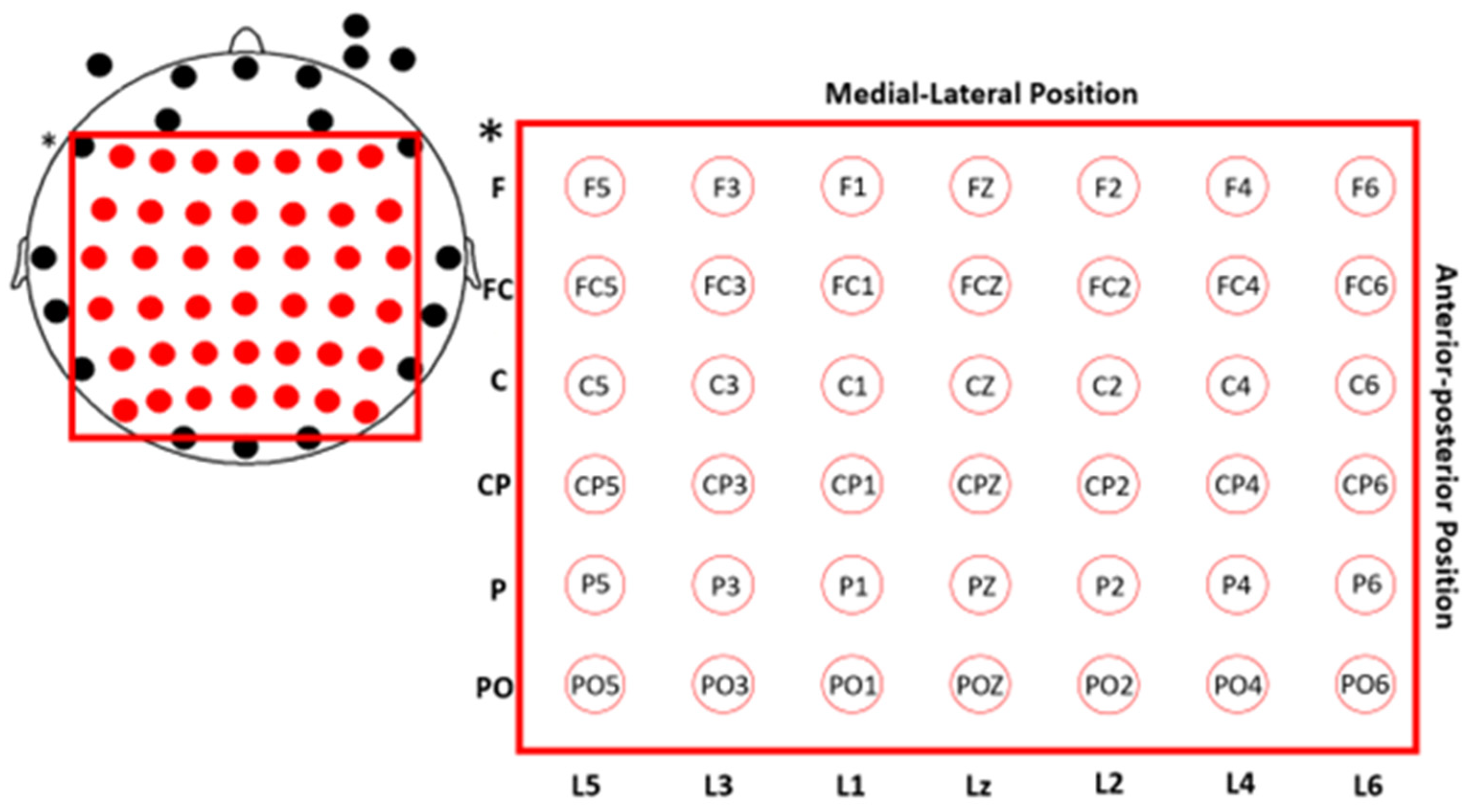
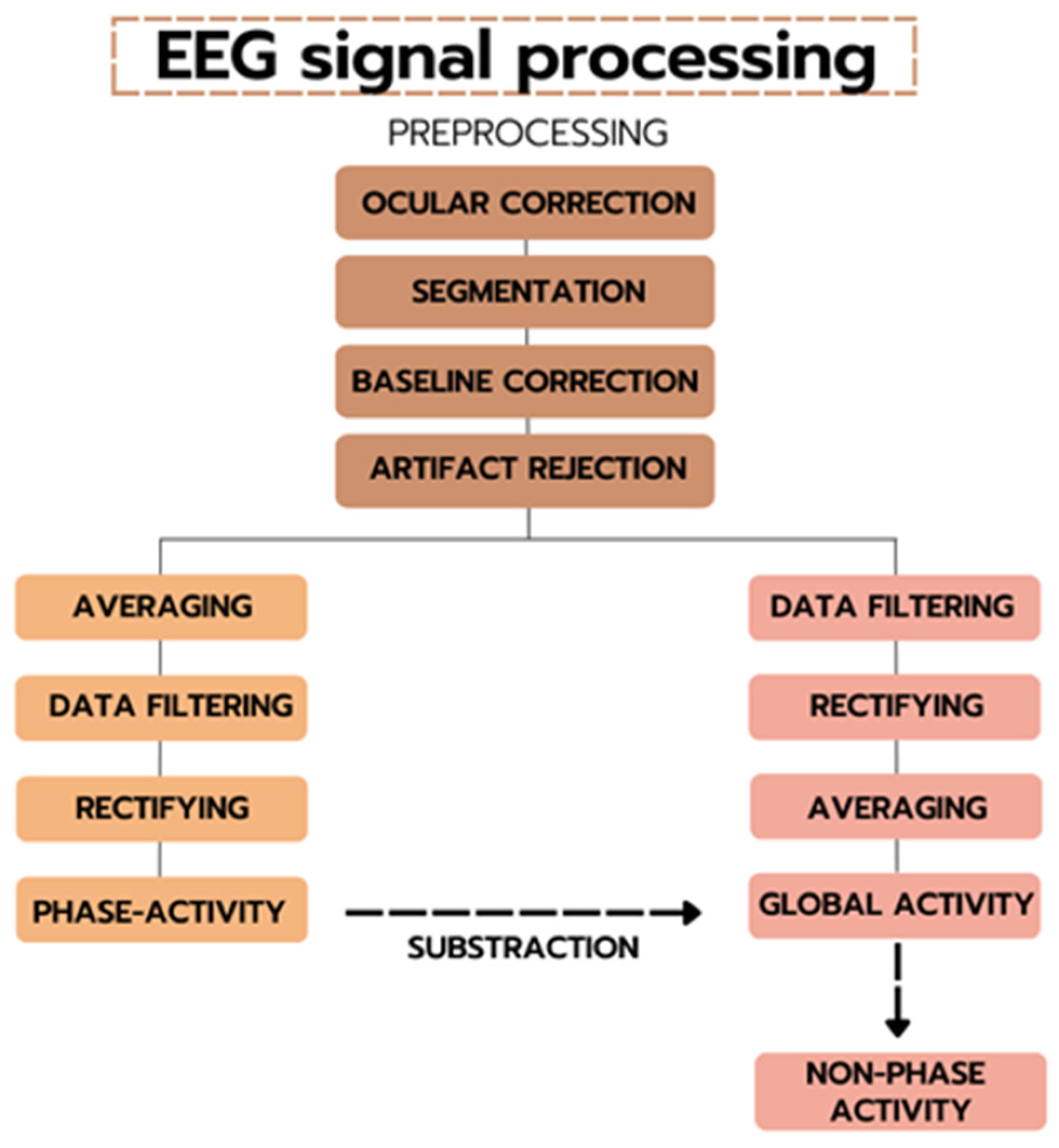
2.3. EEG Signal Acquisition and Analysis
2.4. Statistical Analysis
3. Results
3.1. Behavioral Variables
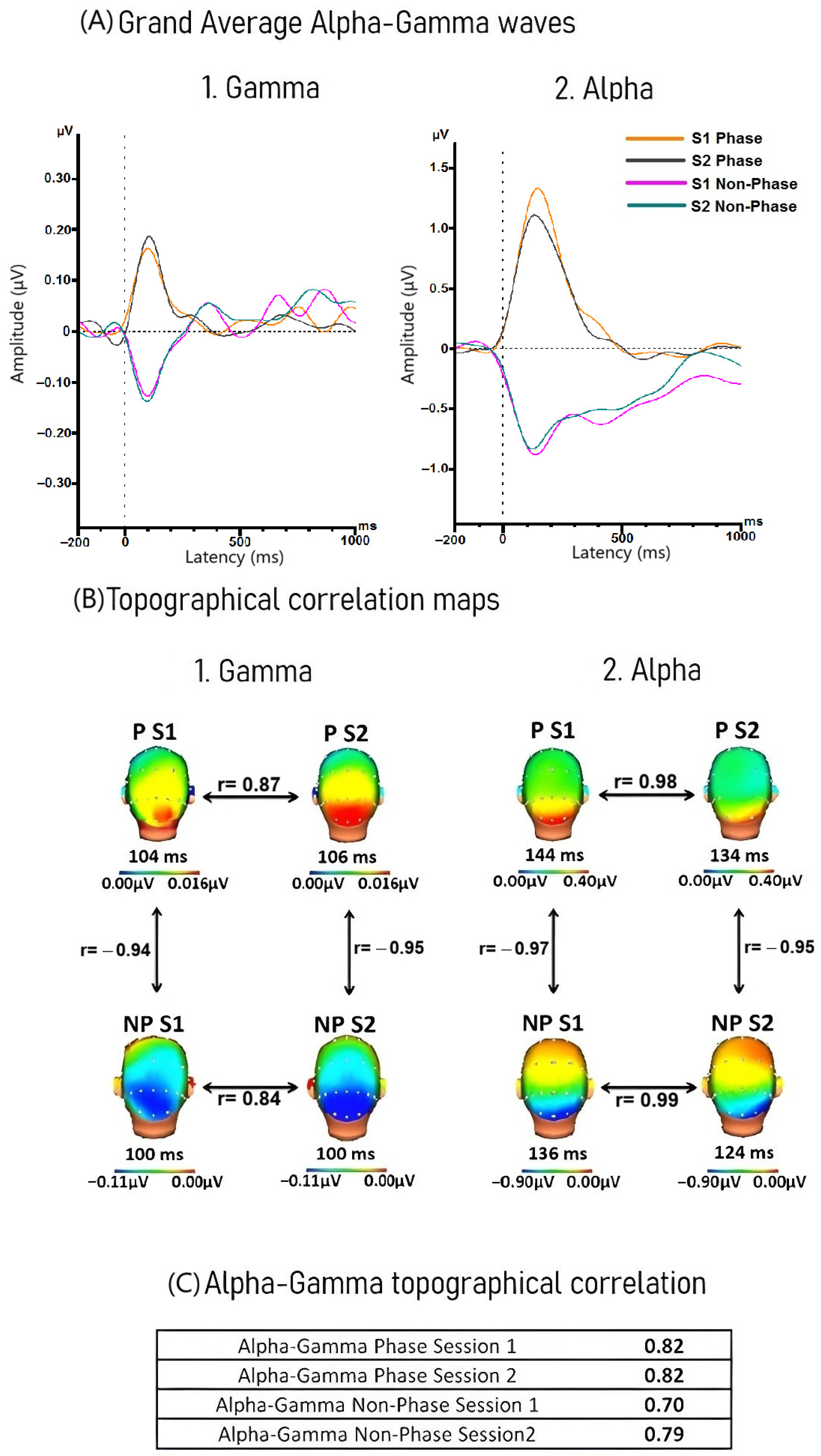
3.2. Latency Analysis
3.3. Amplitude Analysis
3.4. Topographical Correlation Analysis
3.5. Harmonic Analysis
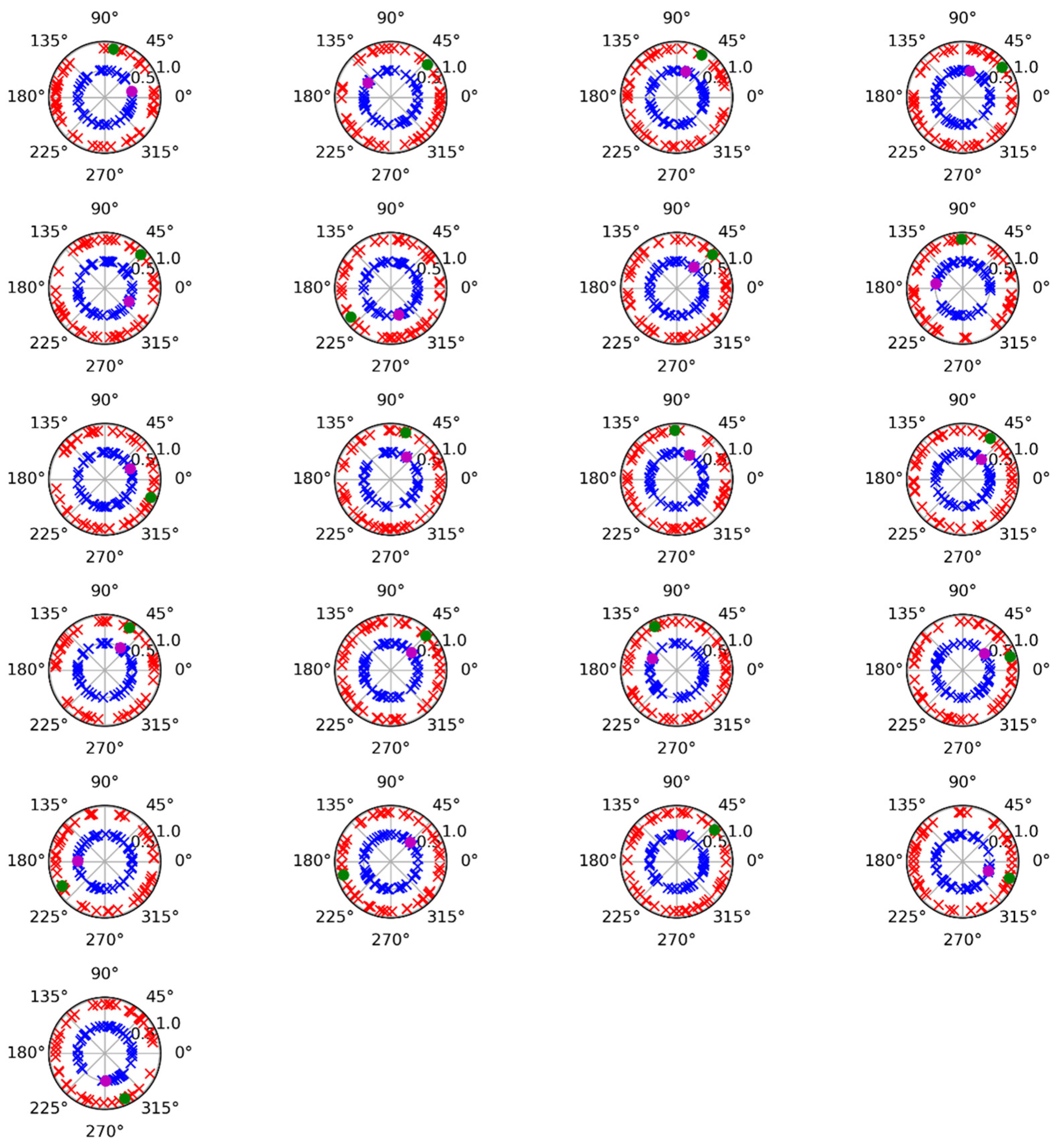
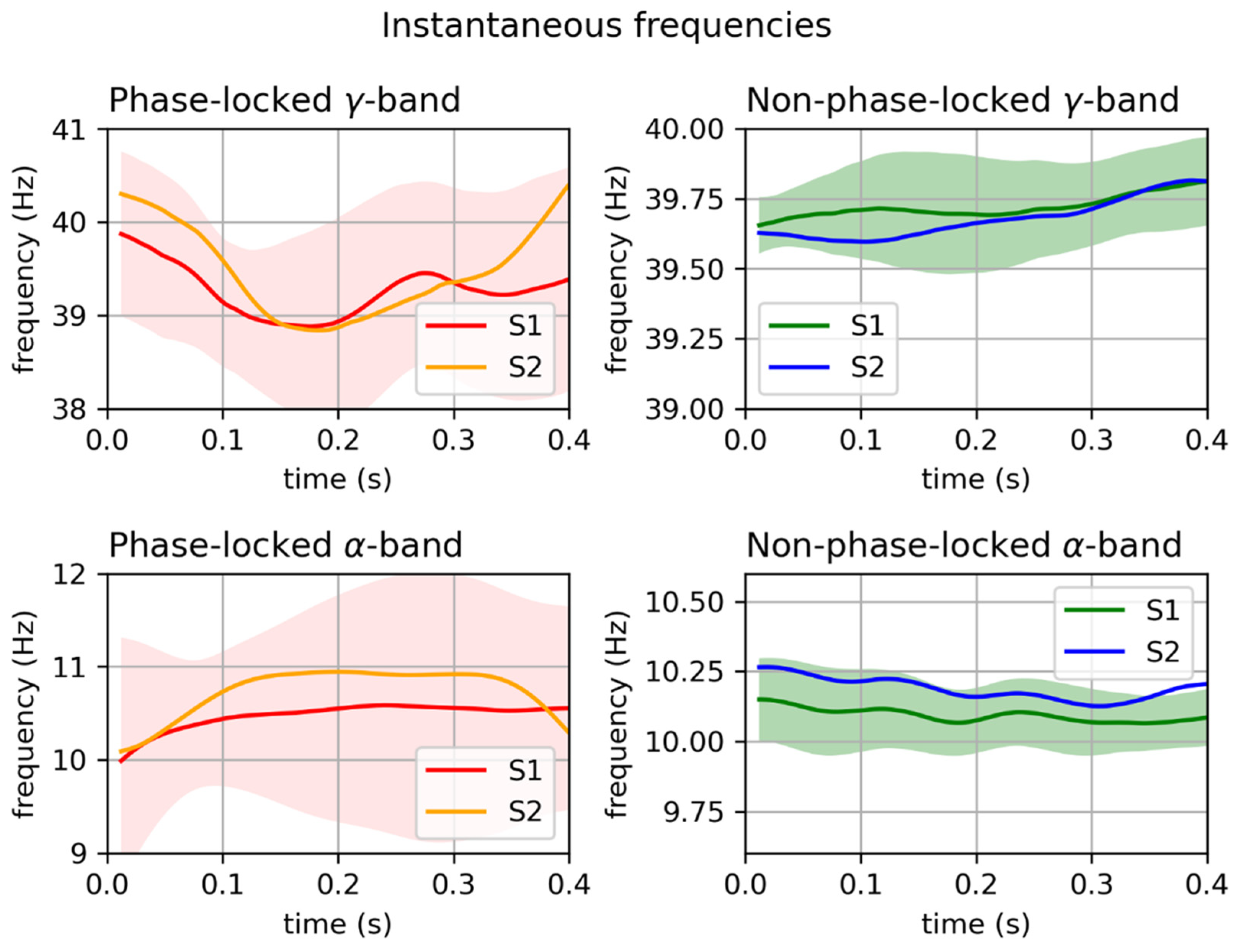
3.6. Phase Analysis
4. Discussion
4.1. Behavioral Variables
4.2. The Role of Phase and Non-Phase Gamma Modulations
4.3. Phase and Non-Phase Activities Replicability Test
4.4. Is Gamma a Harmonic of Alpha
5. Conclusions
Author Contributions
Funding
Institutional Review Board Statement
Informed Consent Statement
Data Availability Statement
Conflicts of Interest
Appendix A
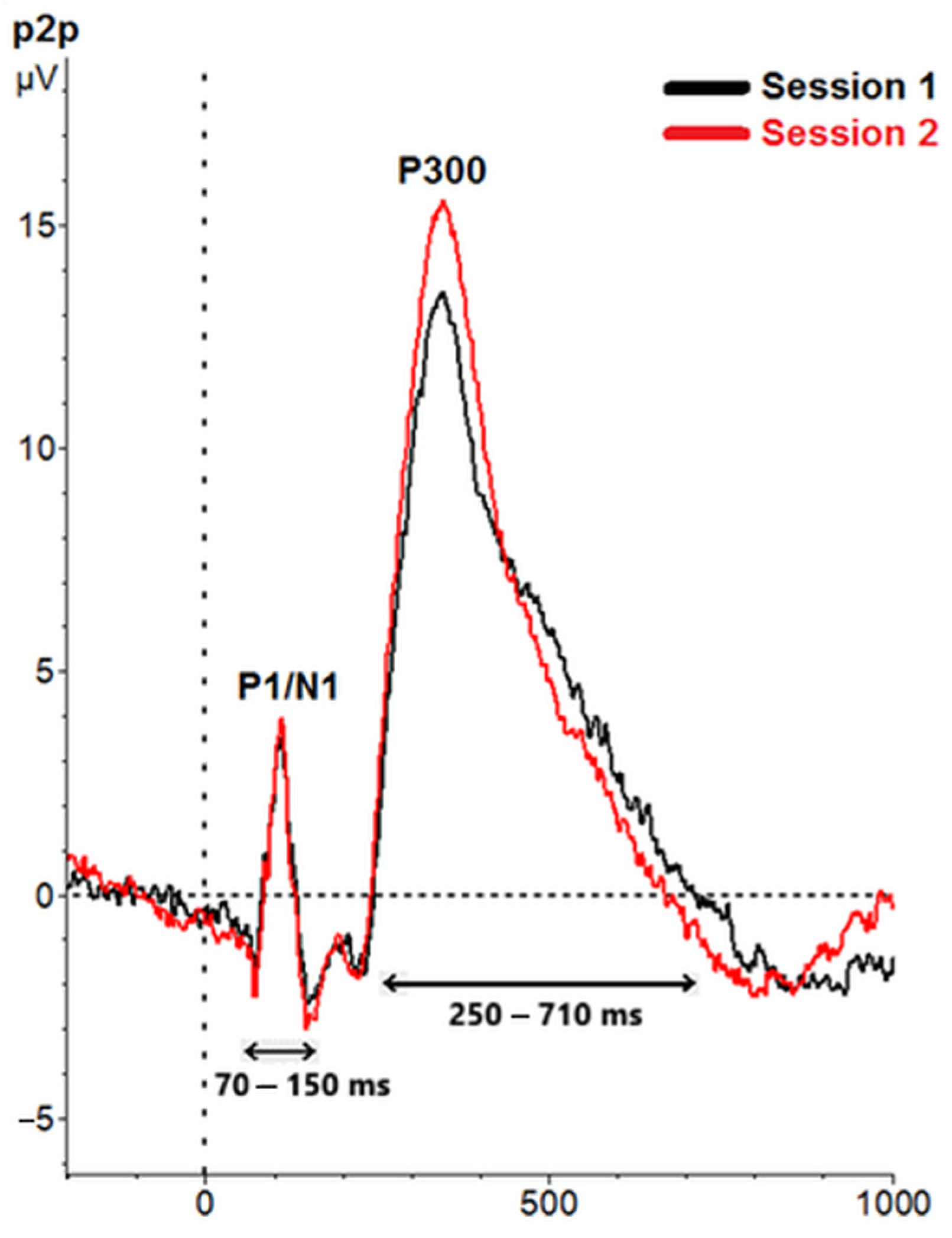
Event-Related Potentials

References
- Carretié, L.; Iglesias, J. Psicofisiología: Fundamentos Metodológicos; Pirámide: Madrid, Spain, 1995; pp. 21–43. [Google Scholar]
- Tallon-Baudry, C. The roles of gamma-band oscillatory synchrony in human visual cognition. Front. Biosci. 2009, 14, 321. [Google Scholar] [CrossRef]
- Loo, S.K.; Makeig, S. Clinical Utility of EEG in Attention-Deficit/Hyperactivity Disorder: A Research Update. Neurotherapeutics 2012, 9, 569–587. [Google Scholar] [CrossRef] [PubMed]
- Hari, R.; Salmelin, R.; Mäkelä, J.P.; Salenius, S.; Helle, M. Magnetoencephalographic cortical rhythms. Int. J. Psychophysiol. 1997, 26, 51–62. [Google Scholar] [CrossRef] [PubMed]
- Vázquez-Marrufo, M.; García-Valdecasas, M.; Caballero-Díaz, R.; Martín-Clemente, R.; Galvao-Carmona, A. Multiple evoked and induced alpha modulations in a visual attention task: Latency, amplitude and topographical profiles. PLoS ONE 2019, 14, e0223055. [Google Scholar] [CrossRef] [PubMed]
- Vázquez-Marrufo, M.; Caballero-Díaz, R.; Martín-Clemente, R.; Galvao-Carmona, A.; González-Rosa, J.J. Individual test-retest reliability of evoked and induced alpha activity in human EEG data. PLoS ONE 2020, 15, e0239612. [Google Scholar] [CrossRef]
- Yusuf, P.A.; Hubka, P.; Konerding, W.; Land, R.; Tillein, J.; Kral, A. Congenital deafness reduces alpha-gamma cross-frequency coupling in the auditory cortex. Hear. Res. 2024, 449, 109032. [Google Scholar] [CrossRef] [PubMed]
- Zhang, J.; Zhu, C.; Han, J. The neural mechanism of non-phase-locked EEG activity in task switching. Neurosci. Lett. 2023, 792, 136957. [Google Scholar] [CrossRef] [PubMed]
- Wu, G.; Tang, X.; Gan, R.; Zeng, J.; Hu, Y.; Xu, L.; Wei, Y.; Tang, Y.; Chen, T.; Li, C.; et al. Temporal and time-frequency features of auditory oddball response in distinct subtypes of patients at clinical high risk for psychosis. Eur. Arch. Psychiatry Clin. Neurosci. 2022, 272, 449–459. [Google Scholar] [CrossRef] [PubMed]
- Dickinson, A.; Ryan, D.; McNaughton, G.; Levin, A.; Naples, A.; Borland, H.; Bernier, R.; Chawarska, K.; Dawson, G.; Dziura, J.; et al. Parsing evoked and induced gamma response differences in Autism: A visual evoked potential study. Clin. Neurophysiol. 2024, 165, 55–63. [Google Scholar] [CrossRef] [PubMed] [PubMed Central]
- Sharma, R.; Thirugnanasambandam, N. Theta-Gamma Decoupling—A neurophysiological marker of impaired reward processing in Parkinson’s disease. Brain Res. 2025, 1850, 149406. [Google Scholar] [CrossRef] [PubMed]
- Sabaté, M.; Llanos, C.; Enriquez, E.; González, B.; RodríGuez, M. Fast modulation of alpha activity during visual processing and motor control. Neuroscience 2011, 189, 236–249. [Google Scholar] [CrossRef]
- Vázquez-Marrufo, M.; Caballero-Díaz, R.; Sarrias-Arrabal, E.; Martín-Clemente, R. Decoupling Alpha Desynchronization from Neural Resource Use: Evidence from Cognitive Load Modulation. NeuroSci 2025, 6, 32. [Google Scholar] [CrossRef] [PubMed]
- Symond, M.B.; Harris, A.; Gordon, E.; Williams, L.M. “Gamma Synchrony” in First-Episode Schizophrenia: A Disorder of Temporal Connectivity? Am. J. Psychiatry 2005, 162, 459–465. [Google Scholar] [CrossRef] [PubMed]
- Tseng, P.; Chang, Y.; Chang, C.; Liang, W.K.; Juan, C.H. The critical role of phase difference in gamma oscillation within the temporoparietal network for binding visual working memory. Sci. Rep. 2016, 6, 32138. [Google Scholar] [CrossRef] [PubMed]
- Bossi, F.; Premoli, I.; Pizzamiglio, S.; Balaban, S.; Ricciardelli, P.; Rivolta, D. Theta- and Gamma-Band Activity Discriminates Face, Body and Object Perception. Front. Hum. Neurosci. 2020, 14, 74. [Google Scholar] [CrossRef]
- Ghiani, A.; Maniglia, M.; Battaglini, L.; Melcher, D.; Ronconi, L. Binding Mechanisms in Visual Perception and Their Link With Neural Oscillations: A Review of Evidence From tACS. Front. Psychol. 2021, 12, 643677. [Google Scholar] [CrossRef]
- Gruber, T.; Müller, M.; Keil, A.; Elbert, T. Selective visual-spatial attention alters induced gamma band responses in the human EEG. Clin. Neurophysiol. 1999, 110, 2074–2085. [Google Scholar] [CrossRef]
- Tallon-Baudry, C.; Bertrand, O. Oscillatory gamma activity in humans and its role in object representation. Trends Cogn. Sci. 1999, 3, 151–162. [Google Scholar] [CrossRef]
- Fell, J.; Fernández, G.; Klaver, P.; Elger, C.E.; Fries, P. Is synchronized neuronal gamma activity relevant for selective attention? Brain Res. Rev. 2003, 42, 265–272. [Google Scholar] [CrossRef]
- Vázquez-Marrufo, M.; Sarrias-Arrabal, E.; Martín-Clemente, R.; Galvao-Carmona, A.; Navarro, G.; Izquierdo, G. Altered phase and nonphase EEG activity expose impaired maintenance of a spatial-object attentional focus in multiple sclerosis patients. Sci. Rep. 2020, 10, 20721. [Google Scholar] [CrossRef]
- Müller, M.; Junghöfer, M.; Elbert, T.; Rochstroh, B. Visually induced gamma-band responses to coherent and incoherent motion. Neuroreport 1997, 8, 2575–2579. [Google Scholar] [CrossRef]
- Müller, M. Oscillatory cortical activities in the gamma band in the human EEG induced by visual stimuli--representation of the stimulus? Acta Neurobiol. Exp. 2000, 60, 49–65. [Google Scholar] [CrossRef]
- Hirano, Y.; Nakamura, I.; Tamura, S.; Onitsuka, T. Long-Term Test-Retest Reliability of Auditory Gamma Oscillations Between Different Clinical EEG Systems. Front. Psychiatry 2020, 11, 876. [Google Scholar] [CrossRef] [PubMed]
- Gratton, G.; Coles, M.G.; Donchin, E. A new method for off-line removal of ocular artifact. Electroencephalogr. Clin. Neurophysiol. 1983, 55, 468–484. [Google Scholar] [CrossRef] [PubMed]
- Nelli, S.; Itthipuripat, S.; Srinivasan, R.; Serences, J.T. Fluctuations in instantaneous frequency predict alpha amplitude during visual perception. Nat. Commun. 2017, 8, 2071. [Google Scholar] [CrossRef] [PubMed]
- Jürgens, E.; Rösler, F.; Hennighausen, E.; Heil, M. Stimulus-induced gamma oscillations. NeuroReport 1995, 6, 813–816. [Google Scholar] [CrossRef]
- Müller, M.; Keil, A. Neuronal Synchronization and Selective Color Processing in the Human Brain. J. Cogn. Neurosci. 2004, 16, 503–522. [Google Scholar] [CrossRef]
- Lozano-Soldevilla, D.; Ter Huurne, N.; Oostenveld, R. Neuronal Oscillations with Non-sinusoidal Morphology Produce Spurious Phase-to-Amplitude Coupling and Directionality. Front. Comput. Neurosci. 2016, 10, 87. [Google Scholar] [CrossRef]
- Maxwell, S.E.; Delaney, H.D.; Kelley, K. Designing Experiments and Analyzing Data: A Model Comparison Perspective, 3rd ed.; Routledge: New York, NY, USA, 2018. [Google Scholar]
- Kileny, P.R.; Kripal, J.P. Test-Retest Variability of Auditory Event-Related Potentials. Ear Hear. 1987, 8, 110–114. [Google Scholar] [CrossRef]
- Cassidy, S.M.; Robertson, I.H.; O’Connell, R.G. Retest reliability of event-related potentials: Evidence from a variety of paradigms. Psychophysiology 2012, 49, 659–664. [Google Scholar] [CrossRef]
- Kumar, W.S.; Manikandan, K.; Murty, D.V.P.S.; Ramesh, R.G.; Purokayastha, S.; Javali, M.; Rao, N.P.; Ray, S. Stimulus-Induced Narrowband Gamma Oscillations are Test–Retest Reliable in Human EEG. Cereb. Cortex Commun. 2022, 3, tgab066. [Google Scholar] [CrossRef]
- Başar-Eroğlu, C.; Strüber, D.; Schürmann, M.; Städler, M.; Başar, E. Gamma-band responses in the brain: A short review of psychophysiological correlates and functional significance. Int. J. Psychophysiol. 1996, 24, 101–112. [Google Scholar] [CrossRef] [PubMed]
- Schoenfeld, M.A.; Tempelmann, C.; MartíNez, A.; Hopf, J.; Sattler, C.; Heinze, H.; Hillyard, S.A. Dynamics of feature binding during object-selective attention. Proc. Natl. Acad. Sci. USA 2003, 100, 11806–11811. [Google Scholar] [CrossRef] [PubMed]
- Schoenfeld, M.A.; Hopf, J.; Merkel, C.; Heinze, H.; Hillyard, S.A. Object-based attention involves the sequential activation of feature-specific cortical modules. Nat. Neurosci. 2014, 17, 619–624. [Google Scholar] [CrossRef] [PubMed]
- Medvedev, A.V. Epileptiform spikes desynchronize and diminish fast (gamma) activity of the brain. Brain Res. Bull. 2002, 58, 115–128. [Google Scholar] [CrossRef]
- Neuper, C.; Grabner, R.H.; Fink, A.; Neubauer, A.C. Long-term stability and consistency of EEG event-related (de-)synchronization across different cognitive tasks. Clin. Neurophysiol. 2005, 116, 1681–1694. [Google Scholar] [CrossRef]
- Fründ, I.; Schadow, J.; Busch, N.A.; Körner, U.; Herrmann, C.S. Evoked γ oscillations in human scalp EEG are test–retest reliable. Clin. Neurophysiol. 2007, 118, 221–227. [Google Scholar] [CrossRef]
- Friedrich, E.V.C.; Scherer, R.; Neuper, C. Stability of event-related (de-) synchronization during brain–computer interface-relevant mental tasks. Clin. Neurophysiol. 2013, 124, 61–69. [Google Scholar] [CrossRef]
- Tan, H.M.; Groß, J.; Uhlhaas, P.J. MEG sensor and source measures of visually induced gamma-band oscillations are highly reliable. NeuroImage 2016, 137, 34–44. [Google Scholar] [CrossRef]
- Mably, A.J.; Colgin, L.L. Gamma oscillations in cognitive disorders. Curr. Opin. Neurobiol. 2018, 52, 182–187. [Google Scholar] [CrossRef]



| Session 1 | Session 2 | |||||
|---|---|---|---|---|---|---|
| RT | TA | GA | RT | TA | GA | |
| 318 | 97.1 | 99.2 | 309 | 97.4 | 99.2 | |
| SD | 34.3 | 4.7 | 1.3 | 36.7 | 4.9 | 1.3 |
| Correlations | r |
|---|---|
| Phase–Non-phase S1 | −0.94 |
| Phase–Non-phase S2 | −0.95 |
| S1-S2 Phase | 0.87 |
| S1-S2 Non-phase | 0.84 |
Disclaimer/Publisher’s Note: The statements, opinions and data contained in all publications are solely those of the individual author(s) and contributor(s) and not of MDPI and/or the editor(s). MDPI and/or the editor(s) disclaim responsibility for any injury to people or property resulting from any ideas, methods, instructions or products referred to in the content. |
© 2026 by the authors. Licensee MDPI, Basel, Switzerland. This article is an open access article distributed under the terms and conditions of the Creative Commons Attribution (CC BY) license.
Share and Cite
Caballero-Díaz, R.; Sarrias-Arrabal, E.; Martin-Clemente, R.; Vazquez-Marrufo, M. Beyond Synchrony: Non-Phase Gamma as a Candidate Mechanism for Perceptual Anti-Binding. Sci 2026, 8, 49. https://doi.org/10.3390/sci8020049
Caballero-Díaz R, Sarrias-Arrabal E, Martin-Clemente R, Vazquez-Marrufo M. Beyond Synchrony: Non-Phase Gamma as a Candidate Mechanism for Perceptual Anti-Binding. Sci. 2026; 8(2):49. https://doi.org/10.3390/sci8020049
Chicago/Turabian StyleCaballero-Díaz, Rocio, Esteban Sarrias-Arrabal, Ruben Martin-Clemente, and Manuel Vazquez-Marrufo. 2026. "Beyond Synchrony: Non-Phase Gamma as a Candidate Mechanism for Perceptual Anti-Binding" Sci 8, no. 2: 49. https://doi.org/10.3390/sci8020049
APA StyleCaballero-Díaz, R., Sarrias-Arrabal, E., Martin-Clemente, R., & Vazquez-Marrufo, M. (2026). Beyond Synchrony: Non-Phase Gamma as a Candidate Mechanism for Perceptual Anti-Binding. Sci, 8(2), 49. https://doi.org/10.3390/sci8020049