


Abstract
The gamma band observed in human electroencephalography (EEG) has been extensively studied. However, recent research has begun distinguishing the potential roles assigned to phase and non-phase modulation within this band. The primary aim of this study is to analyze the potential role of non-phase gamma modulation in a widely used visual task in human subjects. For this purpose, using a 58-channel EEG recording, gamma activity was evaluated during an oddball task. Responses from 21 healthy subjects were recorded at two separate time points, with an average interval of 49.5 ± 48.9 days. Latency, amplitude, and topographic correlation values were calculated to assess the replicability. Furthermore, potential influence of alpha band harmonics on gamma was analyzed. Topographic analyses revealed a strong negative correlation between gamma phase-locked (synchronous) and non-phase-locked (asynchronous) activity, with correlation coefficients of r < −0.9 for both measures. The results observed between the two time points were robust. The harmonic analysis did not show any potential contribution of the alpha band. The separate analysis of phase and non-phase activity has enabled us to identify distinct roles for each. Establishing non-phase activity as a perceptual “anti-binding” mechanism opens new avenues for exploring a previously unaddressed aspect of gamma activity.
1. Introduction
The high temporal resolution of the EEG technique allows accurate recording of neural ensembles firing in synchrony during task performance, providing an indirect measure of cognitive processing [1,2,3]. Various analysis procedures have been employed to extract maximum information from the EEG signal. Some examples include event-related potentials (ERPs), frequency techniques such as power spectral density (PSD), and time–frequency techniques such as wavelets or event-related desynchronization (ERD). A technique similar to ERD is temporal spectral evolution (TSE) [4], which, with some additional processes, allows not only the calculation of phase modulations in response to the stimulus (phase activity) but also those modulations that are not in phase with it (non-phase activity) [5,6].
Non-phase activity refers to neural activity that, while not synchronized with the stimulus onset, is still influenced by it. Unlike phase activity that is phase-locked and time-locked with the stimulus onset, non-phase activity is time-locked but not phase-locked, and is therefore eliminated in traditional averaging since its inconsistent phase cancels out across trials.
By overcoming the limitations of traditional averaging methods, non-phase analysis offers the potential to more comprehensively evaluate cognition [7,8] and to detect novel cognitive deficits, thereby contributing to a better understanding of the underlying mechanisms of cognitive impairment in patients and their behavioral manifestations [9,10,11].
However, in contrast to phase activity, non-phase activity has not been extensively studied. Previous literature has shown that non-phase alpha activity plays an active role in early sensory processing [12]. More recently, the modulation of non-phase alpha activity has been associated with sensory processing efficiency by reducing “background neural noise” in the brain [5,6,13].
Similarly to the alpha band, phase activity in higher-frequency modulations such as the gamma band has been extensively investigated due to its important role in active sensory information processing. Gamma phase activity has been linked to several cognitive processes, including binding [14,15,16,17], attentional processing [18,19,20], and memory [15,19], while non-phase-locked gamma activity has been comparatively less explored.
In the Vázquez-Marrufo et al. (2020) [21] study with a sample composed of two groups (healthy control (HC) and multiple sclerosis (MS) patients), modulation of the non-phase gamma activity was described in those trials where attentional focus translation was required to be able to respond correctly. In addition, the amplitude modulation was greater in MS patients, which was interpreted as a neural compensation mechanism for this group. In other words, non-phase modulations can reveal affected or compensatory mechanisms that are not observable through conventional phase analysis techniques [9,10,11,21].
In the present study, the main objective is to observe the potential response of non-phase gamma modulation in a task that does not require shifts in attentional focus (central presentation), which, a priori, will not elicit synchronous modulations like those observed in Vázquez-Marrufo et al. (2020) [21] and that may overshadow other activities of lower amplitude.
Complementarily, some classic studies have observed high replicability of gamma phase activity in both humans and monkeys [22,23]. Regarding non-phase, Hirano et al. (2020) [24] assessed the replicability of the gamma band (at 40 Hz) in an auditory task, finding high levels of correlation between sessions (>0.6 for both phase and non-phase activity) with a 5-month interval between sessions. A secondary objective of this study is to analyze the robustness of the non-phase gamma response in this visual stimulation paradigm.
Finally, a potential threat described in the gamma band is the possibility that it does not represent a genuine modulation but rather a spillover from alpha activity, as alpha could be a potential harmonic of the gamma band. In this regard, a third objective of the study is to analyze whether this phenomenon occurs in our data, contributing to a better understanding of whether this potential artifact arises in EEG studies with human subjects.
In line with the objectives outlined above, we formulated the following scientific hypotheses. Our primary hypothesis was that non-phase gamma activity reflects a neural suppression mechanism, as previously observed in the alpha band. This hypothesis was evaluated using the task described above, through a modification of the traditional TSE technique to isolate non-phase activity. We also hypothesized that this non-phase activity is replicable, which was assessed through two longitudinal measurements per participant. Finally, we tested the hypothesis that the gamma frequency under investigation is not simply a harmonic of alpha activity.
2. Materials and Methods
2.1. Participants
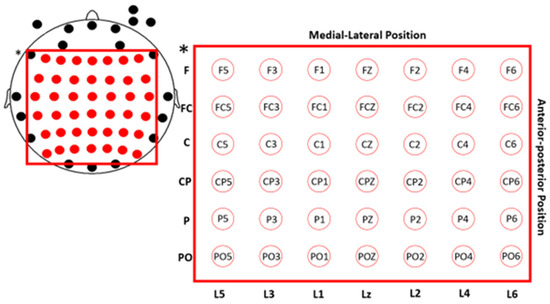
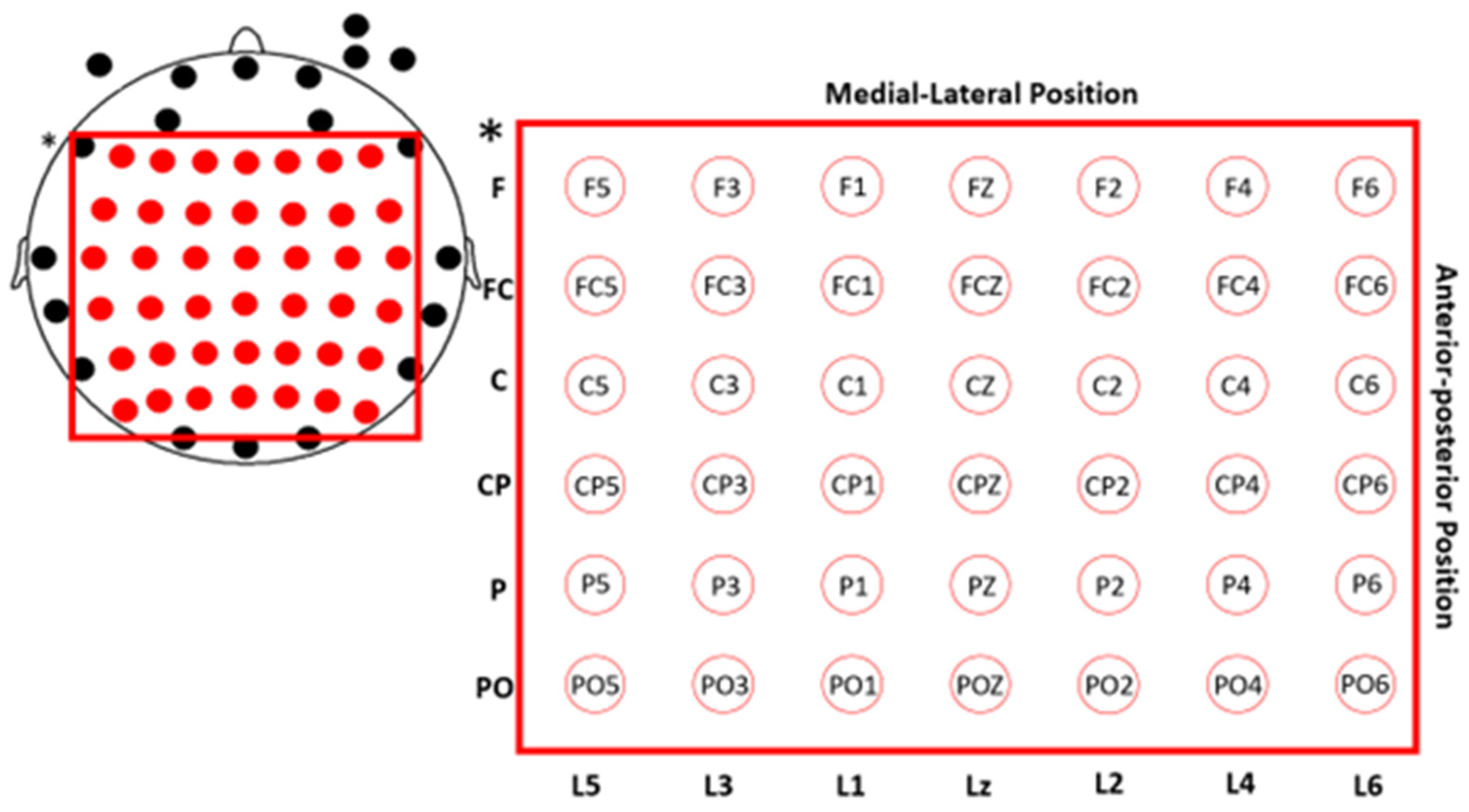
Twenty-one healthy adults were recruited from the university community through advertisements and personal contacts. Individuals with any prior neurological or psychological disorders, or those who presented artifacts that could not be removed from at least one of the analyzed electrodes (Figure 1), were excluded. All selected participants met the inclusion criteria, resulting in a final sample of 21 subjects (9 men and 12 women). The participants’ ages ranged from 21 to 50 years (mean age: 28.4 ± 7.94). Only two participants were left-handed.
Figure 1.
Electrode scalp locations. Note: EEG recording was performed with all electrodes shown in the figure. However, only the 6 × 7 electrode array marked in red was used in the subsequent analysis. Abbreviations F (frontal), FC (frontocentral), C (central), CP (central–parietal), P (parietal), PO (parieto-occipital) L (Lines 1–6; “Lz” stands for the central line of electrodes). * shows the 6 × 7 matrix of electrodes analyzed.
The selection of this sample size (n = 21) aims, on the one hand, to provide a pilot study of the potential role that non-phase gamma modulation may be playing in visual information processing. On the other hand, we conducted two separate recordings over time for the entire sample to study the stability of this modulation over time and to compare it with that obtained in this and other bands (i.e., alpha) and in other cognitive tasks.
2.2. Experimental Paradigm
The methodology is framed under a longitudinal design in which measurements of phase and non-phase activities were taken from the same group using EEG recordings, as well as behavioral responses, during the performance of a visual oddball task at two separate times. The interval between measurements was 49.5 ± 48.9 days (minimum: 5 days; maximum: 150 days). Since the present study does not focus on the potential effects on the robustness of the results within a specific interval, there was no need for a defined temporal measurement. This approach facilitated participant involvement in completing the sessions and eliminated potential biases associated with the timing of the measurements in the results obtained.
All the subjects performed a visual oddball task consisting of discriminating between target and standard stimuli. The primary reason for choosing this task is that the phase modulations it produces are well-known and can be compared with the potential results observed in non-phase modulation. The probabilities of occurrence for the target stimulus were 25% and 75% for the standard stimuli, respectively. Both types of stimuli involved chessboard-shaped rectangles of the same size and position, differing only in color (targets: red and white; standards: black and white). The visual angle for the stimuli was 7.98° on the X-axis and 9.42° on the Y-axis. All stimuli were presented in the center of the screen. In the absence of stimuli, a fixation point (consisting of a cross in the center of the screen) was displayed.
All stimuli were presented for 500 ms with an interstimulus interval of 1 s each (i.e., the potential response time for the subject). The experimental block consisted of 200 trials presented in a pseudorandomized manner. When the target stimulus appeared, the subject had to respond by pressing the left mouse button with the index finger (of the right hand) without making any response to the standard stimulus. At the end of the recording, the following behavioral variables were calculated: reaction time (RT) and overall hit rate (including no responses to standard).
2.3. EEG Signal Acquisition and Analysis
EEG signals were recorded on 58 electrodes placed on the scalp (Figure 1), then amplified with BrainAmp amplifiers (BrainProductsGmbH, Gilching, Germany) and digitized at 500 Hz with Recorder software v1.05 (BrainProductsGmbH, Gilching, Germany). An on-line reference (at the auricular lobes) and an off-line reference (at the common average) were used. Horizontal (HEOG) and vertical (VEOG) eye movements were monitored by placing electrodes on the outer lateral orbits of the eye for HEOG and inferior and superior orbits in the left eye for VEOG. Bandpass filtering was performed over a range of 0.01–100 Hz. An impedance below 5 kΩ was maintained throughout the recording.
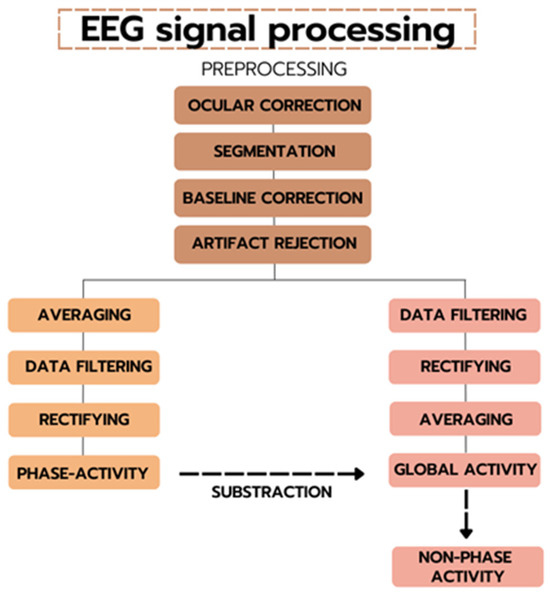
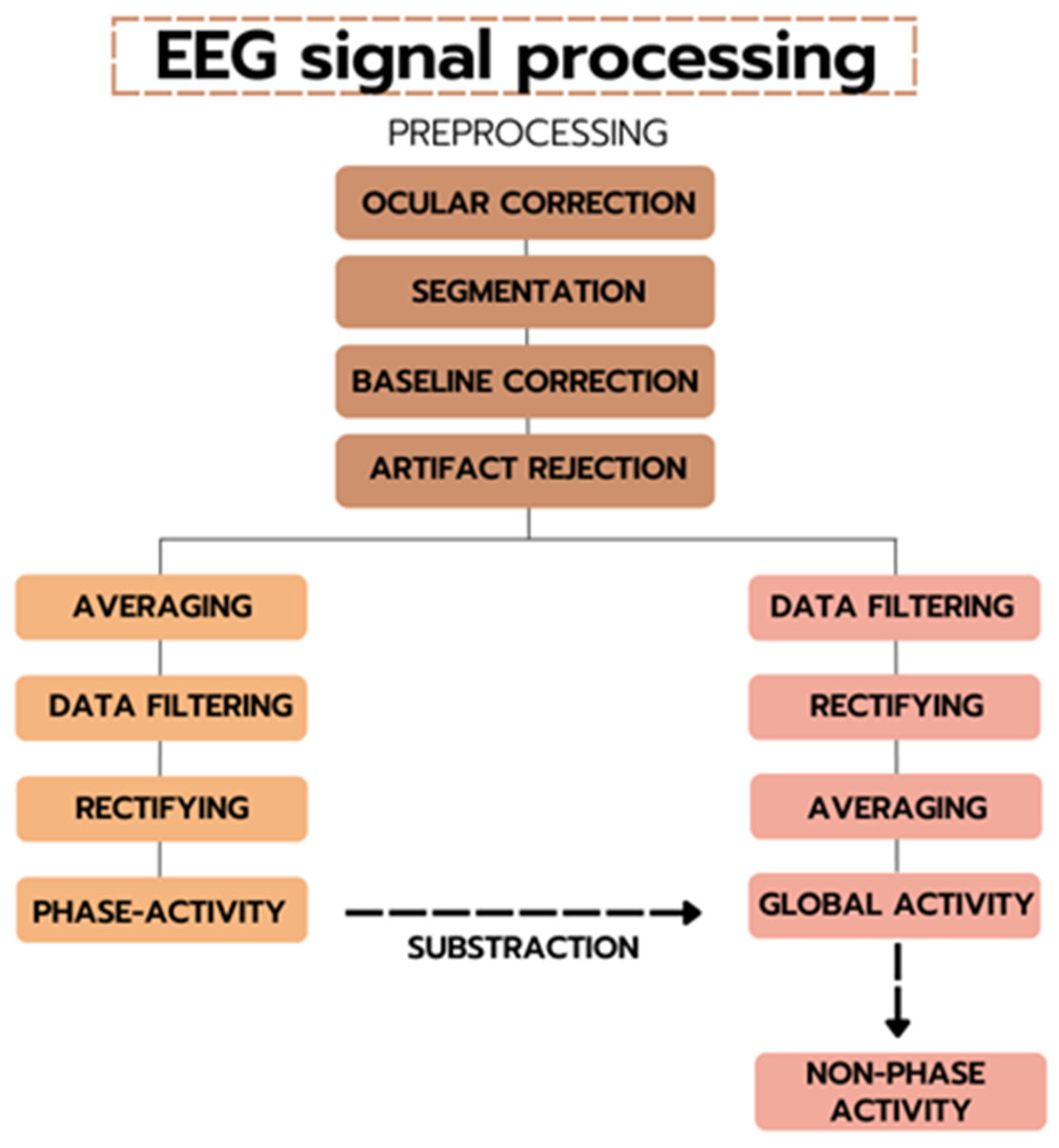
The following protocol was applied: eye correction to remove artifacts using the algorithm developed by Gratton et al. (1983) [25]; segmentation (−200 to 1000 ms interval); baseline correction (−200 to 0 ms); and rejection of any artifacts that exceeded ±75 μV on electrodes Fz, Cz, Pz and HEOG. From this point, the specific analysis of phase and non-phase activities differed (Figure 2). Phase activity was calculated by applying the following procedure: averaging, 35–45 Hz bandpass filtering (48 dB/octave Butterworth zero phase); rectifying; low-pass filtering at 5 Hz (48 dB/octave Butterworth zero phase) and baseline correction (−200 to 0 ms) [6]. The main objectives of this study were the phase and non-phase activity of the gamma band, but an analysis of the ERPs derived from the task has also been conducted for those readers who wish to examine the effect that occurred in the time domain of the EEG signal (see Appendix A).
Figure 2.
Flow diagram of phase and non-phase calculations. Note: Figure 2 shows the EEG signal analysis protocol. The left column shows the process of obtaining the phase activity, and the right column shows the process of obtaining the non-phase activity using TSE. The last step indicated by an arrow refers to the subtraction of the phase activity from the overall activity to calculate the non-phase activity.
In the case of the non-phase activity, it was calculated according to the following protocol: 35–45 Hz bandpass filtering (48 dB/octave Butterworth zero phase); rectifying the signal; averaging all trials in each experimental condition; phase-activity subtraction from this activity; 5 Hz low-pass filtering (48 dB/octave Butterworth zero phase); and baseline correction (−200 to 0 ms) (Figure 2) [5].
To understand the novelty introduced by the analysis of non-phase activity, it is crucial to consider the fundamental role of the rectification process applied to the data. For non-phase activity, rectification must be applied directly to the raw EEG signal to preserve oscillations that are not phase-locked to the stimulus onset. In contrast, for phase modulation analysis, rectification is performed during the final stages of the analysis to standardize both protocols and facilitate a direct comparison between phase and non-phase modulations.
After the two types of analysis of the EEG signal, individual averages for each session without artifacts comprised at least 47 trials for each subject in the target condition for session 1 (49.5 ± 0.93) and 42 trials for session 2 (49.3 ± 1.91). No significant differences were found when Student’s t test was applied to compare the mean number of artifact-free trials per session.
Latency values for phase and non-phase modulations were obtained at the point of maximum amplitude for each subject to assess whether phase and non-phase activity occur at similar latencies. The electrodes with the maximum phase activity were located at PO6 during session 1 and at PO4 during session 2. For non-phase activity, latencies were measured at electrode PO2 in both sessions (refer to Figure 1 for electrodes selected for the analysis).
In the case of studying the potential voltage difference between the two types of activity (phase and non-phase), the interval to calculate the maximum amplitude value was determined based on the grand average peak for phase activity or the valley for non-phase activity (100–120 ms). To ensure comparability between the two types of activity, the non-phase activity was exported as absolute values for the topographic amplitude analyses.
To rule out a possible cross-contribution between phase and non-phase modulation, a phase angle analysis was conducted for both modulations. To do this, after subtracting the average trial from each individual trial, the Hilbert transform was applied to express the gamma band-filtered EEG signals as complex waveforms of the form xn(t) = Cn(t) exp(i wn(t)), where xn(t) represents any one of the average-subtracted trials, e.g., the nth, wn(t) is its instantaneous phase or angle, measured in radians, and i is the imaginary unit. After unwrapping the angles, we approximated the derivative of wn(t) by the slopes of the local regression lines. This derivative divided by 2 pi provides a smooth estimate of the instantaneous frequency in Hz. The latencies of non-phase-locked activity was measured at t = 111 ms and t = 112 ms for the phase activities.
Another possible analysis that can help dissociate both types of activity is the one that allows observing the instantaneous frequency of both bands over time. We conducted this analysis following the method described by Nelli et al. (2017) [26]. The instantaneous angles of both non-phase-locked and phase activities were computed at the latency values previously described.
On the other hand, since the present study is concerned with the gamma band, as mentioned by Jürgens et al. (1995) [27], it is necessary to rule out the possibility that the phenomena observed in the gamma band as a result of task performance are not, at least in part, an epiphenomenon of lower frequency bands such as alpha [28,29]. For this purpose, it was necessary to ensure that the gamma range modulation evaluated was not a harmonic effect of the alpha band. Using the same analysis protocol mentioned previously for the gamma band, latency and amplitude analyses were performed for the alpha band (8–12 Hz). The latency measurements were also carried out for the electrode that exhibited the highest amplitude. In the case of alpha, both phase and non-phase were measured at PO6. Amplitude values were extracted for all subjects within a 110–130 ms window, as determined again from the grand average for both phase and non-phase activities.
2.4. Statistical Analysis
Parametric and nonparametric tests were applied depending on the results of normality analyses using the Shapiro–Wilk test. Data distributions were additionally inspected to identify potential deviations from normality and the presence of extreme outliers. A Wilcoxon test was used to analyze potential differences in accuracy values for responses to targets (TA; target accuracy) and global performance, including no responses to standards (GA; global accuracy), for each session. Comparisons of reaction time (RT) values between sessions were analyzed using paired t-tests for dependent variables (Table 1).
Table 1.
Results of behavioral variables in both sessions.
All statistical analyses were performed using repeated-measures ANOVA designs, as all experimental factors were within-subject. Depending on the specific analysis, one-factor, two-factor, or higher-order repeated-measures ANOVAs were applied. No between-subject factors were included, and therefore no mixed-model designs were used. The selection of statistical tests followed standard methodological recommendations for repeated-measures experimental designs [30]. Statistical analyses were performed using STATISTICA 7 and Statistical Package for the Social Sciences (SPSS) 29.0.1.
Latency analyses of spectral modulations were performed using a 2 × 2 repeated-measures ANOVA with the following factors and levels: SESSION (session 1 [S1], session 2 [S2]) and ACTIVITY (phase [P], non-phase [NP]).
For topographical amplitude differences, analyses were conducted using a 42-electrode matrix. From the original 58-electrode montage, peripheral electrodes were removed, retaining the largest possible central square. This procedure minimized the inclusion of peripheral electrodes that could introduce irrelevant artefactual information (e.g., frontopolar, temporal, or neck-adjacent sites). The excluded electrodes are shown in black in Figure 1. Based on this matrix, a 2 × 2 × 6 × 7 repeated-measures ANOVA was performed with the following factors and levels: SESSION (session 1/session 2), ACTIVITY (phase/non-phase), ANTERO–POSTERIOR LOCATION (frontal, frontocentral, central, central–parietal, parietal, and parietal–posterior), and LATERAL–MEDIAL LOCATION (L1, L2, L3, L4, L5, L6, L7) (Figure 1). Bonferroni correction was applied for multiple-comparison post hoc analyses.
Correlation analyses of topographical amplitude maps were performed using Pearson’s r. Following the recommendations of Kileny and Kripal (1987) [31], the conventional significance level of 0.05 was divided by the number of contrasts performed for all correlation analyses. Accordingly, a corrected significance threshold of p < 0.004 was adopted.
To rule out the possibility that gamma-band modulations were driven by concurrent alpha-band modulations (i.e., harmonic artifacts), a 2 × 2 × 2 repeated-measures ANOVA was conducted to assess latency differences between bands, with the following factors and levels: BAND (alpha/gamma), SESSION (session 1/session 2), and ACTIVITY (phase/non-phase). Amplitude analyses for the alpha band were performed following the same procedure used for the gamma band and were subsequently compared with gamma-band results. Finally, the same correlation analysis procedure was applied to assess topographical similarities between the gamma and alpha bands.
For the analysis of phase-locked and non-phase-locked activity, comparisons between sessions were additionally assessed using Welch’s test when evaluating differences in estimated instantaneous frequencies. This approach was adopted to account for potential violations of the homogeneity of variance assumption between sessions, thereby providing a more robust assessment of session-related differences in instantaneous frequency measures.
3. Results
3.1. Behavioral Variables
Neither the accuracy with respect to the target stimulus (TA) (Session 1: 97.1 ± 4.7, Session 2: 97.4 ± 4.9) (Z = 0.426, p = 0.670) nor the overall accuracy (GA) (Session 1: 99.2 ± 1.3, Session 2: 99.2 ± 1.3) (Z = 0.193, p = 0.847) showed significant differences between sessions. However, the RTs showed significant differences when comparing both sessions, with the response of session 2 being faster than that of the first session (Session 1: 318 ± 34, Session 2: 309 ± 37) (t(20) = 2.78, p = 0.011) (Table 1).
3.2. Latency Analysis
The interaction effect (SESSION × ACTIVITY) showed no significant differences (F(1, 20) = 0.16, p = 0.693; η2 = 0.008). Regarding the SESSION factor, no statistically significant differences were found (F(1, 20) = 0.07, p = 0.788; η2 = 0.004) of session 1 (110 ms ± 38.5) or session 2 (113 ms ± 40) (Figure 3A-1). On the other hand, regarding the ACTIVITY (phase/non-phase), no significant differences were shown between the averaged latency for phase activity (112 ms ± 33) and non-phase activity (111 ms ± 45) (F(1, 20) = 0.07, p = 0.789; η2 = 0.004).
Figure 3.
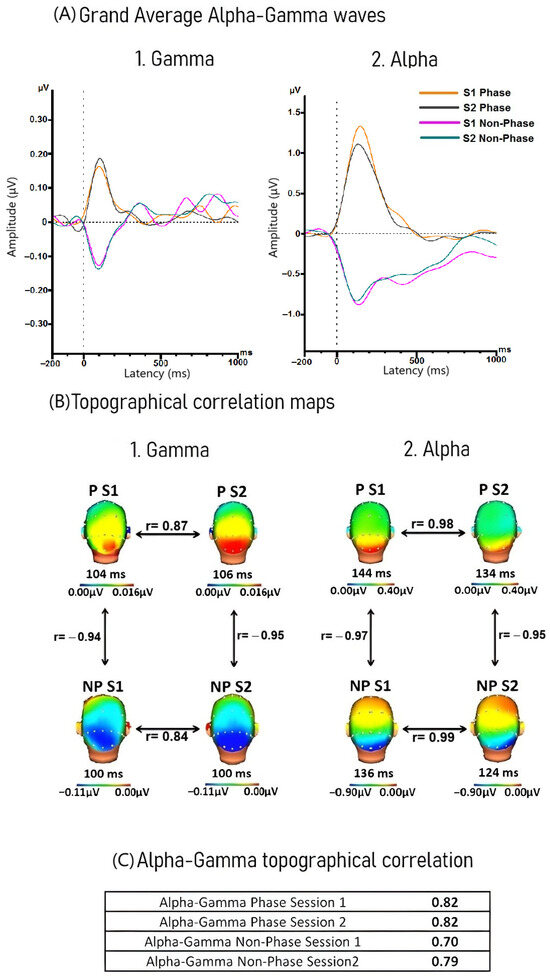
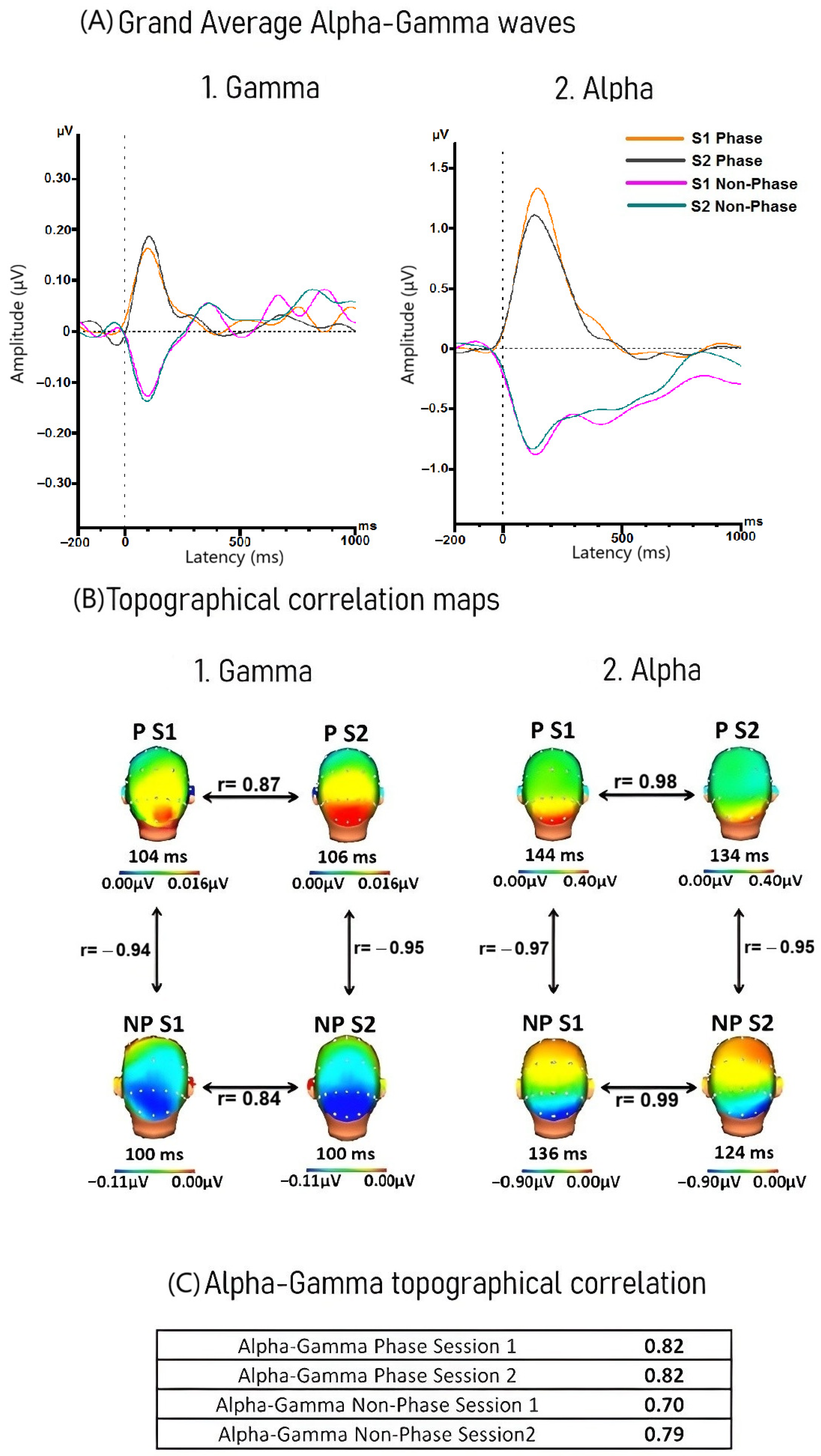
Phase and non-phase alpha and gamma bands modulations. Note: (A) Shows the alpha and gamma band modulations recorded at electrode PO2. (B) Topographic maps for each condition are presented, and arrows indicate the correlation scores between maps. The latency (in milliseconds) of the grand average at which each modulation reaches its maximum peak or valley amplitude is indicated below each map. (C) Correlation scores between topographical maps of both bands. Abbreviations: µV, microvolts; ms, milliseconds; P, phase activity; NP, non-phase activity.
3.3. Amplitude Analysis
In the amplitude analysis, the interaction of all factors involved in the ANOVA (SESSION × ACTIVITY × ANTERO-POSTERIOR LOCATION × LATERAL-MEDIAL LOCATION) or other interactions between the main factors (SESSION or ACTIVITY) with electrode position factors were not statistically significant. To examine in greater detail the potential effects between the two modulations (phase and non-phase), independent ANOVAs were conducted for the SESSION and ACTIVITY factors. Considering the SESSION, no differences were detected in either phase (F(1, 20) = 0.11; p = 0.739; η2 = 0.006) or non-phase activities (F(1, 20) = 0.02; p = 0.902; η2 = 0.001) between sessions (Figure 3A-1).
For the analysis by ACTIVITY, no differences were found between phase and non-phase activity in either of the two sessions (Session 1: F(1, 20) = 1.91; p = 0.181, η2 = 0.087/Session 2: F(1, 20) = 0.19; p = 0.663; η2 = 0.010).
3.4. Topographical Correlation Analysis
Gamma topographical correlation analyses gave values of r (>0.8) when comparing inter-sessions and even higher values of r (>−0.9) when comparing both types of activity intra-session (for precise values, see Table 2 or Figure 3B-1 for a graphical representation).
Table 2.
Correlation values for topographical maps in gamma band.
3.5. Harmonic Analysis
The mean latency values obtained for the alpha phase were 122 ms ± 36.1 in session 1 and 124 ms ± 40.7 in session 2. For the non-phase activity, the values were 121 ms ± 36.9 in session 1 and 133 ms ± 44.5 in session 2 (See Figure 3A-2). No significant differences were found in latency between the alpha and gamma bands for the interaction between factors (F(1, 20) = 0.06, p = 0.802; η2 = 0.003) or as main factors: SESSION (F(1, 20) = 0.66; p = 0.427; η2 = 0.032) or ACTIVITY (F(1, 20) = 0.06; p = 0.802; η2 = 0.003).
As previously described for gamma modulation, topographic amplitude analyses were carried out with the alpha band (8–12 Hz) with the same factors. For the SESSION factor, no significant differences were found for either phase (F(1, 20) = 0.31; p = 0.583; η2 = 0.015) or non-phase activity (F(1, 20) = 0.12; p = 0.729; η2 = 0.06) at any topographical location.
In contrast to the session factor, alpha phase ACTIVITY showed a significantly greater amplitude than non-phase activity, both for session 1 (F(1, 20) = 19.63; p < 0.001; η2 = 0.495) and session 2 (F(1, 20) = 16.84; p < 0.001; η2 = 0.457). Regarding the topographical effects, almost all the electrodes showed a greater amplitude for the phase activity than for the non-phase activity.
As shown in Figure 3A-2, the alpha phase activity in session 1 presented a greater amplitude than that in session 2. The same occurred in the case of the non-phase activity, where session 1 presented a greater decrease than did session 2. Notably, as shown in Figure 3A-1 the gamma band presented the opposite effect, with a greater amplitude of both phase and non-phase activity in session 2 than in session 1.
Correlation analyses comparing alpha and gamma topographical maps showed high values for phase activity in session 1 (r = 0.82) and session 2 (r = 0.82). For non-phase activity, correlations were r = 0.70 for session 1 and r = 0.79 for session 2 (Figure 3C). All of these correlation scores had a significance level of p ≤ 0.004. Complementary analyses were also conducted on alpha-band activity, examining correlations both across sessions and between phase and non-phase components (see Figure 3B-2). Consistent with previous studies [6], alpha activity showed high correlation values across sessions as well as between activity types.
3.6. Phase Analysis
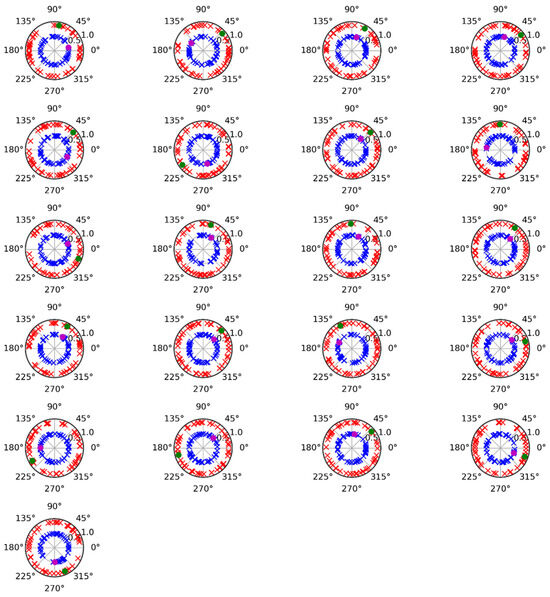
The phase angle analysis (Figure 4) shows that the values observed for non-phase activity were randomly distributed and not concentrated around the values presented for phase modulation. This result suggests that phase and non-phase activities do not appear to influence each other, and the results obtained for each are genuine. This finding has also been previously observed in the alpha band [6], further confirming the independence of both modulations (phase and non-phase) in the EEG signal.
Figure 4.
Polar plot of phase analysis results for phase-locked and non-phase-locked activity in the gamma band (35–45 Hz) for each of the twenty-one participants in the experiment. Inner circles represent instantaneous angle values for session 1, with red dots corresponding to phase-locked activity and blue crosses corresponding to non-phase-locked activity, and outer circles correspond to session 2, with green dots corresponding to phase-locked activity and red crosses corresponding to non-phase-locked activity. Note that there are as many crosses in each circle as there are trials. In contrast, the dots are related to the average of all trials, so there is only one per session.
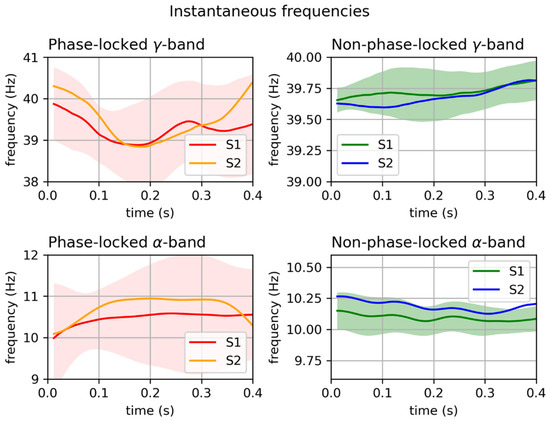
Furthermore, Figure 5 shows the evolution of the estimated instantaneous frequencies for both bands averaged across subjects. For phase-locked modulations, Welch’s test cannot reject the hypothesis that the difference between the average instantaneous frequencies in sessions 1 and 2 is zero over the entire time interval at the standard confidence level (5%). The same result is found when comparing the non-phase averaged instantaneous frequencies in different sessions. However, it is possible to assert that the traces of alpha and gamma activities differ in the early stages of visual processing.
Figure 5.
Instantaneous phase analyses. Upper left corner: Instantaneous frequency (IF) of the phase-locked activity, averaged over all subjects and trials, in session 1 (red) and session 2 (orange). The colored area represents the 95% confidence interval of the IF in session 1, meaning that there is a 95% probability that the true value of the IF lies within these limits. Note that the orange curve also lies within the same confidence interval, indicating a high level of repeatability between sessions. Upper right corner: IFs of the non-phase-locked responses and corresponding confidence intervals in session 1. The graphs in the second row have the same meaning but refer to the alpha band.
4. Discussion
4.1. Behavioral Variables
Significant differences were found between the two sessions in terms of reaction time (RT), which was lower in the second session by 10 ms. This result could reflect the benefit of practice in the execution of the task that remains in the following weeks. These results are in accordance with previous research by other authors [32].
On the other hand, the results obtained for accuracy showed no differences between sessions. The lack of differences in accuracy between sessions guarantees that changes in reaction time between both sessions were not caused by a speed–accuracy trade-off.
4.2. The Role of Phase and Non-Phase Gamma Modulations
The main objective of this study was to suggest a psychophysiological role for the non-phase modulation that has barely been studied before. As previously mentioned, gamma phase activity has been related to a multitude of different functions, such as memory, attentional, and perceptual discrimination mechanisms [2,24,33]. When we focus on phase gamma activity related to visual processing, several studies point to its main role as a signal integrator. Başar-Eroğlu et al. (1996) [34] established gamma activity as a universal operator of brain functions and stressed the need to consider the possibility that its different functions may be due to the presence of different generators. Specifically, the gamma band is related to visual binding processing [2,16,17,19]. In the present study, phase gamma activity occurred at approximately 110 ms, which may correspond to the latency at which certain features of the stimuli (initial binding assemblies) are processed in the visual system before the completion of feature binding [35,36]
However, as indicated earlier, this study focused on non-phase gamma activity. This activity showed a latency practically identical to that of phase modulation but with opposite polarities in amplitude. While phase modulation appears as synchrony, non-phase activity presents as asynchrony. Therefore, these results suggest that both processes may be related but perform different yet complementary functions. Similar results were found in the alpha band in a previous study by our group [6]. These findings led to the conclusion that phase modulation is linked to early stages of visual information processing, whereas non-phase modulation reflects the desynchronization of neural networks that may compete with this processing, potentially reducing internal noise and enhancing the processing of task-relevant stimuli.
Following the rationale employed for the alpha band [5,13], our proposal for the present study is that non-phase modulation of the gamma band may represent a type of “anti-binding” process during information processing. In other words, the visual system would not only combine stimulus assemblies to be processed through binding but also undo other possible couplings that do not correspond to this process. The early latency at which it occurs and its widespread distribution over the scalp suggest that it reflects a general suppression of irrelevant feature conjunctions; however, further research is needed to elucidate whether this mechanism may be more specific to particular configurations.
The concept of “anti-binding” has been proposed by Medvedev et al. [37]. They argued that a decrease in gamma activity could be the cause of memory loss in patients around the time of an epileptic seizure episode. In other words, blocking gamma activity seems to prevent binding in the visual system, a prerequisite for memory formation in the brain. In this case, the decrease in gamma band activity could be widespread in the brain, considering the massive imbalance it undergoes during an epileptic seizure. In our case, we argue that this mechanism does not necessarily act in such a global manner across the brain, leading to amnesia, but rather facilitates information processing by suppressing or rejecting competing assemblies that would otherwise interfere with correct task performance.
Lastly, the lack of correlation between reaction times and gamma modulations deserves a particular comment. An improvement in reaction times (RT) between sessions is observed, which does not translate into a change in either phase or non-phase gamma activity. This result suggests that the potential neural origin of the improvement in reaction times is not localized in the gamma modulations analyzed. In the case of phase-locked modulation, visual processing does not seem to be altered in its latency, and therefore it does not seem reasonable that it is responsible for the faster responses (RT) in session 2.
Regarding non-phase-locked modulation, its role, as indicated in the manuscript, is to reduce potential alternative stimulus configurations (anti-binding) to facilitate processing of the presented stimulus. In this case, this action would be more related to response accuracy than to speed. Unfortunately, in this study, the task was not particularly complex (with very high accuracy percentages), and thus it is not possible to confirm this hypothesis.
4.3. Phase and Non-Phase Activities Replicability Test
The parameters evaluated for phase and non-phase modulations of the gamma band (latency and amplitude) have shown a high degree of replicability in two consecutive measurements separated by an average of 49 days. Additionally, the correlations of the topographic maps for both types of activity showed a strong anti-correlation (r > −0.9), indicating that the spatial distributions of this neural activity are highly opposing and that they are stable and localizable cognitive processes despite representing activity with small voltages (tenths of microvolts).
With regard to the degree of replicability of this band, the study by Hirano et al. (2020) [24] evaluated the non-phase replicability of gamma activity using an auditory steady-state response task (ASSR). These authors found values of r > 0.60 for phase activity and r > 0.70 for non-phase activity. In our case, the values were higher, which may be attributable to several factors, including differences in the time–frequency techniques employed (Morlet wavelets in Hirano et al. [24] and TSE in the present study), the sensory modalities and tasks used (auditory in Hirano’s study and visual in ours), and the inter-session interval (an average of 7 weeks in our study compared with 5 months in Hirano et al.), all of which have been shown to influence the degree of correlation between physiological variables [6]. In this regard, factors such as brain region [38], stimuli characteristics [39] or specific cognitive tasks [40] can impact the test–retest replicability of the analyzed EEG frequency band. These findings highlight the need to assess the replicability of the studied band in each cognitive task for use in longitudinal studies.
The consistency of the results obtained for both phase and non-phase gamma band modulation encourages future studies exploring their application in clinical research, considering that alterations in this band have been observed in various nervous system pathologies such as Alzheimer’s disease (AD), attention deficit and hyperactivity disorder (ADHD), and autism spectrum disorder (ASD) [24,33,37,41,42].
4.4. Is Gamma a Harmonic of Alpha
In 1995, Jürgens et al. [27] noted that in the analysis of high-frequency modulations such as gamma, it would be necessary to rule out that this is not actually a harmonic effect of lower frequency bands such as the alpha band. Despite the theoretical possibility that alpha activity contributes to gamma modulation, several studies have demonstrated that this may not actually occur. In one study by Müller (2000) [23], the author showed that gamma band appears to have greater power in the presence of stimuli with coherent motion (one bar moving across the screen in one direction), as opposed to alpha band, which appears to have greater power in the presence of stimuli with incoherent motion (two bars moving in opposite directions). In turn, this author found that the topographic distribution of gamma activity differed between subjects, which was not the case for alpha activity. He therefore ruled out the existence of gamma as a harmonic of alpha. Other studies have shown that no contribution of alpha modulation is produced over the gamma band [19,34].
In our study, we also obtained some evidence that gamma activity does not appear to result from alpha activity, suggesting that they may have different roles in information processing. While modulation of both bands occurs within a close interval, with a small delay in the alpha band relative to the gamma band (not statistically significant), other evidence suggests that the contribution of the alpha band to gamma band generation is unlikely. For example, the relationships between the phase and non-phase modulations of both bands are different. In the case of the alpha band, the amplitude of the phase modulation is significantly greater than that of the non-phase section; however, in the gamma band, there is hardly any difference between the amplitudes of both sections.
On the other hand, concerning the session effect, despite no statistically significant differences being found for this factor in both bands, the higher amplitude in session 1 for both phase and non-phase activities in the alpha band is presented in the opposite direction in the gamma band, with higher amplitudes in session 2 than in session 1 (see Figure 3).
Regarding the topographical correlation analyses, as shown in Figure 3, the intraband correlation values (gamma or alpha) were consistently higher than the interband (gamma versus alpha) correlation values. This latter result indicates that although there may be some contribution of the alpha band to the gamma band, there is a portion of the gamma band activity that cannot be explained by the presence of alpha band at a similar latency.
Finally, the instantaneous frequency analysis shows that both phase-locked and non-phase-locked modulations differ in the early stages of stimulus processing for the alpha and gamma bands. This serves as further evidence that both bands exhibit distinct behaviors, suggesting different roles in visual information processing.
Nevertheless, it should be considered that this is a pilot study and therefore exhibits certain limitations that require caution when generalizing these results. First, the sample size (n = 21) is relatively small for replicability studies, despite the fact that correlation levels were very high (r > 0.9 in some cases). An increase in sample size in future studies will be necessary to confirm the high levels of replicability observed for both phase-locked and non-phase-locked gamma modulations.
On the other hand, the possibility that the task was relatively easy for participants ensured that no speed–accuracy trade-off was present; however, ceiling effects may have occurred in behavioral responses. This may have limited the ability to observe how non-phase gamma modulation behaves and how specific its effects are (from a topographical perspective) in relation to the presence of a greater number of distractors that need to be suppressed during binding in order to more effectively process the target stimulus. New experimental designs that manipulate cognitive load or include bilateral stimulus presentation are required to draw conclusions in this regard.
Undoubtedly, such future studies will allow a better understanding of the psychophysiological role of non-phase gamma activity and its potential application in identifying the true causes of cognitive impairment across different neuropathologies.
5. Conclusions
Our separate analysis of gamma phase and non-phase activities allowed us to identify frequency band modulations that cannot be captured through traditional analytical approaches, providing relevant insights into the mechanisms underlying sensory information processing associated with these modulations. This dissociation revealed distinct behavioral and neural patterns between them, contributing to a deeper understanding of the diverse roles associated with the gamma band.
While phase activity has been extensively studied by multiple authors and linked to various functions, such as binding, attentional mechanisms, memory, and working memory, this article offers a novel interpretation of the function of non-phase gamma activity through TSE—an aspect previously unexplored. Specifically, we identified a non-phase gamma activity exhibiting an inverted polarity relative to phase activity, while showing no differences in latency and a high topographical correlation. Our findings suggest that, within this paradigm, non-phase gamma activity may play an “anti-binding” perceptual role, potentially minimizing background neural noise in this band during visual processing. This minimization of noise would enable the proper coupling of gamma activity representing the stimulus (binding).
Additionally, we assessed replicability to ensure the robustness of both types of gamma activity through longitudinal measurements across sessions. Our findings indicate that both phase and non-phase gamma activities are highly replicable in this type of task. This conclusion is supported by the absence of differences in latency, amplitude, and topographic correlations of activity, extending previous evidence of replicability observed in other frequency bands, such as alpha, to non-phase gamma activity.
Moreover, in this study, we ruled out the possibility that the observed gamma band activity was merely a harmonic artifact of the alpha band, as previously suggested in the literature. Evidence from latency, amplitude, phase angle, and instantaneous frequency analyses collectively supports the interpretation that both phase-locked and non-phase-locked gamma activity reflect a distinct neural process.
Author Contributions
Conceptualization, R.C.-D. and M.V.-M.; methodology, R.M.-C. and M.V.-M.; Validation, M.V.-M.; formal analysis, R.C.-D. and R.M.-C.; investigation, R.C.-D., E.S.-A., R.M.-C. and M.V.-M.; data curation, R.C.-D. and M.V.-M.; writing—writing—original draft, R.C.-D. and R.M.-C.; writing—review and editing, R.C.-D., E.S.-A., R.M.-C. and M.V.-M.; visualization, R.C.-D.; supervision, E.S.-A. and M.V.-M.; project administration, M.V.-M.; funding acquisition, M.V.-M. All authors have read and agreed to the published version of the manuscript.
Funding
This study was supported by Plan Nacional de Excelencia (Ministerio de Ciencia e Innovación, Government of Spain, PSI2010-16825) and a predoctoral PIF contract funded by the VIIPPIT-US-2022-II.2 (Plan Propio de Investigación y Transferencia, 2022), Universidad de Sevilla. The funders had no role in the study design, data collection and analysis, decision to publish, or preparation of the manuscript.
Institutional Review Board Statement
This study was carried out in compliance with the Helsinki Declaration. The study protocol was approved previously by the ethics committee of the Junta de Andalucía (project code: PSI2016-78133-P). All participants enrolled in the present study signed informed consent before their inclusion.
Informed Consent Statement
Informed consent was obtained from all subjects involved in the study.
Data Availability Statement
The data and materials for all experiments are available at URL: https://hdl.handle.net/11441/158450, accessed on 16 May 2024, DOI: https://doi.org/10.12795/11441/158450.
Conflicts of Interest
The authors declare no conflicts of interest.
Appendix A
Event-Related Potentials
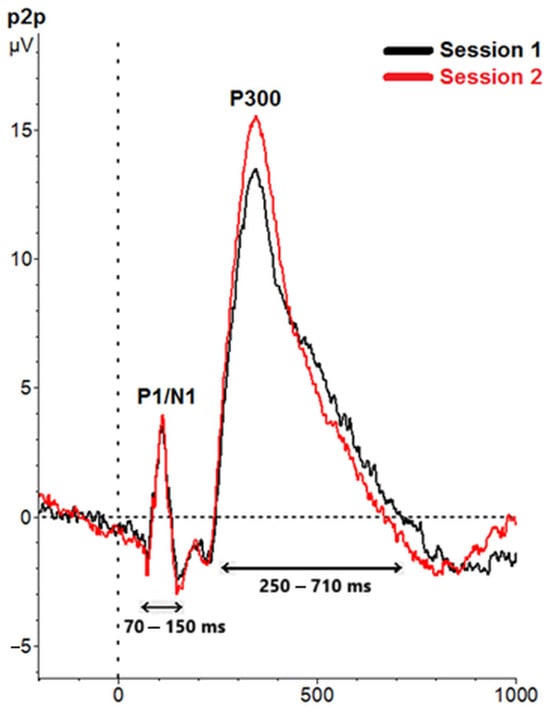
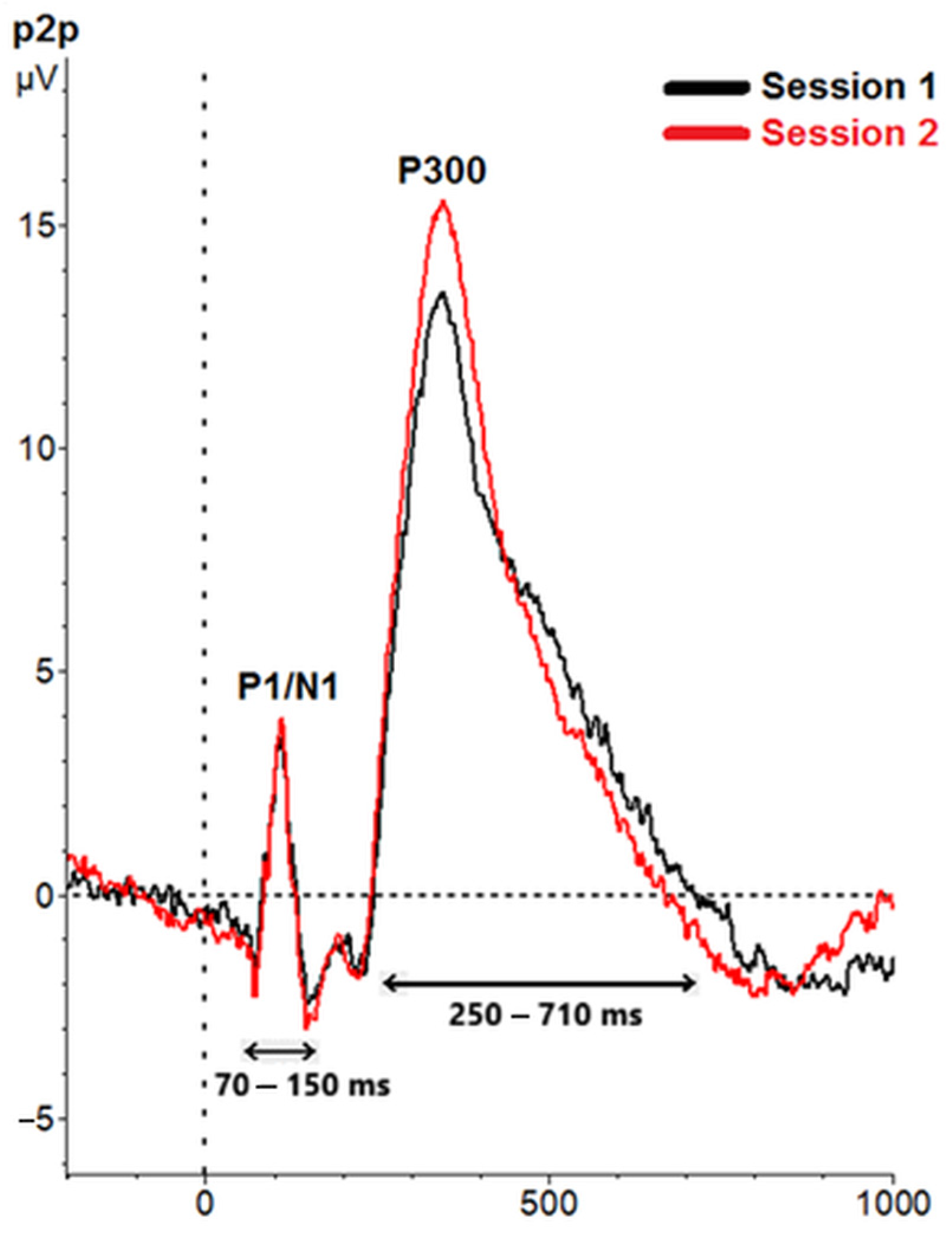
Representation of the event-related potentials (ERPs), which correspond to the EEG signal analyzed for the study of the role of gamma phase. The data for session 1 is shown in black, and the data for session 2 is shown in red. Both are measured at the P2P electrode.
References
- Carretié, L.; Iglesias, J. Psicofisiología: Fundamentos Metodológicos; Pirámide: Madrid, Spain, 1995; pp. 21–43. [Google Scholar]
- Tallon-Baudry, C. The roles of gamma-band oscillatory synchrony in human visual cognition. Front. Biosci. 2009, 14, 321. [Google Scholar] [CrossRef] [Scilit]
- Loo, S.K.; Makeig, S. Clinical Utility of EEG in Attention-Deficit/Hyperactivity Disorder: A Research Update. Neurotherapeutics 2012, 9, 569–587. [Google Scholar] [CrossRef] [Scilit] [PubMed]
- Hari, R.; Salmelin, R.; Mäkelä, J.P.; Salenius, S.; Helle, M. Magnetoencephalographic cortical rhythms. Int. J. Psychophysiol. 1997, 26, 51–62. [Google Scholar] [CrossRef] [Scilit] [PubMed]
- Vázquez-Marrufo, M.; García-Valdecasas, M.; Caballero-Díaz, R.; Martín-Clemente, R.; Galvao-Carmona, A. Multiple evoked and induced alpha modulations in a visual attention task: Latency, amplitude and topographical profiles. PLoS ONE 2019, 14, e0223055. [Google Scholar] [CrossRef] [Scilit] [PubMed]
- Vázquez-Marrufo, M.; Caballero-Díaz, R.; Martín-Clemente, R.; Galvao-Carmona, A.; González-Rosa, J.J. Individual test-retest reliability of evoked and induced alpha activity in human EEG data. PLoS ONE 2020, 15, e0239612. [Google Scholar] [CrossRef] [Scilit]
- Yusuf, P.A.; Hubka, P.; Konerding, W.; Land, R.; Tillein, J.; Kral, A. Congenital deafness reduces alpha-gamma cross-frequency coupling in the auditory cortex. Hear. Res. 2024, 449, 109032. [Google Scholar] [CrossRef] [Scilit] [PubMed]
- Zhang, J.; Zhu, C.; Han, J. The neural mechanism of non-phase-locked EEG activity in task switching. Neurosci. Lett. 2023, 792, 136957. [Google Scholar] [CrossRef] [Scilit] [PubMed]
- Wu, G.; Tang, X.; Gan, R.; Zeng, J.; Hu, Y.; Xu, L.; Wei, Y.; Tang, Y.; Chen, T.; Li, C.; et al. Temporal and time-frequency features of auditory oddball response in distinct subtypes of patients at clinical high risk for psychosis. Eur. Arch. Psychiatry Clin. Neurosci. 2022, 272, 449–459. [Google Scholar] [CrossRef] [Scilit] [PubMed]
- Dickinson, A.; Ryan, D.; McNaughton, G.; Levin, A.; Naples, A.; Borland, H.; Bernier, R.; Chawarska, K.; Dawson, G.; Dziura, J.; et al. Parsing evoked and induced gamma response differences in Autism: A visual evoked potential study. Clin. Neurophysiol. 2024, 165, 55–63. [Google Scholar] [CrossRef] [Scilit] [PubMed] [PubMed Central]
- Sharma, R.; Thirugnanasambandam, N. Theta-Gamma Decoupling—A neurophysiological marker of impaired reward processing in Parkinson’s disease. Brain Res. 2025, 1850, 149406. [Google Scholar] [CrossRef] [Scilit] [PubMed]
- Sabaté, M.; Llanos, C.; Enriquez, E.; González, B.; RodríGuez, M. Fast modulation of alpha activity during visual processing and motor control. Neuroscience 2011, 189, 236–249. [Google Scholar] [CrossRef] [Scilit]
- Vázquez-Marrufo, M.; Caballero-Díaz, R.; Sarrias-Arrabal, E.; Martín-Clemente, R. Decoupling Alpha Desynchronization from Neural Resource Use: Evidence from Cognitive Load Modulation. NeuroSci 2025, 6, 32. [Google Scholar] [CrossRef] [Scilit] [PubMed]
- Symond, M.B.; Harris, A.; Gordon, E.; Williams, L.M. “Gamma Synchrony” in First-Episode Schizophrenia: A Disorder of Temporal Connectivity? Am. J. Psychiatry 2005, 162, 459–465. [Google Scholar] [CrossRef] [Scilit] [PubMed]
- Tseng, P.; Chang, Y.; Chang, C.; Liang, W.K.; Juan, C.H. The critical role of phase difference in gamma oscillation within the temporoparietal network for binding visual working memory. Sci. Rep. 2016, 6, 32138. [Google Scholar] [CrossRef] [Scilit] [PubMed]
- Bossi, F.; Premoli, I.; Pizzamiglio, S.; Balaban, S.; Ricciardelli, P.; Rivolta, D. Theta- and Gamma-Band Activity Discriminates Face, Body and Object Perception. Front. Hum. Neurosci. 2020, 14, 74. [Google Scholar] [CrossRef] [Scilit]
- Ghiani, A.; Maniglia, M.; Battaglini, L.; Melcher, D.; Ronconi, L. Binding Mechanisms in Visual Perception and Their Link With Neural Oscillations: A Review of Evidence From tACS. Front. Psychol. 2021, 12, 643677. [Google Scholar] [CrossRef] [Scilit]
- Gruber, T.; Müller, M.; Keil, A.; Elbert, T. Selective visual-spatial attention alters induced gamma band responses in the human EEG. Clin. Neurophysiol. 1999, 110, 2074–2085. [Google Scholar] [CrossRef] [Scilit]
- Tallon-Baudry, C.; Bertrand, O. Oscillatory gamma activity in humans and its role in object representation. Trends Cogn. Sci. 1999, 3, 151–162. [Google Scholar] [CrossRef] [Scilit]
- Fell, J.; Fernández, G.; Klaver, P.; Elger, C.E.; Fries, P. Is synchronized neuronal gamma activity relevant for selective attention? Brain Res. Rev. 2003, 42, 265–272. [Google Scholar] [CrossRef] [Scilit]
- Vázquez-Marrufo, M.; Sarrias-Arrabal, E.; Martín-Clemente, R.; Galvao-Carmona, A.; Navarro, G.; Izquierdo, G. Altered phase and nonphase EEG activity expose impaired maintenance of a spatial-object attentional focus in multiple sclerosis patients. Sci. Rep. 2020, 10, 20721. [Google Scholar] [CrossRef] [Scilit]
- Müller, M.; Junghöfer, M.; Elbert, T.; Rochstroh, B. Visually induced gamma-band responses to coherent and incoherent motion. Neuroreport 1997, 8, 2575–2579. [Google Scholar] [CrossRef] [Scilit]
- Müller, M. Oscillatory cortical activities in the gamma band in the human EEG induced by visual stimuli--representation of the stimulus? Acta Neurobiol. Exp. 2000, 60, 49–65. [Google Scholar] [CrossRef] [Scilit]
- Hirano, Y.; Nakamura, I.; Tamura, S.; Onitsuka, T. Long-Term Test-Retest Reliability of Auditory Gamma Oscillations Between Different Clinical EEG Systems. Front. Psychiatry 2020, 11, 876. [Google Scholar] [CrossRef] [Scilit] [PubMed]
- Gratton, G.; Coles, M.G.; Donchin, E. A new method for off-line removal of ocular artifact. Electroencephalogr. Clin. Neurophysiol. 1983, 55, 468–484. [Google Scholar] [CrossRef] [Scilit] [PubMed]
- Nelli, S.; Itthipuripat, S.; Srinivasan, R.; Serences, J.T. Fluctuations in instantaneous frequency predict alpha amplitude during visual perception. Nat. Commun. 2017, 8, 2071. [Google Scholar] [CrossRef] [Scilit] [PubMed]
- Jürgens, E.; Rösler, F.; Hennighausen, E.; Heil, M. Stimulus-induced gamma oscillations. NeuroReport 1995, 6, 813–816. [Google Scholar] [CrossRef] [Scilit]
- Müller, M.; Keil, A. Neuronal Synchronization and Selective Color Processing in the Human Brain. J. Cogn. Neurosci. 2004, 16, 503–522. [Google Scholar] [CrossRef] [Scilit]
- Lozano-Soldevilla, D.; Ter Huurne, N.; Oostenveld, R. Neuronal Oscillations with Non-sinusoidal Morphology Produce Spurious Phase-to-Amplitude Coupling and Directionality. Front. Comput. Neurosci. 2016, 10, 87. [Google Scholar] [CrossRef] [Scilit]
- Maxwell, S.E.; Delaney, H.D.; Kelley, K. Designing Experiments and Analyzing Data: A Model Comparison Perspective, 3rd ed.; Routledge: New York, NY, USA, 2018. [Google Scholar]
- Kileny, P.R.; Kripal, J.P. Test-Retest Variability of Auditory Event-Related Potentials. Ear Hear. 1987, 8, 110–114. [Google Scholar] [CrossRef] [Scilit]
- Cassidy, S.M.; Robertson, I.H.; O’Connell, R.G. Retest reliability of event-related potentials: Evidence from a variety of paradigms. Psychophysiology 2012, 49, 659–664. [Google Scholar] [CrossRef] [Scilit]
- Kumar, W.S.; Manikandan, K.; Murty, D.V.P.S.; Ramesh, R.G.; Purokayastha, S.; Javali, M.; Rao, N.P.; Ray, S. Stimulus-Induced Narrowband Gamma Oscillations are Test–Retest Reliable in Human EEG. Cereb. Cortex Commun. 2022, 3, tgab066. [Google Scholar] [CrossRef] [Scilit]
- Başar-Eroğlu, C.; Strüber, D.; Schürmann, M.; Städler, M.; Başar, E. Gamma-band responses in the brain: A short review of psychophysiological correlates and functional significance. Int. J. Psychophysiol. 1996, 24, 101–112. [Google Scholar] [CrossRef] [Scilit] [PubMed]
- Schoenfeld, M.A.; Tempelmann, C.; MartíNez, A.; Hopf, J.; Sattler, C.; Heinze, H.; Hillyard, S.A. Dynamics of feature binding during object-selective attention. Proc. Natl. Acad. Sci. USA 2003, 100, 11806–11811. [Google Scholar] [CrossRef] [Scilit] [PubMed]
- Schoenfeld, M.A.; Hopf, J.; Merkel, C.; Heinze, H.; Hillyard, S.A. Object-based attention involves the sequential activation of feature-specific cortical modules. Nat. Neurosci. 2014, 17, 619–624. [Google Scholar] [CrossRef] [Scilit] [PubMed]
- Medvedev, A.V. Epileptiform spikes desynchronize and diminish fast (gamma) activity of the brain. Brain Res. Bull. 2002, 58, 115–128. [Google Scholar] [CrossRef] [Scilit]
- Neuper, C.; Grabner, R.H.; Fink, A.; Neubauer, A.C. Long-term stability and consistency of EEG event-related (de-)synchronization across different cognitive tasks. Clin. Neurophysiol. 2005, 116, 1681–1694. [Google Scholar] [CrossRef] [Scilit]
- Fründ, I.; Schadow, J.; Busch, N.A.; Körner, U.; Herrmann, C.S. Evoked γ oscillations in human scalp EEG are test–retest reliable. Clin. Neurophysiol. 2007, 118, 221–227. [Google Scholar] [CrossRef] [Scilit]
- Friedrich, E.V.C.; Scherer, R.; Neuper, C. Stability of event-related (de-) synchronization during brain–computer interface-relevant mental tasks. Clin. Neurophysiol. 2013, 124, 61–69. [Google Scholar] [CrossRef] [Scilit]
- Tan, H.M.; Groß, J.; Uhlhaas, P.J. MEG sensor and source measures of visually induced gamma-band oscillations are highly reliable. NeuroImage 2016, 137, 34–44. [Google Scholar] [CrossRef] [Scilit]
- Mably, A.J.; Colgin, L.L. Gamma oscillations in cognitive disorders. Curr. Opin. Neurobiol. 2018, 52, 182–187. [Google Scholar] [CrossRef] [Scilit]

Disclaimer/Publisher’s Note: The statements, opinions and data contained in all publications are solely those of the individual author(s) and contributor(s) and not of MDPI and/or the editor(s). MDPI and/or the editor(s) disclaim responsibility for any injury to people or property resulting from any ideas, methods, instructions or products referred to in the content. |
© 2026 by the authors. Licensee MDPI, Basel, Switzerland. This article is an open access article distributed under the terms and conditions of the Creative Commons Attribution (CC BY) license.