
Key Considerations for Treatment Planning System Development in Electron and Proton FLASH Radiotherapy

 , , , and
Abstract
1. Introduction
2. UHDR Realization: Proton and Electron Methods in FLASH-RT
2.1. Proton
2.2. Electron
3. Biological Model: Physical-to-Biological Conversion Tool in FLASH-RT TPS
4. Beam Parameters: Multi-Parametric Framework for FLASH-RT TPS
5. Dosimetry: Validation Tools in FLASH TPS
5.1. Real-Time Dose Monitoring
5.2. Dose/Dose-Rate Distribution
6. Conclusions
Author Contributions
Funding
Data Availability Statement
Conflicts of Interest
Abbreviations
| FLASH-RT | FLASH Radiotherapy |
| Conv-RT | Conventional Radiotherapy |
| TPS | Treatment Planning System |
| eFLASH-RT | Electron FLASH Radiotherapy |
| pFLASH-RT | Proton FLASH Radiotherapy |
| UHDR | Ultra-High Dose Rate |
| VHEE | Very High-Energy Electron |
| HEE | High-Energy Electron |
| PBS | Pencil Beam Scanning |
| SOBP | Spread-Out Bragg Peak |
| RBE | Relative Biological Effectiveness |
| BED | Biological Effective Dose |
| LQ | Linear-Quadratic |
| LQ-L | Linear-Quadratic-Linear |
| DADR | Dose-Averaged Dose Rate |
| ADR | Average Dose Rate |
| DTDR | Dose Threshold Dose Rate |
| EFDR | Effective Field Dose Rate |
| NT | Normal Tissue |
| CCD | Charge-Coupled Device |
| BCT | Beam Current Transformer |
| UTIC | Ultra-Thin Ionization Chamber |
References
- Sung, H.; Ferlay, J.; Siegel, R.L.; Laversanne, M.; Soerjomataram, I.; Jemal, A.; Bray, F. Global cancer statistics 2020: GLOBOCAN estimates of incidence and mortality worldwide for 36 cancers in 185 countries. CA Cancer J. Clin. 2021, 71, 209–249. [Google Scholar] [CrossRef] [PubMed]
- Lv, Y.; Lv, Y.; Wang, Z.; Lan, T.; Feng, X.; Chen, H.; Zhu, J.; Ma, X.; Du, J.; Hou, G.; et al. FLASH radiotherapy: A promising new method for radiotherapy. Oncol. Lett. 2022, 24, 419. [Google Scholar] [CrossRef]
- Dominello, M.M.; Sanders, T.; Anscher, M.; Bayouth, J.; Brock, K.K.; Carlson, D.J.; Hugo, G.; Joseph, S.; Knisely, J.; Mendonca, M.S.; et al. Responses to the 2018 and 2019 “One big discovery” Question: ASTRO membership’s opinions on the most important research questionfFacing radiation oncology… where are we headed? Int. J. Radiat. Oncol. Biol. Phys. 2021, 109, 38–40. [Google Scholar] [CrossRef]
- Berry, R.J.; Hall, E.J.; Forster, D.W.; Storr, T.H.; Goodman, M.J. Survival of mammalian cells exposed to x rays at ultra-high dose-rates. Br. J. Radiol. 1969, 42, 102–107. [Google Scholar] [CrossRef]
- Montay-Gruel, P.; Petersson, K.; Jaccard, M.; Boivin, G.; Germond, J.F.; Petit, B.; Doenlen, R.; Favaudon, V.; Bochud, F.; Bailat, C.; et al. Irradiation in a flash: Unique sparing of memory in mice after whole brain irradiation with dose rates above 100 Gy/s. Radiother. Oncol. 2017, 124, 365–369. [Google Scholar] [CrossRef]
- Vozenin, M.C.; Hendry, J.H.; Limoli, C.L. Biological benefits of ultra-high dose rate FLASH radiotherapy: Sleeping beauty awoken. Clin. Oncol. 2019, 31, 407–415. [Google Scholar] [CrossRef]
- Montay-Gruel, P.; Bouchet, A.; Jaccard, M.; Patin, D.; Serduc, R.; Aim, W.; Petersson, K.; Petit, B.; Bailat, C.; Bourhis, J.; et al. X-rays can trigger the FLASH effect: Ultra-high dose-rate synchrotron light source prevents normal brain injury after whole brain irradiation in mice. Radiother. Oncol. 2018, 129, 582–588. [Google Scholar] [CrossRef] [PubMed]
- Zhu, H.; Xie, D.; Yang, Y.; Huang, S.; Gao, X.; Peng, Y.; Wang, B.; Wang, J.; Xiao, D.; Wu, D.; et al. Radioprotective effect of X-ray abdominal FLASH irradiation: Adaptation to oxidative damage and inflammatory response may be benefiting factors. Med. Phys. 2022, 49, 4812–4822. [Google Scholar] [CrossRef]
- Montay-Gruel, P.; Acharya, M.M.; Petersson, K.; Alikhani, L.; Yakkala, C.; Allen, B.D.; Ollivier, J.; Petit, B.; Jorge, P.G.; Syage, A.R.; et al. Long-term neurocognitive benefits of FLASH radiotherapy driven by reduced reactive oxygen species. Proc. Natl. Acad. Sci. USA 2019, 116, 10943–10951. [Google Scholar] [CrossRef]
- Bourhis, J.; Sozzi, W.J.; Jorge, P.G.; Gaide, O.; Bailat, C.; Duclos, F.; Patin, D.; Ozsahin, M.; Bochud, F.; Germond, J.F.; et al. Treatment of a first patient with FLASH-radiotherapy. Radiother. Oncol. 2019, 139, 18–22. [Google Scholar] [CrossRef] [PubMed]
- Zeng, Y.; Quan, H. Considerations and current status of treatment planning for proton FLASH radiotherapy. Chin. Sci. Bull. 2023, 68, 4231–4244. [Google Scholar] [CrossRef]
- Oh, K.; Gallagher, K.J.; Yan, Y.; Zhou, S.M. Commissioning and initial validation of Eclipse eMC algorithm for the electron FLASH research extension (FLEX) system for pre-clinical studies. J. Appl. Clin. Med. Phys. 2024, 25, e14289. [Google Scholar] [CrossRef]
- Dai, T.; Sloop, A.M.; Rahman, M.R.; Sunnerberg, J.P.; Clark, M.A.; Young, R.; Adamczyk, S.; Von Voigts-Rhetz, P.; Patane, C.; Turk, M.; et al. First Monte Carlo beam model for ultra-high dose rate radiotherapy with a compact electron LINAC. Med. Phys. 2024, 51, 5109–5118. [Google Scholar] [CrossRef]
- Rahman, M.; Ashraf, M.R.; Gladstone, D.J.; Bruza, P.; Jarvis, L.A.; Schaner, P.E.; Cao, X.; Pogue, B.W.; Hoopes, P.J.; Zhang, R. Treatment planning system for electron FLASH radiation therapy: Open-source for clinical implementation. Int. J. Radiat. Oncol. Biol. Phys. 2022, 112, 1023–1032. [Google Scholar] [CrossRef] [PubMed]
- Zhang, G.; Zhang, Z.; Gao, W.; Quan, H. Treatment planning consideration for very high-energy electron FLASH radiotherapy. Phys. Med. 2023, 107, 102539. [Google Scholar] [CrossRef] [PubMed]
- Wase, V.; Widenfalk, O.; Nilsson, R.; Fälth, C.; Fredriksson, A. Fast spot order optimization to increase dose rates in scanned particle therapy FLASH treatments. Phys. Med. Biol. 2025, 70, 025017. [Google Scholar] [CrossRef] [PubMed]
- Santo, R.J.; Habraken, S.J.M.; Breedveld, S.; Hoogeman, M.S. Pencil-beam delivery pattern ooptimization increases dose rate for stereotactic FLASH proton therapy. Int. J. Radiat. Oncol. Biol. Phys. 2023, 115, 759–767. [Google Scholar] [CrossRef]
- Zhao, X.; Huang, S.; Lin, H.; Choi, J.I.; Zhu, K.; Simone, C.B., 2nd; Yan, X.; Kang, M. A novel dose rate optimization method to maximize ultrahigh-dose-rate coverage of critical organs at risk without compromising dosimetry metrics in proton pencil beam scanning FLASH radiation therapy. Int. J. Radiat. Oncol. Biol. Phys. 2024, 120, 1181–1191. [Google Scholar] [CrossRef]
- Kang, M.; Wei, S.; Choi, J.I.; Simone, C.B.; Lin, H.B. Quantitative assessment of 3D dose rate for proton pencil beam scanning FLASH radiotherapy and its application for lung hypofractionation treatment planning. Cancers 2021, 13, 3549. [Google Scholar] [CrossRef]
- Wei, S.; Lin, H.; Choi, J.I.; Press, R.H.; Lazarev, S.; Kabarriti, R.; Hajj, C.; Hasan, S.; Chhabra, A.M.; Simone, C.B., 2nd; et al. FLASH radiotherapy using single-energy proton PBS transmission beams for hypofractionation liver cancer: Dose and dose rate quantification. Front. Oncol. 2022, 11, 813063. [Google Scholar] [CrossRef]
- van Marlen, P.; Dahele, M.; Folkerts, M.; Abel, E.; Slotman, B.J.; Verbakel, W. Ultra-high dose rate transmission beam proton therapy for conventionally fractionated head and neck cancer: Treatment planning and dose rate distributions. Cancers 2021, 13, 1859. [Google Scholar] [CrossRef] [PubMed]
- Ma, C.; Yang, X.; Chang, C.W.; Liu, R.; Bohannon, D.; Lin, L.; Liu, T.; Tian, S.; Zhou, J. Feasibility study of hybrid inverse planning with transmission beams and single-energy spread-out Bragg peaks for proton FLASH radiotherapy. Med. Phys. 2023, 50, 3687–3700. [Google Scholar] [CrossRef] [PubMed]
- Kang, M.; Wei, S.; Choi, J.I.; Lin, H.; Simone, C. A universal range shifter and range compensator can enable proton pencil beam scanning single-energy Bragg peak FLASH-RT treatment using current commercially available proton systems. Int. J. Radiat. Oncol. Biol. Phys. 2022, 113, 203–213. [Google Scholar] [CrossRef] [PubMed]
- Wei, S.; Lin, H.; Shi, C.; Xiong, W.; Chen, C.C.; Huang, S.; Press, R.H.; Hasan, S.; Chhabra, A.M.; Choi, J.I.; et al. Use of single-energy proton pencil beam scanning Bragg peak for intensity-modulated proton therapy FLASH treatment planning in liver-hypofractionated radiation therapy. Med. Phys. 2022, 49, 6560–6574. [Google Scholar] [CrossRef]
- Lovgren, N.; Kristensen, I.F.; Petersson, K. Feasibility and constraints of Bragg peak FLASH proton therapy treatment planning. Front. Oncol. 2024, 14, 1369065. [Google Scholar] [CrossRef]
- Pennock, M.; Wei, S.; Cheng, C.; Lin, H.; Hasan, S.; Chhabra, A.M.; Choi, J.I.; Bakst, R.L.; Kabarriti, R.; Simone, C.B.; et al. Proton Bragg peak FLASH enables organ sparing and ultra-high dose-rate delivery: Proof of principle in recurrent head and neck cancer. Cancers 2023, 15, 3828. [Google Scholar] [CrossRef]
- Cheng, C.; Xu, L.; Jing, H.; Selvaraj, B.; Lin, H.; Pennock, M.; Chhabra, A.M.; Hasan, S.; Zhai, H.; Zhang, Y.; et al. The potential and challenges of proton FLASH in head and neck cancer reirradiation. Cancers 2024, 16, 3249. [Google Scholar] [CrossRef]
- Zhang, G.; Gao, W.; Peng, H. Design of static and dynamic ridge filters for FLASH-IMPT: A simulation study. Med. Phys. 2022, 49, 5387–5399. [Google Scholar] [CrossRef]
- Zhang, Z.; Zhao, W.; Butkus, M.; Wu, X. Conformal Dose Modulator for Proton Beam Therapy Part 1: A Simulation Study. Front. Oncol. 2022, 12, 840469. [Google Scholar] [CrossRef]
- Roddy, D.; Bélanger-Champagne, C.; Tattenberg, S.; Yen, S.; Trinczek, M.; Hoehr, C. Design, optimization, and testing of ridge filters for proton FLASH radiotherapy at TRIUMF: The HEDGEHOG. Nucl. Instrum. Methods Phys. Res. Sect. A 2024, 1063, 169284. [Google Scholar] [CrossRef]
- Simeonov, Y.; Weber, U.; Schuy, C.; Engenhart-Cabillic, R.; Penchev, P.; Flatten, V.; Zink, K. Development, Monte Carlo simulations and experimental evaluation of a 3D range-modulator for a complex target in scanned proton therapy. Biomed. Phys. Eng. Express 2022, 8, 035006. [Google Scholar] [CrossRef] [PubMed]
- Ma, C.; Zhou, J.; Chang, C.W.; Wang, Y.; Patel, P.R.; Yu, D.S.; Tian, S.; Yang, X. Streamlined pin-ridge-filter design for single-energy proton FLASH planning. Med. Phys. 2024, 51, 2955–2966. [Google Scholar] [CrossRef]
- Chan, T.Y.; Cho, I.C.; Farooq, A.; Fan, K.H.; Tsai, Y.T.; Chao, T.C.; Wang, C.C. Mini-ridge filter designs for conformal FLASH proton therapy. Radiat. Phys. Chem. 2024, 224, 112017. [Google Scholar] [CrossRef]
- Titt, U.; Yang, M.; Wang, X.; Iga, K.; Fredette, N.; Schueler, E.; Lin, S.H.; Zhu, X.R.; Sahoo, N.; Koong, A.C.; et al. Design and validation of a synchrotron proton beam line for FLASH radiotherapy preclinical research experiments. Med. Phys. 2022, 49, 497–509. [Google Scholar] [CrossRef]
- Hachadorian, R.; Cascio, E.; Ruggieri, T.; Bussiere, M.; Schuemann, J. Increased flexibility and efficiency of a double-scattering FLASH proton beamline configuration for in vivo SOBP radiotherapy treatments. Phys. Med. Biol. 2023, 68, 15NT01. [Google Scholar] [CrossRef]
- Rahman, M.; Ashraf, M.R.; Gladstone, D.J.; Bruza, P.; Jarvis, L.A.; Schaner, P.E.; Cao, X.; Pogue, B.W.; Hoopes, P.J.; Zhang, R. Treatment planning system for clinical translation of electron FLASH radiotherapy. Int. J. Radiat. Oncol. Biol. Phys. 2021, 111, S31. [Google Scholar] [CrossRef]
- Giuliano, L.; Alesini, D.; Cardelli, F.; Carillo, M.; Chiadroni, E.; Coppola, M.; Cuttone, G.; Curcio, A.; De Gregorio, A.; Raddo, R.D.; et al. A compact C-band FLASH electron linear accelerator prototype for the VHEE SAFEST project. Front. Oncol. 2025, 15, 151676. [Google Scholar] [CrossRef] [PubMed]
- Böhlen, T.T.; Germond, J.F.; Desorgher, L.; Veres, I.; Bratel, A.; Landström, E.; Engwall, E.; Herrera, F.G.; Ozsahin, E.M.; Bourhis, J.; et al. Very high-energy electron therapy as light-particle alternative to transmission proton FLASH therapy—An evaluation of dosimetric performances. Radiother. Oncol. 2024, 194, 110177. [Google Scholar] [CrossRef]
- Whitmore, L.; Mackay, R.I.; van Herk, M.; Jones, J.K.; Jones, R.M. Focused VHEE (very high energy electron) beams and dose delivery for radiotherapy applications. Sci. Rep. 2021, 11, 14013. [Google Scholar] [CrossRef]
- Bedford, J.L.; Oelfke, U. Treatment planning for very high energy electrons: Studies that indicate the potential of the modality. Phys. Imaging Radiat. Oncol. 2024, 32, 100670. [Google Scholar] [CrossRef]
- Jones, B. Modelled biological effectiveness comparisons of low, high and ultra-high (FLASH) radiation dose rates. Radiat. Phys. Chem. 2023, 208, 110944. [Google Scholar] [CrossRef]
- Jones, B.; Dale, R.G. The evolution of practical radiobiological modelling. Br. J. Radiol. 2018, 92, 20180097. [Google Scholar] [CrossRef]
- Hu, S.; Lan, X.; Zheng, J.; Bi, Y.; Ye, Y.; Si, M.; Fang, Y.; Wang, J.; Liu, J.; Chen, Y.; et al. The dose-related plateau effect of surviving fraction in normal tissue during the ultra-high-dose-rate radiotherapy. Phys. Med. Biol. 2023, 68, 185004. [Google Scholar] [CrossRef]
- Jones, B. The influence of hypoxia on LET and RBE relationships with implications for ultra-high dose rates and FLASH modelling. Phys. Med. Biol. 2022, 67, 125011. [Google Scholar] [CrossRef]
- Shiraishi, Y.; Matsuya, Y.; Kusumoto, T.; Fukunaga, H. Modeling for predicting survival fraction of cells after ultra-high dose rate irradiation. Phys. Med. Biol. 2024, 69, 015017. [Google Scholar] [CrossRef]
- Howard, M.E.; Beltran, C.; Anderson, S.; Tseung, W.C.; Sarkaria, J.N.; Herman, M.G. Investigating dependencies of relative biological effectiveness for proton therapy in cancer cells. Int. J. Part. Ther. 2018, 4, 12–22. [Google Scholar] [CrossRef]
- Chattaraj, A.; Selvam, T.P. Calculation of biological effectiveness of SOBP proton beams: A TOPAS Monte Carlo study. Biomed. Phys. Eng. Express 2024, 10, 035004. [Google Scholar] [CrossRef]
- Böhlen, T.T.; Germond, J.F.; Bourhis, J.; Bailat, C.; Bochud, F.; Moeckli, R. The minimal FLASH sparing effect needed to compensate the increase of radiobiological damage due to hypofractionation for late-reacting tissues. Med. Phys. 2022, 49, 7672–7682. [Google Scholar] [CrossRef]
- Byrne, K.E.; Poirier, Y.; Xu, J.; Gerry, A.; Foley, M.J.; Jackson, I.L.; Sawant, A.; Jiang, K. A small animal irradiation platform for investigating the dependence of the FLASH effect on electron beam parameters. Med. Phys. 2024, 51, 1421–1432. [Google Scholar] [CrossRef]
- Liew, H.; Mein, S.; Tessonnier, T.; Abdollahi, A.; Debus, J.; Dokic, I.; Mairani, A. The impact of sub-millisecond damage fixation kinetics on the in vitro sparing effect at ultra-high dose rate in UNIVERSE. Int. J. Mol. Sci. 2022, 23, 2954. [Google Scholar] [CrossRef]
- Zou, W.; Zhang, R.; Schüler, E.; Taylor, P.A.; Mascia, A.E.; Diffenderfer, E.S.; Zhao, T.; Ayan, A.S.; Sharma, M.; Yu, S.J.; et al. Framework for quality assurance of ultrahigh dose rate clinical trials investigating FLASH effects and current technology gaps. Int. J. Radiat. Oncol. Biol. Phys. 2023, 116, 1202–1217. [Google Scholar] [CrossRef]
- Zhou, S.; Zheng, D.; Fan, Q.; Yan, Y.; Wang, S.; Lei, Y.; Besemer, A.; Zhou, C.; Enke, C. Minimum dose rate estimation for pulsed FLASH radiotherapy: A dimensional analysis. Med. Phys. 2020, 47, 3243–3249. [Google Scholar] [CrossRef]
- Sunnerberg, J.P.; Zhang, R.; Gladstone, D.J.; Swartz, H.M.; Gui, J.; Pogue, B.W. Mean dose rate in ultra-high dose rate electron irradiation is a significant predictor for O2 consumption and H2O2 yield. Phys. Med. Biol. 2023, 68, 165014. [Google Scholar] [CrossRef]
- Sampayan, S.E.; Sampayan, K.C.; Caporaso, G.J.; Chen, Y.J.; Falabella, S.; Hawkins, S.A.; Hearn, J.; Watson, J.A.; Zentler, J.M. Megavolt bremsstrahlung measurements from linear induction accelerators demonstrate possible use as a FLASH radiotherapy source to reduce acute toxicity. Sci. Rep. 2021, 11, 17104. [Google Scholar] [CrossRef]
- Saade, G.; Bogaerts, E.; Chiavassa, S.; Blain, G.; Delpon, G.; Evin, M.; Ghannam, Y.; Haddad, F.; Haustermans, K.; Koumeir, C.; et al. Ultrahigh-dose-rate proton irradiation elicits reduced toxicity in zebrafish embryos. Adv. Radiat. Oncol. 2023, 8, 101124. [Google Scholar] [CrossRef]
- Cooper, C.R.; Jones, D.; Jones, G.D.D.; Petersson, K. FLASH irradiation induces lower levels of DNA damage ex vivo, an effect modulated by oxygen tension, dose, and dose rate. Br. J. Radiol. 2022, 95, 20211150. [Google Scholar] [CrossRef]
- Krieger, M.; van de Water, S.; Folkerts, M.M.; Mazal, A.; Fabiano, S.; Bizzocchi, N.; Weber, D.C.; Safai, S.; Lomax, A.J. A quantitative FLASH effectiveness model to reveal potentials and pitfalls of high dose rate proton therapy. Med. Phys. 2022, 49, 2026–2038. [Google Scholar] [CrossRef]
- Ruan, J.L.; Lee, C.; Wouters, S.; Tullis, I.D.C.; Verslegers, M.; Mysara, M.; Then, C.K.; Smart, S.C.; Hill, M.A.; Muschel, R.J.; et al. Irradiation at ultra-high (FLASH) dose rates reduces acute normal tissue toxicity in the mouse gastrointestinal system. Int. J. Radiat. Oncol. Biol. Phys. 2021, 111, 1250–1261. [Google Scholar] [CrossRef]
- Almeida, A.; Togno, M.; Ballesteros-Zebadua, P.; Franco-Perez, J.; Geyer, R.; Schaefer, R.; Petit, B.; Grilj, V.; Meer, D.; Safai, S.; et al. Dosimetric and biologic intercomparison between electron and proton FLASH beams. Radiother. Oncol. 2024, 190, 109953. [Google Scholar] [CrossRef]
- Karsch, L.; Pawelke, J.; Brand, M.; Hans, S.; Hideghéty, K.; Jansen, J.; Lessmann, E.; Löck, S.; Schürer, M.; Schurig, R.; et al. Beam pulse structure and dose rate as determinants for the flash effect observed in zebrafish embryo. Radiother. Oncol. 2022, 173, 49–54. [Google Scholar] [CrossRef]
- Valdés Zayas, A.; Kumari, N.; Liu, K.; Neill, D.; Delahoussaye, A.; Gonçalves Jorge, P.; Geyer, R.; Lin, S.H.; Bailat, C.; Bochud, F.; et al. Independent reproduction of the flash effect on the gastrointestinal tract: A multi-institutional comparative study. Cancers 2023, 15, 2121. [Google Scholar] [CrossRef]
- Draeger, E.; Sawant, A.; Johnstone, C.; Koger, B.; Becker, S.; Vujaskovic, Z.; Jackson, I.L.; Poirier, Y. A dose of reality: How 20 years of incomplete physics and dosimetry reporting in radiobiology studies may have contributed to the reproducibility crisis. Int. J. Radiat. Oncol. Biol. Phys. 2020, 106, 243–252. [Google Scholar] [CrossRef]
- Farr, J.; Grilj, V.; Malka, V.; Sudharsan, S.; Schippers, M. Ultra-high dose rate radiation production and delivery systems intended for FLASH. Med. Phys. 2022, 49, 4875–4911. [Google Scholar] [CrossRef]
- Gaide, O.; Herrera, F.; Jeanneret Sozzi, W.; Gonçalves Jorge, P.; Kinj, R.; Bailat, C.; Duclos, F.; Bochud, F.; Germond, J.F.; Gondré, M.; et al. Comparison of ultra-high versus conventional dose rate radiotherapy in a patient with cutaneous lymphoma. Radiother. Oncol. 2022, 174, 87–91. [Google Scholar] [CrossRef]
- Zhang, Q.; Gerweck, L.E.; Cascio, E.; Gu, L.; Yang, Q.; Dong, X.; Huang, P.; Bertolet, A.; Nesteruk, K.P.; Sung, W.; et al. Absence of tissue-sparing effects in partial proton FLASH irradiation in murine intestine. Cancers 2023, 15, 2269. [Google Scholar] [CrossRef]
- Schüler, E.; Acharya, M.; Montay-Gruel, P.; Loo, B., Jr.; Vozenin, M.C.; Maxim, P.G. Ultra-high dose rate electron beams and the FLASH effect: From preclinical evidence to a new radiotherapy paradigm. Med. Phys. 2022, 49, 2082–2095. [Google Scholar] [CrossRef]
- van de Water, S.; Safai, S.; Schippers, J.M.; Weber, D.C.; Lomax, A.J. Towards FLASH proton therapy: The impact of treatment planning and machine characteristics on achievable dose rates. Acta Oncol. 2019, 58, 1463–1469. [Google Scholar] [CrossRef]
- Zou, W.; Diffenderfer, E.S.; Cengel, K.A.; Kim, M.M.; Avery, S.; Konzer, J.; Cai, Y.; Boisseu, P.; Ota, K.; Yin, L.; et al. Current delivery limitations of proton PBS for FLASH. Radiother. Oncol. 2021, 155, 212–218. [Google Scholar] [CrossRef]
- Folkerts, M.M.; Abel, E.; Busold, S.; Perez, J.R.; Krishnamurthi, V.; Ling, C.C. A framework for defining FLASH dose rate for pencil beam scanning. Med. Phys. 2020, 47, 6396–6404. [Google Scholar] [CrossRef]
- Kim, M.M.; Verginadis, I.I.; Goia, D.; Haertter, A.; Shoniyozov, K.; Zou, W.; Maity, A.; Busch, T.M.; Metz, J.M.; Cengel, K.A.; et al. Comparison of FLASH proton entrance and the spread-out Bragg peak dose regions in the sparing of mouse intestinal crypts and in a pancreatic tumor model. Cancers 2021, 13, 4244. [Google Scholar] [CrossRef]
- Levy, K.; Natarajan, S.; Wang, J.; Chow, S.; Eggold, J.T.; Loo, P.E.; Manjappa, R.; Melemenidis, S.; Lartey, F.M.; Schüler, E.; et al. Abdominal FLASH irradiation reduces radiation-induced gastrointestinal toxicity for the treatment of ovarian cancer in mice. Sci. Rep. 2020, 10, 21600. [Google Scholar] [CrossRef]
- Eggold, J.T.; Chow, S.; Melemenidis, S.; Wang, J.; Natarajan, S.; Loo, P.E.; Manjappa, R.; Viswanathan, V.; Kidd, E.A.; Engleman, E.; et al. Abdominopelvic FLASH Irradiation Improves PD-1 Immune Checkpoint Inhibition in Preclinical Models of Ovarian Cancer. Mol. Cancer Ther. 2022, 21, 371–381. [Google Scholar] [CrossRef]
- Gao, F.; Yang, Y.; Zhu, H.; Wang, J.; Xiao, D.; Zhou, Z.; Dai, T.; Zhang, Y.; Feng, G.; Li, J.; et al. First demonstration of the FLASH effect with ultrahigh dose rate high-energy X-rays. Radiother. Oncol. 2022, 166, 44–50. [Google Scholar] [CrossRef]
- Simmons, D.A. Reduced cognitive deficits after FLASH irradiation of whole mouse brain are associated with less hippocampal dendritic spine loss and neuroinflammation. Radiother. Oncol. 2019, 139, 4–10. [Google Scholar] [CrossRef]
- Venkatesulu, B.P.; Sharma, A.; Pollard-Larkin, J.M.; Sadagopan, R.; Symons, J.; Neri, S.; Singh, P.K.; Tailor, R.; Lin, S.H.; Krishnan, S. Ultra high dose rate (35 Gy/sec) radiation does not spare the normal tissue in cardiac and splenic models of lymphopenia and gastrointestinal syndrome. Sci. Rep. 2019, 9, 17180. [Google Scholar] [CrossRef]
- Montay-Gruel, P.; Markarian, M.; Allen, B.D.; Baddour, J.D.; Giedzinski, E.; Jorge, P.G.; Petit, B.; Bailat, C.; Vozenin, M.C.; Limoli, C.; et al. Ultra-High-Dose-Rate FLASH Irradiation Limits Reactive Gliosis in the Brain. Radiat. Res. 2020, 194, 636–645. [Google Scholar] [CrossRef]
- Diffenderfer, E.S.; Verginadis, I.I.; Kim, M.M.; Shoniyozov, K.; Velalopoulou, A.; Goia, D.; Putt, M.; Hagan, S.; Avery, S.; Teo, K.; et al. Design, Implementation, and in Vivo Validation of a Novel Proton FLASH Radiation Therapy System. Int. J. Radiat. Oncol. Biol. Phys. 2020, 106, 440–448. [Google Scholar] [CrossRef]
- Kim, Y.E.; Gwak, S.H.; Hong, B.J.; Oh, J.M.; Choi, H.S.; Kim, M.S.; Oh, D.; Lartey, F.M.; Rafat, M.; Schüler, E.; et al. Effects of Ultra-high doserate FLASH Irradiation on the Tumor Microenvironment in Lewis Lung Carcinoma: Role of Myosin Light Chain. Int. J. Radiat. Oncol. Biol. Phys. 2021, 109, 1440–1453. [Google Scholar] [CrossRef] [PubMed]
- Williams, M.T.; Sugimoto, C.; Regan, S.L.; Pitzer, E.M.; Fritz, A.L.; Sertorio, M.; Mascia, A.E.; Vatner, R.E.; Perentesis, J.P.; Vorhees, C.V. Cognitive and behavioral effects of whole brain conventional or high dose rate (FLASH) proton irradiation in a neonatal Sprague Dawley rat model. PLoS ONE 2022, 17, e274007. [Google Scholar] [CrossRef] [PubMed]
- Montay-Gruel, P.; Acharya, M.M.; Gonçalves Jorge, P.; Petit, B.; Petridis, I.G.; Fuchs, P.; Leavitt, R.; Petersson, K.; Gondré, M.; Ollivier, J.; et al. Hypofractionated FLASH-RT as an Effective Treatment against Glioblastoma that Reduces Neurocognitive Side Effects in Mice. Clin. Cancer Res. 2021, 27, 775–784. [Google Scholar] [CrossRef]
- Allen, B.D.; Acharya, M.M.; Montay-Gruel, P.; Jorge, P.G.; Bailat, C.; Petit, B.; Vozenin, M.C.; Limoli, C. Maintenance of Tight Junction Integrity in the Absence of Vascular Dilation in the Brain of Mice Exposed to Ultra-High-Dose-Rate FLASH Irradiation. Radiat. Res. 2020, 194, 625–635. [Google Scholar] [CrossRef]
- Dokic, I.; Meister, S.; Bojcevski, J.; Tessonnier, T.; Walsh, D.; Knoll, M.; Mein, S.; Tang, Z.; Vogelbacher, L.; Rittmueller, C.; et al. Neuroprotective Effects of Ultra-High Dose Rate FLASH Bragg Peak Proton Irradiation. Int. J. Radiat. Oncol. Biol. Phys. 2022, 113, 614–623. [Google Scholar] [CrossRef]
- Zhu, H.; Xie, D.; Wang, Y.; Huang, R.; Chen, X.; Yang, Y.; Wang, B.; Peng, Y.; Wang, J.; Xiao, D.; et al. Comparison of intratumor and local immune response between MV X-ray FLASH and conventional radiotherapies. Clin. Transl. Radiat. Oncol. 2023, 38, 138–146. [Google Scholar] [CrossRef]
- Iturri, L.; Bertho, A.; Lamirault, C.; Juchaux, M.; Gilbert, C.; Espenon, J.; Sebrie, C.; Jourdain, L.; Pouzoulet, F.; Verrelle, P.; et al. Proton FLASH Radiation Therapy and Immune Infiltration: Evaluation in an Orthotopic Glioma Rat Model. Int. J. Radiat. Oncol. Biol. Phys. 2022, 116, 655–665. [Google Scholar] [CrossRef]
- Chaklai, A.; Canaday, P.; O’Niel, A.; Cucinotta, F.A.; Sloop, A.; Gladstone, D.; Pogue, B.; Zhang, R.; Sunnerberg, J.; Kheirollah, A.; et al. Effects of UHDR and Conventional Irradiation on Behavioral and Cognitive Performance and the Percentage of Ly6G+CD45+Cells in the Hippocampus. Int. J. Mol. Sci. 2023, 24, 12497. [Google Scholar] [CrossRef]
- Allen, B.D.; Alaghband, Y.; Kramár, E.A.; Ru, N.; Petit, B.; Grilj, V.; Petronek, M.S.; Pulliam, C.F.; Kim, R.Y.; Doan, N.L.; et al. Elucidating the neurological mechanism of the FLASH effect in juvenile mice exposed to hypofractionated radiotherapy. Neuro-Oncology 2023, 25, 927–939. [Google Scholar] [CrossRef]
- Yin, L.; Masumi, U.; Ota, K.; Sforza, D.M.; Miles, D.; Rezaee, M.; Wong, J.W.; Jia, X.; Li, H. Feasibility of synchrotron-based ultra-high dose rate (UHDR) proton irradiation with pencil beam scanning for FLASH research. Cancers 2024, 16, 221. [Google Scholar] [CrossRef]
- Darafsheh, A.; Hao, Y.; Zhao, X.; Zwart, T.; Wagner, M.; Evans, T.; Reynoso, F.; Zhao, T. Spread-out Bragg peak proton FLASH irradiation using a clinical synchrocyclotron: Proof of concept and ion chamber characterization. Med. Phys. 2021, 48, 4472–4484. [Google Scholar] [CrossRef]
- Petersson, K.; Jaccard, M.; Germond, J.F.; Buchillier, T.; Bochud, F.; Bourhis, J.; Vozenin, M.C.; Bailat, C. High dose-per-pulse electron beam dosimetry—A model to correct for the ion recombination in the Advanced Markus ionization chamber. Med. Phys. 2017, 44, 1157–1167. [Google Scholar] [CrossRef]
- Ashraf, M.R.; Rahman, M.; Cao, X.; Duval, K.; Williams, B.B.; Hoopes, J.P.; Gladstone, D.J.; Pogue, B.W.; Zhang, R.; Bruza, P. Individual pulse monitoring and dose control system for pre-clinical implementation of FLASH-RT. Phys. Med. Biol. 2022, 67, 095003. [Google Scholar] [CrossRef]
- Spruijt, K.H.; Godart, J.; Rovituso, M.; Wang, Y.; van der Wal, E.; Habraken, S.J.M.; Hoogeman, M. Development of patient-specific pre-treatment verification procedure for FLASH proton therapy based on time resolved film dosimetry. Med. Phys. 2025, 52, 1268–1280. [Google Scholar] [CrossRef]
- Ashraf, M.R.; Rahman, M.; Zhang, R.X.; Williams, B.B.; Gladstone, D.J.; Pogue, B.W.; Bruza, P. Dosimetry for FLASH radiotherapy: A review of tools and the role of radioluminescence and Cherenkov emission. Front. Phys. 2020, 8, 328. [Google Scholar] [CrossRef]
- Motta, S.; Christensen, J.B.; Togno, M.; SchSfer, R.; Safai, S.; Lomax, A.J.; Yukihara, E.G. Characterization of LiF: Mg, Ti thermoluminescence detectors in low-LET proton beams at ultra-high dose rates. Phys. Med. Biol. 2023, 68, 045017. [Google Scholar] [CrossRef]
- Hart, A.; Cecchi, D.; Giguère, C.; Larose, F.; Therriault-Proulx, F.; Esplen, N.; Beaulieu, L.; Bazalova-Carter, M. Lead-doped scintillator dosimeters for detection of ultrahigh dose-rate x-rays. Phys. Med. Biol. 2022, 67, 105007. [Google Scholar] [CrossRef]
- Liu, K.; Velasquez, B.; Schüler, E. High-dose and ultra-high dose rate (UHDR) evaluation of Al2O3:C optically stimulated luminescent dosimeter nanoDots and powdered LiF: Mg, Ti thermoluminescent dosimeters for radiation therapy applications. Med. Phys. 2024, 51, 2311–2319. [Google Scholar] [CrossRef]
- Vanreusel, V.; Gasparini, A.; Galante, F.; Mariani, G.; Pacitti, M.; Colijn, A.; Reniers, B.; Yalvac, B.; Vandenbroucke, D.; Peeters, M.; et al. Optically stimulated luminescence system as an alternative for radiochromic film for 2D reference dosimetry in UHDR electron beams. Phys. Med. 2023, 114, 103147. [Google Scholar] [CrossRef]
- Glaser, A.K.; Zhang, R.X.; Gladstone, D.J.; Pogue, B.W. Optical dosimetry of radiotherapy beams using Cherenkov radiation: The relationship between light emission and dose. Phys. Med. Biol. 2014, 59, 3789. [Google Scholar] [CrossRef]
- Glaser, A.K.; Davis, S.C.; McClatchy, D.M.; Zhang, R.X.; Pogue, B.W.; Gladstone, D.J. Projection imaging of photon beams by the Cerenkov effect. Med. Phys. 2013, 40, 012101. [Google Scholar] [CrossRef]
- Brunner, S.E.; Schaart, D.R. BGO as a hybrid scintillator/Cherenkov radiator for cost-effective time-of-flight PET. Phys. Med. Biol. 2017, 62, 4421. [Google Scholar] [CrossRef]
- Subiel, A.; Romano, F. Recent developments in absolute dosimetry for FLASH radiotherapy. Br. J. Radiol. 2023, 96, 20220560. [Google Scholar] [CrossRef]
- Gómez, F.; Gonzalez-Castaño, D.M.; Fernández, N.G.; Pardo-Montero, J.; Schüller, A.; Gasparini, A.; Vanreusel, V.; Verellen, D.; Felici, G.; Kranzer, R.; et al. Development of an ultra-thin parallel plate ionization chamber for dosimetry in FLASH radiotherapy. Med. Phys. 2022, 49, 4705–4714. [Google Scholar] [CrossRef]
- Boag, J.W.; Hochhauser, E.; Balk, O.A. The effect of free-electron collection on the recombination correction to ionization measurements of pulsed radiation. Phys. Med. Biol. 1996, 41, 885. [Google Scholar] [CrossRef]
- Laitano, R.F.; Guerra, A.S.; Pimpinella, M.; Caporali, C.; Petrucci, A. Charge collection efficiency in ionization chambers exposed to electron beams with high dose per pulse. Phys. Med. Biol. 2006, 51, 6419. [Google Scholar] [CrossRef]
- Di Martino, F.; Del Sarto, D.; Bisogni, G.M.; Capaccioli, S.; Galante, F.; Gasperini, A.; Linsalata, S.; Mariani, G.; Pacitti, M.; Paiar, F.; et al. A new solution for UHDP and UHDR (Flash) measurements: Theory and conceptual design of ALLS chamber. Phys. Med. 2022, 102, 9–18. [Google Scholar] [CrossRef]
- Zou, W.; Diffenderfer, E.S.; Ota, K.; Boisseau, P.; Kim, M.M.; Cai, Y.; Avery, S.M.; Carlson, D.J.; Wiersma, R.D.; Lin, A.; et al. Characterization of a high-resolution 2D transmission ion chamber for independent validation of proton pencil beam scanning of conventional and FLASH dose delivery. Med. Phys. 2021, 48, 3948–3957. [Google Scholar] [CrossRef]
- Yang, Y.; Shi, C.; Chen, C.C.; Tsai, P.; Kang, M.; Huang, S.; Lin, C.H.; Chang, F.X.; Chhabra, A.M.; Choi, J.I.; et al. A 2D strip ionization chamber array with high spatiotemporal resolution for proton pencil beam scanning FLASH radiotherapy. Med. Phys. 2022, 49, 5464–5475. [Google Scholar] [CrossRef]
- Kranzer, R.; Poppinga, D.; Weidner, J.; Schüller, A.; Hackel, T.; Looe, H.K.; Poppe, B. Ion collection efficiency of ionization chambers in ultra-high dose-per-pulse electron beams. Med. Phys. 2021, 48, 819–830. [Google Scholar] [CrossRef]
- Schüller, A.; Heinrich, S.; Fouillade, C.; Subiel, A.; De Marzi, L.; Romano, F.; Peier, P.; Trachsel, M.; Fleta, C.; Kranzer, R.; et al. The European Joint Research Project UHDpulse—Metrology for advanced radiotherapy using particle beams with ultra-high pulse dose rates. Phys. Med. 2020, 80, 134–150. [Google Scholar] [CrossRef]
- Jorge, P.G.; Grilj, V.; Bourhis, J.; Vozenin, M.C.; Germond, J.F.; Bochud, F.; Bailat, C.; Moeckli, R. Validation of an ultrahigh dose rate pulsed electron beam monitoring system using a current transformer for FLASH preclinical studies. Med. Phys. 2022, 49, 1831–1838. [Google Scholar] [CrossRef]
- Pageot, C.; Zerouali, K.; Guillet, D.; Muir, B.; Renaud, J.; Lalonde, A. The effect of electron backscatter and charge build up in media on beam current transformer signal for ultra-high dose rate (FLASH) electron beam monitoring. Phys. Med. Biol. 2024, 69, 105016. [Google Scholar] [CrossRef]
- Oesterle, R.; Jorge, P.G.; Grilj, V. Implementation and validation of a beam-current transformer on a medical pulsed electron beam LINAC for FLASH-RT beam monitoring. J. Appl. Clin. Med. Phys. 2023, 22, 165–171. [Google Scholar] [CrossRef]
- Siddique, S.; Ruda, H.E.; Chow, J.C.L. FLASH radiotherapy and the use of radiation dosimeters. Cancers 2023, 15, 3883. [Google Scholar] [CrossRef]
- Ravichandran, R.; Binukumar, J.P.; Al Amri, I.; Davis, C.A. Diamond detector in absorbed dose measurements in high-energy linear accelerator photon and electron beams. J. Appl. Clin. Med. Phys. 2016, 17, 291–303. [Google Scholar] [CrossRef] [PubMed]
- Kranzer, R.; Schüller, A.; Bourgouin, A.; Hackel, T.; Poppinga, D.; Lapp, M.; Looe, H.K.; Poppe, B. Response of diamond detectors in ultra-high dose-per-pulse electron beams for dosimetry at FLASH radiotherapy. Phys. Med. Biol. 2022, 67, 075002. [Google Scholar] [CrossRef]
- Marinelli, M.; Felici, G.; Galante, F.; Gasparini, A.; Giuliano, L.; Heinrich, S.; Pacitti, M.; Prestopino, G.; Vanreusel, V.; Verellen, D.; et al. Design, realization, and characterization of a novel diamond detector prototype for FLASH radiotherapy dosimetry. Med. Phys. 2022, 49, 1902–1910. [Google Scholar] [CrossRef] [PubMed]
- Verona Rinati, G.; Felici, G.; Galante, F.; Gasparini, A.; Kranzer, R.; Mariani, G.; Pacitti, M.; Prestopino, G.; Schüller, A.; Vanreusel, V.; et al. Application of a novel diamond detector for commissioning of FLASH radiotherapy electron beams. Med. Phys. 2022, 49, 5513–5522. [Google Scholar] [CrossRef]
- Marinelli, M.; Di Martino, F.; Del Sarto, D.; Pensavalle, J.H.; Felici, G.; Giunti, L.; De Liso, V.; Kranzer, R.; Verona, C.; Verona Rinati, G. A diamond detector based dosimetric system for instantaneous dose rate measurements in FLASH electron beams. Phys. Med. Biol. 2023, 68, 175011. [Google Scholar] [CrossRef]
- Yogo, K.; Kodaira, S.; Kusumoto, T.; Kitamura, H.; Toshito, T.; Iwata, H.; Umezawa, M.; Yamada, M.; Miyoshi, T.; Komori, M.; et al. Luminescence imaging of water irradiated by protons under FLASH radiation therapy conditions. Phys. Med. Biol. 2023, 68, 15NT02. [Google Scholar] [CrossRef]
- Kudoh, H.; Celina, M.; Kaye, R.; Gillen, K.; Clough, R. Response of alanine dosimeters at very high dose rate. Appl. Radiat. Isot. 1997, 48, 497–499. [Google Scholar] [CrossRef]
- Villoing, D.; Koumeir, C.; Bongrand, A.; Guertin, A.; Haddad, F.; Métivier, V.; Poirier, F.; Potiron, V.; Servagent, N.; Supiot, S.; et al. Proton beam dosimetry at ultra-high dose rates (FLASH): Evaluation of GAFchromic™ (EBT3, EBT-XD) and OrthoChromic (OC-1) film performances. Med. Phys. 2022, 49, 2732–2745. [Google Scholar] [CrossRef]
- Jorge, P.G.; Jaccard, M.; Petersson, K.; Gondré, M.; Durán, M.T.; Desorgher, L.; Germond, J.F.; Liger, P.; Vozenin, M.C.; Bourhis, J.; et al. Dosimetric and preparation procedures for irradiating biological models with pulsed electron beam at ultra-high dose-rate. Radiother. Oncol. 2019, 139, 34–39. [Google Scholar] [CrossRef] [PubMed]
- Karsch, L.; Beyreuther, E.; Burris-Mog, T.; Kraft, S.; Richter, C.; Zeil, K.; Pawelke, J. Dose rate dependence for different dosimeters and detectors: TLD, OSL, EBT films, and diamond detectors. Med. Phys. 2012, 39, 2447–2455. [Google Scholar] [CrossRef] [PubMed]
- Jaccard, M.; Petersson, K.; Buchillier, T.; Germond, J.F.; Durán, M.T.; Vozenin, M.C.; Bourhis, J.; Bochud, F.O.; Bailat, C. High dose-per-pulse electron beam dosimetry: Usability and dose-rate independence of EBT3 Gafchromic films. Med. Phys. 2017, 44, 725–735. [Google Scholar] [CrossRef]
- Casolaro, P.; Campajola, L.; Breglio, G.; Buontempo, S.; Consales, M.; Cusano, A.; Cutolo, A.; Di Capua, F.; Fienga, F.; Vaiano, P. Real-time dosimetry with radiochromic films. Sci. Rep. 2019, 9, 5307. [Google Scholar] [CrossRef]
- Rink, A.; Vitkin, I.A.; Jaffray, D.A. Suitability of radiochromic medium for real-time optical measurements of ionizing radiation dose. Med. Phys. 2005, 32, 1140–1155. [Google Scholar] [CrossRef] [PubMed]
- Campajola, L.; Casolaro, P.; Gandolfo, E.M.; Campajola, M.; Buontempo, S.; Di Capua, F. An innovative real-time dosimeter for radiation hardness assurance tests. Physics 2022, 4, 409–420. [Google Scholar] [CrossRef]



| Dose Rate Type | Function | Description |
|---|---|---|
| Mean Dose Rate | The average dose rate over the total irradiation time T, where D is the total dose delivered during the time T. | |
| Instantaneous Dose Rate | denotes the cumulative dose at time t, is the time derivative of the dose function. | |
| DADR | i denotes a spot, j represents a voxelized region in the target, and ,
is the dose deposited/dose rate by the i-th spot to the j-th voxel. is the max dose rate at the spot center. denotes the position of j-th voxel, denotes the position of the i-th spot center, and σ is the spot sigma. | |
| ADR | (Dj − 2d*) is the total dose deposited in voxel j during the irradiation , d* is a preset dose-threshold that determines the irradiation start time and the end time . | |
| DTDR | d* is a preset dose-threshold. is the i-th spot dose rate in the j-th voxel. | |
| EFDR | indicate the dose at a point () in a water phan-tom from spot n with position () and . is spot delivery time, is cyclotron output current. is slew time and is the energy switching time for the mth energy layer. |
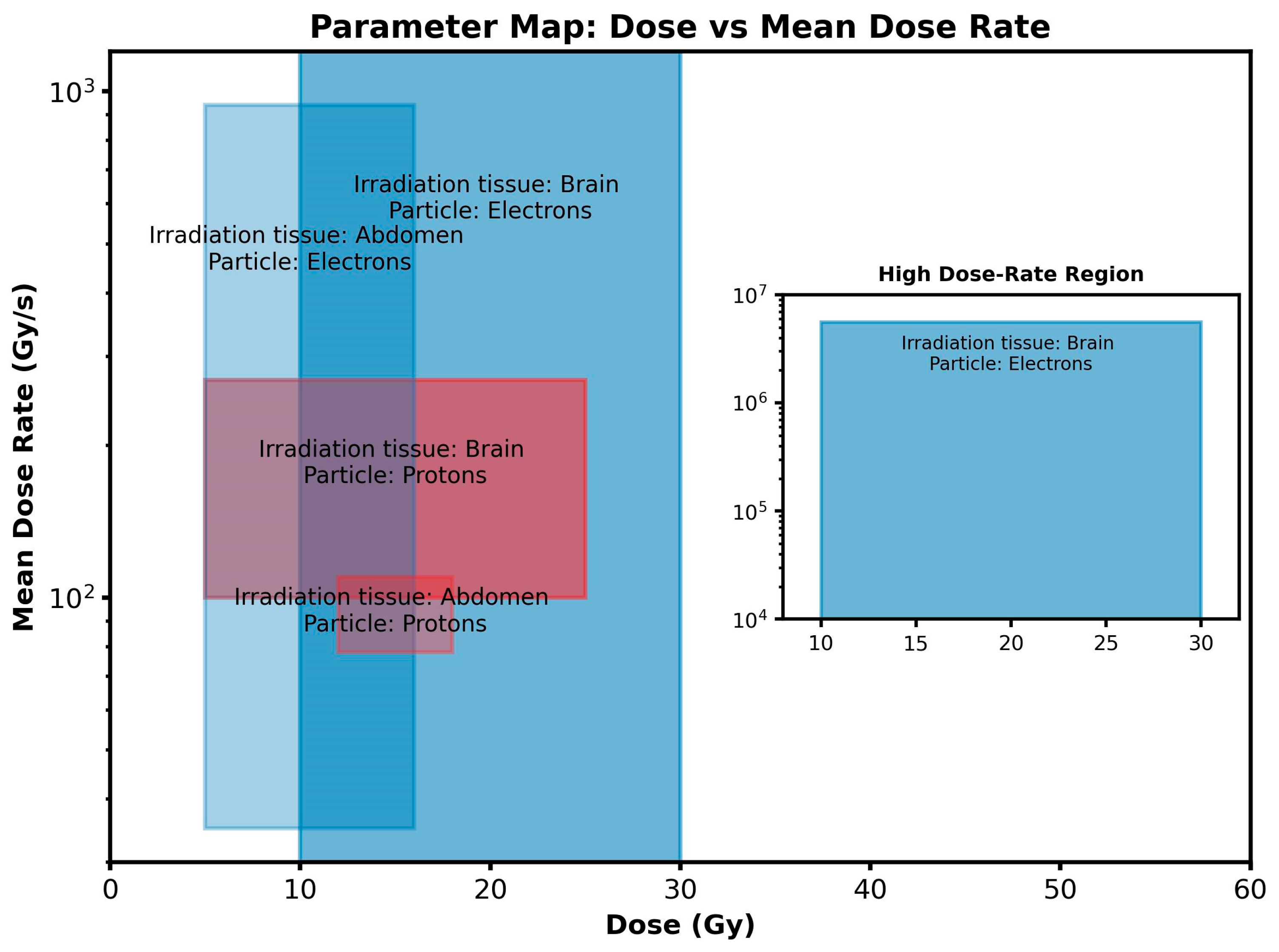
| Particle Type | Dose Range (Gy) | Mean Dose Rate Range (Gy/s) | Experimental Endpoints |
|---|---|---|---|
| Electrons | 10–30 | 30–5.6 × 10⁶ | Cognitive function, novel object recognition, astrocyte activation, microvascular integrity |
| Protons | 5–25 | 100–269 | Cognitive performance, memory, neuroinflammatory response |
| Electrons | 5–16 | 35–940 | Crypt regeneration, acute intestinal injury, lymphocyte depletion (spleen/heart), vascular collapse |
| Protons | 12–18 | 78–110 | Crypt regeneration, fibrosis |
| Phantom | Detector | Gy/s Measurable Range | Dose per Pulse | Temporal Resolution | Saturation Limit | Suitability for FLASH | DADR/DTDR Verification | Reference |
|---|---|---|---|---|---|---|---|---|
| Solid water | Radiochromic film | Extremely wide | – | - | – | Proton/ Electron | Suitable for mean dose rate in DADR/DTDR verification | [12,13,30,70,87] |
| Water phantom, PMMA | Bragg peak chamber | 21 Gy/s (99.5% saturation) | 0.90 mGy (99.5% saturation) | lon collection time 67 μS | Limited | Not suitable | Not suitable | [33,88] |
| 42 Gy/s (99.0% saturation) | 1.80 mGy (99.0% saturation) | |||||||
| Water phantom | Advanced Markus Chamber | 187 Gy/s (99.5% saturation) | 2.78 mGy (99.5% saturation) | lon collection time 22 μS | Limited | Proton/ Electron | Suitable for mean dose rate in DADR/DTDR verification | [34] |
| 375 Gy/s (99.0% saturation) | 5.56 mGy (99.0% saturation) |
Disclaimer/Publisher’s Note: The statements, opinions and data contained in all publications are solely those of the individual author(s) and contributor(s) and not of MDPI and/or the editor(s). MDPI and/or the editor(s) disclaim responsibility for any injury to people or property resulting from any ideas, methods, instructions or products referred to in the content. |
© 2026 by the authors. Licensee MDPI, Basel, Switzerland. This article is an open access article distributed under the terms and conditions of the Creative Commons Attribution (CC BY) license.
Share and Cite
Cheng, C.; Zhang, G.; Li, N.; Hu, X.; Huang, Z.; Xu, X.; Xu, S.; Qu, W. Key Considerations for Treatment Planning System Development in Electron and Proton FLASH Radiotherapy. Quantum Beam Sci. 2026, 10, 3. https://doi.org/10.3390/qubs10010003
Cheng C, Zhang G, Li N, Hu X, Huang Z, Xu X, Xu S, Qu W. Key Considerations for Treatment Planning System Development in Electron and Proton FLASH Radiotherapy. Quantum Beam Science. 2026; 10(1):3. https://doi.org/10.3390/qubs10010003
Chicago/Turabian StyleCheng, Chang, Gaolong Zhang, Nan Li, Xinyu Hu, Zhen Huang, Xiaoyu Xu, Shouping Xu, and Weiwei Qu. 2026. "Key Considerations for Treatment Planning System Development in Electron and Proton FLASH Radiotherapy" Quantum Beam Science 10, no. 1: 3. https://doi.org/10.3390/qubs10010003
APA StyleCheng, C., Zhang, G., Li, N., Hu, X., Huang, Z., Xu, X., Xu, S., & Qu, W. (2026). Key Considerations for Treatment Planning System Development in Electron and Proton FLASH Radiotherapy. Quantum Beam Science, 10(1), 3. https://doi.org/10.3390/qubs10010003