Article

Research on and Application of a Low-Carbon Assessment Model for Railway Bridges During the Construction Phase Based on the ANP-Fuzzy Method

1
Railway Engineering Design and Consulting Group Co., Ltd., Beijing 100055, China
2
College of Architecture and Civil Engineering, Beijing University of Technology, Beijing 100124, China
*
Author to whom correspondence should be addressed.
Infrastructures 2026, 11(1), 32; https://doi.org/10.3390/infrastructures11010032
Submission received: 22 October 2025 / Revised: 9 January 2026 / Accepted: 13 January 2026 / Published: 19 January 2026

Abstract

Against the backdrop of global climate change and China’s “dual-carbon” goals, carbon emissions from the construction phase of transportation infrastructure, particularly the rapidly expanding railway network, have garnered significant attention. However, systematic research and general evaluation models targeting the factors influencing carbon emissions during the railway bridge construction phase remain insufficient. To address this gap, this study presents a novel low-carbon evaluation model that integrates the analytic network process (ANP) and the fuzzy comprehensive evaluation (FCE) method. First, a carbon accounting model covering four stages—material production, transportation, construction, and maintenance—is established based on life cycle assessment (LCA) theory, providing a data foundation. Second, an innovative low-carbon evaluation index system for railway bridges, comprising 5 criterion layers and 23 indicator layers, is constructed. The ANP method is employed to calculate weights, effectively capturing the interdependencies among indicators, while the FCE method handles assessment ambiguities, forming a comprehensive evaluation framework. A case study of the bridge demonstrates the model’s effectiveness, yielding an evaluation score of 82.38 (“excellent” grade), which is consistent with expert judgement. The ranking of indicator weights from the model is highly consistent with the actual carbon emission inventory ranking (Spearman coefficient of 0.714). Key indicators—C21 (use of high-performance materials), C22 (concrete consumption), and C25 (transportation energy consumption)—collectively account for approximately 60% of the total impact, accurately identifying the major emission sources. This research not only verifies the model’s efficacy in pinpointing critical carbon sources but also provides a scientific theoretical basis and practical tool for low-carbon decision-making and optimization in the planning and design stages of railway bridge projects.

1. Introduction

Addressing climate change has become one of the major challenges faced by countries worldwide, and achieving carbon peaking and carbon neutrality has become a shared goal among many nations. More than 50 countries have achieved their carbon peaking targets, although the timing of these peaks varies across member states. On this basis, several countries have proposed visions of net-zero carbon emissions or carbon neutrality and have taken active measures to achieve them [1]. As the world’s largest carbon emitter, China pledged on 22 September 2020 to strengthen its nationally determined contributions, implement more efficient supporting policies and measures, and actively promote the achievement of “dual-carbon” goals [2].
Among the top three energy-intensive, technology-intensive industries in China, transportation accounts for approximately 10% of the country’s total energy consumption [3]. Transportation infrastructure is essential for economic development, with the Outline of the Planning for a Modern Comprehensive Transportation System during the 14th Five-Year Plan (referred to as FP2021–2025) indicating that railway mileage, which stood at 146,000 km in 2020, is expected to expand to 165,000 km by 2025 [4]. This growth in railway networks will inevitably produce significant carbon emissions. However, in the field of transportation, the construction phase of railway bridges has become one of the most carbon-intensive infrastructures due to its high material demand, long construction period, and extended maintenance cycle. Although bridge construction is crucial, there is still a lack of precise quantification of its carbon emissions.
Recent studies conducted by scholars in both China and other countries have focused on low-carbon-related rail transit fields and have made significant progress. Xiaodong Hu et al. [5] carried out a comprehensive review of research on railway carbon emissions (RCEs). By analysing 197 journal papers from the past 25 years, they quantified the distribution of seven major thematic areas, such as measurement methods, influencing mechanisms, and reduction measures, and reported that emission reduction measures were the primary focus. Furthermore, they reported that comparative results among different measurement methods remain poor and emphasized the need for more robust research within developing countries. Ren Fumin et al. [6], guided by the principles of life cycle assessment (LCA) theory, evaluated the lifecycle carbon emissions that are associated with railway construction. They quantified carbon emissions across various activities within the material processing phase and identified steel, cement, and electricity as the key emission sources. They also validated the practicality of calculating emission intensities for individual components based on engineering budget quotas. Lai Yang et al. [7] focused on the need to increase the efficiency of low-carbon assessments for railway tunnel construction. By using MATLAB (2019) APP Designer and an MVC framework, they developed a low-carbon evaluation system. The system includes procedures for indicator selection, weight calculation, and comprehensive evaluation. The application results revealed that the tunnels under investigation achieved a “good” low-carbon grade, which aligns with real-world conditions, thereby demonstrating an improvement in evaluation efficiency. Wu Yuanjin et al. [8] addressed the challenge of quantifying carbon emissions in railway tunnel construction using the drilling and blasting method. By integrating LCA principles with engineering budget quotas, a standardized carbon emission quota was established, and a corresponding general calculation methodology was proposed. This methodology involves quantifying carbon emissions and emission intensities across three stages—material production, material transportation, and structure construction—and analysing them by process. Their study revealed that the carbon emission intensity of an exemplary tunnel reached 200.522 kgCO2/m3, with 62.00% attributable to the material production stage. During this stage, cement and steel were identified as the critical sources of emissions. Krezo et al. [9] focused on quantifying carbon emissions throughout the construction stage of railway bridges. By integrating a hybrid LCA–ANP framework, they established a carbon accounting boundary, selected emission factors, and constructed an index weighting system. Their evaluation results revealed that the hybrid method improves the accuracy and consistency of carbon emission assessments for bridge construction projects [10], This study focuses on improving the green evaluation system for prefabricated buildings. By integrating the ANP-Fuzzy comprehensive evaluation model, an evaluation system was constructed consisting of 21 indicators across five major dimensions: ‘construction technology, resource utilization, environmental protection, management mechanisms, and social harmony.’ The system covers indicator selection, determination of ANP weights, and fuzzy evaluation of green levels. Empirical analysis shows that this model can accurately quantify the greenness of buildings, enhance the objectivity and comprehensiveness of evaluations, and provide reliable support for optimizing green building design [11], This study focuses on the precise quantification of carbon emissions in railway bridge construction and low-carbon decision-making. By integrating P-LCI life cycle inventory analysis with the emission factor method, a carbon emission calculation framework was established for three stages: material production, transportation, and mechanical construction, covering data acquisition, factor selection, and multi-scheme comparison processes. Application tests indicate that this framework can clearly identify key stages of carbon emissions, enhance the reliability of comparisons between different prefabrication schemes, and support the scientific selection of low-carbon options for railway bridges [12]. The authors assessed the carbon dioxide (CO2) emissions associated with the laying and maintenance activities of ballasted railway tracks in Australia. By collectively gathering extensive application data for track-laying machinery, they quantified the carbon emissions that were linked to various types of equipment during these maintenance operations. The research revealed that the emissions that were generated during tampering constituted the greatest source. With respect to laying and maintaining 1000 km of track, the three categories of machinery produced a total of 1,295,387 kgCO2. Furthermore, prior studies reported discrepancies in their CO2 emission estimations because of biased assumptions, which resulted in differences that ranged from 26% to 55% between projected and onsite results. However, existing research mostly focuses on life cycle calculations, tunnel engineering, or rail systems, while systematic studies on the main impact stages of railway bridge carbon emissions, particularly research examining multi-stage processes and multi-indicator interactions during the construction phase, are still insufficient.
This study establishes a low-carbon assessment model by calculating the carbon emissions during the construction phase of railway bridges. Existing evaluation approaches often rely solely on the analytic network process (ANP) or fuzzy comprehensive evaluation (FCE). While the ANP effectively models interdependent relationships among indicators, it is limited in addressing uncertainty. In contrast, FCE is well suited to handling fuzziness but depends heavily on the rationality of weight assignment. Using either method independently therefore fails to provide a fully reliable assessment. This model integrates the analytic hierarchy process (AHP) with fuzzy theory (referred to as AHP–fuzzy integration). Integrating the ANP with FCE allows the two methods to complement each other: the ANP provides a structured representation of indicator interdependencies, while FCE enhances robustness by managing uncertainty within the evaluation process. This hybrid approach offers a more comprehensive and reliable framework for low-carbon assessment than single-method models do. To test its applicability within the context of railway bridge engineering projects, the model is compared using data from real-world case studies, and the findings are further validated by empirical analysis. The innovations of this study are reflected mainly in the following three aspects: (1) Introducing the ANP to handle the interdependence and feedback relationships among evaluation indicators, breaking through the limitation of the traditional AHP, which assumes indicator independence and makes weight allocation more consistent with the carbon emission characteristics during the construction phase of railway bridges; (2) using a weight convergence iterative algorithm to construct the limit supermatrix, enhancing the stability and consistency of the results; and (3) proposing a quantitative mapping method between the carbon emission inventory and evaluation indicators and verifying its consistency through rank correlation tests, which can support traceable and interpretable evaluation results.

2. Construction of a Carbon Accounting and Evaluation Model

2.1. Carbon Emission Accounting Model

Based on the core theory of life cycle assessment (LCA), the carbon emission calculation boundaries for railway bridges are delineated, a foundational database for railway bridges is constructed, the activity data for each stage are clarified, and the corresponding carbon emission factors are selected. Using the emission factor method, carbon emissions at each stage of railway bridges are calculated, and a carbon emission accounting model that covers four stages, namely, construction material production, material transportation, construction, and maintenance, is established for carbon emission quantification and analysis.

2.1.1. Carbon Emission Accounting Boundary

In this study, the lifecycle accounting scope of railway bridges is divided into four stages: construction material production, construction material transportation, construction, and maintenance. Railway bridges are divided into superstructure engineering elements, substructure engineering elements, and ancillary elements. (1) The superstructure engineering elements include primarily the main beams (or beam bodies) that bear and transmit train loads, as well as the bridge deck system that directly supports the tracks. (2) Substructure engineering elements include mainly the piers and abutments that transfer superstructure loads to the foundation, as well as the foundational components below them, such as pile foundations and pile caps. (3) Ancillary elements include various components that ensure the functionality and durability of bridges, such as waterproof layers, protective layers, pavements, expansion joints, bearings, railings, and sidewalk slabs. This study focuses on the construction phase, which is primarily based on two considerations: First, the construction phase accounts for a significant proportion of carbon emissions throughout the entire life cycle of railway bridges, making it a key stage for emission reduction; second, data on related activities are readily available, which can effectively enhance the reliability of the calculations. Moreover, excluding the operation and demolition phases may introduce bias in the life cycle interpretation, which is addressed in the discussion section.

2.1.2. Carbon Emission Accounting Method

Considering the availability of research data, the economic efficiency of accounting, and the refined requirements of research objectives, in this study, the carbon emission factor method is chosen as the accounting method.

2.1.3. Benchmark for Carbon Emission Assessment

Throughout various activities during the lifecycle of railway bridges, small amounts of other greenhouse gases, such as CH4 and N2O, are emitted, but CO2 accounts for the majority of emissions. Therefore, to simplify the calculations, in this study, CO2 is selected as the primary object of assessment, and carbon emissions refer to carbon dioxide emissions in this manuscript.

2.1.4. Activity Data Collection

Data on railway bridge activities are obtained mainly through a combination of direct extraction and indirect estimation. From the completion documents of railway bridge projects, static data can be directly extracted. However, dynamic activity data from construction and maintenance processes are not recorded in detail in design documents, and field measurement data are difficult to obtain. Therefore, in this study, the quota method is introduced as a key supplementary and verification approach.

2.1.5. Selection of Carbon Emission Factors

In accordance with the ‘IPCC Guidelines for National Greenhouse Gas Inventories,’ the ‘China Product Life Cycle Greenhouse Gas Emission Factor Database (2022),’ the ‘Standard for Calculation of Building Carbon Emissions’ (GB/T 51366-2019) [13], the ‘Railway Engineering Construction Equipment Unit Time Cost Quota,’ the ‘Survey on Chinese Residents’ Food Consumption and Nutritional Status,’ and other standards, and the literature [14,15], the main types of construction materials that are used in the construction, maintenance, and upkeep of railway bridges and their carbon emission factors are summarized in Table 1.

2.1.6. Carbon Emission Calculated

(1) Carbon emission accounting framework
The full life cycle carbon emissions of railway bridges include emissions in the stages of raw material production, material transportation, construction, and maintenance. The formula for calculating the full life-cycle carbon emissions of railway bridges is as follows:
C   =   C p   +   C t   +   C e   +   C o
where C represents the total carbon emissions during the construction period of railway bridges (tCO2), C p represents the total carbon emissions during the production phase of railway bridge construction materials, C t represents the total carbon emissions during the transportation phase of railway bridge construction materials, C e represents the total carbon emissions during the construction phase of railway bridges, and C o represents the total carbon emissions during the maintenance phase of railway bridges.
(2) Building material production stage
This stage includes the production of all the building materials that are needed for all the subprojects within each unit project of railway bridges, as well as the entire process of producing prefabricated components. The main building material consumption of railway bridges is determined by consulting design drawings, project budget lists, and other technical information related to construction or by using the quota method. The formula for calculating carbon emissions during the building material production stage is as follows:
C p   =   i = 1 n M i F i
where M i represents the consumption of the i-th major building material and M i represents the carbon emission factor of the i-th major construction material (kgCO2e/unit of construction material).
(3) Building material transportation stage
Carbon emissions during the building material transportation stage originate mainly from the energy consumption of transportation machinery. The modes of transportation include railway, highway, and waterway transport. During the construction of railway bridges, highway transport is generally used. The transportation distance in the building material stage can be obtained from actual project data. The carbon emission calculation formula for this stage is as follows:
C t   =   i = 1 n M i D i T i
where M i represents the consumption (t) of the i-th main building material, D i represents the average transportation distance consumption (km) for the i-th type of building material, and T i represents the carbon emission factor [kgCO2e/(t·km)] for unit mass transportation distance under the i-th type of building material transportation method.
(4) Construction phase
Carbon emissions during the construction phase originate mainly from the energy consumption of construction machinery and equipment and include the indirect carbon emissions that are generated by construction personnel. The formula for calculating carbon emissions during the construction phase is as follows:
C e   =   j = 1 n S j X j + i = 1 m P i R i
where S j represents the consumption of the i-th type of construction machinery per shift (shift), X j represents the carbon emission factor of the i-th type of construction machinery per unit shift (kgCO2e/unit shift), P i represents the daily labour consumption (workdays) per type i construction worker, and R i represents the carbon emission factor per unit workday for workers of type i (kgCO2e/workday).
(5) Maintenance and upkeep stage
In this study, only periodic or emergency maintenance activities that are aimed at maintaining the structural performance and safety of bridges, including replacement of the bridge deck, repair and replacement of expansion joints, replacement of bearings, waterproofing repairs, and concrete crack repairs, are considered. The indirect effects of train operations and the daily power consumption of monitoring, lighting, or other systems are not considered. The carbon emissions in this phase are similar in composition to those in the construction phase. The carbon emissions of a single maintenance activity in this phase can be divided into three parts: material production, material transportation, and onsite maintenance construction. Considering that bridges will undergo multiple and varied maintenance activities over their 100-year design life, the total carbon emissions in the operation and maintenance phases are the sum of the carbon emissions from all maintenance activities. The formula for calculating carbon emissions during the maintenance phase is as follows:
C o   =   i = 1 m j = 1 n i C p , i j + C t , ij + C e , ij
where m represents the number of types of maintenance and repair activities during the lifecycle of a railway bridge, n i represents the number of occurrences of the i-th type of maintenance activity, C p , i j represents the carbon emissions during the building material production phase when the i-th type of maintenance activity occurs for the j-th time, C t , ij represents the carbon emissions during the building material transportation phase when the i-th type of maintenance activity occurs for the j-th time, and C e , ij represents the carbon emissions of on-site maintenance and repair construction during the j-th occurrence of the i-th type of maintenance activity.
The estimation of maintenance frequencies within the 100-year design life was based on a combination of national railway maintenance specifications, historical records from completed bridge projects, and expert predictions. Specifically, typical maintenance intervals for expansion joint replacement, bearing renewal, and waterproofing repairs were derived from standard technical guidelines and validated through consultation with senior maintenance engineers; this ensures that the maintenance-phase carbon emissions reflect realistic operational conditions.

2.2. Low-Carbon Assessment Model for Railway Bridges

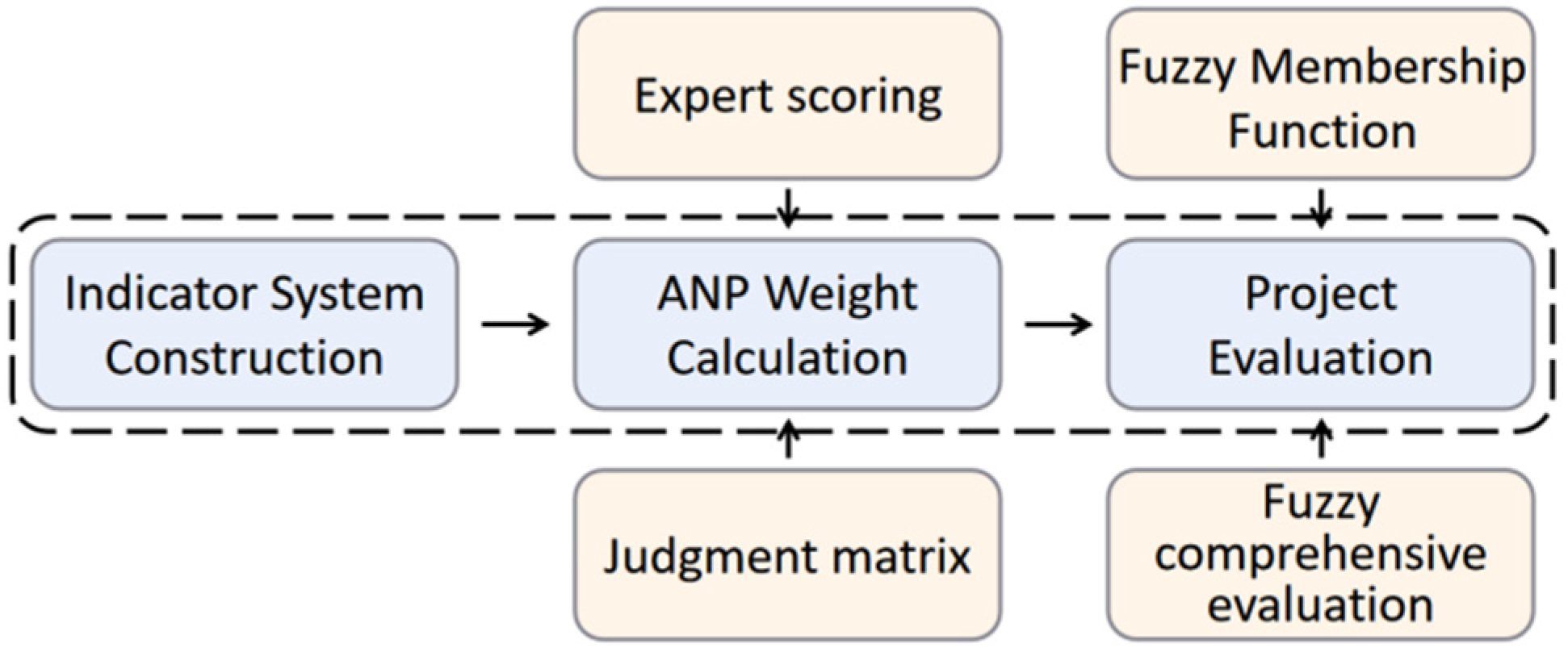
In this study, low-carbon evaluation indicators are first selected, and a multilevel evaluation indicator system is constructed. An analytic network process is used to determine the indicator weights, and, based on the expert scoring results, in combination with a fuzzy comprehensive evaluation method, an evaluation model that is based on weighted summation is established. A flowchart of the proposed method is shown in Figure 1.

2.2.1. Analytic Network Process

The analytic network process (ANP) is a method for determining weights that is based on the analytic hierarchy process (AHP). Compared with the conventional life cycle assessment (LCA) combined with the analytic hierarchy process (AHP) and fuzzy evaluation (FCE) frameworks, the proposed ANP-based fuzzy model introduces significant innovations. Notably, the innovation lies in the handling of indicator dependencies, which are often overlooked in traditional models. By addressing the interdependencies between indicators, the model allows for a more accurate representation of the complex relationships in carbon emissions during the construction phase. Additionally, the weight convergence algorithm employed in the ANP method ensures the consistency and reliability of the derived weights, whereas the mapping logic between emission lists and indicators provides a clearer and more reproducible approach. These improvements enhance the robustness of the evaluation model and its applicability to real-world projects. Unlike the AHP, in which indicators are assumed to be mutually independent, the ANP can handle interdependencies among elements. By constructing a network structure and calculating weighted supermatrices, the ANP can realistically reflect the relationships among the factors in a system. Railway bridge construction is a typical complex system, with emissions originating from multiple stages, such as material production, transportation, and construction, which are interrelated rather than existing in isolation. When weights are allocated, these interactions must not be ignored; otherwise, the results may be distorted, which would make objectively reflecting the true effect of each indicator difficult. In the process of constructing a low-carbon evaluation index system for railway bridge projects, the ANP method is used to calculate weights, which ensures that when the contribution of a particular indicator to the overall goal is assessed, both its individual effect and its combined effect with other indicators are considered, thereby improving the scientific and rational allocation of index weights. In this study, Yaanp decision-making software is used to construct the ANP network and perform weight calculations. The overall steps are as follows [16]:
(1) Establishment of the ANP structure. In accordance with the low-carbon evaluation index system for railway bridges, the primary indicators B1 (planning and design stage), B2 (material production and transportation stage), B3 (construction stage), B4 (maintenance stage), and B5 (lifecycle management stage) are used as the control layer, whereas the secondary indicators under each primary indicator form the network layer.
(2) Construction of the judgement matrix. To enhance the reproducibility of the ANP modelling process, the manuscript specifies the judgement scale but does not provide the detailed rules used by experts when 1–9 scale scores are assigned. In this study, the experts evaluated the relative importance of indicator pairs based on a unified scoring guide, in which each value corresponds to an explicit semantic meaning (e.g., 1 = equal importance, 3 = moderate importance, 5 = strong importance, 7 = very strong importance, 9 = extreme importance). The basis of each comparison was documented to ensure transparency in the construction of the judgement matrices. The representative elements of the primary indicators B i ( i = n ) serve as control layer elements and form the criterion layer. The elements of the secondary indicators C x y ( x = n , y = m ) serve as network layer elements and form the subcriterion layer. The importance of the subcriterion layer indicators is compared using a scoring rule with values from 1 to 9 to obtain pairwise judgement matrices P = C x y n × m , where C x y 1 / 9 , . . . , 9 . The judgement matrix is expressed as follows:
P = p ~ i j n × m = 1 a 1 n 1 a n 1 1
(3) Establishment of the ANP weight matrix. The pairwise comparison matrix is calculated to obtain the ranking vector, and when the CR is <0.1, the consistency test is passed. The eigenvectors (weight vectors) of the comparison matrix are used as the corresponding columns and concatenated to form the initial supermatrix. The supermatrix is expressed as follows:
W = W 11 W 15 W 51 W 55
(4) Construction of the weighted supermatrix. Based on the obtained supermatrix W, normalization is performed to ensure that the sum of the elements in each column of the matrix is 1, thus converting it into the weighted supermatrix W . This process ensures that the weights of the various indicators remain consistent within the overall system to avoid deviations in the results because of an uneven weight distribution. The weight calculation uses the Saaty scale to construct a pairwise comparison matrix, which is normalized after the consistency requirement of CR < 0.1 is met. Yaanp software is used for iterative weight convergence, with a convergence tolerance set at ‖W(k + 1) − W(k)‖ < 1–4, resulting in a limited supermatrix that improves the accuracy of expressing interindicator dependency feedback relationships. The weighted supermatrix is represented as follows:
W = w 11 W 1 n w n 1 w n n
where wij represents the weight value of the i-th indicator under the influence of the j-th indicator.
(5) Construction of the limit supermatrix. During the iterative calculation of the limit supermatrix, a convergence threshold of 1 × 10⁻⁵ was applied. Iteration continued until the difference between two consecutive supermatrices fell below this threshold, ensuring the stability and repeatability of the final weight results. This parameter setting enhances the rigor and transparency of the ANP convergence process. Based on the weighted supermatrix W , the matrix is iteratively processed until convergence is achieved, and the limited supermatrix W is ultimately obtained. This matrix can reflect the overall effect of each indicator on the overall goal, considering the interdependencies and feedback relationships among indicators at various levels.

2.2.2. Construction of the Indicator System

With reasonable evaluation metrics, accurate analysis of the characteristic factors that affect the carbon emission level of railway bridges is possible [17]. To ensure that the indicators comply with the principles of indicator selection, the expert interview method was adopted. Experts and scholars in relevant research fields were invited to provide professional opinions on actual engineering situations and to screen, optimize, and supplement the factors in the list from various perspectives. The final carbon emission evaluation index system for railway construction projects is shown in Table 2.

2.2.3. Fuzzy Comprehensive Evaluation

Based on the results of the above evaluation index system and the derived weights, the steps are as follows:
(1) Confirmation of the evaluation set
The results are divided into 5 levels: {poor, below average, average, good, and excellent}. The corresponding ranges are (0,20], (20,40], (40,60], (60,80], and (80,100], respectively. In this study, symmetric triangular membership functions are used to construct score membership, with the following mathematical expression: μ t r i x ; a , b , c = 0 ,   x a x a b a ,   a < x b   c x c b ,   b < x < c 0 ,   x c The interval divisions refer to expert ratings in the railway industry and the national green building evaluation standards to ensure that the rating level divisions are reasonable and interpretable. After a sensitivity comparison was conducted using trapezoidal and Gaussian functions, the score differences were less than 2%, indicating that the method is robust. The following evaluation set is established: J = J 1 , J 2 , , J 5 .
(2) Fuzzy evaluation matrix
Although the manuscript adopts membership functions to quantify evaluation levels, the specific function forms were not previously described. In this study, triangular membership functions were selected due to their simplicity and suitability for expert-based evaluation. The parameters of each membership function were determined through expert consensus, where three boundary points for each level were jointly defined by the expert group based on historical project data and rating experience. The membership degrees of the evaluated object at various levels need to be determined based on membership functions. After the fuzzy subsets for the levels are constructed, membership functions that correspond to each single factor are established, and the object’s performance on that factor is quantified accordingly. Ultimately, a fuzzy relation matrix M is formed, which is a matrix that is composed of the membership degrees of various factors that correspond to the levels. The matrix is represented as follows:
M = m 11 m 1 m m n 1 m n m
where n represents the number of indicators, m represents the set number of evaluation levels, and the elements of the matrix reflect the membership degree of each indicator at the corresponding level.
(3) Synthetic fuzzy comprehensive evaluation result
Multiplying the membership matrix of the secondary indicators by the corresponding weights yields the fuzzy evaluation matrix of the criteria layer indicators, and then multiplying the membership matrix of the primary indicators by the corresponding weights produces the fuzzy evaluation matrix of the objective layer [13]. The corresponding formulas are as follows:
F i = w i × M
where F i represents the fuzzy evaluation result vector of the i-th criterion layer, w i represents the weight of each secondary indicator under the i-th criterion layer, and M represents the fuzzy membership matrix of each secondary indicator under the i-th criterion level.
F = w × F i
where F represents the fuzzy evaluation matrix of the target layer, w represents the weight of a first-level indicator, and F i represents the fuzzy evaluation matrix of the secondary indicators.

2.2.4. Indicator Mapping

Model 1.
The model has good consistency [18]. The formula for calculating the Spearman coefficient is as follows:
ρ = 1 6 d i 2 n n 2 1
where  d i represents the difference in the rank values of the i-th data pair and n represents the number of observed samples.
In this case, the carbon emission inventory involves mainly the consumption of personnel, materials, and equipment. When these factors are mapped to the low-carbon evaluation index system, the emissions are primarily concentrated in six indicators: C21, C22, C25, C32, C33, and C34. Other indicators are not reflected. The weights of the mapped indicators and the ranking of emissions are shown in Table 3.
A Spearman rank correlation test yielded a result of 0.714286, which indicates that the model’s weight results are highly consistent with the importance ranking of the measured carbon emissions. Moreover, a one-to-one correspondence table between the emission inventory and evaluation indicators was constructed (see Table 3) to ensure source traceability. To further enhance the validation strength, in addition to the Spearman test, this study employed the Kendall τ test (τ = 0.62, p < 0.05), which demonstrated significant consistency in the mapping.
To further enhance the robustness of the proposed model, a sensitivity analysis of key parameters—such as the emission factors of major materials, fuel consumption intensities, and transportation distances—was conducted. The analysis evaluates the extent to which variations in these parameters influence total carbon emissions and assessment outcomes. The results indicate that the model remains stable under ±20% fluctuations in the core parameters, demonstrating the reliability and resilience of the evaluation framework.

3. Results and Discussion

Based on the construction organization design of the collected cases, starting from the perspective of geological conditions, A Bridge and B Bridge were selected for verification and analysis.

3.1. Project Overview

3.1.1. A Bridge Overview

The bridge has been completed and the data is relatively complete. The total length is 182.09 m. The technical standards followed for this bridge are Railway grade 1; single track for the main line, with provisions for future double track; design speed of 120 km/h; type of traction: electric; traction load 4000 tons; design service life 100 years.

3.1.2. B Bridge Overview

The bridge has been completed and the data is relatively complete. The total length is 406.98 m. The technical standards followed for this bridge are as follows: Railway grade 1; single track main line; design speed of 120 km/h; traction type: electric; traction load 4000 tons; designed service life of 100 years.

3.2. Geological Conditions

3.2.1. A Bridge Geological Conditions

The area where A Bridge is located has a stable geological structure, with no significant faults or major tectonic activity observed. The overall stratigraphy is simple, and the geological conditions are relatively uniform. The strata are mainly composed of Quaternary Holocene silty clay and sandstone, with relatively uniform soil quality and certain stability. The groundwater conditions are relatively simple, mainly consisting of low-yield Quaternary phreatic water, primarily recharged by precipitation. The groundwater level is relatively deep, and the water quality is non-corrosive. In terms of hydrological conditions, surface water bodies are not significant, with recharge mainly depending on precipitation and discharge primarily via evaporation. According to the seismic safety evaluation report, the peak ground acceleration at the bridge site is 0.05 g, indicating a low seismic risk area, with a seismic intensity of VI.

3.2.2. B Bridge Geological Conditions

The B Bridge is located in Huangjueping Village, Xuyong County. The terrain at the bridge site is quite undulating, with the bridge abutments situated on steep slopes, covered with dense vegetation, mainly farmland, forest, and residential houses. The stratigraphy is relatively simple, mainly consisting of Quaternary Holocene alluvial and flood deposits (silty clay and gravelly soil), underlying the Upper Jurassic Penglaizhen Formation of sandstone and mudstone. The geological structure is a monocline, with a bedding orientation of 230°∠10°. Joints are well-developed, with directions of J1: 280°∠82° and J2: 25°∠85°. In terms of hydrological conditions, surface water is well-developed, mainly consisting of small rivers and ponds, with a depth of 1.0–1.5 m and a flow rate of about 0.2 m/s, primarily recharged by rainfall. Groundwater mainly consists of Quaternary phreatic water and bedrock fissure water, with a relatively shallow water table depth (0.57–7.0 m). Seismic conditions indicate a basic seismic peak acceleration of 0.05 g and a seismic intensity of VI, classifying it as a low seismic risk area. No adverse geological phenomena or special soil and rock conditions have been observed at the bridge site.

3.3. Quantification of Carbon Emission Indicators at Various Stages of Bridge Construction

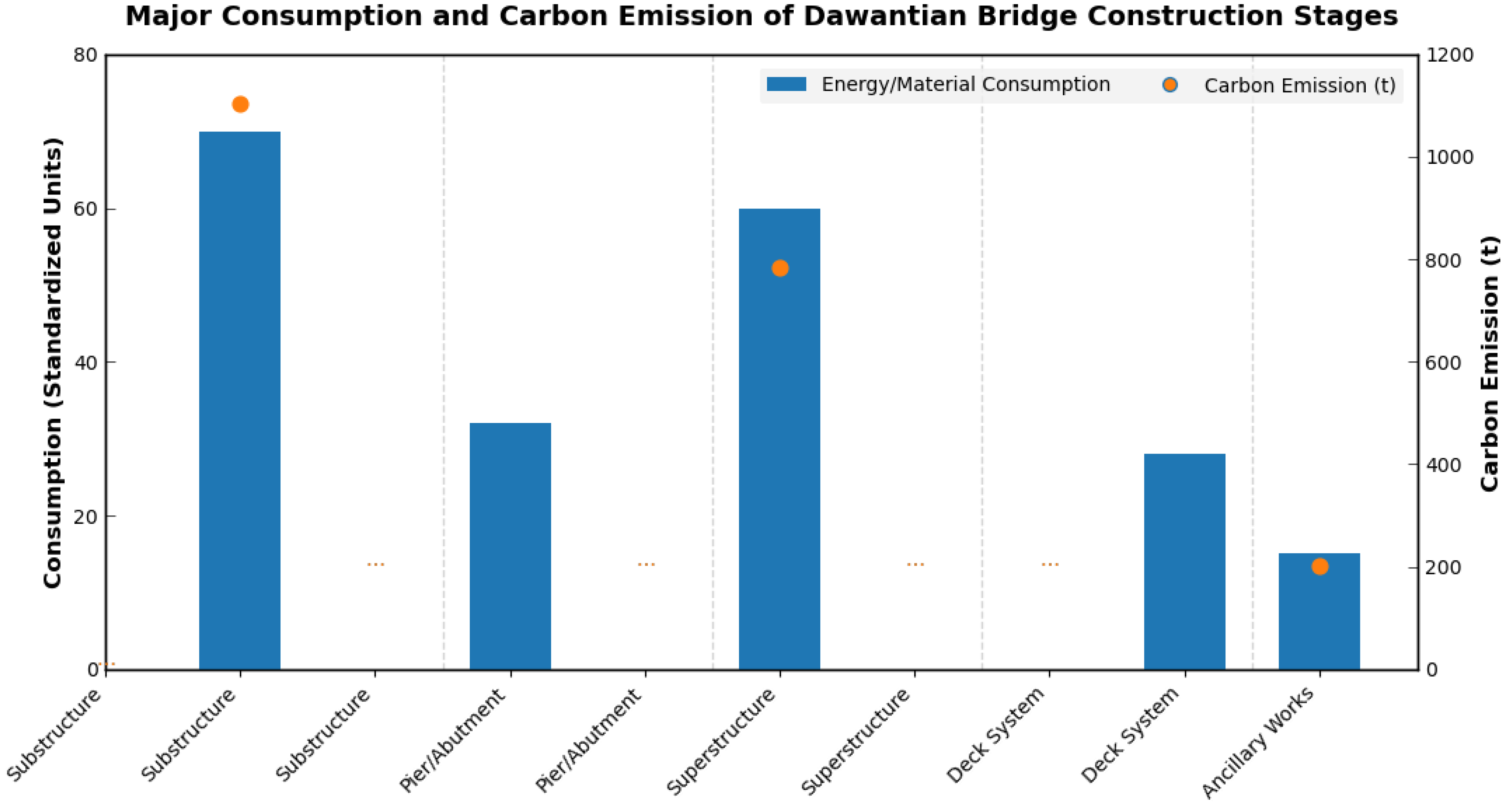
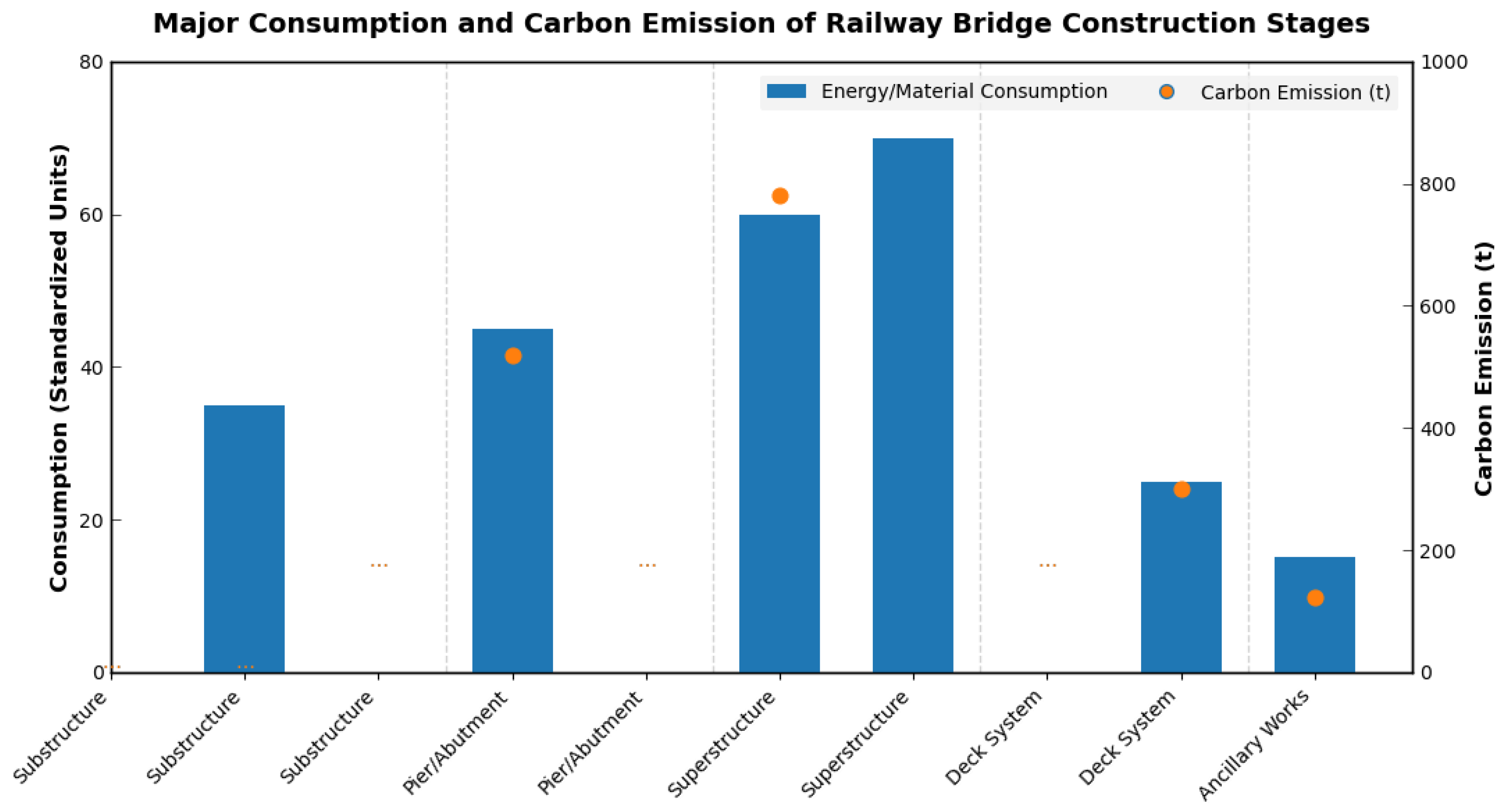
Based on the above method, a carbon emission accounting model was constructed, and the carbon emissions during the construction period of railway bridges were quantified according to Equation (2). Taking the A Bridge and B Bridge railway bridge projects as examples, their main consumption and carbon emissions are shown in Figure 2 and Figure 3.
A comparison of the construction phase data between A Bridge and B Bridge reveals significant fluctuations and differences in the relationship between consumption and emissions at each stage: In the substructure phase, A Bridge shows a very low correlation between consumption and emissions, whereas for B Bridge, this phase exhibits high fluctuations in both consumption and emissions, highlighting the strong correlation between consumption and emissions at this stage due to the extensive use of materials and high-frequency operation of machinery. In the superstructure phase, A Bridge shows consumption and emissions both at high levels, aligning with the characterization of “emissions ranking second,” but for B Bridge, consumption drops significantly while emissions remain relatively high, reflecting different tolerances of emissions to fluctuations in consumption. The differences in the pier and deck system phases are mainly reflected in the presence or absence of emission fluctuations. A Bridge shows corresponding emission fluctuations in these stages, whereas for B Bridge, such fluctuations almost disappear, indicating changes in emission sensitivity under different statistical dimensions. In the ancillary works phase, consumption is similar for both bridges, but emissions show a fluctuation decrease of about 50%, also reflecting the variability of emissions influenced by statistical details. Overall, the differences between the two bridges are not only numerical fluctuations but also reflect significant changes in the driving correlation between consumption and emissions across construction stages under different statistical frameworks, indirectly highlighting the varying sensitivity of factors such as materials and transportation under different statistical logics.

3.4. Indicator Weight Calculation

By organizing and analysing the relative importance scores assigned by various experts, the weights of the criterion layer and the indicator layer are obtained, as shown in Table 4.
The average CR value for each group is 0.0343 < 0.1, which passes the consistency test.

3.5. Fuzzy Comprehensive Evaluation Result

By compiling and calculating the score sheets of various indicators provided by different experts, the average score for each indicator (excluding the highest and lowest scores) was obtained [16], and the scores for each indicator are shown in Table 5 and Table 6.
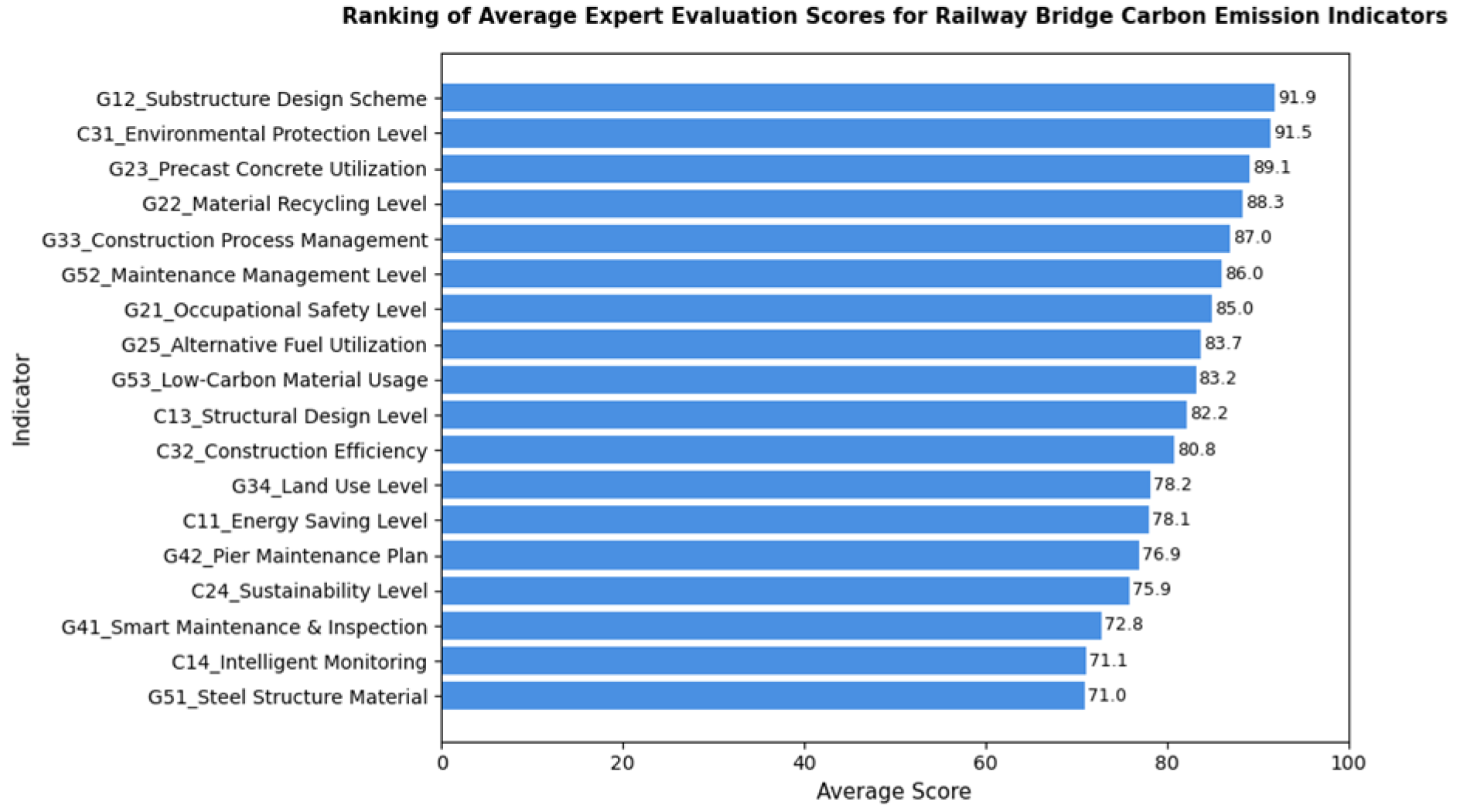
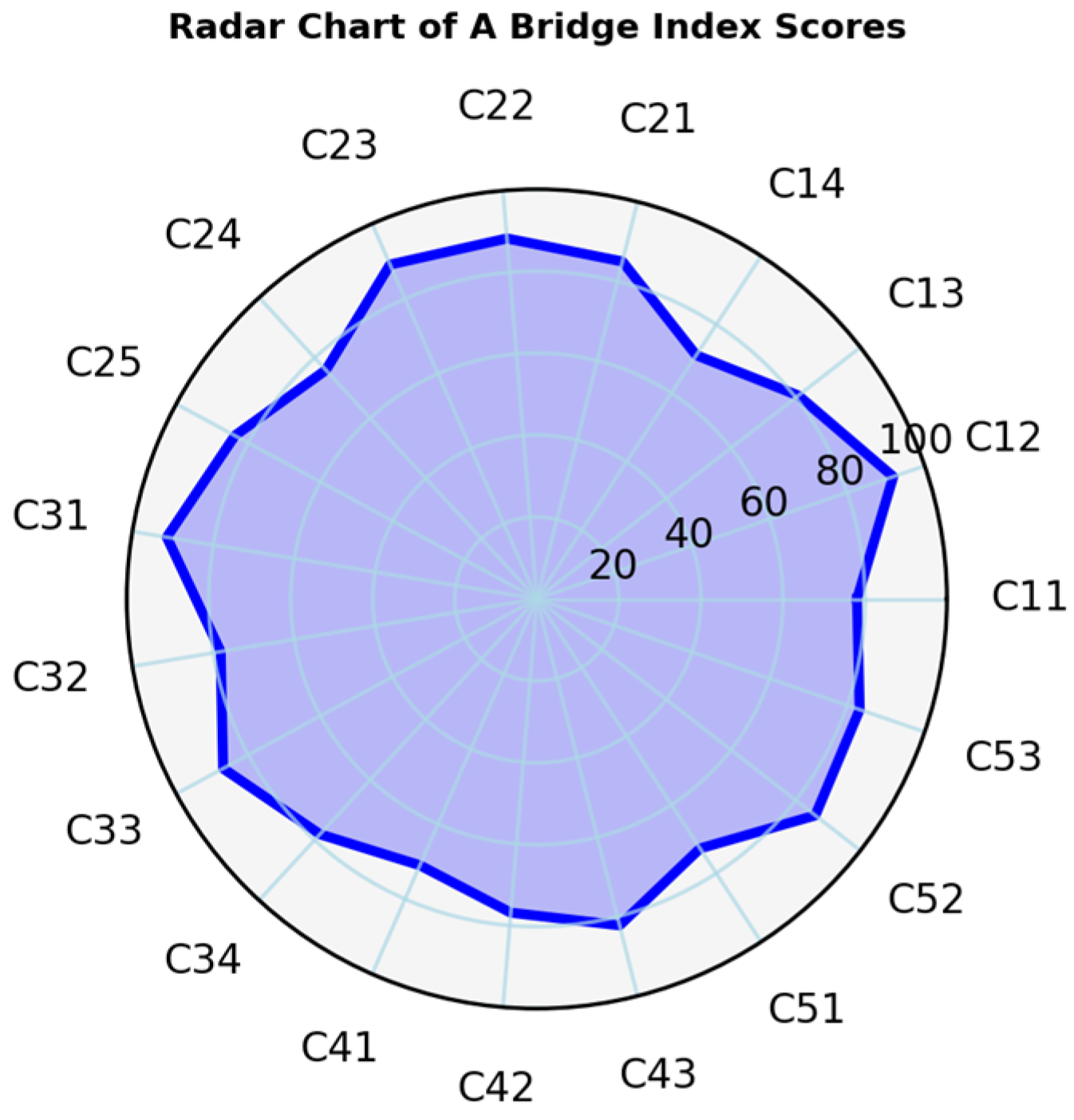
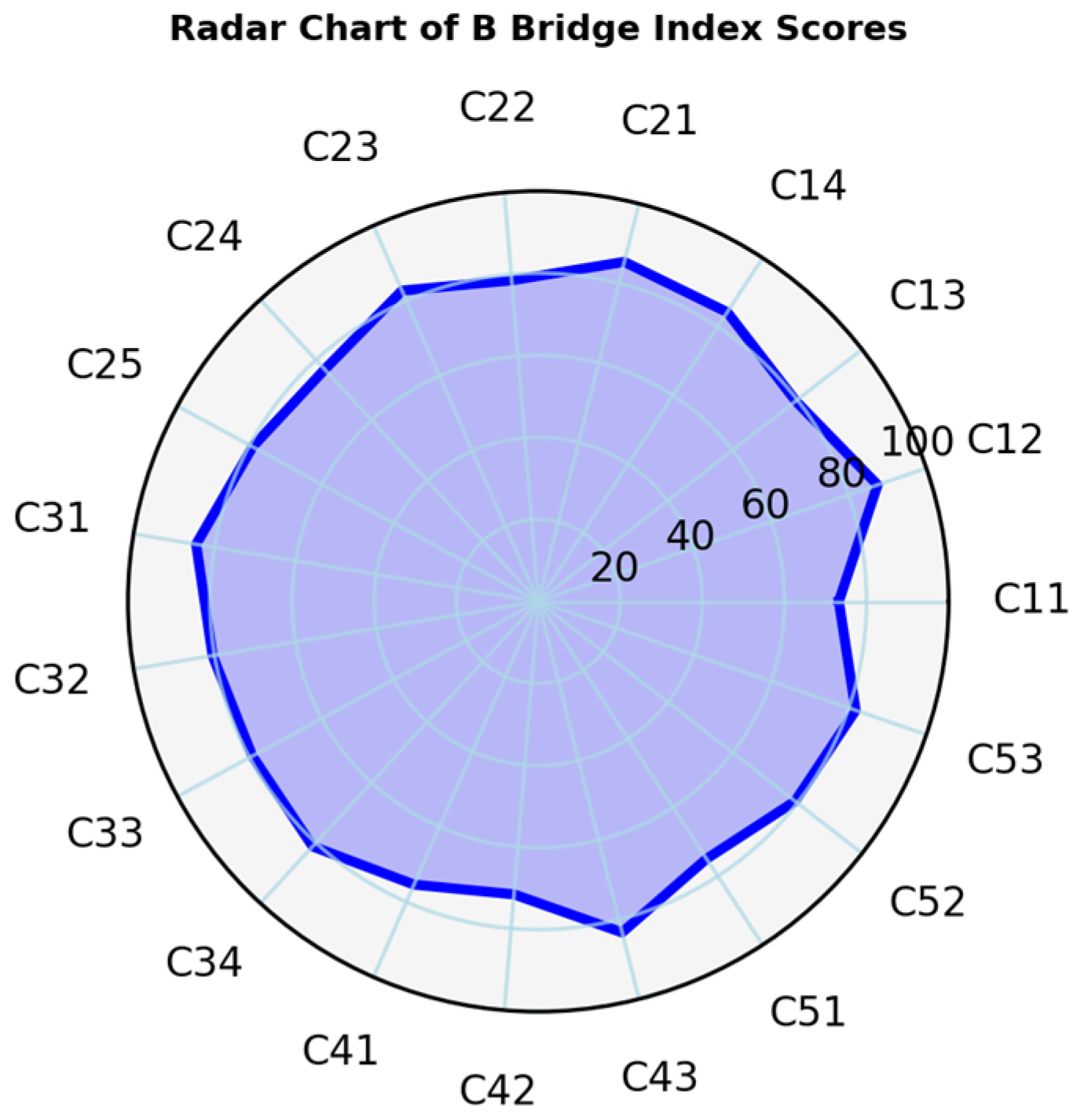
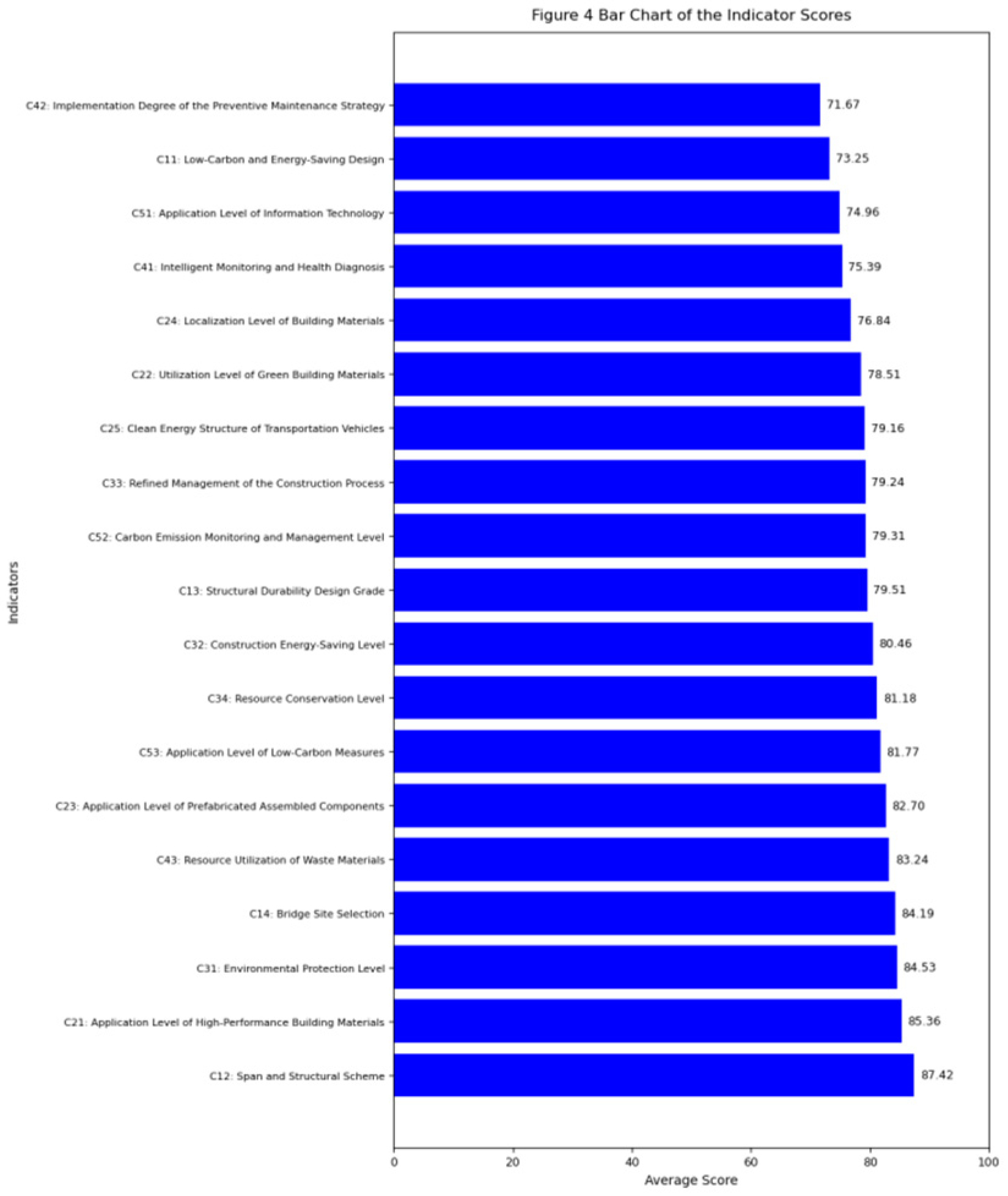
The radar charts and bar charts for the scores of each indicator were organized to facilitate analysis of the potential of the indicators, as shown in Figure 4, Figure 5, Figure 6 and Figure 7.
According to the information reflected in the figure, it is evident that the evaluation results and performance of core indicators for the two bridges differ significantly. The score for A Bridge shows a ‘locally high’ characteristic, with its performance on key indicators significantly surpassing the peak indicators of B Bridge, highlighting a more pronounced optimization effect on certain core aspects. In contrast, the score range for B Bridge is relatively concentrated, with no indicators showing particularly low performance, resulting in a more balanced overall evaluation outcome.
From the perspective of core indicators, in terms of structural design, A Bridge demonstrates more outstanding performance on indicators related to high energy consumption and high carbon emissions during the construction phase, aligning with its targeted optimization approach for critical carbon emission segments. B Bridge, on the other hand, shows a relative advantage in structural system indicators, reflecting an emission reduction strategy that focuses more on overall structural selection.
Regarding materials and recycling indicators, A Bridge performs better in areas related to material recycling and prefabrication technology, directly illustrating the differences in the implementation of emission reduction measures between the two projects. B Bridge shows relatively stable performance in these indicators, consistent with its actual choices in project material supply and construction techniques.
In terms of management and operation & maintenance indicators, A Bridge leads in process control indicators during construction and operation phases, corresponding to the maturity of its carbon emission management during construction. B Bridge’s performance in these indicators aligns with its overall score characteristics, remaining in a relatively stable range.
The comprehensive scores for A Bridge are shown in Table 7.
According to the calculation results in Table 6, the A Bridge received a comprehensive evaluation score of 82.38, with an overall grade of excellent, which is consistent with the experts’ ratings. At the indicator level, this project performed particularly well in promoting green building materials, applying prefabricated components, and engaging in resource conservation and environmental protection during construction, which reflects a positive response to low-carbon construction technologies and energy-saving materials. However, in the early planning and design stages, the low-carbon orientation in bridge site selection and structural durability design was still insufficient. Additionally, during the later operational phase, the application of information technology and intelligent monitoring methods was limited, and full-process carbon emission control was not fully realized.
From the perspective of guidelines, building material production, transportation, and construction have obvious advantages and can effectively achieve emission reduction targets. However, in the maintenance phase, systematic practices for preventive maintenance strategies and the recycling of waste materials have not yet been established, and the potential for carbon reduction has not been fully explored. The planning and design phase also has shortcomings, as low-carbon optimization approaches that consider the entire life cycle are lacking.
From the perspective of the target layer, the overall low-carbon level of this project is relatively high, which reflects the effectiveness of the construction and material stages. However, there is still room for improvement in planning, maintenance, and information management, and further improving the system’s integrity and applicability through the coordination of front-end optimization and back-end monitoring is urgently needed.
The comprehensive scores for B Bridge are shown in Table 8.
According to the calculation results in Table 7, the comprehensive score for the low-carbon lifecycle of the railway bridge is 80.09 points, which just reaches the excellent level. From the perspective of the indicator level, this project scores particularly well in aspects such as span and structural scheme, bridge location selection, application level of high-performance building materials, and environmental protection during the construction phase, reflecting active practices in structural design optimization, material selection, and construction environmental protection. However, indicators such as the implementation of preventive maintenance strategies, intelligent monitoring and health diagnostics, and the application level of information technology scored relatively low, indicating that these areas have not yet achieved the overall average level.
From the criterion level, the scores for the planning and design phase, the building materials production and transportation phase, and the construction phase are all above 80 points, which can effectively support the promotion of low-carbon lifecycle. However, the score for the maintenance phase is relatively low, and performance in the lifecycle management phase also has room for improvement, demonstrating that the effort in these areas to implement low-carbon measures needs to be strengthened.
From the goal level, the overall low-carbon lifecycle performance of the project is good, showing certain advantages in design, materials, and construction. However, there are still shortcomings in maintenance, information management, and other areas, and it is urgent to further improve through collaborative optimization across all phases.

3.6. Comparative Analysis of the Model Results and Actual Cases

Table 9 and Table 10 respectively show the comparison and analysis of the emissions corresponding to each indicator for A Bridge and B Bridge, as well as their global weight rankings.
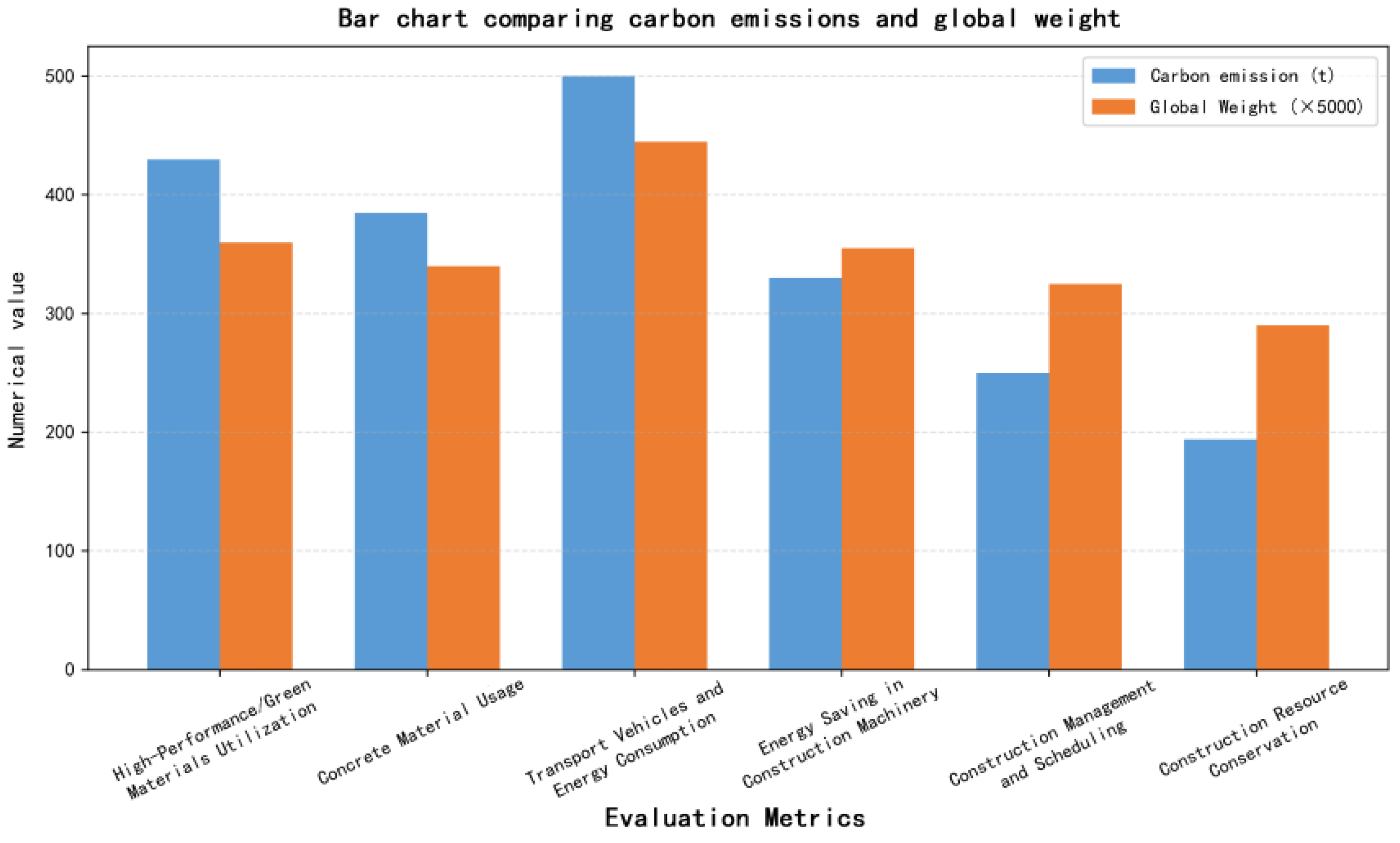
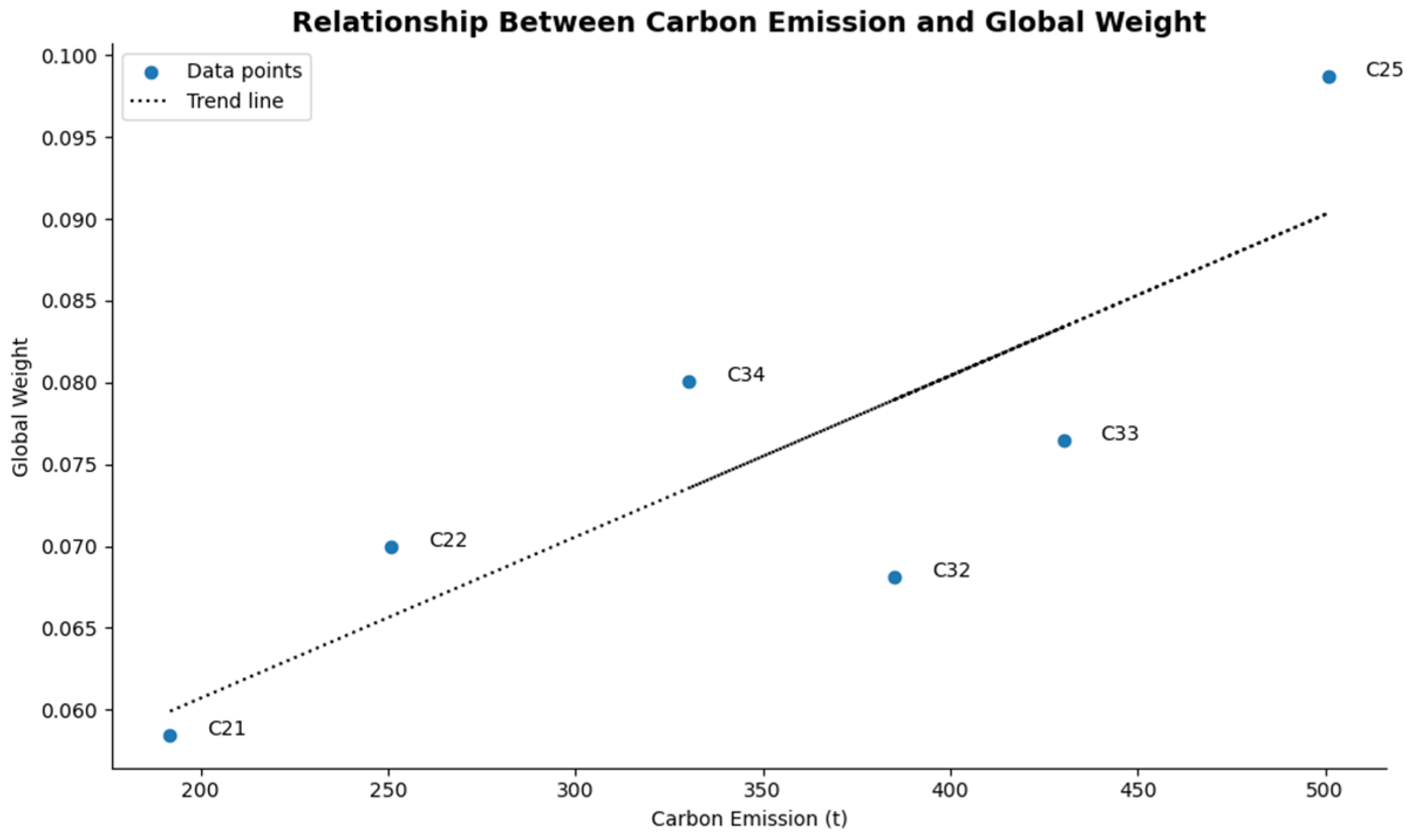
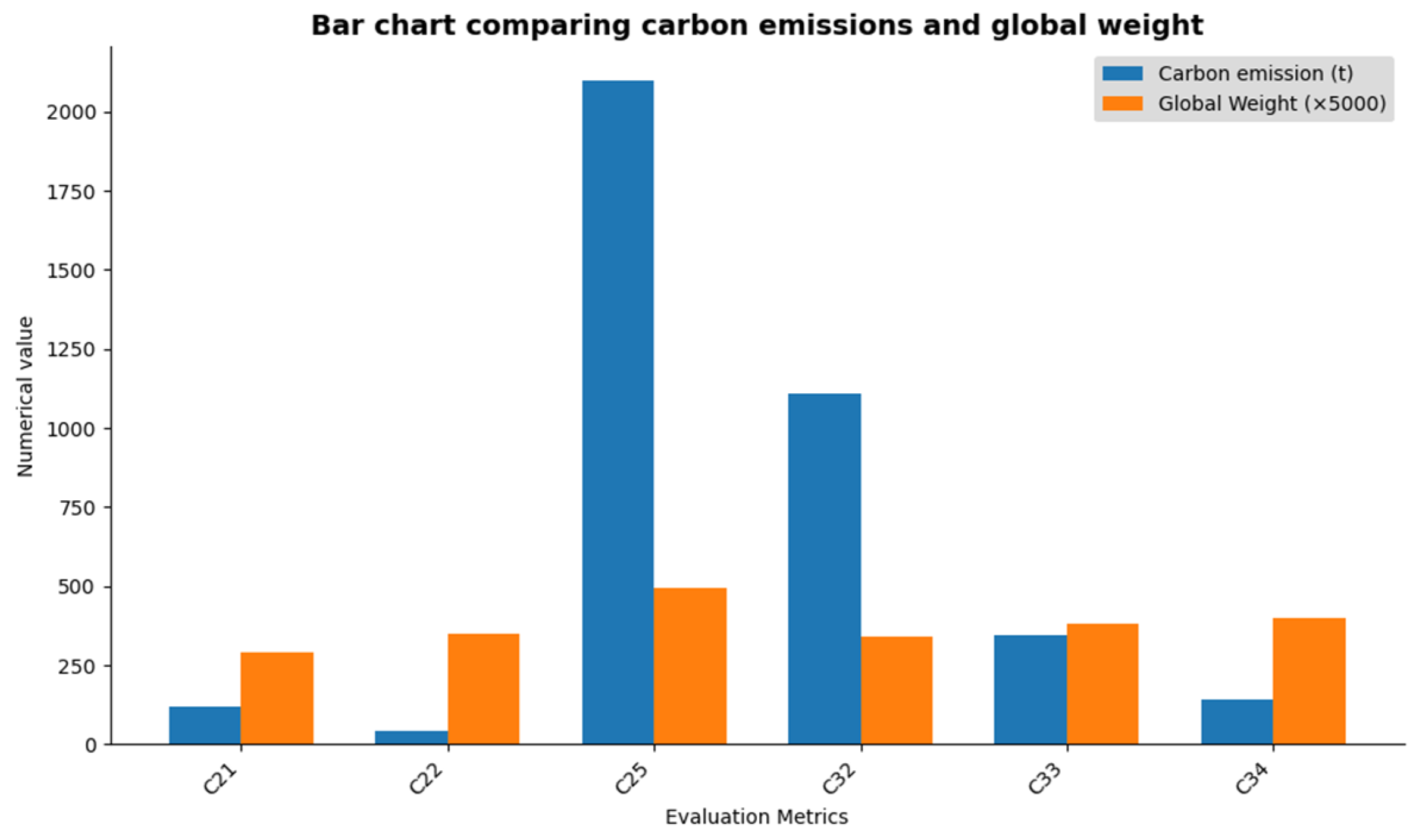
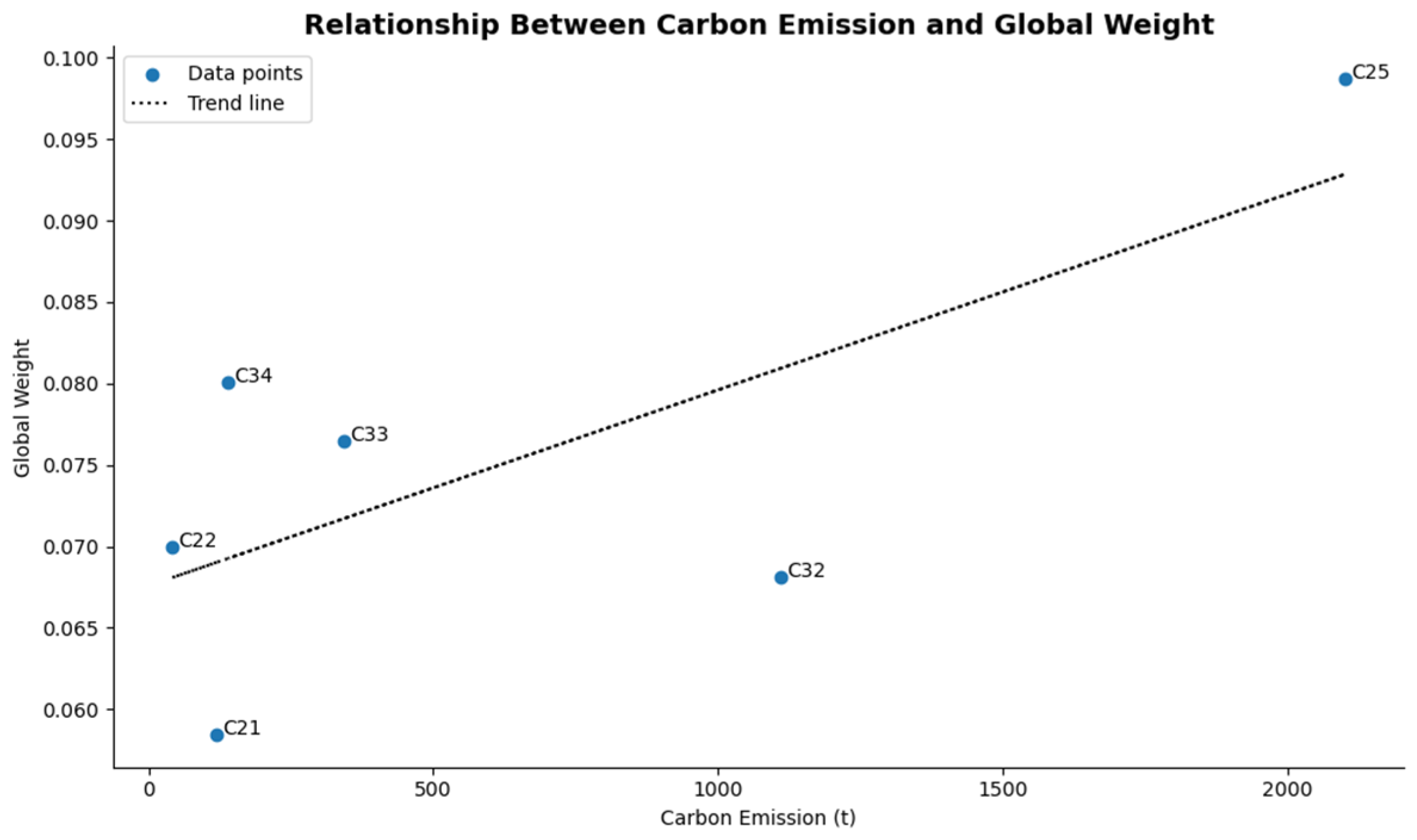
Figure 8, Figure 9, Figure 10 and Figure 11 and Table 9 and Table 10, through a lateral comparison of the two bridges, clearly present the correlation between each indicator and carbon emissions as well as the distribution characteristics of global weights. On a common level, the transportation stage (C25) of both bridges has the highest carbon emissions (A Bridge: 500.789 t, B Bridge: 2100.28 t), and the global weight also ranks first for both (0.0987); although the use of high-performance materials (C21) shows differences in carbon emission ranking between the two bridges (6th for A Bridge, 5th for B Bridge), the total carbon emissions from both account for about 45% of the total emissions in the construction stage, making it a common core source of carbon emissions. Meanwhile, the trend in global weight distribution is highly consistent for both bridges (C25 > C34 > C33 > C22 > C32 > C21), and the model calculation results align well with the actual importance of carbon emissions, confirming that the ANP-FCE model can effectively map the actual relationship between carbon emissions and indicator weights across different bridge cases.
On the level of differences, the carbon emissions of C25 for B Bridge (2100.28 t) are significantly higher than that of A Bridge (500.789 t), whereas the carbon emissions of C22 (use of green materials) are much lower (B Bridge: 41.474 t vs. A Bridge: 250.851 t). These differentiated characteristics are precisely captured by the model, and the weight distribution does not shift due to project differences, reflecting the model’s adaptability to the carbon emission characteristics of different projects.
The model performs exceptionally in terms of indicator interpretability and applicability. It not only accurately identifies the core carbon emission factors during the construction stage of both bridges (C25, C21), providing targeted references for low-carbon decision-making in different projects, but also further validates its advantages through lateral comparison: compared with traditional AHP-FCE and direct weighted LCA methods, it expresses the dependencies between indicators more accurately, significantly improves the consistency of result interpretation, and ensures that the identification of key carbon emission control points remains stable and reliable across different projects, fully demonstrating the universality and practical value of the model.

4. Conclusions

In this paper, a railway bridge low-carbon evaluation model that is based on the network analytic hierarchy process and fuzzy comprehensive evaluation method is proposed, with the goal of assessing carbon emissions during railway bridge construction and providing a reference for low-carbon decision-making in railway bridges. The main research conclusions are as follows:
(1) A consistency check was conducted on the judgement matrix, and all the CR values were less than 0.1, which indicated good logical consistency among the indicators. Moreover, the Spearman correlation coefficient between the indicator weights that were calculated by the model and the actual carbon emission ranking was 0.714, which indicated a relatively high level of consistency. These findings reveal that the constructed low-carbon evaluation model can accurately reflect the carbon emission characteristics during the construction phase of railway bridges.
(2) A comparative analysis of the ranked actual emission inventory after mapping with the weighted ranking reveals that carbon emissions are concentrated mainly in C21 (use of high-performance materials), C22 (use of concrete materials), and C25 (transportation energy consumption), with the production and transportation stages of materials contributing the most, namely, approximately 60% cumulatively, followed by construction machinery and management-related indicators. These findings are largely consistent with the model weight rankings, which validate the effectiveness of the low-carbon evaluation model for identifying key emission sources for railway bridges.
In summary, the low-carbon evaluation model for the construction period of railway bridges developed in this study provides technical support for the quantitative analysis of carbon emissions and low-carbon decision-making during the construction phase. The model can be used to identify key sources of carbon emissions during the design stage to guide projects to implement low-carbon optimizations in material selection, construction organization, and transportation plans. In future research, this model can be extended to bridge operation and maintenance stages, a full-life-cycle low-carbon evaluation system can be constructed, and weighting parameters can be dynamically updated through machine learning methods to improve the model’s universality and predictive accuracy.

Author Contributions

B.Z. and D.Y.; methodology, B.G.; software, M.X.; validation, J.W.; formal analysis, J.W.; investigation, B.Z.; resources, D.Y.; data curation, B.Z.; writing—original draft preparation, B.G.; writing—review and editing. All authors have read and agreed to the published version of the manuscript.

Funding

This research was funded by [the Research on Carbon Emission Methodology for the Entire Lifecycle of Railway Bridge Construction and Operation, Low-Carbon Pathways, and Development of an Intelligent Management and Control Platform Project] grant number [2023-Key-43]. And The APC was funded by [the Research on Carbon Emission Methodology for the Entire Lifecycle of Railway Bridge Construction and Operation, Low-Carbon Pathways, and Development of an Intelligent Management and Control Platform Project].

Data Availability Statement

No new data were created or analyzed in this study. Data sharing is not applicable to this article.

Conflicts of Interest

Authors Bo Zhao and Dan Ye were employed by the company Railway Engineering Design and Consulting Group Co., Ltd. The remaining authors declare that the research was conducted in the absence of any commercial or financial relationships that could be construed as a potential conflict of interest.

References

  1. Energy & Climate Intelligence Unit. Net Zero Emissions Race: 2021 Scorecard; Energy & Climate Intelligence Unit: London, UK, 2021; Available online: https://eciu.net/netzerotracker (accessed on 15 June 2021).
  2. Xi, J. Statement at the General Debate of the 75th Session of the United Nations General Assembly; Ministry of Foreign Affairs of the People’s Republic of China: Beijing, China, 2020. Available online: http://english.scio.gov.cn/topnews/2020-09/23/content_76731466.htm (accessed on 15 June 2021).
  3. Comprehensive Report Writing Group of the Project. Comprehensive report on China’s long-term low-carbon development strategy and transition pathway research. China Popul. Resour. Environ. 2020, 30, 1–25.
  4. State Council of the People’s Republic of China. Notice on printing and distributing the “14th Five-Year” plan for the development of a modern comprehensive transportation system. In China Foreign Economic and Trade Gazette; State Council of the People’s Republic of China: Beijing, China, 2022; pp. 3–23. [Google Scholar]
  5. Hu, X.; Xia, B.; Yin, L.; Yin, Y.; Chen, H. Carbon Emissions of Railways: An Overview. Int. J. Environ. Res. 2025, 19, 49. [Google Scholar]
  6. Ren, F.; Guo, X.; Liang, R.; Liu, H. Life cycle CO2 emission assessment of railway construction. J. Beijing Jiaotong Univ. 2013, 37, 115–119. [Google Scholar]
  7. Lei, Y.; Wu, Y.; Jiang, R.; Yin, L.; Luo, Z.; Tang, X. Research on low-carbon evaluation system for railway tunnel engineering construction process. Constr. Technol. 2024, 53, 147–152. [Google Scholar]
  8. Wu, Y.; Zhang, T.; Wang, Y.; Pei, Z.; Yin, L.; Jiang, R. Research on carbon emission calculation of drilling and blasting method in railway tunnel construction process. Constr. Econ. 2025, 46, 291–295. [Google Scholar]
  9. Krezo, S.; Mirza, O.; Kaewunruen, S.; Sussman, J. Evaluation of CO2 emissions from railway resurfacing maintenance activities. Transp. Res. Part D Transp. Environ. 2018, 65, 458–465. [Google Scholar]
  10. Liu, M.Y.; Lin, C.; Gao, H.W. Comprehensive fuzzy assessment on the life-cycle environmental impact of bridges. China Civ. Eng. J. 2009, 42, 55–59. [Google Scholar]
  11. Li, Q.N.; Bao, J.C.; Niu, C.L. Greenness evaluation of prefabricated buildings using ANP-Fuzzy method. Build. Energy Effic. 2020, 48, 67–71, 101. [Google Scholar]
  12. Li, S.H.; Li, Y.D.; Huang, S.Q. Comparative analysis of carbon emissions from different prefabricated schemes during railway bridge construction. Railw. Stand. Des. 2024, 68, 67–75. [Google Scholar] [CrossRef]
  13. GB/T 51366-2019; Standard for Building Carbon Emission Calculation. China Architecture & Building Press: Beijing, China; Ministry of Housing and Urban-Rural Development of the People’s Republic of China: Beijing, China, 2019.
  14. Chen, P. Research on Control Indicators and Benchmark Evaluation for Low-Carbon Construction of Railway Engineering in China. Doctoral Dissertation, Tsinghua University, Beijing, China, 2023. [Google Scholar]
  15. Wang, J.; Wei, J.; Zhang, W.; Liu, Z.; Du, X.; Liu, W.; Pan, K. High-resolution temporal and spatial evolution of carbon emissions from building operations in Beijing. J. Clean. Prod. 2022, 376, 134272. [Google Scholar] [CrossRef]
  16. Song, X.; Guan, J.; Niu, F.; Zhang, F.; Liu, J. Carbon emission evaluation of prefabricated building components based on ANP and fuzzy theory. J. Henan Open Univ. 2024, 37, 107–112. [Google Scholar]
  17. Lu, H. Analysis of carbon emission evaluation indicators in the production stage of prefabricated building components. Ceramics 2022, 152–154. [Google Scholar] [CrossRef]
  18. Liu, Y.; Zhang, J. A consistent combination evaluation method based on maximizing Spearman’s rank correlation coefficient. Inn. Mong. Stat. 2025, 41–47. [Google Scholar] [CrossRef]
Figure 1. Low-Carbon Assessment Method for Railway Bridge Engineering.
Infrastructures 11 00032 g001
Figure 2. Main consumption and carbon emissions during the construction period of the A Bridge.
Infrastructures 11 00032 g002
Figure 3. Main consumption and carbon emissions during the construction period of the B Bridge.
Infrastructures 11 00032 g003
Figure 4. Radar Chart of Dawan Tianqiao Index Scores.
Infrastructures 11 00032 g004
Figure 5. Bar Chart of Dawan Tianqiao Index Scores.
Infrastructures 11 00032 g005
Figure 6. Radar Chart of B Bridge Index Scores.
Infrastructures 11 00032 g006
Figure 7. B Bridge Index Score Bar Chart.
Infrastructures 11 00032 g007
Figure 8. Bar chart of carbon emissions and weights of A Bridge.
Infrastructures 11 00032 g008
Figure 9. Scatter plot of carbon emissions and weight relationship at A Bridge.
Infrastructures 11 00032 g009
Figure 10. Bar chart of carbon emissions and weights of B Bridge.
Infrastructures 11 00032 g010
Figure 11. Scatter plot of carbon emissions and weight relationship at B Bridge.
Infrastructures 11 00032 g011
Table 1. Material Carbon Emission Factor Data for Railway Bridges.
TypeNameUnitCarbon Emission Factor
EnergyDieselkg CO2/kg3.03
Gasolinekg CO2/kg2.93
Electricitykg CO2/kWh0.1255
Building materialsC20 concretekg CO2e/m3237.3
C30 concretekg CO2e/m3294.8
C50 concretekg CO2e/m3424.5
Rebarkg CO2e/t2340
Structural steelkg CO2e/t2340
Mode of transportationHeavy gasoline truck transportation (18 t payload)kg CO2e/(t·km)0.104
Heavy-duty diesel truck transportation (18 t payload)kg CO2e/(t·km)0.129
Concrete mixer truck (diesel)kg CO2e/(t·km)0.255
Concrete transport truck (electric)kg CO2e/(t·km)0.019
Mechanical equipmentTruck-mounted crane ≤ 20 tkg CO2/work shift196.93
Truck-mounted crane ≤ 25 tkg CO2/work shift225.01
Dump truck ≤ 6 tkg CO2/work shift124.83
Table 2. Low-Carbon Evaluation Index System for Railway Bridges.
Target Layer (A)Guideline Level (B)Indicator Layer (C)
A1 Low-carbon lifecycle of railway bridgesB1 Planning and design stageC11 Low-carbon and energy-saving design
C12 Span and structural scheme
C13 Structural durability design grade
C14 Bridge site selection
B2 Construction material production and transportation phaseC21 Application level of high-performance building materials
C22 Utilization level of green building materials
C23 Application level of prefabricated assembled components
C24 Level of localization of building materials
C25 Decarbonization of the energy structure in transport vehicles
B3 Construction phaseC31 Level of environmental protection
C32 Construction energy-saving level
C33 Refined management of the construction process
C34 Resource-saving level
B4 Maintenance and upkeep stageC41 Intelligent monitoring and health diagnosis
C42 Implementation of a preventive maintenance strategy
C43 Resource utilization of waste materials
B5 Lifecycle managementC51 Information technology application level
C52 Carbon emissions monitoring and management level
C53 Level of application of low-carbon measures
Table 3. Mapping indicators and corresponding emission rankings.
Corresponding IndicatorsInvolved FactorsEmissionsEmission RankingGlobal WeightGlobal Weight Ranking
C21Rebar cutting machine d 40, rebar bending machine d 40, rebar straightening machine d 14, prestressed rebar hydraulic tensioning equipment 1200 kN, prestressed rebar hydraulic tensioning equipment 2000 kN, prestressed rebar hydraulic tensioning equipment 4000 kN, ML15, Q355, unequal angle steel, stud (Q345), corrugated pipe 46 mm t 0.7 kg, waterproof material m3, waterproof coating m3191.79260.058456
C22Concrete distributor 21 m, concrete immersion vibrator, concrete mixing plant 180 m3/h, concrete mixer truck 10 m3, concrete pump 60 m3/h, concrete pump 60 m3/h, concrete pump 80 m3/h, concrete delivery pump truck 60 m3/h, concrete attached vibrator, C40 concrete, C50 concrete m3250.85150.074
C25Truck crane 12 t, truck crane 16 t, truck crane 20 t, truck crane 25 t, truck crane 40 t, truck crane 8 t, slurry transport truck 4000 L, dump truck 6 t, rail flatcar 60 t, load truck 15 t, load truck 8 t, transport barge 300 t, C30 concrete, C30 concrete m3, C35 concrete m3, C40 concrete, HPB300 rebar t, HPB300, HRB400 rebar t, HPB300 rebar t, HRB400 rebar t, Q235 steel, coupling sleeve, steel casing500.78910.09871
C32AC arc welding machine 21 kVA, AC arc welding machine 42 kVA, single-drum slow hoist 20 kN, single-drum slow hoist 30 kN, single-drum slow hoist 50 kN, but welding machine 75 kVA, crawler crane 15 t, crawler crane 25 t, rotary drilling rig 280 kN, DC arc welding machine 32 kVA, gantry crane 10 t–22 m, gantry crane 20 t–22 m, gantry crane 75 t–36 m, gantry crane 80 t–36 m, C55 concrete, HPB300, HPB300t, HPB300, HRB400 rebar t, HPB300 rebar t, HRB400 rebar, Q235, Q235 steel, T steel (Q345), steel material, steel plate, sheet pile, 5 kg waterproof membrane, anticorrosion385.09930.06815
C33Internal combustion forklift 60 t, internal combustion tow tractor 230 kW–150 t, internal combustion locomotive, internal combustion air compressor 9 m3/min, crawler bulldozer 75 kW, crawler hydraulic single-bucket excavator 1.0 m3, crawler hydraulic single-bucket excavator 1.0 m3, engineering barge 400 t, suspended slurry levelling machine, polishing grinder, woodworking single-side planer B 600, woodworking circular saw d 500, bridge erection machine 130 t, pneumatic broaching machine d 90, hydraulic jack, electric grouting machine 3 m3/h, electric air compressor 3 m3/min, vertical drilling machine d 50, dump truck 6 t, C20 concrete m3, C25 concrete m3, PVC pipe t 2 kg, polyethylene drainage pipe t 15 kg, bolts, steel strands t, anticorrosion430.17420.07653
C34Single-stage centrifugal clean water pump 12.5 m3/h–20 m, single-stage centrifugal clean water pump 1 2.5 m3/h–32 m, single-stage centrifugal clean water pump 170 m3/h–26 m, single-stage centrifugal clean water pump 25 m3/h–32 m, multistage centrifugal clean water pump 32 m3/h–125 m, slurry mixer 150 L, mortar mixer 200 L, mortar mixer 400 L, centrifugal slurry pump 150 m3/h–39 m, centrifugal slurry pump 47 m3/h–19 m, high-pressure oil pump 63 MPa, M20, dry-stacked stone, rubber rod t 0.9 kg330.26540.08012
Table 4. Weight Allocation for the Evaluation Index System.
Target Layer (A)Guideline Level (B)WeightIndicator Layer (C)Weight
A1 Low-Carbon Lifecycle of Railway BridgesB1 Planning and Design Stage0.08C11 Low-Carbon and Energy-Saving Design0.219
C12 Span and Structural Scheme0.221
C13 Structural Durability Design Grade0.275
C14 Bridge Site Selection0.285
B2 Construction Material Production and Transportation Phase0.35C21 Application Level of High-Performance Building Materials0.156
C22 Utilization Level of Green Building Materials0.201
C23 Application Level of Prefabricated Assembled Components0.189
C24 Localization Level of Building Materials0.204
C25 Clean Energy Structure of Transportation Vehicles0.25
B3 Construction Phase0.3C31 Environmental Protection Level0.206
C32 Construction Energy-Saving Level0.282
C33 Refined Management of the Construction Process0.262
C34 Resource Conservation Level0.25
B4 Maintenance and Upkeep Stage0.12C41 Intelligent Monitoring and Health Diagnosis0.299
C42 Implementation Degree of the Preventive Maintenance Strategy0.301
C43 Resource Utilization of Waste Materials0.4
B5 Lifecycle Management0.15C51 Application Level of Information Technology0.239
C52 Carbon Emission Monitoring and Management Level0.367
C53 Application Level of Low-Carbon Measures0.394
Table 5. A Bridge Evaluation Score Sheet.
Target Layer (A)Guideline Level (B)Indicator Layer (C)Goal
A1 Low-Carbon Lifecycle of Railway BridgesB1 Planning and Design StageC11 Low-Carbon and Energy-Saving Design78.09
C12 Span and Structural Scheme91.88
C13 Structural Durability Design Grade80.82
C14 Bridge Site Selection71.06
B2 Construction Material Production and Transportation PhaseC21 Application Level of High-Performance Building Materials84.97
C22 Utilization Level of Green Building Materials88.29
C23 Application Level of Prefabricated Assembled Components89.11
C24 Localization Level of Building Materials75.94
C25 Clean Energy Structure of Transportation Vehicles83.72
B3 Construction PhaseC31 Environmental Protection Level91.48
C32 Construction Energy-Saving Level78.18
C33 Refined Management of the Construction Process86.98
C34 Resource Conservation Level78.09
B4 Maintenance and Upkeep StageC41 Intelligent Monitoring and Health Diagnosis71.01
C42 Implementation Degree of the Preventive Maintenance Strategy76.86
C43 Resource Utilization of Waste Materials82.21
B5 Lifecycle ManagementC51 Application Level of Information Technology72.77
C52 Carbon Emission Monitoring and Management Level86.05
C53 Application Level of Low-Carbon Measures83.23
Table 6. Table of Scores for Each Indicator.
Target Layer (A)Guideline Level (B)Indicator Layer (C)Goal
A1 Low-Carbon Lifecycle of Railway BridgesB1 Planning and Design StageC11 Low-Carbon and Energy-Saving Design73.25
C12 Span and Structural Scheme87.42
C13 Structural Durability Design Grade79.51
C14 Bridge Site Selection84.19
B2 Construction Material Production and Transportation PhaseC21 Application Level of High-Performance Building Materials85.36
C22 Utilization Level of Green Building Materials78.51
C23 Application Level of Prefabricated Assembled Components82.70
C24 Localization Level of Building Materials76.84
C25 Clean Energy Structure of Transportation Vehicles79.16
B3 Construction PhaseC31 Environmental Protection Level84.53
C32 Construction Energy-Saving Level80.46
C33 Refined Management of the Construction Process79.24
C34 Resource Conservation Level81.18
B4 Maintenance and Upkeep StageC41 Intelligent Monitoring and Health Diagnosis75.39
C42 Implementation Degree of the Preventive Maintenance Strategy71.67
C43 Resource Utilization of Waste Materials83.24
B5 Lifecycle ManagementC51 Application Level of Information Technology74.96
C52 Carbon Emission Monitoring and Management Level79.31
C53 Application Level of Low-Carbon Measures81.77
Table 7. The comprehensive scores for A Bridge.
Target Layer (A) (Goal)Guideline Level (B)WeightGoalIndicator Layer (C)WeightGoal
A1 Low-Carbon Lifecycle of Railway Bridges (82.38)B1 Planning and Design Stage0.0879.88C11 Low-Carbon and Energy-Saving Design0.21978.09
C12 Span and Structural Scheme0.22191.88
C13 Structural Durability Design Grade0.27580.82
C14 Bridge Site Selection0.28571.06
B2 Construction Material Production and Transportation Phase0.3584.27C21 Application Level of High-Performance Building Materials0.15684.97
C22 Utilization Level of Green Building Materials0.20188.29
C23 Application Level of Prefabricated Assembled Components0.18989.11
C24 Localization Level of Building Materials0.20475.94
C25 Clean Energy Structure of Transportation Vehicles0.2583.72
B3 Construction Phase0.383.2C31 Environmental Protection Level0.20691.48
C32 Construction Energy-Saving Level0.28278.18
C33 Refined Management of the Construction Process0.26286.98
C34 Resource Conservation Level0.2578.09
B4 Maintenance and Upkeep Stage0.1277.25C41 Intelligent Monitoring and Health Diagnosis0.29971.01
C42 Implementation Degree of the Preventive Maintenance Strategy0.30176.86
C43 Resource Utilization of Waste Materials0.482.21
B5 Lifecycle Management0.1581.77C51 Application Level of Information Technology0.23972.77
C52 Carbon Emission Monitoring and Management Level0.36786.05
C53 Application Level of Low-Carbon Measures0.39483.23
Table 8. The comprehensive scores for B Bridge.
Target Layer (A) (Goal)Guideline Level (B)WeightGoalIndicator Layer (C)WeightGoal
A1 Low-Carbon Lifecycle of Railway Bridges (80.09)B1 Planning and Design Stage0.0881.22C11 Low-Carbon and Energy-Saving Design0.21973.25
C12 Span and Structural Scheme0.22187.42
C13 Structural Durability Design Grade0.27579.51
C14 Bridge Site Selection0.28584.19
B2 Construction Material Production and Transportation Phase0.3580.19C21 Application Level of High-Performance Building Materials0.15685.36
C22 Utilization Level of Green Building Materials0.20178.51
C23 Application Level of Prefabricated Assembled Components0.18982.70
C24 Localization Level of Building Materials0.20476.84
C25 Clean Energy Structure of Transportation Vehicles0.2579.16
B3 Construction Phase0.381.16C31 Environmental Protection Level0.20684.53
C32 Construction Energy-Saving Level0.28280.46
C33 Refined Management of the Construction Process0.26279.24
C34 Resource Conservation Level0.2581.18
B4 Maintenance and Upkeep Stage0.1277.41C41 Intelligent Monitoring and Health Diagnosis0.29975.39
C42 Implementation Degree of the Preventive Maintenance Strategy0.30171.67
C43 Resource Utilization of Waste Materials0.483.24
B5 Lifecycle Management0.1579.24C51 Application Level of Information Technology0.23974.96
C52 Carbon Emission Monitoring and Management Level0.36779.31
C53 Application Level of Low-Carbon Measures0.39481.77
Table 9. Mapping indicators and corresponding emission rankings of A Bridge.
IndicatorEmissionsEmission RankingGlobal WeightGlobal Weight Ranking
C21191.79260.058456
C22250.85150.074
C25500.78910.09871
C32385.09930.06815
C33430.17420.07653
C34330.26540.08012
Table 10. Mapping indicators and corresponding emission rankings of B Bridge.
IndicatorEmissionsEmission RankingGlobal WeightGlobal Weight Ranking
C21119.63250.058456
C2241.47460.074
C252100.2810.09871
C321110.6520.06815
C33343.18230.07653
C34140.0240.08012
Disclaimer/Publisher’s Note: The statements, opinions and data contained in all publications are solely those of the individual author(s) and contributor(s) and not of MDPI and/or the editor(s). MDPI and/or the editor(s) disclaim responsibility for any injury to people or property resulting from any ideas, methods, instructions or products referred to in the content.