Article

Conflict Risk Assessment Between Pedestrians and Right-Turn Vehicles: A Trajectory-Based Analysis of Front and Rear Wheel Dynamics


1
Key Laboratory of Maritime Intelligent Cyberspace Technology of Ministry of Education, Hohai University, Changzhou 213200, China
2
College of Transportation Engineering, Chang’an University, Xi’an 710064, China
3
School of Transportation, Southeast University, Nanjing 210096, China
4
Department of Civil Engineering, Toronto Metropolitan University, Toronto, ON M5B 2K3, Canada
*
Author to whom correspondence should be addressed.
Infrastructures 2025, 10(12), 330; https://doi.org/10.3390/infrastructures10120330
Submission received: 24 October 2025 / Revised: 22 November 2025 / Accepted: 25 November 2025 / Published: 2 December 2025

Abstract

Right-turning vehicles at intersections permitting right turn on red (RTOR) frequently conflict with pedestrians, posing significant safety risks. Existing studies often simplify vehicle trajectories by treating vehicles as centroid points, ignoring the spatial disparities between pedestrians and vehicles. To address this gap, we propose a conflict risk assessment framework based on front and rear wheel trajectories (FRWTs), which accounts for the dynamic differences in vehicle segments during turns. First, we partition vehicles into four segments (inner/outer and front/rear wheels) and develop a trajectory prediction model to quantify risk variations across these segments. Our analysis reveals that the inner front wheel poses the highest collision risk due to its speed, trajectory curvature, and pedestrian proximity. Next, we introduce three conflict interaction modes—hard interaction, no interaction, and soft interaction—and evaluate the applicability of conflict indicators (e.g., Time to Collision (TTC) and Post-Encroachment Time (PET)) under each mode. Using a Support Vector Machine (SVM) classification algorithm, we classify risk severity with high accuracy: 96% for hard interaction, 96% for no interaction, and 97% for soft interaction modes when TTC-PET dual indicators are employed. Our findings demonstrate that FRWT-based modeling significantly improves conflict risk assessment accuracy compared to centroid-point approaches. This work provides actionable insights for proactive traffic safety management and supports the development of targeted conflict mitigation strategies at RTOR intersections.

1. Introduction

In many countries, at intersections in urban traffic systems, all vehicles and pedestrians who are faced with a red light are not allowed to cross. But in some countries, such as US, Canada, China and many other Asian countries, vehicles are allowed to turn right on a red light (RTOR), if it is safe and does not affect other vehicles or pedestrians who have the green. In those countries, considering the utilization rate of road resources, traffic efficiency, and local cultural background, allowing RTOR is a common signalized intersection control method for single-lane, double-lane, and even multi-lane intersections in urban traffic systems. In RTOR, right-turning (R-T) vehicles, pedestrians, and non-motorized vehicles share the same phase unless there is a clear “No Turn on Red” sign or the road channelization is designed with dedicated R-T lanes as well as the dedicated R-T phase signals. Although based on related traffic regulations, R-T vehicles need to yield to the straight traffic and pedestrians who have the green light, due to visual blind spots, especially with medium and large R-T vehicles, and some traffic anomie behavior; there have been repeated traffic tragedies when they conflict with pedestrians and bicycles [1].
Many previous studies have demonstrated a significant correlation between traffic conflicts and collisions, highlighting the effectiveness of using traffic conflict technology for safety assessment [2,3,4]. Studying the trajectories of R-T vehicles can better simulate their behaviors, which is essential for pedestrian–vehicle conflict studies [5].
In the micro-traffic environment of urban road intersections, due to the significant size and spatial differences between pedestrians and motor vehicles, there is a considerable deviation between the actual trajectory of an R-T vehicle and the trajectory of its centroid point, which then leads to a trajectory difference between the inside front and rear wheels of a motor vehicle when making a right turn. Current research commonly treats vehicles as a point when extracting their trajectories. Therefore, when analyzing the conflict of trajectories between pedestrians and R-T vehicles, treating the R-T vehicle as a point like a pedestrian can affect the accuracy of the conflict assessment. But which specific vehicle part that is selected as the most representative conflict point during a vehicle–pedestrian conflict remains understudied. To address this issue, the conflict severity between R-T vehicles’ different parts and pedestrians needs to be figured out. Video detection technology is commonly used to determine the trajectory of an R-T vehicle [6,7]. But few studies accurately describe it through mathematical models.
To address the research gap, this study mathematically models the front and rear wheel trajectories of R-T vehicles at intersections to verify the extracted trajectories from UAV video and predicts the trajectories of the inside front and rear wheels of right-turning vehicles. Then, a conflict risk assessment system based on the FRWT method for R-T vehicles is established.
In this study we divided the vehicle into four segments, examining the trajectories of the front and rear wheels, as well as the inner and outer wheels, separately. It assesses the risk differences between the inner and outer sides of the front and rear wheels and identifies the most typical conflict location. It develops a risk assessment method based on the trajectories of the front and rear wheels of R-T vehicles. Additionally, three interaction modes (hard interaction, no interaction, and soft interaction) are introduced, followed by using the Support Vector Machine (SVM) classification algorithm to categorize the severity of risk for the extracted conflict event dataset and to analyze the importance of variables. Based on how each conflict indicator contributes to the risk level assessment, the weighted combination of indicators under each interaction mode is completed.
The contributions of this paper are as follows:
(1)
Novel Vehicle Trajectory Modeling. The paper introduces a front-and-rear-wheel trajectory (FRWT) framework for R-T vehicles, addressing the limitation of centroid-point simplification in existing studies. It partitions vehicles into four segments (inner/outer front/rear wheels) to analyze risk disparities across different vehicle parts. And it proposes a geometric mathematical model of the trajectories of right-turning vehicles. This allows the prediction of the inner front and rear wheel trajectories of R-T vehicles at intersections and provides a foundation for conflict risk assessment based on the FRWT method for R-T vehicles.
(2)
Identification of High-Risk Conflict Zones. It demonstrates that the inner front wheel poses the highest collision risk due to its speed, trajectory curvature, and proximity to pedestrians, followed by the inner rear, outer front, and outer rear wheels.
(3)
Trajectory Prediction Model. It develops a mathematical model for R-T vehicle trajectories, validated against real-world video-extracted data, showing strong alignment with observed wheel paths.
(4)
Classification of Interaction Modes and Conflicts. It proposes three pedestrian–vehicle interaction modes (hard interaction, no interaction, soft interaction) based on trends in Time to Collision (TTC) and Gap Time (GT) curves. Additionally, it employs Support Vector Machine (SVM) with k-fold cross-validation to classify conflict severity levels, outperforming single-indicator methods.
(5)
Practical Implications for Safety Management. It provides a data-driven framework for proactive safety interventions at RTOR intersections, enabling targeted mitigation strategies (e.g., redesigning high-risk wheel-path zones).
The remainder of this paper is organized as follows. Section 2 reviews related work. Section 3 describes the vehicle unit, R-T vehicle trajectory data, and the conflict differences between various parts of the vehicle, which were analyzed. Section 4 introduces the research methodology, including the R-T vehicle trajectory prediction model and conflict assessment method. Section 5 presents the significant findings of this study and discusses the results, while Section 6 concludes the paper and provides an outlook for future research.

2. Literature Review

2.1. Vehicle Trajectory Extraction Method

Vehicle trajectory is a key consideration in traffic safety studies, and scholars have conducted a large number of studies to explore the vehicle trajectory extraction methods [8]. Existing research on vehicle trajectory extraction mainly focuses on two aspects. The first one determines the definition and occurrence area of conflict behavior and uses video detection technology and trajectory extraction software to draw the forward trajectory of the vehicle to analyze the extracted trajectory. The other one analyzes the relationship between the environment and surrounding traffic flows during the conflict between the R-T vehicle and the pedestrian, eliminates interference factors, explores conflicts between pedestrians and vehicles in space and time, and then builds the mathematical models of the R-T vehicle trajectory.
Chen et al. [9] proposed a methodological framework for automatic and accurate vehicle trajectory extraction from aerial videos by developing an ensemble detector to detect vehicles in the target region. They proposed a mapping algorithm to transform vehicle positions from the Cartesian coordinates in the image to the Frenet coordinates to extract raw vehicle trajectories along the roadway curves. Guan et al. [10] proposed a GIS-based method for detecting motorist yield behaviors using multi-modal trajectory data collected from LiDAR sensors at uncontrolled crosswalks. Considering different directions when evaluating pedestrian safety at crosswalks, Xie et al. [11] used advanced computer vision techniques to extract vehicle trajectories from video data. The strength of their algorithm lies in incorporating high-level information from background separation into specific vehicle feature point clustering, and they introduced a non-parametric clustering method, DPGMM, which does not require specifying the number of clusters. Kim et al. [12] conducted a comparative analysis of two vehicle detection frameworks based on deep learning: the human feature-based Aggregated Channel Features and the data-driven feature-based Faster Region Convolutional Neural Network. They extracted vehicle trajectory data from video using these detection algorithms, which can be applied in highly congested traffic areas.
Wang et al. [13] proposed a method for extracting vehicle trajectories using a distributed fiber optic sensing system. The principle is to enhance the vehicle trajectory using the energy response generated by the vehicle’s vibration signals, and then transform the vehicle trajectories into multiple singular points in the x-t plot using the Radon transformation. Chu et al. [14] proposed a distributed processing algorithm that effectively utilizes the secondary sorting function of MapReduce through operations such as partitioning and grouping. This method ultimately identified taxi targets and extracted the vehicle’s passenger-carrying trajectory. Tao et al. [15] used a trajectory stop-point extraction algorithm to optimize issues such as loss, hiding, and camouflage of vehicle stop points. They also used the uneven distribution characteristics derived from vehicle trajectories to perform topological modeling of intersection crossings, filtering and selecting stop points to obtain real vehicle trajectories. Zhou et al. [16] utilized the target detection algorithm YOLOv5 to train a model on vehicle aerial images, achieving vehicle detection. He then applied a multi-target tracking detection algorithm to track the vehicles and used a local weighted regression algorithm to smooth the trajectories. After model optimization, the detection accuracy was improved, and issues with target ID jumps were resolved, successfully extracting the vehicle trajectories from the video.

2.2. Pedestrian–Right-Turn Vehicle Conflict Risk Evaluation

Proper analysis of the extracted vehicle and pedestrian trajectories is essential to assess pedestrian–R-T vehicle conflicts, categorize them according to different risk levels, and conduct evaluations. The most important aspect is to use accurate, effective, and efficient methods to identify conflicts and assess them using appropriate indicators [17]. The conflict indicators and their calculation methods are modified and calibrated according to the pedestrian’s crossing behavior characteristics. The indicators are accurately extracted based on pedestrian–vehicle trajectory data. Using video extraction technology, factors influencing pedestrian–vehicle conflicts are analyzed, and an R-T vehicle trajectory model based on geometric conditions at intersections is established. The model parameters are calibrated using video-extracted trajectory data. A scientific and reasonable quantitative assessment of the safety risk associated with pedestrian–right-turn vehicle conflicts is crucial.
Regarding intersection safety evaluation methods, scholars have mainly focused on characteristics of road users involved in conflicts, different signal control modes, and variations in traffic facility designs. Mario [18] established an automated infrastructure evaluation method by collecting information on intersection traffic facilities via a mobile mapping system. Xin et al. [19] proposed a quantitative method for evaluating the conflict risk between pedestrians and R-T vehicles at intersections based on micro-level behavioral data obtained from video detection. Zaman et al. [20] utilized vision-based artificial intelligence (AI) techniques to record, recognize, and understand video data in real time, explain how an AI-aided algorithm is used to monitor 1 year’s violations at an active grade crossing in New Jersey and provide an overview of the observed trends. Pin et al. [21] demonstrated the use of automated traffic conflict analysis to conduct before and after safety evaluations, and performed a time-series (before-to-after) safety evaluation for an intersection in Surrey, British Columbia, Canada, where several pedestrian-related countermeasures were implemented. Chen et al. [22] established empirical models to represent the stochastic behavior of R-T vehicles and pedestrians under different geometric layouts and operational conditions at signalized intersections, and collected SSMs by simulation based on road user behavior to reflect the frequency and severity of vehicle–pedestrian conflicts. Amini et al. [23] Antoniou proposed a conflict risk evaluation model to assess the safety level of pedestrian conflict with other road users, and surrogate safety indicators are employed to measure road users’ temporal and spatial proximity during a conflict.
In summary, research on vehicle trajectories typically treats pedestrians and vehicles as identical point objects, analyzing objective factors, like speed, acceleration, and turning radius, while lacking exploration of the specific factors related to pedestrians or vehicle bodies. Research on pedestrian–vehicle conflict risks often begins with conflict discrimination or severity classification, with relatively little attention to the dynamics of the conflict process, such as variations in speed, acceleration, and conflict indicators. Furthermore, studies on risk evaluation tend to use a limited set of conflict indicators and lack analysis of their applicability under different conflict interaction modes and risk levels. In other words, there is a gap in research on the importance of various conflict indicators when assessing risks across different conflict modes and severity levels. Additionally, the risk differences in potential conflicts between pedestrians and various parts of R-T vehicles should be paid more attention.
Therefore, this paper considered the size difference between motor vehicles and pedestrians, analyzed the trajectories of the front and rear wheels of R-T vehicles, and established an R-T vehicle trajectory prediction model. Based on the front and rear wheel trajectory (FRWT) characteristics of the R-T vehicle, a conflict risk assessment method under three pedestrian–vehicle interaction modes was proposed. By considering differences among vehicles across segments and the pedestrian–vehicle interaction modes, the research result provided a more scientific and accurate method for evaluating the conflict risk between pedestrians and right-turning vehicles.

3. Data Acquisition and Analysis

3.1. Vehicle Unit Data

3.1.1. Front and Rear Wheel Trajectory Division

Considering that different parts of the vehicle have varying potential and severity of conflicts with crossing pedestrians, this study compares the safety risks of the vehicle’s physical structure at different segments. We analyzed the front and rear wheel trajectories of right-turning vehicles to determine the most appropriate point to present the vehicle’s centroid to evaluate the conflict risk between the right-turning vehicles and pedestrians.
Based on the actual intersection environment and the scope of the study, we focused only on R-T small cars. The vehicle is divided into four parts based on its four wheels. The traffic conditions at the intersection are captured over four signal cycles, and the trajectories of R-T vehicles’ inner front wheel, inner rear wheel, outer front wheel, and outer rear wheel are plotted.

3.1.2. Vehicle Physical Structure Division

In this research, we propose a conflict risk assessment framework based on front and rear wheel trajectories (FRWTs), which considers the dynamic conflict risk differences between pedestrians and vehicles across different segments when the vehicle turns right at the intersection by partitioning vehicles into four segments (inner/outer and front/rear wheels).
This study draws on the most commonly used vehicle aerodynamic model, the DrivAer model [24,25], to divide the vehicle into appropriate small subsets for analysis. The primary components are the four wheels, which represent the front-left, front-right, rear-left, and rear-right sections of the vehicle. Dividing the vehicle based on these wheels simplifies the analysis of each wheel’s trajectory while maintaining representativeness [26,27].
In addition, as small cars account for the largest share of urban road traffic, conflicts between them and pedestrians are the most common at right turns. Medium and large vehicles in urban road traffic include buses, and medium and large trucks, which account for a relatively small proportion. Therefore, the vehicles in this study refer to R-T small cars.

3.2. Right-Turn Vehicle Trajectory Data

To extract the right-turning vehicle trajectory data, we collected field UVA videos at the intersection of Nanshaomen Cross in Xi’an China. This intersection is crossed by Chang’an North Road and Youyi East Road, designed with a fixed-period signal phase. Which signal cycle is 215 s divided into four signal phases. The left-turning vehicles have a dedicated signal phase allowed to turn only when which signal light is green. The straight-going vehicles are allowed to pass only when straight-going phase is green. The right-turning vehicle is allowed to turn during any phase at any signal light. In this situation, when vehicles turn right on red light, they will conflict with pedestrians from the side approach direction who have green light. The channelization and phase diagram of the intersection is as follows (Figure 1).
We collected 20 min videos at every entrance and used the George 2.1 video analysis software to extract the right-turning vehicles’ trajectories. This software could be used to extract vehicle or riding trajectory from the video data, and can also capture the speed and acceleration data of the moving objects [28,29].

3.2.1. Inner Wheel Trajectory Extraction

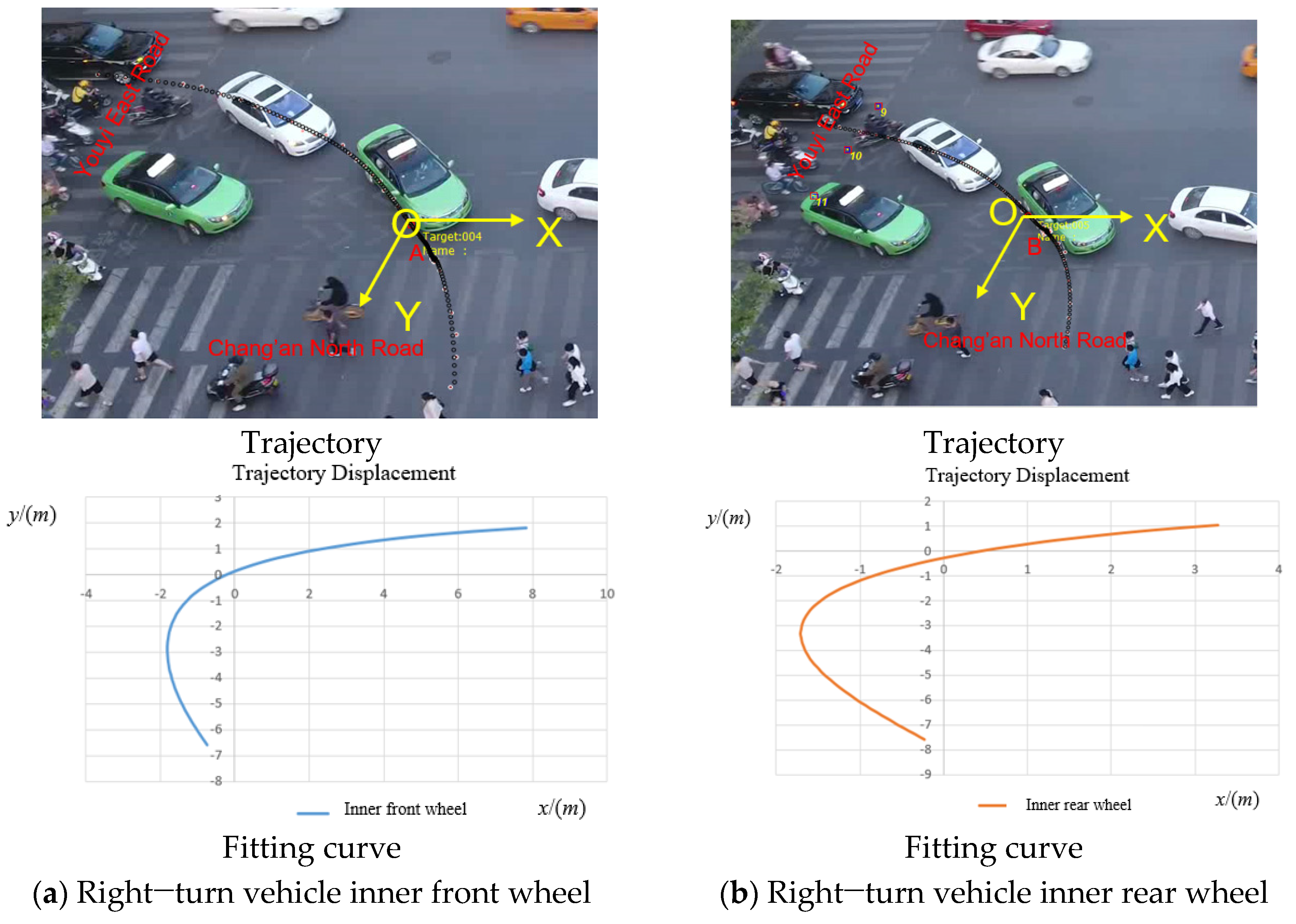
In the video analysis software, to extract the inner wheel’s trajectories, after we uploaded the intersection video into this software, we created a basis point at each wheel’s centroid for the observed vehicle. Firstly, we created a new basis point A and established the coordinate systems in the software as shown in Figure 2a. The centroid point is the O, and the x- and y-axes are parallel to the Youyi East Road and Chang’an North Road, respectively. From the software, we take the four wheels of the vehicle as the basis point could directly achieve the trajectory, speed and acceleration data of each wheel [28,29,30].
Then, we exported the basis-point coordinate data directly from the software to plot the trajectory data point for the inner front wheel. Considering the smoothness and continuity of the vehicle’s physical trajectory, we removed these points with drastic drift to smooth the plotted trajectory curves. After smoothing the spatiotemporal points, the trajectory of the inner front wheel and the coordinates of each spatiotemporal point of the inner front wheel are obtained as shown in Figure 2a.
Similarly, we created a new basis point B and plotted the trajectory data point for the inner rear wheel. After smoothing the spatiotemporal points, the trajectory of the inner rear wheel and the spatiotemporal point coordinates of the inner rear wheel are shown in Figure 2b.
The trajectory curve of the inner rear wheel is similar to that of the inner front wheel. But it can also be observed that there are specific differences in the trajectory variations for the front and rear wheels’ trajectory curves. This results in different conflict risks at the inner front and rear wheels segment with pedestrians during a vehicle’s right turn.

3.2.2. Outer Wheel Trajectory Extraction

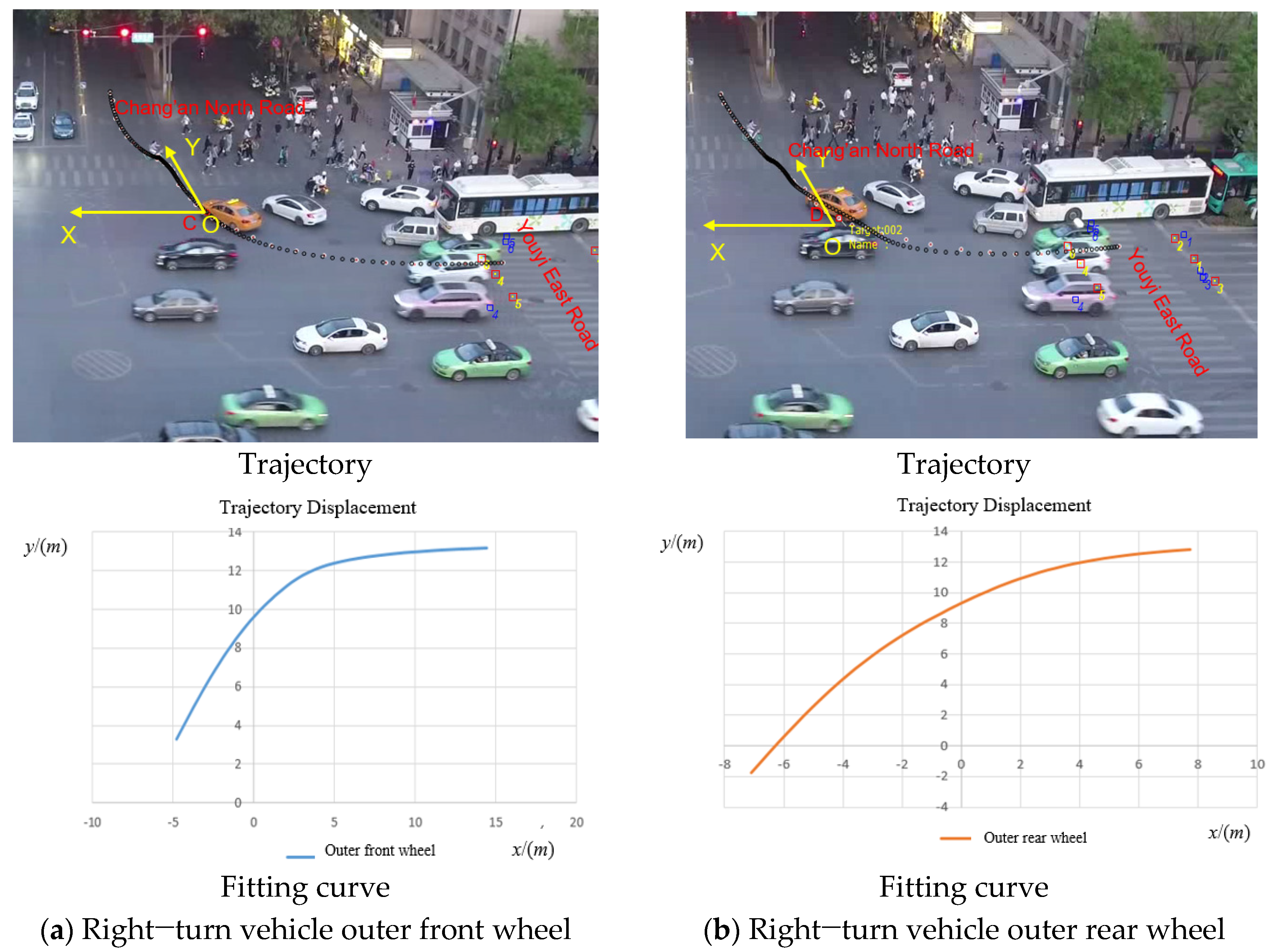
The R-T vehicle at Chang’an North Road turning onto Youyi East Road is selected to draw the trajectory of the outer wheels. Since the observed vehicle needs to switch coordinate systems and to facilitate distance parameter calibration, the intersection of the entry lane stop line and the third lane from the inner side of the R-T lane is chosen as the origin. The x-axis is parallel to the entry lane and in the same direction, while the y-axis is parallel to the exit lane and in the same direction. A new point C is established to plot the spatiotemporal points of the outer front wheel. After smoothing, the trajectory of the outer front wheel is shown in Figure 3a. Using the coordinate data, the trajectory of the outer rear wheel is plotted in Figure 3b.
The trajectory of the outer front wheel is generally similar to that of the inner front wheel, but the turning radius of the circular curve is relatively larger than that of the inner front wheel. The trajectory curve is overall smooth, and the trajectory fitting is relatively consistent with the actual situation. Based on the coordinate system of the outer front wheel trajectory, a new point D is established to plot the spatiotemporal points of the outer rear wheel. After smoothing, the trajectory and the spatiotemporal point coordinates of the outer front and rear wheels are established, as shown in Figure 3a and Figure 3b, respectively.
The trajectory of the outer rear wheel is generally similar to that of the inner rear wheel, but the turning radius of the circular curve is relatively larger than that of the inner front wheel. The trajectory curve is overall smooth, and the trajectory fitting is relatively consistent with the actual situation.

3.3. FRWT Risk Differences Analysis

3.3.1. Inner Wheel Trajectory Traffic Characteristics

Based on the research results of the previous sections, we obtained the inner and outer wheel trajectories. To determine the front and rear wheel risk differences, we mainly focused on the traffic characteristics of the R-T vehicle, including the changes in displacement, speed, and acceleration. After obtaining the trajectory data from the software, the displacement coordinates, speed, and acceleration data are exported, and the related curves are plotted.
Displacement Coordinate Changes
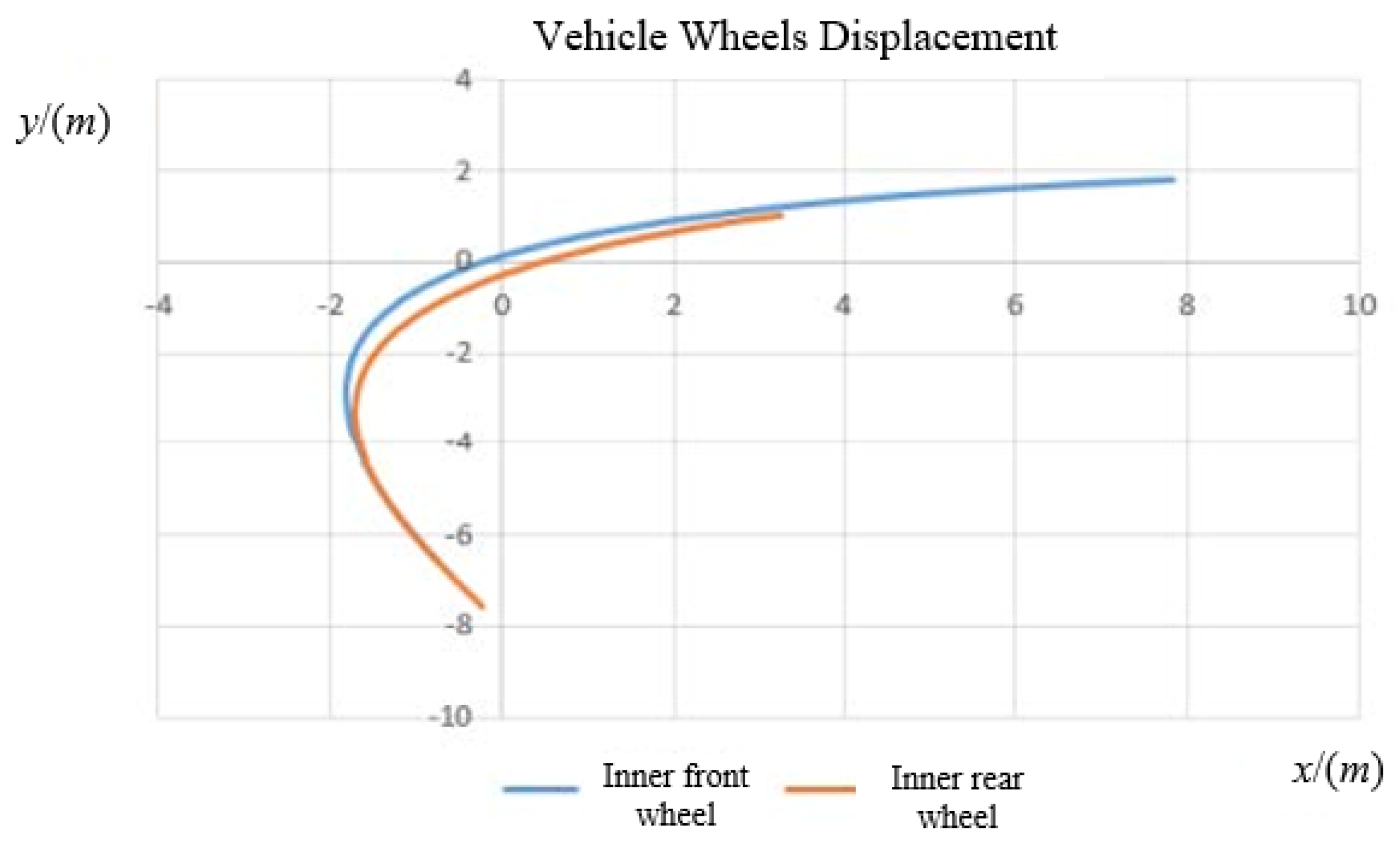
The displacement changes primarily reflect the differences in FAWT, indicating the potential for conflict between the vehicle’s different physical parts and pedestrians. When analyzing displacement changes, the inner front and rear wheel trajectory coordinates are plotted on the same diagram for comparison, as shown in Figure 4. We plotted the vehicle’s front and rear wheel trajectories; the same displacement points corresponded to the same time moments. The diagram shows the positions of the front and rear wheels at the same time moments. It is clear that the front wheel’s trajectory is ahead of the rear wheel’s trajectory, and there are specific differences.
Speed Changes
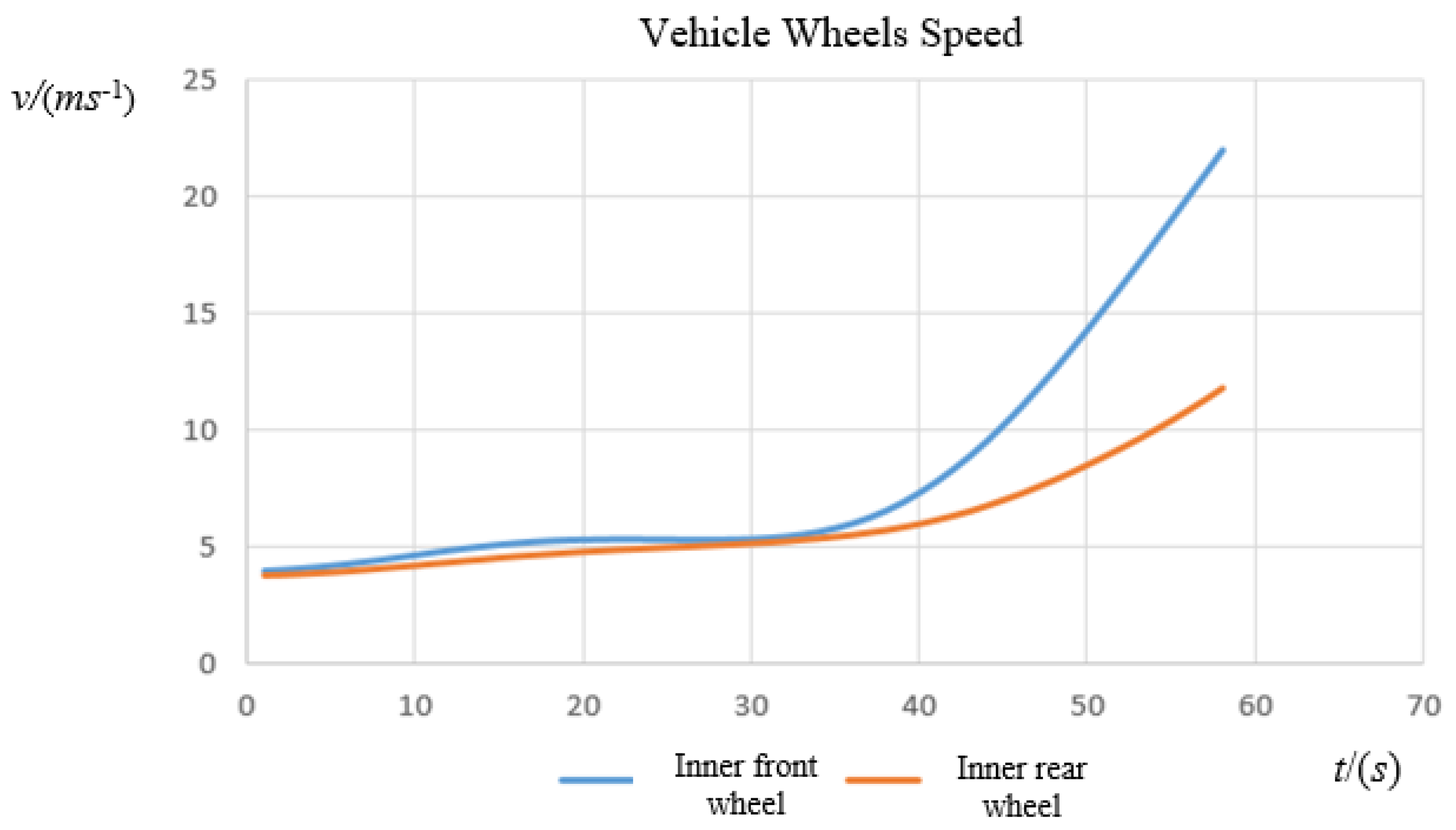
The speed changes mainly reflect the potential impact force of the front and rear wheels during a traffic accident. Since the trajectory data of the front and rear wheels come from the same R-T vehicle during the same R-T behavior, the global time points of the two wheels during the turn are relatively close. These points are treated as effective control variables. Based on this, data is filtered to remove spatiotemporal points with drastically fluctuating speed values and only speed data corresponding to time points that are close together is selected. The total number of speed data points for the front and rear wheels is kept equal. Finally, a speed change diagram is plotted with global time as the horizontal axis and speed as the vertical axis, as shown in Figure 5.
Acceleration Changes
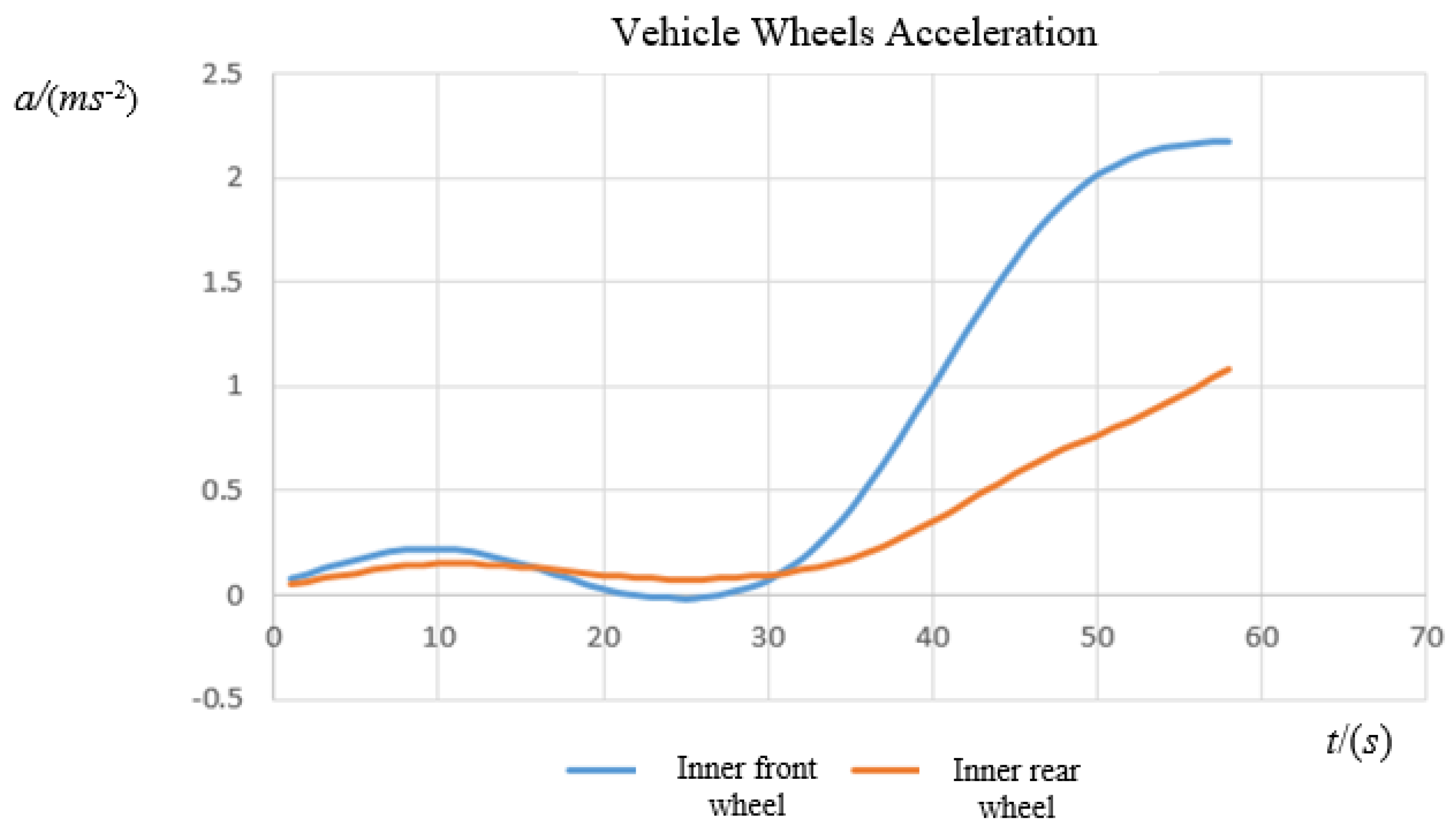
Acceleration mainly reflects the trend of speed changes. For the inner front and rear wheels’ acceleration changes, based on the acceleration spatiotemporal data exported from the software, their change curves are plotted in Figure 6.
Based on the study of displacement, speed, and acceleration of the front and rear wheels, it is clear that the risk levels of the inner front and rear wheels is different. The differences mainly include three aspects: conflict probability, conflict severity, and difficulty in avoiding the conflict. The front wheel reaches a higher speed at the same time, and the rate of speed change is also larger, resulting in higher conflict probability and severity. When pedestrians cross near the inner side of the vehicle, the rear wheel is in the blind spot, making it difficult to detect and avoid. Therefore, it is concluded that the inner front wheel has a higher risk of conflict.

3.3.2. Outer Wheel Trajectory Traffic Characteristics

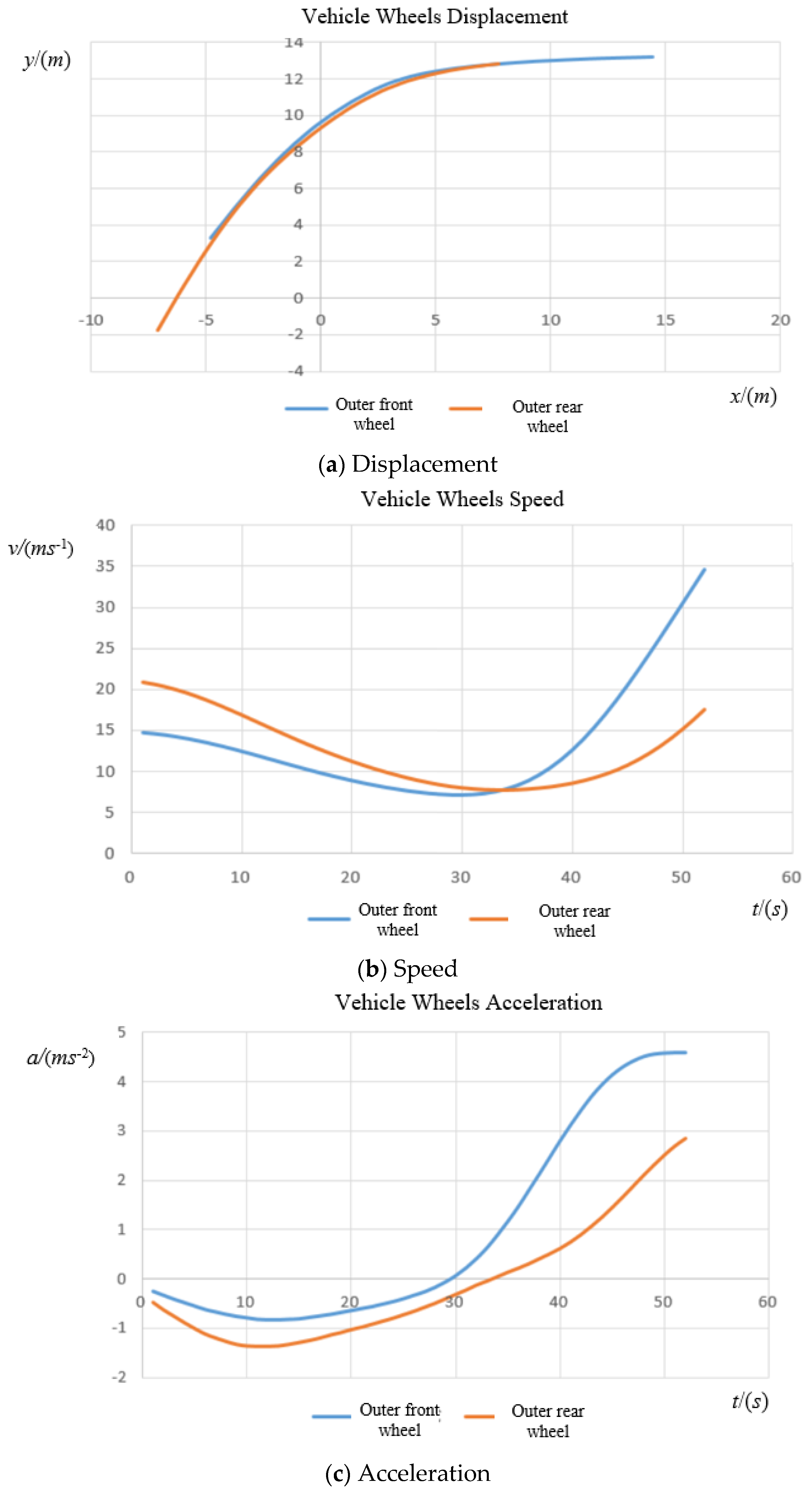
Similarly, for the outer front and rear wheels, the R-T vehicle trajectory was plotted using the software. Then, the coordinates, speed, and acceleration data were exported, and the curves were plotted in Excel. The displacement, speed, and acceleration data were obtained, as shown in Figure 7.
When comparing the outer wheel trajectories, it was found that the difference between the front and rear wheels of the R-T vehicle was not very large. The speed initially decreases and then increases for both wheels, but the speed increase for the front wheel is faster, and the speed value is approximately twice that of the rear wheel. The acceleration of the front wheel changes from negative to positive, and the increase in its acceleration is more pronounced. Therefore, it is concluded that the collision hazard for the front wheel is greater, and its risk level is higher.

3.3.3. Risk Differences Between Front and Rear Wheel Trajectories

In summary, based on the vehicle’s physical structure, the impact of the inner wheel differences, the risk comparison between the inner front and rear wheel trajectories, and the comparison of the outer front and rear wheel risks, the following conclusions can be drawn:
From the perspective of vehicle physical structure, the presence of the differential causes the outer wheels to have a higher forward speed, which results in the outer wheels having a higher collision risk during a vehicle’s right turn.
From the perspective of trajectory differences, due to the front and rear displacement difference in inner wheels in Figure 4 being bigger than the front and rear displacement difference in outer wheels in Figure 7a, and the blind spot around inner wheels which result in pedestrians being easily overlooked in this blind spot, the inner wheels have a higher conflict risk than outer wheels during vehicle turning right.
Comparing the speed data of the inner front and rear wheel trajectories, it is found that the front wheel has a higher collision risk than the rear wheel.
Similarly, for the outer wheels, the front wheel also has a higher collision risk than the rear wheel.
Based on the analysis result ① and ②, it can be concluded that the inner wheel has a higher conflict risk than the outer wheel. And based on the analysis result ③ and ④, it can be concluded that the front wheel has a higher conflict risk than the rear wheel. The order of conflict risk from high to low is inner front wheel > inner rear wheel > outer front wheel > outer rear wheel.
Therefore, in this research, we focus on the trajectories of the inner front and rear wheels as the vehicle turns right. The mathematical model in the following research also mainly focused on the trajectories of the inner front and rear wheels of an R-T vehicle.

4. Methodology

4.1. Mathematical Model for Right-Turn Vehicle FRWT

4.1.1. FRWT Modeling

To verify the consistency of the trajectories extracted by George with actual trajectories, in this section we take the trajectories of the inner front and rear wheels of a right-turning vehicle as an example, developed a geometric mathematical model of the trajectories of right-turning vehicles. The mathematical modeling allows for the prediction of the inner front and rear wheel trajectories of R-T vehicles at intersection. This provides a foundation for conflict risk assessment based on the FRWT method for R-T vehicles.
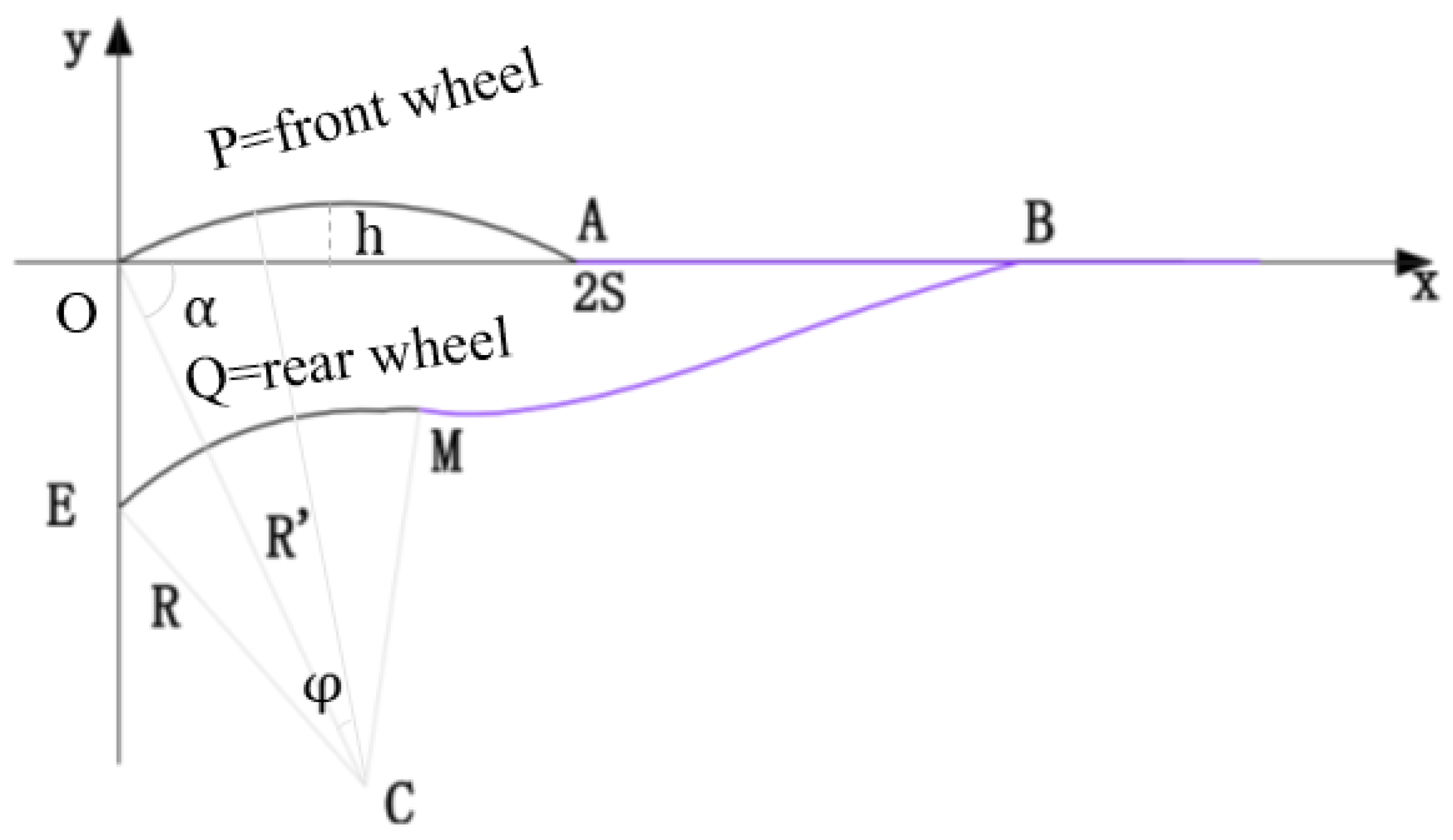
Taking the stop line and the centerline of the R-T entrance lane as the origin point O, we establish a coordinate system with the y-axis parallel to the vehicle’s moving direction, and the x-axis parallel to the centerline of the exit lane. Assuming that the vehicle’s steering angle remains unchanged, both the inner front wheel and the inner rear wheel follow in circular motion along concentric circles. During the vehicle’s motion, the front and rear wheels have the same angular velocity, but they are located at different displacements. After completing the circular arc, the rear wheel (Q) reaches a point where the circular curve ended, while the front wheel (P) enters a straight-line path. At this point, both front and rear wheels are aligned in the same horizontal position, and then both wheels move along a straight line. The mathematical function that simulates this trajectory is shown in Figure 8.
The coordinates of the center of the circle C is C x c , y c , where x c = R c o s α , y c = R s i n α . In the initial stage, the inner rear wheel trajectory coordinates are E 0 , L . The initial point coordinates of the front wheel trajectory are A 2 S , 0 , and the rear wheel turning radius R = C E . Since R 2 = ( R c o s α ) 2 + ( L + R s i n α ) 2 = R 2 + L 2 2 L s i n α , we can derive the following:
R = R 2 + L 2 2 L R s i n α
L represents the wheelbase of the front and rear wheels, α represents the turning angle, that is, the angle at which the steering wheel deviates from the straight front. the front. It is assumed that in the process of vehicle moving in the arc stage, the angle α of the steering wheel remains unchanged, that is, the steering wheel is stable at this degree of curvature. h represents the height of the intended distance from the horizontal line, and 2S is the horizontal distance when the car moves in the arc. Let the center of the circle be C, the radius of the front wheel trajectory at the arc be R′, and the radius of the rear wheel trajectory at the arc be R, then R> R. The function diagram is shown in Figure 8 (For the calculation of α , h and S, when we know two quantities of them, the other one can be determined as follows: h + R s i n α = R , that is, s i n α = 1 h R . According to the Pythagorean theorem S 2 + R h 2 = R 2 , we obtain R = S 2 + h 2 2 h . Substituting into the above formula, we obtain s i n α = 1 2 h 2 S 2 + h 2 ).
(1) Both front and rear wheel trajectories are circular curves.
The coordinates of the front wheel trajectory point are P x P , y P , and the moving angle is the angle φ between CP and CO. The vector is represented by a complex number:
C P = C O e i φ = R c o s α + i R s i n α c o s φ i s i n φ = R cos φ + α + i R s i n φ + α
Since OP = OC + CP, during the motion process, point P, the following should be satisfied:
x P = R c o s α R c o s φ + α y P = R s i n α + R s i n φ + α   0 φ π 2 α
The rear wheel trajectory Q = x Q , y Q , the moving angle is φ, and using a complex number to present the vector, we have the following:
C Q = C E e i φ = R c o s α + i ( L + R s i n α ) c o s φ i s i n φ   = R cos φ + α L s i n φ + i [ R s i n φ + α L c o s φ ]
Since OQ = OC + CQ, during the motion process, point Q, the following should be satisfied:
x P = R c o s α R c o s φ + α L s i n φ y P = R s i n α + R s i n φ + α L s i n φ   0 φ π 2 α
The mathematical equations of the front and rear wheel trajectories are derived from this, and the same parameters represent the position at the same time.
The front wheel reaches point A, and the rear wheel reaches point M x M , x M , where x M = 2 R c o s α L s i n 2 α = 2 S L s i n 2 α , y M = L c o s 2 α . Analyze the impact of α on safety risk. If α > 45 ° , y M < 0 , and the rear wheel is below the x-axis, which is dangerous; if α < 45°, y M < 0 , and the rear wheel is above the x-axis; if α = 45°, the front and rear wheels are both on the x-axis.
(2) The trajectory of the front wheel is a straight line, and the rear wheel is cubic.
According to the displacement fitting curve obtained after trajectory extraction, once the front wheel trajectory becomes a straight line, the rear wheel trajectory must advance 2.2 vehicle lengths from the circular curve to the straight line. When the front and rear wheel trajectories are both straight lines, the front wheel is located at F 2 S + 3 L , 0 and the rear wheel is located at B x B , 0 . Use a cubic function curve to fit the rear wheel trajectory. The cubic function must satisfy the following:
y = g x , g x M = y M , g x M = κ M , g x B = 0 , g x B = 0
where κ M = R c o s α L s i n 2 α R s i n α + l c o s 2 α , M represents the slope of the tangent line at the point, x B represents the double zero of gx, hence,
g x = x x B 2 c 0 + c 1 x x M
where c 0 = y M x x M 2 , c 1 = κ M 2 x M x B c 0 x M x B 2 .
(3) Both front and rear wheel trajectories are straight lines.
In summary, the front and rear wheel trajectories of an R-T vehicle can be divided into two stages when represented by a function curve. In the first stage, the trajectories of the front and rear wheels are represented by Equations (3) and (5), respectively. In the second stage, the front wheel trajectory is a straight line, and the rear wheel trajectory is represented by Equation (7).
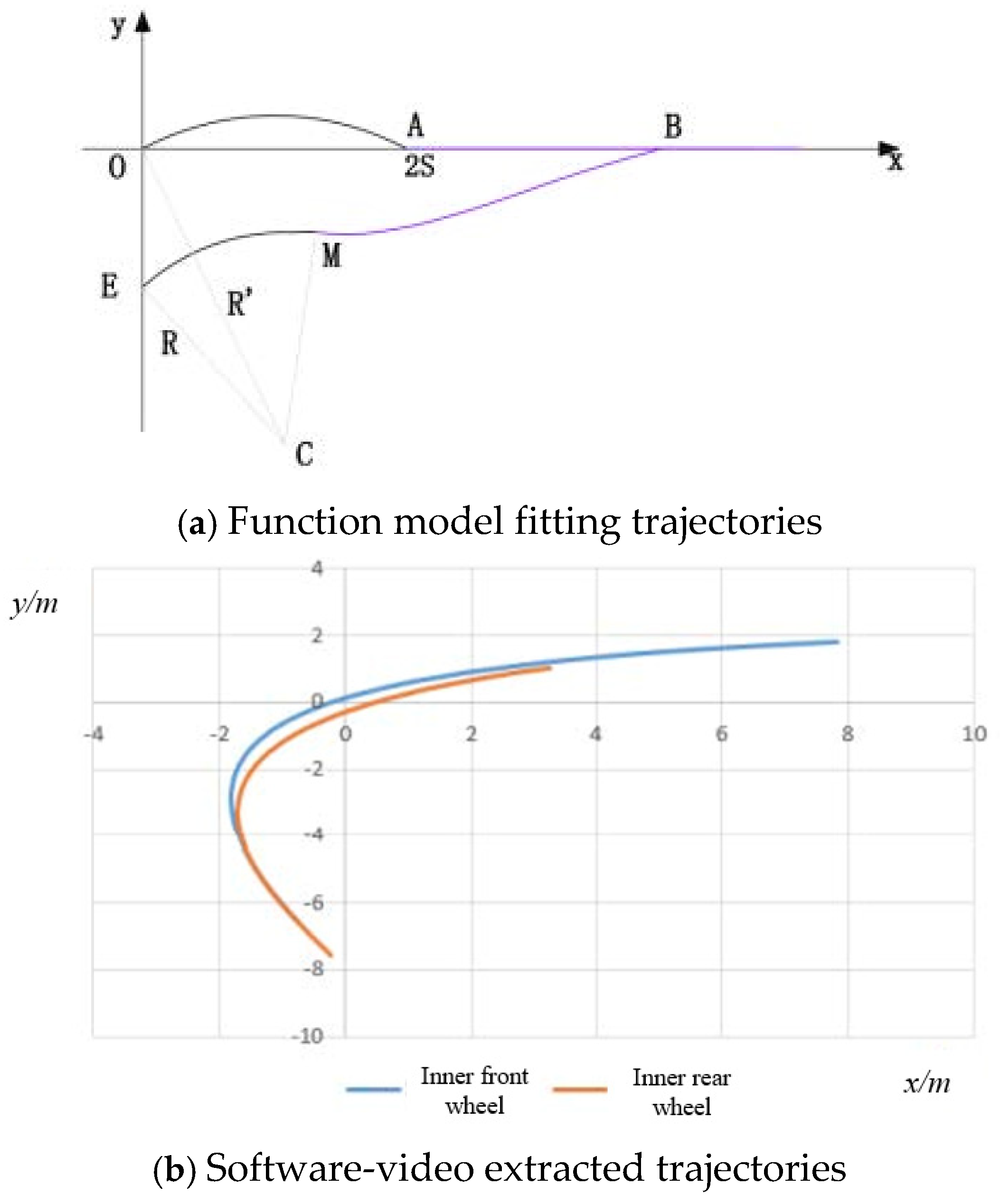
When drawing the fitting trajectory curves, we take the wheel center as the centroid point. In the mathematical model, the wheel’s microscopic motion is taken into consideration, such as the steering angle and alignment process. By comparing the trajectory extracted by the software and the trajectory drawn by the mathematical function model, we found that although there are slight differences in shape, curvature, and length, the driving characteristics during vehicle right turns are the same.
Along with the discussion on the differences in speed and acceleration of the inner front and rear wheels, the inner front wheel has a higher speed and undergoes larger speed changes, aligning earlier during turning. This conflicts with pedestrians at right angles and earlier. Since the difference in inner wheel speed is small in small cars, the inner rear wheel poses a lighter threat to pedestrians. Therefore, the inner front wheel can be chosen as the centroid point of the right-turn R-T vehicle to study the conflict between pedestrians and right-turn R-T vehicles.

4.1.2. Accuracy Verification of Trajectory Model

To further analyze the accuracy of the trajectories extracted from video data, a mathematical function model is introduced to fit the trajectory, and a comparison is made with the video-extracted trajectory from the software, as shown in Figure 9b. Based on the mathematical function trajectory of the front and rear wheels drawn in the previous section, the accuracy of the inner wheel trajectories is verified.
Analysis of the images shows that the wheel trajectory extracted from the software follows a pattern of straight line–circular curve–straight line. When the front wheel straightens out and moves in a straight line, the rear wheel is still in circular motion. Overall, the front wheel trajectory shows greater variation than the rear wheel trajectory. In contrast, the function model’s curve shows a change from the circular curve, straightening the curve to a straight line. During the circular curve phase, the front and rear wheels have the same angular velocity but are located at different positions. During the straightening phase, when the rear wheel reaches the point where the motion curve changes, the front wheel moves straight, and eventually, both front and rear wheels move in a straight line. Therefore it is considered that the trajectories extracted from the video are consistent with the changes in the function model trajectory.

4.2. Pedestrian–Right-Turn Vehicle Conflict Risk Assessment

4.2.1. Traffic Behavior Observation and Conflict Severity Classification

Conflict-Avoiding Behavior Observation
When an R-T vehicle and a pedestrian are involved in a traffic conflict, avoidance measures must be considered to prevent accidents and ensure traffic safety. Usually, the avoidance measures are classified into four categories based on the characteristics of the measures, the target of the measures, and the time of implementation when the pedestrian and the R-T vehicle approach the conflict zone.
The pedestrian slows down or stops, or the vehicle accelerates, allowing the vehicle to pass first.
The pedestrian accelerates before the vehicle reaches the conflict zone, or the vehicle brakes, stops, or changes its path, allowing the pedestrian to pass first.
Both the pedestrian and the vehicle slow down or stop, and after negotiation, one is allowed to pass first.
Neither the pedestrian nor the vehicle takes any action.
Taking the pedestrian–R-T vehicle conflict at the intersection of Chang’an North Road and Youyi East Road at Nanshaomen cross as an example, and following the methods proposed by Vanderhaast et al. [31], the traffic conflict behaviors were analyzed using video observation. In this study, six experts with transportation knowledge were recruited, including master’s students and professors, to observe aerial footage of pedestrian–R-T vehicle conflicts and categorize each conflict. The observers first identified the type of avoidance action taken by the pedestrian or R-T vehicle in the conflict zone, then underwent training in video observation and conflict recording. When there was a disagreement in the observed category, the final category was determined through discussion. The video observation results showed that within a 20 min UAV video, 130 conflicts occurred at this intersection. These conflicts were classified according to the avoidance measures taken, and the frequency of each category was recorded, as summarized in Table 1.
The evasive measures taken by both parties reflect the severity of the conflict. Conflicts where significant evasive actions are taken are often accompanied by rapid changes in speed and displacement, indicating a higher risk of collision if no measures are taken. The classification of evasive actions during the conflict provides a practical basis for future studies on conflict risk levels.
Conflict Severity Classification
By observing the classification of evasive actions and analyzing the conflict distance in both time and space, conflicts can be categorized as follows: When the time or spatial distance between the two parties approaching the conflict zone is large, or the time difference approaching the potential collision point is large. Neither party takes steps to avoid conflict, so the risk of conflict is considered low. If the time or spatial distance between the two parties approaching the potential conflict point is short, it is regarded as an urgent situation with a higher risk. If the two parties do not take timely evasive actions, there is a risk of collision, which is considered the highest risk. Based on the observed evasive actions, three risk levels are defined: Risk Level I, Risk Level II, and Risk Level III. These correspond to increasing levels of severity, with Risk Level I indicating a low conflict risk for both road users, Risk Level II indicating moderate conflict risk, and Risk Level III indicating the highest conflict risk.
Based on the observation result of pedestrian–R-T vehicle conflict events classified from the six observers, the rating result of each conflict event was recorded (Risk Level I, II, or III are presented by 0, 1, and 2). The average score and variance of the conflict severity ratings from the six observers are used to represent the consistency level of the estimations of conflict severity. The specific calculation method for the consistency level of the conflict severity ratings provided in Table 2 is as follows:
S k ¯ = i = 1 i = 6 S i , k 6
S j ¯ = i = 1 , k = 1 i = 6 , k = N j S i , k 6 N J
σ j ¯ = 1 N j i = 1 i = 6 S i , k S k ¯ 6
where i represents the six observers, i = 1–6. The j represents the Risk Level (j = 0, 1, 2), and k represents the number of events to be observed. Nj is the total number of conflict events of Risk Level j, Si,k is the Risk Level estimated result by observer i for event k, S k ¯ is the average score of event k from all six observers, S j ¯ is the average score of Risk Level j from all six observers, and σ j is the average standard deviation of events at Risk Level j.

4.2.2. Conflict Indicators and Interaction Pattern Classification

Given that conflicts of different categories have distinct characteristics, the objective of this section is to seek a method for assessing the severity of pedestrian–R-T vehicle conflict risks based on conflict indicators. In this method, the Post-Encroachment Time (PET) is used to identify spatial conflict features, and the Gap Time (GT) is used to identify the temporal features. The spatiotemporal characteristics of each conflict are analyzed to determine the conflicts classification method.
Conflict Indicators Selection and Calculation
The conflict indicators are compared from two perspectives: temporal proximity and spatial proximity. The conflict indicators considered include TTC, PET, Deceleration-to-Safety Time (DST), and Gap Time (GT). Since PET can independently detect significant events and conflicts in traffic, it provides a more direct way of determining whether a conflict occurs. TTC indicates the proximity of the conflict road users to the potential collision point, and GT represents the time lag between the two parties reaching the potential collision point. Therefore, this study selects PET, TTC, and GT as the conflict indicators for pedestrian–R-T vehicle interactions. The specific calculation methods for these indicators are as follows:
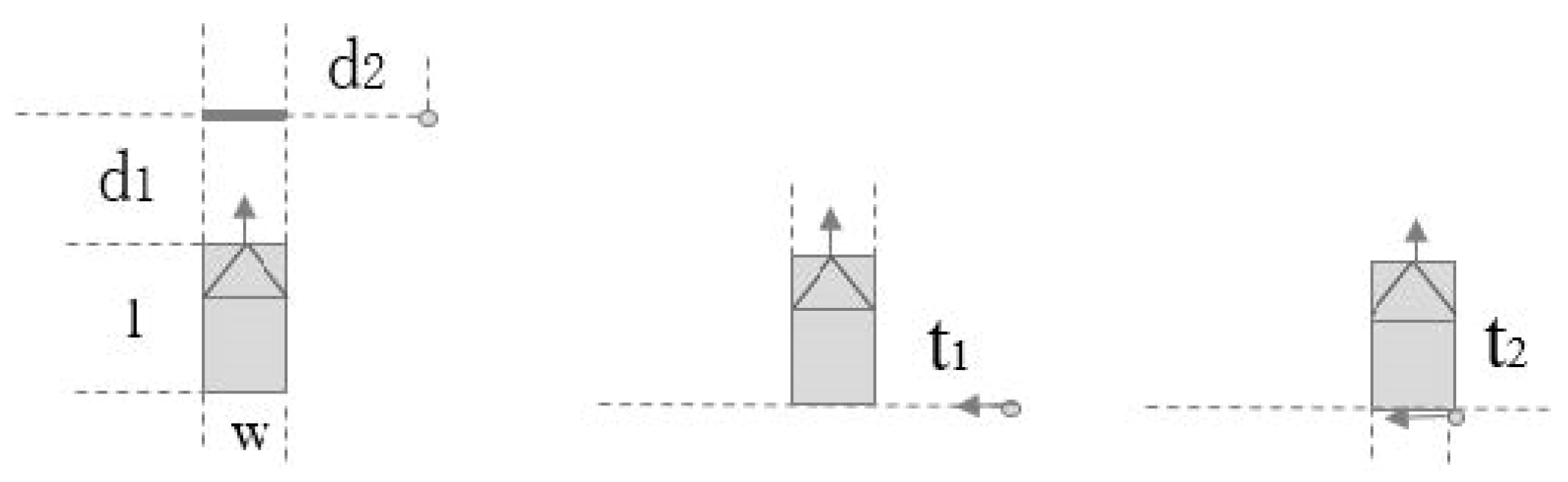
Tc1 and Tp1 represent the times when the pedestrian and vehicle enter the conflict zone, respectively. Tc2 and Tp2 represent the times when the pedestrian and vehicle leave the conflict zone, respectively. Let v(i) represent the speed of the vehicle and pedestrian at time i, dc(i) represent the distance at time i from the vehicle’s front to the pedestrian’s outer profile, and dp(i) represent the distance at time i from the pedestrian to the vehicle’s outer profile. An example of the calculation of these indicators is shown in Figure 10.
① Post-Encroachment Time
If pedestrians cross first, P E T = T c 1 T p 2
If vehicles pass first, P E T = T p 1 T c 2
② Time to Collision
When a conflict occurs between pedestrians and vehicles, the moment one party takes action is defined as the starting moment. Each moment thereafter has a corresponding TTC that changes with the speed of the pedestrians and vehicles.
If pedestrians cross first, T T C i = max d p i + w v p i , d c i v c i ,
if vehicles pass first, T T C i = max d p i v p i , d c i v c i .
③ Gap Time (GT)
It can reflect the time difference between the first and second road users to arrive at the conflict zone and describe the distribution of conflict occurrence over time.
If pedestrians cross first, G T i = d p i + w v p i d c i v c i ,
if vehicles pass first, G T i = d p i v p i d c i + l v c i .
Among them, PET is calculated at the end of the interaction, TTC and GT are calculated every 0.125 s, and the change curves of TTC and GT are drawn to obtain some indicator data, as shown in Table 3.
After calculating the values for each indicator, the analysis shows that a larger PET indicates a greater time difference between the two parties reaching the specified section (potential collision point), suggesting a safer situation. On the other hand, TTC values represent the time to collision for an individual conflict participant as they approach the collision point throughout the conflict process, and smaller TTC values indicate greater danger. GT represents the time difference between the two conflict parties as they approach the collision point, and a shorter time difference indicates greater danger. The following study examines the curve patterns and explores the importance of different conflict indicators for categorizing conflict risk levels across different interaction modes.
Interaction Modes Classification Based on TTC-GT Curves
The smaller TTC means the traffic participants are closer to the potential collision point. At the same time, as GT decreases, the time it takes participants to reach the potential collision point shortens, thereby increasing the danger. Because different pedestrian–vehicle conflict interaction modes exhibit distinct characteristics, the importance of different conflict indicators varies across these modes. Therefore, based on the shape of the TTC and GT curves, this study classifies all conflict events into three interaction modes: Hard Interaction Mode, No Interaction Mode, and Soft Interaction Mode. TTC and GT are selected as indicators because they reflect different aspects of the interaction process: TTC represents the proximity of conflict road users to the potential collision point, and GT represents the time lag for each participant to reach that point.
① Hard Interaction Mode
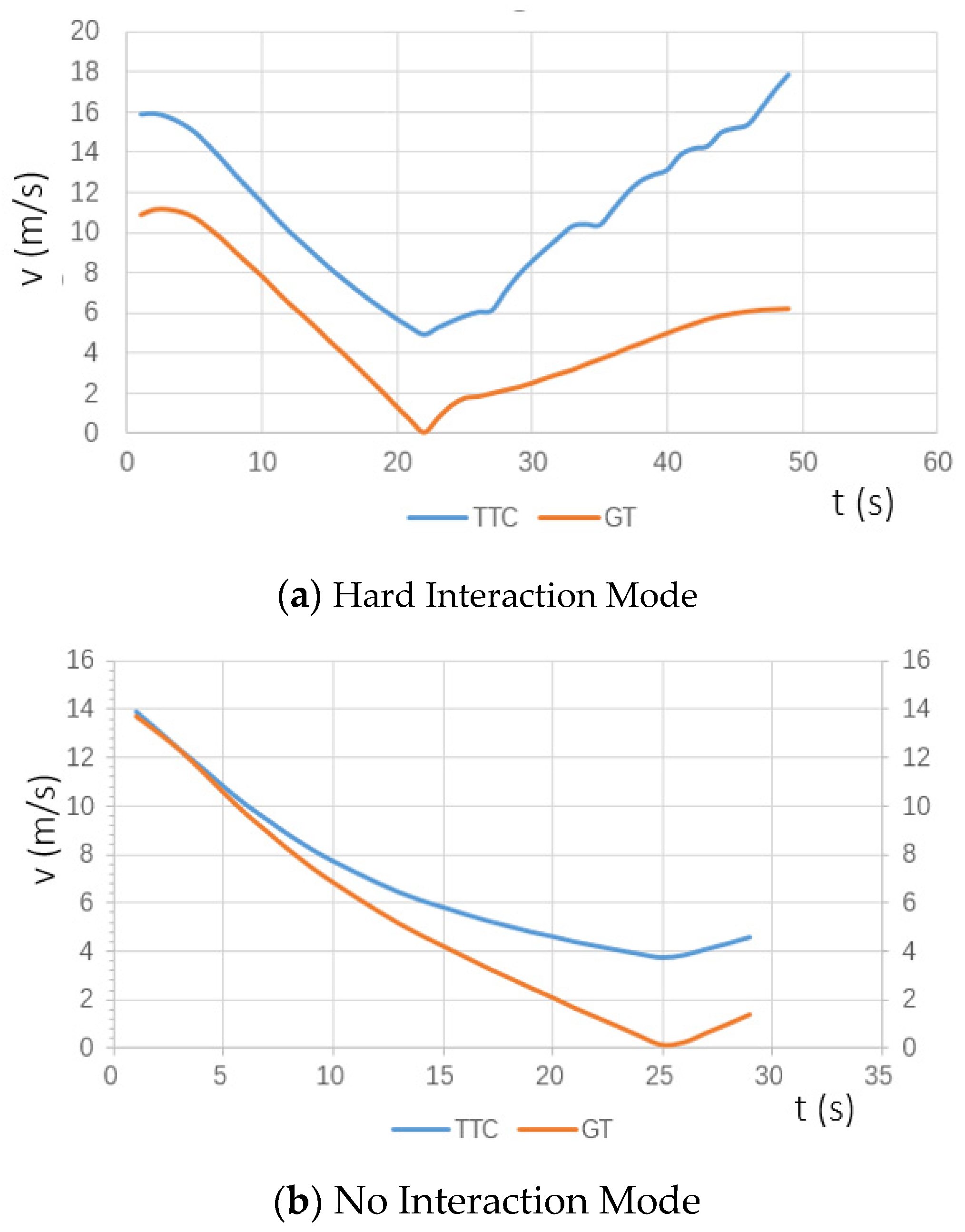
The trends of TTC and GT curves are similar. The speed curve shows that one or both road users take obviously evasive action. The pedestrian slows down noticeably to yield to the vehicle, or accelerates noticeably to pass through the conflict zone before the vehicle arrives. In this case, TTC and GT first decrease and then increase, with the minimum GT occurring after the TTC. The moment when the minimum gap occurs is the most dangerous point in the conflict, as shown in Figure 11a.
② No Interaction Mode
Both parties maintain almost constant speeds with little change. TTC and GT show a downward trend, and the maximum danger occurs at the end of the process, when both GT and TTC reach their minimum values, as shown in Figure 11b.
③ Soft Interaction Mode
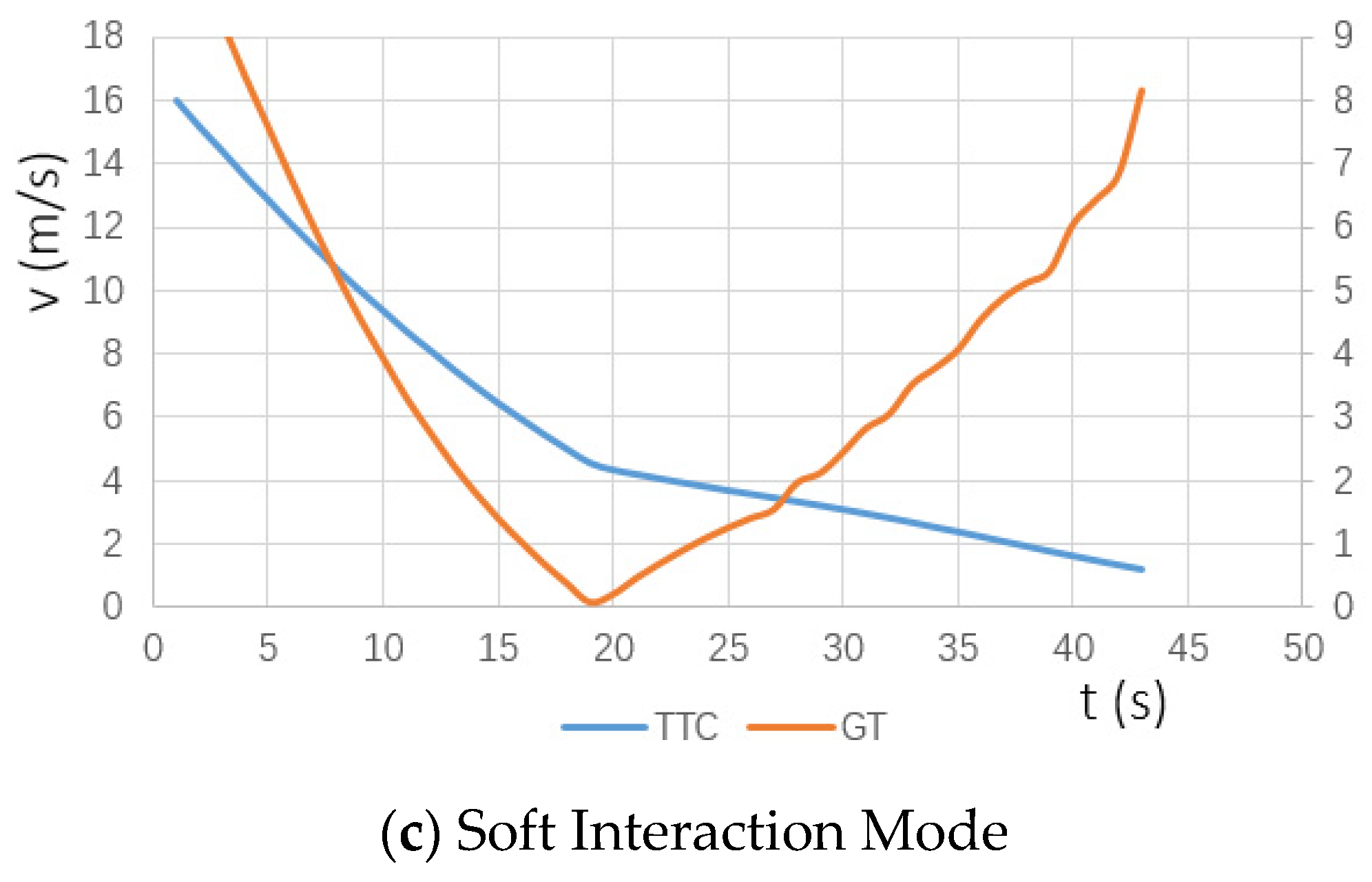
Neither party significantly changes speed, but slight fluctuations can be observed, indicating that the road users adjust their speeds during the interaction. The minimum TTC occurs at the end, but when the first party passes through the conflict zone, the GT shows different trends. When the R-T vehicle passes first, the minimum value of GT occurs at the beginning of the process. If the pedestrian passes first, the minimum value occurs in the middle of the process, as shown in Figure 11c.
The classification of the three interaction modes based on the timing of the minimum values of TTC and GT is as follows: if the two minimum values occur simultaneously during the process or at the end, the event belongs to either Interaction Mode ① (Hard Interaction Mode) or Interaction Mode ② (No Interaction Mode); otherwise, it belongs to Mode ③ (Soft Interaction Mode). The classification method can be expressed using a mathematical model. Assuming the interaction process starts at T0, the two parties will reach the conflict point at T1 and T2, respectively. Let ta and tb be the times when the minimum TTC and GT occur.
  • If tb = ta, the event belongs to Mode ① (Hard Interaction Mode);
  • If tb = ta & ta = T1 & tb = T2, the event belongs to Mode ② (No Interaction Mode);
  • Otherwise, the event belongs to Mode ③ (Soft Interaction Mode).
The interaction modes are distinguished based on the times when the minimum values of TTC and GT occur, as well as the shape of the curves. If the minimum values of the two indicators occur at the same time, it belongs to Hard Interaction or No Interaction Mode. If the minimum values do not occur simultaneously, it belongs to Soft Interaction Mode. If the curves of both indicators show a trend of decreasing and then increasing, it is Hard Interaction; if both continuously decrease, it is No Interaction. Based on the classification of the three interaction modes, the conflict behaviors of pedestrians and R-T vehicles at the Chang’an North Road–Friendship East Road intersection were observed and classified according to the above three modes. The classification results are shown in Table 4.
The results show that the composition of interaction modes for each approach of the intersection varies, which may be due to differences in the surrounding environment and structure of each approach, or due to the characteristics of road users, such as age, gender, and familiarity with the road.

4.2.3. Support Vector Machine Classification Algorithm

The SVM is one of the most powerful and robust prediction methods. Based on the statistical learning framework or VC (Vapnik–Chervonenkis) theory, SVM can effectively perform both linear and nonlinear classifications by mapping input variables to high-dimensional feature spaces. Based on the classification of conflict severity levels from the previous section (Risk Level I, Risk Level II, and Risk Level III), and considering that the sample sizes of conflict data vary across different conflict types, this study employs the SVM algorithm to test the accuracy of classification for the importance and applicability of conflict indicators under different interaction modes, and to determine the most suitable risk assessment conflict indicators for each of the three interaction modes.
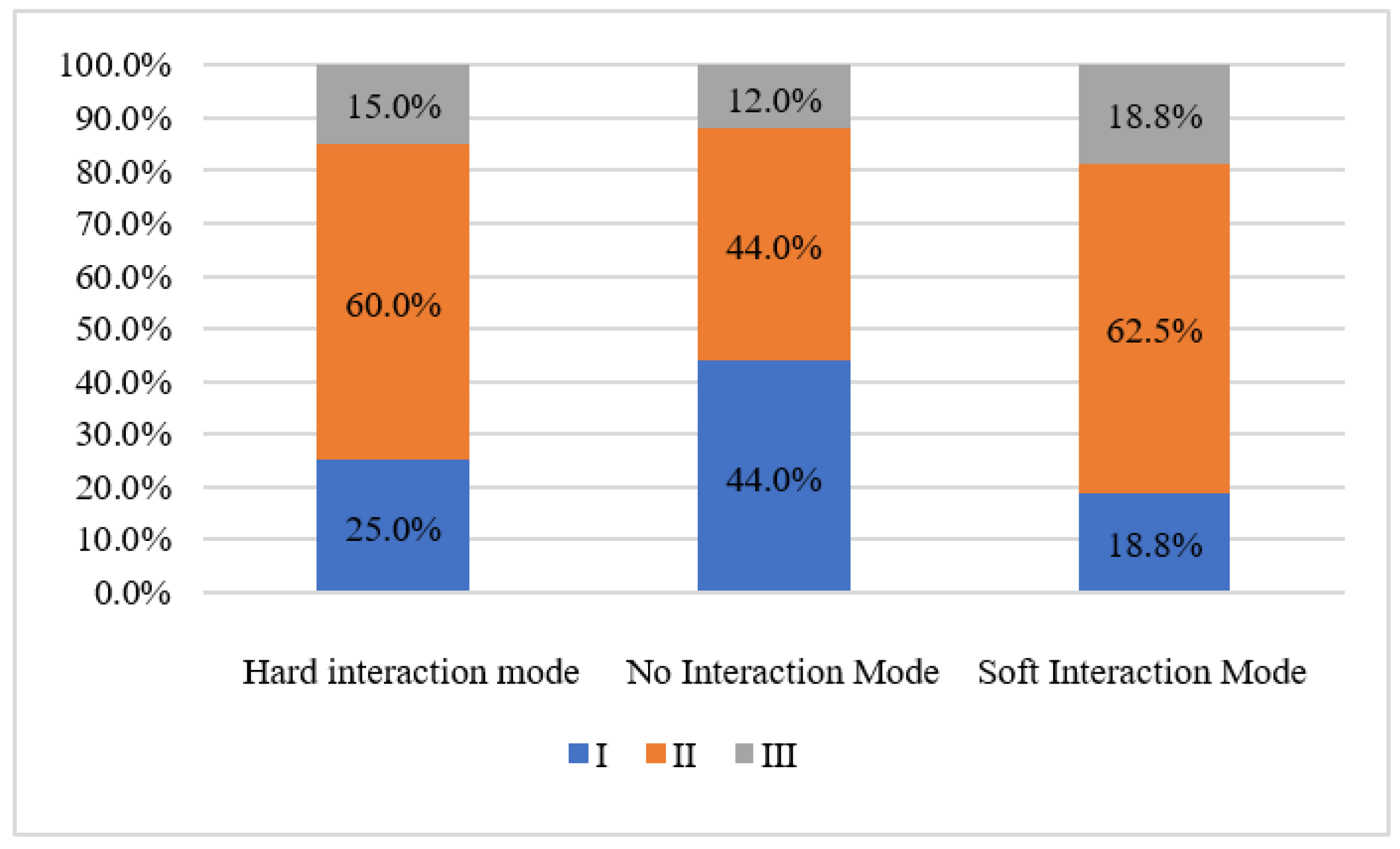
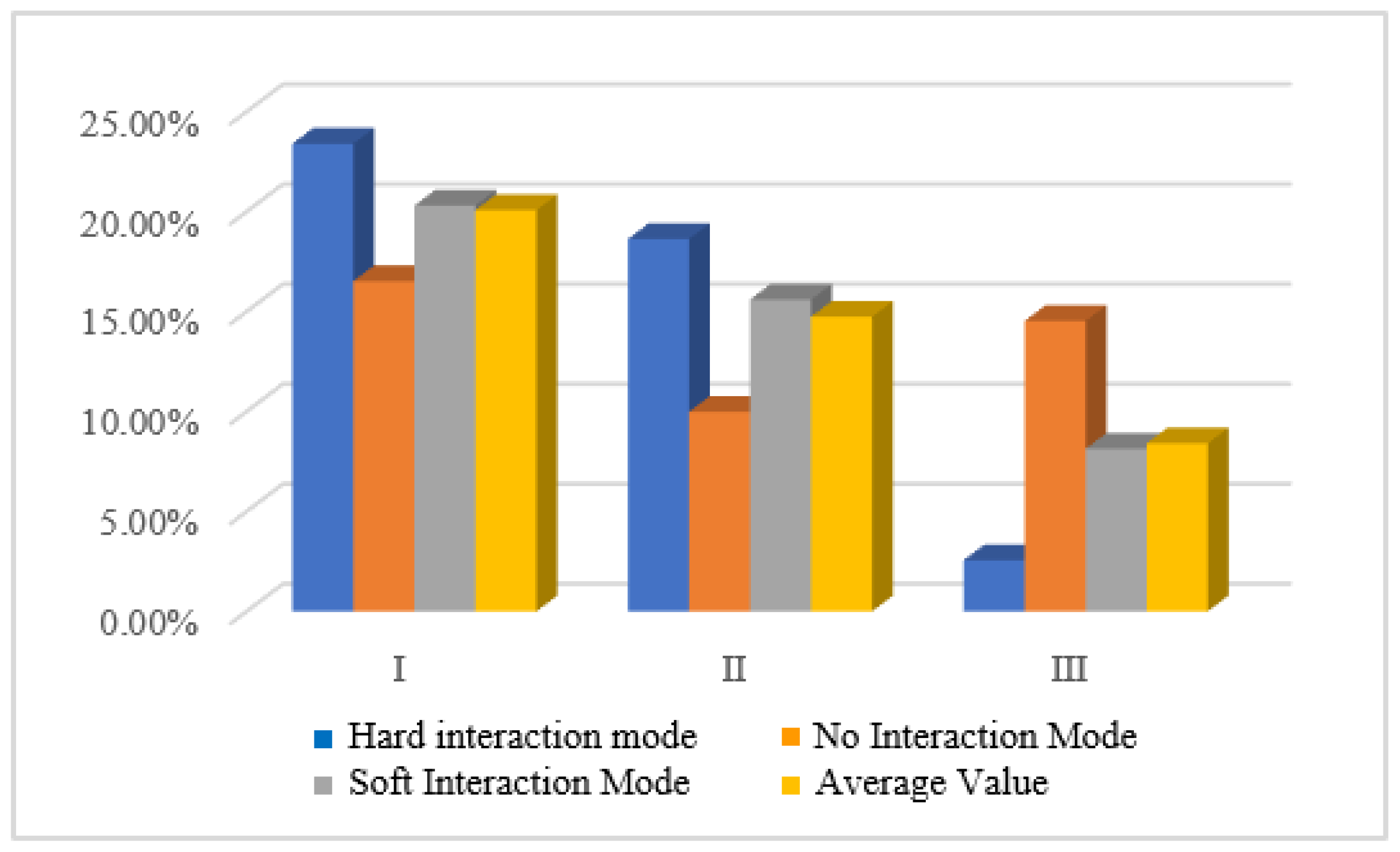
First, the three interaction modes are classified based on the shape of the TTC and GT curves. Then, the differences in conflict risk across various interaction modes are studied. The potential severity of conflicts in the three interaction modes differs. The proportion of events with the three levels of severity in each interaction mode is calculated, as shown in Figure 12. Risk Level I is distributed in the lower-left part of all events, Risk Level II is distributed in the middle part of the events, and Risk Level III is distributed in the upper-right part. Different risk levels exhibit different distribution characteristics, and these characteristics vary across different modes. Therefore, the classification of conflict risks needs to consider the different interaction modes.
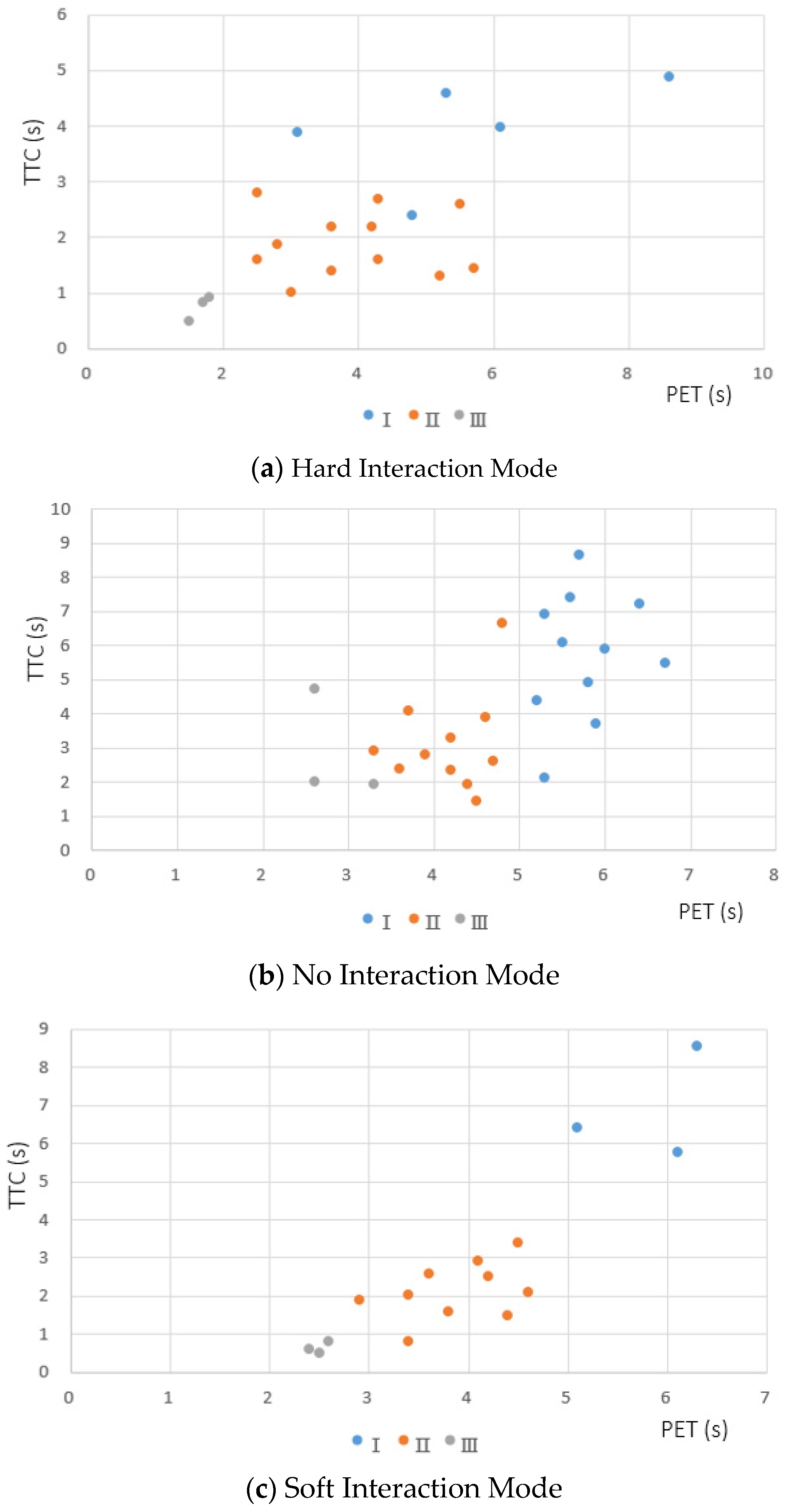
The study focuses on the contribution or importance of TTC and PET in classifying the risk levels in various interaction modes. Using PET as the horizontal axis and TTC as the vertical axis, scatter plots are drawn for all conflict risk events in each of the three interaction modes, showing the distribution of TTC and PET values. In the scatter plots, all events are color-coded based on the severity of the risk determined by behavioral observations, as shown in Figure 13.
Based on the accumulated scatter distribution, the characteristics of the accumulated regions in different interaction modes are analyzed. Since the three levels of conflict severity have unequal sample sizes, and the sample sizes are relatively small, the classification accuracy can be improved. To enhance classification accuracy, this study uses the SVM algorithm for indicator applicability classification. One popular method for assessing the applicability of indicators in classification procedures is k-fold cross-validation. The basic approach of the SVM algorithm is described as follows [22].
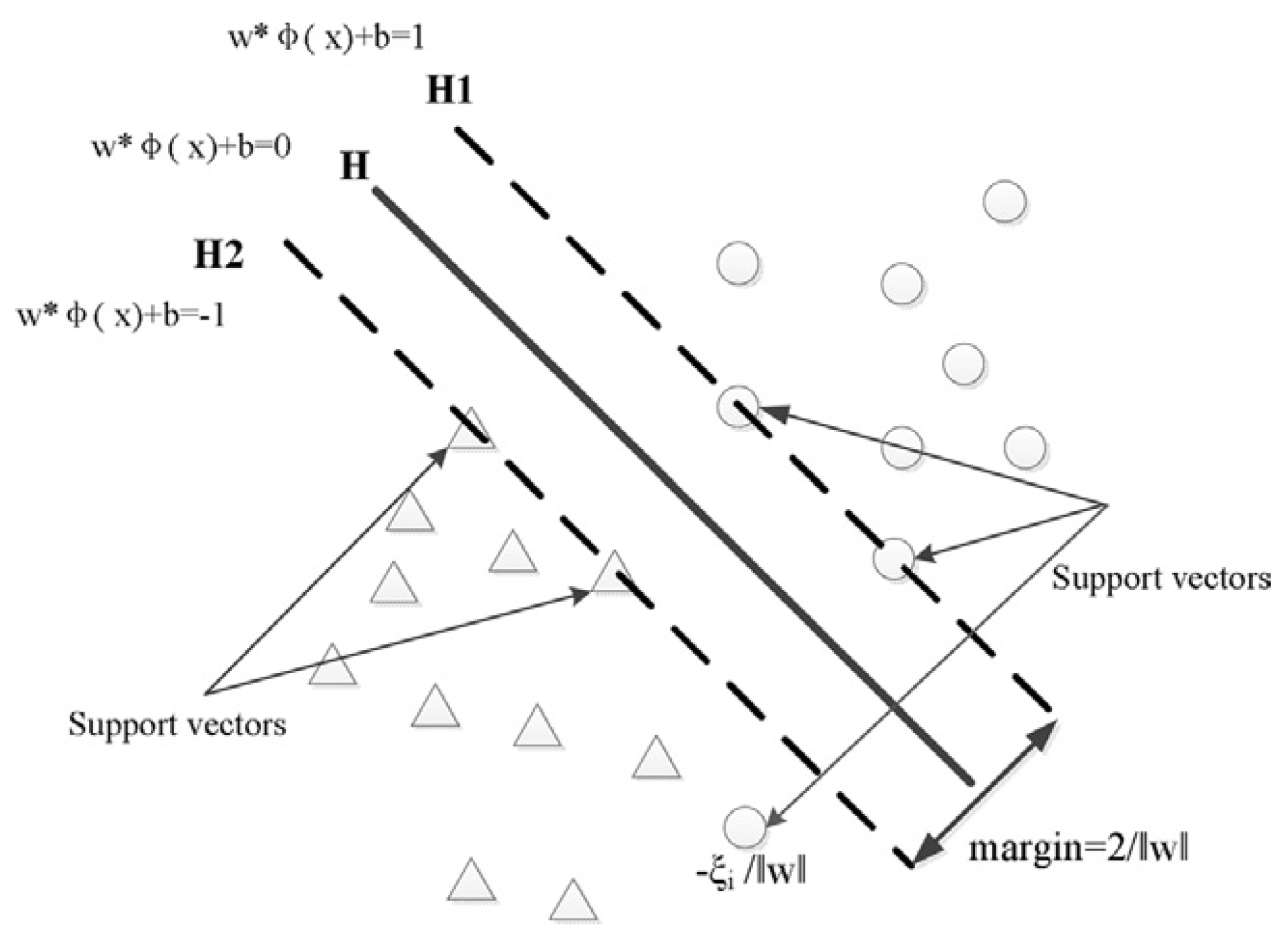
Given a dataset D in the form of x i , y i i = 1 N , where x i R d is the i-th sample and yi ∈ {−1,1} is the corresponding class label, the feature vector x i R d is transformed into a high (possibly infinite) dimensional Euclidean space H using a kernel function, using a nonlinear mapping function : R d H . The decision boundary for the binary classification problem is the optimal separating hyperplane, as shown in Figure 14, such that w ϕ x + b = 0 , which can be obtained by solving the convex optimization problem as follows [32].
1 2 w , b , ξ m i n w 2 + C + y i = 1 ξ i + C y i = 1 ξ i
where y i w ϕ x + b + ξ i 1   and   ξ i 0 , i = 1 , , N .
On wH, bR and non-negative slack variables ξRN, to deal with the imbalance of the sample set, C + and C are used as penalty factors for different categories, that is, yi = 1 and yi = −1, respectively, to improve the accuracy of the sample set. Assuming that αi corresponds to the Lagrange multiplier equation, the dual of the above equation can be expressed as follows:
1 2 α m i n i , j = 1 N y i y j α i α j k x i x j i = 1 N α i
where i = 1 N y i α i = 0 , i = 1 , , N , if y i = 1 ;   0 α i C ,   i f   y i = 1 , has 0 α i C . The kernel function could be written as follows:
k x i , x j = ϕ x i ϕ x j
w = i = 1 N y i α i ϕ x i
From the above formula, we can obtain the expression of the hyperplane, let w ϕ x + b = 0 ; we obtain the following:
f x = i = 1 N y i α i k x i x j + b
The above service equation is used as the decision function for all unseen samples x. If f(x) > 0, the predicted category is +1, otherwise −1. For ease of demonstration, a Gaussian kernel function (RBF) is used. The Gaussian kernel uses γ as the kernel range, and its value represents the similarity between the two vectors:
k x i , x j = exp γ | x i x j | 2
y = v o t e f r x r m a x
Among them, the k(k − 1)/2 binary classifiers f 1 , f 2 , , f k ( k 1 ) / 2 of the combination of r = 1 , 2 , , k ( k 1 ) / 2 predict the category (y) of the (test) sample x corresponding to the most votes of the k ( k 1 ) / 2 classifiers. Given the multi-class classifier problem to be solved in the study, a one-to-one approach is used to build a k-class classifier. This method involves building k ( k 1 ) / 2 SVM classifiers, each of which is trained with data from two classes. So there are a total of k ( k 1 ) / 2 quadratic programming problems, and vote(k) is set to 1 when the kth label appears. The above process can be implemented through MATLAB R2021aprogramming for classification.

5. Results and Discussions

5.1. Analysis of Conflict Indicators Suitability for Three Interaction Modes

Post-Encroachment Time can be independently used to detect whether a conflict occurs, while TTC can be used to detect the degree of approach of road users to the potential collision point. Therefore, using PET and TTC as conflict indicators, the SVM algorithm is employed to determine the most suitable conflict indicators for risk assessment in traffic events across the three interaction modes.
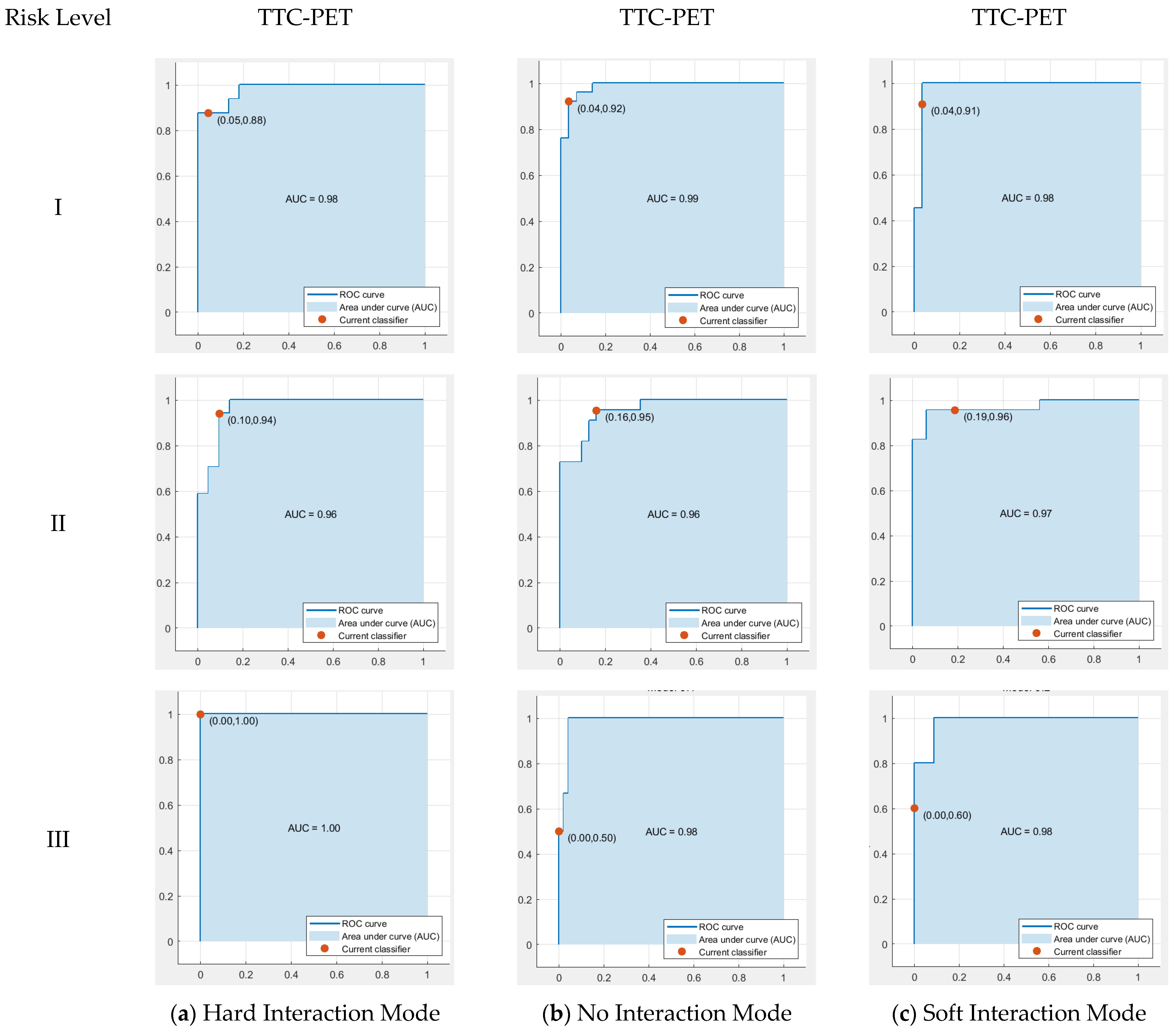
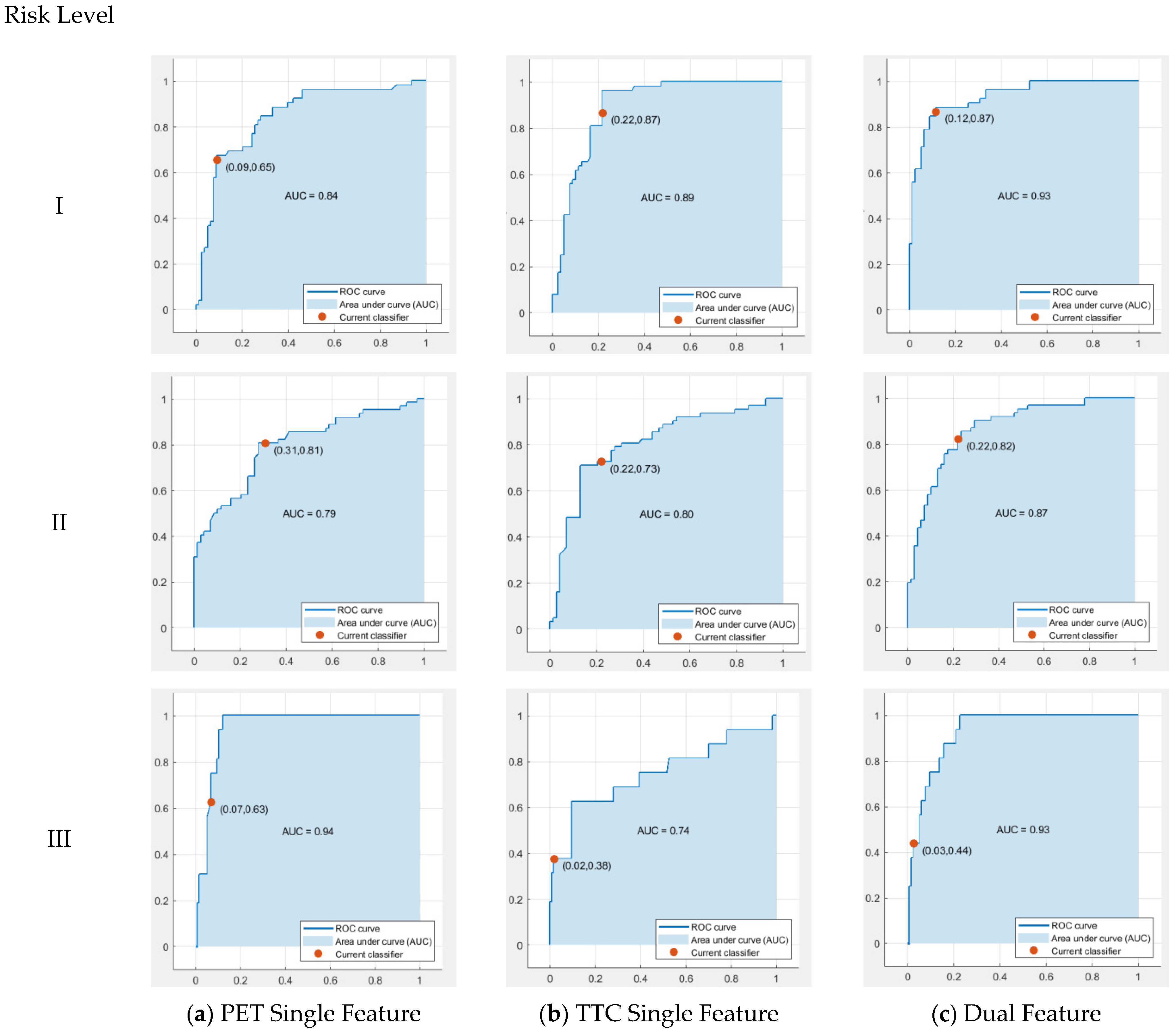
To evaluate the classification algorithm’s performance, the k-fold cross-validation method is used. The entire dataset is randomly divided into four folds, each containing an equal amount of data and maintaining the same class distribution as the entire dataset. The first three folds are used for training, and the last fold is used for testing. By rotating the trial data and the fold composition, the training and testing are completed. We take TTC and PET as the feature variables and SVM is employed to obtain the Risk Level classification accuracy under three interaction modes. The test accuracies for Hard Interaction Mode, No Interaction Mode, and Soft Interaction Mode are 98.3%, 97.6%, and 93.8%, respectively. The SVM classification error rates are shown in Figure 15. The ROC curves in Figure 16 show the distribution of testing errors for the three interaction modes under Risk Levels I, II, and III.
Using the SVM algorithm with k-fold cross-validation, the classification results for Risk Levels I, II, and III under each interaction mode were obtained, and the ROC curve analysis results are shown in Figure 16. The probability of correctly classifying the results as positive is greater than 95%, while the probability of incorrectly classifying them as positive is less than 5%, indicating high accuracy.

5.2. Comparison of Conflict Indicators’ Accuracy for Different Severities

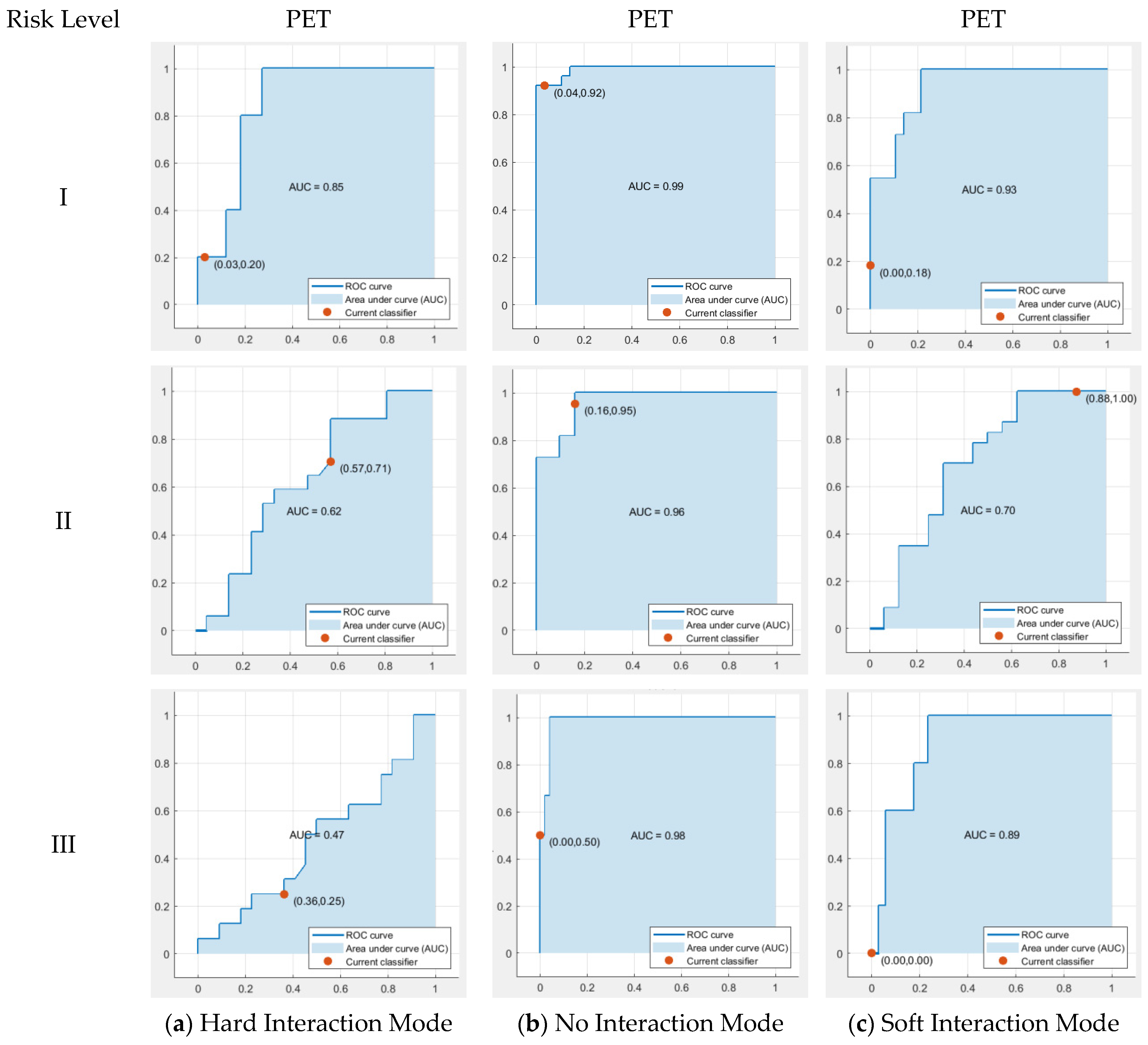
Because different conflict indicators are used for risk classification in each mode, the resulting conflict risk assessments are different. To illustrate the impact of interaction modes on conflict risk assessment, the classification results for each mode, across different evaluation indicators, must be compared. First, the accuracy of risk assessment when using PET as the sole indicator under the three interaction modes is analyzed, as shown in Figure 17. As noted, the accuracy of risk classification using PET as the sole feature indicator is poor. According to the ROC curve, the error rates for predictions in both the Hard and Soft Interaction Modes exceed 30%, reaching 53%. The error rate in the No Interaction Mode is also slightly higher than that of the dual-indicator classification. Therefore, taking PET as the only method for prediction is deemed unsuitable.
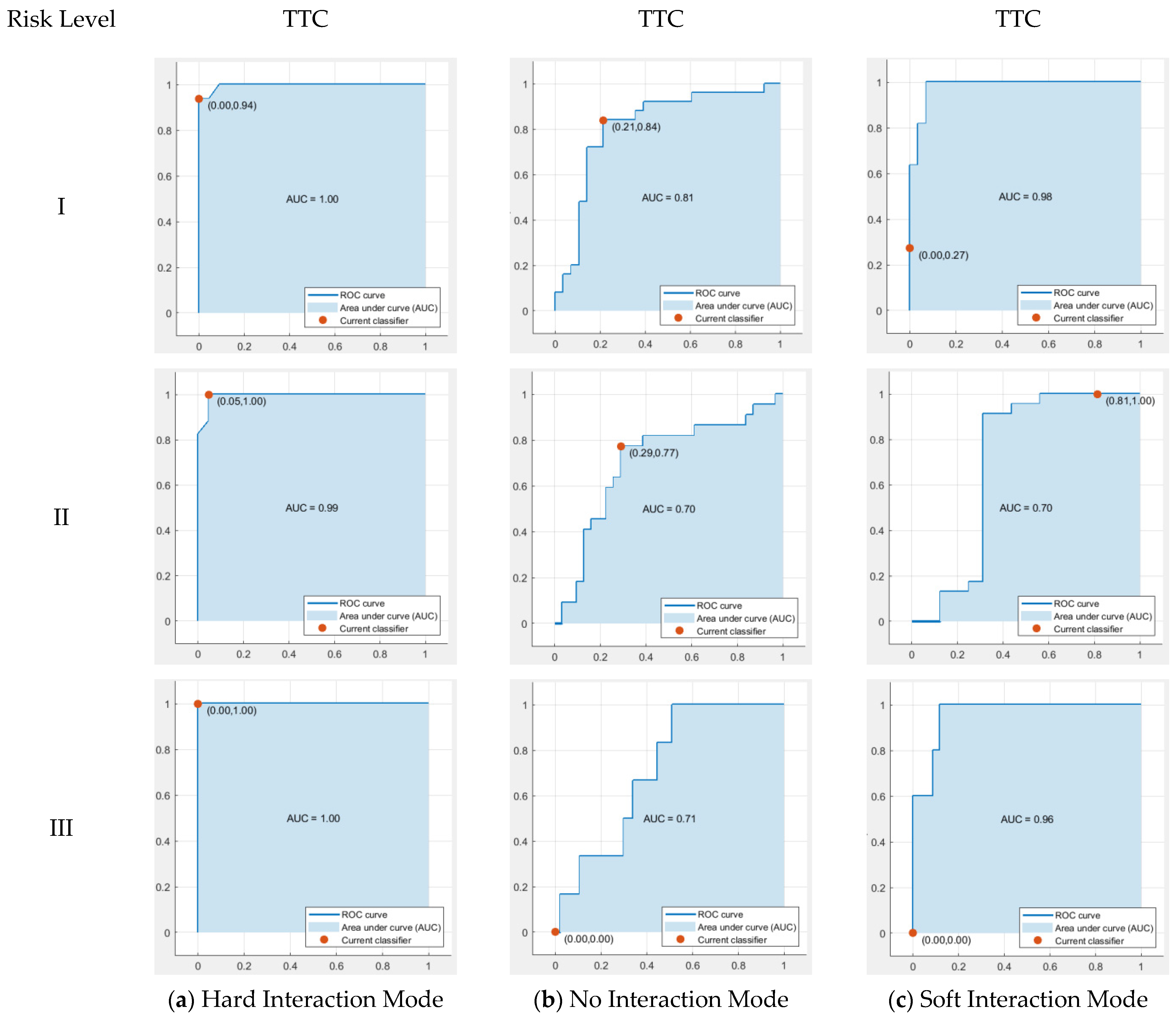
Next, when using only TTC as the classification indicator, the risk assessment classification results for the three interaction modes are shown in Figure 18. In the No Interaction Mode and Soft Interaction Mode, the prediction error rates exceed 25%. From the ROC curve and the area under the curve, it can be observed that the accuracy of TTC-only predictions is lower than that of dual-indicator predictions. However, in the Hard Interaction Mode, the TTC-only prediction results are relatively better, with accuracy above 99%. This is because in the Hard Interaction Mode, TTC is the most important indicator and the primary influencing factor. Overall, combined with Figure 18 in Section 5.1 we can conclude that dual-indicator prediction provides the best accuracy.
Finally, the prediction results of the three indicators for risk assessment classification without distinguishing interaction modes are shown in Figure 19. It is evident that when the interaction modes are not distinguished, the prediction results are poor. The highest classification accuracy is achieved by introducing the three interaction modes into the risk assessment.
These findings also suggest that several low-cost engineering treatments—such as painted turn-trajectory guides, small channelizing elements, or short pedestrian-only signal phases—could help mitigate the high-risk pedestrian–vehicle interactions identified in this study without requiring major geometric reconstruction.

6. Conclusions

This research, considering the significant size difference between motor vehicles and pedestrians at signalized intersections where right turn on red (RTOR) is allowed, extracted data from drone aerial videos at Nanshaomen Cross in Xi’an. The trajectories of the front and rear wheels of R-T vehicles were analyzed, and a trajectory prediction model for R-T vehicles was developed. Based on the characteristics of the front and rear wheel trajectories (FRWTs) of the R-T vehicles, a conflict risk assessment method for three pedestrian–vehicle interaction modes is proposed. Based on the results, the following conclusions are reached:
  • A straightforward demonstration using the extracted R-T vehicle FRWT data indicated that the front wheel presents the highest risk of colliding with pedestrians. The hierarchy of conflict risk is inner front wheel > inner rear wheel > outer front wheel > outer rear wheel.
  • A trajectory prediction model of the R-T vehicle based on the FRWT is proposed. The method is useful for accurately and scientifically identifying and analyzing the potential conflicts between R-T vehicles and pedestrians. According to the comparison, the wheel trajectories extracted from the software are consistent with the trajectories obtained from the mathematical model, and the function model trajectories fit the video-extracted trajectories well.
  • The severity of conflict risk level is classified by conflict avoidance behavior observation and analyzing the conflict distances in both time and space. Based on these avoidance actions, three risk levels are defined: Risk Level I, Risk Level II, and Risk Level III, for example, at the intersection of Chang’an North Road and Youyi East Road. The results showed that 130 conflicts occurred within 20 min. The counts for Risk Level I, Risk Level II, and Risk Level III conflicts were 52, 62, and 46, respectively.
  • Different pedestrian–vehicle interaction conflict modes often exhibit distinct conflict characteristics, and various conflict indicators also vary in applicability across different interaction modes. Three interaction modes—hard, no, and soft—are proposed based on trends in conflict indicators like TTC and GT curves. The SVM classification method was used to categorize risk levels. The results indicated that when TTC-PET dual eigenvalues are used as conflict indicators, the minimum accuracy for the Hard Interaction Mode, No Interaction Mode, and Soft Interaction Mode are 96%, 96%, and 97%, respectively. Under the PET single feature indicator method, the minimum accuracy rates for the three risk interaction modes are 47%, 96%, and 70%, respectively. When using the TTC single feature indicator method, the minimum accuracy rates are 99%, 70%, and 70%, respectively.
Although the conflict between pedestrians and vehicles has been discussed in previous research, existing studies often treat vehicles and pedestrians as single points. This study considers the size difference between motor vehicles and pedestrians, partitions vehicles into four segments, and proposes an R-T vehicle trajectory prediction model and a pedestrian–R-T vehicle conflict risk assessment method based on the FRWT of R-T vehicles under three interaction modes. The developed conflict assessment model provided a more accurate method for evaluating the risks associated with pedestrian–right-turning vehicle conflicts. The results provide necessary theoretical support for addressing pedestrian–R-T vehicle conflicts at intersections and improving intersection throughput. This can be utilized to enhance pedestrian safety at intersections where RTOR is allowed.
For future work, to further improve the accuracy of predicted vehicle trajectories, more detailed vehicle turning movements need to be modeled. And our future works need more focus on more trajectories calculated and calibrated analysis. Additionally, to further improve the accuracy of risk severity, quantitative analysis of conflict events and a mixed analysis of multiple indicators are required, rather than using a two-indicator classification. It should be noted that the motor vehicles analyzed in this research are all small cars, as they account for a large proportion of urban traffic. In addition, some medium trucks and buses are included. Thus, in our future work, we also need to invest more research on a wider range of vehicle sizes when establishing the trajectory model.

Author Contributions

Conceptualization, R.L. and G.L.; methodology, R.L., G.L. and Y.M.; software, C.W.; validation, S.M.E. and B.W.; formal analysis, C.W. and Y.D.; investigation, R.L. and B.W.; resources, R.L.; data curation, C.W. and S.M.E.; writing—original draft preparation, R.L. and G.L.; writing—review and editing, R.L., S.M.E. and Y.M.; visualization, Y.D. and B.W.; supervision, Y.M., G.L.; project administration, R.L., G.L.; funding acquisition, R.L., G.L. All authors have read and agreed to the published version of the manuscript.

Funding

This work was jointly supported by the Fundamental Research Funds for the Central Universities (Project No. B240201136), the Jiangsu Funding Program for Excellent Postdoctoral Talent (Project No. 2024ZB335), the National Natural Science Foundation of China (Project No. 52402420), and the National Natural Science Foundation of China (Project No. 52172338).

Data Availability Statement

Data will be made available on request.

Conflicts of Interest

The authors declare that they have no known competing financial interests or personal relationships that could have appeared to influence the work reported in this paper.

References

  1. Li, W.; Zhang, Y.; Li, L.; Lv, Y.; Wang, M. A pedestrian trajectory prediction model for Right-turn unsignalized intersections Based on Game Theory. IEEE Trans. Intell. Transp. Syst. 2024, 25, 9643–9658. [Google Scholar] [CrossRef]
  2. Guo, Y.; Lai, Z.; Tarek, S. A comparison of collision-based and conflict-based safety evaluation of left-turn bay extension. Transp. A Transp. Sci. 2020, 16, 676–694. [Google Scholar] [CrossRef]
  3. Wang, C.; Ijaz, M.; Chen, F.; Easa, S.M.; Zhang, Y.; Cheng, J.; Zahid, M. Temporal assessment of injury severities of two types of pedestrian-vehicle crashes using unobserved-heterogeneity models. J. Transp. Saf. Secur. 2024, 16, 820–869. [Google Scholar] [CrossRef]
  4. Nasernejad, P.; Sayed, T.; Alsaleh, R. Multiagent modeling of pedestrian-vehicle conflicts using Adversarial Inverse Reinforcement Learning. Transp. A Transp. Sci. 2023, 19, 2061081. [Google Scholar] [CrossRef]
  5. Chen, Z.; Liang, G.; Chen, Y.; Yang, X.; Liu, Y. Study on the risk assessment of pedestrian-vehicle conflicts in channelized right-turn lanes based on the hierarchical-grey entropy-cloud model. Accid. Anal. Prev. 2024, 205, 107664. [Google Scholar] [CrossRef] [PubMed]
  6. Jin, Q.; Abdel-Aty, M.; Wang, C.; Tang, S. Assessing conflict likelihood and its severity at interconnected intersections: Insights from drone trajectory data. Accid. Anal. Prev. 2025, 213, 107943. [Google Scholar] [CrossRef] [PubMed]
  7. Hussain, F.; Ali, Y.; Li, Y.; Haque, M.M. Revisiting the hybrid approach of anomaly detection and extreme value theory for estimating pedestrian crashes using traffic conflicts obtained from artificial intelligence-based video analytics. Accid. Anal. Prev. 2024, 199, 107517. [Google Scholar] [CrossRef]
  8. Kang, D.; Li, Z.; Levin, M.W. Evasion planning for autonomous intersection control based on an optimized conflict point control formulation. J. Transp. Saf. Secur. 2022, 14, 2074–2110. [Google Scholar] [CrossRef]
  9. Chen, X.; Li, Z.; Yang, Y.; Qi, L.; Ke, R. High-resolution vehicle trajectory extraction and denoising from aerial videos. IEEE Trans. Intell. Transp. Syst. 2020, 22, 3190–3202. [Google Scholar] [CrossRef]
  10. Guan, F.; Whitley, T.; Xu, H.; Wang, Z.; Chen, Z.; Hui, T.; Tian, Y. Vehicle-pedestrian interaction analysis for evaluating pedestrian crossing safety at uncontrolled crosswalks—A geospatial approach using multimodal all-traffic trajectories. J. Saf. Res. 2024, 91, 326–341. [Google Scholar] [CrossRef]
  11. Xie, K.; Ozbay, K.; Yan, H. Mining automatically extracted vehicle trajectory data for proactive safety analytics. Transp. Res. 2019, 106, 61–72. [Google Scholar]
  12. Kim, E.J.; Park, H.C.; Ham, S.W.; Kho, S.Y.; Kim, D.K. Extracting vehicle trajectories using unmanned aerial vehicles in congested traffic conditions. J. Adv. Transp. 2019, 2019, 9060797. [Google Scholar] [CrossRef]
  13. Wang, M.; Li, Z.; Zhang, J.; Zhong, Y. Vehicle trajectory extraction method based on distributed fiber optic sensing system. Eng. Sci. Technol. 2021, 53, 141–150. [Google Scholar]
  14. Chu, L.; Li, W. A vehicle trajectory extraction method based on MapReduce. Comput. Knowl. Technol. 2019, 15, 1–26. [Google Scholar]
  15. Tao, J.; Wang, R.; Qin, X.; Yin, X. Vehicle trajectory stop point extraction algorithm based on semantic behavior. J. Tonghua Norm. Univ. 2021, 42, 95–102. [Google Scholar]
  16. Zhou, X. Multi-target vehicle trajectory automatic collection method based on deep learning. Transp. Sci. Technol. 2021, 135–140, 144. [Google Scholar] [CrossRef]
  17. Kang, D.; Zhao, J.; Dick, C.T.; Liu, X.; Bian, Z.; Kirkpatrick, S.W.; Lin, C.Y. Probabilistic risk analysis of unit trains versus manifest trains for transporting hazardous materials. Accid. Anal. Prev. 2023, 181, 106950. [Google Scholar] [CrossRef]
  18. Mario, S.; Belén, R.; Ana, S. Safety assessment on pedestrian crossing environments using MLS data. Accid. Anal. Prev. 2018, 111, 328–337. [Google Scholar] [CrossRef]
  19. Xin, F.; Wang, X.; Sun, C. Risk evaluation for conflicts between crossing pedestrians and right-turn vehicles at intersections. Transp. Res. Rec. 2021, 2675, 1005–1014. [Google Scholar] [CrossRef]
  20. Zaman, A.; Huang, Z.; Li, W.; Qin, H.; Kang, D.; Liu, X. Artificial intelligence-aided grade crossing safety violation detection methodology and a case study in New Jersey. Transp. Res. Rec. 2023, 2677, 688–706. [Google Scholar] [CrossRef]
  21. Pin, C.; Sayed, T.; Zaki, M. Assessing safety improvements to pedestrian crossings using automated conflict analysis. Transp. Res. Rec. 2015, 2514, 58–67. [Google Scholar] [CrossRef]
  22. Chen, P.; Zeng, W.; Yu, G. Assessing right-turn vehicle-pedestrian conflicts at intersections using an integrated microscopic simulation model. Accid. Anal. Prev. 2019, 129, 211–224. [Google Scholar] [CrossRef] [PubMed]
  23. Amini, R.; Yang, K.; Antoniou, C. Development of a conflict risk evaluation model to assess pedestrian safety in interaction with vehicles. Accid. Anal. Prev. 2022, 175, 106773. [Google Scholar] [CrossRef]
  24. Theissen, P.; Wojciak, J.; Heuler, K.; Demuth, R.; Indinger, T.; Adams, N. Experimental Investigation of Unsteady Vehicle Aerodynamics Under Time-Dependent Flow Conditions-Part; SAE Technical Paper: Warrendale, PA, USA, 2011. [Google Scholar]
  25. Heft, A.I.; Indinger, T.; Adams, N.A. Experimental and numerical investigation of the DrivAer model. In Fluids Engineering Division Summer Meeting; American Society of Mechanical Engineers: New York, NY, USA, 2012; Volume 44755, pp. 41–51. [Google Scholar]
  26. Liu, J.; Xu, S.; Wang, Q.; Bao, H.; Wang, Y. Review of automotive aerodynamics research based on physical models. Exp. Fluid Mech. 2020, 34, 38–48. [Google Scholar]
  27. Wei, W.; Wang, H.; Ding, L. Automotive aerodynamics simulation analysis based on DrivAer model. In Proceedings of the 2022 Academic Annual Conference of the Automotive Aerodynamics Branch of the Chinese Society of Automotive Engineering—Pneumatic Branch Venue, Shanghai, China, 20–21 October 2022; pp. 165–170. [Google Scholar]
  28. Yang, B.; Chen, H.; Liu, Z.; Jiang, Q. Trajectory-Based Study on the Conflict Characteristics of Pedestrians and Non-Motorized Vehicles at Bus Stops. In Proceedings of the CICTP 2021, Xi’an, China, 16–19 December 2021; pp. 973–984. [Google Scholar]
  29. Tu, P.; Bai, Y.; Lei, X.; Yu, X. An Investigating Study on Lateral Riding Position of Cyclists from Curb Based on Road Segment Scope Trajectory Data. In Proceedings of the CICTP 2024, Shenzhen, China, 23–26 July 2024; pp. 922–932. [Google Scholar]
  30. Ni, Y.; Wang, M.; Sun, J.; Li, K. Evaluation of pedestrian safety at intersections: A theoretical framework based on pedestrian-vehicle interaction patterns. Accid. Anal. Prev. 2016, 96, 118–129. [Google Scholar] [CrossRef]
  31. Sheykhfard, A.; Haghighi, F.; Papadimitriou, E.; Van Gelder, P. Review and assessment of different perspectives of vehicle-pedestrian conflicts and crashes: Passive and active analysis approaches. J. Traffic Transp. Eng. 2021, 8, 681–702. [Google Scholar] [CrossRef]
  32. Vapnik, V.N. Statistical Learning Theory; Wiley: New York, NY, USA, 1998. [Google Scholar]
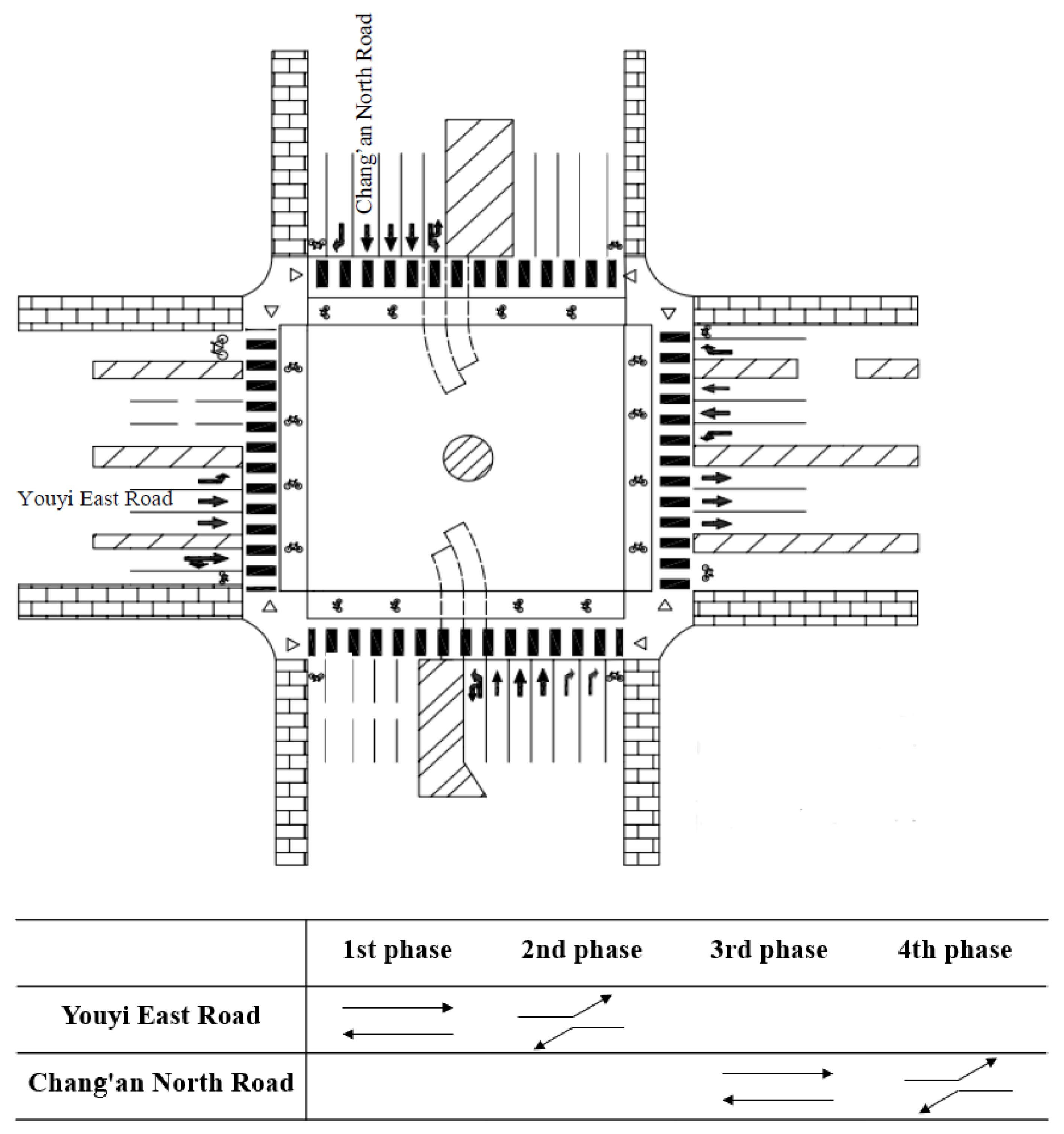
Figure 1. The channelization and phase diagram of Chang’an North Road–Youyi East Road intersection.
Infrastructures 10 00330 g001
Figure 2. Right−turn vehicle inner front and rear wheel.
Infrastructures 10 00330 g002
Figure 3. Right−turn vehicle outer front and rear wheel.
Infrastructures 10 00330 g003
Figure 4. Comparison of displacement of inner FRWT of right−turn vehicle.
Infrastructures 10 00330 g004
Figure 5. Comparison of speed of inner FRWT of right−turn vehicle.
Infrastructures 10 00330 g005
Figure 6. Comparison of acceleration of FRWT of right−turn vehicle.
Infrastructures 10 00330 g006
Figure 7. Comparison of displacement, speed, and acceleration of outer FRWT of right−turn vehicle.
Infrastructures 10 00330 g007
Figure 8. Mathematical function of the trajectory of a right-turn vehicle.
Infrastructures 10 00330 g008
Figure 9. Comparison of function model-fitted and video-extracted trajectories of inner front and rear wheels.
Infrastructures 10 00330 g009
Figure 10. Example diagram of metric calculations.
Infrastructures 10 00330 g010
Figure 11. TTC-GT and speed curve trend.
Infrastructures 10 00330 g011aInfrastructures 10 00330 g011b
Figure 12. Proportion of risk levels in each interaction mode.
Infrastructures 10 00330 g012
Figure 13. Distribution of interaction modes and severity categories.
Infrastructures 10 00330 g013
Figure 14. Optimal separation hyperplane and support vector distribution.
Infrastructures 10 00330 g014
Figure 15. Error distribution of SVM classification test.
Infrastructures 10 00330 g015
Figure 16. ROC curve of TTC-PET dual eigenvalue SVM model classification results.
Infrastructures 10 00330 g016
Figure 17. ROC curve of PET single feature SVM model classification results.
Infrastructures 10 00330 g017
Figure 18. ROC curve of TTC single feature SVM model classification results.
Infrastructures 10 00330 g018
Figure 19. Prediction results without distinguishing interaction modes.
Infrastructures 10 00330 g019
Table 1. Occurrence frequency of four conflict avoidance measures at the intersection.
Right-Turning Vehicle
on Intersection Entrances
Conflict Avoidance MeasureTotal
Chang’an North Road—South Entrance3398454
Youyi East Road—East Entrance1132117
Youyi East Road—West Entrance191213
Chang’an North Road—North Entrance3262536
Total8871312130
Table 2. Conflict events severity ratings along with consistency levels.
ElementRisk Level IRisk Level II Risk Level III Total
Entrances526246130
S j ¯ 0.341.212.06
σ j ¯ 0.250.420.32
Table 3. Conflict events and conflict indicators of each import section.
ElementSouth EntranceEast EntranceWest EntranceNorth Entrance
Event order1231231231234
PET4.202.604.405.306.303.006.105.505.901.82.84.52.6
TTCmin2.331.991.482.138.541.013.982.593.720.931.871.434.74
GTmin0.1180.090.093.050.290.040.260.190.150.020.041.104.46
SeverityIIIIIIIIIIIIIIIIIIIIIIIII
Table 4. Intersection conflict severity estimation based on TTC and GT curves.
Right-Turn Vehicle on Intersection EntrancesHard Interaction ModeNo Interaction ModeSoft Interaction ModeTotal
Chang’an North Road—South Entrance1829754
Youyi East Road—East Entrance74617
Youyi East Road—West Entrance43613
Chang’an North Road—North Entrance9171036
Total385339130
Disclaimer/Publisher’s Note: The statements, opinions and data contained in all publications are solely those of the individual author(s) and contributor(s) and not of MDPI and/or the editor(s). MDPI and/or the editor(s) disclaim responsibility for any injury to people or property resulting from any ideas, methods, instructions or products referred to in the content.