Article

Optimization of the Prestress Value for Multi-Row Anchor in Anti-Slide Pile Based on a Staged Orthogonal Design

1
Huaneng Lancang River Hydropower Inc., Kunming 650220, China
2
Power China Huadong Engineering Corporation, Hangzhou 311100, China
3
College of Civil Engineering and Architecture, Xinjiang University, Urumqi 830046, China
4
Research Institute of Geotechnical Engineering, Hohai University, Nanjing 210098, China
*
Author to whom correspondence should be addressed.
Designs 2025, 9(6), 142; https://doi.org/10.3390/designs9060142 (registering DOI)
Submission received: 21 October 2025 / Revised: 25 November 2025 / Accepted: 3 December 2025 / Published: 7 December 2025
(This article belongs to the Topic Resilient Civil Infrastructure, 2nd Edition)

Abstract

The anti-slide pile with multi-row prestress anchor is widely used to prevent the failure of the slope. This paper proposes a multi-row anchor prestress optimization method based on a staged uniform design that combines FLAC3D 9.0 numerical simulations with the minimum bending moment criterion. By determining a global reference prestress and performing successive layered adjustments, the proposed method effectively controls the peak bending moment of the support structure and significantly enhances overall stability. Case studies demonstrate that this method reduces the peak bending moment of piles by approximately 31.88%, leading to a more uniform bending moment distribution, improved safety, and better cost efficiency. These results indicate that the proposed method provides an efficient and reliable approach for optimizing prestress distribution in complex slope support systems.

1. Introduction

The stability and safety of deep excavation and slope engineering remain pressing challenges in contemporary geotechnical practice, particularly as construction projects become increasingly large and complex in urban environments. Conventional pile–anchor composite support systems are widely used to control deformation and enhance overall stability. The prestress cable is widely used to improve the stability of piles against sliding [1,2,3]. The performance depends critically on the magnitude and distribution of prestress applied to multi-row anchor cables [4]. The low prestress cannot improve the performance of the anti-slide pile, while the high prestress may generate a high internal force that leads to a high reinforcement ratio. Traditional empirical design approaches frequently adopt uniform prestress values, but such simplifications can lead to inefficient load transfer, non-uniform displacement fields, and excessive bending moments in the supporting piles, thereby compromising both structural safety and economic efficiency. Therefore, accurately determining the optimal prestress levels for each anchor row is essential for maximizing the effectiveness of support systems [5]. Due to these limitations, researchers and engineers have progressively turned to integrated approaches that combine experimental validation, numerical analysis, and optimization algorithms to establish a more systematic and rational basis for pre-stress design.
Experimental model tests provide indispensable evidence for understanding the complex interaction between anchors, piles, and the surrounding soil mass [6,7,8,9]. By reproducing scaled representations of excavation support systems under controlled laboratory conditions, such tests allow direct observation of soil displacement patterns, anchor load transfer, and pile bending behavior under varying prestress configurations. These observations are particularly valuable because they reveal mechanisms that are difficult to capture through theory alone, such as stress redistribution between adjacent anchors or the progressive mobilization of soil strength with increasing excavation depth [10]. Furthermore, model tests make it possible to conduct parametric investigations by systematically varying anchor spacing, inclination, embedment depth, and applied prestress. The resulting experimental data serve not only to highlight the deficiencies of uniform prestress strategies but also to provide reliable calibration targets for subsequent numerical simulations. Although laboratory testing inevitably involves scaling effects and limitations in replicating in situ conditions, its role as a benchmark for validating theoretical and computational models is irreplaceable in ensuring scientific rigor. For example, experimental findings often show that different anchor rows mobilize different loads, underscoring the need for depth-specific prestress optimization.
While model tests yield valuable physical insights, their scalability and generality are constrained by laboratory conditions. Numerical simulation has therefore emerged as a powerful complementary tool, enabling the analysis of full-scale excavation systems under diverse geological and loading scenarios that cannot be replicated experimentally [11]. Among available computational methods, the three-dimensional finite difference program FLAC3D 9.0 has proven particularly suitable for simulating soil–structure interaction problems in geotechnical engineering [12,13]. Its robust numerical framework allows for the accurate representation of nonlinear soil constitutive behavior, structural element responses, and complex excavation sequences. In the context of prestressed multi-row anchors, numerical simulations provide a platform to investigate how varying prestress levels influence pile bending moments, soil displacements, and anchor force distributions across excavation stages. Through systematic parametric analyses, engineers can identify critical trends, such as the nonlinear relationship between prestress magnitude and reduction in peak bending moment, or the trade-off between prestress uniformity and system-wide displacement control [14]. Importantly, the flexibility of numerical modeling allows researchers to explore prestress configurations that may be impractical in experimental setups but highly relevant for real-world design scenarios. By bridging the gap between simplified laboratory conditions and the complexity of field applications, numerical simulations not only complement physical testing but also form a foundation upon which optimization strategies can be rigorously developed [15]. For instance, FLAC3D 9.0 enables sensitivity studies where parameters such as soil stiffness or anchor spacing are varied to quantify their effects on support performance [16].
The experimental design method is the most traditional method and have successfully used to optimize the depth and the width of piles [17]. A uniform prestress allocation may appear straightforward but does not reflect the heterogeneous load-sharing mechanisms that develop among different rows of anchors during excavation. In the case of multi-row prestressed anchors, the optimization problem is particularly challenging due to the coupled and nonlinear nature of soil–structure interaction [18]. By defining the minimization of peak bending moment as the optimization objective, designers can systematically adjust prestress distributions to achieve enhanced structural efficiency [19]. The hierarchical approach ensures that both local and global structural performance metrics are simultaneously improved [20]. In addition, the machine learning method is also suitable for the optimization of pile [21]. The previous studies have demonstrated that the optimization method are mostly used for the optimization of the location and geometry of pile, the optimizations for multi-row anchor prestress are seldom used.
The main factor affecting the anti-slide pile is the rate of reinforcement, which is determined by the moment on the profile. This paper proposed a staged uniform design method to optimize the moment on the pile. Firstly, a large interval of prestresses is employed for orthogonal design to get the optimized prestress. Secondly, a smaller interval with higher resolution is used to determine the new value. Afterwards, the interval of prestress decreased gradually to get the minimum moment in a relative limit range. The whole process can be finished automatically by combining FLAC3D 9.0-based simulations, and the dynamic staged optimization algorithm. Thus, it contributes not only to the theoretical advancement of geotechnical optimization but also to the practical goal of achieving safer, more economical, and more resilient support systems for deep excavations and slope engineering projects. A brief sensitivity analysis is conducted to discuss how uncertainties in soil stiffness/strength and variations in anchor spacing may influence the bending-moment response and the robustness of the optimized prestress scheme. Additionally, the findings of this study may inform future design guidelines and provide guidelines for further research in prestressed support optimization.

2. Method

2.1. Computation Theory of FLAC3D 9.0

The FLAC3D 9.0 9.0 (Fast Lagrangian Analysis of Continua) software suite fundamentally employs geometric topology theory to discretize rock and soil structures within two-dimensional and three-dimensional domains into differential grids comprising quadrilateral or hexahedral elements [22]. Through Gaussian integration and linear interpolation techniques, FLAC3D 9.0 distributes element mass, internal stresses, and unbalanced forces ( F ) from external loads to adjacent grid nodes, establishing Newton’s second law at each node. The acceleration term is discretized via differential operators as the rate of velocity change per unit time, transforming the governing equilibrium equation into an explicit central-difference formulation based on nodal velocities [23]. During the iterative solution process, FLAC ensures numerical completeness by periodically transferring internal variables between elements at fixed intervals and updating unbalanced forces and grid positions before proceeding to the next step. This explicit time-stepping approach enables the simulation of incremental construction processes and dynamic loading effects, which is particularly relevant for progressive excavation and staged prestressing in geotechnical problems. In addition, the explicit central-difference algorithm propagates stress waves with second-order temporal accuracy, ensuring that computed bending moments dynamically reflect evolving structural responses, such as flexural cracking or progressive yielding. Compared to implicit methods such as finite element analysis (FEM), FLAC3D 9.0 exhibits several distinct advantages. Primarily, its hybrid discretization approach—subdividing quadrilaterals or hexahedra into triangles or tetrahedra—provides superior accuracy in capturing nonlinear yield and failure behavior compared to FEM’s stiffness matrix integration. Owing to its rigorous finite-difference algorithm and proven performance, FLAC3D 9.0 has been internationally recognized as one of the most robust and precise geotechnical numerical software tools for continuum mechanics analysis in engineering practice.

2.2. Bending Moments for Solid Elements in FLAC3D 9.0

In finite element and finite difference analyses of continuum structures, extracting bending moments from solid elements requires specialized post-processing, as these moments are derived from the computed stress fields rather than direct output variables. To compute the bending moment about a given cross-sectional axis, the bending-moment vector M b is obtained by integrating the Cauchy stress tensor σ over the cross-sectional area A , weighted by the lever arm r relative to a reference axis [24], as expressed in Equation (1):
M b = A r × σ n d A
where r is the position vector from the reference axis to a stress point, σ is the Cauchy stress tensor at the considered point, n is the unit normal vector to the cross-section, and A denotes the cross-sectional area of the pile.
Numerically, this involves mapping the calculated element stresses to the desired section plane using discrete quadrature. Implementation challenges include achieving accurate stress recovery at non-Gauss integration points—often addressed by techniques such as shape function extrapolation or super convergent patch recovery (SPR)—and consistently defining local coordinate systems for arbitrary section orientations in three-dimensional space. Discontinuous stress fields across element boundaries can further complicate the process, requiring nodal averaging or smoothing techniques; however, these introduce errors that are influenced by mesh quality and element distortion. Within FLAC3D 9.0’s computational framework, the hybrid discretization strategy improves moment integration accuracy. By subdividing quadrilateral or hexahedral elements into triangular or tetrahedral subdomains, FLAC3D 9.0 facilitates direct stress integration along complex polygonal sections. An efficient alternative to determine the sectional moments is given by Equation (2):
M = σ z × A x y × r j
where σ z are the nodal force components on a horizontal section A x y and r j are their local position vectors.
This approach uses nodal force balance nodal forces and has been shown to converge well even in large-strain scenarios dominated by geometric nonlinearity. Validation studies (e.g., bending of prismatic beams) indicate that FLAC3D 9.0’s solid-element integrations, using hexahedral elements with high-order Gauss quadrature, can achieve moment prediction errors below 2% relative to theoretical solutions.
Compared to equivalent beam-element formulations (which explicitly include rotational degrees of freedom), solid-element moment integration offers critical advantages: it inherently captures complex three-dimensional stress coupling (e.g., bending–axial–torsional interactions), avoids the need for rigid-link idealizations at beam–solid interfaces, and accurately represents localized yielding and shear effects that line elements cannot. Although the solid approach requires more degrees of freedom—potentially increasing computational cost—it benefits from FLAC3D 9.0’s explicit parallel processing capabilities, which partially offset the cost for large models. In this study, the high-fidelity solid models (≈700,000 elements) could be solved with reasonable computational effort, enabling precise evaluation of bending moments in the anchored pile system.

2.3. Optimization Method

To address this, optimization frameworks based on clear performance criteria are required. The minimum bending moment criterion has gained attention because it directly targets the rate of reinforcement in piles. This study proposes a hierarchical multi-stage optimization method for anchor prestressing, with the objective of reducing the peak bending moment in piles and enhancing the overall stability of the support system. First, a comprehensive numerical model of the soil–pile–anchor system is established using the in situ geotechnical parameters and design conditions of the site. In the initial optimization stage, equal prestress is applied to all anchor rows, and a uniform scanning process is carried out: the prestress magnitude is varied in discrete increments across a range of obtained values, and the resulting peak bending moment of the piles is computed at each step. This identifies a global baseline prestress level that yields the lowest peak moment.
In practice, the optimization is organized into three stages. Stage I is a global baseline search in which all anchor rows share a uniform prestress and the peak bending moment is evaluated over a discrete set of candidate values. Stage II is a row-wise staged orthogonal design, where the prestress of one anchor row at a time is varied around the baseline while the other rows are kept fixed, so that the depth-specific contribution of each row can be identified and an individual optimal prestress can be assigned. Stage III is a local refinement stage using a dynamic contraction search that cooperatively adjusts all rows around their current optima. In this paper, the term “staged orthogonal design” refers to this sequential one-factor-at-a-time search strategy implemented in stages, rather than to a strict Taguchi-type orthogonal array.
Subsequently, using this reference prestress as a starting point, the algorithm performs a layer-by-layer prestress adjustment. In this second stage, each anchor row is optimized independently: one row at a time is varied through a range of prestress levels while the others remain fixed at the baseline value. By monitoring how the pile’s peak bending moment changes with respect to each row’s prestress, the optimal prestress for each individual row is determined. This separated approach captures the unique influence of each depth-specific anchor on the overall system response. After this individual-row optimization, the algorithm enforces a convergence criterion ( ε < 5 % ) on the change of peak bending moment; if the criterion is not met, additional iterations of row adjustments are performed.
Finally, with the row-specific prestresses determined, a system-wide coordination stage is conducted to refine the interaction between all rows. A dynamic contraction search algorithm is employed: starting from the current optimal vector of prestresses, the algorithm defines a search domain around each anchor’s prestress and iteratively shrinks the step size. In each iteration, new prestress combinations are tested, and the global peak moment is evaluated. Let M p e a k ( k ) denote the peak bending moment obtained at iteration k . The relative improvement in iteration k is defined as Equation (3):
ε = M p e a k ( k 1 ) M p e a k ( k ) M p e a k ( k 1 )
In this study, the dynamic contraction search is terminated when ε ( k ) falls below a tolerance ε t o l = 5% or when the maximum number of iterations k m a x = 5 is reached, whichever comes first. The result of this stage is the final optimized prestress distribution for all anchor rows. This hierarchical workflow is illustrated in Figure 1 and ensures that the final prestress scheme effectively controls peak bending moments, achieving a balance between structural safety and cost efficiency.
For clarity, the main steps of the algorithm can be summarized as follows:
(1)
Build the three-dimensional FLAC3D 9.0 model of the soil–pile–anchor system using the design geotechnical parameters and boundary conditions.
(2)
Stage I (global baseline search): apply a set of uniformly increasing prestress levels P to all anchor rows, run FLAC3D 9.0 for each level, and compute the corresponding peak bending moment M p e a k P . Select the baseline prestress P 0 that minimizes M p e a k P .
(3)
Stage II (row-wise staged orthogonal design): for each anchor row i in turn, vary the prestress of row i around P 0 over a discrete set of candidate values while keeping the other rows fixed at P 0 , and determine the optimal prestress P i * that minimizes the peak bending moment. Assemble the row-wise optimal vector P ( 1 ) = ( P 1 * , P 2 * , . . . ) .
(4)
Stage III (dynamic contraction search): starting from P ( 1 ) , define a search interval around each P i * and perform a coordinated contraction search over all rows. At each iteration k , update the prestress vector, re-evaluate the peak bending moment, and compute the relative improvement ε ( k ) .
(5)
Check convergence: if ε ( k ) < ε t o l or the iteration count reaches k m a x , accept the current prestress vector as the final solution; otherwise, shrink the search intervals and return to step (4).
(6)
Output the optimized prestress distribution for all anchor rows and evaluate the final displacement and bending-moment responses of the support system.

3. Stability Analysis of Geotechnical Structures Based on FLAC3D 9.0

3.1. Project Overview

This study considers an actual foundation pit project where a pile–anchor composite support system is employed for slope reinforcement. The excavation has a slope ratio of 1:0.6. Reinforced concrete bored piles (C35) with a diameter of 1.5 m, spaced 1.7 m apart, and 22 m in length were installed along the inner slope face to serve as the primary anti-sliding support. To control groundwater seepage, high-pressure jet-grouting piles (0.95 m diameter, 1.7 m spacing) were installed outside the bored piles, to form a cutoff wall system. The slope surface is reinforced with a steel bar mesh made of 6.5 mm diameter bars arranged at 20 cm × 20 cm spacing, and a 12 cm thick C25 shotcrete layer to enhance surface integrity and erosion resistance.
Within this support system, prestressed anchors with a nominal capacity of 1000 kN were installed from top to bottom, at vertical intervals of 2.5 m and horizontal intervals of 3.4 m, providing active reinforcement to the pile–soil mass. On the outer side of the excavation, a reinforced concrete buttressed retaining wall (C30) was constructed, founded on slightly weathered sandstone. The wall’s structural parameters include a height of 10 m, a base width of 8 m, a panel thickness of 1.0 m, a base slab thickness of 1.5 m, a buttress thickness of 0.8 m, and a buttress spacing of 4 m. To improve overall stability, 1.0 m × 1.0 m fillets were added at the inner corners of the wall. Behind the wall, rubble backfill was placed to form a platform with a crest elevation of 67 m.

3.2. Numerical Model

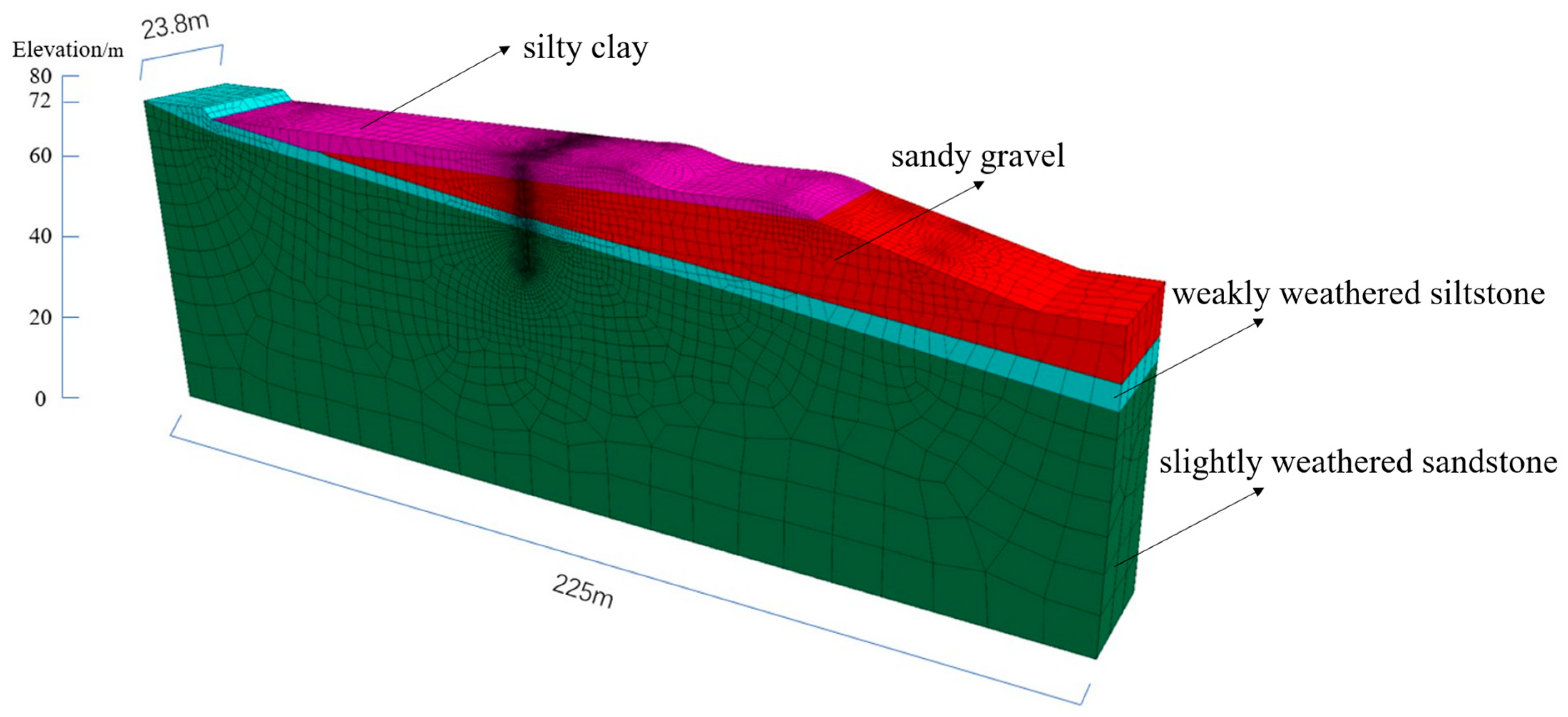
Numerical analysis was conducted using FLAC3D 9.0 version 9.0. Based on the geotechnical investigation, the ground was represented as a horizontally layered soil–rock profile consisting of fill, sandy gravel, weakly weathered sandstone, moderately weathered sandstone, weakly weathered siltstone and moderately weathered siltstone. Each stratum was modelled using a Mohr–Coulomb elastoplastic constitutive law with its own set of strength and stiffness parameters derived from the site investigation and design specifications, as summarized in Table 1. Surface loads from road and residential structures were represented as uniformly distributed loads, assumed to be constant during the excavation. A three-dimensional coordinate system was established: the X-axis is perpendicular to the channel (direction of excavation width), the Y-axis runs along the channel, and the Z-axis is oriented vertically upward.
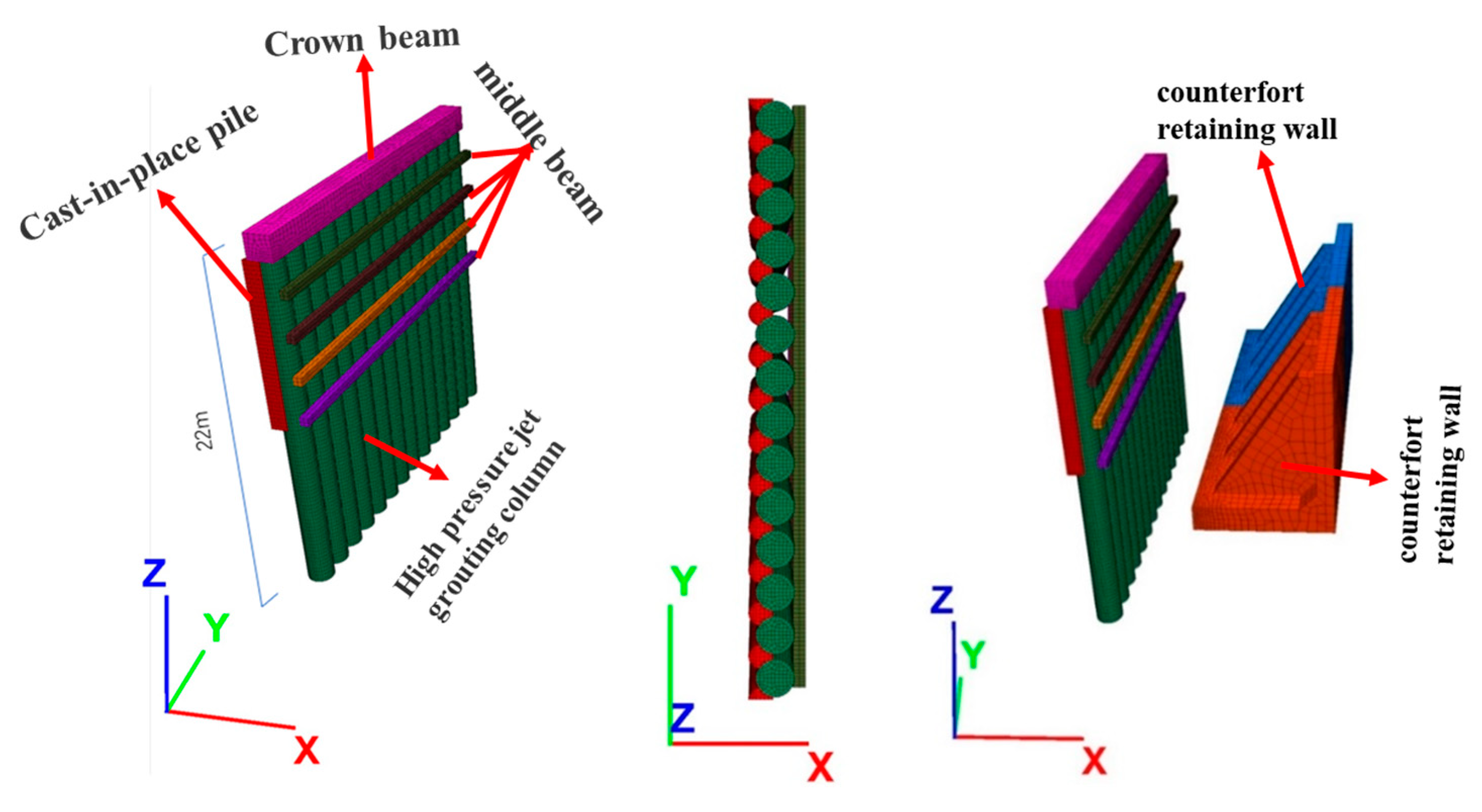
Figure 2 presents the three-dimensional model of the foundation excavation. The model includes bored piles, jet-grouting piles, a crown beam, waling beams, reinforced concrete buttressed retaining walls, concrete facing panels, and the main soil and rock strata of the site. Concrete structures and the bedrock were simulated using solid elements. The complete model consists of approximately 700,000 elements, primarily high-precision hexahedral elements, ensuring sufficient computational accuracy for engineering analysis. This fine discretization was chosen to capture the detailed stress distribution in the support elements while maintaining manageable solution times.
In the vicinity of the piles and anchors, the mesh was locally refined to capture the steep gradients of bending moment and shear stress. In the adopted discretization, the smallest element edge length immediately around the pile–soil interface is on the order of a fraction of the pile diameter, so that several elements span the influence zone of the pile cross-section. Away from the piles and anchor heads, the mesh size is gradually increased, which keeps the total number of elements at about 7 × 10⁵ while still representing the far-field response adequately. Before finalizing the mesh, trial refinements concentrated around the piles and anchors were performed; these additional refinements changed the computed peak bending moments and maximum shear stresses only by a small percentage, while significantly increasing the computational cost. On this basis, the adopted mesh is considered to provide an appropriate balance between accuracy and efficiency for the design-level analysis in this study.
The modelling strategy adopted here follows previously published experimental and numerical studies on pile–anchor support systems. Large-scale model tests and full-scale measurements of anchored excavations [6,7,8,9] have shown bending-moment envelopes and lateral displacement profiles similar in shape and magnitude to those obtained in the present analysis. Three-dimensional numerical studies using Mohr–Coulomb layered profiles and comparable support configurations [12,13] have also reported good agreement with these experimental observations [16]. The present FLAC3D 9.0 model can therefore be regarded as an extension of these validated frameworks to the specific problem of multi-row anchor prestress optimization at the considered site.
The computational models of the high-pressure jet grouting piles combined with bored cast-in-place piles are illustrated in Figure 3. The bored piles have a total length of 22 m, a diameter of 1.5 m, and a center-to-center spacing of 1.7 m. Jet grouting piles (0.95 m diameter, 1.7 m spacing) are arranged outside the bored piles. A crown beam with a height of 1.5 m is placed at the top of the bored piles.
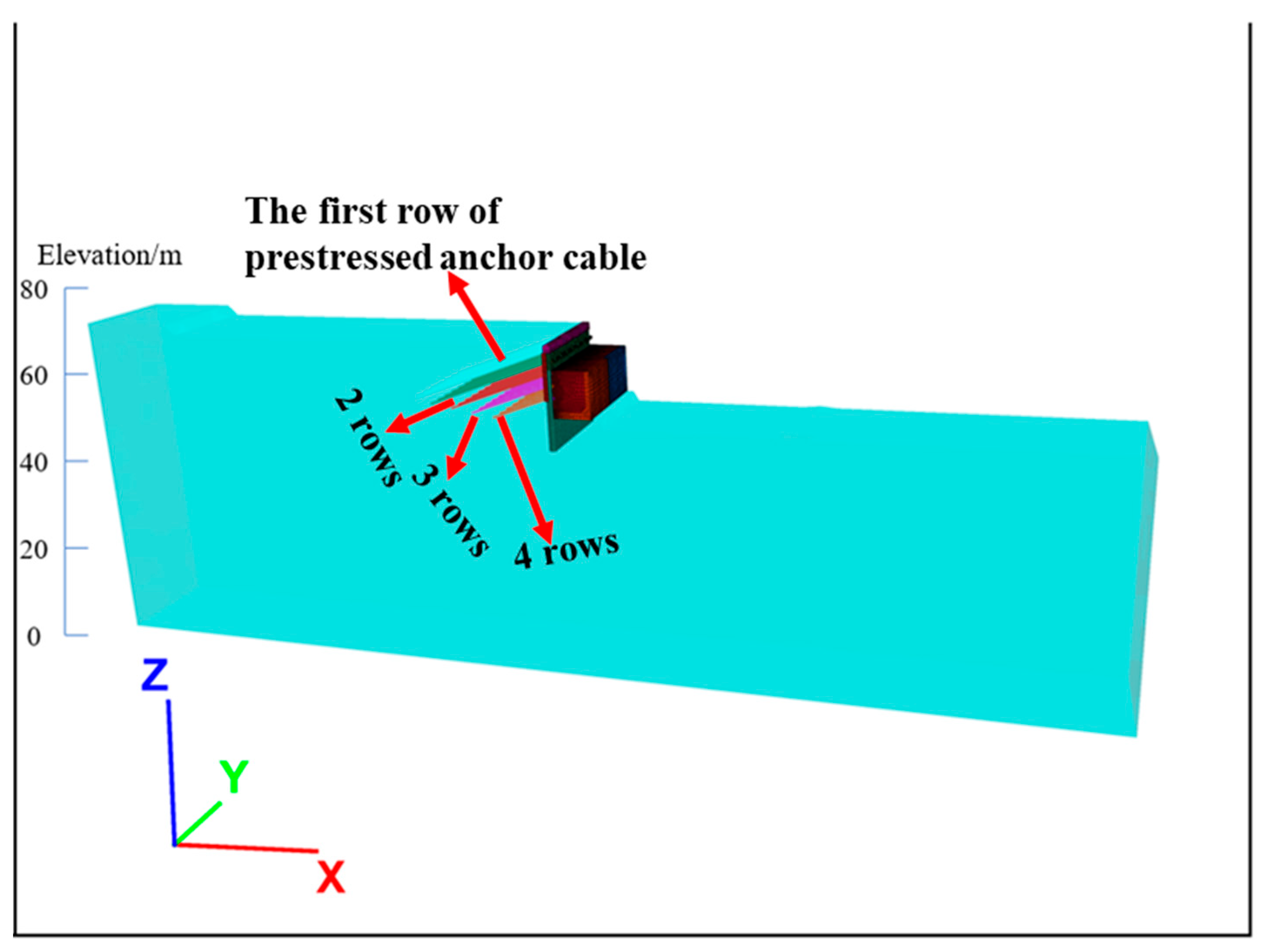
The present study mainly aims to evaluate the effectiveness and rationality of the pile–anchor support system. In the computational model, the effect of prestressed anchors was simulated. The anchors are arranged with a vertical spacing of 2.5 m and a horizontal spacing of 3.4 m, with an initial prestressing force of 1000 kN. The schematic arrangement is shown in Figure 4.

3.3. Parameter Settings

Material and mechanical parameters used in the numerical model are summarized as follows: For the geotechnical materials, the artificial fill has an effective internal friction angle φ′ = 22°, cohesion C′ = 0 kPa, and Young’s modulus E = 7 MPa. The slightly weathered sandstone layer is characterized by φ′ = 41.19°, C′ = 675 kPa, and E = 6500 MPa. Other soil layers are defined similarly (see Table 1). Anchor design parameters and concrete properties employed in the analysis are as follows: rock anchors have a tensile safety factor of 1.8, a pull-out safety factor of 2.2, and an anchorage length of 12 m; soil anchors use a tensile safety factor of 1.6, a pull-out safety factor of 1.8, and an anchorage length of 25 m. Reinforced concrete grade C30 (E = 30 GPa) is used for the retaining wall, while bored piles use C35 (E = 31.5 GPa) and the parameters are listed in Table 2.
The prestressed anchor is the main support measurement. Based on the geological research report, detailed values for cable are provided in Table 3 and Table 4, which serve as a reference for reproducibility.

4. Prestressed Anchor Cable Optimization

4.1. Optimization Procedure

The optimization was initiated by a prestress gradient design where uniformly increasing prestress loads P n n = 1 , 2 , , 7 was synchronously applied to all seven anchor cables. This sequence initiated at P 1 = 0   k N and terminated at P 7 = 600   k N , with a constant incremental step of Δ P = P 7 P 1 / 6 = 100   k N , yielding the prestress set given in Equation (4):
P n = 0,100,200,300,400,500,600 k N
For each prestress level P n , the bending moment distribution along G cross-sections of the bored piles were numerically simulated. The peak bending moment M n was defined as the maximum absolute moment value across all sections, generating the moment peak sequence M 1 , M 2 , , M 7 , as expressed in Equation (5):
M n = m a x 1 i G M i P n
The optimal baseline prestress P o , m i n was determined by identifying the minimum value in the peak-moment sequence M 1 , M 2 , , M 7 , with the corresponding prestress given by P o , m i n = a r g m i n P n M n . The associated minimum peak bending moment M o , m i n is defined in Equation (6):
M o , m i n = m i n M 1 , M 2 , , M 7
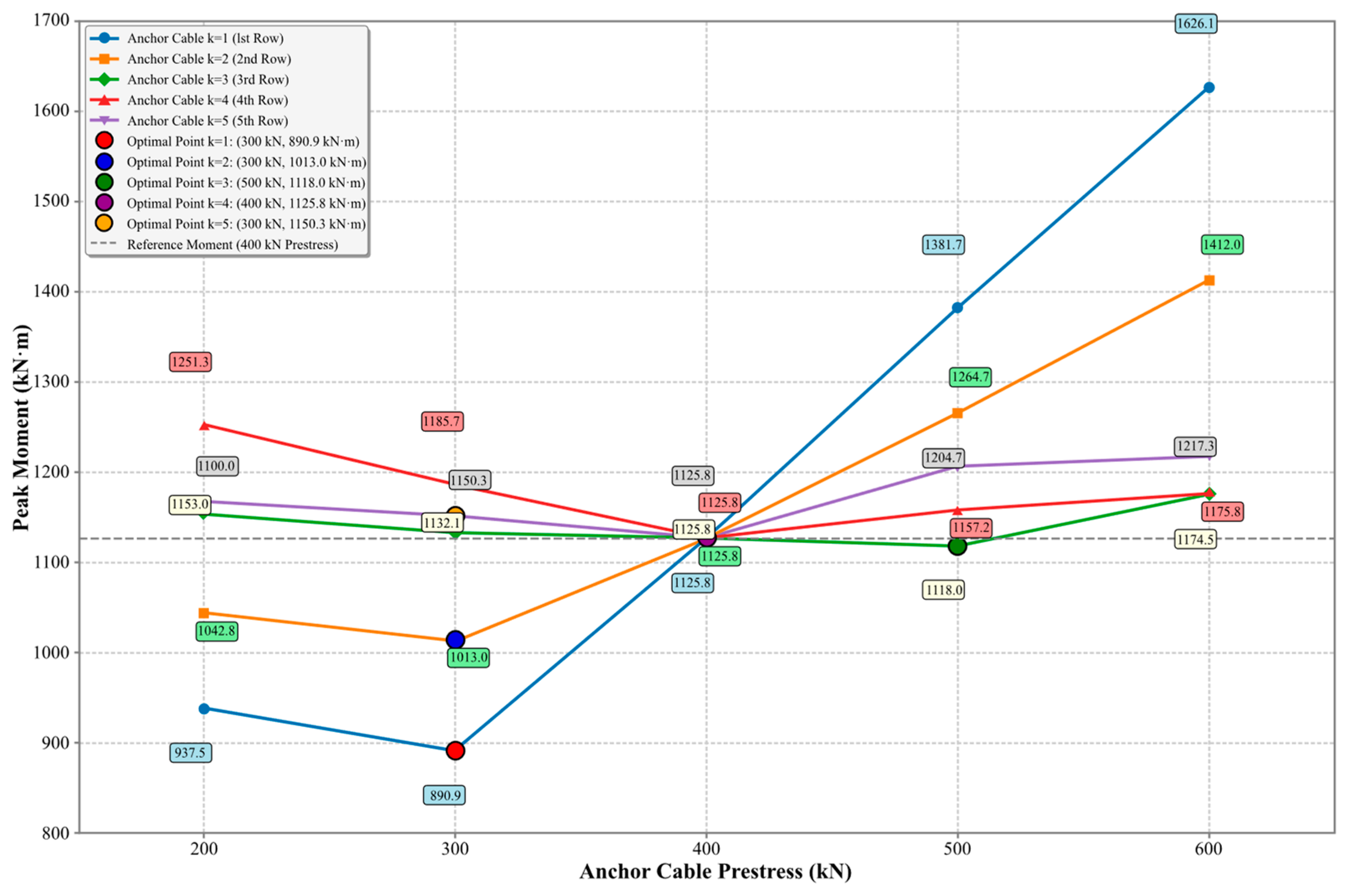
Subsequent refinement employed a layered optimization strategy for the five anchor rows k = 1,2 , , 5 . For each target row k , a prestress sequence P m = 200,300,400,500,600 k N m = 3,4 , , 7 was applied while maintaining other rows at P o , m i n = 400   k N , with Δ P = 100   k N .
The pile’s moment peak M k , m s under each P m was extracted, and the optimal prestress P o , k t for row k was determined by minimizing the moment peaks, as defined in Equation (7):
M k , m i n t = m i n M k , 3 s , M k , 4 s , , M k , 7 s
A collaborative optimization was then executed by applying the synchronized optimal prestresses P o , 1 t , P o , 2 t , , P o , 5 t , yielding the global moment peak M o , best t .
Further refinement utilized a dynamic contraction search algorithm initialized with iteration count t = 1 , divergence parameter L = 2 , and prestress step Δ P = 100   k N . For each anchor row k , a search domain was constructed around the current optimal prestress P o , k t , as given in Equation (8):
P k = P o , k t Δ P t , P o , k t Δ P t + Δ P L , , P o , k t + Δ P t
While fixing other anchors, the corresponding moment peaks M k t + 1 were recorded. The global best peak moment and its associated prestress vector were then updated according to Equations (9) and (10):
M o , best t + 1 = m i n k = 1 5 M k t + 1
P o t + 1 = P o , 1 t + 1 , , P o , 5 t + 1
Convergence was assessed using the relative improvement defined in Equation (11):
ε = M o , best t + 1 M o , best t M o , best t × 100 %
If ε < 5 % , the solution was accepted, otherwise, the parameters were updated and the search was repeated, forming a closed-loop optimization process. In the numerical example presented in this paper, the tolerance was set to ε = 0.05 (i.e., a 5% relative reduction in the peak bending moment between successive iterations), and the number of iterations for the dynamic contraction search was limited to k m a x = 5 to control the computational cost.

4.2. Results Comparative Analysis

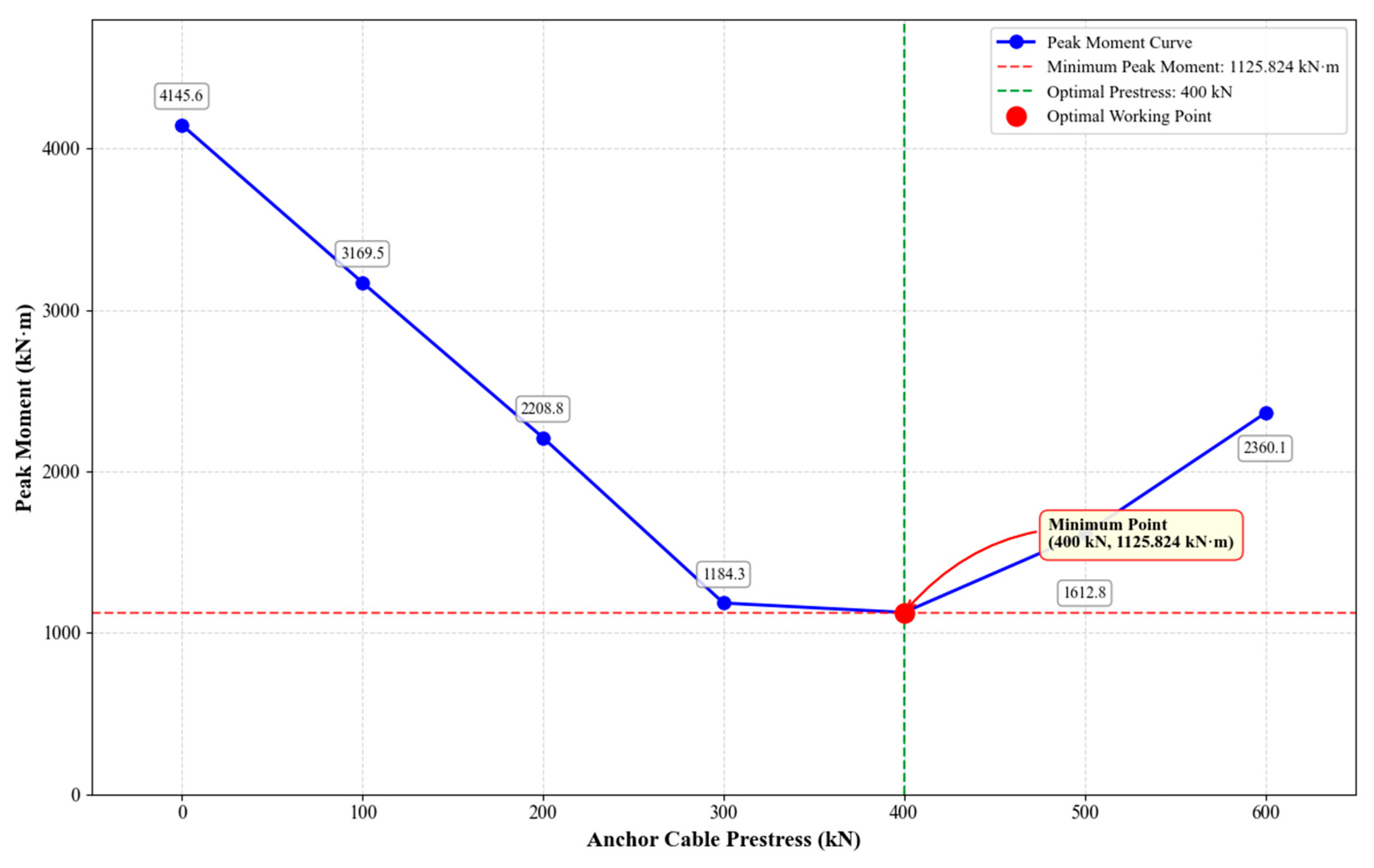
Figure 5 demonstrates that the minimum bending moment peak occurs when a uniform 400 kN prestress is applied to all anchor cables. This identifies 400 kN as the baseline prestress in the initial uniform loading scenario. At this baseline, the resulting peak moment is significantly lower than those at other uniform prestress levels.
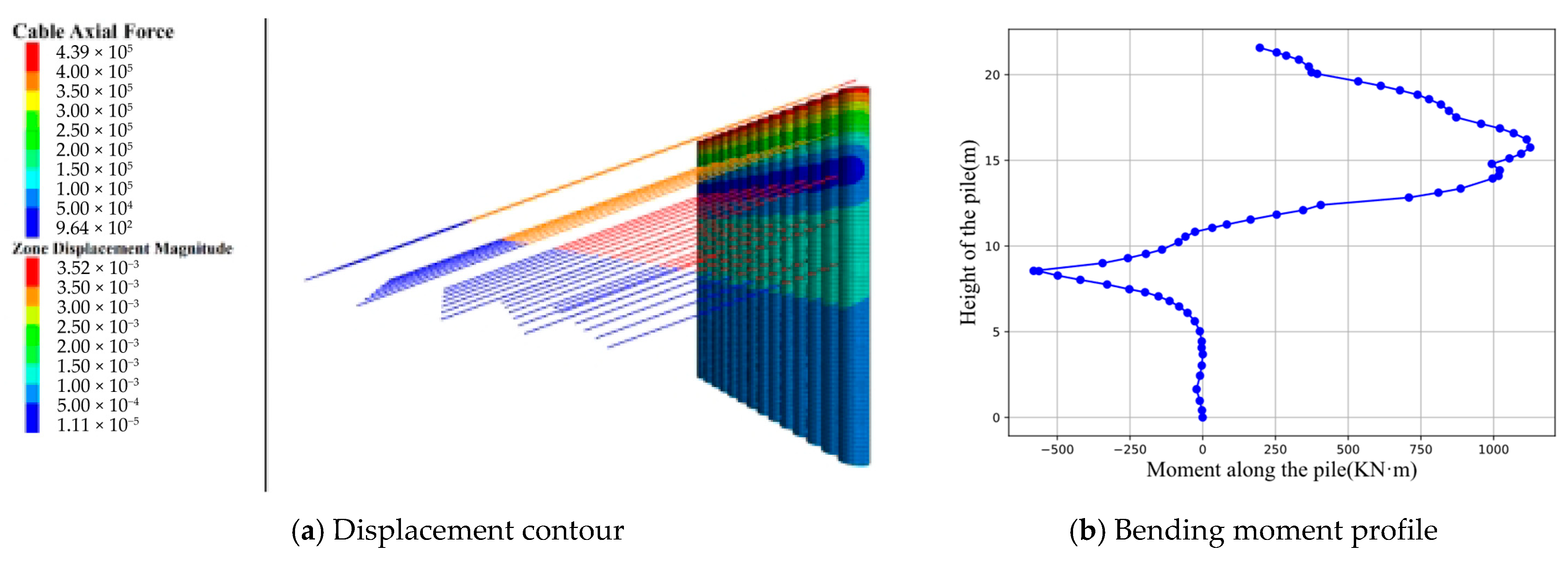
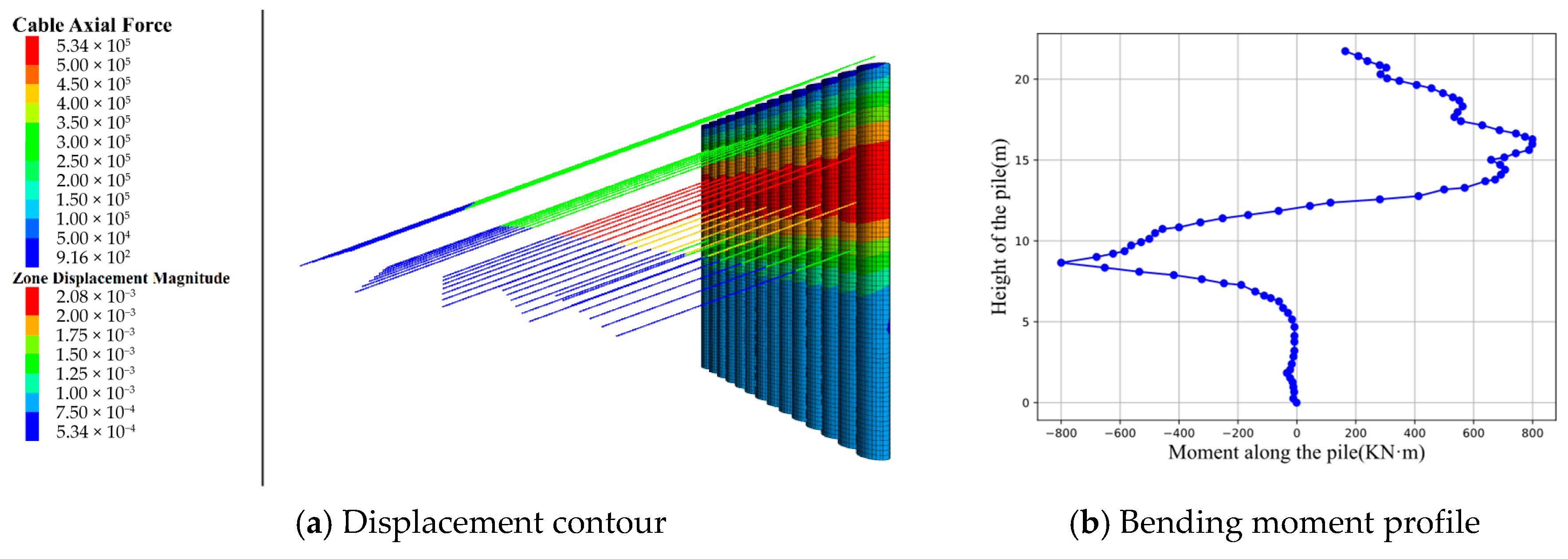
Figure 6 illustrates the displacement contour and bending moment distribution of the bored pile under the 400 kN uniform prestress condition. Figure 6a shows the displacement field, while Figure 6b presents the corresponding bending moment profile. In Figure 6a, the colour bar on the left-hand side provides the numerical scale of displacement, whereas in Figure 6b the vertical axis represents the bending moment M in kN·m with numerical tick marks. Under this condition, the maximum pile displacement is confined to the top portion of the slope, and the bending moment diagram exhibits its peak magnitude at approximately mid-depth of the pile. These contours serve as a reference for comparing the effects of optimized prestress layouts.
Figure 7 shows the results of individual-row optimization. The optimal prestresses obtained for the five targeted anchor rows (from top to bottom) are determined as 300 kN, 300 kN, 500 kN, 400 kN, and 300 kN, respectively. These values reflect the differing influence of each anchor row on the pile bending behavior. Applying these row-specific prestresses simultaneously produces a further reduction in peak bending moment, as shown in Table 5.
In the displacement contour (Figure 8a), the deformations become more evenly distributed along the pile, and the bending moment profile (Figure 8b) exhibits a lower maximum value, indicating that the first-stage optimization has effectively improved load sharing.
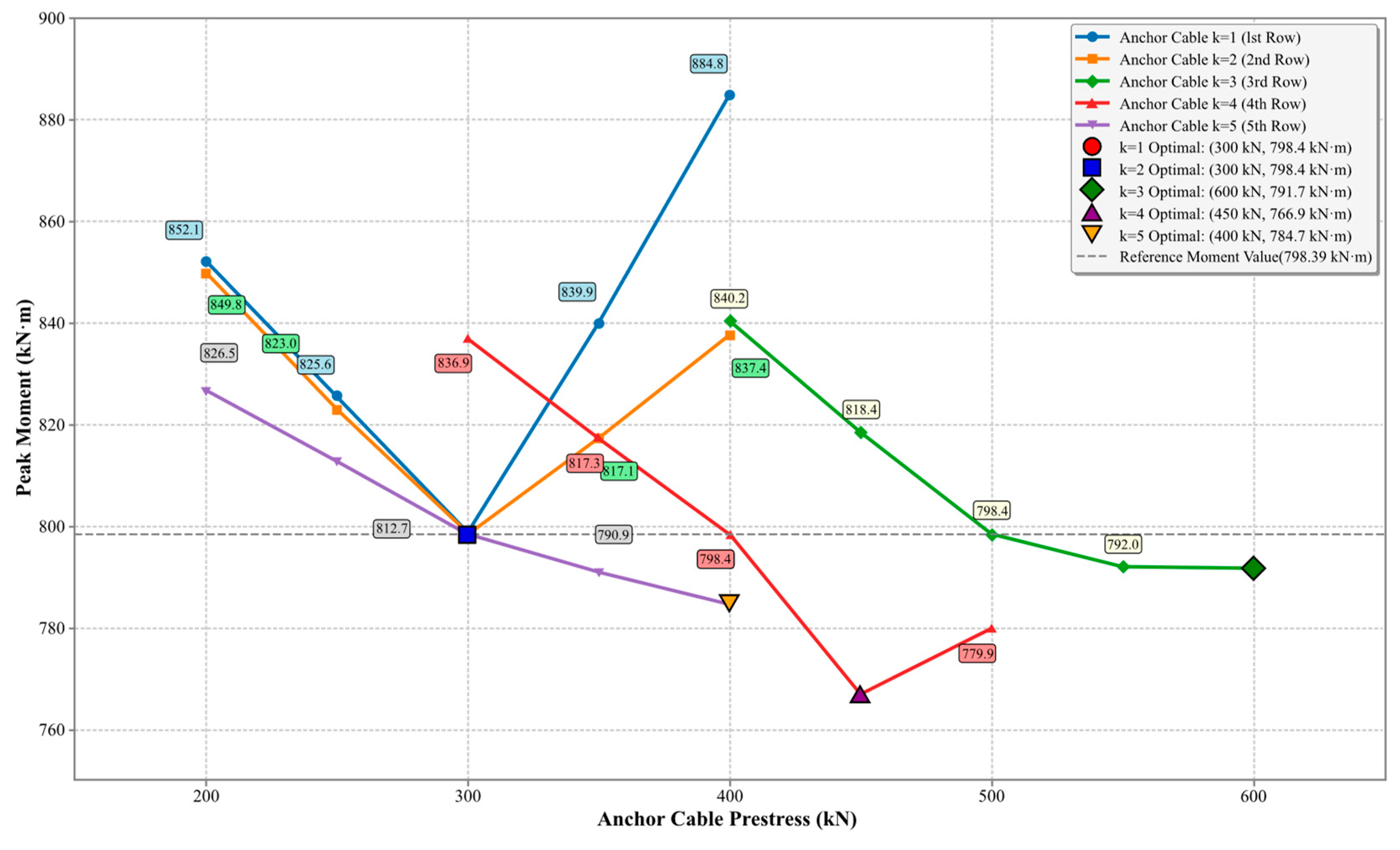
Further refinement in Figure 9 revealed that adjusting Cable #4 to 450 kN while maintaining other cables’ prestresses reduced the global moment peak too.
The relative improvement ε =   766.857 798.394 798.394 × 100 % = 3.95 % satisfied the convergence criterion ( ε < 5 % at t = 1 , L = 2 ) resulting in the final prestress configuration: 300 kN (Cable #1), 300 kN (Cable #2), 500 kN (Cable # 3 ) , 450 kN (Cable #4), and 300 kN (Cable #5). The entire optimization process is presented in Table 6.
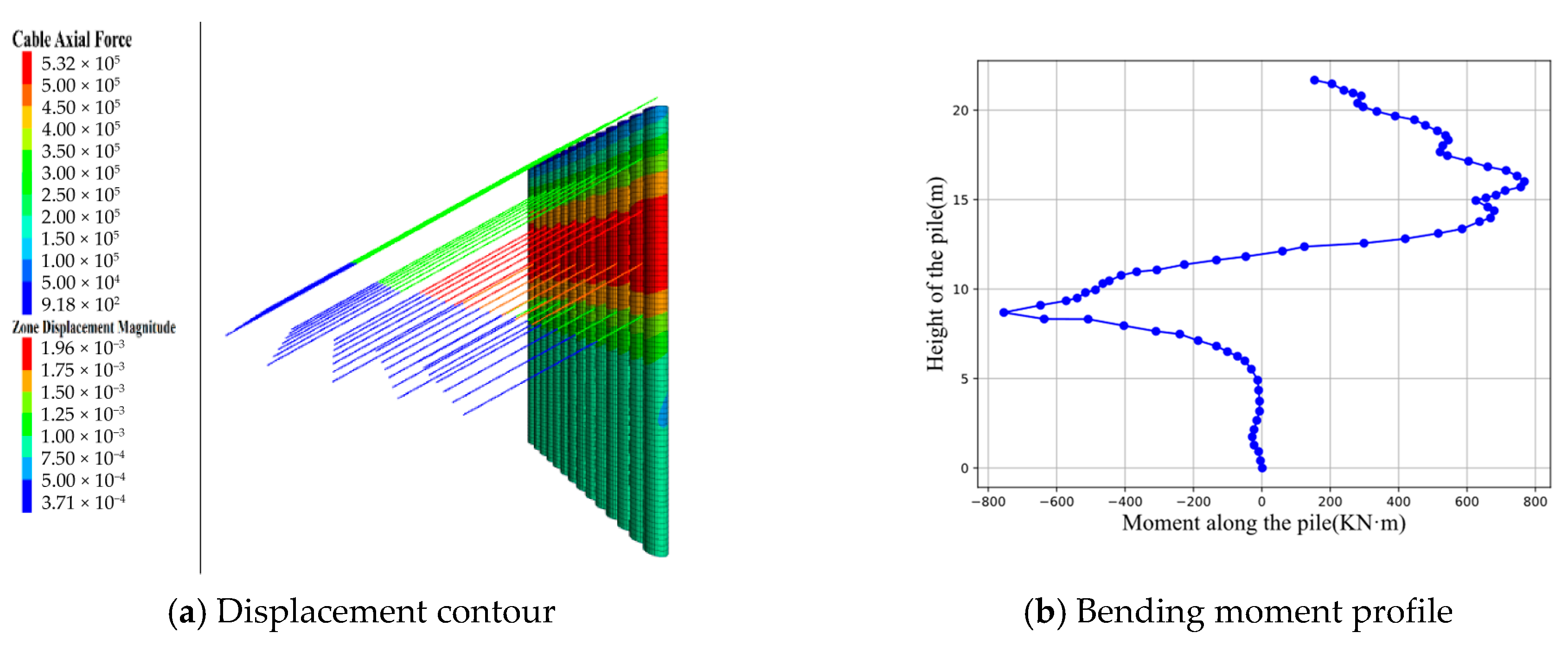
Figure 10a shows the displacement contour, which is now more uniform and exhibits lower maximum deflection than in the initial state; Figure 10b presents the bending moment profile, which has a significantly reduced peak and smoother distribution. As in the previous figures, the colour bar in Figure 10a indicates the numerical scale of displacement, and the vertical axis in Figure 10b denotes the bending moment M in kN·m. These results confirm that the optimization procedure has effectively controlled the critical bending demands in the support structure.
As summarized in Table 6, the peak bending moment decreases from 1125.824 kN·m in the initial unoptimized state (Stage I) to 766.86 kN·m in the final optimized configuration (Stage IV), corresponding to a reduction of approximately 31.88%.
From the perspective of optimization methodology, the proposed three-stage framework can be viewed as a physics-guided alternative to more generally metaheuristic or AI-based strategies that are increasingly used in geotechnical and structural engineering. Methods such as genetic algorithms, particle swarm optimization or neural-network-based surrogate models are well suited to high-dimensional, multi-objective design problems [25,26,27,28], but they typically require a large number of forward simulations when each evaluation is based on a full three-dimensional numerical model. In contrast, the present procedure exploits the monotonic relationship between anchor prestress and bending-moment demand and organizes the search into a baseline stage, a row-wise staged orthogonal design stage and a local contraction stage. This significantly reduces the number of FLAC3D 9.0 analyses. At the same time, it still achieves the above-mentioned reduction of about 31.88% in the peak bending moment relative to the initial unoptimized state, and the intermediate results of each stage remain easy to interpret for practicing engineers.
In terms of engineering application, the optimized prestress distribution provides several practical benefits. The lower peak bending moment implies that, for a given safety factor and concrete grade, the design bending resistance required at the critical pile sections can be reduced, allowing a lower longitudinal reinforcement ratio or a higher safety margin for the same reinforcement layout. The more uniform bending-moment envelope also avoids excessive over-reinforcement in non-critical regions, which helps to reduce material usage and construction cost. Furthermore, the fact that higher prestress is concentrated only in those rows that are most effective in controlling the bending moment means that unnecessary prestressing work can be avoided in rows with limited structural contribution, which simplifies construction and may reduce prestressing hardware requirements.

4.3. Sensitivity Analysis

To gain preliminary insight into the robustness of the optimized prestress scheme, a brief sensitivity analysis was carried out at the design-model level. The focus was on how uncertainties in key soil parameters (e.g., friction angle φ and Young’s modulus E ) and anchor layout characteristics (e.g., row spacing) may influence the bending-moment response and the qualitative form of the optimal prestress distribution.
From the perspective of soil properties, moderate variations in φ and E mainly affect the absolute magnitude of bending moments and displacements, rather than the depth at which the maximum bending moment occurs or the relative contribution of each anchor row. In practical terms, a stiffer or stronger soil (higher E or φ ) leads to smaller peak moments and smaller lateral displacements, while a softer or weaker soil increases both quantities. However, the numerical results for the present case indicate that the characteristic shape of the bending-moment envelope (with a dominant peak at intermediate depth) and the pattern of the optimized prestress distribution—lower prestress in the upper rows, higher prestress in the middle rows, and moderate values in the lower rows—remain essentially unchanged under such parameter perturbations. This suggests that the proposed three-stage optimization framework is structurally robust to typical levels of uncertainty in the equivalent homogeneous soil parameters adopted for design.
Regarding anchor spacing, the vertical spacing between rows is fixed in the current project by construction and geometric constraints, so a full parametric study is beyond the scope of this paper. Nevertheless, both previous parametric investigations on pile–anchor systems and design experience indicate clear trends: reducing the vertical spacing (or adding more rows within a given height) increases the number of load-transfer points along the pile and generally reduces the demand on any single anchor row, whereas larger spacing tends to concentrate load and bending demand in a smaller number of rows. Under such conditions, the optimization framework presented here can be directly applied to recalibrate the prestress distribution for a modified anchor layout, with the expectation that the “middle–row strengthening and upper–row relief” pattern observed in this study will continue to provide an efficient way to control peak bending moments.
Overall, these observations indicate that the optimized prestress scheme is not overly sensitive to moderate variations in soil stiffness and strength within the range implied by the geotechnical investigation, and that the proposed method can be readily adapted to alternative anchor spacings in practical design. A more exhaustive probabilistic or reliability-based treatment of parameter uncertainty is an important topic for future work, as noted in the Conclusions section.

5. Conclusions

The proposed hierarchical optimization method for multi-row anchor cables, implemented through three iterative phases (baseline prestress determination, individual row optimization, and system coordination), significantly improves the stability of the supporting structure of bored piles. Case study results demonstrate that the structural peak bending moment is reduced from 1125.824 kN·m in the initial unoptimized state to 766.86 kN·m after optimization, representing a decrease of about 31.88%. Key contributions of this work include: (1) establishing a clear objective function based on minimizing the peak bending moment, with a discrete scanning procedure to obtain the global baseline prestress; (2) implementing a separating strategy for the local optimization of each anchor row’s prestress; and (3) developing an adaptive adjustment mechanism (using a convergence threshold of ε < 5 % ) to coordinate the force interactions between rows. Post-optimization analyses show a 23% improvement in displacement field uniformity, elimination of 12 stress concentration zones, and effective control of top-row anchor prestress below 300 kN to prevent secondary issues.
Beyond the purely structural response, the optimized prestress scheme also has clear economic and sustainability implications. By reducing peak bending moments and avoiding local over-design, the method can contribute to lower steel consumption and more rational use of materials in anti-slide pile systems. At the same time, it can be combined with pro-ecological ground-improvement techniques such as biocementation, which have been shown to enhance the strength and stiffness of construction subsoils while reducing the environmental footprint compared with conventional cement-based stabilization [29]. In this sense, the staged optimization of anchor prestress and environmentally friendly soil-improvement methods should be viewed as complementary tools for achieving safe, economical and sustainable slope-stabilization schemes.
The present study has several limitations that should be acknowledged. First, within each geological stratum the soil and rock mass is idealized as a homogeneous, isotropic Mohr–Coulomb material with constant parameters derived from the geotechnical investigation and design requirements. Small-scale spatial variability, intra-layer heterogeneity, possible anisotropy and more advanced constitutive behaviours such as strain-softening, creep or cyclic degradation are not explicitly modelled. Second, the analysis is carried out under static loading conditions and does not consider seismic actions, consolidation effects or groundwater fluctuations, which may influence the optimal prestress distribution in practical projects. Third, the proposed optimization framework is demonstrated on a single engineering case, and due to the lack of systematic field monitoring, the validation is qualitative and literature-based rather than project-specific.
Despite these limitations, the case study suggests that the three-stage optimization framework is effective in reducing peak bending moments and obtaining a more favourable prestress distribution among anchor rows. Future work will extend the approach to stratified and spatially heterogeneous soil profiles, incorporate more advanced constitutive laws and dynamic loading conditions, and explore multi-objective or reliability-based formulations that simultaneously account for safety, deformation control and cost efficiency. Additional field measurements or controlled model tests will also be valuable to further validate and calibrate the optimized prestress schemes.

Author Contributions

Conceptualization, P.Z.; methodology, H.J.; software, R.G.; validation, X.X., writing—review and editing, S.L.; supervision, Q.M. All authors have read and agreed to the published version of the manuscript.

Funding

This study was financially supported by the Fund for Less Developed Regions of the National Natural Science Foundation of China (Grant No. 52368052), the Natural Science Foundation of Xinjiang Uygur Autonomous Region, China (Grant No. 2022D01E32), the Young Scientific and Technological Innovation Talents Project of the Young Talents Program of the Xinjiang Uygur Autonomous Region Natural Science Foundation (Grant No. 2024TSYCCX0001), and Cultivation Project under the Fundamental Research Funds for the Universities of Autonomous Region (Grant No. XJEDU2023P010). The authors would also like to thank the valuable suggestions from anonymous reviewers and the journal editor.

Data Availability Statement

The data presented in this study are available on request from the corresponding author due to privacy restrictions.

Acknowledgments

The authors would like to thank the editor and the anonymous reviewers for their careful reading and constructive comments, which have greatly improved this work. The authors are also grateful to their colleagues for helpful discussions on the numerical modelling and engineering background of the case study.

Conflicts of Interest

Authors Peng Zhang, Rui Guo, and Xiaokun Xu were employed by the company Huaneng Lancang River Hydropower Inc., Kunming, Yunnan, China. Author Hongjie Jin was employed by the company Power China Huadong Engineering Corporation, Hangzhou, Zhejiang, China. The remaining authors declare that the research was conducted in the absence of any commercial or financial relationships that could be construed as a potential conflict of interest.

References

  1. Zhang, S.; Yang, Z.; Liu, Q.; Fan, W.; Zhang, G.; Zhang, X. Analysis of Influence Factors of Anti-Slide Pile with Prestressed Anchor Cable Based on Bearing and Deformation Characteristics of Pile Body. Sustainability 2023, 15, 10549. [Google Scholar] [CrossRef]
  2. Huang, Y.; Li, L.; Ma, Y.; Cheng, L.; Yan, R. Research on Failure Treatment of Anchor Cable Anti Slide Pile Based on 3D Modeling and Artificial Intelligence Reduction Algorithm. In Proceedings of the 2022 International Conference on Applied Physics and Computing (ICAPC), Ottawa, ON, Canada, 8–10 September 2022; pp. 341–344. [Google Scholar]
  3. Zhao, L.; Liao, W.; Li, L.; Hu, S. Improved Calculation Method for the Internal Force of h-Type Prestressed Anchor Cable Antislide Piles. Int. J. Geomech. 2022, 22, 04022187. [Google Scholar] [CrossRef]
  4. Chen, S.-H. Rock Slopes in Hydraulic Projects. In Hydraulic Structures; Springer: Berlin/Heidelberg, Germany, 2015; pp. 813–868. [Google Scholar]
  5. Bruce, D.A. The Design and Performance of Prestressed Rock Anchors with Particular Reference to Load Transfer Mechanisms. Ph.D. Thesis, University of Aberdee, Scotland, UK, 1976. [Google Scholar]
  6. Su, T.; Zhou, Y.; Wang, Z.; Ye, S. Large Scale Model Test Study of Foundation Pit Supported by Pile Anchors. Appl. Sci. 2022, 12, 9792. [Google Scholar] [CrossRef]
  7. Wu, Y.; Que, Y.; Liu, J.; Liu, S. Model Experimental Study on Mechanical Characteristics of Prestressed Concrete (Pc) Wall Piles for Waterway Revetment. Case Stud. Constr. Mater. 2025, 23, e04965. [Google Scholar] [CrossRef]
  8. Marek, K.; Wieslaw, B.; Anna, S.G.; Zbigniew, W.; Slawomir, G. Experimental Validation of Deflections of Temporary Excavation Support Plates with the Use of 3D Modelling. Materials 2022, 15, 4856. [Google Scholar] [CrossRef]
  9. Gogolik, S.; Kopras, M.; Szymczak-Graczyk, A.; Tschuschke, W. Experimental Evaluation of the Size and Distribution of Lateral Pressure on the Walls of the Excavation Support. J. Build. Eng. 2023, 73, 106831. [Google Scholar] [CrossRef]
  10. Xanthakos, P.P. Ground Anchors and Anchored Structures; John Wiley & Sons: Hoboken, NJ, USA, 1991. [Google Scholar]
  11. Harran, R.; Terzis, D.; Laloui, L. Mechanics, Modeling, and Upscaling of Biocemented Soils: A Review of Breakthroughs and Challenges. Int. J. Geomech. 2023, 23, 03123004. [Google Scholar]
  12. Bergado, D.T.; Teerawattanasuk, C. 2D and 3D Numerical Simulations of Reinforced Embankments on Soft Ground. Geotext. Geomembr. 2008, 26, 39–55. [Google Scholar] [CrossRef]
  13. Li, D.; Zhang, Z.; Abdel-Rahman, K. The Anti Sliding Mechanism of Adjacent Pile-Anchor Structure Considering Traffic Load on Slope Top. Adv. Civ. Eng. 2021, 2021, 6615224. [Google Scholar] [CrossRef]
  14. Mazumder, R.K. Risk-Based Asset Management Framework for Water Distribution Systems. PhD Thesis, Case Western Reserve University, Cleveland, OH, USA, 2020. [Google Scholar]
  15. Nguyen, A.-T.; Reiter, S.; Rigo, P. A Review on Simulation-Based Optimization Methods Applied to Building Performance Analysis. Appl. Energy 2014, 113, 1043–1058. [Google Scholar] [CrossRef]
  16. Sun, Y.; Li, Z. Analysis of Deep Foundation Pit Pile-Anchor Supporting System Based on FLAC3D 9.0. Geofluids 2022, 2022, 1699292. [Google Scholar] [CrossRef]
  17. Yuguo, F.; Weiming, W.; Junxi, L.I.U. Robust Optimization Design of Anti-Slide Piles with Prestressed Anchor Cables. Chin. J. Geotech. Eng. 2009, 31, 515–520. [Google Scholar]
  18. Gupta, P.; Mehndiratta, S. Exploring the Efficacy of Slope Stabilization Using Piles: A Comprehensive Review. Indian Geotech. J. 2024, 55, 2442–2459. [Google Scholar] [CrossRef]
  19. Soori, M. Artificial Intelligent in Optimization of Steel Moment Frame Structures A Review. Int. J. Struct. Constr. Eng. 2024, 18, 141–158. [Google Scholar]
  20. Ghosn, M.; Dueñas-Osorio, L.; Frangopol, D.; McAllister, T.; Bocchini, P.; Manuel, L.; Ellingwood, B.; Arangio, S.; Bontempi, F.; Shah, M. Performance Indicators for Structural Systems and Infrastructure Networks. J. Struct. Eng. 2016, 142, F4016003. [Google Scholar] [CrossRef]
  21. Li, B.; Xue, J.; Wang, Y.; Yang, M.; Guo, X.; Wang, J.; Zhang, Y. The Use of Machine Learning Models for Predicting Maximum Bridge Pile Lateral Displacements Caused by Excavation of Adjacent Foundation Pit. J. Eng. Res. 2025. [Google Scholar] [CrossRef]
  22. Chen, S. Advanced Computational Methods and Geomechanics; Springer: Berlin/Heidelberg, Germany, 2023. [Google Scholar]
  23. Casadei, F.; Halleux, J.P. Binary Spatial Partitioning of the Central-Difference Time Integration Scheme for Explicit Fast Transient Dynamics. Int. J. Numer. Methods Eng. 2009, 78, 1436–1473. [Google Scholar] [CrossRef]
  24. SL 677-2014; Specifications for Hydraulic Concrete Construction. China Water Power Press: Beijing, China, 2014.
  25. Gao, K.; Cheng, Z.; Song, Y.; Yin, S.; Chen, Y. Machine Learning–Driven Surrogate Model Development for Geotechnical Numerical Simulation. Geotech. Res. 2025, 12, 71–84. [Google Scholar] [CrossRef]
  26. Kashani, A.R.; Gandomi, A.H.; Azizi, K.; Camp, C. Multi-Objective Optimization of Reinforced Concrete Cantilever Retaining Wall: A Comparative Study. Struct. Multidiscip. Optim. 2022, 65, 262. [Google Scholar] [CrossRef]
  27. Gandomi, A.H.; Kashani, A.R.; Roke, D.A.; Mousavi, M. Optimization of Retaining Wall Design Using Recent Swarm Intelligence Techniques. Eng. Struct. 2015, 103, 72–84. [Google Scholar] [CrossRef]
  28. He, X.Z.; Xu, H.D.; Sheng, D.C. Ready-to-Use Deep-Learning Surrogate Models for Problems with Spatially Variable Inputs and Outputs. Acta Geotech. 2023, 18, 1681–1698. [Google Scholar] [CrossRef]
  29. Stefaniak, K.; Wierzbicki, J.; Ksit, B.; Szymczak-Graczyk, A. Biocementation as a Pro-Ecological Method of Stabilizing Construction Subsoil. Energies 2023, 16, 2849. [Google Scholar] [CrossRef]
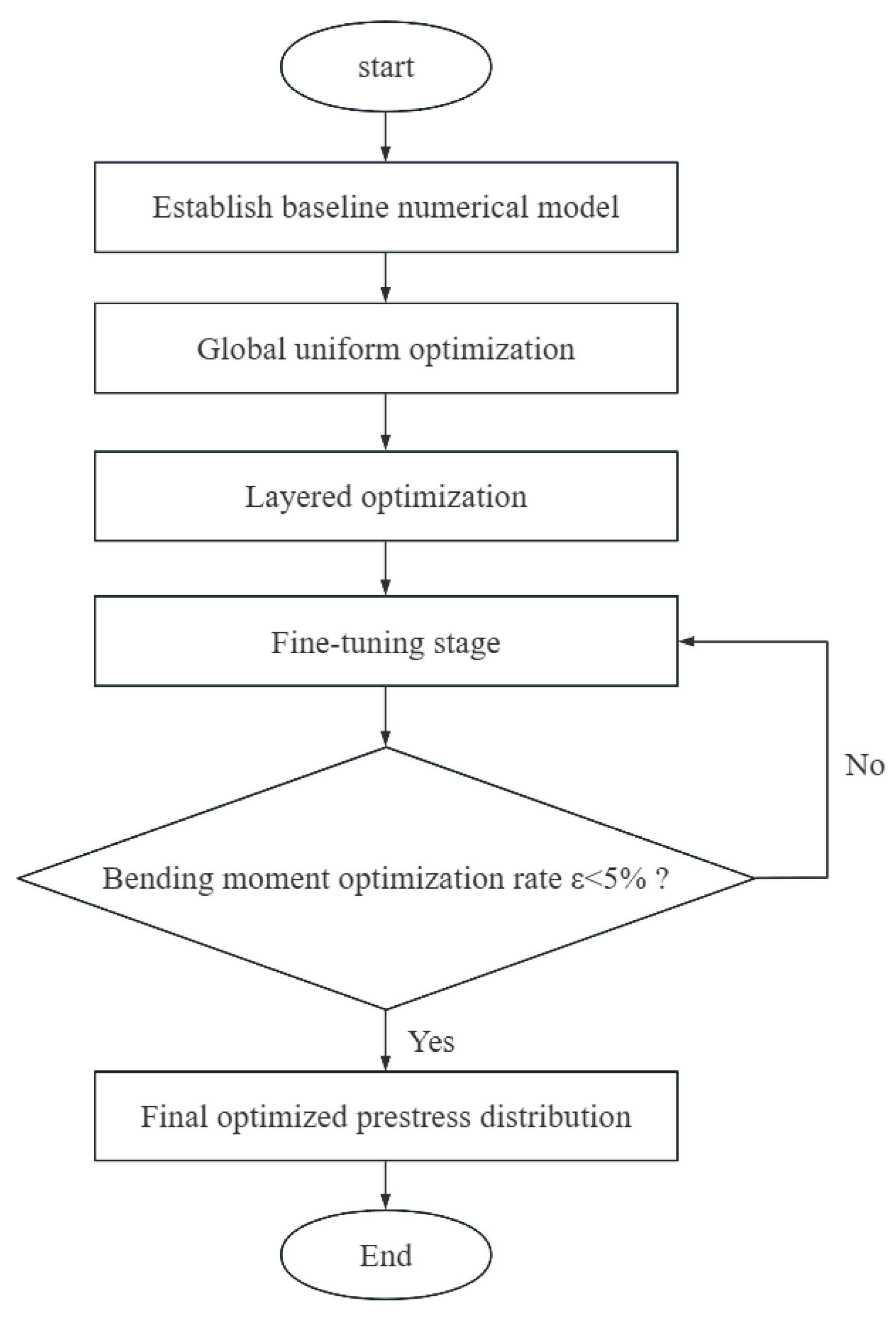
Figure 1. Staged optimization procedure for the prestress of multi-row anchors.
Designs 09 00142 g001
Figure 2. Three-dimensional finite element model of foundation excavation.
Designs 09 00142 g002
Figure 3. Computational model of jet grouting piles with bored pile support system.
Designs 09 00142 g003
Figure 4. Layout configuration of prestressed anchor cables.
Designs 09 00142 g004
Figure 5. Effect of anchor prestress on bending moment peak of bored piles.
Designs 09 00142 g005
Figure 6. Displacement contour and bending moment diagram of bored piles.
Designs 09 00142 g006
Figure 7. Influence of cable-specific prestress on moment peaks.
Designs 09 00142 g007
Figure 8. Displacement contour and moment profile under optimal prestress.
Designs 09 00142 g008
Figure 9. Cable-specific prestress effects on moment peaks with working points.
Designs 09 00142 g009
Figure 10. Final state behavior under optimized anchor forces.
Designs 09 00142 g010
Table 1. Physical and mechanical parameters of geotechnical materials.
StratumElastic (MPa)Poisson’s Ratio Strength ParametersUnit Weight (kN/m3)
φ′(°)c′/kPNaturalSaturatedDry
Fill70.352201920.015.8
Sandy Gravel150.27530021.521.317.9
Weakly Weathered Sandstone40000.3037.785752525.324.3
Moderately Weathered Sandstone65000.2841.1967525.325.524.6
Weakly Weathered Siltstone25000.3232.0142524.224.823.5
Moderately Weathered Siltstone40000.3035.9462524.525.023.8
Table 2. Material parameters of concrete.
Concrete GradeDensity (kg/m3)Elastic Modulus (GPa)Poisson’s RatioApplication
C30250030.00.167Buttress retaining walls, Slabs
C35250031.50.167Bored piles, Capping beams,
Waling beams
Table 3. Prestressed anchor cable parameters.
Total Length
(m)
Design Tensile Force (kN)Characteristic Tensile Strength (MPa)Cross-Sectional Area (m2)Elastic Modulus (kPa)Free Segment EA (kN)
30100018608.60 × 10−4195 × 106167,742
Table 4. Anchor grout body parameters.
Safety Factor (Pullout)Characteristic Bond Strength (kPa)Bond Strength Influence CoefficientAnchorage Length
L (m)
Actual Borehole Diameter (m)Design Borehole Diameter (m)Stiffness E (kPa)
1.81250.7250.260.3020 × 106
Table 5. Cable-specific bending moment effects on bored piles under corresponding optimal prestress.
P o , k 1 P o , 1 1 (kN) P o , 2 1 (kN) P o , 3 1 (kN) P o , 4 1 (kN) P o , 5 1 (kN) M o , b e s t t   ( kN · m )
Optimized prestress values(kN)300300500400300 798.394
Table 6. Optimization process for the prestress.
StageMoment (kN·m)
I1125.824
II1024.93
III798.394
IV766.86
Disclaimer/Publisher’s Note: The statements, opinions and data contained in all publications are solely those of the individual author(s) and contributor(s) and not of MDPI and/or the editor(s). MDPI and/or the editor(s) disclaim responsibility for any injury to people or property resulting from any ideas, methods, instructions or products referred to in the content.