Article

Solar-Thermal Process Intensification for Blue Hydrogen Production: Integrated Steam Methane Reforming with a Waste-Derived Red Mud Catalyst


1
Mechanical and Energy Engineering Department, Imam Abdulrahman Bin Faisal University, Dammam 31441, Saudi Arabia
2
Global Health Education and Policy Alliance (GHEPA), Rue de Chantepoulet 10, 1201 Geneva, Switzerland
3
Institute for Research and Medical Consultations (IRMC), Imam Abdulrahman Bin Faisal University, Dammam 31441, Saudi Arabia
*
Author to whom correspondence should be addressed.
Designs 2025, 9(6), 138; https://doi.org/10.3390/designs9060138
Submission received: 17 September 2025 / Revised: 14 November 2025 / Accepted: 25 November 2025 / Published: 28 November 2025
(This article belongs to the Section Energy System Design)

Abstract

The transition to low-carbon energy systems necessitates innovative design strategies for decarbonizing hydrogen production, particularly in industrial-scale applications where steam methane reforming (SMR) remains predominant. This study proposes a novel, integrated process design for blue hydrogen production that addresses both energy and environmental sustainability through process intensification and resource valorization. A hybrid system was developed that combines solar thermal energy input with the catalytic potential of industrial waste, specifically, red mud, a byproduct of alumina refining. A solar parabolic dish (SPD) was engineered to contribute 10% of the heat demand, generating superheated steam at 477 °C. This work serves as a proof-of-concept, demonstrating the technical viability of integration at a bench scale. In parallel, red mud was characterized, thermochemically activated, and formulated into a low-cost catalyst for the SMR process. The integrated system includes solar-assisted steam generation, red mud-based catalytic reforming, CO2 capture using methyl diethanolamine (MDEA), and hydrogen purification via pressure swing adsorption (PSA). The full process was modeled and optimized using ASPEN Plus, ASPEN Adsorption, and COMSOL Multiphysics® Under optimal conditions (900 °C, 25 bar, steam-to-carbon ratio of 3), the system produced 1070 kg/h of hydrogen, achieving 95% CO2 capture efficiency and 99.99% hydrogen purity. Techno-economic analysis revealed the red mud-derived catalyst costs 3.89 SAR/g (1.04 USD/g), a 77% cost reduction compared to conventional Ni-based catalysts. The integration of solar thermal energy, while offering modest direct economic savings of approximately 9500 SAR (2530 USD) annually, primarily demonstrates the technical feasibility of renewable heat integration for reducing the carbon intensity of hydrogen production.

1. Introduction

The global energy sector is undergoing a profound transformation to mitigate climate change, with hydrogen emerging as a cornerstone enabler for decarbonizing hard-to-abate industrial and transportation sectors [1,2]. Currently, over 70% of the global hydrogen supply is met by steam methane reforming (SMR), a process characterized by high energy demand (800–1000 °C) and significant CO2 emissions, resulting in what is conventionally termed “gray” hydrogen [3,4,5]. The transition to “blue” hydrogen, where carbon capture, utilization, and storage (CCUS) is applied to the SMR process, is a crucial interim solution on the path to a fully renewable “green” hydrogen economy [6,7].
However, the economic viability of blue hydrogen is challenged by the high capital and operational expenditures (CAPEX/OPEX) associated with both the reforming process itself, particularly the catalyst, the fuel consumption, and the integration of CCUS technologies [8]. Process intensification through the integration of renewable energy, such as concentrated solar power (CSP) for providing high-temperature process heat, presents a promising avenue to reduce the fossil fuel consumption and associated emissions of SMR [9,10,11]. Concurrently, the circular economy paradigm encourages the valorization of industrial waste into valuable resources, thereby reducing environmental burdens and process costs [12].
A prime example of such waste is red mud (bauxite residue), an alkaline, iron-rich byproduct generated in vast quantities (estimated global stockpiles exceed 4 billion tons) from the Bayer process for alumina production [13]. Its storage poses serious environmental risks due to its high alkalinity and potential for leaching, but its composition, primarily Fe2O3, Al2O3, TiO2, and SiO2, endows it with properties suitable for catalytic applications, potentially offering a low-cost alternative to expensive conventional nickel-based SMR catalysts [14,15,16].
While previous studies have explored solar-assisted SMR [9,11] or red mud catalysis [14,16] in isolation, a holistic integration of these concepts with full downstream processing has not been thoroughly investigated from a rigorous techno-economic perspective. This work bridges this gap by presenting a comprehensive analysis of an intensified blue hydrogen process that combines: (i) solar-thermal steam generation via a parabolic dish, (ii) SMR catalysis using processed red mud, and (iii) full-scale CO2 capture and H2 purification. It is important to note that the presented model serves as a proof-of-concept to demonstrate integration viability, with a relatively small solar contribution. Scaling this contribution is a key focus for future work. The primary objectives are to design, model, and optimize this integrated system; to experimentally characterize the prepared red mud catalyst; and to conduct a rigorous techno-economic assessment to evaluate its viability, thereby highlighting the synergies between renewable energy integration and industrial waste valorization. It should be noted that the solar thermal integration in this study primarily serves as a proof-of-concept for renewable heat application in industrial processes, with carbon reduction as the primary benefit rather than direct economic savings.

2. Materials and Methods

2.1. Overall Process Design and Simulation

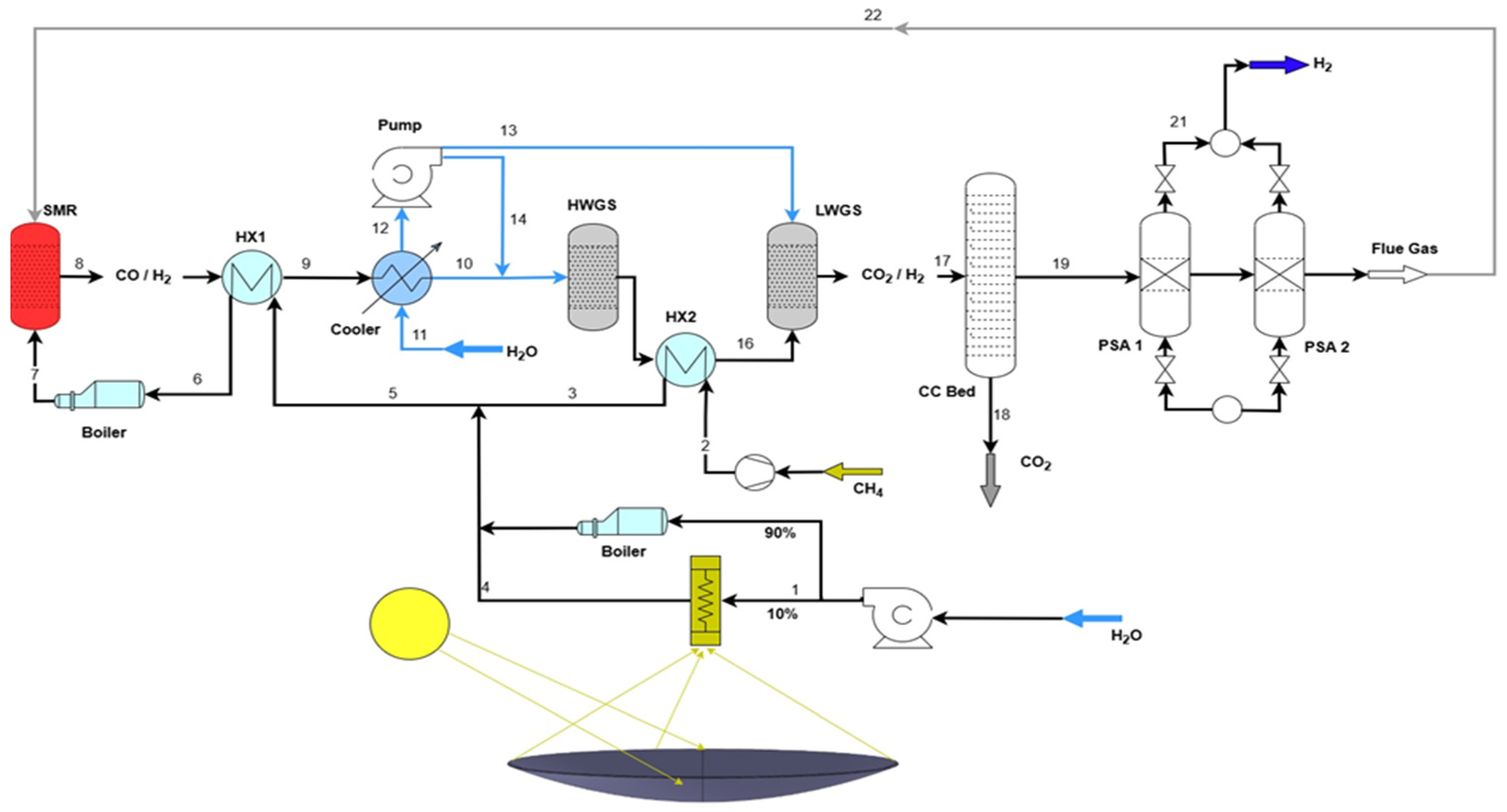
The integrated blue hydrogen production process was simulated using Advanced System for Process Engineering Plus software manufactured by Aspen Technology, Inc. (Bedford, MA, USA), ASPEN Plus Version 10. The overall flow sheet is shown in Figure 1.
The process encompassed the following key sections:
  • Feedstock Preparation: Natural gas (modeled as pure methane) and water were compressed to the system pressure of 25 bar.
  • Solar-Thermal Heating: Water was preheated and vaporized. A portion of this duty (10%) was supplied by a solar parabolic dish (SPD), modeled externally in COMSOL Multiphysics version 6.2 (Section 2.2). The SPD raised the steam temperature to 477 °C. The remaining 90% of the heat was supplied by a conventional natural gas-fired boiler. Methane was preheated separately to 500 °C using a boiler.
  • Reforming Section: The preheated methane and steam (S/C = 3) were mixed and further heated to 900 °C before entering an equilibrium-based SMR reactor (RGibbs model in ASPEN Plus). This model was selected to reflect the assumption of fast kinetics and thermodynamic equilibrium at the optimized high-temperature conditions [4].
  • Water-Gas Shift (WGS): The syngas effluent was cooled and passed through high-temperature (450 °C) and low-temperature (250 °C) shift reactors. These were modeled as stoichiometric reactors (RStoic) with a fixed CO conversion of 85% per stage, representing near-equilibrium operation as commonly applied in industrial design [17].
  • Carbon Capture: The CO2-rich stream was treated in an amine-based absorption column using a 50 wt.% methyl diethanol amine (MDEA) solution. The column was designed to achieve a CO2 capture efficiency of 95%, with the captured CO2 stream achieving 97% purity after regeneration in a distillation column and flash drum [18].
  • Hydrogen Purification: The decarbonized syngas was finally purified using a Pressure Swing Adsorption (PSA) unit, modeled in Advanced System for Process Engineering Adsorption software manufactured by Aspen Technology, Inc (US), ASPEN Adsorption version 10. A standard 4-bed, 12-step cycle was configured to produce hydrogen with a purity of 99.99% [19]. The PSA off-gas, rich in CH4 and CO, was recycled to the reformer furnace as fuel.
Key modeling assumptions and conditions for the major unit operations are summarized in Table 1.

2.2. Solar Parabolic Dish (SPD) Modeling

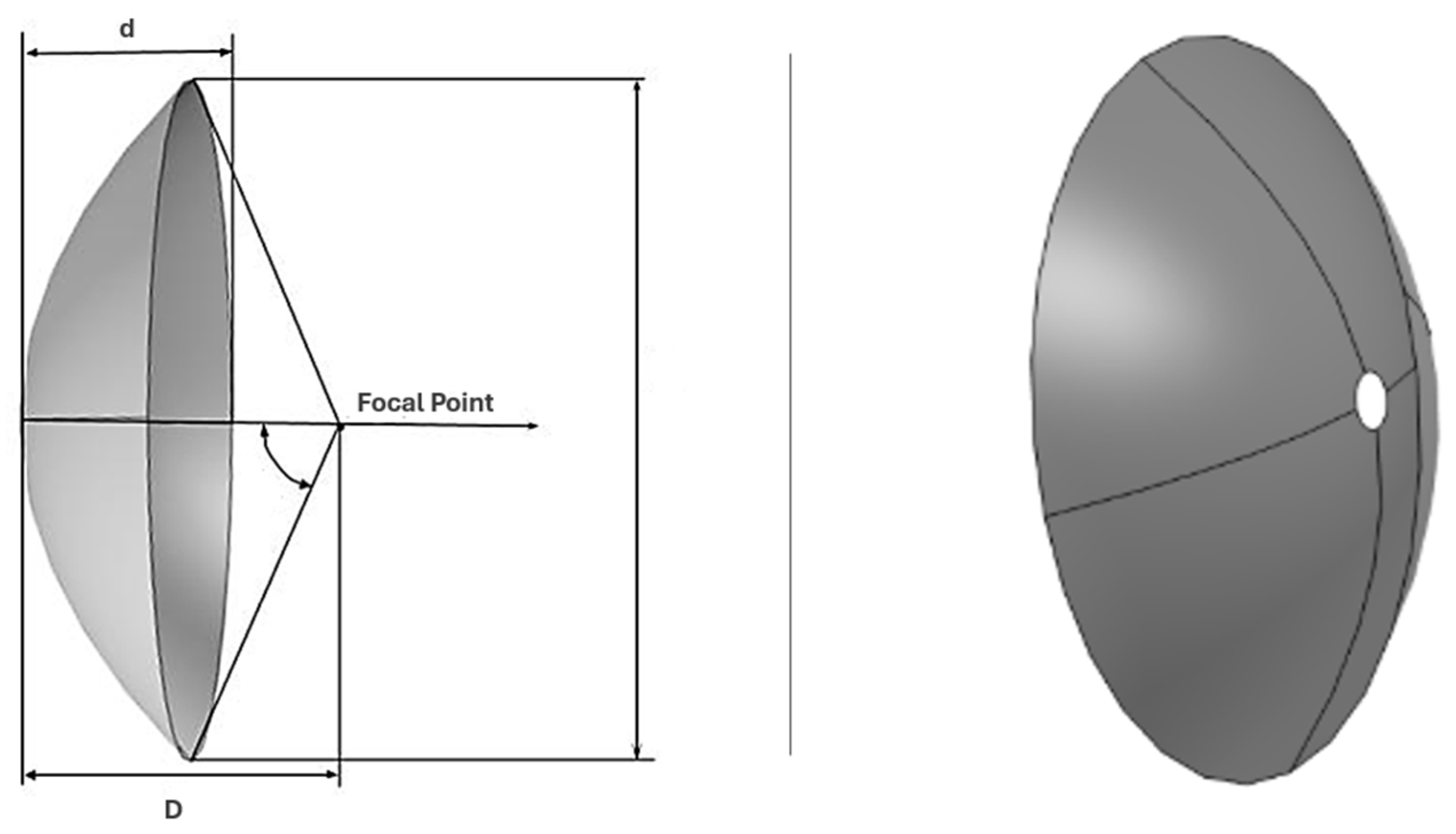
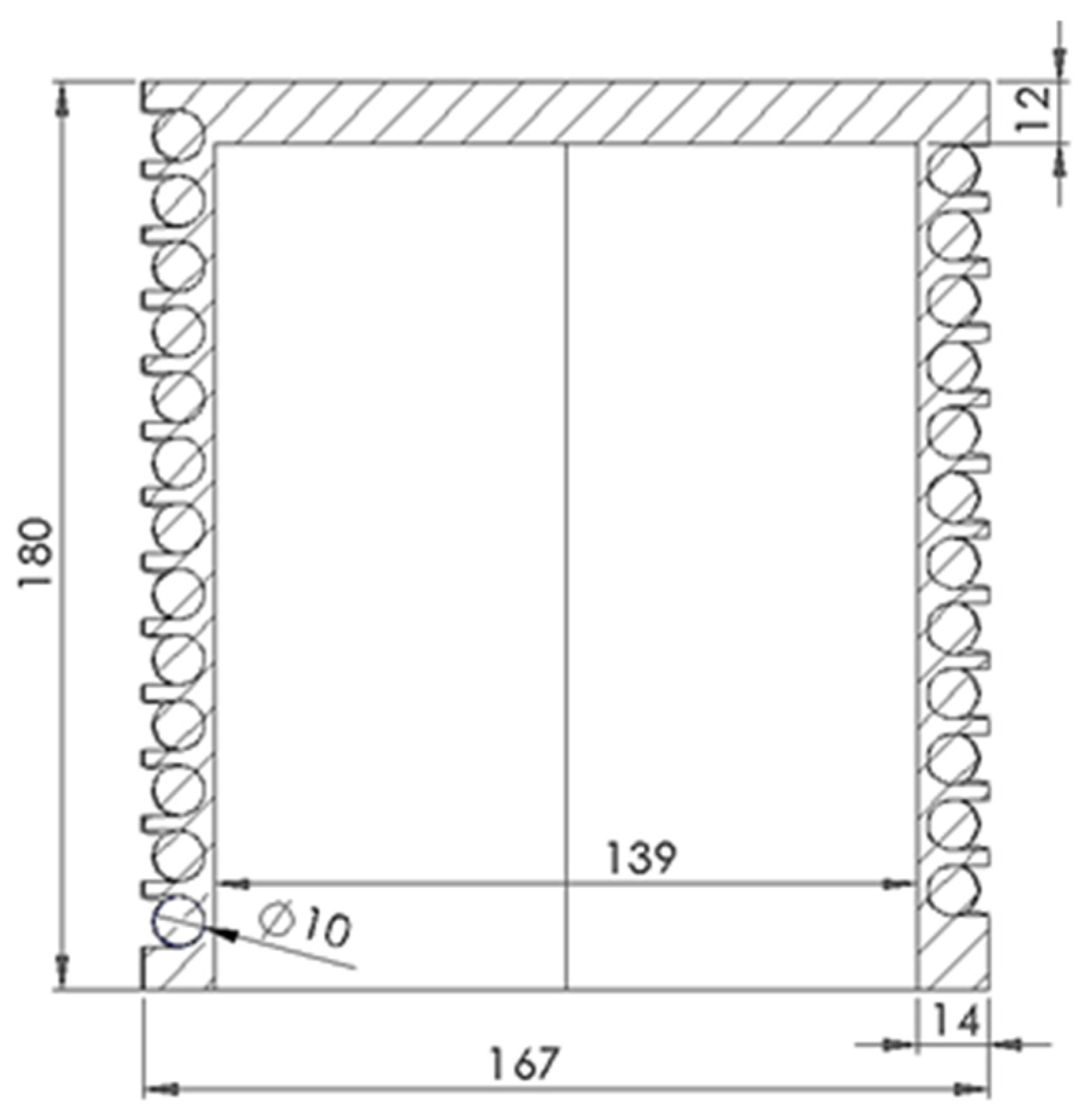
The SPD system was designed and analyzed using COMSOL Multiphysics® (Version 6.2). A solar field of thirty-one parabolic dishes was modeled. Each dish had a diameter of 5 m and a focal length of 3 m based on optical optimization, resulting in a geometric concentration ratio of 896×. Figure 2 details the geometrical design and key dimensions of the Solar Parabolic Dish (SPD), while Figure 3 displays the cross-sectional view of the cylindrical cavity receiver, featuring a helical coil and insulation.
The material properties for Inconel 600 (thermal conductivity, specific heat, and emissivity) were implemented as temperature-dependent functions in COMSOL to improve the accuracy of the thermal-fluid dynamics modeling.
The receiver was modeled as a cylindrical cavity with a helically coiled tube fabricated from Inconel 600. This material was selected for its high-temperature strength and corrosion resistance, which are essential for operating at high operating temperatures and under high thermal stress loads, mitigating structural risks and minimizing convective losses [13]. A detailed design for industrial applications would necessitate a more sophisticated multi-tube or multi-section (e.g., economizer, evaporator, superheater) approach to realistically manage the significant phase-change instabilities, thermal stresses, and dry-out risks associated with single-pass steam generation from liquid to superheated vapor. Future work will focus on this detailed thermo-hydraulic engineering. It is acknowledged that a single-tube receiver heating water to superheated steam in one pass is a simplification for this proof-of-concept model. A full-scale industrial receiver would likely employ a multi-tube or multi-section design (economizer, evaporator, superheater) to manage phase-change instabilities and thermal stresses.

2.2.1. Numerical Model Setup and Validation

To ensure the verifiability and reproducibility of the thermo-fluid model, the numerical setup and key results are detailed below.
Mesh Resolution and Independence
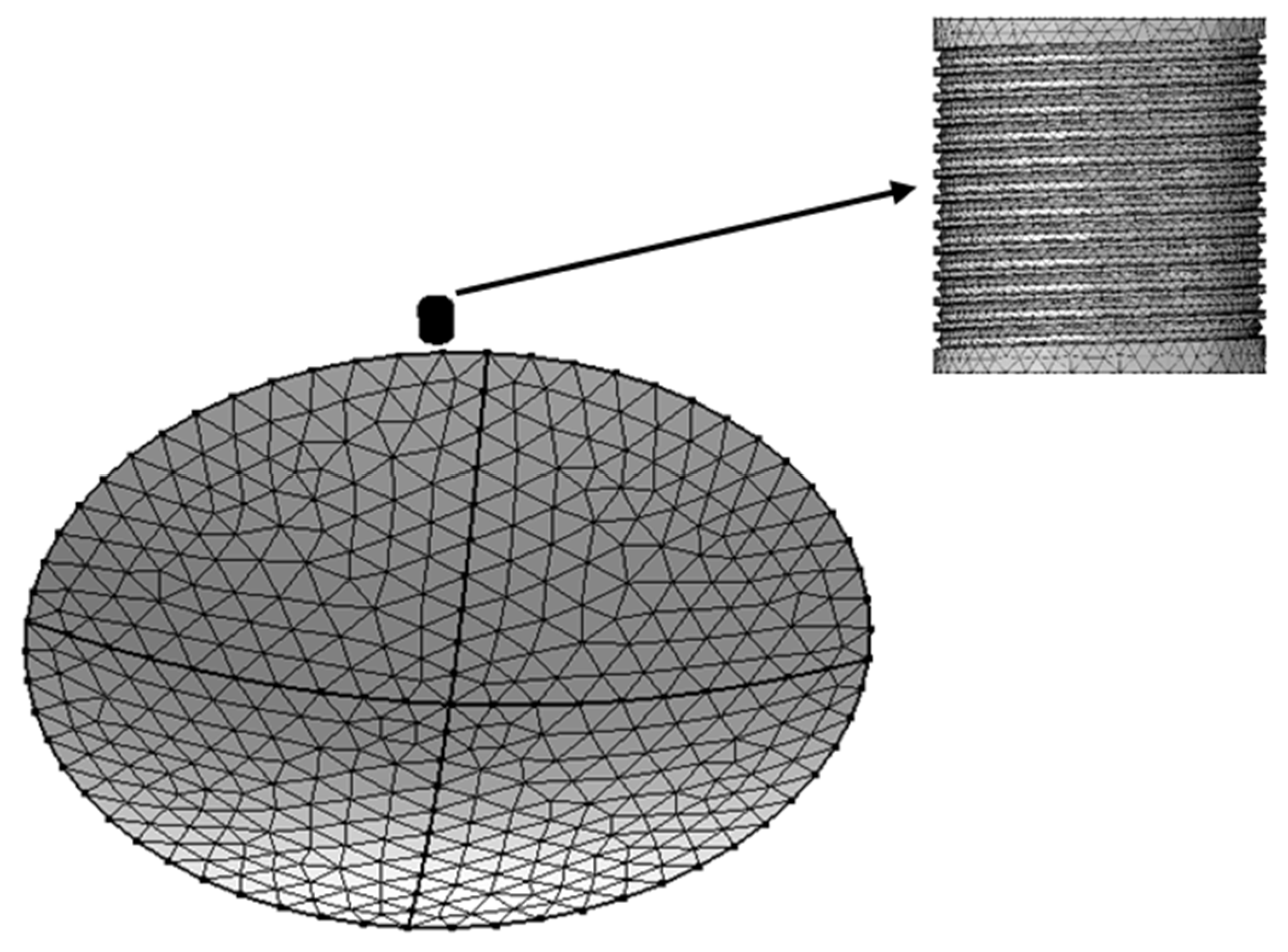
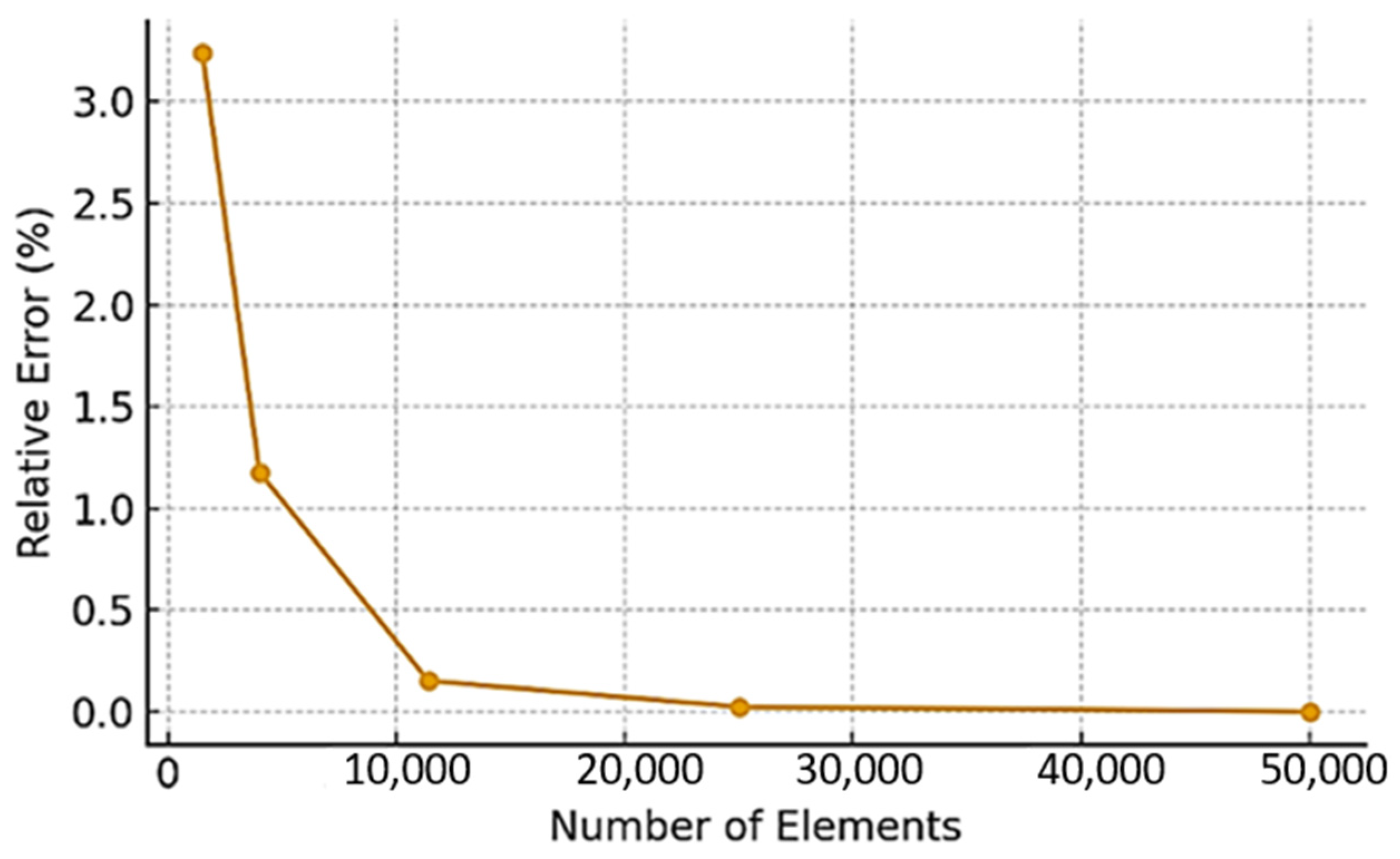
The computational domain was discretized using a structured mesh. A mesh-resolution strategy was implemented where the core flow region utilized elements ranging from 0.5 to 1.0 mm. To accurately capture the geometry and near-wall flow physics, regions near curved walls were refined to a minimum element size of 0.2 mm, and four boundary-layer prism elements were inflated from the walls to ensure y+ ≈ 1. A mesh-independence study using five refinement levels was performed; key outputs (pressure drop, outlet temperature, heat flux) exhibited a clear convergence trend. The computational domain was discretized using an unstructured mesh, as shown in Figure 4.
The outlet temperature, for example, changed by ≤0.2% beyond the medium-to-fine refinement. The relative-error plot (Figure 5) demonstrates that discretization errors become negligible once the mesh exceeds ~100k elements, confirming that the selected mesh offers a reliable compromise between accuracy and computational efficiency.
Boundary Conditions and Convergence Criteria
The boundary conditions used in the conjugate heat-transfer model were as follows. The concentrated solar load was applied as a spatially varying surface heat flux obtained from a ray-tracing optical model. Water was introduced at the inlet with a specified mass flow rate and temperature, while the outlet was held at the design steam pressure. External thermal losses were modeled using combined surface-to-ambient radiation (emissivity ε = 0.85) and forced convection. The model was solved using a nonlinear (Newton) solver with a relative tolerance of 1×10⁻⁶. Convergence was ensured by requiring a nonlinear residual reduction ≥ 106, mass imbalance < 0.1%, and energy imbalance < 0.5%.
Ray Trajectory and Ray Spot Diagram
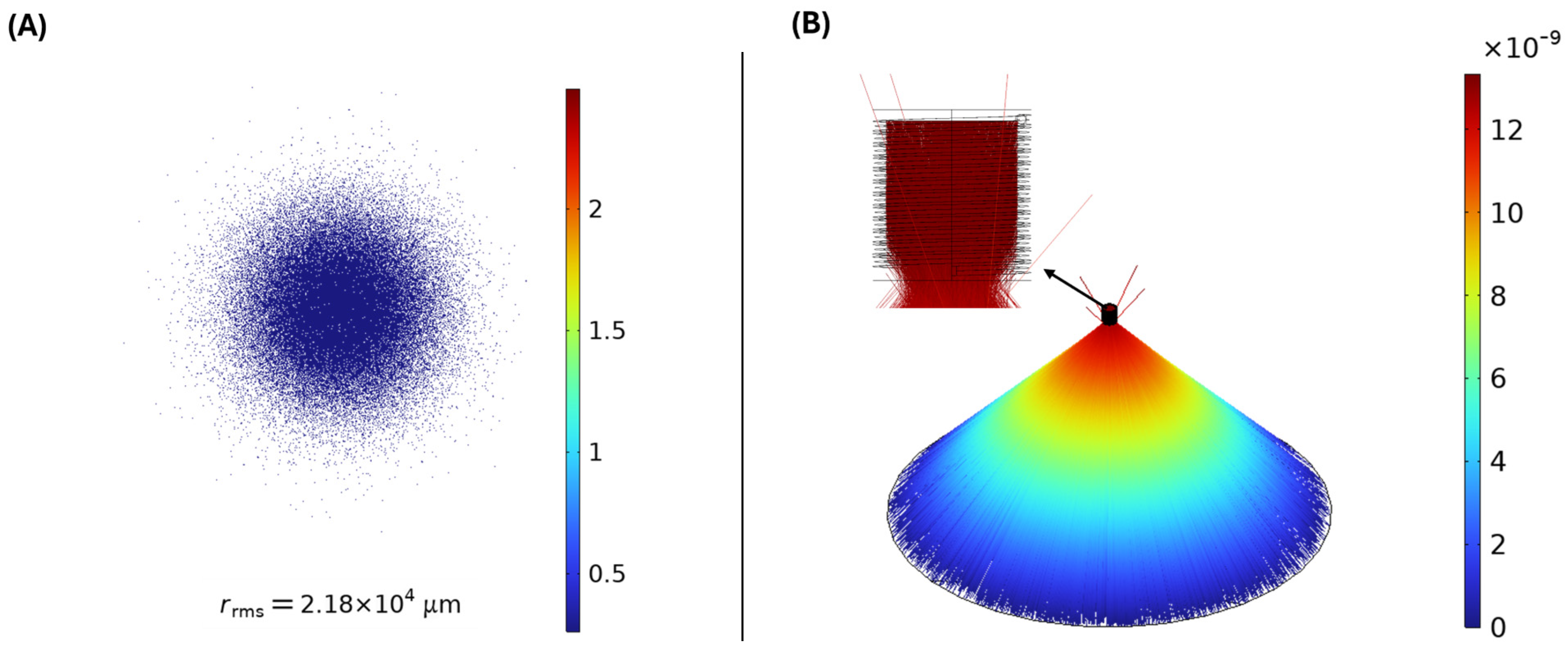
Ray tracing simulations with 10,000 rays were performed to validate the optical performance and focal sharpness. The governing equations for the geometrical and optical design of the SPD system are provided in Appendix A. Analysis confirms the system’s precise optical alignment, with an optical efficiency of 86%. The ray tracing in Figure 6A demonstrates successful concentration on the receiver, while the spot diagram in Figure 6B verifies the sharpness and accuracy of the focal point.
Temperature Distribution and Energy Balance
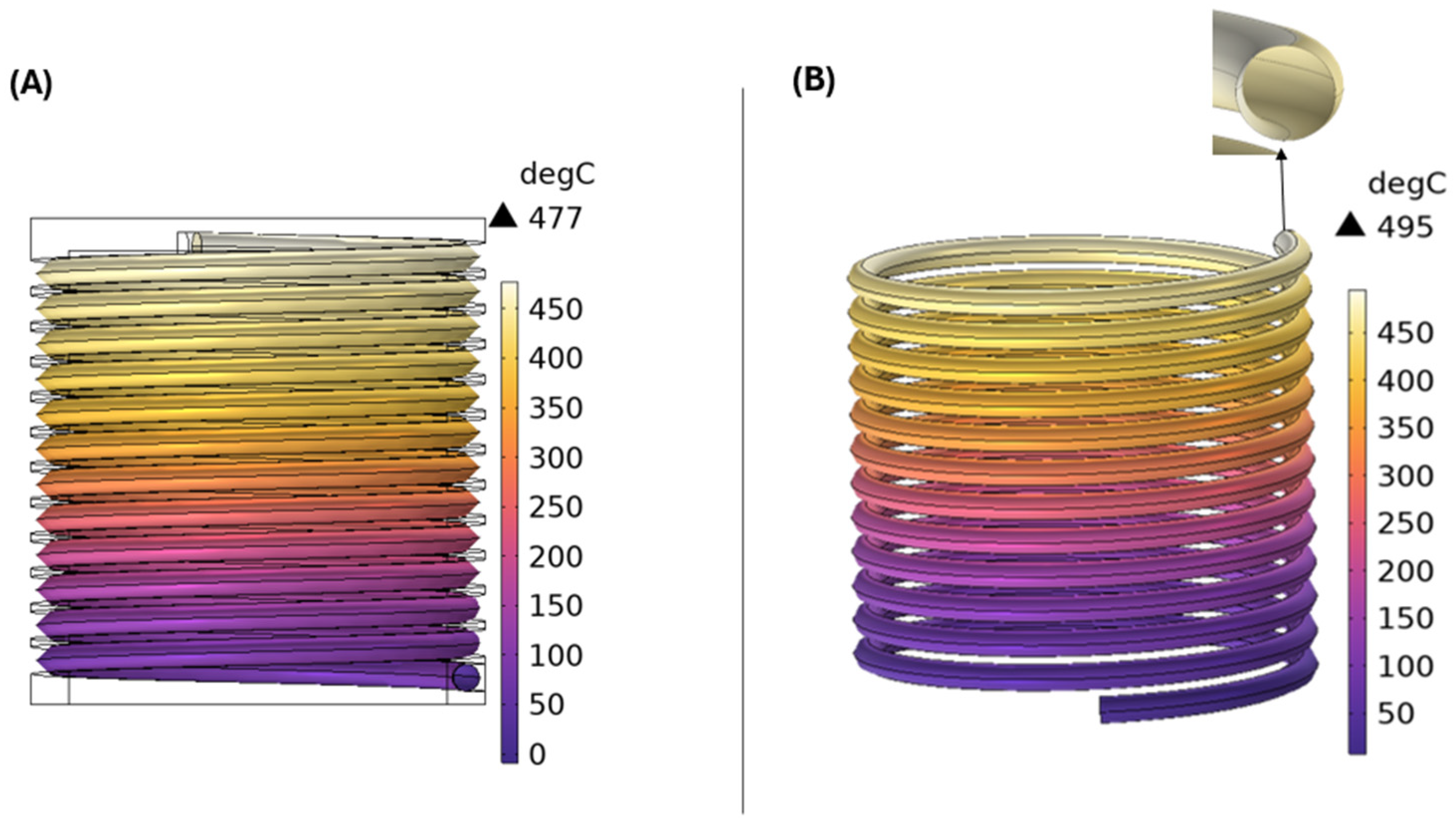
Figure 7A presents the wall-temperature distribution along the helical receiver, with a peak of ~495 °C localized at the focal region where the absorbed solar flux is highest. The temperature progressively decreases along the coil as the fluid removes heat. A consistent gap between the wall and fluid temperatures is observed, which is expected due to the finite convective heat-transfer coefficient. The fluid temperature rise, and the pressure drop are consistent with the expected behavior of high-Reynolds-number flow in a compact helical coil. The global energy balance closes within 2%, confirming that the absorbed solar power is accurately partitioned into useful heat gain and thermal losses.
Fluid Thermodynamic Profile and Vapor Quality
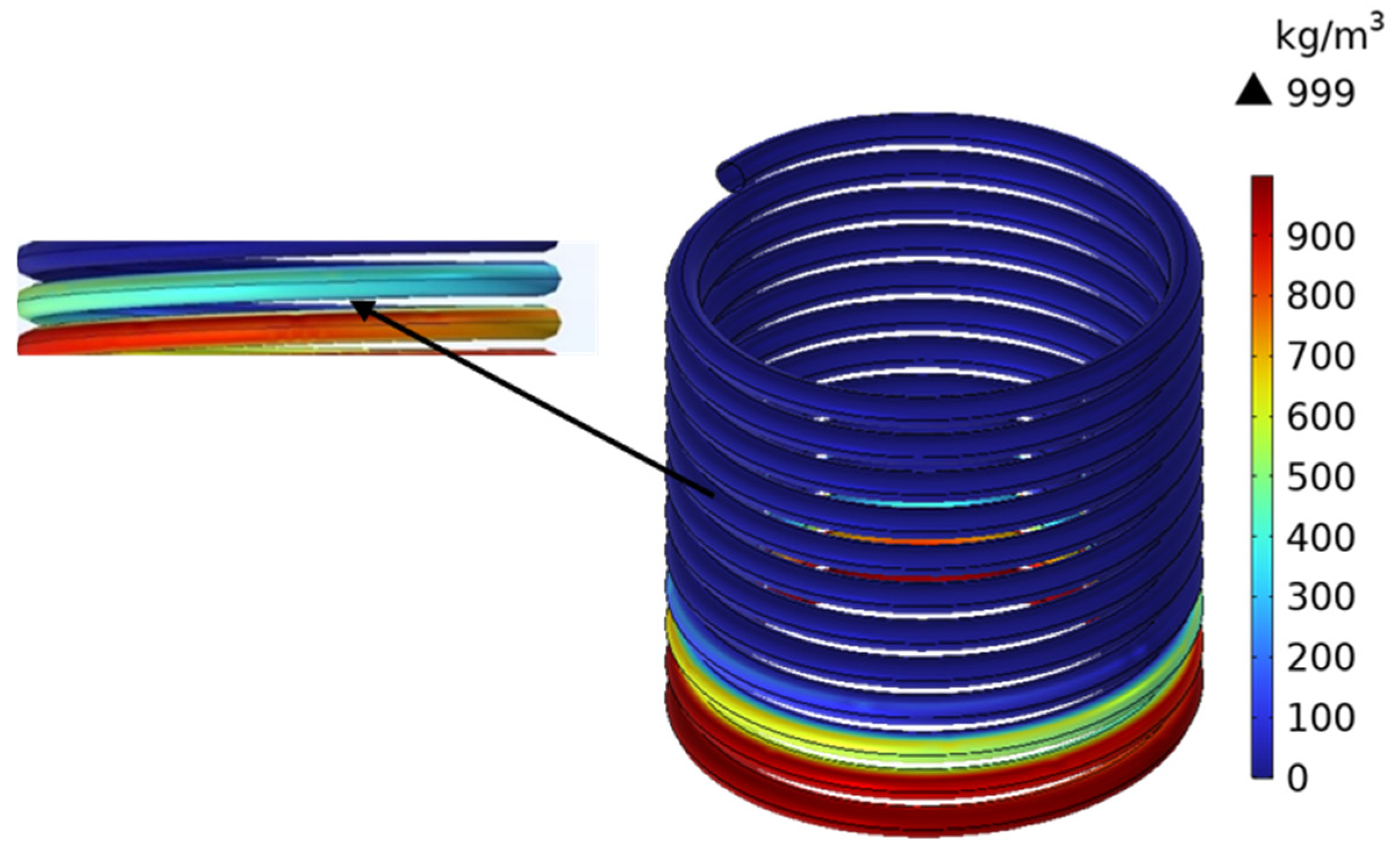
The thermal-fluid model, incorporating the temperature-dependent properties of Inconel 600, successfully achieved the target outlet temperature of 477 °C under the specified flow conditions. It is important to emphasize that this represents a simplified, first-order thermodynamic model for this proof-of-concept study. Its primary purpose is to demonstrate the feasibility of supplying high-temperature solar heat at the required conditions, rather than to present a fully engineered receiver design. Figure 8 presents a validated thermodynamic profile that elucidates the compact phase-change process within the helically coiled tube, confirming the model’s accuracy in resolving conjugate heat and mass transfer. The evolution of the density field mapped from liquid through two-phase to superheated vapor provides a direct visualization of the mass transfer dynamics during evaporation. The transition from sensible heating to a distinct temperature plateau signifies the dominance of latent heat absorption, while the subsequent linear rise in vapor quality indicates a period of stable annular film evaporation. The helical geometry critically enhances this process through centrifugally induced Dean vortices, which disrupt thermal boundary layer development and stabilize the vapor-liquid interface, thereby preventing localized dry-out.
The thermal-fluid dynamics modeling, including the equations for heat transfer efficiency, Dean and Reynolds numbers, and a check for critical heat flux to avoid dry-out conditions, is described in detail in Appendix B. The model coupled computational fluid dynamics (CFD) and heat transfer modules to simulate the heating of water from 23 °C to an outlet temperature of 477 °C at a mass flow rate of 0.027 kg/s per dish. This selected mass flow rate allows the plant’s 10% solar contribution (778.5 kWth) to be met with only 31 dishes, each delivering ~25 kWth, yielding a receiver thermal efficiency of 52.4%. It should be noted that this represents a steady-state, design-point analysis under ideal conditions (DNI = 1000 W/m2). The impact of solar variability and the need for thermal storage for stable operation are key considerations for future scale-up. The thermal efficiency of the receiver under design-point conditions (DNI = 1000 W/m2) was calculated to be approximately 52.4%. It is critical to acknowledge that this represents a steady-state, design-point analysis under ideal conditions (DNI = 1000 W/m2). The impact of solar variability (hourly and daily fluctuations) on process stability is a key challenge for implementation, necessitating future work on thermal energy storage, dynamic control strategies, and the integration of a larger, dispatchable solar field.

2.3. Receiver Mechanical Design and Safety Validation

Following the optical and thermal optimization, a comprehensive engineering analysis was conducted to finalize the helical receiver geometry and validate the design against key failure modes, including pressure integrity, thermal stress, and manufacturability. The finalized geometrical and operational parameters are summarized in Table 2.
Using the finalized geometry from Table 2, a multi-faceted safety analysis was performed to quantify the receiver’s margins against operational risks. The results are consolidated in Table 3.
The receiver design is numerically verified to be mechanically safe. The selection of Inconel 600 provides the foundation for this integrity, with a calculated primary hoop stress of 12.5 MPa yielding a substantial safety factor of approximately 20 against the alloy’s yield strength. This robust pressure margin ensures containment and provides ample capacity to accommodate concurrent thermal stresses. Finally, the helix radius (124 mm) significantly exceeds the minimum bend requirement ((3Do = 30 mm)), confirming the design is manufacturable using standard mandrel bending techniques. Collectively, these analyses confirm the receiver’s operational safety and feasibility for high-flux solar thermal applications. The analyses in Table 3 confirm the receiver’s mechanical integrity and manufacturability for this proof-of-concept. The single-tube configuration successfully demonstrates the feasibility of achieving the target steam conditions.
For future scale-up and safe long-term operation, thermal-hydraulic performance must be addressed. The calculated local heat flux approaches the limits for stable operation in a single tube. Therefore, a transition to a multi-tube configuration will be essential to ensure a robust Critical Heat Flux margin, mitigate dry-out risk, and achieve the reliability required for industrial applications.

2.4. Steam Methane Reactor Modeling

The SMR reaction kinetics were implemented in COMSOL Multiphysics using a first-order reaction with respect to methane concentration, based on the Arrhenius equation. The detailed chemical kinetic model and species transport equations are provided in Appendix C.

2.5. Pressure Swing Adsorption and Carbon Capture-Based MDEA-Based Modeling

The Pressure Swing Adsorption (PSA) unit was modeled in ASPEN Adsorption. The adsorption isotherms (Langmuir model), energy balances, and mass transfer equations governing the PSA cycle are detailed in Appendix D. The carbon capture unit was designed using an MDEA-based absorption process. The numerical framework for the mass and energy balances, reaction kinetics, and equipment design (absorber, distillation column, flash drum) is described in Appendix E.

2.6. Methodology of Simulation and Coupled Physics

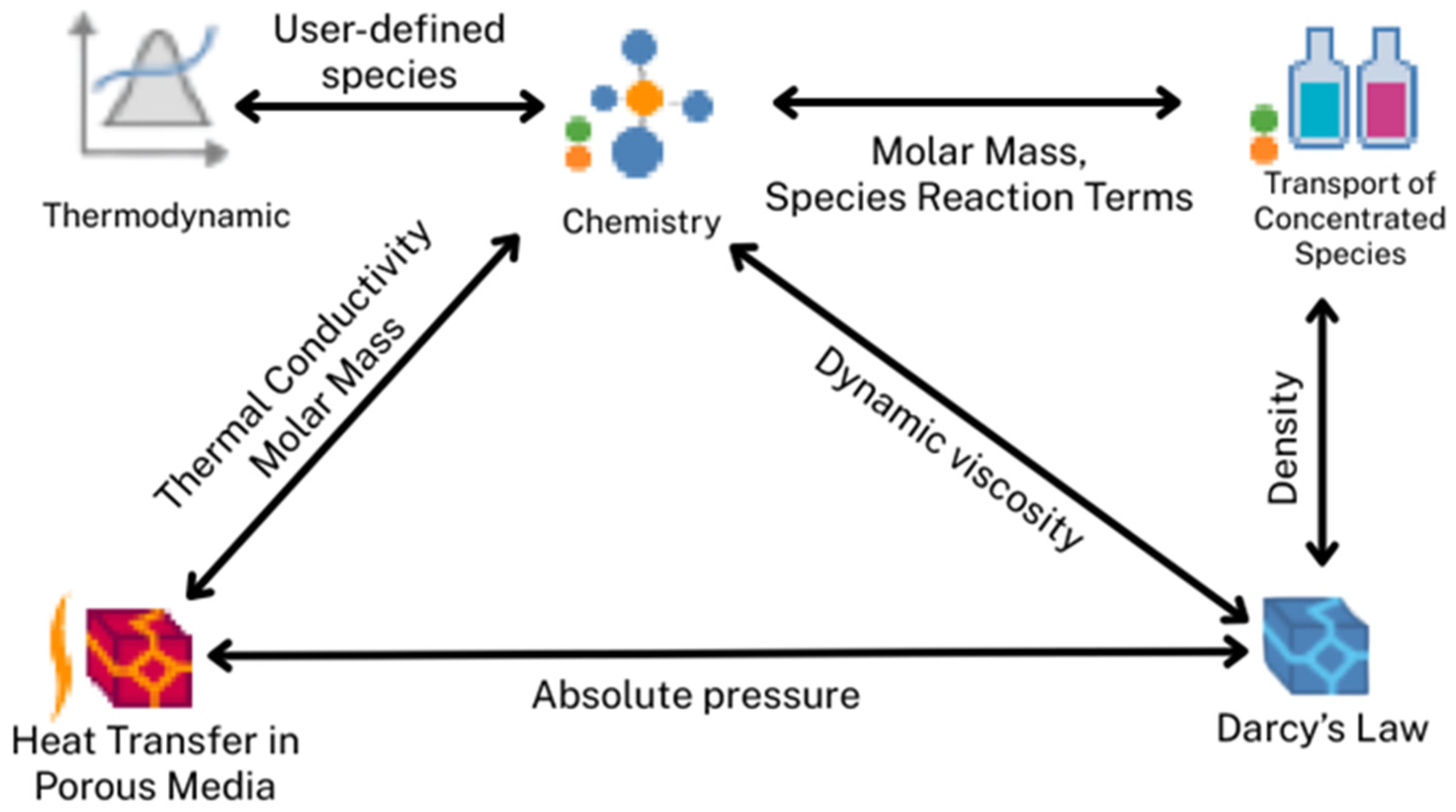
The COMSOL simulation of the steam methane reforming (SMR) process within a porous catalytic reactor integrates multiple physical phenomena through a tightly coupled framework, as illustrated in Figure 9. At the core of this model is the Chemistry interface, which defines the SMR reaction kinetics and species properties. This module bidirectionally couples with the Transport of Concentrated Species interface to solve mass balances, using reaction source terms from Chemistry and providing species concentrations that influence reaction rates. Simultaneously, the Heat Transfer in Porous Media interface calculates the temperature distribution, which is crucial for resolving the endothermic reaction’s energy balance. This temperature field directly feeds back into the Chemistry interface, modulating reaction rates via the Arrhenius expression and closing the critical thermal-reaction feedback loop. Furthermore, the Darcy’s Law interface computes fluid flow through the porous bed, using temperature-dependent properties (e.g., density, viscosity) influenced by the Heat Transfer and Transport modules. The resulting pressure and velocity fields, in turn, govern the convective transport of species, ensuring a comprehensive representation of the reacting flow.
The overall simulation of the integrated hydrogen production process leveraged multiple specialized software tools. The solar parabolic dish (SPD) was first designed and optimized using COMSOL Multiphysics to achieve the target steam temperature of 500 °C. Subsequently, the SMR process, along with the downstream carbon capture unit, was simulated in ASPEN Plus to determine mass/energy balances and heat duties. The pressure swing adsorption (PSA) system for hydrogen purification was then rigorously modeled in ASPEN Adsorption to achieve a purity of 99.99%. Finally, a techno-economic assessment was conducted using the ASPEN Process Economic Analyzer (APEA) to evaluate the economic viability of the entire process.

2.7. Red Mud Catalyst Preparation and Characterization

Red mud (bauxite residue) was obtained from a local alumina refinery (Maaden Company) in the eastern region of Saudi Arabia. The material was prepared for catalytic testing via a multi-step procedure adapted from literature [10,11,20]:
  • Drying: Raw red mud was dried at 105 °C for 12 h to remove moisture.
  • Grinding: The dried material was ground and sieved to a particle size of <100 μm.
  • Calcination: The powder was heated in a muffle furnace at 600 °C for 4 h in air to stabilize the metal oxide phases and potentially mitigate the deactivating effects of alkali components.
  • Composite Formation: The activated red mud was physically mixed with commercially available ZSM-5 zeolite (Sigma-Aldrich, St. Louis, Missouri, USA.) in a 1:1 weight ratio. The mixture was extruded, dried, and finally calcined at 550 °C for 2 h to enhance mechanical stability and surface properties.
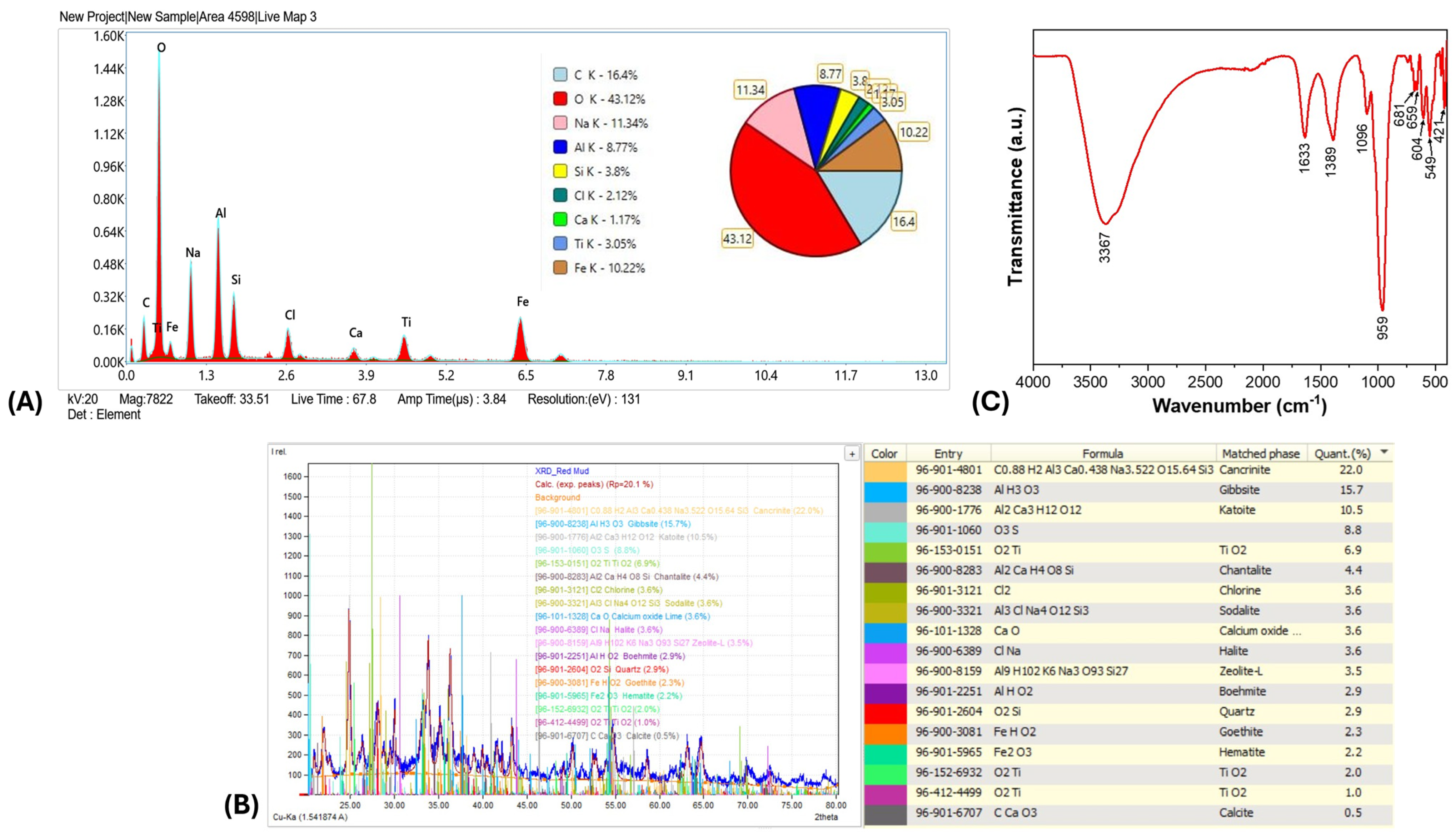
The elemental and mineralogical composition of the raw and processed red mud was determined using Energy Dispersive X-ray Spectroscopy (EDS, AMETEK EDAX Element, Mahwah, New Jersey, USA) on a scanning electron microscope (Tescan Vega 3, Brno, Czech Republic), X-ray Diffraction (XRD; Rigaku Miniflex 600, Tokyo, Japan), and Fourier Transform Infrared (FTIR, Bruker alpha-II FT-IR spectrometer, Ettlingen, Germany) Spectroscopy. The findings obtained are in good agreement with those reported in previous studies [21,22,23,24,25]. The EDS analysis (Figure 10A) confirmed the dominance of several key elements, like Fe, Al, Ti, and O, consistent with the known composition of bauxite residue. As shown in Figure 10A, the analysis revealed a high content of oxygen (43.12 wt.%), iron (10.22 wt.%), sodium (11.34 wt.%), and aluminum (8.77 wt.%), with significant amounts of silicon (3.8 wt.%), titanium (3.05 wt.%), and chlorine (2.12 wt.%). The high concentration of iron and aluminum oxides suggests the material’s potential as a catalytic support, while the presence of sodium, silicon, and chlorine is characteristic of the Bayer process. The high sodium and sulfur content (identified via XRD) are known catalyst poisons that can lead to sintering and deactivation over time. While this study assumes sufficient initial activity for a techno-economic proof-of-concept, the long-term impact on activity and stability is a critical area for future work. Experimental kinetic validation under realistic SMR conditions and investigation of mitigation strategies, such as acid leaching pre-treatments to remove alkali components, are strongly recommended.
The XRD pattern of the prepared catalyst, presented in Figure 10B, confirms that the material is a complex, multiphase composite. The identified phases, and their relative quantitative percentages, are highly consistent with the elemental composition from the EDS analysis and validate the experimental procedure. The XRD analysis indicates that the material primarily consists of cancrinite, gibbsite, katoite, hematite, goethite, sodalite, titanium dioxide, etc. For instance, the presence of hematite Fe2O3 (~2.2%) and goethite FeO(OH) (~2.3%) provides the mineralogical basis for the high iron content observed in EDS, confirming the presence of the active components for the steam methane reforming (SMR) and water-gas shift (WGS) reactions at high temperatures. The large proportion of cancrinite (~22.0%) and sodalite (~3.6%) in XRD directly explains the very high sodium and aluminum content in EDS, as these are both sodium-rich aluminosilicate minerals. The presence of zeolite-L (~3.5%) further confirms the successful physical mixing of the red mud with the commercially available ZSM-5 zeolite, as described in the methodology. The phases that contain calcium, such as katoite Al2Ca3H12O12 (~10.5%) and calcite CaCO3 (~0.5%), account for the small but measurable calcium content (1.17%) from the EDS. The detection of TiO2 in multiple entries (rutile ~ 6.9%, anatase ~ 2.0%, and brookite ~ 1.0%) and quartz (SiO2; ~2.9%) is also consistent with the presence of titanium and silicon in EDS. The presence of Al, Si, and Ti is also crucial, as these elements, typically in the form of oxides, would act as structural support for the catalyst, enhancing its thermal stability and porosity. The presence of Na and Ca components is mostly due to the caustic Bayer process. While high concentrations of these elements can sometimes lead to catalyst deactivation by forming inactive compounds or low-melting-point eutectics, their presence at these levels is a known characteristic of red mud. Sulfur trioxide (SO3; 8.8%) was also identified through the XRD analysis. While a distinct sulfur (S) peak was not observed in the EDS spectrum, its presence in the XRD analysis confirms that sulfur is a component of the crystalline structure, likely in the form of a sulfate compound. The non-automatic identification of S by EDS may possibly be ascribed to the reason that sulfur compounds can be susceptible to volatilization under the high vacuum and electron beam of the SEM, further reducing the amount of sulfur available for EDS detection. The most plausible reason could also be that the signal from sulfur might be weak and easily masked by the much stronger signals from dominant elements like iron, aluminum, and sodium.
The FTIR spectrum of the prepared catalyst, shown in Figure 10C, supports the results from both EDS and XRD analyses. The spectrum exhibits a broad peak at approximately 3367 cm−1, which is attributed to the stretching vibrations of hydroxyl groups (O−H), consistent with the presence of hydrated mineral phases like gibbsite and goethite identified by XRD. The other peak at about 1633 cm−1 is typically assigned to the bending vibrations of adsorbed water molecules, also supporting the presence of moisture and hydrated minerals. The band at 1389 cm−1 indicates the presence of carbonate groups. The peaks in the 600–1100 cm−1 range are mostly associated with the asymmetric stretching vibrations of Si−O−Si or Si−O−Al bonds, which confirm the existence of an aluminosilicate framework. Also, the sharp and intense peak at 959 cm−1 is a characteristic peak of the Zeolite-L phase. Additionally, the absorption bands below 700 cm−1 are mainly associated with the bending vibrations of Fe−O, Al−O, and Ti−O bonds, providing further evidence for the presence of hematite, gibbsite, and titanium oxide. The combined EDS, XRD, and FTIR results provide a comprehensive understanding of the red mud’s elemental and mineralogical composition, confirming its suitability as a catalyst and validating the preparation steps.

2.8. Techno-Economic Analysis (TEA)

A techno-economic assessment was conducted to evaluate the viability of the proposed integrated process. The Levelized Cost of Hydrogen (LCOH) was chosen as the key metric. The analysis was performed using the ASPEN Process Economic Analyzer (APEA) V11 for capital cost (CAPEX) estimation, supplemented with vendor quotes for the solar dish system. Operational costs (OPEX), including natural gas, electricity, catalyst replacement, and maintenance, were calculated based on local market data (Saudi Arabia, 2024). All costs are reported in both Saudi Riyal (SAR) and U.S. Dollars (USD) using a conversion rate of 1 USD = 3.75 SAR to facilitate international comparison. The local energy prices used reflect specific regional economics and are a key sensitivity parameter. The financial assumptions are summarized in Table 4.

3. Results and Discussion

3.1. Solar Thermal System Performance

As depicted in Figure 11, the solar thermal input is primarily utilized in the Solar Methane Reformer (SMR, Unit 8). The heat recovery network, involving heat exchangers HX1 (9) and HX2 (3), is crucial for the overall energy efficiency of the process. COMSOL simulations confirmed the viability of the SPD design. The system successfully produced superheated steam at 477 °C, meeting the requirement for integration into the SMR process. Under a peak DNI of 1000 W/m2, the solar field of thirty-one dishes operated effectively for approximately 5 h per day, supplying 10% of the total thermal energy required for steam generation. It is critical to acknowledge that this represents a design-point analysis. The impact of solar intermittency on process stability is a key challenge for implementation, necessitating future work on thermal energy storage and dynamic control strategies. This direct renewable heat integration reduces natural gas consumption in the boiler, leading to operational cost savings and a corresponding decrease in the plant’s carbon footprint. The flow was characterized by a Reynolds number of ~700 (based on bulk properties at the inlet, indicative of transitional flow) and a Dean number of ~179, indicating a transitional-to-turbulent regime with secondary flows that enhance heat transfer [14].
The demonstrated capability to generate high-temperature superheated steam using solar energy represents a significant technical achievement for industrial process heat decarbonization. While the economic savings from natural gas displacement are secondary in this proof-of-concept scale, the environmental benefits of renewable heat integration are substantial.

3.2. SMR Reactor Optimization and Performance

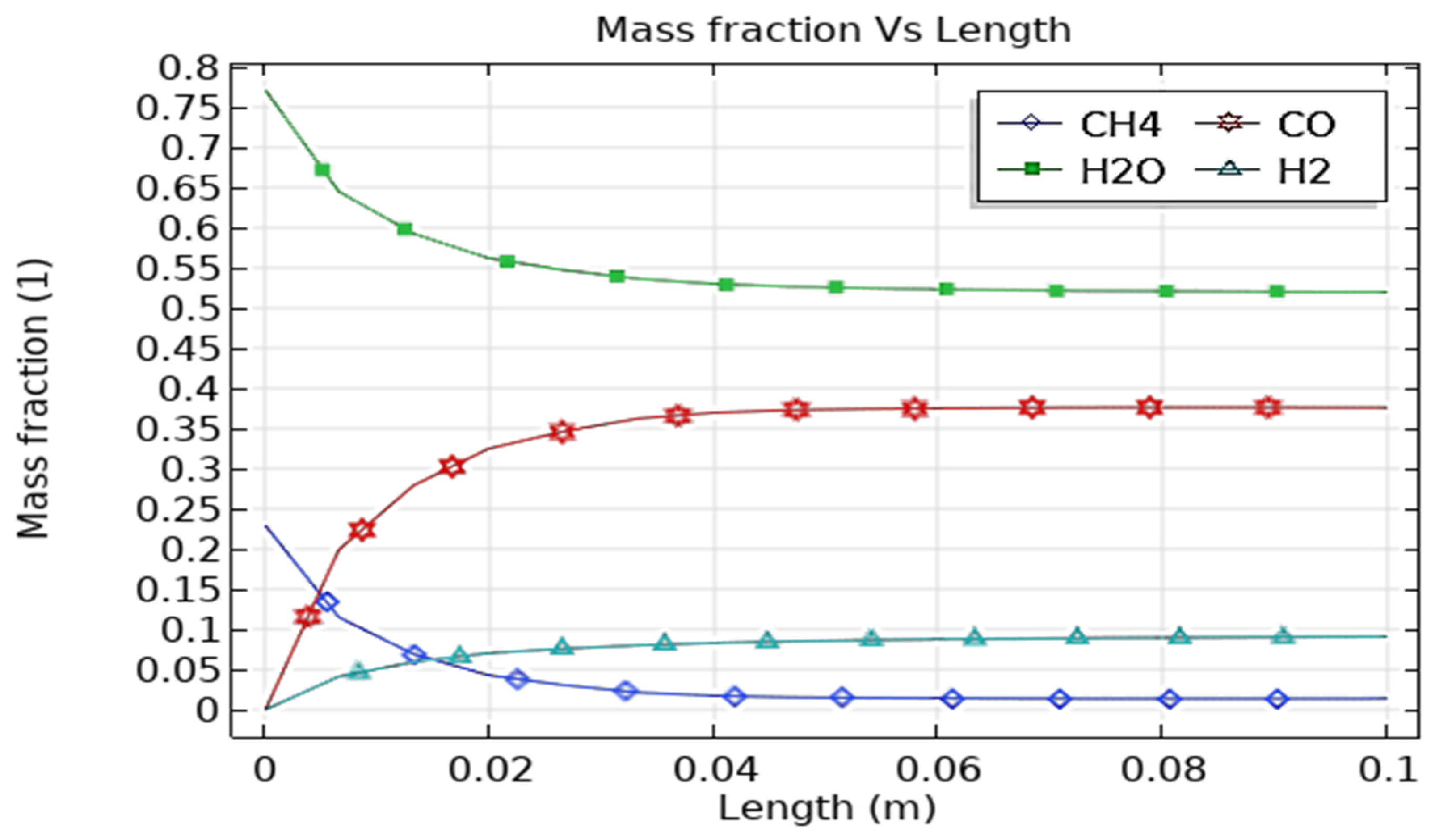
The species concentration profiles along the length of the catalytic reactor, obtained from a detailed COMSOL Multiphysics model (coupling momentum, heat, and mass transfer), showed rapid conversion of methane and steam, approaching thermodynamic equilibrium. A parametric analysis of the catalyst bed length indicated that a length of 0.1 m was optimal; beyond this point, the increase in hydrogen yield was negligible (<1%) as equilibrium was reached, while the pressure drops and reactor capital cost continued to increase (Figure 12).
The high catalytic performance of the red mud-ZSM-5 composite, essential for achieving near-equilibrium conversion as modeled by the RGibbs reactor, is supported by its elemental composition (Figure 13) and literature on iron-based SMR catalysts [14,16,26]. The high Fe2O3 content provides active sites for methane dissociation and water-gas shift reactions, while the zeolite matrix enhances surface area and stability. For the scope of this techno-economic feasibility study, the catalyst activity was assumed sufficient to approach thermodynamic equilibrium under the severe operating conditions (900 °C, 25 bar), an assumption validated by the successful achievement of >99% methane conversion in the model. This assumption is critically underpinned by the experimental work of [16], who demonstrated high activity for red mud in analogous high-temperature catalytic processes. Nevertheless, experimental kinetic validation of the prepared catalyst under SMR conditions is a critically recommended focus for future work to precisely quantify its activity and long-term stability, especially regarding deactivation from sodium and sulfur compounds.
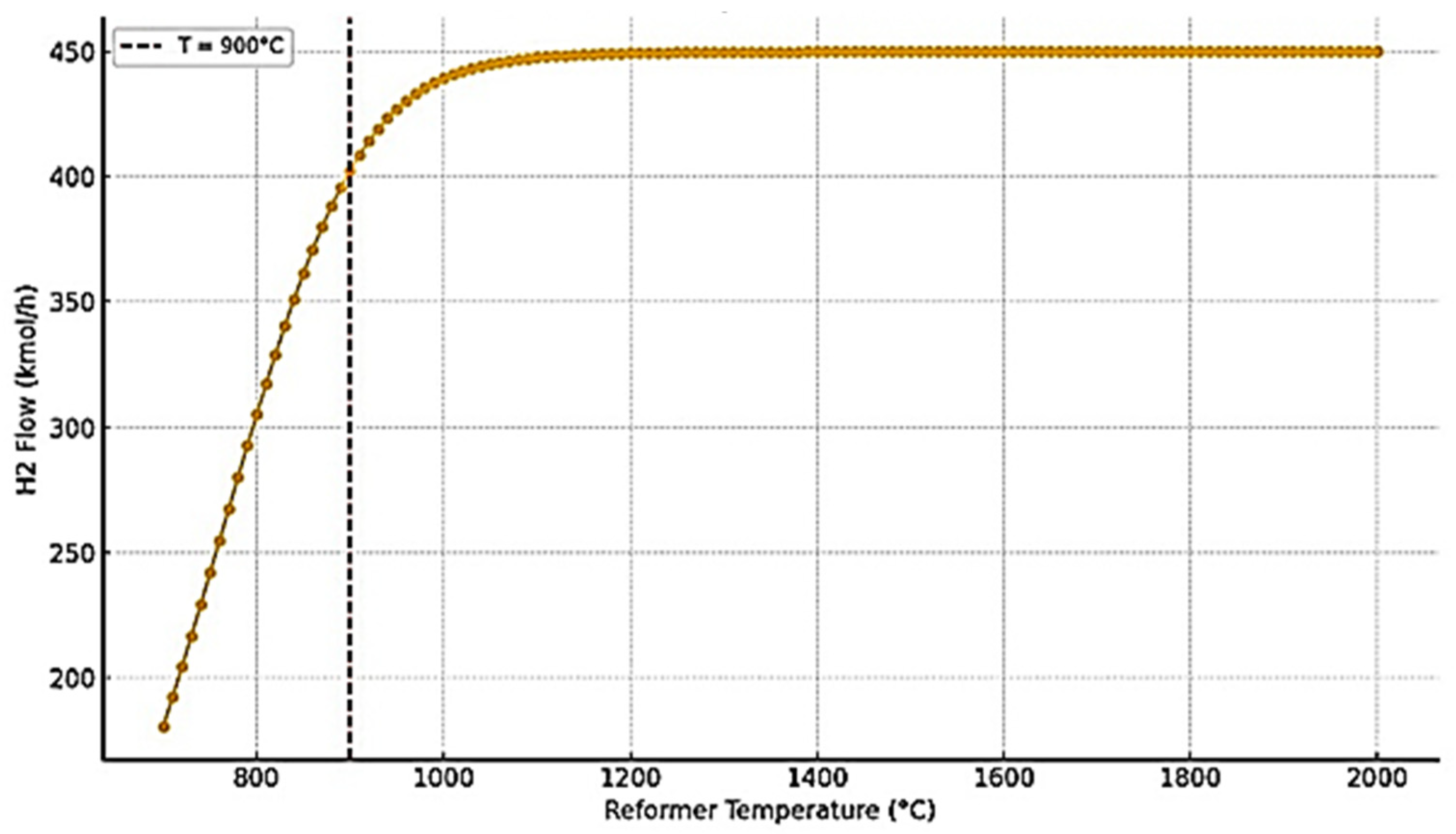
Figure 13 shows the effect of the reformer temperature on hydrogen production. The red dashed line indicates the selected operating temperature (900 °C), while the orange curve represents the molar flow rate of the produced hydrogen. As shown in Figure 13, increasing the reformer temperature has a significant positive effect on hydrogen flow rate up to approximately 900 °C. Beyond this temperature, the rate of increase diminishes, and hydrogen production plateaus near its maximum (~450 kmol / h ). This trend is consistent with the endothermic nature of the steam methane reforming (SMR) reactions, which are thermodynamically favored at higher temperatures. However, the diminishing returns beyond 900 °C suggest that further temperature increases may not justify the additional energy input. The chosen operating point of 900 °C (marked by the vertical dashed line) balances thermal input with hydrogen yield and aligns with typical industrial practice.
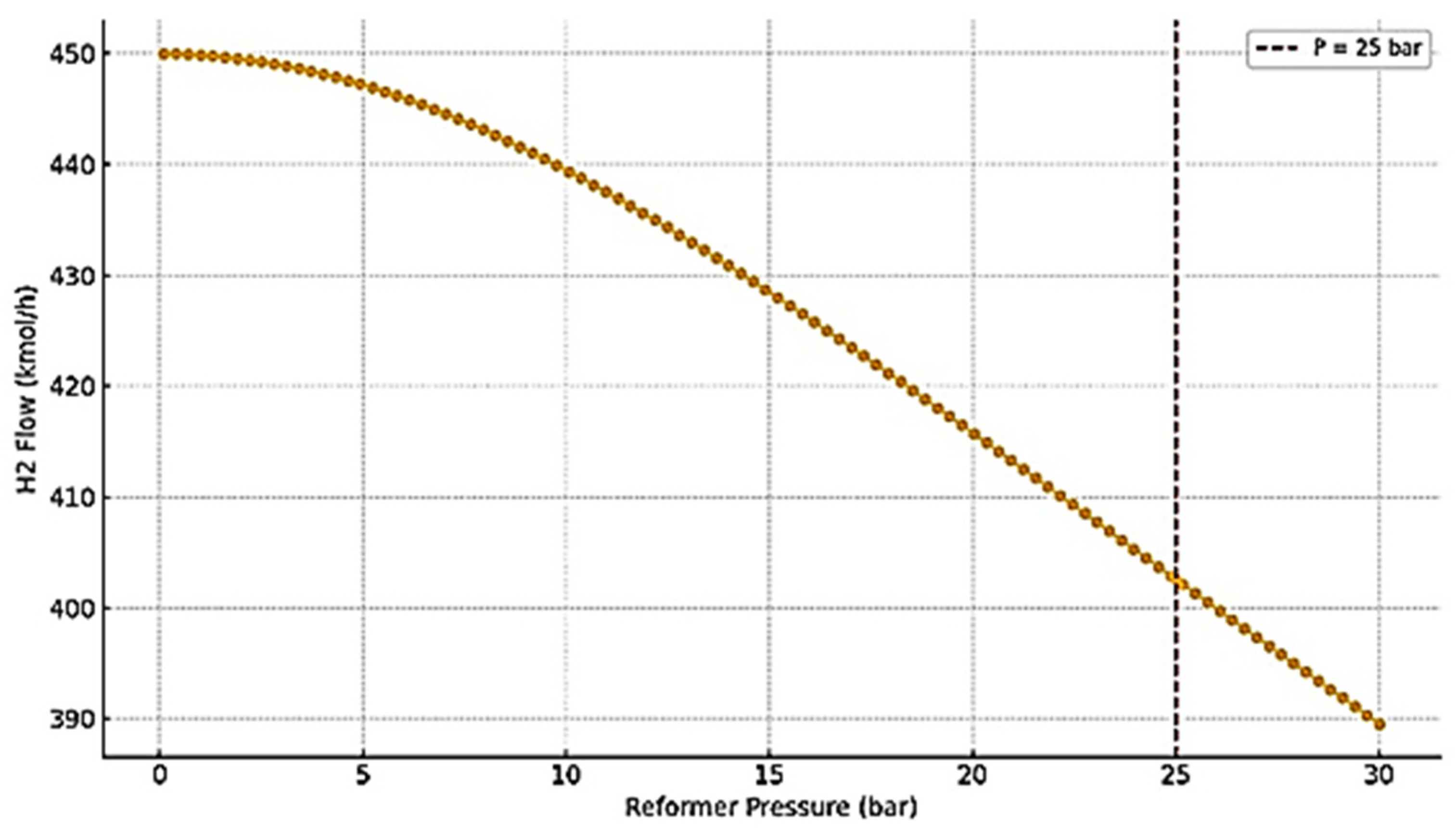
Figure 14 shows the effect of the reformer Pressure on the H 2 yield. The red dashed line indicates the selected operating pressure (25 bar), while the orange curve represents the H 2 yield. As depicted in Figure 14 and predicted by Le Chatelier’s principle (the reforming reaction is mole-increasing), higher operating pressures (0–30 bar) negatively impacted the equilibrium hydrogen yield. However, higher pressure simultaneously enhances hydrogen production, improving the overall process efficiency. A pressure of 25 bar was selected as a practical compromise to balance a high hydrogen yield with efficient methane conversion, while also reducing the energy penalty for downstream CO2 compression and H2 purification.
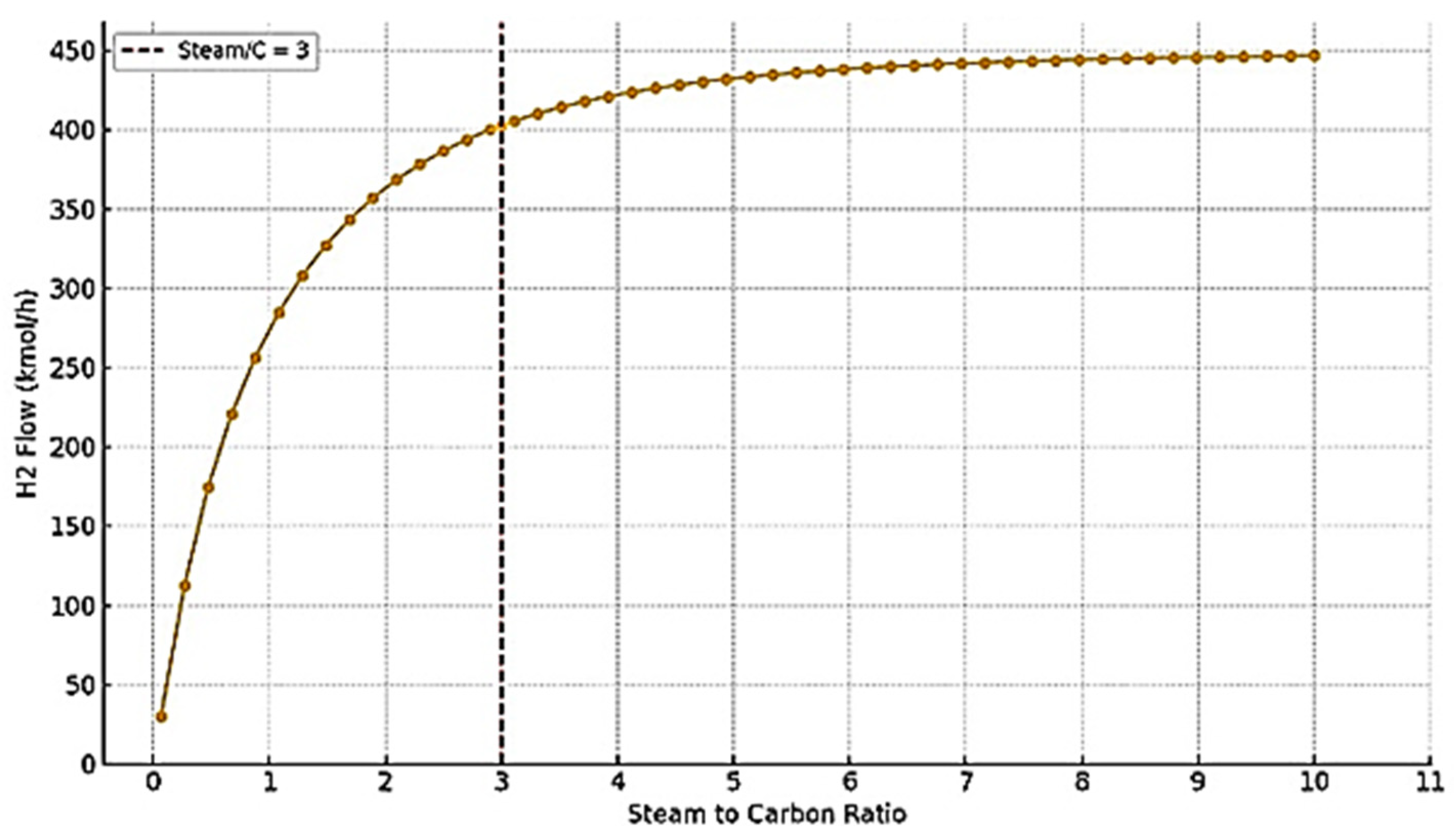
Figure 15 shows that an S/C ratio of 3 was found to be optimal, maximizing hydrogen yield while effectively suppressing carbon formation (coking) on the catalyst surface, which is critical for long-term catalyst stability [18]. This selection balances a high hydrogen flow rate with a minimized coking risk, as illustrated by the orange curve. The optimized SMR process yielded 1070 kg/h of hydrogen with a conversion exceeding 99%, providing a solid foundation for the downstream purification and carbon capture sections. The red mud-ZSM-5 catalyst was assumed to provide equivalent activity to a standard Ni-based catalyst based on its composition and prior literature [14,16,20], though experimental kinetic validation is recommended for future work

3.3. Hydrogen Purification and Carbon Capture

The integrated downstream processing units performed effectively, ensuring the final product met blue hydrogen specifications.
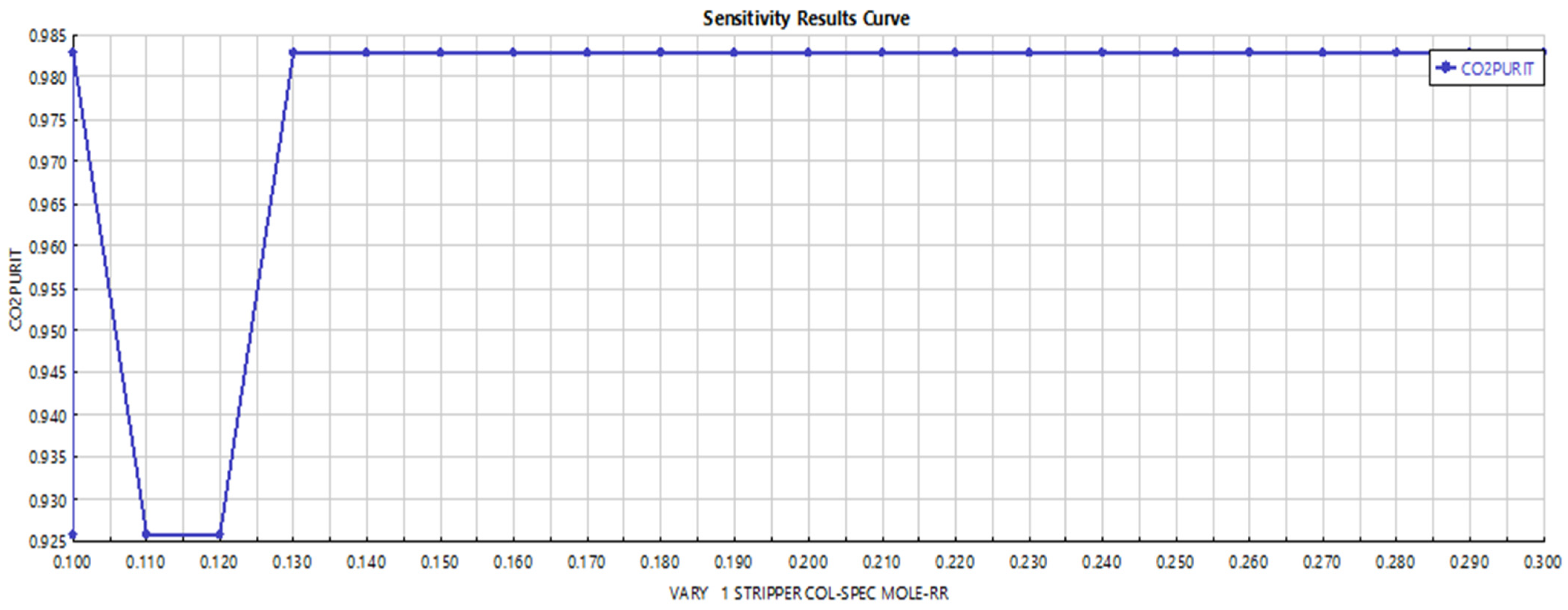
A sensitivity analysis was conducted to investigate the impact of the stripper column’s molar reflux ratio on the purity of CO2 in the overhead product stream. As depicted in Figure 16, when the reflux ratio varied from 0.10 to 0.30, a nonlinear relationship was observed. At very low reflux ratios (~0.10), CO2 purity was initially high (~0.985), likely due to simulation artifacts or the column operating more like a flash separator, which limits internal mass transfer and bypasses effective separation. As the reflux ratio increased to between 0.11 and 0.12, the CO2 purity dropped sharply to around 0.925, indicating inefficient separation. However, beyond a reflux ratio of 0.13, the column began operating more effectively, and CO2 purity rapidly recovered and stabilized near 0.985. This behavior suggests the existence of a minimum reflux ratio threshold (~0.13) required for effective stripper column performance, beyond which further increases do not enhance separation but may result in unnecessary energy consumption.
Overall, the MDEA-based absorption system successfully achieved the design target of 95% CO2 capture efficiency, producing a concentrated CO2 stream with 97% purity, suitable for utilization or geological storage. While solvent regeneration imposes an energy penalty of approximately 5.67 MW, it remains a necessary trade-off for enabling low-carbon hydrogen production, supporting decarbonization goals and it is necessary for low-carbon hydrogen production [18,27].

3.4. Techno-Economic Assessment

Economic evaluation underscores the dual benefit of waste valorization and renewable integration.
  • Catalyst Cost: The prepared red mud-zeolite composite catalyst was calculated to have a cost of 3.89 SAR/g (1.04 USD/g) (Table 4), which is over 75% lower than the market price of a conventional Ni-based catalyst ~17.25 SAR/g (4.60 USD/g). This drastic reduction in a major consumable cost significantly improves operating economics.
  • Solar Integration Benefits: The integration of the SPD system demonstrates the technical feasibility of supplying high-temperature renewable heat to industrial processes. While involving a capital investment, the system directly offsets natural gas consumption, resulting in calculated annual fuel savings of approximately 9500 SAR (2530 USD) and corresponding CO2 emission reductions. The calculated annual fuel savings of approximately 9500 SAR are based on a conservative estimate that accounts for real-world solar field performance, including an average DNI during operation lower than the design-point value, expected maintenance downtime, and boiler efficiency at the point of fuel displacement. The primary value of solar integration in this configuration is the demonstrated pathway for decarbonizing high-temperature industrial heat rather than direct economic savings.
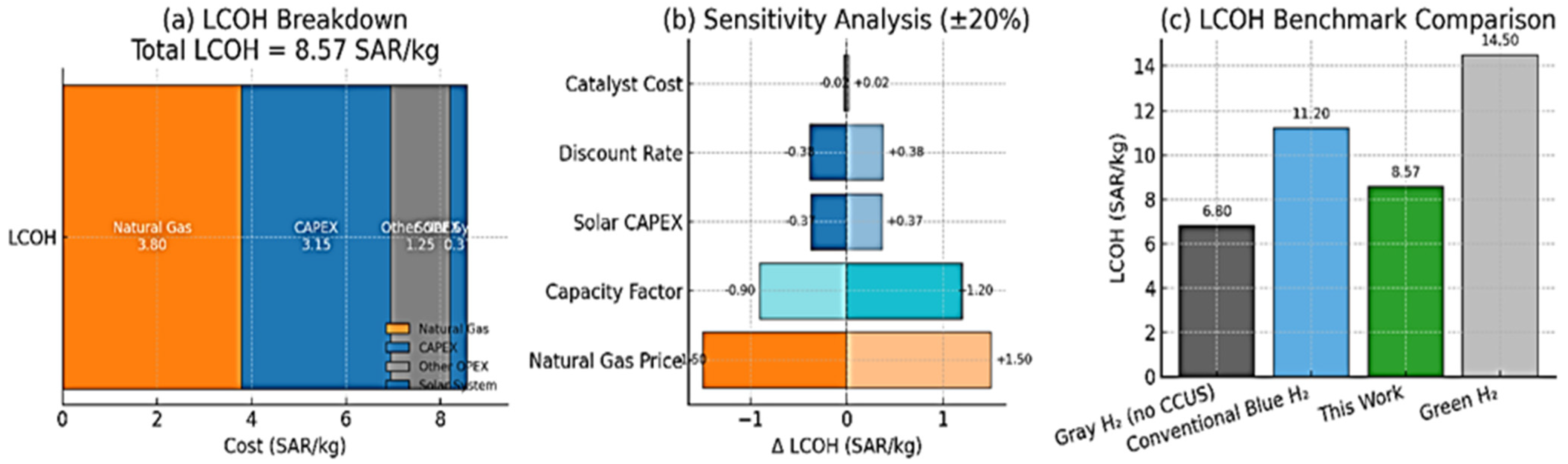
  • Levelized Cost of Hydrogen (LCOH): The overall LCOH for the integrated plant, accounting for all capital and operational expenditures, was calculated to be 8.57 SAR/kg (2.29 USD/kg) (Table 2). This value is highly competitive with reported costs for both conventional blue hydrogen and renewable green hydrogen in the region [28,29], demonstrating the economic promise of the proposed intensified process.

3.4.1. Prospective Analysis for Increased Solar Contribution

A prospective analysis was conducted to explore the impact of scaling the solar field. Increasing the solar thermal share to 20% of the steam demand would proportionally increase both the fuel savings and CO2 emission reductions, enhancing the environmental benefits of the hybrid system. While this would increase CAPEX, the net effect on LCOH is complex. As shown in the sensitivity analysis (Figure 17b), the LCOH is highly sensitive to natural gas prices. In regions with higher gas prices, the OPEX savings from a larger solar field would more quickly offset the additional capital investment, improving economic viability. This underscores the importance of the waste-derived catalyst in managing overall costs, making higher levels of renewable integration more economically feasible.
Capital Expenditure (CAPEX) Breakdown
The total capital expenditure for the base-case plant (with 10% solar contribution) was estimated. A high-level breakdown is as follows: Reforming Island (~45%), CCUS Unit (~30%), H2 Purification (PSA) (~15%), Solar Field (~3.1%), representing an investment of 2,635,000 SAR for thirty-one dishes, and Balance of Plant (~6.9%). This breakdown highlights that while the solar system adds capital cost, its relative share in this configuration is modest, and the major cost drivers remain the core SMR and CCUS units.
To evaluate the robustness of the economic model and identify key cost drivers, a sensitivity analysis was performed on the LCOH. Key parameters varied by 20% from their base case values, and the results are presented in Figure 17b. The analysis reveals that the LCOH is most sensitive to the price of natural gas, followed by the plant capacity factor and the capital expenditure (CAPEX) of the solar dish system. The significant influence of natural gas price underscores the direct economic benefit of solar-thermal integration, which reduces feedstock consumption. The sensitivity to solar CAPEX highlights the importance of continued cost reductions in concentrated solar technology. Conversely, LCOH showed less sensitivity to the discount rate and the cost of the red mud catalyst, reaffirming that the primary economic advantage of the novel catalyst is its dramatic reduction in a major consumable cost rather than its impact on the overall investment risk. The economic analysis reveals that the dominant cost advantage stems from the waste-derived red mud catalyst, which reduces catalyst costs by over 75%. The solar thermal integration, while technically successful, provides primarily environmental benefits at this scale. This underscores that circular economy approaches (waste valorization) can offer more immediate economic advantages while renewable energy integration addresses long-term decarbonization goals. The calculated annual solar contribution of ~9500 SAR represents approximately 0.4% of the total operational costs, confirming that the primary economic advantage of the proposed system derives from the red mud catalyst rather than solar integration. However, the demonstrated technical viability of solar-thermal SMR provides a pathway for future scaling and cost reductions in concentrated solar technology that could enhance economic viability in scenarios with higher natural gas prices or carbon taxation. In fact, while the calculated annual fuel savings of approximately 9500 SAR (2530 USD) are modest within the Saudi context, a direct result of low local natural gas prices (~1.56 USD/GJ), the economic incentive for solar-thermal integration escalates dramatically under global energy market conditions. In Europe, where natural gas prices have consistently ranged between 8 and 12 USD/GJ, an identical system would yield annual savings of ~13,000 to 19,500 USD, a 5 to 8-fold increase. Even under a conservative global average price of 5 USD/GJ, savings would reach ~8100 USD annually. Furthermore, scaling the solar contribution from this proof-of-concept (10%) to a more substantial portion of the plant’s heat demand (e.g., 30–50%) would proportionally multiply these figures, demonstrating that the economic viability of the hybrid system is highly competitive in most international markets and becomes significantly more attractive with increased renewable penetration, even in Saudi Arabia.

4. Conclusions

This study successfully designed, modeled, and evaluated a novel integrated process for producing blue hydrogen by combining solar thermal energy with industrial waste valorization. The key findings and conclusions are as follows:
  • Effective Solar Integration: A solar parabolic dish (SPD) system was proven capable of effectively supplying a significant portion (10%) of the high-temperature heat required for SMR. The system generated superheated steam at 477 °C with a receiver thermal efficiency of 52.4%, directly reducing fossil fuel consumption and associated emissions.
  • Successful Waste Valorization: Red mud, a problematic and abundant industrial waste, was successfully processed and activated to function as an effective, low-cost catalyst for SMR. The catalyst cost of 3.89 SAR/g represents a reduction of over 75% compared to conventional Ni-based catalysts, drastically improving operating economics.
  • High Process Performance: The fully integrated system was optimized to produce high-purity (99.99%) hydrogen at a rate of 1070 kg/h while simultaneously capturing 95% of the produced CO2 at 97% purity, fully meeting the stringent criteria for blue hydrogen production.
  • Strong Economic Competitiveness: The techno-economic analysis confirmed the viability of this approach, yielding a highly competitive levelized cost of hydrogen (LCOH) of 8.57 SAR/kg. The synergies between solar heat integration (reducing OPEX) and waste-derived catalyst use (slashing a major consumable cost) are the key drivers of this economic advantage.
  • The solar thermal integration provides a viable pathway for reducing the carbon footprint of conventional SMR processes, demonstrating the technical feasibility of renewable heat integration in high-temperature industrial applications. While the direct economic savings are modest (~9500 SAR/year), the environmental value of displacing fossil-derived process heat represents a significant benefit for low-carbon hydrogen production.
In conclusion, this work provides a comprehensive and tangible model for applying circular economy principles and renewable energy integration to decarbonize a critical industrial process. It demonstrates a viable and synergistic pathway to simultaneously address the dual challenges of industrial waste management and carbon mitigation in the hydrogen sector, offering a promising interim solution on the road to a fully renewable energy future.

Future Work Recommendations

Based on the findings and limitations of this proof-of-concept study, several avenues for future research are identified: (1) Prototype fabrication and experimental testing of the helical Inconel receiver to verify manufacturability, flow distribution, and high-temperature material behavior; (2) Experimental validation of the red-mud catalyst, including kinetic performance and long-term deactivation under SMR conditions; (3) Dynamic modeling of the integrated system to address solar intermittency, transient operation, and potential incorporation of thermal energy storage; (4) Scaling and techno-economic studies for configurations with higher solar contribution (e.g., >20%) to better assess practical feasibility; and (5) A comprehensive Life Cycle Assessment (LCA) to quantify embedded emissions and evaluate the environmental advantages over conventional SMR pathways.

Author Contributions

Conceptualization, T.M., M.A.-Z., S.H., A.A., M.A. (Mohammad Aljohani), M.A. (Murad Alghamdi), F.A., L.A., Y.S. and S.A.; methodology, T.M. and S.A.; software, T.M., S.H., A.A., M.A. (Mohammad Aljohani), M.A. (Murad Alghamdi) and F.A.; validation, T.M., M.A.-Z., S.H., A.A., M.A. (Mohammad Aljohani), M.A. (Murad Alghamdi), F.A., L.A., Y.S. and S.A.; formal analysis, T.M., M.A.-Z., A.A., M.A. (Mohammad Aljohani), M.A. (Murad Alghamdi), F.A., L.A., Y.S. and S.A.; investigation, T.M. and S.A.; resources, T.M., Y.S. and S.A.; data curation, T.M. and S.A.; writing—original draft preparation, T.M.; writing—review and editing, T.M., M.A.-Z., S.H., A.A., M.A. (Mohammad Aljohani), M.A. (Murad Alghamdi), F.A., L.A., Y.S. and S.A.; visualization, T.M. and S.A.; supervision, T.M.; project administration, T.M. and M.A.-Z.; funding acquisition, T.M. All authors have read and agreed to the published version of the manuscript.

Funding

This research received no external funding.

Data Availability Statement

The data supporting this study’s findings are available from the corresponding author upon reasonable request.

Acknowledgments

We would like to acknowledge the Imam Abdulrahman Bin Faisal University for the assistance and support provided to conduct very efficient research. Thanks, are also extended to Maaden Company for providing the red mud samples.

Conflicts of Interest

The authors declare no conflicts of interest.

Abbreviations

SMRSteam Methane Reforming
SPDSolar Parabolic Dish
PSAPressure Swing Adsorption
WGSWater-Gas Shift
MDEAMethyl Diethanol Amine
LCOHLevelized Cost of Hydrogen
DNIDirect Normal Irradiance
S/CSteam-to-Carbon ratio
CCUSCarbon Capture, Utilization, and Storage
CSPConcentrated Solar Power
EDSEnergy Dispersive X-ray Spectroscopy
CFDComputational Fluid Dynamics

Appendix A. Optical Modeling of the Solar Parabolic Dish (SDP)

This section provides the detailed equations referenced in Section 2.2 of the main text. The geometry of the parabolic dish is defined mathematically to ensure efficient solar energy concentration:
x 2 + y 2 = 4 f z
Equation (A1) represents the standard paraboloid geometry, where f is the focal length. It ensures that all reflected rays converge at the focus, maximizing solar radiation capture. The dish depth d is related to the diameter D and focal length f by:
d = D 2 16 f
A deeper dish enhances concentration efficiency but may require more precise solar tracking, highlighting a design trade-off between performance and system complexity. The focal length f depends on the dish diameter (D) and rim angle (ψrim).
f = D 4 t a n ψ rim   2
In our case, a rim angle of 45° provided an optimal balance between focal length and receiver placement for efficient boundary heating. The surface area S of the dish, critical for determining the solar collection potential, is calculated as:
S = 8 π 3 f 2 1 + D 4 f 2 3 2 1
The aperture area A con . , through which sunlight enters, is given by:
A con .   = π 4 D 2
The receiver diameter depends on the focal length (f), angular acceptance (θa), and incidence angle ( ψ m ). A smaller receiver diameter reduces heat loss but requires precise alignment with the concentrated rays:
D rec .   = f θ a c o s   ψ m ( 1 + c o s   ψ m )
The receiver aperture area determines the amount of concentrated solar radiation absorbed. This must balance with the dish’s aperture area to avoid under-utilization or excessive heat loss.
A rec = π 4 D rec .   2
To enhance thermal transfer, the receiver is designed as a helical coil, which increases fluid contact time and promotes secondary flow, improving heat transfer performance. The relevant helical parameters include the curvature ratio (γ) and dimensionless pitch (β):
γ = R R c
β = h 2 π R c

Appendix B. Thermo-Fluid Modeling of the Receiver

This section provides the detailed equations referenced in Section 2.2 of the main text.
This section evaluates the heat transfer and fluid dynamics inside the helical pipe receiver, which are critical for achieving the required outlet temperatures. The Dean number De, combining Reynolds number Re and curvature ratio γ, characterizes secondary flow effects:
D e = γ R e
The friction factor F represents energy loss due to pipe wall interactions:
F = R ρ v 2 d p d s
bulk velocity ( v ) is derived as follows:
v = Q π R 2
The dimensionless volumetric flow rate Q helps characterize pressure-driven flow:
Q = 1 R 2 ρ ( d p / d s ) R 1 / 2 Q
Heat transfer within the receiver involves conduction, radiation, and convection.
Fourier’s Law of heat conduction:
q = k Δ T
Radiative heat loss:
· q = ε σ T a m b 4 T 4
Convective heat loss:
q = h T e x t T
Conduction heat Loss:
Q conduction   = k A support   L T surface   T ambient  
Useful Heat Gain:
Q useful   = m . c p T outlet   T inlet  
Receiver Efficiency:
η receiver   = Q useful   Q absorbed  
The boundary heat source, which represents the effective thermal input to the receiver, is:
Q b = A r D N I   η o p t , d C R
Thermal property relationships:
Prandtl number:
P r = c p μ k
Nusselt number (forced convection correlation):
N u = 0.332 R e 1 2 P r 1 3
The heat transfer coefficient:
h = k   N u D

Appendix C. Chemical Kinetics and Reactor Modeling for Steam Methane Reforming (SMR)

This section provides the detailed equations referenced in Section 2.3 of the main text.
The industrial production of high purity hydrogen relies on Steam Methane Reforming (SMR) as its primary large-scale method. The chemical process uses methane ( C H 4 ) and steam ( H 2 O ) at 800 °C to 1000 °C temperatures to produce hydrogen through a metal-based catalyst system that includes nickel or Ni-Red Mud composite materials. The endothermic reaction of SMR needs a continuous heat supply to maintain its conversion process. The main chemical reaction is represented as follows:
C H 4 + H 2 O C O + 3 H 2 Δ H   = + 206   k J / m o l
The process benefits from a secondary reaction known as the Water Gas Shift (WGS) reaction, which further enhances hydrogen production by converting carbon monoxide ( C O ) into carbon dioxide ( C O 2 ) with the generation of more hydrogen.
C O + H 2 O C O 2 + H 2
The chemical kinetics of SMR are modeled using a first-order reaction with respect to methane concentration C H 4 . This means that the rate at which methane reacts with steam is directly proportional to its concentration within the reactor. The reaction rate expression is defined mathematically as follows:
r S M R = K S M R × c C H 4
The reaction rate constant K S M R is highly dependent on temperature and is determined using the Arrhenius equation:
K S M R = A f T / T ref   n × e x p E A R g T
In this formulation, A f represents the Arrhenius frequency factor and is set at 7 × 10 5 , while E A is the activation energy, valued at 83.14 × 10 3 J/mol. The reference temperature is considered as 1 K, and the temperature exponent n is 0 in this case. These kinetic parameters are crucial for simulating the chemical reaction rates accurately within the COMSOL environment.
Transport of chemical species is a crucial factor in defining efficiency and production of hydrogen in the SMR reactor. In the porous medium reactor, species such as methane ( C H 4 ), steam ( H 2 O ), carbon monoxide ( C O ), and hydrogen ( H 2 ) undergo both diffusive and convective transfer processes. The equation governing species transfer based on conservation of mass is expressed as follows:
ρ ω i t + · j i + ρ ( u · ) ω i = R i
In this equation, ρ denotes the fluid density, ω i is the mass fraction of species, u represents the velocity vector of the fluid, and R i is the rate of production or consumption of the species. Transport properties were defined using Maxwell-Stefan diffusivities, which provide a more realistic representation of species interaction in multi-component systems. The reactor model is configured with boundary conditions to regulate species inflow and outflow. At the Inlet, methane and steam are introduced with specified mass fractions to initiate the reaction, while at the Outlet, the resulting products primarily hydrogen and carbon monoxide exit the reactor. Convective flux settings were applied to ensure that natural flow dynamics were preserved, mimicking real reactor conditions.

Appendix D. Pressure Swing Adsorption Modeling (PSA)

This section provides the detailed equations referenced in Section 2.4 of the main text.
Langmuir Adsorption describe the relationship between the amount of gas adsorbed (Wi∗) and the gas partial pressure (Pi). Where it takes on the account Ts temperature dependence and fitted parameters. Equation (A29) is used for design phase of the PSA system to predict how much hydrogen can be adsorbed:
W i = I P 1 I P 2 T s I P 3 e i p 4 / T s P i 1 + i   I P 3 e i p 4 / T s P i
where I P 1 I P 4 are fitted parameters from experimental data.
Considering the difference between the equilibrium capacity ( W i ) and the current capacity ( W i ). Multiplied by the mass transfer coefficient. It is the factor affecting the speed of the adsorption:
W i t = M T C s i W i W i
Energy Balance during the adsorption and desorption phases, where heat generation or absorption affects system performance:
T t = k ρ c p 2 T + ( 1 ϵ ) ρ p ρ c p j = 1 N   Δ H j W j t
Tracks the change in bulk gas concentration ( c i ) due to mass transfer into the adsorbent with the term represents the adsorption rate. Used to predict the behavior of gas concentrations during the adsorption phase, ensuring the correct amount of gas is adsorbed and purified:
c i t + · U c i = ( 1 ϵ ) ϵ W i t
Heat of Adsorption Important for designing the thermal management system of the PSA process:
q a d s = Δ H a d s W i t

Appendix E. Carbon Capture Unit Modeling (MDEA Modeling)

This section provides the detailed equations referenced in Section 2.4 of the main text.
Mass transfer inside the absorption column:
N i = k i a C bulk   C interface  
Energy balance equation inside the absorption column:
Q = h V , i y i h L , i x i
Reaction kinetics:
r j = k j f T , C i
Chemical equation for C O 2 absorption:
M D E A + H 2 O + C O 2 M D E A H + + H C O 3
Reaction extent for the C O 2 absorption reaction:
ξ = m i n F i , 0 ν i
Outlet composition, used for calculating outlet molar flow rate after a reaction:
F i = F i , 0 + ν i ξ
Vapor-liquid equilibrium at the flash drum:
y i ϕ i V P = x i γ i P i s a t
Mass balance inside the flash drum:
M F = V + L × n
Adiabatic energy balance for the flash drum:
H F = V H V + L H L
Energy balance used in heaters and coolers:
Q = m . C p T o u t T i n
Isentropic work for pumps and compressors:
W = n R T n 1 P 2 P 1 n 1 n 1
Actual work with efficiency:
W a c t u a l = W i d e a l η

References

  1. Kopeinig, H. Renewable Energy Generation and Consumption in the Aggregate Sector. Master’s Thesis, Technical University of Leoben, Leoben, Austria, 2025. [Google Scholar]
  2. Alami, A.H.; Olabi, A.G.; Mdallal, A.; Rezk, A.; Radwan, A.; Rahman, S.M.A.; Shah, S.K.; Abdelkareem, M.A. Concentrating Solar Power (CSP) Technologies: Status and Analysis. Int. J. Thermofluids 2023, 18, 100340. [Google Scholar] [CrossRef]
  3. Shboul, B.; Khawaldeh, H.A.; Al-Smairan, M.; Alrbai, M.; Ali, H.H.; Almomani, F. Perspectives of new solar energy option for sustainable residential electricity generation: A comparative techno-economic evaluation of photovoltaic and solar dish systems. Energy Rep. 2025, 13, 4514–4527. [Google Scholar] [CrossRef]
  4. Pavlović, S.R.; Vasiljević, D.M.; Stefanović, V.P.; Stamenković, Z.M.; Bellos, E.A. Optical Analysis and Performance Evaluation of a Solar Parabolic Dish Concentrator. Therm. Sci. 2016, 20, 1237–1249. [Google Scholar] [CrossRef]
  5. Al-Amayreh, M.I.; Alahmer, A.; Manasrah, A. A Novel Parabolic Solar Dish Design for a Hybrid Solar Lighting-Thermal Applications. Energy Rep. 2020, 6, 1136–1143. [Google Scholar] [CrossRef]
  6. Malik, M.A.-Z.; Shaikh, P.H.; Zhang, S.; Lashari, A.A.; Leghari, Z.H.; Baloch, M.H.; Memon, Z.A.; Caiming, C. A Review on Design Parameters and Specifications of Parabolic Solar Dish Stirling Systems and Their Applications. Energy Rep. 2022, 8, 4128–4154. [Google Scholar] [CrossRef]
  7. Abed, A.A.; El-Marghany, M.R.; El-Awady, W.M.; Hamed, A.M. Recent Advances in Parabolic Dish Solar Concentrators: Receiver Design, Heat Loss Reduction, and Nanofluid Optimization for Enhanced Efficiency and Applications. Sol. Energy Mater. Sol. Cells 2024, 273, 112930. [Google Scholar] [CrossRef]
  8. Korawan, A.D. Karakteristik penyimpan kalor laten pada parabolic mirror dish. J. Penelit. Dan Pengabdi. Kpd. Masy. UNSIQ 2023, 10, 8–12. [Google Scholar]
  9. Bellos, E.; Bousi, E.; Tzivanidis, C.; Pavlovic, S. Optical and Thermal Analysis of Different Cavity Receiver Designs for Solar Dish Concentrators. Energy Convers. Manag. X 2019, 2, 100013. [Google Scholar] [CrossRef]
  10. Alkhalaf, Q.; Lee, D.; Kumar, R.; Thapa, S.; Singh, A.R.; Akhtar, M.N.; Asif, M.; Ağbulut, Ü. Experimental Investigation of the Thermal Efficiency of a New Cavity Receiver Design for Concentrator Solar Technology. Case Stud. Therm. Eng. 2024, 53, 103848. [Google Scholar]
  11. Arjun Singh, K.; Natarajan, S.K. Thermal Analysis of Modified Conical Cavity Receiver for a Paraboloidal Dish Collector System. Energy Sources Part A Recov. Util. Environ. Effects 2021, 1–12. [Google Scholar] [CrossRef]
  12. Malviya, R.; Baredar, P.V.; Kumar, A. Thermal Performance Improvement of Solar Parabolic Dish System Using Modified Spiral Coil Tubular Receiver. Int. J. Photoenergy 2021, 2021, 4517923. [Google Scholar] [CrossRef]
  13. Wang, F.; Shuai, Y.; Yuan, Y.; Liu, B. Effects of Material Selection on the Thermal Stresses of Tube Receiver under Concentrated Solar Irradiation. Mater. Des. 2012, 33, 284–291. [Google Scholar] [CrossRef]
  14. Sigalotti, L.D.G.; Alvarado-Rodríguez, C.E.; Rendón, O. Fluid Flow in Helically Coiled Pipes. Fluids 2023, 8, 308. [Google Scholar] [CrossRef]
  15. Abu-Zeid, M.A.-R.; Elhenawy, Y.; Toderaș, M.; Bassyouni, M.; Majozi, T.; Al-Qabandi, O.A.; Kishk, S.S. Performance Enhancement of Solar Still Unit Using V-Corrugated Basin, Internal Reflecting Mirror, Flat-Plate Solar Collector and Nanofluids. Sustainability 2024, 16, 655. [Google Scholar] [CrossRef]
  16. Hameed, H.G.; Diabil, H.A.N.; Al-Fahham, M.A. Performance Study on a Solar Concentrator System for Water Distillation Using Different Water Nanofluids. Heliyon 2023, 9, e16535. [Google Scholar] [CrossRef]
  17. Avargani, V.M.; Zendehboudi, S. Parametric Analysis of a High-Temperature Solar-Driven Propane Steam Reformer for Hydrogen Production in a Porous Bed Catalytic Reactor. Energy Convers. Manag. 2023, 276, 116539. [Google Scholar] [CrossRef]
  18. Saeidi, S.; Sápi, A.; Khoja, A.H.; Najari, S.; Ayesha, M.; Kónya, Z.; Asare-Bediako, B.B.; Tatarczuk, A.; Hessel, V.; Keil, F.J. Evolution Paths from Gray to Turquoise Hydrogen via Catalytic Steam Methane Reforming: Current Challenges and Future Developments. Renew. Sustain. Energy Rev. 2023, 183, 113392. [Google Scholar] [CrossRef]
  19. Shahid, M.M.; Abbas, S.Z.; Maqbool, F.; Ramirez-Solis, S.; Dupont, V.; Mahmud, T. Modeling of Sorption Enhanced Steam Methane Reforming in an Adiabatic Packed Bed Reactor Using Various CO2 Sorbents. J. Envrion. Chem. Eng. 2021, 9, 105863. [Google Scholar]
  20. Alfuhaid, L.T.; Nasser, G.A.; Alabdulhadi, R.A.; Khan, M.Y.; Yamani, Z.H.; Helal, A. Steam Reforming of Dodecane Using Ni-Red Mud Catalyst: A Sustainable Approach for Hydrogen Production. Int. J. Hydrogen Energy 2024, 86, 177–184. [Google Scholar] [CrossRef]
  21. Yao, Z.; Wang, Y.; Shen, J.; Niu, Y.; Yang, J.F.; Wei, X. Synergistic CO2 Mineralization Using Coal Fly Ash and Red Mud as a Composite System. Int. J. Coal Sci. Technol. 2024, 11, 37. [Google Scholar] [CrossRef]
  22. Singh, S.; Aswath, M.U.; Das Biswas, R.; Ranganath, R.V.; Choudhary, H.K.; Kumar, R.; Sahoo, B. Role of Iron in the Enhanced Reactivity of Pulverized Red Mud: Analysis by Mössbauer Spectroscopy and FTIR Spectroscopy. Case Stud. Constr. Mater. 2019, 11, e00266. [Google Scholar] [CrossRef]
  23. Mucsi, G.; Halyag, N.; Kurusta, T.; Kristály, F. Control of Carbon Dioxide Sequestration by Mechanical Activation of Red Mud. Waste Biomass Valorization 2021, 12, 6481–6495. [Google Scholar] [CrossRef]
  24. do Nascimento, T.M.; Gambarra, F.G.d.S.; Rodrigues, M.G.F. Valorization of Bauxite Residue for Use as Adsorbent for Reactive Blue Removal: Regeneration Evaluation. Processes 2025, 13, 251. [Google Scholar] [CrossRef]
  25. Zhang, C.; Shuai, B.; Zhang, X.; Hu, X.; Zhang, H.; Jia, Y.; Yang, Z.; Guan, X. Polyurethane/Red Mud Composites with Flexibility, Stretchability, and Flame Retardancy for Grouting. Polymers 2018, 10, 906. [Google Scholar] [CrossRef]
  26. Babatabar, M.A.; Saidi, M. Hydrogen Production via Integrated Configuration of Steam Gasification Process of Biomass and Water--gas Shift Reaction: Process Simulation and Optimization. Int. J. Energy Res. 2021, 45, 19378–19394. [Google Scholar] [CrossRef]
  27. Meerman, J.C.; Hamborg, E.S.; Van Keulen, T.; Ramírez, A.; Turkenburg, W.C.; Faaij, A.P.C. Techno-Economic Assessment of CO2 Capture at Steam Methane Reforming Facilities Using Commercially Available Technology. Int. J. Greenh. Gas Control 2012, 9, 160–171. [Google Scholar] [CrossRef]
  28. Oni, A.O.; Anaya, K.; Giwa, T.; Di Lullo, G.; Kumar, A. Comparative Assessment of Blue Hydrogen from Steam Methane Reforming, Autothermal Reforming, and Natural Gas Decomposition Technologies for Natural Gas-Producing Regions. Energy Convers. Manag. 2022, 254, 115245. [Google Scholar] [CrossRef]
  29. Antzara, A.; Heracleous, E.; Bukur, D.B.; Lemonidou, A.A. Thermodynamic Analysis of Hydrogen Production via Chemical Looping Steam Methane Reforming Coupled with in Situ CO2 Capture. Energy Procedia 2014, 63, 6576–6589. [Google Scholar] [CrossRef]
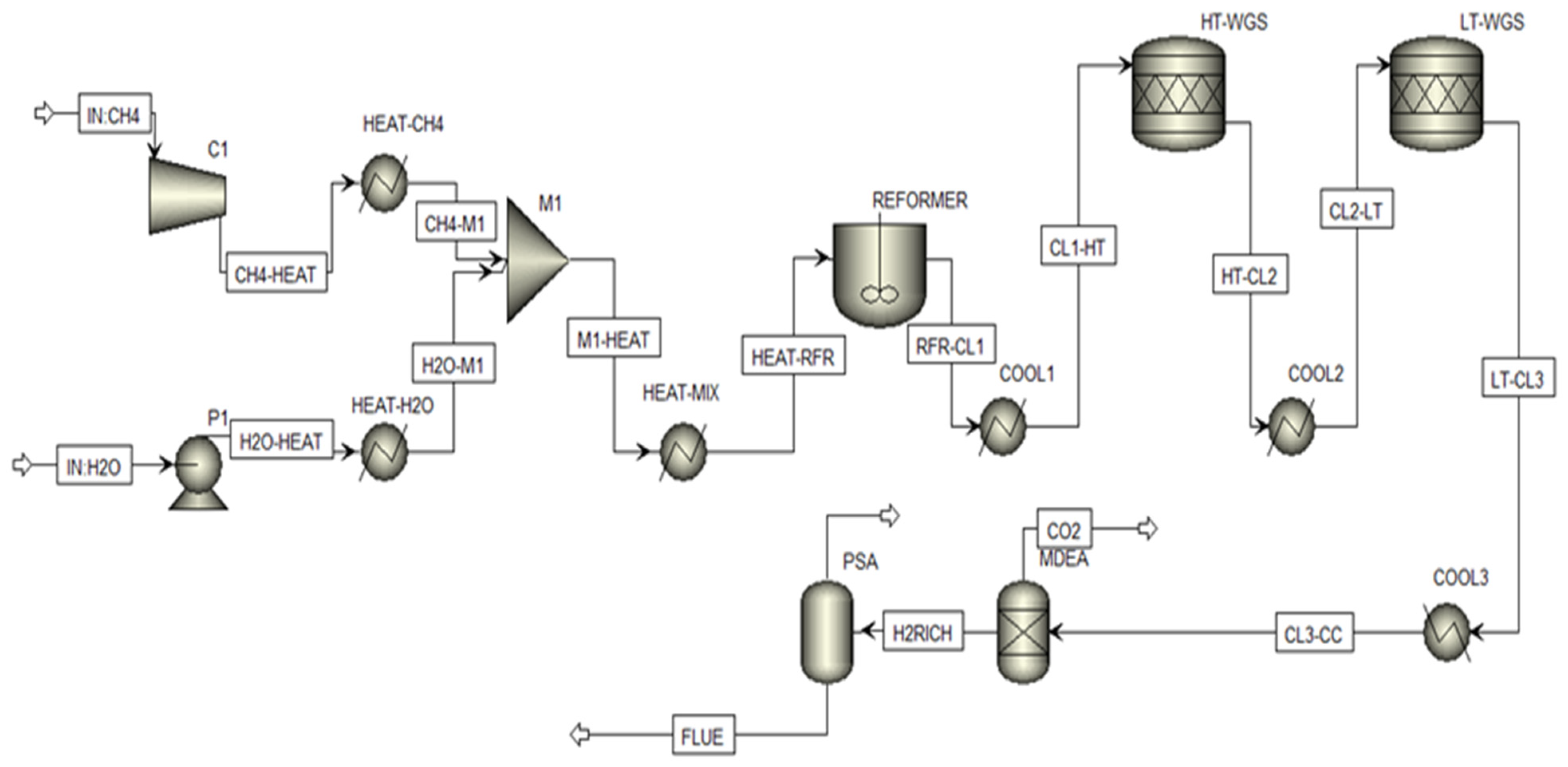
Figure 1. ASPEN Plus process flow diagram of the integrated solar-assisted SMR system for blue hydrogen production, including feed conditioning, reforming, water-gas shift reactors, MDEA-based carbon capture, and PSA purification.
Designs 09 00138 g001
Figure 2. Geometrical design of the Solar Parabolic Dish (SPD) with key dimensions.
Designs 09 00138 g002
Figure 3. Cross-section of the cylindrical cavity receiver with a helical coil and insulation.
Designs 09 00138 g003
Figure 4. Structured mesh used for simulations.
Designs 09 00138 g004
Figure 5. Mesh Independence Study (Relative Error vs. Number of Elements).
Designs 09 00138 g005
Figure 6. (A) Ray spot diagram, (B) Ray trajectories.
Designs 09 00138 g006
Figure 7. Thermal Simulation Results, (A) Surface wall temperature of the helically coil, and (B) Fluid temperature along the helically coiled tube.
Designs 09 00138 g007
Figure 8. Evolution of Fluid Thermodynamic State and Density in the Helically Coiled Tube.
Designs 09 00138 g008
Figure 9. Physics coupling in COMSOL Multiphysics.
Designs 09 00138 g009
Figure 10. (A) EDS spectrum and elemental composition (weight %), (B) XRD pattern along with phase identification, and (C) FTIR spectrum of the red mud sample.
Designs 09 00138 g010
Figure 11. Daily performance profile of the SPD system showing DNI and outlet steam temperature (Tout) over daylight hours.
Designs 09 00138 g011
Figure 12. Optimization of SMR reactor performance: Simulated mole fractions of CH4, H2O, H2, and CO along the catalyst bed length.
Designs 09 00138 g012
Figure 13. Effect of Reformer Temperature on Hydrogen molar flow rate. The red dashed line indicates the selected operating temperature (900 °C), while the orange curve represents the hydrogen yield.
Designs 09 00138 g013
Figure 14. Effect of Reformer Pressure on Hydrogen yield. The red dashed line indicates the selected operating pressure (25 bar), while the orange curve represents the hydrogen molar flow rate.
Designs 09 00138 g014
Figure 15. Effect of Steam-to-Carbon Ratio on Hydrogen Production. The red dashed line indicates the selected operating point (S/C=3), while the orange curve represents the hydrogen yield tendency.
Designs 09 00138 g015
Figure 16. Reflux ratio to CO2 purity.
Designs 09 00138 g016
Figure 17. Techno-economic analysis results: (a) Breakdown of the levelized cost of hydrogen (LCOH) for the proposed system, showing contributions from capital (CAPEX) and operational (OPEX) expenditures, (b) Sensitivity analysis (tornado chart) showing the impact of a ±20% change in key parameters on the LCOH, and (c) Comparison of the calculated LCOH with regional benchmarks for conventional hydrogen production pathways.
Designs 09 00138 g017
Table 1. Key process modeling assumptions and conditions.
SectionReactor TypeT (°C)P (bar)Key ParameterRationale/Reference
SMRRGibbs90025S/C = 3, EquilibriumFast kinetics, high T [4]
HT-WGSRStoic4502585% CO ConversionNear-equilibrium [17]
LT-WGSRStoic2502585% CO ConversionNear-equilibrium [17]
MDEA AbsorberRadFrac402495% Capture EfficiencyStandard design [18]
PSA UnitCustom4024- 14-bed, 12-step cycleH2 purity > 99.99% [19]
Table 2. Finalized Geometrical and Operational Parameters for the Helical Receiver.
Symbol/ItemValueUnitDescription/Notes
Geometrical Parameters
Dish Focal Length (F)3m
Dish Diameter (D)5m
Dish Projected Area (A)19.635m2
Receiver Cavity Radius (Rc)139mm
Tube Outer Radius (R)5.0mm
Tube Outer Diameter (Do)10.0mm
Tube Wall Thickness (t)1.20mmConservative for pressure and corrosion
Tube Inner Diameter (Di)7.60mm
Helix Radius (Rh)124mmAllows for manufacturing clearance
Curvature Ratio (γ)0.0327-
Axial Pitch (p)16.2mm
Total Tube Length (Ltotal)6.24mFor (N = 8) turns
Table 3. Safety and Performance Validation Analysis.
Symbol/ItemValueUnitDescription/Notes
Operational and Material Limits
Design Pressure (P)30bar
Max Tube Wall Temp (Tmax)495°CFrom CFD (Figure 7B)
Thin-Wall Hoop Stress ( σ h o o p )12.5MPa( σ H o o p = P · R / t )
Inconel 600 Yield Strength (at 495 °C)≈250MPaConservative, temp-dependent value
Safety Factors and Margins
Safety Factor (Pressure)≈20- σ y T / σ h o o p
ManufacturabilitySuitable-Mandrel bending; (Rh ≫ 3Do)
Table 4. Key assumptions for techno-economic analysis.
ParameterValueSource/Note
Plant Lifetime25 yearsStandard assumption
Annual Operating Hours7884 h(90% availability)
Discount Rate8%
Natural Gas Price5.85 SAR/GJ (1.56 USD/GJ)Local market data
Electricity Tariff0.18 SAR/kWh (0.048 USD/kWh)Local market data
Ni-based Catalyst Cost17.25 SAR/g (4.60 USD/g)Market quote [RiOGen Inc.,
Winston-Salem, NC, USA]
Red Mud-Zeolite Catalyst3.89 SAR/gCalculated (This work)
Solar Dish Cost31 × 85,000 SAR/unit (31 × 22,667 USD)Vendor quote and literature estimate
Disclaimer/Publisher’s Note: The statements, opinions and data contained in all publications are solely those of the individual author(s) and contributor(s) and not of MDPI and/or the editor(s). MDPI and/or the editor(s) disclaim responsibility for any injury to people or property resulting from any ideas, methods, instructions or products referred to in the content.