Article

Design and Validation of a CNN-BiLSTM Pulsed Eddy Current Grounding Grid Depth Inversion Method for Engineering Applications Based on Informer Encoder

1
Inner Mongolia EHV Power Supply Company Inner Mongolia Electric Power Co., Ltd., Hohhot 010012, China
2
Baotou Power Supply Branch of Inner Mongolia Electric Power (Group) Co., Ltd., Baotou 014030, China
3
State Key Laboratory of Power Transmission Equipment Technology, School of Electrical Engineering, Chongqing University, Chongqing 400044, China
*
Author to whom correspondence should be addressed.
Designs 2025, 9(6), 128; https://doi.org/10.3390/designs9060128

Submission received: 5 September 2025 / Revised: 11 November 2025 / Accepted: 12 November 2025 / Published: 14 November 2025

Abstract

To address the problems of low inversion accuracy and poor noise resistance in pulsed eddy current (PEC) grounding grid depth detection, this study proposes a novel inversion model (IE-CBiLSTM). This model integrates the Informer Encoder with the CNN-BiLSTM for the first time to detect the depth of the PEC grounding grid and conducts experimental verification based on an independently designed pulsed eddy current detection device and a dedicated coil sensor. The model design employs a two-dimensional convolutional neural network (CNN) to extract local spatial features, combines a bidirectional long short-term memory network (Bi-LSTM) to model temporal dependencies, and introduces a multi-head attention mechanism along with the Informer structure to enhance the expression of key features. In terms of data construction, the design integrates both forward simulation data and measured data to improve the model’s generalization capability. Experimental validation includes self-burial experiments and field tests at a substation. In the self-burial test, the IE-CBiLSTM inversion results show high consistency with actual burial depths under various conditions (1.0 m, 1.2 m, and 1.5 m), significantly outperforming other optimization algorithms, achieving a coefficient of determination (R2) of 0.861, along with root mean square error (ERMS) and mean relative error (EMR) values of 17.54 Ω·m and 0.061 Ω·m, respectively. In the field test, the inversion results also closely match the design depths from engineering drawings, with an R2 of 0.933, ERMS of 11.30 Ω·m, and EMR of 0.046 Ω·m. These results are significantly better than those obtained using traditional Occam and LSTM methods. At the same time, based on the inversion results, a three-dimensional inversion map of the grounding grid and a buried depth profile were drawn, and the spatial direction and buried depth distribution of the underground flat steel were clearly displayed, proving the visualization ability of the model and its engineering practicality under complex working conditions. This method provides an efficient and reliable inversion strategy for deep PEC nondestructive testing of grounding grid laying.

1. Introduction

1.1. General Context

The grounding grid is an important facility in the power system to ensure the safe operation of equipment and personal safety [1]. The burial depth of the grounding grid directly affects the size of the grounding resistance [2]. If the burial depth is insufficient, the grounding resistance may increase, increasing the risk of lightning strike or short circuit of equipment, threatening the safety of equipment and personnel; while excessive burial depth may cause waste of construction resources [3]. Therefore, it is necessary to detect the burial depth of the grounding grid when the substation is put into operation to ensure that the burial depth of all grounding grids meets the grounding requirements. PEC is an electromagnetic detection technology developed in recent years. It can detect the burial depth of underground conductors without excavation [4], improve detection efficiency and reduce human, material and financial expenditures. Its core principle is that when the excitation coil applies transient current excitation, the induced eddy current in the conductor under test will generate a characteristic secondary electromagnetic field response. By accurately acquiring the time–frequency domain signal of the secondary field and establishing the corresponding electromagnetic field inversion model, non-destructive detection of structural parameters such as the conductor burial depth can be achieved [5].

1.2. Motivation

For the purpose of effectively invert the information of underground structures and solve the relationship between depth and apparent resistivity, many scholars have proposed various inversion methods. Fu Zhihong et al. [6] first combined the “smoke ring” theory with the transient electromagnetic method, and detected the fault and buried depth of the grounding grid breakpoint by inverting the apparent resistivity. Zhan Wenfeng [7] uses bipartite search and least squares method to fit the full-process visual resistivity, combined with the smoke ring method inversion estimation initial model, to achieve the inversion of measured data of different landforms. Based on the smooth model theory, Lu Juntao [8] et al. innovatively constructed the Occam inversion method and applied it to two-dimensional inversion of aeronautical transient electromagnetic data. This method not only retains the advantage of Occam inversion with little dependence on the initial model, but also effectively maintains the lateral continuity characteristics of electrical parameters between adjacent measurement points by introducing lateral constraints. Based on the above linear optimization methods, some scholars began to systematically explore the application of fully nonlinear optimization methods in inversion problems. During this period, a variety of inversion methods with global optimization characteristics emerged, including simulated annealing algorithm, genetic algorithm, differential evolution algorithm, artificial neural network algorithm and particle swarm optimization algorithm. These inversion calculation methods are applied in multiple detection fields such as gravity exploration [9], seismic exploration [10], magnetotelluric method [11], Rayleigh wave analysis [12], transient electromagnetic [13], PEC [14], etc. However, nonlinear global optimization methods are difficult to put into practical use due to the limitations of complex forward and inverse theories and data processing procedures.

1.3. Literature Review

With the advancement of technology, neural network technology has shown significant advantages in the field of geophysical inversion due to its excellent nonlinear approximation ability and adaptive learning characteristics [15]. Compared with traditional inversion methods, this technology establishes the mapping relationship between observation data and model parameters in a data-driven way, effectively avoiding the tedious forward calculation process and significantly improving the inversion calculation efficiency. In terms of PEC technology, Grochowalski, J.M et al. [16]. proposed a pulse multi-frequency eddy current detection inversion method based on finite element algorithm and deep learning method. This method constructs a sensor defect model through the finite element method to generate training data, and uses k-nearest neighbors to realize intelligent identification of defect parameters of conductive material. Shinan Lang [17] et al. proposed a hybrid inversion method for the inversion problem of airborne transient electromagnetic data. This method introduced the supervised descent method (SDM) into the traditional hybrid inversion framework to enhance the inversion step size and computational efficiency of the artificial neural network (ANN). In the field of transient electromagnetic inversion, Cheng Jiulong [18] et al. applied the BP neural network (BPNN) algorithm to simulation tests of transient electromagnetic prediction of water-richness in mines, achieving quantitative prediction of rock strata water-richness and image inversion in mines. Han Xinyue [19] and others used the Modified Whale Optimization Algorithm-Elman (MWO-Elman) neural network to identify defects in transient electromagnetic signals of the grounding grid. However, the network structure design of the above three methods is relatively simple, and it is difficult to simultaneously capture the spatial characteristics and temporal dependencies in transient electromagnetic signals. Fan Tao’s research team [20] innovatively applied the long short-term memory (LSTM) neural network as a time series processing model to build a fast inversion framework for transient electromagnetic data and successfully achieved real-time inversion imaging of three-layer and five-layer stratigraphic structures. Qin Siyuan [21] and others used the Informer architecture to build an inversion model for ocean sound velocity profiles and achieved the inversion of ocean sound velocity profiles across different regions and time periods. Dong Chunfeng et al. [22] successfully realized the intelligent recognition and automatic tracking of seismic stratigraphic information by constructing a deep CNN architecture. Furthermore, this study innovatively combined the feedforward attention mechanism (Attention) with LSTM to establish a deep learning model that can accurately predict the elastic wave impedance of the entire profile. Xian Jinchi et al. [23] studied the rapid imaging problem of towed ground transient electromagnetic based on the CNN-LSTM combined structure. Le Youxi et al. [24] established a mapping relationship model between high-frequency logging data and low-frequency seismic data through a bidirectional long short-term memory network (BiLSTM) to invert seismic data. Gao Ci [25] uses the mask mechanism to simulate the layout of field measurement points for the two-dimensional resistivity model of the magnetotelluric method, and uses the Transformer neural network to realize the mapping of the output resistivity model. Wang Yunhong [26] designed a transient electromagnetic numerical simulation neural network based on the Transformer neural network architecture and adopted a codec structure to achieve fast and accurate calculation of transient electromagnetic numerical simulation. Although existing studies have demonstrated the applicability of CNN, LSTM, Bi-LSTM, and Informer architectures for electromagnetic signal inversion, the potential of a hybrid framework that integrates these methods remains unexplored.

1.4. Contribution

This paper proposes an Informer Encoder-CNN-BiLSTM (IE-CBiLSTM) model that integrates Informer Encoder and CNN-BiLSTM for the inversion of PEC signals. Based on the analysis of the spatiotemporal characteristics of PEC detection data and the respective advantages of different neural network structures, this method uses forward simulation and traditional inversion results as the learning basis, and organically combines the PEC inversion concept with the deep learning method under the conditions of a specific grounding grid model, thereby achieving efficient and accurate inversion of the buried depth of the grounding grid.

2. Informer Encoder-CNN-BiLSTM Inversion Principle and Method

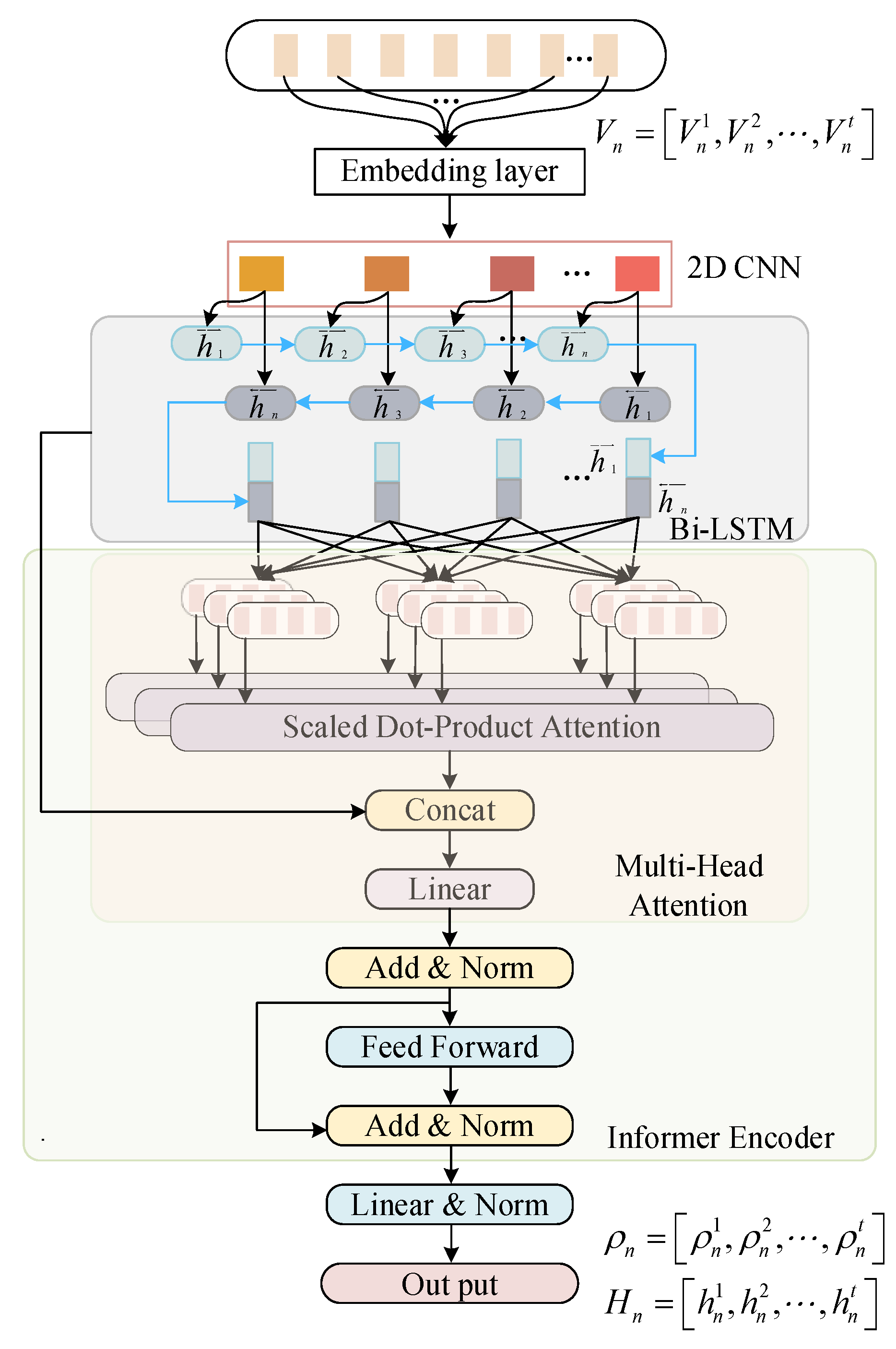
According to different network combination characteristics, inversion requirements and dataset size, this IE-CBiLSTM inversion adopts a PEC signal inversion model based on the encoder structure. First, the acquired PEC voltage time series signal is normalized, and the normalized input embedding layer is feature mapped and sent to the 2D-CNN to extract the spatial characteristics of the local grounding grid stratum and suppress the detection signal noise. Subsequently, the convolution result is input into the BiLSTM to capture the temporal dependency of the sequence from the front and back directions and extract deep-level time series features. On this basis, the attention weights of different features are allocated through the Multi-Head Attention mechanism to enhance the perception of key inversion information. Subsequently, the residual connection, normalization and feedforward network in the Informer Encoder structure are used to further optimize the feature expression. Finally, the output layer performs linear transformation and anti-normalization on the result to obtain the inversion result of the grounding grid burial depth. The overall process is shown in Figure 1, where Vn represents the voltage signal sequence detected by the pulsed eddy current signal receiving coil. h 1 , h 2 , , h t represents the forward hidden state parameter of the pulsed eddy current voltage signal after the convolution operation, and h 1 , h 2 , , h t represents the backward hidden state parameter. ρn and Hn represent the final output soil resistivity sequence and the corresponding burial depth value.

2.1. Two-Dimensional Spatiotemporal Feature Extraction of Pulsed Eddy Current

Since the PEC inversion is similar to the transient electromagnetic inversion method, referring to the transient electromagnetic inversion research [27], the convolution operation of the two-dimensional matrix of the PEC signal can be expressed in the following mathematical form:
g ( l , j ) = σ ( m n k l h ( m , k ) X ( l m , j k ) + b )
The convolution operation process can be described as follows: for the obtained time series data matrix, a 3 × 3 two-dimensional convolution kernel h (m, k) is used for sliding window calculation, where m and k represent the size of the convolution kernel in the spatial and temporal dimensions, respectively. The network input is a two-dimensional tensor X (t × n). For each position (l, j), the convolution kernel is the dot-product with the corresponding local data block X (lm, jk), and after superimposing the bias term b, the output feature g (l, j) is obtained through the nonlinear activation function σ(·). Among them, l and j represent the index of the PEC detection coil measurement point and time channel, and m, k are the index values of the two-dimensional convolution kernel, respectively [28]. The initial convolution kernel parameters adopt a random initialization strategy. The calculation process traverses the entire input feature space in a sliding window manner to achieve joint extraction of time features.

2.2. BiLSTM Deep Inversion Model Construction

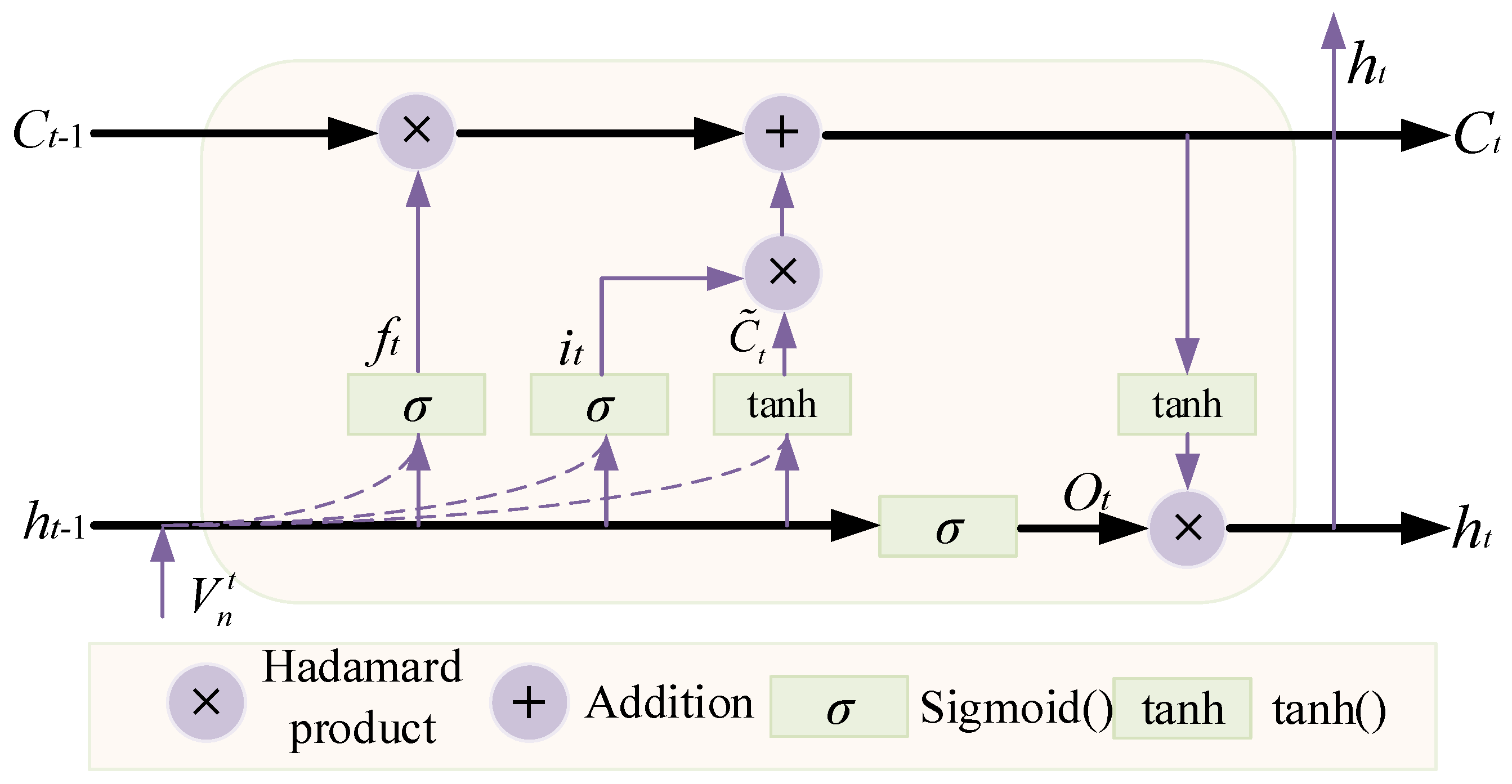
Traditional RNN has the problem of gradient vanishing when processing PEC time series signals, and it is difficult to effectively model long sequence dependencies [29]. To this end, this study uses LSTM network for grounding grid depth inversion. Its gating mechanism enables adaptive control of information flow, allowing it to selectively retain key historical features while filtering out irrelevant noise [30]. For the processing of PEC voltage signals in grounding grid depth inversion, LSTM network achieves accurate modeling through gating mechanism. Suppose that the voltage sequence of the nth measuring point is Vn = [ V n 1 , V n 2 , …, V n t ], and its workflow is as follows: at time t, the forget gate (fi) regulates the degree of retention of historical information ht−1, and the input gate (it) controls the update weight of the current input Vn. The two jointly update the cell state Ct; the output gate (Ot) generates the current output ht based on candidate gate ( C ˜ t ) and ht−1. Figure 2 illustrates the internal anatomy of the LSTM cell unit.
i t = σ ( ω x i X n + ω h i h t 1 + b i ) f t = σ ( ω x f X n + ω h f h t 1 + b f ) O t = σ ( ω x o X n + ω h o h t 1 + b o ) C ˜ t = tanh ( ω x c X n + ω h c h t 1 + b c ) C t = f t C t 1 + i t C ˜ t h t = O t tan h ( C t )
In the formula, ωxi, ωxf, ωxo, ωxc are the weight matrices corresponding to Xn; ωhi, ωhf, ωho, ωhc are the weight matrices corresponding to ht−1; bi, bf, bo, bc are bias vectors; tanh() is the activation function.
Bi-LSTM is the concatenation of forward–backward long short-term memory neural networks, that is, the forward hidden state h 1 , h 2 , , h t and the backward hidden state h 1 , h 2 , , h t are concatenated into the final hidden state h 1 , h t ; h 2 , h t - 1 ; ; h t , h 1 using the concat function, recorded as h 1 , h 2 , , h t . This structure enables the model to utilize both past and future information when processing any element in the sequence, thereby more effectively understanding the long-term dependencies within the sequence [31,32].

2.3. Informer Encoder Model Construction

To address the complex and variable geological environment of grounding grids and the limitations of the traditional BiLSTM model [33], which may overlook critical features in sequential data, this paper introduces the Informer Encoder to perform deep feature extraction on the PEC signal, aiming to improve the inversion accuracy of grounding grid burial depth and reduce errors.
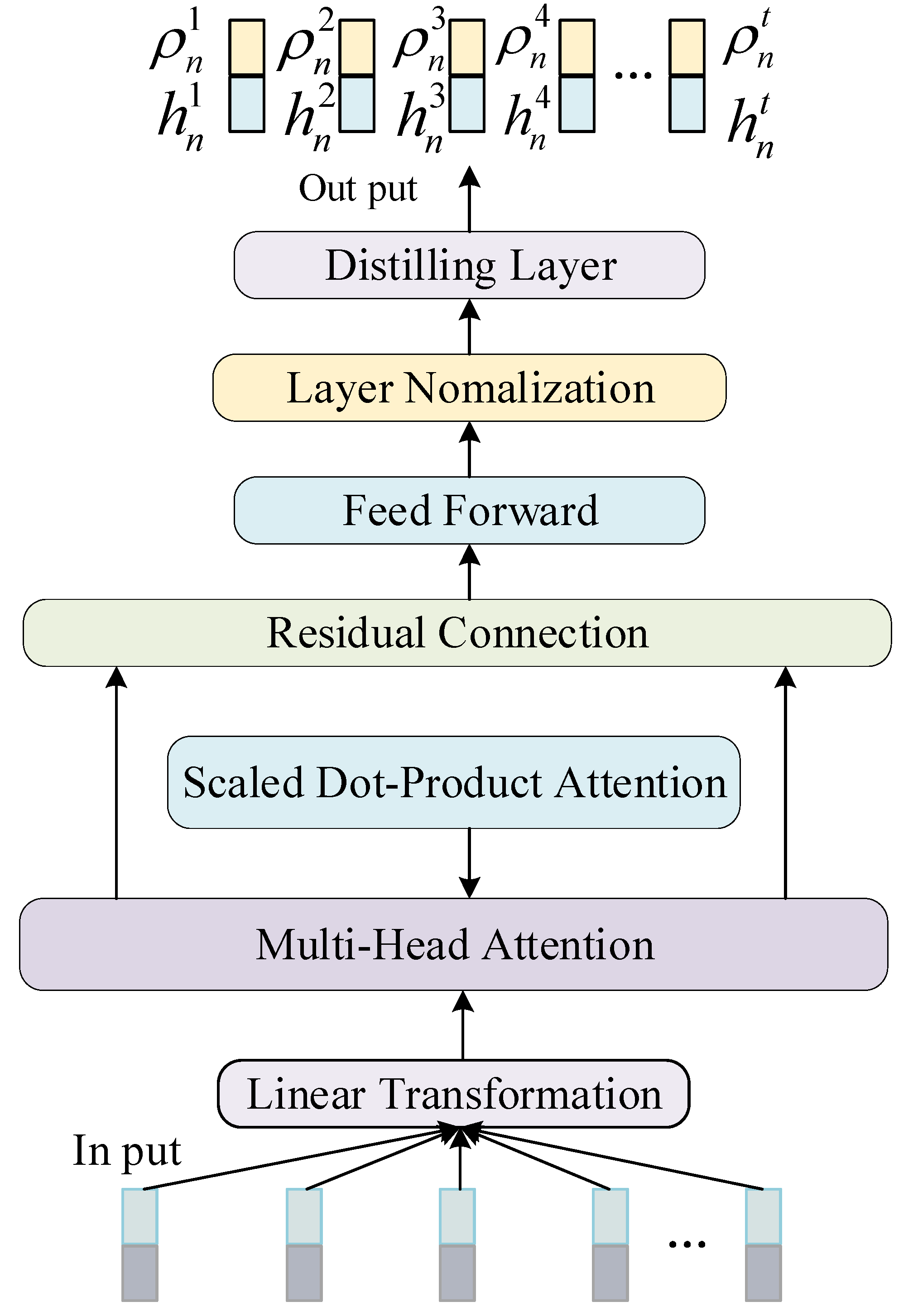
The Informer Encoder employs a modular architecture. Its core component, the Multi-Head Attention mechanism, captures spatiotemporal feature relationships in PEC signals by performing parallel Scaled Dot-Product Attention computations. This is particularly effective for analyzing the amplitude attenuation patterns across early, middle, and late time channels and their correlations with geological parameters. The model integrates these multi-perspective representations through feature concatenation and linear transformation. To enhance training stability and mitigate gradient vanishing, residual connections and layer normalization are incorporated, accelerating model convergence. A feed-forward network (FFN) further boosts feature expression via nonlinear transformation. Additionally, a feature distillation layer is introduced to suppress redundant information and noise, such as power frequency interference, thereby highlighting key features relevant to burial depth through a layer-wise screening process [34]. This modular design leverages the strengths of the Transformer architecture for efficient long-sequence modeling, significantly enhancing performance in PEC-based prediction tasks. The overall model structure is illustrated in Figure 3.
To enhance reproducibility and clarify the internal mechanisms of the proposed model, the key components of the Informer Encoder, namely the multi-head attention mechanism and the feature distillation layer, are described in further detail. The Scaled Dot-Product Attention used within the multi-head attention block is computed as
A t t e n t i o n ( Q , K , V ) = s o f t m a x ( Q K T d k ) V
where Q, K, and V represent the query, key, and value matrices, respectively, and dk is the dimensionality of the key vectors. This operation measures the similarity between elements in the sequence and emphasizes those with higher relevance to the target inversion task.
The Informer Encoder includes a feature distillation layer, which is responsible for suppressing redundant or noisy temporal information while preserving key inversion-related features. Given an input embedding sequence X∈ℝ^{T × d}, where T is the time length and d is the feature dimension, the distilled output Xd is obtained through a gated filtering mechanism:
X d = σ ( W d X + b d ) X
Here, Wd and bd are learnable parameters, σ(·) is an S-type activation function (typically represented by the sigmoid function, which can map the input from −∞ to +∞ to the range of (0, 1)), and ⊙ denotes element-wise multiplication. This operation applies learnable gating and uses the probabilistic output of the S-type function to effectively select and retain the time steps with the most information, and helps to enhance the stability and interpretability of the inversion results.
The integration of the BiLSTM and Informer Encoder inherently alleviates inversion ambiguity: the BiLSTM captures long-range temporal dependencies in PEC sequences to distinguish similar signals from different depths, while the Informer’s multi-head attention and feature distillation mechanisms refine this by selectively emphasizing features most sensitive to depth variations. These components collectively enhance the uniqueness and stability of the inversion results without external regularization.

3. Informer Encoder-CNN-BiLSTM Inversion Model Construction

3.1. Pulsed Eddy Current Signal Dataset Construction

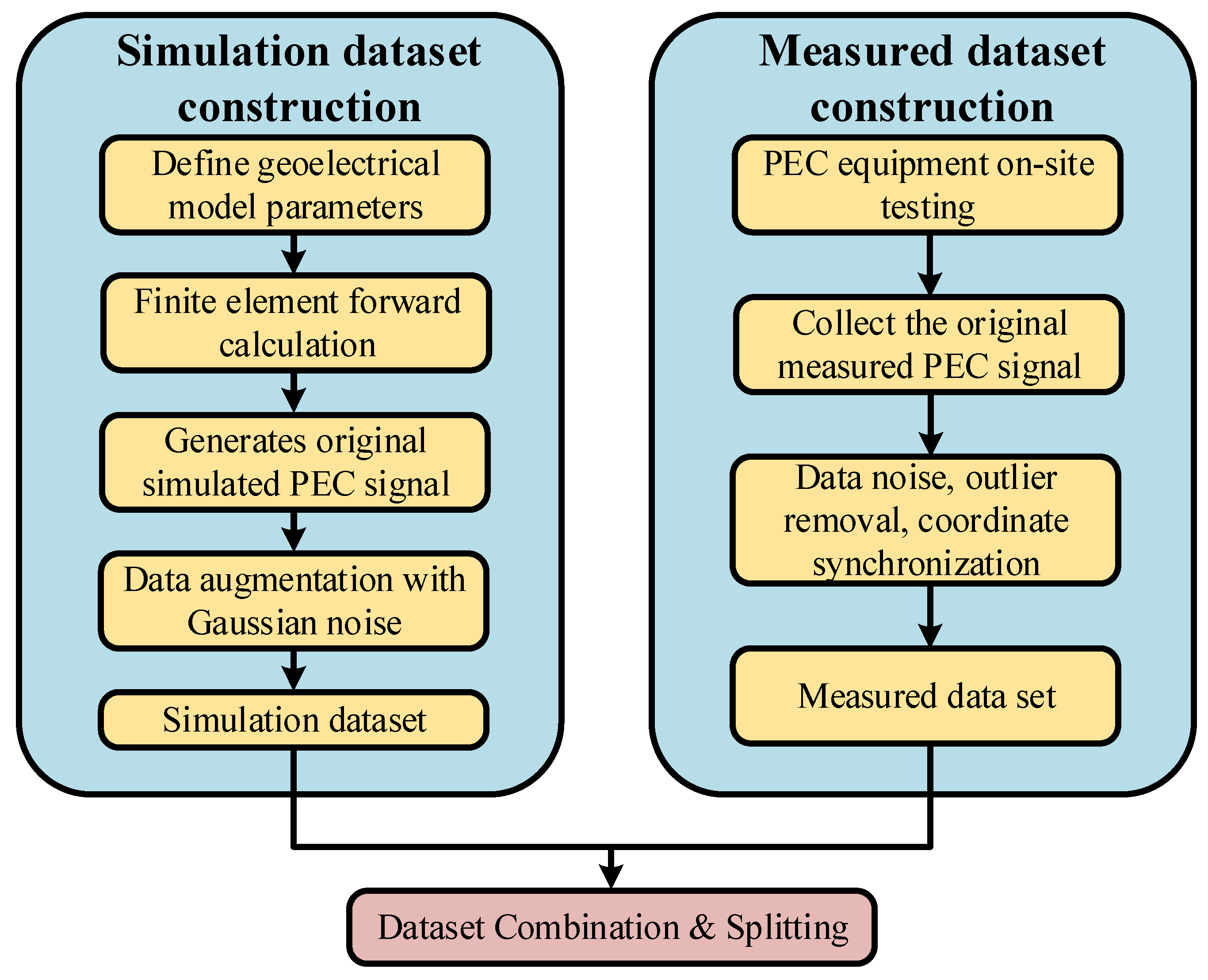
During the model training process, we constructed two types of datasets: simulated datasets and measured datasets. Simulated and measured datasets are strategically combined to leverage the strengths of each. For the construction of the simulated dataset, the data processing software was used to normalize the measured data of 25 substation grounding grid steel bars obtained by the simulation model, and the interlayer apparent resistivity characteristics were extracted according to the curve change law, and then 25 6-layer geoelectric models with similar change trends but different details were designed. Forward calculations were performed based on these geoelectric models, and finally a simulated dataset was formed. This simulated dataset provides a physically consistent and noise-free foundation, covering a wide range of theoretically plausible scenarios, but may not fully capture the complexity and noise inherent in real-world data. To enhance data diversity and robustness, data augmentation was performed on 25 simulation models. This included the introduction of Gaussian noise with a signal-to-noise ratio of 30 dB to simulate instrument and environmental interference and slight variations in the coil lift-off distance (±2 mm). This augmentation process increased the simulated data volume to 2000 samples.
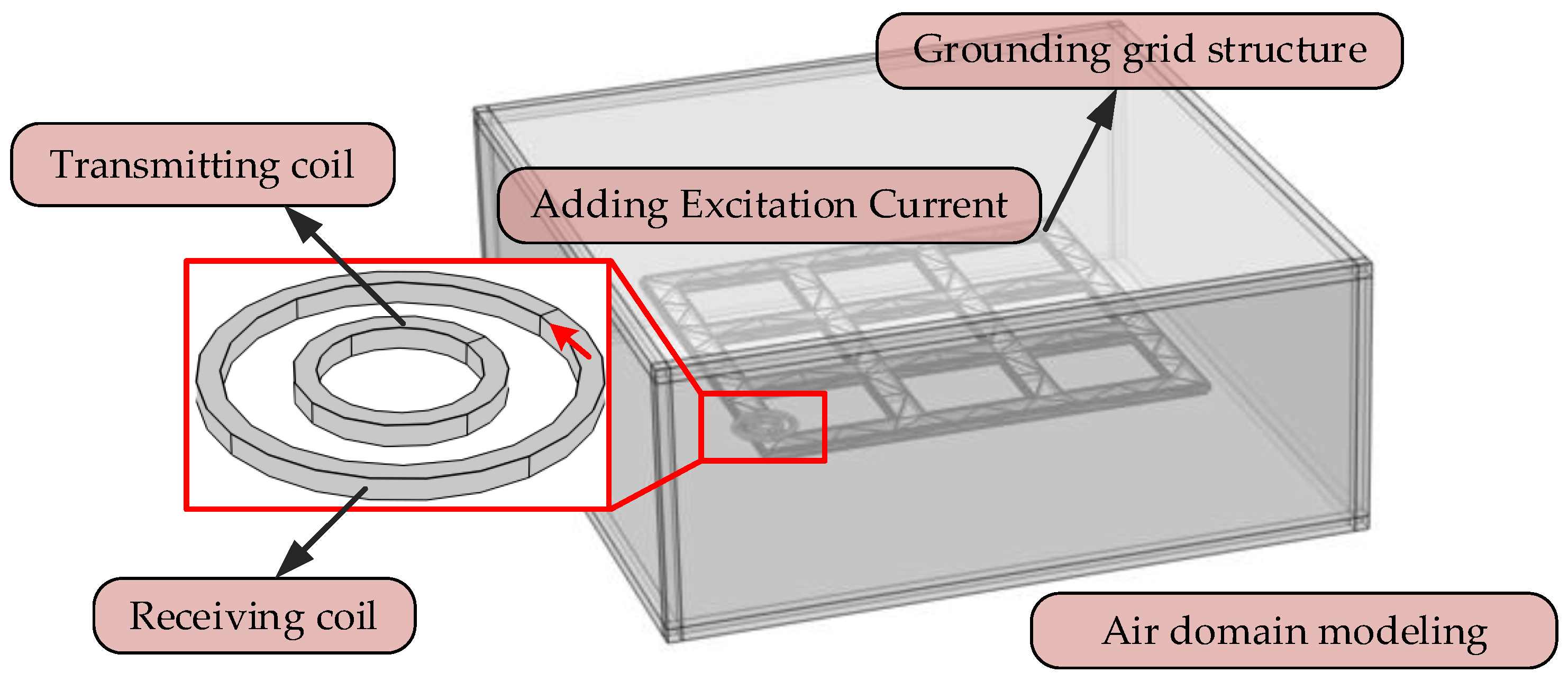
For the construction of the measured dataset, this study used the PEC method to obtain the original data by measuring the grounding grid steel bars in the substation in Baotou, Inner Mongolia. The measurement dataset was collected from multiple substations with diverse geological conditions to ensure comprehensive data. Each measurement was calibrated according to the engineering design depth to minimize systematic errors. Data quality control included signal denoising, outlier removal, and signal stability analysis. The dataset contains over 1000 measurement samples and incorporates simulation enhancement techniques to fully capture variations in ground depth, soil resistivity, and conductor layout. This dataset provides realistic field responses, but its scope is limited and acquisition costs are high. To construct a training set with strong generalization capabilities, we adopted a balanced combination strategy: 2000 augmented forward modeling samples were combined with 800 randomly selected samples from the measured data to form a composite training set of 2800 samples. To objectively evaluate model performance, the remaining 200 measured samples were strictly retained as an independent test set for unbiased validation on unknown field data. Furthermore, during training, 10% of the composite training set was randomly sampled as a validation set to assist in hyperparameter tuning and monitor overfitting. This strict data partitioning ensures a reliable assessment of the model’s generalization capabilities. Table 1 lists the specific parameter settings of the simulated and measured datasets as well as the PEC forward model in detail. Figure 4 is a flowchart for constructing a pulsed eddy current signal dataset, and Figure 5 shows the simulation model used for grounding grid PEC detection.

3.2. Selection of Inversion Model Evaluation Indicators

The evaluation index serves as a crucial criterion for assessing the alignment between inversion findings and real formation characteristics. It can achieve objective evaluation of model performance by quantitatively analyzing the fitting accuracy and deviation degree. This study selected multi-dimensional evaluation indexes to systematically verify the effectiveness and accuracy of the algorithm from the following three aspects: (1) goodness of fit index, namely the R2, is used to evaluate the degree of match between the inversion curve and the measured data; (2) error analysis index, namely the ERMS, is used to quantify the degree of deviation between the inversion results and the actual formation parameters; and (3) similarity measurement index, namely the EMR, is used to evaluate the consistency between the model prediction results and the actual geological structure. This comprehensive evaluation system can comprehensively reflect the inversion performance of the algorithm and provide a reliable quantitative basis for model optimization. The following are the mathematical expressions of the three indicators.
R 2 = i = 1 N ( y t y ¯ t ) ( y t y ¯ t ) i = 1 N ( y t y ¯ t ) 2 i = 1 N ( y t y ¯ t ) 2 2
E RMS = 1 N i = 1 N ( y t y t ) 2
E MR = 1 N t = 1 N y t y t y t
In the formula: N is the total number of data, y t and y ¯ t are the burial depth data and burial depth and average value of the t-th track of the real stratigraphic structure curve, respectively; y t and y ¯ t are the burial depth data and average burial depth of the t-th track of the inverted stratigraphic structure curve, respectively. The determination coefficient mainly calculates the goodness of fit of the model. A number approaching 1 indicates a superior degree of fit. The root mean square error index reflects the precision of the predicted value. A smaller number indicates a lesser discrepancy between the anticipated value and the actual value. The average relative error measures the similarity between the predicted stratigraphic structure and the true stratigraphic structure through the absolute difference between each point. The smaller the value is, the greater the similarity is, that is, the predicted stratigraphic structure is closer to the actual one.
It is noted that the ERMS and EMR are reported in the unit of Ω·m in all subsequent tables, as they quantify the error in the inverted apparent resistivity, which is the direct output of the model used to derive the burial depth.

3.3. Inversion Model Learning Rate Selection

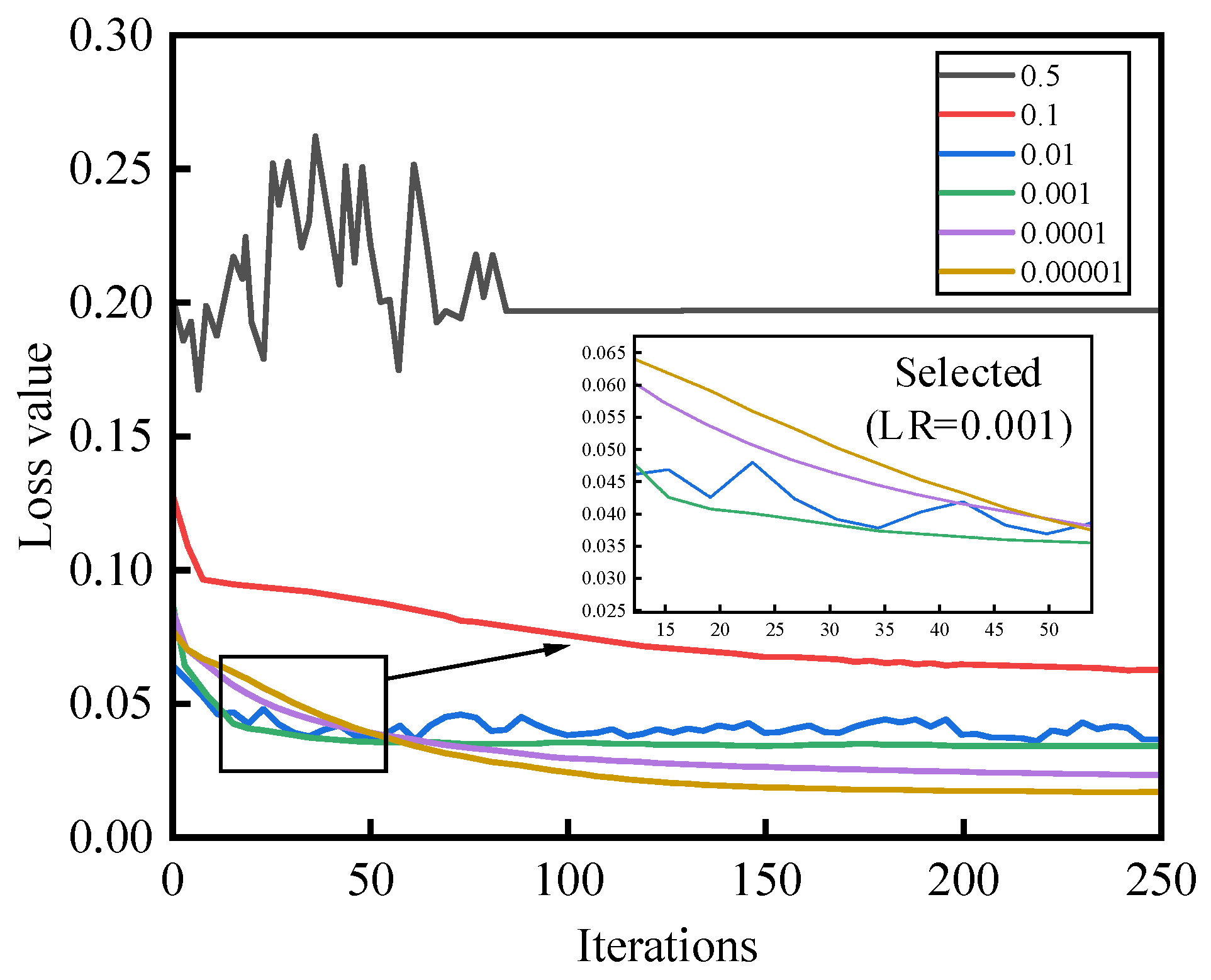
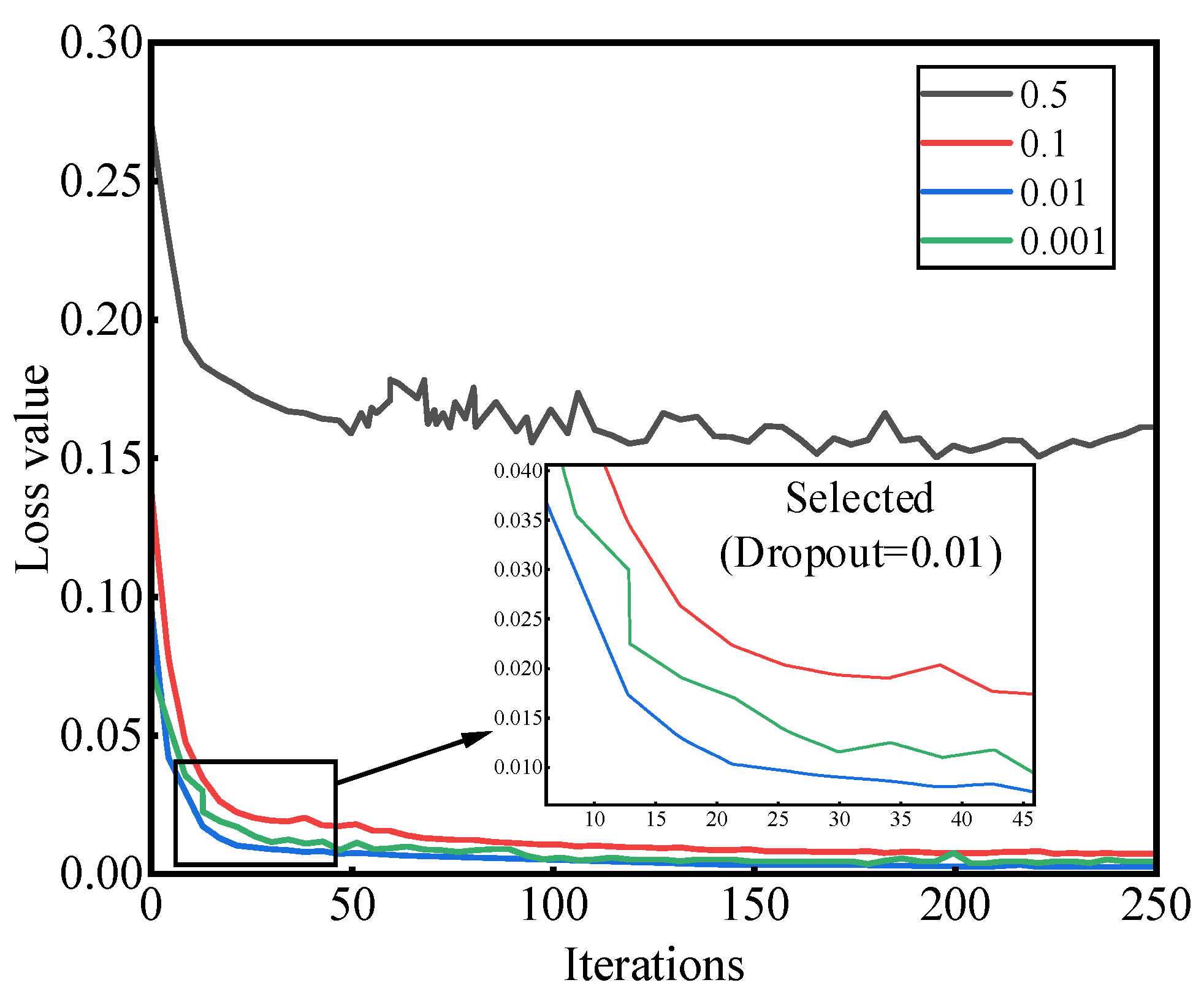
The learning rate directly affects the training effect of the grounding grid depth inversion model. A learning rate that is too small will lead to slow convergence and make it difficult to accurately capture the nonlinear relationship between the PEC signal and the burial depth; a learning rate that is too large will cause the inversion result to oscillate around the optimal solution. This study uses ERMS as the loss function and systematically evaluates the impact of different learning rates on the grounding grid depth inversion model, as shown in Figure 6.
The experimental results show that when the learning rate is set to 0.5 and 0.1, the model has a gradient explosion and cannot converge effectively; although a too small learning rate can obtain a lower error, the training efficiency is significantly reduced; when the learning rate is 0.01 and 0.001, the convergence is stable, and 0.001 performs better. Based on the experimental comparative analysis results, this study adopts a learning rate adjustment strategy with staged decay. The specific implementation method is as follows: a larger learning rate is set in the initial stage to accelerate the convergence of the model, and then the learning rate is constantly modified by an exponential decay approach. During the training process, every time the model completes 50 rounds of iterations, the learning rate is reduced to 1/10 of the current value, and the entire training process is performed for a total of 250 rounds of iterations. This learning rate scheduling strategy not only ensures rapid convergence in the early stage of training, but also enables the model to be stably optimized in the later stage, effectively avoiding the oscillation problem during training.

3.4. Dropout Value Determination

In the task of grounding grid PEC inversion, the number of samples available for training is often limited due to the high cost of obtaining measured data. When a deep neural network with a large number of parameters is used for modeling, overfitting problems are very likely to occur. Specifically, the model can obtain good inversion accuracy on the training dataset, but there is a significant performance degradation on the test set. This phenomenon is essentially because the model over-memorizes the specific noise and local features in the training data, and fails to truly learn the physical mapping relationship between the electromagnetic response of the grounding grid and the formation parameters. To address this problem, we can learn from the staged attenuation strategy in industrial system optimization to balance the convergence speed and stability [35], introduce the Dropout technology to discard some neurons in the propagation process, and improve the model’s generalization capability.
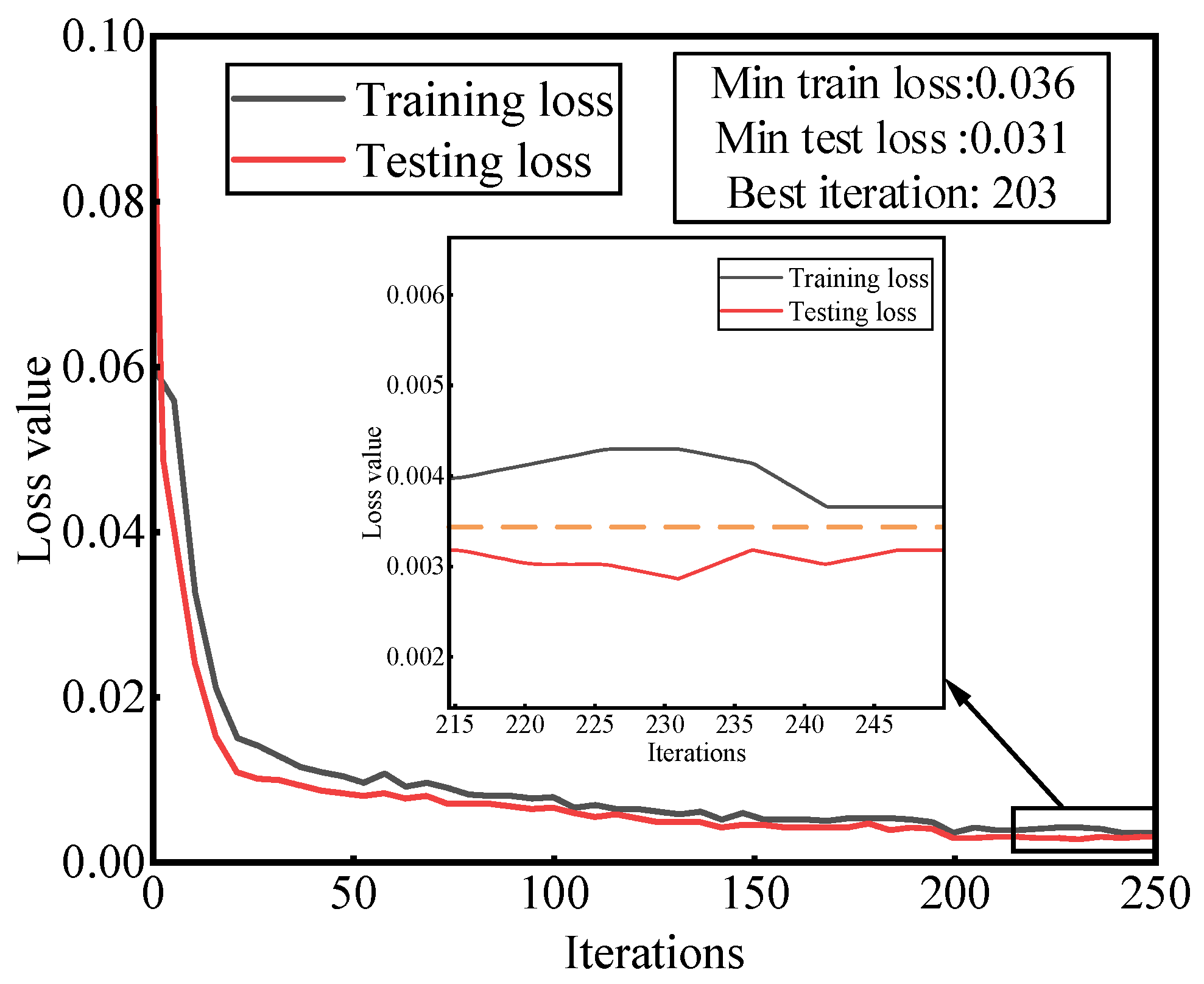
Considering the need for fine inversion, the Dropout value range is set to [0, 0.5] this time. The detailed values and test results are shown in Figure 7. As can be seen from the figure, after adding Dropout, the loss function converges quickly. Except for 0.0001, the loss functions of other values are reduced to a minimum. Taking into account the inversion performance and data requirements, the Dropout value is selected as 0.01, and the loss reduction trend is shown in Figure 8.
The study effectively mitigates potential negative randomness effects from Dropout in the inversion problem through careful design considerations. By primarily applying Dropout to regulate the high-dimensional spatiotemporal characteristics of model inputs while preserving the core physical mapping relationships, the approach maintains model integrity. Experimental validation confirms the effectiveness of this strategy, with a Dropout rate of 0.01 demonstrating stable convergence characteristics and consistent training/test loss curves. These findings underscore that properly calibrated Dropout regularization provides more substantial benefits than any incidental noise interference it might introduce, particularly in maintaining model stability during the inversion process.

3.5. Setting the Number of Hidden Layer Nodes in the Model

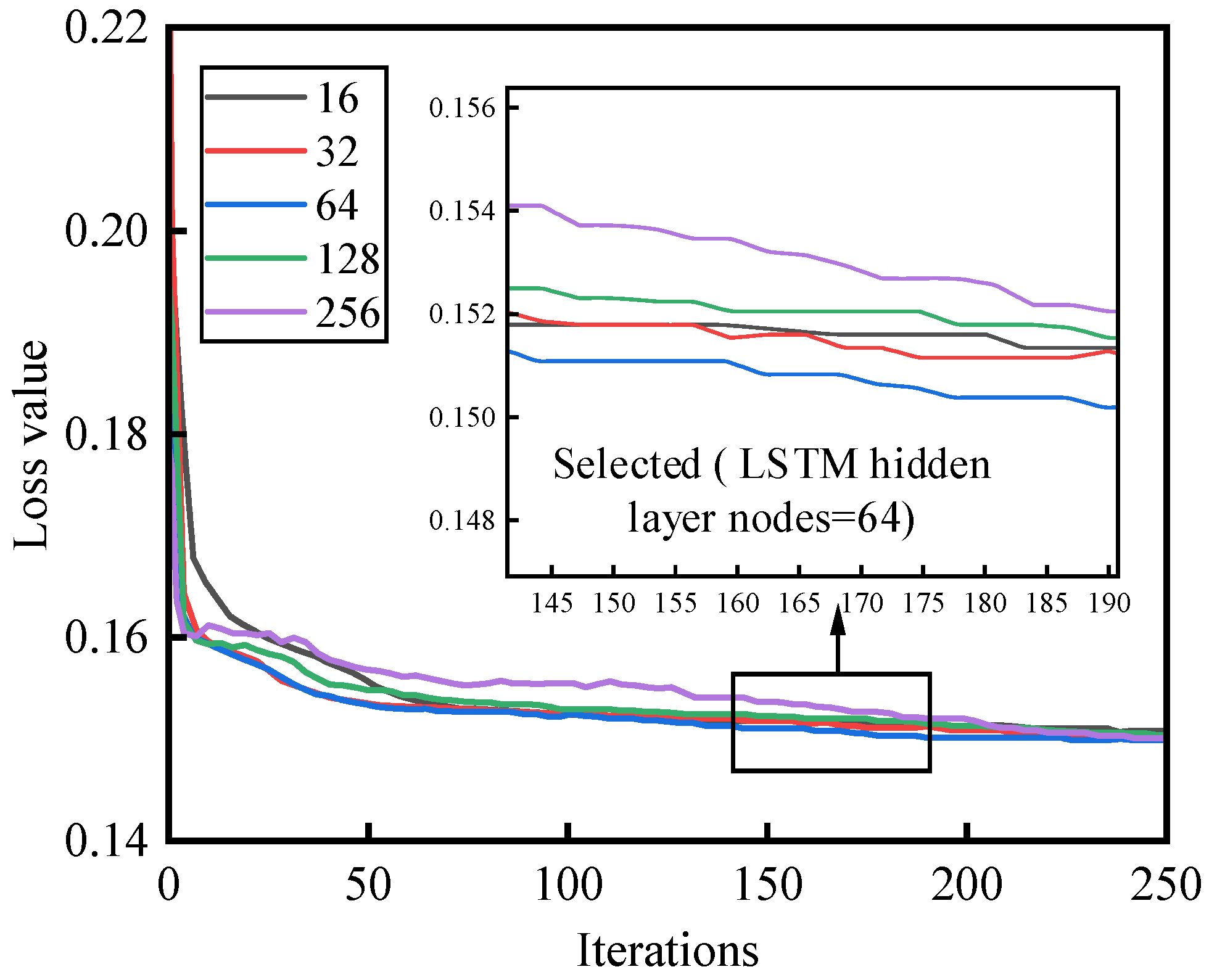
The architecture of the neural network profoundly influences model performance, particularly with the choice of hidden layers and nodes. Reference [36] points out that when the amount of data is limited, increasing the network size can enhance the representation ability, but it is easy to cause overfitting. Therefore, this study adopts a three-layer hidden layer structure. To assess the influence of varying node quantities on inversion accuracy and efficiency, the system tested 16 to 256 (increased by 2 to the power of n) node configurations under the premise that other parameters are fixed. Figure 9 compares the errors under each configuration, and Table 2 lists the ERMS analysis. The experiment shows that: the model is underfitting under 16 nodes; the performance of 32 and 64 nodes is similar, and the convergence of 64 nodes is slightly better in the later stage; although the error of 128 and 256 nodes is slightly reduced, over-parameterization degradation occurs.
Based on the above analysis, 64 hidden layer nodes were finally selected. This configuration not only matches the number of input layer nodes, but also effectively retains geological feature information, and also shows advantages in computational efficiency. This decision strikes an optimal equilibrium between model complexity and training efficiency, while guaranteeing inversion accuracy. In the process of supervised learning and feedback of the model, we set the ratio of training set, validation set, and test set to 8:1:1. The final hyperparameters and other related parameters of the model are shown in Table 3.
All model training and testing were performed on a workstation equipped with an NVIDIA RTX 3090 GPU (24 GB of VRAM), an Intel i9-13900K CPU, and 64 GB of RAM. The model was trained for 250 epochs. The batch size was set to 40 as a balance between computational efficiency and gradient estimation stability. A larger batch size would expedite training but requires more GPU memory, while a smaller batch size may lead to noisy gradient updates. The Adam optimizer was employed due to its adaptive learning rate and proven effectiveness in handling sparse gradients on non-stationary objectives common in deep inversion tasks. The model was trained for 250 epochs, taking approximately 38 min. After training, the model can perform PEC signal inversion predictions within 0.3 s per sample, demonstrating its suitability for near-real-time field applications.

3.6. Ablation Study of Model Structure

To verify the contribution of each sub-module in the proposed IE-CBiLSTM architecture, an ablation study was conducted by constructing three variant models for comparison: Model A (CNN-BiLSTM), which removes the Informer Encoder and retains only the CNN and BiLSTM components; Model B (Informer-BiLSTM), where the CNN module is removed, and the raw PEC signal is directly fed into the Informer Encoder and BiLSTM for inversion; and Model C (Informer-CNN), which omits the BiLSTM module, relying solely on the Informer Encoder for temporal modeling. All models were trained under the same dataset, hyperparameter settings, and training strategy to ensure a fair comparison, with the results presented in Table 4.
The experimental results demonstrate that the complete IE-CBiLSTM model consistently outperforms all its variants across all evaluation metrics. The ablation study reveals that removing any individual component leads to noticeable performance degradation, particularly in terms of error metrics. These findings confirm that the Informer Encoder, CNN, and BiLSTM modules play complementary roles in spatial and temporal feature extraction, and their synergistic integration is crucial for achieving high inversion accuracy and robust performance.

4. Practical Application Effect

4.1. Self-Burying Test

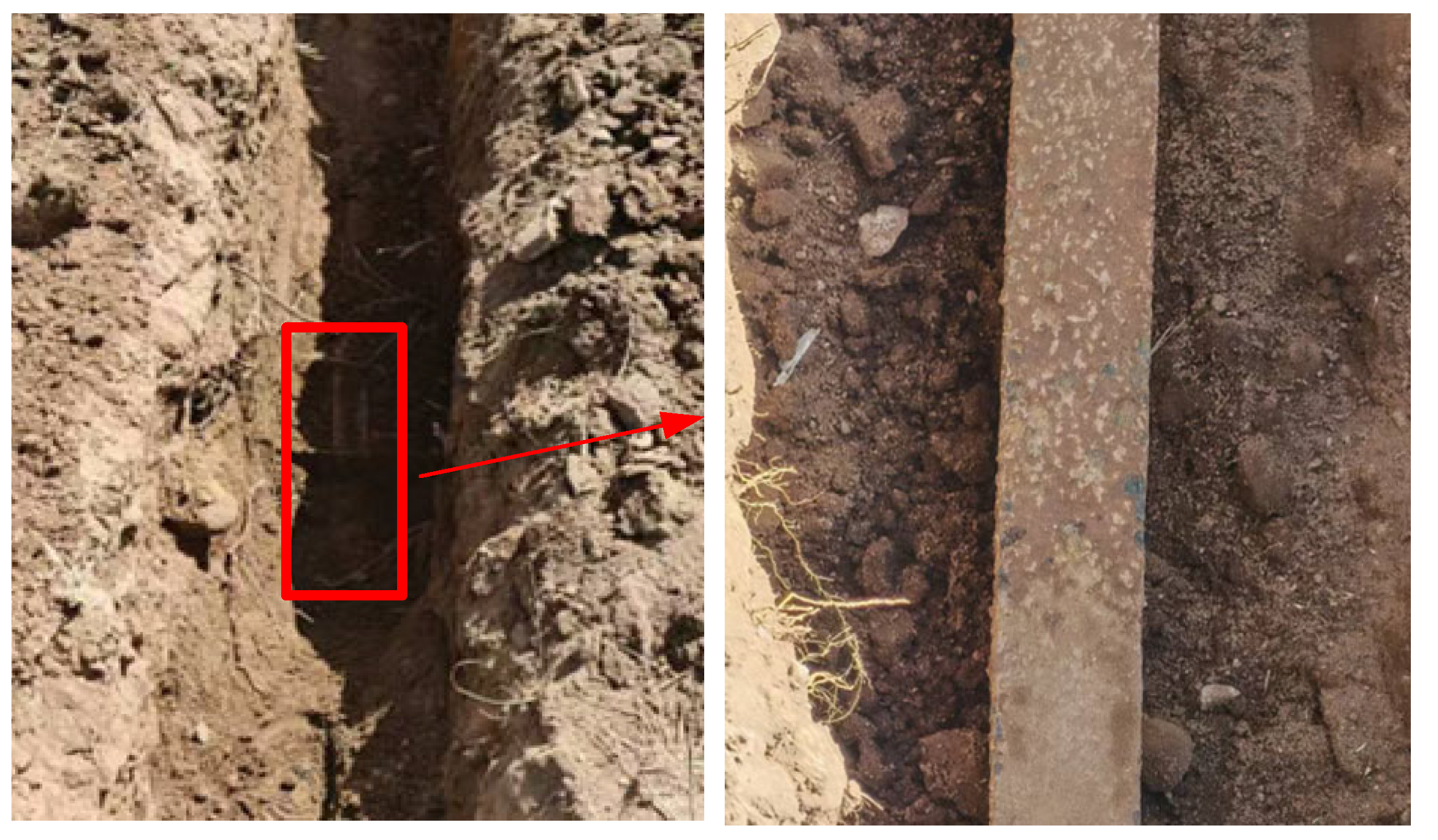
To comprehensively evaluate the efficacy of the IE-CBiLSTM method for inverting the burial depth of steel bars in substation grounding grids, this study designed a rigorous field experiment protocol. At a simulated typical substation site, experimental galvanized flat steel was accurately buried with the following specifications: 60 mm (width) × 3 m (length) × 8 mm (thickness). The burial depths were controlled at three levels: 1.0 m ± 0.05 m, 1.2 m ± 0.05 m, and 1.5 m ± 0.05 m. Multiple test groups were conducted at each depth, and the average values were calculated to simulate the detection process of grounding grids in actual engineering scenarios. To provide a comprehensive reference for the inversion results and their repeatability, the following key parameters were recorded during the test: the soil type at the test site was primarily sandy loam with occasional gravel inclusions; the average soil resistivity was approximately 80 Ω·m (using the Wenner array method at a depth of 1 m); the volumetric soil moisture content, measured by time domain reflectometry (TDR), was between 12% and 15%; the ambient temperature was maintained between 15 °C and 20 °C; and the site terrain was flat and well-compacted, meeting the environmental conditions of a typical substation grounding grid. Figure 10 shows an actual photograph of the independently laid experimental flat steel.
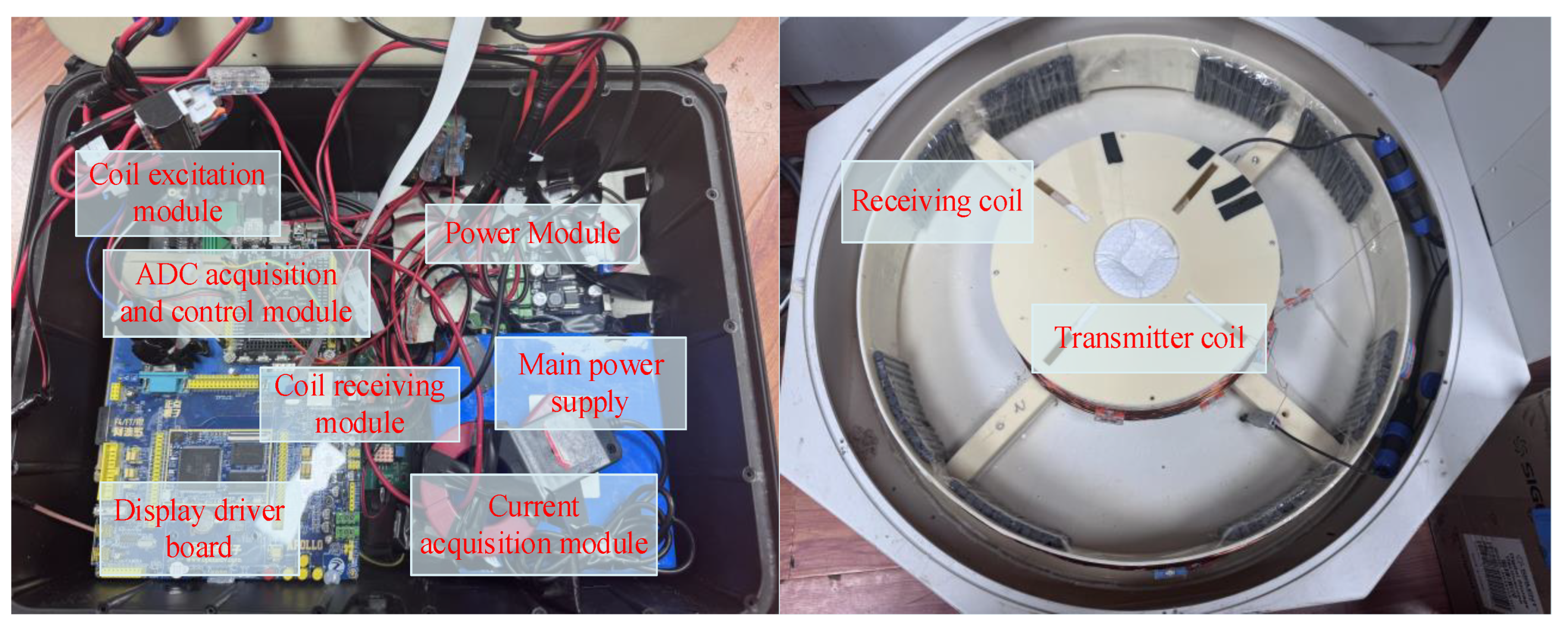
The experiment uses a self-developed PEC grounding grid detection device, which consists of a high-frequency excitation module, a multi-channel data acquisition unit, a GPS synchronous positioning system, and a data processing terminal. It can realize non-excavation single-point detection and three-dimensional imaging of the grounding grid. Figure 11 shows the composition of different modules of the detection system in detail, including: coil excitation module, ADC acquisition and control module, display driver board, receiving module, power module, current acquisition module, and transmitting coil and receiving coil. The system operates as follows: the power module provides stable DC power to all components. Upon receiving a trigger signal from the ADC acquisition and control module, the high-frequency excitation module generates a high-power transient current pulse. The current acquisition module simultaneously monitors this excitation current to ensure signal integrity. This current is driven through the transmitting coil, generating a primary magnetic field. The resulting eddy currents in the grounding grid induce a secondary magnetic field, which is captured as a voltage signal by the receiving coil. This weak signal is then amplified and filtered by the signal conditioning module before being digitized by the ADC acquisition and control module. A GPS synchronous positioning system provides spatiotemporal tags for each measurement. Finally, all data are transmitted to the data processing terminal for storage, display, and inversion analysis using the proposed IE-CBiLSTM model. This system provides reliable experimental data support for method verification.
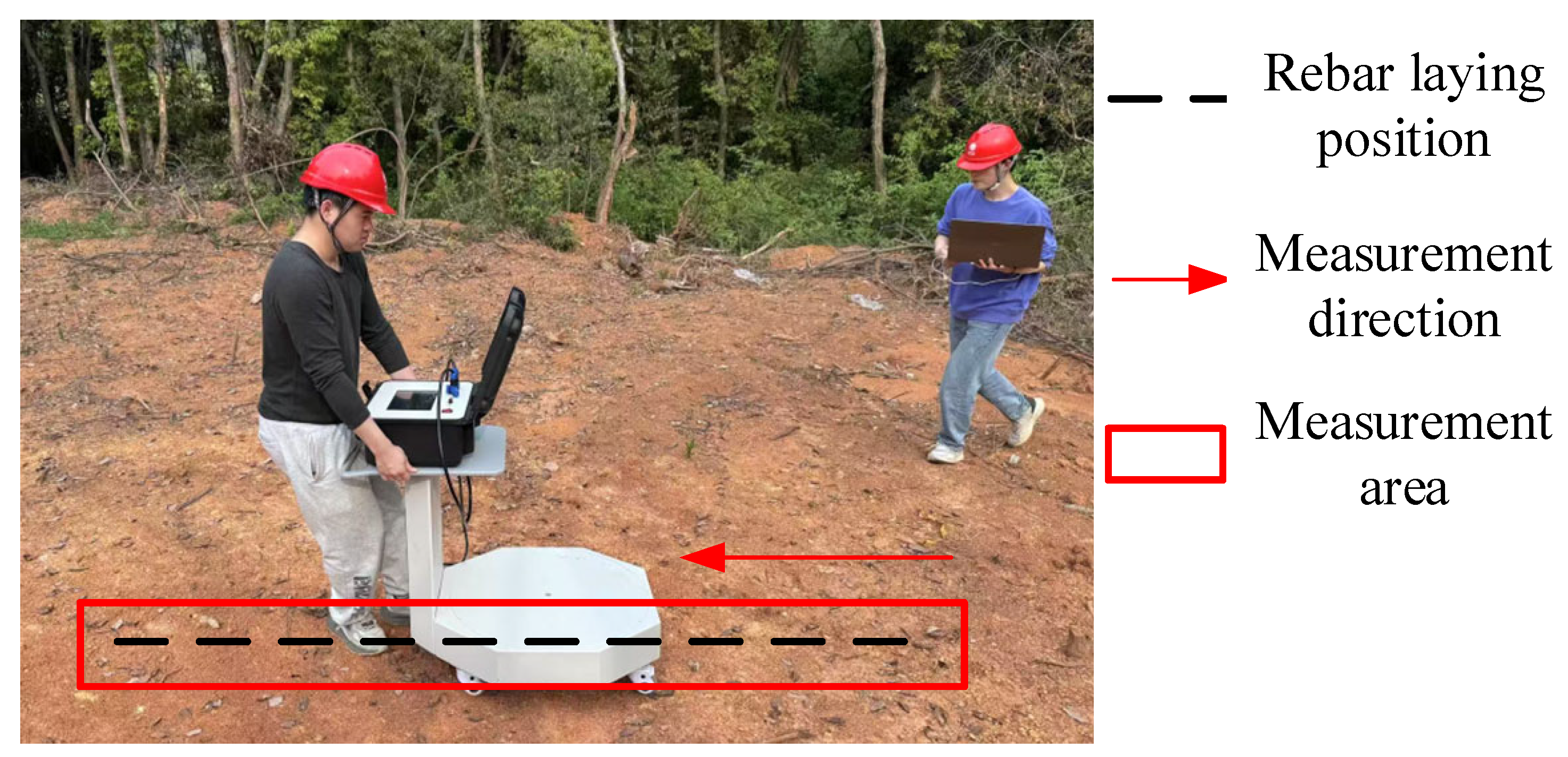
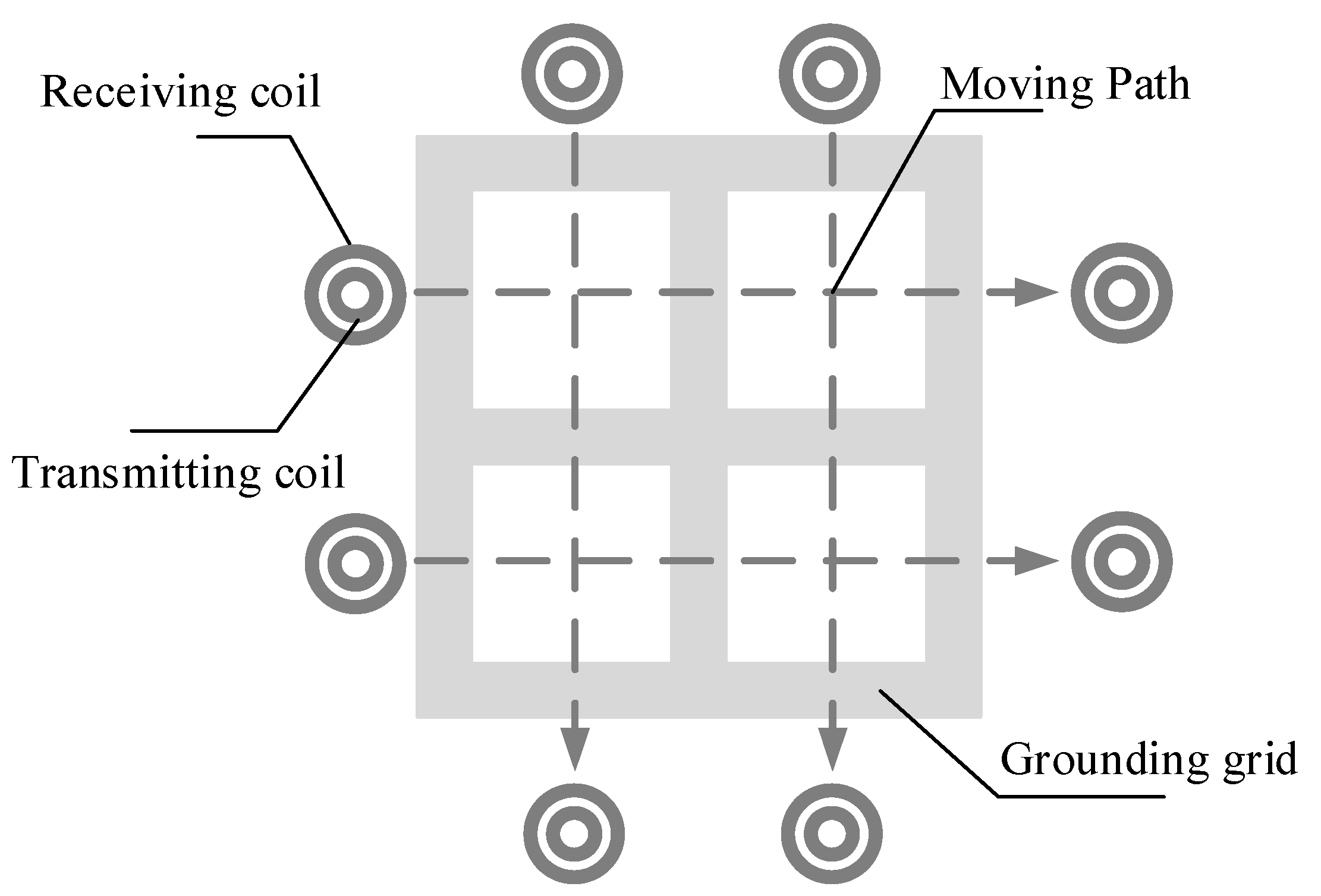
This study adopts a standardized detection process to obtain the electromagnetic response characteristic data of grounded flat steel. The specific detection steps are as follows: first, a detection coordinate system is established based on the measurement results of the total station to determine the precise laying trajectory of the grounded flat steel; then the operator moves the detection device at a constant speed along the axial direction of the flat steel according to the preset 0.2 m spacing measurement grid, keeping the probe 5 cm above the ground and perpendicular to the detection surface; during the movement, the PEC detection device collects the PEC response signal in real time at a sampling frequency of 25 MHz, and the integrated high-precision GPS combined navigation system synchronously records the spatial coordinate information; all detection data are transmitted to the data processing terminal via a USB cable for time synchronization and coordinate matching to ensure the spatial consistency and time accuracy of data acquisition. Figure 12 shows the laying position of the steel bar, the test area of the device, and the dragging direction.
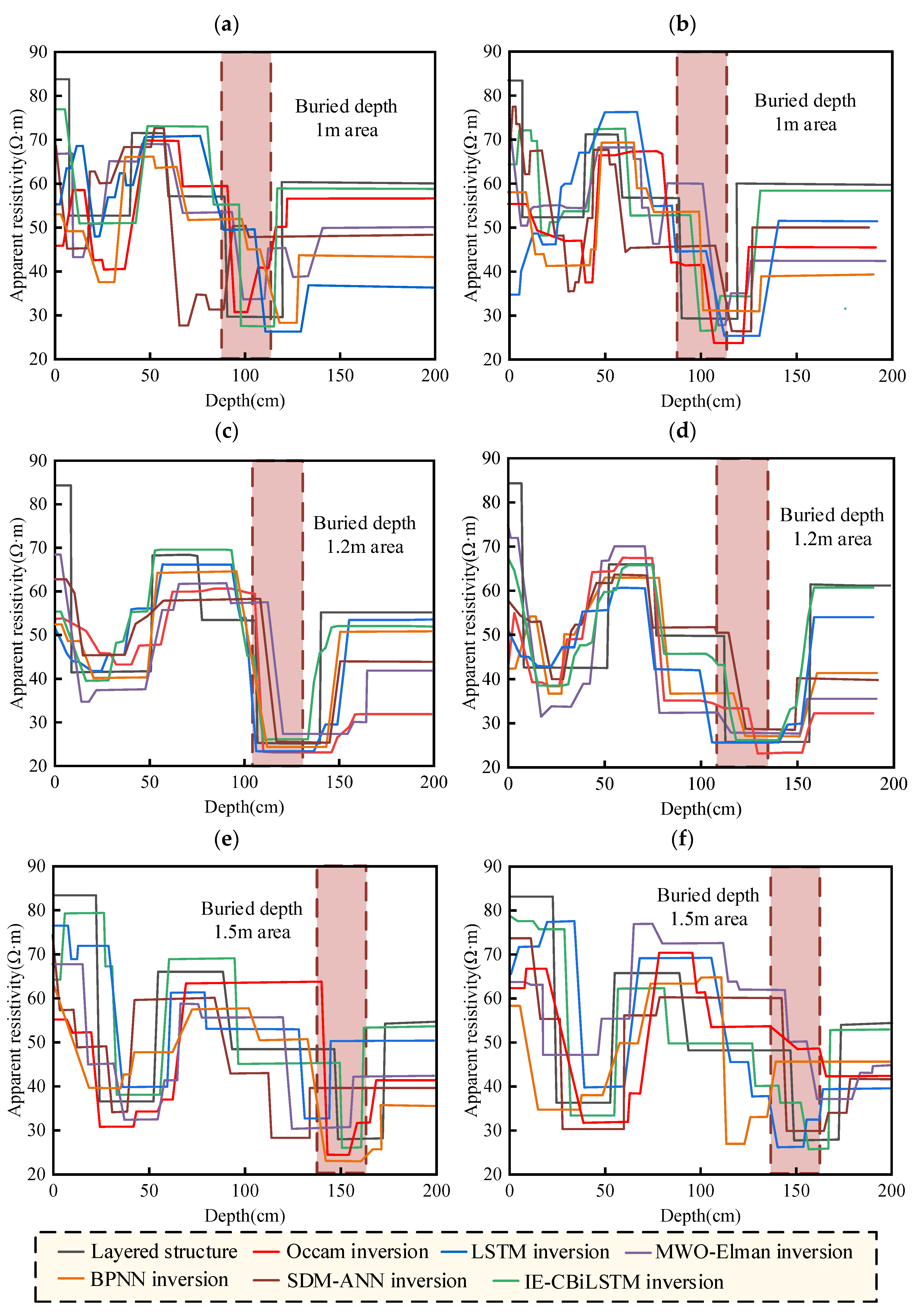
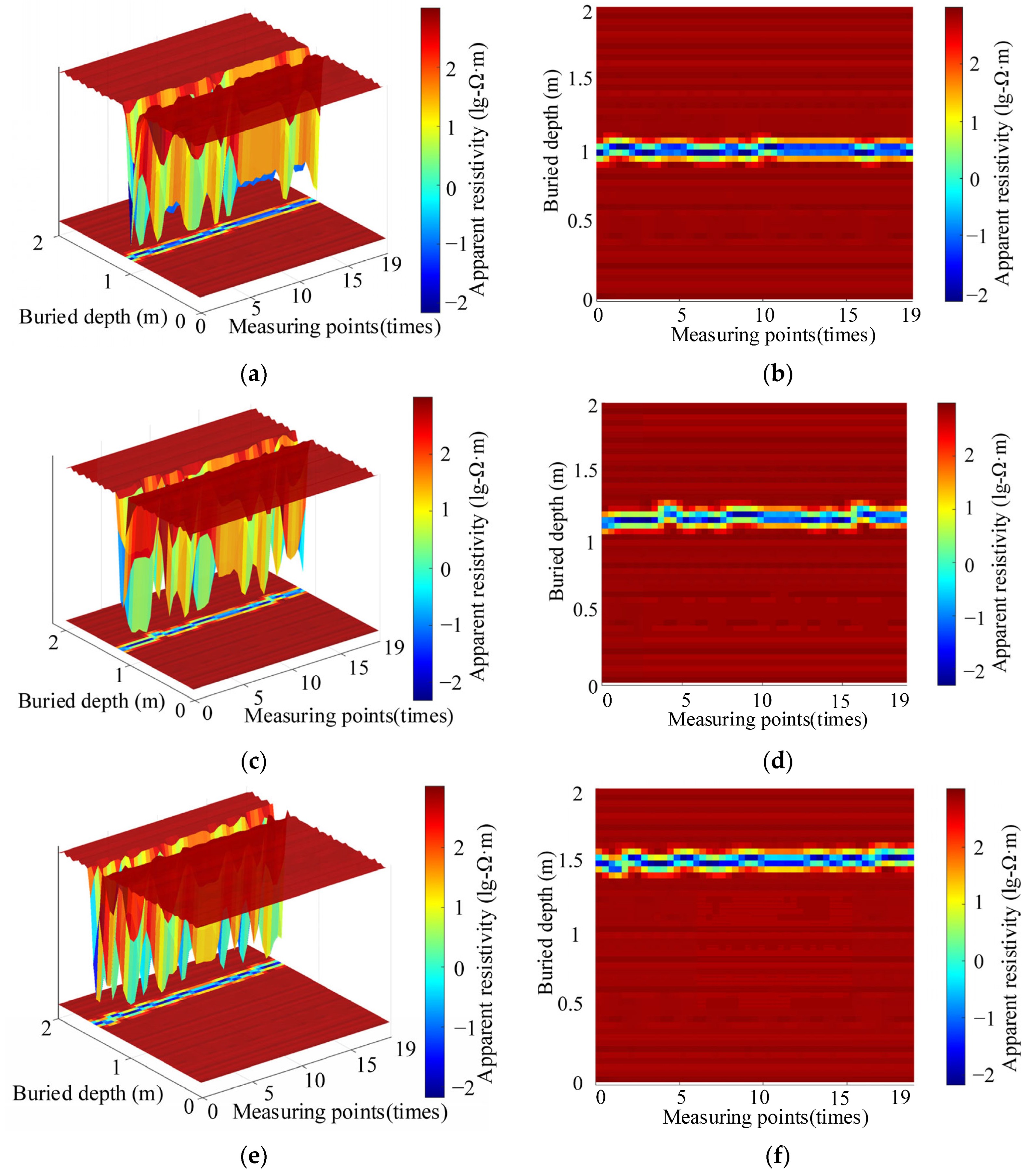
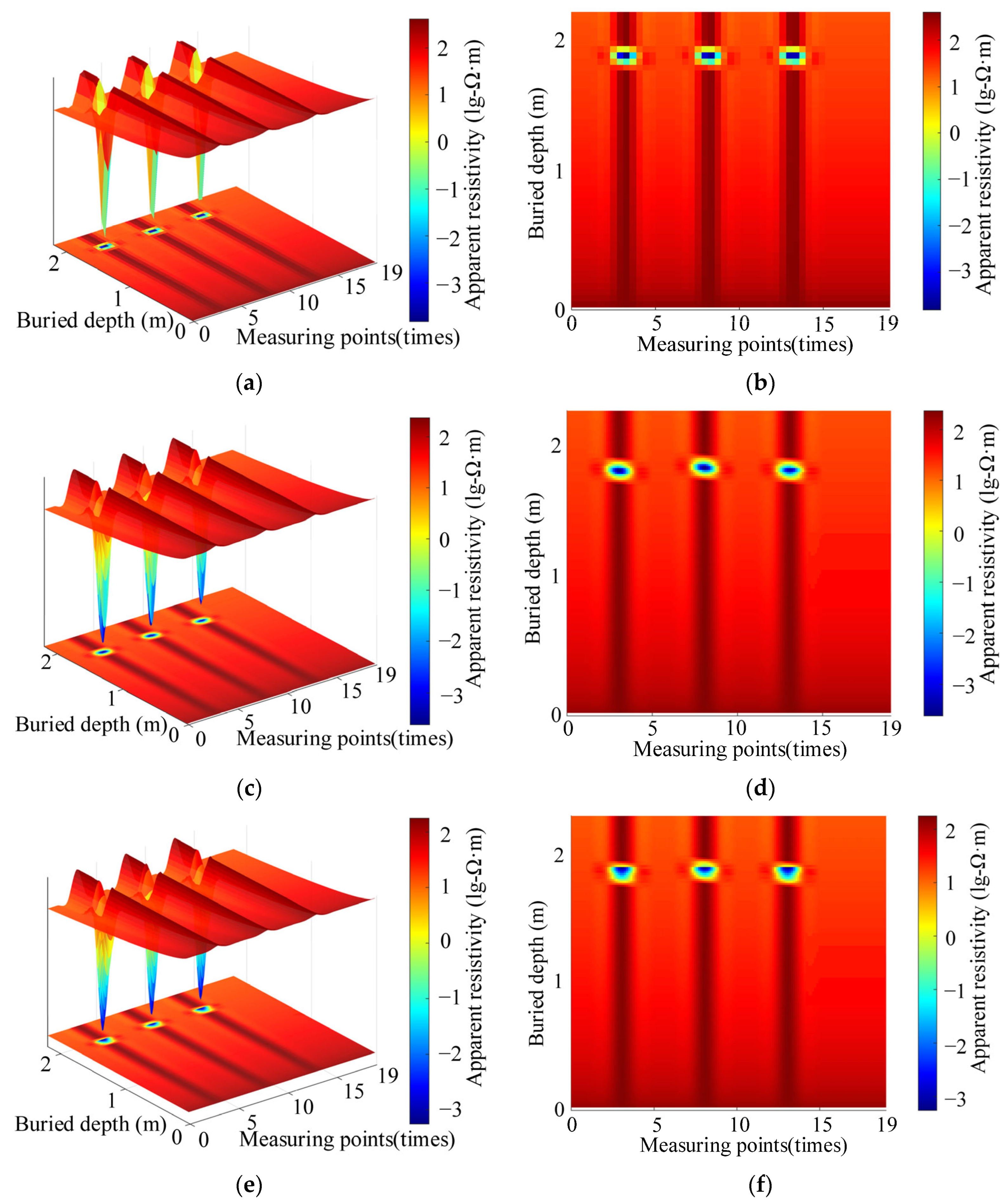
To validate the superiority of the proposed method, experiments were conducted using LSTM, Occam, MWO-Elman, BPNN, and SDM-ANN inversion methods as benchmarks for comparison. The results are shown in Figure 13. The MWO-Elman, BPNN, and SDM-ANN methods do not accurately reflect the overall subsurface trend, resulting in significant deviations between the inversion results and the original stratigraphic structure. The IE-CBiLSTM, LSTM, and Occam methods can reflect the overall stratigraphic trend, but at 3600 and 4000 measurement points, the IE-CBiLSTM inversion results are most consistent with the actual stratigraphic structure. Regarding the inversion performance of the six methods under three rebar depth conditions, the IE-CBiLSTM (green curve) depth corresponding to the lowest soil resistivity point is closer to the actual value. The quantitative analysis results in Table 5 show that the IE-CBiLSTM inversion method achieves the highest R2, lowest ERMS, and lowest EMR, resulting in superior inversion accuracy to the other methods. Furthermore, we used the IE-CBiLSTM inversion method to visualize the buried depth of the grounding flat steel bars. The results are shown in Figure 14. Figure 14a,c,e are 3D inversion images for different buried depths of the steel bars, clearly demonstrating their spatial distribution and depth. Figure 14b, Figure 14d, and Figure 14f are the corresponding cross-sectional images, accurately reflecting vertical sections at burial depths of 1.0 m, 1.2 m, and 1.5 m, respectively. The inversion results are highly consistent with the pre-set buried depth conditions, validating the method’s high-fidelity 3D imaging capabilities.
To quantitatively evaluate the stability and robustness of the IE-CBiLSTM model, we performed a statistical analysis of the inversion results from multiple test sets under different burial depth conditions. Specifically, five independent sets of measurement data were inverted. The average value and 95% confidence interval (CI) of the inverted depths were calculated. The results, summarized in Table 6, demonstrate that the model not only achieves high accuracy but also exhibits low variance and high reproducibility.

4.2. On-Site Inversion Test

To assess the efficacy of various inversion techniques in engineering practice, this study selected a substation grounding grid in Baotou City, Inner Mongolia, for field testing, and compared and analyzed the performance of three inversion methods: Occam, LSTM and IE-CBiLSTM. In view of the particularity of the substation grounding grid, that is, the unclear laying direction and position of non-self-buried steel bars, this study improved the traditional detection method: first, based on the substation completion engineering drawing, the laying direction and design burial depth of the grounding flat steel were obtained. Then, an orthogonal measurement scheme was adopted, that is, the detection device was pushed in the vertical direction of the estimated laying direction for scanning measurement. This method effectively overcomes the limitations of the traditional self-buried experimental test method. Figure 15 shows the schematic diagram of the improved field test principle.
In this field test, three grounding flat steel bars with a buried depth of 1.8 m were selected as test objects based on the substation engineering drawings. The performance differences in the three inversion methods, Occam, LSTM and IE-CBiLSTM, were systematically compared. As shown in Figure 16, the three methods can effectively reconstruct the basic distribution characteristics of underground steel bars. The analysis shows that the depths obtained by the inversion of the Occam method are 1.86 m, 1.90 m and 1.90 m, respectively; the inversion results of the LSTM method are 1.87 m, 1.88 m and 1.88 m; and the inversion results of the IE-CBiLSTM method are 1.80 m, 1.81 m and 1.80 m. Obviously, the inversion results of IE-CBiLSTM are closer to the actual buried depth results. The comparison results in Table 7 show that the IE-CBiLSTM inversion method exhibits the best performance in all evaluation indicators: the R2 reaches 0.933, the ERMS is 11.30 Ω·m, and the EMR is 0.046 Ω·m. This demonstrates that IE-CBiLSTM significantly outperforms traditional Occam and LSTM methods in inversion accuracy, stability, and generalization capabilities in actual tests. Its superior performance stems from its combination of a bidirectional long-short-term memory network and an improved encoder structure, which more effectively captures nonlinear relationships and feature-to-feature dependencies in electromagnetic inversion, enabling more accurate identification and reconstruction of underground targets. Therefore, the IE-CBiLSTM method has high promotion value in practical engineering applications and can provide reliable technical support for nondestructive detection and diagnosis of similar underground concealed facilities.

4.3. Discussion on Advantages and Limitations

While the proposed IE-CBiLSTM method and the self-developed PEC system demonstrate high performance in grounding grid depth inversion, it is essential to discuss their strengths and weaknesses objectively to provide a comprehensive understanding and guide future improvements. These aspects are summarized in Table 8.

5. Conclusions

To address the problems of inaccurate depth identification and deviation of inversion results in the inversion of the buried depth of the grounding grid caused by PEC, a CNN-BiLSTM deep learning inversion method based on the Informer Encoder structure is proposed in this paper. This method closely integrates with the physical principles of PEC, achieving both high accuracy and interpretability. Specifically, the local spatiotemporal features captured by the 2D-CNN correspond to the spatial distribution of grounding grid conductors; the BiLSTM effectively models the diffusion of electromagnetic fields in the stratum through time-dependent learning and captures the skin effect; and the multi-head attention mechanism adaptively focuses on key time channels in the PEC attenuation signal that are most sensitive to depth variations. This layered feature extraction, from spatial structure to temporal evolution to significant feature points, closely aligns with the physical process of PEC detection, forming a robust and physically interpretable depth inversion framework, improving the model’s performance in complex electromagnetic environments. The experimental and field test results show that:
(1)
Verification results based on self-burial test measurement data demonstrate that the IE-CBiLSTM method significantly outperforms the MWO-Elman, BPNN, SDM-ANN, Occam, and LSTM methods in inversion accuracy. At three different burial depths (1 m, 1.2 m, and 1.5 m), the inversion results of this method are highly consistent with the actual burial depths. This advantage is further confirmed by evaluation metrics, including an R2 of 0.861, an ERMS of 17.54 Ω·m, and an EMR of 0.061 Ω·m. Furthermore, the three-dimensional and cross-sectional images of the buried depth of the grounded flat steel bars generated using image reconstruction technology accurately reflect the spatial depth of the steel bars and the coordinates of the measurement points, further demonstrating the accuracy and reliability of the IE-CBiLSTM method in simulation scenarios.
(2)
In the field inversion test, the inversion results of IE-CBiLSTM were 1.80 m, 1.81 m and 1.80 m, which were highly consistent with the actual burial depth of 1.8 m shown in the engineering drawings. The inversion R2 reached 0.933, and the ERMS and EMR were 11.30 Ω·m and 0.046 Ω·m, respectively, which were better than the comparison model, showing stronger anti-noise ability and generalization performance.
(3)
This method fully integrates the spatial and temporal feature extraction mechanisms, effectively enhancing the model’s understanding and expression of complex geoelectric structures while improving the inversion accuracy. Combined with the long sequence modeling advantages of Informer, IE-CBiLSTM has stronger generalization performance and stability. It may offer dependable technological assistance for PEC non-destructive testing and intelligent assessment of grounding grids, and possesses favorable prospects for engineering advancement. In future work, the proposed framework can be further extended by integrating lightweight model compression and edge computing techniques to enable real-time on-site deployment and efficient inversion during field detection.

Author Contributions

Conceptualization, Y.Y.; methodology, S.X.; software, Y.F.; validation, X.T.; formal analysis, X.L.; investigation, X.H.; resources, Y.Y.; data curation, S.X.; writing—original draft preparation, J.W.; writing—review and editing, J.W.; visualization, Y.F.; supervision, X.T.; project administration, X.H.; funding acquisition, X.L. All authors have read and agreed to the published version of the manuscript.

Funding

This research was funded by Inner Mongolia Electric Power (Group) Co., Ltd. Science and Technology Project, grant No. nmgdlkjxm20240403.

Data Availability Statement

The data used in the analysis presented in the paper will be made available, subject to the approval of the data owner.

Conflicts of Interest

Y.Y., Y.F., X.T. and X.L. were employed by Inner Mongolia EHV Power Supply Company Inner Mongolia Electric Power Co., Ltd. S.X. and X.H. were employed by Baotou Power Supply Branch of Inner Mongolia Electric Power (Group) Co., Ltd. The authors declare that this study received funding from Baotou Power Supply Branch of Inner Mongolia Electric Power (Group) Co., Ltd. Science and Technology Project. All authors declare that the research was conducted in the absence of any commercial or financial relationships that could be construed as a potential conflict of interest. The funder was involved in the study design, collection, analysis, interpretation of data, the writing of this article or the decision to submit it for publication.

References

  1. Fan, L.; Li, B.; Zhang, R.; Sun, B.; Dong, L.; Lu, C.; Zhang, D. Simulation analysis of grounding net cathodic protection based on COMSOL. Autom. Instrum. 2021, 89–92. [Google Scholar] [CrossRef]
  2. Zhou, X.; Song, H.; Yang, T.; Liu, Y.; Luo, Y. Impulse Characteristics of the Grounding Body for Stereo Pressure Balance Ring of Transmission Lines in Mountain Areas. Insul. Surge Arresters 2023, 98–105. [Google Scholar] [CrossRef]
  3. Li, W.; Wang, W.; Sun, Y.; Cong, Y.; Li, S.; Wang, S.; Shen, W.; Wang, X. Application of CDEGS in Substation Grounding Grid Design Process. Insul. Surge Arresters 2022, 113–118. [Google Scholar] [CrossRef]
  4. Yu, J.; Lu, C.; Yu, Z.; Ding, S.; Zhang, Z.; Qiu, K. Research on detection method of rebar location and buried depth based on electromagnetic induction. Electron. Meas. Technol. 2021, 44, 119–125. [Google Scholar]
  5. Liu, H.; Hu, S.; Liang, H.; Han, B.; Meng, T. Application of Pulsed Eddy Current Detection Technology in Industry Pipeline Inspection. China Spec. Equip. Saf. 2023, 39 (Suppl. 2), 81–85. [Google Scholar]
  6. Fu, Z.; Yu, C.; Hou, X.; Zhang, H.; Qin, S. Transient Electromagnetic Apparent Resistivity Imaging for Break Point Diagnosis of Grounding Grids. Trans. Chin. Soc. Electrotech. Eng. 2014, 29, 253–259. [Google Scholar]
  7. Zhan, W. On 1D Damped Least Squares Inversion of Large Fixed—Loop Transient Electromagnetic Method. J. Beijing Polytech. Coll. 2025, 24, 1–5. [Google Scholar]
  8. Lu, J.; Lei, D.; Ren, H.; Yang, L. Smooth quasi-2D inversion of airborne transient electromagnetic data. Prog. Geophys. 2021, 36, 1573–1580. [Google Scholar]
  9. Xiong, L.; Jia, Z.; Zhang, G.; Zhang, G. Sparse Inversion of Gravity and Gravity Gradient Data Using a Greedy Cosine Similarity Search Algorithm. Remote Sens. 2025, 17, 2060. [Google Scholar] [CrossRef]
  10. Godio, A.; Santilano, A. On the optimization of electromagnetic geophysical data Application of the PSO algorithm. J. Appl. Geophys. 2018, 148, 163–174. [Google Scholar] [CrossRef]
  11. Li, L.; Li, C.; Cheng, B.; Chen, H.; Lv, Y.; Xiong, B.; Zhang, Y.; Hunga, Y. Magnetotelluric Inversion Based on Improved Particle Swarm Optimization Algorithm. Sci. Technol. Eng. 2023, 23, 11098–11107. [Google Scholar]
  12. Meng, Q.; Chen, Y.; Sha, F.; Liu, T. Inversion of Rayleigh Wave Dispersion Curve Extracting from Ambient Noise Based on DNN Architecture. Appl. Sci. 2023, 13, 10194. [Google Scholar] [CrossRef]
  13. Tan, C.; Ou, X.; Tan, J.; Min, X.; Sun, Q. Segmental Regularized Constrained Inversion of Transient Electromagnetism Based on the Improved Sparrow Search Algorithm. Appl. Sci. 2024, 14, 1360. [Google Scholar] [CrossRef]
  14. Hao, X.; Gong, H.; Sun, G.; Wang, A.; Dai, Y. Research on residual wall thickness inversion of oil and gas pipeline with cladding based on support vector machine. Oil Gas Storage Transp. 2021, 40, 15–20. [Google Scholar]
  15. Tian, X.; Wang, M.; Zhang, X.; Wang, X.; Sheng, S.; Lv, J. Discrimination of earthquake and quarry blast based on multi-input convolutional neural network. Chin. J. Geophys. 2022, 65, 1802–1812. [Google Scholar]
  16. Grochowalski, J.M.; Chady, T. Rapid Identification of Material Defects Based on Pulsed Multifrequency Eddy Current Testing and the k-Nearest Neighbor Method. Materials 2023, 16, 6650. [Google Scholar] [CrossRef] [PubMed]
  17. Lang, S.; Huang, W.; Huang, L.; Liu, X. A Hybrid Inversion Method Based on SDM and ANNs Considering Electromagnetic Response Laws. IEEE Trans. Geosci. Remote Sens. 2024, 62, 5923610. [Google Scholar] [CrossRef]
  18. Cheng, J.; Zhao, J.; Dong, Y.; Dong, Q. Quantitative prediction of water abundance in rock mass by transient electro-magnetic method with LBA-BP neural network. J. China Coal Soc. 2020, 45, 330–337. [Google Scholar]
  19. Han, X.; Deng, C.; Fu, T.; Xia, P.; Liu, X. Transient Electromagnetic Defect Identification of Grounding Grid Based on MWOA-Elman Neural Network. J. Guangxi Norm. Univ. (Nat. Sci. Ed.) 2023, 41, 53–66. [Google Scholar]
  20. Fan, T.; Xue, G.; Li, P.; Yan, B.; Bao, L.; Song, J.; Ren, X.; Li, Z. TEM real-time inversion based on long-short term memory network. Chin. J. Geophys. 2022, 65, 3650–3663. [Google Scholar]
  21. Qin, S.; Zhang, Y.; Chen, Z. An estimation method of sound speed profile based on grouped dilated convolution informer model. Front. Mar. Sci. 2025, 12, 1484098. [Google Scholar] [CrossRef]
  22. Dong, C.; Zhang, Y.; Liu, X.; Dong, H. Microseismic Event Recognition Method Based on Improved U-Net. J. Jilin Univ. (Earth Sci. Ed.) 2025, 55, 970–986. [Google Scholar] [CrossRef]
  23. Xian, J.; Cai, H.; Xiong, Y.; He, Z.; Hu, X. Ground-based Towed Transient Electromagnetic Imaging Method Based on Deep earning. Chin. J. Eng. Geophys. 2022, 19, 536–545. [Google Scholar]
  24. Yue, Y.X.; Wu, J.W.; Chen, Y.D. Seismic-inversion method for nonlinear mapping multilevel well-seismic matching based on bidirectional long short-term memory networks. Appl. Geophys. 2022, 19, 244–257. [Google Scholar] [CrossRef]
  25. Gao, C. Research on Magnetotelluric Inversion Based on Improved Neural Network. Master’s Thesis, Jilin University, Changchun, China, 2025. [Google Scholar] [CrossRef]
  26. Wang, Y. Transient electromagnetic numerical simulation based on the transformer neural network. Coal Geol. Explor. 2024, 52, 151–159. [Google Scholar] [CrossRef]
  27. Li, A.; Yuan, Z.; Guo, Z.; Cheng, Z. A Remote Sensing Retrieval Method For River Water Turbidity Based on a Convolutional Neural Network. J. Geo-Inf. Sci. 2025, 27, 1305–1316. [Google Scholar] [CrossRef]
  28. Liu, H.; Bi, W.; Mughees, N. Enhanced Hyperspectral Image Classification Technique Using PCA-2D-CNN Algorithm and Null Spectrum Hyperpixel Features. Sensors 2025, 25, 5790. [Google Scholar] [CrossRef]
  29. Zhang, H.; Yang, X.; Chen, Z.; Zhao, H.; Zhou, W.; Huang, Z.; Lai, F. Log data reconstruction method based on enhanced bidirectional long short-term memory neural network. Prog. Geophys. 2022, 37, 1214–1222. [Google Scholar]
  30. Wu, X.-J.; Gao, M.-Y.; Xu, S.-K.; Liu, S.-X.; Yan, H.; Wang, Y. Research on ECT image reconstruction method based on Long Short-Term Memory Network (LSTM). Flow Meas. Instrum. 2024, 95, 102504. [Google Scholar] [CrossRef]
  31. Patra, R.K.; Patil, S.N.; Falkowski-Gilski, P.; Łubniewski, Z.; Poongodan, R. Feature Weighted Attention—Bidirectional Long Short Term Memory Model for Change Detection in Remote Sensing Images. Remote Sens. 2022, 14, 5402. [Google Scholar] [CrossRef]
  32. Cruz-Victoria, J.C.; Netzahuatl-Muñoz, A.R.; Cristiani-Urbina, E. Long Short-Term Memory and Bidirectional Long Short-Term Memory Modeling and Prediction of Hexavalent and Total Chromium Removal Capacity Kinetics of Cupressus lusitanica Bark. Sustainability 2024, 16, 2874. [Google Scholar] [CrossRef]
  33. Ammar, K.; Fraihat, S.; Al-Naymat, G.; Sanjalawe, Y. ECG-CBA: An End-to-End Deep Learning Model for ECG Anomaly Detection Using CNN, Bi-LSTM, and Attention Mechanism. Algorithms 2025, 18, 674. [Google Scholar] [CrossRef]
  34. Li, W.; Fu, H.; Han, Z.; Zhang, X.; Jin, H. Intelligent tool wear prediction based on Informer encoder and stacked bidirectional gated recurrent unit. Robot. Comput. Integr. Manuf. Int. J. Manuf. Prod. Process Dev. 2022, 77, 102368. [Google Scholar] [CrossRef]
  35. Zhao, P.; Wang, J.; Sun, L.; Li, Y.; Xia, H.; He, W. Optimal Electrode Configuration and System Design of Compactly-Assembled Industrial Alkaline Water Electrolyzer. Energy Convers. Manag. 2024, 299, 117875. [Google Scholar] [CrossRef]
  36. Cao, W.; Guo, X.-B.; Tian, F.; Shi, Y.; Wang, W.-H.; Sun, H.-R.; Ke, X. Seismic velocity inversion based on CNN-LSTM fusion deep neural network. Appl. Geophys. 2021, 18, 499–514. [Google Scholar] [CrossRef]
Figure 1. IE-CBiLSTM model workflow.
Designs 09 00128 g001
Figure 2. Internal structure of LSTM cell.
Designs 09 00128 g002
Figure 3. Informer Encoder model framework diagram.
Designs 09 00128 g003
Figure 4. PEC signal dataset construction flow chart.
Designs 09 00128 g004
Figure 5. Construction of forward model for PEC grounding grid detection.
Designs 09 00128 g005
Figure 6. Comparison of loss values at different learning rates.
Designs 09 00128 g006
Figure 7. Comparison of different Dropout loss values.
Designs 09 00128 g007
Figure 8. Comparison of training loss and test loss when Dropout value is 0.01.
Designs 09 00128 g008
Figure 9. Comparison of loss values for different numbers of nodes in the hidden layer.
Designs 09 00128 g009
Figure 10. On-site photos of the grounding flat steel used in the experiment.
Designs 09 00128 g010
Figure 11. Equipment module photo view.
Designs 09 00128 g011
Figure 12. Schematic diagram of autonomous buried detection.
Designs 09 00128 g012
Figure 13. Comparison of results from different inversion methods: (a) inversion results at a burial depth of 1 m with 3600 measuring points; (b) inversion results at a burial depth of 1 m with 4000 measuring points; (c) inversion results at a burial depth of 1.2 m with 3600 measuring points; (d) inversion results at a burial depth of 1.2 m with 4000 measuring points; (e) inversion results at a burial depth of 1.5 m with 3600 measuring points; (f) inversion results at a burial depth of 1.5 m with 4000 measuring points.
Designs 09 00128 g013
Figure 14. Three-dimensional inversion diagram and cross-section diagram of flat steel with different buried depths: (a) 3D inversion diagram of the depth of a flat steel bar buried at a depth of 1 m; (b) cross-sectional inversion diagram of the depth of a flat steel bar buried at a depth of 1 m; (c) 3D inversion diagram of the depth of a flat steel bar buried at a depth of 1.2 m; (d) cross-sectional inversion diagram of the depth of a flat steel bar buried at a depth of 1.2 m; (e) 3D inversion diagram of the depth of a flat steel bar buried at a depth of 1.5 m; (f) cross-sectional inversion diagram of the depth of a flat steel bar buried at a depth of 1.5 m.
Designs 09 00128 g014
Figure 15. Schematic diagram of field testing based on engineering drawings.
Designs 09 00128 g015
Figure 16. Reconstructed images of three different inversion methods: Occam, LSTM, and IE-CBiLSTM. (a) Occam inversion 3D image; (b) Occam inversion profile; (c) LSTM inversion 3D image; (d) LSTM inversion profile; (e) IE-CBiLSTM inversion 3D image; (f) IE-CBiLSTM inversion profile.
Designs 09 00128 g016
Table 1. Dataset and PEC device parameter settings.
ProjectValueNotes
Transmitting coil radius (m)0.2Weak magnetic small loop
Transmitting coil turns (turn)10/
Receiving coil radius (m)0.6/
Receiving coil turns100/
Sampling frequency (MHz)25/
Excitation current (A)20/
Excitation voltage (V)12/
Sampling time (ms)2540 logarithmically equally spaced
Excitation waveform/Bipolar pulse square wave
Formation resistivity distributionVariation with depth/
Stratum thickness distributionVariation with depth/
Simulated dataset2000/
Measured dataset800/
Validation dataset200/
Table 2. Comparison of ERMS with different number of nodes in hidden layer.
Number of Hidden Layer Nodes163264128256
ERMS (Ω·m)19.7019.8019.4019.6019.50
Table 3. IE-CBiLSTM model hyperparameter selection.
HyperparametersValue
Number of LSTM hidden layer nodes64
Number of Bi-LSTM layers3
Batch size40
Optimizing functionsAdam
Learning Rate0.001
Dropout0.01
Table 4. Comparison of ablation test results. The errors (ERMS and EMR) are evaluated in terms of apparent resistivity (Ω·m).
Model VariantR2ERMS (Ω·m)EMR (Ω·m)
IE-CBiLSTM0.86417.630.064
CNN-BiLSTM0.80921.480.093
Informer-BiLSTM0.81620.730.087
Informer-CNN0.82319.850.082
Table 5. Comparison of accuracy of inversion results of different methods.
Inversion MethodR2ERMS (Ω·m)EMR (Ω·m)
MWO-Elman0.36738.420.287
BPNN0.35837.610.249
SDM-ANN0.47431.350.223
Occam0.72926.490.157
LSTM0.76520.370.087
IE-CBiLSTM0.86117.540.061
Table 6. Statistical analysis of the depth stability of IE-CBiLSTM inversion.
Target Depth (m)Mean Inverted Depth (m)95% Confidence Interval (m)Number of Tests
1.01.02[0.99, 1.05]5
1.21.19[1.16, 1.22]5
1.51.48[1.45, 1.51]5
Table 7. Comparison of inversion accuracy of different methods in field tests.
Inversion MethodR2ERMS (Ω·m)EMR (Ω·m)
Occam0.58131.670.180
LSTM0.79225.540.128
IE-CBiLSTM0.93311.300.046
Table 8. Advantages and limitations of PEC detection and inversion systems.
AspectAdvantagesLimitations
Inversion Model (IE-CBiLSTM)High Accuracy: Superior inversion accuracy and low error in field tests
Strong Robustness: Excellent noise resistance in complex electromagnetic environments
Automation and Efficiency: Fast prediction speed
Good Interpretability: Model architecture aligns with PEC physics
Data Dependency: Requires substantial training data
Computational Cost: Training requires GPU resources
Model Complexity: Requires careful hyperparameter tuning
Black-Box Nature: Decision path not fully transparent
Detection Device and MethodologyNon-Destructive: No excavation required
Portable: Designed for field use with portable power supply
Integrated Positioning: GPS for spatial data tagging
Visualization Capability: Generates 3D inversion maps
Limited Detection Depth: Effectiveness decreases for deep conductors
Site Sensitivity: Affected by extreme soil conditions
Surface Access Required: Needs direct ground contact
Coil Orientation Sensitivity: Accuracy depends on proper alignment
General ApplicabilityPromising Engineering Utility: Reliable strategy for grounding grid testingTask-Specific Design: Optimized for depth inversion only
Disclaimer/Publisher’s Note: The statements, opinions and data contained in all publications are solely those of the individual author(s) and contributor(s) and not of MDPI and/or the editor(s). MDPI and/or the editor(s) disclaim responsibility for any injury to people or property resulting from any ideas, methods, instructions or products referred to in the content.