Review

Abrasive Water Jet Machining (AWJM) of Titanium Alloy—A Review

by
Aravinthan Arumugam
1,
Alokesh Pramanik
2,
Amit Rai Dixit
3 and
Animesh Kumar Basak
4,5,*
1
School of Mechanical Engineering, Engineering Institute of Technology, Perth, WA 6005, Australia
2
School of Civil and Mechanical Engineering, Curtin University, Perth, WA 6102, Australia
3
Department of Mechanical Engineering, Indian Institute of Technology (Indian School of Mines), Dhanbad 826004, India
4
Adelaide Microscopy, Adelaide University, Adelaide, SA 5005, Australia
5
Centre for Research Impact & Outcome, Chitkara University Institute of Engineering and Technology, Chitkara University, Rajpura 140401, India
*
Author to whom correspondence should be addressed.
Designs 2026, 10(1), 13; https://doi.org/10.3390/designs10010013
Submission received: 24 December 2025 / Revised: 25 January 2026 / Accepted: 30 January 2026 / Published: 31 January 2026
(This article belongs to the Special Issue Studies in Advanced and Selective Manufacturing Technologies)

Abstract

Abrasive water jet machining (AWJM) is a non-traditional machining process that is increasingly employed for shaping hard-to-machine materials, particularly titanium (Ti)-based alloys such as Ti-6Al-4V. Owing to its non-thermal nature, AWJM enables effective material removal while minimising metallurgical damage and preserving subsurface integrity. The process performance is governed by several interacting parameters, including jet pressure, abrasive type and flow rate, nozzle traverse speed, stand-off distance, jet incident angle, and nozzle design. These parameters collectively influence key output responses such as the material removal rate (MRR), surface roughness, kerf geometry, and subsurface quality. The existing studies consistently report that the jet pressure and abrasive flow rate are directly proportional to MRR, whereas the nozzle traverse speed and stand-off distance exhibit inverse relationships. Nozzle geometry plays a critical role in jet acceleration and abrasive entrainment through the Venturi effect, thereby affecting the cutting efficiency and surface finish. Optimisation studies based on the design of the experiments identify jet pressure and traverse speed as the most significant parameters controlling the surface quality in the AWJM of titanium alloys. Recent research demonstrates the effectiveness of artificial neural networks (ANNs) for process modelling and optimisation of AWJM of Ti-6Al-4V, achieving high predictive accuracy with limited experimental data. This review highlights research gaps in artificial intelligence-based fatigue behaviour prediction, computational fluid dynamics analysis of nozzle wear mechanisms and jet behaviour, and the development of hybrid AWJM systems for enhanced machining performance.

1. Introduction

Titanium alloys are mixtures of pure titanium and other metals, such as aluminium, chromium, cobalt, copper, iron, manganese, vanadium, and molybdenum, to impart titanium with the refined physical properties preferred in many industrial applications. Titanium (Ti) alloys can be grouped as “α-alloys, near α-alloys, α + β alloys, near β-alloys and β-alloys,” based on the crystalline structure and alloying element [1]. The most commonly used Ti-alloy, Ti-6Al-4V, goes to the “α + β alloy” classification and covers almost 50% usage of Ti alloys in manufacturing [2]. Titanium alloys possess a “high strength-to-weight ratio, high strength to stiffness at elevated temperatures, superior corrosion resistance and fatigue resistance and can sustain moderate to high temperatures without creeping” [3], which categorises them as “hard-to-machine” materials. Table 1 gives the mechanical properties of the Ti-6Al-4V alloy.
Components are manufactured by machining materials to the required end shape, size, and surface requirements. Metals and alloys are machined using conventional machining through plastic shearing, hence leading to the “formation of a chip (for example, broaching, drilling, milling, turning), abrasion (for example, lapping, grinding) or micro-chipping (for example, polishing micro-abrasive and blasting)”. Having said that, it is not recommended to apply “conventional machining processes to hard-to-machine materials, such as metal matrix composites, nickel alloys and titanium alloys such as Ti-6Al-4V” [5,6,7,8]. This is because of issues such as high “tool wear”, poor “surface finish”, longer machining time, and the inability to attain complex/intricate design and shapes. In addition, the relatively lower elastic modulus, low rate of thermal conductivity, and higher chemical affinity at an elevated temperature upsurge the cost related to the machining of Ti-alloy [9,10]. The “Metallurgical distinctiveness of titanium alloys makes it complicated and costlier to machine than that of steel with a similar range of hardness” [11].
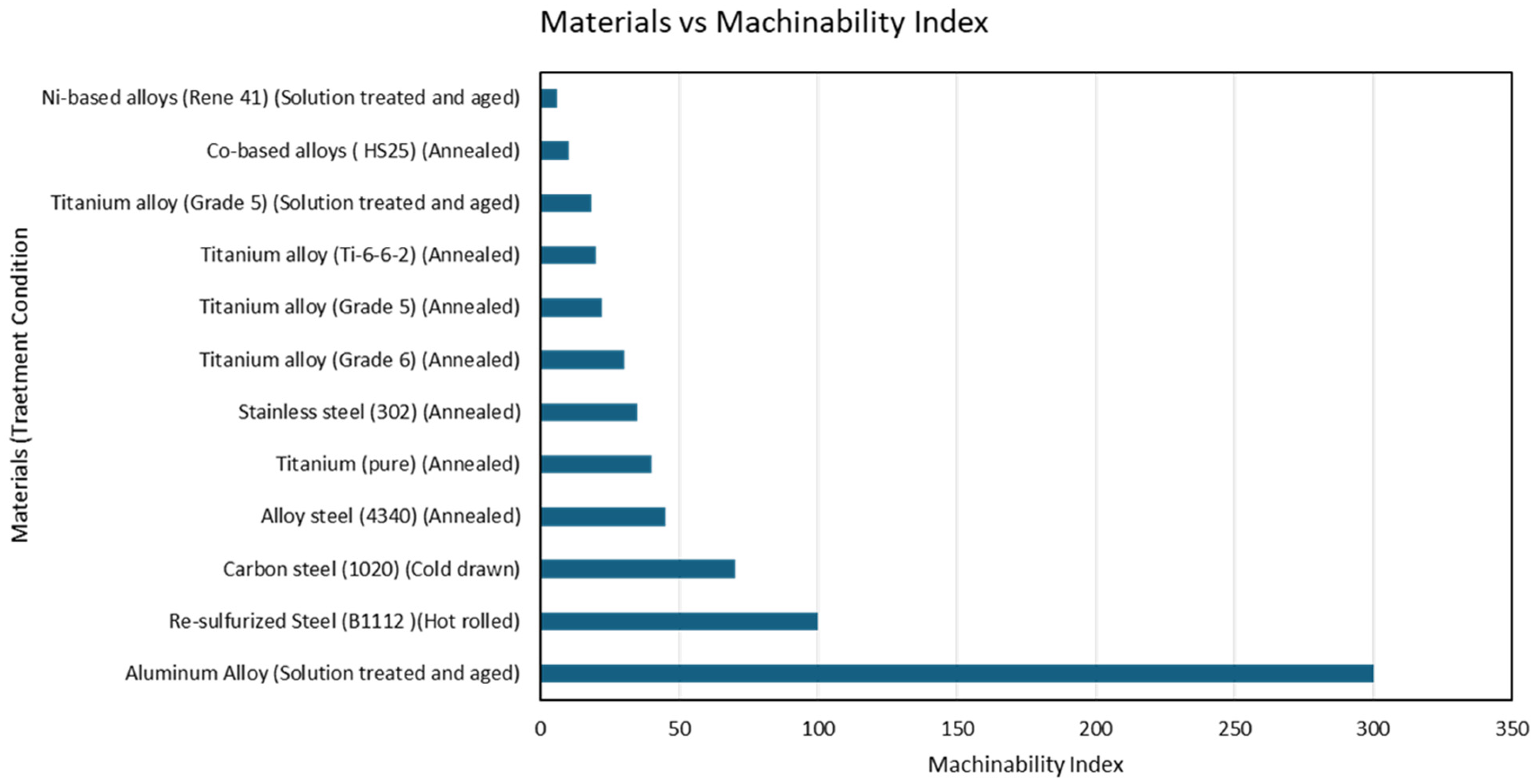
Figure 1 depicts an evaluation of the conventional machinability of a number of titanium alloys and where it stands against other materials. Despite their “poor machinability, titanium alloys are widely used in medical (for example, dental implants, spinal fusion cages, finger and toe replacements and bone plate expandable ribs cages), aerospace, marine, chemical processing and automobile sectors” [12]. The depth of milling has a non-linear relationship with milling time for different materials, and for materials such as titanium, which has a “low machinability index, the non-linearity is more prominent” [13].
The present manuscript reviews the abrasive water jet machining (AWJM) of titanium alloys, with particular emphasis on Ti-6Al-4V, by systematically analysing the effects of key process parameters, individually and in combination, on machining quality indicators such as surface roughness and material removal rate. The review critically evaluates the existing parameter-optimisation techniques to identify the dominant factors influencing machining performance. Importantly, this review uniquely incorporates a focused and critical discussion on the application of artificial intelligence and machine learning in the AWJM of titanium alloys, an emerging area that has not been comprehensively addressed in previous reviews. By integrating conventional process-parameter studies with emerging data-driven modelling and optimisation approaches, this review fills a clear gap in the literature and provides practical guidance for researchers and engineers seeking to enhance the machining performance of Ti-6Al-4V.

2. Abrasive Water Jet Machining (AWJM) of Titanium Alloys

The traditional machining processes of titanium alloys possess several limitations. The heat formation during machining gives rise to changes in microstructure within the machining zone “due to the low thermal conductivity of Ti-6Al-4V and the formation of the built-up edge (BUE) chips that are detrimental to the machined surface quality” [15,16]. Other limitations of the “conventional machining processes, such as milling and drilling, were high tool wear, low material removal rate (MRR)”, low dimensional accuracy, and high surface roughness [17,18,19]. All of these limitations open the door for alternative machining practices for the titanium alloy, commonly known as non-traditional machining, which includes, but is not limited to, “electro-discharge machining (EMD)” [20,21], “electro-chemical machining (ECM)” [22], “ultrasonic machining (UM)”, “laser beam machining (LBM)” [23], “water jet machining (WJM)” [24], and “abrasive water jet machining (AWJM)” [25]. In contrast to “conventional machining,” no cutting tools were used for material removal in this process. Thus, this process does not induce shear deformation, the material deformation mechanism, during conventional machining [26,27]. The material removal mechanisms are “different in non-conventional machining and conventional machining. In the former, residual stress and chatter while machining can also be overcome” [28]. Out of these different “non-traditional machining” practices, AWJM of Ti-alloys is one of the promising processes that is foreseen to provide quality and efficient machining of complex geometries of titanium alloys [29].
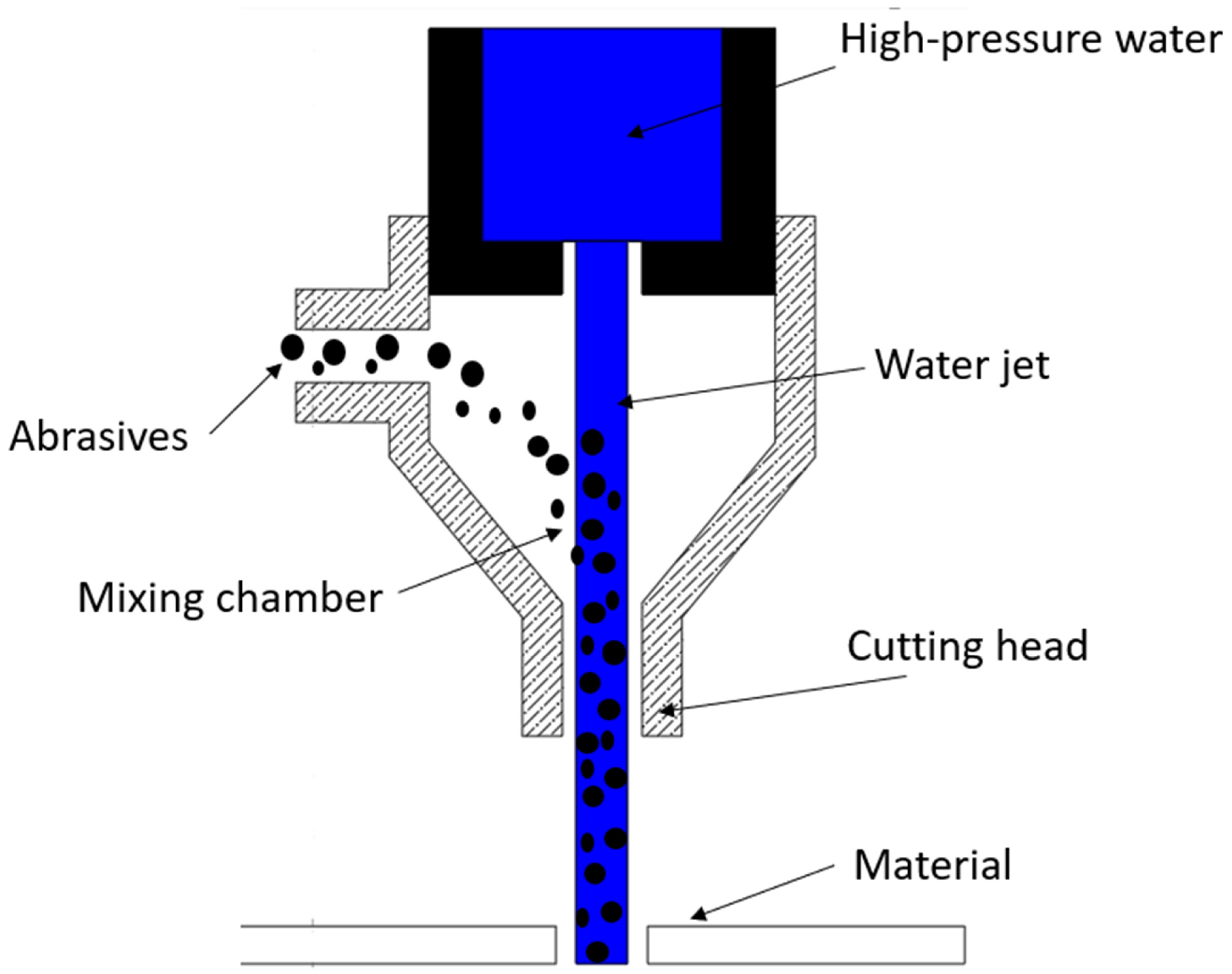
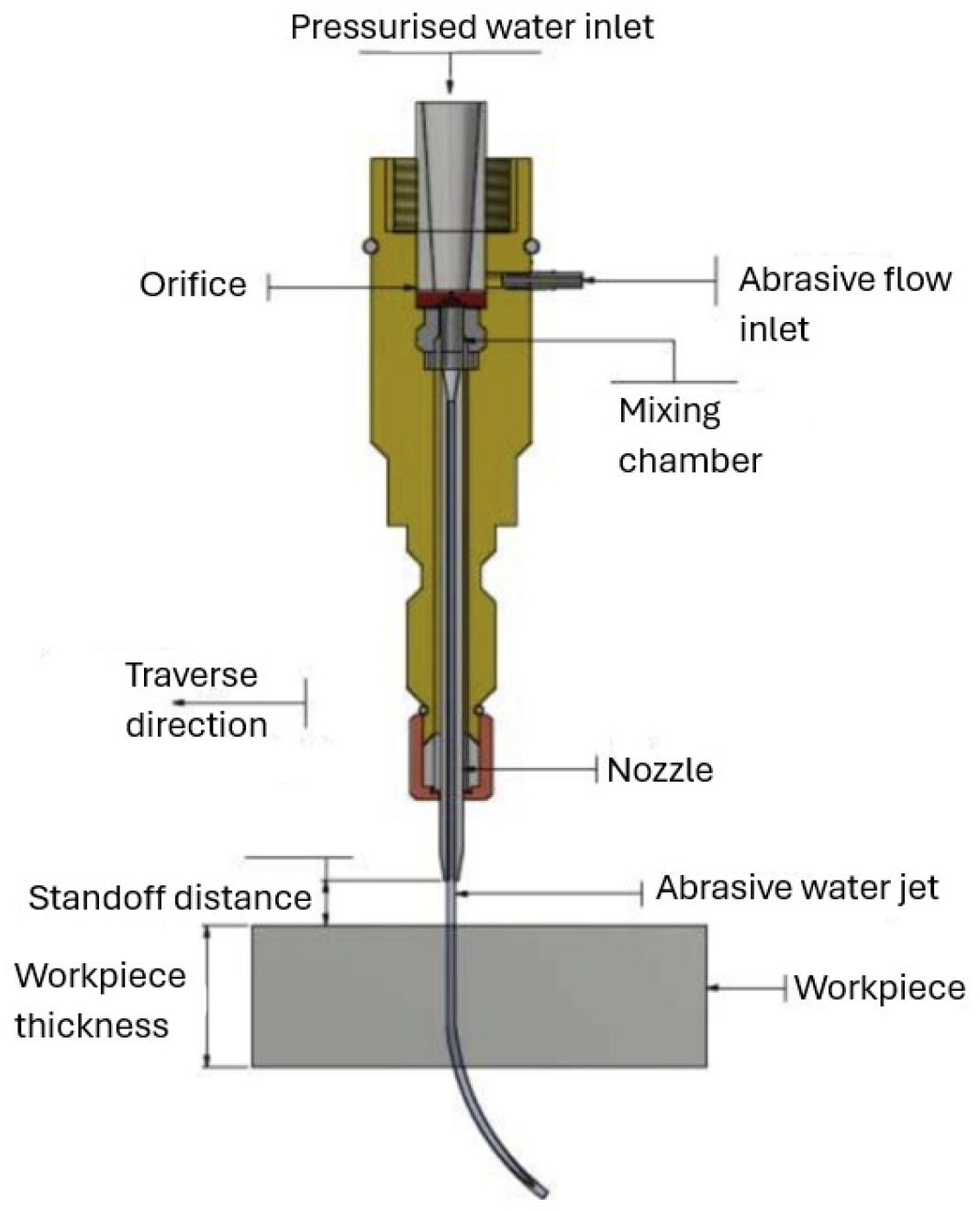
AWJM uses a “high-velocity jet of water mixed with abrasive particles to cut materials”. This material can be alloys, metals, ceramics, composites, and even “thick materials that are difficult to machine using conventional methods” [30,31]. AWJM relies on the fundamental physics of fluid mechanics and erosion. The process involves accelerating water to supersonic speeds using a high-pressure pump, typically in the range of 200–600 MPa. The water jet is then mixed with abrasive particles such as garnet or aluminium oxide, which are introduced into the jet stream through a mixing chamber. When the high-speed mixture impacts the workpiece, the “kinetic energy of the abrasive particles” converts into mechanical energy, causing “material removal through a combination of micro-cutting and erosion”. A schematic of the simplified process of this method was depicted in Figure 2.
The cutting process in AWJM involves several physical phenomena that take place simultaneously: namely, (i) fluid dynamics (Bernoulli’s principle), (ii) abrasive particle velocity, and (iii) different material removal mechanisms that are relevant to the “workpiece” material [32]. As the high-pressure jet is forced through a small-diameter nozzle, commonly known as an orifice (typically 0.1–0.4 mm [33]), the water forms a jet and exits at a significantly high velocity (up to 900 m/s [34]), accordingly to Bernoulli’s equation in Equation (1):
P + 1 2 ρ v 2 + ρ g h = c o n s t a n t
where P = pressure, ρ = fluid density, v = velocity, g = acceleration due to gravity, and h = height.
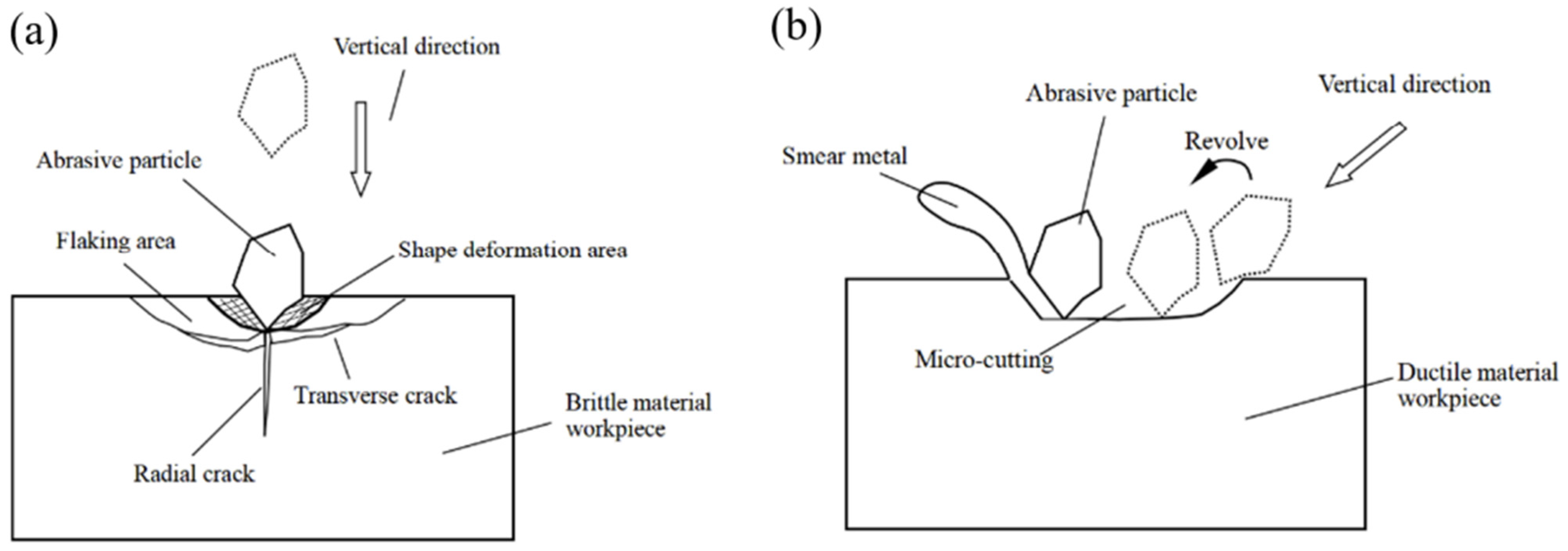
After forming the desired water jet, abrasives are introduced into the jet stream via a venturi effect, where the high-speed water creates a low-pressure region, drawing in the abrasive particles [35]. The abrasives mixed with the water jet gain substantial kinetic energy and are focused towards the “workpiece” in a precise way. Upon striking the “workpiece” material, the controlled erosion of the material took place according to the inherent nature of the material [36]. The mechanism can be in the form of brittle and quasi-brittle fracture for “brittle materials” [37] such as ceramics and glass. The impact of abrasive particles on the material surface induces localised fracture when the compressive stress within the plastic deformation zone exceeds the material’s tensile strength. The resulting radial crack propagation, oriented perpendicular to the surface due to the high stress concentration, subsequently triggers the formation of lateral cracks that are parallel to the machined surface, which are primarily responsible for material removal [38,39]. In the case of ductile materials (e.g., metals, plastics), plastic deformation and cutting prevailed, where repeated impact from abrasives causes plastic deformation, micro-cutting, and progressive layer-by-layer removal of the workpiece material [25]. Figure 3a,b show the material removal in brittle material and ductile material, respectively.
The scenario is different for polymer matrix composite materials, where abrasives cut through fibres and matrix phases differently, leading to controlled shearing [40]. The erosion kinetic energy (UK) and effective erosion kinetic energy (UM) are as in Equations (2) and (3), below [41].
U M = U K 1 + H H a
where UK—erosion kinetic energy and Ha—hardness of abrasive particle.
U K = 1 / 2 m v a 2
where va—velocity of particles.
At the bottom, there is a catcher that dissipates the remaining energy of the jet after it passes through the “workpiece”. The whole process is computerised and controlled automatically by a mechanical/robotic arm in a closed chamber. Both the water and abrasive were collected at the end of each run and recirculated in the system. As it is a closed-loop process, the recovery of both the water and abrasive is high. The abrasive could be used for several runs until it becomes fragmented and loses its erosion capability.
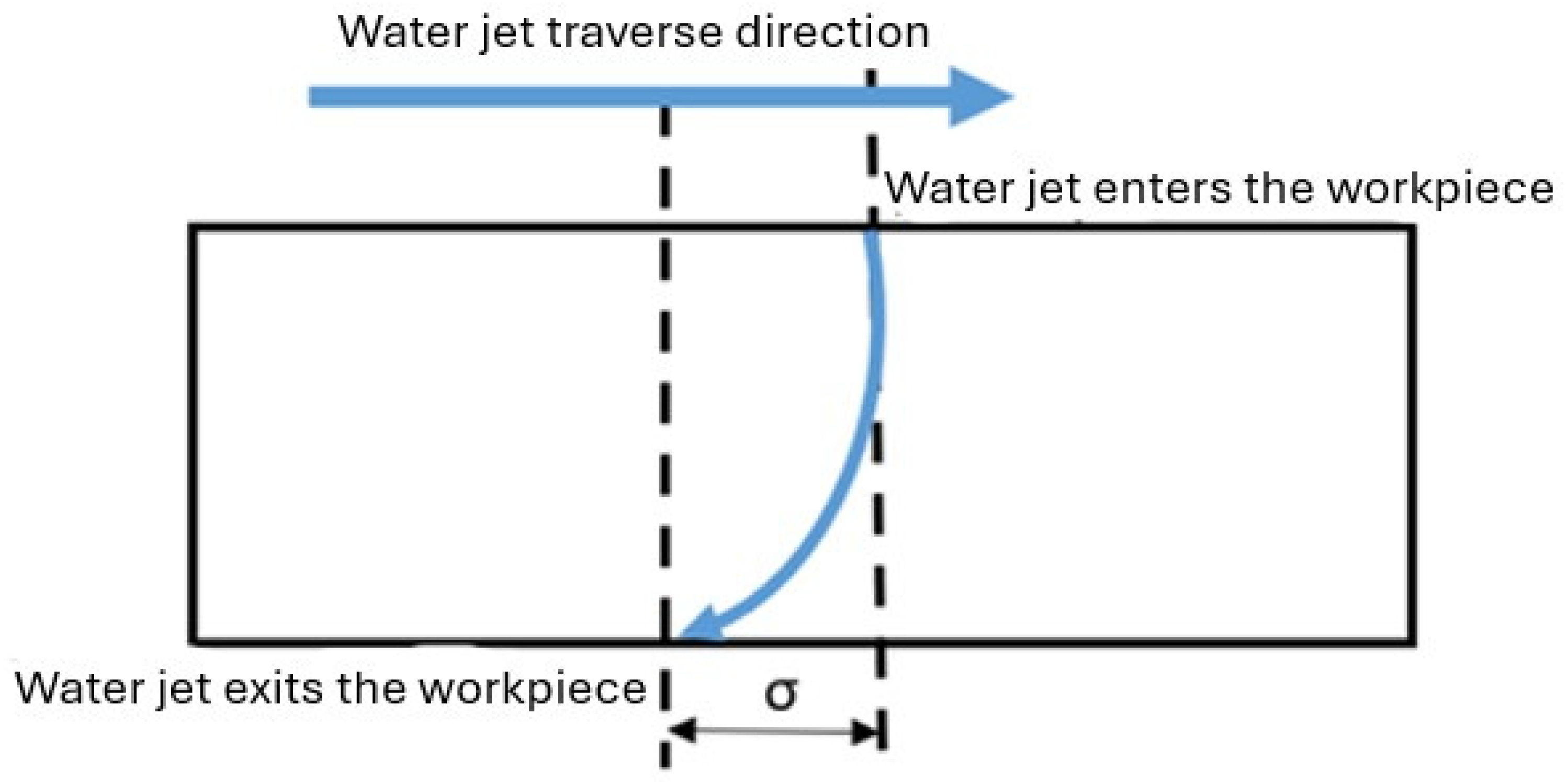
As an AWJM is carried out, the deflection of the jet through the material being cut was observed [42]. Upon entering the material, the water jet will deflect in the opposite direction to the nozzle motion direction. The jet exiting the material “lags behind the point at the top of the material where the jet enters”. The horizontal distance from the exit point to the entry point is called the trail back (σ). The jet moves in the direction of the arrowhead in Figure 3. It was noticed that “the jet–material interface is a curved surface”. These phenomena are shown schematically in Figure 4.
The angle the water jet deflects at, relative to the perpendicular axis at the water jet entrance, is the declination angle, as shown in Figure 5. The trail back is formed due to the declination angle and the curvature of the path between the “inlet surface and the outlet surface of the cut”. The recommended declination angle for material with 30 mm thickness is 45°, material with 60 mm thickness is 22.5°, and material with 120 mm thickness is 15°. For thickness above 120 mm, the declination angle should be below 10° [43].

3. AWJM Process Parameters

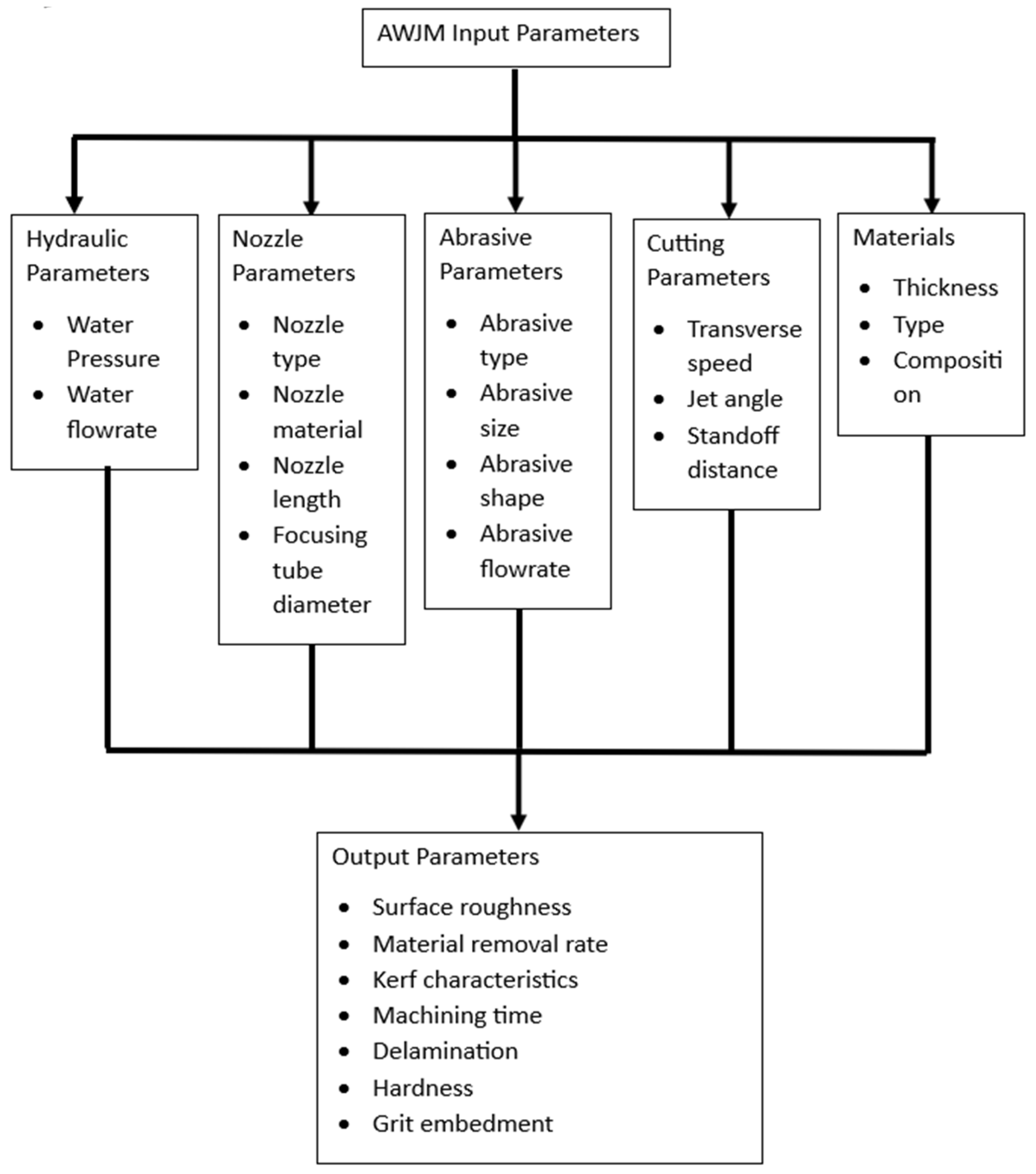
The AWJM has several parameters that govern the quality of machined components. Figure 6 illustrates the various input parameters and the output parameters that directly influence the quality and productivity of the process.

3.1. Hydrodynamic Parameters

The use of WJM to “machine gamma titanium aluminide (γ-TiAl)” reported that the water jet pressure and jet paths affected the generated surface [44]. It was observed that a lower water pressure does not form continuous erosion traces on the workpiece surface. The erosion traces turn out to be more continuous with the rise in water pressure. With a further increase in jet pressure, erosion rises along the depth and develops continuously along the jet path [44]. Higher water pressure increased the jet velocity and kinetic energy of the water jet, enhancing the cutting efficiency [45].
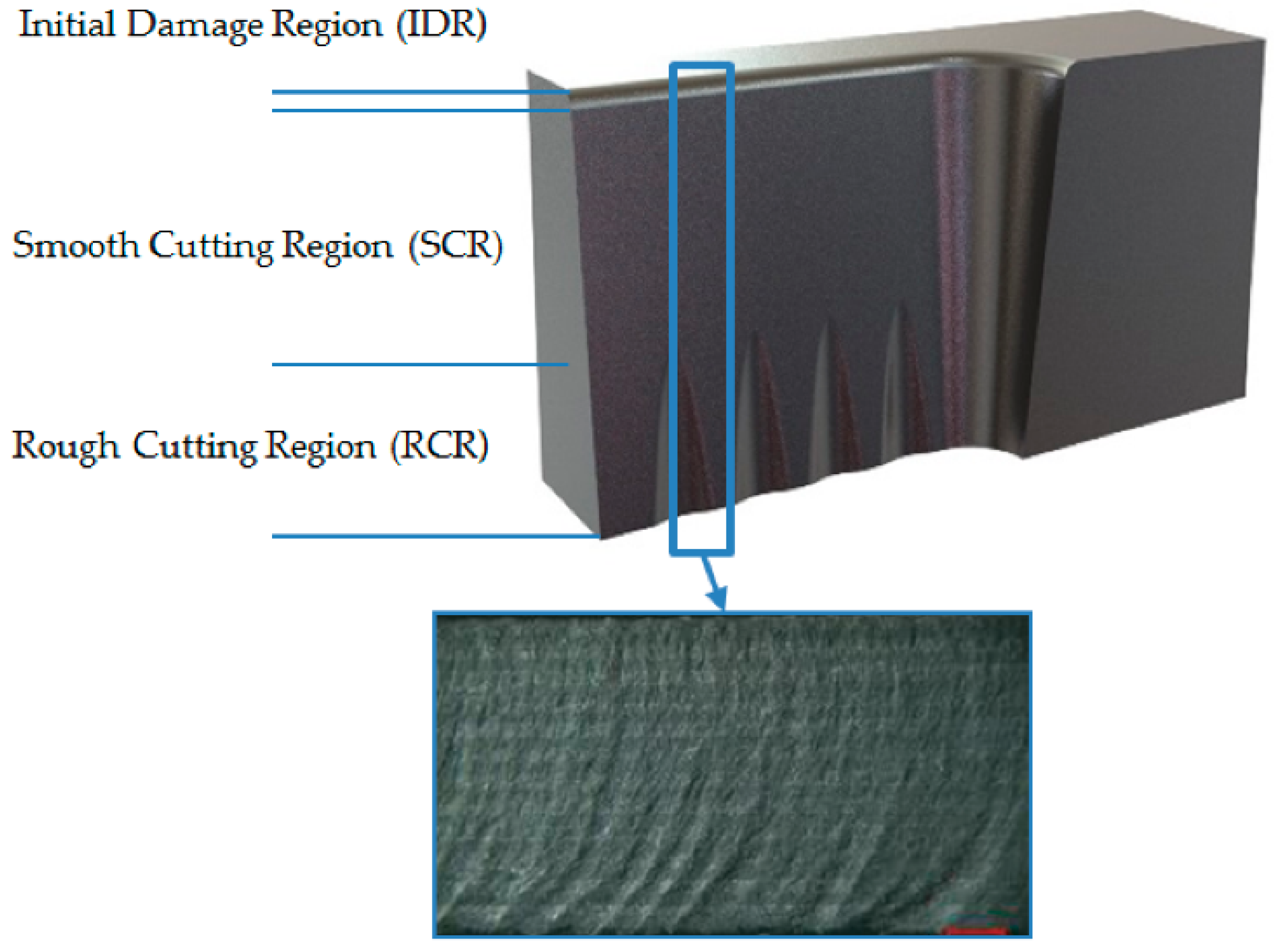
During the AWJM of Ti-6Al-4V, three different microstructural regions form in the “workpiece” material: (a) the “initial damage region” (IDR), (b) the “smooth cutting region” (SCR), and (c) the “rough cutting region” (RCR) [46]. The IDR is the “deformation on the surface of the material due to the successive impact of particles from the water jet”, the SCR is the surface area with reduced “roughness due to the water jet” retaining sufficient kinetic energy, and RCR is the surface area with the most roughness “due to the water jet delay at the material’s exit” [47]. A surge in jet pressure increased the microhardness in all three microstructural regions due to “plastic deformation and strain hardening”. The increase in hardness of the cut surfaces was also attributed to the embedment of abrasive particles, which will be discussed in a later section [48]. The increase in water pressure was also found to result in the formation of non-recrystallised grains and deformed grains and increased the dislocation density [49]. The increase in the dislocation density induced the “embrittlement in order to reduce ductility”. During hole-machining, the “depth of cut” and the diameter of the hole are directly related to the jet pressure, and the surface roughness is inversely related to the jet pressure [37,50]. An upsurge in jet pressure increased the abrasives’ kinetic energy, leading to a higher depth of cut. In a pocket milling study for Ti-6Al-4V, at lower jet pressures, the “milled surface was found to be uniform with good surface finish for all traverse speeds”. As the pressure increased, the surface became uneven and rough due to excessive material removal. The surface was found to “contain grooves and ridges at high jet pressure” [51]. To summarise, an increase in water jet pressure results in a greater depth of cut and higher material removal rates, due to the increased kinetic energy of the water jet. Increasing the water jet pressure up to an optimum level has a positive effect on surface roughness, due to a more uniform material removal. However, excessively high water jet pressure leads to increased surface roughness and waviness due to over-erosion; therefore, it must be carefully balanced in conjunction with other process parameters, as discussed later.

3.2. Nozzle Parameter

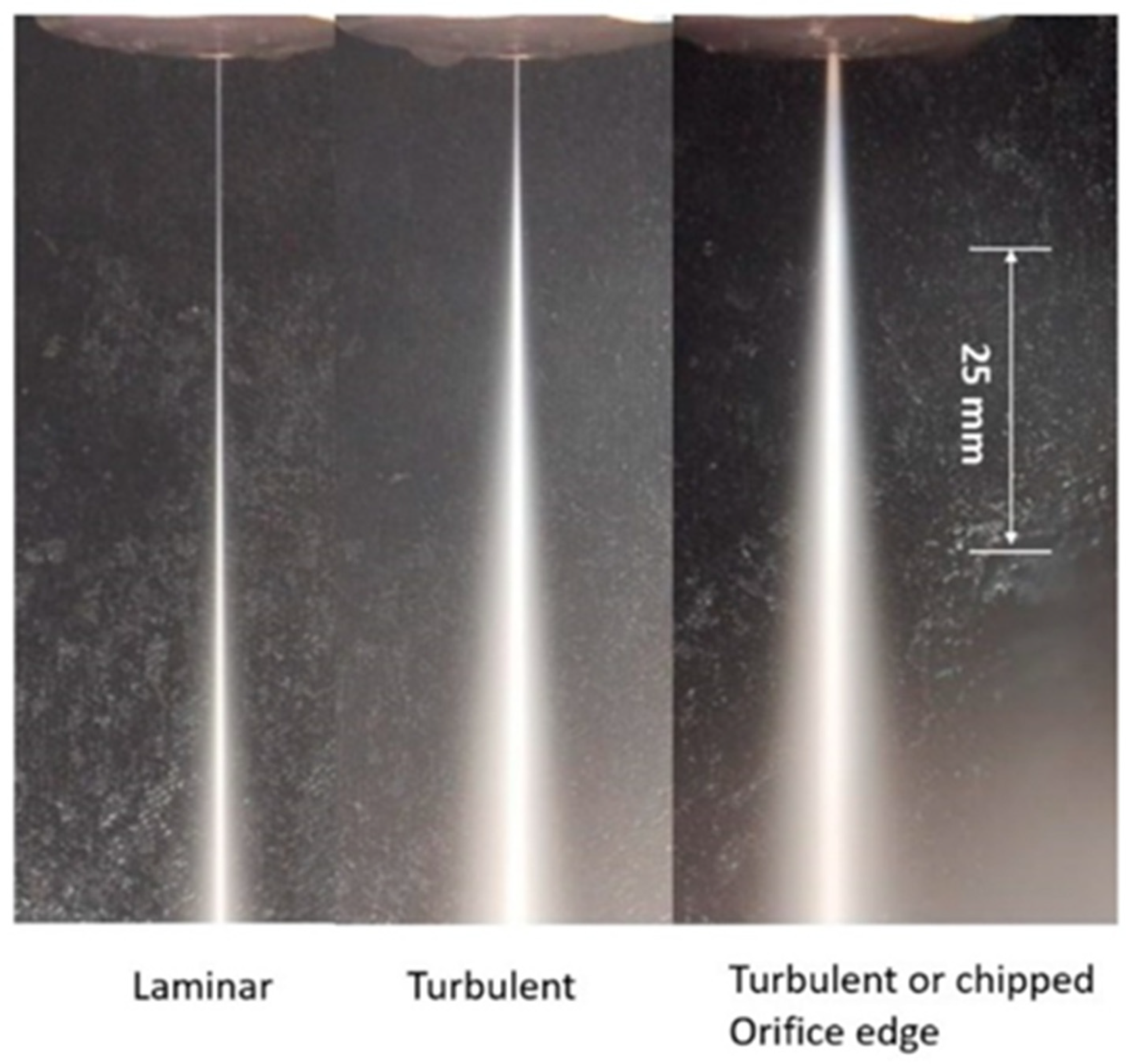
The crucial components of the AWJM system are the orifice and nozzle, which form water jets, as shown in Figure 7. The nozzle diameter and shape influence jet focus and precision, with smaller nozzles enabling more detailed cuts through energy conversion from pressure energy to kinetic energy that is transmitted to the water jet and abrasives [52]. The recommended orifice range is 0.13 to 0.76 mm [42]. The nozzle has three important parameters: “convergence tube angle (α), abrasive incidence angle (θ) and abrasive feed length.” The smaller convergence angle provides more axial acceleration to the abrasives, hence increasing the kinetic energy of the water jet. Abrasive particles achieve high velocity in the mixing chamber, under a “minimum abrasive incidence angle”. The position of the abrasive feed tube should not be close to the lower section nozzle for the abrasives to gain a higher initial velocity due to the Venturi effect [53]. The nozzle is a consumable, which is made of hard materials like “sapphire, ruby, natural diamond, or synthetic mono- or polycrystalline diamond” to minimise/resist wear by the high-velocity water jet. The edge of the nozzle must be sharp, with a minimal fillet radius, to form high-coherency water jets. The formation of different jet coherency was shown in Figure 8 at 350 MPa WJP [42]. The ideal jet will be the laminar flow where the jet strikes the workpiece in the focused region with maximum kinetic energy.
Computational fluid dynamics (CFD) studies on erosion of the internal components of abrasive water jet cutting heads have shown that abrasive particles entrained in a high-speed water jet mix with the turbulent flow within the mixing chamber. The maximum erosion is consistently reported at the junction between the mixing chamber and the focusing nozzle. These studies further confirm that the erosion rate increases with the increasing abrasive mass flow rate and particle size, owing to the higher particle mass and kinetic energy. In addition, the flow pressure within the nozzle is non-uniform along the radial direction: the pressure is lowest and velocity is highest at the nozzle centre, whereas the pressure is highest and the velocity approaches zero near the nozzle wall. An axial pressure drop is also observed along the nozzle length, with higher pressure at the inlet and lower pressure at the outlet. Consequently, the water jet velocity increases along the nozzle axis and reaches a maximum at the nozzle centre [55,56].

3.3. Abrasive Characteristics

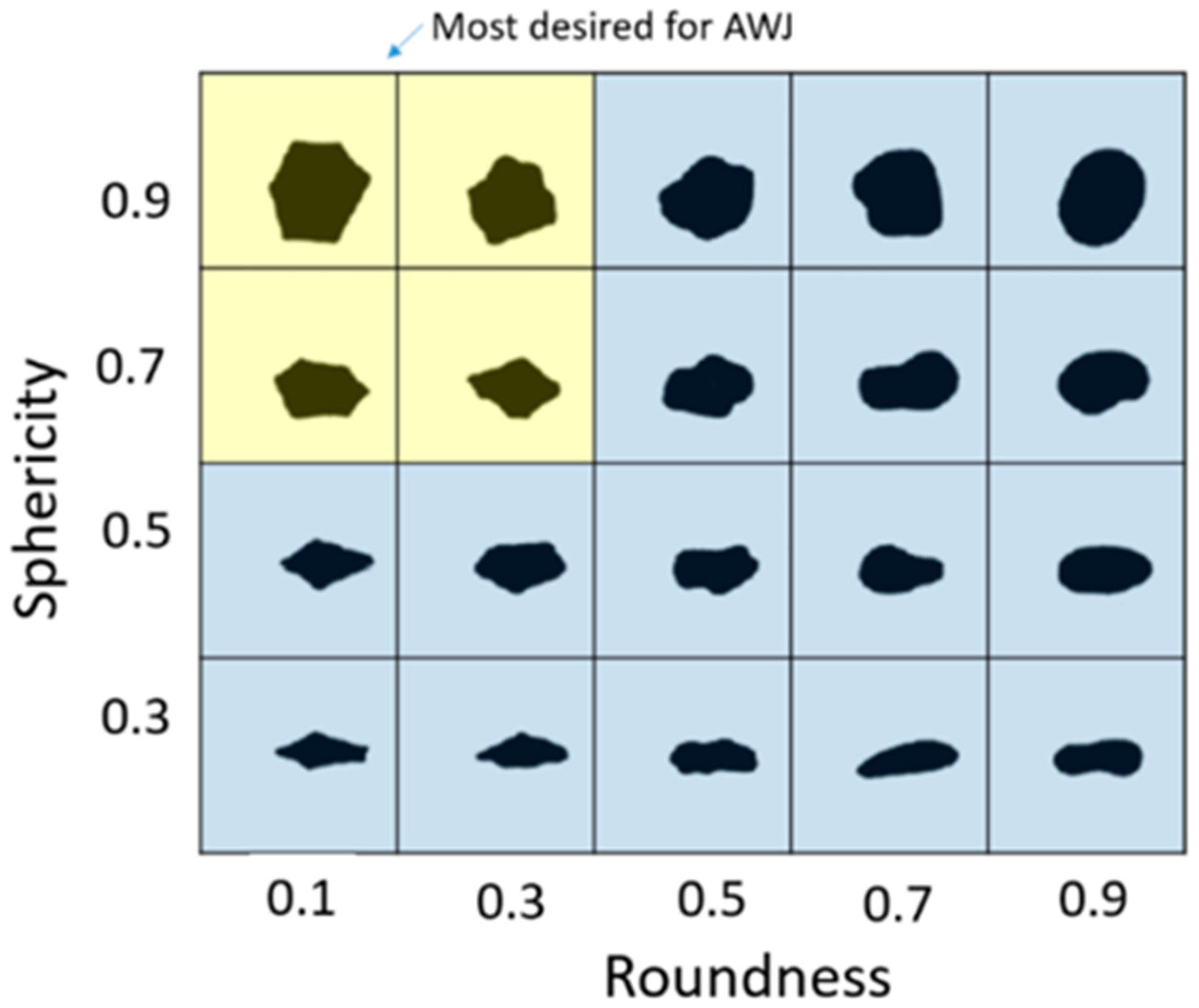
The preferred abrasives in AWJM are “garnet, aluminium oxide, glass beads, olivine sand and steel grit”. Garnet is commonly used due to its availability, non-toxicity, and mechanical and physical properties. “The most important properties of abrasives are hardness, specific gravity, size, shape, and frangibility”. Among them, the “shape of the abrasive particles” plays a dominant role, as this actually acts as a ‘cutting tool’ during the AWJM process. “The sphericity and roundness, the most commonly known indices, of the abrasive particles” were shown in Figure 9. The sphericity refers to the “extent to which a particle approaches a spherical shape”. The roundness relates to the corners and the edge sharpness of an abrasive particle. In the application in AWJM, abrasives with a “high sphericity and low roundness index” are preferred. Glass beads, garnet, brown and white aluminium oxide, steel, olivine, silica, silicon carbide, and zirconia are generally used as abrasives for machining titanium alloys [57,58].
A comparison study between SiC and garnet abrasives reported that SiC produced a greater depth and material removal rate (MRR), with minimised kerf taper angles compared to garnet under similar machining conditions, as SiC is harder than garnet. However, the multi-objective optimisation study of this work concluded that even though SiC is the abrasive of choice for an individual output—for example, MRR—to achieve optimisation for more objectives that might contradict each other (for example, higher depth and lower kerf width), garnet was found to be the preferred abrasive [59]. In spite of the widespread choices, 86% of AWJM processes used a garnet abrasive [60].
Garnet is relatively hard, easily available, and cheap. In addition, this abrasive has sharp edges, better flow characteristics, and “better performance” compared to “silicon carbide, silica, aluminium oxide, steel grit, steel shot, copper slag and glass beads” [61]. The shape factor of abrasives, type of abrasives, and hardness of abrasives are the variables, apart from jet pressure, jet impingement angle, and traverse speed, that affect the AWJM of titanium alloy [57,62,63]. The use of eco-friendly soft walnut as an abrasive was found, under optimum conditions, to be able to be used with harder abrasives for cleaning and polishing operations, leading to higher productivity and surface integrity [64]. The characteristics of the common abrasive used in the AWJM process was tabulated in Table 2.
The MRR reduced with the rise in the “shape factor” for all traverse speeds (0.03 m/s, 0.083 m/s and 0.166 m/s) [31]. However, the MRR and particle hardness are directly proportional to each other. A sharp rise in MMR was noted, as the particle hardness rises during milling until 100 HV. MRR also increased with an increase in the abrasive size, as high mass abrasives have higher kinetic energy when they impact the material surface [65]. The optimum concentration of abrasives in water was found to be 20% for abrasives such as GMA80, olivine, and glass in the AWJM of Ti-6Al-4V [66]. Above this concentration, the water was not able to provide the maximum velocity to the “abrasive particles” and below this concentration, the smaller number of abrasive particles led to a smaller number of cutting blades, hence achieving a smaller cutting depth.
The surface scratch size depends on the abrasive particle size and other parameters, such as “water jet pressure, traverse speed and standoff distance” were observed to have less effect on scratch size [67]. Small particle sizes are suitable for smaller surface roughness in IDR, and large particle sizes are suitable to reduce the surfaces at the SCR and RCR. An increase in “abrasive flow rate and abrasive mesh size” increased the depth of the cut. A larger abrasive flow rate increased the abrasive impingement of the surface, leading to increased surface erosion. The larger abrasive size increased the unit area of the machining surface. The larger abrasive size was also found to increase the top kerf width [68]. A surge in flow rate is directly related to the lowering of surface roughness, as is the increase in “kinetic energy of the jet” and the higher cutting ability of the abrasives. However, observation showed that a reduction in surface roughness will be at the “jet entrance and the jet exit” surface roughness gradually increases due to a “reduction in the kinetic energy of the jet”, which is caused by the collision between abrasive particles [69]. The impact of hard particles, as well as the water jet, induces localised plastic strain at the workpiece surface.
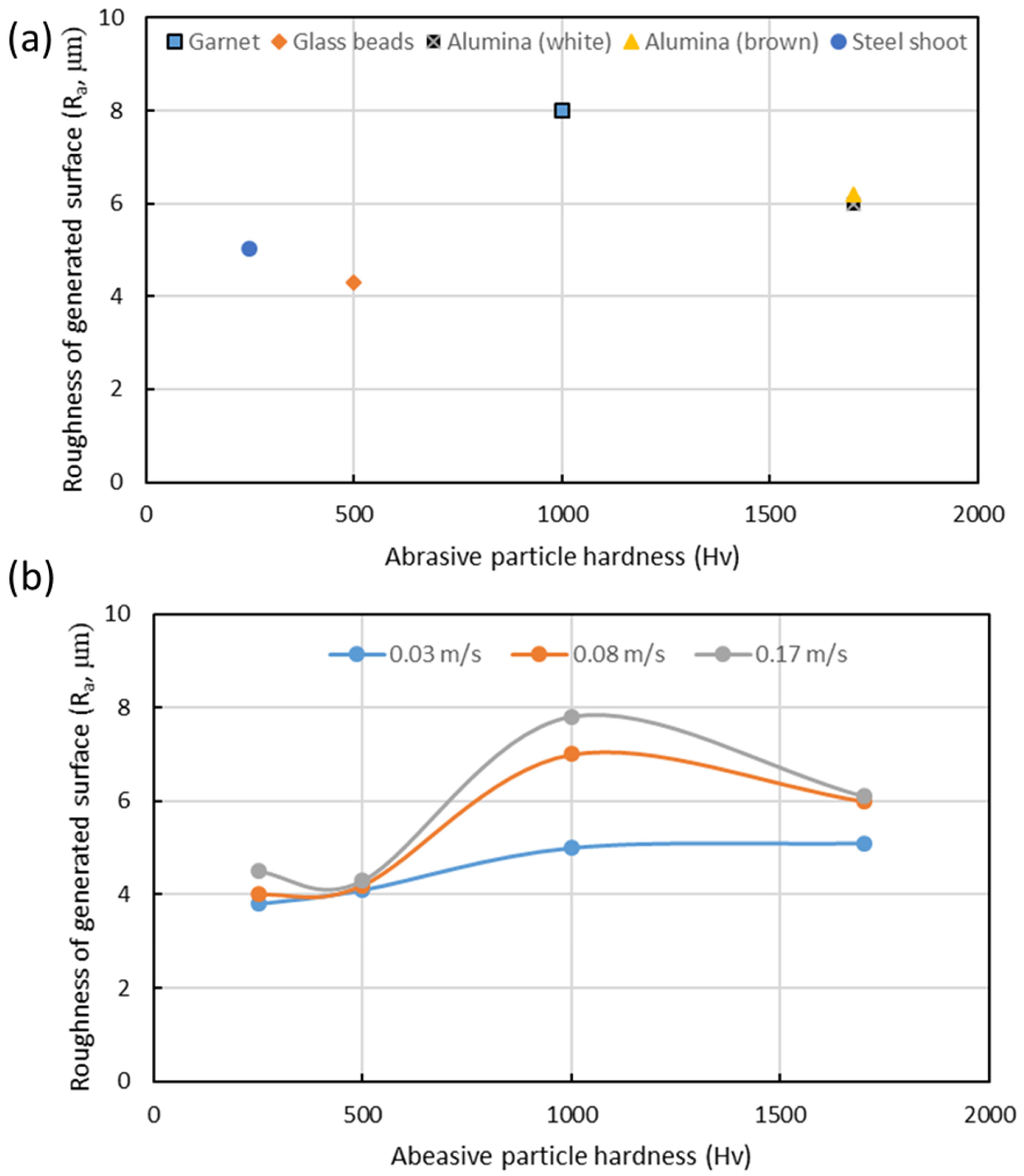
Material is removed when this strain surpasses the “strain-to-failure” value of the workpiece material [70]. If the abrasive’s hardness is greater than that of the workpiece, an inflexible indent forms, causing plastic strain on the workpiece surface. However, when the particle hardness is lower than that of the workpiece, the particles deform or fracture [57]. Figure 10a,b showed that lower hardness abrasives—for example, steel shot and glass beads (around 500 HV)—gave a better surface finish at different traverse speeds. During the AWJM of titanium alloy, a 50% lesser roughness was generated by the glass bead abrasive compared to that of the garnet abrasive (Figure 10b) [57].
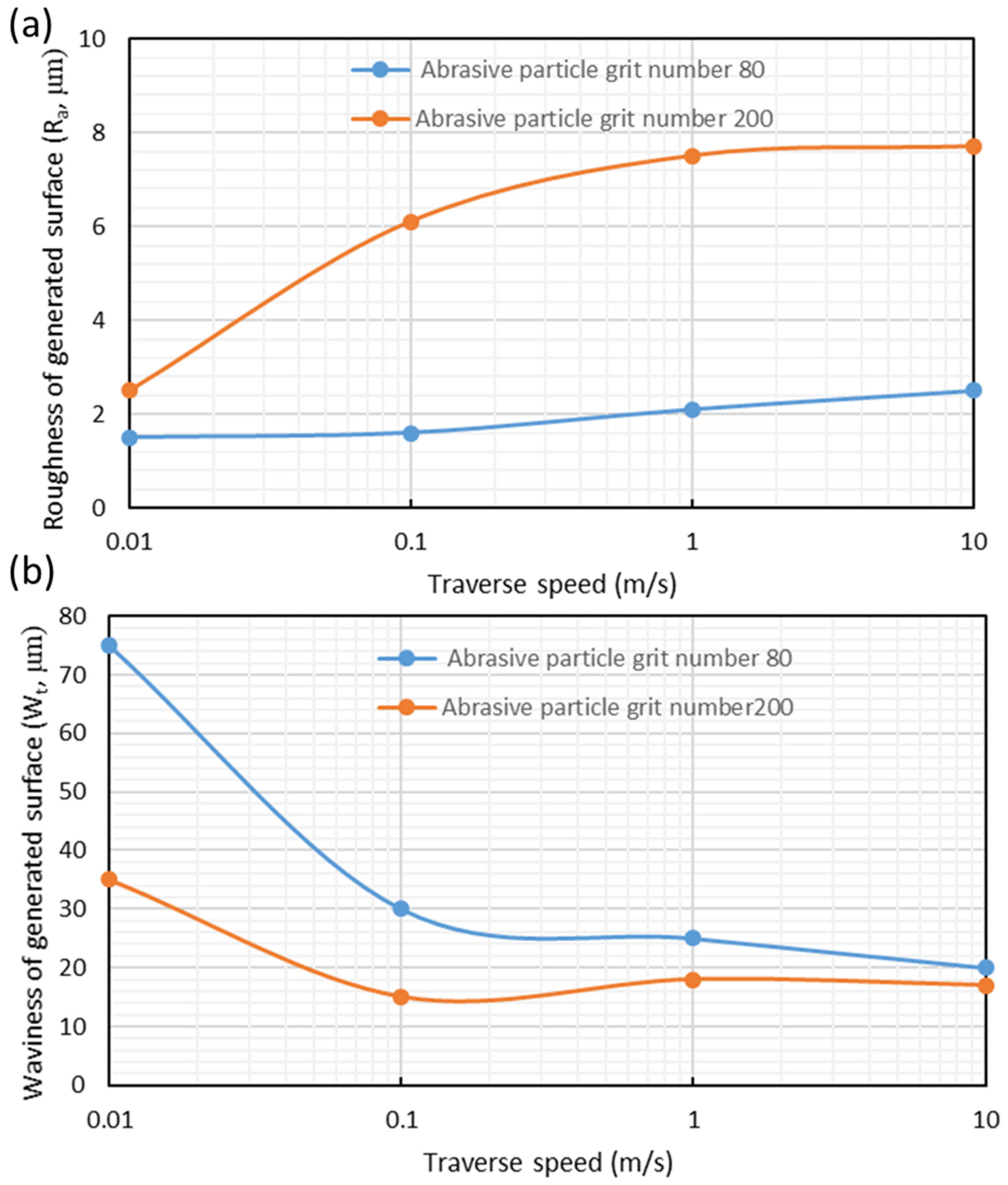
The effects of abrasive grit size on “surface roughness at different traverse speeds” during the AWJM of Ti-6Al-4V are given in Figure 11a [71]. Finer-grit-size abrasives (200# or 75 μm) produced lesser surface roughness compared to the commonly used 80 mesh (80# or 180 μm). Larger grit sizes have the tendency to remove more materials; hence, they will lead to rougher surface finishes. AWJM also induces waviness on the generated surface due to irregularities in the material removal process. Smaller abrasives generate a less wavy surface compared to that of larger abrasives at the same traverse speed, as presented in Figure 11b. This is because of the fact that smaller abrasives induce reduced damage to the surface during machining and are capable of tracking the streamlines of the water jet more accurately.

3.4. Cutting Parameters

3.4.1. Traverse Speed

The traverse speed affects the material removal rate (MRR) of Ti-6Al-4V for various abrasives and grit sizes [62,71]. For four different abrasives—garnet, glass bead, Al2O3 white, Al2O3 brown, and steel shot—at a lower traverse speed of 0.025 m/s, Al2O3 brown, with the highest hardness of 1800 HV, produced the highest MRR and glass bead, with the lowest hardness of 500 HV, produced the lowest MRR. At a higher traverse speed of 0.16 m/s, Al2O3 white (1800 HV) produced the highest MRR and steel shot (200 HV) produced the lowest MRR. At a range of traverse speed of 0.001 m/s to 10 m/s, the 80-grit abrasives produced higher MRR compared to 200-grit abrasives [57,71]. The ANOVA analysis showed that the water jet traverse speed influences MRR by 84.32% and surface roughness by 54.32% [72]. The MRR for the Ti-6Al-4V alloy can be represented using Equation (4), below [73]:
MRR = h t × W × v f
where vf—traverse speed, W—width of kerf (average of top kerf width and bottom kerf width), and ht—depth of cut.
A non-linear regression equation for MRR, which included the effect of process parameters on MRR, was given by Equation (5) [74]:
MRR = 0.2395 + 0.000589   T v + 0.00069   A f + 0.0861   S d 0.000196   ( T v × S d ) 0.000104   ( A f × S d )
where Tv—traverse speed, Af—abrasive flow rate, and Sd—standoff distance.
The increase in traverse speed increased the MRR but also increased the surface roughness, as abrasive particles do not have sufficient time to remove surface asperities from the surface to produce enhanced surface quality [74]. The increase in traverse speed is inversely proportional to the “depth-of-cut” because of the decrease in jet kinetic energy, due to the reduction in time to carry out a cut at a point [75].
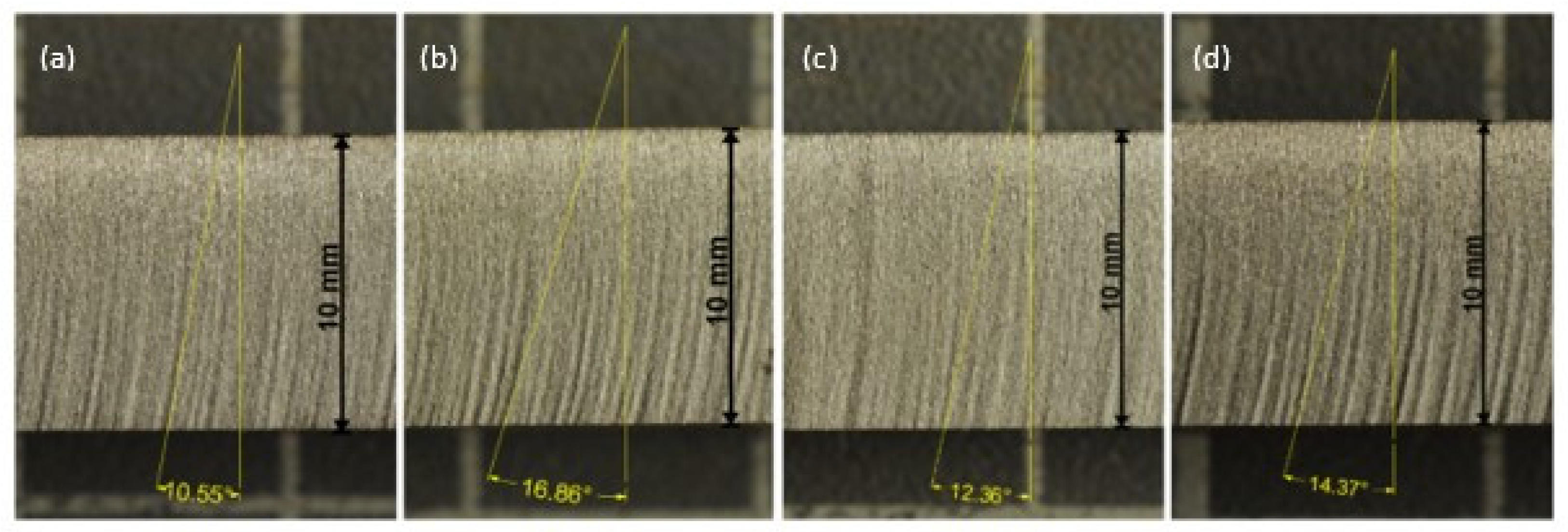
It was found that the IDR decreased slightly, and the SCR decreased significantly with the increase in “traverse speed, which reduced the intensity of particles hitting a target area and the depth of penetration”. The texture of the generated surface indicates that material removal in AWJM occurs by the amalgamation of two actions, such as “scooping-induced ductile shear and ploughing actions by the abrasives” [63,76]. According to Wang et al. [77], “the material removal mechanisms of AWJM in the IDR and SCR are recognised as cutting and deformation”, correspondingly, while RCR is contributed by erosive wear at a large abrasive attack angle [38]. In the erosion process, abrasives push the material on the surface in the direction of focus (against the surface) because of abrasive deceleration, and the surface suffers elastic and plastic deformation as a response to the external force [57]. The magnified pictures of the generated surface shown in Figure 12 indicate that the amount of “plastic deformation” rises from the “top to the bottom of the machined surface”. In the IDR of the machined surface, abrasives induce significant damage due to significantly greater kinetic energy [63]. When the abrasives penetrate more into the material, the “kinetic energy of particles” reduces, and part of it is consumed to form the SCR. Therefore, a lower energy abrasive stream generates RCR where the stream deflects from the normal direction to the cutting plane and forms striation on the machined surfaces [63]. The “declination angle of striations” on the machined surfaces is generated during their interaction with the workpiece material, which is larger than the “angle of the relevant faster jet core” [78]. With the increase in traverse speed, the amount of deflection rises, and the striation generation is affected by the decrease in stream energy and the striation angle. The striation formation depends on the dynamics of the water jet, the type of abrasives, and the machine vibration [79].

3.4.2. Stand-Off Distance

As the standoff distance increased, the abrasive-laden water jet diverged, creating a “wider and less focused cutting zone”. This increased the MRR [65]. Even though a higher standoff distance increased the MRR, it affected the surface roughness due to an increase in random surfaces consisting of peaks and valleys [81]. In contrast, reduction in “standoff distance decreased surface roughness” due to the targeted abrasive stream, leading to hardening of the workpiece surface [82]. The optimum lower standoff distance has been reported as 2 mm [83]. The abrasive water jet is made of two zones: the inner zone (a), with higher velocity particles, and the outer zone (b), with low velocity particles. The increase in “standoff distance” increases the outer zone compared to the inner zone, leading to divergence in the Gaussian distribution of particles [84]. The increase in standoff distance is “inversely proportional to the depth of cut” for the same reason as the “increase in traverse speed”; reduction in jet kinetic energy causes insufficient energy to “increase the depth of cut” [75]. The same reason applied to the “increase in surface roughness with an increase in stand-off distance; the lower density abrasive particles due to the jet expansion, generate more random peaks and valleys on the surface” [74,85]. The “kerf taper increased as the standoff distance” increased from 2 to 10 mm at different traverse speeds. However, with the “increase in standoff distance at different increasing traverse speeds”, the entrance and exit widths decreased but the kerf taper angle increased [86].

3.4.3. Jet Angle

The “crater depth” for the Ti alloy, due to the impact of abrasive particles, has been reported to increase with an increase in the jet angle (30° and 60°), the number of particles, and increased particle velocities of 180 m/s, 200 m/s, and 220 m/s [70]. The depth of cut is higher for the 60° jet angle compared to the 30° angle, as at a “higher velocity and impact angle”, the particles gain higher energy and momentum; therefore, the “deformation on the workpiece increases”. In the study of jet angles (50° to 90°) and two pitch values of 0.7 mm and 1.1 mm, the depth of cut increased with an increase in the jet inclination angle, but for the same jet angle, the pitch of 0.7 mm produced deeper cuts compared to the pitch of 1.1 mm [87].

4. Machining Mechanism and Parameter Optimisation

The multi-pass strategy for the AWJM of the Ti-6Al-4V alloy was reported to assist in increasing the “depth of cut”, with the water jet pressure and traverse speed playing major roles in achieving the desired depth. Even though the strategy did not have a major impact on the top kerf width, as the kerf width showed a slight “increase with a higher number of passes”, the method effectively reduced the kerf angle after multiple passes. Similarly, the MMR and cutting efficiency also decreased with increases in passes, hence showing that the single-pass method is preferred for higher MRR and efficient cutting [88].
The roughness of the surface generated from the AWJM depends on the traverse speed [89], properties of abrasives, jet pressure [57,71], standoff distance [89], and abrasive flow rate, which are the most substantial variables to determine the “quality of the machined surfaces”. A greater rate of abrasive flow with longer standoff distance produces rougher surfaces because of higher and more random energy dispersal [90]. “The surface roughness increased with the increase in jet traverse speed” [91,92]. With an increase in traverse speed from 0.03 to 0.166 m/s, surface roughness increases by 20% for most of the abrasive particles, although it increased by 40% for garnet abrasives [57]. This might have taken place because of fewer machining action overlaps and fewer abrasives to impact the surface as the traverse speeds rose [93]. Hascalik et al. [63] reported that the “depth of cut” increases and surface quality worsens because of the reduced “kinetic energy of the jet stream”. The jet impact angle degrades in RCR, and the disfigurement wear mechanism becomes more effective than at the highest position of the machining zone, where the cutting wear mechanism is predominant. The average surface roughness of 2.30–3.57 µm at 1 mm depth can be achieved at 60–250 mm/min traverse speeds, respectively [63]. The Ra values between the IDR, SCR, and RCR, with the RCR having the highest Ra value, showed that the deflected water jet creates a secondary material removal with a reduced momentum. This secondary material removal predominantly acted at the IDR and SCR [94].

4.1. Experimental Design for Parameter Optimisation

A number of studies have used the “Taguchi method for process optimisation” of AWJM to machine titanium alloys (Ti-6Al-4V). “The increase in pressure and standoff distance affected the surface roughness and hardness, and the influence of abrasive flow rate and traverse speed is low for both output parameters” [95]. The increase in traverse speed and the abrasive flow rate with sharp edges significantly increased the material flow rate. However, the increase in traverse speed increased surface roughness, while the increase in the sharp-edged abrasive flow rate decreased the surface roughness. The roughness Ra during the AWJM of Ti6Al4V is represented by Equation (6) [69]:
Ra = 61.38 + 0.00624667 A − 0.1093 B − 0.0105522 C − 31.67667 D − 1.4 E
−0.06 A2 + 0.00001330 B2 + 4.12222 E − 0.06 C2 + 6.62 D2
where A stands for water jet pressure, B stands for abrasive mass flow rate, C stands for traverse speed, and D stands for standoff distance. Another surface roughness control model is given in Equation (7) [96]:
Ra = 4.68 + 0.24 B + 0.22 AB+ 0.18 AC − 0.14 BC − 0.24 A2B + 0.16 A2C + 0.088 A3
where A stands for travel speed, B stands for water pressure, and C stands for standoff distance. The study that report Equation (7) confirmed that the cube of travel speed (A3) and the interaction between travel speed and pressure (AB) are the most significant terms for the surface roughness. Both Equations (6) and (7) showed the combined effect of the input parameters.
ANOVA with the smoothed particle hydrodynamics (SPH) approach to model the AWJM [97] reported that the residual stress on the machined component and surface roughness can be optimised with the combination of parameters such as water jet pressure, abrasive flow rate, traverse speed, orifice diameter, standoff distance, abrasive type, and mesh. The choice of abrasive type and size is also crucial, as harder abrasives such as garnet improve the cutting capability, while finer particles result in smoother surface finishes [98]. The standoff distance, or the gap between the nozzle and workpiece, affects the jet dispersion and cutting accuracy [99], while the cutting speed determines the material removal rates, with higher speeds increasing productivity but reducing depth penetration [100]. A Taguchi and ANOVA parameter optimisation study also reported that among the parameters of water pressure, standoff distance, and nozzle diameter, the nozzle diameter significantly affects the MRR while the quality of the hole is mostly influenced by the standoff distance [101]. The standoff distance was also reported to be the highest influence parameter between the water pressure, abrasive flow rate, feed rate, and standoff distance [102]. This Taguchi–DEAR process optimisation study identified that the standoff distance has the highest contribution to the material removal rate, surface roughness, and multi-response performance index in titanium alloy machining, as the standoff distance is directly related to the impact energy that produces the surface craters on machined surfaces.
A Grey Rational Analysis combined with Taguchi method optimisation study [103] on the AWJM of Ti6Al4V reported that the depth of cut is most controlled by the traverse speed followed by the abrasive mass flow rate. Regarding the interaction between traverse speed and mass flow rate, a lower traverse speed and higher mass flow rate will produce the highest depth of cut. This study also reported that the surface roughness was highly impacted by the water pressure, followed by the traverse speed. Surface roughness can be improved by higher water pressure and lower traverse speed. Another Grey Rational Analysis combined with Taguchi method optimisation study showed that, in AWJM slot machining of Ti6Al4V, the water jet pressure has the highest significance of 55.4%, followed by the traverse speed at 28.57%, and the abrasive mass flow rate at 16.06% [104]. This study used glass beads as the abrasive particle, due to their higher recyclability and lower ability to create surface damage compared to garnet abrasives. The study that used SiC in garnet as abrasives reported that the Grey Relational Approach–Taguchi Method study showed that the SiC content, SiC size, and abrasive flow rate were the optimal process parameters [105]. The addition of SiC in garnet improved the material removal rate as the hexagonal crystal of SiC increased its hardness, hence removing materials at high velocity via brittle fracture. However, the addition of more SiC particles increased the surface roughness as the particles collided with neighbouring particles, creating large criss-crosses on the workpiece surfaces. The Taguchi optimisation study on titanium 6242 reported that traverse speed contributes about 98.2% to the MRR and 33.5% to the surface roughness compared to the water pressure and standoff distance. Both the traverse speed and standoff distance have almost similar contributions to the kerf angle, with 31% and 37%, respectively [106].
A “multi-objective optimisation algorithm (MO-Jaya algorithm) was used to optimise the surface roughness, milling depth and material erosion rate in AWJM of titanium Ti-6Al-4V”. Milling depth is negatively correlated with traverse speed, because an increase in speed reduces the erosion time, leading to a decrease in depth. The effect of the feed rate on the depth is the same as in traverse speed; an increase in the feed rate shrinks the jet overlap area. Deeper milling depth can be produced with a greater abrasive flow rate. The mass flow rate has the most significant effect on the MRR, followed by jet pressure. As for surface roughness, the traverse speed is more sensitive to changes in surface roughness compared to other parameters. Surface roughness decreases linearly with an increase in both the traverse speed and standoff distance [107]. The VIKOR method, a multi-criteria decision-making method used in the AWJM of titanium alloy, concludes that the pressure is the most important parameter, and an optimum traverse speed will produce minimum surface roughness [108]. Another multi-objective optimisation study that used a grey relational study reported that the radial overcut of a hole increased with the standoff distance. At lower pressure and lower standoff distance, the radial overcut is less, as the abrasive particles impinge on the workpiece with rebounding. The taper angle also increased with an increase in standoff distance, due to the flaring of the water jet. Finer particles produced more taper than the coarser particles, as coarser particles retained their energy at a higher depth while the finer particles lose energy with an increase in depth, leading to an increase in taper. The GRA optimisation showed that the hole properties, such as radial overcut and taper angle, are affected by the standoff distance by 67.3% and the abrasive size by 15.3% [109]. Table 3 provides a summary of parameter optimisation study outcomes for the AWJM of Ti-6Al-4V.

4.2. Application of Artificial Intelligence (AI) in the AWJM of Titanium Alloys

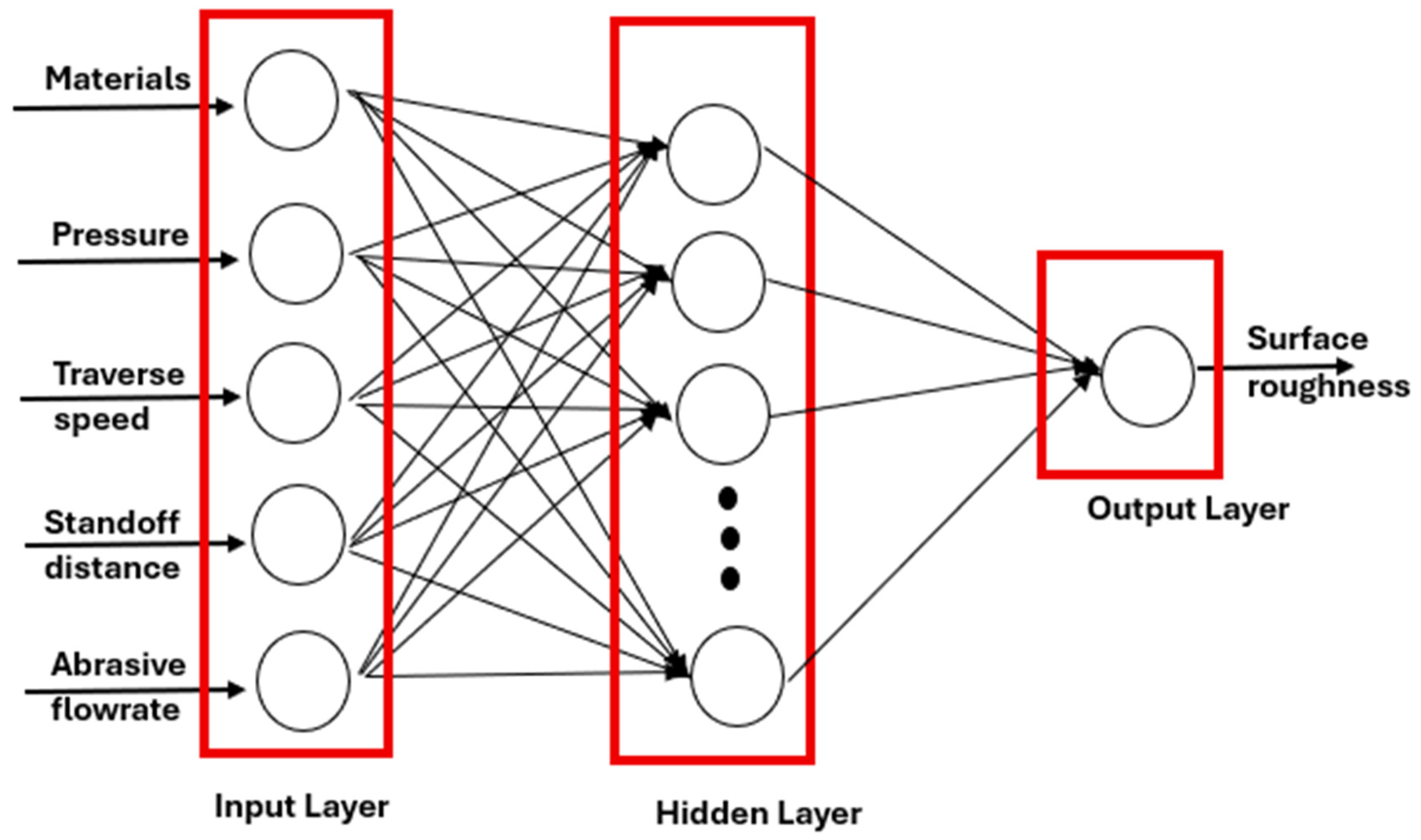
The use of “artificial intelligence and machine learning” is a current trend for identifying an optimal parameter combination in AWJM of composites and metal alloys. Studies have shown that a backpropagation artificial neural network (ANN) is a suitable model for faster computation and increased accuracy [114,115,116,117]. Figure 13 shows an ANN model for AWJM.
The backpropagation ANN with one hidden layer of 5-neurons was used to predict the surface roughness during the AWJM of a titanium alloy. The ANOVA study showed that the water jet pressure was the most important parameter, followed by the traverse speed. The standoff distance was found to be insignificant because of its small contribution to the surface roughness. The ANN machine learning (ML) model was reported to predict the surface roughness with minimal error compared to the support vector machine (SVM) ML and the regression analysis statistical method [118]. Two backpropagation ANN models with one hidden layer, one with water pressure and traverse speed as inputs, and the other with mass flow rate and standoff distance as inputs, were developed. The output for both models was the depth of cut [75]. Both models were able to predict the depth of cut with an accuracy of 90%. A hybrid machine learning model was developed using ANN for kerf quality optimisation of AWJM of hybrid stacks of Ti-6AL-4V alloy/CFRP/Al7075 [119]. The ANN has three inputs (jet pressure, traverse speed. and standoff distance), one hidden layer with 17 neurons, and an output layer with nine targets (kerf angle, surface roughness, and material removal rate for all three materials). The ANN model was able to effectively predict the non-linear relationship between the input parameters and the output parameters. The study’s objective was to reduce the kerf angle and surface roughness while increasing the material removal rate on the Ti-6Al-4V/CFRP/Al7075 stack, which showed that pressure made a significant contribution of 53.3%, followed by standoff distance (20.49%) and traverse speed (13.52%).
A 4-3-1 (four neurons as inputs, three neurons in a single hidden layer, and one output neuron) ANN model with an “artificial neural fuzzy logic algorithm” was created to study the effect of “water jet pressure, standoff distance, abrasive flow rate and traverse speed on the depth of cut” of the titanium metal matrix composite (TiMMC) [120]. The study concluded that a neuro-fuzzy method effectively eliminated the uncertainties in the empirical data and required minimal data for the parameter optimisation study. The method successfully predicted travel speed as the most significant parameter, with a 60.98% contribution, followed by water pressure. “The adaptive neuro-fuzzy inference system, or ANFIS”, which includes the learning ability of ANN and the fuzzy logic’s ability to deal with uncertainties and vagueness of data, was able to provide closer multi-parameter prediction in the AWJM of Ti-6Al-4V [121]. The ANOVA study in the work also reported that the water pressure was the most significant parameter, followed by the traverse speed. Similarly, Jitendra and Basha [122] used an adaptive neuro-fuzzy system to optimise the parameters of AWJM for cutting Ti-6Al-4V and reported that the ANFIS-reptile search algorithm integration (ANFIS-RSA) was able to improve the prediction accuracy for the surface roughness much better compared to the “ANFIS, ANFIS-PSO and ANFIS-BAS models”. The use of a backpropagation ANN to predict the six parameters for a depth of cut on Ti-6Al-4V, machined using AWJM, was studied in [123]. A 1-10-5 architecture was used, with 10 neurons at the hidden layer and five outputs: water jet pressure, traverse speed, nozzle diameter, abrasive flow rate, and orifice size. The ability of the neural network to accurately predict the process parameters for a given depth of cut was validated using the experiments generated using the Taguchi method. The study showed the ANN algorithm faced difficulty in predicting parameters for a depth of cut of 3 mm to 5 mm, but the prediction improved for higher depth of cuts. A hybrid “Taguchi–Gray Relational Analysis (GRA)” combined with ANN was used to process optimisation for the AWJM of Ti-6Al-V6, where the ANN served as a digital twin to accurately predict machining outcomes based on an experimental dataset generated using Taguchi and GRA [124]. The ANN significantly predicted the new parameter combination, which developed a higher Grey Relational Grade (GRG) than the parameters suggested by the Taguchi Method. This study demonstrated ANN’s generalisation and predictive efficiency, reducing the need for a large number of experiments. This study further revealed that SiC addition to garnet abrasives and abrasive flow rate is a significant factor in improving MRR and reducing surface roughness.

5. Discussions and Challenges

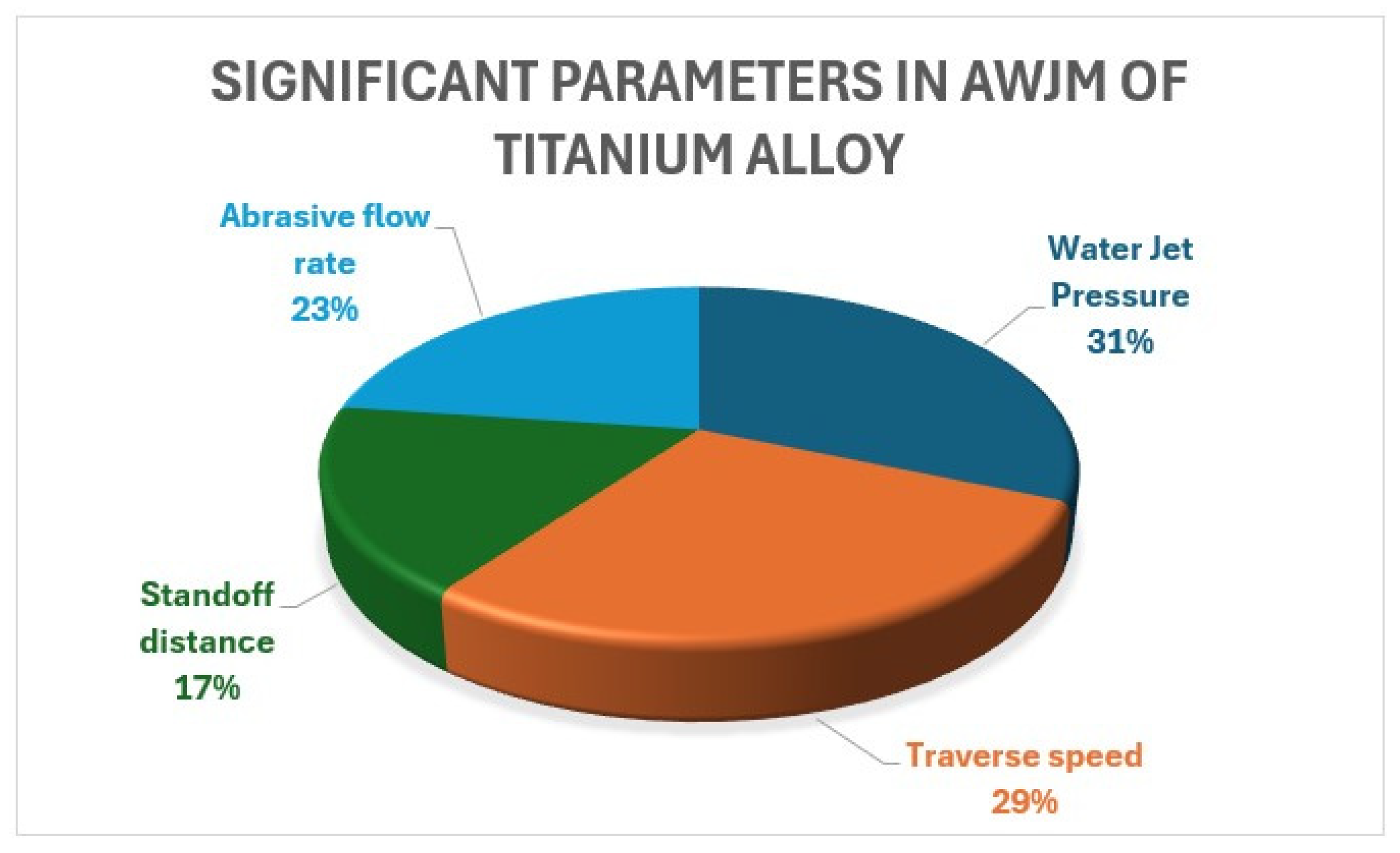
Based on the literature review presented above, the AWJM of titanium alloy, such as the Ti-6Al-4V, is governed by different parameters that have a close inter-relationship that affect the selection of other parameters. The optimisation of parameters in the AWJM of titanium alloys involves a crucial balance of key parameters, such as water jet pressure, traverse speed, standoff distance, and abrasive flow rate. The water jet pressure and nozzle traverse speed are the two parameters that have been widely reported in Section 3.1 and Section 3.2 as parameters with significant contributions to the AWJM of titanium alloy. These parameters played an important role in maximising the MRR, depth of cut, kerf angle accuracy, and surface hardness and minimising surface roughness in Ti-6Al-4V. The standoff distance and abrasive flow rate have also been reported to play a major role in achieving quality machined surfaces. Figure 14 gives the most significant parameters, based on the 35 process parameter optimisation studies reviewed in this paper. The majority of the reviewed works have reported water pressure, followed closely by traverse speed, as the most significant parameter governing the AWJM of titanium alloys.
According to Fuse et al. [81], the optimal values of AWJM of titanium alloys are as follows: water pressure of 234.94 MPa, a stand-off distance of 1.77 mm, an abrasive flow rate of 103.41 g/min, and a traversing speed of the nozzle of 91.54 mm/min.

5.1. Abrasive Embedment

One of the key problems of AWJM is that the abrasives or parts of the abrasives embed onto the machined surfaces [76,125]. This adulteration of the surfaces causes great complications in the course of additional treatments: for example, coating, welding or grinding [126]. Embedded particles also act as initiators of fatigue cracks and reduce the fatigue strength [127]. The embedded abrasives in the Ti-6Al-4V alloy can be divided into the following: (a) larger abrasives with sizes greater than 100 μm that are close to their original size, (b) abrasive particles of 25–100 μm that are commonly found across the surfaces, and (c) microscopic abrasives with particle sizes of below 25 μm [128]. Without having any heat-affected zone components produced by AWJM, the component still failed before the laser-machined component under fatigue loading because of the ease of fatigue crack initiation as a result of grit embedment. The same was reported in [129].
Kong et al. [125]’s work on machining titanium aluminide noted “bubble-like TiO2-based spots on the AWJ cut surfaces, which might be caused by a strong exothermic reaction”. Li et al. [130] reported that the titanium surface on the Ti6Al4V/CFRP hybrid stack showed wear tracks; these are likely the traces left by repeated impacts of abrasive particles, leading to the “micro-removal of material”. Fractured abrasive particles are embedded in the titanium; this indicates that not all abrasive material bounces off, as some of it becomes trapped, which can impact subsurface integrity and possibly affect strength or fatigue behaviour. Studies have reported that abrasive embodiments observed below the machined surfaces, and the number of residual abrasives and the depth of abrasives’ penetration, increased with the increase in grit size, water jet velocity, and impingement angle during AWJM [131,132]. Hence, abrasive embedment can be minimised, if not eliminated, with the proper selection of parameters. Other drawbacks of AWJM include frequent replacement of nozzles due to high wear-out of materials, failure of other components of the system due to the abrasive action of the abrasive particles and the bluntness of abrasive particles after repeated usage. However, there were no works observed in the parameter optimisation studies that identified parameter combinations that will reduce abrasive embedment in Ti-6Al-4V or improve the service life of the AWJM nozzles.

5.2. Hybrid AWJM Systems

A number of works that concentrated on hybrid AWJM systems have been reported recently. Huang et al. [133] considered the “hybrid waterjet cleaning (HWJC) process on Ti-6Al-4V,” where AWJM is firstly applied to remove material to a near-chosen depth, followed by WJM to remove the embedded abrasive particles and to reduce surface roughness. Though the HWJC process effectively reduced the abrasive embedment, its efficiency depends on the water jet machining (WJM)’s parameters as well as the embedment behaviour of the abrasives. The sub-surface grit elimination is not foreseen unless the plain water jet is adequately powerful to remove the material around the abrasive, and afterwards dislodge it. The lower traverse speed, which corresponds to higher energy densities, does not provide effective removal of embedded abrasives all the time. Plain WJM is more effective at grit removal when its travelling path is normal to that of AWJM compared to those in a similar path. An implanted particle might be partially submerged during AWJM, which may be partially removed by plain WJM, keeping the submerged portion on the surface because of mechanical interlocking. The fragments occupied the indentations, which make the surface flat and reduce the surface roughness. Nevertheless, if the jet impulse is powerful enough, it will remove the whole particle, leaving the empty crater, which increases the surface roughness. Therefore, a distinct effect of the HWJC process on the surface roughness is not predictable.
Patel and Tandon [134] introduced “thermally enhanced abrasive water jet machining (TEAWJM)”, where an oxy acetylene gas welding arrangement was used to heat and soften the workpiece locally just before machining. The MRR increased due to the combined effect of temperature and standoff distance, which increased the MRR due to the material being soft. The thermal effect also caused differences in surface morphology at the top and bottom surfaces, due to differences in the material removal phenomenon; at the bottom, “material is removed due to erosion and plastic deformation, while on the top, material removal is due to erosion by abrasive particles”. Experimentation showed that the MRR increased for TEAWJM compared to AWJM for Ti-6Al-4V, as more materials were removed at a constant pressure and machining time. TEAWJM was recommended as being suitable for Ti-6Al-4V in extreme pressure and temperature environments, as the microstructural properties remained undisturbed, even when machined at higher temperatures. In addition, no cracks and residual stresses were noticed, even when the material endures thermo-mechanical quenching.
Limited work has been reported on these hybrid AWJM processes, even though they have demonstrated promising outcomes to further improve the efficiency of the AWJM of Ti-6Al-4V alloy.

6. Future Trends

Titanium alloys are relatively expensive materials and are primarily used in aerospace and biomedical applications, due to their exceptional mechanical, corrosion-resistant, and biocompatible properties. Components for these applications must be defect-free and are therefore predominantly manufactured using conventional machining processes. Although “non-traditional machining methods such as AWJM” offer several advantages over conventional processes, such as lower machining forces, the ability to produce complex geometries, and reduced tooling costs, can unpredictably alter surface and subsurface properties if not properly controlled.
Despite significant research interest in the AWJM of titanium alloys, particularly Grade 5 titanium alloy (Ti-6Al-4V), several challenges remain unresolved. These challenges mainly arise from the strong interdependence of multiple process input parameters and the large number of output responses required to define successful machining outcomes. Furthermore, achieving high surface integrity remains a major concern due to the need to simultaneously control numerous parameters, as well as issues related to abrasive embedment and severe nozzle wear caused by continuous abrasive flow. Moreover, such particle embedment can cause wear [135,136] and corrosion wear [137] in certain applications. This review has identified several key areas that warrant further investigation to enhance the reliability of AWJM for machining titanium alloys:
(a) The application of “artificial intelligence (AI) and machine learning (ML)” in AWJM process optimisation has gained notable attention, with a significant number of studies being published in 2025. However, substantial research opportunities remain, particularly in exploring alternative ML models to ANN for real-time adaptive control. Such studies should focus on accurately predicting and optimising key machining responses, including MRR, surface roughness, kerf geometry, and subsurface damage.
(b) Very limited work has been reported on understanding the relationship between AWJM process parameters and the fatigue behaviour of titanium alloys. Future research should focus on a detailed analysis of subsurface deformation, micro-cracking, and residual stresses resulting from abrasive characteristics and embedment. In addition, parameter optimisation studies, using multi-objective optimisation techniques or AI-based approaches, are required to identify optimal process conditions that minimise abrasive embedment while enhancing the fatigue performance of titanium alloys.
(c) The review identified only a single study employing computational-based modelling of the AWJM process for Ti-6Al-4V. Future studies should therefore focus on developing robust numerical and computational models to analyse the influence of process parameters on jet behaviour, nozzle wear mechanisms, and resulting surface quality, thereby improving process predictability and control.
(d) The review identified only two hybrid-assisted AWJM processes. Further studies are required to develop a deeper understanding of the material removal mechanisms in hybrid-assisted AWJM and to systematically compare their performance with conventional AWJM, particularly for applications in critical industries such as aerospace and biomedical engineering.

7. Conclusions

Abrasive water jet machining (AWJM) is a non-traditional machining process that has gained considerable attention for machining titanium alloys, particularly Ti-6Al-4V, due to its ability to machine difficult-to-cut materials without inducing significant thermal damage. In AWJM, a high-velocity jet of water entrained with hard abrasive particles is employed to erode and cut the workpiece material. The process involves the conversion of pressure energy into kinetic energy, leading to material removal, primarily through plastic deformation and quasi-brittle fracture mechanisms.
AWJM is governed by a large number of process input parameters, which may be broadly classified into hydraulic parameters, nozzle parameters, abrasive parameters, and cutting parameters. These parameters collectively influence key output responses such as the material removal rate (MRR), surface roughness, kerf geometry, and subsurface integrity. An increase in water jet pressure results in higher jet kinetic energy, thereby enhancing the erosive capability of the jet and promoting material removal. The nozzle design is critical in accelerating and converging the water jet, while also facilitating efficient mixing of water and abrasive particles through the Venturi effect. The abrasive particles, possessing significantly higher hardness than the workpiece material, act as high-energy micro-cutting tools; their shape and velocity play a decisive role in the erosion and cutting mechanisms upon impact with the machined surface.
Cutting parameters, including nozzle traverse speed, standoff distance, and jet impingement angle, regulate the intensity and exposure time of the abrasive-laden jet on the workpiece surface. The water jet pressure and abrasive flow rate are generally reported to be directly proportional to the material removal rate, whereas the traverse speed and standoff distance exhibit an inverse relationship with the MRR. With respect to surface integrity, higher water jet pressure, increased traverse speed, elevated abrasive flow rate, and larger standoff distance have been shown to increase surface roughness.
Parameter optimisation studies employing experimental design methodologies and data-driven approaches, such as artificial neural networks, consistently identify water jet pressure and nozzle traverse speed as the most influential parameters governing surface quality in AWJM of titanium alloys. Despite the extensive body of literature on process parameter optimisation, limited attention has been paid to abrasive embedment on the machined surface and the development of hybrid AWJM techniques. Accordingly, this review highlights these research gaps and proposes potential future research directions to advance the understanding and industrial applicability of AWJM for titanium alloy machining.

Author Contributions

A.A.: Resource, Data curation, Writing, Writing—review and editing; A.P.: Conceptualization, Validation, Writing, Writing—review and editing; A.R.D.: Formal analysis, Validation, Data curation, Writing—review and editing, A.K.B.: Conceptualization, Writing, Writing—review and editing, Supervision. All authors have read and agreed to the published version of the manuscript.

Funding

This research received no external funding.

Data Availability Statement

The raw/processed data used to produce the results will be made available by the corresponding author upon reasonable request.

Conflicts of Interest

The authors declare that they have no known competing financial interest or personal relationship whatsoever that could have influenced the work reported in this paper.

References

  1. Pushp, P.; Dasharath, S.M.; Arati, C. Classification and applications of titanium and its alloys. Mater. Today Proc. 2022, 54, 537–542. [Google Scholar] [CrossRef]
  2. Arrazola, P.J.; Garay, A.; Iriarte, L.M.; Armendia, M.; Marya, S.; Le Maître, F. Machinability of titanium alloys (Ti6Al4V and Ti555.3). J. Mater. Process. Technol. 2009, 209, 2223–2230. [Google Scholar] [CrossRef]
  3. Biffi, C.A.; Lecis, N.; Previtali, B.; Vedani, M.; Vimercati, G.M. Fiber laser microdrilling of titanium and its effect on material microstructure. Int. J. Adv. Manuf. Technol. 2011, 54, 149–160. [Google Scholar] [CrossRef]
  4. Bammidi, R.; Sreeramulu, D.; Madivada, H.; Rejeti, P.K.; Venkatesh, M. Towards an understanding of Ti-6Al-4V machining and machinability. Mater. Today Proc. 2024, 115, 289–292. [Google Scholar] [CrossRef]
  5. Pramanik, A.; Littlefair, G. Developments in machining of stacked materials made of CFRP and titanium/aluminum alloys. Mach. Sci. Technol. 2014, 18, 485–508. [Google Scholar] [CrossRef]
  6. Pramanik, A. Developments in the non-traditional machining of particle reinforced metal matrix composites. Int. J. Mach. Tools Manuf. 2014, 86, 44–61. [Google Scholar] [CrossRef]
  7. Pramanik, A.; Neo, K.; Rahman, M.; Li, X.; Sawa, M.; Maeda, Y. Ultraprecision turning of electroless nickel: Effects of crystal orientation and origin of diamond tools. Int. J. Adv. Manuf. Technol. 2009, 43, 681. [Google Scholar] [CrossRef]
  8. Kim, D.-H.; Lee, C.-M. Experimental Investigation on Machinability of Titanium Alloy by Laser-Assisted End Milling. Metals 2021, 11, 1552. [Google Scholar] [CrossRef]
  9. Pramanik, A. Problems and solutions in machining of titanium alloys. Int. J. Adv. Manuf. Technol. 2014, 70, 919–928. [Google Scholar] [CrossRef]
  10. Pramanik, A.; Littlefair, G. Machining of titanium alloy (Ti-6Al-4V)—Theory to application. Mach. Sci. Technol. 2015, 19, 1–49. [Google Scholar] [CrossRef]
  11. Donachie, M.J. Titanium: A Technical Guide; ASM International: Materials Park, OH, USA, 2000. [Google Scholar]
  12. Pandey, A.K.; Dubey, A.K. Simultaneous optimization of multiple quality characteristics in laser cutting of titanium alloy sheet. Opt. Laser Technol. 2012, 44, 1858–1865. [Google Scholar] [CrossRef]
  13. Pal, V.K.; Tandon, P. Identification of the role of machinability and milling depth on machining time in controlled depth milling using abrasive water jet. Int. J. Adv. Manuf. Technol. 2013, 66, 877–881. [Google Scholar] [CrossRef]
  14. Kumar, J. Investigating the Machining Characteristics of Titanium Using Ultrasonic Machining; Thapar Institute of Engineering Technology: Patiala, India, 2009. [Google Scholar]
  15. Patil Amit, S.; Nashik, I.S.V.; More Yogesh, S.; Nathe Manik, S. Machining Challenges in Ti-6Al-4V.-A Review. Int. J. Innov. Eng. Technol. 2015, 5, 17. [Google Scholar]
  16. Mruthunjaya, M.; Yogesha, K.B. A review on conventional and thermal assisted machining of titanium based alloy. Mater. Today Proc. 2021, 46, 8466–8472. [Google Scholar] [CrossRef]
  17. Oke, S.R.; Ogunwande, G.S.; Onifade, M.; Aikulola, E.; Adewale, E.D.; Olawale, O.E.; Ayodele, B.E.; Mwema, F.; Obiko, J.; Bodunrin, M.O. An overview of conventional and non-conventional techniques for machining of titanium alloys. Manuf. Rev. 2020, 7, 34. [Google Scholar] [CrossRef]
  18. Nouari, M.; Makich, H. On the Physics of Machining Titanium Alloys: Interactions between Cutting Parameters, Microstructure and Tool Wear. Metals 2014, 4, 335–358. [Google Scholar] [CrossRef]
  19. Yuan, C.G.; Pramanik, A.; Basak, A.K.; Prakash, C.; Shankar, S. Drilling of titanium alloy (Ti6Al4V)—A review. Mach. Sci. Technol. 2021, 25, 637–702. [Google Scholar] [CrossRef]
  20. Basak, A.; Pramanik, A.; Prakash, C.; Shankar, S.; Debnath, S. Understanding the micro-mechanical behaviour of recast layer formed during WEDM of titanium alloy. Metals 2022, 12, 188. [Google Scholar] [CrossRef]
  21. Alshemary, A.; Pramanik, A.; Basak, A.; Littlefair, G. Accuracy of duplex stainless steel feature generated by electrical discharge machining (EDM). Measurement 2018, 130, 137–144. [Google Scholar] [CrossRef]
  22. Rajurkar, K.P.; Zhu, D.; McGeough, J.; Kozak, J.; De Silva, A. New developments in electro-chemical machining. CIRP Ann. 1999, 48, 567–579. [Google Scholar] [CrossRef]
  23. Pramanik, A.; Basak, A.K. Laser beam machining of titanium alloy—A review. Metals 2023, 13, 1536. [Google Scholar] [CrossRef]
  24. Mardi, K.B.; Dixit, A.; Pramanik, A.; Basak, A. Tribology in (abrasive) water jet machining: A review. Mach. Tribol. 2022, 113–125. [Google Scholar] [CrossRef]
  25. Natarajan, Y.; Murugesan, P.K.; Mohan, M.; Khan, S.A.L.A. Abrasive Water Jet Machining process: A state of art of review. J. Manuf. Process. 2020, 49, 271–322. [Google Scholar] [CrossRef]
  26. Pramanik, A.; Littlefair, G. Wire EDM mechanism of MMCs with the variation of reinforced particle size. Mater. Manuf. Process. 2016, 31, 1700–1708. [Google Scholar] [CrossRef]
  27. Mandal, A.; Dixit, A.R.; Chattopadhyaya, S.; Paramanik, A.; Hloch, S.; Królczyk, G. Improvement of surface integrity of Nimonic C 263 super alloy produced by WEDM through various post-processing techniques. Int. J. Adv. Manuf. Technol. 2017, 93, 433–443. [Google Scholar] [CrossRef]
  28. Wang, F.; Liu, Y.; Zhang, Y.; Tang, Z.; Ji, R.; Zheng, C. Compound machining of titanium alloy by super high speed EDM milling and arc machining. J. Mater. Process. Technol. 2014, 214, 531–538. [Google Scholar] [CrossRef]
  29. Chang, S.; Liu, W.; Tang, J.; Fan, M. Thermomechanical coupling mechanisms and surface integrity in the abrasive waterjet machining of Ti-5Al-5Mo-5V-1Fe-1Cr alloy. Mater. Today Commun. 2025, 46, 112770. [Google Scholar] [CrossRef]
  30. Hashish, M. Characteristics of surfaces machined with abrasive-waterjets. J. Eng. Mater. Technol. 1991, 113, 354–362. [Google Scholar] [CrossRef]
  31. Hashish, M. An investigation of milling with abrasive-waterjets. J. Eng. Ind. 1989, 111, 158–166. [Google Scholar] [CrossRef]
  32. Ozcan, Y.; Tunc Lutfi, T.; Kopacka, J.; Cetin, B.; Sulitka, M. Modelling and simulation of controlled depth abrasive water jet machining (AWJM) for roughing passes of free-form surfaces. Int. J. Adv. Manuf. Technol. 2021, 114, 3581–3596. [Google Scholar] [CrossRef]
  33. Momber, A.W.; Kovacevic, R. Principles of Abrasive Water Jet Machining; Springer Science & Business Media: Berlin/Heidelberg, Germany, 2012. [Google Scholar]
  34. Finnie, I. Erosion of surfaces by solid particles. Wear 1960, 3, 87–103. [Google Scholar] [CrossRef]
  35. Summers, D.A. Waterjetting Technology; CRC Press: Boca Raton, FL, USA, 2003. [Google Scholar]
  36. Guo, Z.; Ramulu, M. Investigation of displacement fields in an abrasive waterjet drilling process: Part 1. Experimental measurements. Exp. Mech. 2001, 41, 375–387. [Google Scholar] [CrossRef]
  37. Li, H.; Wang, J. An experimental study of abrasive waterjet machining of Ti-6Al-4V. Int. J. Adv. Manuf. Technol. 2015, 81, 361–369. [Google Scholar] [CrossRef]
  38. Basak, A.; Fan, J.; Wang, J.; Mathew, P. Material removal mechanisms of monocrystalline silicon under the impact of high velocity micro-particles. Wear 2010, 269, 269–277. [Google Scholar] [CrossRef]
  39. Wang, H.; Yuan, R.; Zhang, X.; Zai, P.; Deng, J. Research Progress in Abrasive Water Jet Processing Technology. Micromachines 2023, 14, 1526. [Google Scholar] [CrossRef]
  40. Wang, J.; Wong, W. A study of abrasive waterjet cutting of metallic coated sheet steels. Int. J. Mach. Tools Manuf. 1999, 39, 855–870. [Google Scholar] [CrossRef]
  41. Miao, X.; Wu, M. Modeling of cutting of stainless steel AISI 304 by abrasive water jet. Mater. Res. Express 2020, 7, 086507. [Google Scholar] [CrossRef]
  42. Hashish, M. Abrasive Waterjet Machining. Materials 2024, 17, 3273. [Google Scholar] [CrossRef]
  43. Hlaváč, L.M. Revised Model of Abrasive Water Jet Cutting for Industrial Use. Materials 2021, 14, 4032. [Google Scholar] [CrossRef]
  44. Kong, M.; Axinte, D.; Voice, W. Aspects of material removal mechanism in plain waterjet milling on gamma titanium aluminide. J. Mater. Process. Technol. 2010, 210, 573–584. [Google Scholar] [CrossRef]
  45. Hashish, M. Optimization factors in abrasive-waterjet machining. J. Eng. Ind. 1991, 113, 29–37. [Google Scholar] [CrossRef]
  46. Ramakrishnan, S. Investigating the effects of abrasive water jet machining parameters on surface integrity, chemical state in machining of Ti-6Al-4V. Mater. Today Commun. 2022, 31, 103480. [Google Scholar] [CrossRef]
  47. de la Rosa, S.; Rodríguez-Parada, L.; Ponce, M.B.; Mayuet Ares, P.F. The Abrasive Water Jet Cutting Process of Carbon-Fiber-Reinforced Polylactic Acid Samples Obtained by Additive Manufacturing: A Comparative Analysis. J. Compos. Sci. 2024, 8, 437. [Google Scholar] [CrossRef]
  48. Chaturvedi, C.; Kumar, H.; Nagdeve, L. Machining Efficiency and Property Change Analysis of Ti-6Al-4V Alloy Processed by Abrasive Water Jet Machining. J. Mater. Eng. Perform. 2024, 34, 8551–8561. [Google Scholar] [CrossRef]
  49. Ramakrishnan, S.; Singaravelu, D.L.; Senthilkumar, V.; Velmurugan, C. Experimental investigation on microstructural characterization of machined Ti-6Al-4V using abrasive water jet machining. Sadhana 2022, 47, 83. [Google Scholar] [CrossRef]
  50. Kanthababu, M.; Ram, R.; Emannuel, N.; Gokul, R.; Rammohan, R. Experimental investigations on pocket milling of titanium alloy using abrasive water jet machining. FME Trans. 2016, 44, 133–138. [Google Scholar] [CrossRef]
  51. Natarajan, Y.; Raj, K.L.N.; Tandon, P. Measurement and analysis of pocket milling features in abrasive water jet machining of Ti-6Al-4V alloy. Arch. Civ. Mech. Eng. 2023, 23, 42. [Google Scholar] [CrossRef]
  52. Liu, H. Precision machining of advanced materials with waterjets. IOP Conf. Ser. Mater. Sci. Eng. 2017, 164, 012008. [Google Scholar] [CrossRef]
  53. Wu, L.; Zou, X.; Guo, Y.; Fu, L. Parametric Structure Optimization Design of High-Pressure Abrasive Water Jet Nozzle Based on Computational Fluid Dynamics-Discrete Element Method (CFD-DEM). Lubricants 2025, 13, 91. [Google Scholar] [CrossRef]
  54. Llanto, J.M.; Vafadar, A.; Aamir, M.; Tolouei-Rad, M. Analysis and Optimization of Process Parameters in Abrasive Waterjet Contour Cutting of AISI 304L. Metals 2021, 11, 1362. [Google Scholar] [CrossRef]
  55. Pătîrnac, I.; Ripeanu, R.G.; Popescu, C.; Tănase, M. Analysis of Water Flow through the Active Parts of an Abrasive Water Jet Machine: A Combined Analytical and CFD Approach. Processes 2024, 12, 1551. [Google Scholar] [CrossRef]
  56. Pătîrnac, I.; Ripeanu, R.G.; Tănase, M. Computational Fluid Dynamics Analysis of Erosion in Active Components of Abrasive Water Jet Machine. Processes 2024, 12, 1860. [Google Scholar] [CrossRef]
  57. Fowler, G.; Pashby, I.; Shipway, P. The effect of particle hardness and shape when abrasive water jet milling titanium alloy Ti6Al4V. Wear 2009, 266, 613–620. [Google Scholar] [CrossRef]
  58. Boud, F.; Carpenter, C.; Folkes, J.; Shipway, P. Abrasive waterjet cutting of a titanium alloy: The influence of abrasive morphology and mechanical properties on workpiece grit embedment and cut quality. J. Mater. Process. Technol. 2010, 210, 2197–2205. [Google Scholar] [CrossRef]
  59. Karkalos, N.E.; Dekster, L.; Kudelski, R.; Karmiris-Obratański, P. A Statistical and Optimization Study on the Influence of Different Abrasive Types on Kerf Quality and Productivity during Abrasive Waterjet (AWJ) Milling of Ti-4Al-6V. Materials 2023, 17, 11. [Google Scholar] [CrossRef] [PubMed]
  60. Mort, G.A. Results of abrasive water jet market survey. In Proceedings of the of 8th American Water Jet Conference, Houston, TX, USA, 26–29 August 1995. [Google Scholar]
  61. Babu, M.K.; Chetty, O.K. Studies on recharging of abrasives in abrasive water jet machining. Int. J. Adv. Manuf. Technol. 2002, 19, 697–703. [Google Scholar] [CrossRef]
  62. Fowler, G.; Shipway, P.; Pashby, I. A technical note on grit embedment following abrasive water-jet milling of a titanium alloy. J. Mater. Process. Technol. 2005, 159, 356–368. [Google Scholar] [CrossRef]
  63. Hascalik, A.; Çaydaş, U.; Gürün, H. Effect of traverse speed on abrasive waterjet machining of Ti–6Al–4V alloy. Mater. Des. 2007, 28, 1953–1957. [Google Scholar] [CrossRef]
  64. Karkalos, N.E.; Karmiris-Obratański, P. Determination of the Feasibility of Using Eco-Friendly Walnut Shell Abrasive Particles for Pocket Milling of Titanium Workpieces by Abrasive Waterjet Technology. Metals 2023, 13, 1645. [Google Scholar] [CrossRef]
  65. Muzammil, S.B.; Endale, A.E.; Gasha, S.B. Studies on machining characteristics of titanium alloy Ti-6Al-4V using abrasive water jet cutting. J. Eng. Res. Appl. 2018, 8, 7. [Google Scholar]
  66. Perec, A. Experimental research into alternative abrasive material for the abrasive water-jet cutting of titanium. Int. J. Adv. Manuf. Technol. 2018, 97, 1529–1540. [Google Scholar] [CrossRef]
  67. Fengchao, W.; Kaining, Y.; Nanzhe, X.; Liucan, L.; Chuwen, G. Quantitative analysis on the surface topography of Ti-6Al-4V machined by abrasive suspension jet. Int. J. Adv. Manuf. Technol. 2021, 112, 323–332. [Google Scholar] [CrossRef]
  68. Umanath, K.; Devika, D.; Begum, R.S. Experimental Investigation of Role of Particles Size and Cutting Passes in Abrasive Waterjet Machining Process on Titanium Alloy (Ti–6Al–4V) using Taguchi’s Method. Mater. Manuf. Process. 2021, 36, 936–949. [Google Scholar] [CrossRef]
  69. Sami Abushanab, W.; Moustafa, E.B.; Harish, M.; Shanmugan, S.; Elsheikh, A.H. Experimental investigation on surface characteristics of Ti6Al4V alloy during abrasive water jet machining process. Alex. Eng. J. 2022, 61, 7529–7539. [Google Scholar] [CrossRef]
  70. Kumar, N.; Shukla, M. Finite element analysis of multi-particle impact on erosion in abrasive water jet machining of titanium alloy. J. Comput. Appl. Math. 2012, 236, 4600–4610. [Google Scholar] [CrossRef]
  71. Shipway, P.; Fowler, G.; Pashby, I. Characteristics of the surface of a titanium alloy following milling with abrasive waterjets. Wear 2005, 258, 123–132. [Google Scholar] [CrossRef]
  72. Sharma, V.S.; Kumar, A.; Gupta, M.K.; Bhanot, N. Process Parameter Optimization for Abrasive Water Jet Machining of Titanium Alloy Using Meta-Heuristic Algorithms; EDP Sciences: Les Ulis, France.
  73. Gnanavelbabu, A.; Saravanan, P.; Rajkumar, K.; Karthikeyan, S. Experimental Investigations on Multiple Responses in Abrasive Waterjet Machining of Ti-6Al-4V Alloy. Mater. Today Proc. 2018, 5, 13413–13421. [Google Scholar] [CrossRef]
  74. Fuse, K.; Chaudhari, R.; Vora, J.; Patel, V.K.; de Lacalle, L.N.L. Multi-Response Optimization of Abrasive Waterjet Machining of Ti6Al4V Using Integrated Approach of Utilized Heat Transfer Search Algorithm and RSM. Materials 2021, 14, 7746. [Google Scholar] [CrossRef]
  75. Chithirai Pon Selvan, M.; Midhunchakkaravarthy, D.; Senanayake, R.; Ramaswamy Pillai, S.; Reddy Madara, S. A mathematical modelling of Abrasive Waterjet Machining on Ti-6Al-4V using Artificial Neural Network. Mater. Today Proc. 2020, 28, 538–544. [Google Scholar] [CrossRef]
  76. Seo, Y.; Ramulu, M.; Kim, D. Machinability of titanium alloy (Ti’6Al’4V) by abrasive waterjets. Proc. Inst. Mech. Eng. Part B J. Eng. Manuf. 2003, 217, 1709–1721. [Google Scholar] [CrossRef]
  77. Wang, J. Abrasive waterjet machining of polymer matrix composites–cutting performance, erosive process and predictive models. Int. J. Adv. Manuf. Technol. 1999, 15, 757–768. [Google Scholar] [CrossRef]
  78. Hlaváč, L.M.; Gembalová, L.; Štěpán, P.; Hlaváčová, I.M. Improvement of abrasive water jet machining accuracy for titanium and TiNb alloy. Int. J. Adv. Manuf. Technol. 2015, 80, 1733–1740. [Google Scholar] [CrossRef]
  79. Arola, D.; Ramulu, M. Material removal in abrasive waterjet machining of metals surface integrity and texture. Wear 1997, 210, 50–58. [Google Scholar] [CrossRef]
  80. Ruiz-Garcia, R.; Mayuet Ares, P.F.; Vazquez-Martinez, J.M.; Salguero Gómez, J. Influence of abrasive waterjet parameters on the cutting and drilling of CFRP/UNS A97075 and UNS A97075/CFRP stacks. Materials 2018, 12, 107. [Google Scholar] [CrossRef] [PubMed]
  81. Fuse, K.; Vora, J.; Wakchaure, K.; Patel, V.K.; Chaudhari, R.; Saxena, K.K.; Bandhu, D.; Ramacharyulu, D.A. Abrasive waterjet machining of titanium alloy using an integrated approach of taguchi-based passing vehicle search algorithm. Int. J. Interact. Des. Manuf. 2025, 19, 2249–2263. [Google Scholar] [CrossRef]
  82. Dubey, A.K.; Kumar, Y.; Kumar, S.; Raja, A.R. Parametric Optimization of AWJM Using RSM-Grey-TLBO-Based MCDM Approach for Titanium Grade 5 Alloy. Arab. J. Sci. Eng. 2025, 50, 13693–13711. [Google Scholar] [CrossRef]
  83. Ramakrishnan, S.; Senthilkumar, V.; Lenin Singaravelu, D. Effect of cutting parameters on surface integrity characteristics of Ti-6Al-4V in abrasive water jet machining process. Mater. Res. Express 2019, 6, 116583. [Google Scholar] [CrossRef]
  84. Sultan, T.; Gilles, P.; Cohen, G.; Cenac, F.; Rubio, W. Modeling incision profile in AWJM of Titanium alloys Ti6Al4V. Mech. Ind. 2016, 17, 403. [Google Scholar] [CrossRef]
  85. Karkalos, N.E.; Karmiris-Obratański, P. A Comparative Study of Efficient Modeling Approaches for Performing Controlled-Depth Abrasive Waterjet Pocket Milling. Machines 2024, 12, 168. [Google Scholar] [CrossRef]
  86. Xiong, J.; Wan, L.; Qian, Y.n.; Sun, S.; Li, D.; Wu, S. A new strategy for improving the surface quality of Ti6Al4V machined by abrasive water jet: Reverse cutting with variable standoff distances. Int. J. Adv. Manuf. Technol. 2022, 120, 5339–5350. [Google Scholar] [CrossRef]
  87. Van Hung, B.; Gilles, P.; Cohen, G.; Rubio, W. Develop Model for Controlled Depth Milling by Abrasive Water Jet of Ti6Al4V at Jet Inclination Angle. In International Joint Conference on Mechanics, Design Engineering & Advanced Manufacturing; Springer: Cham, Switzerland, 2021; pp. 21–27. [Google Scholar]
  88. Dekster, L.; Karkalos, N.E.; Karmiris-Obratański, P.; Markopoulos, A.P. Evaluation of the Machinability of Ti-6Al-4V Titanium Alloy by AWJM Using a Multipass Strategy. Appl. Sci. 2023, 13, 3774. [Google Scholar] [CrossRef]
  89. Pan, H.; Chen, X.; Chen, L.; You, H.; Liang, X. Surface Topography Analysis of BK7 with Different Roughness Nozzles Using an Abrasive Water Jet. Materials 2024, 17, 4494. [Google Scholar] [CrossRef] [PubMed]
  90. Vasanth, S.; Muthuramalingam, T.; Vinothkumar, P.; Geethapriyan, T.; Murali, G. Performance Analysis of Process Parameters on Machining Titanium (Ti-6Al-4V) Alloy Using Abrasive Water Jet Machining Process. Procedia CIRP 2016, 46, 139–142. [Google Scholar] [CrossRef]
  91. Hloch, S.; Valíček, J. Prediction of distribution relationship of titanium surface topography created by abrasive waterjet. Int. J. Surf. Sci. Eng. 2011, 5, 152–168. [Google Scholar] [CrossRef]
  92. Monková, K.; Monka, P.; Vegnerová, P.; Čep, R.; Müllerová, J.; Bražina, D.; Duspara, M. Factor analysis of the abrasive waterjet factors affecting the surface roughness of titanium. Teh. Vjesn. 2011, 18, 73–77. [Google Scholar]
  93. Chen, F.L.; Wang, J.; Lemma, E.; Siores, E. Striation formation mechanisms on the jet cutting surface. J. Mater. Process. Technol. 2003, 141, 213–218. [Google Scholar] [CrossRef]
  94. Lenin Raj, S.; Rajadurai, A. Experimental study on deep-hole making in Ti-6Al-4V by abrasive water jet machining. Mater. Res. Express 2019, 6, 66532. [Google Scholar] [CrossRef]
  95. Chaturvedi, C.; Rao, P.S.; Khan, M.Y. Optimization of process variable in abrasive water jet Machining (AWJM) of Ti-6Al-4V alloy using Taguchi methodology. Mater. Today Proc. 2021, 47, 6120–6127. [Google Scholar] [CrossRef]
  96. Ahmed, T.M.; El Mesalamy, A.S.; Youssef, A.; El Midany, T.T. Improving surface roughness of abrasive waterjet cutting process by using statistical modeling. CIRP J. Manuf. Sci. Technol. 2018, 22, 30–36. [Google Scholar] [CrossRef]
  97. Soori, M.; Arezoo, B. Minimization of surface roughness and residual stress in abrasive water jet cutting of titanium alloy Ti6Al4V. Proc. Inst. Mech. Eng. Part E J. Process Mech. Eng. 2024, 238, 1613–1625. [Google Scholar] [CrossRef]
  98. Thirumalai Kumaran, S.; Uthayakumar, M.; Mathiyazhagan, P.; Krishna Kumar, K.; Muthu Kumar, P. Effect of abrasive grain size of the AWJM performance on AA (6351)-SiC-B4C hybrid composite. Appl. Mech. Mater. 2015, 766, 324–329. [Google Scholar] [CrossRef]
  99. Mohamad, W.; Kasim, M.; Norazlina, M.; Hafiz, M.; Izamshah, R.; Mohamed, S. Effect of standoff distance on the kerf characteristic during abrasive water jet machining. Results Eng. 2020, 6, 100101. [Google Scholar] [CrossRef]
  100. Ramulu, M.; Arola, D. Water jet and abrasive water jet cutting of unidirectional graphite/epoxy composite. Composites 1993, 24, 299–308. [Google Scholar] [CrossRef]
  101. Nagendra Prasad, K.; John Basha, D.; Varaprasad, K.C. Experimental Investigation and Analysis of Process Parameters in Abrasive Jet Machining of Ti-6Al-4V alloy using Taguchi Method. Mater. Today Proc. 2017, 4, 10894–10903. [Google Scholar] [CrossRef]
  102. Muthuramalingam, T.; Vasanth, S.; Vinothkumar, P.; Geethapriyan, T.; Rabik, M.M. Multi Criteria Decision Making of Abrasive Flow Oriented Process Parameters in Abrasive Water Jet Machining Using Taguchi–DEAR Methodology. Silicon 2018, 10, 2015–2021. [Google Scholar] [CrossRef]
  103. Mogul, Y.I.; Nasir, I.; Myler, P. Investigation and optimization for depth of cut and surface roughness for control depth milling in Titanium Ti6AL4V with abrasive water jet cutting. Mater. Today Proc. 2020, 28, 604–610. [Google Scholar] [CrossRef]
  104. Karkalos, N.E.; Karmiris-Obratański, P.; Kudelski, R.; Markopoulos, A.P. Experimental Study on the Sustainability Assessment of AWJ Machining of Ti-6Al-4V Using Glass Beads Abrasive Particles. Sustainability 2021, 13, 8917. [Google Scholar] [CrossRef]
  105. K, S.; J., F.X.; M.P, S.; Maridurai, T.; Suyamburajan, V.; Jayaseelan, V. Optimization of SiC Abrasive Parameters on Machining of Ti-6Al-4V Alloy in AJM Using Taguchi-Grey Relational Method. Silicon 2022, 14, 997–1004. [Google Scholar] [CrossRef]
  106. Perumal, A.; Kailasanathan, C.; Wilson, V.H.; Sampath Kumar, T.; Stalin, B.; Rajkumar, P.R. Machinability of Titanium alloy 6242 by AWJM through Taguchi method. Mater. Today Proc. 2023, 81, 606–611. [Google Scholar] [CrossRef]
  107. Wan, L.; Liu, J.; Qian, Y.n.; Wang, X.; Wu, S.; Du, H.; Li, D. Analytical modeling and multi-objective optimization algorithm for abrasive waterjet milling Ti6Al4V. Int. J. Adv. Manuf. Technol. 2022, 123, 4367–4384. [Google Scholar] [CrossRef]
  108. Radomska-Zalas, A. Experimental Research on the Use of a Selected Multi-Criteria Method for the Cutting of Titanium Alloy with an Abrasive Water Jet. Materials 2023, 16, 5405. [Google Scholar] [CrossRef]
  109. Tomy, A.; Hiremath, S.S. An experimental investigation and multi-objective optimization of abrasive jet machining on Ti-6Al-4V ELI bio-material. J. Micromanuf. 2023, 6, 50–59. [Google Scholar] [CrossRef]
  110. Yuan, Y.; Chen, J.; Gao, H.; Wang, X. An investigation into the abrasive waterjet milling circular pocket on titanium alloy. Int. J. Adv. Manuf. Technol. 2020, 107, 4503–4515. [Google Scholar] [CrossRef]
  111. Dubey, A.K.; Kumar, Y.; Kumar, S. Optimizing Parameters of AWJM for Ti-6Al-4 V Grade 5 Alloy Using Grey Entropy Weight Method: A Multivariable Approach. J. Inst. Eng. India Ser. C 2025, 106, 181–195. [Google Scholar] [CrossRef]
  112. Kumar, R.; Krishna, M.G.; Billu, E.; Reddy, D.A.K.; Ram, S. Optimization of surface roughness in machining of titanium composite using taguchi method. Interactions 2025, 246, 33. [Google Scholar] [CrossRef]
  113. Naresh Raj, K.L.; Jayavelu, S.; Kumar, M.S.; Kumar, A.; Swarna, B. Multi-criteria decision analysis approach on parametric optimization of abrasive waterjet pocket milling in Ti-6Al-4V alloy. Sci. Rep. 2025, 15, 42719. [Google Scholar] [CrossRef]
  114. Popan, I.A.; Bocăneț, V.I.; Softic, S.; Popan, A.I.; Panc, N.; Balc, N. Artificial Intelligence Model Used for Optimizing Abrasive Water Jet Machining Parameters to Minimize Delamination in Carbon Fiber-Reinforced Polymer. Appl. Sci. 2024, 14, 8512. [Google Scholar] [CrossRef]
  115. Periyappillai, G.; Subbarayan, S.; Sengottaiyan, S. Advanced ensemble machine learning prediction to enhance the accuracy of abrasive waterjet machining for biocomposites. Mater. Chem. Phys. 2025, 333, 130175. [Google Scholar] [CrossRef]
  116. Ficko, M.; Begic-Hajdarevic, D.; Cohodar Husic, M.; Berus, L.; Cekic, A.; Klancnik, S. Prediction of Surface Roughness of an Abrasive Water Jet Cut Using an Artificial Neural Network. Materials 2021, 14, 3108. [Google Scholar] [CrossRef]
  117. Doreswamy, D.; Bhat, S.K.; Hiremath, P.; Shreyas, D.S.; Bongale, A. ANN-based predictive modelling of the effect of abrasive water-jet parameters on the surface roughness of AZ31 Mg alloy. Manuf. Rev. 2024, 11, 21. [Google Scholar]
  118. Ting, H.Y.; Asmelash, M.; Azhari, A.; Alemu, T.; Saptaji, K. Prediction of surface roughness of titanium alloy in abrasive waterjet machining process. Int. J. Interact. Des. Manuf. 2022, 16, 281–289. [Google Scholar] [CrossRef]
  119. Abouhawa, M.; Elshinawi, A.; Eisa, A.; Fattouh, M. A hybrid machine learning approach to optimize kerf quality in AWJM of Ti-6Al-4V/CFRP/Al7075 stacks. Int. J. Interact. Des. Manuf. 2025, 19, 7413–7435. [Google Scholar] [CrossRef]
  120. Kumar, T.S.K.; Kaviti, A.K. An advanced study on the application of artificial neural networks in the abrasive waterjet machining of titanium nanocomposites. Int. J. Interact. Des. Manuf. 2025, 19, 4463–4470. [Google Scholar] [CrossRef]
  121. Thakur, P.; Khemchandani, M.; Deshmukh, M. Statistical and Artificial Intelligence-Based Modeling of Multi-Parameter Evaluation Index (MPEI) in Abrasive Waterjet Cutting Process. Arab. J. Sci. Eng. 2025, 50, 18799–18814. [Google Scholar] [CrossRef]
  122. Jithendra, T.; Basha, S.S. A forecasting model for optimizing abrasive water jet machining (AWJM) parameters based on the adaptive neuro-fuzzy inference system and meta-heuristic algorithms. Proc. Inst. Mech. Eng. Part E J. Process Mech. Eng. 2025, 239, 3197–3210. [Google Scholar] [CrossRef]
  123. Mogul, Y.I.; Mogul, I.; Quadros, J.D.; Mohin, M.; Aabid, A.; Baig, M.; Malik, M.A. Prediction of cutting depth in abrasive water jet machining of Ti-6AL-4V alloy using back propagation neural networks. Results Eng. 2025, 25, 104520. [Google Scholar] [CrossRef]
  124. Parthasarathi, S.; Induja, I.; Anila, S.; Nisha, D.; Prija, V.; Hansen, R. Optimization of Machining Parameters for Ti-6Al-4V Nano-alloy in Abrasive Jet Machining Using Taguchi-Grey Relational Analysis with ANN. J. Environ. Nanotechnol. 2025, 14, 477–485. [Google Scholar] [CrossRef]
  125. Kong, M.; Axinte, D. Response of titanium aluminide alloy to abrasive waterjet cutting: Geometrical accuracy and surface integrity issues versus process parameters. Proc. Inst. Mech. Eng. Part B J. Eng. Manuf. 2009, 223, 19–42. [Google Scholar] [CrossRef]
  126. Chen, F.L.; Siores, E.; Patel, K.; Momber, A. Minimising particle contamination at abrasive waterjet machined surfaces by a nozzle oscillation technique. Int. J. Mach. Tools Manuf. 2002, 42, 1385–1390. [Google Scholar] [CrossRef]
  127. Singh, J.; Jain, S.C. Mechanical issues in laser and abrasive water jet cutting. JOM 1995, 47, 28–30. [Google Scholar] [CrossRef]
  128. Sourd, X.; Zitoune, R.; Hejjaji, A.; Salem, M.; Hor, A.; Lamouche, D. Plain water jet cleaning of titanium alloy after abrasive water jet milling: Surface contamination and quality analysis in the context of maintenance. Wear 2021, 477, 203833. [Google Scholar] [CrossRef]
  129. Fordham, J.; Pilkington, R.; Tang, C. The effect of different profiling techniques on the fatigue performance of metallic membranes of AISI 301 and Inconel 718. Int. J. Fatigue 1997, 6, 487–501. [Google Scholar]
  130. Li, M.; Huang, M.; Chen, Y.; Kai, W.; Yang, X. Experimental study on hole characteristics and surface integrity following abrasive waterjet drilling of Ti6Al4V/CFRP hybrid stacks. Int. J. Adv. Manuf. Technol. 2019, 104, 4779–4789. [Google Scholar] [CrossRef]
  131. Maruyama, T.; Akagi, K.; Kobayashi, T. Effects of blasting parameters on removability of residual grit. J. Therm. Spray Technol. 2006, 15, 817–821. [Google Scholar] [CrossRef]
  132. Arola, D.; Hall, C.L. Parametric Effects on Particle Deposition in Abrasive Waterjet Surface Treatments. Mach. Sci. Technol. 2004, 8, 171–192. [Google Scholar] [CrossRef]
  133. Huang, L.; Kinnell, P.; Shipway, P. Parametric effects on grit embedment and surface morphology in an innovative hybrid waterjet cleaning process for alpha case removal from titanium alloys. Procedia CIRP 2013, 6, 594–599. [Google Scholar] [CrossRef]
  134. Patel, D.; Tandon, P. Experimental investigations of thermally enhanced abrasive water jet machining of hard-to-machine metals. CIRP J. Manuf. Sci. Technol. 2015, 10, 92–101. [Google Scholar] [CrossRef]
  135. Basak, A.K.; Celis, J.-P.; Vardavoulias, M.; Matteazzi, P. Effect of nanostructuring and Al alloying on friction and wear behaviour of thermal sprayed WC–Co coatings. Surf. Coat. Technol. 2012, 206, 3508–3516. [Google Scholar] [CrossRef]
  136. Basak, A.; Celis, J.-P.; Vardavoulias, M.; Matteazzi, P. Abrasive wear of nanostructured cermet coatings in dry and slurry conditions. Int. J. Refract. Met. Hard Mater. 2021, 100, 105638. [Google Scholar] [CrossRef]
  137. Basak, A.; Matteazzi, P.; Vardavoulias, M.; Celis, J.-P. Corrosion–wear behaviour of thermal sprayed nanostructured FeCu/WC–Co coatings. Wear 2006, 261, 1042–1050. [Google Scholar] [CrossRef]
Figure 1. Machinability index of different materials. The figure was drawn based on the information from the literature [14].
Designs 10 00013 g001
Figure 2. A simplified schematic of the process.
Designs 10 00013 g002
Figure 3. Material removal mechanism in (a) brittle material and (b) ductile material [39].
Designs 10 00013 g003
Figure 4. Schematic of the trail back formation during AWJM.
Designs 10 00013 g004
Figure 5. Average angles from left to right: (a) high strength steel, (b) tool steel, (c) stainless steel and (d) Hardox 500 [43].
Designs 10 00013 g005
Figure 6. AWJM input and output parameters.
Designs 10 00013 g006
Figure 7. AWJM nozzle components [54].
Designs 10 00013 g007
Figure 8. Different water jet flow at 350 MPa pressure [42].
Designs 10 00013 g008
Figure 9. The preferred abrasive shape for AWJM (highlighted in yellow) [42].
Designs 10 00013 g009
Figure 10. Influence of particle hardness on the roughness of generated surfaces for (a) different abrasives and (b) at different traverse speeds (m/s). The graphs were drawn based on information in ref. [57].
Designs 10 00013 g010
Figure 11. Effect of different abrasive particle grit size on (a) surface roughness and (b) surface waviness. The graphs were drawn based on information in ref. [71].
Designs 10 00013 g011
Figure 12. Different surface roughness zones after AWJM: IDR, SCR, and RCR [80].
Designs 10 00013 g012
Figure 13. ANN model for AWJM.
Designs 10 00013 g013
Figure 14. Significant parameters in AWJM of titanium alloys based on 35 literature reviews.
Designs 10 00013 g014
Table 1. Common properties of Ti-6Al-4V alloy, adapted from [4].
PropertiesValues
Knoop hardness362 HRC
Hardness349 HV
Ultimate tensile strength0.95 GPa
Elastic modulus112 GPa
Density4.4 g/cc
Poisson’s ratio0.35
Elongation14%
Table 2. Characteristics of the common abrasive [42].
AbrasiveSpecific GravityHardnessRough Relative CostRoundnessSphericityFrangibility Level (*)
Knoop Moh
Garnet3.4–4.313507.510.450.78medium
Aluminium oxide3.95–4.0210094–60.350.78medium
Silicon carbide3.225009.23–40.310.75medium
Chilled iron752064–50.50.8medium
Steel grit750055–70.520.82low
Steel shot746054–60.890.93low
Copper slag2.8–3.8105070.50.50.78high
Silica sand2.2–2.6570070.50.570.79high
Olivine3.2–4.511006.50.75–10.60.82high
Staurolite3.7–3.812757.50.6–0.70.460.79medium
Glass beads2.57005.51.5–20.950.95high
Tungsten carbide14.921870 7–100.470.77low
(*) Author’s estimate depends on grit size and target material.
Table 3. Parameter optimisation study for Titanium alloys.
ReferenceTechniqueSignificant Parameter and Percentage
[72]Taguchi methodTraverse speed—54.53% significant for surface roughness and 84.32% significant for MRR.
[50]Taguchi methodTraverse speed—90% significant for depth of cut.
[90]Taguchi method“Abrasive flow rate and standoff distance most significant for surface roughness”.
[101]Taguchi methodNozzle diameter is most significant for MRR. Standoff distance is the most significant for kerf accuracy.
[96]Response surface method“Traverse speed and water pressure” are significant (as a single factor) for surface roughness.
[73]Response surface method“Water jet pressure and traverse speed are significant for kerf geometry and surface roughness. Water jet pressure, traverse speed and abrasive flow rate are significant for the material removal rate”.
[102]Taguchi–DEAR methodStandoff distance the most significant for MRR and surface roughness.
[66]Response surface method“Traverse speed is the most significant for the depth of cut”.
[65]Multivariate regression model“Water jet pressure and mass flow rate are the most significant for the depth of cut”.
[103]Grey relational analysis + Taguchi method“Traverse speed is the most significant for depth of cut followed by abrasive flow rate. Water pressure is the most significant for surface roughness, followed by traverse speed”.
[110]Box–Behnken design method + response surface method“Traverse speed is the most significant for milling depth and surface roughness followed by water pressure. The combined effect of abrasive flow rate and standoff distance is significant for surface roughness”.
[95]Taguchi methodWater jet pressure is the most significant for machining duration, surface roughness, and surface hardness.
[68]Taguchi methodAbrasive flow rate is the most significant for depth of cut, with 61.53%, and material removal rate with 61.82%.
[48]Taguchi methodWater pressure provides the highest contribution to machining time (61.47%) and surface roughness (57.17%), while the abrasive flow rate has the highest significance for surface hardness (73.7%).
[111]Grey entropy weigh method“Standoff distance is the most significant followed by abrasive flow rate for material flow rate, surface roughness and kerf angle”.
[112]Taguchi method“Water pressure is the most significant (92%) for surface roughness”.
[113]Multi-criteria decision-making (MCDM)“Water jet pressure is the most significant for depth of cut, surface roughness and material removal rate followed by traverse speed”.
Disclaimer/Publisher’s Note: The statements, opinions and data contained in all publications are solely those of the individual author(s) and contributor(s) and not of MDPI and/or the editor(s). MDPI and/or the editor(s) disclaim responsibility for any injury to people or property resulting from any ideas, methods, instructions or products referred to in the content.