Communication

Do Grading Gray Stimuli Help to Encode Letter Position?


1
Departamento de Metodología and ERI-Lectura, Universitat de València, 46010 Valencia, Spain
2
Centro de Ciencia Cognitiva, Universidad Antonio de Nebrija, 28015 Madrid, Spain
3
Departamento de Didáctica de la Lengua y la Literatura, Universitat de València, 46022 Valencia, Spain
4
Department of Psychology, Palm Desert Campus, California State University, San Bernardino, CA 92407, USA
*
Author to whom correspondence should be addressed.
Vision 2021, 5(1), 12; https://doi.org/10.3390/vision5010012

Submission received: 27 December 2020 / Revised: 4 February 2021 / Accepted: 1 March 2021 / Published: 4 March 2021

Abstract

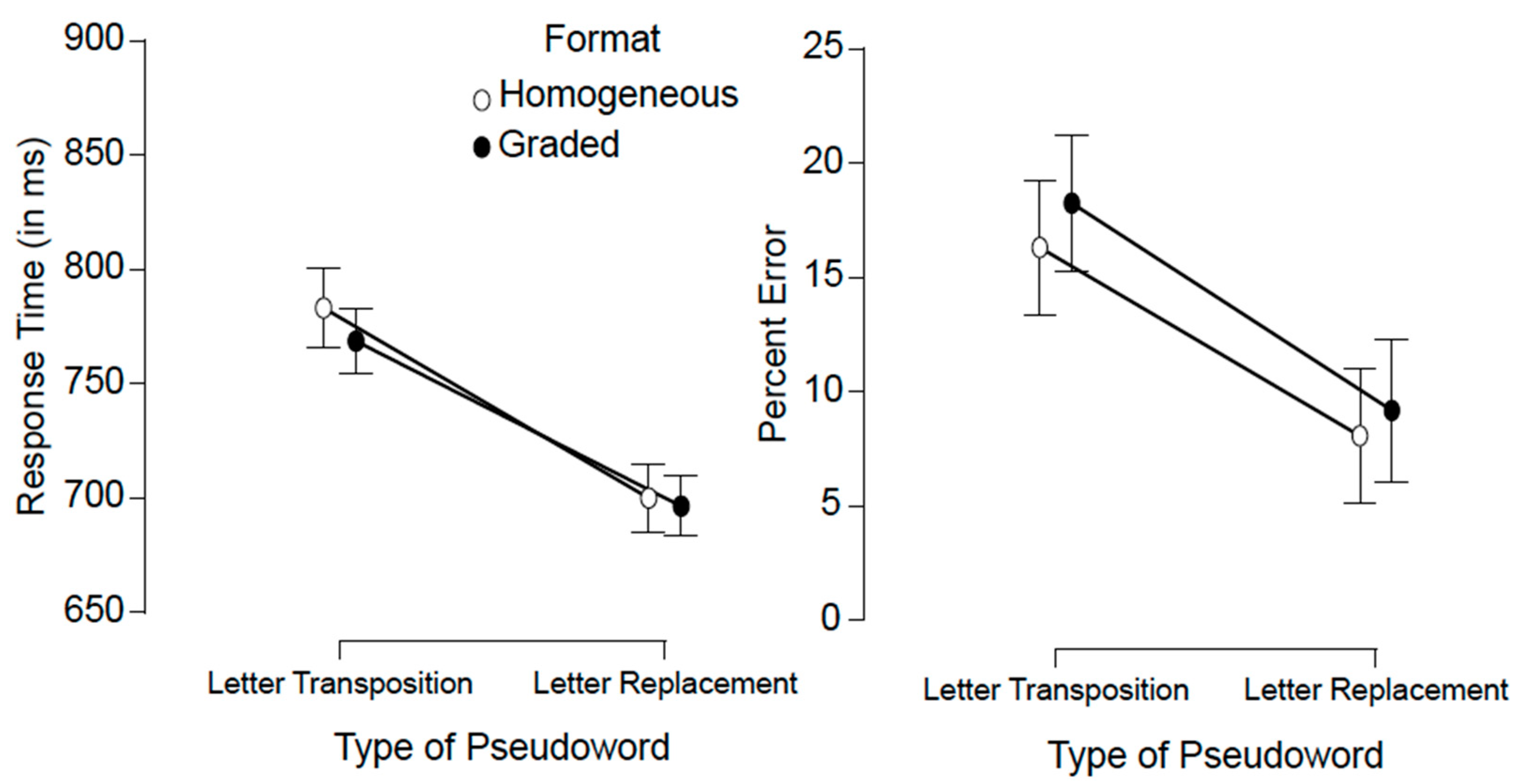
Numerous experiments in the past decades recurrently showed that a transposed-letter pseudoword (e.g., JUGDE) is much more wordlike than a replacement-letter control (e.g., JUPTE). Critically, there is an ongoing debate as to whether this effect arises at a perceptual level (e.g., perceptual uncertainty at assigning letter position of an array of visual objects) or at an abstract language-specific level (e.g., via a level of “open bigrams” between the letter and word levels). Here, we designed an experiment to test the limits of perceptual accounts of letter position coding. The stimuli in a lexical decision task were presented either with a homogeneous letter intensity or with a graded gray intensity, which indicated an unambiguous letter order. The pseudowords were either transposed-letter pseudowords or replaced-letter pseudowords (e.g., jugde vs. jupte). The results showed much longer response times and substantially more errors in the transposed-letter pseudowords than in the replacement-letter pseudowords, regardless of visual format. These findings favor the idea that language-specific orthographic element factors play an essential role when encoding letter position during word recognition.
Keywords: word recognition; letter position coding; perceptual factors; lexical decision; orthographic processing word recognition; letter position coding; perceptual factors; lexical decision; orthographic processing