
Exercise Training Characteristics and Psycho-Bio-Chemical Outcomes in Individuals with Addictive Behaviours: A Scoping Review

 , ,
, ,  ,
,  , , ,
, , ,  and
and 
Abstract
1. Introduction
2. Materials and Methods
2.1. Review Design
2.2. Review Question
- Population (P): Individuals with substance-related or behavioural addictions.
- Concept (C): Structured exercise training interventions, including their prescription according to the FITT principles, and the physiological, biochemical, psychological, behavioural, and clinical outcomes assessed.
- Context (C): Any clinical, institutional, community, academic, rehabilitation, or other setting in which structured exercise interventions were implemented.
2.3. Eligibility Criteria
2.3.1. Inclusion Criteria
- (i)
- Included human participants with substance-related addictions (e.g., alcohol, nicotine, cannabis, cocaine, methamphetamine, opioids, or polysubstance use disorders) and/or behavioural addictions (e.g., internet gaming disorder, gambling disorder, problematic smartphone use, compulsive buying, or problematic internet use);
- (ii)
- Investigated a structured exercise training intervention, including but not limited to aerobic training, resistance training, high-intensity interval training (HIIT), combined training, yoga, Tai Chi, or multicomponent exercise programmes;
- (iii)
- Reported at least one characteristic related to exercise prescription according to the FITT principles (frequency, intensity, time, and/or type);
- (iv)
- Assessed at least one physiological, biochemical, psychological, behavioural, or clinical outcome relevant to the study population or addictive behaviour;
- (v)
- Included participants of any age, sex, or clinical status;
- (vi)
- Employed an interventional study design, including randomized controlled trials, non-randomized intervention studies, pilot studies, feasibility studies, and other prospective exercise intervention designs;
- (vii)
- Were published as full-text articles in peer-reviewed journals in English, Portuguese, or Spanish; and
- (viii)
- Were published between January 2015 and March 2025
2.3.2. Exclusion Criteria
- (i)
- Did not involve human participants with a substance-related or behavioural addiction;
- (ii)
- Did not evaluate a structured exercise training intervention;
- (iii)
- Were observational or cross-sectional studies based exclusively on self-reported or habitual physical activity without a structured exercise intervention;
- (iv)
- Were pre-clinical or animal studies;
- (v)
- Were study protocols without intervention results;
- (vi)
- Did not report exercise prescription characteristics or outcomes relevant to the review objectives;
- (vii)
- Were conference abstracts, editorials, letters, commentaries, dissertations, case reports, or review articles;
- (viii)
- Included fewer than 10 participants;
- (ix)
- Were not available in full text; or
- (x)
- Were not published in English, Portuguese, or Spanish.
2.4. Search Strategy
2.5. Study Selection
2.6. Data Extraction and Charting
2.7. Outcomes Assessed
2.8. Data Synthesis and Presentation
3. Results
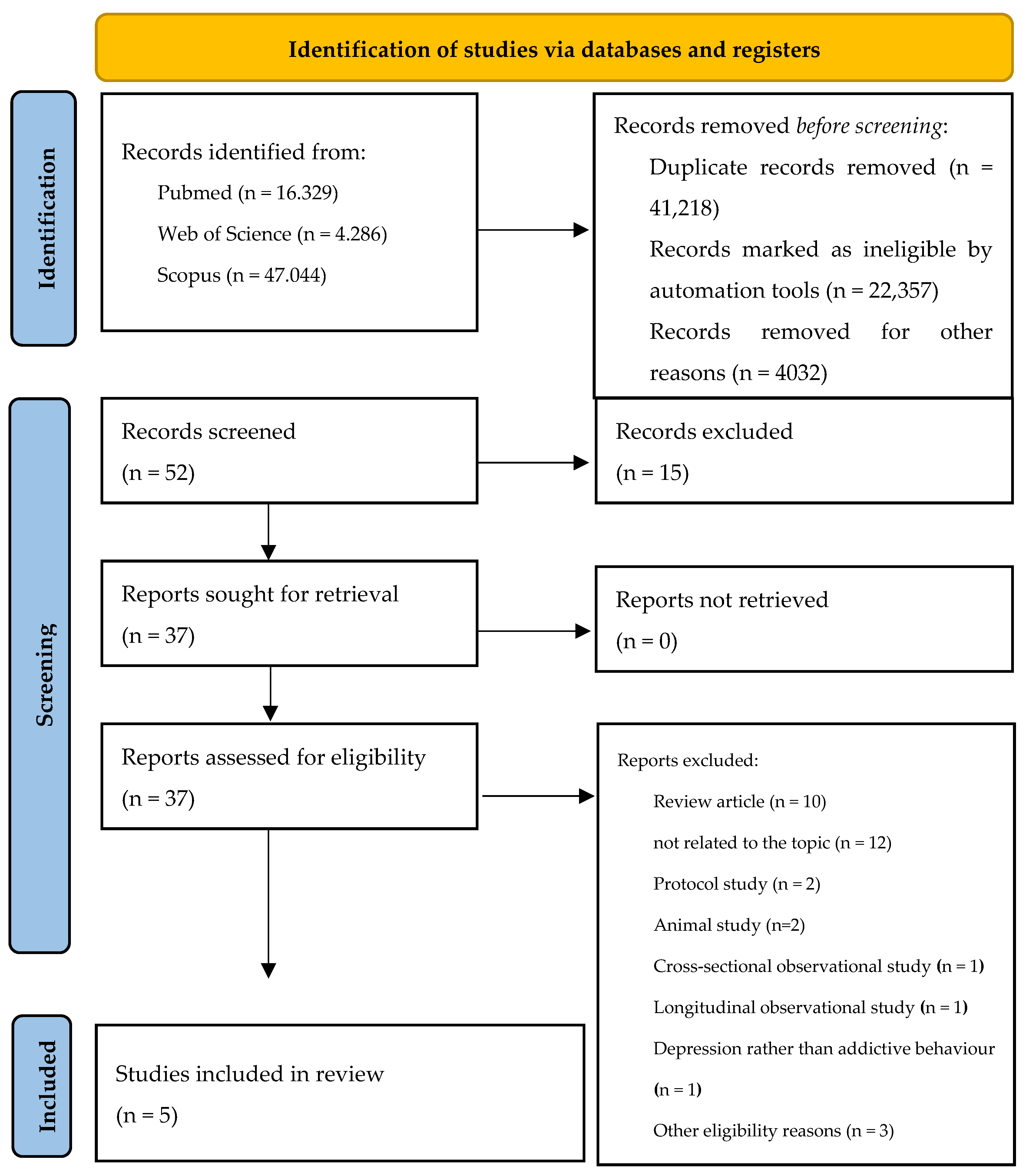
3.1. Search Results and Study Selection
3.2. Characteristics of Included Studies
3.3. Exercise Training Characteristics
3.4. Evidence Gaps and Heterogeneity
4. Discussion
4.1. Exercise Prescription and FITT Characteristics
4.2. Neurobiological and Biochemical Outcomes
4.3. Psychological and Addiction-Related Outcomes
4.4. Heterogeneity and Methodological Considerations
4.5. Evidence Gaps and Future Research
4.6. Implications of the Evidence Map
5. Conclusions
Author Contributions
Funding
Institutional Review Board Statement
Informed Consent Statement
Data Availability Statement
Acknowledgments
Conflicts of Interest
Abbreviations
| AUD | Alcohol Use Disorder |
| BDNF | Brain-Derived Neurotrophic Factor |
| D2/D3 | Dopamine Receptor Subtype 2/Subtype 3 |
| DA | Dopamine |
| FITT | Frequency, Intensity, Time, and Type |
| fNIRS | Functional Near-Infrared Spectroscopy |
| HADS | Hospital Anxiety and Depression Scale |
| HIIT | High-Intensity Interval Training |
| HRmax | Maximum Heart Rate |
| JBI | Joanna Briggs Institute |
| MeSH | Medical Subject Headings |
| min | Minutes |
| PANAS | Positive and Negative Affect Schedule |
| PCC | Population, Concept, and Context |
| PET | Positron Emission Tomography |
| PRISMA-ScR | Preferred Reporting Items for Systematic Reviews and Meta-Analyses Extension for Scoping Reviews |
| RCT | Randomized Controlled Trial |
| RPE | Rating of Perceived Exertion |
| STAI-Y1 | State-Trait Anxiety Inventory—Form Y1 |
| SUD | Substance Use Disorder |
| TH | Tyrosine Hydroxylase |
| VO2max | Maximal Oxygen Uptake |
References
- Santangelo, O.E.; Provenzano, S.; Firenze, A. Risk Factors for Addictive Behaviors: A General Overview. Int. J. Environ. Res. Public Health 2022, 19, 6583. [Google Scholar] [CrossRef] [PubMed]
- Alavi, S.S.; Ferdosi, M.; Jannatifard, F.; Eslami, M.; Alaghemandan, H. Behavioral Addiction vs. Substance Addiction Correspondence of Psy and Psy Views. Int. J. Prev. Med. 2012, 3, 290. [Google Scholar] [PubMed]
- Raji, H.; Dinesh, S.; Sharma, S. Inside the Impulsive Brain: A Narrative Review on the Role of Neurobiological, Hormonal and Genetic Factors Influencing Impulsivity in Psychiatric Disorders. Egypt. J. Neurol. Psychiatry Neurosurg. 2025, 61, 4. [Google Scholar] [CrossRef]
- Vassileva, J.; Conrod, P.J. Impulsivities and Addictions: A Multidimensional Integrative Framework Informing Assessment and Interventions for Substance Use Disorders. Philos. Trans. R. Soc. B Biol. Sci. 2019, 374, 20180137. [Google Scholar] [CrossRef] [PubMed]
- An, J.; Wang, Q.; Bai, Z.; Du, X.; Yu, D.; Mo, X. Global Burden and Trend of Substance Use Disorders, Self-Harm, and Interpersonal Violence from 1990 to 2021, with Projection to 2040. BMC Public Health 2025, 25, 1632. [Google Scholar] [CrossRef] [PubMed]
- Park, S.H.; Kim, D.J. Global and Regional Impacts of Alcohol Use on Public Health: Emphasis on Alcohol Policies. Clin. Mol. Hepatol. 2020, 26, 652–661. [Google Scholar] [CrossRef] [PubMed]
- Wacks, Y.; Weinstein, A.M. Excessive Smartphone Use Is Associated With Health Problems in Adolescents and Young Adults. Front. Psychiatry 2021, 12, 669042. [Google Scholar] [CrossRef] [PubMed]
- Coelho, P.; Figueiredo, A.; Mateus, S.; Furtado, G.E.; Rodrigues, F.J.B. Early Cardiovascular Risk Indicators in School-Aged Children from Inland Portugal: Elevated Blood Pressure at Screening and the Coexistence of Underweight and Excess Weight. Obesities 2026, 6, 16. [Google Scholar] [CrossRef]
- Coelho, P.M.S.C.; Duarte, M.; Cabral, E.T.; Mateus, S.M.F.; Rodrigues, F.J.B. Childhood and Adolescent Obesity in a School in Interior Portugal—A Teen without Risk Study. Obesities 2024, 4, 281–291. [Google Scholar] [CrossRef]
- Baik, J.H. Stress and the Dopaminergic Reward System. Exp. Mol. Med. 2020, 52, 1879–1890. [Google Scholar] [CrossRef] [PubMed]
- Noushad, S.; Ahmed, S.; Ansari, B.; Mustafa, U.-H.; Saleem, Y.; Hazrat, H. Physiological Biomarkers of Chronic Stress: A Systematic Review Introduction. Int. J. Health Sci. 2021, 15, 46–59. [Google Scholar]
- Zafar, T. Potential Biomarkers of Emotional Stress Induced Neurodegeneration. eNeurologicalSci 2020, 21, 100292. [Google Scholar] [CrossRef] [PubMed]
- Mansoor, M.; Ibrahim, A.; Hamide, A.; Tran, T.; Candreva, E.; Baltaji, J. Exercise-Induced Neuroplasticity: Adaptive Mechanisms and Preventive Potential in Neurodegenerative Disorders. Physiologia 2025, 5, 13. [Google Scholar] [CrossRef]
- White, R.L.; Vella, S.; Biddle, S.; Sutcliffe, J.; Guagliano, J.M.; Uddin, R.; Burgin, A.; Apostolopoulos, M.; Nguyen, T.; Young, C.; et al. Physical Activity and Mental Health: A Systematic Review and Best-Evidence Synthesis of Mediation and Moderation Studies. Int. J. Behav. Nutr. Phys. Act. 2024, 21, 134. [Google Scholar] [CrossRef] [PubMed]
- Furtado, G.E.; Palotino-Ferreira, B.M.; Rocha, S.V.; Nunes-Silva, A.; Barros, M.P.; Coelho, P.; Bachi, A.L.L.; de Oliveira, R.A.; de Barros, M.P.; Furtado, G.E. The influence of structured physical activity on vaccination response from adults to older individuals: A systematic review on the immunoinflammatory crosstalk of COVID-19. Immun. Ageing 2025, 22, 44. [Google Scholar] [CrossRef] [PubMed]
- Mahindru, A.; Patil, P.; Agrawal, V. Role of Physical Activity on Mental Health and Well-Being: A Review. Cureus 2023, 15, e33475. [Google Scholar] [CrossRef] [PubMed]
- Li, X.; Wang, J.; Yu, H.; Liu, Y.; Xu, X.; Lin, J.; Yang, N. How does physical activity improve adolescent resilience? Serial indirect effects via self-efficacy and basic psychological needs. PeerJ 2024, 12, e17059. [Google Scholar] [CrossRef] [PubMed]
- Yu, H.; Li, X.; Yu, X.; Fusheng, L.; Li, L.; Yang, Y.; Wu, J. How physical exercise enhances life satisfaction in Chinese senior college students: Mediating roles of self-efficacy and resilience. Front. Psychol. 2025, 16, 1515101. [Google Scholar] [CrossRef] [PubMed]
- de Melo Batista Dos Santos, J.; Furtado, G.E.; Correa-Sousa, E.; Brandao-Rangel, M.A.R.; Oliveira-Junior, M.C.; da Silva Cardoso, K.R.; de Souza, M.A.; Rodrigues, F.; de Oliveira, L.V.F.; Bachi, A.L.L.; et al. Short-Term High-Intensity Resistance Training: A Feasibility Study on Pulmonary, Immune and Physical-Functional Fitness Benefits for Older Adults with Metabolic Syndrome. Eur. J. Appl. Physiol. 2026, 126, 437–453. [Google Scholar] [CrossRef] [PubMed]
- Montón-Martínez, R.; Castellano-Galvañ, I.; Roldán, A.; Javaloyes, A.; Peña-González, I.; Sarabia, J.M.; Pastor, D.; Moya-Ramón, M. Effects of Physical Exercise on Substance Use Disorder: A Comprehensive Review. Appl. Sci. 2025, 15, 1481. [Google Scholar] [CrossRef]
- Marrero-Cristobal, G.; Gelpi-Dominguez, U.; Morales-Silva, R.; Alvarado-Torres, J.; Perez-Torres, J.; Perez-Perez, Y.; Sepulveda-Orengo, M. Aerobic exercise as a promising nonpharmacological therapy for the treatment of substance use disorders. J. Neurosci. Res. 2022, 100, 1602–1642. [Google Scholar] [CrossRef] [PubMed]
- Psarianos, A.E.; Philippou, A.; Papadopetraki, A.; Chatzinikita, E.; Chryssanthopoulos, C.; Theos, A.; Theocharis, A.; Tzavara, C.; Paparrigopoulos, T. Cortisol and β-Endorphin Responses During a Two-Month Exercise Training Program in Patients with an Opioid Use Disorder and on a Substitution Treatment. Int. J. Mol. Sci. 2025, 26, 5178. [Google Scholar] [CrossRef] [PubMed]
- Tricco, A.C.; Lillie, E.; Zarin, W.; O’Brien, K.K.; Colquhoun, H.; Levac, D.; Moher, D.; Peters, M.D.J.; Horsley, T.; Weeks, L.; et al. PRISMA Extension for Scoping Reviews (PRISMA-ScR): Checklist and Explanation. Ann. Intern. Med. 2018, 169, 467–473. [Google Scholar] [CrossRef] [PubMed]
- Aromataris, E.; Lockwood, C.; Porritt, K.; Pilla, B.; Jordan, Z. JBI Manual for Evidence Synthesis; JBI: Adelaide, Australia, 2024. [Google Scholar] [CrossRef]
- Malagodi, B.M.; Greguol, M.; Tavares, V.D.d.O.; Carraro, A.; Serassuelo Júnior, H. Acute Effect of Different Types of Moderate Intensity Physical Exercise on Affective Response and Mood State in Individuals with Substance Use Disorder. Ment. Health Phys. Act. 2024, 27, 100634. [Google Scholar] [CrossRef]
- Ellingsen, M.M.; Clausen, T.; Johannesen, S.L.; Martinsen, E.W.; Hallgren, M. Effects of Acute Exercise on Affect, Anxiety, and Self-Esteem in Poly-Substance Dependent Inpatients. Eur. Addict. Res. 2023, 29, 285–293. [Google Scholar] [CrossRef] [PubMed]
- Hallgren, M.; Vancampfort, D.; Hoang, M.T.; Andersson, V.; Ekblom, Ö.; Andreasson, S.; Herring, M.P. Effects of Acute Exercise on Craving, Mood and Anxiety in Non-Treatment Seeking Adults with Alcohol Use Disorder: An Exploratory Study. Drug Alcohol Depend. 2021, 220, 108506. [Google Scholar] [CrossRef] [PubMed]
- Welford, P.; Gunillasdotter, V.; Andréasson, S.; Hallgren, M. Effects of Physical Activity on Symptoms of Depression and Anxiety in Adults with Alcohol Use Disorder (FitForChange): Secondary Outcomes of a Randomised Controlled Trial. Drug Alcohol Depend. 2022, 239, 109601. [Google Scholar] [CrossRef] [PubMed]
- Robertson, C.L.; Ishibashi, K.; Chudzynski, J.; Mooney, L.J.; Rawson, R.A.; Dolezal, B.A.; Cooper, C.B.; Brown, A.K.; Mandelkern, M.A.; London, E.D. Effect of Exercise Training on Striatal Dopamine D2/D3 Receptors in Methamphetamine Users during Behavioral Treatment. Neuropsychopharmacology 2016, 41, 1629–1636. [Google Scholar] [CrossRef] [PubMed]
- Giménez-Meseguer, J.; Tortosa-Martínez, J.; Remedios Fernández-Valenciano, M. de los Benefits of Exercise for the Quality of Life of Drug-Dependent Patients. J. Psychoact. Drugs 2015, 47, 409–416. [Google Scholar] [CrossRef] [PubMed]
- Giménez-Meseguer, J.; Tortosa-Martínez, J.; Cortell-Tormo, J.M. The Benefits of Physical Exercise on Mental Disorders and Quality of Life in Substance Use Disorders Patients. Systematic Review and Meta-Analysis. Int. J. Environ. Res. Public Health 2020, 17, 3680. [Google Scholar] [CrossRef] [PubMed]
- Osbak, P.S.; Mourier, M.; Henriksen, J.H.; Kofoed, K.F.; Jensen, G.B. Effect of physical exercise training on muscle strength and body composition, and their association with functional capacity and quality of life in patients with atrial fibrillation: A randomized controlled trial. J. Rehabil. Med. 2012, 44, 975–979. [Google Scholar] [CrossRef] [PubMed]
- Bryn, E.; Tagliabue, M.; Strømgren, B. Psychosocial outcomes of group-based physical activity among individuals with substance use disorders: A scoping review. Addict Sci. Clin. Pract. 2026, 21, 54. [Google Scholar] [CrossRef] [PubMed]
- Zhang, T.; Wang, K.; Li, N.; Hurr, C.; Luo, J. The Relationship between Different Amounts of Physical Exercise, Internal Inhibition, and Drug Craving in Individuals with Substance-Use Disorders. Int. J. Environ. Res. Public Health 2021, 18, 12436. [Google Scholar] [CrossRef] [PubMed]
- Psarianos, A.; Chryssanthopoulos, C.; Theocharis, A.; Paparrigopoulos, T.; Philippou, A. Effects of a Two-Month Exercise Training Program on Concurrent Non-Opiate Substance Use in Opioid-Dependent Patients during Substitution Treatment. J. Clin. Med. 2024, 13, 941. [Google Scholar] [CrossRef] [PubMed]
- Bao, H. Association between peer relationships and exercise self-efficacy among college students: The mediating role of physical activity commitment. Front. Psychol. 2025, 16, 1533097. [Google Scholar] [CrossRef] [PubMed]
- Volkow, N.D.; Fowler, J.S.; Wang, G.J.; Baler, R.; Telang, F. Imaging Dopamine’s Role in Drug Abuse and Addiction. Neuropharmacology 2009, 56, 3–8. [Google Scholar] [CrossRef] [PubMed]
- Li, L.; Kong, J.; Tian, X. What role does the Notch signaling pathway play in exercise-related metabolic and neurological adaptations? A molecular-to-systems perspective. Front. Physiol. 2026, 17, 1772055. [Google Scholar] [CrossRef] [PubMed]
- Sandroff, B.M.; Jones, C.D.; Baird, J.F.; Motl, R.W. Systematic Review on Exercise Training as a Neuroplasticity-Inducing Behavior in Multiple Sclerosis. Neurorehabil. Neural Repair. 2020, 34, 575–588. [Google Scholar] [CrossRef] [PubMed]
- Faria, V.S.; McManus, L.; O’Hagan, A.D.; Egan, B. Effects of acute exercise or short-term exercise interventions on metabolic markers during experimentally-induced sleep loss in humans: A systematic literature review. J. Sport Health Sci. 2025, 14, 101044. [Google Scholar] [CrossRef] [PubMed]
- Walzik, D.; Joisten, N.; Metcalfe, A.J.; Proschinger, S.; Schenk, A.; Wenzel, C.; Henneberg, A.L.; Schneider, M.; Calderazzo, S.; Groll, A.; et al. Acute exercise rewires the proteomic landscape of human immune cells. Nat. Commun. 2026, 17, 130. [Google Scholar] [CrossRef] [PubMed]
- Farhani, Z.; Ghouili, H.; Boukari, S.; Ceylan, H.I.; Dridi, A.; Souissi, N.; Dhahbi, W.; Bouassida, A.; Mavritsakis, N.; Muntean, R.I.; et al. Mood, technical performance, and physiological responses after 4 vs 4 small-sided soccer games of different durations: A pre-post study. Medicine 2026, 105, e49444. [Google Scholar] [CrossRef] [PubMed]
- Aydin, A.E. Exercise unveiled: An integrated model of motives, goals, affective states, and stress during the COVID-19 pandemic. BMC Psychol. 2026, 14, 953. [Google Scholar] [CrossRef] [PubMed]
- Gantois, P.; Piqueras-Sanchiz, F.; Cid, M.J.F.A.; Pino-Ortega, J.; Castillo, D.; Nakamura, F.Y. The effects of different small-sided games configurations on heart rate, rating of perceived exertion, and running demands in professional soccer players. Eur. J. Sport Sci. 2023, 23, 1214–1222. [Google Scholar] [CrossRef] [PubMed]


| Study | Country | Design | Population/Addiction | Sample | Exercise Type | Frequency | Intensity | Time | Duration | Supervision | Adherence |
|---|---|---|---|---|---|---|---|---|---|---|---|
| Malagodi et al., 2024 [25] | Brazil | Acute crossover intervention | Hospitalized adults with SUD | 43 | Moderate-intensity aerobic and functional exercise | Single session | Moderate | ~40 min | Acute | Supervised | NR |
| Ellingsen et al., 2023 [26] | Norway | Multicentre crossover intervention | Inpatients with poly-substance dependence | 38 | Soccer-based and circuit exercise | Single session | Moderate-to-vigorous | 45 min | Acute | Supervised | NR |
| Hallgren et al., 2021 [27] | Sweden | Exploratory acute exercise study | Non-treatment-seeking adults with AUD | 140 | Cycle ergometer exercise | Single session | Strenuous; RPE ≈16 | 12 min | Acute | Supervised | NR |
| Welford et al., 2022 [28] | Sweden | Randomized controlled trial; secondary outcomes | Adults with AUD | 140 | Aerobic exercise and yoga | ≥3 sessions/week | Moderate | 60 min/session | 12 weeks | Supervised | Monitored; exact adherence NR |
| Robertson et al., 2016 [29] | USA | Randomized controlled trial | Adults with methamphetamine use disorder undergoing behavioural treatment | 19 | Aerobic plus resistance exercise | 3 sessions/week | Individualized moderate intensity | 60 min/session | 8 weeks | Supervised | NR |
| Study | Neurobiological/Biochemical Outcomes | Psychological Outcomes | Addiction-Related Outcomes | Principal Findings |
|---|---|---|---|---|
| Malagodi et al., 2024 [25] | Not assessed | Affect; mood state | — | Acute moderate-intensity exercise was associated with changes in affective response and mood state in individuals with SUD. |
| Ellingsen et al., 2023 [26] | — | Affect; anxiety; self-esteem | — | Acute exercise was associated with favourable changes in affective and psychological responses among poly-substance-dependent inpatients. |
| Hallgren et al., 2021 [27] | — | Mood; anxiety | Alcohol craving | Acute exercise was associated with reduced alcohol craving and favourable changes in mood and anxiety. |
| Welford et al., 2022 [28] | — | Depressive symptoms; anxiety | AUD-related clinical context | Exercise interventions were associated with changes in depression and anxiety outcomes in adults with AUD. |
| Robertson et al., 2016 [29] | Striatal dopamine D2/D3 receptor availability | — | Methamphetamine use disorder / behavioural treatment | Exercise training was associated with changes in striatal dopamine D2/D3 receptor availability during behavioural treatment. |
Disclaimer/Publisher’s Note: The statements, opinions and data contained in all publications are solely those of the individual author(s) and contributor(s) and not of MDPI and/or the editor(s). MDPI and/or the editor(s) disclaim responsibility for any injury to people or property resulting from any ideas, methods, instructions or products referred to in the content. |
© 2026 by the authors. Licensee MDPI, Basel, Switzerland. This article is an open access article distributed under the terms and conditions of the Creative Commons Attribution (CC BY) license.
Share and Cite
Furtado, G.E.; Marques, M.I.; Sampaio, A.R.; Duarte, D.; Ramos, S.; Carballera, E.; Sevilla-Sanchez, M.; Eduardo, E.; Mateus, S.; Coelho, P.; et al. Exercise Training Characteristics and Psycho-Bio-Chemical Outcomes in Individuals with Addictive Behaviours: A Scoping Review. J. Funct. Morphol. Kinesiol. 2026, 11, 311. https://doi.org/10.3390/jfmk11030311
Furtado GE, Marques MI, Sampaio AR, Duarte D, Ramos S, Carballera E, Sevilla-Sanchez M, Eduardo E, Mateus S, Coelho P, et al. Exercise Training Characteristics and Psycho-Bio-Chemical Outcomes in Individuals with Addictive Behaviours: A Scoping Review. Journal of Functional Morphology and Kinesiology. 2026; 11(3):311. https://doi.org/10.3390/jfmk11030311
Chicago/Turabian StyleFurtado, Guilherme Eustáquio, Maria Inês Marques, António Rodrigues Sampaio, Daniel Duarte, Susana Ramos, Eduardo Carballera, Marta Sevilla-Sanchez, Edson Eduardo, Sónia Mateus, Patrícia Coelho, and et al. 2026. "Exercise Training Characteristics and Psycho-Bio-Chemical Outcomes in Individuals with Addictive Behaviours: A Scoping Review" Journal of Functional Morphology and Kinesiology 11, no. 3: 311. https://doi.org/10.3390/jfmk11030311
APA StyleFurtado, G. E., Marques, M. I., Sampaio, A. R., Duarte, D., Ramos, S., Carballera, E., Sevilla-Sanchez, M., Eduardo, E., Mateus, S., Coelho, P., & Rodrigues, F. (2026). Exercise Training Characteristics and Psycho-Bio-Chemical Outcomes in Individuals with Addictive Behaviours: A Scoping Review. Journal of Functional Morphology and Kinesiology, 11(3), 311. https://doi.org/10.3390/jfmk11030311