
A Narrative Review of HRV Metric Selection for Applied Monitoring: RMSSD as the Default Metric for Sport and Exercise

Abstract
1. Introduction
2. Methods
3. The Problem: Metric Proliferation
4. RMSSD as the Default HRV Metric for Practical Monitoring
5. Contextualizing RMSSD Interpretation
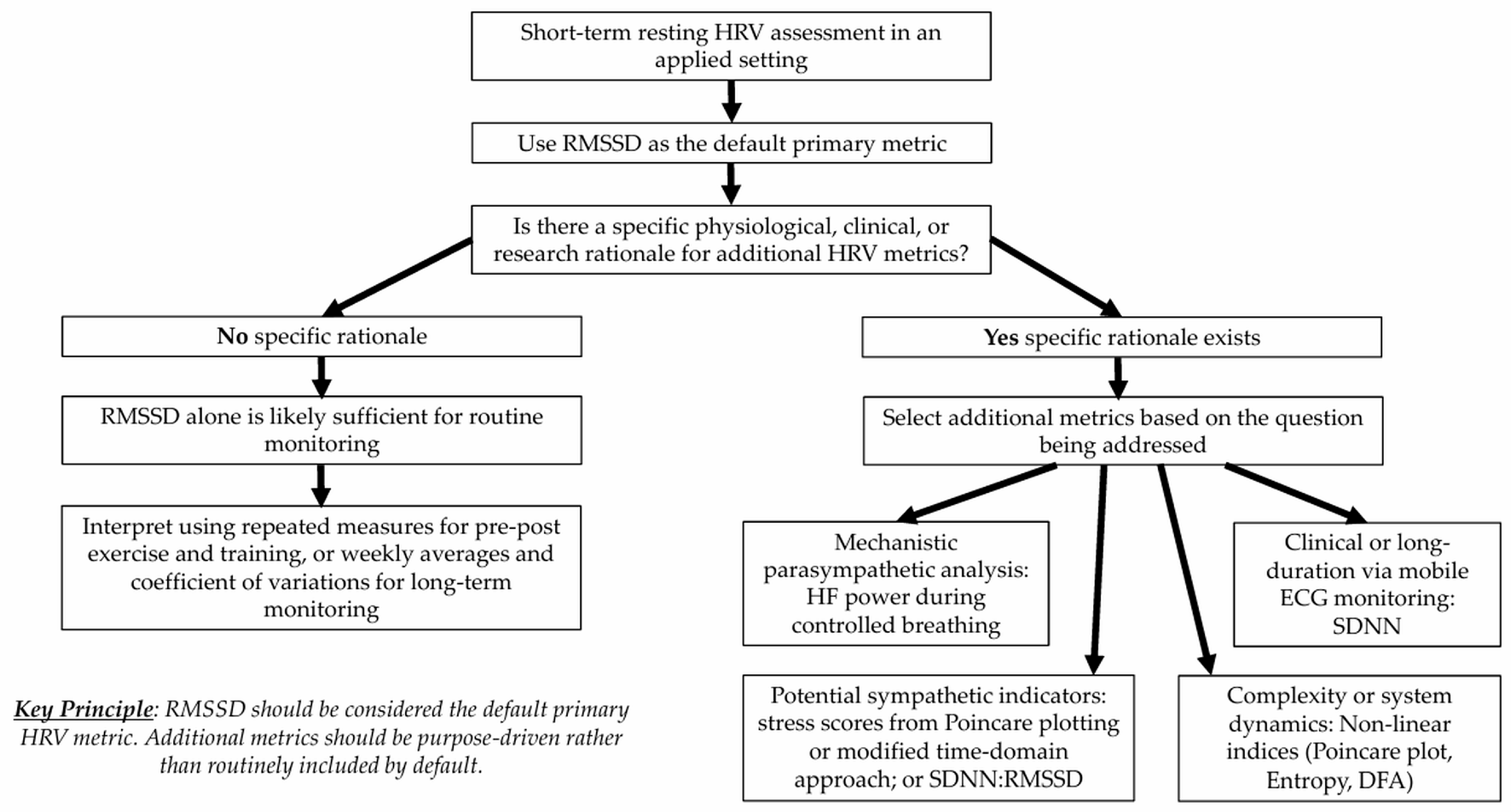
6. When Are Additional HRV Metrics Justified?
7. Conclusions
Funding
Institutional Review Board Statement
Informed Consent Statement
Data Availability Statement
Acknowledgments
Conflicts of Interest
Abbreviations
| HF | High-frequency power |
| HRV | Heart rate variability |
| LF | Low-frequency power |
| LF:HF | Low-frequency to high frequency ratio |
| LnRMSSD | Natural logarithm of the root mean square of successive differences between adjacent normal-to-normal intervals |
| RMSSD | Root mean square of successive differences between adjacent normal-to-normal intervals |
| SD1 | Standard deviation 1 from Poincaré plot analysis |
| SD2 | Standard deviation 2 from Poincaré plot analysis |
| SDNN | Standard deviation of normal-to-normal intervals |
| SDNN:RMSSD | SDNN to RMSSD ratio |
References
- Plews, D.J.; Laursen, P.B.; Stanley, J.; Kilding, A.E.; Buchheit, M. Training adaptation and heart rate variability in elite endurance athletes: Opening the door to effective monitoring. Sports Med. 2013, 43, 773–781. [Google Scholar] [CrossRef] [Scilit] [PubMed]
- Bellenger, C.R.; Fuller, J.T.; Thomson, R.L.; Davison, K.; Robertson, E.Y.; Buckley, J.D. Monitoring athletic training status through autonomic heart rate regulation: A systematic review and meta-analysis. Sports Med. 2016, 46, 1461–1486. [Google Scholar] [CrossRef] [Scilit] [PubMed]
- Dobbs, W.C.; Fedewa, M.V.; MacDonald, H.V.; Holmes, C.J.; Cicone, Z.S.; Plews, D.J.; Esco, M.R. The accuracy of acquiring heart rate variability from portable devices: A systematic review and meta-analysis. Sports Med. 2019, 49, 417–435. [Google Scholar] [CrossRef] [Scilit] [PubMed]
- Plews, D.J.; Scott, B.; Altini, M.; Wood, M.; Kilding, A.E.; Laursen, P.B. Comparison of heart-rate-variability recording with smartphone photoplethysmography, Polar H7 chest strap, and electrocardiography. Int. J. Sports Physiol. Perform. 2017, 12, 1324–1328. [Google Scholar] [CrossRef] [Scilit] [PubMed]
- Esco, M.R.; Flatt, A.A. Ultra-short-term heart rate variability indexes at rest and post-exercise in athletes: Evaluating the agreement with accepted recommendations. J. Sports Sci. Med. 2014, 13, 535–541. [Google Scholar] [PubMed]
- Task Force of the European Society of Cardiology and the North American Society of Pacing and Electrophysiology. Heart rate variability: Standards of measurement, physiological interpretation and clinical use. Circulation 1996, 93, 1043–1065. [Google Scholar] [CrossRef] [Scilit]
- Billman, G.E. The LF/HF ratio does not accurately measure cardiac sympatho-vagal balance. Front. Physiol. 2013, 4, 26. [Google Scholar] [CrossRef] [Scilit] [PubMed]
- Shaffer, F.; Ginsberg, J.P. An overview of heart rate variability metrics and norms. Front. Public Health 2017, 5, 258. [Google Scholar] [CrossRef] [Scilit] [PubMed]
- Ciccone, A.B.; Siedlik, J.A.; Wecht, J.M.; Deckert, J.A.; Nguyen, N.D.; Weir, J.P. Reminder: RMSSD and SD1 are identical heart rate variability metrics. Muscle Nerve 2017, 56, 674–678. [Google Scholar] [CrossRef] [Scilit] [PubMed]
- Buchheit, M. Monitoring training status with HR measures: Do all roads lead to Rome? Front. Physiol. 2014, 5, 73. [Google Scholar] [CrossRef] [Scilit] [PubMed]
- Esco, M.R.; Fields, A.D.; Mohammadnabi, M.A.; Kliszczewicz, B.M. Monitoring training adaptation and recovery status in athletes using heart rate variability via mobile devices: A narrative review. Sensors 2025, 26, 3. [Google Scholar] [CrossRef] [Scilit] [PubMed]
- Laborde, S.; Mosley, E.; Thayer, J.F. Heart rate variability and cardiac vagal tone in psychophysiological research—Recommendations for experiment planning, data analysis, and data reporting. Front. Psychol. 2017, 8, 213. [Google Scholar] [CrossRef] [Scilit] [PubMed]
- Chand, K.; Chandra, S.; Dutt, V. A comprehensive evaluation of linear and non-linear HRV parameters between paced breathing and stressful mental state. Heliyon 2024, 10, e32195. [Google Scholar] [CrossRef] [Scilit] [PubMed]
- Voss, A.; Schulz, S.; Schroeder, R.; Baumert, M.; Caminal, P. Methods derived from nonlinear dynamics for analysing heart rate variability. Philos. Trans. R. Soc. A Math. Phys. Eng. Sci. 2009, 367, 277–296. [Google Scholar] [CrossRef] [Scilit] [PubMed]
- Munoz, M.L.; van Roon, A.; Riese, H.; Thio, C.; Oostenbroek, E.; Westrik, I.; de Geus, E.J.C.; Gansevoort, R.T.; Lefrandt, J.D.; Nolte, I.M.; et al. Validity of (ultra-)short recordings for heart rate variability measurements. PLoS ONE 2015, 10, e0138921. [Google Scholar] [CrossRef] [Scilit] [PubMed]
- Nussinovitch, U.; Elishkevitz, K.P.; Katz, K.; Nussinovitch, M.; Segev, S.; Volovitz, B.; Nussinovitch, N. Reliability of ultra-short ECG indices for heart rate variability. Ann. Noninvasive Electrocardiol. 2011, 16, 117–122. [Google Scholar] [CrossRef] [Scilit] [PubMed]
- Esco, M.R.; Williford, H.N.; Flatt, A.A.; Freeborn, T.J.; Nakamura, F.Y. Ultra-shortened time-domain HRV parameters at rest and following exercise in athletes: An alternative to frequency computation of sympathovagal balance. Eur. J. Appl. Physiol. 2018, 118, 175–184. [Google Scholar] [CrossRef] [Scilit] [PubMed]
- Fields, A.D.; Mohammadnabi, M.A.; Fedewa, M.V.; Esco, M.R. Modified stress score and sympathetic-parasympathetic ratio using ultra-short-term HRV in athletes: A novel approach to autonomic monitoring. J. Funct. Morphol. Kinesiol. 2025, 10, 310. [Google Scholar] [CrossRef] [Scilit] [PubMed]
- Sundas, A.; Contreras, I.; Navarro-Otano, J.; Soler, J.; Beneyto, A.; Vehi, J. Heart rate variability over the decades: A scoping review. PeerJ 2025, 13, e19347. [Google Scholar] [CrossRef] [Scilit] [PubMed]
- von Rosenberg, W.; Chanwimalueang, T.; Adjei, T.; Jaffer, U.; Goverdovsky, V.; Mandic, D.P. Resolving ambiguities in the LF/HF ratio: LF-HF scatter plots for the categorization of mental and physical stress from HRV. Front. Physiol. 2017, 8, 360. [Google Scholar] [CrossRef] [Scilit] [PubMed]
- Goldstein, D.S.; Bentho, O.; Park, M.-Y.; Sharabi, Y. Low-frequency power of heart rate variability is not a measure of cardiac sympathetic tone but may be a measure of modulation of cardiac autonomic outflows by baroreflexes. Exp. Physiol. 2011, 96, 1255–1261. [Google Scholar] [CrossRef] [Scilit] [PubMed]
- Reyes del Paso, G.A.; Langewitz, W.; Mulder, L.J.M.; van Roon, A.; Duschek, S. The utility of low frequency heart rate variability as an index of sympathetic cardiac tone: A review with emphasis on a reanalysis of previous studies. Psychophysiology 2013, 50, 477–487. [Google Scholar] [CrossRef] [Scilit] [PubMed]
- Tarvainen, M.P.; Niskanen, J.-P.; Lipponen, J.A.; Ranta-Aho, P.O.; Karjalainen, P.A. Kubios HRV—Heart rate variability analysis software. Comput. Methods Programs Biomed. 2014, 113, 210–220. [Google Scholar] [CrossRef] [Scilit] [PubMed]
- Simmons, J.P.; Nelson, L.D.; Simonsohn, U. False-positive psychology: Undisclosed flexibility in data collection and analysis allows presenting anything as significant. Psychol. Sci. 2011, 22, 1359–1366. [Google Scholar] [CrossRef] [Scilit] [PubMed]
- Flatt, A.A.; Esco, M.R. Heart rate variability stabilization in athletes: Towards more convenient data acquisition. Clin. Physiol. Funct. Imaging 2016, 36, 331–336. [Google Scholar] [CrossRef] [Scilit] [PubMed]
- Shaffer, F.; Meehan, Z.M.; Zerr, C.L.A. Critical Review of Ultra-Short-Term Heart Rate Variability Norms Research. Front. Neurosci. 2020, 14, 594880. [Google Scholar] [CrossRef] [Scilit] [PubMed]
- Pinna, G.D.; Maestri, R.; Torunski, A.; Danilowicz-Szymanowicz, L.; Szwoch, M.; La Rovere, M.T.; Raczak, G. Heart rate variability measures: A fresh look at reliability. Clin. Sci. 2007, 113, 131–140. [Google Scholar] [CrossRef] [Scilit] [PubMed]
- Besson, C.; Baggish, A.L.; Monteventi, P.; Schmitt, L.; Stucky, F.; Gremeaux, V. Assessing the clinical reliability of short-term heart rate variability: Insights from controlled dual-environment and dual-position measurements. Sci. Rep. 2025, 15, 5611. [Google Scholar] [CrossRef] [Scilit] [PubMed]
- Schmitt, L.; Regnard, J.; Millet, G.P. Monitoring fatigue status with HRV measures in elite athletes: An avenue beyond RMSSD? Front. Physiol. 2015, 6, 343. [Google Scholar] [CrossRef] [Scilit] [PubMed]
- Fennell, C.R.J.; Mauger, A.R.; Hopker, J.G. Inter-day reliability of heart rate complexity and variability metrics in healthy highly active younger and older adults. Eur. J. Appl. Physiol. 2024, 124, 1409–1424. [Google Scholar] [CrossRef] [Scilit] [PubMed]
- Nakamura, F.Y.; Flatt, A.A.; Pereira, L.A.; Ramirez-Campillo, R.; Loturco, I.; Esco, M.R. Ultra-short-term heart rate variability is sensitive to training effects in team sports players. J. Sports Sci. Med. 2015, 14, 602–605. [Google Scholar] [PubMed]
- Plews, D.J.; Laursen, P.B.; Kilding, A.E.; Buchheit, M. Evaluating training adaptation with heart-rate measures: A methodological comparison. Int. J. Sports Physiol. Perform. 2013, 8, 688–691. [Google Scholar] [CrossRef] [Scilit] [PubMed]
- Flatt, A.A.; Esco, M.R. Evaluating individual training adaptation with smartphone-derived heart rate variability in a collegiate female soccer team. J. Strength Cond. Res. 2016, 30, 378–385. [Google Scholar] [CrossRef] [Scilit] [PubMed]
- Flatt, A.A.; Esco, M.R. Smartphone-derived heart-rate variability and training load in a women’s soccer team. Int. J. Sports Physiol. Perform. 2015, 10, 994–1000. [Google Scholar] [CrossRef] [Scilit] [PubMed]
- Plews, D.J.; Laursen, P.B.; Kilding, A.E.; Buchheit, M. Heart-rate variability and training-intensity distribution in elite rowers. Int. J. Sports Physiol. Perform. 2014, 9, 1026–1032. [Google Scholar] [CrossRef] [Scilit] [PubMed]
- Plews, D.J.; Laursen, P.B.; Le Meur, Y.; Hausswirth, C.; Kilding, A.E.; Buchheit, M. Monitoring training with heart-rate-variability: How much compliance is needed for valid assessment? Int. J. Sports Physiol. Perform. 2014, 9, 783–790. [Google Scholar] [CrossRef] [Scilit] [PubMed]
- Hopkins, W.G. Measures of reliability in sports medicine and science. Sports Med. 2000, 30, 1–15. [Google Scholar] [CrossRef] [Scilit] [PubMed]
- Laborde, S.; Mosley, E.; Mertgen, A. Vagal Tank Theory: The Three Rs of Cardiac Vagal Control Functioning—Resting, Reactivity, and Recovery. Front. Neurosci. 2018, 12, 458. [Google Scholar] [CrossRef] [Scilit] [PubMed]
- Brown, T.E.; Beightol, L.A.; Koh, J.; Eckberg, D.L. Important influence of respiration on human R-R interval power spectra is largely ignored. J. Appl. Physiol. 1993, 75, 2310–2317. [Google Scholar] [CrossRef] [Scilit] [PubMed]
- Penttilä, J.; Helminen, A.; Jartti, T.; Kuusela, T.; Huikuri, H.V.; Tulppo, M.P.; Coffeng, R. Time domain, geometrical and frequency domain analysis of cardiac vagal outflow: Effects of various respiratory patterns. Clin. Physiol. 2001, 21, 365–376. [Google Scholar] [CrossRef] [Scilit] [PubMed]
- Grossman, P.; Taylor, E.W. Toward understanding respiratory sinus arrhythmia: Relations to cardiac vagal tone, evolution and biobehavioral functions. Biol. Psychol. 2007, 74, 263–285. [Google Scholar] [CrossRef] [Scilit] [PubMed]
- Saboul, D.; Pialoux, V.; Hautier, C. The impact of breathing on HRV measurements: Implications for the longitudinal follow-up of athletes. Eur. J. Sport Sci. 2013, 13, 534–542. [Google Scholar] [CrossRef] [Scilit] [PubMed]
- Thomas, B.L.; Claassen, N.; Becker, P.; Viljoen, M. Validity of commonly used heart rate variability markers of autonomic nervous system function. Neuropsychobiology 2019, 78, 14–26. [Google Scholar] [CrossRef] [Scilit] [PubMed]
- Natarajan, A.; Pantelopoulos, A.; Emir-Farinas, H.; Natarajan, P. Heart rate variability with photoplethysmography in 8 million individuals: A cross-sectional study. Lancet Digit. Health 2020, 2, e650–e657. [Google Scholar] [CrossRef] [Scilit] [PubMed]
- Stanley, J.; Peake, J.M.; Buchheit, M. Cardiac parasympathetic reactivation following exercise: Implications for training prescription. Sports Med. 2013, 43, 1259–1277. [Google Scholar] [CrossRef] [Scilit] [PubMed]
- Alfonso, C.; Clarke, D.C.; Capdevila, L. Individual training prescribed by heart rate variability, heart rate and well-being scores in experienced cyclists. Sci. Rep. 2025, 15, 34023. [Google Scholar] [CrossRef] [Scilit] [PubMed]
- Rabbani, M.; Agha-Alinejad, H.; Gharakhanlou, R.; Rabbani, A.; Flatt, A.A. Monitoring training in women’s volleyball: Supine or seated heart rate variability? Physiol. Behav. 2021, 240, 113537. [Google Scholar] [CrossRef] [Scilit] [PubMed]
- Holmes, C.J.; Wind, S.A.; Esco, M.R. Heart rate variability responses to an undulating resistance training program in free-living conditions: A case study in a collegiate athlete. Sports 2018, 6, 121. [Google Scholar] [CrossRef] [Scilit] [PubMed]
- Ernst, G. Heart-rate variability—More than heart beats? Front. Public Health 2017, 5, 240. [Google Scholar] [CrossRef] [Scilit] [PubMed]
- Michael, S.; Graham, K.S.; Davis, G.M. Cardiac autonomic responses during exercise and post-exercise recovery using heart rate variability and systolic time intervals—A review. Front. Physiol. 2017, 8, 301. [Google Scholar] [CrossRef] [Scilit] [PubMed]
- McCraty, R.; Shaffer, F. Heart rate variability: New perspectives on physiological mechanisms, assessment of self-regulatory capacity, and health risk. Glob. Adv. Health Med. 2015, 4, 46–61. [Google Scholar] [CrossRef] [Scilit] [PubMed]
- Ritz, T. Putting back respiration into respiratory sinus arrhythmia or high-frequency heart rate variability: Implications for interpretation, respiratory rhythmicity, and health. Biol. Psychol. 2024, 185, 108728. [Google Scholar] [CrossRef] [Scilit] [PubMed]
- Garabedian, C.; Champion, C.; Servan-Schreiber, E.; Butruille, L.; Aubry, E.; Sharma, D.; Logier, R.; Deruelle, P.; Storme, L.; Houfflin-Debarge, V.; et al. A new analysis of heart rate variability in the assessment of fetal parasympathetic activity: An experimental study in a fetal sheep model. PLoS ONE 2017, 12, e0180653. [Google Scholar] [CrossRef] [Scilit] [PubMed]
- Billman, G.E. The effect of heart rate on the heart rate variability response to autonomic interventions. Front. Physiol. 2013, 4, 222. [Google Scholar] [CrossRef] [Scilit] [PubMed]
- Marmerstein, J.T.; McCallum, G.A.; Durand, D.M. Direct measurement of vagal tone in rats does not show correlation to HRV. Sci. Rep. 2021, 11, 1210, Correction in Sci. Rep. 2021, 11, 10233. https://doi.org/10.1038/s41598-021-88882-5. [Google Scholar] [CrossRef] [Scilit] [PubMed]
- Billman, G.E. Heart rate variability—A historical perspective. Front. Physiol. 2011, 2, 86. [Google Scholar] [CrossRef] [Scilit] [PubMed]
- Schwerdtfeger, A.R.; Schwarz, G.; Pfurtscheller, K.; Thayer, J.F.; Jarczok, M.N.; Pfurtscheller, G. Heart rate variability (HRV): From brain death to resonance breathing at 6 breaths per minute. Clin. Neurophysiol. 2020, 131, 676–693. [Google Scholar] [CrossRef] [Scilit] [PubMed]
- Naranjo-Orellana, J.; de la Cruz Torres, B.; Sarabia Cachadina, E.; de Hoyo, M.; Dominguez-Cobo, S. Two new indexes for the assessment of autonomic balance in elite soccer players. Int. J. Sports Physiol. Perform. 2015, 10, 452–457. [Google Scholar] [CrossRef] [Scilit] [PubMed]
- Salazar-Martinez, E.; Naranjo-Orellana, J.; Sarabia-Cachadina, E. Heart rate variability: Obtaining the stress score from SDNN values. Isokinet. Exerc. Sci. 2024, 32, 301–307. [Google Scholar] [CrossRef] [Scilit]
- Lipka, A.; Luthardt, C.; Tognaccioli, T.; Cairo, B.; Abreu, R.M. Heart rate variability and overtraining in soccer players: A systematic review. Physiol. Rep. 2025, 13, e70357. [Google Scholar] [CrossRef] [Scilit] [PubMed]
- Addleman, J.S.; Lackey, N.S.; DeBlauw, J.A.; Hajduczok, A.G. Heart rate variability applications in strength and conditioning: A narrative review. J. Funct. Morphol. Kinesiol. 2024, 9, 93. [Google Scholar] [CrossRef] [Scilit] [PubMed]
- Hannon, J.; O’Hagan, A.; Lambe, R.; O’Grady, B.; Doherty, C. Associations between daily heart rate variability and self-reported wellness: A 14-day observational study in healthy adults. Sensors 2025, 25, 4415. [Google Scholar] [CrossRef] [Scilit] [PubMed]


| Metric (Domain) | Interpretation | Strengths | Limitations | Recommended Use |
|---|---|---|---|---|
| RMSSD (Time) | Short-term cardiac interval variability strongly associated with parasympathetic modulation | Strong reliability; compatible with ultra-short recordings; computationally simple; robust during spontaneous breathing; well suited for long-term monitoring | Does not fully capture overall autonomic complexity or broader variability patterns | Primary metric for routine short-term resting HRV monitoring in sport and exercise settings |
| SDNN (Time) | Overall variability of normal-to-normal intervals | Provides broader representation of HRV; useful in long-duration recordings | Less physiologically specific during short-term recordings; influenced by slower oscillations | Complementary metric alongside RMSSD |
| pNN50 (Time) | Short-term cardiac interval variability strongly associated with parasympathetic modulation | Intuitive percentage-based interpretation | Sensitive to recording artifacts and often redundant with RMSSD | Limited additional value beyond RMSSD during routine short-term monitoring |
| HF Power (Frequency) | Respiratory-related variability commonly associated with parasympathetic modulation | Strong physiological rationale under controlled conditions | Influenced by breathing frequency and respiratory pattern; requires spectral analysis | Laboratory-based investigations with controlled respiration |
| LF Power (Frequency) | Historically interpreted as sympathetic modulation or baroreflex-related activity | May provide information regarding broader autonomic oscillations | Physiological interpretation remains controversial | Use cautiously and only with a clearly defined rationale |
| LF/HF (Frequency) | Historically interpreted as sympathovagal balance | Commonly reported in historical literature | Increasingly criticized for oversimplified physiological interpretation | Generally not recommended for routine applied monitoring |
| SD1 (Non-linear) | Short-term variability from Poincaré plot analysis | Visually intuitive; mathematically equivalent to RMSSD | Provides little additional information beyond RMSSD | Alternative visualization approach rather than a necessary additional metric |
| SD2 (Non-linear) | Longer-term variability from Poincaré plot analysis | May provide broader variability context | Interpretation less established during short-term recordings | Potential complementary metric when combined with RMSSD |
| Entropy/DFA (Non-linear) | Complexity and fractal characteristics of HRV dynamics | May provide insight into autonomic system complexity | More difficult interpretation; less standardized for field use | Advanced mechanistic or research-focused applications |
Disclaimer/Publisher’s Note: The statements, opinions and data contained in all publications are solely those of the individual author(s) and contributor(s) and not of MDPI and/or the editor(s). MDPI and/or the editor(s) disclaim responsibility for any injury to people or property resulting from any ideas, methods, instructions or products referred to in the content. |
© 2026 by the author. Licensee MDPI, Basel, Switzerland. This article is an open access article distributed under the terms and conditions of the Creative Commons Attribution (CC BY) license.
Share and Cite
Esco, M.R. A Narrative Review of HRV Metric Selection for Applied Monitoring: RMSSD as the Default Metric for Sport and Exercise. J. Funct. Morphol. Kinesiol. 2026, 11, 304. https://doi.org/10.3390/jfmk11030304
Esco MR. A Narrative Review of HRV Metric Selection for Applied Monitoring: RMSSD as the Default Metric for Sport and Exercise. Journal of Functional Morphology and Kinesiology. 2026; 11(3):304. https://doi.org/10.3390/jfmk11030304
Chicago/Turabian StyleEsco, Michael R. 2026. "A Narrative Review of HRV Metric Selection for Applied Monitoring: RMSSD as the Default Metric for Sport and Exercise" Journal of Functional Morphology and Kinesiology 11, no. 3: 304. https://doi.org/10.3390/jfmk11030304
APA StyleEsco, M. R. (2026). A Narrative Review of HRV Metric Selection for Applied Monitoring: RMSSD as the Default Metric for Sport and Exercise. Journal of Functional Morphology and Kinesiology, 11(3), 304. https://doi.org/10.3390/jfmk11030304