

Comparison of Arch Index Derived from Optical Pedography and Barometric Platform in Children: A Method Agreement Study
 , and
, and Abstract
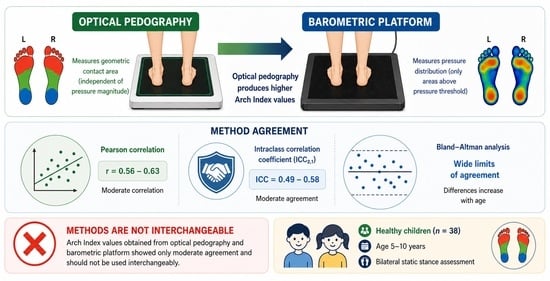
Share and Cite
Gajdoš, M.; Čuj, J.; Hnatová, K.; Mikuľáková, W.; Kendrová, L.D. Comparison of Arch Index Derived from Optical Pedography and Barometric Platform in Children: A Method Agreement Study. J. Funct. Morphol. Kinesiol. 2026, 11, 228. https://doi.org/10.3390/jfmk11020228
Gajdoš M, Čuj J, Hnatová K, Mikuľáková W, Kendrová LD. Comparison of Arch Index Derived from Optical Pedography and Barometric Platform in Children: A Method Agreement Study. Journal of Functional Morphology and Kinesiology. 2026; 11(2):228. https://doi.org/10.3390/jfmk11020228
Chicago/Turabian StyleGajdoš, Miloslav, Jakub Čuj, Katarína Hnatová, Wioletta Mikuľáková, and Lucia Demjanovič Kendrová. 2026. "Comparison of Arch Index Derived from Optical Pedography and Barometric Platform in Children: A Method Agreement Study" Journal of Functional Morphology and Kinesiology 11, no. 2: 228. https://doi.org/10.3390/jfmk11020228
APA StyleGajdoš, M., Čuj, J., Hnatová, K., Mikuľáková, W., & Kendrová, L. D. (2026). Comparison of Arch Index Derived from Optical Pedography and Barometric Platform in Children: A Method Agreement Study. Journal of Functional Morphology and Kinesiology, 11(2), 228. https://doi.org/10.3390/jfmk11020228