


Abstract
Sports-related injuries remain a major challenge in team sports, with important consequences for athlete health, performance, and team success. Recent advances in artificial intelligence (AI) and sensor-based monitoring technologies have enabled the integration of large volumes of training, competition, and physiological data to support injury prediction and risk modelling. However, the literature is characterised by substantial methodological diversity, limiting the ability to draw consistent conclusions. Hence, this scoping review aimed to map the existing evidence on the use of AI and sensor-based monitoring technologies for injury prediction and risk modelling in team sports, and to identify key methodological trends and research gaps. The scoping review was conducted in accordance with the PRISMA-ScR guidelines. Systematic searches were performed in PubMed and Scopus. Eligible studies included team-sport athletes and applied AI or machine learning approaches to predict injury occurrence, injury risk, or related outcomes using data derived from wearable or monitoring systems. Data were charted on study characteristics, sports and competition level, data sources, modelling techniques, validation strategies, and performance metrics. The database search yielded 123 records (PubMed: n = 37; Scopus: n = 86). After screening and eligibility assessment, 11 studies met the inclusion criteria. Most studies focused on football and rugby and relied primarily on wearable-derived data, particularly GPS and inertial sensor outputs. Common predictors included external workload variables, training exposure, previous injury history, and, in some studies, wellness or physiological markers. A wide range of models was reported, including logistic regression, decision trees, random forests, support vector machines, and neural networks. Validation strategies and reported performance varied markedly, and external validation was rarely undertaken. Across the included studies, injury risk was most consistently associated with external workload metrics, previous injury history, and internal or physiological indicators of recovery and readiness. However, current models remain limited by heterogeneous methodologies, single-team datasets, and the lack of external validation. Future research should emphasise multimodal data integration and multi-centre validation to develop reliable, interpretable, and practically applicable AI-based injury prediction systems.
1. Introduction
Sports-related injuries remain a major challenge in team sports, with substantial implications for athlete health, performance, and career longevity, as well as for the economic and organisational sustainability of sporting programmes. Injury epidemiology has traditionally focused on quantifying injury incidence, prevalence, and severity, and on identifying risk factors associated with injury occurrence [1,2]. These efforts provide the foundation for evidence-based injury prevention strategies and guide medical and training decisions in applied settings. In addition to descriptive epidemiology, considerable efforts have been made to estimate and model injury risk, particularly through the monitoring of training load and its relationship with injury occurrence. Early approaches focused on workload-based models, including cumulative load, training monotony, and strain, as well as the acute-to-chronic workload ratio (ACWR), which has been widely used to assess fluctuations in training demand and their association with injury risk [3,4,5]. A large body of evidence has demonstrated a consistent association between training load and injury risk across different athletic populations [6]. Furthermore, the concept of the training–injury prevention paradox suggests that appropriately high chronic workloads may have a protective effect against injury, whereas rapid spikes in load increase injury risk [5]. Empirical studies using ACWR models have also shown that sudden increases in workload are associated with significantly higher injury likelihood [7]. Although such models have contributed to understanding load–injury relationships, their predictive capacity remains limited when applied at the individual level, highlighting the complexity and multifactorial nature of injury mechanisms.
The rapid development of wearable technologies and athlete monitoring systems has enabled the continuous collection of high-resolution data across multiple domains. External load is commonly quantified using global positioning system (GPS) devices and inertial measurement units (IMUs), capturing variables such as distance covered, velocity profiles, and acceleration–deceleration patterns [8,9]. In parallel, internal load can be assessed through physiological and perceptual measures, including heart rate responses, session rating of perceived exertion (sRPE), and subjective wellness indicators [10,11]. Monitoring both internal and external load has been widely recommended to better understand athlete responses and reduce injury risk [12]. Practical frameworks have also emphasised the importance of combining physiological and biomechanical load pathways to understand adaptation and injury mechanisms [13]. Additionally, tracking systems have been shown to support training planning and injury risk management through objective quantification of external load [14]. The integration of these data sources allows for a more comprehensive representation of the athlete’s response to training, facilitating the translation of external workload into internal physiological stress. With the widespread adoption of athlete monitoring systems, including wearable sensors and digital performance tracking technologies, injury surveillance has progressively shifted from descriptive reporting toward more data-driven and predictive approaches.
External load refers to the physical work completed by the athlete and is commonly quantified through metrics such as total distance covered, high-speed running, sprint distance, accelerations, and decelerations derived from GPSs, local positioning systems (LPSs) and inertial sensor systems. On the other hand, internal load reflects the individual physiological and psychological response to the imposed workload and is typically assessed using measures such as heart rate, sRPE, wellness questionnaires, and fatigue-related indicators. The distinction between internal and external load is important because athletes may respond differently to similar external demands depending on fitness level, recovery status, and contextual factors.
Early investigations into injury risk in sport have primarily relied on traditional statistical methods to examine associations between workload, physical characteristics, and injury outcomes. Techniques such as linear and logistic regression, survival analysis, and correlation-based models have been widely applied to estimate injury risk and to explore potential predictors at the population level [15]. Traditional monitoring approaches have also incorporated physiological and perceptual markers such as heart rate, training impulse (TRIMP), and subjective fatigue measures to evaluate training stress and injury risk [11]. Heart rate monitoring has been extensively used as a valid indicator of internal load and physiological stress in team sports [16]. More broadly, training load monitoring frameworks combining internal and external metrics have been proposed as essential tools for optimising performance and minimising injury risk [17]. Although these approaches have generated important insights into injury mechanisms and training–injury relationships, they are inherently limited in their capacity to handle high-dimensional data, complex interactions, and non-linear patterns [18]. Furthermore, traditional statistical models often assume stable and homogeneous relationships across individuals, which may not adequately reflect the dynamic and multifactorial nature of injury risk in elite and sub-elite sport contexts [3].
In the modern era of sport science, the rapid expansion of data availability and the development of advanced analytical techniques have transformed how athlete performance and injury risk are assessed. More recently, machine learning (ML) has emerged as a promising alternative for injury prediction and risk modelling. ML approaches differ from traditional statistical techniques because they are designed to identify complex, non-linear, and multidimensional relationships within large datasets without requiring predefined assumptions regarding variable interactions. Such approaches are particularly relevant in sports injury prediction, where injury occurrence is influenced by multiple interacting physiological, biomechanical, historical, and contextual factors. Specifically, ML approaches are well suited to analysing large and heterogeneous datasets derived from wearable devices, training logs, and physiological monitoring systems, and may better capture interactions among workload variables, contextual factors, and individual responses [19,20,21]. Alongside these developments, explainable artificial intelligence (XAI) techniques have been introduced to improve the interpretability of complex predictive models. By providing information on feature importance and decision pathways, XAI methods address concerns related to the “black box” nature of many ML algorithms and support transparency and trust in applied environments [22,23]. In sports medicine and performance settings, interpretability is particularly important to facilitate communication between analysts, clinicians, and coaching staff, and to enable the translation of model outputs into practical and ethical decision-making.
Despite growing interest in AI-based injury prediction, the existing literature remains methodologically heterogeneous and fragmented [24]. Studies differ considerably in terms of the sports examined, the type and granularity of sensor-derived data, feature engineering strategies, modelling techniques, validation procedures, and performance metrics. In addition, limited attention has been devoted to external validation and to the clinical interpretability of model outputs, which constrains the generalisability and real-world applicability of many proposed models. To date, no synthesis has comprehensively mapped how AΙ and sensor-based monitoring technologies have been applied to injury prediction and risk modelling across team sports. Therefore, the aim of this scoping review is to systematically map the literature on the use of AI and sensor-based monitoring technologies for injury prediction and injury-related risk modelling in team sports, primarily focusing on studies examining time-loss, non-contact, or workload-related injury outcomes. Specifically, this review aims to describe the characteristics of the included studies, the data sources and modelling approaches employed, and the strategies used for model validation and interpretation, while identifying key methodological limitations and priorities for future research.
2. Materials and Methods
This scoping review was conducted in accordance with the Preferred Reporting Items for Systematic Reviews and Meta-Analyses extension for Scoping Reviews (PRISMA-ScR) 22-item checklist to ensure a rigorous, consistent, and transparent review process [25,26,27,28]. By adhering to the PRISMA-ScR framework, this study sought to maintain high methodological standards, facilitate reproducibility, and enhance the reliability and validity of the qualitative synthesis. The protocol for this scoping review was prospectively registered on the Open Science Framework (OSF; https://osf.io/xnr7q, accessed on 30 January 2026) to enhance methodological transparency and reproducibility.
2.1. Literature Searches
A systematic literature search was performed using the PubMed and Scopus databases. These databases were selected to ensure comprehensive coverage of biomedical, sports science, and technology-oriented research. PubMed and Scopus were selected because together they provide extensive coverage of biomedical, sports science, engineering, and interdisciplinary research relevant to athlete monitoring, wearable technologies, and AI-based modelling. In addition, Scopus includes broader indexing of sports technology and data science literature, while PubMed provides strong coverage of sports medicine and health-related research. Searches were conducted on 18 January 2026. The search strategy combined keywords and phrases related to team sports, sports injuries, injury prediction and risk modelling, artificial intelligence, and sensor-based monitoring technologies. Searches were applied to the Title and Abstract fields in each database and included terms associated with AI and ML (e.g., “artificial intelligence”, “machine learning”, “deep learning”), injury-related outcomes (e.g., “injury prediction”, “risk modelling”, “prognosis”), team sports (e.g., “football”, “rugby”, “basketball”, “hockey”), and wearable or monitoring technologies (e.g., “global positioning system”, “inertial measurement units”, “wearable sensors”, “training load”). The full search strategies for each database are provided in the Supplementary Materials File S1.
2.2. Eligibility Criteria
2.2.1. Inclusion Criteria
Only peer-reviewed journal articles were considered to ensure scientific quality and reliability. The review focused on studies published between 1 January 2014 and 18 January 2026 in order to capture contemporary developments in AI and athlete monitoring technologies. The 2014 starting date was selected because it coincides with the broader adoption of wearable athlete monitoring technologies and the increasing application of contemporary machine learning methods within sports performance and injury research. Eligible studies were required to involve athletes participating in team sports and to apply AI or ML approaches to predict injury occurrence, injury risk, or related injury outcomes. Studies were also required to use data derived from wearable devices or athlete monitoring systems, such as global positioning systems (GPSs), inertial measurement units (IMUs), physiological sensors, or workload monitoring platforms.
2.2.2. Exclusion Criteria
Studies were excluded if they were published before 2014, were not written in English, or were not peer-reviewed journal articles. Additional exclusions included conference proceedings, books, editorials, commentaries, and review articles. Studies were also excluded if they did not address injury-related outcomes, did not apply artificial intelligence or machine learning methods, focused exclusively on individual sports or non-athlete populations, or examined rehabilitation or return-to-play processes without a predictive modelling component. Articles with inaccessible full texts were also excluded to ensure complete evaluation. For additional reporting transparency, the eligibility criteria were also structured according to an adapted PICOS framework provided in Appendix A (Table A1).
2.3. Data Extraction
The study selection process was conducted independently by two reviewers (M.T and C.K.), who screened titles, abstracts, and full texts for relevance according to the predefined eligibility criteria. All retrieved records were initially compiled into a spreadsheet, and duplicate entries were removed. Title and abstract screening was performed first, followed by full-text assessment of potentially eligible articles. Disagreements at any stage of the screening process were resolved through discussion and consensus.
Following study selection, data extraction was carried out independently by the same two reviewers to ensure consistency and accuracy. A standardised data charting form, which was piloted by the review team prior to full extraction, was used to capture key variables across studies. Extracted information included publication characteristics, sport and competition level, sample size and participant characteristics, data sources and monitoring technologies, input variables, AI or ML models applied, validation strategies, and reported performance outcomes. A descriptive synthesis approach was employed to summarise and organise the charted data, allowing for identification of patterns and thematic trends across studies in terms of data sources, modelling approaches, and methodological quality. This structured process ensured that the final set of included studies was both relevant to the research question and methodologically robust.
3. Results
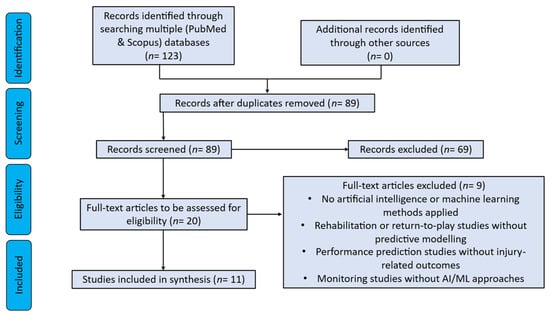
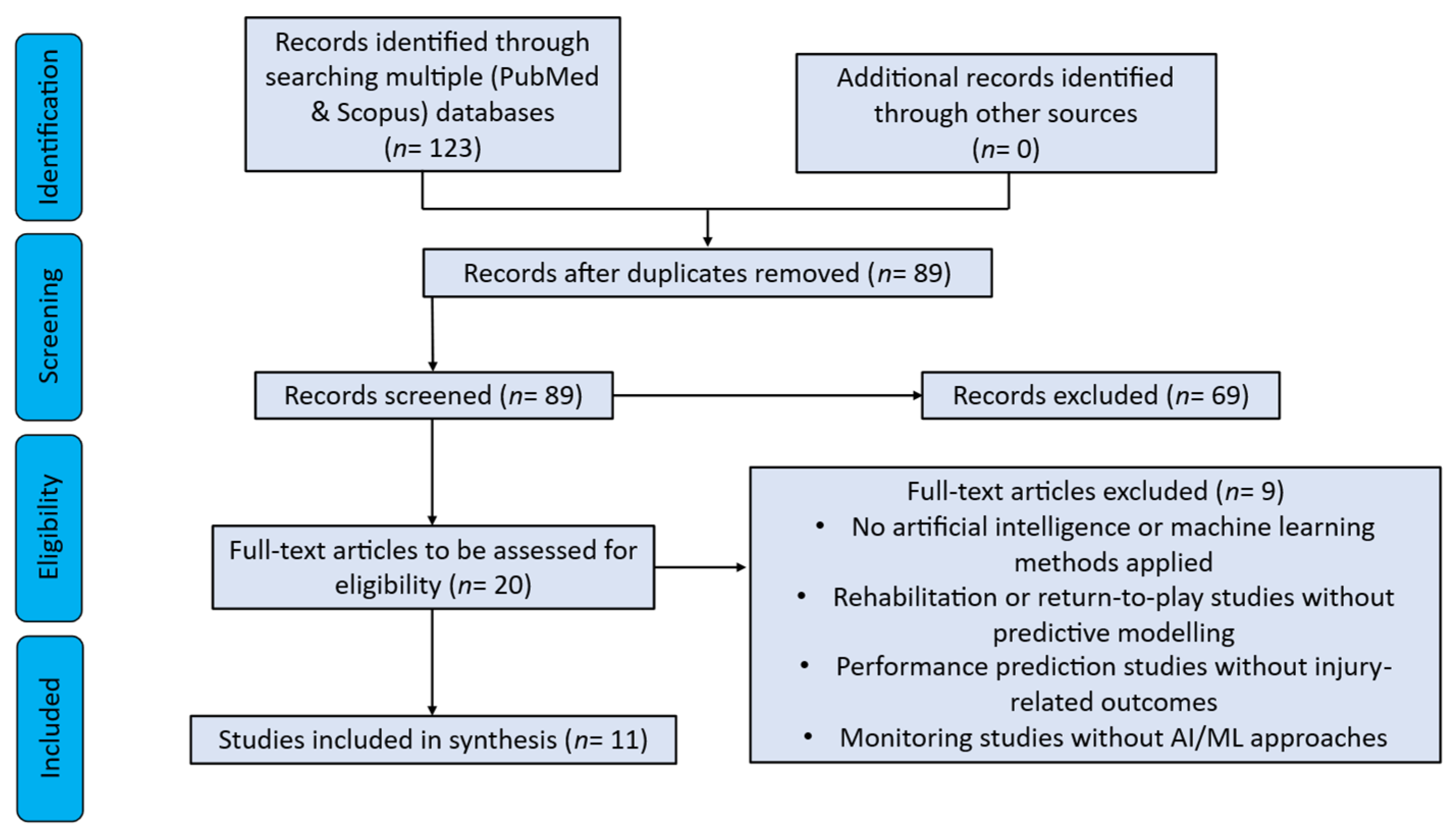
The initial database search yielded a total of 123 records, including 37 articles from PubMed and 86 articles from Scopus. After removal of duplicate records, the remaining studies were screened based on their titles and abstracts. Articles that did not address injury prediction or risk modelling in team sports using artificial intelligence and monitoring technologies were excluded. Full-text assessment of potentially eligible studies was subsequently performed. Following this screening and eligibility process, 11 studies met the predefined inclusion criteria and were included in the qualitative synthesis. The study selection process is illustrated in Figure 1 using a PRISMA-ScR flow diagram.
Figure 1.
Workflow diagram of the screening methodology according to PRISMA-ScR guidelines.
3.1. Characteristics of Included Studies
The 11 included studies were published between 2014 and 2026 and were conducted predominantly in Europe and Australia, with a smaller number originating from North America. Most investigations focused on professional or elite-level athletes, while a smaller proportion included semi-professional or youth populations.
Football was the most frequently investigated sport, followed by rugby, American football, and Australian football. The duration of data collection varied across studies, ranging from single-season monitoring of individual teams to multi-season datasets including several squads. Sample sizes also differed considerably, reflecting variations in team size, observation periods, and data availability.
Injury outcomes were defined heterogeneously. Most studies focused on time-loss injuries, whereas others adopted broader definitions based on physical complaints or medical diagnosis. The majority of the studies employed retrospective designs using historical training and injury records, while only a limited number implemented prospective or temporally structured prediction approaches. Among the included studies, most adopted retrospective observational designs (n = 8), while only a limited number used temporally separated or prospective prediction frameworks (n = 3). Sample sizes ranged from 18 to 133 athletes, and monitoring periods varied from single-season datasets to multi-season longitudinal observations spanning up to four seasons. Details of each included study are presented in Table 1.
3.2. Data Sources and Monitoring Technologies
All included studies utilised data derived from athlete monitoring systems. Wearable technologies constituted the primary source of input data, particularly GPS devices and IMUs. External workload variables were consistently reported and included total distance covered, high-speed running distance, sprint distance, and counts of accelerations and decelerations. Several studies also incorporated cumulative workload measures, rolling averages, and workload ratios to represent short-term and long-term training exposure.
In addition to external workload metrics, a subset of studies integrated internal load indicators, such as heart rate-based variables, ratings of perceived exertion, and subjective wellness or fatigue scores. Historical injury information was commonly used as an input variable, alongside contextual factors including playing position, match exposure, training frequency, and competition density. Some studies also incorporated calendar-related variables, such as days between matches or training sessions.
Feature construction and temporal aggregation strategies varied across investigations. Differences were observed in the length of aggregation windows, the frequency of feature updates, and the use of raw versus derived variables. Preprocessing approaches, including data normalisation and handling of missing values, were not consistently described across studies.
3.3. Modelling Approaches and Predictive Outcomes
A wide range of AI and ML techniques were applied across the included studies. Commonly reported models included logistic regression, decision trees, random forests, support vector machines, and artificial neural networks. Several investigations compared multiple algorithms within the same dataset, whereas others focused on a single modelling approach. Tree-based and ensemble methods were among the most frequently employed techniques.
Validation strategies varied across studies. Most relied on internal validation procedures, such as k-fold cross-validation or split-sample testing, whereas external validation using independent datasets was rarely reported. Only a small number of studies adopted temporally separated training and testing periods to reflect prospective prediction scenarios.
Performance was assessed using a range of metrics, most commonly accuracy, sensitivity, specificity, and the area under the receiver operating characteristic curve (AUC). Some studies also reported precision, recall, or F1-scores to account for class imbalance. A limited number of studies reported the use of class imbalance handling techniques or analyses of model explainability.
Considerable methodological heterogeneity was observed not only in modelling approaches but also in feature engineering procedures, injury definitions, aggregation windows, and validation frameworks, limiting direct comparison across studies and reducing reproducibility.
3.4. Study-by-Study Summary of Application Domains
Across the 11 included studies, the vast majority concentrated on injury prediction in football. Martins et al. used longitudinal monitoring data to model muscle injury risk, with tree-based ensemble methods performing best and both internal load (RPE) and external workload variables, including total distance, accelerations, decelerations, high-speed running, and time spent in high-intensity zones, identified as the most influential features [29]. Similarly, Saberisani et al. [30] and Freitas et al. [31] applied machine learning models to GPS-derived workload data, reporting the best performance with ensemble or support vector machine approaches. In these studies, distances covered at moderate and high speeds, decelerations, player load, velocity, acceleration, session type, and playing position were among the most important predictors. Tsilimigkras et al. also used training load data in soccer, with gradient-boosted models highlighting both acute load deviations, such as sprint counts, heart rate-based load, and time spent at 90–100% of maximal heart rate, and cumulative load variables, including total distance, high-speed running, and sprint distance [32].
Two studies by Rossi and colleagues explored different modelling strategies. In their earlier work, Rossi et al. used GPS-derived training data and identified three key predictors, time since previous injury (PI), high-speed running variation (dHSR), and total distance monotony (dTOT), through recursive feature elimination, with a decision tree providing the best performance [19]. In a later study, Rossi et al. incorporated blood-derived biomarkers alongside monitoring data, showing improved predictive performance when hematological and hormonal variables such as hematocrit, hemoglobin, red blood cell count, ferritin, and testosterone were included alongside external workload metrics [33].
In rugby contexts, Duffuler et al. applied a recurrent neural network to model readiness and injury risk across a season, capturing sequential workload patterns [34]. Key predictors included high-intensity running distances in preceding days and player age, indicating the importance of both recent workload exposure and individual characteristics. Ren et al. used GPS-derived metrics and machine learning models to predict injury risk in professional rugby players, with random forest models achieving the best results [35]. The most influential predictors varied by playing position and included monotony of sprint and very high-speed running, cumulative acceleration loads, high-speed running distance, and high-intensity accelerations and decelerations.
Matas-Bustos et al. focused on feature engineering rather than a specific sport context, proposing advanced methods for calculating acute-to-chronic workload ratios [36]. Their gradient-boosted models demonstrated improved injury forecasting when variables such as total distance, speed, high-intensity efforts, accelerations, decelerations, impacts, player load, and workload changes were incorporated.
Outside of association football, Lyubovsky et al. examined injury prediction in American football using GPS, training load, and survey-based wellness data [37]. Their models showed moderate predictive performance, with subjective wellness indicators and injury history, particularly previous injuries, perceived soreness, and recovery status, emerging as the most influential predictors, while many GPS-derived variables showed limited contribution. In Australian football, Carey et al. applied multivariate predictive models based on training load data [38]. Although model performance was modest, cumulative load, acute and chronic workload, ACWR, monotony, and strain were identified as key variables, with improved performance observed when modelling specific injury types.
Across all studies, considerable variability was observed in prediction targets, input variables, modelling techniques, and validation strategies, as detailed in Table 1.
Table 1.
Characteristics of included studies.
4. Discussion
This scoping review synthesised evidence from 11 studies examining the use of AI and sensor-based monitoring technologies for injury prediction and risk modelling in team sports. Most of the included studies were published within the last three years, reflecting the growing interest in data-driven approaches to support injury prevention. However, the field remains methodologically fragmented, with substantial variation in injury definitions, monitoring inputs, feature engineering procedures, modelling strategies, and validation frameworks. Such heterogeneity limits meaningful comparison across studies and constrains the translation of findings into applied settings.
Given these inconsistencies, the present scoping review was designed to map and critically synthesise the current literature rather than perform quantitative evidence pooling. Importantly, the findings suggest that the current limitations of AI-based injury prediction in team sports are not solely related to modelling sophistication, but also to inconsistent data collection practices, limited dataset quality, insufficient external validation, and the absence of standardised analytical pipelines. Collectively, these issues restrict the reproducibility, generalisability, and practical applicability of current AI-based injury prediction models.
4.1. Important Variables and Feature Engineering
Across the included studies, workload-related variables consistently emerged as the most prominent predictors of injury risk. Frequently reported inputs included total distance covered, high-speed running distance, sprint distance, accelerations and decelerations, session duration, and cumulative workload metrics derived from GPS and inertial sensor data. These variables were typically operationalised as daily, weekly, or multi-week aggregates to reflect both acute and chronic training demands. Historical injury information and indicators of training exposure were also commonly incorporated, consistent with their established role as risk factors in sports injury epidemiology. Several studies further included contextual variables such as playing position, match participation, and competition density to capture situational contributors to injury risk. Evidence from individual studies further highlighted the interaction between workload and injury history. For example, recursive feature selection in one investigation reduced the predictor set to three key variables, time since previous injury, variations in high-speed running, and total distance monotony, demonstrating the combined influence of previous injury status and workload fluctuations on injury risk.
These findings are consistent with earlier non-AI research, which has identified training load, particularly external load metrics, as a key modifiable risk factor for injury, with both excessive loads and rapid load increases associated with elevated injury risk [5,6]. Similarly, ACWR-based models have demonstrated that spikes in workload are strongly associated with injury likelihood, further supporting the importance of workload dynamics rather than absolute values alone [7]. In addition to workload-related metrics, some studies incorporated broader physiological or performance-related features.
The distinction between internal and external load is well supported in previous research, where external load reflects the work performed, while internal load captures the individual physiological and psychological response to that work [17,40]. Moreover, recent frameworks emphasise that combining these two dimensions is essential for accurately understanding adaptation and injury risk [13]. Internal load measures, including heart rate-based variables, ratings of perceived exertion, and subjective assessments of wellness or fatigue, were less consistently applied but were reported in some studies to enhance predictive performance when combined with external workload metrics. However, the contribution of these variables was rarely evaluated systematically, and their inclusion was often driven by data availability rather than formal optimisation procedures. In one study, subjective wellness indicators, particularly perceived soreness and overall recovery scores, showed the highest predictive power, outperforming several GPS-derived workload variables. This finding aligns with previous literature suggesting that internal load indicators, such as heart rate and perceived exertion, can provide valuable insight into athlete fatigue and physiological stress, sometimes exceeding the explanatory value of external load metrics alone [11,16]. Additionally, subjective load measures have been shown to be effective, low-cost tools for capturing psychophysiological responses to training [41]. Nevertheless, these findings do not necessarily indicate that internal load indicators are inherently superior to external load metrics for injury prediction. The observed differences may partly reflect variations in study design, methodological approaches, and the use of workload variables derived from arbitrary or non-standardised measurement units. Another important factor may be the excessive number and diversity of external load variables generated by commercial monitoring systems, which often differ substantially between manufacturers and proprietary software platforms. Importantly, the identification of influential predictors within ML models should not be interpreted as evidence of causal relationships. Most included studies were observational and retrospective in nature, meaning that the reported models primarily capture statistical associations and predictive patterns rather than mechanistic explanations of injury occurrence. Consequently, variables such as external workload metrics may indicate increased injury likelihood without necessarily representing direct causal factors.
Feature engineering strategies varied considerably across investigations. While some studies relied primarily on raw sensor outputs or manufacturer-derived workload metrics, others constructed higher-level features using temporal aggregation, rolling averages, and ratio-based indicators such as ACWRs. Several studies applied explicit feature selection procedures, including correlation-based filtering, univariate statistical screening, and model-based importance ranking. In particular, recursive feature elimination (RFE) was employed in some investigations to iteratively remove less informative predictors and retain a reduced subset of variables that optimised model performance. A smaller number of studies implemented dimensionality reduction techniques, such as principal component analysis (PCA) or regularisation-based methods, to address multicollinearity and manage high-dimensional feature spaces. From a practical perspective, the absence of standardised feature engineering and preprocessing pipelines may substantially limit comparability between clubs, competitions, wearable systems, and commercial software platforms. Differences in aggregation windows, proprietary workload calculations, filtering procedures, and firmware updates may lead to inconsistent input representations, thereby affecting both model reproducibility and transferability across sporting environments. Indicatively, commercial data-processing software associated with wearable sensor systems may generate more than 50 workload-related variables, substantially increasing the complexity of data interpretation and feature selection for analysts and practitioners. Consequently, many newly derived variables or composite metrics may require further validation regarding their predictive value and practical relevance before being incorporated into applied injury prediction frameworks.
Despite these advances, traditional (non-AI) studies have largely relied on predefined workload metrics and simpler aggregation strategies, often without systematic feature optimisation, highlighting a key methodological difference between conventional and machine learning approaches [5,17]. Given the inherently imbalanced nature of injury datasets, with relatively few injury events compared with non-injury observations, some studies adopted data-level strategies to mitigate class imbalance. These included oversampling approaches, most notably the Synthetic Minority Over-sampling Technique (SMOTE), to generate artificial injury cases and improve model sensitivity to rare events. However, the use of SMOTE and related techniques was inconsistent, and few studies systematically compared performance with and without synthetic data augmentation. The length of aggregation windows and the frequency of feature updates differed widely, ranging from short-term daily summaries to multi-week cumulative measures. Nevertheless, only a minority of studies clearly reported the criteria used for feature inclusion, feature elimination, or synthetic data generation, or examined the impact of these procedures on predictive performance. In most cases, feature construction and selection were guided by established workload conventions rather than by systematic, cross-validated optimisation.
Across the 11 included studies, several predictors consistently emerged as the most influential factors in injury risk estimation. The most frequently reported and influential variables were external load metrics, particularly total distance, high-speed running distance, sprint distance, and counts of accelerations and decelerations, which also represent the most commonly shared variables across athlete monitoring systems. Cumulative and temporally aggregated workload indicators, such as rolling averages, monotony indices, and acute-to-chronic workload ratios, were also repeatedly identified as important predictors. Previous injury history was one of the most consistent and influential factors across studies, often appearing among the top-ranked features. Internal load indicators, including perceived soreness, wellness or recovery scores, and heart rate-based measures, were also identified as important predictors in multiple investigations. Additionally, studies incorporating physiological and biochemical markers reported that hematological and hormonal variables such as hematocrit, hemoglobin, red blood cell count, ferritin, and testosterone contributed to improved individualised injury prediction.
Overall, these findings are highly consistent with the broader literature, which suggests that injury risk is multifactorial and best explained through the interaction between workload exposure, previous injury, and individual physiological response to training [5,6]. Τhe absence of standardised and transparently reported pipelines for feature engineering, feature selection, dimensionality reduction, and class imbalance handling represents a major source of methodological variability across studies. Differences in how predictors were derived, filtered, transformed, and balanced limit reproducibility and hinder meaningful comparison of modelling approaches.
4.2. Machine Learning Approaches
A wide range of ML models was applied across the included studies, reflecting the exploratory nature of this research field. Commonly reported algorithms included logistic regression, decision trees, random forests, support vector machines, gradient-boosted models, and artificial neural networks. In addition, several studies implemented more advanced deep learning approaches, such as recurrent neural networks (RNNs) and long short-term memory (LSTM) architectures, particularly in attempts to capture temporal patterns in training load and injury risk. Extreme gradient boosting (XGBoost) and other ensemble-based techniques were also employed in some investigations to improve predictive performance. Importantly, algorithm selection was often based on empirical performance comparison rather than on theoretical justification or sport-specific modelling rationale. Tree-based and ensemble methods were frequently favoured because of their flexibility and ability to capture non-linear relationships, although few studies critically evaluated whether such approaches were optimal for the structure and quality of the available data.
Several studies implemented and compared multiple algorithms within the same dataset to identify the most suitable modelling approach, while others focused on a single technique tailored to their data structure or prediction objective. Ensemble and tree-based methods, particularly random forests and gradient-boosted models, were frequently employed because of their capacity to model non-linear relationships and complex interactions among workload, historical, physiological, and contextual predictors. Deep learning approaches were primarily used in studies aiming to model sequential or time-dependent patterns in player monitoring data.
Despite the frequent use of advanced algorithms, model development strategies varied substantially. Some studies adopted relatively simple classification frameworks to distinguish between injured and non-injured observations, whereas others attempted probabilistic risk estimation, short-term injury risk forecasting, or readiness prediction across training cycles or competitive periods. A number of investigations addressed class imbalance through resampling techniques, cost-sensitive learning, or threshold optimisation, although these procedures were not applied consistently and were often insufficiently described.
Although several studies reported improved predictive performance relative to traditional statistical approaches, the magnitude and robustness of these improvements varied widely. In many cases, gains in accuracy or discrimination were modest and dependent on the specific dataset, injury definition, and prediction horizon used. Some studies reported moderate performance levels, while others achieved higher discrimination for specific injury types or short-term risk windows. Importantly, model selection was typically driven by empirical comparison rather than by theoretical or domain-specific considerations, and few studies provided explicit justification for algorithm choice. Hyperparameter tuning procedures and optimisation strategies were also inconsistently reported, limiting reproducibility. Moreover, preprocessing pipelines, missing-data handling procedures, and hyperparameter optimisation strategies were inconsistently reported across studies, limiting reproducibility and increasing the potential risk of methodological bias.
Overall, the diversity of modelling approaches highlights both the flexibility of ML for injury prediction and the absence of consensus regarding optimal analytical strategies. The lack of standardised modelling frameworks, combined with inconsistent reporting of training procedures, feature pipelines, and parameter settings, constrains cross-study comparison and hinders cumulative knowledge building. These findings suggest that future research should move beyond purely exploratory model testing toward more principled and transparent modelling pipelines that incorporate domain knowledge, address data imbalance, and report methodological details in a reproducible manner. Hence, the findings indicate that many current AI-based injury prediction models remain primarily exploratory and context-specific rather than clinically validated systems capable of reliable implementation across sporting environments.
4.3. Validation Strategies and Predictive Results
Validation strategies varied considerably across the included studies. Most investigations relied on internal validation procedures, including k-fold cross-validation and random or stratified split-sample testing, whereas external validation using independent datasets was rarely undertaken. Only a small number of studies adopted temporally separated training and testing periods to reflect prospective prediction scenarios or season-based forecasting. This predominance of internal validation raises concerns regarding potential overfitting and optimistic estimates of predictive performance, particularly in studies based on single teams or short observation periods.
Performance was reported using a range of metrics, most commonly accuracy, sensitivity, specificity, and the area under the receiver operating characteristic curve (AUC). Several studies also reported precision, recall, or F1-scores to account for class imbalance. Reported predictive performance ranged from modest to high. Some investigations achieved only limited discrimination, with AUC values close to random classification, particularly when general non-contact injuries were considered. In contrast, higher predictive performance was reported in studies focusing on specific injury types, short-term risk windows, or enriched feature sets, including physiological or wellness-related variables. From a practical perspective, models demonstrating high overall accuracy but limited sensitivity to injury events may have restricted value in applied injury prevention settings, since failure to correctly identify true injury cases substantially reduces clinical usefulness.
Substantial variability in performance was observed across studies and was influenced by differences in injury definitions, prediction horizons, class distributions, and feature engineering strategies. In several cases, relatively high accuracy values were achieved despite limited sensitivity to injury events, reflecting the challenges posed by highly imbalanced datasets and the low incidence of injuries in elite team sports.
The lack of standardised validation frameworks and outcome definitions precluded meaningful comparison of predictive performance across studies and limited the ability to draw robust conclusions regarding model superiority. Furthermore, the infrequent use of external validation raises concerns about the generalisability of proposed models beyond the specific teams, seasons, or competitive contexts in which they were developed.
Importantly, not all forms of heterogeneity observed across studies are equally problematic. While differences in model architecture may reflect legitimate analytical exploration, inconsistencies in injury definitions, feature engineering procedures, and validation strategies directly affect reproducibility, comparability, and the ability to externally validate predictive models across teams and sporting contexts.
Collectively, these findings suggest that many currently proposed AI-based injury prediction models may remain insufficiently robust for reliable implementation in real-world clinical or performance settings. Models developed using small, single-team datasets with limited external validation are particularly vulnerable to overfitting and context-specific bias.
4.4. Explainability and Model Transparency
In most studies, explainability was operationalised through relatively simple approaches, such as feature importance rankings, regression coefficients, or tree-based importance measures, rather than through comprehensive XAI frameworks capable of supporting clinically interpretable decision-making at the individual athlete level. Only a minority of studies explicitly addressed model interpretability or incorporated XAI techniques. When explainability was considered, feature importance rankings, regression coefficients, or tree-based importance measures were used to identify influential predictors of injury risk. Across these studies, workload-related variables, particularly cumulative and high-intensity running measures, and previous injury history consistently emerged as key contributors to model predictions.
Nevertheless, most investigations prioritised predictive accuracy over interpretability, and few applied advanced XAI methods such as SHAP values or local explanation frameworks to explore individual-level predictions [42,43]. Moreover, explainability was rarely linked to clinical reasoning or decision-making processes, limiting its practical relevance. Given the clinical, operational, and ethical implications of injury prediction, insufficient attention to model transparency represents a critical shortcoming [44]. Interpretable models are necessary to support practitioner trust, enable interdisciplinary communication between data scientists and clinicians, and ensure that predictive outputs can be meaningfully integrated into training and medical decision-making. Consequently, explainability often remained descriptive rather than functionally integrated into applied decision-support processes, limiting its practical utility in interdisciplinary sport environments.
4.5. Geographical Distribution of Studies
The geographical distribution of the included studies was predominantly concentrated in Europe and Australia, with comparatively few investigations conducted in North America or other regions. This pattern likely reflects differences in access to wearable monitoring technologies, institutional support for data-driven performance analysis, and established research collaborations in elite team sport environments. In addition, the dominance of football- and rugby-based studies aligns with the popularity of these sports and the routine use of monitoring systems in professional leagues within these regions.
However, this geographical concentration limits the transferability of findings to sporting contexts characterised by different competition structures, training methodologies, and injury profiles. Regions with less developed monitoring infrastructure or different seasonal formats may exhibit distinct workload patterns and risk factors that are not captured in current models. Broader geographical representation, including studies from diverse sporting systems and resource settings, is therefore necessary to enhance the external validity and global applicability of injury prediction models.
4.6. Technology Characteristics and Limitations
Wearable technologies, particularly GPS units and IMUs, constituted the primary data sources across the included studies. These systems enable continuous quantification of external workload and movement characteristics, including distance covered, velocity profiles, and acceleration–deceleration patterns. In recent years, alternative tracking technologies have also emerged, including LPS devices and advanced IMU-based solutions. Importantly, these systems rely on different measurement technologies and signal acquisition principles. For example, GPS devices operate through satellite-based positioning, IMUs rely on inertial sensors and estimate movement-related variables from acceleration data across the three movement axes, and LPS technologies are based on ultra-wideband (UWB) radio-frequency infrastructure. Despite the increasing use of these systems in athlete monitoring, relatively few studies have directly examined the relationships and comparability of variables generated across different tracking technologies. Existing evidence suggests that LPS devices may demonstrate higher validity in open-field environments compared with some GPS devices operating at 10 Hz sampling frequency, although findings remain inconsistent across settings and movement demands. Consequently, further validation studies are required to investigate the relationships, equivalence, and interoperability of workload variables derived from different monitoring systems and reference technologies [45,46,47].
Compared with traditional GPS devices, which rely on satellite signals and are primarily suited for outdoor environments, LPS technologies operate using local radio-frequency infrastructure and can provide higher spatial accuracy and reliability in indoor settings or stadiums with signal obstruction. IMU-based systems, on the other hand, capture high-frequency motion data (e.g., acceleration, angular velocity) and are particularly effective for quantifying rapid changes in movement and mechanical load. Hybrid systems that combine GPS, LPS, and IMU data streams are increasingly used to enhance measurement precision and provide a more comprehensive representation of athlete workload.
Nevertheless, such technologies are subject to several technical constraints. Measurement error, signal loss, and inter-device variability may affect data quality, particularly in environments with limited satellite reception or during high-intensity movements. For example, GPS accuracy may deteriorate during rapid accelerations, changes in direction, or in congested playing environments, whereas LPS devices require infrastructure installation and calibration, which may limit their accessibility. In addition, substantial differences exist in sampling frequency, data filtering procedures, and proprietary algorithms used by manufacturers to derive workload metrics, which may compromise comparability across studies. Furthermore, firmware and software updates introduced by manufacturers over time may alter signal processing, workload calculations, and variable outputs, potentially affecting longitudinal data consistency and comparability across seasons or studies.
Beyond technical issues, reliance on sensor-derived metrics alone may provide an incomplete representation of injury risk. Physiological, psychological, and contextual contributors, such as fatigue, sleep quality, stress, recovery status, and match congestion, are often underrepresented or omitted. The limited integration of multimodal data sources may restrict model sensitivity to complex injury mechanisms. These findings highlight the need for predictive systems that combine wearable-derived variables with internal load, wellness, and contextual data to better reflect the multifactorial nature of sports injuries. Ultimately, there is a growing need for the development of integrated workload indicators capable of simultaneously incorporating external load, internal load, physiological responses, contextual factors, and recovery-related parameters in order to provide a more comprehensive and ecologically valid representation of athlete burden and injury risk.
4.7. Limitations of the Included Studies
Several methodological limitations were evident across the included studies. Sample sizes were frequently small and often restricted to single teams or seasons, limiting statistical power and increasing the risk of overfitting. Observation periods were typically short, reducing the ability to capture long-term injury patterns and cumulative workload effects. Inconsistent injury definitions and outcome measures further complicated cross-study comparison, with some investigations focusing on time-loss injuries and others including any physical complaint.
Many studies employed retrospective designs based on historical monitoring and injury records, which may introduce bias related to data completeness, reporting accuracy, and temporal alignment between predictors and outcomes. Handling of missing data was seldom described in detail, and few studies reported sensitivity analyses to assess the robustness of their findings. Moreover, most investigations focused on model development and performance metrics, while relatively little attention was paid to clinical interpretability, implementation feasibility, or the potential behavioural consequences of predictive outputs. The lack of prospective validation and real-world testing remains a substantial barrier to translation.
4.8. Limitations of This Scoping Review
This scoping review has several limitations that should be acknowledged. The search strategy was restricted to studies published in English and indexed in PubMed and Scopus, which may have resulted in the omission of relevant research reported in other languages or databases. Grey literature and unpublished studies were not included, potentially introducing publication bias. The exclusion of grey literature may also have limited the inclusion of emerging methodological developments in this rapidly evolving field, particularly given the pace of innovation in wearable technologies and applied ML. The substantial heterogeneity in study designs, injury definitions, and analytical approaches precluded quantitative synthesis or formal meta-analysis. Therefore, conclusions regarding the relative validity, robustness, or superiority of specific modelling approaches should be interpreted cautiously.
In addition, as a scoping review, the primary objective was to map the extent and nature of existing research rather than to evaluate methodological quality or risk of bias. Consequently, no formal critical appraisal of included studies was undertaken. Although this approach is consistent with scoping review methodology, it limits the ability to draw definitive conclusions regarding the relative effectiveness of different modelling approaches.
Finally, a quantitative meta-analysis was not undertaken because of the substantial methodological and clinical heterogeneity across the included studies. Differences in injury definitions, prediction outcomes, monitoring systems, feature engineering procedures, machine learning architectures, validation strategies, and performance reporting precluded meaningful statistical pooling and direct quantitative comparison.
4.9. Future Research Directions
Future research should prioritise the development of standardised injury definitions and harmonised feature engineering procedures to improve comparability and reproducibility across studies. Greater emphasis should be placed on robust validation frameworks, including external validation across multiple teams, seasons, and competitive levels. Prospective study designs are required to assess predictive performance in real-world conditions and to determine whether model-informed interventions can meaningfully reduce injury incidence.
Importantly, future models should be trained on multi-team and multi-season datasets and externally tested on independent cohorts, in order to improve generalisability and reduce overfitting to team-specific characteristics. Current evidence suggests that many models are developed using single-team datasets, which limits their applicability across different sporting environments. This issue has also been highlighted in previous literature on training load and injury risk, where findings are often context-specific and influenced by team structure, competition demands, and monitoring practices [5,6].
In addition, future research should extend beyond a narrow focus on football and rugby and examine the applicability of injury prediction models across a broader range of team sports, including basketball, volleyball, futsal, and handball. Differences in game structure, physical demands, and scheduling may influence both workload patterns and injury mechanisms, and therefore model performance. Expanding research across sports contexts is essential to improve the external validity and practical applicability of AI-based injury prediction systems, as also suggested in athlete monitoring and tracking literature [14].
Advances in ΧAΙ should be leveraged to enhance transparency and interpretability, enabling practitioners to understand which variables drive risk predictions and why. Integration of physiological, psychological, and contextual variables alongside sensor-derived data may improve predictive accuracy and clinical relevance. Additionally, future work should explore ethical considerations, including data privacy, informed consent, and the potential unintended consequences of algorithm-driven decision-making in sport.
4.10. Practical Implications and Guidelines
From an applied perspective, injury prediction models should be implemented as decision-support tools rather than as deterministic or prescriptive systems. Predictive outputs should be interpreted alongside clinical assessment, coaching insight, and contextual information such as competition schedule and athlete readiness. Overreliance on algorithmic predictions without domain expertise may increase the risk of inappropriate training modifications or misclassification of injury risk.
To enhance real-world applicability, practitioners and organisations should prioritise the use of models that have been validated across multiple teams and, where possible, across different sports contexts, rather than relying on models developed within a single-team environment. Models trained and tested on diverse populations are more likely to capture the variability in training practices, competition demands, and athlete characteristics that exist across teams and sports.
Transparent reporting of model inputs, assumptions, and limitations is essential to avoid misinterpretation and to promote responsible use. Practitioners should be trained to understand basic principles of model uncertainty and performance metrics. The development of interdisciplinary teams involving sports scientists, clinicians, and data scientists is strongly recommended to ensure that predictive systems are technically robust, clinically meaningful, and ethically sound. Clear operational protocols should be established to define how predictive information is communicated and acted upon within performance and medical teams.
5. Conclusions
This scoping review mapped current applications of AI and sensor-based monitoring technologies for injury prediction in team sports. Across the included studies, injury risk was most consistently associated with three groups of predictors: external workload metrics, previous injury history, and internal or physiological indicators of recovery and readiness. These findings reinforce the multifactorial nature of injury risk and highlight the importance of integrated athlete monitoring approaches.
However, substantial heterogeneity was observed in data sources, feature engineering procedures, modelling strategies, and validation frameworks. Most studies relied on single-team datasets and internal validation, with limited use of external validation, multimodal data integration, or explainable modelling approaches. These limitations restrict the generalisability and practical applicability of current predictive models.
In an era characterised by the rapid expansion of athlete monitoring data, there is a growing need for the development of integrated monitoring ecosystems in which data collection, processing, and analytical methodologies are standardised across indoor and outdoor team sports. Validation studies examining the accuracy and comparability of workload monitoring systems, together with the reduction in and optimisation of monitoring variables representing specific components of internal and external load, may facilitate the long-term identification of the parameters most strongly associated with injury risk prediction.
AI-based injury prediction systems should therefore be considered decision-support tools rather than deterministic predictors. Future research should prioritise methodological standardisation, the integration of multiple data sources, and robust external validation across teams and contexts. Addressing these challenges is essential for developing reliable, interpretable, and clinically meaningful AI-driven tools that can effectively support injury prevention in team sports.
Supplementary Materials
The following supporting information can be downloaded at: https://www.mdpi.com/article/10.3390/jfmk11020204/s1, Supplementary File S1: Search Strategy.
Funding
The project is co-funded by the European Union—NextGenerationEU through the Recovery and Resilience Facility (RRF) for the period 2022–2025, with the contribution of the National Public Investment Programme (PIP) and national resources covering VAT under grant agreement 8238 (IRONMAN-ΥΠ3ΤA-0561410).
Institutional Review Board Statement
Not applicable.
Informed Consent Statement
Not applicable.
Data Availability Statement
No new data were created or analyzed in this study. Data sharing is not applicable to this article.
Conflicts of Interest
Authors N.A. and D.T. were employed by the company Novelcore. The remaining authors declare that the research was conducted in the absence of any commercial or financial relationships that could be construed as a potential conflict of interest.
Appendix A
Table A1.
Eligibility criteria according to an adapted PICOS framework.
References
- van Mechelen, W.; Hlobil, H.; Kemper, H.C.G. Incidence, Severity, Aetiology and Prevention of Sports Injuries. Sports Med. 1992, 14, 82–99. [Google Scholar] [CrossRef] [Scilit]
- Bahr, R.; Holme, I. Risk Factors for Sports Injuries—A Methodological Approach. Br. J. Sports Med. 2003, 37, 384. [Google Scholar] [CrossRef] [Scilit] [PubMed]
- Bittencourt, N.F.N.; Meeuwisse, W.H.; Mendonça, L.D.; Nettel-Aguirre, A.; Ocarino, J.M.; Fonseca, S.T. Complex Systems Approach for Sports Injuries: Moving from Risk Factor Identification to Injury Pattern Recognition—Narrative Review and New Concept. Br. J. Sports Med. 2016, 50, 1309. [Google Scholar] [CrossRef] [Scilit]
- Hulin, B.T.; Gabbett, T.J.; Blanch, P.; Chapman, P.; Bailey, D.; Orchard, J.W. Spikes in Acute Workload Are Associated with Increased Injury Risk in Elite Cricket Fast Bowlers. Br. J. Sports Med. 2014, 48, 708. [Google Scholar] [CrossRef] [Scilit]
- Gabbett, T.J. The Training—Injury Prevention Paradox: Should Athletes Be Training Smarter and Harder? Br. J. Sports Med. 2016, 50, 273–280. [Google Scholar] [CrossRef] [Scilit] [PubMed]
- Eckard, T.G.; Padua, D.A.; Hearn, D.W.; Pexa, B.S.; Frank, B.S. The Relationship Between Training Load and Injury in Athletes: A Systematic Review. Sports Med. 2018, 48, 1929–1961. [Google Scholar] [CrossRef] [Scilit] [PubMed]
- Murray, N.B.; Gabbett, T.J.; Townshend, A.D.; Blanch, P. Calculating Acute:Chronic Workload Ratios Using Exponentially Weighted Moving Averages Provides a More Sensitive Indicator of Injury Likelihood than Rolling Averages. Br. J. Sports Med. 2017, 51, 749. [Google Scholar] [CrossRef] [Scilit]
- Cummins, C.; Orr, R.; O’Connor, H.; West, C. Global Positioning Systems (GPS) and Microtechnology Sensors in Team Sports: A Systematic Review. Sports Med. 2013, 43, 1025–1042. [Google Scholar] [CrossRef] [Scilit]
- Scott, M.T.U.; Scott, T.J.; Kelly, V.G. The Validity and Reliability of Global Positioning Systems in Team Sport: A Brief Review. J. Strength Cond. Res. 2016, 30, 1470–1490. [Google Scholar] [CrossRef] [Scilit]
- Impellizzeri, F.M.; Rampinini, E.; Coutts, A.J.; Sassi, A.; Marcora, S.M. Use of RPE-Based Training Load in Soccer. Med. Sci. Sports Exerc. 2004, 36, 1042–1047. [Google Scholar] [CrossRef] [Scilit]
- Halson, S.L. Monitoring Training Load to Understand Fatigue in Athletes. Sports Med. 2014, 44, 139–147. [Google Scholar] [CrossRef] [Scilit]
- Bourdon, P.C.; Cardinale, M.; Murray, A.; Gastin, P.; Kellmann, M.; Varley, M.C.; Gabbett, T.J.; Coutts, A.J.; Burgess, D.J.; Gregson, W.; et al. Monitoring Athlete Training Loads: Consensus Statement. Int. J. Sports Physiol. Perform. 2017, 12, S2-161–S2-170. [Google Scholar] [CrossRef] [Scilit]
- Vanrenterghem, J.; Nedergaard, N.J.; Robinson, M.A.; Drust, B. Training Load Monitoring in Team Sports: A Novel Framework Separating Physiological and Biomechanical Load-Adaptation Pathways. Sports Med. 2017, 47, 2135–2142. [Google Scholar] [CrossRef] [Scilit] [PubMed]
- Torres-Ronda, L.; Beanland, E.; Whitehead, S.; Sweeting, A.; Clubb, J. Tracking Systems in Team Sports: A Narrative Review of Applications of the Data and Sport Specific Analysis. Sports Med.-Open 2022, 8, 15. [Google Scholar] [CrossRef] [Scilit] [PubMed]
- Drew, M.K.; Finch, C.F. The Relationship Between Training Load and Injury, Illness and Soreness: A Systematic and Literature Review. Sports Med. 2016, 46, 861–883. [Google Scholar] [CrossRef] [Scilit] [PubMed]
- Berkelmans, D.M.; Dalbo, V.J.; Kean, C.O.; Milanović, Z.; Stojanović, E.; Stojiljković, N.; Scanlan, A.T. Heart Rate Monitoring in Basketball: Applications, Player Responses, and Practical Recommendations. J. Strength Cond. Res. 2018, 32, 2383–2399. [Google Scholar] [CrossRef] [Scilit]
- Foster, C.; Rodriguez-Marroyo, J.A.; Koning, J.J. de Monitoring Training Loads: The Past, the Present, and the Future. Int. J. Sports Physiol. Perform. 2017, 12, S2-2–S2-8. [Google Scholar] [CrossRef] [Scilit] [PubMed]
- Wang, Z.Z.; Xia, X.; Chen, Q. Multi-Level Data Fusion Enables Collaborative Dynamics Analysis in Team Sports Using Wearable Sensor Networks. Sci. Rep. 2025, 15, 28210. [Google Scholar] [CrossRef] [Scilit]
- Rossi, A.; Pappalardo, L.; Cintia, P.; Iaia, F.M.; Fernàndez, J.; Medina, D. Effective Injury Forecasting in Soccer with GPS Training Data and Machine Learning. PLoS ONE 2018, 13, e0201264. [Google Scholar] [CrossRef] [Scilit]
- Mandorino, M.; Figueiredo, A.J.; Cima, G.; Tessitore, A. Predictive Analytic Techniques to Identify Hidden Relationships between Training Load, Fatigue and Muscle Strains in Young Soccer Players. Sports 2022, 10, 3. [Google Scholar] [CrossRef] [Scilit]
- Pillitteri, G.; Petrigna, L.; Ficarra, S.; Giustino, V.; Thomas, E.; Rossi, A.; Clemente, F.M.; Paoli, A.; Petrucci, M.; Bellafiore, M.; et al. Relationship between External and Internal Load Indicators and Injury Using Machine Learning in Professional Soccer: A Systematic Review and Meta-Analysis. Res. Sports Med. 2024, 32, 902–938. [Google Scholar] [CrossRef] [Scilit]
- Rudin, C. Stop Explaining Black Box Machine Learning Models for High Stakes Decisions and Use Interpretable Models Instead. Nat. Mach. Intell. 2019, 1, 206–215. [Google Scholar] [CrossRef] [Scilit]
- Hassija, V.; Chamola, V.; Mahapatra, A.; Singal, A.; Goel, D.; Huang, K.; Scardapane, S.; Spinelli, I.; Mahmud, M.; Hussain, A. Interpreting Black-Box Models: A Review on Explainable Artificial Intelligence. Cogn. Comput. 2024, 16, 45–74. [Google Scholar] [CrossRef] [Scilit]
- Chidambaram, S.; Maheswaran, Y.; Patel, K.; Sounderajah, V.; Hashimoto, D.A.; Seastedt, K.P.; McGregor, A.H.; Markar, S.R.; Darzi, A. Using Artificial Intelligence-Enhanced Sensing and Wearable Technology in Sports Medicine and Performance Optimisation. Sensors 2022, 22, 6920. [Google Scholar] [CrossRef] [Scilit]
- Peters, M.D.; Marnie, C.; Tricco, A.C.; Pollock, D.; Munn, Z.; Alexander, L.; McInerney, P.; Godfrey, C.M.; Khalil, H. Updated Methodological Guidance for the Conduct of Scoping Reviews. JBI Evid. Implement. 2021, 19, 3–10. [Google Scholar] [CrossRef] [Scilit]
- Tricco, A.C.; Lillie, E.; Zarin, W.; O’Brien, K.K.; Colquhoun, H.; Levac, D.; Moher, D.; Peters, M.D.; Horsley, T.; Weeks, L. PRISMA Extension for Scoping Reviews (PRISMA-ScR): Checklist and Explanation. Ann. Intern. Med. 2018, 169, 467–473. [Google Scholar] [CrossRef] [Scilit]
- Kokkotis, C.; Kansizoglou, I.; Stampoulis, T.; Giannakou, E.; Siaperas, P.; Kallidis, S.; Koutra, M.; Koutra, C.; Beneka, A.; Bebetsos, E. Artificial Intelligence as Assessment Tool in Occupational Therapy: A Scoping Review. BioMedInformatics 2025, 5, 22. [Google Scholar] [CrossRef] [Scilit]
- Retzepis, N.-O.; Avloniti, A.; Kokkotis, C.; Stampoulis, T.; Balampanos, D.; Gkachtsou, A.; Aggelakis, P.; Kelaraki, D.; Protopapa, M.; Pantazis, D.; et al. The Effect of Peak Height Velocity on Strength and Power Development of Young Athletes: A Scoping Review. J. Funct. Morphol. Kinesiol. 2025, 10, 168. [Google Scholar] [CrossRef] [Scilit]
- Martins, F.; Sarmento, H.; Gouveia, É.R.; Saveca, P.; Przednowek, K. Machine Learning-Based Prediction of Muscle Injury Risk in Professional Football: A Four-Year Longitudinal Study. J. Clin. Med. 2025, 14, 8039. [Google Scholar] [CrossRef] [Scilit] [PubMed]
- Saberisani, R.; Barati, A.H.; Zarei, M.; Santos, P.; Gorouhi, A.; Ardigò, L.P.; Nobari, H. Prediction of Football Injuries Using GPS-Based Data in Iranian Professional Football Players: A Machine Learning Approach. Front. Sports Act. Living 2025, 7, 1425180. [Google Scholar] [CrossRef] [Scilit] [PubMed]
- Freitas, D.N.; Mostafa, S.S.; Caldeira, R.; Santos, F.; Ferme, E.; Gouveia, É.R.; Morgado-Dias, F. Predicting Noncontact Injuries of Professional Football Players Using Machine Learning. PLoS ONE 2025, 20, e0315481. [Google Scholar] [CrossRef] [Scilit]
- Tsilimigkras, T.; Kakkos, I.; Matsopoulos, G.K.; Bogdanis, G.C. Enhancing Sports Injury Risk Assessment in Soccer through Machine Learning and Training Load Analysis. J. Sports Sci. Med. 2024, 23, 537. [Google Scholar] [CrossRef] [Scilit] [PubMed]
- Rossi, A.; Pappalardo, L.; Filetti, C.; Cintia, P. Blood Sample Profile Helps to Injury Forecasting in Elite Soccer Players. Sport Sci. Health 2023, 19, 285–296. [Google Scholar] [CrossRef] [Scilit]
- Duffuler, M.; Bourgain, M.; Haddad, Z.; Heraud, R.; Blanchard, S.; Rouch, P. Recurrent Neural Networks Model for Injury Prevention within a Professional Rugby Union Club: A Proof of Concept over One Season. Clin. Biomech. 2025, 130, 106600. [Google Scholar] [CrossRef] [Scilit]
- Ren, X.; Boisbluche, S.; Philippe, K.; Demy, M.; Äyrämö, S.; Rautiainen, I.; Ding, S.; Prioux, J. Global Positioning System-Derived Metrics and Machine Learning Models for Injury Prediction in Professional Rugby Union Players. Eur. J. Sport Sci. 2025, 25, e70057. [Google Scholar] [CrossRef] [Scilit] [PubMed]
- Matas-Bustos, J.B.; Mora-García, A.M.; de Hoyo Lora, M.; Nieto-Alarcón, A.; Gonzalez-Fernández, F.T. Advanced Feature Engineering in Acute: Chronic Workload Ratio (ACWR) Calculation for Injury Forecasting in Elite Soccer. PLoS ONE 2025, 20, e0327960. [Google Scholar] [CrossRef] [Scilit] [PubMed]
- Lyubovsky, A.; Liu, Z.; Watson, A.; Kuehn, S.; Korem, E.; Zhou, G. A Pain Free Nociceptor: Predicting Football Injuries with Machine Learning. Smart Health 2022, 24, 100262. [Google Scholar] [CrossRef] [Scilit]
- Carey, D.L.; Ong, K.; Whiteley, R.; Crossley, K.M.; Crow, J.; Morris, M.E. Predictive Modelling of Training Loads and Injury in Australian Football. Int. J. Comput. Sci. Sport 2018, 17, 49–66. [Google Scholar] [CrossRef] [Scilit]
- Fuller, C.W.; Ekstrand, J.; Junge, A.; Andersen, T.E.; Bahr, R.; Dvorak, J.; Hägglund, M.; McCrory, P.; Meeuwisse, W.H. Consensus Statement on Injury Definitions and Data Collection Procedures in Studies of Football (Soccer) Injuries. Scand. J. Med. Sci. Sports 2006, 16, 83–92. [Google Scholar] [CrossRef] [Scilit] [PubMed]
- Wing, C. Monitoring Athlete Load: Data Collection Methods and Practical Recommendations. Strength Cond. J. 2018, 40, 26–39. [Google Scholar] [CrossRef] [Scilit]
- Coyne, J.O.C.; Coutts, A.J.; Newton, R.U.; Haff, G.G. The Current State of Subjective Training Load Monitoring: Follow-Up and Future Directions. Sports Med.-Open 2022, 8, 53. [Google Scholar] [CrossRef] [Scilit] [PubMed]
- Colak, C.; Yagin, F.H.; Algarni, A.; Algarni, A.; Al-Hashem, F.; Ardigò, L.P. Proposed Comprehensive Methodology Integrated with Explainable Artificial Intelligence for Prediction of Possible Biomarkers in Metabolomics Panel of Plasma Samples for Breast Cancer Detection. Medicina 2025, 61, 581. [Google Scholar] [CrossRef] [Scilit] [PubMed]
- Retzepis, N.-O.; Avloniti, A.; Kokkotis, C.; Protopapa, M.; Stampoulis, T.; Gkachtsou, A.; Pantazis, D.; Balampanos, D.; Smilios, I.; Chatzinikolaou, A. Identifying Key Factors for Predicting the Age at Peak Height Velocity in Preadolescent Team Sports Athletes Using Explainable Machine Learning. Sports 2024, 12, 287. [Google Scholar] [CrossRef] [Scilit] [PubMed]
- Rico-González, M.; Holsbrekken, E.; Gómez-Carmona, C.D.; Ardigò, L.P. Machine Learning Applications for In-School Physical Activity Data Using IMUs in Children and Adolescents: A Systematic Review for Health Promotion. J. Prim. Care Community Health 2026, 17, 21501319261431024. [Google Scholar] [CrossRef] [Scilit]
- Valenzuela, R.; Corral, J.; Diez, M.; Provot, T.; Campa, F.J.; Herrero, S.; Macho, E.; Pinto, C. Validation of a Markerless Motion Capture System for Centre of Mass Kinematic Analysis. Biocybern. Biomed. Eng. 2025, 45, 278–286. [Google Scholar] [CrossRef] [Scilit]
- Sharma, P.; Shah, B.B.; Prakash, C. A Pilot Study on Human Pose Estimation for Sports Analysis. In Proceedings of the Pattern Recognition and Data Analysis with Applications; Gupta, D., Goswami, R.S., Banerjee, S., Tanveer, M., Pachori, R.B., Eds.; Springer Nature: Singapore, 2022; pp. 533–544. [Google Scholar]
- Badiola-Bengoa, A.; Mendez-Zorrilla, A. A Systematic Review of the Application of Camera-Based Human Pose Estimation in the Field of Sport and Physical Exercise. Sensors 2021, 21, 5996. [Google Scholar] [CrossRef] [Scilit]
Disclaimer/Publisher’s Note: The statements, opinions and data contained in all publications are solely those of the individual author(s) and contributor(s) and not of MDPI and/or the editor(s). MDPI and/or the editor(s) disclaim responsibility for any injury to people or property resulting from any ideas, methods, instructions or products referred to in the content. |
© 2026 by the authors. Licensee MDPI, Basel, Switzerland. This article is an open access article distributed under the terms and conditions of the Creative Commons Attribution (CC BY) license.