
Age-Related Breakpoints in Pacing Variability and Performance in Masters Swimmers: A Segmented Regression Analysis of World Championship Male and Female Data



Abstract
1. Introduction
1.1. Pacing and Performance in Cyclic Locomotor Activities
1.2. Aging and Performance Decline in Masters Sports
1.3. Pacing Instability as an Early Marker of Functional Decline
1.4. Study Objectives
2. Materials and Methods
2.1. Study Design and Data Collection
2.2. Participants and Sociodemographic Characteristics
2.3. Data Collection and Ethical Considerations
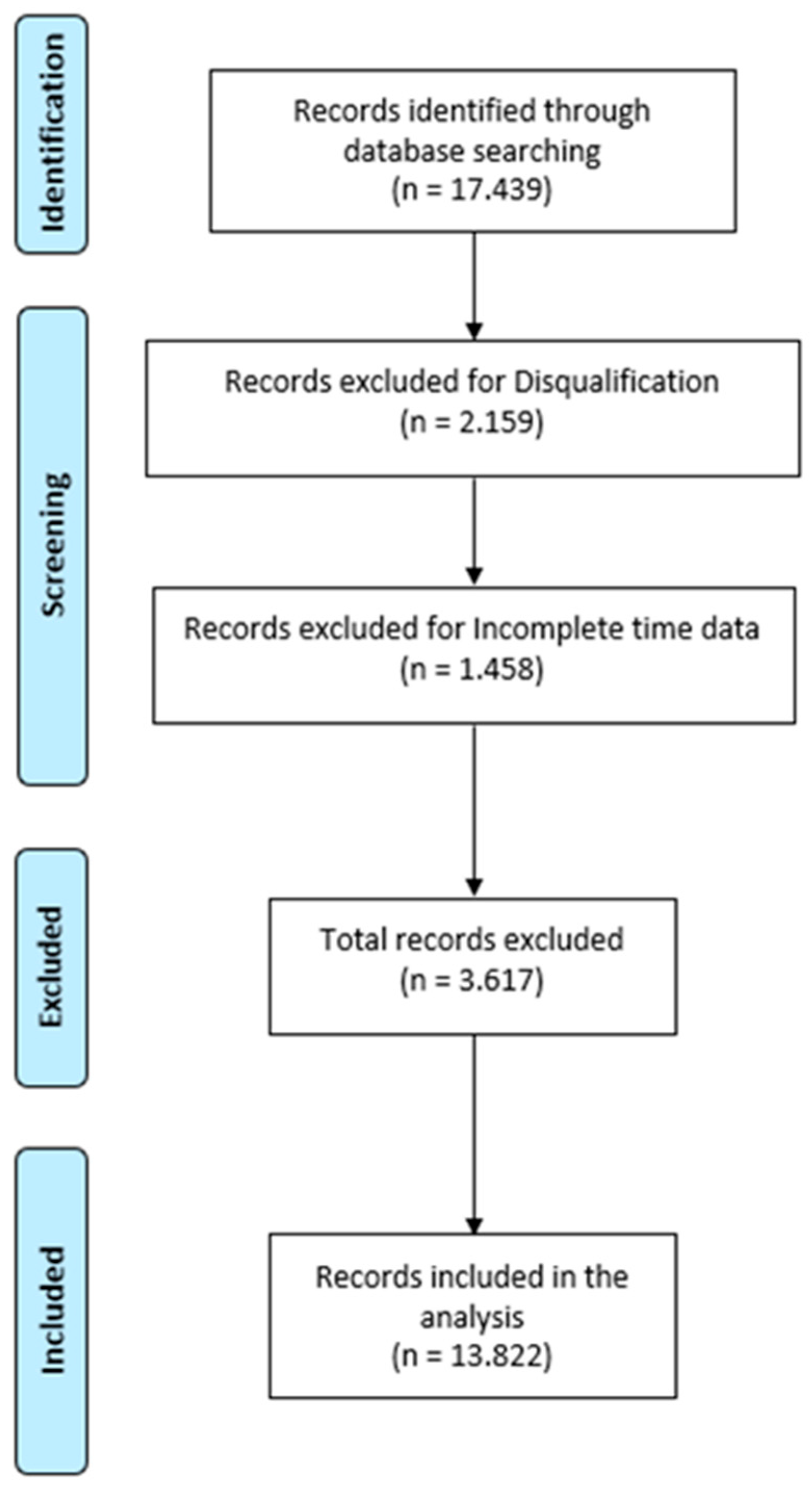
2.4. Study Flowchart
2.5. Inclusion and Exclusion Criteria
- (1)
- Official finisher in individual swimming events at the specified championships;
- (2)
- Complete split-time data available;
- (3)
- Adherence to World Aquatics competition rules during the event;
- (4)
- Participants in individual events;
- (5)
- Participants in single stroke events.
- (1)
- Disqualification by officials for rule violations (including false starts, stroke infractions, or improper turns);
- (2)
- Incomplete or missing split-time data for any race segment.
2.6. Study Timeline and Protocol
2.7. Variables Analyzed
2.8. Sample Size Estimation
2.9. Data Analysis Strategy
3. Results
3.1. Participant Characteristics
3.2. Associations Between Pacing Variables and Race Time
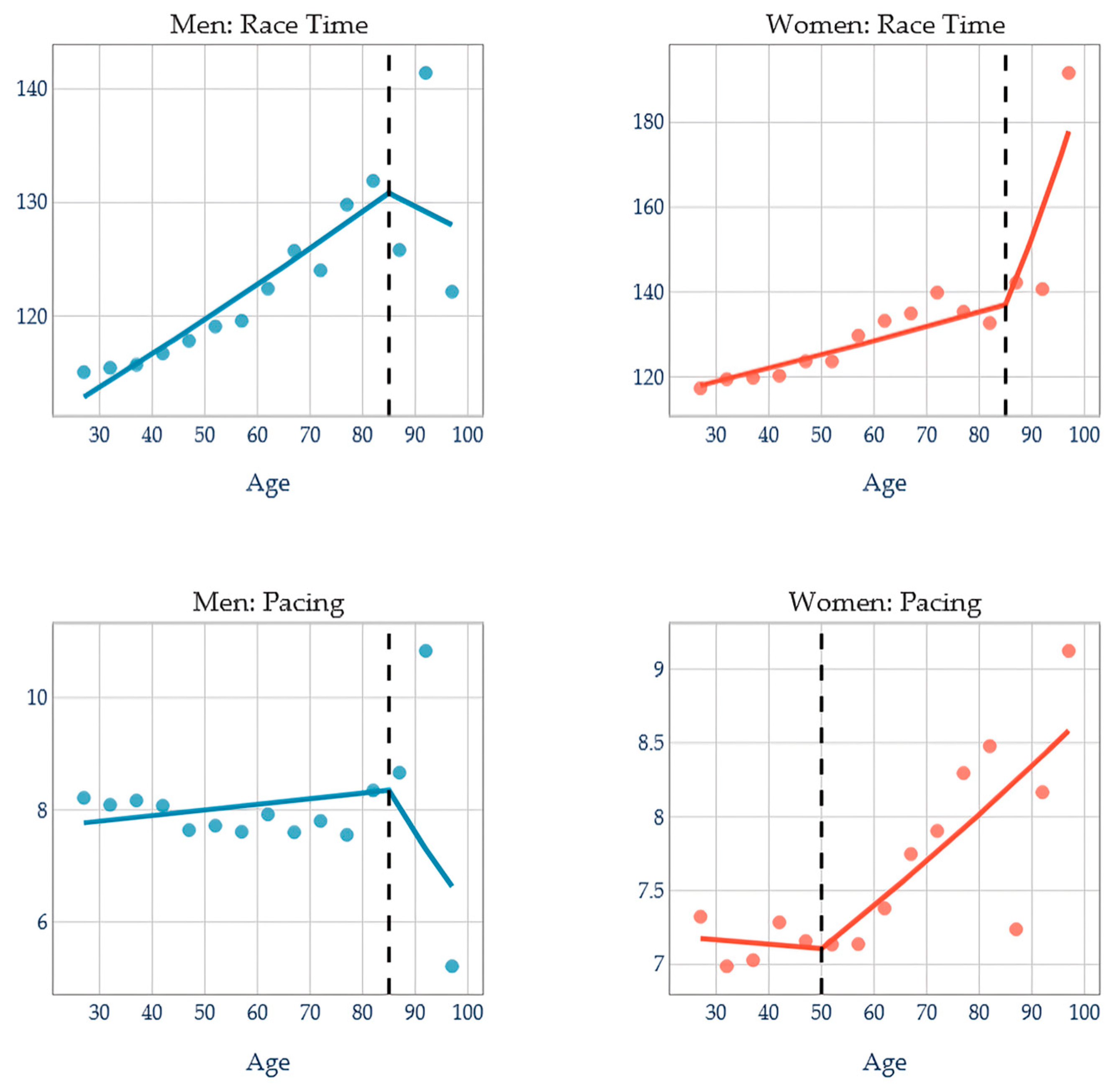
3.3. Age Breakpoint Analysis: Pooled Data Across All Strokes and Sexes
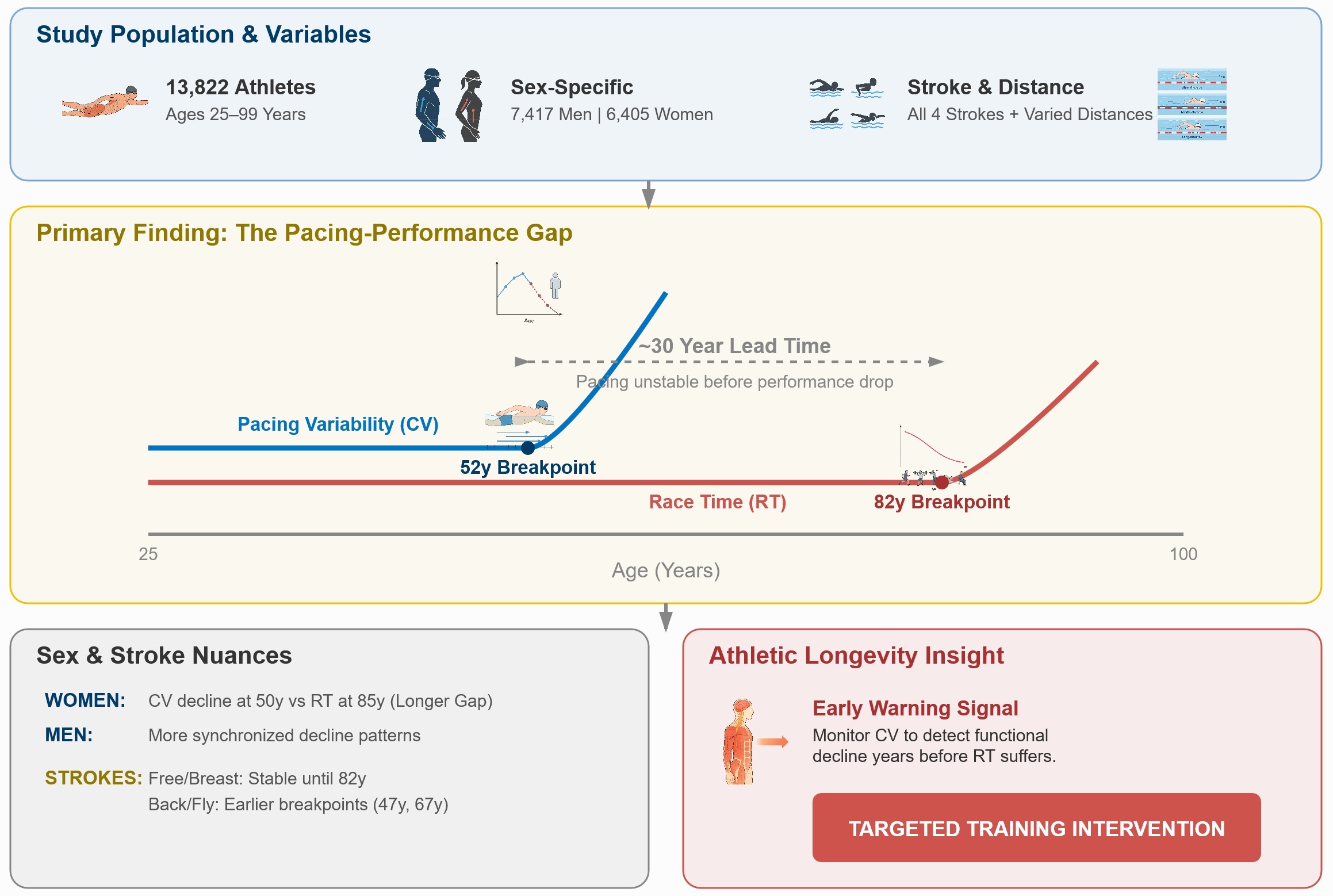
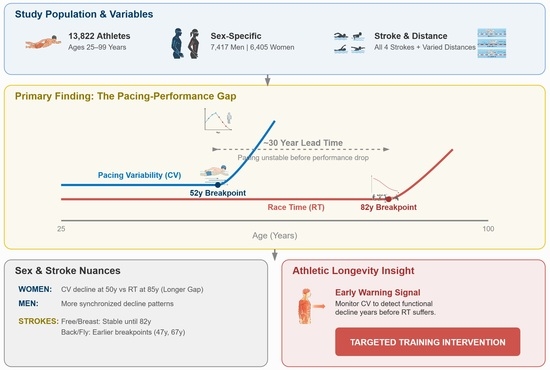
- Pacing Variability Breakpoint (52 years): Prior to age 52, pacing variability increased at a relatively modest rate (+0.18%/year). After the breakpoint, the rate of deterioration accelerated dramatically to +2.82%/year, a 15.7-fold increase. The high R2 value before the breakpoint (0.764) indicates a reliable pre-breakpoint relationship (f2 = 1.46).
- Race Performance Breakpoint (82 years): Race Time %WR showed minimal change before age 82 (+0.28%/year) but then deteriorated significantly thereafter (+0.51%/year), displaying a 1.82-fold acceleration (f2 = 12.34). This breakpoint occurs 30 years after the pacing breakpoint.
- Temporal Dissociation: The most striking finding is the 30-year temporal separation between pacing and performance breakpoints. Pacing instability emerges decades before measurable performance deterioration becomes pronounced, suggesting that pacing variability is a sensitive early warning indicator of age-related decline.
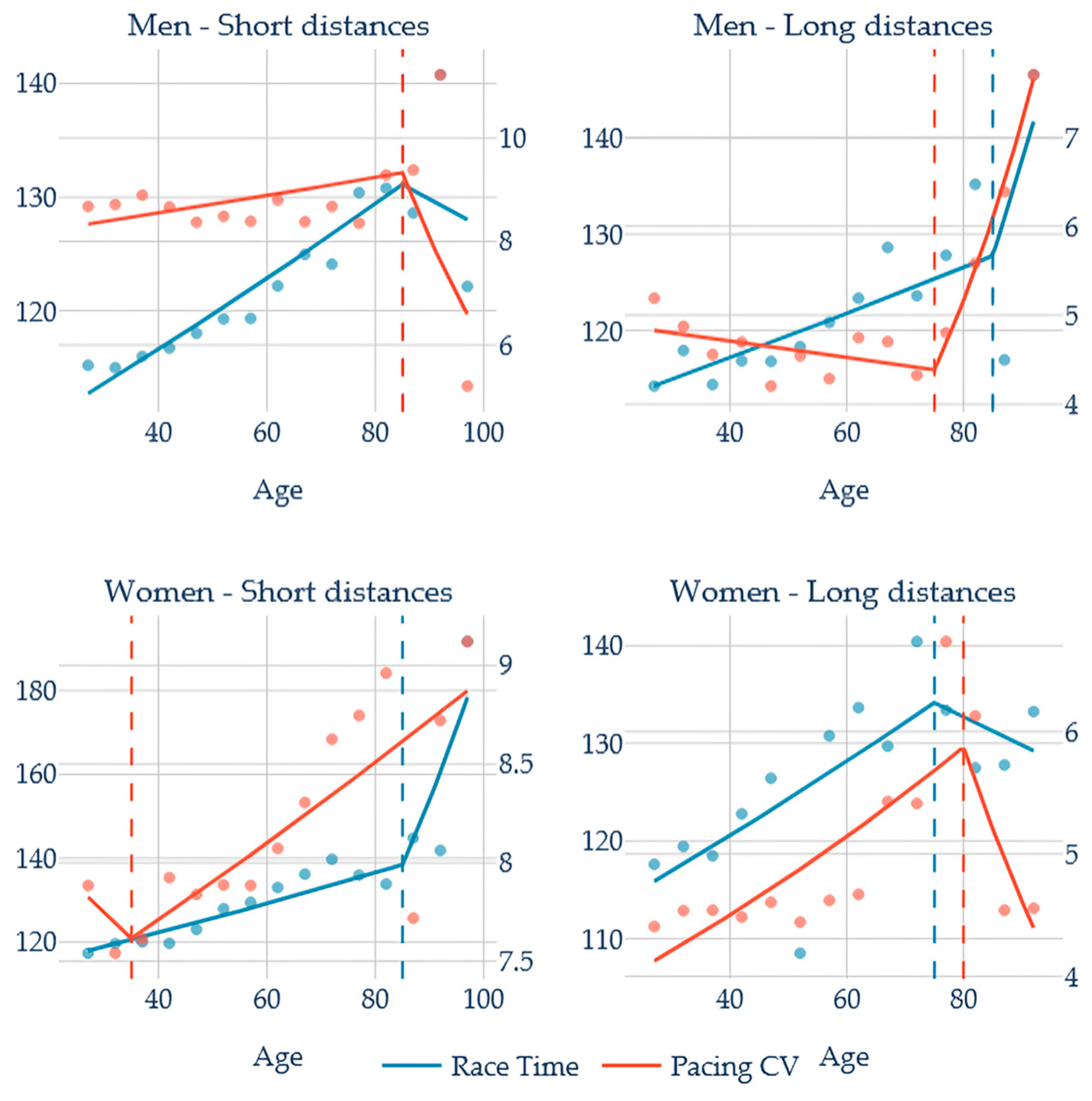
3.4. Age Breakpoint Analysis by Sexes
3.5. Stroke-Specific Age Breakpoints and Performance Trajectories
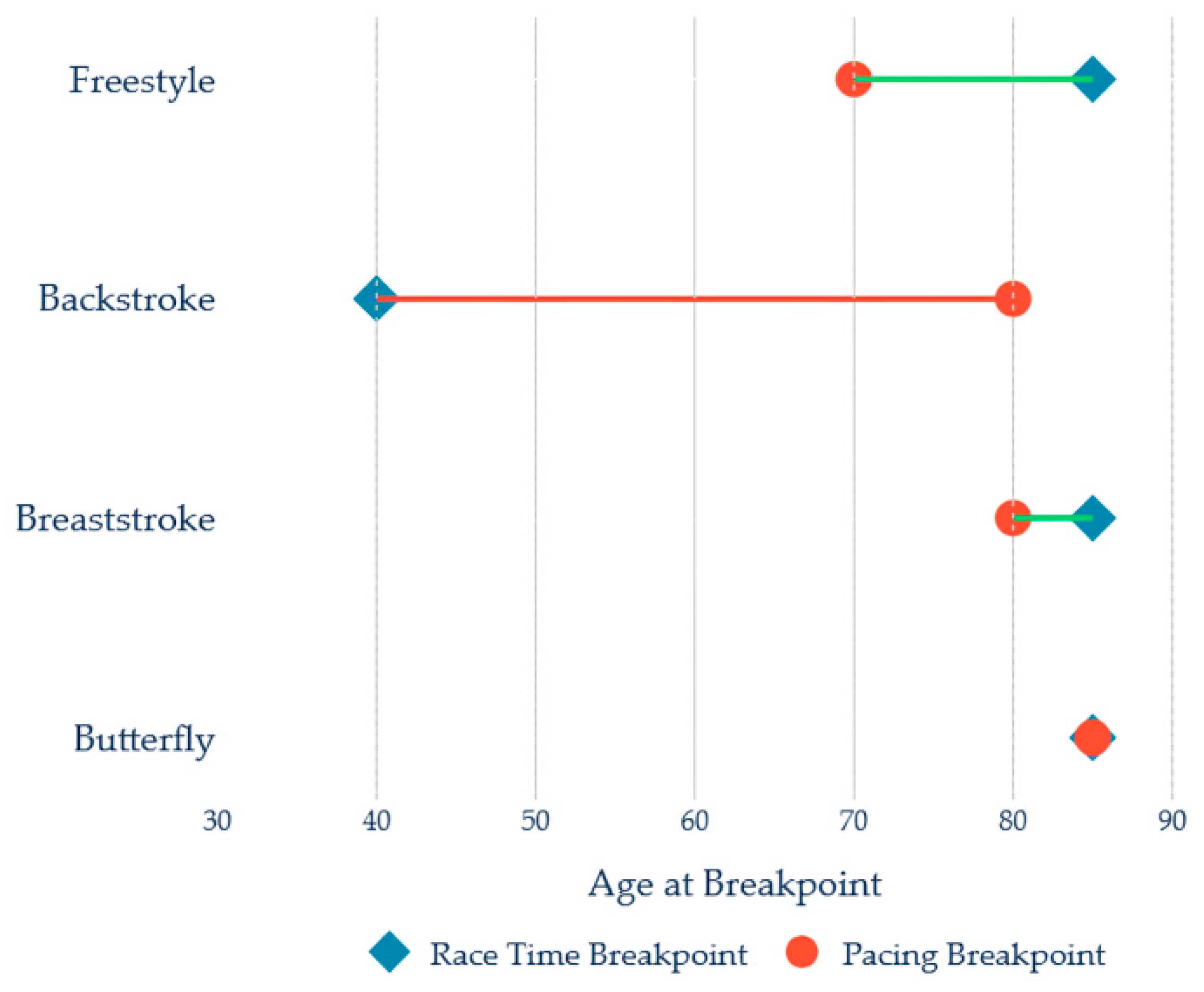
- Freestyle: Both pacing and performance breakpoints coincided at 82 years. However, freestyle displayed the steepest post-breakpoint slope for performance (6.58%/year), indicating the most rapid deterioration once decline began. Pacing also deteriorated steeply post breakpoint (3.15%/year). This pattern suggests that freestyle performers maintain stability until very advanced ages, after which decline accelerates sharply.
- Breaststroke: Like freestyle, breaststroke showed coincident breakpoints at 82 years for both pacing and performance. However, the post-breakpoint rise in Race Time %WR was more gradual (1.02%/year), resulting in a slower rate of performance decline compared to freestyle. This more gradual deterioration suggests greater resilience in breaststroke performance with advancing age.
- Backstroke: Backstroke displayed the earliest performance breakpoint of all strokes (47 years), yet the smallest post-breakpoint slope in Race Time %WR (0.30%/year). Notably, pacing variability remained relatively stable until approximately 72 years, representing a 25-year lag behind performance decline. This dissociation suggests that backstroke performance begins to decline in the late 40s through mechanisms not directly reflected in pacing variability, possibly related to stroke-specific biomechanical constraints (e.g., neck extension, shoulder range of motion).
- Butterfly: Butterfly combined an earlier breakpoint in pacing variability (67 years) with a subsequent breakpoint in race performance (72 years), revealing a 5-year advance in pacing deterioration. The post-breakpoint slope for race performance (2.07%/year) and pacing variability (3.52%/year) were both substantial, indicating that butterfly swimmers experience noticeable deterioration in both pacing control and race times once decline begins.
3.6. Stroke-Specific Critical Age Windows and Risk Profiles
- Backstroke (40–49 years): Moderate risk driven by earliest performance onset.
- Butterfly (60–79 years): Moderate risk with early pacing deterioration (67 years).
- Freestyle and Breaststroke (80–89 years): Moderate and low-moderate risk, respectively, with late but potentially rapid decline in freestyle.
3.7. Relationship Between Pacing Breakpoint and Performance Breakpoint Timing
4. Discussion
4.1. Main Findings and Significance
4.2. Physiological and Metabolic Characteristics of Swimming
4.3. Aging, Pacing Control, and Endurance Performance
4.4. Biomechanical and Physiological Mechanisms Underlying Age-Related Decline
4.5. Sex-Specific Aging Patterns
4.6. Stroke-Specific Aging Patterns
4.7. Implications for Training and Performance Monitoring
4.8. Evidence from Exceptional Aging in Masters Athletes
4.9. Study Limitations
4.10. Deductions
5. Conclusions
Author Contributions
Funding
Institutional Review Board Statement
Informed Consent Statement
Data Availability Statement
Conflicts of Interest
References
- Mauger, A.R.; Neuloh, J.; Castle, P.C. Analysis of Pacing Strategy Selection in Elite 400-m Freestyle Swimming. Med. Sci. Sports Exerc. 2012, 44, 2205–2212. [Google Scholar] [CrossRef]
- Nikolaidis, P.T.; Knechtle, B. Pacing in Age-Group Freestyle Swimmers at The XV FINA World Masters Championships in Montreal 2014. J. Sports Sci. 2017, 35, 1165–1172. [Google Scholar] [CrossRef] [PubMed][Green Version]
- Elferink-Gemser, M.T.; Hettinga, F.J. Pacing and Self-Regulation: Important Skills for Talent Development in Endurance Sports. Int. J. Sports Physiol. Perform. 2017, 12, 831–835. [Google Scholar] [CrossRef] [PubMed]
- McGibbon, K.E.; Pyne, D.B.; Shephard, M.E.; Thompson, K.G. Pacing in Swimming: A Systematic Review. Sports Med. 2018, 48, 1621–1633. [Google Scholar] [CrossRef] [PubMed]
- Menting, S.G.P.; Elferink-Gemser, M.T.; Huijgen, B.C.; Hettinga, F.J. Pacing in Lane-Based Head-to-Head Competitions: A Systematic Review on Swimming. J. Sports Sci. 2019, 37, 2287–2299. [Google Scholar] [CrossRef]
- Lara, B.; Del Coso, J. Pacing Strategies of 1500 m Freestyle Swimmers in the World Championships According to Their Final Position. Int. J. Environ. Res. Public Health 2021, 18, 7559. [Google Scholar] [CrossRef]
- Demarie, S.; Pycke, J.R.; Pizzuti, A.; Billat, V. Pacing of Human Locomotion on Land and in Water: 1500 m Swimming vs. 5000 m Running. Appl. Sci. 2023, 13, 6455. [Google Scholar] [CrossRef]
- Hołub, M.; Prajzner, A.; Stanula, A. Pacing Strategy Models in 1500 m Male Freestyle Long-Course Swimming on the Basis of the All-Time Ranking. Int. J. Environ. Res. Public Health 2023, 20, 4809. [Google Scholar] [CrossRef]
- Demarie, S.; Pycke, J.R.; Pizzuti, A.; Billat, V. Pacing Strategy of 800 m and 1500 m Freestyle Swimming Finals in the World Championships According to the Performance in Males and Females of Different Age Groups. Appl. Sci. 2023, 13, 10515. [Google Scholar] [CrossRef]
- Millard-Stafford, M.; Sparling, P.B.; Rosskopf, L.B.; DiCarlo, L.J. Differences in Peak Physiological Responses during Running, Cycling and Swimming. J. Strength Cond. Res. 1991, 5, 213–218. [Google Scholar]
- Forton, K.; Motoji, Y.; Deboeck, G.; Faoro, V.; Naeije, R. Effects of Body Position on Exercise Capacity and Pulmonary Vascular Pressure-Flow Relationships. J. Appl. Physiol. 2016, 121, 1145–1150. [Google Scholar] [CrossRef] [PubMed]
- Ade, C.J.; Broxterman, R.M.; Barstow, T.J. Effects of Body Posture and Exercise Training on Cardiorespiratory Responses to Exercise. Respir. Physiol. Neurobiol. 2013, 188, 39–48. [Google Scholar] [CrossRef] [PubMed]
- Yermakova, I.I.; Potter, A.W.; Chapman, C.L.; Friedl, K.E. Modeling Physiological and Thermoregulatory Responses during an Olympic Triathlon. J. Therm. Biol. 2025, 131, 104203. [Google Scholar] [CrossRef] [PubMed]
- Donato, A.J.; Tench, K.; Glueck, D.H.; Seals, D.R.; Eskurza, I.; Tanaka, H. Declines in Physiological Functional Capacity with Age: A Longitudinal Study in Peak Swimming Performance. J. Appl. Physiol. 2003, 94, 764–769. [Google Scholar] [CrossRef]
- Rubin, R. Effects of Aging in Masters Swimmers: 40-Year Review and Suggestions for Optimal Health Benefits. Open Access J. Sports Med. 2010, 1, 39–44. [Google Scholar] [CrossRef]
- Rubin, R.; Lin, S.; Curtis, A.; Auerbach, D.; Win, C. Declines in Swimming Performance with Age: A Longitudinal Study of Masters Swimming Champions. Open Access J. Sports Med. 2013, 4, 63–70. [Google Scholar] [CrossRef]
- Medic, N.; Müssener, M.; Lobinger, B.H.; Young, B.W. Constituent Year Effect in Masters Sports: An Empirical View on the Historical Development in US Masters Swimming. J. Sports Sci. Med. 2019, 18, 505–512. [Google Scholar]
- Knechtle, B.; Barbosa, T.M.; Nikolaidis, P.T. The Age-Related Changes and Sex Difference in Master Swimming Performance. Mov. Sport Sci.-Sci. Mot. 2019, 104, 29–36. [Google Scholar] [CrossRef]
- Demarie, S.; Guidotti, F.; Billat, V.L. Ageing in Reverse? The Accelerated Performance Gains of Older Female Swimmers in Age-Group Records. J. Sports Sci. 2025, 43, 3063–3071. [Google Scholar] [CrossRef]
- Bratta, C.; Leggiero, L.; Galvani, C.; Demarie, S. Master Swimmers’ Start Reaction Time: A Trainable Skill for Health and Performance. Med. Dello Sport 2025, 78, 123–132. [Google Scholar] [CrossRef]
- Billat, V.; Dhonneur, G.; Mille-Hamard, L.; Le Moyec, L.; Momken, I.; Launay, T.; Koralsztein, J.P.; Besse, S. Case Studies in Physiology: Maximal Oxygen Consumption and Performance in a Centenarian Cyclist. J. Appl. Physiol. 2017, 122, 430–434. [Google Scholar] [CrossRef] [PubMed]
- Breen, D.; Powell, C.; Anderson, R. Pacing During 200-m Competitive Masters Swimming. J. Strength Cond. Res. 2020, 34, 1903–1910. [Google Scholar] [CrossRef] [PubMed]
- Demarie, S.; Guidotti, F.; Pizzuti, A.; Capranica, L. Analysis of the 800-m Freestyle Competition across Age Groups: Recommendations for Master Swimmers’ Performance. Med. Dello Sport 2023, 76, 457–469. [Google Scholar] [CrossRef]
- Tanaka, H.; Seals, D.R. Endurance Exercise Performance in Masters Athletes: Age-Associated Changes and Underlying Physiological Mechanisms. J. Physiol. 2008, 586, 55–63. [Google Scholar] [CrossRef]
- Ofoghi, B.; Zeleznikow, J.; MacMahon, C.; Raab, M. Data Mining in Elite Sports: A Review and a Framework. Meas. Phys. Educ. Exerc. Sci. 2013, 17, 171–186. [Google Scholar] [CrossRef]
- Güllich, A.; Barth, M.; Hambrick, D.Z.; Macnamara, B.N. Recent Discoveries on the Acquisition of the Highest Levels of Human Performance. Science 2025, 390, eadt7790. [Google Scholar] [CrossRef]
- Gonjo, T.; Olstad, B.H. Race Analysis in Competitive Swimming: A Narrative Review. Int. J. Environ. Res. Public Health 2020, 18, 69. [Google Scholar] [CrossRef]
- Hopkins, W.G.; Marshall, S.W.; Batterham, A.M.; Hanin, J. Progressive Statistics for Studies in Sports Medicine and Exercise Science. Med. Sci. Sports Exerc. 2009, 41, 3–12. [Google Scholar] [CrossRef]
- Goreham, J.A.; Landry, S.C.; Kozey, J.W.; Smith, B.; Ladouceur, M. Using Principal Component Analysis to Investigate Pacing Strategies in Elite International Canoe Kayak Sprint Races. Sports Biomech. 2023, 22, 1444–1459. [Google Scholar] [CrossRef]
- Muggeo, V.M.R. Estimating Regression Models with Unknown Break-points. Stat. Med. 2003, 22, 3055–3071. [Google Scholar] [CrossRef]
- Khan, S.S.; Singer, B.D.; Vaughan, D.E. Molecular and Physiological Manifestations and Measurement of Aging in Humans. Aging Cell 2017, 16, 624–633. [Google Scholar] [CrossRef]
- Belsky, D.W.; Caspi, A.; Houts, R.; Cohen, H.J.; Corcoran, D.L.; Danese, A.; Harrington, H.; Israel, S.; Levine, M.E.; Schaefer, J.D.; et al. Quantification of Biological Aging in Young Adults. Proc. Natl. Acad. Sci. U.S.A 2015, 112, E4104–E4110. [Google Scholar] [CrossRef] [PubMed]
- Roelands, B.; De Koning, J.; Foster, C.; Hettinga, F.; Meeusen, R. Neurophysiological Determinants of Theoretical Concepts and Mechanisms Involved in Pacing. Sports Med. 2013, 43, 301–311. [Google Scholar] [CrossRef] [PubMed]
- Barbosa, T.M.; Bragada, J.A.; Reis, V.M.; Marinho, D.A.; Carvalho, C.; Silva, A.J. Energetics and Biomechanics as Determining Factors of Swimming Performance: Updating the State of the Art. J. Sci. Med. Sport 2010, 13, 262–269. [Google Scholar] [CrossRef] [PubMed]
- Mejias, M.J.E. “Young” Masters vs. Elite Swimmers: Comparison of Performance, Energetics, Kinematics and Efficiency. Int. SportMed J. 2014, 15, 165–177. [Google Scholar]
- Macaluso, A.; De Vito, G. Muscle Strength, Power and Adaptations to Resistance Training in Older People. Eur. J. Appl. Physiol. 2004, 91, 450–472. [Google Scholar] [CrossRef]
- Eskurza, I.; Donato, A.J.; Moreau, K.L.; Seals, D.R.; Tanaka, H. Changes in Maximal Aerobic Capacity with Age in Endurance-Trained Women: 7-Yr Follow-Up. J. Appl. Physiol. 2002, 92, 2303–2308. [Google Scholar] [CrossRef]
- López-Otín, C.; Blasco, M.A.; Partridge, L.; Serrano, M.; Kroemer, G. The Hallmarks of Aging. Cell 2013, 153, 1194–1217. [Google Scholar] [CrossRef]
- Furrer, R.; Handschin, C. Biomarkers of Aging: From Molecules and Surrogates to Physiology and Function. Physiol. Rev. 2025, 105, 1609–1694. [Google Scholar] [CrossRef]
- Lipinska, P.; Allen, S.V.; Hopkins, W.G. Relationships Between Pacing Parameters and Performance of Elite Male 1500-m Swimmers. Int. J. Sports Physiol. Perform. 2016, 11, 159–163. [Google Scholar] [CrossRef]
- Morais, J.E.; Barbosa, T.M.; Neiva, H.P.; Marinho, D.A. Stability of Pace and Turn Parameters of Elite Long-Distance Swimmers. Hum. Mov. Sci. 2019, 63, 108–119. [Google Scholar] [CrossRef] [PubMed]
- Furrer, R.; Handschin, C. Biomarkers of Aging: Functional Aspects Still Trump Molecular Parameters. npj Aging 2025, 11, 15. [Google Scholar] [CrossRef] [PubMed]
- Tucker, R.; Noakes, T.D. The Physiological Regulation of Pacing Strategy during Exercise: A Critical Review. Br. J. Sports Med. 2009, 43, e1. [Google Scholar] [CrossRef] [PubMed]
- Espada, M.C.; Costa, M.J.; Costa, A.M.; Silva, A.J.; Barbosa, T.M.; Pereira, A.F. Relationship Between Performance, Dry-Land Power and Kinematics in Master Swimmers. Acta Bioeng. Biomech. 2016, 18, 145–151. [Google Scholar] [CrossRef]
- Allen, M.D.; Dalton, B.H.; Gilmore, K.J.; McNeil, C.J.; Doherty, T.J.; Rice, C.L.; Power, G.A. Neuroprotective Effects of Exercise on the Aging Human Neuromuscular System. Exp. Gerontol. 2021, 152, 111465. [Google Scholar] [CrossRef]
- Fell, J.; Williams, A.D. The Effect of Aging on Skeletal-Muscle Recovery from Exercise: Possible Implications for Aging Athletes. J. Aging Phys. Act. 2008, 16, 97–115. [Google Scholar] [CrossRef]
- Cruz-Jentoft, A.J.; Bahat, G.; Bauer, J.; Boirie, Y.; Bruyère, O.; Cederholm, T.; Cooper, C.; Landi, F.; Rolland, Y.; Sayer, A.A.; et al. Sarcopenia: Revised European Consensus on Definition and Diagnosis. Age Ageing 2019, 48, 16–31. [Google Scholar] [CrossRef]
- Frontera, W.R.; Hughes, V.A.; Lutz, K.J.; Evans, W.J. A Cross-Sectional Study of Muscle Strength and Mass in 45- to 78-Yr-Old Men and Women. J. Appl. Physiol. 1991, 71, 644–650. [Google Scholar] [CrossRef]
- Ferreira, M.I.; Barbosa, T.M.; Costa, M.J.; Neiva, H.P.; Marinho, D.A. Energetics, Biomechanics, and Performance in Masters’ Swimmers: A Systematic Review. J. Strength Cond. Res. 2016, 30, 2069–2081. [Google Scholar] [CrossRef]
- Boisgontier, M.P.; Olivier, I.; Chenu, O.; Nougier, V. Presbypropria: The Effects of Physiological Ageing on Proprioceptive Control. AGE 2012, 34, 1179–1194. [Google Scholar] [CrossRef]
- Knechtle, B.; Nikolaidis, P.T.; Rosemann, T.; Rüst, C.A. Performance Trends in Master Butterfly Swimmers Competing in the FINA World Championships. J. Hum. Kinet. 2017, 57, 199–211. [Google Scholar] [CrossRef] [PubMed]
- De Veaux, R.; Plantinga, A.; Upton, E. Age and Performance in Masters Swimming and Running. J. Quant. Anal. Sports 2025, 21, 137–152. [Google Scholar] [CrossRef]
- Pollock, M.L.; Foster, C.; Knapp, D.; Rod, J.L.; Schmidt, D.H. Effect of Age and Training on Aerobic Capacity and Body Composition of Master Athletes. J. Appl. Physiol. 1987, 62, 725–731. [Google Scholar] [CrossRef] [PubMed]
- Hollenberg, M.; Yang, J.; Haight, T.J.; Tager, I.B. Longitudinal Changes in Aerobic Capacity: Implications for Concepts of Aging. J. Gerontol. Ser. A Biol. Sci. Med. Sci. 2006, 61, 851–858. [Google Scholar] [CrossRef]
- Sowers, M.; Tomey, K.; Jannausch, M.; Eyvazzadeh, A.; Nan, B.; Randolph, J. Physical Functioning and Menopause States. Obstet. Gynecol. 2007, 110, 1290–1296. [Google Scholar] [CrossRef]
- Pesonen, H.; Laakkonen, E.K.; Hautasaari, P.; Aukee, P.; Kovanen, V.; Sipilä, S.; Finni, T.; Tarkka, I.M. Perimenopausal Women Show Modulation of Excitatory and Inhibitory Neuromuscular Mechanisms. BMC Women’s Health 2021, 21, 133. [Google Scholar] [CrossRef]
- Senefeld, J.W.; Hunter, S.K. Hormonal Basis of Biological Sex Differences in Human Athletic Performance. Endocrinology 2024, 165, bqae036. [Google Scholar] [CrossRef]
- Gava, P.; Giuriati, W.; Ravara, B. Gender Difference of Aging Performance Decay Rate in Normalized Masters World Records of Athletics: Much Less than Expected. Eur. J. Transl. Myol. 2020, 30, 103–106. [Google Scholar] [CrossRef]
- Wooten, S.V.; Moestl, S.; Chilibeck, P.; Alvero Cruz, J.R.; Mittag, U.; Tank, J.; Tanaka, H.; Rittweger, J.; Hoffmann, F. Age- and Sex-Differences in Cardiac Characteristics Determined by Echocardiography in Masters Athletes. Front. Physiol. 2021, 11, 630148. [Google Scholar] [CrossRef]
- Wiswell, R.A.; Hawkins, S.A.; Jaque, S.V.; Hyslop, D.; Constantino, N.; Tarpenning, K.; Marcell, T.; Schroeder, E.T. Relationship Between Physiological Loss, Performance Decrement, and Age in Master Athletes. J. Gerontol. Ser. A Biol. Sci. Med. Sci. 2001, 56, M618–M626. [Google Scholar] [CrossRef]
- Tanaka, H.; Seals, D.R. Age and Gender Interactions in Physiological Functional Capacity: Insight from Swimming Performance. J. Appl. Physiol. 1997, 82, 846–851. [Google Scholar] [CrossRef] [PubMed]
- Borzuola, R.; Giombini, A.; Torre, G.; Campi, S.; Albo, E.; Bravi, M.; Borrione, P.; Fossati, C.; Macaluso, A. Central and Peripheral Neuromuscular Adaptations to Ageing. J. Clin. Med. 2020, 9, 741. [Google Scholar] [CrossRef] [PubMed]
- Woo, J.S.; Derleth, C.; Stratton, J.R.; Levy, W.C. The Influence of Age, Gender, and Training on Exercise Efficiency. J. Am. Coll. Cardiol. 2006, 47, 1049–1057. [Google Scholar] [CrossRef] [PubMed]
- Zampagni, M.L.; Casino, D.; Benelli, P.; Visani, A.; Marcacci, M.; De Vito, G. Anthropometric and Strength Variables to Predict Freestyle Performance Times in Elite Master Swimmers. J. Strength Cond. Res. 2008, 22, 1298–1307. [Google Scholar] [CrossRef]
- Barbosa, T.M.; Marinho, D.A.; Costa, M.J.; Silva, A.J. Biomechanics of Competitive Swimming Strokes. Biomech. Appl. 2011, 23, 367–388. [Google Scholar]
- Knechtle, B.; Andrade, M.S.; Ahmad, W.; Moreitz, S.; Weiss, K.; Vancini, R.L.; Nikolaidis, P.T.; Rosemann, T.; Thuany, M.; Seffrin, A. The Effects of Age and Sex on Swimming Time in Master Breaststroke Swimmers. Hum. Mov. 2025, 26, 73–82. [Google Scholar] [CrossRef]
- González-Ravé, J.M.; González-Mohino, F.; Hermosilla Perona, F.; Rodrigo-Carranza, V.; Yustres, I.; Pyne, D.B. Biomechanical, Physiological and Anthropometric Determinants of Backstroke Swimming Performance: A Systematic Review. Sports Med.-Open 2025, 11, 68. [Google Scholar] [CrossRef]
- Unterweger, C.M.; Knechtle, B.; Nikolaidis, P.T.; Rosemann, T.; Rüst, C.A. Increased Participation and Improved Performance in Age Group Backstroke Master Swimmers from 25–29 to 100–104 Years at the FINA World Masters Championships from 1986 to 2014. SpringerPlus 2016, 5, 645. [Google Scholar] [CrossRef]
- Joyner, M.J. Modeling: Optimal Marathon Performance on the Basis of Physiological Factors. J. Appl. Physiol. 1991, 70, 683–687. [Google Scholar] [CrossRef]
- Lampadari, V.; Thanopoulos, V.; Dopsaj, M.; Rozi, G. Effects of Age and Gender in Physiological Responses, Mechanics and Performance of Master Swimmers. Hum. Mov. 2019, 20, 17–23. [Google Scholar] [CrossRef]
- Toussaint, H.; Truijens, M. Biomechanical Aspects of Peak Performance in Human Swimming. Anim. Biol. 2005, 55, 17–40. [Google Scholar] [CrossRef]
- Kramer, A.A.; Sebat, F.; Lissauer, M. A Review of Early Warning Systems for Prompt Detection of Patients at Risk for Clinical Decline. J. Trauma Acute Care Surg. 2019, 87, S67–S73. [Google Scholar] [CrossRef] [PubMed]
- Kim, J.; Lee, W.; Lee, S.H. A Systematic Review of the Guidelines and Delphi Study for the Multifactorial Fall Risk Assessment of Community-Dwelling Elderly. Int. J. Environ. Res. Public Health 2020, 17, 6097. [Google Scholar] [CrossRef] [PubMed]
- Fray, M.; Hignett, S. TROPHI: Development of a Tool to Measure Complex, Multi-Factorial Patient Handling Interventions. Ergonomics 2013, 56, 1280–1294. [Google Scholar] [CrossRef]
- Buendía-Romero, Á.; Higueras-Liébana, E.; Alegre, L.M.; Ara, I.; Valenzuela, P.L. Centenarian Athletes: The Paradigm of Healthy Longevity? J. Nutr. Health Aging 2025, 29, 100665. [Google Scholar] [CrossRef]
- Lepers, R.; Stapley, P.J.; Cattagni, T. Centenarian Athletes: Examples of Ultimate Human Performance? Age Ageing 2016, 45, 729–733. [Google Scholar] [CrossRef]





| Age Group (Years) | Men (n) | Women (n) | Total (n) |
|---|---|---|---|
| 95–99 | 2 | 3 | 5 |
| 90–94 | 36 | 14 | 50 |
| 85–89 | 88 | 53 | 141 |
| 80–84 | 196 | 176 | 372 |
| 75–79 | 284 | 272 | 556 |
| 70–74 | 403 | 387 | 790 |
| 65–69 | 588 | 564 | 1152 |
| 60–64 | 780 | 737 | 1517 |
| 55–59 | 760 | 709 | 1469 |
| 50–54 | 839 | 716 | 1555 |
| 45–49 | 713 | 657 | 1370 |
| 40–44 | 683 | 565 | 1248 |
| 35–39 | 578 | 415 | 993 |
| 30–34 | 771 | 559 | 1330 |
| 25–29 | 697 | 577 | 1274 |
| Total | 7417 | 6405 | 13,822 |
| Age Range and Sex | RT Mean | RT SD | CV Mean | CV SD | ST1 Mean | ST1 SD | ST2 Mean | ST2 SD | Δ Mean | Δ SD |
|---|---|---|---|---|---|---|---|---|---|---|
| M 25–29 | 115.1 | 10.3 | 8.2 | 3.3 | 91.0 | 4.6 | 105.3 | 4.0 | −14.3 | 6.8 |
| M 30–34 | 115.5 | 11.5 | 8.1 | 3.9 | 91.0 | 4.5 | 104.9 | 4.1 | −13.9 | 6.5 |
| M 35–39 | 115.7 | 10.2 | 8.2 | 3.5 | 90.8 | 4.5 | 105.2 | 4.3 | −14.4 | 7.1 |
| M 40–44 | 116.7 | 13.3 | 8.1 | 3.6 | 90.8 | 4.6 | 104.9 | 4.3 | −14.1 | 7.1 |
| M 45–49 | 117.8 | 14.5 | 7.6 | 3.5 | 91.2 | 4.4 | 104.5 | 4.2 | −13.4 | 6.9 |
| M 50–54 | 119.1 | 14.1 | 7.7 | 3.5 | 90.7 | 4.6 | 104.3 | 4.6 | −13.6 | 7.2 |
| M 55–59 | 119.6 | 15.0 | 7.6 | 3.7 | 90.9 | 4.7 | 104.1 | 4.5 | −13.2 | 7.3 |
| M 60–64 | 122.4 | 15.6 | 7.9 | 3.8 | 90.3 | 4.8 | 103.8 | 5.1 | −13.4 | 7.7 |
| M 65–69 | 125.8 | 19.0 | 7.6 | 3.9 | 90.8 | 4.8 | 103.4 | 6.5 | −12.5 | 8.6 |
| M 70–74 | 124.0 | 19.4 | 7.8 | 4.4 | 90.1 | 8.2 | 103.9 | 5.3 | −13.8 | 10.5 |
| M 75–79 | 129.8 | 20.9 | 7.6 | 4.1 | 90.5 | 9.2 | 101.9 | 10.3 | −11.4 | 14.3 |
| M 80–84 | 131.9 | 20.5 | 8.3 | 4.3 | 87.5 | 13.7 | 102.9 | 5.9 | −15.5 | 15.0 |
| M 85–89 | 125.8 | 28.4 | 8.7 | 4.4 | 89.9 | 5.1 | 103.9 | 7.7 | −14.0 | 10.8 |
| M 90–94 | 141.4 | 26.3 | 10.8 | 4.4 | 88.5 | 5.5 | 104.7 | 7.4 | −16.3 | 10.0 |
| M 95–99 | 122.2 | 5.2 | 96.3 | 103.7 | −7.4 | |||||
| F 25–29 | 117.4 | 7.9 | 7.3 | 3.0 | 91.9 | 3.3 | 104.4 | 3.7 | −12.5 | 5.4 |
| F 30–34 | 119.5 | 8.9 | 7.0 | 2.9 | 91.9 | 3.7 | 104.1 | 3.8 | −12.2 | 5.6 |
| F 35–39 | 119.8 | 9.6 | 7.0 | 3.1 | 91.7 | 3.8 | 104.1 | 4.4 | −12.5 | 6.5 |
| F 40–44 | 120.3 | 10.8 | 7.3 | 3.3 | 91.3 | 3.6 | 104.1 | 4.3 | −12.8 | 6.1 |
| F 45–49 | 123.7 | 12.0 | 7.2 | 3.1 | 91.6 | 3.7 | 103.8 | 4.3 | −12.2 | 5.9 |
| F 50–54 | 123.7 | 27.6 | 7.1 | 3.3 | 91.4 | 3.9 | 103.5 | 4.6 | −12.2 | 6.3 |
| F 55–59 | 129.8 | 16.1 | 7.1 | 3.3 | 91.4 | 3.9 | 103.2 | 4.8 | −11.8 | 6.6 |
| F 60–64 | 133.2 | 15.9 | 7.4 | 4.6 | 91.4 | 5.1 | 103.2 | 5.5 | −11.8 | 8.2 |
| F 65–69 | 135.0 | 18.6 | 7.8 | 5.4 | 90.8 | 8.3 | 103.9 | 7.4 | −13.1 | 14.4 |
| F 70–74 | 139.9 | 19.2 | 7.9 | 6.6 | 90.9 | 7.9 | 103.8 | 8.2 | −12.9 | 14.1 |
| F 75–79 | 135.4 | 17.4 | 8.3 | 8.1 | 90.6 | 10.2 | 103.8 | 10.5 | −13.2 | 19.6 |
| F 80–84 | 132.7 | 18.6 | 8.5 | 6.9 | 90.9 | 7.0 | 103.7 | 7.6 | −12.8 | 12.0 |
| F 85–89 | 142.2 | 28.9 | 7.2 | 3.1 | 91.4 | 4.5 | 103.3 | 4.3 | −11.9 | 6.6 |
| F 90–94 | 140.7 | 23.8 | 8.2 | 4.2 | 92.8 | 3.4 | 103.8 | 5.3 | −11.1 | 7.0 |
| F 95–99 | 191.7 | 40.5 | 9.1 | 4.0 | 92.0 | 7.2 | 102.2 | 6.8 | −10.2 | 12.6 |
| Predictor Variable | Correlation (r) | p-Value | 95% CI |
|---|---|---|---|
| CV | 0.173 | <0.001 | 0.159–0.188 |
| ST1 | −0.147 | <0.001 | −0.162–−0.133 |
| ST2 | 0.130 | <0.001 | 0.115–0.144 |
| Δ | −0.147 | <0.001 | −0.162–−0.133 |
| Parameter | Race Time %WR | Pacing Variability (CV) |
|---|---|---|
| Age Breakpoint (years) | 82 | 52 |
| 95% CI for Breakpoint | 80–84 | 50–54 |
| Before Breakpoint | ||
| Age Range | 27–82 | 27–52 |
| Annual % Change | +0.28 | +0.18 |
| R2 | 0.891 | 0.764 |
| After Breakpoint | ||
| Age Range | 82–97 | 52–97 |
| Annual % Change | +0.51 | +2.82 |
| R2 | 0.734 | 0.687 |
| Acceleration Factor | 1.82× | 15.7× |
| Stroke | BP RT (Years) | Post-BP RT Slope (%/yrs) | BP CV (Years) | Post-BP CV Slope (%/yrs) |
|---|---|---|---|---|
| Freestyle | 82 | 6.58 | 82 | 3.15 |
| Breaststroke | 82 | 1.02 | 82 | 2.41 |
| Backstroke | 47 | 0.30 | 72 | 1.89 |
| Butterfly | 72 | 2.07 | 67 | 3.52 |
| Stroke | Composite Risk Score | Risk Category | Critical Age Window (Years) | Primary Concern |
|---|---|---|---|---|
| Freestyle | 39.98 | Moderate | 80–89 | Fast decline onset |
| Breaststroke | 21.81 | Low-Moderate | 80–89 | Gradual decline |
| Backstroke | 31.52 | Moderate | 40–49 | Early onset |
| Butterfly | 34.70 | Moderate | 60–79 | Pacing instability |
Disclaimer/Publisher’s Note: The statements, opinions and data contained in all publications are solely those of the individual author(s) and contributor(s) and not of MDPI and/or the editor(s). MDPI and/or the editor(s) disclaim responsibility for any injury to people or property resulting from any ideas, methods, instructions or products referred to in the content. |
© 2026 by the authors. Licensee MDPI, Basel, Switzerland. This article is an open access article distributed under the terms and conditions of the Creative Commons Attribution (CC BY) license.
Share and Cite
Demarie, S.; Guidotti, F.; Galvani, C.; Billat, V.L. Age-Related Breakpoints in Pacing Variability and Performance in Masters Swimmers: A Segmented Regression Analysis of World Championship Male and Female Data. J. Funct. Morphol. Kinesiol. 2026, 11, 78. https://doi.org/10.3390/jfmk11010078
Demarie S, Guidotti F, Galvani C, Billat VL. Age-Related Breakpoints in Pacing Variability and Performance in Masters Swimmers: A Segmented Regression Analysis of World Championship Male and Female Data. Journal of Functional Morphology and Kinesiology. 2026; 11(1):78. https://doi.org/10.3390/jfmk11010078
Chicago/Turabian StyleDemarie, Sabrina, Flavia Guidotti, Christel Galvani, and Veronique L. Billat. 2026. "Age-Related Breakpoints in Pacing Variability and Performance in Masters Swimmers: A Segmented Regression Analysis of World Championship Male and Female Data" Journal of Functional Morphology and Kinesiology 11, no. 1: 78. https://doi.org/10.3390/jfmk11010078
APA StyleDemarie, S., Guidotti, F., Galvani, C., & Billat, V. L. (2026). Age-Related Breakpoints in Pacing Variability and Performance in Masters Swimmers: A Segmented Regression Analysis of World Championship Male and Female Data. Journal of Functional Morphology and Kinesiology, 11(1), 78. https://doi.org/10.3390/jfmk11010078