
Effects of Endurance and Resistance Training on Cardiovascular Outcomes and Quality of Life in Patients with Heart Failure with Reduced Ejection Fraction: A Structured Narrative Review

 , , , and
Abstract
1. Introduction
2. Methods
2.1. Search Strategy
2.2. Inclusion Criteria
- -
- involved adults (≥18 years) with HFrEF (LVEF ≤ 40–45%);
- -
- investigated aerobic and/or resistance training, alone or in combination, compared with usual care or standard therapy;
- -
- reported outcomes related to VO2peak, VE/VCO2 slope, QoL, or clinical endpoints (e.g., hospitalization or mortality).
2.3. Study Selection and Data Extraction
2.4. Synthesis
3. Results
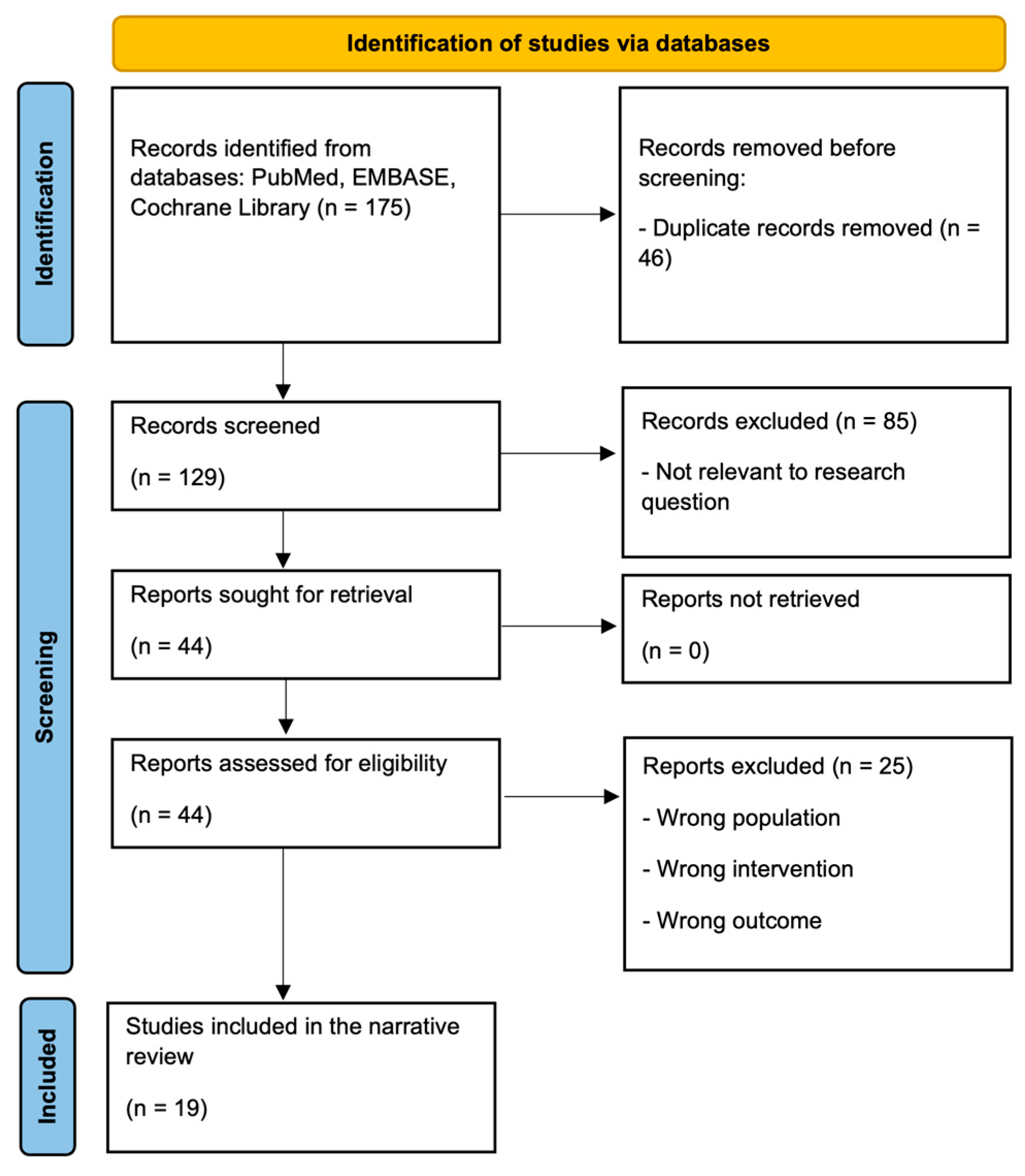
3.1. Study Selection and Overview
3.2. Study and Intervention Heterogeneity
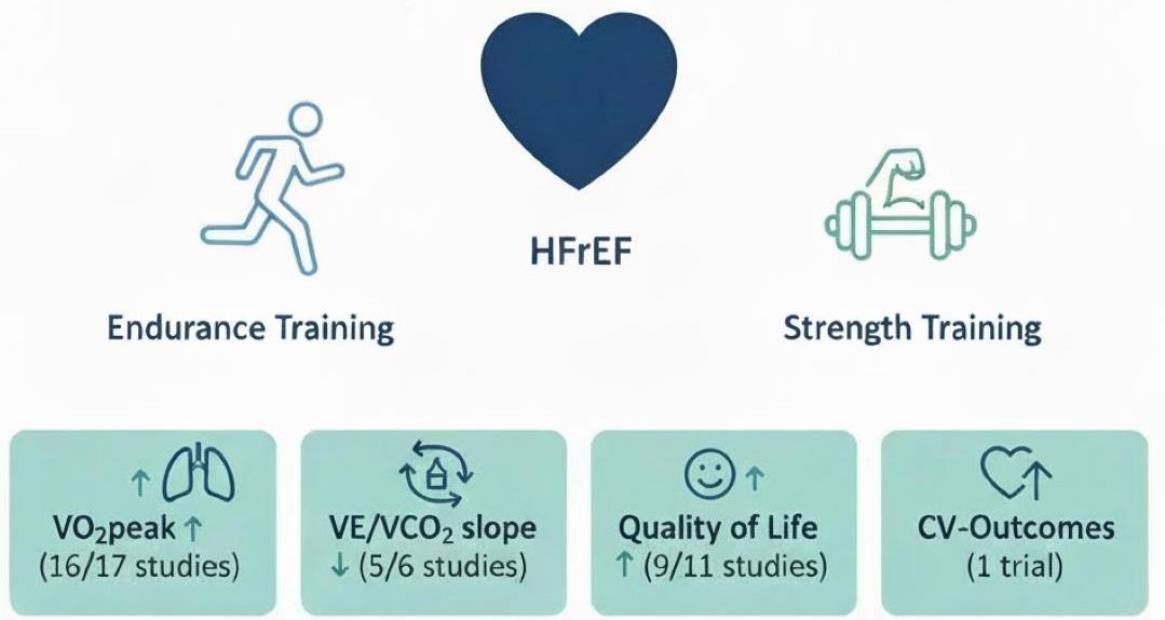
3.3. Summary of Main Outcomes
3.3.1. Cardiorespiratory Fitness (VO2peak)
3.3.2. Ventilatory Efficiency (VE/VCO2 Slope)
3.3.3. Quality of Life (QoL)
3.3.4. Mortality and Hospitalizations
3.3.5. Additional Findings
- -
- Home-based vs. center-based training: Both groups improved VO2peak, with the center-based group showing larger increases (+2.7 vs. +0.8 mL·kg−1·min−1) and greater QoL improved (MLHFQ −13 vs. −1) [43].
- -
- Low-mass, high-repetitiontraining: The PRIME protocol increased VO2peak by +2.4 mL·kg−1·min−1, whereas combined training alone improved VO2peak by only +0.2 mL·kg−1·min−1 [44].
- -
- Inflammatory Biomarkers: Improvements in VO2peak (+3.5 mL·kg−1·min−1) only in low-inflammation groups [34].
- -
- -
- NYHA class: Dyspnea improved by 0.8 points after 4 months of supervised training in both men and women, with no significant change in untrained controls [37].
- -
- Echocardiography: LVEF improved in some studies, including 39% to 44% with supervised combined training and 31% to 36% in patients with permanent AF [40,41], while older adults showed no change [32]. HIIT and MCT reduced left ventricular end-diastolic diameter (LVEDD, −2.8 mm and −1.2 mm, respectively) [28]. Left atrial dimensions also decreased in HFrEF patients with permanent AF [41].
- -
- In older patients (≥60 years): VO2peak did not improve significantly overall (mean change −0.2 mL·kg−1·min−1), although 26% of participants achieved ≥ 10% individual improvements [32].
- -
- Patients with HFrEF and permanent AF: Aerobic training increased VO2peak by +3.8 mL·kg−1·min−1, along with improvements in HR and QoL [41].
- -
- Post-cardiac resynchronization therapy (CRT): CRT combined with HIIT, as well as HIIT alone, improved exercise capacity, QoL, and LVEF [38].
4. Discussion
4.1. Overview
4.2. Aerobic Capacity (VO2peak)
4.3. Ventilatory Efficiency—VE/VCO2 Slope
4.4. Quality of Life (QoL)
4.5. Mortality and Hospitalization Rates
4.6. Additional Physiological Effects of Exercise Training
4.7. Cardiac Effects of Exercise Training
4.8. Mode of Exercise
4.9. Supervised vs. Unsupervised Exercise and Cardiac Rehabilitation
4.10. Subgroup Variability
4.11. Clinical Implications
4.12. Comparison with Previous Reviews
4.13. Limitations
4.14. Future Research
5. Conclusions
Author Contributions
Funding
Institutional Review Board Statement
Informed Consent Statement
Data Availability Statement
Conflicts of Interest
Abbreviations
| AF | Atrial Fibrillation |
| COM | Combined Training |
| COMBO | Combined Moderate-Intensity Aerobic and Resistance Training |
| CON | Concentric Training |
| CPT | Combined Physical Training |
| CR | Cardiac Rehabilitation |
| CRF | Cardiorespiratory Fitness |
| CRT | Cardiac Resynchronization Therapy |
| ECC | Eccentric Training |
| ET | Exercise Training |
| FBF | Forearm Blood Flow |
| HF | Heart Failure |
| HFrEF | Heart Failure with reduced Ejection Fraction |
| HIIT | High-Intensity Interval Training |
| KCCQ | Kansas City Cardiomyopathy Questionnaire |
| LVEDD | Left Ventricular End-Diastolic Dimension |
| LVEF | Left Ventricular Ejection Fraction |
| MCT | Moderate Continuous Training |
| METs | Metabolic Equivalents |
| MLHFQ | Minnesota Living with HF Questionnaire |
| MOS-SF-36 | Medical Outcomes Study Short Form 36 |
| MSNA | Muscle Sympathetic Nerve Activity |
| NYHA | New York Heart Association |
| PHQ-9 | Patient Health Questionnaire-9 |
| PRIME | Progressive Resistance Intensity Modulated Exercise |
| QoL | Quality of Life |
| RCT | Randomized Controlled Trial |
| RRE | Regular Exercise Regimen |
| VO2peak | Peak Oxygen Uptake |
Appendix A. Short Summary of All the Included Studies
- -
- The HF-ACTION study [26] enrolled 2331 patients with chronic HF (LVEF ≤ 35%). These patients participated in a 12-week aerobic exercise training program, which included three supervised sessions per week, gradually transitioning to home-based exercise five times a week. The study aimed to assess the impact of exercise on clinical outcomes. While initial findings showed a non-significant reduction in all-cause mortality or hospitalization, further analysis revealed modest yet significant improvements in cardiovascular outcomes, specifically in cardiovascular mortality or HF hospitalization. Participants in the exercise group experienced modest improvements in VO2peak over time. Specifically, there was a small but significant increase in VO2peak at both 3 and 12 months, indicating improved aerobic capacity due to the exercise intervention.
- -
- The sub-analysis of the HF-ACTION study by Flynn et al. [27] explored how exercise training impacts the QoL in patients with chronic HF. It revealed that the Kansas City Cardiomyopathy Questionnaire (KCCQ) scores improved significantly at 3 months for those in the exercise group, with an increase of 5.21 points compared to 3.28 points in the usual care group. This improvement was both modest and statistically significant, with the benefits sustained over a median follow-up of 2.5 years.
- -
- The study by Ellingsen et al. 2017 [28] involved 261 patients with HFrEF. It compared high-intensity interval training (HIIT) with moderate continuous training (MCT) and regular exercise recommendations (RRE). HIIT consisted of four 4-min intervals at 90–95% of maximal heart rate, while MCT involved continuous exercise at 60–70% of maximal heart rate. Patients following RRE received home exercise advice with occasional sessions. The study found no significant difference in left ventricular remodeling between HIIT and MCT. Both HIIT and MCT improved VO2peak more than RRE but were similar to each other. However, these improvements were not maintained at the 52-week follow-up.
- -
- Dalal et al. [29] included 216 participants with HFrEF, divided into 107 in the intervention group and 109 in the control group. The home-based cardiac rehabilitation program (REACH-HF) involved chair-based exercises or progressive walking training, performed at least three times per week over 12 weeks. The intervention significantly improved QoL, with a mean improvement of −5.7 points on the Minnesota Living with HF Questionnaire (MLHFQ) compared to the control group.
- -
- Huang et al. 2014 [30]. The study involved 68 HFrEF patients (LVEF ≤ 40%), split into 35 for modified high-intensity interval training (mHIT) and 33 for usual care. The intervention lasted 12 weeks, with the first 4 weeks focused on continuous aerobic training and the next 8 weeks on 3-min intervals at 40% and 80% VO2 reserve, conducted 3 days per week for 50 min per session under supervision. Results for the mHIT group showed significant improvements: cardiac power output increased from 1151 ± 573 to 1306 ± 596 L/min/mmHg, ventilation efficiency improved with a VE/VO2 reduction from 32.4 ± 4.6 to 30.0 ± 4.0, and both cardiac output and stroke volume were enhanced during exercise. VO2peak increased from 16.4 ± 0.6 to 18.6 ± 0.9 mL·kg−1·min−1, indicating improved aerobic capacity.
- -
- The study by Fu et al. [31] examined aerobic interval training (AIT) effects on 60 HFrEF patients, defined as LVEF < 30%. The AIT regimen involved 3-min intervals at 40% and 80% VO2peak for 30 min per session, three days a week, over 12 weeks. This training led to significant increases in VO2peak and improvements in QoL, as measured by enhanced Short Form-36 scores and reduced Minnesota Living with HF questionnaire scores.
- -
- Brubaker et al. 2009 [32]. The study included 59 patients aged 60 and older with HFrEF and a median LVEF of 31% (LVEF < 45%). They were randomized into two groups: 30 in the exercise training (ET) group and 29 in the control group. The ET group participated in a 16-week program of walking and stationary cycling, three times a week, at moderate intensity regulated by heart rate and perceived exertion. Results showed no significant changes in VO2peak or QoL between the groups, although some individuals in the ET group experienced improvements.
- -
- The observational study by Rengo et al. [33] involved 49 patients with HFrEF. The intervention included aerobic and strength training sessions, typically conducted three times a week, up to 36 sessions. Patients engaged in activities such as treadmill walking, elliptical training, cycling, and resistance exercises. Outcomes showed significant improvements: VO2peak increased from 14.4 to 16.4 mL·kg−1·min−1, and QoL scores, measured by MOS-SF-36, improved from 57 to 69, while PHQ-9 scores for depressive symptoms decreased from 5 to 3.
- -
- In the study by Fernandes-Silva et al. [34], 44 HF patients were divided into two groups: 28 in the exercise group and 16 in the control group. The exercise group participated in a 12-week program with three sessions per week, totaling 36 sessions. This included both aerobic interval training and moderate continuous training. The results showed that aerobic exercise significantly improved peak oxygen uptake (VO2peak) in patients with low inflammatory biomarkers. Those with higher inflammation levels did not experience the same degree of improvement.
- -
- The study by Alshamari et al. [35] involved 44 patients with chronic HF to assess exercise interventions. The HIIT group (19 patients) underwent HIIT training, while the COM group (25 patients) added strength training. Both groups showed significant improvements in functional capacity and QoL. VO2peak increased for the HIIT group, from 18.4 to 21.5 mL·kg−1·min−1, and for the COM group, from 18.5 to 20.1 mL·kg−1·min−1. QoL scores improved, with the HIIT group decreasing from 33 to 21 and the COM group from 23 to 12. The COM group also benefited from enhanced muscle strength and endurance.
- -
- In a study by Casillas et al. [36], 42 chronic HF patients were randomized into eccentric (ECC) and concentric (CON) training groups for 20 sessions over 7 weeks. The ECC group used an ergocycle at low perceived exertion, while the CON group trained at a heart rate corresponding to the first ventilatory threshold. Both groups improved peak work rate (+20%, p < 0.01), but VO2peak increased significantly only in the CON group (+13.5%, p < 0.01), indicating better cardiovascular outcomes with concentric training.
- -
- Antunes-Correa 2010 [37]: Over 4 months, participants in the exercise program engaged in cycling and strengthening exercises tailored to their anaerobic thresholds. This regimen significantly improved VO2peak and decreased the VE/VCO2 slope, enhancing aerobic capacity and ventilatory efficiency in both men and women. QoL, measured by NYHA class, improved for both genders. Additionally, muscle sympathetic nerve activity (MSNA) and forearm vascular resistance (FVR) decreased, while forearm blood flow (FBF) increased. The benefits were consistent across genders.
- -
- The study by Santa-Clara et al. [38] explored HIIT post-cardiac resynchronization therapy (CRT) in chronic HF patients. Over 24 weeks, HIIT led to an 8.6% increase in VO2peak, compared to 4.9% in the control group, with no significant difference between them. Both groups showed similar improvements in cardiovascular outcomes like left ventricular ejection fraction. HIIT enhanced exercise performance but did not significantly affect functional capacity or QoL compared to CRT alone.
- -
- The study by Sales et al. [39] involved 30 patients with HF and reduced ejection fraction, divided into three groups: HIIT (n = 11), moderate-intensity continuous training (MICT, n = 11), and no training (NT, n = 8). Both HIIT and MICT were performed on a cycle ergometer, three times a week for 12 weeks. HIIT-Sessions were conducted at a heart rate 5% below the respiratory compensation point (RCP). MICT-Intensity was set between the anaerobic threshold (AT) and RCP. Outcomes showed significant improvements in VO2peak for both HIIT and MICT. Additionally, HIIT led to greater reductions in muscle sympathetic nerve activity and improved peripheral vascular function.
- -
- The study by Fabri et al. [40] involved 28 patients with HFrEF. The intervention included a trained group of 17 patients who underwent 12 weeks of supervised combined physical training, while the nontrained group of 11 patients followed unsupervised, physician-prescribed regular exercise. VO2peak was assessed using METS, showing significant improvement in the trained group. Additionally, there was an enhanced QoL in areas such as physical functioning, vitality, and mental health.
- -
- The study by Alves et al. [41] investigated the effects of aerobic exercise training on patients with HF and permanent AF. It involved a 12-week program with 26 participants split into trained and untrained groups. Results showed that the exercise-trained group experienced improvements in oxygen consumption, heart rate, and cardiac function, as well as enhanced QoL. The untrained group showed no significant changes.
- -
- The study by Guimaraes et al. [42] involved 24 patients with HFrEF. The intervention was a 12-week supervised exercise program with three sessions per week, including a 5-min warm-up, 30-min endurance exercise on a cycle ergometer, resistance exercises, and a 5-min cool-down with stretching. Results showed a significant increase in VO2peak from 15.5 to 17.1 mL·kg−1·min−1 and a significant decrease in the VE/VCO2 slope in the exercise group. Additionally, there was improved muscle oxygenation, increased muscle blood flow, and reduced muscle sympathetic nerve activity.
- -
- The study by Andrade et al. 2021 [43] involved 23 patients with chronic HF and reduced ejection fraction. Participants were randomized into two groups: a home-based group (n = 11) engaged in walking and resistance exercises and a center-based group (n = 12) involved in supervised cycling and resistance exercises over a 12-week period. Both groups showed improvements in VO2peak, with the center-based group experiencing a more substantial increase (19%). While there were no significant changes in the VE/VCO2 slope between the groups, QoL, as measured by the Minnesota Living with HF Questionnaire (MLHF), improved significantly in the center-based group, with scores decreasing from 35 to 22. Additionally, the center-based group showed a greater improvement in inspiratory muscle strength and a significant increase in daily steps compared to the home-based group.
- -
- The study by Giuliano et al. [44] involved 19 older adults with HF with reduced ejection fraction (HFrEF). Participants were divided into two groups: the PRIME group (9 patients) underwent 4 weeks of low-mass, high-repetition exercises followed by 4 weeks of combined moderate-intensity aerobic and resistance training (COMBO). The COMBO group (10 patients) participated in 8 weeks of combined training. Outcomes showed a significant increase in VO2peak by 2.4 mL·kg−1·min−1 in the PRIME group, while the COMBO group had a minimal change of 0.2 mL·kg−1·min−1.
References
- McDonagh, T.A.; Metra, M.; Adamo, M.; Gardner, R.S.; Baumbach, A.; Böhm, M.; Burri, H.; Butler, J.; Čelutkienė, J.; Chioncel, O.; et al. 2021 ESC Guidelines for the diagnosis and treatment of acute and chronic heart failure. Eur. Heart J. 2021, 42, 3599–3726. [Google Scholar] [CrossRef]
- Brouwers, F.P.; de Boer, R.A.; van der Harst, P.; Voors, A.A.; Gansevoort, R.T.; Bakker, S.J.; Hillege, H.L.; van Veldhuisen, D.J.; van Gilst, W.H. Incidence and epidemiology of new onset heart failure with preserved vs. reduced ejection fraction in a community-based cohort: 11-year follow-up of PREVEND. Eur. Heart J. 2013, 34, 1424–1431. [Google Scholar] [CrossRef] [PubMed]
- Meyer, S.; Brouwers, F.P.; Voors, A.A.; Hillege, H.L.; de Boer, R.A.; Gansevoort, R.T.; van der Harst, P.; Rienstra, M.; van Gelder, I.C.; van Veldhuisen, D.J.; et al. Sex differences in new-onset heart failure. Clin. Res. Cardiol. 2015, 104, 342–350. [Google Scholar] [CrossRef]
- Fonarow, G.C.; Ahmad, F.S.; Ahmad, T.; Albert, N.M.; Alexander, K.M.; Baker, W.L.; Bozkurt, B.; Breathett, K.; Carter, S.; Cheng, R.K.; et al. HF STATS 2025: Heart Failure Epidemiology and Outcomes Statistics an Updated 2025 Report from the Heart Failure Society of America. J. Card. Fail. 2025. [Google Scholar] [CrossRef]
- GBD 2017 Disease and Injury Incidence and Prevalence Collaborators. Global, regional, and national incidence, prevalence, and years lived with disability for 354 diseases and injuries for 195 countries and territories, 1990–2017: A systematic analysis for the Global Burden of Disease Study 2017. Lancet 2018, 392, 1789–1858, Erratum in Lancet 2019, 393, E44. https://doi.org/10.1016/S0140-6736(19)31047-5. [Google Scholar] [CrossRef]
- Tsao, C.W.; Lyass, A.; Enserro, D.; Larson, M.G.; Ho, J.E.; Kizer, J.R.; Gottdiener, J.S.; Psaty, B.M.; Vasan, R.S. Temporal Trends in the Incidence of and Mortality Associated with Heart Failure with Preserved and Reduced Ejection Fraction. JACC Heart Fail. 2018, 6, 678–685. [Google Scholar] [CrossRef]
- Gerber, Y.; Weston, S.A.; Redfield, M.M.; Chamberlain, A.M.; Manemann, S.M.; Jiang, R.; Killian, J.M.; Roger, V.L. A contemporary appraisal of the heart failure epidemic in Olmsted County, Minnesota, 2000 to 2010. JAMA Intern. Med. 2015, 175, 996–1004. [Google Scholar] [CrossRef]
- Heiat, A.; Gross, C.P.; Krumholz, H.M. Representation of the elderly, women, and minorities in heart failure clinical trials. Arch. Intern. Med. 2002, 162, 1682–1688. [Google Scholar] [CrossRef]
- Motiejūnaitė, J.; Akiyama, E.; Cohen-Solal, A.; Maggioni, A.P.; Mueller, C.; Choi, D.-J.; Kavoliūnienė, A.; Čelutkienė, J.; Parenica, J.; Lassus, J.; et al. The association of long-term outcome and biological sex in patients with acute heart failure from different geographic regions. Eur. Heart J. 2020, 41, 1357–1364. [Google Scholar] [CrossRef] [PubMed]
- Barasa, A.; Schaufelberger, M.; Lappas, G.; Swedberg, K.; Dellborg, M.; Rosengren, A. Heart failure in young adults: 20-year trends in hospitalization, aetiology, and case fatality in Sweden. Eur. Heart J. 2014, 35, 25–32. [Google Scholar] [CrossRef] [PubMed]
- Mosterd, A.; Hoes, A.W.; CliniMosterd, A.; Hoes, A.W. Clinical epidemiology of heart failure. Heart 2007, 93, 1137–1146. [Google Scholar] [CrossRef]
- Pelliccia, A.; Sharma, S.; Gati, S.; Bäck, M.; Börjesson, M.; Caselli, S.; Collet, J.-P.; Corrado, D.; Drezner, J.A.; Halle, M.; et al. 2020 ESC Guidelines on sports cardiology and exercise in patients with cardiovascular disease. Eur. Heart J. 2021, 42, 17–96. [Google Scholar] [CrossRef]
- Wen, C.P.; Wu, X. Stressing harms of physical inactivity to promote exercise. Lancet 2012, 380, 192–193. [Google Scholar] [CrossRef]
- Lee, I.M.; Shiroma, E.J.; Lobelo, F.; Puska, P.; Blair, S.N.; Katzmarzyk, P.T.; Lancet Physical Activity Series Working Group. Effect of physical inactivity on major non-communicable diseases worldwide: An analysis of burden of disease and life expectancy. Lancet 2012, 380, 219–229. [Google Scholar] [CrossRef]
- Nguyen, S.; Bellettiere, J.; Anuskiewicz, B.; Di, C.; Carlson, J.; Natarajan, L.; LaMonte, M.J.; LaCroix, A.Z. Prospective Associations of Accelerometer-Measured Machine-Learned Sedentary Behavior with Death Among Older Women: The OPACH Study. J. Am. Heart Assoc. 2024, 13, e031156. [Google Scholar] [CrossRef] [PubMed]
- Kirk-Sanchez, N.J.; McGough, E.L. Physical exercise and cognitive performance in the elderly: Current perspectives. Clin. Interv. Aging 2013, 9, 51–62. [Google Scholar] [CrossRef]
- Biddle, S.J.; Ciaccioni, S.; Thomas, G.; Vergeer, I. Physical activity and mental health in children and adolescents: An updated review of reviews and an analysis of causality. Psychol. Sport Exerc. 2019, 42, 146–155. [Google Scholar] [CrossRef]
- Kokkinos, P.; Faselis, C.; Samuel, I.B.H.; Pittaras, A.; Doumas, M.; Murphy, R.; Heimall, M.S.; Sui, X.; Zhang, J.; Myers, J. Cardiorespiratory Fitness and Mortality Risk Across the Spectra of Age, Race, and Sex. J. Am. Coll. Cardiol 2022, 80, 598–609. [Google Scholar] [CrossRef] [PubMed]
- Myers, J.; Prakash, M.; Froelicher, V.; Do, D.; Partington, S.; Atwood, J.E. Exercise Capacity and Mortality among Men Referred for Exercise Testing. N. Engl. J. Med. 2002, 346, 793–801. [Google Scholar] [CrossRef] [PubMed]
- Ross, R.; Blair, S.N.; Arena, R.; Church, T.S.; Despres, J.P.; Franklin, B.A.; Haskell, W.L.; Kaminsky, L.A.; Levine, B.D.; Lavie, C.J.; et al. Importance of Assessing Cardiorespiratory Fitness in Clinical Practice: A Case for Fitness as a Clinical Vital Sign: A Scientific Statement from the American Heart Association. Circulation 2016, 134, e653–e699. [Google Scholar] [CrossRef] [PubMed]
- Guimarães, G.V.; da Silva, M.S.V.; D’AVila, V.M.; Ferreira, S.M.A.; Silva, C.P.; Bocchi, E.A. Peak VO2 and VE/VCO2 slope in betablockers era in patients with heart failure: A Brazilian experience. Arq. Bras Cardiol. 2008, 91, 39–48. [Google Scholar] [CrossRef] [PubMed]
- Haykowsky, M.J.; Tomczak, C.R.; Scott, J.M.; Paterson, D.I.; Kitzman, D.W. Determinants of exercise intolerance in patients with heart failure and reduced or preserved ejection fraction. J. Appl. Physiol. 2015, 119, 739–744. [Google Scholar] [CrossRef]
- Hirai, D.M.; Musch, T.I.; Poole, D.C. Exercise training in chronic heart failure: Improving skeletal muscle O2 transport and utilization. Am. J. Physiol. Heart Circ. Physiol. 2015, 309, H1419–H1439. [Google Scholar] [CrossRef]
- Gomes-Neto, M.; Durães, A.R.; Conceição, L.S.R.; Roever, L.; Silva, C.M.; Alves, I.G.N.; Ellingsen, Ø.; Carvalho, V.O. Effect of combined aerobic and resistance training on peak oxygen consumption, muscle strength and health-related quality of life in patients with heart failure with reduced left ventricular ejection fraction: A systematic review and meta-analysis. Int. J. Cardiol. 2019, 293, 165–175. [Google Scholar] [CrossRef]
- Edwards, J.J.; O’Driscoll, J.M. Exercise Training in Heart failure with Preserved and Reduced Ejection Fraction: A Systematic Review and Meta-Analysis. Sports Med. Open 2022, 8, 76. [Google Scholar] [CrossRef]
- O’cOnnor, C.M.; Whellan, D.J.; Lee, K.L.; Keteyian, S.J.; Cooper, L.S.; Ellis, S.J.; Leifer, E.S.; Kraus, W.E.; Kitzman, D.W.; Blumenthal, J.A.; et al. Efficacy and safety of exercise training in patients with chronic heart failure HF-ACTION randomized controlled trial. JAMA 2009, 301, 1439–1450. [Google Scholar] [CrossRef]
- Flynn, K.E.; Piña, I.L.; Whellan, D.J.; Lin, L.; Blumenthal, J.A.; Ellis, S.J.; Fine, L.J.; Howlett, J.G.; Keteyian, S.J.; Kitzman, D.W.; et al. Effects of exercise training on health status in patients with chronic heart failure HF-ACTION randomized controlled trial. JAMA 2009, 301, 1451–1459. [Google Scholar] [CrossRef] [PubMed]
- Ellingsen, Ø.; Halle, M.; Conraads, V.; Støylen, A.; Dalen, H.; Delagardelle, C.; Larsen, A.-I.; Hole, T.; Mezzani, A.; Van Craenenbroeck, E.M.; et al. High-Intensity Interval Training in Patients with Heart Failure with Reduced Ejection Fraction. Circulation 2017, 135, 839–849. [Google Scholar] [CrossRef] [PubMed]
- Dalal, H.M.; Taylor, R.S.; Jolly, K.; Davis, R.C.; Doherty, P.; Miles, J.; van Lingen, R.; Warren, F.C.; Green, C.; Wingham, J.; et al. The effects and costs of home-based rehabilitation for heart failure with reduced ejection fraction: The REACH-HF multicentre randomized controlled trial. Eur. J. Prev. Cardiol. 2019, 26, 262–272, Erratum in Eur. J. Prev. Cardiol. 2020, 27, NP17. [Google Scholar] [CrossRef]
- Huang, S.-C.; Wong, M.-K.; Lin, P.-J.; Tsai, F.-C.; Fu, T.-C.; Wen, M.-S.; Kuo, C.-T.; Wang, J.-S. Modified high-intensity interval training increases peak cardiac power output in patients with heart failure. Eur. J. Appl. Physiol. 2014, 114, 1853–1862. [Google Scholar] [CrossRef]
- Fu, T.-C.; Yang, N.-I.; Wang, C.-H.; Cherng, W.-J.; Chou, S.-L.; Pan, T.-L.; Wang, J.-S. Aerobic Interval Training Elicits Different Hemodynamic Adaptations between Heart Failure Patients with Preserved and Reduced Ejection Fraction. Am. J. Phys. Med. Rehabil. 2016, 95, 15–27. [Google Scholar] [CrossRef] [PubMed]
- Brubaker, P.H.; Moore, J.B.; Stewart, K.P.; Wesley, D.J.; Kitzman, D.W. Endurance exercise training in older patients with heart failure: Results from a randomized, controlled, single-blind trial. J. Am. Geriatr. Soc. 2009, 57, 1982–1989. [Google Scholar] [CrossRef]
- Rengo, J.L.M.; Savage, P.D.M.; Barrett, T.; Ades, P.A. Cardiac Rehabilitation Participation Rates and Outcomes for Patients with Heart Failure. J. Cardiopulm. Rehabil. Prev. 2018, 38, 38–42. [Google Scholar] [CrossRef]
- Fernandes-Silva, M.M.; Guimarães, G.V.; Rigaud, V.O.; Lofrano-Alves, M.S.; E Castro, R.; Cruz, L.G.d.B.; A Bocchi, E.; Bacal, F. Inflammatory biomarkers and effect of exercise on functional capacity in patients with heart failure: Insights from a randomized clinical trial. Eur. J. Prev. Cardiol. 2017, 24, 808–817. [Google Scholar] [CrossRef]
- Alshamari, M.; Kourek, C.; Sanoudou, D.; Delis, D.; Dimopoulos, S.; Rovina, N.; Nanas, S.; Karatzanos, E.; Philippou, A. Does the Addition of Strength Training to a High-Intensity Interval Training Program Benefit More the Patients with Chronic Heart Failure? Rev. Cardiovasc. Med. 2023, 24, 29. [Google Scholar] [CrossRef]
- Casillas, J.M.; Besson, D.; Hannequin, A.; Gremeaux, V.; Morisset, C.; Tordi, N.; Laurent, Y.; Laroche, D. Effects of an eccentric training personalized by a low rate of perceived exertion on the maximal capacities in chronic heart failure: A randomized controlled trial. Eur. J. Phys. Rehabil. Med 2015, 52, 159–168. [Google Scholar]
- Antunes-Correa, L.M.; Melo, R.C.; Nobre, T.S.; Ueno, L.M.; Franco, F.G.; Braga, A.M.; Rondon, M.U.; Brum, P.C.; Barretto, A.C.; Middlekauff, H.R.; et al. Impact of gender on benefits of exercise training on sympathetic nerve activity and muscle blood flow in heart failure. Eur. J. Heart Fail. 2010, 12, 58–65. [Google Scholar] [CrossRef] [PubMed]
- Santa-Clara, H.; Abreu, A.; Melo, X.; Santos, V.; Cunha, P.; Oliveira, M.; Pinto, R.; Carmo, M.M.; Fernhall, B. High-intensity interval training in cardiac resynchronization therapy: A randomized control trial. Eur. J. Appl. Physiol. 2019, 119, 1757–1767. [Google Scholar] [CrossRef]
- Sales, A.R.; Azevedo, L.F.; Silva, T.O.; Rodrigues, A.G.; Oliveira, P.A.; Jordão, C.P.; Andrade, A.C.; Urias, U.; Guimaraes, G.V.; Bocchi, E.A.; et al. High-Intensity Interval Training Decreases Muscle Sympathetic Nerve Activity and Improves Peripheral Vascular Function in Patients with Heart Failure with Reduced Ejection Fraction. Circ. Heart Fail. 2020, 13. [Google Scholar] [CrossRef] [PubMed]
- Fabri, T.; Catai, A.M.; Ribeiro, F.H.O.; Junior, J.A.A.; Milan-Mattos, J.; Rossi, D.A.A.; Coneglian, R.C.; Borra, R.C.; Bazan, S.G.Z.; Hueb, J.C.; et al. Impact of a supervised twelve-week combined physical training program in heart failure patients: A randomized trial. Cardiol. Res. Pr. 2019, 2019, 1–6. [Google Scholar] [CrossRef]
- Alves, L.S.; Bocchi, E.A.; Chizzola, P.R.; Castro, R.E.; Salemi, V.M.C.; de Melo, M.D.T.; Andreta, C.R.d.L.; Guimarães, G.V. Exercise training in heart failure with reduced ejection fraction and permanent atrial fibrillation: A randomized clinical trial. Heart Rhythm. 2022, 19, 1058–1066. [Google Scholar] [CrossRef]
- Guimarães, G.V.; Ribeiro, F.; Castro, R.E.; Roque, J.M.; Machado, A.D.T.; Antunes-Correa, L.M.; Ferreira, S.A.; Bocchi, E.A. Effects of the exercise training on skeletal muscle oxygen consumption in heart failure patients with reduced ejection fraction. Int. J. Cardiol. 2021, 343, 73–79. [Google Scholar] [CrossRef]
- de Andrade, G.N.; Umeda, I.I.K.; Fuchs, A.R.C.N.; Mastrocola, L.E.; Rossi-Neto, J.M.; Moreira, D.A.R.; de Oliveira, P.A.; de André, C.D.S.; Cahalin, L.P.; Nakagawa, N.K. Home-based training program in patients with chronic heart failure and reduced ejection fraction: A randomized pilot study. Clinics 2021, 76, e2550. [Google Scholar] [CrossRef]
- Giuliano, C.; Levinger, I.; Vogrin, S.; Neil, C.J.; Allen, J.D. PRIME-HF: Novel Exercise for Older Patients with Heart Failure. A Pilot Randomized Controlled Study. J. Am. Geriatr. Soc. 2020, 68, 1954–1961. [Google Scholar] [CrossRef]
- Kitzman, D.W. Exercise training in heart failure with preserved ejection fraction: Beyond proof-of-concept. J. Am. Coll. Cardiol. 2011, 58, 1792–1794. [Google Scholar] [CrossRef]
- Tucker, W.J.; Nelson, M.D.; I Beaudry, R.; Halle, M.; Sarma, S.; Kitzman, D.W.; La Gerche, A.; Haykowksy, M.J. Impact of Exercise Training on Peak Oxygen Uptake and its Determinants in Heart Failure with Preserved Ejection Fraction. Card. Fail. Rev. 2016, 2, 95–101, Erratum in Card. Fail. Rev. 2018, 4, 62. [Google Scholar] [CrossRef] [PubMed]
- Keteyian, S.J.; Patel, M.; Kraus, W.E.; Brawner, C.A.; McConnell, T.R.; Piña, I.L.; Leifer, E.S.; Fleg, J.L.; Blackburn, G.; Fonarow, G.C.; et al. Variables measured during cardiopulmonary exercise testing as predictors of mortality in chronic systolic heart failure. J. Am. Coll. Cardiol. 2016, 67, 780–789, Erratum in J. Am. Coll. Cardiol. 2016, 67, 1979–1980. [Google Scholar] [CrossRef] [PubMed]
- Mancini, D.M. Value of peak exercise oxygen consumption for optimal timing of cardiac transplantation in ambulatory patients with heart failure. Circulation 1991, 83, 778–786. [Google Scholar] [CrossRef]
- Cahalin, L.P.; Chase, P.; Arena, R.; Myers, J.; Bensimhon, D.; Peberdy, M.A.; Ashley, E.; West, E.; Forman, D.E.; Pinkstaff, S.; et al. A meta-analysis of the prognostic significance of cardiopulmonary exercise testing in patients with heart failure. Heart Fail. Rev. 2013, 18, 79–94. [Google Scholar] [CrossRef]
- Woo, J.S.; Derleth, C.; Stratton, J.R.; Levy, W.C. The influence of age, gender, and training on exercise efficiency. J. Am. Coll. Cardiol. 2006, 47, 1049–1057. [Google Scholar] [CrossRef] [PubMed]
- Hawkins, S.A.; Wiswell, R.A. Rate and Mechanism of Maximal Oxygen Consumption Decline with Aging: Implications for Exercise Training. Sports Med. 2003, 33, 877–888. [Google Scholar] [CrossRef]
- López-González, M.; Priego-Jiménez, S.; López-Requena, A.; De Miguel-Brox, M.; Álvarez-Bueno, C. Effect of exercise interventions on oxygen uptake in healthy older adults: A network meta-analysis of randomized controlled trials. Exp. Gerontol. 2025, 212, 112962. [Google Scholar] [CrossRef]
- Kunz, H.E.; Lanza, I.R. Age-associated inflammation and implications for skeletal muscle responses to exercise. Exp. Gerontol. 2023, 177, 112177. [Google Scholar] [CrossRef]
- You, T.; Arsenis, N.C.; Disanzo, B.L.; LaMonte, M.J. Effects of exercise training on chronic inflammation in obesity: Current evidence and potential mechanisms. Sports Med. 2013, 43, 243–256. [Google Scholar] [CrossRef]
- Shuai, Z.; Jie, M.S.; Wen, X.K.; Xu, H.; Yuan, L. Effects of exercise intervention on exercise capacity and cardiopulmonary function in patients with atrial fibrillation: A randomized controlled trial systematic review and meta-analysis. Med Clin. 2025, 164, 106908. [Google Scholar] [CrossRef]
- Chua, T.P.; Ponikowski, P.; Harrington, D.; Anker, S.D.; Webb-Peploe, K.; Clark, A.L.; A Poole-Wilson, P.; Coats, A.J. Clinical correlates and prognostic significance of the ventilatory response to exercise in chronic heart failure. J. Am. Coll. Cardiol. 1997, 29, 1585–1590. [Google Scholar] [CrossRef] [PubMed]
- Kleber, F.X.; Vietzke, G.; Wernecke, K.D.; Bauer, U.; Opitz, C.; Wensel, R.; Sperfeld, A.; Gläser, S. Impairment of ventilatory efficiency in heart failure: Prognostic impact. Circulation 2000, 101, 2803–2809. [Google Scholar] [CrossRef] [PubMed]
- Arena, R.; Myers, J.; Abella, J.; Peberdy, M.A.; Bensimhon, D.; Chase, P.; Guazzi, M. Development of a ventilatory classification system in patients with heart failure. Circulation 2007, 115, 2410–2417. [Google Scholar] [CrossRef] [PubMed]
- Gong, J.; Castro, R.R.; Caron, J.P.; Bay, C.P.; Hainer, J.; Opotowsky, A.R.; Mehra, M.R.; Maron, B.A.; Di Carli, M.F.; Groarke, J.D.; et al. Usefulness of ventilatory inefficiency in predicting prognosis across the heart failure spectrum. ESC Heart Fail. 2022, 9, 293–302. [Google Scholar] [CrossRef]
- Neder, J.A.; Phillips, D.B.; O’DOnnell, D.E.; Dempsey, J.A. Excess ventilation and exertional dyspnoea in heart failure and pulmonary hypertension. Eur. Respir. J. 2022, 60, 2200144. [Google Scholar] [CrossRef]
- de Tejada, M.G.-S.; Bilbao, A.; Ansola, L.; Quirós, R.; García-Perez, L.; Navarro, G.; Escobar, A. Responsiveness and minimal clinically important difference of the Minnesota living with heart failure questionnaire. Health Qual. Life Outcomes 2019, 17, 36. [Google Scholar] [CrossRef] [PubMed]
- Jellestada, L.; Auschraa, B.; Zuccarella-Hackla, C.; Principa, M.; von Känela, R.; Eulera, S.; Hermannb, M. Sex and age as predictors of health-related quality of life change in Phase II cardiac rehabilitation. Eur. J. Prev. Cardiol. 2023, 30, 128–136. [Google Scholar] [CrossRef] [PubMed]
- Gayda, M.; Normandin, E.; Meyer, P.; Juneau, M.; Haykowsky, M.; Nigam, A. Central hemodynamic responses during acute high-intensity interval exercise and moderate continuous exercise in patients with heart failure. Appl. Physiol. Nutr. Metab. 2012, 37, 1171–1178. [Google Scholar] [CrossRef] [PubMed]
- Mentz, R.J.; Whellan, D.J.; Reeves, G.R.; Pastva, A.M.; Duncan, P.; Upadhya, B.; Nelson, M.B.; Chen, H.; Reed, S.D.; Rosenberg, P.B.; et al. Rehabilitation Intervention in Older Patients with Acute Heart Failure with Preserved Versus Reduced Ejection Fraction. JACC Heart Fail. 2021, 9, 747–757. [Google Scholar] [CrossRef]
- Li, Y.; He, W.; Jiang, J.; Zhang, J.; Ding, M.; Li, G.; Luo, X.; Ma, Z.; Li, J.; Ma, Y.; et al. Non-Pharmacological Interventions in Patients with Heart Failure with Reduced Ejection Fraction: A Systematic Review and Network Meta-analysis. Arch. Phys. Med. Rehabil. 2024, 105, 963–974. [Google Scholar] [CrossRef]


| Study (Year) | Participants (n)/LVEF | Design/Comparator | Intervention (Type/Duration) | VO2peak Change (mL·kg−1·min−1) | VE/VCO2 Slope Change | QoL Change (In Points) | Key Comments |
|---|---|---|---|---|---|---|---|
| O’Connor et al. (HF-ACTION) 2009 [26] and Flynn et al., 2009 [27] (Sub analysis) | 2331/ ≤35% | RCT/usual care | Aerobic training/3×/wk 12 wk supervised → home 5×/wk | +0.6 (3 months) +0.7 (12 months) | - | +1.93 KCCQ (sustained for 2.5 years) | Reduced adjusted all-cause mortality or hospitalization (HR 0.89) and cv mortality or HF hospitalization (HR 0.85). |
| Ellingssen et al., 2017 [28] | 261/ ≤35% | RCT/HIIT vs. MCT vs. RRE | HIIT or MCT or RRE/3×/wk 12 wk | HIIT + 1.4 MCT + 0.8 RRE−1.0 | - | - | Effect not maintained at 1 year. |
| Dalal et al., 2019 (REACH-HF) [29] | 216/ ≤45% | RCT/usual care | Home-based (chair-based and walking) 3×/wk 12 wk | - | - | MLHFQ −5.7 | |
| Huang et al., 2014 [30] | 68/ ≤40% | Prospective/mHIT vs. UC | mHIT 3×/wk 12 wk. | +2.2 | −2.4 (32.4→ 30.0) | - | |
| Fu et al. [31] | 60/ ≤30% | RCT/usual care | Intervals at 40% and 80% VO2peak/3×/wk 12 wk | +~2.6 | - | MLHFQ −18 SF-36 Physical + 9 SF-36 mental + 12 | |
| Brubaker et al., 2009 [32] | 59/ ≤45% (age ≥ 60 yr) | RCT/usual care | Moderate endurance training/3×/wk 16 wk | −0.2 | - | MLHFQ −4.6 | A subset (26%) showed an increase in VO2peak by 10% or more. |
| Rengo et al., 2018 [33] | 49/ ≤35% | Cohort- observational study/vs. baseline | Endurance and strength/36 CR sessions | +2.0 | - | SF-36 Physical +12 PHQ-9 − 2 | +1.6METs. Only 11 completed all 36 sessions and exit measures |
| Fernandes-Silva et al., 2017 [34] | 44/ ≤40% | RCT/usual care | Endurance (interval between VT1 and RCP)/3×/wk 12 wk | +3.5 (low inflammation) No significant improvement (high inflammation) | - | - | No significant biomarker changes. |
| Alshamari et al., 2023 [35] | 44/ <50% | RCT/HIIT vs. COM | HIIT vs. COM (HIIT and strength)/3×/wk/12 wk | +3.1 (HIIT) +1.6 (COM) | trend towards improvement | MLHFQ: −12 (HIIT) −11 (COM) | Patients with LVEF < 50% included (but median LVEF 30%). |
| Casillas et al., 2016 [36] | 42/ ≤45% | RCT/ECC vs. CON | Endurance (ergocyle vs. conventional cycle)/3×/wk 7 wk | +1.9 (ECC) +2.0 (CON) | - | - | Triceps Surae Strength: +23% in ECC group. |
| Antunes-Correa et al., 2010 [37] | 40/ ≤40% | RCT/usual care | Endurance and strength/3×/wk 16 wk | +~2.7 (both genders) | −3.7 (men) −4.9 (women) | NYHA: −0.8 (men) −0.7 (women) | FBF increased, vascular resistance decreased. |
| Santa-Clara et al., 2019 [38] | 37/ ≤40% (Patients with CRT) | RCT/HIIT and CRT vs. CRT alone | HIIT/2×/wk 24 wk | +1.7 vs. +0.6 | - | HeartQoL: +0.9 vs. +1.0; NHYA −1.2 vs. −1.1 | Similar improvements in LVEF in both groups |
| Sales et al., 2020 [39] | 30/ ≤40% | RCT/HIIT vs. MICT vs. usual care | HIIT vs. MICT/3×/wk 12 wk | Significant increase (in HIIT and MICT) | - | - | HIIT > MICT significantly decreased MSNA |
| Fabri et al., 2019 [40] | 28/ <50% | RCT/usual care | Moderate endurance and resistance training/3×/wk 12 wk | ~7 (2 METs; only indirectly measured with METs) | - | SF-36: improved in ≥ 6 domains | LVEF 39% → 44% (vs. 35% → 34% in the nontrained group) |
| Alves et al., 2022 [41] | 26 ≤40% (permanent AF) | RCT/usual care | Moderate endurance/3×/wk 12 wk | +3.8 | −6.4 | MLHFQ: −16 | LVEF 31%→ 36%. Left atrial dimension 52→ 47 mm |
| Guimaraes et al., 2021 [42] | 24/ ≤40% | RCT/usual care | Endurance and resistance training 3×/wk 12 wk | +1.6 | Significant decrease | - | MSNA decreased, FBF increased. |
| Andrade et al., 2021 [43] | 23/ ≤40% | RCT/CR: home-based vs. center-based) | Moderate endurance and resistance training/3×/wk 12 wk | +2.7 (center-based) +0.8 (home-based) | No significant changes in either group. | MLHFQ: −13 (center-based) −1 (home-based) | |
| Giuliano et al., 2020 [44] | 19/ ≤40% (Age ≥ 65 yr) | RCT/PRIME AND COMBO vs. COMBO | PRIME (8 strength exercises, 5 min each) vs. COMBO (endurance and strength training)/ 2×/wk 8 wk | +2.4 (PRIME) +0.2 (COMBO) | - | - |
Disclaimer/Publisher’s Note: The statements, opinions and data contained in all publications are solely those of the individual author(s) and contributor(s) and not of MDPI and/or the editor(s). MDPI and/or the editor(s) disclaim responsibility for any injury to people or property resulting from any ideas, methods, instructions or products referred to in the content. |
© 2025 by the authors. Licensee MDPI, Basel, Switzerland. This article is an open access article distributed under the terms and conditions of the Creative Commons Attribution (CC BY) license (https://creativecommons.org/licenses/by/4.0/).
Share and Cite
Stiefel, M.; O’Driscoll, J.; Brito da Silva, H.; Ramcharan, T.; Papadakis, M. Effects of Endurance and Resistance Training on Cardiovascular Outcomes and Quality of Life in Patients with Heart Failure with Reduced Ejection Fraction: A Structured Narrative Review. J. Funct. Morphol. Kinesiol. 2025, 10, 483. https://doi.org/10.3390/jfmk10040483
Stiefel M, O’Driscoll J, Brito da Silva H, Ramcharan T, Papadakis M. Effects of Endurance and Resistance Training on Cardiovascular Outcomes and Quality of Life in Patients with Heart Failure with Reduced Ejection Fraction: A Structured Narrative Review. Journal of Functional Morphology and Kinesiology. 2025; 10(4):483. https://doi.org/10.3390/jfmk10040483
Chicago/Turabian StyleStiefel, Michael, Jamie O’Driscoll, Hadassa Brito da Silva, Tristan Ramcharan, and Michael Papadakis. 2025. "Effects of Endurance and Resistance Training on Cardiovascular Outcomes and Quality of Life in Patients with Heart Failure with Reduced Ejection Fraction: A Structured Narrative Review" Journal of Functional Morphology and Kinesiology 10, no. 4: 483. https://doi.org/10.3390/jfmk10040483
APA StyleStiefel, M., O’Driscoll, J., Brito da Silva, H., Ramcharan, T., & Papadakis, M. (2025). Effects of Endurance and Resistance Training on Cardiovascular Outcomes and Quality of Life in Patients with Heart Failure with Reduced Ejection Fraction: A Structured Narrative Review. Journal of Functional Morphology and Kinesiology, 10(4), 483. https://doi.org/10.3390/jfmk10040483