

A Distributed, Energy-Autonomous Multi-Sensor IoT System for Monitoring and Reducing Water Losses in Distribution Networks

 ,
,  , and
, and
Abstract
1. Introduction
1.1. Background and Motivation
- Natural causes related to climate change: The decrease in precipitation during the past year, 2022, with respect to the reference data, between 1981 and 2010, reaches 16% on average among all the Spanish basins [1].
- Increase of water consumption: During the last years, Spain has experienced a notable growth in water consumption, both at the level of human consumption, which is reflected in the data provided by the National Institute of Statistics on household water consumption [2], as well as at the level of mass consumption in sectors such as agriculture, which represents 80.4% of the water consumed at the national level [3].
- Water distribution networks: As warned by the Drought Group of the Ministry of Ecological Transition of the Spanish government, the Spanish water distribution networks (WDN) are obsolete, producing a large amount of intangible losses, which implies a deterioration in the efficiency of the use of this resource [4].
1.2. Objective
1.3. Main Contributions
- Integrated multi-sensor monitoring at the network edge, combining flow, pressure and acoustic sensing within a single distributed node for leak and micro-leak detection.
- Embedded hydraulic actuation, enabling local, real-time control of valves and irrigation cycles instead of relying solely on centralized SCADA commands.
- Energy autonomy through solar power and battery management, which allows installation in off-grid or hard-to-access locations.
- Long-range LoRa communication and SCADA-compatible backend, facilitating scalable deployment of multiple beWater Drop devices over wide areas and seamless integration with existing water management infrastructures.
- Leaks and micro-leaks: Losses resulting from a deficient condition of the distribution infrastructure are responsible for the leakage of between 15% and 16% of the total water supplied, according to data provided by different media such as the Spanish National Institute of Statistics (INE) [2].
- Unauthorized consumptions: In situations of drought or low availability of water in the reservoirs, the regulatory government bodies usually impose restrictions on consumption quantities. In many cases, users consider the quotas granted to be insufficient and, in order to increase the productivity of their crops or not to pay for the water consumed, they carry out unauthorized prospecting on the distribution network. In fluid mechanics terms, an unauthorized consumption causes the same effect as a leak so that it will also be detected.
- Inefficient irrigation: Precision agriculture involves the efficient use of water in the irrigation process, calculating the precise amount of this fundamental resource and distributing it only in productive areas is essential to implement an optimized irrigation system. The implemented device is able to open and close its valve, controlling the amount of water released with precision, making use of an installed flow meter to calculate the amount of water in liters.
1.4. Related Work
1.4.1. Academic Papers
- Water Management in Agriculture: A Survey on Current Challenges and Technological Solutions [6]: This survey, which investigates water management systems in agriculture. It sets out four challenges related to agricultural water management: water reuse and monitoring of water contamination levels, pipeline condition monitoring, irrigation management, and drinking water supply for livestock. Two of these four challenges are directly addressed: pipeline condition monitoring and irrigation management. This survey also establishes a reference deployment architecture, to which the proposed system is fully compliant.
- An Enhanced Water Pipeline Monitoring System in Remote Areas Using Flow Rate and Vibration Sensors [7]: In this article, a prototype with Wi-Fi and LTE communication capabilities is presented, which monitors, like the proposed system, the flow present in a water distribution system as well as its pressure and state through sensors that capture vibration. The main differences proposed with the system detailed in this article are the presence of the ability to control valves to open and close the way and the presence of a LoRa [8] communication module.
- Acoustic Leak Detection in Water Networks [9]: This article focuses on the analysis of spectrograms recorded by microphones installed on the surface of the pipes under analysis. It makes use of different analysis methods encompassed in the field of AI, such as convolutional encoders or adversarial networks. This is a test of the feasibility of analyzing the sounds recorded by a digital microphone using AI techniques, which is taken into account when designing the system. The inclusion of this microphone is therefore a justified decision based on studies that have been carried out previously.
- Leak detection using the pattern of sound signals in water supply systems [10]: This paper focuses on the analysis of audio signals recorded by a microphone arranged in the distribution network such as the one proposed in the present system. It obtains analysis data such as PCA, Principal Component Analysis, and DSF, Damage Sensitive Feature. These are used to perform leak detection using support vector machines. This paper is also a proof of the feasibility of using analysis techniques for leak detection based on vibration data captured by acoustic microphones installed in the distribution network.
1.4.2. Commercial Devices
- Plantae Flow Meter [14]: This device has a digital flow meter and a LoRa communications module. Unlike the proposed system, it does not have a pressure switch, a motor driver to control solenoid valves, or a microphone to detect leaks or other problems in the distribution network. It is able to measure, in a distributed way, the flow rates in different points of the distribution network and collect all these data in real time. If there are no leaks, the flow rate at the starting point must be equal to the sum of the flow rates in the different distribution paths. Through this simple set of sums, the system can check for the presence of leaks in real time.
- Nautilus [15]: This device is capable of detecting leaks in distribution networks of large magnitudes. Instead of being a device that is installed in the network to perform monitoring, it is a diagnostic device that travels along a pipeline and is able to detect the leaks present in its path. The device has a spherical shape that allows it to be introduced into the pipe to be diagnosed. Then, like the proposed system, it makes use of microphones to record the sounds present in the pipe. When the ball passes through a leak, peaks in sound intensity are recorded, which are stored together with the location of the ball. The main difference with respect to this system is that Nautilus is not able to warn when a leak occurs, since it is not permanently installed in the network and therefore cannot perform monitoring tasks.
1.4.3. Relevant Patents
2. Materials and Methods
2.1. Methodology
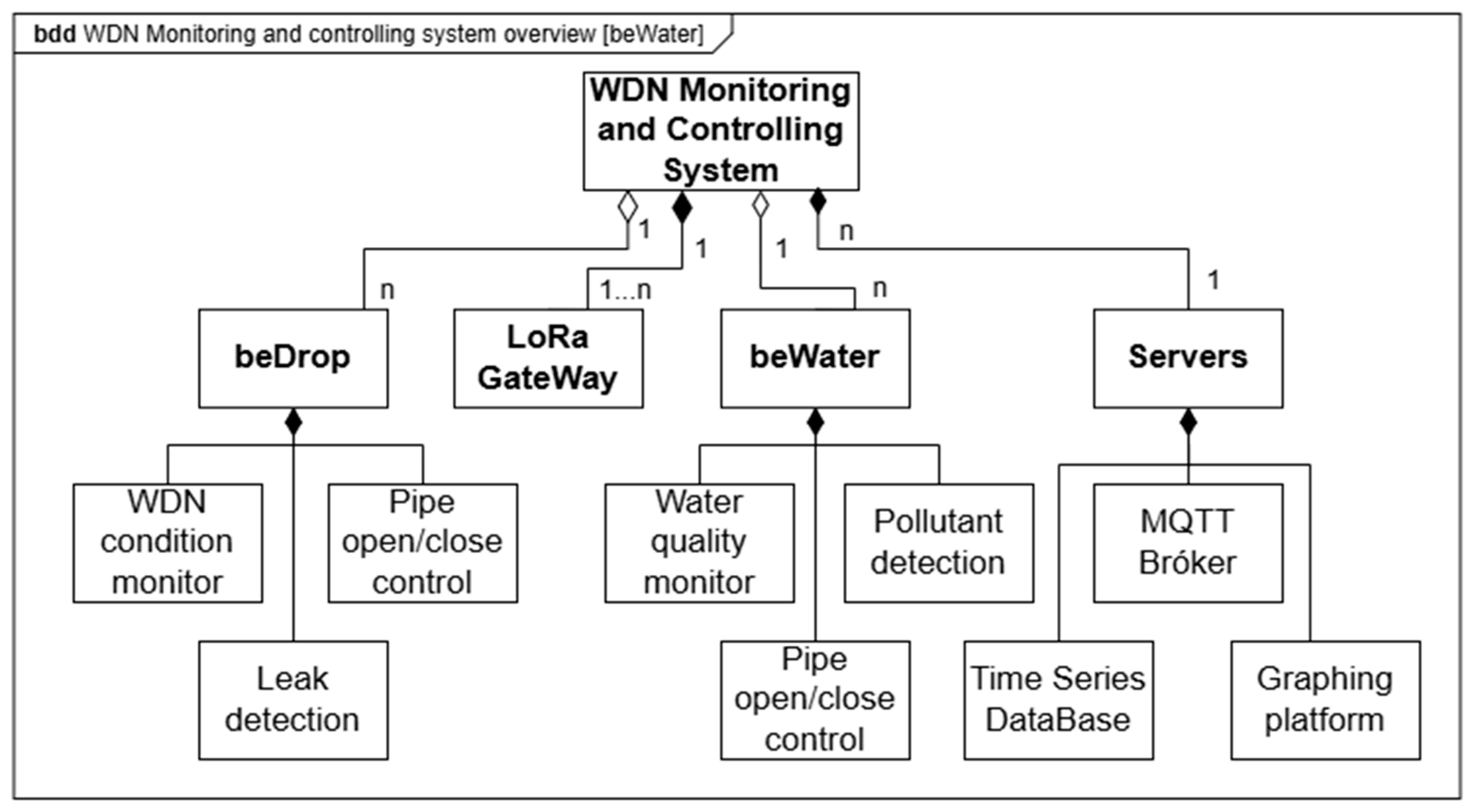
2.2. System Architecture
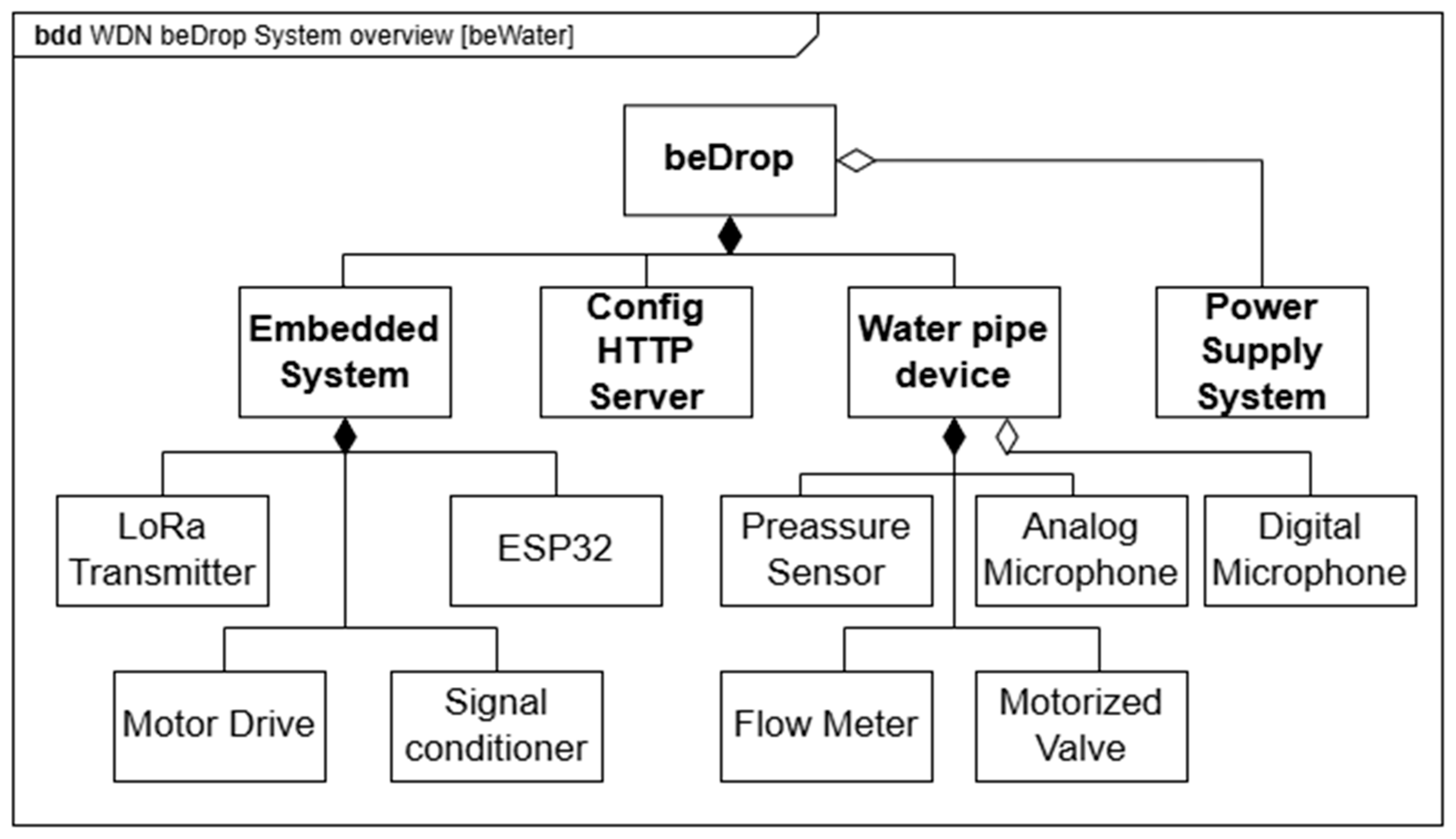
2.3. Hardware Development
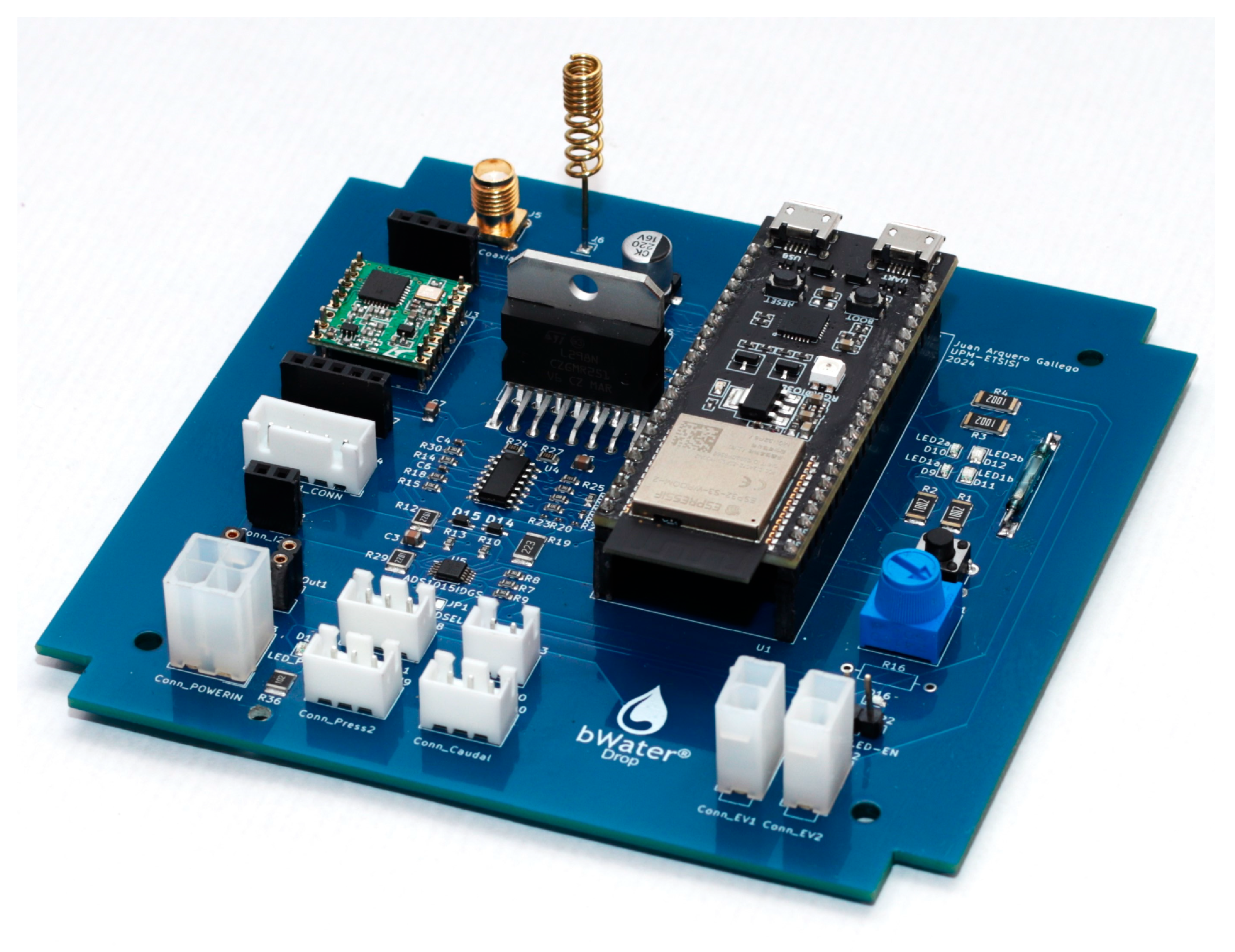
- Embedded System: A PCB board has been designed and developed to interconnect the microcontroller, an ESP32-S3, with the rest of the hardware components of the system. In addition, the developed PCB implements in analog form some functions, such as the detection of sound intensity peaks in the signal captured by the membrane microphone installed in the system. The system responsible for making this detection is under the signal conditioner block in the previous BDD diagram and is composed by an amplification stage, a buffer, and several operational amplifiers as comparators in a Schmitt trigger configuration. This board is presented in the next Figure 3.
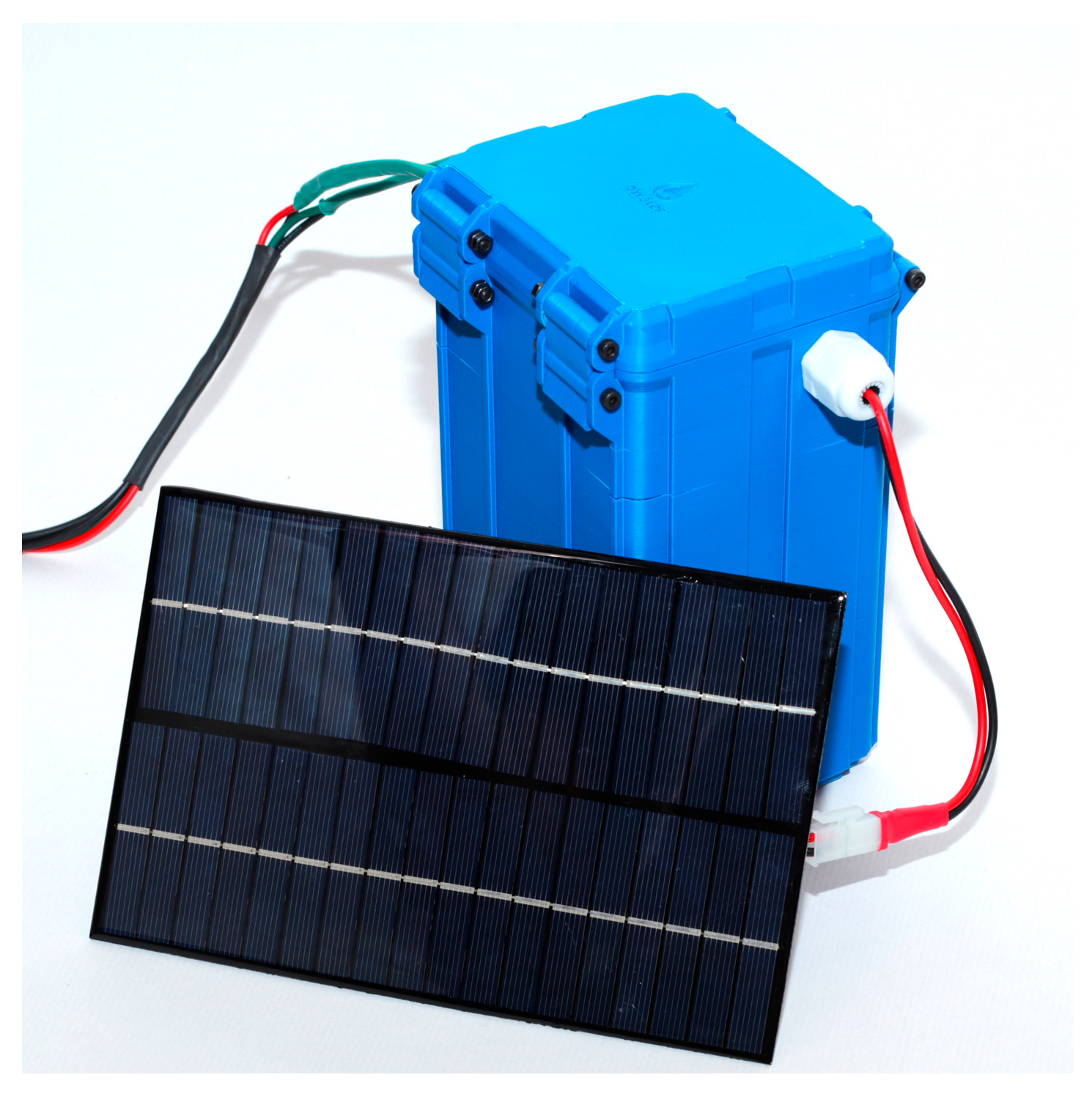
- Power supply system (Figure 4): The power supply system is composed of a lead acid battery, a BMS battery charge and status manager, and a solar panel that allows the system to be autonomous in environments that do not have a continuous 220 V AC power supply. Since this system is designed for field installation, the self-supply capability is crucial, as the need for a continuous power supply would significantly restrict the environments in which it could be installed. In the next figure, a photography of this system is provided. In this figure, there are two elements; firstly, a blue container box, designed specifically for this propose, containing the BMS, and the lead acid battery is on the back, while a solar panel stands in the front of the picture. Both the battery and the solar panel correspond to generic, commercially available components without a specific branded model, as they were selected for their compatibility with the system requirements rather than for any proprietary characteristics.

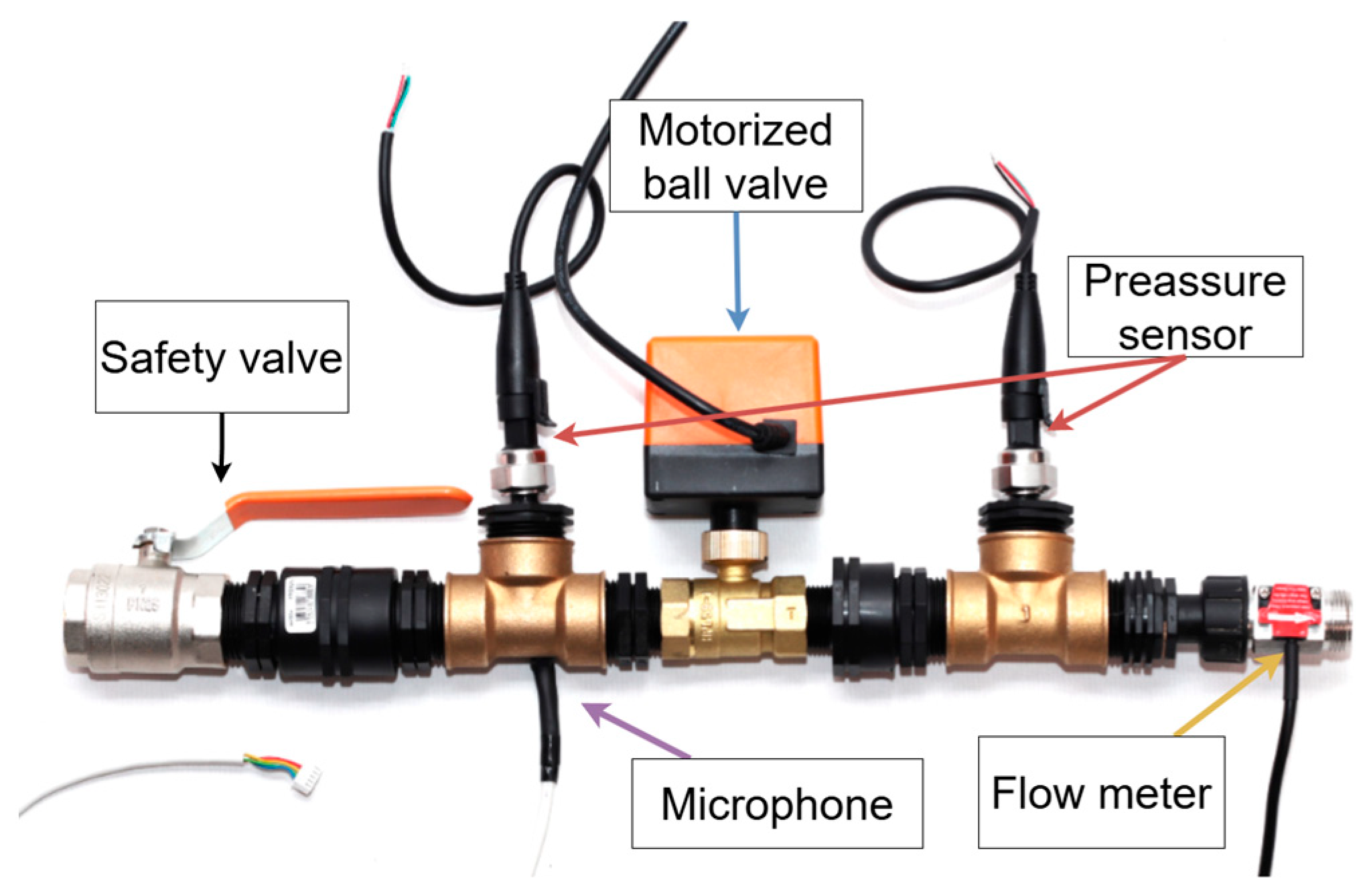
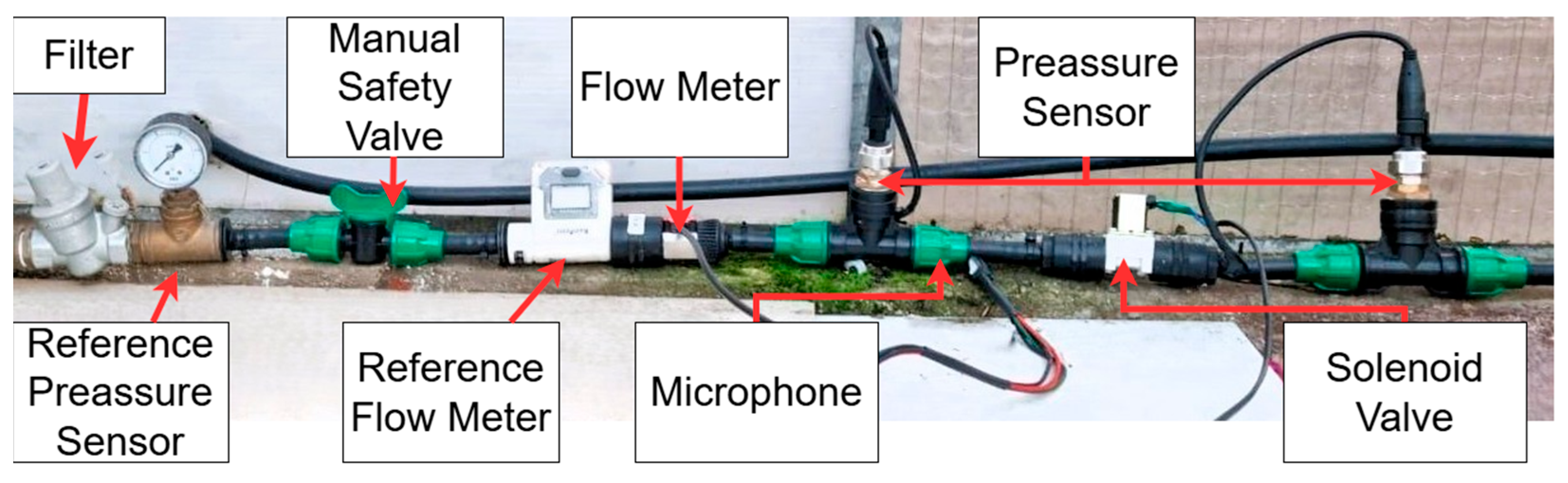
- Water pipe monitoring and controlling device (Figure 5): To enable the developed embedded system to control and sensor the water distribution medium in which it is installed, the presence of actuators and sensors on it are necessary, as they allow the physical interaction of the system. These are a digital flow meter, which senses the volume of water flowing through the pipe by generating pulses, a digital pressure sensor, capable of measuring the pressure at a specific time to which the pipe is being subjected, and a motorized ball valve, which is able to open and close, both fully and partially, the distribution channel. These are also accompanied by two microphones, one digital and the other analog, in charge of measuring the vibrations caused by possible leaks or micro-leaks present in the network. A sample device with only one microphone installed is presented in the next figure.
2.4. Software Development
2.4.1. Embedded Software
- Analog-to-digital conversion: The analog-to-digital converter ADC has to be used to measure the envelope signal of the one produced by the analog microphone, so it is necessary to use the highest sampling frequency that the ADC is able to give. In order to achieve this goal, firstly, a frequency of 3.4 MHz is set for the I2C line, corresponding to the High-Speed mode. Secondly, the interrupt reading is configured, which allows us to collect each sample at the precise moment it is captured. Finally, the ADC is configured to work at the highest number of samples per second (sps) that it offers, which is 3.3 K sps. This sampling frequency is not enough to fulfill the Nyquist theorem [26], so it is not useful to reconstruct the sound wave, but it is enough to perform a correct measurement of the envelope. For the pressure data measurements, the continuous reading by interruption is not used, the discrete mode with multisampling is used instead.
- Digital Microphone: To make use of the digital microphone it is necessary to correctly configure two elements; the I2S interface [27] and the direct access to memory (DMA) [28]. In addition, a file system capable of supporting the creation of .wav files with the captured waves must be configured. The I2S bus is configured at 16 kHz as sample rate, with a precision of 16 bits per sample, and the DMA buffer size is set according to the amount of data recorded. SPIFFS [29] is used to implement the file system responsible for saving the recorded .wav files within a custom partition table that allows us to save up to 25 MB. This table has also a partition reserved for allowing Over The Air (OTA) updates.
- LoRa transceiver: An RFM69 is installed as LoRa transceiver and is responsible for communicating acquired data to its configured gateway. For this proposal, different features are configured. First, a high power transmission is set, allowing us to expand the coverage of the connection; second, an ACK frame is added to the protocol, ensuring the reliability. Lastly, an AES [30] encryption is set, making the communications more secure.
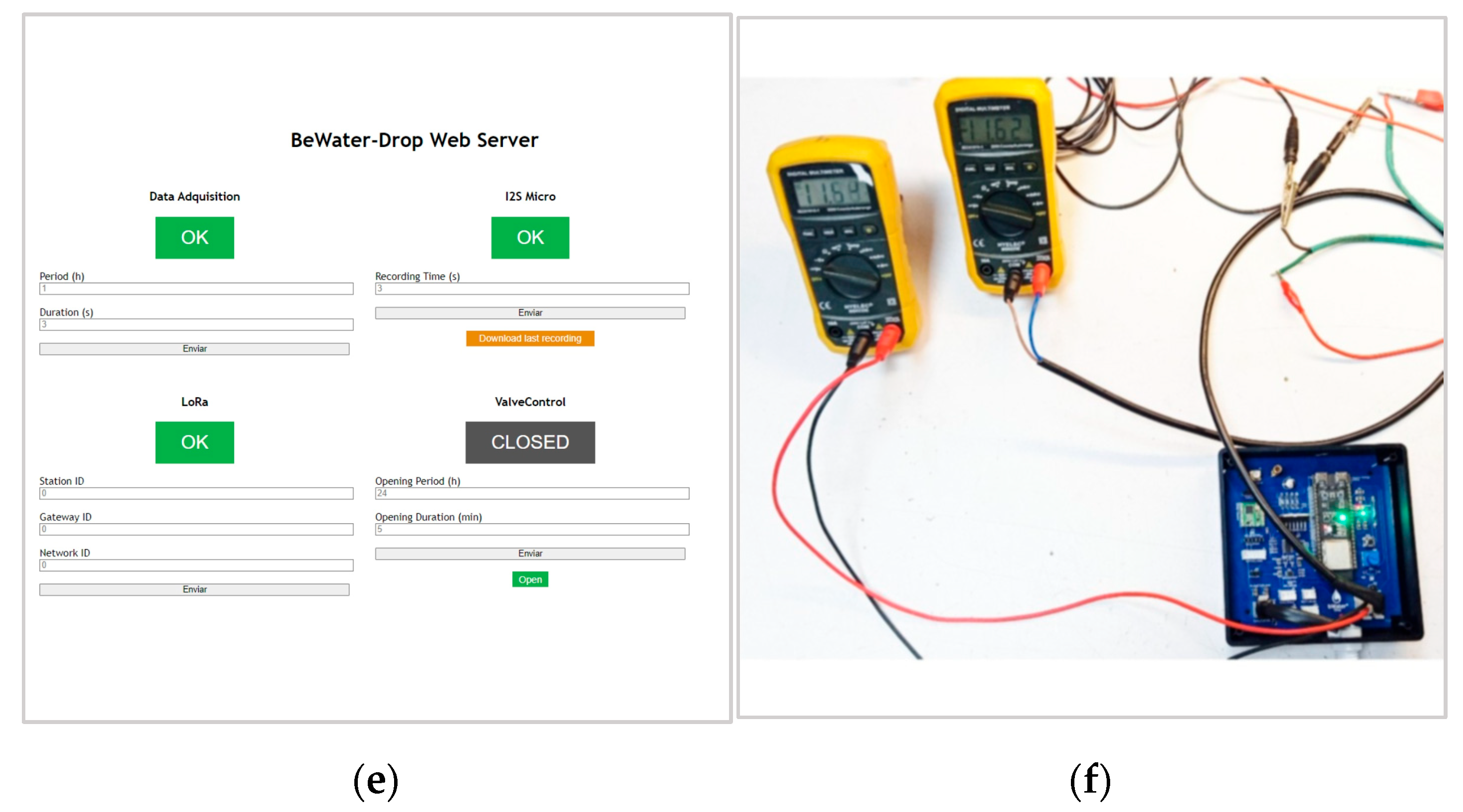
- Configuration portal: A web server is implemented that supports a configuration portal programmed using HTML and CSS on port 80, since it is offered through the HTTP protocol. This portal allows us to change several settings on the operation of the embedded device, such as the periodicity of its measurements, recording time of the microphones, valve opening periods, and duration. This portal also offers the possibility to download the generated .wav files.
2.4.2. Servers
- Database: A TimescaleDB time series database is implemented due to its good performance [31], low cost, and integration with the other software components. This database is optimized to store telemetry data indexed based on the timestamp at which they are captured, thus optimizing their plotting and querying based on the time axis.
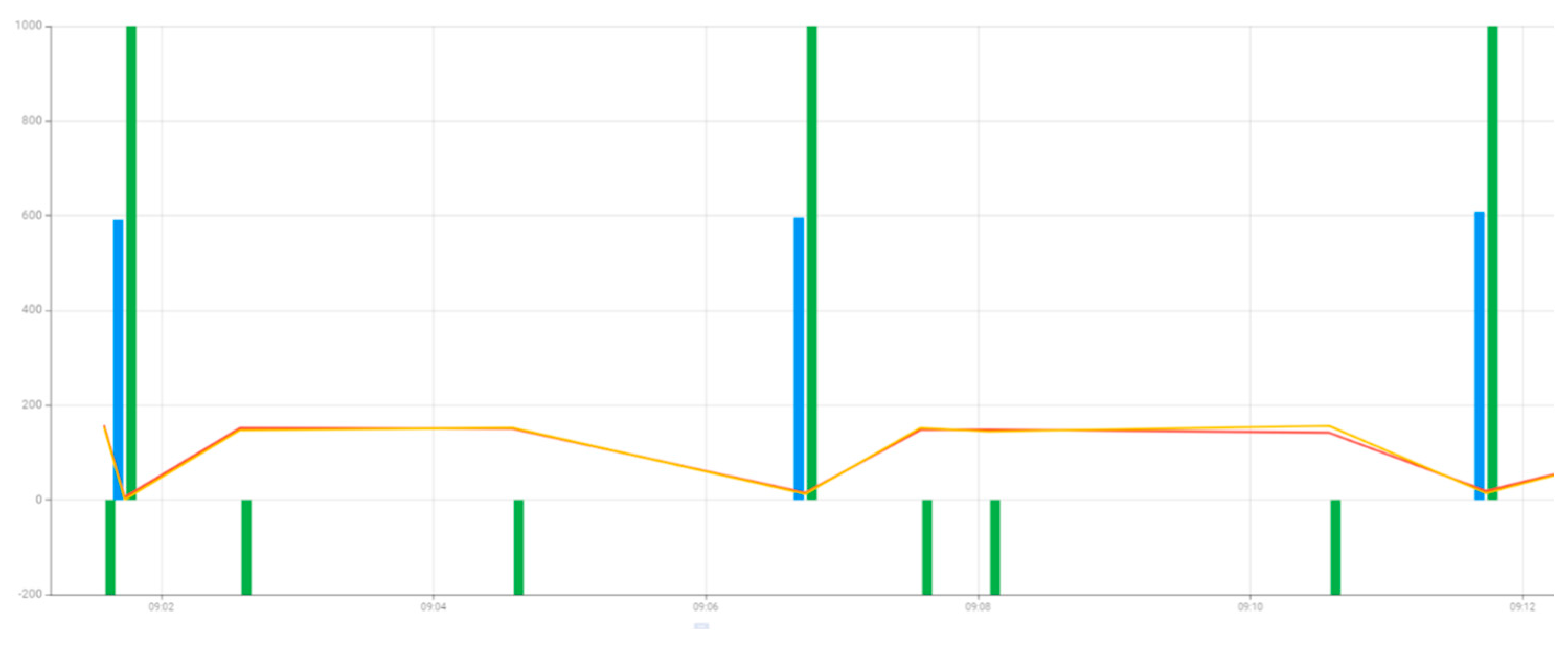
- Rule chain executor: For this project, two rule chains have been developed. The main one only executes the second one after saving the data in the time series database. The process that follows the second chain is recurrent and consists of executing a script that checks the value of the different variables, and depending on the result of the execution of this script, an alarm is created according to the problem that may occur, such as leakage, data out of the expected thresholds, etc. After this, if the alarm is created, a message is sent via email to the user to alert him.
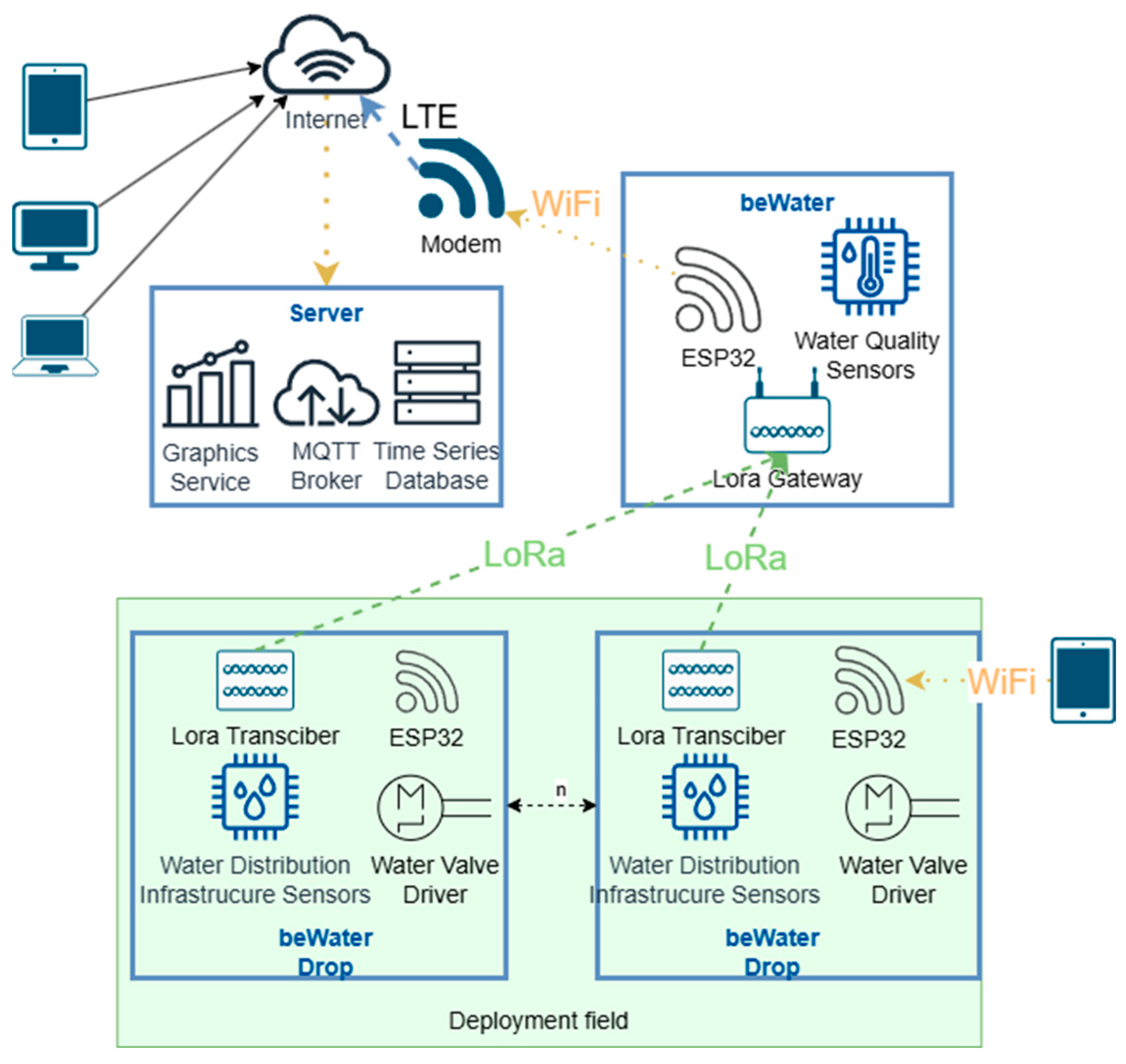
- MQTT broker: This technology is used to carry out the messages collected by the gateway and upload them to the database. This protocol allows to define a topic structure for organizing the different deployed devices and its recorded data, making the message passing protocol scalable. For naming each topic, the number of the gateway is referenced, and the device number is then specified. So the devices “D” connected to Gateway “G” will publish in the topics below under the prefix GateWay<G>/Dp<D>/. After the prefix specified above, the different topics that will contain the information provided by the different sensors and actuators installed are defined.
2.4.3. Graphing Platform
2.4.4. Telecommunication System
3. Results and Discussion
3.1. Module Tests

| Module | Test Description | Test Results |
|---|---|---|
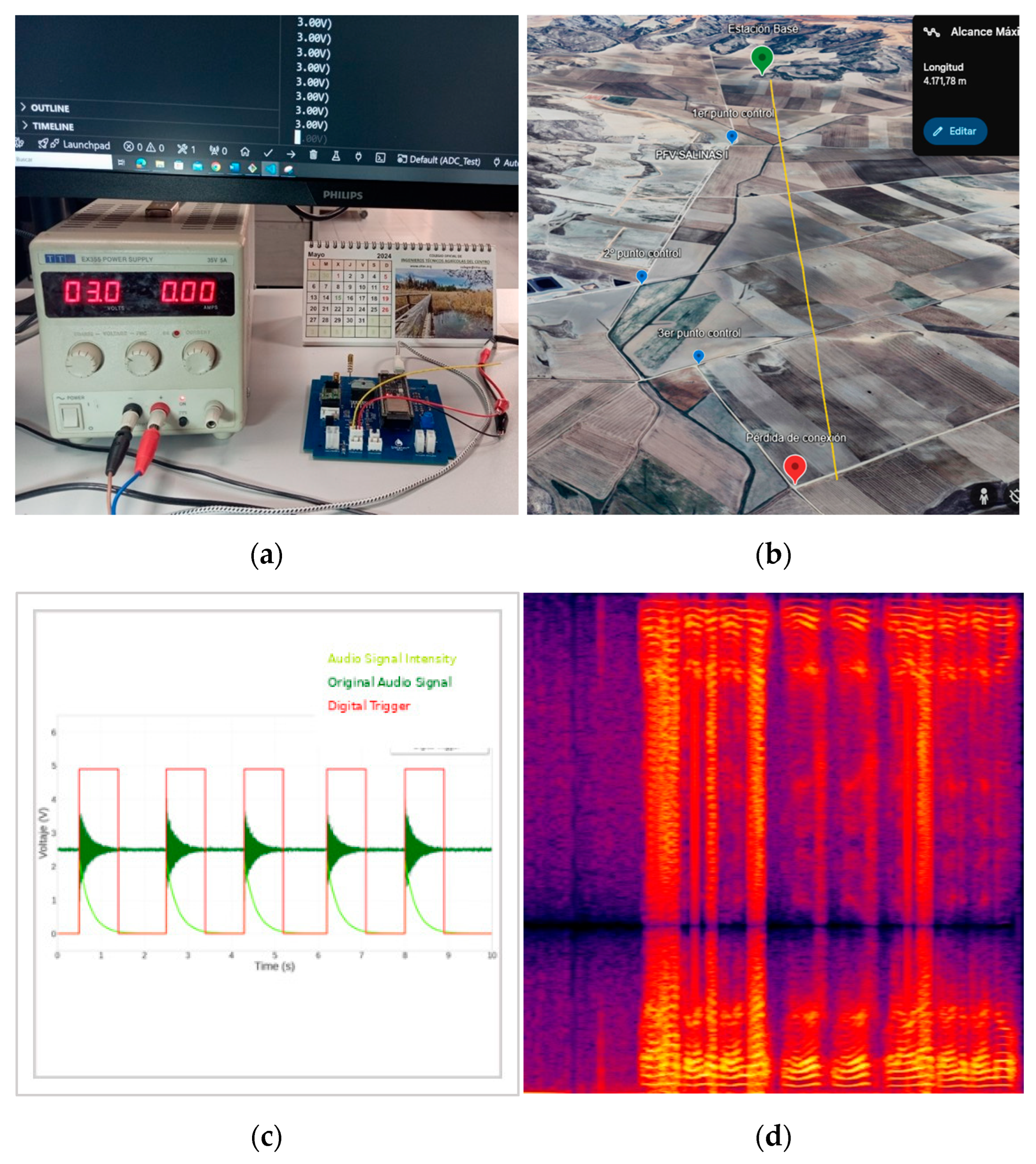
| ADC | Through the execution of a test program, voltage measurements are performed comparing the input against the output of a current-limited adjustable power supply. The values returned by the ADC must match the values provided by the power supply. | Passed. Verified at voltage levels: 1 V, 2 V, 3 V, 4 V, and 5 V. The power supply output matches the value captured by the test program and displayed via UART serial communication. (Figure 8a) |
| LoRa Transceiver | Point-to-point connectivity between the distributed device and the Gateway is validated via test software, ensuring data integrity by confirming that the transmitted sequence number matches the received value. | Passed. Field test results: Maximum coverage of 4 km achieved in an open, flat environment with minimal interference. Video available. (Figure 8b) |
| Digital Microphone | A test program is executed to verify that the digital microphone is capable of capturing an audio signal and generating a .wav file containing the received audio data. The file must be successfully stored in the file system. | Passed. INMP441 digital microphone setup and SPIFFS file system configuration verified. The recording was successfully generated and downloaded via the configuration portal. A spectrogram and the .wav file are provided as evidence. (Figure 8d) |
| Sound sensor | An analog microphone is connected to verify it generates a trigger when a sound of a specific intensity is detected. Additionally, the test verifies that the system’s sensitivity can be adjusted using the installed potentiometer. | Passed. Tested with surface impacts. Sensitivity was successfully tuned via the potentiometer. The module generates three signals: the amplified audio path with a 2.5 V offset (dark green), an intensity envelope proportional to volume (light green), and a threshold-based trigger (red) used to generate the system interrupt for sound analysis. (Figure 8c) |
| HTTP Server | Through the execution of a test program, verify that the HTTP portal is capable of accessing files stored in the file system and serving them in response to an HTTP GET request. | Passed. Validated in conjunction with Test 4. The output shows the portal address, the presence of the generated audio file, and its size, allowing for successful download. (Figure 8e) |
| Flow Control System | A test program executes control over the motor system. It must be verified that two motors—one connected to EV1 and the other to EV2—can be powered with 12 V in both polarities. | Passed. Multimeters connected to EV outputs verified voltage and polarity during sequential open/close actuation (12 V DC). (Figure 8f) |


3.2. Integration Tests
3.3. Real Scenario Test
4. Conclusions
Author Contributions
Funding
Data Availability Statement
Acknowledgments
Conflicts of Interest
References
- AEMET Informe Sobre el Estado del Clima de España 2022. Resumen Ejecutivo 2022. Available online: https://www.aemet.es/documentos/es/conocermas/recursos_en_linea/publicaciones_y_estudios/publicaciones/Informes_estado_clima/resumen_ejecutivo_iecle2022.pdf (accessed on 9 December 2025).
- INE. Estadística Sobre el Suministro y Saneamiento del Agua 2020; INE: Madrid, Spain, 2020. [Google Scholar]
- INE. Suministro de Agua y Tratamiento de las Aguas Residuales. In Producción Total por Actividades Económicas (CNAE-93) y Productos (CPA-2002) 2007; INE: Madrid, Spain, 2007. [Google Scholar]
- BOPA. BOPA 380. Technical Report, Parlamento de Andalucía 2024. Available online: https://www.parlamentodeandalucia.es/webdinamica/portal-web-parlamento/pdf.do?tipodoc=bopa&id=180235 (accessed on 9 December 2025).
- Arquero, J. Diseño Y Construcción De Módulo IOT Para La Monitorización De La Calidad Del Agua De Riego; UPM Open Access: Madrid, Spain, 2022. [Google Scholar]
- Saad, A.; Benyamina, A.E.H.; Gamatie, A. Water Management in Agriculture: A Survey on Current Challenges and Technological Solutions. IEEE Access 2020, 8, 38082–38097. [Google Scholar] [CrossRef]
- Dhulavvagol, P.M.; Ankita, K.R.; Sohan, G.; Ganiger, R. An Enhanced Water Pipeline Monitoring System in Remote Areas Using Flow Rate and Vibration Sensors; Springer Singapore Pte. Limited: Singapore, 2018; pp. 331–345. [Google Scholar]
- Devalal, S.; Karthikeyan, A. LoRa Technology—An Overview. In Proceedings of the 2018 Second International Conference on Electronics, Communication and Aerospace technology (ICECA), Coimbatore, India, 29–31 March 2018; pp. 284–290. [Google Scholar]
- Müller, R.; Illium, S.; Ritz, F.; Schröder, T.; Platschek, C.; Ochs, J.; Linnhoff-Popien, C. Acoustic Leak Detection in Water Networks. arXiv 2021. [Google Scholar] [CrossRef]
- Sato, T.; Mita, A. Leak detection using the pattern of sound signals in water supply systems. In Sensors and Smart Structures Technologies for Civil, Mechanical, and Aerospace Systems 2007; SPIE: Bellingham, WA, USA, 2017; Volume 6529, pp. 816–824. [Google Scholar] [CrossRef]
- Bakhtawar, B.; Fares, A.; Zayed, T. AIoT-Driven Leak Detection in Real Water Networks Using Hydrophones. Water Resour. Manag. 2024, 39, 2551–2566. [Google Scholar] [CrossRef]
- Salman, M.Y.; Hasar, H. Real-time pipeline monitoring with FSR sensors: An IoT wireless sensor network approach to multi-leak detection. Water Pract. Technol. 2025, 20, 2849–2861. [Google Scholar] [CrossRef]
- Liu, R.; Zayed, T.; Xiao, R.; Hu, Q. Time-Transformer for acoustic leak detection in water distribution network. J. Civ. Struct. Health Monit. 2024, 15, 759–775. [Google Scholar] [CrossRef]
- Plantae. Plantae Flow Meter 2025. 2025. Available online: https://plantae.garden/en/caudalimetro-de-riego/ (accessed on 9 December 2025).
- Aganova. Nautilus Leak Detection System 2025; Aganova: Málaga, Spain, 2025. [Google Scholar]
- Commercial News. Meas. Control. 2014, 47, 66–70. [CrossRef]
- Flexim FLUXUS G722 Dual Channel Gas Flowmeters. FedBizOpps 2023. Available online: https://sam.gov/workspace/contract/opp/0ae9dc4149a1436e8623d284a2ac3f57/view (accessed on 9 December 2025).
- Press Release: Echologics Introduces the New Valve-Based Leak Monitoring Sensor. Dow Jones Institutional News. 15 November 2022. Available online: https://ir.muellerwaterproducts.com/press-releases/2022/11-15-2022-221332628 (accessed on 9 December 2025).
- Aclara STAR ZoneScan Cited as One of Ten Stand-Out Technologies at ACE12. PR Newswire. 23 July 2012. Available online: https://www.prnewswire.com/news/Aclara/?page=4 (accessed on 9 December 2025).
- Sensus (Xylem Inc.). Smart Water Metering Solutions—AMI and LPWAN Technologies. Technical Overview, 2023. Available online: https://sensus.com (accessed on 9 December 2025).
- Khulief, Y.A.; Khalifa, A.; Mansour, R.B.; Habib, M.A. Acoustic Probe for Leak Detection in Water Pipelines. WO 2012/158267 A1, 5 March 2012. [Google Scholar]
- Enev, M.; Banerjee, S.; Patel, S.N. Water Leak Detection Using Pressure Sensing. EP 3374747 B1, 9 November 2016. [Google Scholar]
- Tailor, D.; Dunn, R.; Phillip, M.; Hammami, B.; Conners, S.; Slingerland, E.; Wong, D. Method and Apparatus for Pipeline Monitoring. WO 2020/215161 A1, 29 April 2020. [Google Scholar]
- OMG Systems Modeling Language (SysML) Specification Version 1.7 2022. Available online: https://www.omg.org/spec/SysML/1.7/PDF (accessed on 9 December 2025).
- Arquero, J. Diseño E Implementación De Sistema IoT Para Monitorización Y Control De Redes De Distribución Hídrica; UPM Open Access: Madrid, Spain, 2024. [Google Scholar]
- Shannon, C.E. Communication In The Presence Of Noise. Proc. IEEE 1998, 86, 447–457. [Google Scholar] [CrossRef]
- NXP I2S Bus Specification 2022. Available online: https://www.nxp.com/docs/en/user-manual/UM11732.pdf (accessed on 9 December 2025).
- Rubini, A.; Corbet, J. Linux Device Drivers, 2nd ed.; O’Reilly: Beijing, China, 2001; pp. 412–463. [Google Scholar]
- Espressif SPIFFS Filesystem 2025. 2025. Available online: https://docs.espressif.com/projects/esp-idf/en/latest/esp32/api-reference/storage/spiffs.html (accessed on 9 December 2025).
- Daemen, J.; Rijmen, V. Rijndael: The advanced encryption standard. Dobb’s J. 2001, 26, 137–139. [Google Scholar]
- Mostafa, J.; Wehbi, S.; Chilingaryan, S.; Kopmann, A. SciTS: A Benchmark for Time-Series Databases in Scientific Experiments and Industrial Internet of Things. In Proceedings of the 34th International Conference on Scientific and Statistical Database Management, Copenhagen, Denmark, 6–8 July 2022. [Google Scholar] [CrossRef]
- IEEE. IEEE Standard for Information Technology-Telecommunications and Information Exchange Between Systems Local and Metropolitan Area Networks-Specific Requirements Part 11: Wireless LAN Medium Access Control (MAC) and Physical Layer (PHY) Specifications; IEEE: Piscataway, NJ, USA, 2020. [Google Scholar]


| Reference | Application | Sensors Used | Detection Techniques | Communication Technologies | Energy/Autonomy | Architecture | Limitations | Differential Contribution |
|---|---|---|---|---|---|---|---|---|
| [6] Water Management in Agriculture (Survey) | Agricultural management (irrigation, reuse, quality) | Pressure, flow, acoustic microphones, water quality sensors | General supervision (no advanced techniques) | Wi-Fi, ZigBee, MQTT, etc. | Not addressed | Distributed architecture | Theoretical approach, no prototype | beWater Drop provides a real, autonomous prototype |
| [7] Enhanced Water Pipeline Monitoring | Pipelines in remote areas | Flow, vibration | Vibration analysis and flow comparison | Wi-Fi, LTE | Not autonomous | Basic prototype | Cellular dependency; no valve control | Adds solar autonomy, LoRa and hydraulic actuation |
| [9] Acoustic Leak Detection in Water Networks | Acoustic leak detection in urban networks | Contact microphones on hydrants | Acoustic detection and ML (autoencoders, adversarial nets) | Low-energy, low-bandwidth network | Not autonomous | centralized architecture. IoT nodes | High computational cost; no hydraulic integration | Lightweight acoustic analysis + hydraulic sensors |
| [11] AIoT-Driven Leak Detection | Urban real-world networks | Hydrophones + acoustic logger | Signal analysis + FFT | IoT, Wi-Fi with mobile network usage | Not autonomous | AIoT | Complexity and cost | Lower-cost, autonomous LoRa-based alternative |
| [10] Leak Detection Using Sound Signals | Water supply networks | Microphones | Acoustic detection | Laboratory-based approach | Not specified | Experimental | Limited to controlled environments | PCA/DSF feasible on low-power hardware |
| [12] Real-time Pipeline Monitoring with FSR Sensors | Urban multi-leak detection | FSR sensors | Multipoint analysis | Wireless IoT | Not specified | WSN | Limited scalability | Adds energy autonomy and hydraulic control |
| [13] Liu et al.—Time-Transformer for Acoustic Leak Detection | Distribution networks | Microphones | Sequential ML (Transformers) | Not specified | Not autonomous | Experimental-phase prototype | Algorithmic complexity | Prioritizes simplicity and low-power processing |
| Device | Sensing | Communication | Real-Time | Autonomy | Valve | Install | Environment | Comparison |
|---|---|---|---|---|---|---|---|---|
| Plantae [14] | Flow | LoRaWan | Yes | Battery | No | Fixed | Irrigation | beWater Drop System adds pressure, acoustic sensing and valve control |
| Nautilus [15] | Acoustic | No communication. Creates offline datasets | No | One operation | No | Not installed | General WDN | beWater Drop remains installed, performing a WDN monitoring, while Nautilus performs a single scan when its deployed |
| HWM PermaNET+ [16] | Acoustic | Integrated cellular modem | Yes | Limited battery (5 years) | No | Fixed | Urban WDN | beWater Drop System offers multi-sensor fusion, long-range lora and hydraulic actuation |
| Flexim FLUXUS [17] | Flow | Local | Local only | Not specified | No | Clamp-on | Industrial Gas Distribution | beWater Drop System provides remote lora connectivity plus acoustic and pressure sensing |
| Echologics EchoShore-DX [18] | Acoustic | Cellular | Yes | Battery (5–10 years) | No | Fixed curb-box | Urban WDN | beWater Drop System integrates multi-sensor monitoring and distributed control |
| Gutermann ZONESCAN [19] | Acoustic | Nb-iot | Yes | Battery (5 years) | No | Fixed | Urban WDN | beWater Drop System improves autonomy and adds valve control capabilities |
| Sensus/Badger AMI [20] | Flow + pressure | NFC | Yes | Battery (20 years) | No | Fixed | Urban WDN | beWater Drop System adds acoustic sensing and active hydraulic actuation |
| Advantages | Disadvantages |
|---|---|
| Standardization increases control over the development process. | It is a process with low flexibility, where significant deviations from the established plan are not allowed. |
| It increases reliability and precision when estimating development costs. | If any of the verification phases are not passed, it becomes a blocking factor for development, which can be severely affected in terms of deadlines. |
| The conclusion of each phase delivers a verified product that can be exported for outsourcing the development of subsequent phases. | It increases the product’s Time to Market, making it vulnerable to market disruptions and potentially jeopardizing its viability as a business project. |
| Codification is facilitated due to the existence of prior documentation and unit tests. | A larger team template is required because, ideally, the testing team cannot share personnel with the implementation team. |
| Tasks are appropriately assigned for each phase, providing a clear roadmap for development and minimizing idle times between phases. | Until the last phase, there is no prototype, so implementing changes to specifications once the product’s behavior is analyzed requires restarting development, thus consuming a significant amount of time. |
Disclaimer/Publisher’s Note: The statements, opinions and data contained in all publications are solely those of the individual author(s) and contributor(s) and not of MDPI and/or the editor(s). MDPI and/or the editor(s) disclaim responsibility for any injury to people or property resulting from any ideas, methods, instructions or products referred to in the content. |
© 2025 by the authors. Licensee MDPI, Basel, Switzerland. This article is an open access article distributed under the terms and conditions of the Creative Commons Attribution (CC BY) license.
Share and Cite
Arquero-Gallego, J.; Gilarranz-Casado, C.; Garcia-Alcántara, V.; Álvarez, J. A Distributed, Energy-Autonomous Multi-Sensor IoT System for Monitoring and Reducing Water Losses in Distribution Networks. Inventions 2026, 11, 3. https://doi.org/10.3390/inventions11010003
Arquero-Gallego J, Gilarranz-Casado C, Garcia-Alcántara V, Álvarez J. A Distributed, Energy-Autonomous Multi-Sensor IoT System for Monitoring and Reducing Water Losses in Distribution Networks. Inventions. 2026; 11(1):3. https://doi.org/10.3390/inventions11010003
Chicago/Turabian StyleArquero-Gallego, Juan, Carlos Gilarranz-Casado, Vicente Garcia-Alcántara, and José Álvarez. 2026. "A Distributed, Energy-Autonomous Multi-Sensor IoT System for Monitoring and Reducing Water Losses in Distribution Networks" Inventions 11, no. 1: 3. https://doi.org/10.3390/inventions11010003
APA StyleArquero-Gallego, J., Gilarranz-Casado, C., Garcia-Alcántara, V., & Álvarez, J. (2026). A Distributed, Energy-Autonomous Multi-Sensor IoT System for Monitoring and Reducing Water Losses in Distribution Networks. Inventions, 11(1), 3. https://doi.org/10.3390/inventions11010003