1. Introduction
Intimate partner violence (IPV), as an often neglected common cause of injury worldwide, is underreported and underrecognized by healthcare professionals [
1]. Women are unlikely to report IPV due to fear of retribution by the perpetrator, thus prolonging the years of abuse. Women may decide not to seek healthcare due to fear of the consequences, or when they do seek care, the victim may deceive the healthcare provider or lie about the physical signs of abuse, or the healthcare provider may take the victim at their word, secondary to a lack of training in recognizing signs of IPV. IPV refers to physical violence, sexual violence, psychological aggression, and stalking by a person with whom the individual has a close personal relationship, potentially a current or former partner [
1]. In the United States, approximately 47% of women and 44% of men experienced some form of IPV in their lifetime [
1]. IPV is prevalent in communities across the United States and affects women at higher rates of contact sexual violence than men [
1]. Worldwide, over a quarter of women aged 15 to 49 years who have been in a relationship report that they have been subjected to IPV [
2]. Minority ethnic and immigrant women, including Asian and Black women, may experience barriers to seeking help for abuse due to cultural norms, institutional racism, and factors associated with immigration [
3]. Although IPV is present across all populations, it is important to note that there are vast racial and cultural inequities in the numbers of women who are most likely to experience IPV, and most IPV research is conducted in high-income countries [
2]. Negative outcomes, risk factors, formal and informal types of support, resilience, and individual experiences explored in the literature and in future research need to be critiqued in the context of participants’ demographics and disparities across populations.
Negative outcomes associated with IPV victimization include poor mental and physical health and the inability of women to establish financial stability and pursue a satisfying career. The prevalence of IPV and its effects on employment and health are well documented. A recent meta-analysis noted increased odds for all mental health outcomes associated with IPV, including depression (odds ratio = 2.04–3.14), posttraumatic stress disorder (OR = 2.15–2.66), and suicidality (OR = 2.17–5.52). Each of these factors significantly affects the victim of IPV, impairing their ability to carry on at work and in everyday life [
4]. An individual’s working-life conditions are a key social determinant of health [
4]. Attaining and maintaining employment has been identified as critical for women to separate from IPV. However, previous research has described IPV and employment as intertwined or entangled in complex ways [
5].
Borchers, Lee, Martsolf, and Mahler [
5] developed a theoretical framework describing the process by which women survivors of IPV attain and maintain employment. This framework highlights how IPV and work are intertwined and the need for women to fully disentangle from IPV to maintain employment and pursue a satisfying career path [
5]. Disentanglement, or separating from things that are intertwined, allows the woman to distance herself from IPV by creating a new identity focused on work and career [
5]. Employment, career, and education have been identified as crucial for women to fully disentangle themselves from IPV [
5]. In their study, finding meaning in work allowed the victim of IPV to regain control of their life and focus on career [
5].
Outside of risk factors and negative outcomes associated with IPV, women’s decision-making related to disclosing abuse and leaving the relationship, or disentangling, has been highlighted in relevant research. Due to perceived and actual risks associated with leaving an abusive partner, including but not limited to financial hardships, isolation from family and friends, and fear of retaliation, the decision to leave is often a multi-step process. The Transtheoretical Model of Change (TTM) has been used to assess the stage of change and readiness to change in abusive relationships [
6]. The TTM aims to help understand, measure, and intervene in behavior change and offers five stages of change ranging from precontemplation to action and maintenance [
6]. In other words, successfully disentangling from IPV is a process and takes time. While some studies have applied the TTM to situations of IPV [
6,
7], an understanding of resilience factors that contribute to the eventual TTM action stage, or decision to leave or disentangle, is absent from the literature.
Resilience is an individual’s capacity to successfully adapt or change in the face of adversity or trauma and recover from stress [
8]. This definition includes the impact of multiple systems on an individual’s capacity for resilience. Similarly, disentanglement refers to the ability to separate things that are twisted together in a complex way [
5]. In the context of IPV, the ability to be resilient is related to the ability to disentangle from an abusive relationship. It should also be noted that one’s ability to be resilient and leave an abuser is embedded in many structural and social constraints, such as race and class. This complex interplay between individual factors, such as relationships, as well as community-level factors, such as poverty, is associated with higher levels of violence and IPV [
9,
10,
11]. While these are important aspects to identify, the current study focused on factors contributing to resiliency among the ten survivors interviewed, so an in-depth analysis of the impact of structural barriers is beyond the scope of this work.
Resilience is a multi-faceted concept that scholars have approached from different perspectives. Ungar investigated resilience within a social/ecological framework and suggested that several interrelated factors are associated with positive outcomes when an individual is under stress [
12]. These factors include relationships, a defined identity, power/control, social justice, access to material resources, a sense of cohesion/belonging, and cultural adherence [
13]. Likewise, employment and the workplace have been identified as informal and formal resources for these factors [
5]. Employment has been identified as a key social/ecological element for women to completely disentangle from IPV. The current research sought to contribute to the literature by qualitatively exploring the resilience factors contributing to the process of disentangling from IPV and establishing a career path. An understanding of these elements, as described in their own words, by women who become disentangled from IPV and establish a career path, is central to developing effective inter-professional interventions that reduce further violence and injury, and address health concerns.
In the context of IPV, Anderson et al. [
13]. also reported that women who had previously experienced IPV emphasized the importance of secure relationships and informal as well as formal support. Survivors of IPV frequently found meaning in taking pride in their achievements, relying on God for help, and believing that things happen for a reason [
13]. Howell et al. [
14]. also found that social support and spirituality significantly predicted higher resilience among a group of IPV survivors.
3. Results
The mean age of the ten participants at the time of the interview was 47 (ranging from 23 to 62 years), with six Caucasians and four Hispanics being interviewed. The participants’ racial/ethnic identities reflect the southwest region from which the sample was drawn.
Table 1 represents the demographics of those interviewed who had experienced IPV. At the time of the interview, four of the participants had completed graduate school, three had completed a bachelor’s degree, one was currently taking college classes, and two had a high school education. All participants were employed at the time of the interview. In terms of personal income level at the time of the interview, participants’ income ranged from three making less than
$10,000 to three earning between
$100,000 and
$124,999. All but one participant had children, with an average of 2.7 kids per participant.
The ten women interviewed are by no means representative of all IPV survivors, as the majority are white, wealthy, educated women. This is likely due to the timing of the interviews (the current day, asking them to reflect on their experiences with IPV) and the recruiting process (women who had established a career path since disentangling from IPV). In other words, for many of the women, the abuse occurred years before they received their education and were hired in well-paying jobs. From this perspective, the participants offer novel insight into the resilience factors identified below because they made substantial changes in their own lives, relative to education and work, after leaving the abusive relationship.
3.1. Disentangling from IPV: Stories of Resilience
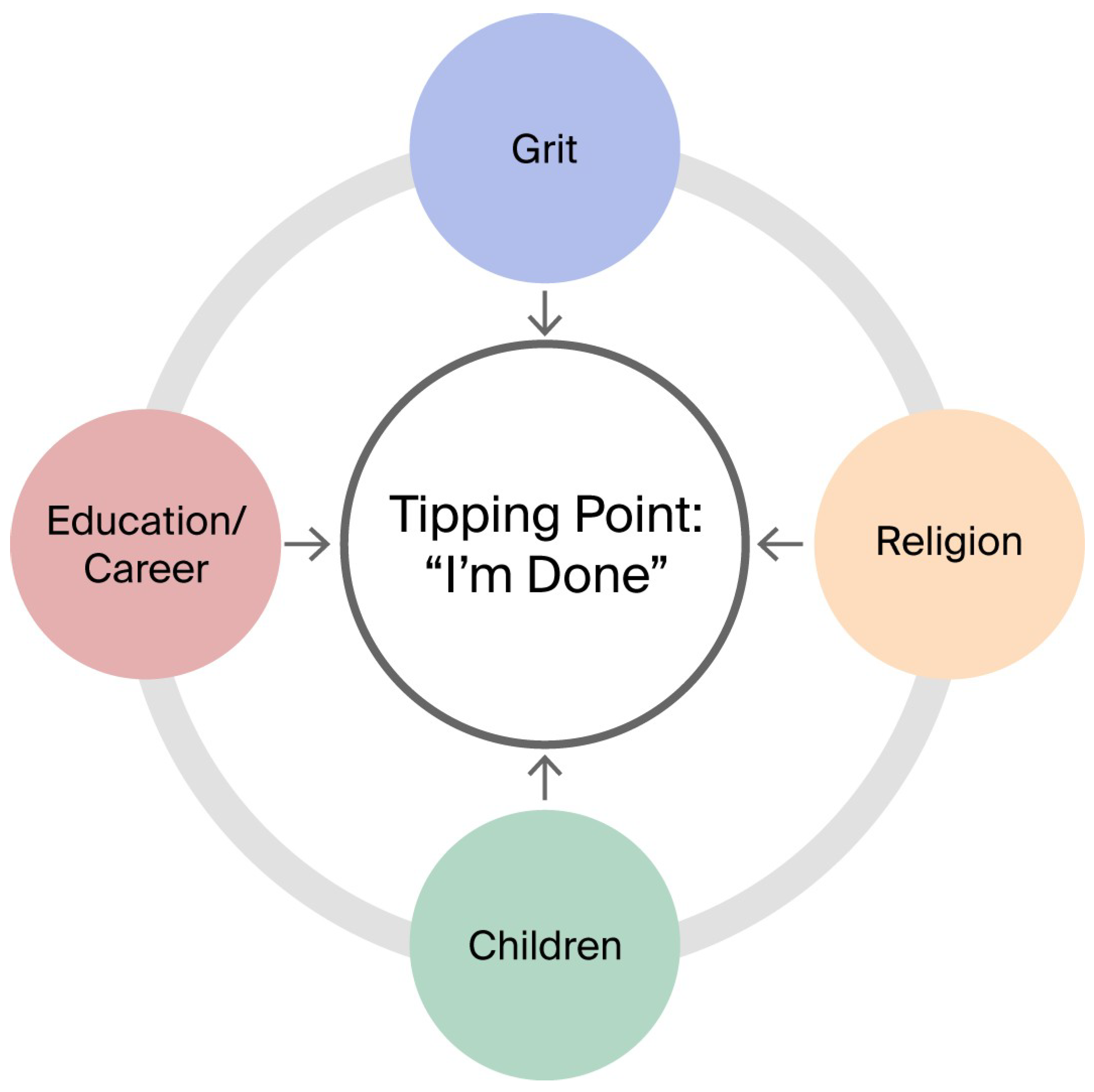
Analysis of the interview narratives revealed several factors that the women found to be important in their decision-making or process of disentangling from their abusive situation. While they may not have used the terms “turning points” or “resiliency”, the ways in which they characterized a shift in their thinking or described sources of support and strength emerged from the participant interviews. The researchers noted that the women highlighted the following key elements in their lives as most important in their disentanglement: “I’m done”, tipping point, grit, religion, children, and education/career. Women found relational support and others’ perspectives on the abuse through children, career/education, and religion, with “being done” with the violence and grit as the two key resilience factors.
Table 2 provides resilience factors and examples gathered from the participants. Likewise, children, religion, and further education fueled the tipping point needed to persevere.
Figure 1 describes the relationship between the descriptive factors contributing to disentanglement.
3.2. “I’m Done”: Reaching the Tipping Point and the Role of Children
All ten participants reached a tipping point, which many of the women described as “being done”, which led them to disentangle from the violence. Once the participant reached this tipping point, they verbally declared that they were “done with the violence”, they decided to act, and then started taking steps toward leaving the violent situation. All ten participants reached this tipping point through different means. As shown in
Figure 1, multiple factors or a single factor may be identified by women in their stories of disentanglement, with a feeling of “being done” or a key tipping point centering the decision or ability to disentangle from the abuse. For example, one participant who reached the tipping point of IPV noted, “If you’re going to do it, do it. I am done. I need this to be over, and I need you to never come back. So, if that means that I die, then I want to die.” Here, the woman is describing how the violence had gotten to a point that pushed her to end the relationship or to face more violence—either way, she described her readiness for something to change.
A second participant noted that once the violence extended to her child, she was done:
“That was the day I was done with him. I can take it. I’m an adult. I know that everything I did was the wrong thing, I know that it wasn’t. But in my mind, I know everything I’m doing is wrong. I know it’s all my fault when he hits me. I know I’m the problem. But when he hit my kid, something in my brain totally rewired that day, and I was like, ‘This is not okay. You can’t hit a child because they don’t want to get soap in their eyes.’”
After an incident in which the abuse extended to “arbitrarily hitting her son”, this woman decided to meet with an attorney to begin divorce proceedings. She described being able to tolerate the abuse as an adult, but the “I’m done” moment for her appeared to be a clear line against victimizing a child. The participants’ realization of the harm to their children quickly reached the tipping point. Similarly, another participant began safety planning and steps toward leaving in earnest once she discovered that her partner was abusing her eldest daughter.
In addition to protecting children from experiencing abuse directly, the interviews also illustrated women who characterized their tipping point moment to prevent children from witnessing the abuse. The decision to leave and protect her children was not wanting the kids to see violence and have the kids see him hitting her. After 6 months, she was done. Another mother described an interaction with her two daughters, who were seeing their father bring flowers after an abusive incident, and that their mom would say, “Okay, stay here.” In this example, the mother realized what the children were witnessing and explained the next time this happened: “So he brings me the flowers, as the abusers do,” and he says, ‘I’m sorry.’ And I say, “Not anymore.” This mother further described feeling “so tired” about her situation and not knowing what to do or how, but that something changed when her daughter spoke up: “She’s eight years old, and she says, ‘Stop it.’” When the daughter witnessed the abuse, she told her mom, and her mom told the abuser, “You need to leave the house.” With help from her daughter, this woman was able to decide she was done and take steps to disentangle from the abuse. The verbal declaration of “being done with the violence” is a key resilience factor in disentangling from the violence.
3.3. “You Have to Have Grit”
The second dynamic in women’s stories of disentanglement identified by the authors was grit, which was evident in the interview narratives. Duckworth et al. [
16] noted that grit reflects the ability to sustain motivation while overcoming obstacles and striving toward a goal. Blalock et al. [
17] found that the interaction of gratitude and grit predicted increased meaning in life. All ten of the participants shared examples of grit in disentangling from the IPV, which appears to be the key resilience factor in sparking the shift in thinking about the abuse (“I’m done”) and finding the strength to act. For example, one participant noted that she had to “keep fighting and keep having that strength”. These words reveal the persistence and strength that women in abusive situations know is required of them to survive. Women experiencing IPV may face multiple systemic constraints that compound the feeling of hopelessness and prevent the woman from keeping fighting, negatively impacting her grit. Another participant stated, “You have to have grit, and you have to have a vision to move forward. The reality is we aren’t alone, but we are in our struggle.” While not all narratives include the word “grit” in women’s descriptions, this was a typical response in that women describe the resiliency and toughness that is part of the struggle to disentangle from abuse.
Another participant noted the following:
I couldn’t be who I am because that’s my story, that’s my strength, to me it’s a very beautiful triumphant experience that I had to share something about my past and it’s very scary, it’s this behavior of grit is learning, is not wanting to be the same, I mean the action of trying to get past that, the actions are motivating, so much to not allow you not to fall into the whirlwind of thoughts that dig you deeper into a hole. Being able to recognize them and say, “stop it”, this isn’t who you are, this isn’t what you do, you can be better. If you are trapped by the loneliness of that struggle, it can condemn you.
Here we see the woman connecting grit to the change in thinking and recognition that there is a possibility of change, while simultaneously describing the challenges in the existing pattern of thinking and experiences of abuse. Participants described sustained motivation as grit, a key resilience factor in ultimately disentangling from the violence.
3.4. “Okay, God, You Tell Me When to Go”: Faith and Religion
The women interviewed characterized the role of spiritual support and belief systems, as well as the direct supportive network of individuals through the church, which the authors identified as religion or faith. Six of the ten participants noted that religion played a role in their resilience in surviving IPV and as an important element in disentangling from their abusive partner. Grych et al. [
18]. proposed a framework, the Resilience Portfolio Model, to provide a holistic understanding of the protective factors and processes that promote resilience in children and adults exposed to violence. They proposed that this model facilitates protective factors when individuals have a clear set of beliefs, values, and goals, and a sense of life having meaning and purpose. They noted that spirituality is associated with life satisfaction and posttraumatic growth, as well as creating some of the highest associations with adjustment following adversity [
18,
19]. Interestingly, the authors noted that spiritual well-being has been relatively neglected in mainstream psychology.
While not all women turn to their faith or find support through their church, for those women who are spiritual or religious, we see this as a valuable factor in their resilience and decision to leave the abusive relationship. One of the six participants noted that “God is the one thing you have. People who are in a bad situation should love each other. They have to respect their bodies, so other people can’t disrespect them. Put them down.”
In some cases, the women described using prayer to gain strength or guidance on the steps required to help themselves and their children. Another woman described how faith interacted with a family “audience” for verbal abuse to create the final straw in her decision to leave. The public setting in which religion may be practiced can create situations in which others witness abuse that may be hidden otherwise; this can provide a source of strength combined with one’s faith. In one case, a woman described a religious family gathering in which her abusive partner, for the first time, had never spoken to me that way in front of anybody else, until that day. My entire family was standing there when he did that. That was the point when I… said, ‘Okay, God, you tell me when to go. Because I’m done. And out of nowhere, and it has not happened since then, I heard a very clear, very strong voice tell me, ‘You’re done. It’s time to go.’
His belittling of her in front of family, in this context, led her to experience shame but also evidenced a turning toward her faith for guidance. This woman described how she found an attorney and made active steps to disentangle from the relationship by the end of that week. Again, the idea of a tipping point and feeling of “being done” shows how this pathway may involve one’s faith as a source of strength and resilience to spur action.
3.5. “It Got Me Away from Him”: Education and Career
Because education and career can be controlled or disrupted by an abusive partner, we were particularly interested in how women who disentangled from abuse described their pathways in higher education and work. Four participants noted that education played a role in their resilience in surviving IPV. Campbell-Sills, Forde, and Stein [
20] pointed out that education may bolster resilience and that greater educational attainment is associated with healthier functioning. Education promotes higher income levels, which tend to be associated with greater access to resources, greater perceived control, and higher resilience [
21]. In a recent study, Howell et al. [
14]. found that higher education was associated with greater resilience.
One respondent noted that “Some of it I truly think… Honestly, I feel like I have no control over some of it. They made me get more education so I could continue working. That was a good thing because it forced me to do more.” She describes her attempt to regain some control in a situation that had otherwise left her powerless or being controlled by her abuser. Thus, through education and work, she is recognizing the possible steps toward change.
Another way in which education was discussed by the interview participants indicated the dynamics in which IPV survivors draw strength from education, while perpetrators attempt to undercut the importance or meaning of educational achievement. In one example, a perpetrator challenged the time and effort his partner needed for her work and minimized her degree as he said to her, “I don’t know what it is you think you’re doing. You only have a Ph.D. Anybody could do that. You haven’t done anything special.”
Here, the woman described his attempt to shame and devalue her; yet this became her moment of “being done”. She no longer accepted his attempts to belittle her past hard work toward her degree and current efforts to succeed in her career. In essence, the external recognition of her hard work became a source of strength and self-esteem, enabling her to challenge the dismissive verbal abuse. In considering the TTM stages, this participant moved from the preparation stage to the action stage when she stopped listening to her partner’s negative comments about her educational success. Another participant described the struggle in considering immediate financial pressures in the context of abuse and the long-term potential of seeking education and employment: “This is my outlet. This is the way to get the hell away from him. This is my only chance to have a life and to break free of him. I’ve got to do this for me and my kids because I couldn’t depend on anybody else.”
Women also characterized their work or time at school as an escape. One typical response is “I had a job to go to, and I would’ve worked any amount of overtime… because it got me away from him”. Another described “working and working and working” to avoid the negative thoughts (about herself) associated with the abuse. By finding the space to avoid interactions with the abusive partner, women experiencing IPV may then find through their work the financial and emotional support needed to move toward change.
While education offers benefits in terms of employment opportunities and financial independence, many participants also characterized their schooling and careers in ways that demonstrate resilience and self-esteem. One woman demonstrated the economic and personal value of a shelter, providing her with avenues into education and employment. She received support to write and share her story of abuse, and she won a scholarship to further her education. Another participant described the external support she received from someone at work, recognizing her potential in her career, and showing her that success in this career was crucial to her plans to disentangle from the abuse: “The president of the organization said to me, you have the potential to be great, I’ll even pay for your schooling, you know, he could see beyond what was going on… and I knew that if I lost my job, I’d lose even more security; so I clung to it and decided to just focus myself in my career and what that would look like.”
This was typical of the interviews, in which women mentioned supportive others at school and in the workplace who recognized their potential and helped provide resources or remove potential barriers to success. Educational and career aspirations provide an important source of external support and positive identity, further enhancing resilience and providing a turning point for these women.
3.6. Freedom
In addition to the positive sources of identity that come with education and career, the women in this study described financial and emotional freedom in their stories of disentanglement from IPV. Three participants noted that freedom from IPV allowed them to persevere during the abuse and was a potential motivator for leaving. Authors have defined this as being the owner of one’s life. Other interpretations of freedom include economic independence [
22].
One participant noted that “my ambition led me, with my thoughts that if I focused on my career, if I focused on my schooling, on where I was going, it would align me with the freedom, knowledge, and understanding of how to escape the verbal, physical, and mental abuse.” Here, there is a specific focus on school and career as the way to advance the exit strategy to fully disentangle from IPV.
4. Discussion
The women in this study described terrible verbal, emotional, and physical abuse by their partners, often including children. Given the extent and complexity of the victimization experienced, the strength and resilience evidenced by these women offer meaningful contributions to the literature on the disentanglement from abuse. The psychological consequences of victimization are well established in the literature, as are the significant barriers faced by women in abusive relationships who experience isolation, financial dependence, and constant emotional degradation and physical threats [
23]. As the current study involved 6 Caucasian and 4 Navajo women who live in the community where the study was conducted, the authors acknowledge that for many IPV survivors who are facing socioeconomic factors such as economic instability or disability, experiences of disentanglement may be much different from those of the participants in the current study. Further understanding the conditions under which women persist in their educational and work pursuits while living in ongoing abusive relationships provides further insight into the dynamics of turning points among survivors.
The “I’m done” moment was clearly verbalized by the women in this study as the overriding theme among the narratives. As the interview participants were all individuals who have disentangled from abusive relationships, it may not be surprising that they tell stories that highlight a clearly verbalized decision point in which the women moved through the TTM stages of change from preparation to action to overcome the control of the perpetrator over their relationship. Our conclusions may be limited to the population of women who have some distance from their abusive situations; however, we aim to give voice and meaning to how women have successfully reached this point. Further, it is worth noting that the language these women used was consistent, as they distinguished between times when they remained entrapped and times when they were
able or ready to say “I’m done”. Our findings are consistent with previous research related to survivors’ leaving, showing that an important turning point occurs when someone else is at risk—in our study, children suddenly becoming at risk was a typical “I’m done” moment. Our findings further illustrated, however, that the involvement of children may be about the harm they experience as well as about the support articulated to their mother. Recently, Bogat et al. [
24]. highlighted the important role children play in intimate partner violence. The varied roles of children in their mothers’ resilience, both as witnesses and victims themselves, and in their honest statements about what they are seeing and how they support their mother, are important areas of future research.
Women in our study described clinging to a positive and independent career identity, often externally supported, that they cultivated through educational and career pathways. Even as these women faced challenges from their abusers in completing their degrees or maintaining their work, women’s educational and career aspirations and achievements further empowered them to withstand their partners’ controlling and abusive actions while also taking control back through education and work and continuing to reach toward safety and freedom. Just as previous research shows how one helpful response from others may spur further help-seeking [
25], our findings add nuance by suggesting that positive school and work interactions and experiences can enhance a woman’s resiliency and pathway to disentanglement from abuse. Positive academic or work experiences may be responsible for moving from the contemplative stage to preparation and action following the TTM Stages of Change. Further research might explore the degree to which education and work are about instrumental financial independence for these survivors, as a source of self-esteem and resilient identity, and as being integrated with decisions about “being done” that prompt action steps toward leaving.
Limitations
The scope of this research is limited to the stories and recollections of only those women who participated. The authors acknowledge that these stories do not represent those of women survivors across cultural and socioeconomic backgrounds. Our sampling process specifically targeted women who currently have employment and advanced educational degrees, given our interest in career and education as they relate to disentanglement from IPV. As such, we did not study the process of disentanglement among women who did not complete their degrees or did not maintain employment. We know that the process of disentangling from abusive relationships is quite complex and not linear; thus, we recognize our research provides only a partial view of the process and elements in the context of intimate partner violence, with particular attention to education and career pathways. Future research might examine the varied ways in which education and career operate, in terms of structural and financial support and barriers to completion or success over time, and include samples of women survivors across cultures who are most likely to experience IPV and to pursue varied careers and degrees.