Article

Sexual Pleasure’s Associations with Self-Esteem and Body Appreciation

by
Jacques J. D. M. van Lankveld
*,
Sira ter Steege
,
Piet van Tuijl
and
Andrea Grauvogl
Faculty of Psychology, Open University of The Netherlands, 6401 DL Heerlen, The Netherlands
*
Author to whom correspondence should be addressed.
Submission received: 29 July 2025 / Revised: 12 December 2025 / Accepted: 16 December 2025 / Published: 20 December 2025

Abstract

Sexual pleasure has attracted increasing scientific attention in recent years. In this cross-sectional study, we investigated self-esteem and body appreciation as potential determinants of sexual pleasure. We examined data from a community sample of young adult women and men. Specifically, we tested the hypotheses that self-esteem and body appreciation positively predict sexual pleasure, and that body appreciation moderates the association between self-esteem and sexual pleasure. We exploratively investigated the moderation of these effects by gender. Sexual pleasure was measured using seven items from the trait scales of the Amsterdam Sexual Pleasure Index 1.0. Self-esteem was measured with the Dutch translation of the Rosenberg Self-Esteem Scale. Body appreciation was measured using the Dutch translation of the Body Appreciation Scale 2. The results showed that self-esteem positively predicted a substantial proportion (19%) of the variance of sexual pleasure, whereas body appreciation did not directly predict sexual pleasure. Body appreciation did not moderate the association between self-esteem and sexual pleasure in the full sample and in women, but it was found to moderate this association in men; however, in the opposite direction of what was predicted in the hypothesis. The findings were discussed, and suggestions were made for future research.

1. Introduction

Sexual pleasure has increasingly become the focus of scientific interest in recent years. Milestones on the road of sexual pleasure taking center stage were the incorporation of sexual pleasure in the World Health Organization’s 2006 definition of sexual health [1], and the more recent Declaration on Sexual Pleasure of the World Association for Sexual Health [2], see also Ford et al. [3]. Initial attempts were made to define sexual pleasure in relation to other constructs, including sexual function, sexual arousal, and sexual satisfaction [3,4,5]. Werner et al. [6] defined the core of sexual pleasure as the experience of positive affect (‘feeling good’) during sexual activity. Although sexual pleasure shares a considerable proportion of its variance with sexual satisfaction (e.g., [7]), and although both constructs are often mentioned in the same breath (e.g., [8,9]), they are not to be considered identical. In their scoping review, Reis et al. [10] define sexual pleasure as a multifaceted concept, including biological, emotional, and cognitive aspects (e.g., [11]), whereas sexual satisfaction is defined as the emotional response to the subjective evaluation of both positive and negative aspects of sexual activities. Sexual pleasure, although treated as a uniform construct in earlier publications, has been found to contain both state and trait aspects, as well as hedonic, interpersonal, and intrapersonal subdomains [6,12]. Sexual pleasure is also an incentive for sexual behavior because such behavior is motivated by the expectation of pleasurable feelings and other types of reward [12,13,14,15,16,17,18].

1.1. Determinants of Sexual Pleasure

The search for determinants of sexual pleasure has yielded a wide and as yet unstructured variety from various biopsychosocial perspectives, including negative factors such as sexual dysfunction (e.g., [19]), mental disorder (e.g., [20]), and cultural scripts prohibiting sexual pleasure for part of the population [21]. In regard to the latter, experiencing sexual pleasure during sexual activity is not self-evident, as shown in population surveys in the US and Germany, where women, on average, reported lower sexual pleasure than men [22,23]. Low trait hedonic capacity, defined as the ability to prevent distracting thoughts from interfering with immersion in sexual activity, is still another negative contribution to sexual pleasure. Individuals with lower trait hedonic capacity experienced less sexual pleasure [24].
Positive determinants of sexual pleasure have also been suggested, including high self-esteem [9,23], positive appreciation of one’s own body [25], and sexual agency [26]. Greater sexual agency, including better communication about one’s sexual likes and dislikes, was found to increase the likelihood of experiencing pleasure both in first sexual encounters of adolescents and young adults [27] and in adolescents with more sexual experience [28]. In the present study, we focused on self-esteem and body appreciation as potential determinants of sexual pleasure. In the next two sections, we introduce these concepts and their relationship with sexual pleasure.

1.2. Self-Esteem and Sexual Pleasure

Low self-esteem has been suggested to facilitate the development of several mental disorders (e.g., [29]) as well as low sexual health [30]. In a meta-analysis of Sakaluk et al. [31], self-esteem was positively correlated with sexual health (r = 0.12); most strongly with sexual functioning (r = 0.27), when compared with other aspects of sexual health. In a systematic review of studies among college students, self-esteem was found to be negatively related to the number of sexual partners and other indicators of health risk behavior [32].
Although self-esteem has also been proposed as a determinant of sexual pleasure (e.g., [9,33]), and self-esteem has been found to be associated with neighboring constructs, including sexual intimacy [34], empirical research directly testing this proposition is still scarce. In their reanalysis of data from a population survey among adolescents in the US, Galinsky and Sonenstein [23] found a gender difference in the association of self-esteem and sexual pleasure, consisting of orgasm consistency, liking of performing oral sex for one’s partner, and liking of receiving oral sex from one’s partner. While self-esteem in female adolescents was significantly associated with all aspects of sexual pleasure, in male adolescents, only the association between self-esteem and performing oral sex for one’s partner was significant. The level of self-esteem in this study did not differ between genders.
Against the background of the previously mentioned strong association between sexual satisfaction and sexual pleasure, self-esteem can also be expected to play a facilitating or predisposing role in sexual pleasure. This suggestion was further supported by the finding of Oattes and Offman [35] of a strong association between global self-esteem and sexual self-esteem in both men and women. Moreover, positive associations were found between self-esteem, communication during sexual activity, and sexual satisfaction [35,36].
Gender and age of first sexual experience both seem to play an important role with regard to the effects of self-esteem on sexuality. The association of self-esteem with age of first sexual intercourse differed between boys and girls in early adolescence [37]. Boys with higher self-esteem at age 12–14 were 2.4 times more likely to have initiated intercourse by age 14–16 than those with lower self-esteem. In contrast, girls with lower self-esteem at age 12–14 were three times more likely to have initiated intercourse by age 14–16 than those with higher self-esteem. The authors suggested that this gender difference might reflect a societally-based double standard for sexual agency, in which early sexual debut for boys is not regarded as negative as it is for girls [38,39]. In a study among university students in Portugal [40], sexual self-esteem partially mediated the association between sexual functioning and sexual satisfaction. Sexual self-esteem also mediated the associations of insecure attachment with sexual functioning and sexual satisfaction in a Canadian study among mostly female students [41].

1.3. Body Image and Sexual Pleasure

Body image has been put forward as another potential determinant of sexual pleasure, mostly through its effects on attentional aspects of sexual functioning. In a cross-sectional study in a large sample of women, attentional distraction was found to be associated with lower levels of sexual pleasure and sexual functioning [42]. Body dissatisfaction was an important distractor, particularly because it was associated with weaker motives for sexual approach. In an online convenience sample of US adults, Blumenstock et al. [43] investigated orgasm consistency as an indicator of sexual pleasure during oral sex and penile–vaginal intercourse, either with or without additional clitoral stimulation. Predictors examined were sexual self-esteem, body image, and genital image. Sexual self-esteem predicted orgasm consistency in each sexual context. When general body image and genital image were added to the models, body image did not predict orgasm consistency in any models, whereas genital image did, suggesting a role overlap of genital image with general body image and sexual self-esteem. The authors concluded that genital image appeared to play a unique role in sexual pleasure beyond overall sexual self-esteem and body image. Body image and sexual pleasure were investigated in a male-to-female transgender population before and after gender-affirming surgery [44]. Gender-affirming surgery significantly improved both body image and sexual pleasure, suggesting a positive association between the latter factors. Thus, in previous research, the relationship between body image and sexual pleasure appeared to be somewhat inconsistent, and further research seems warranted to clarify this relationship.

1.4. Interaction Effects of Self-Esteem and Body Appreciation on Sexual Pleasure

Much research has focused on the association between body appreciation and self-esteem in the context of eating disorders [45,46], while a small number of studies examined the associations of body appreciation and self-esteem with life satisfaction and sexual satisfaction. In a cross-sectional study in Poland [47], self-esteem and body appreciation were both positively correlated with life satisfaction. However, the positive association between self-esteem and life satisfaction was stronger in participants with low body appreciation, suggesting that the effects of self-esteem and body appreciation may not be simply additive, but that higher body appreciation can mitigate the negative effects of low self-esteem on life satisfaction. Self-esteem and body appreciation were both found to be correlated with sexual satisfaction in undergraduate students [48], but their interaction was not examined in that study. To our knowledge, no research has been published on the relation of self-esteem, body appreciation, and their combination, with sexual pleasure. Analogous to the findings of Wodarz and Rogowska [47], we expect self-esteem and body evaluation to be positively related to sexual pleasure. We also expect that the positive association of self-esteem with sexual pleasure will be stronger among participants with low levels of body esteem.

1.5. The Present Study

To better understand the determinants of sexual pleasure, we examined self-esteem and body appreciation and their interaction as predictors of sexual pleasure. In this study, we tested the following hypotheses in a cross-sectional study design: (1) Self-esteem positively predicts sexual pleasure; (2) Body appreciation positively predicts sexual pleasure; (3) Body appreciation moderates the association between self-esteem and sexual pleasure. This association will be stronger at lower levels of body appreciation. The moderation of these effects by gender will be exploratively investigated.

2. Method

2.1. Participants

Male and female respondents between the ages of 18 and 35 were eligible for participation. Other inclusion criteria were sufficient command of the Dutch language to complete questionnaires, and having been sexually active in the past year. No exclusion criteria were used.

2.2. Instruments

Demographic questions were asked about age, gender, attained level of education, age of first sexual intercourse, and lifetime number of sexual partners. When asked about gender, respondents could identify themselves as male, female, other gender, or ‘prefer not to say’.
Sexual pleasure was measured using the trait scales of the Amsterdam Sexual Pleasure Index 1.0 (ASPI) [12], consisting of 27 items rated on a 6-point Likert scale from ‘strongly disagree’ (1) to ‘strongly agree’ (6). An example item is ‘I know how to shape my sex life in a way that I really enjoy’. The ASPI is organized into six subscales termed ‘arousal enjoyment’, ‘enjoyment-related self-efficacy’, ‘enjoyment-related self-worth’, ‘interaction enjoyment’, ‘bonding enjoyment’, and ‘sexual experience enjoyment’. Borgmann et al. [12] recommended not to combine subscale scores into a total score in the present stage of the validation process. Item scores are averaged to arrive at subscale scores. Higher scores indicate more sexual pleasure. The construct validity of the ASPI trait subscales was supported in the study of Borgmann et al. [12].
In alignment with Borgmann et al.’s stipulation, we have not summed the scores on the different scales to arrive at one ASPI score. In order to arrive at one general sexual pleasure score, we performed a preliminary validation study on a new short form of the ASPI using Exploratory and Confirmatory Factor Analysis (EFA and CFA) and Item Response Technique (IRT) analyses. Firstly, from each of the six trait subscales of the ASPI [12], at least one item was taken—the item expressing the most general aspect of the subscale. From two subscales two items were taken to take their symmetry into account: (1) From the ‘Enjoyment-related self-efficacy’ subscale, both the item expressing sexual pleasure with a partner and the item expressing enjoying one’s sex life in general were included; and (2) From the ‘Interaction Enjoyment’ subscale two items were included expressing enjoyment to stimulate a sexual partner and enjoyment of being stimulated by a sexual partner. From three subscales, one item was included; no item was included from ‘enjoyment-related self-worth’ because the EFA showed that none of the items from this subscale performed well within the context of a uniform one-factor solution. With the seven resulting items, an EFA was performed on a random half split of the data (n = 128). Testing assumptions of EFA, Bartlett’s test of sphericity (p < 0.001) and Kaiser–Meyer–Olkin measures (item values ranging from 0.87 to 0.92) showed the data suitable for EFA. An EFA was performed, and a one-factor structure was established for the seven items with an eigenvalue of 3.87 for the first factor and 0.21 for the second factor—a proportion of first and second eigenvalues of more than 18 to 1, supporting a uniform one-factor solution [49]. The scree plot showed a sharp bend after one factor, and the Explained Common Variance of the one-factor model was also adequate, with 0.72. Correlations between the items ranged from 0.36 to 0.74. After EFA, CFA was performed on the other half of the data (n = 128), showing reasonable to good fit measures for CFI and TLI of 0.99, for RMSEA of 0.096, and for SRMR of 0.069. Factor loadings varied from 0.52 to 0.90. The estimate of internal consistency of the ASPI-Short Form (ASPI-SF) was good, with alpha = 0.89 and omega = 0.93. We also performed analyses on nine other different splits of the data, randomizing each split. In the total of ten splits, CFI ranged from 0.99 to 1.00, TLI ranged from 0.99 to 1.00, RMSEA ranged from 0.000 to 0.096, and RSMR ranged from 0.037 to 0.069. To 0zfurther establish uniformity of the scale, we tested local independence and monotonicity. No item pairs shared unique covariance >0.2. Individual Hi for the seven items varied from 0.36 to 0.60, and total H was 0.50—both measures showing adequate monotonicity—expressing a strictly increasing score. Also, Differential Item Functioning (DIF) was checked to test if there were different response patterns for women and men. No DIF was detected for the ASPI-SF, implying that women and men with the same latent trait values will show the same outcome scores. Therefore, all seven items are retained. The seven selected items of the ASPI-SF are presented in Table 1, together with discrimination and threshold values. Note that items 18 and 21 show the lowest discrimination values, indicating that these items contain the least amount of information within the context of this scale. Item Characteristic Curves and Item Information Curves (Figures S1 and S2) are presented in the openly available material pertaining to this study (https://osf.io/uqx8h/?view_only=c60ed13bf6934b499b05eec6a3c85d32 (accessed on 10 December 2025)), together with data and analysis script. Note that further validation of the short form of the ASPI is warranted, for instance, in other populations and with other adjacent or unrelated scales—the latter to test concurrent and divergent validity. For the current study, this preliminary validation showed good to excellent fit and uniformity, absence of DIF, and an excellent estimate of internal consistency of the ASPI-short form.
Self-esteem was measured using the Dutch translation [50] of the Rosenberg Self-Esteem Scale [51], consisting of 10 items rated on a 4-point Likert scale from ‘do not agree at all’ (0) to ‘agree completely’ (3). An example item is ‘I take a positive attitude toward myself’. After the recoding of the negatively formulated items 2, 5, 6, 8, and 9, a single mean score was calculated to represent the level of self-esteem, theoretically ranging from ‘0’ to ‘3’. A higher score indicates higher self-esteem. The estimate of internal consistency was found to be good in previous research (α = 0.86) [50] and in the current study (α = 0.88; omega = 0.88). A Confirmatory Factor Analysis (CFA) was performed, specifying one factor. Fit measures were acceptable to good: CFI: 0.99, TLI: 0.98, RMSEA: 0.097, and SRMR: 0.81. No DIF for gender was found for any of the items.
Body appreciation is measured using the Dutch translation of the Body Appreciation Scale 2 [52], consisting of 10 items rated on a 4-point Likert scale from ‘never’ (1) to ‘always’ (5). An example item is ‘I feel good about my body’. A single mean score was calculated to represent the level of body appreciation, theoretically ranging from ‘1’ to ‘5’. A higher score indicates higher body appreciation. The estimate of internal consistency was found to be excellent in previous research (α = 0.90 [52] and in the current study (α = 0.91; omega = 0.92). A CFA was performed, specifying one factor. Fit measures were good: CFI: 1.00, TLI: 1.00, RMSEA: 0.049, SRMR: 0.050. Only item 9 was flagged for DIF (‘Ik voel me op mijn gemak in mijn lichaam. I am comfortable in my body.’)—this item showed non-uniform DIF. This signified that for the same latent trait score, the actual score for women was mostly higher than for men. As gender is a predictor and moderator in the analyses, this item was removed to preclude response bias due to gender. After the removal of item 9 of the Body Appreciation Scale, the estimate of internal consistency stayed similar (alpha = 0.91; omega = 0.92), and CFA fit measures partly improved (RMSEA: 0.024, SRMR: 0.040).
For descriptive purposes and to compare the sample to the general Dutch population, two sexual history questions were posed.
The number of sexual partners was measured as a continuous variable with the question ‘How many sexual partners have you had in total?’ A sexual partner was defined as a person with whom the respondent had had penetrative sex.
Age of first-time sex was measured as a continuous variable with the question ‘How old were you when you had penetrative sex for the first time?’ Penetrative sex was defined as vaginal or anal penetration.

2.3. Procedure

Respondents were invited to participate in the current study via social media. To indicate their interest, respondents clicked on the link to the study on their cell phone or computer. Respondents first read the informed consent text. This described the purpose and subject of the study, how long on average it would take to complete, and what was expected of them. They were assured that their responses would remain completely anonymous and that they could stop participating at any time. Once respondents agreed and digitally signed the informed consent statement, they could proceed with completing the questionnaires.

2.4. Statistical Analysis

Power analysis [53] yielded a required number of participants of 77 for multiple linear regression analysis with three predictors (2-tailed, effect size f2 = 0.15, α = 0.05, power = 0.80). Data were screened for assumptions of linear regression analysis. The data of one participant reporting 0 for the age of first sexual penetration were deleted. Descriptive statistics and correlations were calculated for descriptive purposes. For hypothesis testing, multiple linear regression analysis was performed.

3. Results

3.1. Description of the Data and Preliminary Results

Responses were collected from 356 individuals. Nine respondents (2.5%) indicated other than male or female gender. Eight respondents (2.2%) reported not being sexually active in the last year. Their data were not included in the analysis. Data of two more respondents were removed, one who reported having had 250 sexual partners, and the other reporting 0 years for the age of first penetrative sex. Only data of respondents who completed the key questionnaires were retained for analysis, in total 157 women and 99 men, with a mean age of 26.2 (SD = 3.6) years. In Table 2 of six variables the means, standard deviations, differences between women and men, and correlations are presented. Skewness and kurtosis did not exceed boundaries of −1–1 (skewness) and −3 to 3 (kurtosis), except for ASPI scores, which showed a left-skewed (−1.4) and leptokurtic (3.8) distribution of scores, and number of sexual partners, which showed a right-skewed (2.2) and leptokurtic (5.9) distribution. The latter scores were calculated after removing two outliers reporting 150 and 250 sexual partners. These participants were included in the main analyses as their other scores did not show any deviance or indication of unseriousness. Descriptive analyses and t-tests showed that women and men did not significantly differ in age and age of first-time sexual experience. Sexual pleasure, body appreciation, and self-esteem were, on average, higher for men, as was the average number of lifetime sexual partners. Sexual pleasure showed the largest gender difference. Women scored on average significantly lower than men (5.0—SD = 0.7—versus 5.3—SD = 0.5; t(251.9) = 3.0; p = 0.003), a difference that represents a small to moderate effect size (d = −0.35). The correlation between body appreciation and self-esteem was the largest (0.69; p < 0.001), and also the correlations between self-esteem and sexual pleasure (0.42; p < 0.001) and body appreciation and sexual pleasure (0.36; p < 0.001) were significant. Further details of descriptive analyses are shown in Table 2.

3.2. Predicting Sexual Pleasure from Self-Esteem and Body Appreciation—Moderated by Gender

The results of the multivariate regression analyses are summarized in Table 3. The first model that was tested contained the three predictors self-esteem, body appreciation, and gender. The number of sexual lifetime partners, age of first-time sexual experience, and age were tested for inclusion as covariates. Although these variables did not show moderation of the two main effects, of self-esteem and body appreciation on sexual pleasure, they were also not significant in predicting sexual pleasure and were therefore not included in the analyses.
First, a model (Model 1) with only the three main effects of Self-esteem, Body appreciation, and Gender or Sexual pleasure was analyzed. The assumptions of linear associations between predictors and outcome and absence of multicollinearity (VIF values ranging between 1.02 and 1.90) were met. The assumptions of homoscedasticity of residuals (plot) and normal distribution of residuals (W = 0.94; p < 0.001) were not met, although skewness (−1.07) and kurtosis (2.83) of the residuals did not show extreme deviations from normality. Model 1 showed that self-esteem was a significant predictor of sexual pleasure (estimate = 0.42; SE = 0.10; p < 0.001) while body appreciation (estimate = 0.13; SE = 0.08; p = 0.11) and gender (estimate = −0.14; SE = 0.08; p = 0.060) were not. The model explained 18.7% (adjusted R2) of the variance in sexual pleasure (F(3252) = 20.5; p < 0.001). Outcomes are also presented in Table 3.
Next, Model 2 was analyzed, adding to Model 1 the three two-way interactions of the three predictors. Assumptions for this model showed similar results to the assumption tests for Model 1. Model 2 did not show a significant improvement compared to Model 1 (p = 0.44), with explained variance, based on adjusted R2, even declining to 18.6%. This decline is due to Model 2 containing three more predictors than Model 1, as adjusted R2 corrects for the number of predictors. The estimates and p-values for the added predictors of model 2 are presented in Table 3.
Finally, Model 3 was analyzed, adding to Model 2 the three-way interaction of all three predictors. Assumption tests for this model showed similar results to those of the assumption tests for Models 1 and 2. Model 3 showed a slightly increased proportion of explained variance as compared to Model 2 (p = 0.025), with 19.9% of variance explained. The three-way interaction of self-esteem, body appreciation, and gender was significant (estimate = −0.47; SE = 0.21; p = 0.025). The three-way interaction of Model 3 is reported in Table 3.
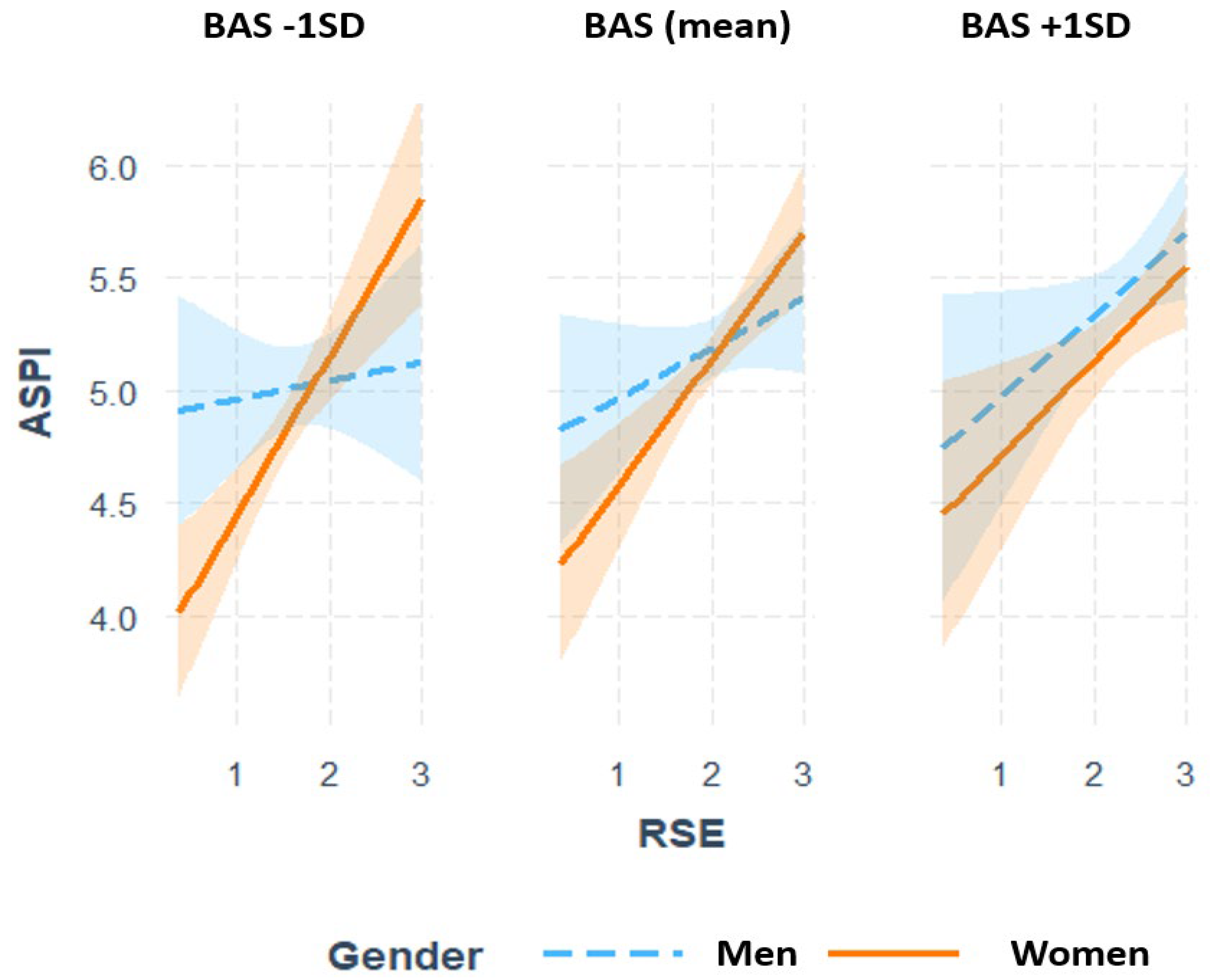
In Figure 1, we visually present the three-way interaction. Simple slopes analyses pertaining to Figure 1 show that for women, when body appreciation is low (one standard deviation below the mean), an increase in self-esteem is associated with a significant increase in sexual pleasure (estimate = 0.71, SE = 0.16, p < 0.001) while for men there is no association between self-esteem and sexual pleasure at lower levels of body appreciation (estimate = 0.08, SE = 0.19, p = 0.66). For women, when body appreciation is average, an increase in self-esteem is associated with a significant increase in sexual pleasure (estimate = 0.57, SE = 0.05, p < 0.001). For men, there still is no association between self-esteem and sexual pleasure at average values of body appreciation (estimate = 0.22, SE = 0.16, p = 0.15). For women, when body appreciation is high (one standard deviation above average), an increase in self-esteem is associated with a significant increase in sexual pleasure (estimate = 0.42, SE = 0.16, p = 0.01) and for men there is now also a significant association between self-esteem and sexual pleasure (estimate = 0.37, SE = 0.18, p = 0.04). At lower values of body appreciation, there are large differences between women and men in the association between self-esteem and sexual pleasure. At higher values of body appreciation, these differences have virtually disappeared, and the association between self-esteem and sexual pleasure is, in this case, positive for both women and men.

4. Discussion

In this cross-sectional study in a sample of young adults, we aimed to examine the associations between sexual pleasure, self-esteem, and body appreciation. As predicted, self-esteem positively predicted a substantial part (19%) of the variance of sexual pleasure, supporting the first hypothesis. This effect was similar in female and male participants. Our second hypothesis was not supported by the data, as body appreciation did not directly predict sexual pleasure, both in female and male participants. Our third hypothesis was also not supported in the full sample, but its three-way interaction with gender was significant, although not in the expected direction: whereas sexual pleasure in women was positively predicted by self-esteem at all levels of body appreciation, in men, self-esteem only predicted sexual pleasure at higher levels of body appreciation (see Figure 1). We note, however, that this interaction effect yielded only a small increase in explained variance, so adding these interactions to the model may not have a major impact on the prediction of sexual pleasure.
The finding that self-esteem positively predicted sexual pleasure aligns with previous research showing that self-esteem is positively associated with neighboring constructs in the sexual domain, including sexual health [31,32,44]. This supports our current expectations as well as previous propositions [9,34] about the role of self-esteem in enabling or propelling sexual pleasure. In contrast, body appreciation did not independently predict sexual pleasure in our study. Given the substantial correlation between self-esteem and body appreciation, self-esteem might overshadow the predictive effect of body appreciation for sexual pleasure. In this study, we measured general body appreciation using the Body Appreciation Scale 2 [53]. Previous work demonstrated that genital image predicted sexual pleasure, operationalized as orgasm consistency, more strongly than body image in general [44]. In that study, self-esteem significantly predicted orgasm consistency when included as the only predictor. However, when body image and genital image were added, only genital image remained a significant predictor, eclipsing self-esteem and overall body appreciation.
Nevertheless, the significant prediction of sexual pleasure in men by the interaction of body appreciation with self-esteem and gender points to a supplementary role of body appreciation. In men, self-esteem only predicted sexual pleasure at higher levels of body appreciation. This finding does not replicate the buffering role of body appreciation for low self-esteem in predicting sexual pleasure that was found by Wodarz and Rogowska [48] in their study of life satisfaction. In contrast, greater body appreciation seemed to enhance the prediction in men of sexual pleasure through self-esteem. The current data do not allow us to explain this effect, but we might speculate that greater body appreciation serves to enhance self-focusing during sexual activity, which in turn increases subjective sexual arousal in men [54].
The future search for relevant determinants of sexual pleasure need not be confined to self-esteem and body appreciation. Although the current findings show that a substantial part of the variance of sexual pleasure can be explained by these two factors, further research seems warranted. A wide range of potential determinants could be investigated further, including dispositional factors such as sexual excitation/inhibition proneness [55], attachment orientation [56,57], as well as dyadic factors such as intimacy [58,59,60] and mutual trust and emotional responsiveness [61,62].

Strengths and Limitations

A strength of the current research is the use of the general constructs of self-esteem and body appreciation to predict sexual pleasure. While more specific constructs such as ‘sexual self-esteem’ or ‘genital self-image’ might be more predictive [42,63], they also have greater conceptual overlaps with sexual pleasure. The fact that the more general predictor of body appreciation is not strongly correlated with sexual pleasure, whereas general self-esteem is, points to (the absence of) associations between very different constructs.
A number of limitations of the present study need to be acknowledged. First, the cross-sectional research design precludes conclusions about the causality of observed associations, as well as the direction of such causal relationships. In addition to sexual pleasure being caused or facilitated by self-esteem and body appreciation, experiencing sexual pleasure can also serve to reinforce one’s self-esteem and positive evaluations of one’s own body. Although the relationship found between self-esteem and sexual pleasure could provide a new intervention option for sexual health professionals to help individuals experiencing problems with low sexual pleasure, research answering these questions must be awaited. Furthermore, the findings of this study should prove to be robust, that is, replicable in new samples. Secondly, a convenience sample has been used to collect data, which precludes generalization of findings to the population of young adults between 18 and 35. However, descriptive measures were as could be expected, with the samples of women and men showing similar ages, and men showing higher scores on self-esteem, body-appreciation, and sexual pleasure, as would also be expected in a representative general population sample. Unfortunately, we omitted asking any questions about the sexual orientation of the respondents in our survey, which meant that we were unable to describe our sample in relation to this aspect. Furthermore, we did not inquire about the sexual orientation of the participants, nor if participants had partners with whom they had penile–vaginal intercourse versus penile–anal partners. Potential differences between these participant subgroups were therefore not identified.
Thirdly, in this study, sexual pleasure was measured with a new instrument, which is a shortened version of the 27-item ASPI [12]. Although this brief version of the ASPI was found to have adequate psychometric characteristics, this preliminary validation was based on a limited population. The psychometric properties of the brief ASPI should be validated in other populations in future research. Therefore, the findings of this study should be considered preliminary. They should be replicated in new and more diverse samples.

5. Conclusions

In this cross-sectional study in a convenience sample, self-esteem was found to predict sexual pleasure. Body appreciation was not an independent predictor of sexual pleasure. Body appreciation and gender moderated the relationship of self-esteem and sexual pleasure; self-esteem predicted sexual pleasure in men only at a higher level of body appreciation, whereas self-esteem positively predicted sexual pleasure in women, regardless of their level of body appreciation. Further research into determinants of sexual pleasure is needed. Our findings imply that self-esteem is relevant for clinical diagnosis in problems related to sexual pleasure. Especially in men with such problems, it may also be important to include body esteem in the diagnostic examination.

Supplementary Materials

The following supporting information can be downloaded at: https://www.mdpi.com/article/10.3390/sexes7010001/s1, Figure S1: Item Characteristic Curves for the ASPI-short form; Figure S2. Item Information Curves.

Author Contributions

Conceptualization, J.J.D.M.v.L., S.t.S. and A.G.; Formal analysis, P.v.T.; Data curation, S.t.S.; Writing—original draft, J.J.D.M.v.L.; Writing—review and editing, S.t.S., P.v.T. and A.G.; Supervision, J.J.D.M.v.L. All authors have read and agreed to the published version of the manuscript.

Funding

This research received no external funding.

Institutional Review Board Statement

The study was conducted in accordance with the Declaration of Helsinki, and approved by the Institutional Review Board of the Open Universiteit (protocol code: Ceto_RP324/U202305807; the date of approval: 18 July 2023).

Informed Consent Statement

Informed consent was obtained from all participants involved in the study.

Data Availability Statement

Study data and analysis script are available at (https://osf.io/uqx8h/?view_only=c60ed13bf6934b499b05eec6a3c85d32, accessed on 10 December 2025).

Conflicts of Interest

The authors declare no conflict of interest.

References

  1. WHO. Defining Sexual Health: Report of a Technical Consultation on Sexual Health; World Health Organization: Geneva, Switzerland, 2006.
  2. World Association for Sexual Health. Declaration on Sexual Pleasure; World Association for Sexual Health: Minneapolis, MN, USA, 2021. [Google Scholar]
  3. Ford, J.V.; Vargas, E.C.; Finotelli, I., Jr.; Fortenberry, J.D.; Kismödi, E.; Philpott, A.; Rubio-Aurioles, E.; Coleman, E. Why pleasure matters: Its global relevance for sexual health, sexual rights and wellbeing. Int. J. Sex. Health 2019, 31, 217–230. [Google Scholar] [CrossRef]
  4. Laan, E.T.M.; Klein, V.; Werner, M.A.; van Lunsen, R.H.W.; Janssen, E. In pursuit of pleasure: A biopsychosocial perspective on sexual pleasure and gender. Int. J. Sex. Health 2021, 33, 516–536. [Google Scholar] [CrossRef] [PubMed]
  5. Sladden, T.; Philpott, A.; Braeken, D.; Castellanos-Usigli, A.; Yadav, V.; Christie, E.; Gonsalves, L.; Mofokeng, T. Sexual health and wellbeing through the life course: Ensuring sexual health, rights and pleasure for all. Int. J. Sex. Health 2021, 33, 565–571. [Google Scholar] [CrossRef] [PubMed]
  6. Werner, M.; Borgmann, M.; Laan, E. Sexual pleasure matters—And how to define and assess it too A conceptual framework of sexual pleasure and the sexual response. Int. J. Sex. Health 2023, 35, 313–340. [Google Scholar] [CrossRef]
  7. Pascoal, P.M.; Sanchez, D.T.; Raposo, C.F.; Pechorro, P. Initial validation of the Sexual Pleasure Scale in clinical and non-clinical samples of partnered heterosexual people. J. Sex. Med. 2016, 13, 1408–1413. [Google Scholar] [CrossRef]
  8. Higgins, J.A.; Hoffman, S.; Graham, C.A.; Sanders, S.A. Relationships between condoms, hormonal methods, and sexual pleasure and satisfaction: An exploratory analysis from the Women’s Well-Being and Sexuality Study. Sex. Health 2008, 5, 321–330. [Google Scholar] [CrossRef]
  9. GAB. Working Definition of Sexual Pleasure. 2016. Available online: https://www.gab-shw.org/our-work/working-definition-of-sexual-pleasure/ (accessed on 10 December 2025).
  10. Reis, J.; de Oliveira, L.; Oliveira, C.; Nobre, P. Psychosocial and behavioral aspects of women’s sexual pleasure: A scoping review. Int. J. Sex. Health 2021, 33, 494–515. [Google Scholar] [CrossRef]
  11. Thorpe, S.; Malone, N.; Hargons, C.N.; Dogan, J.N.; Jester, J.K. The peak of pleasure: US Southern Black women’s definitions of and feelings toward sexual pleasure. Sex. Cult. Interdiscip. Q. 2022, 26, 1115–1131. [Google Scholar] [CrossRef]
  12. Borgmann, M.; Brandner, L.M.; D’Urso, D.; Gonin-Spahni, S.; Znoj, H.J.; Werner, M.A. A psychometric study of a trait and state assessment of sexual pleasure–The Amsterdam Sexual Pleasure Inventory. J. Sex Res. 2025, 62, 12–38. [Google Scholar] [CrossRef]
  13. Toates, F. An integrative theoretical framework for understanding sexual motivation, arousal, and behavior. J. Sex Res. 2009, 46, 168–193. [Google Scholar] [CrossRef]
  14. Toates, F. How Sexual Desire Works: The Enigmatic Urge; Cambridge University Press: New York, NY, USA, 2014. [Google Scholar]
  15. Ågmo, A. Sexual motivation: An inquiry into events determining the occurrence of sexual behavior. Behav. Brain Res. 1999, 105, 129–150. [Google Scholar] [CrossRef]
  16. Ågmo, A.; Laan, E. The sexual incentive motivation model and its clinical applications. J. Sex Res. 2022, 60, 969–988. [Google Scholar] [CrossRef] [PubMed]
  17. Basson, R. The female sexual response: A different model. J. Sex Marital. Ther. 2000, 26, 51–65. [Google Scholar] [CrossRef] [PubMed]
  18. Boul, L.; Hallam-Jones, R.; Wylie, K.R. Sexual pleasure and motivation. J. Sex Marital. Ther. 2009, 35, 25–39. [Google Scholar] [CrossRef] [PubMed]
  19. Stephenson, K.R.; Meston, C.M. Why is impaired sexual function distressing to women? The primacy of pleasure in female sexual dysfunction. J. Sex. Med. 2015, 12, 728–737. [Google Scholar] [CrossRef]
  20. Vulink, N.C.C.; Denys, D.; Bus, L.; Westenberg, H.G.M. Sexual pleasure in women with obsessive-compulsive disorder? J. Affect. Disord. 2006, 91, 19–25. [Google Scholar] [CrossRef]
  21. Rubin, J.D.; Conley, T.D.; Klein, V.; Liu, J.; Lehane, C.M.; Dammeyer, J. A cross-national examination of sexual desire: The roles of ‘gendered cultural scripts’ and ‘sexual pleasure’ in predicting heterosexual women’s desire for sex. Personal. Individ. Differ. 2019, 151, 109502. [Google Scholar] [CrossRef]
  22. Klein, V.; Laan, E.; Brunner, F.; Briken, P. Sexual pleasure matters (especially for women)—Data from the German sexuality and health survey (GESID). Sex. Res. Soc. Policy J. NSRC 2022, 19, 1879–1887. [Google Scholar] [CrossRef]
  23. Galinsky, A.M.; Sonenstein, F.L. The association between developmental assets and sexual enjoyment among emerging adults. J. Adolesc. Health 2011, 48, 610–615. [Google Scholar] [CrossRef][Green Version]
  24. Bernecker, K.; Becker, D.; Weitkamp, K.; Wehrli, F. Trait hedonic capacity correlates with sexual pleasure and motives for sexualized drug use in young adults. Curr. Psychol. 2024, 43, 23278–23294. [Google Scholar] [CrossRef]
  25. Sanchez, D.T.; Kiefer, A.K. Body concerns in and out of the bedroom: Implications for sexual pleasure and problems. Arch. Sex. Behav. 2007, 36, 808–820. [Google Scholar] [CrossRef] [PubMed]
  26. McFadden, P. Sexual pleasure as feminist choice. Fem. Afr. 2003, 1–8. Available online: https://feministafrica.net/feminist-africa-issue-2-2003-changing-cultures/ (accessed on 10 December 2025).
  27. Boydell, V.; Wright, K.Q.; Smith, R.D. A rapid review of sexual pleasure in first sexual experience(s). J. Sex Res. 2021, 58, 850–862. [Google Scholar] [CrossRef] [PubMed]
  28. Saliares, E.; Wilkerson, J.M.; Sieving, R.E.; Brady, S.S. Sexually experienced adolescents’ thoughts about sexual pleasure. J. Sex Res. 2017, 54, 604–618. [Google Scholar] [CrossRef] [PubMed]
  29. de Moor, E.L.; Hutteman, R.; Korrelboom, K.; Laceulle, O.M. Linking stressful experiences and psychological problems: The role of self-esteem. Soc. Psychol. Personal. Sci. 2019, 10, 914–923. [Google Scholar] [CrossRef]
  30. Landor, A.M.; Simons, L.G.; Granberg, E.M.; Melby, J.N. Colorizing self-esteem among African American young women: Linking skin tone, parental support, and sexual health. J. Child Fam. Stud. 2019, 28, 1886–1898. [Google Scholar] [CrossRef]
  31. Sakaluk, J.K.; Kim, J.; Campbell, E.; Baxter, A.; Impett, E.A. Self-esteem and sexual health: A multilevel meta-analytic review. Health Psychol. Rev. 2020, 14, 269–293. [Google Scholar] [CrossRef]
  32. Arsandaux, J.; Montagni, I.; Macalli, M.; Bouteloup, V.; Tzourio, C.; Galéra, C. Health risk behaviors and self-esteem among college students: Systematic review of quantitative studies. Int. J. Behav. Med. 2020, 27, 142–159. [Google Scholar] [CrossRef]
  33. Guerreiro, P.P.; Raposo, C.F.; Salvador, Á.; Manão, A.A.; Pascoal, P.M. A transdiagnostic approach to sexual distress and pleasure: The role of worry, rumination, and emotional regulation. Curr. Psychol. 2024, 43, 15385–15396. [Google Scholar] [CrossRef]
  34. Sowan, W. The effects of self-esteem, traditional gender roles, and gender on reward, intimacy, and enhancement as motivations for sexual relations. Sex. Cult. Interdiscip. Q. 2024, 28, 1008–1020. [Google Scholar] [CrossRef]
  35. Oattes, M.K.; Offman, A. Global self-esteem and sexual self-esteem as predictors of sexual communication in intimate relationships. Can. J. Hum. Sex. 2007, 16, 89–100. [Google Scholar]
  36. Bennett-Brown, M.; Denes, A. Testing the communication during sexual activity model: An examination of the associations among personality characteristics, sexual communication, and sexual and relationship satisfaction. Commun. Res. 2023, 50, 106–127. [Google Scholar] [CrossRef]
  37. Spencer, J.M.; Zimet, G.D.; Aalsma, M.C.; Orr, D.P. Self-esteem as a predictor of initiation of coitus in early adolescents. Pediatrics 2002, 109, 581–584. [Google Scholar] [CrossRef] [PubMed]
  38. Emmerink, P.M.; Vanwesenbeeck, I.; van den Eijnden, R.J.; Ter Bogt, T.F. Psychosexual correlates of sexual double standard endorsement in adolescent sexuality. J. Sex Res. 2016, 53, 286–297. [Google Scholar] [CrossRef] [PubMed]
  39. Grauvogl, A.; Pat-El, R.; van Lankveld, J. Associations of implicit and explicit sexual double standard endorsement and sexual assertiveness with sexual and interactional competence in emerging adults. Behav. Sci. 2024, 14, 790. [Google Scholar] [CrossRef] [PubMed]
  40. Peixoto, M.M.; Amarelo-Pires, I.; Biscaia, M.S.P.; Machado, P.P.P. Sexual self-esteem, sexual functioning and sexual satisfaction in Portuguese heterosexual university students. Psychol. Sex. 2018, 9, 305–316. [Google Scholar] [CrossRef]
  41. Brassard, A.; Dupuy, E.; Bergeron, S.; Shaver, P.R. Attachment insecurities and women’s sexual function and satisfaction: The mediating roles of sexual self-esteem, sexual anxiety, and sexual assertiveness. J. Sex Res. 2015, 52, 110–119. [Google Scholar] [CrossRef]
  42. Poovey, K.; de Jong, D.C.; Morey, K. The roles of body image, sexual motives, and distraction in women’s sexual pleasure. Arch. Sex. Behav. 2022, 51, 1577–1589. [Google Scholar] [CrossRef]
  43. Blumenstock, S.M.; Hoskins, K.; Lehmiller, J.J. Sexual self-esteem and orgasm consistency: Exploring the unique roles of body image and genital image. Arch. Sex. Behav. 2024, 53, 2035–2044. [Google Scholar] [CrossRef]
  44. Sammons, D. Body beautiful: The impact of body image on sexual pleasure in a transgender population. In Dissertation Abstracts International: Section B: The Sciences and Engineering; ProQuest Information & Learning: Ann Arbor, MI, USA, 2011; p. 5144. [Google Scholar]
  45. Prnjak, K.; Jukic, I.; Mitchison, D.; Griffiths, S.; Hay, P. Body image as a multidimensional concept: A systematic review of body image facets in eating disorders and muscle dysmorphia. Body Image 2022, 42, 347–360. [Google Scholar] [CrossRef]
  46. Krauss, S.; Dapp, L.C.; Orth, U. The link between low self-esteem and eating disorders: A meta-analysis of longitudinal studies. Clin. Psychol. Sci. 2023, 11, 1141–1158. [Google Scholar] [CrossRef]
  47. Wodarz, R.; Rogowska, A.M. The moderating effect of body appreciation on the relationship between self-esteem and life satisfaction. Eur. J. Investig. Health. Psychol. Educ. 2024, 14, 870–887. [Google Scholar] [CrossRef] [PubMed]
  48. Walker-Hill, R. An analysis of the relationship of human sexuality knowledge, self-esteem, and body image to sexual satisfaction in college and university students. In Dissertation Abstracts International: Section B: The Sciences and Engineering; ProQuest Information & Learning: Ann Arbor, MI, USA, 2000; p. 4560. [Google Scholar]
  49. Prinsen, C.A.; Mokkink, L.B.; Bouter, L.M.; Alonso, J.; Patrick, D.L.; De Vet, H.C.; Terwee, C.B. COSMIN guideline for systematic reviews of patient-reported outcome measures. Qual. Life Res. 2018, 27, 1147–1157. [Google Scholar] [CrossRef] [PubMed]
  50. Franck, E.; De Raedt, R.; Barbez, C.; Rosseel, Y. Psychometric properties of the Dutch Rosenberg self-esteem scale. Psychol. Belg 2008, 48, 25–35. [Google Scholar] [CrossRef]
  51. Rosenberg, M. Conceiving the Self; Basic Books: New York, NY, USA, 1979. [Google Scholar]
  52. Alleva, J.M.; Martijn, C.; Veldhuis, J.; Tylka, T.L. A Dutch translation and validation of the Body Appreciation Scale-2: An investigation with female university students in the Netherlands. Body Image 2016, 19, 44–48. [Google Scholar] [CrossRef]
  53. Faul, F.; Erdfelder, E.; Lang, A.-G.; Buchner, A. GPower 3: A flexible statistical power analysis program for the social, behavioral, and biomedical sciences. Behav. Res. Methods 2007, 39, 175–191. [Google Scholar] [CrossRef]
  54. van Lankveld, J.; van den Hout, M.A.; Schouten, E.G. The effects of self-focused attention, performance demand, and dispositional sexual self-consciousness on sexual arousal of sexually functional and dysfunctional men. Behav. Res. Ther. 2004, 42, 915–935. [Google Scholar] [CrossRef]
  55. Janssen, E.; Bancroft, J. The dual control model of sexual response: A scoping review, 2009–2022. J. Sex Res. 2023, 60, 948–968. [Google Scholar] [CrossRef]
  56. Conradi, H.J.; Noordhof, A.; Dingemanse, P.; Barelds, D.P.H.; Kamphuis, J.H. Actor and partner effects of attachment on relationship satisfaction and sexual satisfaction across the genders: An APIM approach. J. Marital. Fam. Ther. 2017, 43, 700–716. [Google Scholar] [CrossRef]
  57. Stefanou, C.; McCabe, M.P. Adult attachment and sexual functioning: A review of past research. J. Sex. Med. 2012, 9, 2499–2507. [Google Scholar] [CrossRef]
  58. Mizrahi, M.; Hirschberger, G.; Mikulincer, M.; Szepsenwol, O.; Birnbaum, G.E. Reassuring sex: Can sexual desire and intimacy reduce relationship-specific attachment insecurities? Eur. J. Soc. Psychol. 2016, 46, 467–480. [Google Scholar] [CrossRef]
  59. Rubin, H.; Campbell, L. Day-to-day changes in intimacy predict heightened relationship passion, sexual occurrence, and sexual satisfaction: A dyadic diary analysis. Soc. Psychol. Personal. Sci. 2012, 3, 224–231. [Google Scholar] [CrossRef]
  60. van Lankveld, J.; Jacobs, N.; Thewissen, V.; Dewitte, M.; Verboon, P. The associations of intimacy and sexuality in daily life. J. Soc. Pers. Relatsh. 2018, 35, 557–576. [Google Scholar] [CrossRef]
  61. Bergeron, S.; Pâquet, M.; Steben, M.; Rosen, N.O. Perceived partner responsiveness is associated with sexual well-being in couples with genito-pelvic pain. J. Fam. Psychol. 2021, 35, 628–638. [Google Scholar] [CrossRef]
  62. Gadassi, R.; Bar-Nahum, L.E.; Newhouse, S.; Anderson, R.; Heiman, J.R.; Rafaeli, E.; Janssen, E. Perceived partner responsiveness mediates the association between sexual and marital satisfaction: A daily diary study in newlywed couples. Arch. Sex. Behav. 2016, 45, 109–120. [Google Scholar] [CrossRef]
  63. Vigil, K.E.; de Jong, D.C.; Poovey, K.N. Roles of genital self-image, distraction, and anxiety in women’s sexual pleasure: A preregistered study. J. Sex Marital. Ther. 2022, 47, 325–340. [Google Scholar] [CrossRef]
Figure 1. Three-way interaction of sexual pleasure (ASPI-SF) predicted by self-esteem (RSE), body appreciation (BAS), and gender.
Sexes 07 00001 g001
Table 1. Items in the ASPI-SF.
The Seven Items of Shortened Version of the ASPI a* b1/b2/b2/b4/b5 **
Aspi-trait 2: I love feeling sexual arousal.1.9−3.4/−2.9/−1.4/0.5/na ***
Aspi-trait 6: I know how to shape my sex life in a way that I really enjoy.3.5−2.7/−1.7/−1.2/−0.4/1.1
Aspi-trait 9: I can engage in partner sex in a way that I really enjoy.3.4−2.1/−1.4/−0.7/0.8/na
Aspi-trait 17: I enjoy stimulating my sex partner during sex.1.4−4.1/−3.6/−2.1/0.3/na
Aspi-trait 18: I enjoy it when my sex partner stimulates me during sex.1.1−3.9/−3.2/−2.1/0.3/na
Aspi-trait 21: During sex, I enjoy the affection between me and my sex partner.1.0−4.5/−2.1/0.1/na/na
Aspi-trait 24: I experience sexual pleasure in my life.3.0−2.3/−1.8/−1.0/0.6/na
a*: Discrimination parameter; b1–b5 **: thresholds between adjacent response categories; na ***: not a number/not measurable.
Table 2. Mean, standard deviations, women/men differences and correlations of relevant variables.
VariablesM(SD)/RangeWomen (n = 157)—Men (n = 99);
t(df)/p/d
12345
1 Age26.2(3.6)/18–3526.0–26.4;
t = 0.8(212.5)/p = 0.40/d = −0.11
2 N sexual partners12.4(14.2)/1–85 110.9–14.8;
t = 1.3(212.3)/p = 0.05/d = −0.28 1
0.32 ***
3 Age of first-time sex17.8(2.6)/12–2917.6–18.1;
t = 1.4(236.9)/p = 0.15/d = −0.18
0.05−0.17 **
4 Sexual pleasure5.1(0.7)/2.0–6.05.0–5.3;
t = 3.0(251.9)/p = 0.003/d = −0.35
0.120.090.01
5 Self-esteem2.0(0.5)/0.4–3.01.9–2.1;
t = 2.3(214.0)/p = 0.024/d = −0.29
0.12−0.01−0.120.42 ***
6 Body appreciation 3.7(0.6)/1.7–5.03.7–3.9
t = 2.1(199.2)/p = 0.039/d = −0.27
0.13 *0.050.060.36 ***0.69 ***
1 From these calculations, two outliers were excluded who had more than 100 sexual partners (150 and 250). If these two values should be included, M(SD) = 13.9(22.2). The outliers were included in the correlation analyses, as they did not severely impact correlations. * p < 0.05; ** p < 0.01; *** p < 0.001.
Table 3. Regression analyses with sexual pleasure as outcome, predicted by self-esteem, body appreciation, and gender.
ModelEstimate/SEp-ValueR2/adj. R2Model Significance (F; p) and
Model Improvement (p)
Model 1 19.6%/18.7%F(3252) = 20.5; p < 0.001
 Intercept3.88/0.25p < 0.001
 Self-esteem0.42/0.10p < 0.001
 Body appreciation0.13/0.08p = 0.11
 Gender (m = 0; w = 1)−1.75p = 0.06
Model 2 (added to Model 1) 20.5%/18.6%F(6249) = 10.7; p < 0.001
 Intercept3.55/0.81p < 0.001Model improvement p = 0.44
 Self-esteem × Body appreciation−0.6p = 0.56
 Self-esteem × Gender0.32/0.21p = 0.13
 Body appreciation × Gender−1p = 0.33
Model 3 (added to Model 2) 22.1%/19.9%F(7248) = 10.1; p < 0.001
 Intercept5.61/1.21p < 0.001Model improvement p = 0.025
 Self-esteem × Body appreciation × Gender−2.2381p = 0.025
Disclaimer/Publisher’s Note: The statements, opinions and data contained in all publications are solely those of the individual author(s) and contributor(s) and not of MDPI and/or the editor(s). MDPI and/or the editor(s) disclaim responsibility for any injury to people or property resulting from any ideas, methods, instructions or products referred to in the content.