1. Introduction
1.1. The Clinical Problem: Positive Surgical Margins
Complete tumor resection with negative surgical margins is a fundamental objective of oncologic surgery. A positive surgical margin (PSM) occurs when malignant cells are present at the cut edge of the specimen, indicating incomplete tumor removal [
1]. Analysis of more than 6.5 million patients in the National Cancer Data Base (1998–2012) shows substantial variability in PSM rates across the ten most common solid cancers, ranging from 4.32% in uterine cancer to 35% in ovarian cancer [
2]. Among cancers affecting both sexes, the highest PSM rates occur in oral cavity tumors (12.75%), followed by thyroid (11.52%), bladder (9.64%), lung and bronchus (7.32%), and colon and rectum (6.83%). These rates increase markedly with disease stage, rising from 4.39% for in situ lesions to 29.96% for T4 tumors in the same analysis.
The clinical and economic burden of PSM is considerable. Positive margins often necessitate additional adjuvant treatment or re-excision, increasing healthcare costs and patient morbidity. In breast-conserving surgery, approximately one in four patients has positive or indeterminate margins requiring a second operation, resulting in heightened physical and emotional burden, increased complication risk, potentially poorer cosmetic outcomes, and higher overall healthcare expenditure [
2,
3].
Prognostically, PSM is associated with worse outcomes across multiple cancers. In node-negative breast cancer, PSM correlates with higher locoregional recurrence and reduced disease-specific survival, with patients experiencing approximately double the odds of tumor recurrence [
2]. In oral cavity cancer, patients with PSM have a markedly increased risk of death, with a relative risk of 11.61 [
4]. In bladder cancer, PSM decreases 5-year cancer-specific survival from 72% to 32% and increases the likelihood of local recurrence [
5]. Similarly, in lung cancer, 5-year survival decreases from 46% for R0 resections to 20% for R1 cases, accompanied by substantially higher recurrence rates [
6].
1.2. Limitations of Current Intraoperative Assessment
Frozen section analysis remains the intraoperative gold standard for tissue identification, achieving a diagnostic concordance rate of 98.58% across 461 institutions and 90,538 cases [
7]. However, several inherent limitations constrain its effectiveness. The method requires fresh tissue, immediate transport, specialized staffing, and the on-demand availability of a pathologist [
8]. The College of American Pathologists defines a 20 min turnaround time benchmark, introducing substantial intraoperative delays [
9].
Analysis of discordant frozen section diagnoses underscores the technique’s vulnerability to sampling error. In the same large cohort, 30.0% of discordances were attributable to diagnostic tissue present in permanent sections but absent from the frozen sample, and 31.4% resulted from unsampled portions of the specimen; a further 31.8% were due to misinterpretation [
7]. Notably, 67.8% of discordant cases represented false-negative diagnoses of neoplasm, the most clinically consequential form of error. Moreover, 4.6% of intraoperative consultations yielded deferred results, providing no actionable guidance [
9].
Freezing artifacts may further compromise cellular detail in certain tissues, and discordance rates are higher in the pancreas, lymph nodes, and gynecologic specimens [
8]. Overall, frozen section is limited by its reliance on representative sampling rather than comprehensive assessment.
1.3. The Need for Real-Time Tissue Identification
These limitations highlight the need for a diagnostic modality capable of providing real-time, accurate tissue characterization without the logistical delays or sampling constraints inherent to frozen section analysis. An ideal intraoperative technology should deliver:
Immediate feedback (in seconds rather than minutes);
Continuous assessment during surgical dissection;
Minimal disruption to operative workflow;
High sensitivity and specificity for cancer detection;
Broad applicability across organ systems.
1.4. Rapid Evaporative Ionization Mass Spectrometry: The Intelligent Knife
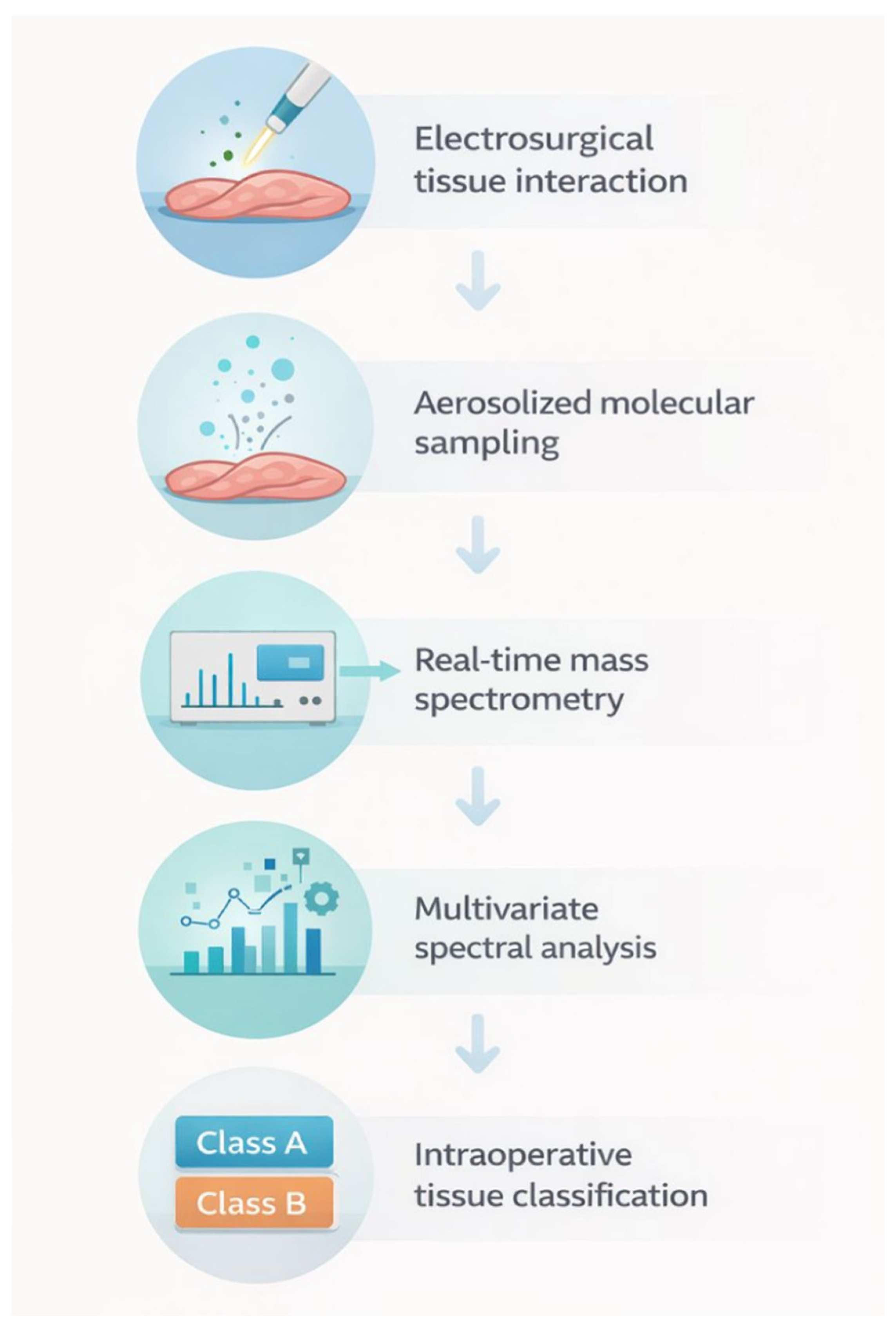
Rapid Evaporative Ionization Mass Spectrometry (REIMS) offers a compelling solution to these challenges. By coupling electrosurgical dissection with mass spectrometric analysis of the resulting aerosol, REIMS provides real-time tissue characterization based on lipidomic signatures. When integrated directly into standard electrosurgical handpieces, this technology forms the “intelligent surgical knife” (iKnife).
In the first-in-human validation study, Balog and colleagues demonstrated high diagnostic accuracy, with classification times of 0.7–2.5 s, substantially faster than the ~20 min turnaround typical for frozen section analysis, across multiple organ systems including colon, liver, lung, breast, and brain [
9,
10].
Table 1 summarizes the key comparative advantages of REIMS over conventional frozen section analysis.
This review synthesizes the development, principles, clinical validation, and applications of REIMS and the iKnife. We examine diagnostic performance, operational considerations, current limitations, and future opportunities, particularly in relation to artificial intelligence, database expansion, and integration with robotic and image-guided surgery.
2. Principles and Core Technology of REIMS
2.1. Operating Principles
REIMS enables the real-time biochemical characterization of tissue by analyzing the surgical aerosol generated during electrosurgical dissection, requiring no sample preparation. At the electrode–tissue interface, temperatures > 400 °C vaporize cellular lipids and other thermally labile biomolecules [
15]. The resulting aerosol is transported to the mass spectrometer, where ionization occurs via surface collisions in the atmospheric interface of the instrument rather than within the surgical plume itself [
16,
17]. This collision-based ionization mechanism involves processes such as proton transfer, electron capture, and adduct formation.
This collision-based mechanism allows for the liberation of ions from large molecular clusters that are otherwise resistant to traditional post-ionization. Ionization efficiency can be modulated experimentally: acidification stabilizes phosphatidylethanolamine (PE) signals, while chloride promotes the formation of [M + Cl]
− adducts that improve phosphatidylcholine and triacylglycerol detection [
18]. REIMS spectra contain both intact lipid ions and thermally generated degradation products, with both contributing to the characteristic tissue fingerprint. The REIMS interface utilizes surface-induced dissociation (SID) to address the inherent challenge of large molecular cluster formation. Aerosol clusters are accelerated by the adiabatic expansion that occurs after passing through the first gas conductance limit of the atmospheric interface. Upon impacting a solid collision surface, optimized to approximately 1000 K, the clusters undergo rapid dissociation into gaseous ions. This impact-based declustering is highly efficient because it operates on a shorter time scale than thermal heating methods and is independent of the initial cluster size, ensuring consistent ion liberation from the complex surgical aerosol (
Figure 1).
2.2. Lipidomic Profiling and Spectral Features
Tandem MS has identified a diverse range of discriminatory ionic species within the negative-ion mode lipidome, primarily consisting of glycerophospholipids and sphingolipids [
10]. These derive from major lipid classes, including PE, PC, PI, PA, sphingomyelins, cardiolipins, plasmalogens, phosphatidylserines, and sulfatides. Several ions are enriched in specific tissues, e.g., PA (34:1)–H (
m/
z 673.48) in alveolar lung, PE (36:1)–NH
3 (
m/
z 727.53) in colon mucosa, and PI (38:4)–H (
m/
z 885.55) across multiple organs. Classification does not rely on individual biomarkers but on the relative abundance patterns across many lipid species.
2.3. System Architecture and Instrumentation
The instrumentation of the iKnife system has evolved from early Venturi air-jet pump transfer designs to sophisticated ambient ionization platforms. A key advantage of REIMS is its seamless integration into standard monopolar or bipolar electrosurgical devices, which act as direct sampling probes. The generated aerosol is transported via a 1.5–2 m unheated transfer tube (typically 1/8” OD PTFE tubing) to the mass spectrometer, reaching the atmospheric interface within 1–2 s.
Unlike traditional ambient ionization where ions form in the plume, REIMS ionization occurs via surface collisions within the atmospheric interface of the instrument. This interface often incorporates heated collision surfaces and 2-propanol-assisted ionization to improve signal stability and efficiency. While the original proof-of-concept studies employed Thermo LTQ linear ion trap and Orbitrap analyzers, current implementations primarily utilize Time-of-Flight (TOF) systems, such as the Waters Xevo G2-S QTOF [
17]. These TOF systems provide rapid scanning (150–500 ms) with moderate mass resolution (10,000–30,000). Orbitrap platforms remain an alternative for applications requiring higher resolution (≥100,000) and <5 ppm mass accuracy, albeit at lower scan rates.
The selection of mass analyzer hardware involves a critical trade-off between mass resolution and acquisition speed. While Orbitrap platforms provide exceptional mass accuracy and high resolution, their lower scan rates can be a limiting factor for real-time applications. Conversely, TOF systems, such as Waters Xevo G2-S, were adopted for the iKnife because they provide the rapid scanning (150–500 ms) necessary for instantaneous feedback. This high temporal resolution ensures that the entire diagnostic workflow, from tissue evaporation to algorithmic classification, is completed in under 3 s, meeting the stringent latency requirements of intraoperative surgical navigation.
2.4. Database Construction and Classification
The foundational reference database for the iKnife was established through multicenter collection of histologically validated spectra across multiple organ systems. Unknown spectra are classified against a large, multicenter reference database of histologically validated cancer and healthy tissue profiles. Smaller tissue fragments can yield reduced ion counts and altered lipid profiles, contributing to reduced sensitivity [
18]. For healthy tissues, the first three principal components capture 34.6%, 10.7%, and 5.4% of variance, respectively. Linear discriminant analysis applied to the first 60 principal components provides optimized features for classification. The entire workflow, from tissue evaporation to classification, typically requires under 3 s (with ranges of 0.7–2.5 s reported in initial human trials).
3. Development and Validation
The development of REIMS from a laboratory ionization technique into a clinically viable intraoperative diagnostic tool required evidence across sequential phases: preclinical feasibility, tissue-specific molecular characterization, ex vivo human validation, construction of histologically authenticated databases, and prospective intraoperative deployment. The following section outlines this translational trajectory and the major technical and clinical milestones that established the iKnife as an effective real-time tissue identification platform.
3.1. Preclinical Development and Tissue Specificity
REIMS was first described by Schäfer et al., who demonstrated that electrosurgical dissection generates an aerosol containing ionized biomolecules suitable for direct mass spectrometric analysis without sample preparation. Early animal studies confirmed that REIMS spectra were reproducible and tissue-specific. Mechanistic investigations initially proposed both two-step and simultaneous desorption–ionization pathways, with subsequent work favoring a rapid thermal evaporation-driven ionization process consistent with earlier REIMS and ambient ionization studies [
15,
19].
Initial preclinical work focused on reducing technical variability caused by electrosurgical settings, electrode geometry, and tissue hydration. Normalization strategies based on relative ion abundances improved reproducibility across experiments [
15]. Instrumentation evolved from a Venturi air-jet pump aerosol transfer system [
19] to enhanced designs incorporating orthogonal nitrogen flow, 2-propanol-assisted ionization, and optimized heated collision surfaces that improved signal stability and ionization efficiency [
10].
Lipidomic characterization played a central role in establishing tissue specificity. PCA of REIMS spectra from multiple organs demonstrated clear separation between tissue types [
15], and subsequent comprehensive profiling identified 199 phospholipid species in the
m/
z 600–900 range [
10]. Parallel work by Strittmatter et al. showed that REIMS can also function as a shotgun lipidomics platform, enabling untargeted analysis of metabolic alterations in cancer [
20].
Human ex vivo studies extended these findings by correlating REIMS spectra with histopathology from freshly excised surgical specimens. Sampling across tumor centers, peripheries, and adjacent tissue revealed metabolic transition zones around primary tumors (~1 cm), whereas metastatic lesions showed abrupt spectral boundaries [
10]. This demonstrated the sensitivity of REIMS to metabolic gradients relevant to surgical margins.
Sampling devices also underwent important refinements. Bipolar forceps offered higher sensitivity and reduced memory effects for small-volume sampling [
20]. A major instrumentation advancement is Laser Ablation REIMS (LA-REIMS), which enables high-resolution molecular imaging and non-contact, automated sampling [
21].
The system utilizes various mid-infrared laser sources, including CO
2 (λ = 10.6 µm), Optical Parametric Oscillator (OPO) (λ = 2.94 µm), and Optical Parametric Amplifier (OPA) (λ = 3.0 µm) systems. These lasers target the natural water content of the tissue to induce ablation. Notably, picosecond pulses from OPA systems operate in an stress-confined regime, which maximizes the yield of intact biomolecules like phospholipids and metabolites while minimizing collateral thermal damage. In contrast, microsecond pulses from CO
2 systems are not thermally confined, leading to thermally conducted energy that can cause molecular degradation. This laser-based approach facilitates the integration of REIMS into robotic platforms and the creation of single-cell resolution histological databases [
22].
3.2. Clinical Validation Across Surgical and Endoscopic Procedures
The first major clinical validation study by Balog et al. constructed a multicenter histologically validated reference database consisting of 2933 spectra from 302 patients across gastric, colorectal, hepatic, pulmonary, breast, and brain pathologies. This library served as the foundation for real-time intraoperative testing [
10].
Prospective intraoperative validation in 81 surgical procedures generated 864 spectra and achieved 100% case-level concordance with postoperative histology [
10]. Leave-one-patient-out cross-validation demonstrated high accuracy: sensitivity 97.7%, specificity 96.5%, false-positive rate 3.5%, and false-negative rate 2.3%. These results compare favorably with frozen section analysis (81–87% sensitivity; 90–98% specificity) [
23,
24]. PCA showed no systematic differences between ex vivo and in vivo spectra, confirming robustness in the operating room. In cases where biopsy and final histopathology disagreed, REIMS correctly matched the definitive diagnosis in 11 of 15 cases [
10]. Organ-specific performance metrics are provided in
Table 2.
REIMS has also been adapted for minimally invasive procedures. Alexander et al. demonstrated accurate ex vivo and in vivo classification of colorectal cancer, adenomas, and normal mucosa using modified diathermic snares. Diagnostic performance reached AUC values of 0.96–0.99, and REIMS successfully identified differentiation, EMVI, radiotherapy-induced changes, and fibrosis, supporting its potential for margin assessment in endoscopic oncology [
11].
3.3. Multicenter Reproducibility and Standardization
Generalizability across institutions is essential for clinical translation. Harmonization work by Kaufmann et al. demonstrated that inter-site variability can be minimized through standardized lock-mass correction, consistent mass binning (0.1 Da), and routine calibration and QA workflows. Database transferability is feasible when acquisition parameters are aligned, though local augmentation remains important for rare tumor subtypes or population-specific histologies [
28].
Cross-platform normalization, developed by Golf et al., enabled the integration of REIMS, DESI, and LDI datasets across Orbitrap, FT-ICR, and Q-TOF instruments, achieving concordance coefficients of 0.91–0.97 and classification accuracies ≥ 94%. Such methods support the development of larger multinational repositories [
29].
Although formal inter-operator reliability studies are limited, multicenter data indicate that the use of standard electrosurgical tools and automated processing pipelines reduces operator-dependent variability [
10,
28].
Real-time performance remains one of REIMS’s major advantages. Diagnostic output requires <3 s [
10], compared with 20–30 min for frozen section. St John et al. reported a mean intraoperative analysis time of 1.80 ± 0.40 s, supporting seamless integration into surgical workflow [
12].
3.4. Limitations Identified During Validation
Despite its strong diagnostic performance, several limitations emerged during REIMS validation that are important for clinical translation. Accuracy is inherently constrained by database completeness: rare tumors, unusual benign mimics, and population-specific histologies are more likely to be classified as outliers, reflecting insufficient representation in current reference libraries. Certain tumor types also pose intrinsic challenges. Histologically heterogeneous malignancies, including hepatocellular carcinoma and several lung cancer subtypes, show reduced specificity because their metabolic profiles overlap with reactive or inflamed tissues, a pattern similarly observed in low-grade gliomas where subtle lipidomic differences limit discriminative power [
10,
30].
Technical and biological sampling constraints further contribute to classification variability. REIMS interrogates a very small tissue volume (~0.1 mm
3) at the electrode tip, which may not capture full intratumoral heterogeneity or reflect distant margin status [
10]. Small tissue fragments also produce fewer ions, leading to altered spectral profiles and lower reliability. Pre-analytical and acquisition-related variables, including pH, chloride concentration, tissue hydration, and electrosurgical power, affect ionization efficiency and spectral reproducibility, underscoring the need for standardized operating parameters and consistent quality-control workflows [
18].
Beyond technical constraints, the clinical risks associated with diagnostic errors in REIMS must be managed through a systematic risk-management framework. False negatives may occur in cases of extreme intratumoral metabolic heterogeneity, such as necrotic regions or specific clonal subtypes that dilute the characteristic malignant lipid signal [
10,
17]. Conversely, false positives can arise from non-neoplastic metabolic interference, where inflammatory, fibrotic, or post-radiation changes produce spectra that overlap with tumor profiles [
11].
To mitigate these risks, an intraoperative REIMS quality control and decision-support protocol is proposed. This framework utilizes confidence-based thresholds to categorize results: high-confidence predictions (e.g., >95% probability) may independently guide resection, while low-confidence results act as a trigger for traditional pathological verification via frozen section [
13]. Furthermore, adopting multimodal confirmation in critical anatomical regions, integrating REIMS with real-time imaging or clinical metadata, can enhance diagnostic consistency and minimize the impact of sampling bias [
31].
4. Clinical Applications in Oncology
The maturation of REIMS as a validated platform for real-time tissue identification has enabled its targeted application across a range of oncological contexts where intraoperative decision-making is critically dependent on accurate, rapid tissue discrimination. These include breast, colorectal, ovarian, cervical, and hepatocellular carcinoma, tumor types in which frozen section analysis is technically limited or insufficiently sensitive. The following subsections summarize the diagnostic performance of REIMS in each cancer type, emphasizing both intraoperative utility and lipidomic insights relevant to tumor biology.
4.1. Breast Cancer
4.1.1. Metabolic Subtyping: PIK3CA Mutations
Breast-conserving surgery frequently requires re-excision due to positive margins, and frozen sections are often unreliable in adipose-rich tissue [
32,
33,
34]. Beyond margin assessment, REIMS has demonstrated value for molecular subtyping. Koundouros et al. analyzed patient-derived xenografts and primary tumors (9 PIK3CA wild-type, 9 mutant PDXs; 5 wild-type, 7 mutant primaries) using ex vivo REIMS. Multivariate classification achieved ~90% accuracy in distinguishing PIK3CA-mutant from wild-type tumors [
35].
Mechanistically, PIK3CA mutation activated an mTORC2 → PKCζ → cPLA2 signaling axis, increasing arachidonic acid (AA) release. REIMS detected elevated AA and downstream eicosanoid metabolites in mutant tumors, linking lipidomic signatures directly to oncogenic pathway activation [
35]. This suggests that REIMS could support real-time metabolic subtyping, with potential implications for targeting PI3K-driven tumors.
4.1.2. Margin Assessment in Breast-Conserving Surgery
St. John et al. validated REIMS specifically for breast surgery, analyzing 359 specimens (training) and 260 specimens (independent validation). Diagnostic performance reached 93.4% sensitivity and 94.9% specificity in the ex vivo database, and 90.9% sensitivity and 98.8% specificity in the independent validation set. Intraoperative deployment in six cases showed that 99.27% of spectra were interpretable, with a mean acquisition time of 1.80 ± 0.40 s. MS/MS analysis identified 24 discriminatory lipid species, including PE (18:0/20:4), PC (16:0/18:1), PC (16:0/18:2), and PA (36:2), enriched in malignant tissue. These findings support the feasibility of real-time margin assessment using REIMS during lumpectomy procedures [
12].
4.2. Colorectal Cancer
Colorectal surgery requires precise margin identification, yet frozen section is generally impractical due to anatomical complexity. Alexander et al. analyzed ex vivo tissue from 26 patients (adenocarcinoma, mucinous adenocarcinoma, adenoma, GIST) and conducted an in vivo pilot during hot-snare polypectomy in five patients.
Ex vivo classification achieved the following:
Cancer vs. normal mucosa: 86.7% sensitivity, 92.4% specificity (AUC 0.96);
Cancer vs. adenoma: 78.6% sensitivity, 97.3% specificity (AUC 0.99);
Adenoma vs. normal mucosa: 85.7% sensitivity, 98.6% specificity (AUC 0.99).
REIMS also identified relevant histopathologic features, such as differentiation, tumor budding, lymphovascular invasion, EMVI, and nodal micrometastases. In vivo endoscopic profiling detected ceramides characteristic of adenomatous tissue and visualized radiotherapy-associated metabolic changes [
11].
This application demonstrates the potential use of REIMS in endoscopic oncology for improving the completeness of resection and reducing recurrence rates following EMR or ESD.
4.3. Ovarian Cancer
Frozen section analysis during ovarian cancer surgery is prone to errors, particularly for borderline tumors [
36,
37]. Phelps et al. performed the most extensive REIMS validation in ovarian pathology: 198 patients and 335 samples (171 frozen, 119 fresh ex vivo, 45 fresh in vivo).
Diagnostic performance included the following:
OC vs. normal: 97.4% sensitivity, 100% specificity (AUC 0.96);
OC vs. borderline tumors: 90.5% sensitivity, 89.7% specificity (AUC 0.99).
Inter-rater agreement between REIMS and expert histopathology was high (κ = 0.84). Fresh-tissue validation achieved 99.1% correct classification, and in vivo testing yielded high-quality spectra. Key discriminatory lipids included PA (36:2) and PE (34:2), among others that were significantly enriched in malignant tissue [
25].
These results position REIMS as a valuable adjunct to frozen section by improving the distinction between benign, borderline, and malignant ovarian lesions.
4.4. Cervical Cancer
Accurate intraoperative margin assessment in cervical excision procedures is vital for fertility preservation, but frozen section is often not feasible due to small specimen size [
38]. Tzafetas et al. analyzed 87 samples (normal, HPV ± CIN, cancer) using REIMS with LASSO feature selection and LDA.
Performance reached 100% sensitivity and 100% specificity across all pairwise comparisons. Discriminatory lipids included sphingomyelins, phosphatidic acids, phosphatidylethanolamines, phosphatidylglycerols, phosphatidylcholines, and phosphatidylinositols, all elevated in cancer.
In vivo analysis of four patients included one case in which REIMS predicted negative margins despite initial CIN3-positive histology; repeat excision confirmed no residual disease [
26]. These results highlight REIMS’s potential to enhance intraoperative margin assessment during fertility-preserving procedures.
4.5. Hepatocellular Carcinoma
HCC arises in diseased liver, complicating margin assessment due to overlapping histologic features between tumor, dysplastic nodules, and inflamed parenchyma. Wang et al. analyzed 36 specimens from 12 patients representing HCC, paracancerous tissue (<1 cm), and noncancerous liver (>2 cm). Diagnostic performance reached 100% sensitivity, 90.5% specificity, and 88.89% overall accuracy.
Lipidomic analysis identified nine free fatty acids and 34 phospholipids significantly altered in HCC. Elevated FA 20:4 (arachidonic acid) and saturated fatty acids (FA 16:0, FA 18:0) reflected inflammatory and metabolic drivers of hepatocarcinogenesis.
Crucially, paracancerous tissue exhibited a distinct metabolic phenotype, not an intermediate between tumor and healthy liver [
27]. This may enable REIMS to refine margin planning and prognostic assessment beyond conventional histology.
4.6. Other Malignancies
In the multi-organ study by Balog et al., REIMS demonstrated broad applicability across brain, lung, and liver tumors. Reported sensitivities included 92.3% for brain metastases and 95.5% for glioblastoma, with near-perfect discrimination from normal brain tissue, making it useful in neurosurgical contexts where tissue preservation is paramount [
10,
39,
40].
Lung tumors showed greater variability: 69.6–88.6% sensitivity across histologic subtypes, with corresponding false-negative rates of 11.4–30.4% [
10]. Primary liver tumors (HCC, cholangiocarcinoma) and malignant lung tumors collectively demonstrated specificity < 95%, likely reflecting overlap between malignant and reactive lipidomic profiles in chronically diseased organs.
These findings emphasize the need for cancer-specific database expansion and more granular spectral libraries to optimize REIMS performance in histologically heterogeneous or metabolically overlapping tumor types.
5. Artificial Intelligence and Future Directions
The growth of REIMS datasets and the increasing complexity of intraoperative classification tasks have accelerated the adoption of machine learning approaches that extend beyond traditional PCA–LDA workflows. Published studies have introduced deep learning, uncertainty modeling, self-supervised learning, anomaly detection, and foundation models, each addressing distinct limitations in robustness, data efficiency, and generalizability. This section summarizes the AI methods applied to REIMS, as reported in the literature (
Table 3).
5.1. Deep Learning Foundations
The first application of deep learning to REIMS was reported by Santilli et al., who trained a symmetric autoencoder on 693 ex vivo spectra (252 BCC, 441 benign) from 91 patients (m/z 100–1000). After max-pooling to ~800 features, the model encoded spectra into a 100-dimensional latent space. Data augmentation incorporating Gaussian noise in both Fourier and original domains generated 4000 synthetic spectra to balance classes and improve generalization.
The autoencoder achieved 96.62% accuracy, 100% sensitivity, and 95% specificity, outperforming PCA–LDA (85.12%,
p < 0.0072) [
41].
To quantify predictive confidence, Fooladgar et al. implemented Bayesian neural networks with Monte Carlo dropout, obtaining a baseline balanced accuracy of 72.1%, sensitivity of 60.5%, specificity of 83.7%, and an AUC of 81.1%; after filtering the 20% most uncertain training samples, performance improved to a balanced accuracy of 75.2%, sensitivity of 74.1%, specificity of 77.3%, and an AUC of 82.1%.
During deployment, excluding uncertain test spectra raised sensitivity from 80.7% to 88.2%, indicating reduced false-negative risk, an important clinical consideration for cancer surgery [
13].
5.2. Self-Supervised Learning and Data Efficiency
To address limited annotated datasets, Santilli et al. used domain adaptation, pretraining an autoencoder on BCC spectra and transferring it to breast margin assessment. Fine-tuning on only 11 patients (92 spectra) improved accuracy to 92.68%, compared with 86.36% when training from scratch [
14]. This demonstrates that the spectral features learned in one tissue type can transfer across anatomical contexts.
Connolly et al. introduced ImSpect, converting 1D spectra into 2D time-frequency representations (GASF, GADF, MTF) to generate 224 × 224 three-channel images processed by a ResNet-18 backbone. Using SimCLR contrastive self-supervision, the model was pretrained on 10,407 unlabeled intraoperative spectra and then fine-tuned on the BCC dataset, improving balanced accuracy from 66.4% → 73.5% and AUC = 81.6% after SimCLR pretraining.
Attention maps highlighted
m/
z 150–400 (fatty acids) and 600–900 (phospholipids), aligning with the known biochemical markers of BCC [
31].
Radcliffe et al. explored anomaly detection, training a one-class PCA model exclusively on 2149 unlabeled normal breast spectra. When tested on 200 ex vivo spectra (149 normal, 51 cancer), it achieved a balanced accuracy of 81%, sensitivity of 90%, and specificity of 72%.
This approach requires no labeled training data, making it applicable in new surgical contexts where curated databases are unavailable [
42].
5.3. Foundation Models for REIMS
Foundation models pretrained on large, diverse datasets offer improved generalizability. Farahmand et al. developed FACT, the first REIMS-specific foundation model, adapting concepts from CLAP by using a supervised triplet-loss framework with hard negative mining. The model learned an embedding space robust to determine the following: intraoperative vs. ex vivo acquisition, patient-specific variability, and inter-institutional differences. Fine-tuned on the BCC dataset, FACT achieved a balanced accuracy of 77.5%, an AUC of 82.4%, and an inference time of 72 ms.
The inference speed is compatible with REIMS spectral acquisition (150–500 ms), supporting real-time intraoperative deployment [
43].
Table 3.
Summary of machine learning approaches applied to REIMS datasets.
Table 3.
Summary of machine learning approaches applied to REIMS datasets.
| Approach/Study | Methodology | Application/Dataset | Key Findings | Reference |
|---|
| Deep learning for spectral classification | Symmetric autoencoder neural network | Basal cell carcinoma (BCC) margin detection | 96.6% accuracy and 100% sensitivity; outperformed PCA–LDA (85%). Demonstrated capture of nonlinear spectral relationships. | [41] |
| Domain adaptation and transfer learning | Self-supervised pretraining with cross-domain fine-tuning | Transfer from BCC to breast-cancer REIMS spectra | Achieved 92% accuracy with only 11 patients (144 spectra). Demonstrated feasibility of cross-tissue model transfer. | [14] |
| Uncertainty quantification for decision support | Bayesian neural networks modeling uncertainty | Intraoperative cancer margin detection | Filtering low-confidence predictions improved sensitivity to 88% with 75% balanced accuracy. Introduced confidence-based thresholds. | [13] |
| Foundation models for cross-institution generalization | FACT model (contrastive pretraining with hard-negative mining) | Multi-institution REIMS datasets | Enhanced calibration and robustness to acquisition variability; enabled cross-center generalization with fast inference. | [43] |
| Image-based spectral representations | 1D → 2D Gramian angular fields + CNN (ResNet-18) with SimCLR | BCC REIMS spectra | AUC = 0.81; demonstrated utility of computer-vision methods for spectral data. | [31] |
| Anomaly detection and one-class learning | One-class PCA and isolation-based models | Normal vs. malignant breast tissue | Balanced accuracy 81%, sensitivity 90%. Effective without labeled cancer data; supports adaptive thresholds. | [42] |
5.4. Future Directions and Emerging Technologies
Future developments in REIMS–AI systems are expected to move beyond binary tissue discrimination toward integrated, multimodal intraoperative decision-support frameworks. One important direction is the incorporation of REIMS spectral data with complementary information from imaging, pathology, or clinical metadata to improve classification robustness, particularly in anatomically complex or metabolically heterogeneous tumors. Interpretability methods, such as the attention mapping used by Connolly et al., may help reveal which m/z intervals drive model predictions, thereby enhancing transparency, clinical acceptance, and potential regulatory approval. Advances in compact and portable mass spectrometry hardware could reduce the logistical and financial burden associated with current REIMS systems, supporting broader adoption in diverse surgical environments, including community hospitals and endoscopy units. As surgical robotics continues to evolve, REIMS-based metabolic feedback may also be integrated into robotic platforms, providing real-time margin navigation capabilities. Finally, the increasing accumulation of intraoperative spectra across institutions may enable continual learning or federated learning paradigms, allowing AI models to improve over time without centralized data-sharing, preserving patient privacy while enhancing generalizability across acquisition contexts and patient populations.
The path to the widespread clinical adoption of REIMS is contingent upon a robust health economic evaluation. The technology offers significant potential to improve operational metrics, such as increasing operating room turnover and reducing pathology staffing needs by providing automated, on-site diagnostics. Most critically, its ability to reduce re-operation rates, particularly in breast-conserving surgery where one in four patients currently requires a second procedure, could substantially lower overall healthcare expenditure and patient morbidity [
2,
32]. However, its clinical adoption will require evidence from prospective RCTs demonstrating not only improved margin status but also a reduction in long-term local recurrence.
Practical challenges also remain regarding the integration of REIMS into robotic surgical systems (e.g., Da Vinci). Hardware integration must ensure that REIMS-enabled probes are compatible with robotic end-effectors without compromising surgical dexterity or haptic feedback. From a data-flow perspective, current deep learning models achieve inference times as low as 72 ms, meeting the real-time demands of robotic surgery [
43]. This facilitates an envisioned ‘metabolic navigation’ workflow, where REIMS-defined metabolic boundaries are overlaid directly onto the surgical field in real-time, allowing surgeons to visualize ‘what the tissue is doing’ metabolically to guide precise resection [
17].
6. Conclusions
The development of the iKnife and REIMS technology represents a transformative step toward real-time intraoperative pathology, offering surgeons rapid, accurate, and workflow-integrated tissue identification that overcomes the long-standing limitations of frozen section analysis. By leveraging the biochemical richness of lipidomic profiling and coupling it with ambient ionization mass spectrometry, REIMS delivers diagnostic outputs within seconds while maintaining high sensitivity and specificity across a broad range of malignancies. Extensive validation, including multicenter studies, in vivo trials, and organ-specific investigations, demonstrates the robustness, reproducibility, and clinical utility of the technique, with particular strength in cancer detection and margin assessment. Despite the current challenges related to database completeness, tumor heterogeneity, and standardization, ongoing advancements such as expanded spectral libraries, chemical ionization optimization, and integration with machine learning promise to further enhance accuracy and generalizability. As the technology continues to mature, its potential applications extend beyond oncology to include microbial identification, metabolic phenotyping, and minimally invasive and robotic surgery. Ultimately, REIMS-enabled surgical tools may redefine intraoperative decision-making by providing surgeons with instantaneous molecular guidance, paving the way for more precise, personalized, and efficient surgical care.
Author Contributions
Conceptualization, G.A.M.A. and A.S.P.M.A.; methodology, G.A.M.A.; validation, M.D., F.K. and M.S.; investigation, M.S.; resources, G.A.M.A., M.D. and F.K.; data curation, M.D. and F.K.; writing—original draft preparation, G.A.M.A. and A.S.P.M.A.; writing—review and editing, G.A.M.A. and A.S.P.M.A.; visualization, G.A.M.A. and M.S.; supervision, A.S.P.M.A.; project administration, G.A.M.A. All authors have read and agreed to the published version of the manuscript.
Funding
This research received no external funding.
Data Availability Statement
No new data were created or analyzed in this study. Data sharing is not applicable to this article.
Acknowledgments
The authors have reviewed and edited the output and take full responsibility for the content of this publication.
Conflicts of Interest
The authors declare no conflicts of interest.
Abbreviations
The following abbreviations are used in this manuscript:
| AA | Arachidonic acid |
| AUC | Area under the curve |
| BCC | Basal cell carcinoma |
| BOT | Borderline ovarian tumor |
| CIN | Cervical intraepithelial neoplasia |
| cPLA2 | Cytosolic phospholipase A2 |
| cPR | Complete pathological response |
| DESI | Desorption electrospray ionization |
| EMR | Endoscopic mucosal resection |
| EMVI | Extramural vascular invasion |
| ESD | Endoscopic submucosal dissection |
| FT-ICR | Fourier transform ion cyclotron resonance |
| GADF | Gramian Angular Difference Field |
| GASF | Gramian Angular Summation Field |
| GIST | Gastrointestinal stromal tumor |
| HPV | Human papillomavirus |
| HCC | Hepatocellular carcinoma |
| iKnife | Intelligent surgical knife |
| LA-REIMS | Laser-assisted rapid evaporative ionization mass spectrometry |
| LC | Long-course (radiotherapy) |
| LC-RT/LCRT | Long-course radiotherapy |
| LDA | Linear discriminant analysis |
| LEEP | Loop electrosurgical excision procedure |
| LOOCV | Leave-one-patient-out cross-validation |
| mTORC2 | Mechanistic target of rapamycin complex 2 |
| MTF | Markov Transition Field |
| PA | Phosphatidic acid |
| PC | Phosphatidylcholine |
| PDX | Patient-derived xenograft |
| PE | Phosphatidylethanolamine |
| PI | Phosphatidylinositol |
| PI3K | Phosphoinositide 3-kinase |
| PKCζ | Protein kinase C zeta |
| PS | Phosphatidylserine |
| PSM | Positive surgical margin |
| QC/QA | Quality control/Quality assurance |
| REIMS | Rapid evaporative ionization mass spectrometry |
| SM | Sphingomyelin |
| TOF | Time-of-flight (mass spectrometry) |
| Xevo G2-S QTOF | Waters Xevo Quadrupole Time-of-Flight instrument |
References
- American Joint Committee on Cancer. AJCC Cancer Staging Manual, 7th ed.; Springer: Berlin/Heidelberg, Germany, 2010. [Google Scholar]
- Orosco, R.K.; Tapia, V.J.; Califano, J.A.; Clary, B.; Cohen, E.E.W.; Kane, C.; Lippman, S.M.; Messer, K.; Molinolo, A.; Murphy, J.D.; et al. Positive Surgical Margins in the 10 Most Common Solid Cancers. Sci. Rep. 2018, 8, 5686. [Google Scholar] [CrossRef] [Scilit] [PubMed]
- Smith, B.D.; Jiang, J.; Shih, Y.-C.; Giordano, S.H.; Huo, J.; Jagsi, R.; Momoh, A.O.; Caudle, A.S.; Hunt, K.K.; Shaitelman, S.F.; et al. Cost and complications of local therapies for early-stage breast cancer. J. Natl. Cancer Inst. 2017, 109, djw178. [Google Scholar] [CrossRef] [Scilit]
- Sutton, D.N.; Brown, J.S.; Rogers, S.N.; Vaughan, E.D.; Woolgar, J.A. The prognostic implications of the surgical margin in oral squamous cell carcinoma. Int. J. Oral Maxillofac. Surg. 2003, 32, 30–34. [Google Scholar] [CrossRef] [Scilit]
- Dotan, Z.A.; Kavanagh, K.; Yossepowitch, O.; Kaag, M.; Olgac, S.; Donat, M.; Herr, H.W. Positive Surgical Margins in Soft Tissue Following Radical Cystectomy for Bladder Cancer and Cancer Specific Survival. J. Urol. 2007, 178, 2308–2313. [Google Scholar] [CrossRef] [Scilit] [PubMed]
- Riquet, M.; Achour, K.; Foucault, C.; Le Pimpec Barthes, F.; Dujon, A.; Cazes, A. Microscopic Residual Disease After Resection for Lung Cancer: A Multifaceted but Poor Factor of Prognosis. Ann. Thorac. Surg. 2010, 89, 870–875. [Google Scholar] [CrossRef] [Scilit]
- Gephardt, G.N.; Zarbo, R.J. Interinstitutional comparison of frozen section consultations. A college of American Pathologists Q-Probes study of 90,538 cases in 461 institutions. Arch. Pathol. Lab. Med. 1996, 120, 804–809. [Google Scholar]
- Lott, R.; Tunnicliffe, J.; Sheppard, E.; Santiago, J.; Hladik, C.; Nasim, M.; Zeitner, K.; Haas, T.; Kohl, S.; Movahedi-Lankarani, S. Practical Guide to Specimen Handling in Surgical Pathology. 2023. Available online: https://cap.objects.frb.io/documents/practical-guide-specimen-handling.pdf (accessed on 18 January 2026).
- Novis, D.A.; Zarbo, R.J. Interinstitutional comparison of frozen section turnaround time. A College of American Pathologists Q-Probes study of 32,868 frozen sections in 700 hospitals. Arch. Pathol. Lab. Med. 1997, 121, 559–567. [Google Scholar]
- Balog, J.; Sasi-Szabó, L.; Kinross, J.; Lewis, M.R.; Muirhead, L.J.; Veselkov, K.; Mirnezami, R.; Dezső, B.; Damjanovich, L.; Darzi, A.; et al. Intraoperative Tissue Identification Using Rapid Evaporative Ionization Mass Spectrometry. Sci. Transl. Med. 2013, 5, 194ra93. [Google Scholar] [CrossRef] [Scilit]
- Alexander, J.; Gildea, L.; Balog, J.; Speller, A.; McKenzie, J.; Muirhead, L.; Scott, A.; Kontovounisios, C.; Rasheed, S.; Teare, J.; et al. A novel methodology for in vivo endoscopic phenotyping of colorectal cancer based on real-time analysis of the mucosal lipidome: A prospective observational study of the iKnife. Surg. Endosc. 2017, 31, 1361–1370. [Google Scholar] [CrossRef] [Scilit] [PubMed]
- St John, E.R.; Balog, J.; McKenzie, J.S.; Rossi, M.; Covington, A.; Muirhead, L.; Bodai, Z.; Rosini, F.; Speller, A.V.M.; Shousha, S.; et al. Rapid evaporative ionisation mass spectrometry of electrosurgical vapours for the identification of breast pathology: Towards an intelligent knife for breast cancer surgery. Breast Cancer Res. 2017, 19, 59. [Google Scholar] [CrossRef] [Scilit]
- Fooladgar, F.; Jamzad, A.; Connolly, L.; Santilli, A.; Kaufmann, M.; Ren, K.; Abolmaesumi, P.; Rudan, J.F.; McKay, D.; Fichtinger, G.; et al. Uncertainty estimation for margin detection in cancer surgery using mass spectrometry. Int. J. Comput. Assist. Radiol. Surg. 2022, 17, 2305–2313. [Google Scholar] [CrossRef] [Scilit]
- Santilli, A.M.L.; Jamzad, A.; Sedghi, A.; Kaufmann, M.; Logan, K.; Wallis, J.; Ren, K.Y.M.; Janssen, N.; Merchant, S.; Engel, J.; et al. Domain adaptation and self-supervised learning for surgical margin detection. Int. J. Comput. Assist. Radiol. Surg. 2021, 16, 861–869. [Google Scholar] [CrossRef] [Scilit]
- Balog, J.; Szaniszlo, T.; Schaefer, K.-C.; Denes, J.; Lopata, A.; Godorhazy, L.; Szalay, D.; Balogh, L.; Sasi-Szabo, L.; Toth, M.; et al. Identification of biological tissues by rapid evaporative ionization mass spectrometry. Anal. Chem. 2010, 82, 7343–7350. [Google Scholar] [CrossRef] [Scilit]
- Jones, E.A.; Simon, D.; Karancsi, T.; Balog, J.; Pringle, S.D.; Takats, Z. Matrix assisted rapid evaporative ionization mass spectrometry. Anal. Chem. 2019, 91, 9784–9791. [Google Scholar] [CrossRef] [Scilit]
- Simon, D.; Horkovics-Kováts, G.S.; Xiang, Y.; Battle, R.A.; Wang, Y.; Abda, J.; Papanastasiou, D.; Maneta Stavrakaki, S.; Ho, H.-Y.; Wang, H.; et al. Subcellular-Resolution Molecular Pathology by Laser Ablation–Rapid Evaporative Ionization Mass Spectrometry. Anal. Chem. 2025, 97, 17433–17443. [Google Scholar] [CrossRef] [Scilit]
- Eckel, J.C.; Seidemann, L.; Albadry, M.; Schicht, G.; Skvoznikova, M.; Nickel, S.; Hänsel, R.; Seehofer, D.; Hiller, G.G.R.; Tautenhahn, H.-M.; et al. Application of rapid evaporative ionization mass spectrometry in preclinical and clinical analyses of steatotic liver tissues and cells. Sci. Rep. 2025, 15, 9226. [Google Scholar] [CrossRef] [Scilit] [PubMed]
- Schäfer, K.-C.; Dénes, J.; Albrecht, K.; Szaniszló, T.; Balog, J.; Skoumal, R.; Katona, M.; Tóth, M.; Balogh, L.; Takáts, Z. In vivo, in situ tissue analysis using rapid evaporative ionization mass spectrometry. Angew. Chem.—Int. Ed. 2009, 48, 8240–8242. [Google Scholar] [CrossRef] [Scilit] [PubMed]
- Strittmatter, N.; Rebec, M.; Jones, E.A.; Golf, O.; Abdolrasouli, A.; Balog, J.; Behrends, V.; Veselkov, K.A.; Takáts, Z. Characterization and identification of clinically relevant microorganisms using rapid evaporative ionization mass spectrometry. Anal. Chem. 2014, 86, 6555–6562. [Google Scholar] [CrossRef] [Scilit]
- Cameron, S.J.S.; Bodai, Z.; Temelkuran, B.; Perdones-Montero, A.; Bolt, F.; Burke, A.; Alexander-Hardiman, K.; Salzet, M.; Fournier, I.; Rebec, M.; et al. Utilisation of Ambient Laser Desorption Ionisation Mass Spectrometry (ALDI-MS) Improves Lipid-Based Microbial Species Level Identification. Sci. Rep. 2019, 9, 3006. [Google Scholar] [CrossRef] [Scilit] [PubMed]
- Bolt, F.; Cameron, S.J.S.; Karancsi, T.; Simon, D.; Schaffer, R.; Rickards, T.; Hardiman, K.; Burke, A.; Bodai, Z.; Perdones-Montero, A.; et al. Automated High-Throughput Identification and Characterization of Clinically Important Bacteria and Fungi using Rapid Evaporative Ionization Mass Spectrometry. Anal. Chem. 2016, 88, 9419–9426. [Google Scholar] [CrossRef] [Scilit]
- Khoo, J.J. An Audit of Intraoperative Frozen Section in Johor. Med. J. Malays. 2004, 59, 50–55. [Google Scholar]
- Garcia, M.T.; Mota, B.S.; Cardoso, N.; Martimbianco, A.L.C.; Ricci, M.D.; Carvalho, F.M.; Gonçalves, R.; Soares Junior, J.M.; Filassi, J.R. Accuracy of frozen section in intraoperative margin assessment for breast-conserving surgery: A systematic review and meta-analysis. PLoS ONE 2021, 16, e0248768. [Google Scholar] [CrossRef] [Scilit]
- Phelps, D.L.; Balog, J.; Gildea, L.F.; Bodai, Z.; Savage, A.; El-Bahrawy, M.A.; Speller, A.V.M.; Rosini, F.; Kudo, H.; McKenzie, J.S.; et al. The surgical intelligent knife distinguishes normal, borderline and malignant gynaecological tissues using rapid evaporative ionisation mass spectrometry (REIMS). Br. J. Cancer 2018, 118, 1349–1358. [Google Scholar] [CrossRef] [Scilit] [PubMed]
- Tzafetas, M.; Mitra, A.; Paraskevaidi, M.; Bodai, Z.; Kalliala, I.; Bowden, S.; Lathouras, K.; Rosini, F.; Szasz, M.; Savage, A.; et al. The intelligent knife (iKnife) and its intraoperative diagnostic advantage for the treatment of cervical disease. Proc. Natl. Acad. Sci. USA 2020, 117, 7338–7346. [Google Scholar] [CrossRef] [Scilit]
- Wang, H.; Li, T.; Shen, Q.; Liu, Z.; Chen, Y.-W.; Huang, D.; Yu, J.; Wang, L. Lipidomic study and diagnosis of hepatocellular carcinoma tumor with rapid evaporative ionization mass spectrometry. Electrophoresis 2023, 44, 1057–1067. [Google Scholar] [CrossRef] [Scilit] [PubMed]
- Kaufmann, M.; Vaysse, P.-M.; Savage, A.; Amgheib, A.; Marton, A.; Manoli, E.; Fichtinger, G.; Pringle, S.D.; Rudan, J.F.; Heeren, R.M.A.; et al. Harmonization of Rapid Evaporative Ionization Mass Spectrometry Workflows across Four Sites and Testing Using Reference Material and Local Food-Grade Meats. Metabolites 2022, 12, 1130. [Google Scholar] [CrossRef] [Scilit] [PubMed]
- Golf, O.; Muirhead, L.J.; Speller, A.; Balog, J.; Abbassi-Ghadi, N.; Kumar, S.; Mróz, A.; Veselkov, K.; Takáts, Z. XMS: Cross-platform normalization method for multimodal mass spectrometric tissue profiling. J. Am. Soc. Mass Spectrom. 2014, 26, 44–54. [Google Scholar] [CrossRef] [Scilit]
- Van Hese, L.; De Vleeschouwer, S.; Theys, T.; Larivière, E.; Solie, L.; Sciot, R.; Porta Siegel, T.; Rex, S.; Heeren, R.M.A.; Cuypers, E. Towards real-time intraoperative tissue interrogation for REIMS-guided glioma surgery. J. Mass Spectrom. Adv. Clin. Lab 2022, 24, 80–89. [Google Scholar] [CrossRef] [Scilit]
- Connolly, L.; Fooladgar, F.; Jamzad, A.; Kaufmann, M.; Syeda, A.; Ren, K.; Abolmaesumi, P.; Rudan, J.F.; McKay, D.; Fichtinger, G.; et al. ImSpect: Image-driven self-supervised learning for surgical margin evaluation with mass spectrometry. Int. J. Comput. Assist. Radiol. Surg. 2024, 19, 1129–1136. [Google Scholar] [CrossRef] [Scilit]
- Jeevan, R.; Cromwell, D.A.; Trivella, M.; Lawrence, G.; Kearins, O.; Pereira, J.; Sheppard, C.; Caddy, C.M.; van der Meulen, J.H.P. Reoperation rates after breast conserving surgery for breast cancer among women in England: Retrospective study of hospital episode statistics. BMJ 2012, 345, e4505. [Google Scholar] [CrossRef] [Scilit]
- Cserni, G. Intraoperative analysis of sentinel lymph nodes in breast cancer by one-step nucleic acid amplification. J. Clin. Pathol. 2012, 65, 193–199. [Google Scholar] [CrossRef] [Scilit]
- Osako, T.; Nishimura, R.; Nishiyama, Y.; Okumura, Y.; Tashima, R.; Nakano, M.; Fujisue, M.; Toyozumi, Y.; Arima, N. Efficacy of intraoperative entire-circumferential frozen section analysis of lumpectomy margins during breast-conserving surgery for breast cancer. Int. J. Clin. Oncol. 2015, 20, 1093–1101. [Google Scholar] [CrossRef] [Scilit] [PubMed]
- Koundouros, N.; Karali, E.; Tripp, A.; Valle, A.; Inglese, P.; Perry, N.J.S.; Magee, D.J.; Anjomani Virmouni, S.; Elder, G.A.; Tyson, A.L.; et al. Metabolic Fingerprinting Links Oncogenic PIK3CA with Enhanced Arachidonic Acid-Derived Eicosanoids. Cell 2020, 181, 1596–1611.e27. [Google Scholar] [CrossRef] [Scilit]
- Tempfer, C.B.; Polterauer, S.; Bentz, E.K.; Reinthaller, A.; Hefler, L.A. Accuracy of intraoperative frozen section analysis in borderline tumors of the ovary: A retrospective analysis of 96 cases and review of the literature. Gynecol. Oncol. 2007, 107, 248–252. [Google Scholar] [CrossRef] [Scilit]
- Gultekin, E.; Gultekin, O.E.; Cingillioglu, B.; Sayhan, S.; Sanci, M.; Yildirim, Y. The value of frozen section evaluation in the management of borderline ovarian tumors. J. Cancer Res. Ther. 2011, 7, 416–420. [Google Scholar] [CrossRef] [Scilit]
- Livasy, C.A.; Moore, D.T.; Van Le, L. The clinical significance of a negative loop electrosurgical cone biopsy for high-grade dysplasia. Obstet. Gynecol. 2004, 104, 250–254. [Google Scholar] [CrossRef] [Scilit]
- Stupp, R.; Mason, W.P.; van den Bent, M.J.; Weller, M.; Fisher, B.; Taphoorn, M.J.B.; Belanger, K.; Brandes, A.A.; Marosi, C.; Bogdahn, U.; et al. Radiotherapy plus Concomitant and Adjuvant Temozolomide for Glioblastoma. N. Engl. J. Med. 2005, 352, 987–996. [Google Scholar] [CrossRef] [Scilit]
- Sanai, N.; Polley, M.Y.; McDermott, M.W.; Parsa, A.T.; Berger, M.S. An extent of resection threshold for newly diagnosed glioblastomas: Clinical article. J. Neurosurg. 2011, 115, 3–8. [Google Scholar] [CrossRef] [Scilit] [PubMed]
- Santilli, A.M.L.; Jamzad, A.; Janssen, N.N.Y.; Kaufmann, M.; Connolly, L.; Vanderbeck, K.; Wang, A.; McKay, D.; Rudan, J.F.; Fichtinger, G.; et al. Perioperative margin detection in basal cell carcinoma using a deep learning framework: A feasibility study. Int. J. Comput. Assist. Radiol. Surg. 2020, 15, 887–896. [Google Scholar] [CrossRef] [Scilit]
- Radcliffe, O.; Connolly, L.; Jamzad, A.; Kaufmann, M.; Merchant, S.; Engel, J.; Walker, R.; Varma, S.; Fichtinger, G.; Rudan, J.; et al. Anomaly detection using intraoperative iKnife data: A comparative analysis in breast cancer surgery. Int. J. Comput. Assist. Radiol. Surg. 2025, 20, 1953–1963. [Google Scholar] [CrossRef] [Scilit] [PubMed]
- Farahmand, M.; Jamzad, A.; Fooladgar, F.; Connolly, L.; Kaufmann, M.; Ren, K.Y.M.; Rudan, J.; McKay, D.; Fichtinger, G.; Mousavi, P. FACT: Foundation model for assessing cancer tissue margins with mass spectrometry. Int. J. Comput. Assist. Radiol. Surg. 2025, 20, 1097–1104. [Google Scholar] [CrossRef] [Scilit] [PubMed]
| Disclaimer/Publisher’s Note: The statements, opinions and data contained in all publications are solely those of the individual author(s) and contributor(s) and not of MDPI and/or the editor(s). MDPI and/or the editor(s) disclaim responsibility for any injury to people or property resulting from any ideas, methods, instructions or products referred to in the content. |




 ,
,