Article

Shoulder Muscle Strength Assessment: A Comparative Study of Hand-Held Dynamometers and Load Cell Measurements


by
Carla Antonacci
1,2,
Arianna Carnevale
2,
Letizia Mancini
1,2,
Alessandro de Sire
3,4,
Pieter D’Hooghe
5,
Michele Mercurio
4,6,
Rocco Papalia
2,7,
Emiliano Schena
1,2 and
Umile Giuseppe Longo
2,7,*
1
Research Unit of Measurements and Biomedical Instrumentation, Università Campus Bio-Medico di Roma, Via Alvaro del Portillo, 21, 00128 Roma, Italy
2
Fondazione Policlinico Universitario Campus Bio-Medico, Via Alvaro del Portillo, 200, 00128 Roma, Italy
3
Department of Medical and Surgical Sciences, Research Center on Musculoskeletal Health, University of Catanzaro “Magna Graecia”, 88100 Catanzaro, Italy
4
Research Center on Musculoskeletal Health, MusculoSkeletalHealt@UMG, Magna Græcia University, 88100 Catanzaro, Italy
5
Department of Orthopaedic Surgery and Sports Medicine, Aspetar Hospital, Doha 29222, Qatar
6
Department of Orthopedic and Trauma Surgery, Magna Græcia University, Renato Dulbecco University Hospital, 88100 Catanzaro, Italy
7
Research Unit of Orthopaedic and Trauma Surgery, Department of Medicine and Surgery, Università Campus Bio-Medico di Roma, Via Alvaro del Portillo, 21, 00128 Roma, Italy
*
Author to whom correspondence should be addressed.
Instruments 2026, 10(1), 2; https://doi.org/10.3390/instruments10010002

Submission received: 28 August 2025 / Revised: 6 November 2025 / Accepted: 18 December 2025 / Published: 20 December 2025
(This article belongs to the Special Issue Instrumentation and Measurement Methods for Industry 4.0 and IoT)

Abstract

Accurate measurement of shoulder muscle strength is important for diagnosis, treatment planning, and monitoring recovery. Hand-held dynamometers (HHDs) are widely used in clinical practice but are affected by operator strength, patient positioning, and device stabilization, particularly under high-load conditions. No previous study has directly compared HHD measurements with a reference load cell in a rigid serial configuration or evaluated the effect of different load cell signal processing strategies on the final strength value. The aim of this study was to compare HHD measurements with those obtained from a reference load cell in a rigid serial configuration and to assess how different signal processing strategies applied to load cell data influence the final outcomes. A custom 3D-printed support was developed to align a commercial HHD and a load cell in series, ensuring identical loading conditions. Measurements were performed under two conditions: (i) application of known weights (9.81–98.10 N) and (ii) standardized strength tasks in five healthy volunteers. Agreement between instruments was evaluated using Bland–Altman analysis and Root Mean Square Error (RMSE). In static validation (i.e., experiments applying know weights), the load cell demonstrated stable performance, with standard deviations below 1% of the applied load. HHD variability increased with load, with RMSE rising from 0.55 N at 9.81 N to 5.06 N at 98.10 N. In human testing, the HHD consistently underestimated muscle strength compared with the load cell, with mean differences ranging from −15 N to −19 N, over exerted force ranges of approximately 20–90 N. Overall, the load cell provided stable reference measurements, while the choice of signal processing strategy influenced the results: plateau-phase analysis tended to reduce systematic bias but did not consistently narrow the limits of agreement.

1. Introduction

The shoulder is a complex and kinematically redundant joint, characterized by high mobility resulting from the coordinated interaction of three bones (clavicle, scapula, and humerus) and four joints (sternoclavicular, acromioclavicular, glenohumeral, and scapulothoracic) [1,2]. Under physiological conditions, shoulder motion is primarily governed by muscular action [1,2,3,4].
The assessment of shoulder muscle strength is essential for evaluating musculoskeletal function, supporting diagnosis, guiding treatment planning, and monitoring clinical recovery [2,5,6,7]. In clinical practice, several scoring systems are used to assess shoulder function, especially in pre- and post-treatment phases, to detect short- and long-term changes in symptoms and disabilities [6,8,9]. Among these, the Constant Murley Score is one of the most widely used assessments [10,11,12,13]. It integrates measures of pain, range of motion, daily living activities, and muscle strength, thus providing a comprehensive evaluation of shoulder function [10,11,14]. Muscle strength is a key element of the Constant Murley Score, and it has a significant impact on the final evaluation, frequently influencing future treatment choices [14,15].
Several methods and instruments have been developed to obtain objective measurements of shoulder muscle strength [16,17]. Hand-held dynamometers (HHDs) are commonly used due to their portability, ease of use, and low cost [7,16,18,19,20,21]. However, the measurements collected with this instrument may be affected by factors such as tester strength, subject positioning, and device stabilization [16,17,18,20,21,22,23,24,25]. These limitations become more evident during high-force tasks, where reduced stabilization can compromise measurement consistency [17,20,21,26,27,28,29]. Studies indicate that HHDs perform best under lower-force conditions, typically below 120 N, where stabilization challenges are minimized, while higher-force assessments, often exceeding 200 N, generally show reduced reliability and may require alternative stabilization methods or equipment to improve accuracy [17,30,31,32,33]. Given these limitations, it was crucial to evaluate the performance of HHD measurements across different testing conditions to ensure accuracy and consistency, especially for clinical assessments in patients with shoulder musculoskeletal disorders during relevant movements.
Recent studies have investigated advanced devices for assessing muscle strength, such as load cells, due to their high accuracy and data reliability [34,35,36,37]. However, research on their application for shoulder muscle strength evaluation remains limited. Existing evidence suggests that load cells may be less influenced by factors like subject or examiner anthropometric characteristics compared to HHDs [34]. Despite these advantages, their application in clinical settings remains limited, primarily due to setup complexity and the requirement for dedicated acquisition and processing software [34,35,36,37]. One limitation of load cells in clinical strength assessment is that they do not provide an immediate scalar output, such as peak or average force, that can be directly entered into scoring systems like the Constant-Murley Score. Instead, the output is a continuous force-time signal spanning the entire test duration. To obtain a usable value, the signal must be post-processed, typically by selecting a relevant time window and computing the mean force [7,19,20,21,38,39,40,41]. This adds processing time and may require additional steps for integration into standard clinical procedures.
To date, several studies have investigated operator dependency in HHD measurements [7,19,20,21,38,39,40,41]. Moreover, no study has yet implemented a serial configuration that enables a direct comparison between the outputs of a handheld dynamometer and those of a load cell, considered the reference standard for force measurement, to evaluate their relative agreement. In addition, the impact of different signal processing strategies applied to load cell data on the final strength value has not been systematically investigated, despite its potential influence on measurement interpretation and clinical usability.
This study proposes the design and implementation of a custom Computer-Aided Design-modeled (CAD-modeled) support system that enables the rigid, serial alignment of a commercial hand-held dynamometer and a load cell. The configuration ensures consistent, standardized measurements while reducing operator-related variability in a setup that closely reflects clinical conditions. Additionally, the study examines the agreement between the two measurement devices (i.e., the proposed system and the HHD) and assesses the impact of various signal selection approaches on the force values obtained from load cell recordings.

2. Materials and Methods

All experiments were conducted at the Lab of Motion Analysis of the Fondazione Policlinico Universitario Campus Bio-Medico. A Lafayette HHD (Model 01165A, Lafayette Instrument Company, Lafayette, IN, USA) and a load cell (AMTI MC3A, Advanced Mechanical Technology, Inc., Westford, MA, USA) were used to measure the strength of the shoulder muscles.
The Lafayette HHD is a handheld dynamometer with a measurement range up to approximately 1335 N and a resolution of 0.1 N. It uses a threshold-based acquisition system that triggers data recording once a predefined force is exceeded. The recording duration can be set between 1 s and 10 s. In this study, the recording duration was set to 5 s, corresponding to the instructed maximal voluntary contraction. The HHD operates through a threshold-based acquisition system, which automatically triggers data recording once a predefined force level is exceeded. The device outputs peak force, average force, and time to peak force, and includes internal memory for data storage. Manual stabilization is required during testing. The AMTI MC3A is a six-axis force/torque sensor with a vertical load capacity of 4400 N. It provides six outputs (Fx, Fy, Fz, Mx, My, Mz), corresponding to the three orthogonal force and moment components. Sensor sensitivity is 0.17 μV/(V∙N), stiffness is 30.0 × 10⁷ N/m, and crosstalk is below 2%. Due to reduced horizontal capacity, the z-axis was selected as the main direction for force acquisition. The load cell was fixed inside a modular vertical bracket using threaded inserts and through holes [42]. The bracket included a rotatable support that allowed the z-axis to be aligned with the direction of the applied force [42]. Additionally, the height of the support is adjustable from 0 to approximately 2 m, allowing measurements in upright, seated, or supine positions [42].
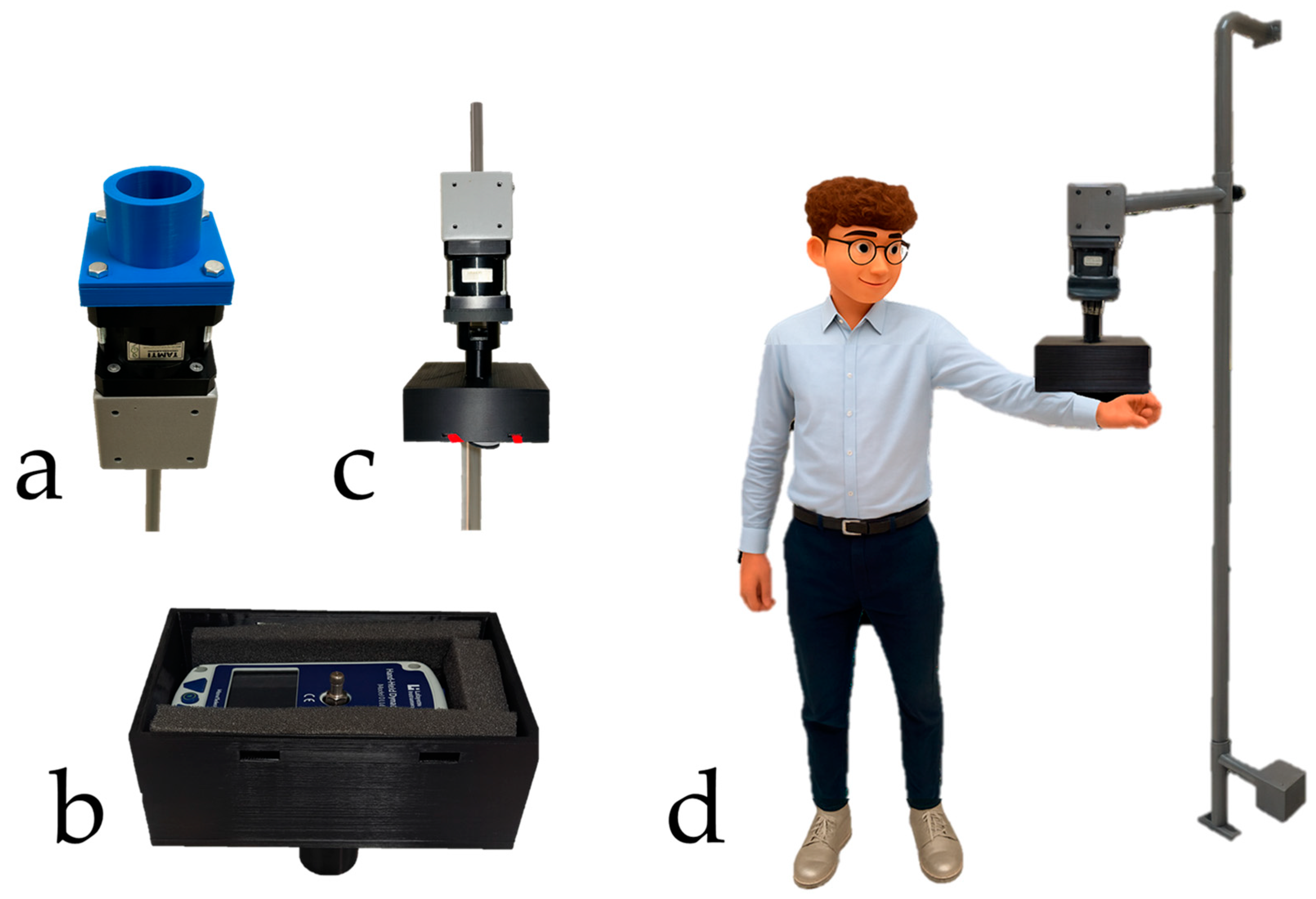
A dedicated housing was used to connect the HHD to the load cell in a serial configuration, designed to ensure precise alignment and reliable force transmission. The support structure was designed in CAD and fabricated with 3D printing. It consisted of two main components: a base to fix the load cell (Figure 1a) and a housing for the dynamometer (Figure 1b). Assembly was achieved using screws and bolts aligned with the load cell’s mounting points (Figure 1c). To ensure accurate and consistent force transmission from the HHD to the load cell, the structure was designed to prevent force dispersion and contact between components. The support featured a hollow outer cylinder with a diameter slightly larger than the sensitive element of the load cell (37 mm) and a solid inner cylinder, which was slightly smaller and directly connected to the dynamometer housing. The two components fit together to form a stable assembly that replicates testing conditions for any load cell orientation.
To validate the structural accuracy of the system, six static weights (range: 9.81–98.10 N) were applied using cast-iron discs placed on a padded support above the HHD. This range was chosen as it reflects values reported in previous experiments and is consistent with data from the literature on patients with musculoskeletal shoulder disorders [14,30,34,43]. Measurements were performed using both devices in series, with 20 repetitions per weight, applied sequentially in increasing order. Both instruments were zeroed before each repetition. After acquisition, the force signals from the load cell were preprocessed to extract the relevant portion of the recording. From each repetition, the mean force value and the corresponding standard deviation (SD) were computed to assess the consistency of the measurements. To assess the agreement between the HHD and the load cell, the Root Mean Square Error (RMSE) was computed for each trial. The RMSE represents the square root of the average squared differences between the force values recorded by the two measurement systems [44]:
R M S E =   1 n   i = 1 n F o r c e H H D i   F o r c e L o a d C e l l i 2
in which F o r c e H H D i represents the force measured by the HHD, and F o r c e L o a d C e l l i refers to the force measured by the load cell, with n indicating the number of repetitions, and i representing the i-th repetition. This metric is particularly useful for capturing both the magnitude and variability in the error, as it increases proportionally with the presence of larger discrepancies in the data [44,45].
For human testing, a total of 5 healthy volunteers (mean age 26 years; 2 males and 3 females; 4 right-handed and 1 left-handed) were enrolled at the Fondazione Policlinico Universitario Campus Bio-Medico (FPUCBM). None of the participants had experienced shoulder pain in the past six months or had a history of shoulder surgery. The study was approved by the local Ethics Committee Lazio Area 2 (protocol code: 13.25 CET2 cbm), and informed consent was obtained from all participants prior to data collection. Participants were instructed to exert maximum muscle force against the instruments arranged in a serial configuration during the execution of two clinically relevant movements: arm elevation in the scapular plane (also known as scaption) and elbow flexion [19,41,46,47]. For the first movement, the participant stood with feet shoulder-width apart, arm abducted to 90° in the scapular plane, wrist pronated, elbow extended, and the HHD strap secured around the wrist, following the Constant Murley Score protocol [47]. The second exercise involved participants performing elbow flexion at 90 degrees in a standing position, with the forearm vertical and supinated, the upper arm stabilized against the trunk, and the HHD strap secured around the mid-forearm, aligned with the brachialis insertion, to ensure consistent force application. In clinical evaluation of shoulder muscle strength, elbow flexion is often employed to isolate and measure the strength of the biceps brachii, which is considered one of the major muscles contributing to shoulder stability and function. This movement allows the biceps to be tested in relative isolation and provides clinically relevant information on its role within the shoulder complex [19,41,46]. The test involved exerting maximal force against the system for 5 s while maintaining a steady and continuous effort throughout. Each participant completed five trials per arm to ensure consistency and reliability of the force measurements. A brief rest period (about 3 s) was provided between consecutive trials to maintain consistency in the testing procedure. Standardized instructions were provided during each trial, accompanied by clear cues that signaled the start and end of the test.
To synchronize the two systems, the HHD emitted an acoustic signal at both the start and the end of each trial. The load cell recording was initiated immediately after the start signal and terminated by the operator when the stop signal was emitted, using these acoustic markers as a common temporal reference.
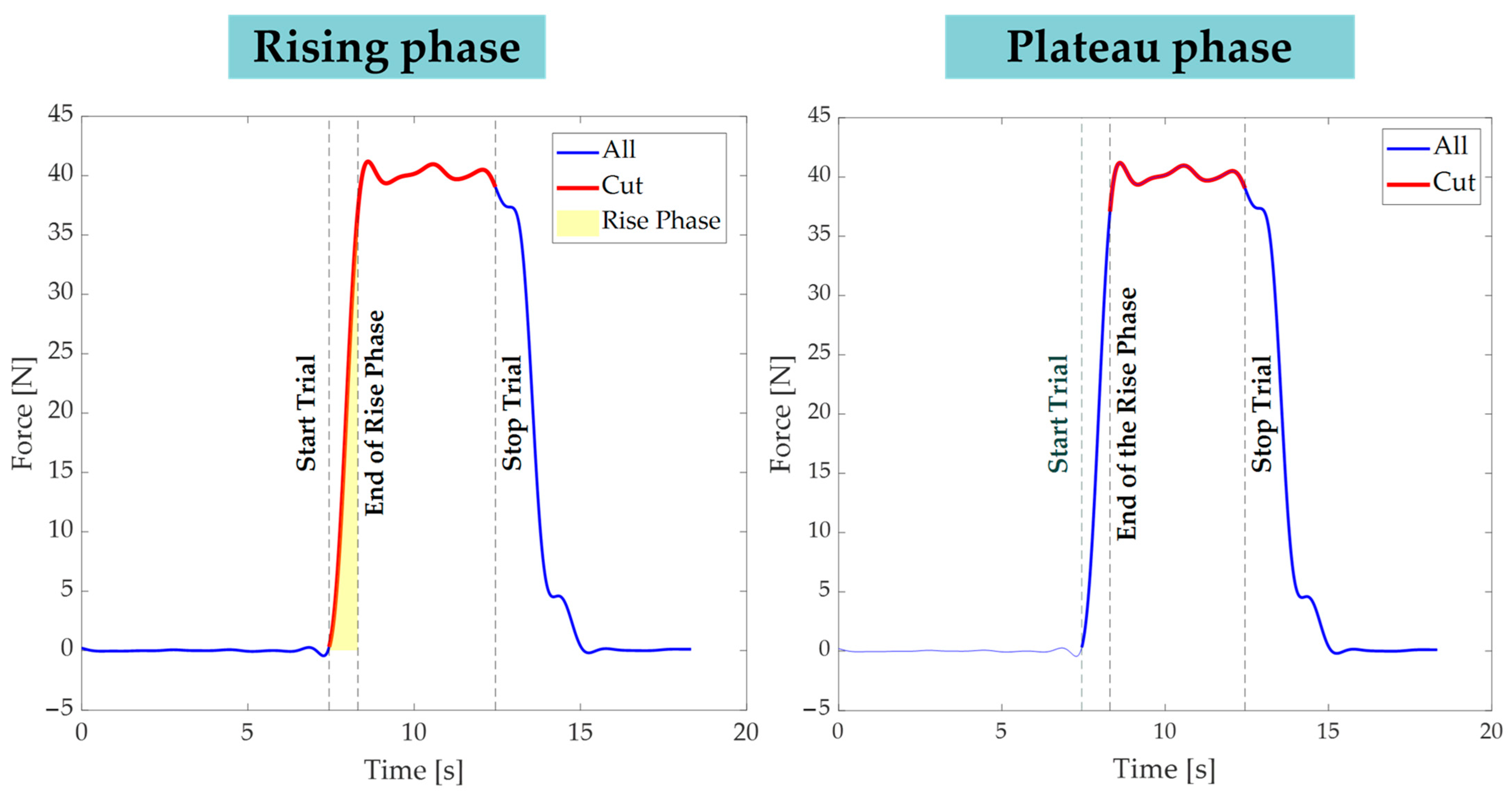
The HHD data’s mean and peak values were saved as a .csv file, which was subsequently imported into MATLAB® (R2024b, The MathWorks Inc., Natick, MA, USA) for further analysis. Load cell data were acquired using Qualisys Track Manager and exported as .mat files for further preprocessing in MATLAB®. A fourth-order Butterworth lowpass filter was applied to these data, and then the mean value was extracted for each muscle contraction signal. To assess the agreement between the two force-sensing systems and investigate how different signal selection methods influence the resulting force values, two distinct strategies were applied to identify the relevant portion of the load cell signal for each shoulder muscle strength curve. For both methods, the average force was computed over the selected segment. In the first method (rising phase), a 5 s window was extracted starting from the synchronization point with the HHD, which marked the onset of force application. This window captured the initial part of the contraction, including the ascending phase of the force curve, and ended at the time corresponding to the stop signal of the HHD. In the second method (plateau phase), a threshold-based approach was employed to isolate the more stable portion of the contraction [39,40]. Specifically, the rising phase of the signal was considered to end when the force reached 90% of its peak value [39,40]. From this point forward, all subsequent samples until the end of the trial (as defined by the stop signal from the HHD) were included in the analysis. This method was chosen to isolate the portion of the contraction most representative of maximal voluntary effort, minimizing the influence of initial acceleration and end-phase fatigue [48]. An illustrative example of the two signal selection methods was shown in Figure 2, where the rising and plateau phases are highlighted on a representative force signal.
To evaluate the agreement between the measurements obtained from the HHD and the load cell, a Bland–Altman analysis was performed. This method enabled a quantitative assessment of the agreement between the two instruments by calculating the mean of difference (MOD) and the limits of agreement (LOA) between paired force values [26,49,50,51]. MOD represents the average discrepancy between the two instruments, while LOA defines the interval within which approximately 95% of the data points are expected to fall [26,49,50,51]. These metrics were calculated as follows [49]:
M O D = 1 n i = 1 n M e a n S t r e n g t h H H D i M e a n S t r e n g t h L o a d C e l l i
L O A = M O D ± 1.96 S D
where SD is the standard deviation where SD is the standard deviation of the differences between the paired force values recorded by the two instruments. In addition, the RMSE was computed as an additional quantitative measure of agreement, following the same procedure adopted in the system validation with static weights, and calculated for each trial based on the point-by-point differences between the measurements obtained from the two force-measuring devices. Both analyses were conducted separately for each signal processing method (rising phase and plateau phase).

3. Results

All data acquired using the HHD and the load cell are presented in Table 1, which reports the mean force values and standard deviations for each static weight condition, along with the corresponding RMSE between the two devices. The load cell consistently demonstrated stable measurements across all applied loads. At 9.81 N, it recorded a mean value of 10.40 N (SD = 0.03 N), while at 98.10 N, it measured 98.61 N (SD = 0.25 N), maintaining a low variability throughout the tested range. These results reflect high precision, with standard deviations remaining well below 1% of the applied force. In comparison, the HHD exhibited increasing variability as the weight increased. For lighter loads, such as 9.81 N, the device reported 10.45 N (SD = 0.09 N), with a low RMSE of 0.55 N. Similar performance was observed at 19.62 N and 29.43 N (RMSE = 0.41 N and 0.46 N, respectively). However, for higher loads, dispersion around the mean became more pronounced. At 49.05 N, the HHD recorded 48.83 N (SD = 0.31 N), and at 98.10 N, it measured 93.38 N (SD = 0.60 N), with RMSE values increasing to 1.29 N and 5.06 N, respectively.
Regarding the experimental tests conducted on healthy partecipants, the protocol was completed under controlled laboratory conditions, enabling the evaluation of measurement agreement and signal processing approaches in the absence of confounding clinical variability. A total of 50 paired measurements were collected and analyzed between the HHD and the load cell across two tasks (scaption and elbow flexion), both limbs, and five repetitions per condition. Mean force values and SD measured by the HHD and the load cell for both tasks were summarized in Table 2 and Table 3. For each participant, these values represent the average of five repeated trials per condition.
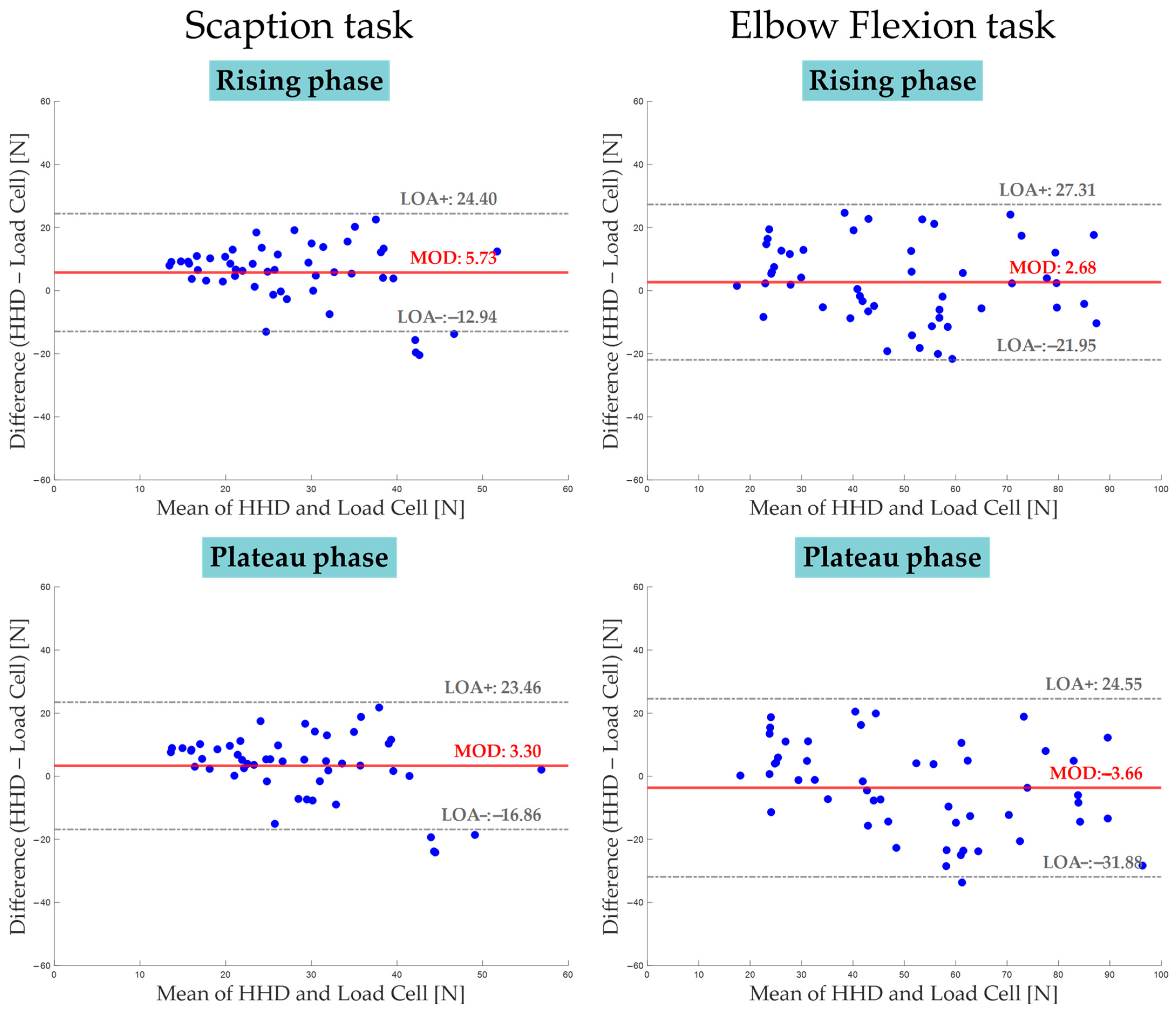
The Bland–Altman analysis results are presented in Figure 3, which were performed separately for the two signal selection techniques from the load cell: the rising phase and the plateau phase. Each subplot in Figure 3 reports the mean difference and limits of agreement for the respective task and processing approach. In the Scaption task, during the rising phase of the force signal, the MOD between the HHD and the load cell was 5.73 N. The LOAs were −12.94 N and +24.40 N, resulting in a total width of 37.34 N. This indicates a relevant difference between the two instruments during the ascending portion of the force curve, with a tendency of the HHD to slightly overestimate values compared to the load cell. In the plateau phase, the MOD decreased to 3.30 N, and the LOAs were −16.86 N and +23.46 N, with a total span of 40.32 N. Similarly, in the Elbow Flexion task, the rising phase showed a MOD of 2.68 N, with LOA of −21.95 N and +27.31 N, corresponding to a total range of 49.26 N. During the plateau phase, the MOD further decreased to −3.66 N, with LOA of −31.88 N and +24.55 N (range = 56.43 N). Despite the relatively low values of the MOD, the agreement between the devices remained limited due to the broad limits of agreement.
In addition to the Bland–Altman analysis, RMSE values were calculated to further quantify the magnitude of disagreement. For the Scaption task, RMSE was 11.03 N during the rising phase and 10.70 N during the plateau phase. In the Elbow Flexion task, RMSE was 12.72 N in the rising phase and increased to 14.71 N in the plateau phase.

4. Discussion and Conclusions

This study directly addressed the current lack of evidence on the methodological comparison between HHD measurements and those of a reference load cell by implementing, for the first time, a rigid serial configuration between a commercial hand-held dynamometer and a load cell. This design enabled both systems to be tested under identical loading conditions, thereby minimizing operator-related variability and allowing for a direct assessment of their relative accuracy and reliability. In addition, the work systematically examined how different load cell signal processing strategies affect the final measured force, providing insight into their impact on data interpretation and potential clinical applicability.
The static validation phase provided important insights into the performance characteristics of both measurement systems under controlled loading conditions. In the lower load conditions, both instruments slightly overestimated the applied force, which may be attributed to baseline signal noise and the high sensitivity of the transducers at low force levels. Conversely, in the higher load conditions, the HHD tended to underestimate the applied forces, likely due to minor mechanical deformation and limited stabilization of the handheld system, whereas the load cell continued to slightly overestimate, reflecting its higher stiffness and precision in load detection. In particular, the results showed that the load cell maintained standard deviations well below 1% of the applied load, confirming its suitability as a reference instrument for biomechanical force assessment in both clinical and research settings. Conversely, the HHD showed increasing dispersion at higher loads, with RMSE values rising sharply from 0.55 N at 9.81 N to 5.06 N at 98.10 N. This pattern reflects established evidence showing that portable dynamometry is more susceptible to measurement variability under high-force conditions, where tester stabilization and device handling can influence accuracy [16,17,18,22,23,24,25,30,31,32,33,42].
The study was conducted in healthy participants, and the experimental setup was designed to ensure consistent and comparable conditions for the methodological evaluation of the two measurement systems. During human testing, both systems reported mean force values that were relatively low compared with previously published normative data, which can be attributed to the controlled testing conditions, standardized posture, and short rest intervals intentionally adopted to enhance measurement reproducibility and minimize operator-related variability rather than to elicit maximal performance [52].
The variability of the HHD measurements also increased with higher force levels, mirroring the trend observed in the static weight validation. This finding is consistent with previous literature, which has reported that portable dynamometry tends to show increased dispersion at higher force outputs, particularly when examiner stabilization becomes a limiting factor [16,17,18,22,23,24,25,30,31,32,33,42]. Bland–Altman analysis showed that selecting the plateau phase generally reduced the MOD between devices in both scaption and elbow flexion tasks. In scaption, the MOD decreased from 5.73 N in the rising phase to 3.30 N in the plateau phase, while in elbow flexion it shifted from 2.68 N to −3.66 N. Although this change did not represent a true reduction, it indicated a shift in the direction of the bias, with the HHD tending to underestimate force values compared to the load cell. However, these differences were not consistently associated with narrower LOA or lower RMSE. For example, in elbow flexion, the LOA widened from 49.26 N to 56.43 N, and RMSE increased from 12.72 N to 14.71 N, corresponding to approximately 10–12% of the mean force values recorded in this task. Although these variations are unlikely to be clinically meaningful, they demonstrate that changes in signal selection criteria can affect the numerical comparison between devices. Likely contributors include differences in sensor design, sampling characteristics, and internal processing algorithms, as well as mechanical factors such as minor misalignments, variable fixation stability, and different dynamic responses to rapid force changes [53]. While excluding the initial ramp-up phase can reduce certain systematic biases, it may also eliminate essential information on contraction onset and early force development, periods that reflect fundamental aspects of neuromuscular function [54,55]. Its omission does not necessarily reduce variability and may compromise the physiological validity of the measurement [49]. However, it should be noted that the calculation of the mean force also depends on the internal algorithm of the HHD, which averages the sampled values over the entire test duration. This methodological difference may contribute to the discrepancies observed between devices.
Scaption consistently exhibited a narrower LOA than elbow flexion across both signal selection methods. This difference is likely explained by the biomechanical characteristics of the tasks [56]. In scaption, the peak forces were generally lower than those generated during elbow flexion, allowing the limb to be maintained in a more stable and controlled position throughout the contraction, as the reduced load minimized compensatory movements and instability [17,24,32,33,34,56]. This stability limits the occurrence of compensatory movements, reduces joint translation, and minimizes mechanical artifacts transmitted to the measuring devices [17,24,32,33,34,56]. In contrast, elbow flexion tasks typically involve higher peak forces and require the partecipant to counteract greater torque at the joint [17,24,32,33,34]. These higher demands place increased emphasis on both partecipant stabilization and precise alignment of the measurement apparatus [17,57]. Even in a rigid serial configuration, small deviations in posture, for example, may alter load transmission, leading to greater variability in recorded values. Furthermore, the elbow flexion posture may allow for subtle adjustments in trunk or shoulder position, although minor, which can affect force measurements and widen the LOA [58].
The serial configuration proposed in this study enabled a direct and controlled comparison between two measurement systems for assessing shoulder strength. The load cell consistently delivered stable and precise measurements across all conditions, whereas the HHD exhibited increasing variability as force levels rose. Selecting the plateau phase of the load cell signal reduced the MOD between devices; however, this adjustment did not consistently lead to narrower LOA or lower RMSE across conditions. Taken together, the findings suggest that the load cell would maintain high stability and precision in both tests with known weights and healthy participants. In contrast, the HHD displayed greater variability, which became more pronounced at higher applied forces. The method used to select the signal segment for analysis also influenced the results: plateau-phase analysis generally reduced MOD, yet this adjustment did not consistently improve LOA or RMSE. Moreover, the comparison between the two signal processing approaches aimed to highlight that methodological choices, such as whether to include or exclude the rising phase, can influence not only the numerical results but also the interpretation of force generation in a clinical setting. Understanding how these variations affect the agreement between devices is important for developing standardized analysis procedures and ensuring more consistent and comparable strength assessments in both research and clinical applications.
Differences between devices must be considered when interpreting absolute force values, particularly in clinical contexts, where even minor inaccuracies in strength estimation may influence the evaluation of functional recovery and subsequent therapeutic decisions. These findings underscore both the potential and the limitations of portable dynamometry in clinical practice, highlighting its practicality for routine strength assessment while also emphasizing its susceptibility to variability under higher-load conditions or when stabilization cannot be fully controlled, thereby underscoring the need for standardized and operator-independent clinical protocols supported by complementary reference validation. While well-suited for low- to moderate-force measurements, the accuracy of HHDs declines under high-load conditions, highlighting the importance of reference validation and, where feasible, the integration of objective signal processing techniques.
The proposed configuration establishes a controlled and repeatable approach for assessing shoulder muscle strength measurement using commercial devices, supporting the development of evidence-based standards for research and clinical applications. In fact, this setup provides objective data that may contribute to the standardization of measurement protocols, the definition of normative values, and the validation of portable devices for use in both laboratory and clinical settings. This study has some limitations. The sample was relatively small and homogeneous, comprising healthy young volunteers, which may limit the generalizability of the findings. Moreover, all tests were conducted under controlled laboratory conditions, and accuracy was not directly assessed in clinical populations. Additionally, although the Bland–Altman analysis assumes independent observations, in the present repeated-measures design, each measurement was treated as an independent data point due to the small sample size and the exploratory nature of this pilot study. Nonetheless, the controlled methodological design enabled a precise evaluation of the measurement systems while minimizing potential confounding factors and provided a preliminary understanding of the comparative performance between the two devices. Future work should assess the performance of this configuration in clinical populations and explore automated processing pipelines to streamline load cell signal analysis, thereby facilitating its integration into routine clinical practice. Reliable and reproducible strength measurement forms the basis for evidence-driven interventions, enabling clinicians to optimize patient function and quality of life.

Author Contributions

Conceptualization: C.A.; Methodology: A.C., U.G.L. and L.M.; Formal analysis: A.d.S. and P.D.; Investigation: M.M., C.A., E.S. and U.G.L.; Resources: A.C.; Data curation: A.C., L.M., E.S. and R.P.; Writing—Original Draft: C.A., A.C., L.M. and E.S.; Writing—Review & Editing: E.S., U.G.L. and A.d.S.; Visualization: R.P., P.D. and M.M.; Supervision: U.G.L. and E.S. All authors have read and agreed to the published version of the manuscript.

Funding

This research received no external funding.

Data Availability Statement

The original contributions presented in this study are included in the article. Further inquiries can be directed to the corresponding author.

Acknowledgments

This work has been supported by the Italian Ministry of Health in the framework of RICERCA FINALIZZATA 2021 (RF-2021-12372810).

Conflicts of Interest

The authors declare no conflicts of interest.

Abbreviations

The following abbreviations are used in this manuscript:
HHDHand-held Dynamometer
STStandard Deviation
RMSERoot Mean Square Error
MODMean of Difference
LOALimits of Agreement

References

  1. Matsuki, K.; Matsuki, K.O.; Mu, S.; Yamaguchi, S.; Ochiai, N.; Sasho, T.; Sugaya, H.; Toyone, T.; Wada, Y.; Takahashi, K.; et al. In vivo 3-dimensional analysis of scapular kinematics: Comparison of dominant and nondominant shoulders. J. Shoulder Elb. Surg. 2011, 20, 659–665. [Google Scholar] [CrossRef] [PubMed]
  2. Maffulli, N.; Longo, U.G.; Berton, A.; Loppini, M.; Denaro, V. Biological factors in the pathogenesis of rotator cuff tears. Sports Med. Arthrosc. Rev. 2011, 19, 194–201. [Google Scholar] [CrossRef]
  3. Rockwood, C.A. The Shoulder; Elsevier Health Sciences: Amsterdam, The Netherlands, 2009; Volume 1. [Google Scholar]
  4. Longo, U.G.; Risi Ambrogioni, L.; Berton, A.; Candela, V.; Massaroni, C.; Carnevale, A.; Stelitano, G.; Schena, E.; Nazarian, A.; DeAngelis, J.; et al. Scapular Dyskinesis: From Basic Science to Ultimate Treatment. Int. J. Environ. Res. Public Health 2020, 17, 2974. [Google Scholar] [CrossRef]
  5. Cools, A.M.; De Wilde, L.; Van Tongel, A.; Ceyssens, C.; Ryckewaert, R.; Cambier, D.C. Measuring shoulder external and internal rotation strength and range of motion: Comprehensive intra-rater and inter-rater reliability study of several testing protocols. J. Shoulder Elb. Surg. 2014, 23, 1454–1461. [Google Scholar] [CrossRef]
  6. Mera, B.J. Current Perspectives on Rotator Cuff Disease. Osteology 2022, 2, 62–69. [Google Scholar] [CrossRef]
  7. González-Rosalén, J.; Benítez-Martínez, J.C.; Medina-Mirapeix, F.; Cuerda-Del Pino, A.; Cervelló, A.; Martín-San Agustín, R. Intra- and Inter-Rater Reliability of Strength Measurements Using a Pull Hand-Held Dynamometer Fixed to the Examiner’s Body and Comparison with Push Dynamometry. Diagnostics 2021, 11, 1230. [Google Scholar] [CrossRef]
  8. Franceschi, F.; Longo, U.G.; Ruzzini, L.; Rizzello, G.; Denaro, V. Arthroscopic management of calcific tendinitis of the subscapularis tendon. Knee Surg. Sports Traumatol. Arthrosc. 2007, 15, 1482–1485. [Google Scholar] [CrossRef]
  9. Maffulli, N.; Longo, U.G. Conservative management for tendinopathy: Is there enough scientific evidence? Rheumatology 2008, 47, 390–391. [Google Scholar] [CrossRef]
  10. Constant, C.R.; Gerber, C.; Emery, R.J.; Søjbjerg, J.O.; Gohlke, F.; Boileau, P. A review of the Constant score: Modifications and guidelines for its use. J. Shoulder Elb. Surg. 2008, 17, 355–361. [Google Scholar] [CrossRef]
  11. Vrotsou, K.; Ávila, M.; Machón, M.; Mateo-Abad, M.; Pardo, Y.; Garin, O.; Zaror, C.; González, N.; Escobar, A.; Cuéllar, R. Constant-Murley Score: Systematic review and standardized evaluation in different shoulder pathologies. Qual. Life Res. 2018, 27, 2217–2226. [Google Scholar] [CrossRef]
  12. Booker, S.; Alfahad, N.; Scott, M.; Gooding, B.; Wallace, W.A. Use of scoring systems for assessing and reporting the outcome results from shoulder surgery and arthroplasty. World J. Orthop. 2015, 6, 244–251. [Google Scholar] [CrossRef] [PubMed]
  13. Kirkley, A.; Griffin, S.; Dainty, K. Scoring systems for the functional assessment of the shoulder. Arthroscopy 2003, 19, 1109–1120. [Google Scholar] [CrossRef] [PubMed]
  14. Ziegler, P.; Kühle, L.; Stöckle, U.; Wintermeyer, E.; Stollhof, L.E.; Ihle, C.; Bahrs, C. Evaluation of the Constant score: Which is the method to assess the objective strength? BMC Musculoskelet. Disord. 2019, 20, 403. [Google Scholar] [CrossRef]
  15. Burrus, C.; Deriaz, O.; Luthi, F.; Konzelmann, M. Role of pain in measuring shoulder strength abduction and flexion with the Constant-Murley score. Ann. Phys. Rehabil. Med. 2017, 60, 258–262. [Google Scholar] [CrossRef]
  16. Durfee, W.K.; Iaizzo, P. Rehabilitation and Muscle Testing; John Wiley and Sons: Hoboken, NJ, USA, 2006. [Google Scholar]
  17. Wikholm, J.B.; Bohannon, R.W. Hand-held Dynamometer Measurements: Tester Strength Makes a Difference. J. Orthop. Sports Phys. Ther. 1991, 13, 191–198. [Google Scholar] [CrossRef]
  18. Chamorro, C.; Arancibia, M.; Trigo, B.; Arias-Poblete, L.; Jerez-Mayorga, D. Absolute Reliability and Concurrent Validity of Hand-Held Dynamometry in Shoulder Rotator Strength Assessment: Systematic Review and Meta-Analysis. Int. J. Environ. Res. Public Health 2021, 18, 9293. [Google Scholar] [CrossRef]
  19. Decleve, P.; Van Cant, J.; De Buck, E.; Van Doren, J.; Verkouille, J.; Cools, A.M. The Self-Assessment Corner for Shoulder Strength: Reliability, Validity, and Correlations With Upper Extremity Physical Performance Tests. J. Athl. Train. 2020, 55, 350–358. [Google Scholar] [CrossRef]
  20. Hirano, M.; Katoh, M. Absolute reliability of shoulder joint horizontal adductor muscle strength measurements using a handheld dynamometer. J. Phys. Ther. Sci. 2015, 27, 2125–2127. [Google Scholar] [CrossRef][Green Version]
  21. Holt, K.L.; Raper, D.P.; Boettcher, C.E.; Waddington, G.S.; Drew, M.K. Hand-held dynamometry strength measures for internal and external rotation demonstrate superior reliability, lower minimal detectable change and higher correlation to isokinetic dynamometry than externally-fixed dynamometry of the shoulder. Phys. Ther. Sport 2016, 21, 75–81. [Google Scholar] [CrossRef]
  22. Croci, E.; Born, P.; Eckers, F.; Nüesch, C.; Baumgartner, D.; Müller, A.M.; Mündermann, A. Test-retest reliability of isometric shoulder muscle strength during abduction and rotation tasks measured using the Biodex dynamometer. J. Shoulder Elb. Surg. 2023, 32, 2008–2016. [Google Scholar] [CrossRef] [PubMed]
  23. Tanveer, F.; Arslan, S.A.; Darain, H.; Ahmad, A. Reliability of Hand-Held Dynamometer for assessing Isometric Lumbar Muscles Strength in Asymptomatic Healthy Population. Pak. J. Med. Sci. 2021, 37, 461–465. [Google Scholar] [CrossRef]
  24. Byl, N.N.; Richards, S.; Asturias, J. Intrarater and interrater reliability of strength measurements of the biceps and deltoid using a hand held dynamometer. J. Orthop. Sports Phys. Ther. 1988, 9, 395–398. [Google Scholar] [CrossRef]
  25. Cadogan, A.; Laslett, M.; Hing, W.; McNair, P.; Williams, M. Reliability of a new hand-held dynamometer in measuring shoulder range of motion and strength. Man. Ther. 2011, 16, 97–101. [Google Scholar] [CrossRef]
  26. Beshara, P.; Davidson, I.; Pelletier, M.; Walsh, W.R. The Intra- and Inter-Rater Reliability of a Variety of Testing Methods to Measure Shoulder Range of Motion, Hand-behind-Back and External Rotation Strength in Healthy Participants. Int. J. Environ. Res. Public Health 2022, 19, 14442. [Google Scholar] [CrossRef]
  27. Stone, C.A.; Nolan, B.; Lawlor, P.G.; Kenny, R.A. Hand-held dynamometry: Tester strength is paramount, even in frail populations. J. Rehabil. Med. 2011, 43, 808–811. [Google Scholar] [CrossRef] [PubMed]
  28. Wadsworth, C.T.; Krishnan, R.; Sear, M.; Harrold, J.; Nielsen, D.H. Intrarater reliability of manual muscle testing and hand-held dynametric muscle testing. Phys. Ther. 1987, 67, 1342–1347. [Google Scholar] [CrossRef] [PubMed]
  29. Reed, R.L.; Den Hartog, R.; Yochum, K.; Pearlmutter, L.; Ruttinger, A.C.; Mooradian, A.D. A comparison of hand-held isometric strength measurement with isokinetic muscle strength measurement in the elderly. J. Am. Geriatr. Soc. 1993, 41, 53–56. [Google Scholar] [CrossRef] [PubMed]
  30. Brinkmann, J.R. Comparison of a hand-held and fixed dynamometer in measuring strength of patients with neuromuscular disease. J. Orthop. Sports Phys. Ther. 1994, 19, 100–104. [Google Scholar] [CrossRef]
  31. Bohannon, R.W. Intertester reliability of hand-held dynamometry: A concise summary of published research. Percept. Mot. Ski. 1999, 88, 899–902. [Google Scholar] [CrossRef]
  32. McMahon, L.M.; Burdett, R.; Whitney, S.L. Effects of muscle group and placement site on reliability of hand-held dynamometry strength measurements. J. Orthop. Sports Phys. Ther. 1992, 15, 236–242. [Google Scholar] [CrossRef]
  33. Lu, T.W.; Hsu, H.C.; Chang, L.Y.; Chen, H.L. Enhancing the examiner’s resisting force improves the reliability of manual muscle strength measurements: Comparison of a new device with hand-held dynamometry. J. Rehabil. Med. 2007, 39, 679–684. [Google Scholar] [CrossRef]
  34. Beshay, N.; Lam, P.H.; Murrell, G.A. Assessing the reliability of shoulder strength measurement: Hand-held versus fixed dynamometry. Shoulder Elb. 2011, 3, 244–251. [Google Scholar] [CrossRef]
  35. Ruschel, C.; Haupenthal, A.; Jacomel, G.F.; Fontana, H.B.; Santos, D.P.; Scoz, R.D.; Roesler, H. Validity and reliability of an instrumented leg-extension machine for measuring isometric muscle strength of the knee extensors. J. Sport Rehabil. 2015, 24, 122. [Google Scholar] [CrossRef]
  36. Macedo, M.C.; Souza, M.A.; Ferreira, K.R.; Campos, L.O.; Souza, I.S.O.; Barbosa, M.A.; Brito, C.J.; Intelangelo, L.; Barbosa, A.C. Validity and Test-Retest Reliability of a Novel Push Low-Cost Hand-Held Dynamometer for Knee Strength Assessment during Different Force Ranges. Diagnostics 2022, 12, 186. [Google Scholar] [CrossRef]
  37. Machado Rodrigues, F.; Demeyer, H.; Hornikx, M.; Camillo, C.A.; Calik-Kutukcu, E.; Burtin, C.; Janssens, W.; Troosters, T.; Osadnik, C. Validity and reliability of strain gauge measurement of volitional quadriceps force in patients with COPD. Chron. Respir. Dis. 2017, 14, 289–297. [Google Scholar] [CrossRef]
  38. Hong, J.-S.; Ko, J.-B.; Ju, M.-M.; Lee, B.-K.; Park, D.-S.; Lee, S.-H. The Reliability and Validity of an Isometric Knee Strength Measurement Device in Older Adult Individuals. Sensors 2025, 25, 2981. [Google Scholar] [CrossRef]
  39. Choi, J.; Yeoh, W.L.; Loh, P.Y.; Muraki, S. Force and electromyography responses during isometric force release of different rates and step-down magnitudes. Hum. Mov. Sci. 2019, 67, 102516. [Google Scholar] [CrossRef]
  40. Liu, J.; Qu, X.; Stone, M.H. Evaluation of force-time curve analysis methods in the isometric mid-thigh pull test. Sports Biomech. 2023, 22, 1381–1397. [Google Scholar] [CrossRef] [PubMed]
  41. González-Rosalén, J.; Cuerda-Del Pino, A.; Sánchez-Barbadora, M.; Martín-San Agustín, R. Validity and reliability of the DiCI for the measurement of shoulder flexion and abduction strength in asymptomatic and symptomatic subjects. PeerJ 2021, 9, e11600. [Google Scholar] [CrossRef] [PubMed]
  42. Antonacci, C.; Ghelli, G.; Carnevale, A.; Silvestri, S.; Schena, E.; Longo, U.G. A novel system integrating load cell for assessing shoulder muscle strength. In Proceedings of the 2024 IEEE International Workshop on Metrology for Industry 4.0 & IoT (MetroInd4. 0 & IoT), Firenze, Italy, 29–31 May 2024; pp. 591–596. [Google Scholar]
  43. Bradley, H.; Pierpoint, L. Normative Values of Isometric Shoulder Strength Among Healthy Adults. Int. J. Sports Phys. Ther. 2023, 18, 977–988. [Google Scholar] [CrossRef] [PubMed]
  44. Chai, T. Root Mean Square. In Encyclopedia of Mathematical Geosciences; Springer: Berlin/Heidelberg, Germany, 2022; pp. 1–3. [Google Scholar]
  45. Chicco, D.; Warrens, M.J.; Jurman, G. The coefficient of determination R-squared is more informative than SMAPE, MAE, MAPE, MSE and RMSE in regression analysis evaluation. Peerj Comput. Sci. 2021, 7, e623. [Google Scholar] [CrossRef]
  46. Wittstein, J.R.; Queen, R.; Abbey, A.; Toth, A.; Moorman, C.T. Isokinetic strength, endurance, and subjective outcomes after biceps tenotomy versus tenodesis: A postoperative study. Am. J. Sports Med. 2011, 39, 857–865. [Google Scholar] [CrossRef] [PubMed]
  47. Constant, C.R.; Murley, A.H. A clinical method of functional assessment of the shoulder. Clin. Orthop. Relat. Res. 1987, 214, 160–164. [Google Scholar] [CrossRef]
  48. Cools, A.M.; Vanderstukken, F.; Vereecken, F.; Duprez, M.; Heyman, K.; Goethals, N.; Johansson, F. Eccentric and isometric shoulder rotator cuff strength testing using a hand-held dynamometer: Reference values for overhead athletes. Knee Surg. Sports Traumatol. Arthrosc. 2016, 24, 3838–3847. [Google Scholar] [CrossRef]
  49. Bland, J.M.; Altman, D.G. Statistical methods for assessing agreement between two methods of clinical measurement. Int. J. Nurs. Stud. 2010, 47, 931–936. [Google Scholar] [CrossRef]
  50. Awatani, T.; Morikita, I.; Shinohara, J.; Mori, S.; Nariai, M.; Tatsumi, Y.; Nagata, A.; Koshiba, H. Intra- and inter-rater reliability of isometric shoulder extensor and internal rotator strength measurements performed using a hand-held dynamometer. J. Phys. Ther. Sci. 2016, 28, 3054–3059. [Google Scholar] [CrossRef]
  51. Ludbrook, J. Statistical techniques for comparing measurers and methods of measurement: A critical review. Clin. Exp. Pharmacol. Physiol. 2002, 29, 527–536. [Google Scholar] [CrossRef]
  52. Andrews, A.W.; Thomas, M.W.; Bohannon, R.W. Normative values for isometric muscle force measurements obtained with hand-held dynamometers. Phys. Ther. 1996, 76, 248–259. [Google Scholar] [CrossRef] [PubMed]
  53. Merry, K.; Napier, C.; Chung, V.; Hannigan, B.C.; MacPherson, M.; Menon, C.; Scott, A. The Validity and Reliability of Two Commercially Available Load Sensors for Clinical Strength Assessment. Sensors 2021, 21, 8399. [Google Scholar] [CrossRef]
  54. Maffiuletti, N.A.; Aagaard, P.; Blazevich, A.J.; Folland, J.; Tillin, N.; Duchateau, J. Rate of force development: Physiological and methodological considerations. Eur. J. Appl. Physiol. 2016, 116, 1091–1116. [Google Scholar] [CrossRef]
  55. Aagaard, P.; Simonsen, E.B.; Andersen, J.L.; Magnusson, P.; Dyhre-Poulsen, P. Increased rate of force development and neural drive of human skeletal muscle following resistance training. J. Appl. Physiol. 2002, 93, 1318–1326. [Google Scholar] [CrossRef] [PubMed]
  56. Hoshikawa, K.; Yuri, T.; Giambini, H.; Kiyoshige, Y. Shoulder scaption is dependent on the behavior of the different partitions of the infraspinatus muscle. Surg. Radiol. Anat. 2021, 43, 653–659. [Google Scholar] [CrossRef]
  57. Wang, Y.; Sun, Y.; Gao, L.; Ma, Z.; Yang, X. Development and performance verification of an isometric dynamometer for lower extremity. Sci. Rep. 2025, 15, 26145. [Google Scholar] [CrossRef] [PubMed]
  58. Cavuoto, L.A.; Pajoutan, M.; Mehta, R.K. Reliability analyses and values of isometric shoulder flexion and trunk extension strengths stratified by body mass index. PLoS ONE 2019, 14, e0219090. [Google Scholar] [CrossRef] [PubMed]
Figure 1. (a) A 3D-printed modular support securely attaches the load cell with screws and bolts. (b) A custom casing stabilizes the HHD. (c) The final configuration integrates the load cell, HHD, and support structure. (d) Example of a healthy participant performing one task from the experimental protocol: the participant was instructed to exert maximal muscle force against the two devices, arranged in a serial configuration.
Instruments 10 00002 g001
Figure 2. An example of a signal extracted using the load cell. The entire signal is shown in blue, while the portion used for calculating the mean muscle strength is highlighted in red. The left panel illustrates the Rising phase method, and the right panel shows the Plateau phase method.
Instruments 10 00002 g002
Figure 3. Bland–Altman plot comparing shoulder muscle strength measurements obtained using the two devices and both techniques for extracting the load cell mean value. The mean of differences (MOD) is represented by the solid red line, while the upper and lower limits of agreement (LOA) are indicated by the dashed grey lines.
Instruments 10 00002 g003
Table 1. Mean force values and standard deviations (SD) recorded by the HHD and the load cell across six known static weight conditions. The corresponding Root Mean Square Error (RMSE) quantifies the measurement discrepancy between the two devices for each load.
Known Weights [N]HHD Mean Value (SD) [N]Load Cell Mean Value (SD) [N]RMSE [N]
9.8110.45 (0.09)10.40 (0.03)0.55
19.6219.76 (0.04)19.79 (0.02)0.41
29.4330.04 (0.46)30.29 (0.11)0.46
39.2438.63 (0.43)39.37 (0.09)0.40
49.0548.83 (0.31)50.08 (0.08)1.29
98.1093.38 (0.60)98.81 (0.25)5.06
Table 2. Mean force values and standard deviations (SD) recorded by the HHD and the load cell across healthy participants during the scaption.
Partecipant IDsArm SideHHD Mean Value (SD) [N]Rising Phase—Load Cell Mean Value (SD) [N]Plateau Phase—Load Cell Mean Value (SD) [N]
1Right39.80 (7.07)27.11 (3.95)28.27 (4.42)
Left44.94 (7.53)40.96 (8.59)45.58 (19.94)
2Right30.36 (3.61)20.55 (6.36)24.10 (7.99)
Left31.36 (4.26)22.60 (4.76)26.30 (5.92)
3Right32.98 (3.28)44.53 (9.82)47.56 (10.95)
Left33.78 (10.96)26.86 (3.74)28.34 (4.27)
4Right19.80 (1.44)11.60 (2.70)12.11 (2.93)
Left19.76 (2.34)12.25 (1.95)13.15 (2.26)
5Right25.18 (1.31)20.91 (3.51)24.12 (4.99)
Left23.82 (1.67)17.14 (1.71)19.21 (2.33)
Table 3. Mean force values and standard deviations (SD) recorded by the HHD and the load cell across healthy participants during the elbow flexion task.
Partecipant IDsArm SideHHD Mean Value (SD) [N]Rising Phase—Load Cell Mean Value (SD) [N]Plateau Phase—Load Cell Mean Value (SD) [N]
1Right81.66 (8.83)73.46 (9.47)80.26 (10.81)
Left82.34 (2.08)78.58 (11.32)89.78 (14.37)
2Right50.42 (6.48)57.01 (6.87)69.33 (9.27)
Left62.02 (5.53)55.00 (10.88)70.25 (11.71)
3Right43.24 (9.76)51.54 (12.15)54.42 (12.85)
Left46.32 (5.60)54.78 (12.65)57.55 (13.13)
4Right31.26 (1.92)17.12 (3.03)18.36 (3.39)
Left22.94 (4.40)21.60 (3.57)23.37 (4.21)
5Right43.12 (11.80)28.61 (2.41)32.27 (2.03)
Left37.06 (2.89)35.90 (11.92)41.42 (13.21)
Disclaimer/Publisher’s Note: The statements, opinions and data contained in all publications are solely those of the individual author(s) and contributor(s) and not of MDPI and/or the editor(s). MDPI and/or the editor(s) disclaim responsibility for any injury to people or property resulting from any ideas, methods, instructions or products referred to in the content.