


Abstract
Graphene holds significant promise as an ideal reinforcing phase. However, its tendency to irreversibly aggregate and its unclear impact on electrodeposition mechanisms have hindered the full exploitation of its advantages for enhancing material mechanical properties. In this study, we produced a graphene/Ni composite reinforced with reduced graphene oxide (rGO) via a simple, scalable, and cost-effective electrodeposition approach. The incorporation of graphene not only raised the cathodic polarization potential but also enhanced the transport of ions. As a result, the presence of rGO significantly influenced the grain size, grain distribution, and the proportion of growth twins-3(111). Compared with Ni, the graphene/Ni composite exhibited improvements of 14.8% in strength and 16.8% in fracture elongation. Additionally, first-principles calculations confirmed that superior electronic conductivity and all elastic moduli along with Poisson’s ratio were found to be higher in the composite. Our findings offer fundamental insights into the role of rGO in governing the structural evolution of graphene/metal composites.
1. Introduction
Metal matrix composites (MMCs) are an important class of advanced materials. In MMCs, metal or alloy matrix materials are combined with another, which is often nonmetallic, such as fibers, whiskers, or particles, to create not only high mechanical properties, good electrical conductivity, a controllable thermal expansion coefficient, and excellent high-temperature behavior but also designability and machinability [1,2,3,4]. Since 2004, when graphene was discovered, it received significant attention due to its large specific surface area, high thermal stability, good electrical conductivity, and excellent mechanical properties, with an ultra-high Young’s modulus (1 TPa) and tensile strength (130 GPa) [5,6]. Adding graphene as a reinforcing phase to a metal matrix can improve the electrical conductivity and thermal conductivity of materials, as well as the mechanical properties [7,8].
There are two key factors determining the mechanical properties of graphene/metal [9], namely (i) good interfacial binding capability between graphene and the metal matrix and (ii) ensuring that graphene dispersion in the metal matrix is uniform. As we all know, the unfilled d orbitals of Ni elements will strongly interact with the p orbitals of carbon atoms in graphene [10]. The interface between graphene and the Ni matrix have an intimate binding ability. In forming metal layers, electroplating is an efficient method due to its lower manpower, the fact that it creates less waste, and its ease of operation [11,12,13]. The electroplating process in fabricating metal layers is very mature and has been widely studied in synthesizing graphene/metal composites, especially graphene/Ni composites [14,15,16,17]. Moreover, in an electroplating bath, graphene oxide (GO) is always selected as the source reinforcement, thanks to its good dissolvability, and it can be reduced in cathodes [18,19,20,21]. Owing to the existing oxygen-containing functional groups on surfaces, a large number of Ni2+ can be absorbed after a hydrolysis reaction [22,23,24,25]. According to previous studies, prepared graphene/Ni composites using electrochemical deposition and a GO aqueous solution will promote the homogeneous dispersion of graphene in a Ni matrix [19,20,21,22].
Kumar and his team find that the corrosion resistance coating of the rGo/Ni composite obtained by electrodeposition is better than depositing a pure Ni coating on a surface [26]. The representative electrodeposition with GO sheets in a suspension was proposed by Kuang et al. [23], who synthesized graphene-reinforced Ni matrix composites (graphene/Ni composites). A graphene/Ni composite with 0.12 wt% graphene has a hardness and elastic modulus of 5.69 GPa and 190.57 GPa, respectively. Hardness increases almost 4-fold compared to pure Ni electrodeposits. Meanwhile, electrical conductivity and thermal conductivity are increased by 34% and 15%, respectively. The yield strength and tensile strength of graphene/Ni composites are increased by 140% and 42%, respectively. The reason for the improvement in mechanical properties observed with graphene/Ni composites is highlighted by graphene’s special structures. Different from the commonly used second-phase reinforcements, such as ceramic compounds (SiC, Al2O3, etc.), intermetallic materials, and carbon allotropes, graphene is a two-dimensional sheet-like structure with a high aspect ratio and large surface that has a special effect on electro-crystallization nucleation and the growth of metal atoms [27]. The literature also proposes that graphene in the metal matrix could increase inter-planar spacing, accelerate the nucleation rate, and restrain grain growth [28,29,30]. But how graphene achieves them and how graphene affects the deposition mechanism to obtain a special microstructure urgently needs to be further explored.
In this manuscript, theoretical calculations at the molecular scale have been used to simulate mechanical properties and the situation of adsorption sites of Ni2+ under the application of an electric field. Moreover, pure Ni and a graphene/Ni composite are prepared by direct current electrodeposition in an improved traditional electroplating bath. In the deposition process, the effect of graphene on microstructures is analyzed as well. The prepared graphene/Ni composite exhibits high strength and good ductility, and the strengthening and toughing mechanism is rationally discussed.
2. Result and Discussion
2.1. Mechanism of Microstructure Evolution and Mechanical Property Analysis
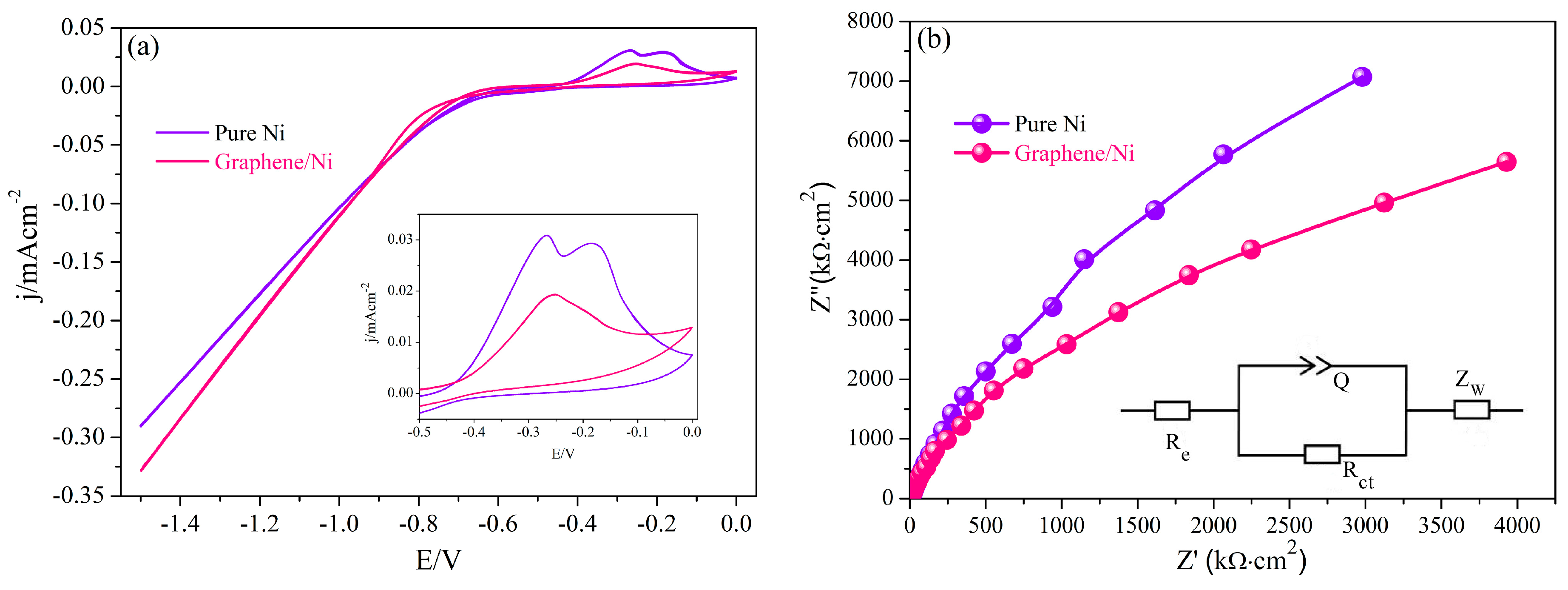
The samples of Ni and graphene/Ni were prepared by electrodeposition. Bulk Ni and the graphene/Ni composite are synthesized at 0.86 A/dm2 with a thickness of approximately 280 μm. The effect of graphene on the electrochemical behaviors of the electroplating baths is investigated by the cyclic voltammogram (CV) and Nyquist plots in Figure 1. The slopes of the CV curves are increased after the addition of rGO in electroplating baths when the deposition potential ranges from −680 mV to −1500 mV. The onset potential, determined from the slope, corresponds to the Ni ion deposition potential and provides insight into the nucleation and growth rates of Ni grains. In the −180 mV to −220 mV range, the Ni sample exhibits higher oxidation peaks than the graphene/Ni composite, implying greater dissolution of deposited Ni and consequent coarse grain formation [31]. The comparative analysis reveals that GO in the electroplating bath significantly inhibits the dissolution of nucleating Ni grains and refined the grain size. This is mainly because the oxygen-containing functional groups (e.g., -OH, -COOH) on GO can coordinate with Ni2+ ions to form stable surface complexes, which enhance the structural stability of Ni grains [32]. Simultaneously, positively charged Ni colloidal nanoparticles can be effectively anchored to the negatively charged GO surface via strong electrostatic interactions. This binding effect helps immobilize Ni atoms and suppresses their oxidation and dissolution. Moreover, the slope of the CV curve increases, pointing to more favorable reaction kinetics. With the addition of GO, its surface nanochannels enable the rapid transport of Ni2+, resolving the slow ion diffusion problem in pure Ni plating solutions, ensuring sufficient Ni2+ supply at the electrode surface and accelerating Ni2+ reduction/oxidation reactions [33,34]. Meanwhile, GO is in situ reduced to highly conductive rGO during electrodeposition, forming a three-dimensional conductive network on the electrode surface. This significantly lowers the electron transfer resistance at the electrode/electrolyte interface and ensures smoother charge transfer [32,35].
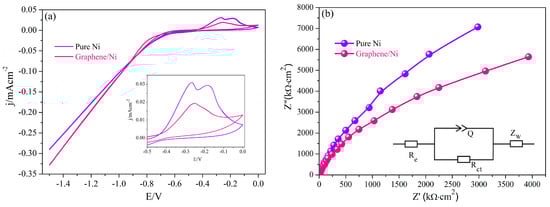
Figure 1.
The cyclic voltammogram (a) and Nyquist plots (b) of pure Ni and the graphene/Ni composite (the inset is the equivalent electrical circuit).
Nyquist plots for pure Ni and the graphene/Ni composite are similar in shape, with a singular semicircle, as shown in Figure 1b. Pure Ni exhibits a larger semi-circular radius than graphene/Ni composites. The semi-circular radius is negatively correlated with the conductivities of the electrodes [32]. That is to say, the addition of GO dispersion greatly improves the conductivity of the electrode. An equivalent circuit can be obtained, as shown in the Figure 1b inset. In the circuit, Re, Rct, Q, and Zw are the solution resistance, charge transfer resistance at the electrolyte interface, the double-layer capacitor, and Warburg resistance, respectively [33]. When GO dispersion is added into the plating baths, the values of Re and Rct significantly decrease. Re and Rct decrease from 76.5 Ω cm2 or 359 kΩ cm−2 to 60.2 Ω cm2 or 20.3 kΩ cm−2, as shown in Table 1. It can be revealed that the rapid transport of ions and electrons in the plating bath/electrodes enables a swift reduction of Ni ions, thereby accelerating the nucleation rate. This enhancement stems from the multifunctional role of GO: its oxygen-containing functional groups impart hydrophilicity and create nanoscopic channels that facilitate Ni2+ diffusion in the electrolyte, thereby alleviating the sluggish ion transport and insufficient active supply typical of conventional Ni plating [36,37]. Furthermore, during electrodeposition, GO is in situ reduced to highly conductive rGO, which substantially lowers the electron transfer resistance at the electrode/electrolyte interface and further optimizes the overall electrochemical performance of the composite plating system [38,39,40].

Table 1.
Fitting results of impedance spectra of as-synthesized graphene/Ni composites.
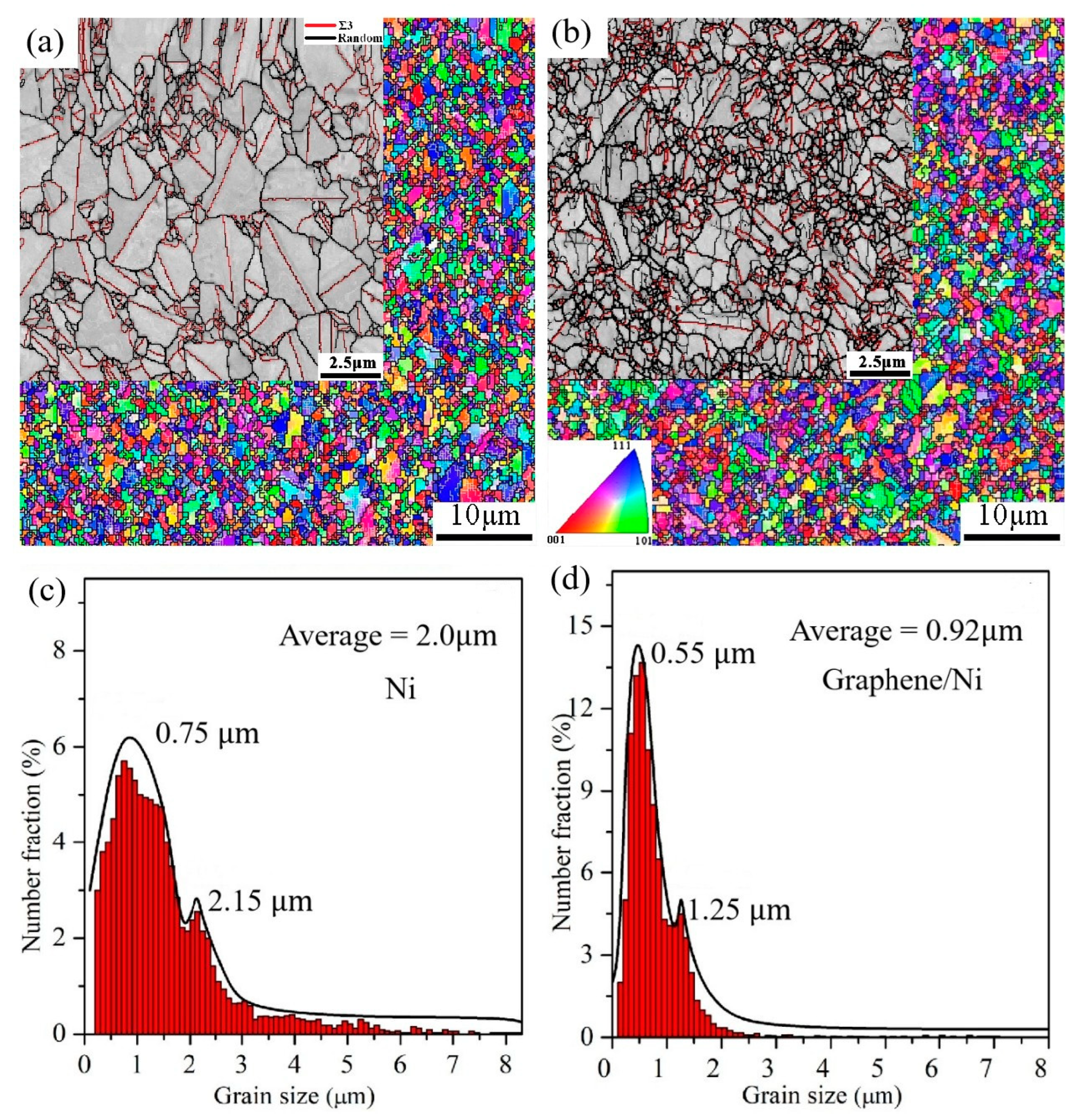
The effect of graphene on the microstructure of Ni was carried out through EBSD methods, and EBSD mapping of the Ni and graphene/Ni composite are shown in Figure 2a,b. It can be clearly seen that the Ni and graphene/Ni composite do not display remarkable preferred grain orientation. Considering the mechanical properties of the Ni and graphene/Ni composite, the texture is excluded. Carbon–sulfur analysis was employed to determine the carbon content of the Ni and graphene/Ni samples. Each sample was measured at several different locations, and each measurement was repeated three times to ensure reliability, with the average value being recorded. The mass fraction of carbon of the composite is 0.009 higher than Ni (wt% = 0.001), which implies that rGO has been added to the composite. A description of the grain size distribution of the Ni and graphene/Ni composite is illustrated in Figure 2c,d. The histograms of the grain size distribution have two distinct peaks quite similar to the hump. The histogram of grain size distribution exhibits a twin-peak pattern, resembling the shape of a camel’s back, which clearly indicates a bimodal distribution [38]. The average grain size of the Ni and graphene/Ni are 2.0 μm and 0.92 μm, respectively. In addition, a large number of growth coherent Σ3 twin boundary exist in pure Ni and the graphene/Ni composite, accounting for 4.08% and 7.92% of the total number, respectively.
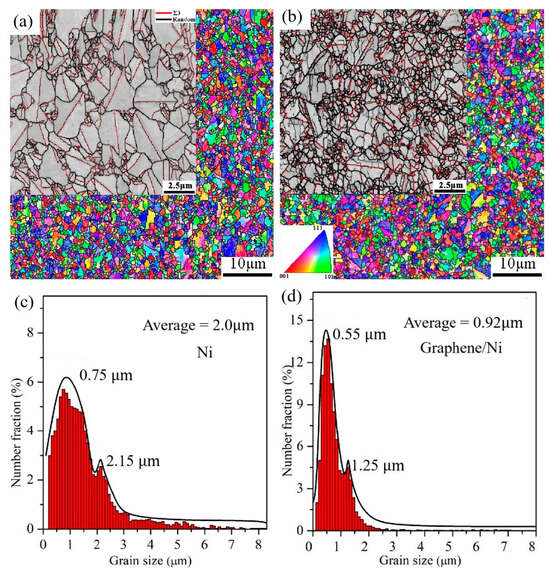
Figure 2.
(a,b) EBSD mapping of the pure Ni and graphene/Ni composite. (a) Ni; (b) graphene/Ni composite. (c,d) An adequate description of the grain size distribution on the Ni and graphene/Ni composite.
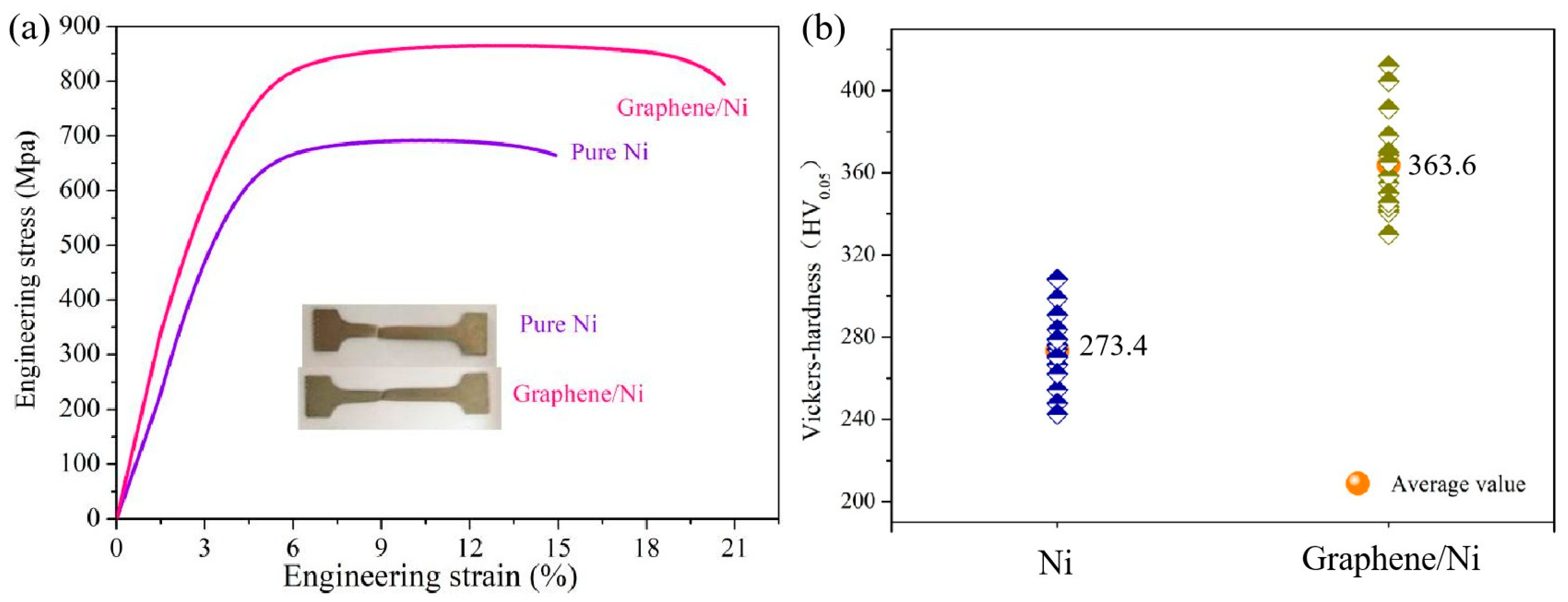
Figure 3 displays stress–strain curves of the Ni and graphene/Ni composite at room temperature. To ensure the authenticity and reliability of the data, each sample was tested three times, the standard deviation of the data was calculated, and the average values were taken, as displayed in Table S2. It can be observed that the ultimate tensile strength and elongation of the graphene/Ni composite is larger than Ni. The composite achieves an ultimate tensile strength of 800 MPa and a fracture elongation of 15.3%. These values represent an increase of 15% and 17% over pure Ni (697 MPa and 13.1%), respectively. Fifteen hardness values of Ni and graphene/Ni were tested, respectively. The average Vickers values of Ni and graphene/Ni are 273.4 and 363.6 HV, respectively. The distribution of hardness values in Ni (242.6 HV~308.2 HV) is relatively narrow. The range of hardness variation in graphene (330.0 HV~412.0 HV) is wide, as shown in Figure 3b. The grain-refining effect of graphene introduces microstructural heterogeneity into the composite. A gradient in grain size is established, transitioning from fine grains (and high hardness) adjacent to the graphene to coarser grains (and lower hardness) at greater distances [41]. This heterogeneity thereby causes considerable hardness fluctuations throughout the material. The mechanical properties are enhanced by grain refinement, the load transfer and dislocation-hindering role of graphene, and the formation of coherent twin boundaries. These twin boundaries, with their symmetrical, low-energy structure, provide strengthening as per the Hall–Petch relation while also refining the microstructure and sustaining high strain-hardening coefficients [42,43].
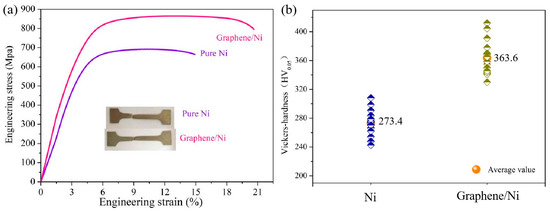
Figure 3.
(a) Stress–strain curves and (b) microhardness variation, as well as average microhardness of Ni and graphene/Ni composite.
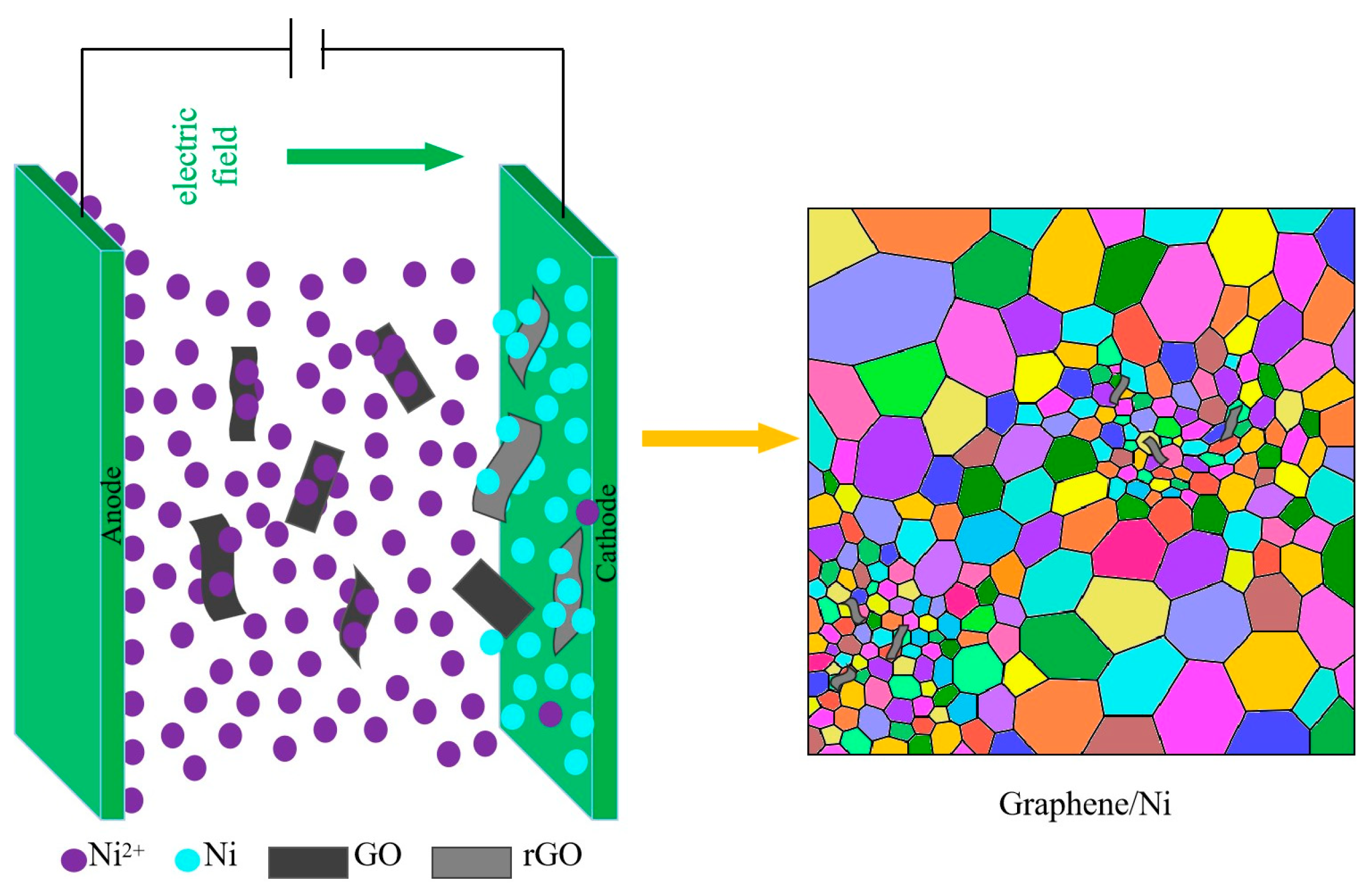
A schematic of the composite co-deposition mechanism was proposed, derived from electrochemical and microstructure analysis, as displayed in Figure 4. The configuration utilized Ni plates and stainless-steel sheets as the anode and cathode, respectively. Under an applied electric field, the electronegative oxygen-containing functional groups on GO, such as carboxyl (-COOH) and hydroxyl (-OH) groups, act as heterogeneous nucleation sites. These sites attract and concentrate positively charged Ni2+ ions through directional adsorption. The functional groups lower the nucleation energy barrier for Ni2+, thereby disrupting the random nucleation typically observed in Ni electrodeposition. Consequently, Ni atoms nucleate uniformly across the GO surface, leading to a significantly increased nucleation rate. Simultaneously, the layered structure of GO physically constrains grain growth, preventing the disordered enlargement of Ni grains and promoting the formation of a fine-grained microstructure. As electrodeposition proceeds, GO undergoes in situ electrochemical reduction at the cathode surface. The resulting rGO layers grow synchronously and become interwoven with the Ni grains. These rGO layers insert between the Ni grains, forming strong interfacial bonds with the Ni matrix and ultimately constructing a three-dimensional conductive network throughout the coating. This network not only addresses the limited electron transport pathways characteristic of Ni coatings but also further suppresses the coarsening of Ni grains. Additionally, the physical encapsulation by rGO fills micro-voids within the coating, reducing structural defects. Together, these mechanisms achieve simultaneous optimization of the coating′s microstructure and electrical conductivity.
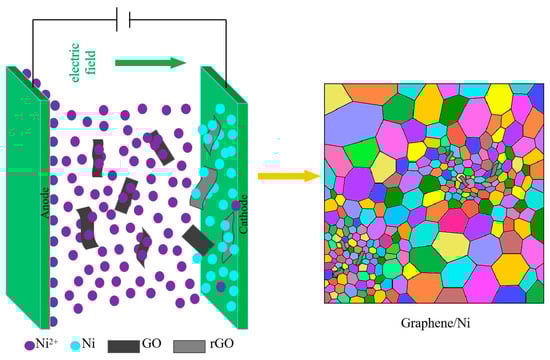
Figure 4.
The schematic illustration of the formation mechanism of graphene/Ni.
2.2. DFT Analysis
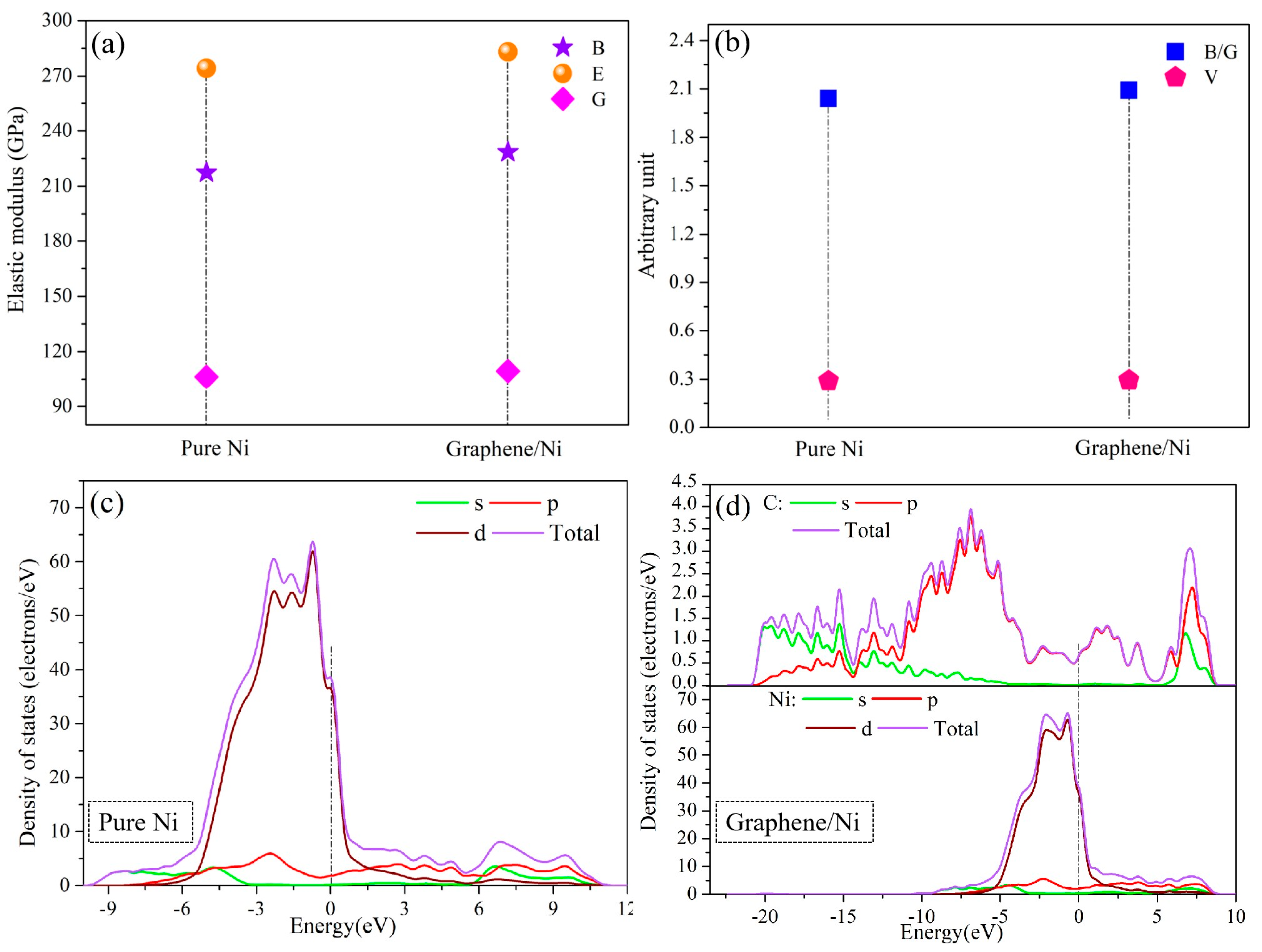
The mechanical properties, the density of states (DOS), and the partial density of states (PDOS) of pure Ni(111) and Ni(111)/graphene/Ni(111) were calculated via first-principles calculations, as shown in Figure 5. The elastic constant Cij of pure Ni(111) and Ni(111)/graphene/Ni(111) satisfies the Born–Huang criterion listed in Table 2 and Table 3, and their crystal structures are stable. In Figure 5a, the bulk modulus (B, 228.4 GPa), Young’s modulus (E, 283.1 GPa), and shear modulus (G, 109.4 GPa) of Ni(111)/graphene/Ni(111) are higher than that of B (217.3 GPa), E (274.2 GPa), and G (106.3 GPa) of pure Ni(111). Poisson’s ratio (ν) and Pugh’s criterion (B/G) are widely used to distinguish the ductility and brittleness of metals. Generally speaking, if ν < 0.26 or B/G < 1.75, a material behaves in a brittle manner; conversely, the material exhibits ductile behavior. Poisson’s ratio (ν, 0.294) and the B/G (2.09) of Ni(111)/graphene/Ni(111) are higher than the values of ν (0.290) and B/G (2.04) of pure Ni, which demonstrates that Ni(111)/graphene/Ni(111) has better plasticity than pure Ni(111). Electrical conductivity is analyzed through the density of states (DOS) in Figure 5c,d. According to the Boltzmann transport equation and Einstein relation, electrical conductivity is proportional to the density of states [44]. The numeric values of the total density of states for Ni atoms can qualitatively determine the strength of the reaction’s conductivity under the same calculation parameters. At the Fermi level (EF), the numeric values of the total density of states for Ni atoms in pure Ni(111) and Ni(111)/graphene/Ni(111) are 38.46 and 38.58 electrons per eV, respectively, as shown in Figure 5c,d. Hence, it can be concluded that the addition of graphene promotes the conductivity of the Ni matrix.
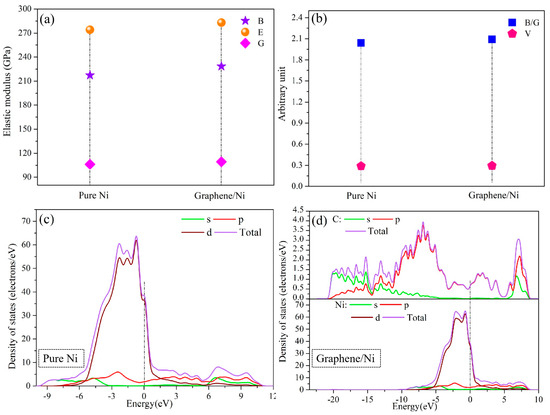
Figure 5.
(a) Bulk modulus (B), Young’s modulus (E), shear modulus (G), (b) Poisson’s ratio (ν), Pugh’s constant (B/G), and (c,d) the density of states (DOS) and partial density of states (PDOS) of pure Ni(111) and Ni(111)/graphene/Ni(111) composite.
Table 2.
Single-crystal elastic constants of pure Ni.
Table 3.
Single-crystal elastic constants of graphene/Ni composite.
3. Methods
3.1. Computational Method
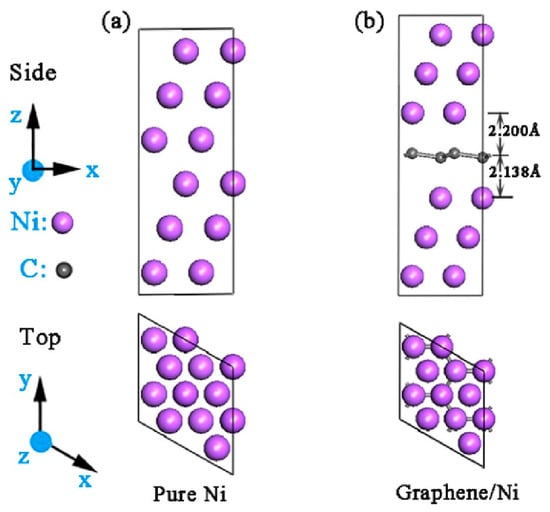
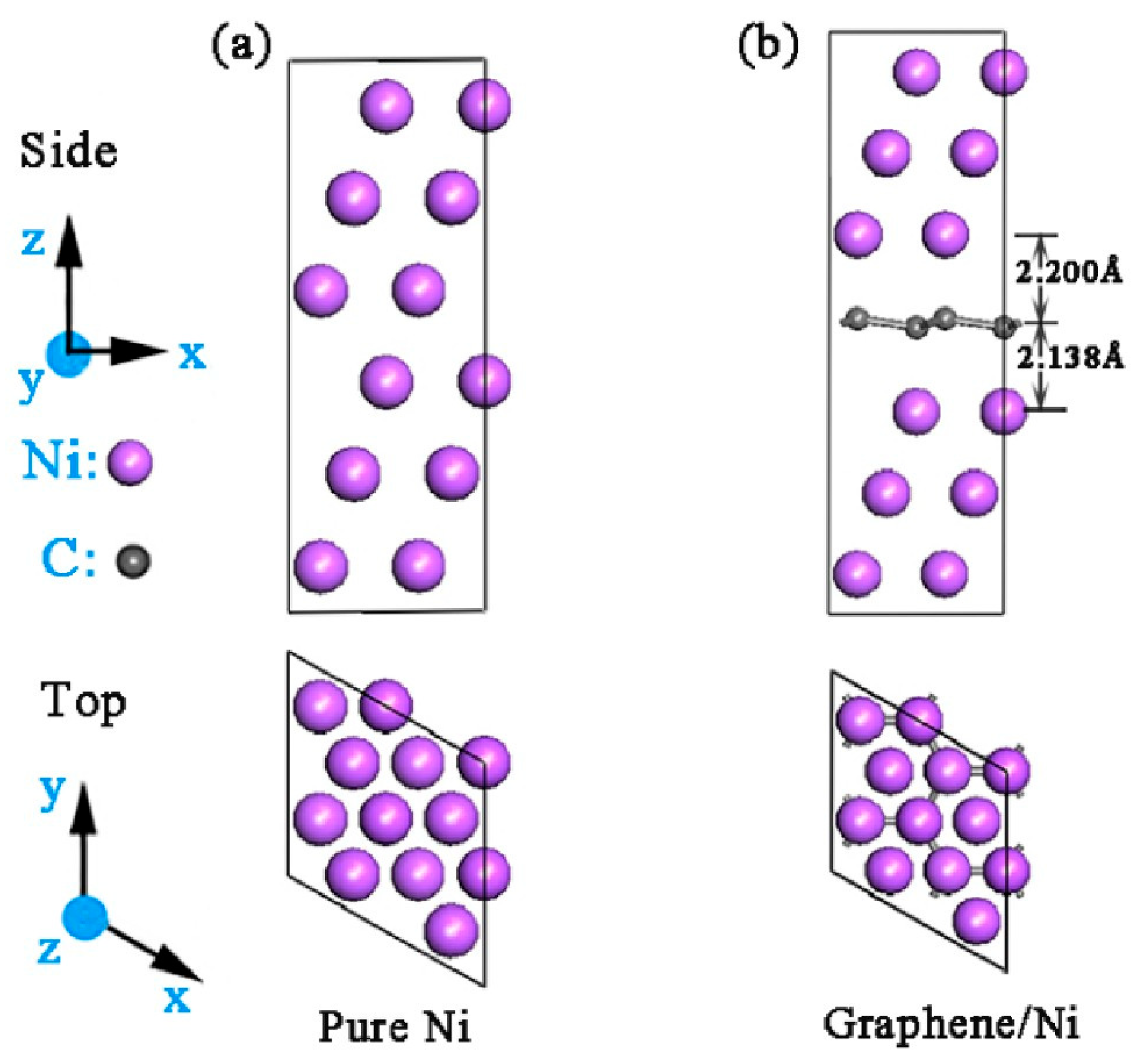
In the present study, all calculations were performed using the framework of the density functional theory (DFT), as implemented in Cambridge Serial Total Energy Package (CASTEP) 8.0 software. The exchange correlation function was described by the Perdew–Burke–Ernzerhof parameterization scheme of the generalized gradient approximation [45]. The DFT-D method was employed to account for long-range van der Waals interactions [46]. The convergence criteria for structural optimization were energy and force as well as a maximum displacement less than 10−5 eV, 0.03 eV/Å, and 0.001 Å, respectively. Pure Ni(111) and Ni(111)/graphene/Ni(111) models were built in Scheme 1. The computational models in this study were constructed using a 2 × 2 supercell. The pure Ni system was modeled with 24 atoms. For the graphene/nickel (graphene/Ni) composite, the model consisted of a monolayer graphene sheet on a six-atomic-layer Ni(111) slab, containing 24 Ni atoms and 8 carbon atoms from graphene. By examining the symmetry of the optimized model structure of pure Ni(111) and Ni(111)/graphene/Ni(111), it was found that pure Ni(111) and Ni(111)/graphene/Ni(111) are monoclinic and triclinic crystal systems, respectively. A 650 eV cutoff energy for a plane wave basis set was used in each case, and the k-point sampling employs a 5 × 5 × 1 mesh within the Monkhorst–Pack scheme. The elastic constants (Cij; i, j = 1, 2, 3, 4, 5 and 6) were calculated to understand the mechanical stability of pure Ni and the graphene/Ni composite [47,48]. The calculations employed a plane wave cut-off energy of 850 eV, with a Monkhorst–Pack k-point mesh grid of size 6 × 6 × 2. The bulk modulus (B) and shear modulus (G) of pure Ni(111) and Ni(111)/graphene/Ni(111) were calculated from the single-crystal elastic constants by the Voigt–Reuss average scheme, where the Young’s modulus (E) was estimated by Equation (1) [49].
E = 9GB/(G + 3B)
Scheme 1.
Side (a) and top (b) views of pure Ni(111) and Ni(111)/graphene/Ni(111) composite.
Pure Ni(111) and Ni(111)/graphene/Ni(111) belong to a monoclinic system and triclinic system. The mechanical stability of the monoclinic system and triclinic system are governed by the following Born’s conditions [50]:
Monoclinic system:
C11 > 0, C22 > 0, C33 > 0, C44 > 0, C55 > 0, C66 > 0, C11 + C22 +C33 + 2(C12 + C13 + C23) > 0, C11 + C22 − 2C12 > 0, C11 + C33 − 2C13 > 0, C22 + C33 − 2C23 > 0.
Triclinic system:
The binding energy Eb was calculated to examine the structural ability, as defined in Equation (4) [51]:
where Etotal represents the total energy of the models and N represents the total number of atoms. is the cohesive energy per i atom. If Eb less than zero, the optimized geometry is stable.
3.2. Experimental Section
The dense and bulk Ni and graphene/Ni composite were synthesized through direct current electrodeposition. Austenitic stainless-steel sheets (40 mm × 50 mm × 1 mm) and Ni sheets (purity quotient of 99.9%) were used as the cathode and anode. The stainless-steel sheet was ultrasonically cleaned to remove surface oils and contaminants, activated with dilute hydrochloric acid, and then positioned 40 mm from the anode plate. The GO aqueous solution was provided by the Institute of Coal Chemistry, Chinese Academy of Sciences, and deionized water was utilized to prepare the plating bath. Additionally, the GO aqueous solution was uniformly dispersed and appeared brown, as shown in Figure S1. The electroplating bath consisted of 208 g/L NiSO4·6H2O, 30 g/L NiCl2·6H2O, 30 g/L H3BO3, 0.016 g/L GO, and 0.08 g/L of sodium dodecyl benzene sulfonate. The temperature and pH of the bath were maintained at 55 °C and 4.0~4.2 through diluted hydrochloric acid. The experimental results demonstrated that the cathode has the highest current efficiency at 0.86 A/dm2, when current densities ranged from 0.14~1.44 A/dm2, as shown in Table 4. To ensure solution stability, the GO aqueous solution was first dispersed in deionized water via ultrasonication and then incorporated into the composite plating bath for further ultrasonic treatment. The bath was left to stand for three days, during which no precipitate formation was observed, confirming its stability. During electrodeposition experiments, magnetic stirring at 950 rpm was employed to maintain uniformity throughout the plating solution, and no significant particle aggregation was observed within the electrolyte or on the electrode surfaces.
Table 4.
At different current densities, the time required for depositing pure Ni with 280 μm thickness.
The microstructure of specimens was characterized using the EBSD (TSL OIM system on the Philips XL30 FEG SEM with step sizes of 250 nm, Beijing Zhongke Keyi Optoelectronics Technology Corp. Ltd., Beijing, China), and the test-related parameters are shown in Table S1. Electro-crystallization behaviors of the graphene/Ni composites were analyzed using a CS350H electrochemical workstation (Wuhan Corrtest Instruments Corp. Ltd., Wuhan, China). Electroplating baths preparing Ni and the graphene/Ni composite as the electrolyte, cathode, anode, and a saturated calomel electrode (SCE) were used as the electrolyte, the counter electrode, the working electrode, and the reference electrode to ensure consistency with experimental conditions. The cyclic voltammograms (CVs) were measured at a scan rate of 10 mV/s, and the electrochemical impedance spectra (EIS) were tested in the bias applied relative to the open-circuit potential with a frequency range from 10−2 Hz to 105 Hz. The tensile tests were performed on an Instron 5582 testing machine at a strain rate of 1.2 × 10⁻⁴ s−1 (Shandong Zhongyi Instrument Corp. Ltd., Jinan, Chian). Dog bone-shaped tensile specimens, with a gauge cross-section of 2.5 mm × 0.28 mm and a gauge length of 14.0 mm, were wire-cut from the as-deposited sheets and polished to a mirror-like finish. Three replicate tests were conducted to ensure statistical reliability.
4. Conclusions
This study presents a combined computational and experimental investigation into the electrodeposition mechanism and mechanical properties of graphene/Ni composites. First-principles calculations reveal that the composite exhibits superior electronic conductivity compared to pure Ni, as indicated by a higher density of states at the Fermi level. All key elastic constants—including the bulk, Young’s, and shear moduli—as well as the Poisson’s ratio, are found to be higher in the graphene/Ni composite than in pure Ni.
During the electrodeposition process, the incorporation of rGO accelerates the transport of ions and electrons and promotes the formation of Σ3(111) growth twins. These microstructural changes result in significant grain refinement, a unique bimodal structure, and a high density of twins. Specifically, the average grain size decreases from 2.0 μm in pure Ni to 0.92 μm in the composite. As a result of these structural modifications, the composite demonstrates markedly improved mechanical properties. It achieves an ultimate tensile strength of 800 MPa and a fracture elongation of 15.3%, representing increases of 14.8% and 16.8%, respectively, over pure Ni.
Supplementary Materials
The following supporting information can be downloaded at: https://www.mdpi.com/article/10.3390/condmat10040063/s1, Figure S1: The picture of GO aqueous solution; Table S1: EBSD test parameters of Ni and graphene/Ni; Table S2: The ultimate tensile strength, fracture elongation, average value and standard deviation of the Ni and graphene/Ni.
Author Contributions
B.Z.: writing—review and editing, writing—original draft, visualization, methodology, investigation, funding acquisition, formal analysis, data curation. J.Z.: investigation, data curation. Z.Y.: supervision. P.H.: software, resources. All authors have read and agreed to the published version of the manuscript.
Funding
This research was funded by [Postgraduate Education Reform and Quality Improvement Project of Henan Province] grant number [YJS2025GZZ17]; [Henan Agricultural University] grant number [30501149 and 30501692]; and [Henan Province Science and Technology Tackling Key Projects] grant number [252102110366].
Data Availability Statement
All relevant experimental data and models as well as simulation parameters were described in detailed in the main text and Supplementary Materials.
Acknowledgments
The authors thank the financial support from the Postgraduate Education Reform and Quality Improvement Project of Henan Province (YJS2025GZZ17); Henan Agricultural University (no. 30501149, 30501692); and Henan Province Science and Technology Tackling Key Projects (no. 252102110366).
Conflicts of Interest
The authors declare that they have no known competing financial interests or personal relationships that could have appeared to influence the work reported in this paper.
References
- Rohatgi, P.K.; Asthana, R.; Das, S. Solidification, structures, and properties of cast metal-ceramic particle composites. Int. Met. Rev. 1986, 31, 115–139. [Google Scholar] [CrossRef]
- Alem, S.A.A.; Sabzvand, M.H.; Govahi, P.; Poormehrabi, P.; Azar, M.H.; Siouki, S.S.; Rashidi, R.; Angizi, S.; Bagherifard, S. Advancing the next generation of high-performance metal matrix composites through metal particle reinforcement. Adv. Compos. Hybrid Mater. 2025, 8, 3. [Google Scholar] [CrossRef]
- Simões, S. Design and Development of Metal Matrix Composites. Metals 2025, 15, 848. [Google Scholar] [CrossRef]
- Ferguson, J.B.; Thao, X.; Rohatgi, P.K.; Cho, K.; Kim, C.S. Computational and analytical prediction of the elastic modulus and yield stress in particulate-reinforced metal matrix composites. Scr. Mater. 2014, 83, 45–48. [Google Scholar] [CrossRef]
- Lee, C.; Wei, X.; Kysar, J.W.; Hone, J. Measurement of the elastic properties and intrinsic strength of monolayer graphene. Science 2008, 321, 385–388. [Google Scholar] [CrossRef]
- Shokrieh, M.M.; Rafiee, R. Prediction of Young’s modulus of graphene sheets and carbon nanotubes using nanoscale continuum mechanics approach. Mater. Des. 2010, 31, 790–795. [Google Scholar] [CrossRef]
- Moghadam, A.D.; Omrani, E.; Menezes, P.L.; Rohatgi, P.K. Mechanical and tribological properties of self-lubricating metal matrix nanocomposites reinforced by carbon nanotubes (CNTs) and grapheme-a review. Compos. Part B 2015, 77, 402–420. [Google Scholar] [CrossRef]
- Mei, J.; Liao, T.; Ayoko, G.A.; Bell, J.; Sun, Z. Cobalt oxide-based nanoarchitectures for electrochemical energy applications. Prog. Mater. Sci. 2019, 103, 596–677. [Google Scholar] [CrossRef]
- Nieto, A.; Bisht, A.; Lahiri, D.; Zhang, C.; Agarwal, A. Graphene reinforced metal and ceramic matrix composites: A review. Int. Mater. Rev. 2016, 62, 241–302. [Google Scholar] [CrossRef]
- Banhart, F.; Charlier, J.C.; Ajayan, P.M. Dynamic Behavior of Nickel Atoms in Graphitic Networks. Phys. Rev. Lett. 2000, 84, 686–689. [Google Scholar] [CrossRef] [PubMed]
- Lajevardi, S.A.; Shahrabi, T. Effects of pulse electrodeposition parameters on the properties of Ni–TiO2 nanocomposites coatings. Appl. Sur. Sci. 2010, 256, 6775–6781. [Google Scholar] [CrossRef]
- Yang, H.; Guo, X.; Bribillis, N.; Wu, G.; Ding, W. Tailoring nickel coatings via electrodeposition from a eutectic-based ionic liquid doped with nicotinic acid. Appl. Sur. Sci. 2011, 257, 9094–9102. [Google Scholar] [CrossRef]
- Rudnik, E.; Burzynska, L.; Dolasinski, L.; Misiak, M. Electrodeposition of nickel/SiC composites in the presence of cetyltrimethylammonium bromide. Appl. Sur. Sci. 2012, 256, 7414–7420. [Google Scholar] [CrossRef]
- Luo, J.K.; Pritschow, A.; Flewitt, J.; Spearing, S.M.; Fleck, N.A.; Milne, W.I. Effects of process conditions on properties of electroplated Ni thin films for microsystem applications. J. Electrochem. Soc. 2006, 153, 155–161. [Google Scholar] [CrossRef]
- Shao, W.; Nabb, D.; Renevier, N.; Sherrington, I.; Fu, Y.Q.; Luo, J.K. Mechanical and anti-corrosion properties of TiO2 nanoparticle reinforced Ni coating by electrodeposition. J. Electrochem. Soc. 2012, 159, 671–676. [Google Scholar] [CrossRef]
- Yang, W.; Qu, Z.; Yang, J.; Zheng, M.; Zhai, S.; Zhu, S. Production of ZnAlFeO4 spinel through pyrometallurgical treatment of electroplating sludge: Growth and stabilization process of spinel. J. Environ. Chem. Eng. 2025, 13, 115637. [Google Scholar] [CrossRef]
- Ibáñez, A.; Escudero-Cid, R.; Ocón, P.; Fatás, E. Effect of the pulse plating parameters on the mechanical properties of nickel. Surf. Coat. Technol. 2012, 212, 94–100. [Google Scholar] [CrossRef]
- Shao, Y.; Wang, J.; Engelhard, M.; Wang, C.; Lin, Y. Facile and controllable electro-chemical reduction of graphene oxide and its applications. J. Mater. Chem. 2010, 20, 743–748. [Google Scholar] [CrossRef]
- An, S.J.; Zhu, Y.; Lee, S.H.; Stoller, M.D.; Emilsson, T.; Park, S.; Velamakanni, A.; An, J.; Ruoff, R.S. Thin film fabrication and simultaneous anodic reduction of deposited graphene oxide platelets by electrophoretic deposition. J. Phys. Chem. Lett. 2010, 1, 1259–1263. [Google Scholar] [CrossRef]
- Guo, H.L.; Wang, X.F.; Qian, Q.Y.; Wang, F.B.; Xia, X.H. A green approach to the synthesis of graphene nanosheets. ACS Nano 2009, 3, 2653–2659. [Google Scholar] [CrossRef]
- Zhou, M.; Wang, Y.; Zhai, Y.; Zhai, J.; Ren, W.; Wang, F.; Dong, S. Controlled synthesis of large-area and patterned electrochemically reduced graphene oxide films. Chem.-Eur. J. 2009, 15, 6116–6120. [Google Scholar] [CrossRef]
- Jagannadham, K. Electrical conductivity of copper-graphene composite films synthesized by electrochemical deposition with exfoliated graphene platelets. J. Vac. Sci. Technol. B 2012, 43, 316–324. [Google Scholar] [CrossRef]
- Kuang, D.; Xu, L.; Liu, L.; Hu, W.; Wu, Y. Graphene—Nickel composites. Appl. Surf. Sci. 2013, 273, 484–490. [Google Scholar] [CrossRef]
- Liu, X.; Pan, L.; Lv, T.; Zhu, G.; Lu, T.; Sun, Z.; Sun, C. Microwave-assisted synthesis of TiO2-reduced graphene oxide composites for the photocatalytic reduction of Cr(VI). RSC Adv. 2011, 1, 1245–1249. [Google Scholar] [CrossRef]
- Ramanathan, T.; Abdala, A.A.; Stankovich, S.; Dikin, D.A.; Herrera-Alonso, M.; Piner, R.D.; Adamson, D.H.; Schniepp, H.C.; Chen, X.; Ruoff, R.S.; et al. Functionalized graphene sheets for polymer nanocomposites. Nat. Nanotechnol. 2008, 3, 327–331. [Google Scholar] [CrossRef] [PubMed]
- Kumar, C.M.P.; Venkatesha, T.V.; Shabadi, R. Preparation and corrosion behavior of Ni and Ni–graphene composite coatings. Mater. Res. Bull. 2013, 48, 1477–1483. [Google Scholar] [CrossRef]
- Casati, R.; Vedani, M. Metal matrix composites reinforced by nano-particles—A review. Metals 2014, 4, 65–83. [Google Scholar] [CrossRef]
- Li, Y.; Wang, G.F.; Liu, S.Y.; Zhao, S.S.; Zhang, K.F. The preparation of Ni/GO composite foils and the enhancement effects of GO in mechanical properties. Compos. Part B Eng. 2018, 135, 43–48. [Google Scholar] [CrossRef]
- Pavithra, C.L.; Sarada, B.V.; Rajulapati, K.V.; Rao, T.N.; Sundararajan, G. A new electrochemical approach for the synthesis of copper-graphene nanocomposite foils with high hardness. Sci. Rep. 2014, 4, 4049. [Google Scholar] [CrossRef]
- Li, Y.; Wang, G.F.; Liu, Q.; Yang, M. Ni/GO nanocomposites and its plasticity. Manuf. Rev. 2015, 2, 8. [Google Scholar] [CrossRef][Green Version]
- Mishra, R.; Balasubramaniam, R. Effect of nanocrystalline grain size on the electrochemical and corrosion behavior of nickel. Corros. Sci. 2004, 46, 3019–3029. [Google Scholar] [CrossRef]
- Wang, Q.; Zhao, J.; Zhang, J.; Xue, X.; Li, M.; Sui, Z.; Zhang, X.; Zhang, W.; Lu, C. Dendrite-Free Zn/rGO@CC Composite Anodes Constructed by One-Step Co-Electrodeposition for Flexible and High-Performance Zn-Ion Batteries. Adv. Funct. Mater. 2023, 33, 2306346. [Google Scholar] [CrossRef]
- Liu, J.; Guo, P.; Cao, D.; Ma, Y.; Liu, D.; Liu, Q.; Fu, Y.; Liu, J.; He, D. Sheet-Like Stacking SnS2/rGO Heterostructures as Ultrastable Anodes for Lithium-Ion Batteries. ACS Appl. Mater. Interfaces 2022, 14, 11739–11749. [Google Scholar] [CrossRef] [PubMed]
- Sun, Z.; Liu, J.; Qi, H.; Huang, Z.; Wang, X. RGO-Induced Flower-like Ni-MOF In Situ Self-Assembled Electrodes for High-Performance Hybrid Supercapacitors. ACS Appl. Mater. Interfaces 2024, 16, 584–593. [Google Scholar] [CrossRef] [PubMed]
- Zhang, W.; Wu, Y.; Xu, Z.; Li, H.; Xu, M.; Li, J.; Dai, Y.; Zong, W.; Chen, R.; He, L.; et al. Rationally Designed Sodium Chromium Vanadium Phosphate Cathodes with Multi-Electron Reaction for Fast-Charging Sodium-Ion Batteries. Adv. Energy Mater. 2022, 12, 2201065. [Google Scholar] [CrossRef]
- Joshi, R.; Carbone, P.; Wang, F.; Kravets, V.; Su, Y.; Grigorieva, I.; Wu, H.; Geim, A.; Nair, R. Precise and Ultrafast Molecular Sieving Through Graphene Oxide Membranes. Science 2014, 343, 752–754. [Google Scholar] [CrossRef]
- Zhang, W.; Ma, X.; Niu, B.; Chen, M.; Zhang, H.; Zhang, Y.; Long, D. General synthesis of ultrafine metal oxide/reducedgraphene oxide nanocomposites for ultrahigh-flux nanofiltration membrane. Nat. Commun. 2022, 1, 471. [Google Scholar] [CrossRef]
- Wang, K.; Chen, J.; Hou, F.; Wang, H.; Zhang, Y.; Zhong, X.; Song, Y.; Zhang, Y.; Zhang, Z.; Liu, H.; et al. In situ growth-optimized synthesize of Al-MOF@RGO anode materials with long-life capacity-enhanced lithium-ion storage. Chem. Eng. J. 2023, 455, 140561. [Google Scholar] [CrossRef]
- Li, Y.; Feng, F.; Liu, S.; Liu, L.; Gao, X. Preparation of Nitrogen and Phosphorus Co-doped Graphene Oxide and Corrosion Resistance of Waterborne Composite Coatings NPGO/Epoxy Resin. Chin. J. Mater. Res. 2024, 38, 861–871. [Google Scholar]
- Samira, M.; Amir, M.; Seyed, M. High-Performance Ni(II)@Amine-Functionalized Graphene Oxide Composite as Supercapacitor Electrode: Theoretical and Experimental Study. ACS Appl. Energy Mater. 2024, 7, 6142–6154. [Google Scholar]
- Wang, Y.; Huang, K.; Derré, A.; Puech, P.; Rouzière, S.; Launois, P.; Castro, C.; Monthioux, M.; Pénicaud, A. Conductive graphene coatings synthesized from graphenide solutions. Carbon 2017, 121, 217–225. [Google Scholar] [CrossRef]
- Stoller, M.D.; Park, S.; Zhu, Y.W.; An, J.H.; Ruoff, R.S. Graphene-based ultracapacitors. Nano Lett. 2008, 10, 3498–3502. [Google Scholar] [CrossRef]
- Liu, Y.; Liu, Y.; Zhang, Q.; Zhang, C.; Wang, J.; Wu, Y.; Han, P.; Gao, Z.; Wang, L.; Wu, X. Control of the microstructure and mechanical properties of electrodeposited graphene/Ni composite. Mater. Sci. Eng. A 2018, 727, 133–139. [Google Scholar] [CrossRef]
- D’Souza, R.; Mukherjee, S. First-principles study of the electrical and lattice thermal transport in monolayer and bilayer graphene. Phys. Rev. B 2017, 95, 085435. [Google Scholar] [CrossRef]
- Perdew, J.P.; Burke, K.; Ernzerhof, M. Generalized gradient approximation made simple. Phys. Rev. Lett. 1996, 77, 3865. [Google Scholar] [CrossRef] [PubMed]
- Grimme, S. Semiempirical GGA-type density functional constructed with a long-range dispersion correction. J. Comput. Chem. 2006, 27, 1787. [Google Scholar] [CrossRef] [PubMed]
- Born, M. On the stability of crystal lattices. Math. Proc. Camb. Philos. Soc. 1940, 36, 160–172. [Google Scholar] [CrossRef]
- Wu, Z.J.; Zhao, E.J.; Xiang, H.P.; Hao, X.F.; Liu, X.J.; Meng, J. Crystal structures and elastic properties of superhard IrN2 and IrN3 from first principles. Phys. Rev. B 2007, 76, 054115. [Google Scholar] [CrossRef]
- Hill, R. The elastic behaviour of a crystalline aggregate. Proc. Phys. Soc. Sect. A 1952, 65, 349. [Google Scholar] [CrossRef]
- Ivanovskii, A.L. New superconductors based on (Ca, Sr, Ba) Fe2As2 ternary arsenides: Synthesis, properties, and simulation. J. Struct. Chem. 2009, 50, 539–551. [Google Scholar] [CrossRef]
- Zhang, B.; Du, L.; Yuan, Z.; Wang, D.; Han, P.; Zhang, Z. Theoretical insight on interface enhancement mechanism and electrocatalytic water splitting reactions using heteroatoms-mediated graphene/Cu composites. Mater. Today Commun. 2025, 48, 113306. [Google Scholar] [CrossRef]
Disclaimer/Publisher’s Note: The statements, opinions and data contained in all publications are solely those of the individual author(s) and contributor(s) and not of MDPI and/or the editor(s). MDPI and/or the editor(s) disclaim responsibility for any injury to people or property resulting from any ideas, methods, instructions or products referred to in the content. |
© 2025 by the authors. Licensee MDPI, Basel, Switzerland. This article is an open access article distributed under the terms and conditions of the Creative Commons Attribution (CC BY) license (https://creativecommons.org/licenses/by/4.0/).