
Review

Adaptation Mechanisms of Aquatic Animals to Saline–Alkaline Water Aquaculture: Physiological, Energetic and Molecular Perspectives


1
National Key Laboratory of Mariculture Biobreeding and Sustainable Goods, Yellow Sea Fisheries Research Institute, Chinese Academy of Fishery Sciences, Qingdao 266000, China
2
Weihai Municipal Bureau of Marine Development, Marine and Fishery Supervision and Inspection Detachment, Weihai 264200, China
3
College of Fisheries and Life Science, Shanghai Ocean University, Shanghai 201306, China
*
Author to whom correspondence should be addressed.
Fishes 2026, 11(4), 202; https://doi.org/10.3390/fishes11040202

Submission received: 14 February 2026 / Revised: 20 March 2026 / Accepted: 23 March 2026 / Published: 27 March 2026
(This article belongs to the Special Issue Influences of Environmental Change on Fishes and Fisheries)

Abstract

Saline–alkaline water constitutes a vital strategic non-traditional fishery resource in China, characterized by high pH values, elevated carbonate alkalinity, and complex ionic compositions. These extreme environmental conditions impose significant stress on aquatic animals, mainly by inducing ionic toxicity and disrupting acid–base regulatory mechanisms. Such disruptions subsequently lead to osmotic imbalance, metabolic dysregulation, and immunosuppression, thus restricting the survival and growth of aquatic species in aquaculture systems. Consequently, the sustainable development of the saline–alkaline aquaculture is imperative for enhancing production efficiency and promoting the utilization of marginal land and water resources. This review comprehensively summarizes the current status of saline–alkaline aquaculture and highlights the stress-inducing impacts of salinity, alkalinity, and specific ionic ratios on teleost fishes and crustaceans. It further explores key adaptive mechanisms, including osmoregulatory and ionoregulatory strategies, bioenergetic trade-offs related to oxygen consumption and ammonia excretion, coordinated antioxidant and innate immune responses, as well as recent findings from multi-omics research. This review aims to offer a scientific foundation for the selection and breeding of saline–alkaline-tolerant strains, the precise regulation of aquaculture water environments, and the development of ecological aquaculture models in saline–alkaline regions, thereby facilitating the sustainable utilization of saline–alkaline land and water resources.
Key Contribution: This review elucidates the critical environmental challenges faced by aquatic species in saline–alkaline aquaculture and identifies adaptive mechanisms that enhance their resilience, thereby providing a scientific basis for the selection of tolerant strains and the optimization of aquaculture practices. Furthermore, it underscores the necessity of sustainable development in saline–alkaline regions to maximize the productivity of non-traditional fishery resources while promoting ecological balance.

1. Overview of Saline–Alkaline Water

Inland saline–alkaline water, a non-traditional water resource of substantial strategic significance, generally denotes non-marine water bodies situated in inland areas with mineralization levels typically surpassing 1 g·L−1. These water bodies predominantly exist in saline–alkaline lakes, low-lying seepage areas, and underground brines [1,2], and are also commonly referred to as inland saline water (ISW) under the same definition. On a global scale, such water bodies are extensively distributed in arid and semi-arid regions, including deserts, grasslands, and plateaus. China is endowed with abundant inland saline–alkaline water resources, covering a total area of approximately 46 million hectares, which accounts for 55% of the total lake area in the country and is distributed across 19 provinces, municipalities, and autonomous regions [3]. Influenced by the combined effects of geographical location and formation mechanisms (e.g., evaporative concentration and geological leaching), the physicochemical properties of these water bodies demonstrate high habitat heterogeneity.
From a hydrochemical standpoint, the attributes of saline–alkaline water are defined by the dual indicators of “salinity” and “alkalinity”. Salinity represents the total mineralization of major cations (Na+, Mg2+, Ca2+, K+) and anions (Cl, SO42−, HCO3, CO32−), while alkalinity reflects the buffering capacity of the carbonate system [4]. Based on the stoichiometric relationships of major ions, saline–alkaline waters are generally classified into three major categories, namely chloride type, carbonate type, and sulfate type, which are further subdivided into subtypes I–IV according to specific ionic ratios [5]. In China, coastal regions are predominantly characterized by chloride-type waters, whereas inland regions are primarily typified by carbonate-and sulfate-type waters [6].
In comparison to natural freshwater and seawater, saline–alkaline water exhibits distinct habitat stress characteristics. In contrast to freshwater, the high osmotic pressure environment and specific ion accumulation in saline–alkaline water exert significant “physiological drought” and ion toxicity stress on aquatic organisms, severely restricting nutrient uptake and metabolic functions. Secondly, compared to seawater with a relatively stable ionic composition, inland saline–alkaline water not only displays high salinity fluctuations but often features higher carbonate/bicarbonate ratios and high pH [7]. Research by Szabó et al. [8] verified that this unique ionic composition ratio is a core factor driving changes in the structure of the aquatic microbial community, with ecological effects being potentially as significant as salinity itself. Owing to the complex water chemistry, most saline–alkaline waters are unsuitable for direct consumption or agricultural irrigation and have long remained under-exploited [6]. Under natural conditions, only a few euryhaline species such as the naked carp (Gymnocypris przewalskii) and the Amur ide (Leuciscus waleckii) can survive [9,10].

2. Current Status of Saline–Alkaline Water Aquaculture

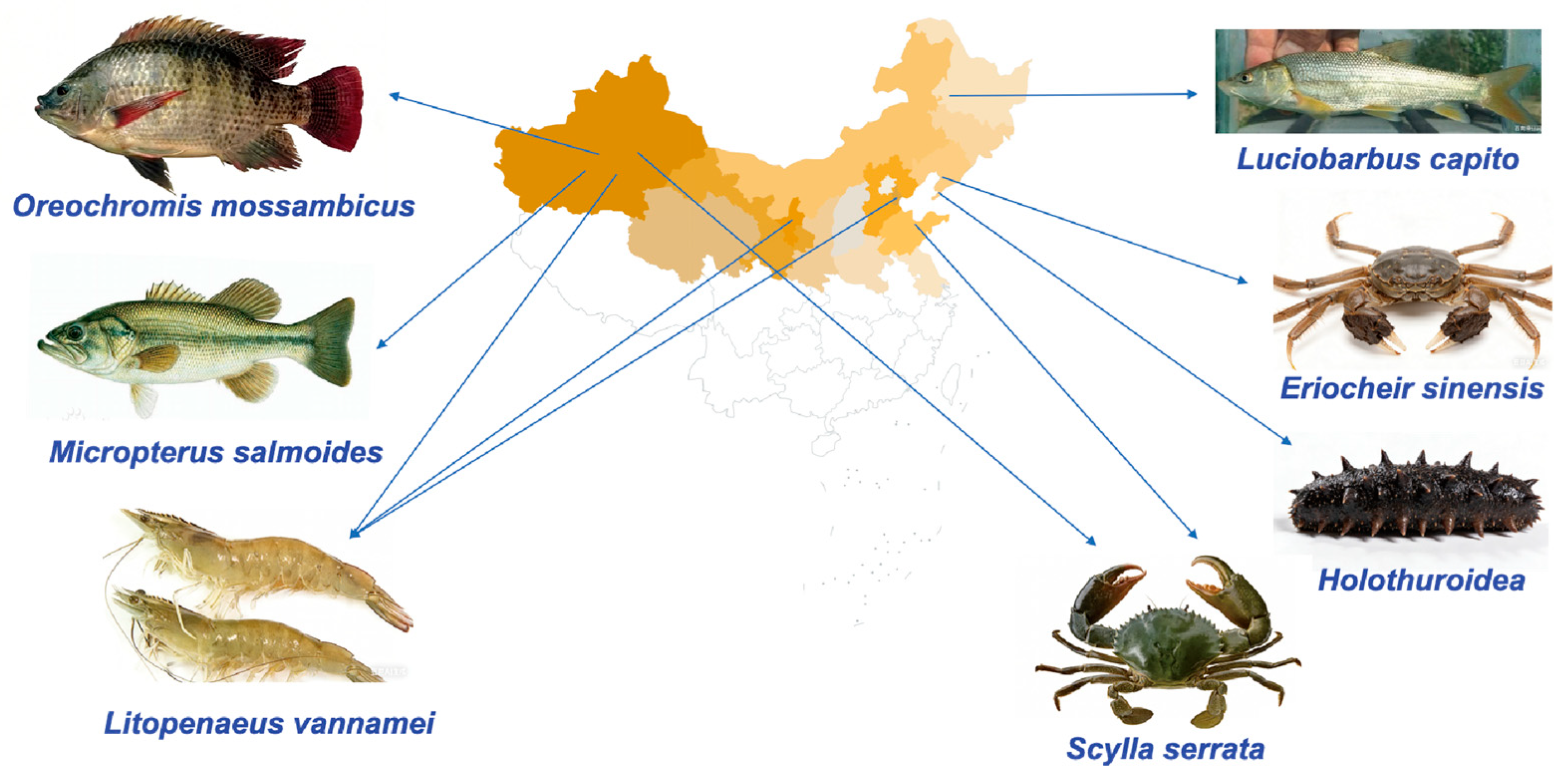
Despite the limitations imposed on conventional agriculture by the complex physicochemical environments of saline–alkaline waters, their substantial resource abundance and unique ecological potential offer extensive opportunities for aquaculture. Currently, saline–alkaline aquaculture has gained significant global momentum as an innovative model to address freshwater scarcity and alleviate pressure on land resources. Geographically, this practice is primarily concentrated in two types of regions: arid and semi-arid areas possessing vast expanses of saline–alkaline land, and regions rich in underground brackish water resources. In China, northwestern provinces serve as key regions for this practice. By utilizing abundant saline–alkaline water resources to develop aquaculture on saline–alkaline wastelands, these regions have achieved a “win–win” outcome of ecological amelioration and economic benefits—a strategy often described as “controlling alkalinity through fisheries” [11]. Figure 1 provides an overview of saline–alkaline aquaculture regions and major cultured species in China.
In South Asia, shrimp farming based on underground brackish water is widely practiced in Indian states such as Haryana, Punjab, and Rajasthan, where it has gradually become a vital pillar of the local rural economy [12]. Similarly, the Punjab and Sindh provinces of Pakistan, parts of Egypt, and regions of the North American Great Plains have emerged as potential or active areas for saline–alkaline aquaculture due to comparable land and water resource conditions [13]. In these regions, where traditional agriculture is constrained by high soil salinity or freshwater deficits, utilizing inland saline–alkaline water for aquaculture offers novel possibilities for the development and utilization of these marginal lands.
In the selection of candidate species for aquaculture, euryhalinity and economic value are the primary considerations. Currently, the Pacific white shrimp (Litopenaeus vannamei) stands out as the most critical and economically valuable species. Owing to its superior osmoregulatory capacity and growth advantages, it has become the predominant species in inland saline–alkaline aquaculture worldwide [14,15]. In addition to crustaceans, various fish species have also demonstrated significant aquaculture potential. The Genetically Improved Farmed Tilapia (GIFT Oreochromis niloticus) has been widely promoted due to its robust environmental adaptability. Furthermore, research indicates that dietary supplementation with additives such as bile acids can further optimize the lipid utilization efficiency and growth performance of this species in saline–alkaline waters [16]. Several carnivorous and omnivorous fish species have also been successfully cultured in these environments, including the red drum (Sciaenops ocellatus) [17], channel catfish (Ictalurus punctatus) [18], and Indian major carps such as rohu (Labeo rohita) [19].
Table 1 summarizes the major global distribution regions, common cultured species, and culture models associated with inland saline–alkaline aquaculture.
The feasibility of aquaculture in saline–alkaline water is fundamentally determined by its distinctive physicochemical properties. Different from natural seawater and freshwater, the habitat characteristics of these waters are mainly defined by variations in salinity, pH, alkalinity, and specific ionic concentrations [105]. These environmental factors directly impact the physiological functions of aquatic animals, including osmoregulation, oxygen consumption and metabolism, digestive and absorptive capabilities, and immune defense mechanisms [106,107]. Although studies in the past few decades have offered preliminary understandings of the molecular mechanisms underlying species adaptation to saline–alkaline environments, a systematic assessment of the overall adaptability of cultured animals is still lacking. In particular, there is a significant dearth of comprehensive summaries regarding specific physiological response processes.
Consequently, this review endeavors to clarify the influence of core environmental factors, namely salinity, pH, ionic concentrations, and ionic ratios, on the growth and physiological state of cultured animals. It commences with an analysis of the crucial chemical differences between saline–alkaline water and seawater. Through the systematic synthesis of extant research findings to interpret the adaptive patterns of aquatic animals to saline–alkaline habitats, this paper aims to offer a scientific reference for the healthy and sustainable development of the inland saline–alkaline aquaculture industry.

3. Impacts of the Saline–Alkaline Environment on Cultured Organisms

3.1. Effects of Salinity on Cultured Aquatic Animals

Salinity represents a crucial abiotic environmental factor within aquatic ecosystems and serves as one of the pivotal determinants regulating the physiological functions of aquatic organisms [108,109]. In natural settings, fluctuations in salinity that surpass a species’ potential tolerance threshold not only present direct perils to survival but may also lead to the decline in aquatic biodiversity [110,111]. In aquaculture systems, salinity stress exerts a significant influence on the physiological processes of cultured species, encompassing growth performance, survival rates, metabolism, and nutrient absorption [112,113,114,115]. Moreover, sub-optimal salinity environments can inhibit non-specific immune functions, consequently enhancing the susceptibility to pathogens and restricting the sustainable productivity of the aquaculture industry [116].
Salinity tolerance demonstrates substantial inter-specific variation. For most commercial freshwater species, mortality rates usually increase steeply when the ambient salinity surpasses 10 ppt [117,118]. Conversely, estuarine or coastal euryhaline commercial fish, like Takifugu flavidus, generally display an optimal growth salinity range of 10–20 ppt [119]. This strong adaptability to low-to-moderate salinity environments makes these species suitable candidates for aquaculture development in inland saline waters. Globally, successful applications of saline–alkaline water resources in aquaculture have been established for a long time in countries such as Thailand [120], the United States [121], Brazil [122], Ecuador [123], and Australia [124]. The research results on the salinity adaptability of several commercial species in saline–alkaline waters are summarized in Table 2.
Studies in fish indicate that salinity exerts a dual effect on flesh quality and physiological health. On the one hand, moderate salinity can improve filet quality. Evidence shows that red drum (Sciaenops ocellatus) and other euryhaline fishes cultured in inland low-salinity saline–alkaline waters exhibit significantly higher contents of umami- and sweet-tasting amino acids in muscle, resulting in superior flavor compared with conspecifics reared in seawater [139,140]. However, inappropriate salinity stress often causes more harm than benefit. Under high-salinity conditions, fish may face pronounced pathological challenges. For example, turbot (Scophthalmus maximus) exposed to salinities exceeding its tolerance can develop histopathological lesions such as glomerular atrophy and renal tubular dilation [141]. In addition, some species show splenic congestion or enlargement, hepatocellular degeneration, and thickening of the intestinal mucosa under salinity stress [141,142,143]. Moreover, Sai-Ut et al. [144] reported that the combined effects of high-salt diets and high-salinity water can decrease muscle protein content and increase lipid peroxidation (TBARS), thereby promoting excessive salt accumulation in muscle and ultimately compromising nutritional value.
Notably, fish are more sensitive to salinity during early life stages. The hatching rate of tilapia embryos decreases markedly at 15–20, indicating that salinity tolerance in adults does not necessarily reflect developmental-stage adaptability [145]. In practical farming, salinity frequently interacts with other environmental factors. For instance, when salinity stress is combined with ammonia–nitrogen exposure, the antioxidant status and immune function of tilapia are more severely suppressed [146]. Therefore, in low-salinity saline–alkaline aquaculture, in addition to prioritizing low-salinity-tolerant species such as common carp (Cyprinus carpio) [136], nutritional modulation is also required to alleviate oxidative stress and enhance immune responses [147].
For crustaceans, salinity responses are mainly manifested in immune defense and the integrity of organ structure. In typical euryhaline species such as the Pacific white shrimp (Litopenaeus vannamei) and black tiger shrimp (Penaeus monodon), although survival salinity ranges are broad, total hemocyte count (THC) still declines significantly over time under low-salinity conditions (e.g., <10 or even 1), accompanied by elevated glucose and protein levels, suggesting an immunosuppressed and stress-associated state [148,149]. In addition, low-salinity stress can cause edema of gill filaments with separation of the cuticle from the epithelium; such gill lesions markedly impair osmoregulatory capacity [150,151]. By contrast, the giant river prawn (Macrobrachium rosenbergii) exhibits better adaptation to freshwater and low-salinity environments [152,153].
Under high-salinity or combined-stressor conditions, crustacean growth is also constrained. It has been reported that high salinity and high stocking density show a significant negative synergistic effect; in a stress trial on Pacific white shrimp (Litopenaeus vannamei), growth performance was poorest under 44 g/L salinity and a density of 600 individuals m−3 [154]. The interaction between salinity and alkalinity should also be considered. For example, under combined salinity–alkalinity stress, the Chinese mitten crab (Eriocheir sinensis) exhibits evident pathological alterations in the gills, hepatopancreas, and intestine, potentially involving apoptosis mediated via the ROS/MAPK signaling pathway [155]. To mitigate such stress, dietary supplementation with feed additives such as Chlorella vulgaris and non-lethal heat shock (NLHS) preconditioning have been demonstrated to be effective interventions, and both strategies can significantly enhance cross-tolerance to environmental fluctuations in crustaceans [156,157,158].
Notably, aquaculture in saline–alkaline waters is challenged not only by total salinity but also by pronounced ionic imbalances, particularly potassium (K+) deficiency, which impose additional physiological burdens on cultured organisms. As a result, aquatic animals must rely on complex regulatory mechanisms involving ion transport, osmoregulation, and energy reallocation to maintain internal homeostasis.

3.2. Effects of Water pH on Cultured Animals

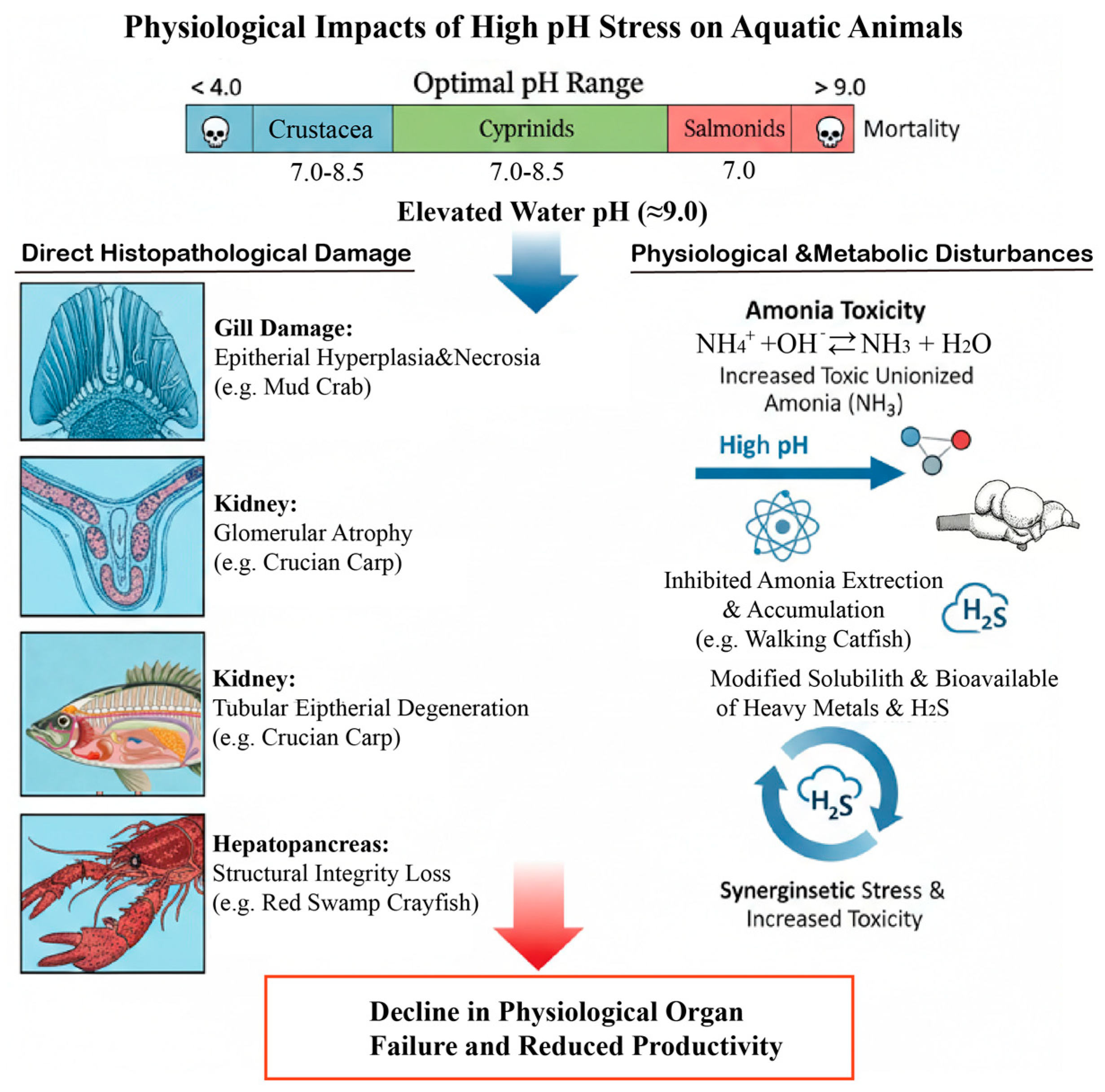
As a core indicator of the aquatic chemical environment, pH functions as a crucial ecological factor that determines the success of aquaculture activities. Generally, the optimal pH range for the growth of crustaceans is 7.0–8.5 [159]; cyprinids also flourish within a similar range (7.0–8.5), while salmonids typically favor near-neutral environments (pH ≈ 7.0). Deviations from these safe thresholds (e.g., pH > 9.0 or <4.0) can directly lead to the mortality of cultured organisms [160].
The dynamic equilibrium of water pH is mainly regulated by the carbon dioxide–carbonate system. In conventional aquatic environments, pH variations are predominantly driven by fluctuations in free CO2 resulting from biological respiration, organic matter oxidation, and photosynthesis [161]. However, in saline–alkaline waters, which cover approximately 46 million hectares in China, high carbonate alkalinity serves as the dominant factor maintaining consistently elevated pH levels. This unique habitat characteristic makes high-pH stress the primary environmental bottleneck restricting the spatial expansion and productivity improvement in saline–alkaline aquaculture.
The influence of high-pH environments on aquatic animals is initially presented as direct histopathological impairment. Since organs like the gills and skin are directly exposed to the water, high pH can induce epithelial cell swelling, fusion, hyperplasia, and even necrosis and exfoliation [162,163]. A research on the mud crab (Scylla paramamosain) indicated severe morphological destruction of gill filaments in high-pH saline–alkaline water, which directly undermined respiratory and ion-exchange functions [68]. Similarly, other investigations have reported renal tubular epithelial degeneration in crucian carp (Carassius auratus) and loss of hepatopancreatic structural integrity in red swamp crayfish (Procambarus clarkii) [164,165]. Such structural damage to physical barriers and metabolic organs forms the morphological foundation for the decline in physiological function.
Beyond direct physical harm, elevated pH modifies water chemical equilibria, thereby instigating more profound physiological and metabolic disruptions. Notably, pH plays a crucial role in regulating the speciation of ammonia nitrogen: high pH promotes the transformation of ionized ammonium (NH4+) into the more toxic unionized ammonia (NH3). Considering that NH3 is highly lipophilic and can freely penetrate biological membranes, high-pH environments not only aggravate exogenous ammonia toxicity but also impede the excretion of endogenous ammonia wastes [46]. Studies have verified that in walking catfish (Clarias batrachus) exposed to pH 10, ammonia excretion is hindered, resulting in a large-scale accumulation of ammonia in plasma and brain tissue, which subsequently triggers severe metabolic dysfunction [164]. Moreover, high pH alters the solubility and bioavailability of heavy metals and hydrogen sulfide [166]; the synergistic effects between these environmental factors and toxic substances further enhance the intensity of combined stress.
The physiological impacts of pH on aquatic animals are depicted in Figure 2.

3.3. Effects of Water Hardness on Cultured Animals

Water hardness, predominantly determined by the concentrations of calcium (Ca2+) and magnesium (Mg2+) ions, represents another crucial hydrochemical factor in maintaining physiological homeostasis in aquatic animals, along with salinity and pH [167]. Appropriate concentrations of Ca2+ and Mg2+ are indispensable for osmoregulation, skeletal development, and neuromuscular transmission. Nevertheless, saline–alkaline waters are characterized by intricate hydrochemistry, typically presenting as high salinity, high carbonate alkalinity, and high pH [168]. In such distinctive habitats, abnormal fluctuations in hardness, whether extreme deficiency or excessive load, disrupt physiological equilibrium, resulting in growth retardation or mortality [169].
For commercial fish species, the impacts of water hardness on growth performance, metabolic rate, and stress resistance display complex dose-dependent and species-specific patterns. Research suggests that most fish have an optimal hardness range within which growth and feed utilization efficiency are maximized. For example, water hardness significantly regulates the physiological state of juvenile largemouth bass (Micropterus salmoides). Varying hardness levels (100–600 mg/L CaCO3) not only directly modify growth rates but also notably influence oxygen consumption, ammonia excretion rates, and the activities of ion-regulatory enzymes [170]. This implies that optimizing hardness within an appropriate range can improve the energy budget of fish, enabling more energy to be allocated to growth rather than basal metabolic maintenance. Moreover, in saline–alkaline environments, higher water hardness often exerts a “protective effect,” enhancing tolerance to other environmental stressors. Sinha et al. [171] demonstrated that juvenile channel catfish (Ictalurus punctatus) acclimated to high-hardness environments exhibited significantly enhanced resilience to subsequent high ammonia exposure and salinity shock. This increased tolerance may be ascribed to the stabilizing effect of hardness on gill epithelial membranes. However, this protection has physiological limitations. Once hardness exceeds the tolerance threshold, it transforms from a protective factor to a lethal agent. For instance, a 96 h LC50 was recorded for channel catfish (Ictalurus punctatus) at extremely high hardness (~4939 mg/L CaCO3), indicating direct acute toxicity [172].
Compared to fish, crustaceans exhibit higher sensitivity to hardness variations in saline–alkaline waters, and these impacts extend beyond survival to physiological growth and final product quality. As key organs for osmoregulation and excretion, crustacean gills are directly exposed to the water and are highly susceptible to combined damage from high hardness and alkalinity [173]. Studies on Pacific white shrimp (Litopenaeus vannamei) and ridgetail white prawn (Exopalaemon carinicauda) reveal that suboptimal hardness alters gill filament histology, thereby affecting ion transport enzyme activity and respiratory function, ultimately impairing adaptation to saline–alkaline conditions [174,175]. Crucially, chronic exposure to inland waters characterized by intersecting high hardness and carbonate alkalinity significantly suppresses reproductive development and muscle quality. For example, in the Chinese mitten crab (Eriocheir sinensis), combined stress from high hardness and alkalinity not only induced apoptosis mediated by metabolic disorders of ammonia but also significantly reduced the gonadosomatic index (GSI), meat yield, and total edible yield [176]. This implies that hardness management is vital for securing the economic traits of high-value crustaceans in saline–alkaline aquaculture.
Therefore, when evaluating the potential of saline–alkaline aquaculture, water hardness should not be viewed as an isolated parameter; it interacts closely with salinity, carbonate alkalinity, and nutrient levels [177]. High-hardness environments may alleviate the toxicity of certain ions through competitive antagonism mechanisms, yet they may also form synergistic stressors with high alkalinity, exacerbating the energetic burden on cultured animals. Such complex environmental interactions necessitate precise, species-specific water quality management strategies.

3.4. Effects of the Four Major Cations (Na+, K+, Ca2+, and Mg2+) and Their Ratios on Cultured Animals

Major waterborne ions, including sodium (Na+), potassium (K+), calcium (Ca2+), and magnesium (Mg2+), play critical roles in physiological and metabolic processes such as osmoregulation and energy transformation, serving as essential nutrients for aquatic organisms. However, the ionic concentrations and ratios of inland saline–alkaline waters differ significantly from those of seawater. Consequently, ionic deficiencies or imbalances are detrimental to the growth and survival of cultured aquatic animals.

3.4.1. Na+ and K+

Sodium (Na+) and potassium (K+) constitute the fundamental physicochemical basis for maintaining cellular osmolarity, acid–base balance, and neuromuscular excitability; moreover, they are critical elements for energy metabolism and osmoregulation in aquatic animals coping with environmental salinity fluctuations [178,179]. Physiologically, ion transport relies heavily on the activity of membrane-bound Na+/K+-ATPase (NKA), which maintains intracellular homeostasis and membrane potential equilibrium through ATP hydrolysis [180]. However, NKA activity is highly sensitive to environmental ionic composition. In contrast to natural seawater, which maintains a relatively stable Na+/K+ ratio, inland saline–alkaline waters are frequently characterized by K+ deficiency and abnormally elevated Na+/K+ ratios. Research indicates that when environmental Na+/K+ ratios deviate significantly from the normal range found in seawater, NKA activity in the gill tissues of aquatic animals is markedly inhibited [181,182], thereby impairing their osmoregulatory capacity.
This ionic imbalance inflicts multidimensional physiological and pathological impairments on cultured animals. Histomorphologically, environments characterized by K+ deficiency or elevated Na+/K+ ratios predispose animals to gill pathologies; typical symptoms include cellular apoptosis, gill filament edema, and atrophy [183], which directly compromise respiratory and excretory functions. At the biochemical and metabolic levels, ionic stress triggers oxidative stress responses and metabolic disturbances. For instance, crucian carp (Carassius auratus) exhibits significant hepatic oxidative damage under saline–alkaline stress [184], whereas black tiger shrimp (P. monodon) exposed to potassium-deficient environments display failure in serum ion regulation and shifts in the isosmotic point [185]. Furthermore, the deficiency of specific ions extends its impact to reproductive performance; in salmonids, sperm motility is severely inhibited or even totally inactivated in purely potassium-deficient environments [186,187,188,189].
In response to these challenges, numerous empirical studies have confirmed that optimizing the aquatic Na+/K+ ratio significantly improves the survival and growth performance of cultured organisms. A study on the razor clam (Sinonovacula constricta) demonstrated that larvae maintained at a Na+/K+ ratio of 31.9–47.3 exhibited significantly superior growth rates compared to those in high-ratio groups [178]. Similarly, in Pacific white shrimp (Litopenaeus vannamei) cultured in low-salinity or saline–alkaline water, K+ supplementation—such as increasing concentrations to 110–221 mg/L or adding 10–40 mg/L K+ to low-salinity water—effectively alleviated ionic stress, restored growth performance, and reduced mortality [190,191]. Likewise, studies on blue mussels (Mytilus edulis) and cobia (Rachycentron canadum) have identified K+ fortification as a requisite measure for ensuring larval development and survival [133,192]. Given the ubiquitous K+ deficiency in saline–alkaline waters, correcting the Na+/K+ ratio through aqueous potassium addition or dietary supplementation has emerged as a critical technical strategy to mitigate osmotic stress and enhance aquaculture productivity [129,193].

3.4.2. Ca2+ and Mg2+

In inland saline–alkaline aquaculture ecosystems, calcium (Ca2+) and magnesium (Mg2+) serve not only as macro-minerals constituting the skeletons, scales, and exoskeletons of aquatic animals but also as critical signaling molecules and cofactors. They are intricately involved in core physiological processes such as neural transmission, muscle contraction, enzyme activation, and the regulation of cell membrane permeability [194,195]. Consequently, the concentrations of Ca2+ and Mg2+, along with their ratio (Ca2+/Mg2+), directly govern the growth, metabolic homeostasis, and environmental adaptability of cultured organisms.
At the microscopic level of physiological mechanisms, Ca2+ acts as an absolute limiting factor in the molting cycle of crustaceans. Because crustaceans lack effective calcium storage mechanisms, the calcium required for post-molt exoskeleton mineralization must be absorbed directly from the aquatic environment [196]. Fluctuations in environmental Ca2+ concentrations not only directly affect the exoskeleton hardening process but also regulate the molting regulatory network through molecular pathways; for instance, they influence the gene expression of molt-inhibiting hormone (MIH) and the ecdysone receptor (EcR), thereby determining molting frequency and energy budgets [197,198]. When water is deficient in Ca2+, juvenile Pacific white shrimp (Litopenaeus vannamei) exhibit symptoms such as difficulty in cuticular calcification, reduced feeding rates, and prolonged molting cycles [199,200]. For fish, the physiological significance of Ca2+ extends to reproductive biology. Research confirms that fish sperm motility is highly dependent on environmental Ca2+; calcium deficiency prevents the successful activation and maturation of sperm in various species [187,201,202]. For euryhaline fish such as tilapia, adequate calcium concentration is also a prerequisite for maintaining sperm motility in hypertonic environments [203]. Mg2+ functions as an activator for numerous enzymes in metabolic pathways such as glycolysis and protein synthesis. Following entry into the organism via passive absorption, Mg2+ not only participates in hemolymph osmoregulation but is also crucial for maintaining elemental balance. While cultured animals may sustain growth when aquatic Mg2+ is insufficient, this can induce “magnesium deficiency,” a metabolic disorder characterized by decreased magnesium content in scales and bones accompanied by a compensatory increase in sodium [204].
However, the ionic composition of inland saline–alkaline waters is highly heterogeneous, often manifesting as abnormal fluctuations in Ca2+ and Mg2+ concentrations. Although some euryhaline species, such as the naked carp (Gymnocypris przewalskii), possess a wide tolerance range for Ca2+, their growth is significantly inhibited when concentrations exceed 10 times or fall below 1% of that in seawater of equivalent salinity [205]. More critically, satisfying single-ion requirements is often insufficient to support homeostasis; a significant synergistic effect exists between Ca2+ and Mg2+. For example, studies on the larval rearing of Chinese mitten crab (Eriocheir sinensis) found that raising freshwater Ca2+ concentration alone had a limited effect on survival. In contrast, simultaneously increasing Mg2+ and maintaining a Ca2+/Mg2+ ratio between 1:1.25 and 1:3 significantly improved juvenile survival [206]. Similarly, under natural saline–alkaline conditions, Litopenaeus vannamei requires specific Ca2+/Mg2+ ratios (e.g., 1:3) and total concentrations to achieve optimal growth performance [191,207,208].

3.5. Effects of Major Anions in Water on Cultured Animals

3.5.1. Alkalinity

In saline–alkaline aquaculture systems, Total Alkalinity (TA) serves as the chemical buffering foundation for maintaining relative pH stability, primarily composed of anions such as bicarbonate (HCO3) and carbonate (CO32−). High concentrations of carbonate and bicarbonate not only directly elevate water pH but also disrupt acid–base balance and ionic homeostasis in aquatic animals. Numerous studies have previously demonstrated the impact of alkalinity levels on cultured aquatic organisms [203,204]. By interfering with physiological metabolism, inducing oxidative damage, and modulating key gene expression, they exert significant stress effects on the growth, survival, and tissue structure of cultured organisms [155,173,209,210,211]
Crustaceans are particularly sensitive to high-alkalinity environments due to their lack of comprehensive body fluid regulatory mechanisms. High-carbonate alkalinity primarily impairs ion transport functions in the gills, leading to osmoregulatory dysfunction and acid–base imbalance. Research indicates that under high carbonate alkalinity stress, the Chinese mitten crab (Eriocheir sinensis) exhibits significant alterations in gene expression and DNA methylation levels of carbonic anhydrase (CAs) in the gills. Although CAs play a pivotal role in maintaining the CO2/HCO3 balance, their catalytic efficiency is compromised under extreme alkalinity, often exacerbating acid–base imbalance and triggering metabolic pathway disorders [155,212]. At the molecular regulation level, the ridgetail white prawn (Exopalaemon carinicauda) displays significant transcriptomic changes under acute alkalinity stress, increasing transcriptional diversity through alternative splicing (AS) to cope with environmental pressure; however, aberrant splicing may lead to adaptive impairment [174,213]. Furthermore, high-alkalinity environments predispose crustaceans to oxidative stress, resulting in lipid peroxidation of cell membranes and the accumulation of reactive oxygen species (ROS) in critical tissues such as the hepatopancreas, which subsequently activates the ROS/MAPK signaling pathway and induces apoptosis [155,214]. These physiological impairments are directly reflected in production performance, manifested as retarded ovarian development in Exopalaemon carinicauda and significantly reduced gonadosomatic index (GSI) and meat yield in Eriocheir sinensis [175,176].
For fish, high alkalinity stress similarly causes severe histopathological damage and alterations in energy metabolism. The gills, liver, and kidneys, serving as core organs for ion regulation and metabolic excretion, frequently exhibit structural degeneration in high-carbonate environments. Studies show that in staple fish species such as crucian carp (Carassius auratus) and grass carp (Ctenopharyngodon idella), alkalinity stress induces cell swelling and necrosis in the gill filament epithelium. Additionally, it disrupts antioxidant defense mechanisms in hepatic and renal tissues and suppresses digestive enzyme activity, thereby reducing feed utilization efficiency and inhibiting growth [215,216]. Regarding energy metabolism, fish under alkalinity stress must expend additional energy to maintain internal homeostasis, leading to a reduction in energy allocated for growth. Research has indicated that while long-term alkalinity stress reduces energy metabolic efficiency in Nile tilapia (Oreochromis niloticus), this issue can be effectively ameliorated by adjusting the dietary protein-to-carbohydrate ratio [80].
Although high alkalinity is generally regarded as an environmental stressor, its impact on the quality of aquaculture products is complex. While chronic high alkalinity stress leads to reduced edible yield in species like Eriocheir sinensis, low-salinity saline–alkaline environments within a moderate range have been proven to enhance the quality of certain aquatic animals. This view is supported by the increased accumulation of flavor-imparting amino acids and non-volatile flavor substances in the muscle of black tiger shrimp (Penaeus monodon) and red drum (Sciaenops ocellatus) reared in saline–alkaline water [17,140]. Wang’s research indicates that during the fattening period of the Eriocheir sinensis, its color, nutritional value and flavor quality perform better in saline–alkali water [56].

3.5.2. Sulfate

In inland saline–alkaline aquaculture ecosystems, the physiological and ecological impacts of sulfate (SO42−) on aquatic animals demonstrate notable environmental dependence and ionic synergistic properties. Distinct from chlorides or carbonates, the direct toxicity of the sulfate ion itself is generally relatively low. Nevertheless, its bioavailability and toxicity thresholds undergo substantial alterations under specific hydrochemical conditions, especially with respect to variations in ionic composition. Toxicological investigations have verified that in K+-deficient environments, the acute toxicity of aqueous sulfate to GIFT tilapia (Oreochromis niloticus) increases remarkably, with the 96 h median lethal concentration (96 h LC50) decreasing to 2.56 g/L, which is far lower than the levels observed in the freshwater and artificial seawater control groups [34]. The fundamental physiological mechanism of this heightened toxicity resides in the competitive inhibition of ion transport channels and the depletion of osmoregulatory functions. Specifically, high-sulfate environments not only impede NKA activity on the basolateral membrane of gill epithelial cells, disrupting transmembrane ion gradients, but also induce antagonistic effects in the absorption kinetics of key divalent cations such as Ca2+, Mg2+, and Mn2+ [217]. Particularly in low-hardness waters, excessive sulfate ions competitively bind to transport proteins or form insoluble complexes and down-regulate the expression of sulfate transporter genes, thereby obstructing the assimilation of essential minerals in fish and triggering systemic electrolyte imbalances and nutritional metabolic disorders [218].
Beyond direct osmoregulatory interference, exposure to high sulfate concentrations serves as a crucial inducer for triggering oxidative stress cascades and histopathological lesions in aquatic animals. When environmental sulfate surpasses the organism’s regulatory threshold, it results in electron leakage within the mitochondrial respiratory chain and an excessive accumulation of reactive oxygen species (ROS), thereby activating compensatory responses in the antioxidant defense system. Research on the silver carp (Hypophthalmichthys molitrix) demonstrates that chronic exposure to high-salinity and high-sulfate environments significantly upregulates the activities of superoxide dismutase (SOD) and catalase (CAT) while inhibiting the activity of glutathione peroxidase (GSH-Px) [217]. Such abnormal fluctuations in enzyme activity signify the disruption of redox homeostasis.
The persistence of oxidative stress further gives rise to the lipid peroxidation of cell membranes and irreversible damage to tissue structure, which is especially prominent in metabolically active organs. Histopathological observations of the mud crab (Scylla paramamosain) reveal that chronic sulfate stress causes thickening and shrinkage of gill filament epithelial cells, leading to a reduction in the efficiency of gas exchange and ion excretion. Simultaneously, the hepatopancreas, which functions as the center for detoxification and metabolism, exhibits severe cellular vacuolization, nuclear pyknosis, and a disordered cellular arrangement [63,219].
Moreover, impairment of intestinal barrier function induces immune inflammatory responses, characterized by the downregulation of relevant immune gene expression and the release of inflammatory factors. Ultimately, this leads to a reduction in growth performance and a compromise in the immune defense capabilities of cultured animals [220].
Notably, within intensive aquaculture systems, particularly recirculating aquaculture systems (RASs) or pond bottoms replete with organic sediments, the perils of sulfate are also evident in the secondary risks stemming from its biochemical transformation processes. In hypoxic or anaerobic microenvironments, sulfate-reducing bacteria (SRB) employ sulfate as an electron acceptor for dissimilatory reduction metabolism, converting relatively low-toxicity sulfate into highly neurotoxic hydrogen sulfide (H2S). H2S binds to cytochrome c oxidase, obstructing the mitochondrial electron transport chain and inducing cellular asphyxiation [221]. For species with high sensitivity to substrate conditions, such as Atlantic salmon (Salmo salar), the accumulation of even trace quantities of H2S can instigate mass mortality [222]. Nevertheless, the tolerance mechanisms for sulfate display significant inter-specific specificity. For example, largemouth bass (Micropterus salmoides) and large-scale loach (Paramisgurnus dabryanus) show robust adaptability to high sulfate levels, while tilapia exhibit extreme sensitivity in environments characterized by low potassium and high sulfate coupling [101,223,224].
Consequently, evaluating the ecological risks posed by sulfate in saline–alkaline waters requires comprehensive consideration of aqueous ionic composition (particularly K+ and Ca2+ concentrations), redox potential, and the physiological tolerance of cultured species.

4. Adaptation Mechanisms of Aquatic Animals Under Saline–Alkaline Conditions

4.1. Osmoregulation

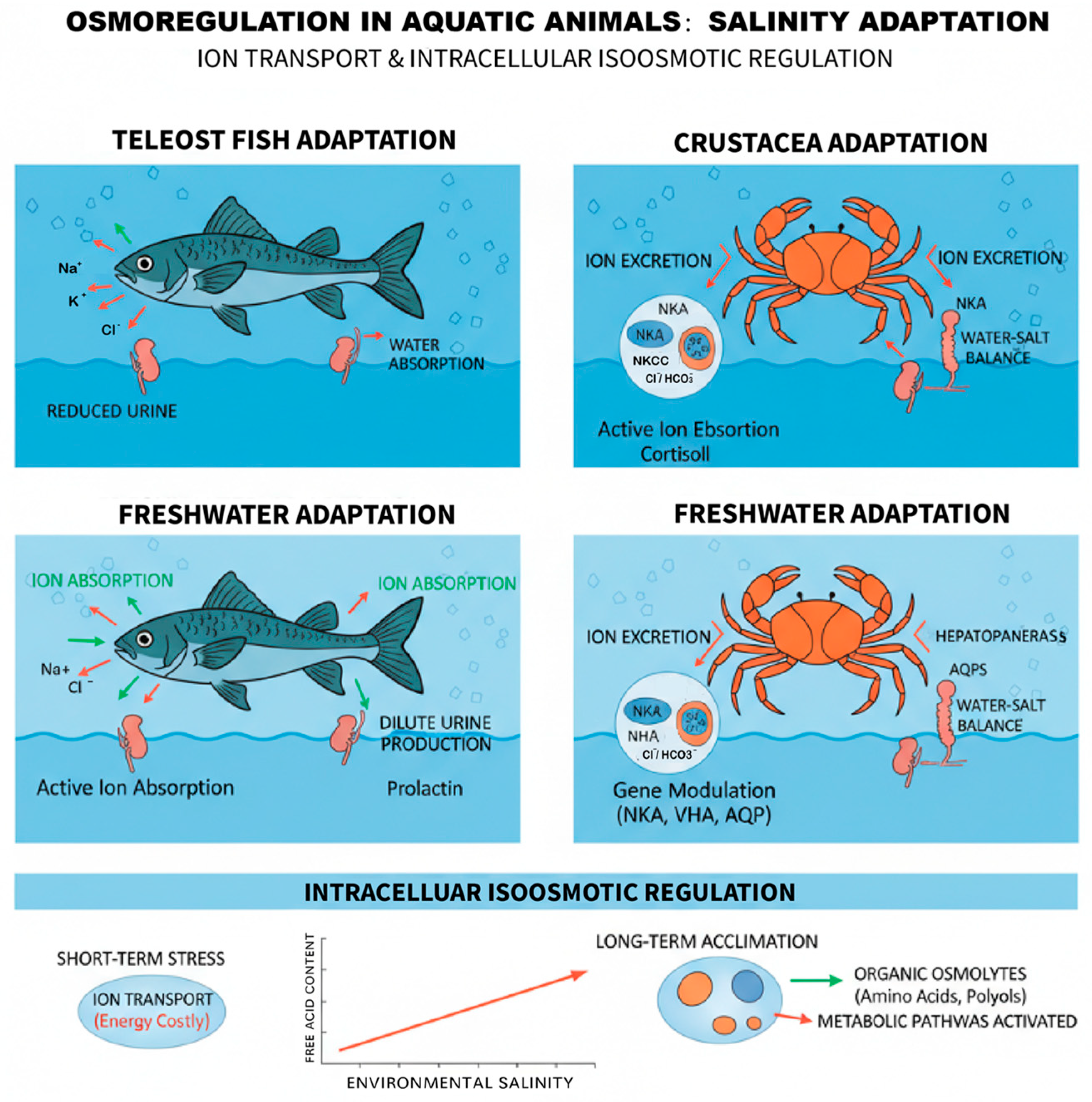
In both teleosts and crustaceans, the gill serves as the principal organ for osmoregulation and ion transport [225,226]. Functioning through a typical process of extracellular anisosmotic regulation, aquatic animals rely on mitochondria-rich ionocytes (also known as chloride cells) within the gill epithelium to drive transmembrane ion transport via ATP energy supply [227,228]. Specifically, NKA is primarily responsible for establishing transmembrane electrochemical gradients, which drive the synergistic action of the Na+-K+-2Cl cotransporter (NKCC) and Cl/HCO3 exchangers to facilitate active ion excretion or absorption [43,229].
In fish, seawater-adapted species counteract dehydration through a coordinated mechanism involving the excretion of excess salts via the gills, reduced urine production by the kidneys, and active water absorption in the intestine. Conversely, freshwater-adapted species maintain their hyperosmotic state (relative to the environment) by minimizing salt excretion, increasing the production of dilute urine, and accelerating intestinal metabolism; cortisol and prolactin play pivotal roles in these regulatory processes [230]. In crustaceans, in addition to the gills, the antennal glands and hepatopancreas also participate in the regulation of water–salt balance [231,232,233]. Research indicates that under salinity fluctuations, crustaceans significantly modulate the expression abundance of genes such as the NKA αα-subunit, V-type H+-ATPase (VHA), and aquaporins (AQPs) to maintain relatively constant hemolymph osmolality [226,234].
In addition to maintaining extracellular fluid homeostasis (e.g., hemolymph) through ion transport, intracellular isosmotic regulation represents a critical mechanism for protecting cell volume and function. This process primarily relies on the accumulation or degradation of intracellular organic osmolytes to achieve regulation [235]. Common osmolytes include amino acids and their derivatives, polyols and sugars, and methylamines [236]. Previous studies have shown that the free amino acid content in Pacific white shrimp (Litopenaeus vannamei) exhibits a significant linear positive correlation with environmental salinity [237]. However, this regulatory mechanism often displays pronounced non-singularity. For example, the mud crab (Scylla paramamosain) employs a combined strategy involving both extracellular and intracellular regulation to cope with environmental stress [151]. Metabolomic analyses have further revealed that under short-term low-salinity stress, organisms primarily rely on energetically costly ion transport (anisotonic regulation) to counteract osmotic shock, whereas during long-term acclimation, amino acid metabolic pathways are activated, and organic osmolytes (isosmotic regulation) gradually become dominant [238]. Figure 3 illustrates the osmotic regulation mechanisms of aquatic animals under salinity fluctuations.

4.2. Oxygen Consumption, Ammonia Excretion, and Metabolism

In inland saline–alkaline aquaculture environments, aquatic animals face severe challenges regarding osmotic gradient imbalances and ion regulation. These challenges compel them to initiate energy-intensive adaptive physiological mechanisms, leading to significant remodeling of oxygen consumption rates, ammonia excretion, and bioenergetic profiles. As the primary cultured species, teleosts and crustaceans have evolved distinct physiological regulatory strategies during their long-term adaptation.
For teleosts, maintaining internal homeostasis in high-salinity and high-alkalinity environments entails significant bioenergetic costs. This trade-off in energy allocation is directly reflected in the physiological compensation of respiratory oxygen consumption and nitrogen metabolism. Fish rely primarily on the synergistic action of the gills, kidneys, and intestines for osmoregulation. Since osmoregulation constitutes a substantial portion of the metabolic budget, oxygen consumption rates typically rise with fluctuations in environmental salinity. For instance, when Nile tilapia (Oreochromis niloticus) are transferred from freshwater to high-salinity environments, their oxygen consumption rate increases significantly during the initial phase, indicating active energy metabolism to cope with osmotic shock [239]. However, the oxygen consumption response is not influenced solely by environmental salinity; temperature and feeding status also exert superimposed effects. A study on channel catfish (Ictalurus punctatus) and blue catfish (Ictalurus furcatus) found that at high temperatures (25 °C and 32 °C), post-prandial oxygen consumption increased significantly, peaking at 1.8–2.0 times pre-feeding levels [240]. Notably, the high pH characteristic of saline–alkaline waters significantly inhibits the transmembrane diffusion of un-ionized ammonia (NH3), leading to internal ammonia nitrogen accumulation [241,242,243]. To mitigate ammonia toxicity, fish have evolved specific adaptive mechanisms for excretion. On one hand, they responsively upregulate the expression of Rh glycoproteins (Rhbg, Rhcgb) via the HIF1A signaling pathway and enhance active ammonia transport in coordination with H+ pumps [244,245]. On the other hand, they activate metabolic detoxification pathways to convert endogenous ammonia into glutamine or urea [243,244,246]. To meet the energy demands of these processes, fish undergo metabolic reprogramming, characterized by prioritizing carbohydrate utilization via glycolysis, mobilizing lipid metabolism to maintain cell membrane fluidity, and activating amino acid catabolism to assist in osmoregulation [215,240,247,248,249].
Although the adaptive mechanisms of crustaceans (especially euryhaline species such as mud crabs and Pacific white shrimp) in saline–alkaline environments also follow the “energy for homeostasis” principle, they exhibit significant differences in organ coordination and metabolic strategies. Similarly to fish, the gills of crustaceans act as the core organ for ion transport, relying on NKA and V-type H+-ATPase to drive transmembrane transport [250]. However, under hyposaline or high-alkalinity stress, the antennal glands and hepatopancreas play critical compensatory roles by activating ion reabsorption pathways [231]. Fluctuations in environmental salinity directly induce adjustments in the respiratory metabolic rates of crustaceans, with oxygen consumption and ammonia excretion rates exhibiting marked fluctuations along salinity gradients [251,252]. Particularly under combined high-alkalinity stress, when ammonia excretion is inhibited, crustaceans often cope with ammonia toxicity by regulating genes related to ammonia metabolism and ion balance [253]. Furthermore, a distinguishing feature of crustacean adaptation to saline–alkaline environments is the adoption of intracellular isosmotic regulation strategies (as introduced in Section 4.1), which is a relatively energy-efficient strategy. During this process, the hepatopancreas serves as the metabolic hub, where pathways including glycolysis, the TCA cycle, and lipid metabolism are significantly regulated to ensure energy supply and maintain metabolite balance [254,255].

4.3. Immunity and Antioxidant Defense

In saline–alkaline aquaculture settings, the health condition of cultured organisms is highly contingent upon the synergistic regulation of their antioxidant capacity and immune defense systems. These two systems represent the crucial mechanisms for maintaining homeostasis and adapting to environmental stress [256]. The primary influence of saline–alkaline stress on aquatic organisms originates from the energetic compensation necessary for osmoregulation. To counteract ionic gradients in high-salinity and high-alkalinity environments, chloride cells in fish gills and epithelial cells in crustaceans must significantly upregulate Na+/K+-ATPase (NKA) activity, an active transport process that is highly ATP-consuming [231,250]. As energy production centers, mitochondria operating under such high loads are prone to electron leakage in the electron transport chain, subsequently leading to the excessive generation of reactive oxygen species (ROS), such as superoxide anions (O2) and hydrogen peroxide (H2O2) [257,258,259].
Oxidative stress is initiated when the rate of ROS generation induced by environmental pressure surpasses the scavenging capacity of the organism’s endogenous antioxidant system. At the molecular level, this stress is manifested as lipid peroxidation (LPO), where excess free radicals attack polyunsaturated fatty acids in cell membrane phospholipids, generating toxic byproducts such as malondialdehyde (MDA) and resulting in a loss of membrane fluidity and altered permeability [259]. At the tissue level, it is characterized by nuclear pyknosis and mitochondrial swelling in the hepatopancreas or liver, as well as the physical disruption of the intestinal mucosal barrier [256,258]. Notably, high-pH environments specifically inhibit ammonia excretion; the accumulation of intracellular ammonia and ROS produces synergistic toxic effects, further aggravating the risks of protein denaturation and DNA damage [146,259,260].
In response to oxidative damage, aquatic organisms have evolved a sophisticated antioxidant defense strategy that demonstrates significant time-dependence and tissue-specificity. During the initial stage of stress, teleosts (e.g., carp, tilapia) and crustaceans (e.g., Chinese mitten crab, Pacific white shrimp) typically initiate a “compensatory activation” mechanism. Through signaling pathways such as nuclear factor erythroid 2-related factor 2 (Nrf2), they rapidly upregulate the gene transcription and enzymatic activities of superoxide dismutase (SOD), catalase (CAT), and glutathione peroxidase (GSH-Px) to maintain intracellular redox potential balance [261,262,263,264,265,266,267,268].
However, this compensatory mechanism has distinct physiological limitations. If the duration of stress is prolonged or the intensity exceeds tolerance thresholds, the antioxidant enzyme system enters a “decompensation phase.” This is characterized by a significant decline in enzymatic activity due to excessive consumption or structural impairment, resulting in the hyperaccumulation of ROS [269]. Furthermore, response strategies to oxidative stress vary across species and tissues. The liver of teleosts, serving as a center for metabolic detoxification, primarily relies on the synergistic action of GSH-Px and non-enzymatic antioxidants (e.g., glutathione, selenium, vitamins) [147]. In contrast, crustaceans tend to utilize multifunctional proteins and organic osmolytes within the hemolymph to assist in antioxidant defense [270].
A complex bidirectional regulatory mechanism exists between the antioxidant system and the innate immune system. ROS not only serve as metabolic byproducts but also act as crucial immune signaling molecules capable of activating nuclear factor-kappa B (NF-κB) and Toll-like receptor (TLR) signaling pathways, thereby inducing the expression of inflammatory cytokines and antimicrobial peptides [267,268,271]. At mucosal interfaces such as the gills and intestines, moderate ROS levels induced by saline–alkaline stress can upregulate the expression of immune effector molecules, including heat shock proteins (HSP70/90), crustin, and anti-lipopolysaccharide factors (ALFs), resulting in a state of immune activation [272,273,274]. However, this mechanism is notably more complex in crustaceans. Their unique prophenoloxidase (proPO) activation system is highly sensitive to redox status: while moderate stress can activate the proPO system to enhance the melanization reaction and pathogen clearance capacity, excessive oxidative stress leads to the downregulation of proPO gene expression, triggering immunosuppression [275]. Additionally, the activities of acid phosphatase (ACP) and alkaline phosphatase (AKP), key enzymes in non-specific immunity, are significantly enhanced in saline–alkaline environments. This enhancement not only aids in pathogen defense but also participates in metabolic compensatory mechanisms involving phosphorylation [276,277,278].
It is further noteworthy that the negative impacts of saline–alkaline environments on immunity are frequently mediated by the disruption of intestinal microecology. High osmotic pressure and alkalinity induce intestinal dysbiosis and compromise the physical barrier of the intestinal epithelium, thereby facilitating the invasion of opportunistic pathogens and subsequently inducing systemic inflammation [279]. Therefore, the survival of aquatic organisms in saline–alkaline environments is inherently a comprehensive outcome of dynamically adjusting resource allocation between antioxidant and immune systems. This occurs against the backdrop of high energy expenditure required for maintaining osmotic balance, aiming to tolerate oxidative damage while sustaining pathogen defense capabilities.

5. Summary and Perspectives

Saline–alkaline aquaculture serves not only as a crucial avenue for expanding the production space of fisheries but also as a vital approach for promoting the ecological restoration of saline–alkaline lands and the efficient utilization of resources. Existing research suggests that the responses of aquatic animals to the combined stresses of high salinity, high pH, and complex ionic compositions depend on a highly coordinated physiological compensation network. To uphold internal homeostasis, organisms must modulate the activity of ion-transport enzymes and acid–base regulatory proteins via key organs such as the gills, kidneys, and intestine. This energy-intensive process compels animals to restructure their energy metabolism strategies and is accompanied by significant alterations in oxygen consumption and ammonia excretion patterns.
Simultaneously, in response to the oxidative stress and immune challenges that ensue, cultured animals have developed protective mechanisms centered around enzymatic antioxidant systems and non-specific immune defenses, mitigating tissue damage through the scavenging of reactive oxygen species (ROS) and the activation of immune factors. This cross-system coordination, which encompasses osmoregulation, energy allocation, and immune defense, collectively forms the physiological foundation for the survival of aquatic animals in extreme saline–alkaline habitats.
Although the adaptive mechanisms at the physiological and biochemical levels have been relatively well-characterized, further endeavors are necessary to clarify the molecular regulatory networks underlying saline–alkaline tolerance and to advance research on germplasm innovation. Future studies should integrate multi-omics approaches to thoroughly explore the key functional genes that regulate osmotic balance and acid–base homeostasis, and to examine the roles of epigenetic modifications such as DNA methylation in environmental memory and trait inheritance. In particular, a systematic elucidation of the unique tolerance mechanisms of indigenous species such as Gymnocypris przewalskii and Leuciscus spp. is required to enrich the adaptive gene pools.
On this basis, it is essential to establish molecular marker-assisted breeding systems based on genome-wide association studies (GWAS), and to shift the research focus from the analysis of acute stress induced by single factors to the examination of chronic adaptation under multifactorial coupled stresses. Such efforts will facilitate the construction of precise water quality regulation models and nutritional enhancement strategies, providing robust theoretical support for the breeding of high-quality saline–alkaline-tolerant varieties and for promoting the green and high-quality development of saline–alkaline fisheries.

Author Contributions

Conceptualization, Y.Q. and H.L.; formal analysis, B.Z.; investigation, H.C.; resources, J.C.; data curation, Y.X.; writing—original draft preparation, H.L. (Huichen Li); writing—review and editing, Y.Q.; visualization, Y.Q.; supervision, K.Q.; project administration, H.L. (Hao Li); funding acquisition, Z.C. All authors have read and agreed to the published version of the manuscript.

Funding

This paper is supported by the Key R&D Program of Shandong Province (Grant no. 2023TZXD052), National Key R&D Program of China (Grant no. 2023YFD2400403), China Agriculture Research System of MOF and MARA (Grant no. CARS—47), and Central Public-interest Scientific Institution Basal Research Fund (Grant no. 20603022025010, 2023TD53).

Institutional Review Board Statement

Not applicable.

Informed Consent Statement

Not applicable.

Data Availability Statement

No new data were created or analyzed in this study.

Acknowledgments

I would like to express my sincere gratitude to all my professors and friends for their support of this thesis. As I am a non-native English speaker, I used ChatGPT 5.2 to polish the English language during the writing process to ensure greater accuracy. I also used Doubao 2.0 to enhance the clarity of the images. I am providing this disclosure for the record.

Conflicts of Interest

The authors declare no conflicts of interest.

References

  1. Xu, W.; Wang, H.; Li, Y. Distribution and aquaculture application of saline alkali water at home and abroad. China Fish. 2021, 50–53. Available online: https://kns.cnki.net/kcms2/article/abstract?v=iB5Z0i9DW_wzaWzZQj-VRpJTpdO65tMCs7w5sw_q1wvsKZGS5BQiCWMgqF72i1QlElQnOQ31dLfeAb7CzIQvgZAvOcqr99XWCtr9PY29DaMBbIRUk-U9jWeFG2o-ROx18W6Q-di0XoFWBCPyWJTmXfEvK3U7mlF5tEGixPUukQC2pD7FvKg5gQ==&uniplatform=NZKPT&language=CHS (accessed on 14 January 2026). (In Chinese)
  2. Liang, L.; Ren, B.; Chang, Y.; Tang, R.; Zhang, L. Inland brackish(alkaline-saline) water resources and fisheries utilization in China. Chin. Fish. Econ. 2013, 138–145. Available online: https://kns.cnki.net/kcms2/article/abstract?v=iB5Z0i9DW_zQ6-fa1Ee0uJoSECyO8F8mty0Izsp82OOZGGVZThIdlY2s8fcBOVR3jAvn7hkHFDPr04lMQYnSBUESGxxypal8vCjJfSXz3Guo1gKbIQUKWGcxJgMkqazKbX7fQ9Twaoj3MtsCRTu6NjW2XbyRcqCbyIEYDertBl-pbY7uACaieg==&uniplatform=NZKPT&language=CHS (accessed on 14 January 2026). (In Chinese)
  3. Chen, L. Physiological and Biochemical Changesand Transcriptome Analysis of Gill and Liver Tissues of Grass Carp Under NaHCO3. Master’s Thesis, Shanghai Ocean University, Shanghai, China, 2024. (In Chinese) [Google Scholar]
  4. Dhoke, S.K. Determination of alkalinity in the water sample: A theoretical approach. Chem. Teach. Int. 2023, 5, 283–290. [Google Scholar] [CrossRef]
  5. Zhu, H. Effects of Ambient Na+/K+ on Growth and Physiologicalcharacteristics of Litopenaeus vannamei in Low-Salinity. Master’s Thesis, Shanghai Ocean University, Shanghai, China, 2022. (In Chinese) [Google Scholar]
  6. Chen, X.; Lai, Q.; Me, Z.; Gao, H.; Han, Z. Saline-alkali water green breeding technology model. China Fish. 2020, 61–63. Available online: https://kns.cnki.net/kcms2/article/abstract?v=iB5Z0i9DW_ymM3Yg4EaAb6KrjPmO_nkjr_PAJ_ULCGS030L46WMQ4TFHQImXDSlYYm821-3Mt35RSgaA1MPRAkHjzMJDO1P4vv5_b0wnzJYEofE4t1iJcQYVJg03iVB9TIblfuPI_NiAcIpYgfUHOs_aRFrul9f9mlanYDwse97uvML1zS5XwA==&uniplatform=NZKPT&language=CHS (accessed on 14 January 2026). (In Chinese)
  7. Liang, C.; Yang, B.; Cao, Y.; Liu, K.; Wu, J.; Hao, F.; Han, Y.; Han, W. Salinization mechanism of lakes and controls on organic matter enrichment: From present to deep-time records. Earth-Sci. Rev. 2024, 251, 104720. [Google Scholar] [CrossRef]
  8. Szabó, A.; Székely, A.J.; Boros, E.; Márton, Z.; Csitári, B.; Barteneva, N.; Anda, D.; Dobosy, P.; Eiler, A.; Bertilsson, S.; et al. A matter of salt: Global assessment of the effect of salt ionic composition as a driver of aquatic bacterial diversity. Limnol. Oceanogr. Lett. 2026, 11, e70088. [Google Scholar] [CrossRef]
  9. Wang, F.; Zhu, L.; Wei, Y.; Gao, P.; Liu, Y.; Zhou, K.; Sun, Z.; Lai, Q.; Yao, Z. Intestinal ion regulation exhibits a daily rhythm in Gymnocypris przewalskii exposed to high saline and alkaline water. Sci. Rep. 2022, 12, 807. [Google Scholar] [CrossRef]
  10. Zhou, Z.; Yang, J.; Lv, H.; Zhou, T.; Zhao, J.; Bai, H.; Pu, F.; Xu, P. The adaptive evolution of Leuciscus waleckii in Lake Dali Nur and convergent evolution of Cypriniformes fishes inhabiting extremely alkaline environments. Genome Biol. Evol. 2023, 15, evad082. [Google Scholar] [CrossRef]
  11. Jahan, I.; Nanda, C.; Reddy, A.K.; Tiwari, V.K.; Chadha, N.K.; Verma, A.K.; Rani, A.M.b.; Kumar, A.P. A review on the role of inland saline aquaculture in reclaiming saline wastelands. Discov. Agric. 2025, 3, 256. [Google Scholar] [CrossRef]
  12. Ragunathan, M.; Yadav, A.; Jayanthi, J.; Basu, K.; Malakondaiah, S. Shrimp Aquaculture in Inland Saline Waters of Haryana: A Step towards Sustainable Aquafarming. Uttar Pradesh J. Zool. 2024, 45, 265–282. [Google Scholar] [CrossRef]
  13. Rossignoli, C.M.; Obi, C.; Ali, S.A.; Ullah, N.; Khalid, S.; Hafeez, M.; Shah, S.M.H. Production system and challenges of saline aquaculture in Punjab and Sindh provinces of Pakistan. Front. Aquac. 2023, 2, 1302571. [Google Scholar] [CrossRef]
  14. Pandey, A.; Pathan, M.A.; Sudhagar, S.A.; Krishnani, K.K.; Sreedharan, K.; Prakash, S.; Jana, P. Influence of crowding density mediated stress on haematological, biochemical indices and molecular changes of Penaeus vannamei reared in inland saline water (ISW) sourced earthen ponds. Aquac. Int. 2024, 32, 6287–6302. [Google Scholar] [CrossRef]
  15. Pandey, A.; Pathan, M.A.; Ananthan, P.S.; Sudhagar, A.; Krishnani, K.K.; Sreedharan, K.; Kumar, P.; Thirunavukkarasar, R.; Harikrishna, V. Stocking for sustainable aqua-venture: Optimal growth, yield and economic analysis of Penaeus vannamei culture in inland saline water (ISW) of India. Environ. Dev. Sustain. 2023, 26, 6913–6942. [Google Scholar] [CrossRef]
  16. Susitharan, U.; Krishnan, S.; Kumar, P.; Sukhdhane, K.; Sathiya Kala, A.; Babitha Rani, A.M. Mineral supplementation in biofloc influences growth and haemato-biochemical indices of Genetically Improved Farmed Tilapia reared in inland saline ground water. Aquac. Eng. 2024, 104, 102386. [Google Scholar] [CrossRef]
  17. Jiang, X.; Niu, M.; Qin, K.; Hu, Y.; Li, Y.; Che, C.; Wang, C.; Mu, C.; Wang, H. Enhancement of Nutrient Composition and Non-Volatile Flavor Substances in Muscle Tissue of Red Drum (Sciaenops ocellatus) Through Inland Low Salinity Saline-Alkaline Water Culture. J. Agric. Food Chem. 2024, 72, 7326–7335. [Google Scholar] [CrossRef]
  18. Li, B.; Jia, R.; Hou, Y.; Zhu, J. Treating performance of a commercial-scale constructed wetland system for aquaculture effluents from intensive inland Micropterus salmoides farm. Front. Mar. Sci. 2022, 9, 1000703. [Google Scholar] [CrossRef]
  19. Patel, R.K.; Verma, A.K.; Krishnani, K.K.; Krishnan, S.; Hittinahalli, C.M.; Singh, A.L.; Haque, R. Effect of temporal increment in salinity of inland saline groundwater on growth performance, survival, metabolic and osmoregulatory responses of juveniles of Labeo rohita (Hamilton, 1822). Aquaculture 2023, 571, 739473. [Google Scholar] [CrossRef]
  20. Li, Y.; Ye, Y.; Zhu, X.; Wei, Y.; Li, Y.; Sun, Z.; Zhou, K.; Gao, P.; Yao, Z.; Lai, Q. Transcriptional analysis reveals antioxidant, ion transport, and glycolysis mechanisms in Litopenaeus vannamei gills involved in the response to high alkali stress. Comp. Biochem. Physiol. A Mol. Integr. Physiol. 2025, 306, 111868. [Google Scholar] [CrossRef]
  21. Zhang, R.; Shi, X.; Liu, Z.; Sun, J.; Sun, T.; Lei, M. Histological, Physiological and Transcriptomic Analysis Reveal the Acute Alkalinity Stress of the Gill and Hepatopancreas of Litopenaeus vannamei. Mar. Biotechnol. 2023, 25, 588–602. [Google Scholar] [CrossRef]
  22. Shi, X.; Zhang, R.; Liu, Z.; Sun, J.; Li, L.; Zhao, G.; Lu, J. Combined analysis of mRNA and miRNA reveals the mechanism of pacific white shrimp (Litopenaeus vannamei) under acute alkalinity stress. PLoS ONE 2023, 18, e0290157. [Google Scholar] [CrossRef]
  23. Mustafa, A.; Syah, R.; Tarunamulia; Paena, M.; Samad, W.; Ratnawati, E.; Athirah, A.; Asaf, R.; Akmal; Kamariah; et al. Performance and land characteristics of brackishwater pond to support sustainability of Pacific white shrimp (Litopenaeus vannamei) culture intensive technology. Environ. Sci. Pollut. Res. Int. 2024, 31, 66808–66826. [Google Scholar] [CrossRef] [PubMed]
  24. Hoang, T.M.H.; Te, M.S.; Hieu Duong, V.; Luong, Q.D.; Stiers, I.; Triest, L. Relationship between water quality and phytoplankton distribution of aquaculture areas in a tropical lagoon. Environ. Monit. Assess. 2024, 196, 1099. [Google Scholar] [CrossRef] [PubMed]
  25. Jayanthi, M.; Thirumurthy, S.; Samynathan, M.; Manimaran, K.; Duraisamy, M.; Muralidhar, M. Assessment of land and water ecosystems capability to support aquaculture expansion in climate-vulnerable regions using analytical hierarchy process based geospatial analysis. J. Environ. Manag. 2020, 270, 110952. [Google Scholar] [CrossRef] [PubMed]
  26. Morales-Covarrubias, M.S.; García-Aguilar, N.; Bolan-Mejía, M.D.; Puello-Cruz, A.C. Evaluation of medicinal plants and colloidal silver efficiency against Vibrio parahaemolyticus infection in Litopenaeus vannamei cultured at low salinity. Dis. Aquat. Organ. 2016, 122, 57–65. [Google Scholar] [CrossRef]
  27. Valencia-Castañeda, G.; Frías-Espericueta, M.G.; Vanegas-Pérez, R.C.; Pérez-Ramírez, J.A.; Chávez-Sánchez, M.C.; Páez-Osuna, F. Acute Toxicity of Ammonia, Nitrite and Nitrate to Shrimp Litopenaeus vannamei Postlarvae in Low-Salinity Water. Bull. Environ. Contam. Toxicol. 2018, 101, 229–234. [Google Scholar] [CrossRef]
  28. Valencia-Castañeda, G.; Millán-Almaraz, M.I.; Fierro-Sañudo, J.F.; Fregoso-López, M.G.; Páez-Osuna, F. Monitoring of inland waters for culturing shrimp Litopenaeus vannamei: Application of a method based on survival and chemical composition. Environ. Monit. Assess. 2017, 189, 395. [Google Scholar] [CrossRef]
  29. Ghodrati, F.; Ghorbani, R.; Agh, N.; Hedayati, A.; Naddafi, R.; Jalali, A.; Shiroudmirzaei, F. Assessing nitrogen dynamics model and the role of artificial lagoon in effluent loading of shrimp farms in Gomishan wetland, southern Caspian Sea. Sci. Rep. 2022, 12, 22358. [Google Scholar] [CrossRef]
  30. Martinez-Antonio, E.M.; Racotta, I.S.; Ruvalcaba-Marquez, J.C.; Magallon-Barajas, F. Modulation of stress response and productive performance of Litopenaeus vannamei through diet. PeerJ 2019, 7, e6850. [Google Scholar] [CrossRef]
  31. Moraes, C.M.; Fabri, L.M.; Garcon, D.P.; Augusto, A.; Faria, S.C.; McNamara, J.C.; Leone, F.A. Kinetic properties of gill (Na+, K+)-ATPase in the Pacific whiteleg shrimp Penaeus vannamei (Decapoda, Penaeidae). Comp. Biochem. Physiol. B Biochem. Mol. Biol. 2025, 275, 111038. [Google Scholar] [CrossRef]
  32. Hou, D.; Zhou, R.; Zeng, S.; Wei, D.; Deng, X.; Xing, C.; Yu, L.; Deng, Z.; Wang, H.; Weng, S.; et al. Intestine Bacterial Community Composition of Shrimp Varies Under Low- and High-Salinity Culture Conditions. Front. Microbiol. 2020, 11, 589164. [Google Scholar] [CrossRef]
  33. Fan, L.; Liao, G.; Wang, Z.; Liu, H.; Cheng, K.; Hu, J.; Yang, Y.; Zhou, Z. Insight into three water additives: Revealing the protective effects on survival and stress response under cold stress for Pacific white shrimp Litopenaeus vannamei. Fish Shellfish Immunol. 2023, 139, 108845. [Google Scholar] [CrossRef] [PubMed]
  34. Bhatt, S.; Dasgupta, S.; Gupta, S.; Sahu, N.P.; Kumar, V.J.R.; Varghese, T. Effect of sulfate on the osmoregulatory and physio-biochemical responses of GIFT (Oreochromis niloticus) juveniles reared in potassium-deficient medium saline waters. Environ. Sci. Pollut. Res. Int. 2024, 31, 18636–18655. [Google Scholar] [CrossRef] [PubMed]
  35. Li, C.; Chen, H.Q.; Gao, P.; Huang, X.H.; Zhu, Y.X.; Xu, M.; Yuan, Q.; Gao, Y.; Shen, X.X. Distribution and drivers of antibiotic resistance genes in brackish water aquaculture sediment. Sci. Total Environ. 2023, 860, 160475. [Google Scholar] [CrossRef] [PubMed]
  36. Li, K.; Zhao, S.; Guan, W.; Li, K.J. Planktonic bacteria in white shrimp (Litopenaeus vannamei) and channel catfish (Letalurus punetaus) aquaculture ponds in a salt-alkaline region. Lett. Appl. Microbiol. 2022, 74, 212–219. [Google Scholar] [CrossRef]
  37. Mustafa, A.; Syah, R.; Paena, M.; Tarunamulia; Samad, W.; Ratnawati, E.; Kamariah; Athirah, A.; Asaf, R.; Akmal; et al. Evaluating the performance of the wastewater treatment plant in intensive whiteleg shrimp (Litopenaeus vannamei) brackishwater pond aquaculture. Environ. Sci. Pollut. Res. Int. 2025, 32, 14220–14246. [Google Scholar] [CrossRef]
  38. Teitge, F.; Peppler, C.; Steinhagen, D.; Jung-Schroers, V. Water disinfection by ozonation has advantages over UV irradiation in a brackish water recirculation aquaculture system for Pacific white shrimp (Litopenaeus vannamei). J. Fish Dis. 2020, 43, 1259–1285. [Google Scholar] [CrossRef]
  39. Bauer, J.; Teitge, F.; Neffe, L.; Adamek, M.; Jung, A.; Peppler, C.; Steinhagen, D.; Jung-Schroers, V. Impact of a reduced water salinity on the composition of Vibrio spp. in recirculating aquaculture systems for Pacific white shrimp (Litopenaeus vannamei) and its possible risks for shrimp health and food safety. J. Fish Dis. 2021, 44, 89–105. [Google Scholar] [CrossRef]
  40. Rego, M.A.S.; Sabbag, O.J.; Soares, R.B.; Peixoto, S. Technical efficiency analysis of marine shrimp farming (Litopenaeus vannamei) in biofloc and conventional systems: A case study in northeastern Brazil. Acad. Bras. Cienc. 2018, 90, 3705–3716. [Google Scholar] [CrossRef]
  41. Ayers, J.C.; George, G.; Fry, D.; Benneyworth, L.; Wilson, C.; Auerbach, L.; Roy, K.; Karim, M.R.; Akter, F.; Goodbred, S. Salinization and arsenic contamination of surface water in southwest Bangladesh. Geochem. Trans. 2017, 18, 4. [Google Scholar] [CrossRef]
  42. Zeng, S.; Khoruamkid, S.; Kongpakdee, W.; Wei, D.; Yu, L.; Wang, H.; Deng, Z.; Weng, S.; Huang, Z.; He, J.; et al. Dissimilarity of microbial diversity of pond water, shrimp intestine and sediment in Aquamimicry system. AMB Express 2020, 10, 180. [Google Scholar] [CrossRef]
  43. Giffard-Mena, I.; Ponce-Rivas, E.; Sigala-Andrade, H.M.; Uranga-Solís, C.; Re, A.D.; Díaz, F. Evaluation of the osmoregulatory capacity and three stress biomarkers in white shrimp Penaeus vannamei exposed to different temperature and salinity conditions: Na+/K+ ATPase, Heat Shock Proteins (HSP), and Crustacean Hyperglycemic Hormones (CHHs). Comp. Biochem. Physiol. Part. B Biochem. Mol. Biol. 2024, 271, 110942. [Google Scholar] [CrossRef] [PubMed]
  44. Guan, W.; Li, K.; Zhao, S.; Li, K. A high abundance of Firmicutes in the intestine of chinese mitten crabs (Eriocheir sinensis) cultured in an alkaline region. AMB Express 2021, 11, 141. [Google Scholar] [CrossRef] [PubMed]
  45. Zhang, H.; Dong, S.; Shan, H.; Yang, C.; Wang, F. Application of the DEB-TKTD model with multi-omics data: Prediction of life history traits of Chinese mitten crab (Eriocheir sinensis) under different salinities. Ecotoxicol. Environ. Saf. 2025, 290, 117635. [Google Scholar] [CrossRef] [PubMed]
  46. Zhang, R.; Zhao, Z.; Li, M.; Luo, L.; Wang, S.; Guo, K.; Xu, W. Effects of saline-alkali stress on the tissue structure, antioxidation, immunocompetence and metabolomics of Eriocheir sinensis. Sci. Total Environ. 2023, 871, 162109. [Google Scholar] [CrossRef]
  47. Zhao, W.; Liang, H.; Fu, Y.; Liu, Y.; Yang, C.; Zhang, T.; Wang, T.; Rong, L.; Zhang, S.; Wu, Z.; et al. Effects of different fertilization modes on rice yield and quality under a rice-crab culture system. PLoS ONE 2020, 15, e0230600. [Google Scholar] [CrossRef]
  48. Fu, H.; Sun, W.; Cao, Y.; Li, Q.; Wang, X.; Zhou, Z.; Meng, Q.; Luo, T.; Gu, W.; Meng, Q. Prevalence of antibiotic resistance genes, heavy metal, and bacterial community composition in sea sediments influenced by Eriocheir sinensis breeding aquaculture. Environ. Sci. Pollut. Res. Int. 2024, 31, 58599–58608. [Google Scholar] [CrossRef]
  49. Long, X.; Wu, X.; Zhao, L.; Ye, H.; Cheng, Y.; Zeng, C. Effects of salinity on gonadal development, osmoregulation and metabolism of adult male Chinese mitten crab, Eriocheir sinensis. PLoS ONE 2017, 12, e0179036. [Google Scholar] [CrossRef]
  50. Long, X.; Wu, X.; Zhao, L.; Ye, H.; Cheng, Y.; Zeng, C. Physiological Responses and Ovarian Development of Female Chinese Mitten Crab Eriocheir sinensis Subjected to Different Salinity Conditions. Front. Physiol. 2017, 8, 1072. [Google Scholar] [CrossRef]
  51. Qi, T.; Liu, J.; Zhao, P.; Ge, B.; Liu, Q.; Jiang, S.; Wang, Z.; Zhang, H.; Tang, B.; Ding, G.; et al. A novel modulation of physiological regulation in cultured Chinese mitten crab (Eriocheir japonica sinensis) in response to consistent salinity changes. Gene 2020, 756, 144914. [Google Scholar] [CrossRef]
  52. Zhai, W.; Zhang, R.; Zhou, S.; Qiao, F.; Wu, X.; Wang, X.; Zhang, L. Brackish water stabilizes textural quality by regulating muscle protein properties of Eriocheir sinensis during temporary fattening. J. Sci. Food Agric. 2025, 105, 6654–6665. [Google Scholar] [CrossRef]
  53. Zhang, L.; Yin, M.; Zheng, Y.; Xu, C.H.; Tao, N.P.; Wu, X.; Wang, X. Brackish water improves the taste quality in meat of adult male Eriocheir sinensis during the postharvest temporary rearing. Food Chem. 2021, 343, 128409. [Google Scholar] [CrossRef] [PubMed]
  54. Wang, C.; An, L.; Dong, X.S.; Xu, X.; Feng, X.Y.; Wang, Z.Z.; He, F.; Chen, X.; Zhu, Y.A.; Meng, Q.L. The tricarboxylic acid cycle is inhibited under acute stress from carbonate alkalinity in the gills of Eriocheir sinensis. Comp. Biochem. Physiol. Part D Genom. Proteom. 2024, 51, 101245. [Google Scholar] [CrossRef] [PubMed]
  55. Yang, Z.; Zhou, J.; Wei, B.; Cheng, Y.; Zhang, L.; Zhen, X. Comparative transcriptome analysis reveals osmotic-regulated genes in the gill of Chinese mitten crab (Eriocheir sinensis). PLoS ONE 2019, 14, e0469. [Google Scholar] [CrossRef] [PubMed]
  56. Wang, S.; Guo, K.; Luo, L.; Zhang, R.; Xu, W.; Song, Y.; Zhao, Z. Fattening in Saline and Alkaline Water Improves the Color, Nutritional and Taste Quality of Adult Chinese Mitten Crab Eriocheir sinensis. Foods 2022, 11, 2573. [Google Scholar] [CrossRef]
  57. Liu, X.; Wu, H.; Wang, Y.; Liu, Y.; Zhu, H.; Li, Z.; Shan, P.; Yuan, Z. Comparative assessment of Chinese mitten crab aquaculture in China: Spatiotemporal changes and trade-offs. Environ. Pollut. 2023, 337, 122544. [Google Scholar] [CrossRef]
  58. Guo, Y.; Tian, J.; Wang, Z. Composition and functional diversity of soil and water microbial communities in the rice-crab symbiosis system. PLoS ONE 2025, 20, e0316815. [Google Scholar] [CrossRef]
  59. Liu, J.; Kou, Y.; Kong, D.; Yan, Z.; Guo, Z.; Lu, W.; Lv, W.; Li, Y. Effects of alkali stress on antioxidant capacity, lipid metabolism, apoptosis and autophagy of Eriocheir sinensis. Sci. Rep. 2025, 15, 22224. [Google Scholar] [CrossRef]
  60. Zhang, Y.; Wu, Q.; Fang, S.; Li, S.; Zheng, H.; Zhang, Y.; Ikhwanuddin, M.; Ma, H. mRNA profile provides novel insights into stress adaptation in mud crab megalopa, Scylla paramamosain after salinity stress. BMC Genom. 2020, 21, 559. [Google Scholar] [CrossRef]
  61. Wang, H.; Tang, L.; Wei, H.; Lu, J.; Mu, C.; Wang, C. Transcriptomic analysis of adaptive mechanisms in response to sudden salinity drop in the mud crab, Scylla paramamosain. BMC Genom. 2018, 19, 421. [Google Scholar] [CrossRef]
  62. Che, C.; Yang, P.; Qin, K.; Li, Y.; Fan, Z.; Li, W.; Gao, S.; Wang, C.; Mu, C.; Wang, H. Based on metabolomics analysis: Metabolic mechanism of intestinal tract of Scylla paramamosain under low-salt saline-alkali water aquaculture environment. BMC Genom. 2024, 25, 1232. [Google Scholar] [CrossRef]
  63. Gao, G.; Hu, Y.; Qin, K.; Fan, Z.; Wang, C.; Wang, H. The effects of sulfate on the physiology, biochemistry, and intestinal transcriptome of Scylla paramamosain under low-salinity conditions. Comp. Biochem. Physiol. Part D Genom. Proteom. 2025, 55, 101502. [Google Scholar] [CrossRef]
  64. Wang, H.; Wei, H.; Tang, L.; Lu, J.; Mu, C.; Wang, C. A proteomics of gills approach to understanding salinity adaptation of Scylla paramamosain. Gene 2018, 677, 119–131. [Google Scholar] [CrossRef] [PubMed]
  65. Zhong, S.; Ma, X.; Jiang, Y.; Qiao, Y.; Zeng, M.; Huang, L.; Huang, G.; Zhao, Y.; Chen, X. MicroRNA sequencing analysis reveals injury-induced immune responses of Scylla paramamosain against cheliped autotomy. Fish Shellfish Immunol. 2023, 141, 109055. [Google Scholar] [CrossRef] [PubMed]
  66. Zhou, D.; Fu, Y.; Liu, L.; Lin, W.; Lu, Z.; Ye, Y.; Zhang, M. Comparative analysis of bacterial communities and environmental interactions in seawater and saline-alkali aquaculture ponds for Scylla paramamosain in northern China. Front. Microbiol. 2025, 16, 1589304. [Google Scholar] [CrossRef] [PubMed]
  67. Lu, Z.; Lin, W.; Li, Q.; Wu, Q.; Ren, Z.; Mu, C.; Wang, C.; Shi, C.; Ye, Y. Recirculating aquaculture system as microbial community and water quality management strategy in the larviculture of Scylla paramamosain. Water Res. 2024, 252, 121218. [Google Scholar] [CrossRef]
  68. Li, Y.; Chen, C.; Li, Z.; Yang, J.; Che, C.; Gao, S.; Qin, K.; Yang, P.; Fan, Z.; Li, W.; et al. Effects of high-pH saline-alkaline water on tissue structure, osmoregulation, antioxidant capacity, and metabolic activity in mud crab Scylla paramamosain Estampador, 1950. Aquaculture 2026, 613, 743430. [Google Scholar] [CrossRef]
  69. Liu, S.; Tang, Z.; Gao, M.; Hou, G. Evolutionary process of saline-water intrusion in Holocene and Late Pleistocene groundwater in southern Laizhou Bay. Sci. Total Environ. 2017, 607–608, 586–599. [Google Scholar] [CrossRef]
  70. Xing, L.; Huang, L.; Yang, Y.; Xu, J.; Zhang, W.; Chi, G.; Hou, X. The Blocking Effect of Clay in Groundwater Systems: A Case Study in an Inland Plain Area. Int. J. Environ. Res. Public Health 2018, 15, 1816. [Google Scholar] [CrossRef]
  71. Debnath, S.C.; Chaput, D.L.; McMurtrie, J.; Bell, A.G.; Temperton, B.; Mohan, C.V.; Alam, M.M.; Hasan, N.A.; Haque, M.M.; Bass, D.; et al. Seasonal dynamics and factors shaping microbiomes in freshwater finfish earthen aquaculture ponds in Bangladesh. Environ. Microbiome 2025, 20, 38. [Google Scholar] [CrossRef]
  72. Siddique, M.A.B.; Mahalder, B.; Haque, M.M.; Ahammad, A.K.S. Impact of climatic factors on water quality parameters in tilapia broodfish ponds and predictive modeling of pond water temperature with ARIMAX. Heliyon 2024, 10, e37717. [Google Scholar] [CrossRef]
  73. Su, H.; Ma, D.; Zhu, H.; Liu, Z.; Gao, F. Transcriptomic response to three osmotic stresses in gills of hybrid tilapia (Oreochromis mossambicus female × O. urolepis hornorum male). BMC Genom. 2020, 21, 110. [Google Scholar] [CrossRef] [PubMed]
  74. Chourasia, T.K.; D’Cotta, H.; Baroiller, J.F.; Slosman, T.; Cnaani, A. Effects of the acclimation to high salinity on intestinal ion and peptide transporters in two tilapia species that differ in their salinity tolerance. Comp. Biochem. Physiol. A Mol. Integr. Physiol. 2018, 218, 16–23. [Google Scholar] [CrossRef] [PubMed]
  75. Dawood, M.A.O.; Noreldin, A.E.; Sewilam, H. Long term salinity disrupts the hepatic function, intestinal health, and gills antioxidative status in Nile tilapia stressed with hypoxia. Ecotoxicol. Environ. Saf. 2021, 220, 112412. [Google Scholar] [CrossRef] [PubMed]
  76. Yu, J.; Li, D.; Zhu, J.; Zou, Z.; Xiao, W.; Chen, B.; Yang, H. Salt tolerance performance and associated gene analysis of three tilapia species (strains). Fish Physiol. Biochem. 2025, 51, 73. [Google Scholar] [CrossRef]
  77. Velselvi, R.; Dasgupta, S.; Varghese, T.; Sahu, N.P.; Tripathi, G.; Panmei, H.; Singha, K.P.; Krishna, G. Taurine and/or inorganic potassium as dietary osmolyte counter the stress and enhance the growth of GIFT reared in ion imbalanced low saline water. Food Chem. 2022, 4, 100058. [Google Scholar] [CrossRef]
  78. Liu, W.; Xu, C.; Li, Z.; Chen, L.; Wang, X.; Li, E. Reducing Dietary Protein Content by Increasing Carbohydrates Is More Beneficial to the Growth, Antioxidative Capacity, Ion Transport, and Ammonia Excretion of Nile Tilapia (Oreochromis niloticus) under Long-Term Alkalinity Stress. Aquac. Nutr. 2023, 2023, 1–15. [Google Scholar] [CrossRef]
  79. Ibrahim, R.E.; Abdelwarith, A.A.; Younis, E.M.; Mohamed, A.A.; Khamis, T.; Osman, A.; Metwally, M.M.M.; Davies, S.J.; Abd-Elhakim, Y.M. Carbonate alkalinity induces stress responses and renal and metabolic disorders in Nile tilapia: Mitigation by camel whey protein hydrolysate diet. Fish Physiol. Biochem. 2025, 51, 66. [Google Scholar] [CrossRef]
  80. Pavlosky, K.K.; Yamaguchi, Y.; Lerner, D.T.; Seale, A.P. The effects of transfer from steady-state to tidally-changing salinities on plasma and branchial osmoregulatory variables in adult Mozambique tilapia. Comp. Biochem. Physiol. A Mol. Integr. Physiol. 2019, 227, 134–145. [Google Scholar] [CrossRef]
  81. Favero Neto, J.; Maia, C.M.; de Oliveira, R.; Giaquinto, P.C. Nile Tilapia Prefer Water Hyacinth as Structural Enrichment Regardless of Stocking Density. J. Appl. Anim. Welf. Sci. 2026, 29, 279–293. [Google Scholar] [CrossRef]
  82. Emam, W.; Lambert, H.; Brown, C. The welfare of farmed Nile tilapia: A review. Front. Vet. Sci. 2025, 12, 1567984. [Google Scholar] [CrossRef]
  83. Madkour, K.; Kimera, F.; Mugwanya, M.; Eissa, R.A.; Nasr-Eldahan, S.; Aref, K.; Ahmed, W.; Farouk, E.; Dawood, M.A.O.; Abdelmaksoud, Y.; et al. Evaluating the Growth Performance of Nile and Red Tilapia and Its Influence on Morphological Growth and Yield of Intercropped Wheat and Sugar Beet Under a Biosaline Integrated Aquaculture-Agriculture System. Plants 2025, 14, 1346. [Google Scholar] [CrossRef]
  84. Shourbela, R.M.; Khatab, S.A.; Hassan, M.M.; Van Doan, H.; Dawood, M.A.O. The Effect of Stocking Density and Carbon Sources on the Oxidative Status, and Nonspecific Immunity of Nile tilapia (Oreochromis niloticus) Reared under Biofloc Conditions. Animals 2021, 11, 184. [Google Scholar] [CrossRef]
  85. Powell, D.; Thoa, N.P.; Nguyen, N.H.; Knibb, W.; Elizur, A. Transcriptomic responses of saline-adapted Nile tilapia (Oreochromis niloticus) to rearing in both saline and freshwater. Mar. Genom. 2021, 60, 100879. [Google Scholar] [CrossRef]
  86. Abdel-Rahim, M.M.; Elhetawy, A.I.G.; Shawky, W.A.; El-Zaeem, S.Y.; El-Dahhar, A.A. Enhancing Florida red tilapia aquaculture: Biofloc optimization improves water quality, pathogen bacterial control, fish health, immune response, and organ histopathology across varied groundwater salinities. Vet. Res. Commun. 2024, 48, 2989–3006. [Google Scholar] [CrossRef] [PubMed]
  87. Song, L.; Zhao, Y.; Song, Y.; Zhao, L.; Ma, C.; Zhao, J. Effects of saline-alkaline water on growth performance, nutritional processing, and immunity in Nile tilapia (Oreochromis niloticus). Aquaculture 2021, 544, 737036. [Google Scholar] [CrossRef]
  88. Li, X.; Ji, L.; Wu, L.; Gao, X.; Li, X.; Li, J.; Liu, Y. Effect of flow velocity on the growth, stress and immune responses of turbot (Scophthalmus maximus) in recirculating aquaculture systems. Fish Shellfish Immunol. 2019, 86, 1169–1176. [Google Scholar] [CrossRef] [PubMed]
  89. Wang, J.; Shi, X.; Gong, Z.; Chen, S.; Hu, G. Establishment and characterization of a gill cell line from turbot (Scophthalmus maximus). Fish Shellfish Immunol. 2025, 161, 110265. [Google Scholar] [CrossRef] [PubMed]
  90. Gao, C.; Cai, X.; Fu, Q.; Yang, N.; Song, L.; Su, B.; Tan, F.; Liu, B.; Li, C. Dynamics of MiRNA Transcriptome in Turbot (Scophthalmus maximus L.) Intestine Following Vibrio anguillarum Infection. Mar. Biotechnol. 2019, 21, 550–564. [Google Scholar] [CrossRef]
  91. Cui, W.; Ma, A.; Huang, Z.; Wang, X.; Liu, Z.; Xia, D.; Yang, S.; Zhao, T. Comparative transcriptomic analysis reveals mechanisms of divergence in osmotic regulation of the turbot Scophthalmus maximus. Fish Physiol. Biochem. 2020, 46, 1519–1536. [Google Scholar] [CrossRef]
  92. Liu, Z.; Ma, A.; Zhang, J.; Yang, S.; Cui, W.; Xia, D.; Qu, J. Cloning and molecular characterization of PRL and PRLR from turbot (Scophthalmus maximus) and their expressions in response to short-term and long-term low salt stress. Fish Physiol. Biochem. 2020, 46, 501–517. [Google Scholar] [CrossRef]
  93. Sevgili, H.; Kurtoğlu, A.; Oikawa, M.; Pak, F.; Aktaş, Ö.; Sivri, F.M.; Eroldoğan, O.T. Dietary salt concentrations influence growth, nutrient utilization, and fatty acid profiles of turbot (Scophthalmus maximus) reared in brackish water. Fish Physiol. Biochem. 2024, 50, 2357–2372. [Google Scholar] [CrossRef] [PubMed]
  94. Yu, J.; Wang, Y.; Xiao, Y.; Li, X.; Zhou, L.; Wang, Y.; Du, T.; Ma, X.; Li, J. Investigating the effect of nitrate on juvenile turbot (Scophthalmus maximus) growth performance, health status, and endocrine function in marine recirculation aquaculture systems. Ecotoxicol. Environ. Saf. 2021, 208, 111617. [Google Scholar] [CrossRef] [PubMed]
  95. Ma, A.; Cui, W.; Wang, X.; Zhang, W.; Liu, Z.; Zhang, J.; Zhao, T. Osmoregulation by the myo-inositol biosynthesis pathway in turbot Scophthalmus maximus and its regulation by anabolite and c-Myc. Comp. Biochem. Physiol. A Mol. Integr. Physiol. 2020, 242, 110636. [Google Scholar] [CrossRef] [PubMed]
  96. Zhu, T.; Liu, Y.; Du, J.; Lei, C.; Wang, C.; Li, S.; Song, H. Effects of short-term salt exposure on gill damage, serum components and gene expression patterns in juvenile Largemouth bass (Micropterus salmoides). Comp. Biochem. Physiol. Part. D Genom. Proteom. 2025, 53, 101365. [Google Scholar] [CrossRef]
  97. Wang, Y.; Li, H.; Li, C.; Tang, W.; Wang, Y.; Hou, H. Transcriptome Analysis of Environmental Adaptation of Largemouth Bass (Micropterus salmonides). Genes 2025, 16, 267. [Google Scholar] [CrossRef]
  98. Ding, M.; Tao, Y.; Hua, J.; Dong, Y.; Lu, S.; Qiang, J.; He, J. Genome-Wide Association Study Reveals Growth-Related SNPs and Candidate Genes in Largemouth Bass (Micropterus salmoides) Adapted to Hypertonic Environments. Int. J. Mol. Sci. 2025, 26, 1834. [Google Scholar] [CrossRef]
  99. Guan, W.; Jian, J.; Niu, B.; Zhang, X.; Yu, J.; Xu, X. Germplasm Resources Evaluation of Cultured Largemouth Bass (Micropterus salmoides) in China Based on Whole Genome Resequencing. Genes 2024, 15, 1307. [Google Scholar] [CrossRef]
  100. Galaviz, S.L.; Escobar, G.B.; Iruegas, B.F.; Molina, Z.J. Metazoan parasites of Micropterus salmoides (Centrarchidae: Perciformes) from reservoirs of Nuevo León, México and their association with condition factor and gender. Rev. Biol. Trop. 2016, 64, 559–569. [Google Scholar]
  101. Liu, Y.; Tian, J.; Song, H.; Zhu, T.; Lei, C.; Du, J.; Li, S. Osmoregulation and Physiological Response of Largemouth Bass (Micropterus salmoides) Juvenile to Different Salinity Stresses. Int. J. Mol. Sci. 2025, 26, 3847. [Google Scholar] [CrossRef]
  102. Du, X.; Zhang, W.; He, J.; Zhao, M.; Wang, J.; Dong, X.; Fu, Y.; Xie, X.; Miao, S. The Impact of Rearing Salinity on Flesh Texture, Taste, and Fatty Acid Composition in Largemouth Bass Micropterus salmoides. Foods 2022, 11, 3261. [Google Scholar] [CrossRef]
  103. Nie, Z.; Zheng, Z.; Zhu, H.; Sun, Y.; Gao, J.; Gao, J.; Xu, P.; Xu, G. Effects of submerged macrophytes (Elodea nuttallii) on water quality and microbial communities of largemouth bass (Micropterus salmoides) ponds. Front. Microbiol. 2022, 13, 1050699. [Google Scholar] [CrossRef]
  104. Qiu, J.; Zhang, C.; Lv, Z.; Zhang, Z.; Chu, Y.; Shang, D.; Chen, Y.; Chen, C. Analysis of changes in nutrient salts and other water quality indexes in the pond water for largemouth bass (Micropterus salmoides) farming. Heliyon 2024, 10, e24996. [Google Scholar] [CrossRef]
  105. Wang, L.; Xing, L.; Zhang, Y.; Zhang, F.; Sun, B. Research Progress of Shallow Salt Groundwater in Inland Region. In Proceedings of the 2nd International Conference on Civil Engineering and Transportation (ICCET 2012), Guilin, China, 27–28 October 2012; pp. 2594–2597. [Google Scholar]
  106. Huang, Y.; Xia, L.; Me, Z.; Gao, L.; Zhou, K.; Lai, Q.; Gui, C. Study on growth and oxygen consumption of Esoxlucius raised in greenhouse. Prog. Fish. Sci. 2006, 27, 64–70. (In Chinese) [Google Scholar]
  107. Brown, J.; Wickins, J.F.; MacLean, M.H. The effect of water hardness on growth and carapace mineralization of juvenile freshwater prawns, Macrobrachium rosenbergii de Man. Aquaculture 1991, 95, 329–345. [Google Scholar] [CrossRef]
  108. Timms, B.V. Drivers restricting biodiversity in Australian saline lakes: A review. Mar. Freshw. Res. 2021, 72, 462–468. [Google Scholar] [CrossRef]
  109. Albecker, M.A.; Pahl, M.; Smith, M.; Wilson, J.G.; McCoy, M.W. Influence of density and salinity on larval development of salt-adapted and salt-naive frog populations. Ecol. Evol. 2020, 10, 2436–2445. [Google Scholar] [CrossRef]
  110. Lou, F.; Gao, T.; Han, Z. Effect of salinity fluctuation on the transcriptome of the Japanese mantis shrimp Oratosquilla oratoria. Int. J. Biol. Macromol. 2019, 140, 1202–1213. [Google Scholar] [CrossRef]
  111. Nielsen, D.L.; Brock, M.A. Modified water regime and salinity as a consequence of climate change: Prospects for wetlands of Southern Australia. Clim. Change 2009, 95, 523–533. [Google Scholar] [CrossRef]
  112. Li, E.; Wang, X.; Chen, K.; Xu, C.; Qin, J.G.; Chen, L. Physiological change and nutritional requirement of Pacific white shrimp Litopenaeus vannamei at low salinity. Rev. Aquac. 2017, 9, 57–75. [Google Scholar] [CrossRef]
  113. Li, E.; Chen, L.; Zeng, C.; Yu, N.; Xiong, Z.; Chen, X.; Qin, J.G. Comparison of digestive and antioxidant enzymes activities, haemolymph oxyhemocyanin contents and hepatopancreas histology of white shrimp, Litopenaeus vannamei, at various salinities. Aquaculture 2008, 274, 80–86. [Google Scholar] [CrossRef]
  114. Nordlie, F.G. Environmental influences on regulation of blood plasma/serum components in teleost fishes: A review. Rev. Fish Biol. Fish. 2009, 19, 481–564. [Google Scholar] [CrossRef]
  115. Farrae, D.J.; Albeke, S.E.; Pacifici, K.; Nibbelink, N.P.; Peterson, D.L. Assessing the influence of habitat quality on movements of the endangered shortnose sturgeon. Environ. Biol. Fishes 2014, 97, 691–699. [Google Scholar] [CrossRef]
  116. Botella-Cruz, M.; Pallarés, S.; Velasco, J.; Moody, A.J.; Billington, R.; Millán, A.; Bilton, D.T. The colonisation of saline waters is associated with lowered immune responses in aquatic beetles. Freshw. Biol. 2022, 67, 2024–2034. [Google Scholar] [CrossRef]
  117. Brion, M.A.; Guillermo, J.; Uy, C.; Chávez, J.M.; Carandang, J.S.R. Salinity Tolerance of Introduced South American Sailfin Catfishes (Loricariidae: Pterygoplichthys GILL 1858). Philipp. J. Sci. 2013, 142, 13–19. [Google Scholar]
  118. Niu, Y.; Luo, Z.; Qu, Y.; Lan, J.; Wen, J.; Li, J.; Zhou, H. The survival and structural changes in gill of juvenile Eleutheronema tetradactylum under different salinities. J. South. Agric. 2021, 52, 1719–1726. [Google Scholar] [CrossRef]
  119. Zhang, G.; Shi, Y.; Zhu, Y.; Liu, J.; Zang, W. Effects of salinity on embryos and larvae of tawny puffer Takifugu flavidus. Aquaculture 2010, 302, 71–75. [Google Scholar] [CrossRef]
  120. Braaten, R.O.; Flaherty, M. Salt balances of inland shrimp ponds in Thailand: Implications for land and water salinization. Environ. Conserv. 2001, 28, 357–367. [Google Scholar] [CrossRef]
  121. Saoud, I.P.; Davis, D.A.; Rouse, D.B. Suitability studies of inland well waters for Litopenaeus vannamei culture. Aquaculture 2003, 217, 373–383. [Google Scholar] [CrossRef]
  122. Nunes, A.J.P.; Lopez, C.V. Low-salinity, inland shrimp culture in Brazil and Ecuador: Economic, disease issues move farms away from coasts. Glob. Aquac. Advocate 2001, 4, 62–64. [Google Scholar]
  123. Boyd, C.E.; Thunjai, T.; Boonyaratpalin, M. Dissolved salts in water for inland low-salinity shrimp culture. Glob. Aquac. Advocate 2002, 5, 40–45. [Google Scholar]
  124. Doupé, R.G.; Sarre, G.A.; Partridge, G.J.; Lymbery, A.J.; Jenkins, G.I. What are the prospects for black bream Acanthopagrus butcheri (Munro) aquaculture in salt-affected inland Australia? Aquac. Res. 2005, 36, 1345–1355. [Google Scholar] [CrossRef]
  125. Partridge, G.J.; Jenkins, G.I. The effect of salinity on growth and survival of juvenile black bream (Acanthopagrus butcheri). Aquaculture 2002, 210, 219–230. [Google Scholar] [CrossRef]
  126. Fielder, D.S.; Bardsley, W.J.; Allan, G.L. Survival and growth of Australian snapper, Pagrus auratus, in saline groundwater from inland New South Wales, Australia. Aquaculture 2001, 201, 73–90. [Google Scholar] [CrossRef]
  127. Doroudi, M.S.; Webster, G.K.; Allan, G.L.; Fielder, D.S. Survival and growth of silver perch, Bidyanus bidyanus, a salt-tolerant freshwater species, in inland saline groundwater from southwestern New South Wales, Australia. J. World Aquac. Soc. 2007, 38, 314–317. [Google Scholar] [CrossRef]
  128. Doroudi, M.S.; Fielder, D.S.; Allan, G.L.; Webster, G.K. Combined effects of salinity and potassium concentration on juvenile mulloway (Argyrosomus japonicus, Temminck and Schlegel) in inland saline groundwater. Aquac. Res. 2006, 37, 1034–1039. [Google Scholar] [CrossRef]
  129. Prangnell, D.I.; Fotedar, R. The growth and survival of western king prawns, Penaeus latisulcatus Kishinouye, in potassium-fortified inland saline water. Aquaculture 2006, 259, 234–242. [Google Scholar] [CrossRef]
  130. Prangnell, D.I.; Fotedar, R. Effect of sudden salinity change on Penaeus latisulcatus Kishinouye osmoregulation, ionoregulation and condition in inland saline water and potassium-fortified inland saline water. Comp. Biochem. Physiol. A-Mol. Integr. Physiol. 2006, 145, 449–457. [Google Scholar] [CrossRef]
  131. Shakeeb Ur, R.; Jain, A.K.; Reddy, A.K.; Kumar, G.; Raju, K.D. Ionic manipulation of inland saline groundwater for enhancing survival and growth of Penaeus monodon (Fabricius). Aquac. Res. 2005, 36, 1149–1156. [Google Scholar] [CrossRef]
  132. Raizada, S.; Purushothaman, C.S.; Sharma, V.K.; Harikrishna, V.; Rahaman, M.; Agrahari, R.K.; Hasan, J.; Venugopal, G.; Kumar, A. Survival and Growth of Tiger Shrimp (Penaeus monodon) in Inland Saline Water Supplemented with Potassium. Proc. Natl. Acad. Sci. India Sect. B Biol. Sci. 2015, 85, 491–497. [Google Scholar] [CrossRef]
  133. Huy Quang, D.; Fotedar, R. Early development of the blue mussel Mytilus edulis (Linnaeus, 1758) cultured in potassium-fortified inland saline water. Aquaculture 2016, 452, 373–379. [Google Scholar] [CrossRef]
  134. Antony, J.; Sandeep, K.P.; Aravind, R.; Panigrahi, A.; Balasubramanian, C.P. Growth, Survival, and Osmoregulation of Indian White Shrimp Penaeus indicus Juveniles Reared in Low Salinity Amended Inland Saline Groundwater and Seawater. J. Coast. Res. 2019, 86, 21–31. [Google Scholar] [CrossRef]
  135. Kumari, S.; Harikrishna, V.; Surasani, V.K.R.; Balange, A.K.; Rani, A.M.B. Growth, biochemical indices and carcass quality of red tilapia reared in zero water discharge based biofloc system in various salinities using inland saline ground water. Aquaculture 2021, 540, 736730. [Google Scholar] [CrossRef]
  136. Iffat, J.; Tiwari, V.K.; Verma, A.K.; Pavan-Kumar, A. Effect of different salinities on breeding and larval development of common carp, Cyprinus carpio (Linnaeus, 1758) in inland saline groundwater. Aquaculture 2020, 518, 734658. [Google Scholar] [CrossRef]
  137. Patel, R.K.; Verma, A.K.; Krishnani, K.K.; Sreedharan, K.; Chandrakant, M.H. Growth performance, physio-metabolic, and haemato-biochemical status of Labeo rohita (Hamilton, 1822) juveniles reared at varying salinity levels using inland saline groundwater. Aquaculture 2022, 559, 738408. [Google Scholar] [CrossRef]
  138. Kumar, M.; Chadha, N.K.; Prakash, S.; Pavan-Kumar, A.; Harikrishna, V.; Gireesh-Babu, P.; Krishna, G. Salinity, stocking density, and their interactive effects on growth performance and physiological parameters of white-leg shrimp, Penaeus vannamei (Boone, 1931), reared in inland ground saline water. Aquac. Int. 2024, 32, 675–690. [Google Scholar] [CrossRef]
  139. Hu, W.; Cao, Y.; Liu, Q.; Yuan, C.; Hu, Z. Effect of salinity on the physiological response and transcriptome of spotted seabass (Lateolabrax maculatus). Mar. Pollut. Bull. 2024, 203, 116432. [Google Scholar] [CrossRef]
  140. Qin, K.; Feng, W.; Ji, Z.; Jiang, X.; Hu, Y.; Li, Y. Shrimp Cultured in Low-Salt Saline-Alkali Water has a Better Amino Acid Nutrition and Umami—Comparison of Flavors between Saline-Alkali Water- and Seawater-Cultured Litopenaeus vannamei. J. Agric. Food Chem. 2024, 72, 6585–6592. [Google Scholar] [CrossRef]
  141. Xu, C.; Li, E.; Suo, Y.; Su, Y.; Lu, M.; Zhao, Q.; Qin, J.G.; Chen, L. Histological and transcriptomic responses of two immune organs, the spleen and head kidney, in Nile tilapia (Oreochromis niloticus) to long-term hypersaline stress. Fish Shellfish Immunol. 2018, 76, 48–57. [Google Scholar] [CrossRef]
  142. Tran-Ngoc, K.T.; Schrama, J.W.; Le, M.T.T.; Nguyen, T.H.; Roem, A.J.; Verreth, J.A.J. Salinity and diet composition affect digestibility and intestinal morphology in Nile tilapia (Oreochromis niloticus). Aquaculture 2017, 469, 36–43. [Google Scholar] [CrossRef]
  143. Xiong, Y.; Dong, S.; Huang, M.; Li, Y.; Wang, X.; Wang, F.; Ma, S.; Zhou, Y. Growth, osmoregulatory response, adenine nucleotide contents, and liver transcriptome analysis of steelhead trout (Oncorhynchus mykiss) under different salinity acclimation methods. Aquaculture 2020, 520, 734937. [Google Scholar] [CrossRef]
  144. Sai-Ut, S.; Watchasit, S.; Indriani, S.; Srisakultiew, N.; Boonanuntanasarn, S.; Nakharuthai, C.; Kingwascharapong, P.; Pongsetkul, J. 1H NMR metabolomic responses correlated to meat quality of Nile tilapia (Oreochromis niloticus) reared under combined dietary salt and water salinity conditions. Food Chem. X 2025, 32, 103235. [Google Scholar] [CrossRef]
  145. Fridman, S.; Bron, J.; Rana, K. Influence of salinity on embryogenesis, survival, growth and oxygen consumption in embryos and yolk-sac larvae of the Nile tilapia. Aquaculture 2012, 334, 182–190. [Google Scholar] [CrossRef]
  146. Dawood, M.A.O.; Gewaily, M.; Sewilam, H. Combined effects of water salinity and ammonia exposure on the antioxidative status, serum biochemistry, and immunity of Nile tilapia (Oreochromis niloticus). Fish Physiol. Biochem. 2023, 49, 1461–1477. [Google Scholar] [CrossRef] [PubMed]
  147. Che, X.; Geng, L.; Zhang, Q.; Wei, H.; He, H.; Xu, W.; Shang, X. Selenium-rich Lactobacillus plantarum alleviates salinity stress in Cyprinus carpio: Growth performance, oxidative stress, and immune and inflammatory responses. Aquac. Rep. 2024, 36, 102058. [Google Scholar] [CrossRef]
  148. Antony, J.; Vungurala, H.; Saharan, N.; Reddy, A.K.; Chadha, N.K.; Lakra, W.S.; Roy, L.A. Effects of Salinity and Na+/K+Ratio on Osmoregulation and Growth Performance of Black Tiger Prawn, Penaeus monodon Fabricius, 1798, Juveniles Reared in Inland Saline Water. J. World Aquac. Soc. 2015, 46, 171–182. [Google Scholar] [CrossRef]
  149. Esparza-Leal, H.M.; Ponce-Palafox, J.T.; Cervantes-Cervantes, C.M.; Valenzuela-Quiñónez, W.; Luna-González, A.; López-Álvarez, E.S.; Vázquez-Montoya, N.; López-Espinoza, M.; Gómez-Peraza, R.L. Effects of low salinity exposure on immunological, physiological and growth performance in Litopenaeus vannamei. Aquac. Res. 2019, 50, 944–950. [Google Scholar] [CrossRef]
  150. Henry, R.P.; Lucu, C.; Onken, H.; Weihrauch, D. Multiple functions of the crustacean gill: Osmotic/ionic regulation, acid-base balance, ammonia excretion, and bioaccumulation of toxic metals. Front. Physiol. 2012, 3, 431. [Google Scholar] [CrossRef]
  151. Xu, W.; Zhang, Y.; Li, B.; Lin, C.; Chen, D.; Cheng, Y.; Guo, X.; Dong, W.; Shu, M. Effects of low salinity stress on osmoregulation and gill transcriptome in different populations of mud crab Scylla paramamosain. Sci. Total Environ. 2023, 867, 161522. [Google Scholar] [CrossRef]
  152. Raizada, S.; Javed, H.; Ayyappan, S.; Mukhergee, S.C.; Maheshwari, U.K.; Fielder, D.S. Hatchery seed production of giant freshwater prawn, Macrobrachium rosenbergii using inland ground saline water in India. Aquac. Res. 2015, 46, 49–58. [Google Scholar] [CrossRef]
  153. Do Thi Thanh, H.; Wang, T.; Bayley, M.; Nguyen Thanh, P. Osmoregulation, growth and moulting cycles of the giant freshwater prawn (Macrobrachium rosenbergii) at different salinities. Aquac. Res. 2010, 41, e135–e143. [Google Scholar] [CrossRef]
  154. Liu, F.; Sun, J.; Long, J.; Sun, L.; Liu, C.; Wang, X.; Zhang, L.; Hao, P.; Wang, Z.; Cui, Y.; et al. Assessing the Interactive Effects of High Salinity and Stocking Density on the Growth and Stress Physiology of the Pacific White Shrimp Litopenaeus vannamei. Fishes 2024, 9, 62. [Google Scholar] [CrossRef]
  155. Tao, S.; Li, X.; Wang, J.; Bai, Y.; Wang, J.; Yang, Y.; Zhao, Z. Examination of the relationship of carbonate alkalinity stress and ammonia metabolism disorder-mediated apoptosis in the Chinese mitten crab, Eriocheir sinensis: Potential involvement of the ROS/MAPK signaling pathway. Aquaculture 2024, 579, 740179. [Google Scholar] [CrossRef]
  156. Chen, J.; Wang, H.; Yuan, H.; Hu, N.; Zheng, Y.; Tan, B.; Shi, L.; Zhang, S. Tapping Chlorella vulgaris potential for enhanced growth, immunity, digestion, microbiota, and immunometabolism in Litopenaeus vannamei feeding across varied salinities. Aquaculture 2024, 581, 740469. [Google Scholar] [CrossRef]
  157. Paul Nathaniel, T.; Varghese, T.; Sahu, N.P.; Panmei, H.; Krishna, G.; Dasgupta, S. The effects of non-lethal heat-shock-induced cross-protection on survival and growth of Pacific whiteleg shrimp, Litopenaeus vannamei in response to ionic stress in inland saline waters. Aquaculture 2023, 568, 739287. [Google Scholar] [CrossRef]
  158. Zhu, G.; Lu, K.; Lai, Y.; Wang, L.; Wang, F.; Li, N.; Peng, Y.; Gong, H. Effects of dietary 25-hydroxyvitamin D3 on growth, calcium-phosphorus metabolism, lipid metabolism and immunity of Litopenaeus vannamei at low salinity. Aquac. Rep. 2024, 35, 101965. [Google Scholar] [CrossRef]
  159. Li, Z.; Wang, J.; He, Y.; Hu, S.; Wang, Q.; Li, J. Comprehensive identification and profiling of Chinese shrimp (Fenneropenaeus chinensis) microRNAs in response to high pH stress using Hiseq2000 sequencing. Aquac. Res. 2019, 50, 3154–3162. [Google Scholar] [CrossRef]
  160. Wang, W.N.; Wang, A.L.; Chen, L.; Liu, Y.; Sun, R.Y. Effects of pH on survival, phosphorus concentration, adenylate energy charge and Na(+)-K(+) ATPase activities of Penaeus chinensis Osbeck juveniles. Aquat. Toxicol. 2002, 60, 75–83. [Google Scholar] [CrossRef]
  161. Raven, J.A.; Gobler, C.J.; Hansen, P.J. Dynamic CO(2) and pH levels in coastal, estuarine, and inland waters: Theoretical and observed effects on harmful algal blooms. Harmful Algae 2020, 91, 101594. [Google Scholar] [CrossRef]
  162. Daye, P.G.; Garside, E.T. Histopathologic changes in surficial tissues of brook trout, Salvelinus fontinalis (Mitchill), exposed to acute and chronic levels of pH. Can. J. Zool. 1976, 54, 2140–2155. [Google Scholar] [CrossRef]
  163. Galat, D.L.; Post, G.; Keefe, T.J.; Bouck, G.R. Histological changes in the gill, kidney and liver of Lahontan cutthroat trout, Salmo clarki henshawi, living in lakes of different salinity-alkalinity. J. Fish Biol. 1985, 27, 533–552. [Google Scholar] [CrossRef]
  164. Saha, N.; Kharbuli, Z.Y.; Bhattacharjee, A.; Goswami, C.; Häussinger, D. Effect of alkalinity (pH 10) on ureogenesis in the air-breathing walking catfish, Clarias batrachus. Comp. Biochem. Physiol. A-Mol. Integr. Physiol. 2002, 132, 353–364. [Google Scholar] [CrossRef]
  165. Ding, L.; Liu, Y.; Wei, X.; Geng, C.; Liu, W.; Han, L.; Yuan, F.; Wang, P.; Sun, Y. Effects of Saline-Alkaline Stress on Metabolome, Biochemical Parameters, and Histopathology in the Kidney of Crucian Carp (Carassius auratus). Metabolites 2023, 13, 159. [Google Scholar] [CrossRef]
  166. Tucker, C.S.; D’Abramo, L.R. Managing High pH in Freshwater Ponds; Southern Regional Aquaculture Center: Stoneville, MS, USA, 2008. [Google Scholar]
  167. Boyd, C.E.; Tucker, C.S.; Somridhivej, B. Alkalinity and Hardness: Critical but Elusive Concepts in Aquaculture. J. World Aquac. Soc. 2016, 47, 6–41. [Google Scholar] [CrossRef]
  168. Loewenthal, R.E. Carbonate Chemistry of Aquatic Systems; Ann Arbor Science: Ann Arbor, MI, USA, 1976. [Google Scholar]
  169. Zhou, H.; Yao, T.; Zhang, T.; Sun, M.; Ning, Z.; Chen, Y.; Mu, W. Effects of chronic saline-alkaline stress on gill, liver and intestinal histology, biochemical, and immune indexes in Amur minnow (Phoxinus lagowskii). Aquaculture 2024, 579, 740153. [Google Scholar] [CrossRef]
  170. Romano, N.; Egnew, N.; Quintero, H.; Kelly, A.; Sinha, A.K. The effects of water hardness on the growth, metabolic indicators and stress resistance of largemouth bass Micropterus salmoides. Aquaculture 2020, 527, 735469. [Google Scholar] [CrossRef]
  171. Sinha, A.K.; Limbaugh, N.; Renukdas, N.; Bishop, W.M.; Romano, N. Modulating effect of elevated water hardness on growth performance, ammonia dynamics and ion-regulatory capacity in channel catfish (Ictalurus punctatus) following chronic challenge with high environmental ammonia and salinity stress. Aquaculture 2022, 560, 738489. [Google Scholar] [CrossRef]
  172. Limbaugh, N.; Romano, N.; Egnew, N.; Shrivastava, J.; Bishop, W.M.; Sinha, A.K. Coping strategies in response to different levels of elevated water hardness in channel catfish (Ictalurus punctatus): Insight into ion-regulatory and histopathological modulations. Comp. Biochem. Physiol. A Mol. Integr. Physiol. 2021, 260, 111040. [Google Scholar] [CrossRef]
  173. Zhang, R.; Shi, X.; Guo, J.; Mao, X.; Fan, B. Acute stress response in gill of Pacific white shrimp Litopenaeus vannamei to high alkalinity. Aquaculture 2024, 586, 740766. [Google Scholar] [CrossRef]
  174. Qin, Z.; Ge, Q.; Wang, J.; Li, M.; Liu, P.; Li, J.; Li, J. Comparative Transcriptomic and Proteomic Analysis of Exopalaemon carinicauda in Response to Alkalinity Stress. Front. Mar. Sci. 2021, 8, 759923. [Google Scholar] [CrossRef]
  175. Zhang, X.; Wang, J.; Wang, C.; Li, W.; Ge, Q.; Qin, Z.; Li, J.; Li, J. Effects of Long-Term High Carbonate Alkalinity Stress on the Ovarian Development in Exopalaemon carinicauda. Water 2022, 14, 3690. [Google Scholar] [CrossRef]
  176. Wang, S.; Luo, L.; Zhang, R.; Guo, K.; Zhao, Z. The Biochemical Composition and Quality of Adult Chinese Mitten Crab Eriocheir sinensis Reared in Carbonate-Alkalinity Water. Foods 2024, 13, 362. [Google Scholar] [CrossRef]
  177. Menon, S.V.; Kumar, A.; Middha, S.K.; Paital, B.; Mathur, S.; Johnson, R.; Kademan, A.; Usha, T.; Hemavathi, K.N.; Dayal, S.; et al. Water physicochemical factors and oxidative stress physiology in fish, a review. Front. Environ. Sci. 2023, 11, 1240813. [Google Scholar] [CrossRef]
  178. Peng, M.; Li, Z.; Liu, X.; Lan, T.; Niu, D.; Ye, B.; Dong, Z.; Li, J. Survival, growth and physiology of the juvenile razor clam (Sinonovacula constricta) under Na+/K+ ratio stress. Aquac. Res. 2019, 51, 794–804. [Google Scholar] [CrossRef]
  179. Seale, A.P.; Cao, K.; Chang, R.J.A.; Goodearly, T.R.; Malintha, G.H.T.; Merlo, R.S.; Peterson, T.L.; Reighard, J.R. Salinity tolerance of fishes: Experimental approaches and implications for aquaculture production. Rev. Aquac. 2024, 16, 1351–1373. [Google Scholar] [CrossRef]
  180. Li, T.-Z.; Chen, C.-Z.; Xing, S.-Y.; Liu, L.; Li, P.; Li, Z.-H. The Influence of Triphenyltin Exposure on the Osmoregulatory Capacity of Marine Medaka (Oryzias melastigma) at Different Salinities. Water 2024, 16, 921. [Google Scholar] [CrossRef]
  181. Sowers, A.D.; Young, S.P.; Grosell, M.; Browdy, C.L.; Tomasso, J.R. Hemolymph osmolality and cation concentrations in Litopenaeus vannamei during exposure to artificial sea salt or a mixed-ion solution: Relationship to potassium flux. Comp. Biochem. Physiol. A-Mol. Integr. Physiol. 2006, 145, 176–180. [Google Scholar] [CrossRef]
  182. Pan, L.-Q.; Luan, Z.-H.; Jin, C.-X. Effects of Na+/K+ and Mg2+/Ca2+ ratios in saline groundwaters on Na+/K+-ATPase activity, survival and growth of Marsupenaeus japonicus postlarvae. Aquaculture 2006, 261, 1396–1402. [Google Scholar] [CrossRef]
  183. Romano, N.; Zeng, C. Importance of balanced Na+/K+ ratios for blue swimmer crabs, Portunus pelagicus, to cope with elevated ammonia-N and differences between in vitro and in vivo gill Na+/K+-ATPase responses. Aquaculture 2011, 318, 154–161. [Google Scholar] [CrossRef]
  184. Wei, X.-F.; Liu, Y.-J.; Li, S.-W.; Ding, L.; Han, S.-C.; Chen, Z.-X.; Lu, H.; Wang, P.; Sun, Y.-C. Stress response and tolerance mechanisms of NaHCO3 exposure based on biochemical assays and multi-omics approach in the liver of crucian carp (Carassius auratus). Ecotoxicol. Environ. Saf. 2023, 253, 114633. [Google Scholar] [CrossRef]
  185. Tantulo, U.; Fotedar, R. Physiological performance and serum Na+, K+ Ca2+ and Mg2+ regulation of black tiger prawn (Penaeus monodon Fabricius 1798) reared in varying Na+/K+ ratios of inland saline water. Aquaculture 2017, 479, 52–59. [Google Scholar] [CrossRef]
  186. Tanimoto, S.; Kudo, Y.; Nakazawa, T.; Morisawa, M. Implication that potassium flux and increase in intracellular calcium are necessary for the initiation of sperm motility in salmonid fishes. Mol. Reprod. Dev. 1994, 39, 409–414. [Google Scholar] [CrossRef] [PubMed]
  187. Alavi, S.M.H.; Gela, D.; Rodina, M.; Linhart, O. Roles of osmolality, calcium—Potassium antagonist and calcium in activation and flagellar beating pattern of sturgeon sperm. Comp. Biochem. Physiol. A-Mol. Integr. Physiol. 2011, 160, 166–174. [Google Scholar] [CrossRef] [PubMed]
  188. Li, P.; Li, Z.-H.; Hulak, M.; Rodina, M.; Linhart, O. Regulation of spermatozoa motility in response to cations in Russian sturgeon Acipenser gueldenstaedtii. Theriogenology 2012, 78, 102–109. [Google Scholar] [CrossRef]
  189. Carmen Vilchez, M.; Morini, M.; Penaranda, D.S.; Gallego, V.; Asturiano, J.F.; Perez, L. Role of potassium and pH on the initiation of sperm motility in the European eel. Comp. Biochem. Physiol. A-Mol. Integr. Physiol. 2017, 203, 210–219. [Google Scholar] [CrossRef]
  190. Jinfang, Y. Effects of Varying Levels of Potassium Supplementation to the Low Salinity Waters or Diets on Growth and Physiological Characteristics of Shrimp, Litopenaeus vannamei, Boone. Master’s Thesis, Gangdong Ocean University, Zhanjiang, China, 2011. (In Chinese) [Google Scholar]
  191. Lijing, L. Studies on Optimal Ionic Concentration and Proportion of the Brackish Water fromSaline-alkali Area for Culturing Litopenaeus vannamei. Master’s Thesis, Hebei University, Baoding, China, 2007. (In Chinese) [Google Scholar]
  192. Antony, J.; Reddy, A.K.; Sudhagar, A.; Vungurala, H.K.; Roy, L.A. Effects of salinity on growth characteristics and osmoregulation of juvenile cobia, Rachycentron canadum (Linnaeus 1766), reared in potassium-amended inland saline groundwater. J. World Aquac. Soc. 2020, 52, 155–170. [Google Scholar] [CrossRef]
  193. Zaffar, I.; Varghese, T.; Dasgupta, S.; Sahu, N.P.; Srivastava, P.P.; Harikrishna, V.; Mushtaq, Z.; Dar, S.A.; Prakash, S.; Krishna, G. Dietary potassium partially compensates the requirement of aqueous potassium of P. vannamei reared in medium saline inland groundwater. Aquac. Res. 2021, 52, 4094–4104. [Google Scholar] [CrossRef]
  194. Wendelaar Bonga, S.E.; Pang, P.K. Control of calcium regulating hormones in the vertebrates: Parathyroid hormone, calcitonin, prolactin, and stanniocalcin. Int. Rev. Cytol. 1991, 128, 139–213. [Google Scholar]
  195. Kovalenko, V.F.; Sova, A.M. Effects of Calcium and Magnesium Ion Ratios in Natural and Drinking Water on the Vitality of Test Organisms. J. Water Chem. Technol. 2024, 46, 414–418. [Google Scholar] [CrossRef]
  196. Dall, W.H.; Smith, D.M.S. Ionic regulation of four species of penaeid prawn. J. Exp. Mar. Biol. Ecol. 1981, 55, 219–232. [Google Scholar] [CrossRef]
  197. Li, X.; Lan, H.; Dai, X. The effects of Ca2+ and Mg2+ in the water column on the growth and molting of Macrobrachium rosenbergii. Aquac. Int. 2024, 32, 8823–8841. [Google Scholar] [CrossRef]
  198. Hou, C.; Wang, F.; Dong, S.; Zhu, Y. The effects of different Ca2+ concentration fluctuation on the moulting, growth and energy budget of juvenile Litopenaeus vannamei (Boone). Aquac. Res. 2010, 42, 1453–1459. [Google Scholar] [CrossRef]
  199. Ahearn, G.A.; Mandal, P.K.; Mandal, A. Calcium regulation in crustaceans during the molt cycle: A review and update. Comp. Biochem. Physiol. A-Mol. Integr. Physiol. 2004, 137, 247–257. [Google Scholar] [CrossRef]
  200. Wheatly, M.G.; Zanotto, F.P.; Hubbard, M.G. Calcium homeostasis in crustaceans: Subcellular Ca dynamics. Comp. Biochem. Physiol. B-Biochem. Mol. Biol. 2002, 132, 163–178. [Google Scholar] [CrossRef]
  201. He, S.Y.; Jenkins-Keeran, K.; Woods, L.C. Activation of sperm motility in striped bass via a cAMP-independent pathway. Theriogenology 2004, 61, 1487–1498. [Google Scholar] [CrossRef]
  202. Bondarenko, O.; Dzyuba, B.; Rodina, M.; Cosson, J. Role of Ca2+ in the IVM of spermatozoa from the sterlet Acipenser ruthenus. Reprod. Fertil. Dev. 2017, 29, 1319–1328. [Google Scholar] [CrossRef]
  203. Morita, M.; Takemura, A.; Okuno, M. Acclimation of sperm motility apparatus in seawater-acclimated euryhaline tilapia Oreochromis mossambicus. J. Exp. Biol. 2004, 207, 337–345. [Google Scholar] [CrossRef]
  204. Bijvelds, M.J.C.; Flik, G.; Bonga, S.E.W. Mineral balance in Oreochromis mossambicus: Dependence on magnesium in diet and water. Fish Physiol. Biochem. 1997, 16, 323–331. [Google Scholar] [CrossRef]
  205. Gao, Z.; Wang, L.; Cui, Y.; Li, Y.; Yan, L.; Deng, Y.; Tian, W.; Wei, F.; Liang, J. Morphology, transcriptome and physiology analyses reveal adaptation mechanisms of Gymnocypris przewalskii juveniles to saline-alkaline stresses. BMC Genom. 2025, 26. [Google Scholar] [CrossRef]
  206. Cheng, Y.; Wang, W.; Tan, Y.; Yan, S.; Shi, Z. Effects of salinity, calcium and magnesium ions on the survival rate and growth of juvenile Chinese mitten crab (Eriocheir sinensis). J. Fish. China 1997, 21, 85–89. (In Chinese) [Google Scholar]
  207. Roy, L.A.; Allen Davis, D.; Saoud, I.P.; Henry, R.P. Effects of varying levels of aqueous potassium and magnesium on survival, growth, and respiration of the Pacific white shrimp, Litopenaeus vannamei, reared in low salinity waters. Aquaculture 2007, 262, 461–469. [Google Scholar] [CrossRef]
  208. Paswan, V.K.; Sudhagar, A.; Lingam, R.S.S.; Sangavi, S.; Singh, D.; Kumar, R.; Katira, N.N. Effects of Salinity and Ca2+: Mg2+ Ratio on Growth Performance and Survival of Penaeus vannamei (Boone, 1931) Reared in Inland Saline Ground Water. Indian J. Anim. Res. 2024, 59, 163–167. [Google Scholar] [CrossRef]
  209. Gonzalez-Vera, C.; Brown, J.H. Effects of alkalinity and total hardness on growth and survival of postlarvae freshwater prawns, Macrobrachium rosenbergii (De Man 1879). Aquaculture 2017, 473, 521–527. [Google Scholar] [CrossRef]
  210. Yao, Z.L.; Wang, H.; Chen, L.; Zhou, K.; Ying, C.Q.; Lai, Q.F. Transcriptomic profiles of Japanese medaka (Oryzias latipes) in response to alkalinity stress. Genet. Mol. Res. 2012, 11, 2200–2246. [Google Scholar] [CrossRef]
  211. Peng, M.; Ye, B.; Liu, X.; Niu, D.; Lan, T.; Dong, Z.; Li, J. Effects of Alkalinity and pH on Survival, Growth, and Enzyme Activities in Juveniles of the Razor Clam, Sinonovacula constricta. Front. Physiol. 2018, 9, 552. [Google Scholar] [CrossRef]
  212. Zhang, R.; Zhao, Z.; Li, M.; Luo, L.; Wang, S.; Guo, K.; Xu, W. Metabolomics analysis reveals the response mechanism to carbonate alkalinity toxicity in the gills of Eriocheir sinensis. Comp. Biochem. Physiol. C Toxicol. Pharmacol. 2023, 263, 109487. [Google Scholar] [CrossRef]
  213. Shi, X.; Zhang, R.; Liu, Z.; Zhao, G.; Guo, J.; Mao, X.; Fan, B. Alternative Splicing Reveals Acute Stress Response of Litopenaeus vannamei at High Alkalinity. Mar. Biotechnol. 2024, 26, 103–115. [Google Scholar] [CrossRef]
  214. Wang, J.; Sun, L.; Li, X.; Tao, S.; Wang, F.; Shi, Y.; Guan, H.; Yang, Y.; Zhao, Z. Alkali exposure induces autophagy through activation of the MAPKpathway by ROS and inhibition of mTOR in Eriocheir sinensis. Aquat. Toxicol. 2023, 258, 106481. [Google Scholar] [CrossRef]
  215. Lei, X.; Cao, X.; Zhang, F.; Lai, Q.; Gao, P.; Li, Y.H. Study of carbonate alkalinity-induced hepatic tissue damage in Hefang crucian carp (Carassius auratus) based on transcriptomic analysis. Comp. Biochem. Physiol. Part D Genom. Proteom. 2024, 52, 101351. [Google Scholar] [CrossRef]
  216. Wen, J.; Chen, S.-l.; Xu, W.-y.; Zheng, G.-d.; Zou, S.-m. Effects of high NaHCO3 alkalinity on growth, tissue structure, digestive enzyme activity, and gut microflora of grass carp juvenile. Environ. Sci. Pollut. Res. 2023, 30, 85223–85236. [Google Scholar] [CrossRef] [PubMed]
  217. Jiang, Y.; Yuan, C.; Qi, M.; Liu, Q.; Hu, Z. The Effect of Salinity Stress on Enzyme Activities, Histology, and Transcriptome of Silver Carp (Hypophthalmichthys molitrix). Biology 2022, 11, 1580. [Google Scholar] [CrossRef]
  218. Reich, M.; Aghajanzadeh, T.; Helm, J.; Parmar, S.; Hawkesford, M.J.; De Kok, L.J. Chloride and sulfate salinity differently affect biomass, mineral nutrient composition and expression of sulfate transport and assimilation genes in Brassica rapa. Plant Soil 2017, 411, 319–332. [Google Scholar] [CrossRef] [PubMed]
  219. Hu, Y.; Gao, G.; Qin, K.; Jiang, X.; Che, C.; Li, Y.; Mu, C.; Wang, C.; Wang, H. Effects of sulfate on survival, osmoregulation and immune inflammation of mud crab (Scylla paramamosain) under low salt conditions. Aquaculture 2024, 590, 741029. [Google Scholar] [CrossRef]
  220. Abdel-Latif, H.M.R.; Abdel-Tawwab, M.; Khafaga, A.F.; Dawood, M.A.O. Dietary oregano essential oil improved the growth performance via enhancing the intestinal morphometry and hepato-renal functions of common carp (Cyprinus carpio L.) fingerlings. Aquaculture 2020, 526, 735432. [Google Scholar] [CrossRef]
  221. Fernandes, P.M.; Steigum, E.; Höglund, E.; Rojas-Tirado, P.; Åtland, Å. Hydrogen sulphide dynamics in recirculating aquaculture systems with moving or fixed bed biofilters: A case study in two commercial salmon smolt producing farms in Norway. Aquac. Eng. 2024, 104, 102392. [Google Scholar] [CrossRef]
  222. Balseiro, P.; Nordvoll, E.; Calabrese, S.; Pino-Martínez, E.; Fjelldal, P.G.; Handeland, S. Performance of Atlantic salmon post-smolts reared in RAS with nanofiltered sulfate-reduced brackish water. Aquaculture 2026, 611, 742997. [Google Scholar] [CrossRef]
  223. Li, L.; Luo, W.; Chen, P.; Wang, Y.; Liu, D.; Lan, Y.; Chen, X.; Zhou, L.; Yang, S.; Du, Z. Study on the physiological responses and tolerance mechanisms to subchronic carbonate alkalinity exposure in the gills of Paramisgurnus dabryanus. Ecotoxicol. Environ. Saf. 2024, 287, 117319. [Google Scholar] [CrossRef]
  224. Liu, W.; Han, L.; Yuan, F.; Liu, Q.; Cheng, H.; Jin, X.; Sun, Y. α-Ketoglutarate modulates the mechanisms of toxicity in crucian carp kidneys chronically exposed to NaHCO(3): Metabolomics insights. Comp. Biochem. Physiol. Part D Genom. Proteom. 2025, 55, 101466. [Google Scholar] [CrossRef]
  225. Pan, L.; Liu, H. Review on the osmoregulation of crustacean. J. Fish. China 2005, 29, 109–114. (In Chinese) [Google Scholar]
  226. Pequeux, A. Osmotic regulation in crustaceans. J. Crustac. Biol. 1995, 15, 1–60. [Google Scholar] [CrossRef]
  227. Li, Y.; Zhang, Z.; Wang, Z.; Deng, Z.; Zhao, R.; Sun, J.; Hao, P.; Zhang, L.; Wang, X.; Liu, F.; et al. How Do Gene Expression Patterns Change in Response to Osmotic Stresses in Kuruma Shrimp (Marsupenaeus japonicus)? J. Mar. Sci. Eng. 2022, 10, 1870. [Google Scholar] [CrossRef]
  228. Zhang, T.; Yao, J.; Xu, D.; Lv, G.; Wen, H. Effects of Short-Term Salinity Stress on Ions, Free Amino Acids, Na+/K+-ATPase Activity, and Gill Histology in the Threatened Freshwater Shellfish Solenaia oleivora. Fishes 2022, 7, 346. [Google Scholar] [CrossRef]
  229. Su, Y.; Yu, S.-E.; Sun, Y.-X.; Zhang, L.; Tan, Y.; Zhang, Y.-Y.; Wang, S.; Zhou, Y.-G.; Hu, L.-S.; Dong, Y.-W. Genome-wide identification and quantification of salinity-responsive Na+/K+-ATPase α-subunits in three salmonids. Aquaculture 2024, 582, 740514. [Google Scholar] [CrossRef]
  230. Chang, R.J.A.; Celino-Brady, F.T.; Seale, A.P. Changes in cortisol and corticosteroid receptors during dynamic salinity challenges in Mozambique tilapia. Gen. Comp. Endocrinol. 2023, 342, 114340. [Google Scholar] [CrossRef]
  231. Mo, N.; Feng, T.; Zhu, D.; Liu, J.; Shao, S.; Han, R.; Lu, W.; Zhan, P.; Cui, Z. Analysis of adaptive molecular mechanisms in response to low salinity in antennal gland of mud crab, Scylla paramamosain. Heliyon 2024, 10, e25556. [Google Scholar] [CrossRef]
  232. Shi, W.; Hu, R.; Zhao, R.; Zhu, J.; Shen, H.; Li, H.; Wang, L.; Yang, Z.; Jiang, Q.; Qiao, Y.; et al. Transcriptome analysis of hepatopancreas and gills of Palaemon gravieri under salinity stress. Gene 2023, 851, 147013. [Google Scholar] [CrossRef]
  233. Xue, C.; Xu, K.; Jin, Y.; Bian, C.; Sun, S. Transcriptome Analysis to Study the Molecular Response in the Gill and Hepatopancreas Tissues of Macrobrachium nipponense to Salinity Acclimation. Front. Physiol. 2022, 13, 926885. [Google Scholar] [CrossRef]
  234. Deng, Z.; Zhang, Z.; Zhao, R.; Sun, J.; Hao, P.; Zhang, L.; Wang, X.; Cui, Y.; Liu, F.; Wang, R.; et al. Effects of high-salinity on the expression of aquaporins and ion transport-related genes in Chinese shrimp (Fenneropenaeus chinensis). Aquac. Rep. 2023, 30, 101577. [Google Scholar] [CrossRef]
  235. Niu, J.; Hu, X.L.; Ip, J.C.H.; Ma, K.Y.; Tang, Y.; Wang, Y.; Qin, J.; Qiu, J.-W.; Chan, T.F.; Chu, K.H. Multi-omic approach provides insights into osmoregulation and osmoconformation of the crab Scylla paramamosain. Sci. Rep. 2020, 10, 21771. [Google Scholar] [CrossRef]
  236. Yancey, P.H. Organic osmolytes as compatible, metabolic and counteracting cytoprotectants in high osmolarity and other stresses. J. Exp. Biol. 2005, 208, 2819–2830. [Google Scholar] [CrossRef]
  237. Via, J.D. Salinity responses of the juvenile penaeid shrimp Penaeus japonicus. II. Free amino acids. Aquaculture 1986, 55, 307–316. [Google Scholar]
  238. Niu, M.; Gao, G.; Qin, K.; Chen, Y.; Wang, H.; Li, X.; Liang, G.; Wang, C.; Mu, C.-K.; Su, Q. Multiple low salinity stress modes provided novel insight into the metabolic response of Scylla paramamosain adapting to inland saline-alkaline water. Front. Mar. Sci. 2022, 9, 977599. [Google Scholar] [CrossRef]
  239. Kombat, E.O.; Zhao, J.L.; Abakari, G.; Owusu-Afriyie, G.; Birteeb, P.T.; Alhassan, E.H. Metabolic cost of acute and chronic exposure of Nile tilapia (Oreochromis niloticus) to different levels of salinity. Aquac. Res. 2021, 52, 6152–6163. [Google Scholar] [CrossRef]
  240. Ott, B.D.; Chisolm, D.O.; Pfeiffer, T.J. Postprandial oxygen consumption, ammonia excretion and carbon dioxide production of channel and blue catfish. J. Fish Biol. 2025, 107, 603–612. [Google Scholar] [CrossRef] [PubMed]
  241. Sun, Y.; Geng, C.; Liu, W.; Liu, Y.; Ding, L.; Wang, P. Investigating the Impact of Disrupting the Glutamine Metabolism Pathway on Ammonia Excretion in Crucian Carp (Carassius auratus) under Carbonate Alkaline Stress Using Metabolomics Techniques. Antioxidants 2024, 13, 170. [Google Scholar] [CrossRef] [PubMed]
  242. Liu, Y.; Yao, M.; Li, S.; Wei, X.; Ding, L.; Han, S.; Wang, P.; Lv, B.; Chen, Z.; Sun, Y. Integrated application of multi-omics approach and biochemical assays provides insights into physiological responses to saline-alkaline stress in the gills of crucian carp (Carassius auratus). Sci. Total Environ. 2022, 822, 153622. [Google Scholar] [CrossRef]
  243. Liu, W.; Han, L.; Yuan, F.; Liu, Q.; Cheng, H.; Jin, X.; Sun, Y. Mechanism of blocking the glutamate pathway to exacerbate oxidative stress, ammonia toxicity and metabolic disorders in crucian carp (Carassius auratus) under saline-alkaline exposure. Comp. Biochem. Physiol. C Toxicol. Pharmacol. 2025, 291, 110146. [Google Scholar] [CrossRef]
  244. Zhao, X.; Zhang, Y.; Li, S.; Bai, S.; Zhang, W.; Xu, Y.; Chang, Y. HIF1A Regulates Rhbg Expression to Enhance Ammonia Excretion in Amur Ide (Leuciscus waleckii) Under Extreme Alkaline Conditions. Biology 2025, 14, 498. [Google Scholar] [CrossRef]
  245. Zhao, X.F.; Huang, J.; Li, W.; Wang, S.Y.; Liang, L.Q.; Zhang, L.M.; Liew, H.J.; Chang, Y.M. Rh proteins and H+ transporters involved in ammonia excretion in Amur Ide (Leuciscus waleckii) under high alkali exposure. Ecotoxicol. Environ. Saf. 2024, 273, 116160. [Google Scholar] [CrossRef]
  246. Wang, M.; Yan, Y.; Liu, W.; Fan, J.; Li, E.; Chen, L.; Wang, X. Proline metabolism is essential for alkaline adaptation of Nile tilapia (Oreochromis niloticus). J. Anim. Sci. Biotechnol. 2024, 15, 142. [Google Scholar] [CrossRef]
  247. Liu, W.; Li, E.; Xu, C.; Chen, L.; Wang, X. Effects of Diets With Different Carbohydrate to Lipid Ratios on the Growth Performance, Ion Transport, and Carbohydrate, Lipid and Ammonia Metabolism of Nile Tilapia (Oreochromis niloticus) Under Long-Term Saline-Alkali Stress. Aquac. Nutr. 2024, 2024, 9388755. [Google Scholar] [CrossRef] [PubMed]
  248. Zhou, F.; Chang, M.; Lan, Y.; Huang, W.; Sha, Z.; Liu, J.; Zhang, Z.; Ruan, S.; Liu, Z. Effects of saline-alkaline stress on metabolomics profiles, biochemical parameters, and liver histopathology in large yellow croaker (Larimichthys crocea). Comp. Biochem. Physiol. Part D Genom. Proteom. 2024, 52, 101343. [Google Scholar] [CrossRef] [PubMed]
  249. Ruan, S.; Lu, Z.; Huang, W.; Zhang, Y.; Shan, X.; Song, W.; Ji, C. Renal metabolomic profiling of large yellow croaker Larimichthys crocea acclimated in low salinity waters. Comp. Biochem. Physiol. Part D Genom. Proteom. 2023, 46, 101083. [Google Scholar] [CrossRef]
  250. Lee, C.E.; Charmantier, G.; Lorin-Nebel, C. Mechanisms of Na+ uptake from freshwater habitats in animals. Front. Physiol. 2022, 13, 1006113. [Google Scholar] [CrossRef]
  251. Burhanuddin, B.; Malik, A.; Haris, A.; Anwar, A.; Ayuzar, E. The post-larval metabolism rate of vannamei shrimp (Litopenaeus vannamei) in terms of oxygen consumption and ammonia excretion at different salinities. Acta Aquat. Aquat. Sci. J. 2024, 11, 256–260. [Google Scholar] [CrossRef]
  252. Dal Pont, G.; Po, B.; Wang, J.; Wood, C.M. How the green crab Carcinus maenas copes physiologically with a range of salinities. J. Comp. Physiol. B 2022, 192, 683–699. [Google Scholar] [CrossRef]
  253. Chen, Z.; Zhu, S.; Feng, B.; Zhang, M.; Gong, J.; Chen, H.; Munganga, B.P.; Tao, X.; Feng, J. Temporal Transcriptomic Profiling Reveals Dynamic Changes in Gene Expression of Giant Freshwater Prawn upon Acute Saline-Alkaline Stresses. Mar. Biotechnol. 2024, 26, 511–525. [Google Scholar] [CrossRef]
  254. Cao, S.; Li, Y.; Jiang, S.; Yang, Q.; Huang, J.; Yang, L.; Shi, J.; Jiang, S.; Wen, G.; Zhou, F. Transcriptome Analysis Reveals the Regulatory Mechanism of Lipid Metabolism and Oxidative Stress in Litopenaeus vannamei under Low-Salinity Stress. J. Mar. Sci. Eng. 2024, 12, 1387. [Google Scholar] [CrossRef]
  255. Qin, Z.; Ge, Q.; Wang, J.; Li, M.; Zhang, X.; Li, J.; Li, J. Metabolomic responses based on transcriptome of the hepatopancreas in Exopalaemon carinicauda under carbonate alkalinity stress. Ecotoxicol. Environ. Saf. 2023, 268, 115723. [Google Scholar] [CrossRef]
  256. Jena, K.B.; Verlecar, X.N.; Chainy, G.B. Application of oxidative stress indices in natural populations of Perna viridis as biomarker of environmental pollution. Mar. Pollut. Bull. 2009, 58, 107–113. [Google Scholar] [CrossRef]
  257. Moniruzzaman, M.; Ghosal, I.; Das, D.; Chakraborty, S.B. Melatonin ameliorates H2O2-induced oxidative stress through modulation of Erk/Akt/NFkB pathway. Biol. Res. 2018, 51, 17. [Google Scholar] [CrossRef]
  258. Shang, X.; Geng, L.; Yang, J.; Zhang, Y.; Xu, W. Transcriptome analysis reveals the mechanism of alkalinity exposure on spleen oxidative stress, inflammation and immune function of Luciobarbus capito. Ecotoxicol. Environ. Saf. 2021, 225, 112748. [Google Scholar] [CrossRef]
  259. Hoseinifar, S.H.; Yousefi, S.; Van Doan, H.; Ashouri, G.; Gioacchini, G.; Maradonna, F.; Carnevali, O. Oxidative Stress and Antioxidant Defense in Fish: The Implications of Probiotic, Prebiotic, and Synbiotics. Rev. Fish. Sci. Aquac. 2020, 29, 198–217. [Google Scholar] [CrossRef]
  260. Duan, Y.; Liu, Q.; Wang, Y.; Zhang, J.; Xiong, D. Impairment of the intestine barrier function in Litopenaeus vannamei exposed to ammonia and nitrite stress. Fish Shellfish Immunol. 2018, 78, 279–288. [Google Scholar] [CrossRef] [PubMed]
  261. Feng, G. Effects of salinity on osmo-ionic regulation and enzyme activities in mature female Eriocheir sinensis. Mar. Fish. 2013, 35, 468–473. [Google Scholar]
  262. Zhao, Y.; Wang, R.; Shen, M.; Cui, Y.; Wang, S.; Li, Y.; Fu, R.; Zhang, S. Effects of high-salt stress on daily weight gain, osmoregulation and immune related enzyme activities in Litopenaeus vannamei postlarvae. J. Fish. China 2019, 43, 833–840. [Google Scholar]
  263. Zhao, L.; Long, X.W.; Wu, X.G.; He, J.; Shi, Y.H.; Zhang, G.Y.; Cheng, Y.X. Effects of water salinity on osmoregulation and physiological metabolism of adult male Chinese mitten crab Eriocheir sinensis. Acta Hydrobiol. Sin. 2016, 40, 27–34. [Google Scholar]
  264. Lee, D.W.; Choi, Y.U.; Park, H.S.; Park, Y.S.; Choi, C.Y. Effect of low pH and salinity conditions on the antioxidant response and hepatocyte damage in juvenile olive flounder Paralichthys olivaceus. Mar. Environ. Res. 2022, 175, 105562. [Google Scholar] [CrossRef]
  265. Nitz, L.F.; Pellegrin, L.; Maltez, L.C.; Pinto, D.; Garcia, L. Temperature and hypoxia on oxidative stress responses in pacu Piaractus mesopotamicus. J. Therm. Biol. 2020, 92, 102682. [Google Scholar] [CrossRef]
  266. Mu, W.; Wang, X.; Wu, X.; Li, X.; Dong, Y.; Geng, L.; Ma, L.; Ye, B. The optimal arginine requirement in diets for juvenile humpback grouper, Cromileptes altivelis. Aquaculture 2020, 514, 734509. [Google Scholar] [CrossRef]
  267. Shang, X.; Xu, W.; Zhang, Y.; Sun, Q.; Li, Z.; Geng, L.; Teng, X. Transcriptome analysis revealed the mechanism of Luciobarbus capito (L. capito) adapting high salinity: Antioxidant capacity, heat shock proteins, immunity. Mar. Pollut. Bull. 2023, 192, 115017. [Google Scholar] [CrossRef] [PubMed]
  268. Mao, X.; Zhang, R.; Wang, J.; Fan, B.; Shi, X.; Guo, J.; Wang, Z. The response mechanism of high pH and alkalinity interactive stress on immune system and energy metabolism pathway of Litopenaeus vannamei. Comp. Biochem. Physiol. Part D Genom. Proteom. 2025, 56, 101531. [Google Scholar] [CrossRef] [PubMed]
  269. Wang, X.; Guo, Z.-X.; Lei, X.-Y.; Wang, S.; Wan, J.-W.; Liu, H.-J.; Chen, Y.-K.; Zhao, Y.-L.; Wang, G.-Q.; Wang, Q.-J.; et al. Osmoregulation, physiological metabolism, and oxidative stress responses to water salinity in adult males of Chinese mitten crabs (Eriocheir sinensis). Aquac. Int. 2022, 31, 583–601. [Google Scholar] [CrossRef]
  270. Wang, Y.; Li, H.; Wei, J.; Hong, K.; Zhou, Q.; Liu, X.; Hong, X.; Li, W.; Liu, C.; Zhu, X.; et al. Multi-Effects of Acute Salinity Stress on Osmoregulation, Physiological Metabolism, Antioxidant Capacity, Immunity, and Apoptosis in Macrobrachium rosenbergii. Antioxidants 2023, 12, 1836. [Google Scholar] [CrossRef]
  271. Liu, H.; Guo, S.; He, Y.; Shi, Q.; Yang, M.; You, X. Toll protein family structure, evolution and response of the whiteleg shrimp (Litopenaeus vannamei) to exogenous iridescent virus. J. Fish Dis. 2021, 44, 1131–1145. [Google Scholar] [CrossRef]
  272. Ge, Q.; Wang, J.; Li, J.; Li, J. Highly sensitive and specific responses of shrimp gill cells to high pH stress based on single cell RNA-seq analysis. Front. Cell Dev. Biol. 2022, 10, 1031828. [Google Scholar] [CrossRef]
  273. Shi, Q.; Yu, C.; Zhu, D.; Li, S.; Wen, X. Effects of dietary Sargassum horneri on resisting hypoxia stress, which changes blood biochemistry, antioxidant status, and hepatic HSP mRNA expressions of juvenile black sea bream Acanthopagrus schlegelii. J. Appl. Phycol. 2020, 32, 3457–3466. [Google Scholar] [CrossRef]
  274. Thamizhvanan, S.; Nafeez Ahmed, A.; Vinoth Kumar, D.; Vimal, S.; Majeed, S.A.; Taju, G.; Hauton, C.; Sahul Hameed, A.S. Silencing of prophenoloxidase (proPO) gene in freshwater prawn, Macrobrachium rosenbergii, makes them susceptible to white spot syndrome virus (WSSV). J. Fish Dis. 2021, 44, 573–584. [Google Scholar] [CrossRef]
  275. Xu, Z.; Guan, W.; Xie, D.; Lu, W.; Ren, X.; Yuan, J.; Mao, L. Evaluation of immunological response in shrimp Penaeus vannamei submitted to low temperature and air exposure. Dev. Comp. Immunol. 2019, 100, 103413. [Google Scholar] [CrossRef]
  276. Liu, W.; Chen, Z. Effects of the anesthetic MS-222 on the AKP, CAT and ACP activities in goldfish. J. Shanghai Ocean Univ. 2010, 19, 327–332. [Google Scholar]
  277. Ajima, M.N.O.; Kumar, K.; Poojary, N.; Pandey, P.K. Oxidative stress biomarkers, biochemical responses and Na(+) -K(+) -ATPase activities in Nile tilapia, Oreochromis niloticus exposed to diclofenac. Comp. Biochem. Physiol. C Toxicol. Pharmacol. 2021, 240, 108934. [Google Scholar] [CrossRef]
  278. Shen, M.; Cui, Y.; Wang, R.; Dong, T.; Ye, H.; Wang, S.; Fu, R.; Li, Y. Acute response of Pacific white shrimp Litopenaeus vannamei to high-salinity reductions in osmosis-, metabolism-, and immune-related enzyme activities. Aquac. Int. 2020, 28, 31–39. [Google Scholar] [CrossRef]
  279. Ouyang, H.; Deng, N.; Xu, J.; Huang, J.; Han, C.; Liu, D.; Liu, S.; Yan, B.; Han, L.; Li, S.; et al. Effects of hyperosmotic stress on the intestinal microbiota, transcriptome, and immune function of mandarin fish (Siniperca chuatsi). Aquaculture 2023, 563, 738901. [Google Scholar] [CrossRef]
Figure 1. Distribution of saline–alkaline water aquaculture regions and major cultured species in China.
Fishes 11 00202 g001
Figure 2. Physiological impacts of pH on aquatic animals.
Fishes 11 00202 g002
Figure 3. Diagram of osmotic regulation in aquatic animals [231,232,233,234,235,236,237,238,239,240,241,242,243,244,245].
Fishes 11 00202 g003
Table 1. Major cultured species and their adaptability in saline–alkaline aquaculture.
VarietyAquaculture AreaAdaptabilityMain Farming ModelsPhysical Injury
CrustaceansPacific white shrimp (Litopenaeus vannamei)China coastal saline–alkali areas [20], Inland saline–alkali areas [21,22]; Southeast Asia (e.g., Indonesia, Vietnam [23,24]); South Asia (e.g., India [25]); South America (e.g., Mexico [26,27,28]); Other arid regions (e.g., Iran [29])Salinity tolerance: Capable of surviving in a salinity range of 1–50 [30,31]. Particularly adapted to low–salinity conditions [26,32]. Exhibits stress response mechanisms to acute alkalinity stress, such as specific gene expression regulation [21,22].
Physiological constraints and optimization: Adaptability is challenged by alkalinity stress [21,22], cold stress [33], water quality variations [34], and microbial influences (e.g., antibiotic resistance gene transmission) [35].
Traditional pond farming [36,37]; Recirculating aquaculture systems [38,39]; Bioflocculation technology (BFT) systems [40]; Others: fish-shrimp co-culture [36], Rice-shrimp rotation [41], Ecological simulation system farming [42], etc.Altering the activity of Na+/K+-ATPase and heat shock proteins (altered gene expression) [43].
Chinese Mitten Crab (Eriocheir sinensis)China, especially the alkaline regions in the northwest [44,45], the saline–alkali areas in the northeast [46,47], and the saline–alkali areas along the coast of Jiangsu [48].Salinity tolerance: Optimal growth occurs at low salinity (≤5) [49,50], with a tolerance range from 0 to 25 [51]. Salinity exceeding 15 may restrict gonadal development [49,50].
Quality improvement: Crabs cultured in saline–alkali water (salinity 6–12) exhibit superior meat quality [52,53].
Osmotic regulation burden: Carbonate alkalinity (CA) affects osmotic regulation [54]. High-salt environments increase the energy expenditure required to maintain osmotic balance [55].
Common pond aquaculture [56,57], Rice-crab co-culture [44,47,58]There was a marked increase in MDA content and a decrease in SOD, CAT, and T-AOC levels in the hemolymph. Additionally, there was an elevation of ROS levels in the gills and hepatopancreas, along with Keap1 expression, leading to tissue oxidative damage [59].
Giant mud crab (Scylla serrata)The Indo-Western Pacific region, including the southern coastline of China, Southeast Asian countries, and other coastal nations [60,61]Basic adaptability: Due to its descending migration, it can adapt to a wide range of salinity, from fresh water to high-salinity water.
Adaptation differences in saline–alkaline water types: The body establishes a new homeostasis to adapt to chloride-based low-salinity alkaline water [62]. High concentrations of sulfate disrupt intestinal immunity and undermine the integrity of hepatopancreatic tissues [63]. Sudden changes in salinity may damage gill tissues, impairing osmoregulation and antioxidant capacity [64].
Pond aqaculture [65,66]; Recirculating aqaculture system [67]Abnormal fluctuations in hemolymph biochemical markers—such as acid phosphatase (ACP), alkaline phosphatase (AKP), aspartate aminotransferase (AST), and alanine aminotransferase (ALT)—further confirmed tissue damage. Moreover, the expression of key osmoregulatory enzymes in the gills, including Na+/K+-ATPase (NKA) and Ca2+/Mg2+-ATPase (CaMgA) [68].
FishesMozambique tilapia (Oreochromis mossambicus), Nile tilapia (Oreochromis niloticus)China region [69,70]; South Asia region (such as Bangladesh, India [71,72,73])Salt tolerance variations: Significant differences in salt tolerance exist among tilapia species. For example, Oreochromis mossambicus (Mozambique tilapia) performs better in high-salinity environments, while Oreochromis niloticus (Nile tilapia) shows significantly reduced growth and feed efficiency in saline–alkaline waters [74,75]. GIFT strains of tilapia demonstrate superior performance in saline–alkaline aquaculture [76]. High concentrations of sulfate exhibit certain toxicity to tilapia [34]. Low-potassium water affects the ion homeostasis in fish [77]. High alkalinity (e.g., 23.8 µmol/L) impairs tilapia growth [78,79]. Generally, tilapia can enhance their salt tolerance through specific adaptation periods [80].Pond culture [81,82]; Integrated aquaculture–agriculture system (IAAS) [83]; Bio-floc culture [84,85,86]The activity of pancreatic amylase and the number of white blood cells (WBCs), red blood cells (RBCs), and the activity of alanine aminotransferase (ALT) was significantly lower; The mRNA expression of peptide transporter 1 (PEPT-1) was significantly increased [87].
Turbot (Scophthalmus maximus)China region [88,89,90]Salinity tolerance: The large flounder (Paralucranus argenteus) exhibits broad salinity tolerance (5–50, with 11 being optimal), and its kidney morphology undergoes adaptive changes under salinity stress [91]. Prolactin (PRL) and its receptor (PRLR) play critical roles in osmoregulation [92]. Increasing dietary salt levels can partially alleviate osmoregulatory stress and enhance the physiological tolerance of fish [93].Recirculating Aquaculture System [88,94]knockdown of genes involved in myo-inositol biosynthesis and the consequent decrease in myo-inositol concentration significantly impair osmoregulatory capacity [95].
Largemouth bass (Micropterus salmoides)China inland saline water and coastal saline water areas [96,97,98,99]; North America [100]Salt tolerance: Juvenile fish exhibit basic tolerance to salinity levels of 0–12 [101], while adult fish selectively breed at 9 salinity to develop tolerance [101]. However, high salinity may cause tissue damage [96]. Cultivation at 3–9 salinity for 10 weeks can enhance the flavor of fish meat [102]. Nevertheless, long-term adaptation to high-osmotic environments (e.g., saline–alkaline water) remains limited, and there is a lack of readily available salt-tolerant germplasm resources [98].Ecological pond aquaculture [103,104]Serum osmolality, Na+, Cl, and cortisol levels of the high salinity group were significantly higher than of the low salinities [101].
Table 2. Study on Optimal Salinity of Major Economic Species in Saline Water Culture.
Economic Species (Latin)AreaSalinity (g/L)Survival RateNoteReferences
Black Sea Bream (Pagrus auratus)southwestern New South Wales, Australia12–48Same as the control group (100%)Add seawater equivalent of 50–100% K+ concentrationPartridge et al. [125]; Fielder et al. [126]
Silver Perch (Bidyanus bidyanus)southwestern New South Wales, Australia1096.1 ± 3.9%After adding the K+ concentration equivalent to seawaterDoroudi et al. [127]
Nibea albiflora (Argyrosomus japonicus)southwestern New South Wales, Australia15–3596%Add K+ concentration equivalent to more than 40% of seawaterDoroudi et al. [128]
King prawn
(Penaeus latisulcatus)
Curtin Aquatic Research Laboratory, Australia25–32≈64%Addition of 80% to 100% K+ concentrationPrangnell et al. [129,130]
Black tiger shrimp (Penaeus monodon)Udaipur, Rajasthan, India.10~12.588~100%Supplementation of K+ concentration exceeding 100%, with Mg2+ concentration not exceeding 48% of the equivalent seawater levelShakeeb et al. [131]; Raizada et al. [132]
Blue mussel
(Mytilus edulis)
Aquatic Research Laboratory, Curtin University, Australia2762%100% K+ enhancementHuy et al. [133]
Indian prawn (Penaeus indicus)Tamil Nadu, India591.1%Adjust the Na+/K+ ratio to 44:1Antony et al. [134]
Red tilapia (Oreochromis sp.)Kumari, India.2095.56% Kumari et al. [135].
Carp (Cyprinus carpio)Rohtak, Haryana, India5≈74.28% Iffat et al. [136]
Roho labeo (Labeo rohita)Rohtak, Haryana, India4–1272~100%Optimal at salinity of 4Patel et al. [137]
Pacific white shrimp (Litopenaeus vannamei)Rohtak Center, Rohtak, Haryana, India15>92% Kumar et al. [138]
Disclaimer/Publisher’s Note: The statements, opinions and data contained in all publications are solely those of the individual author(s) and contributor(s) and not of MDPI and/or the editor(s). MDPI and/or the editor(s) disclaim responsibility for any injury to people or property resulting from any ideas, methods, instructions or products referred to in the content.