


Abstract
Integrated multitrophic aquaculture (IMTA) emerges as a sustainable strategy to control the excess of solids and inorganic nutrients that tend to increase in the biofloc system (BFT) cycle, since the model integrates organisms from different trophic levels sharing the same system and nutrients. Thus, this study compared a Penaeus vannamei monoculture system with an integrated biofloc system including Mugil liza, Holothuria grisea, Crassostrea tulipa, and Salicornia neei, focusing on water quality and the performance of organisms and systems. This study consisted of three monoculture systems (16 m3; 375 shrimp m−3) and three IMTA systems, composed of a shrimp tank (16 m3), a mullet tank (4 m3; 30 ind m−3), a combined tank (3 m3) for oysters (45 ind m−3) and sea cucumbers (3 ind m−2), and a Salicornia neei bed (2.78 m2; 37 ind m−2). All IMTA systems operated in recirculation without water exchange, using 10% of the established biofloc inoculum. The IMTA system had half the hydrated lime use (2.13 vs. 4.29 kg), lower solids (299.56 vs. 373.33 mg L−1), and reduced sludge production (9.37 vs. 15.87 kg). Shrimp growth was similar in both systems. Mullet grew adequately with a survival rate of 95.8%, but oysters showed a survival rate of 45.7%. Sea cucumber had a survival rate of 100% until day 28, when a marked decline appeared, strongly correlated with rising temperature (>28 °C; r = −0.71). This resulted in a significant increase in solids in the last weeks, suggesting that the population decline reduces solids control capacity. Furthermore, the biofloc in IMTA was dominated by coccoid forms, with lower proportions of filamentous and cyanobacterial forms.
Key Contribution:
This study shows that integrating mullet, sea cucumber, oyster, and Salicornia neei into a shrimp biofloc system reduces total suspended solids, sludge production, and chemical alkalinity demand while maintaining Penaeus vannamei growth and survival. By jointly evaluating zootechnical performance, water quality, and microbial community structure, the work demonstrates that IMTA–biofloc systems enhance early solids control and microbial stability compared to monoculture while revealing temperature sensitivity of extractive species as a key operational constraint for integrated intensive aquaculture.
1. Introduction
Intensive shrimp farming of Penaeus vannamei in biofloc systems has gained global economic relevance due to its ability to produce shrimp in a sustainable and profitable manner. The biofloc system, composed mainly of bacterial communities that transform toxic nitrogen compounds, such as ammonia and nitrite, into microbial biomass that is harmless to shrimp, allows super-intensive production without requiring constant water changes [1,2]. However, one of the critical challenges of these systems is the control of total suspended solids (TSS).
TSS, composed of bacterial biomass, dissolved organic compounds derived from uneaten feed residues, excreta, and a living fraction composed of phytoplankton and zooplankton, tends to accumulate throughout the shrimp production cycle, compromising water quality [3,4]. High concentrations of solids can reduce dissolved oxygen levels, affect the efficiency of aeration systems, and cause physiological stress in shrimp [5,6], making continuous monitoring and control essential to maintain the balance of the system. These problems can be mitigated through mechanical approaches, such as filtration, or through biological processes. However, these solutions frequently require additional energy and labor and generate effluent rich in nitrogen and phosphorus that must be properly managed [7]. These limitations reinforce the importance of developing more sustainable strategies for solids control in biofloc systems.
Integrated multitrophic aquaculture (IMTA) systems are emerging as an innovative solution to address the problem of solids in biofloc systems. These systems integrate species from different trophic levels, such as fish, mollusks, and algae, mimicking natural food webs to optimize nutrient use and reduce environmental impact [8]. Studies have demonstrated their effectiveness in reducing nitrogen compounds and increasing productivity. For example, systems combining shrimp, tilapia, and halophytic plants have reduced nitrate by up to 23% and increased productivity by up to 21.5% [7]. In the case of solids management, IMTA integrates organisms, such as deposit-eating invertebrates [9], filter feeders [10], or iliophagous–detritivorous feeders [11], capable of converting residual organic matter into useful biomass. This process can close nutrient cycles and improve system efficiency.
The sea cucumber Holothuria grisea is a key benthic species in marine ecosystems, regulating sediments and recycling nutrients [12,13]. In IMTA, its introduction into biofloc systems is a promising strategy for controlling solids [9], as it consumes detritus and organic particles, transforming them into biomass. Contreras-Sillero et al. [14] demonstrated that, in recirculating polyculture systems, the integration of shrimp, P. vannamei, and sea cucumbers (Holothuria inornata) results in high shrimp survival rates (up to 98%) and efficient feed conversion (FCR 0.69–0.71), in addition to 100% survival of sea cucumbers, highlighting the effectiveness of biofloc systems in aquaculture. This not only improves water quality and system efficiency but can also generate additional income due to the demand for sea cucumbers in gourmet markets [15,16].
The mullet Mugil liza and the oyster Crassostrea tulipa are species that, like the sea cucumber, benefit from and contribute to the IMTA system. The mullet, an herbivorous-omnivorous fish, can feed on bioflocs and algae present in the water, contributing to the reduction in organic load and the improvement of water quality in IMTA systems using biofloc [11,17]. Oysters, on the other hand, are efficient filter feeders that help reduce water turbidity and remove suspended particles [10], although their ability to control solids is limited [18]. Both species, being commercially valuable, increase the profitability of the IMTA system, diversifying production and reducing economic dependence on a single species.
The Salicornia neei is a halophilic plant that has been successfully integrated into IMTA systems, offering multiple benefits. It acts as a natural biofilter, absorbing excess nutrients such as nitrogen and phosphorus, which helps prevent nutrient enrichment of water and subsequent eutrophication [19]. In addition, its presence in the system can reduce the need for water exchange, as it improves water quality by removing toxic nitrogen compounds [20]. Salicornia also produces biomass that can be used as livestock feed or fertilizer, adding another economic dimension to the IMTA system [21].
Based on the relevance of biofloc technology for intensive and sustainable shrimp production, and considering the potential of IMTA systems to mitigate the accumulation of solids and to improve the culture efficiency, the present study aimed to compare a P. vannamei monoculture system and an integrated system with mullet M. liza, sea cucumber H. grisea, oyster C. tulipa, and plant S. neei in biofloc, focusing on water quality and the performance of organisms and systems.
2. Materials and Methods
2.1. Study Site and Ethics
The present study was carried out for 45 days at a greenhouse of the Marine Station of Aquaculture (EMA), Institute of Oceanography (IO) of the Federal University of Rio Grande (FURG), located on Cassino Beach, Rio Grande, Rio Grande do Sul (32°12′17″ S; 52°10′40″ W). The study was approved by the Ethics Committee on Animal Use of the FURG (protocol 23116.003569/2024-19).
2.2. Experimental Organisms
The shrimp P. vannamei came from a biofloc system grow-out tank at the Marine Shrimp Culture Laboratory of the EMA. The shrimp, with an initial mean weight of 2.71 ± 0.13 g for monoculture and 2.59 ± 0.05 g for IMTA, were stocked at a density of 375 shrimp per m−3.
The mullets M. liza were collected at Cassino, Rio Grande do Sul, Brazil, in the vicinity of the EMA. Upon capture, fish were acclimated for one week in a 4 m3 tank with biofloc, under the same conditions under which the experiment was carried out. After acclimatization, fish were distributed to the corresponding tanks at a stocking density of 30 ind m−3. The initial mean weight was 17.16 ± 0.6 g, with a standard length of 11.51 ± 0.14 cm and a total length of 9.97 ± 0.14 cm.
The oysters C. tulipa were obtained from a commercial farm in the state of Santa Catarina, Brazil. Upon arrival at the EMA, they were manually cleaned and disinfected to prevent the introduction of epibionts and fouling organisms into the experimental systems. Once prepared, the oysters were placed in lantern nets with a density of 45 individuals per lantern, one lantern per cubic meter (equivalent to 45 ind m−3), and transferred to the corresponding experimental tanks. The initial mean weight of the oysters was 33.34 ± 1.04 g, with an average height of 5.75 ± 0.13 cm, a length of 4.71 ± 0.1 cm, and a width of 1.87 ± 0.13 cm.
A total of 90 sea cucumbers, H. grisea, were collected from Ponta do Papagaio (Palhoça, Santa Catarina, Brazil). The individuals were placed in a 300-L container for biometric measurements and then directly distributed among the experimental tanks. Stocking density was adjusted to 3 ind m−2 of effective benthic area (including the tank bottom and accessible vertical surfaces), corresponding to approximately 1.3 ind m−3 of the system. The initial mean body weight was 90.45 ± 2.04 g.
The propagules of S. neei were produced through vegetative propagation from plants maintained in the germplasm of the Halophyte Biotechnology Laboratory of the EMA, utilizing a cutting technique [19]. Prior to cultivation using aquaponics, all plants underwent uprooting, and their roots were cleaned with water to remove any substrate. S. neei plants with shoot heights between 10 and 15 cm were placed in 200 mL plastic net pots filled with small gravel and transferred to the hydroponic benches connected to the IMTA system. Subsequently, all plants underwent a leveling cut of their shoots, with each shoot being cut 4 cm above the upper edge of each cup.
P. vannamei, M. liza, C. tulipa, and H. grisea were stocked directly into the IMTA systems filled with raw seawater and inoculated with 10% mature biofloc inoculum. The systems were maintained in continuous recirculation for two weeks prior to the introduction of S. neei, which marked the beginning of the experimental period. During this pre-experimental phase, shrimp were fed according to Jory et al. [22], while mullets received a daily feeding rate equivalent to 2% of their biomass.
2.3. Experimental Design
The experiment was conducted in six separate systems: three monoculture systems, each consisting of one 16 m3 tank stocked with P. vannamei (375 ind m−3); and three integrated multitrophic aquaculture (IMTA) systems, each composed of one 16 m3 shrimp tank (375 ind m−3), one 4 m3 tank for M. liza (30 ind m−3), one 3 m3 tank for C. tulipa (45 ind m−3) and H. grisea (3 ind m−2), and one 2.78 m2 NFT (Nutrient Film Technique) hydroponic benches containing S. neei (37 ind m−2) positioned on the exterior of the greenhouse. All systems were filled exclusively with seawater with a salinity of 30 g L−1.
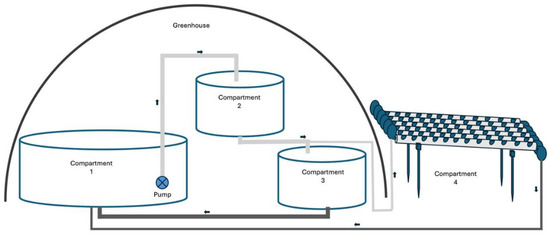
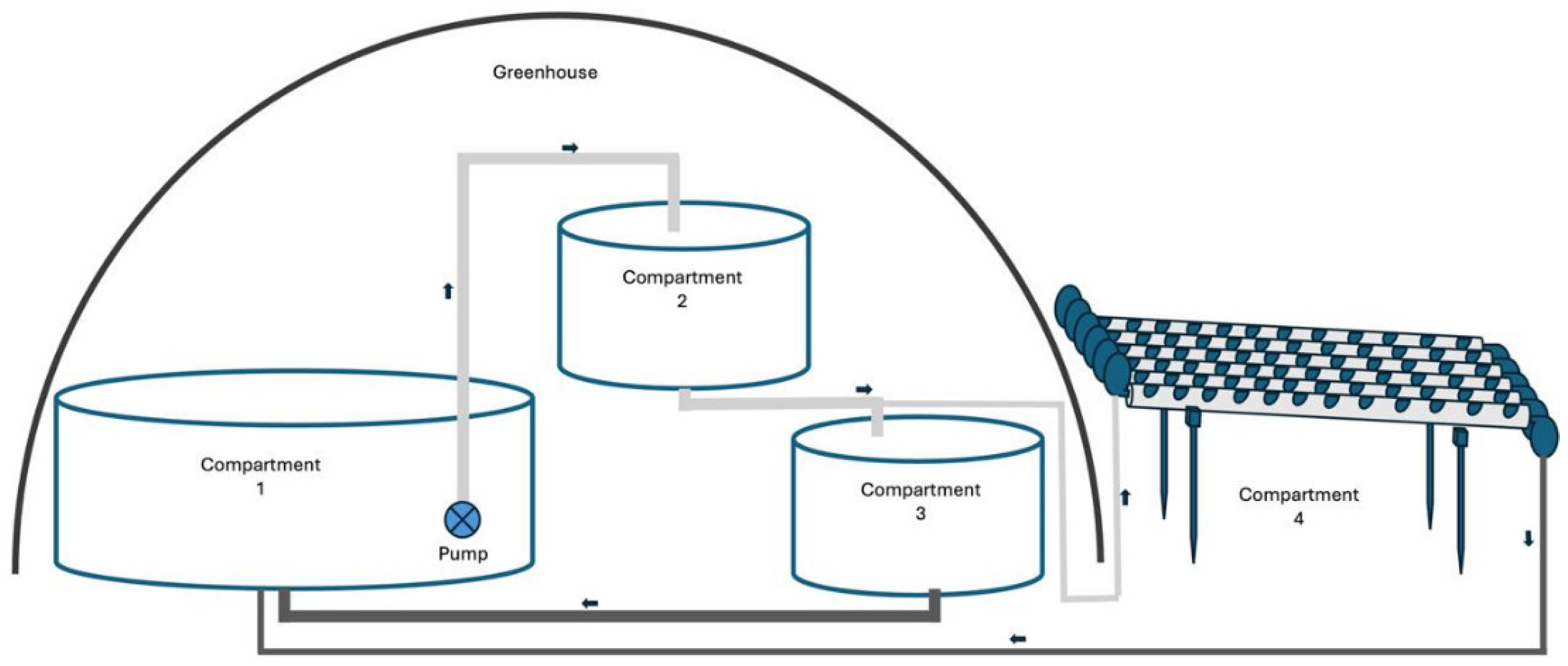
In the IMTA systems (Figure 1), the tanks were hydraulically connected through a recirculation setup powered by a single submersible pump (JAD AQUARIUM Co., Ltd. Jad FP Series, MODEL FP-58, 41 W, 2500 L h−1, Chaozhou, China.) installed in the shrimp tank. The outflow was split into two separate lines: one directed water to the mullet tank, which then drained by gravity into the oyster and sea cucumber tank before returning to the shrimp tank. The second line delivered water to the plant bed, from which it also flowed back to the shrimp tank.
Figure 1.
Illustrative representation of the IMTA system. Compartment 1: Shrimp tank; Compartment 2: Mullet tank; Compartment 3: Oyster and Sea cucumber tank; and Compartment 4: Salicornia hydroponic bench.
Continuous aeration was provided using a blower (Ibram®, 4HP, São Paulo, SP, Brazil) connected to Aero-Tube® Hose (20 cm, Orange Park, FL, USA), distributed one per m2. No water exchange was performed during the experimental period; losses due to evaporation were compensated by the addition of freshwater. All tanks were located inside the greenhouse equipped with an 80% shade cloth net (Sombrite®, Campinas, SP, Brazil), maintaining natural photoperiod conditions with reduced light intensity. For biofloc development, each tank was inoculated with 10% of fresh inoculum derived from a previously established and mature biofloc system from the Marine Shrimp Culture Laboratory.
2.4. Water Quality and Meteorological Parameters
Water temperature (°C) and dissolved oxygen (mg L−1) were monitored twice a day using a multiparameter probe (HANNA, HI98194, Woonsocket, RI, USA). Salinity (g L−1) was measured twice a week using the same device. For the water quality analyses, the samples were collected in plastic containers and taken immediately for analysis.
The following parameters were monitored twice a week: pH, using a benchtop pH meter (Mettler Toledo, FEP20, São Paulo, Brazil); TSS, following the method described by Strickland and Parsons [23], using pre-weighed Whatman glass fiber filters (0.45 µm); alkalinity (mg L−1), according to the methodology described by the American Public Health Association [24]; total ammonia nitrogen (N-NH3 + N-NH4+, mg L−1) and nitrite nitrogen (NO2−-N, mg L−1), measured by spectrophotometry using a HANNA photometer (HI83203, Woonsocket, RI, USA), following the UNESCO [25] and Aminot and Chaussepied [26], respectively.
Nitrate nitrogen (NO3−-N, mg L−1) and orthophosphate (PO43−, mg L−1) were monitored once a week using the same spectrophotometer, following the standard protocol from Aminot and Chaussepied [26] and García-Robledo et al. [27].
Calcium hydroxide [Ca(OH)2] was added whenever necessary to maintain alkalinity levels above 150 mg L−1. Total suspended solids (TSS) were monitored twice a week and managed using an operational threshold of 350 mg L−1. Whenever measured TSS values exceeded this threshold, clarifiers were activated with the objective of reducing TSS concentrations to approximately 300 mg L−1. The PVC pipes on the hydroponic benches were washed weekly, draining solids back to the shrimp tanks, to remove excess solids and prevent pipe blockages and water overflow.
Daily meteorological data were obtained from the INMET automatic station on the FURG campus (32°04′43″ S; 52°10′03″ W). The air temperature outside the greenhouse ranged from 14.5 to 38.5 °C (24.1 ± 0.4 °C), with a maximum solar radiation observed at 4.2 J m−2 s−1 (4150 W m−2; 21.3 ± 0.8 MJ m−2 day−1).
2.5. Growth Performance and Feeding Protocol
P. vannamei were individually weighed every week to adjust feed rations according to their biomass. M. liza individuals were also subjected to biometric analysis every two weeks, recording their individual body weight, standard length (cm), and total length (cm). C. tulipa were weighed individually, and shell height, length, and width were measured at the same biweekly interval. Biweekly H. grisea were dried externally with absorbent towels before being individually weighed within one minute, following the methodology described by Battaglene et al. [28] and Dong [29]. The same scale (Quality house, QH-0157, Nova Odessa, SP, Brazil) was used for all organisms throughout the experiment to ensure measurement consistency. All biometrics were conducted in the morning, prior to the first feeding.
Shrimp were fed twice daily with a commercial feed of 35% crude protein (Camanutri 35J, Neovia Nutricao e Saude Animal Ltda., Contagem, MG, Brazil), and rations were adjusted weekly based on biomass estimations according to [22]. M. liza rations were likewise adjusted biweekly based on the recorded biometrics using a daily feeding rate equivalent to 2% of their biomass; they were fed twice daily, at the same time as the shrimp, with a commercial feed of 45% crude protein (Guabitech inicial 1.0 mm, Guabi Nutrition and Animal Health S.A., Campinas, SP, Brazil).
At the end of the 45-day experiment, the following growth performance parameters were calculated:
Final mean weight (g) = final biomass (g)/total number of organisms
Feed conversion ratio = total weight of offered feed (g)/(final biomass (g) − initial biomass (g))
Daily growth (g day−1) = (final weight (g) − initial weight (g))/number of days
Yield (kg m−3) = (final biomass (kg) − initial biomass (kg))/useful tank volume (m−3)
Survival rate (%) = ((final biomass (g)/final mean weight (g))/(initial biomass (g)/initial mean weight (g))) × 100
The development of S. neei plants was evaluated based on the regrowth of branch apical meristems of the shoots after a leveling cut at day 1 [19]. Plants were submitted to one additional harvest after 45-day interval (≈6 weeks) at the same cutting height. The fresh shoot biomass of each plant was measured using a precision balance (±0.01 g). The fresh root biomass, which developed outside the cups, was quantified by weighing on a balance. The percentage of fresh biomass allocated to shoots was estimated by dividing the shoot biomass values by the total biomass formed (shoots + roots) and multiplying by 100. Shoot biomass production per unit of bench horizontal ground area was also estimated by summing the fresh shoot biomass of all plants on the bench and then dividing this total by the bench area (2.78 m2).
2.6. Microbiological Analysis
Water samples (18 mL) were collected from each experimental unit at the end of the trial to analyze microbial communities. Samples were taken using opaque glass containers to avoid light exposure, then fixed with 4% formalin (final concentration) and stored in amber bottles until further analysis. For bacterial abundance, the fixed samples were filtered through polycarbonate membrane filters (Whatman 10417006 Nuclepore, 0.2 μm pore, 2.5 mm diameter, Panorama City, CA, USA) previously treated with Irgalan black to block background fluorescence. The filters were stained with acridine orange (1 μg mL−1) following Hobbie et al. [30] and observed under an Axioplan-Zeiss epifluorescence microscope at 1000× magnification (ZEISS, Jardins, São Paulo, SP, Brazil). Thirty random fields were counted per sample, and bacteria were classified and counted manually based on their morphotypes.
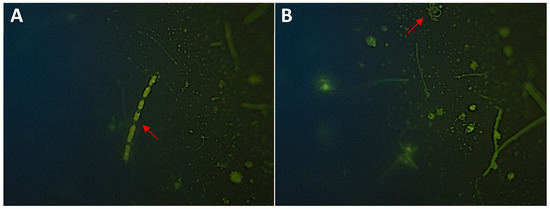
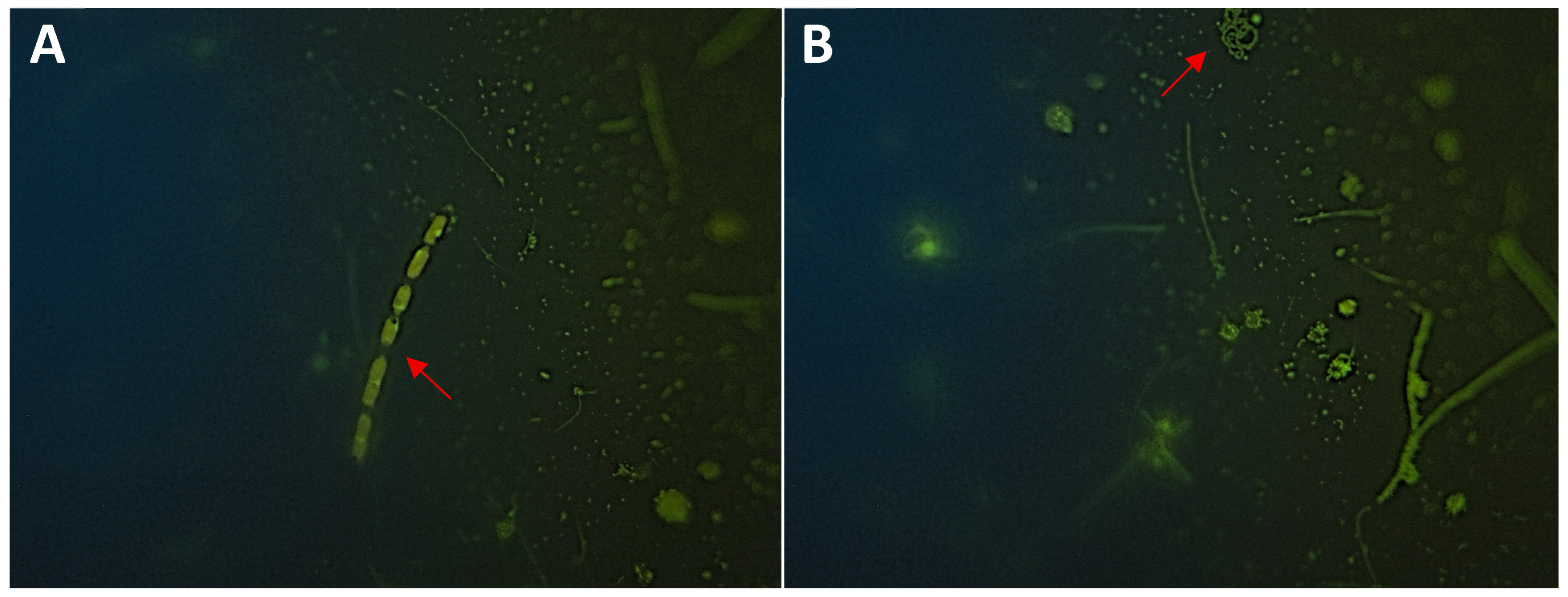
Cyanobacteria were classified into three operational morphological categories based on optical microscopy observations: small cyanobacteria, big cyanobacteria, and cyanobacteria clusters. Small cyanobacteria were defined as individual, dispersed cells with no visible aggregation. Big cyanobacteria corresponded to larger individual cells, filaments, or compact colonial structures observed as single morphological units (Figure 2A). Cyanobacteria clusters were defined as aggregations of multiple small cyanobacterial cells occurring in close association, forming irregular groupings without constituting a single compact colony, and frequently associated with biofloc particles (Figure 2B).
Figure 2.
Representative micrographs of cyanobacterial morphotypes observed in the systems. (A) = big cyanobacteria, observed as a single large morphological unit. (B) = cyanobacteria cluster, composed of multiple small cyanobacterial cells aggregated and associated with biofloc particles. Magnification: 100×.
2.7. Survival Estimation and Correlation Analyses
Sea cucumber survival was used as the main variable to assess its relationship with temperature and TSS within the IMTA-BFT system. No correlations were performed for M. lisa, since mortality was negligible, nor for C. tulipa, as their mortality occurred early and was independent of temperature. Moreover, oyster density in our system was far below the 0.33 individuals L−1 reported by Costa et al. [18] as the threshold required to exert effective control over TSS.
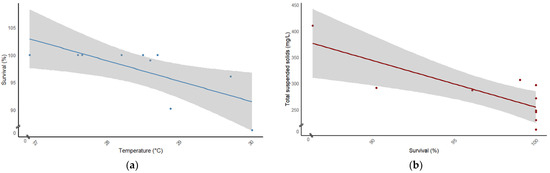
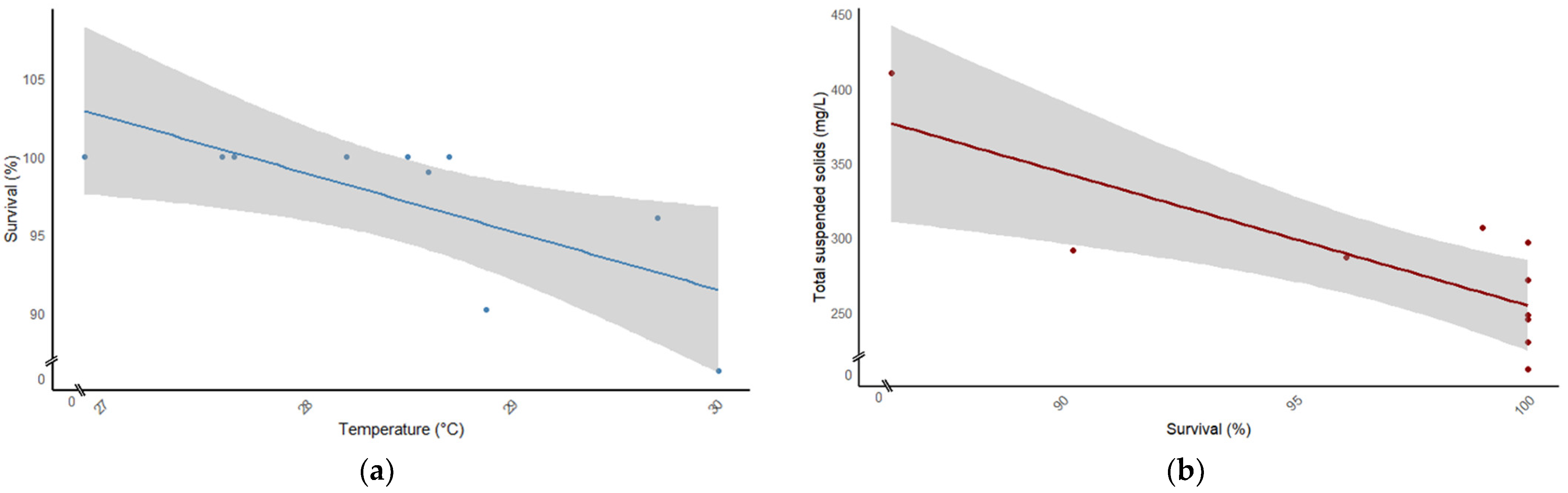
The correlation between temperature (y-axis) and sea cucumber survival (x-axis) was calculated using the full experimental period (day 0–45). In contrast, the correlation between survival (y-axis) and TSS (x-axis) was restricted to data collected up to week 5, since clarifiers were introduced thereafter to control TSS, introducing an additional factor that could bias the relationship.
When daily survival values were not available, they were estimated from the survival recorded during consecutive biometric samplings. Daily survival was interpolated by assuming a constant rate of change between the two samplings, using the following formula:
where Si is the survival value at the initial sampling, Sf is the survival value at the following sampling, Tb is the number of days between samplings (14 days in this study), and Si+n is the estimated survival at day n between both samplings. This approach linearly interpolates survival by distributing the total change in survival evenly across the interval between two biometric samplings.
Daily survival (%) = Si+n − (Si − Sf)/Tb
2.8. Statistical Analysis
All statistical analyses were performed in R (version RStudio 2024.12.1+563). Shrimp, mullet, and plant growth performance and microbiological variables were first tested for normality using the Shapiro–Wilk test and for homogeneity of variances using Levene’s test. Since only two treatments were compared, differences between groups were evaluated using Student’s t-tests (assuming equal or unequal variances depending on Levene’s test results).
For water quality parameters and other repeated measures, we applied linear mixed-effects models using the “nlme 3.1-166” package, considering time as a within-subject factor and treatment as a fixed effect. The best model structure was selected based on AIC values and residual diagnostics. When interactions between time and treatment were significant, estimated marginal means (EMMs) were computed using the “emmeans 1.11.2” package to facilitate interpretation.
The relationships between sea cucumber survival and environmental parameters (temperature and TSS) were assessed using Pearson’s product–moment correlation performed with the cor.test function in R. The analysis provided correlation coefficients, 95% confidence intervals, and p-values, with significance considered at p < 0.05.
All data were visualized using “ggplot2, 3.5.2”, and model assumptions were checked by inspecting residual plots. Statistical significance was set at p < 0.05.
3. Results
3.1. Water Quality Parameters
The overall water quality parameters remained within acceptable limits for shrimp culture in both treatments (Table 1). No significant differences were found between monoculture and IMTA systems for temperature, salinity, pH, ammonia, nitrite, nitrate, phosphate, or alkalinity (p > 0.05). However, the IMTA system showed significantly higher dissolved oxygen levels (5.73 ± 0.41 mg L−1 vs. 5.40 ± 0.55 mg L−1 in monoculture (p < 0.05) and required less calcium hydroxide over time (2.13 ± 0.52 kg in IMTA vs. 4.29 ± 0.38 kg in monoculture, p < 0.05).
Table 1.
Water quality parameters for the monoculture and IMTA system in the 45-day experiment. Values are means ± SD; means with different superscripts within the same row are significantly different (p < 0.05) after Student’s t-test analysis.
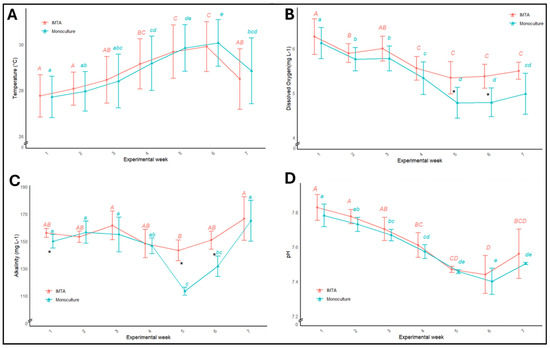
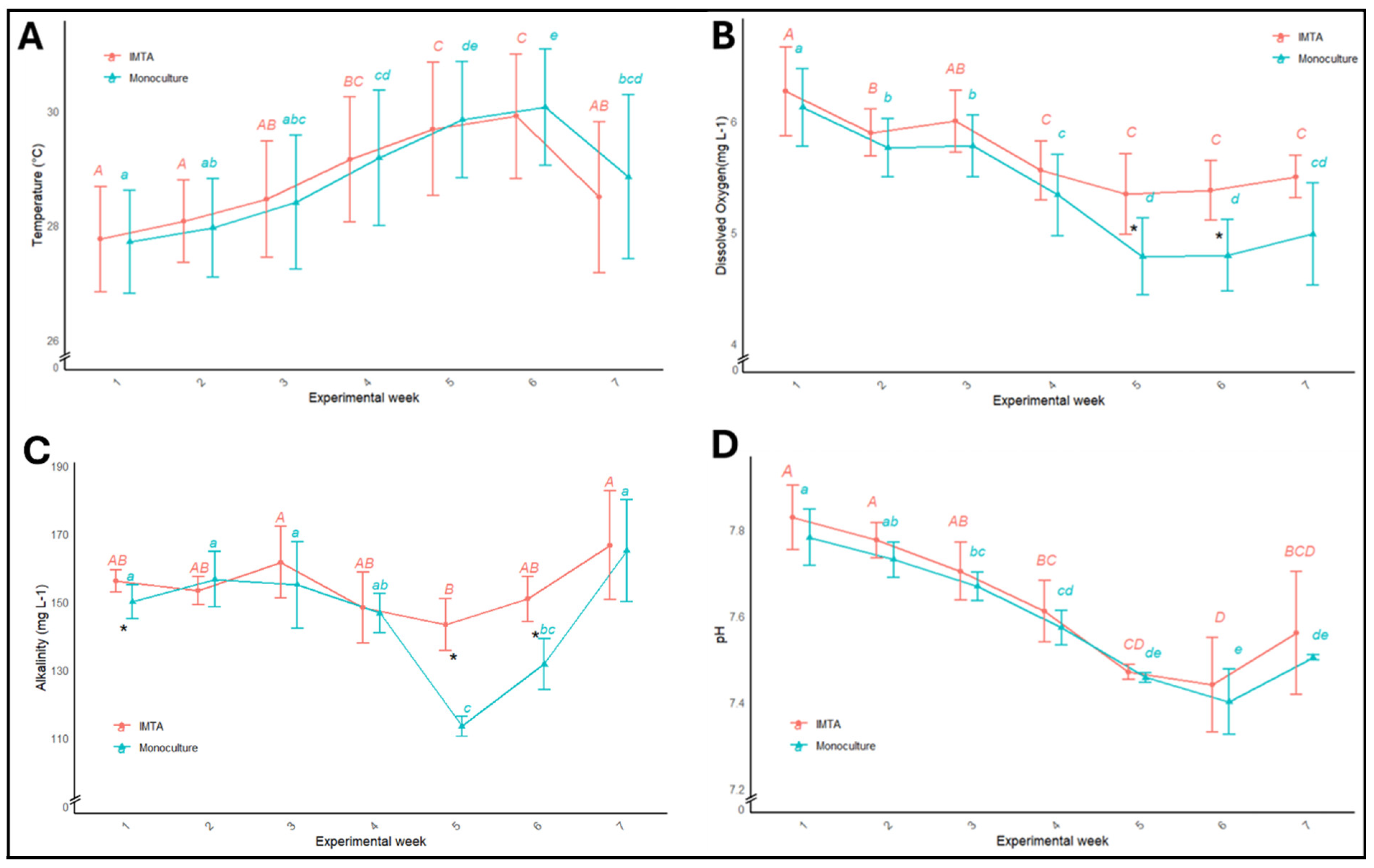
Temperature increased progressively from week 1 to week 6 due to seasonal warming, with a slight decline in week 7, likely related to the arrival of a cold front. Although no differences were observed between treatments, significant differences were found between weeks (p < 0.05), reflecting temporal variation in thermal conditions (Figure 3A). Dissolved oxygen concentrations began to diverge between treatments from week 5 onward, with significantly higher values in IMTA (p < 0.05) (Figure 3B).
Figure 3.
Evolution of temperature (A), dissolved oxygen (B), alkalinity (C), and pH (D) throughout the 45-day experiment, divided into weeks. Lines and error bars stand for the mean values and standard deviation (n = 3). Different letters indicate significant differences between weeks in the same treatment (p < 0.05). Asterisk (*) subscripts indicate significant differences between treatments in the same week (p < 0.05).
Alkalinity values showed a marked decline in the monoculture system during weeks 5 and 6, while remaining more stable in IMTA (p < 0.05). Outside this period, both treatments exhibited similar values. This indicates a greater buffering capacity in the IMTA system (Figure 3C). pH decreased gradually over the course of the experiment in both treatments. Although slightly higher pH values were recorded in IMTA during some weeks, these differences were not statistically significant. Both systems followed a similar downward trend over time (Figure 3D).
Table 2 summarizes the solids-related parameters measured in both systems. Notably, the IMTA system demonstrated significantly lower values of TSS and sludge production compared to the monoculture system (p < 0.05). Specifically, monoculture systems produced an average of 373.33 ± 53.48 mg/L of TSS and 15.87 ± 2.61 kg of sludge per tank, while IMTA systems recorded 299.56 ± 68.45 mg/L of TSS and 9.37 ± 1.49 kg of sludge per tank.
Table 2.
Mean suspended solids (SS), mean total suspended solids (TSS), and total sludge produced for the monoculture and IMTA system in the 45-day experiment. Values are means ± SD; means with different superscripts within the same row are significantly different (p < 0.05).
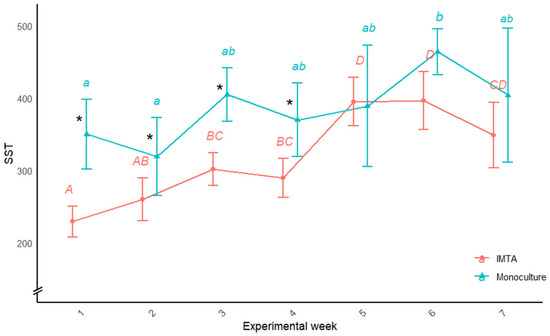
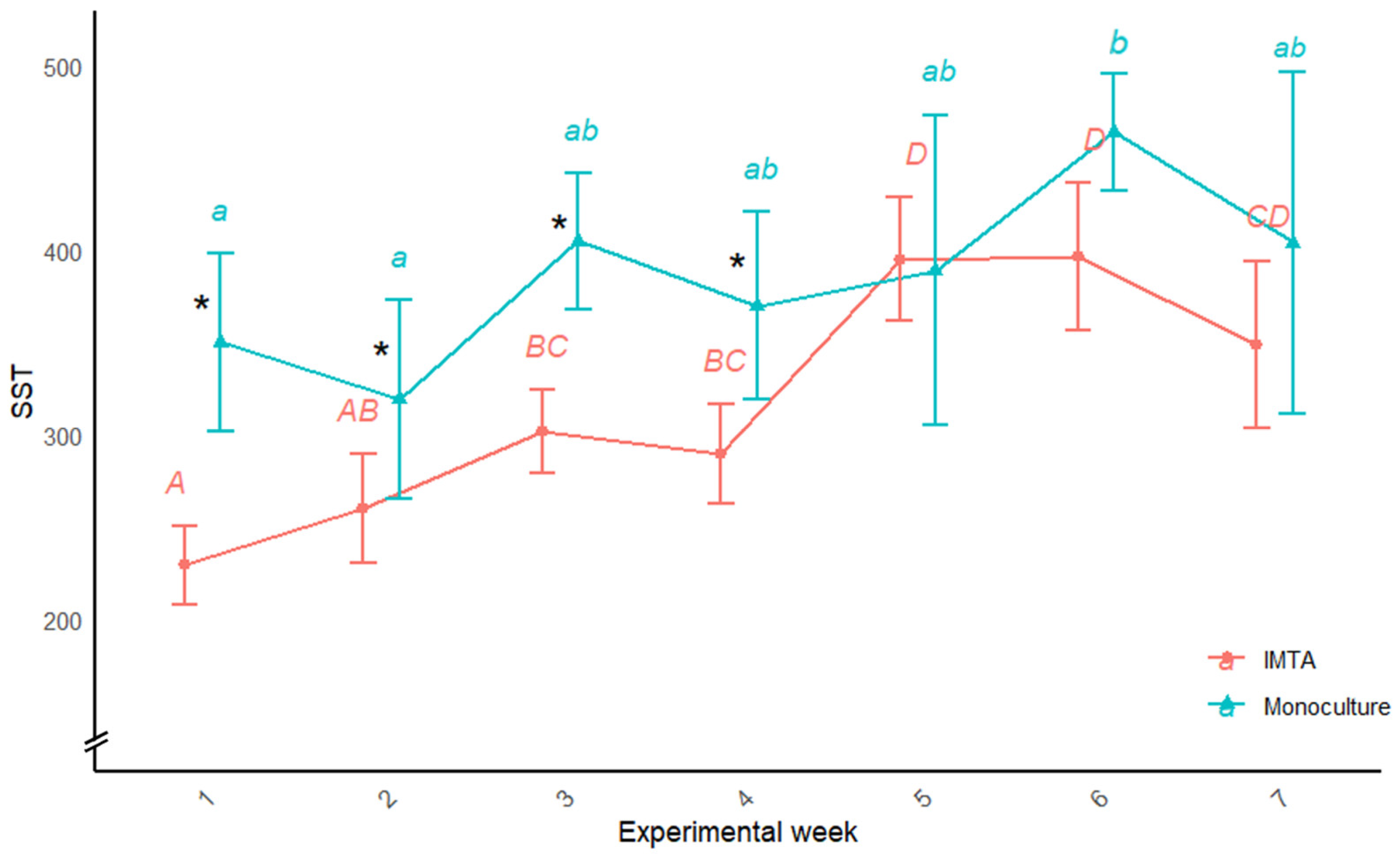
As shown in Figure 4, TSS values increased progressively in both systems, with significant differences observed between treatments during the first four weeks (p < 0.05). Monoculture consistently presented higher concentrations, whereas IMTA maintained comparatively lower levels, particularly during the initial phase. From week 5 onwards, however, differences between treatments were no longer significant, as TSS values converged. These results indicate that the IMTA system effectively reduced particulate matter and sludge generation during the early stages of culture, although this effect diminished over time.
Figure 4.
Evolution of total suspended solids throughout the 45-day experiment, divided into weeks. Lines and error bars stand for the mean values and standard deviation (n = 3). Different letter capitalization indicates significant differences between weeks in the same treatment (p < 0.05). Asterisks (*) indicate significant differences between treatments in the same week (p < 0.05).
Clarifier was required earlier and more frequently in the monoculture, beginning on day 6 and applied once per week, except for week 6 when it was used twice. In contrast, clarifier use in the IMTA system was not necessary until week 5.
3.2. Growth Performance Parameters
No significant differences were observed in any of the shrimp performance indicators between monoculture and IMTA systems. Both treatments showed similar final weight, daily growth, biomass, yield, and survival rates (Table 3). Mullets exhibited strong adaptation to the system, with a high survival (95.83 ± 1.67%) and a steady daily growth rate (0.29 ± 0.02 g day−1).
Table 3.
The zootechnical and plant parameters were obtained from the different species used, both in monoculture and in IMTA treatment. Values are means ± SD.
In contrast, oysters exhibited a negative growth rate (−0.06 ± 0.02 g day−1) and low survival (45.71 ± 17.01%), with only 64 final individuals remaining per tank (Table 3). Similarly, sea cucumbers also lost weight over the experimental period (−0.53 ± 0.12 g day−1) and showed moderate survival (56.9 ± 7.9%) with only 16.33 final individuals per tank.
Salicornia neei’s survival was approx. 78%. The individual plant parameters showed no significant difference (p > 0.05) between hydroponic benches. The overall average values of shoot biomass, total biomass (shoot + root), and allocation to shoot formation were 15.20 g, 16.33 g, and 93.37%, respectively. The average yield of S. neei fresh shoots (per bench area) ranged from 280.35 to 514.27 g m−2 after a growing period of 6 weeks (average = 431.58 g m−2; Table 3).
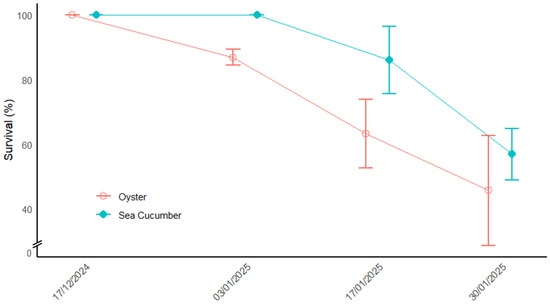
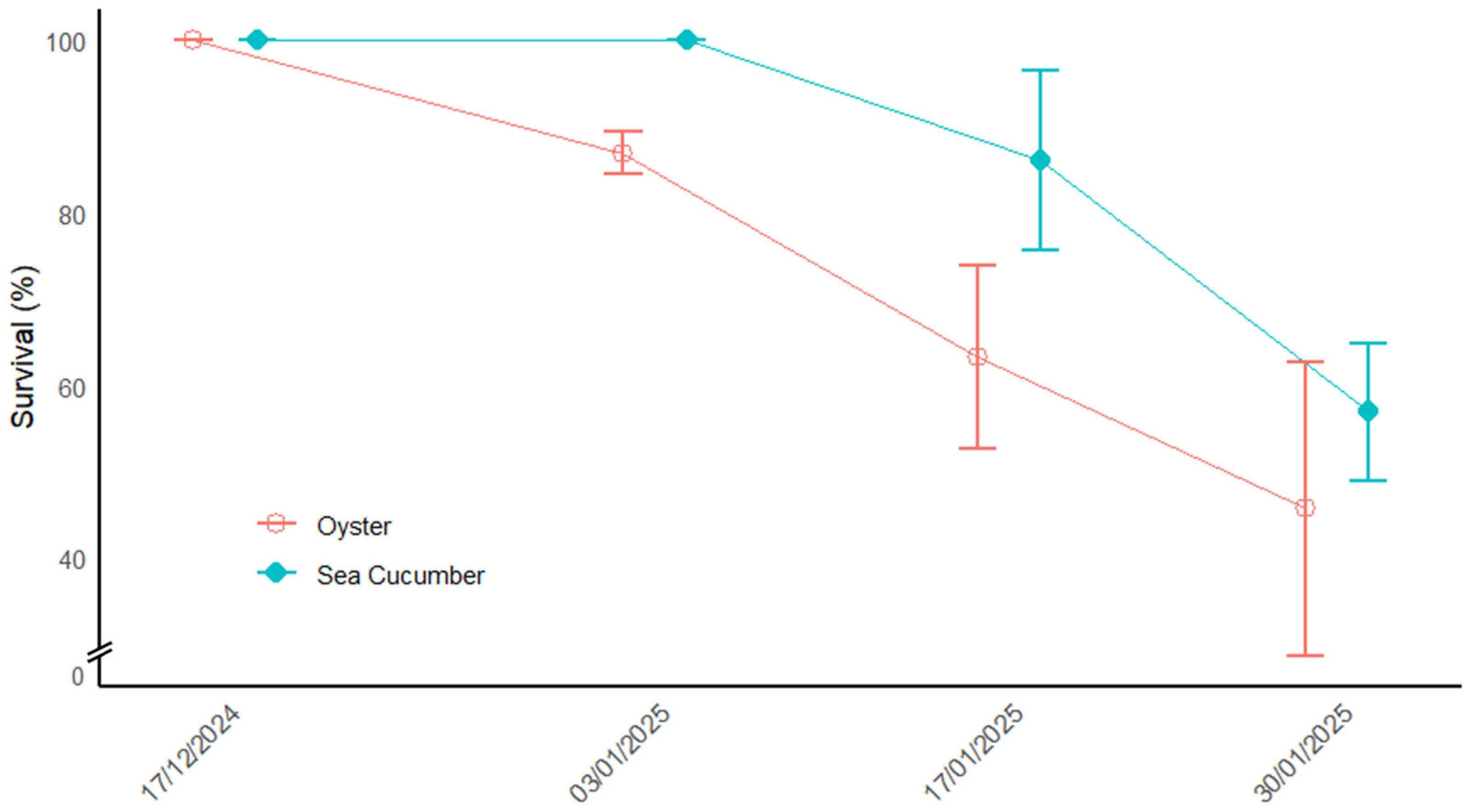
Figure 5 shows the survival trends of oysters and sea cucumbers throughout the experimental period. Oyster mortality began early, with a steady decline from the first biometry, reaching values below 45.71 ± 17.01% by the end of the study. In contrast, sea cucumbers maintained survival rates close to 100% during the first 30 days, after which a marked decline was observed, coinciding with a sustained increase in temperature above 28 °C.
Figure 5.
Evolution of survival for oyster (Crassostrea tulipa) and sea cucumber (Holothuria grisea) throughout the 45-day experiment. Lines and error bars stand for the mean values and standard deviation (n = 3).
3.3. Microorganism Analysis
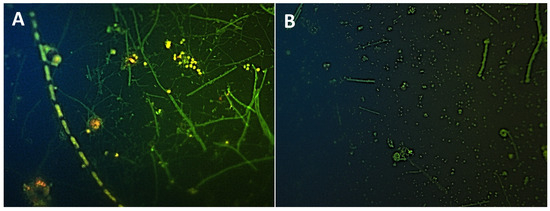
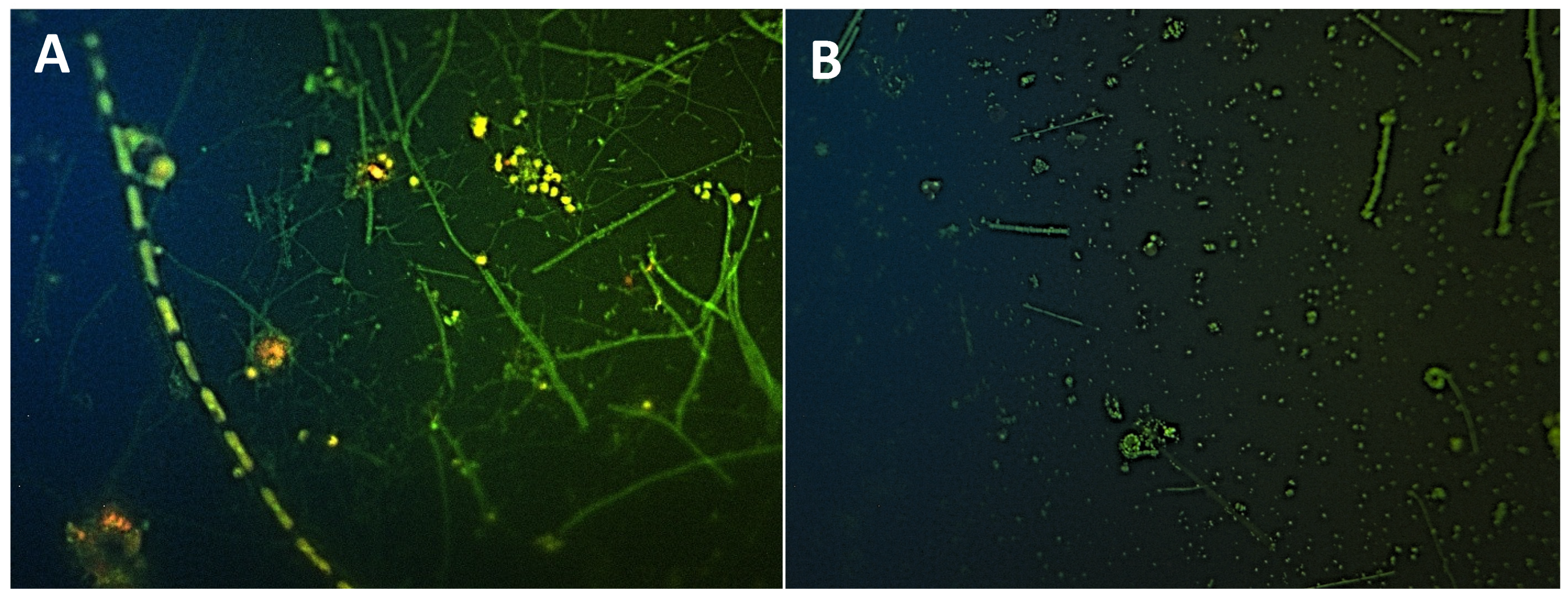
Representative micrographs of bacterial communities in monoculture and IMTA systems are shown in Figure 6A and Figure 6B, respectively. The analysis of the final microbial communities revealed clear differences between the monoculture and IMTA systems (Table 4). In the IMTA treatment, coccoid forms overwhelmingly dominated (86.72 ± 1.49% vs. 47.04 ± 2.35% in monoculture). Conversely, monoculture systems showed a greater abundance of free filamentous bacteria (34.22 ± 5.01% vs. 4.24 ± 0.61%), fusiform bacteria (8.2 ± 1.32% vs. 1.66 ± 0.18%), and adhered filamentous bacteria (3.28 ± 0.63% vs. 0.68 ± 0.27%).
Figure 6.
Representative sample of bacterial communities in different treatments: (A) = monoculture; (B) = IMTA. Magnification: 100×.
Table 4.
The relative abundances of bacteria obtained from monoculture and IMTA treatment. Values are means ± SD; means with different superscripts within the same row are significantly different (p < 0.05) after the Student’s t-test.
Although Vibrio was present in both treatments, its abundance did not differ significantly between systems. Interestingly, bacilli were more abundant in IMTA (3.55 ± 0.84% vs. 0.91 ± 0.33% in monoculture). Small and large cyanobacteria were notably reduced under IMTA conditions, and grouped cyanobacteria appeared only in this treatment, though at very low proportions.
3.4. Correlations
Pearson’s correlation analysis revealed a significant negative relationship between temperature and sea cucumber survival (r = −0.71, p = 0.0208) (Figure 7a). Survival also showed a significant negative correlation with TSS (r = −0.79, p = 0.0060), highlighting that reduced survival was linked to higher concentrations of suspended solids (Figure 7b).
Figure 7.
Pearson’s correlation analysis for: (a) survival rate of sea cucumber vs. temperature; (b) = total suspended solids vs. survival rate of sea cucumber. Daily survival values of sea cucumbers were estimated by linear interpolation between consecutive biweekly biometric samplings, assuming a constant rate of change within each interval.
4. Discussion
This study aimed to evaluate the performance of an integrated multitrophic aquaculture system compared to a shrimp monoculture under biofloc conditions. Although shrimp growth and survival did not differ significantly between systems, the inclusion of extractive species promoted a reduction in suspended solids, less calcium hydroxide addition over time, and it shaped a more balanced microbiota dominated by coccoid forms. Unlike oysters, which showed poor adaptation, sea cucumbers played a clear role in regulating the system, underscoring their importance as keystone extractive organisms in diversified aquaculture designs.
4.1. Growth Performance
Shrimp, P. vannamei, growth and survival were not affected by the IMTA system, indicating that the inclusion of extractive species does not compromise the primary crop. Mullet, M. lisa, showed excellent adaptation, reaching 95.8% survival and steady growth (0.29 g day−1), even with restricted feeding. Previous studies [17,31,32] demonstrated that mullets tolerate biofloc conditions and actively consume floc, confirming that M. liza can be successfully integrated into high-density systems with minimal supplementation.
Oysters, C. tulipa, however, performed poorly under biofloc conditions, with only 45.7% survival and experiencing weight loss. Lima et al. [10] reported that juvenile oyster survival declines under more than 5 mL L−1 of settleable solids (ρ = −0.79), with the lowest mortalities at 0–5 mL L−1. In this study, settleable solids exceeded 7 mL L−1 from day 3 onward, likely causing physiological stress that impaired oyster performance [33]. Thermal stress added further pressure: Li et al. [34] and Rybovich et al. [35] showed that temperatures above 28 °C significantly increase oyster mortality. Thus, the low survival and poor nutritional condition of oysters likely resulted from the combined effect of high particle load, elevated temperature, and microbial aggregation.
Sea cucumbers, H. grisea, initially adapted well to biofloc, maintaining nearly 100% survival during the first 30 days. However, survival declined sharply to 56.9% once average temperatures rose above 28 °C. Pearson’s correlation showed a significant negative relationship between temperature and survival (r = −0.71, p = 0.0208), indicating that thermal stress was a major driver of mortality. Zamora & Jeffs [36] reported that Australostichopus mollis reduces ingestion by 40% and conversion efficiency by 70% at 24–26 °C. Although H. grisea may tolerate higher temperatures, it is likely that some individuals stopped feeding before mortality occurred, limiting their role as extractive species. Similar temperature sensitivity has been observed in other holothurians, where growth and energy balance are strongly impaired by heat stress [37,38,39].
It should be noted that daily survival values used in the correlation analyses were derived from linear interpolation between biweekly biometric samplings, assuming a constant mortality rate between observations. This approach may increase temporal autocorrelation and thus potentially inflate the apparent strength of the temperature–survival relationship. Accordingly, the reported correlation coefficient (r = −0.71) should be interpreted as indicative of a robust temporal trend rather than as a precise estimate of instantaneous mortality response.
Salicornia neei showed a moderate survival rate (78%) compared with the commonly reported values above 90% [19,40]. This outcome was associated with intense heat waves that affected the region in January 2025 and with inadequate irrigation in one of the three hydroponic benches, where only 49% of the plants survived. The individual plant parameters and overall yield were relatively low compared with other aquaponic studies using the same species, which have reported yields ranging from 380 to 2200 g m−2 [40]. Dissolved macronutrient concentrations in the IMTA system were above the limiting values for this species [41], suggesting that the reduced plant performance was again related to the same factors that affected survival.
4.2. Control of TSS
The IMTA system displayed an early and clear capacity to control total suspended solids and sludge production, although this function was partially lost after week 5. For the first four weeks, clarifiers were unnecessary in IMTA, while monoculture required them from day 6, highlighting greater passive stability in the integrated system. Average TSS in IMTA (299.56 mg L−1) was significantly lower than in monoculture (373.33 mg L−1), and total sludge production was reduced by 41% (9.37 vs. 15.87 kg). This represents a substantial reduction in organic load, with monoculture systems producing 0.3 kg of sludge per kg of shrimp, while IMTA producing 0.17 kg of sludge per kg of shrimp.
Holanda et al. [11] showed that M. lisa effectively controls TSS, though at a lower shrimp-to-mullet ratio (1.5:1) compared to this study (50:1). Borges et al. [17] also demonstrated that mullets fed at 1% biomass reduced sludge generation by one-third. In contrast, mullets in our system received 2% biomass daily feed intake, likely increasing organic load. While mullets contributed to solids regulation [31,42], most of the reduction was attributable to other extractive species.
Oysters did not contribute significantly to the control of TSS. Their survival rate was low, and their density (0.045 ind L−1) was well below the threshold used by Costa et al. [18] of 0.33 ind L−1, where it was shown that they do not control TSS. Moreover, settleable solids in IMTA (10.7 mL L−1) exceeded the 5 mL L−1 optimum for oyster survival, further limiting their extractive capacity [10,33]. Although bioflocs can be deposited in the pipes of hydroponic benches and S. neei roots grow over them [40], most of the solids returned to the shrimp tank by weekly washing of the pipes and plants did not affect TSS content.
Holothuria grisea emerged as a keystone species in regulating system stability. During their peak survival in the first month, TSS and sludge production dropped significantly. However, as temperatures exceeded 28 °C, sea cucumber survival declined sharply, leading to a marked rise in TSS. Physiological stress likely preceded mortality [36,37,39], suggesting that individuals stopped feeding before death. Furthermore, their carcasses, accumulated due to the inability to detect them in a biofloc system, likely became an additional organic source, increasing TSS in later weeks. These findings suggest that thermal stress not only limits the functionality of sea cucumbers as extractive organisms but also exposes a critical vulnerability in IMTA systems reliant on temperature-sensitive species.
Collectively, these results suggest that IMTA did not fail by design but due to the loss of functional species. The sea cucumber possibly acted as an allogenic engineer, like earthworms, stabilizing the system until its decline, which marked a tipping point in solids regulation. Possibly using species of sea cucumber with environmental compatibility with P. vannamei, such as Holothuria scabra or Holothuria edulis, will solve these problems. More research is required.
4.3. Water Quality
Water quality remained within suitable ranges for P. vannamei in both systems, with no significant differences in temperature, salinity, pH, or dissolved nutrients. However, two parameters highlighted a functional advantage of IMTA: greater alkalinity stability and higher dissolved oxygen, both indicators of systemic regulation.
Wolfe et al. [43] showed that Stichopus herrmanni can act as a biological buffer, modulating alkalinity via carbonate dissolution and inorganic carbon release. In our system, this was reflected in a 50% reduction in hydrated lime, Ca(OH)2, use (39.65 g per kg of shrimp in IMTA vs. 82.83 g per kg of shrimp in monoculture), despite no final difference in alkalinity between treatments. Thus, IMTA not only maintained alkalinity but stabilized it with less chemical input, likely due to reduced TSS and H. grisea activity.
Bioturbation and sediment ingestion by sea cucumbers and mullets likely promoted carbonate remineralization [13,44]. While direct evidence of holothurian effects on alkalinity in biofloc systems is scarce [45,46], our results provide novel evidence that their presence reduces reliance on external inputs. Additionally, the solubility of carbonates is inversely proportional to temperature. Underwater conditions with pH higher than 7.2 and elevated temperatures, magnesium and calcium carbonates may have precipitated [47] within the pipes of the hydroponic benches and been carried back to the shrimp tanks during weekly cleaning. The contribution of the coupled hydroponic bench to carbonate stability in saline IMTAs requires further investigation.
Dissolved oxygen was significantly higher in IMTA than in monoculture, independent of temperature or salinity. This improvement likely reflects lower biological oxygen demand due to reduced TSS. Ray et al. [48] showed that TSS removal enhances oxygen availability in high-density systems. Because flocs are composed of live heterotrophic bacteria, lower accumulation reduces oxygen consumption [49]. Additionally, functional biomass distribution in IMTA with metabolic load shared across mullets, oysters, sea cucumbers, and Salicornia, likely reduced respiratory demand in the main tank. This “division of metabolic labor” suggests that IMTA improves efficiency not by sheer water volume, but by a more balanced systemic regulation.
4.4. Microbial Community
Biofloc composition differed sharply between treatments, with IMTA showing a marked reduction in filamentous bacteria. While some filaments aid biofloc structure, their overgrowth weakens aggregation and hampers sedimentation, compromising stability in zero-exchange systems [50]. Burger et al. [51] reported that protruding filaments hinder solid–liquid separation, while Shi et al. [52] noted that AHL-mediated quorum sensing promotes filament proliferation, destabilizing floc. In contrast, IMTA favored a coccoid-dominated microbiota, associated with denser, more stable, and easily settled flocs [49]. This indicates that the integrated system positively modulated microbial dynamics.
IMTA also reduced both large and small cyanobacteria, groups that compete with biofloc, induce flotation, or produce toxins. Although mechanisms were not directly tested, Salicornia neei may have contributed. Nezbrytska et al. [53] reviewed evidence that aquatic vascular plants suppress cyanobacteria through nutrient competition, allelopathic release, and modification of microenvironments. For instance, recently, Teles et al. [54] identified twenty-nine bacterial strains from the rhizosphere of Brazilian populations of S. neei (sin. S. fruticosa) by molecular tools and determined their phosphorus solubilization capability.
Overall, the microbial composition suggests a greater dominance of coccoid forms in IMTA, associated with lower abundances of filamentous and potentially problematic groups that were prevalent in monoculture. These patterns indicate that IMTA may favor a more stable microbial community structure, potentially reducing the risk of excessive cyanobacterial proliferation observed under monoculture conditions. These findings suggest that IMTA not only regulates water quality but also fosters a more resilient microbial community, reducing groups linked to instability and health risks.
5. Conclusions
The integrated multitrophic aquaculture (IMTA) system effectively maintained water quality, reducing total suspended solids (TSS) and sludge production while promoting a more stable microbial community dominated by coccoid forms. This biological regulation minimized the need for chemical correction, with lime usage reduced by more than half compared to monoculture, demonstrating that IMTA can enhance system stability while lowering operational costs.
Author Contributions
Writing—original draft: E.A.E.H.; Writing—review and editing: I.S., C.S.B.C., R.V.R., S.M.-L. and L.H.P.; Methodology: E.A.E.H., I.S., M.H.O., M.S.K. and L.M.; Formal analysis: E.A.E.H. and I.S.; Investigation: E.A.E.H. and L.M.; Visualization: E.A.E.H., I.S. and R.V.R.; Conceptualization: E.A.E.H., I.S. and L.M.; Validation: E.A.E.H., I.S., C.S.B.C., R.V.R. and L.H.P.; Resources: L.A.S., C.S.B.C., R.V.R., D.K. and L.H.P.; Supervision: R.V.R. and L.H.P.; Project administration: R.V.R. and L.H.P. All authors have read and agreed to the published version of the manuscript.
Funding
This study was funded by the Sustainable Blue Economy Partnership (SBEP) project BLUEBOOST ID: SBEP2023-725 with European Union COFUND, Horizon Europe, and Foundation for Research Support of the State of Rio Grande do Sul (FAPERGS), project number 24/2551-0000118-2. This study was financed in part by the Coordenacao de Aperfeiçoamento de Pessoal de Nível Superior—Brasil (CAPES). Edital FAPERGS/CNPq 07/2022—Programa de Apoio à Fixação de Jovens Doutores no Brasil, Grant 23/2551-0001887-0 has also contributed. Luís André Sampaio and Luis Poersch are also supported by Brazilian CNPq, Grant 315939/2023-0 and 307403/2023-8, respectively.
Institutional Review Board Statement
The present study was approved by the Ethics Committee on Animal Use of the FURG (Protocol 23116.003569/2024-19).
Data Availability Statement
The data used for statistical analysis can be found in Zenodo, an EU Open Research Repository, with the DOI: https://doi.org/10.5281/zenodo.17724828 (accessed on 15 December 2025).
Acknowledgments
The authors thank all the students and staff who contributed to and supported the entire study. The author also thanks the Sustainable Blue Economy Partnership, all members of the BLUEBOOST project, and the Foundation for Research Support of the State of Rio Grande do Sul. The author thanks Project CYTED Red Latinoamericana de Biointegración Agro-Acuícola para una Economía Circular Sostenible (CYTED-SIBIOLAT Plus) P423RT0144. The authors would also like to thank Ivan Angelo Taffarel Trois, owner of Moluskus fazenda marinha ltda. for their valuable support during the collection of sea cucumbers and for providing part of the oysters used in this study. The authors would like to thank Wilson Wasielesky Jr. for his support in facilitating logistical contacts related to the acquisition of biological material used in this study.
Conflicts of Interest
The authors declare that they have no conflicts of interest.
References
- Avnimelech, Y. Carbon/nitrogen ratio as a control element in aquaculture systems. Aquaculture 1999, 176, 227–235. [Google Scholar] [CrossRef] [Scilit]
- Ballester, E.L.C.; Abreu, P.C.; Cavalli, R.O.; Emerenciano, M.; De Abreu, L.; Wasielesky, W., Jr. Effect of practical diets with different protein levels on the performance of Farfantepenaeus paulensis juveniles nursed in a zero exchange suspended microbial flocs intensive system. Aquac. Nutr. 2010, 16, 163–172. [Google Scholar] [CrossRef] [Scilit]
- Avnimelech, Y. Biofloc Technology. In A Practical Guide Book; The World Aquaculture Society: Baton Rouge, LA, USA, 2009. [Google Scholar]
- Dauda, A.B. Biofloc technology: A review on the microbial interactions, operational parameters and implications to disease and health management of cultured aquatic animals. Rev. Aquac. 2020, 12, 1193–1210. [Google Scholar] [CrossRef] [Scilit]
- Schveitzer, R.; Baccarat, R.F.C.; Gaona, C.A.P.; Wasielesky, W., Jr.; Arantes, R. Concentration of suspended solids in superintensive culture of the Pacific white shrimp Litopenaeus vannamei with biofloc technology (BFT): A review. Rev. Aquac. 2024, 16, 785–795. [Google Scholar] [CrossRef] [Scilit]
- Soaudy, M.R.; Ghonimy, A.; Greco, L.S.L.; Chen, Z.; Dyzenchauz, A.; Li, J. Total suspended solids and their impact in a biofloc system: Current and potentially new management strategies. Aquaculture 2023, 572, 739524. [Google Scholar] [CrossRef] [Scilit]
- Poli, M.A.; Legarda, E.C.; Lorenzo, M.A.; Pinheiro, I.; Martins, M.A.; Seiffert, W.Q.; Vieira, F. Integrated multitrophic aquaculture applied to shrimp rearing in a biofloc system. Aquaculture 2019, 511, 734274. [Google Scholar] [CrossRef] [Scilit]
- Lal, J.; Singh, S.K.; Pawar, L.; Biswas, P.; Meitei, M.M.; Meena, D.K. Chapter 15—Integrated multi-trophic aquaculture: A balanced ecosystem approach to blue revolution. In Organic Farming, 2nd ed.; Sarathchandran, Unni, M.R., Thomas, S., Meena, D.K., Eds.; Woodhead Publishing: Sawston, UK, 2023; pp. 513–535. [Google Scholar] [CrossRef] [Scilit]
- Cubillo, A.M.; Ferreira, J.G.; Robinson, S.M.C.; Pearce, C.M.; Corner, R.A.; Johansen, J. Role of deposit feeders in integrated multi-trophic aquaculture—A model analysis. Aquaculture 2016, 453, 54–66. [Google Scholar] [CrossRef] [Scilit]
- Lima, P.C.M.; Silva, A.E.M.; Silva, D.A.; Silva, S.M.B.C.; Brito, L.O.; Gálvez, A.O. Effect of stocking density of Crassostrea sp. In a multitrophic biofloc system with Litopenaeus vannamei in nursery. Aquaculture 2021, 530, 735913. [Google Scholar] [CrossRef] [Scilit]
- Holanda, M.; Santana, G.; Furtado, P.; Rodrigues, R.V.; Cerqueira, V.R.; Sampaio, L.A.; Wasielesky, W.; Poersch, L.H. Evidence of total suspended solids control by Mugil liza reared in an integrated system with pacific white shrimp Litopenaeus vannamei using biofloc technology. Aquac. Rep. 2020, 18, 100479. [Google Scholar] [CrossRef] [Scilit]
- Arnull, J.; Wilson, A.; Brayne, K.; Dexter, K.; Donah, A.; Gough, C.; Klückow, T.; Ngwenya, B.; Tudhope, A. Ecological co-benefits from sea cucumber farming: Holothuria scabra increases growth rate of seagrass. Aquac. Environ. Interact. 2021, 13, 301–310. [Google Scholar] [CrossRef] [Scilit]
- Purcell, S.W.; Conand, C.; Byrne, S.U.M. Ecological Roles of Exploited Sea Cucumbers. In Oceanography and Marine Biology: An Annual Review; CRC Press: Boca Raton, FL, USA, 2016. [Google Scholar]
- Contreras-Sillero, M.E.; Pacheco-Vega, J.M.; Valdez-González, F.J.; De La Paz-Rodríguez, G.; Cadena-Roa, M.A.; Bautista-Covarrubias, J.C.; Godínez-Siordia, D.E. Polyculture of White shrimp (Penaeus vannamei) and sea cucumber (Holothuria inornata) in a biofloc system. Aquac. Res. 2020, 51, 4410–4420. [Google Scholar] [CrossRef] [Scilit]
- Chen, J.; Chang, Y. Sea Cucumber Aquaculture in China. In Echinoderm Aquaculture; John Wiley & Sons, Ltd.: Hoboken, NJ, USA, 2015; pp. 317–330. [Google Scholar] [CrossRef] [Scilit]
- Meñez, M.A.; Tech, E.; Ticao, I.; Gorospe, J.R.; Edullantes, C.; Rioja, R.A. Adaptive and integrated culture production systems for the tropical sea cucumber Holothuria scabra. Fish. Res. 2016, 186, 502–513. [Google Scholar] [CrossRef] [Scilit]
- Borges, B.A.A.; Rocha, J.L.; Pinto, P.H.O.; Zacheu, T.; Chede, A.C.; Magnotti, C.C.F.; Cerqueira, V.R.; Arana, L.A.V. Integrated culture of white shrimp Litopenaeus vannamei and mullet Mugil liza on biofloc technology: Zootechnical performance, sludge generation, and Vibrio spp. reduction. Aquaculture 2020, 524, 735234. [Google Scholar] [CrossRef] [Scilit]
- Costa, L.C.d.O.; Poersch, L.H.d.S.; Abreu, P.C. Biofloc removal by the oyster Crassostrea gasar as a candidate species to an Integrated Multi-Trophic Aquaculture (IMTA) system with the marine shrimp Litopenaeus vannamei. Aquaculture 2021, 540, 736731. [Google Scholar] [CrossRef] [Scilit]
- Doncato, K.B.; Costa, C.S. Effects of cutting on vegetative development and biomass quality of perennial halophytes grown in saline aquaponics. Hortic. Bras. 2022, 40, 432–440. [Google Scholar] [CrossRef] [Scilit]
- Diaz, M.R.; Araneda, J.; Osses, A.; Orellana, J.; Gallardo, J.A. Efficiency of Salicornia neei to Treat Aquaculture Effluent from a Hypersaline and Artificial Wetland. Agriculture 2020, 10, 621. [Google Scholar] [CrossRef] [Scilit]
- Harboub, N.; Mighri, H.; Bennour, N.; Dbara, M.; Pereira, C.; Chouikhi, N.; Custódio, L.; Abdellaoui, R.; Akrout, A. Nutritional profile, chemical composition and health promoting properties of Salicornia emerici Duval-Jouve and Sarcocornia alpini (Lag.) Rivas Mart. From southern Tunisia. Biocatal. Agric. Biotechnol. 2025, 64, 103502. [Google Scholar] [CrossRef] [Scilit]
- Jory, D.E.; Cabrera, T.R.; Dugger, D.; Fegan, D.; Lee, P.G.; Lawrence, A.L.; Jackson, C.J.; McIntosh, R.P.; Castañeda, J. A global review of shrimp feed management: Status and perspectives. New Wave Proc. Spec. Sess. Sustain. Shrimp Cult. Aquac. 2001, 2001, 104–152. [Google Scholar]
- Strickland, J.D.H.; Parsons, T.R. A Practical Handbook of Seawater Analysis, 2nd ed.; Fisheries Research Board of Canada: Ottawa, ON, Canada, 1972; Available online: https://epic.awi.de/id/eprint/39262/1/Strickland-Parsons_1972.pdf (accessed on 15 November 2025).
- APHA. Standard Methods for the Examination of Water and Wastewater, 24th ed.; American Public Health Association: Washington, DC, USA; American Water Works Association: Denver, CO, USA; Water Environment Federation: Alexandria, VA, USA, 2022. [Google Scholar]
- UNESCO. Intergovernmental Oceanographic Commission Chemical methods for use in marine environment monitoring. In Intergovernmental Oceanographic Commission Manuals and Guides; 12; UNESCO: Paris, France, 1983; p. 53. [Google Scholar] [CrossRef]
- Aminot, A.; Centre National pour l’Exploitation des Oceans; Chaussepied, M. Manuel des Analyses Chimiques En Milieu Marin; CNEXO: Brest, France, 1983; Available online: https://agris.fao.org/search/en/providers/122621/records/647396bae01106880097f33c (accessed on 15 December 2025).
- García-Robledo, E.; Corzo, A.; Papaspyrou, S. A fast and direct spectrophotometric method for the sequential determination of nitrate and nitrite at low concentrations in small volumes. Mar. Chem. 2014, 162, 30–36. [Google Scholar] [CrossRef] [Scilit]
- Battaglene, S.C.; Seymour, J.E.; Ramofafia, C. Survival and growth of cultured juvenile sea cucumbers, Holothuria scabra. Aquaculture 1999, 178, 293–322. [Google Scholar] [CrossRef] [Scilit]
- Dong, Y.; Dong, S. Growth and oxygen consumption of the juvenile sea cucumber Apostichopus japonicus (Selenka) at constant and fluctuating water temperatures. Aquac. Res. 2006, 37, 1327–1333. [Google Scholar] [CrossRef] [Scilit]
- Hobbie, J.E.; Daley, R.J.; Jasper, S. Use of nuclepore filters for counting bacteria by fluorescence microscopy. Appl. Environ. Microbiol. 1977, 33, 1225–1228. [Google Scholar] [CrossRef] [Scilit] [PubMed]
- Hoang, M.N.; Nguyen, P.N.; Le, D.V.B.; Nguyen, D.V.; Bossier, P. Effects of stocking density of gray mullet Mugil cephalus on water quality, growth performance, nutrient conversion rate, and microbial community structure in the white shrimp Litopenaeus vannamei integrated system. Aquaculture 2018, 496, 123–133. [Google Scholar] [CrossRef] [Scilit]
- Hoang, M.N.; Nguyen, P.N.; Bossier, P. Water quality, animal performance, nutrient budgets and microbial community in the biofloc-based polyculture system of white shrimp, Litopenaeus vannamei and gray mullet, Mugil cephalus. Aquaculture 2020, 515, 734610. [Google Scholar] [CrossRef] [Scilit]
- Costa, L.C.d.O.; Carvalho, A.; Holanda, M.; Santos, J.; Borges, L.; Guterres, B.; Nam Junior, J.; Fonseca, V.; Muller, L.; Romano, L.; et al. Biological responses of oyster Crassostrea gasar exposed to different concentrations of biofloc. Fishes 2023, 8, 586. [Google Scholar] [CrossRef] [Scilit]
- Li, X.; Shi, C.; Yang, B.; Li, Q.; Liu, S. High temperature aggravates mortalities of the Pacific oyster (Crassostrea gigas) infected with Vibrio: A perspective from homeostasis of digestive microbiota and immune response. Aquaculture 2023, 568, 739309. [Google Scholar] [CrossRef] [Scilit]
- Rybovich, M.; Peyre, M.K.L.; Hall, S.G.; Peyre, J.F.L. Increased temperatures combined with lowered salinities differentially impact oyster size class growth and mortality. J. Shellfish Res. 2016, 35, 101–113. [Google Scholar] [CrossRef] [Scilit]
- Zamora, L.N.; Jeffs, A.G. Feeding, metabolism and growth in response to temperature in juveniles of the Australasian sea cucumber, Australostichopus mollis. Aquaculture 2012, 358–359, 92–97. [Google Scholar] [CrossRef] [Scilit]
- Bai, Y.; Chen, Y.; Pan, Y.; Zhang, L.; Liu, S.; Ru, X.; Xing, L.; Zhang, T.; Yang, H.; Li, J. Effect of temperature on growth, energy budget, and physiological performance of green, white, and purple color morphs of sea cucumber, Apostichopus japonicus. J. World Aquac. Soc. 2018, 49, 625–637. [Google Scholar] [CrossRef] [Scilit]
- Madruga, A.S.; Félix, P.M.; Sousa, J.; Azevedo e Silva, F.; Brito, A.C.; Mendes, S.; Pombo, A. Effect of rearing temperature in the growth of hatchery reared juveniles of the sea cucumber Holothuria arguinensis (Koehler & Vaney, 1906). Aquaculture 2023, 562, 738809. [Google Scholar] [CrossRef] [Scilit]
- Wang, L.; Wei, C.; Chang, Y.; Ding, J. Response of bacterial community in sea cucumber Apostichopus japonicus intestine, surrounding water and sediment subjected to high-temperature stress. Aquaculture 2021, 535, 736353. [Google Scholar] [CrossRef] [Scilit]
- Gonçalves, M.d.S.; Carvalho, A.; Santos, J.; Holanda, M.; Poersch, L.H.; Costa, C.S.B. Biofloc formation strategy effects on halophyte integration in IMTA with marine shrimp and tilapia. Aquac. J. 2024, 4, 217–231. [Google Scholar] [CrossRef] [Scilit]
- Doncato, K.B.; Costa, C.S.B. Evaluation of nitrogen and phosphorus nutritional needs of halophytes for saline aquaponics. Hortic. Environ. Biotechnol. 2023, 64, 355–370. [Google Scholar] [CrossRef] [Scilit]
- Legarda, E.C.; Martins, M.A.; Pereira, P.K.M.; Carneiro, R.F.S.; Pinheiro, I.C.; Seiffert, W.Q.; Machado, C.; Lorenzo, M.A.; Vieira, F.N. Shrimp rearing in biofloc integrated with different mullet stocking densities. Aquac. Res. 2020, 51, 3571–3581. [Google Scholar] [CrossRef] [Scilit]
- Wolfe, K.; Vidal-Ramirez, F.; Dove, S.; Deaker, D.; Byrne, M. Altered sediment biota and lagoon habitat carbonate dynamics due to sea cucumber bioturbation in a high-pCO2 environment. Glob. Change Biol. 2018, 24, 465–480. [Google Scholar] [CrossRef] [Scilit] [PubMed]
- Collard, M.; Laitat, K.; Moulin, L.; Catarino, A.I.; Grosjean, P.; Dubois, P. Buffer capacity of the coelomic fluid in echinoderms. Comp. Biochem. Physiol. Part A Mol. Integr. Physiol. 2013, 166, 199–206. [Google Scholar] [CrossRef] [Scilit] [PubMed]
- Grosso, L.; Rampacci, M.; Pensa, D.; Fianchini, A.; Batır, E.; Aydın, İ.; Ciriminna, L.; Felix, P.M.; Pombo, A.; Lovatelli, A.; et al. Evaluating sea cucumbers as extractive species for benthic bioremediation in mussel farms. Sci. Rep. 2023, 13, 1457. [Google Scholar] [CrossRef] [Scilit]
- Huo, Y.; Stuart, K.; Rotman, F.; Ernst, D.; Drawbridge, M. The culture of fish, mussels, sea cucumbers and macroalgae in a modular integrated multi-tropic recirculating aquaculture system (IMTRAS): Performance and waste removal efficiencies. Aquaculture 2024, 585, 740720. [Google Scholar] [CrossRef] [Scilit]
- Anyango, G.W.; Bhowmick, G.D.; Sahoo Bhattacharya, N. A critical review of irrigation water quality index and water quality management practices in micro-irrigation for efficient policy making. Desalination Water Treat. 2024, 318, 100304. [Google Scholar] [CrossRef] [Scilit]
- Ray, A.J.; Seaborn, G.; Leffler, J.W.; Wilde, S.B.; Lawson, A.; Browdy, C.L. Characterization of microbial communities in minimal-exchange, intensive aquaculture systems and the effects of suspended solids management. Aquaculture 2010, 310, 130–138. [Google Scholar] [CrossRef] [Scilit]
- Schveitzer, R.; Arantes, R.; Costódio, P.F.S.; do Espírito Santo, C.M.; Arana, L.V.; Seiffert, W.Q.; Andreatta, E.R. Effect of different biofloc levels on microbial activity, water quality and performance of Litopenaeus vannamei in a tank system operated with no water exchange. Aquac. Eng. 2013, 56, 59–70. [Google Scholar] [CrossRef] [Scilit]
- Liu, H.; Li, H.; Wei, H.; Zhu, X.; Han, D.; Jin, J.; Yang, Y.; Xie, S. Biofloc formation improves water quality and fish yield in a freshwater pond aquaculture system. Aquaculture 2019, 506, 256–269. [Google Scholar] [CrossRef] [Scilit]
- Burger, W.; Krysiak-Baltyn, K.; Scales, P.J.; Martin, G.J.O.; Stickland, A.D.; Gras, S.L. The influence of protruding filamentous bacteria on floc stability and solid-liquid separation in the activated sludge process. Water Res. 2017, 123, 578–585. [Google Scholar] [CrossRef] [Scilit] [PubMed]
- Shi, H.-X.; Wang, J.; Liu, S.-Y.; Guo, J.-S.; Fang, F.; Chen, Y.-P.; Yan, P. New insight into filamentous sludge bulking: Potential role of AHL-mediated quorum sensing in deteriorating sludge floc stability and structure. Water Res. 2022, 212, 118096. [Google Scholar] [CrossRef] [Scilit]
- Nezbrytska, I.; Bilous, O.; Sereda, T.; Ivanova, N.; Pohorielova, M.; Shevchenko, T.; Dubniak, S.; Lietytska, O.; Zhezherya, V.; Polishchuk, O.; et al. Effects of war-related human activities on microalgae and macrophytes in freshwater ecosystems: A case study of the Irpin river basin, Ukraine. Water 2024, 16, 3604. [Google Scholar] [CrossRef] [Scilit]
- Teles, E.a.P.; Xavier, J.F.; Arcênio, F.S.; Amaya, R.L.; Gonçalves, J.V.S.; Rouws, L.F.M.; Zonta, E.; Coelho, I.S. Characterization and evaluation of potential halotolerant phosphate solubilizing bacteria from Salicornia fruticosa rhizosphere. Front. Plant Sci. 2024, 14, 1324056. [Google Scholar] [CrossRef] [Scilit]

Disclaimer/Publisher’s Note: The statements, opinions and data contained in all publications are solely those of the individual author(s) and contributor(s) and not of MDPI and/or the editor(s). MDPI and/or the editor(s) disclaim responsibility for any injury to people or property resulting from any ideas, methods, instructions or products referred to in the content. |
© 2026 by the authors. Licensee MDPI, Basel, Switzerland. This article is an open access article distributed under the terms and conditions of the Creative Commons Attribution (CC BY) license.