
Hydrodynamic Performance of Cubic Artificial Reefs During Deployment Process Based on Smoothed Particle Hydrodynamics
Abstract
1. Introduction
2. Numerical Methods
2.1. Fluid Governing Equations in SPH Formulation
2.2. Boundary Conditions
2.3. Sliding Resistance Safety Factor and Overturning Resistance Safety Factor
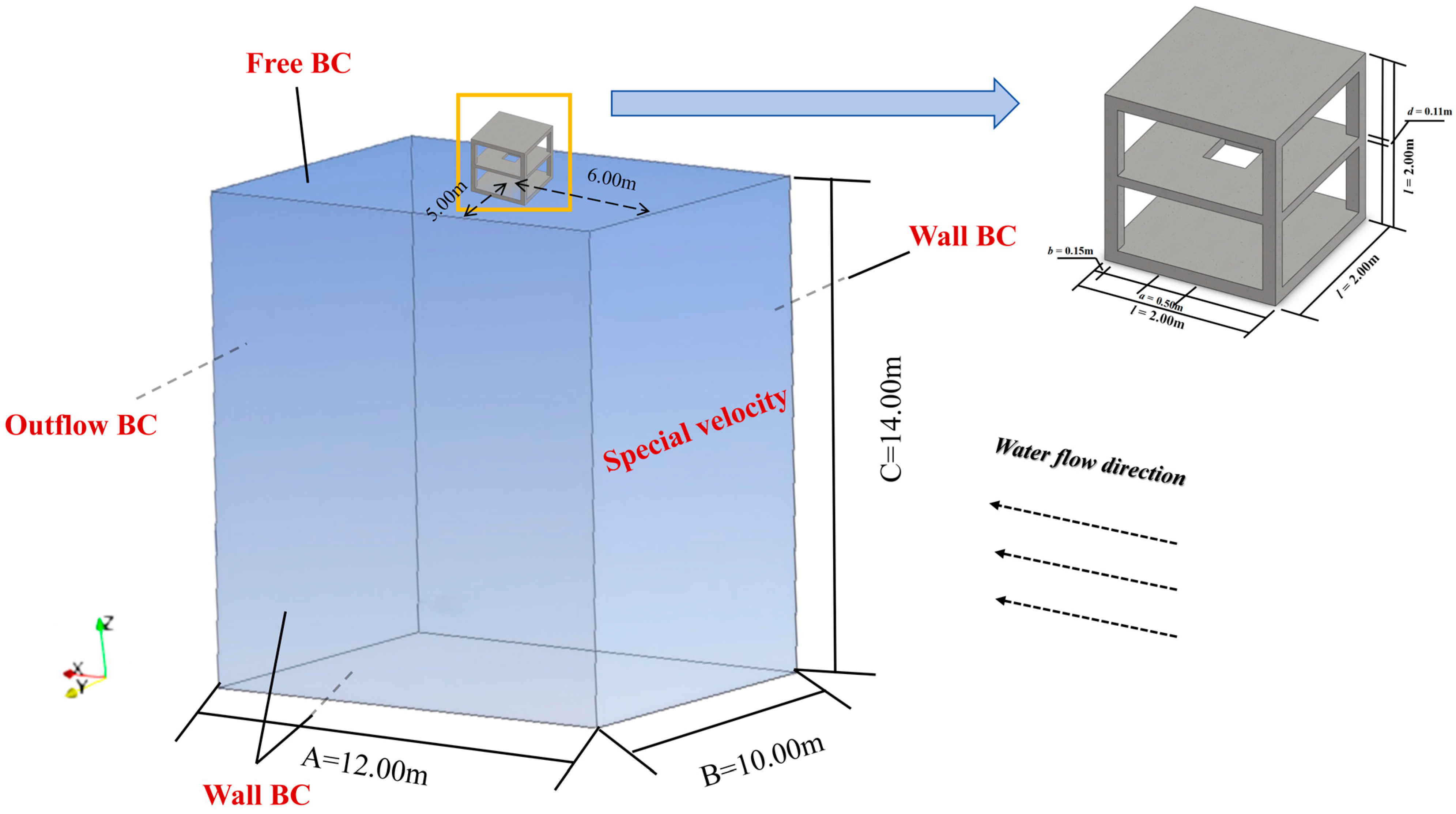
3. Establishment of 3D Numerical Model for Cubic Artificial Reef Deployment
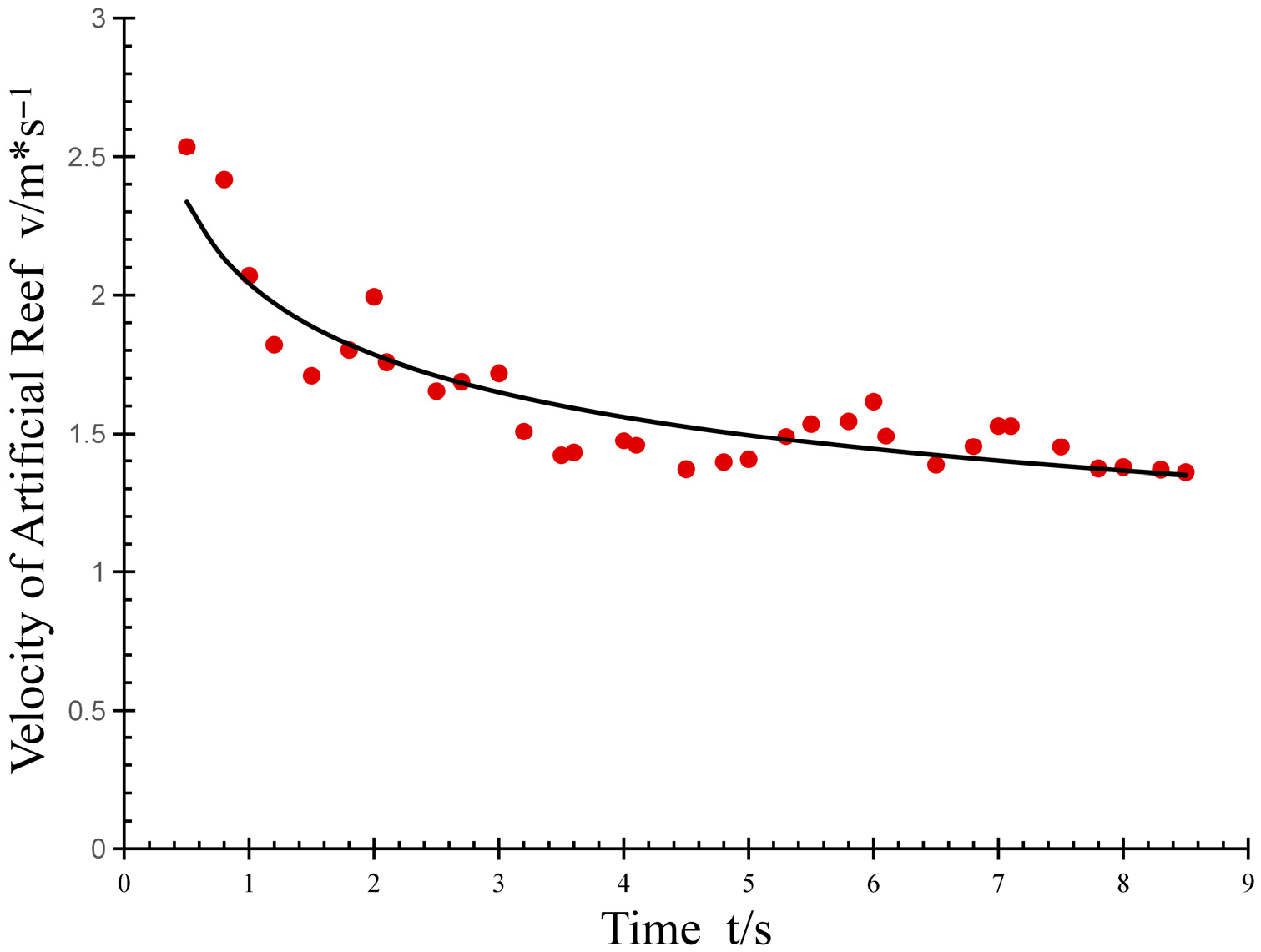
4. Model Validation
5. Research Results
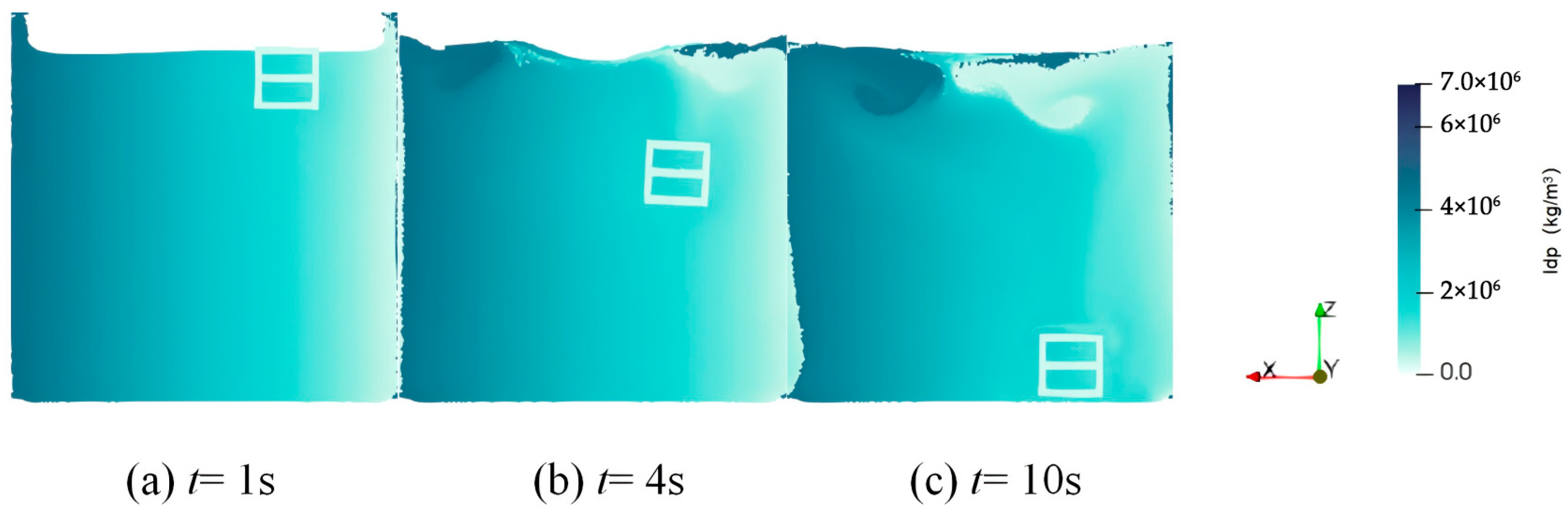
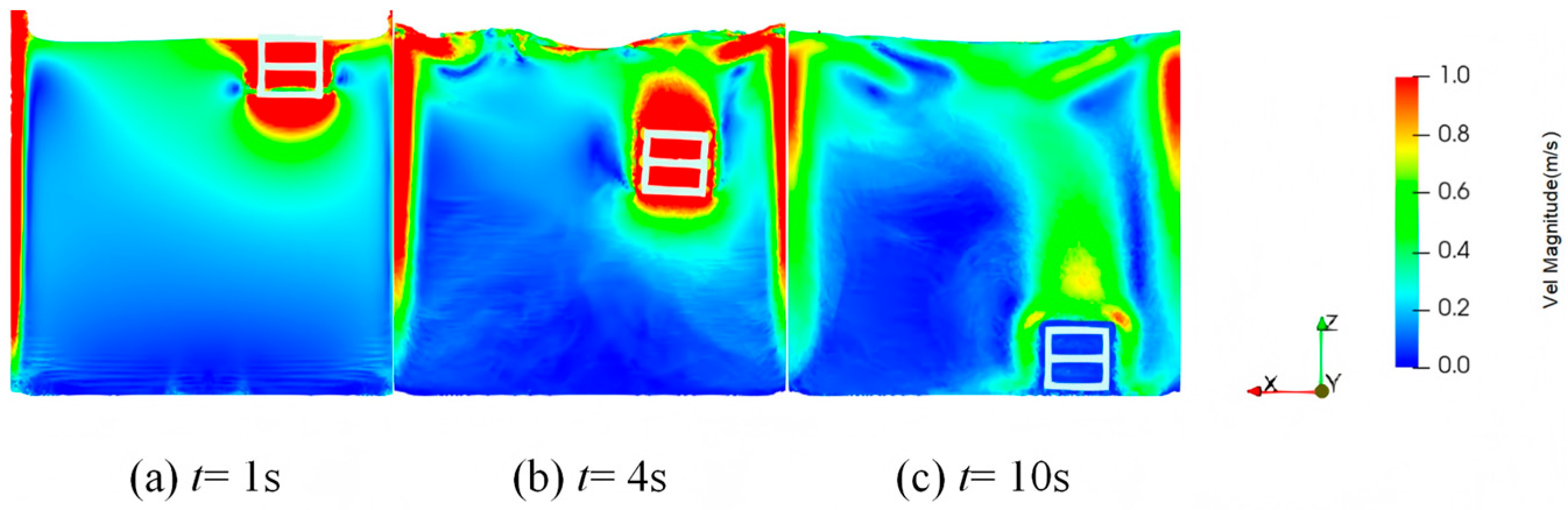
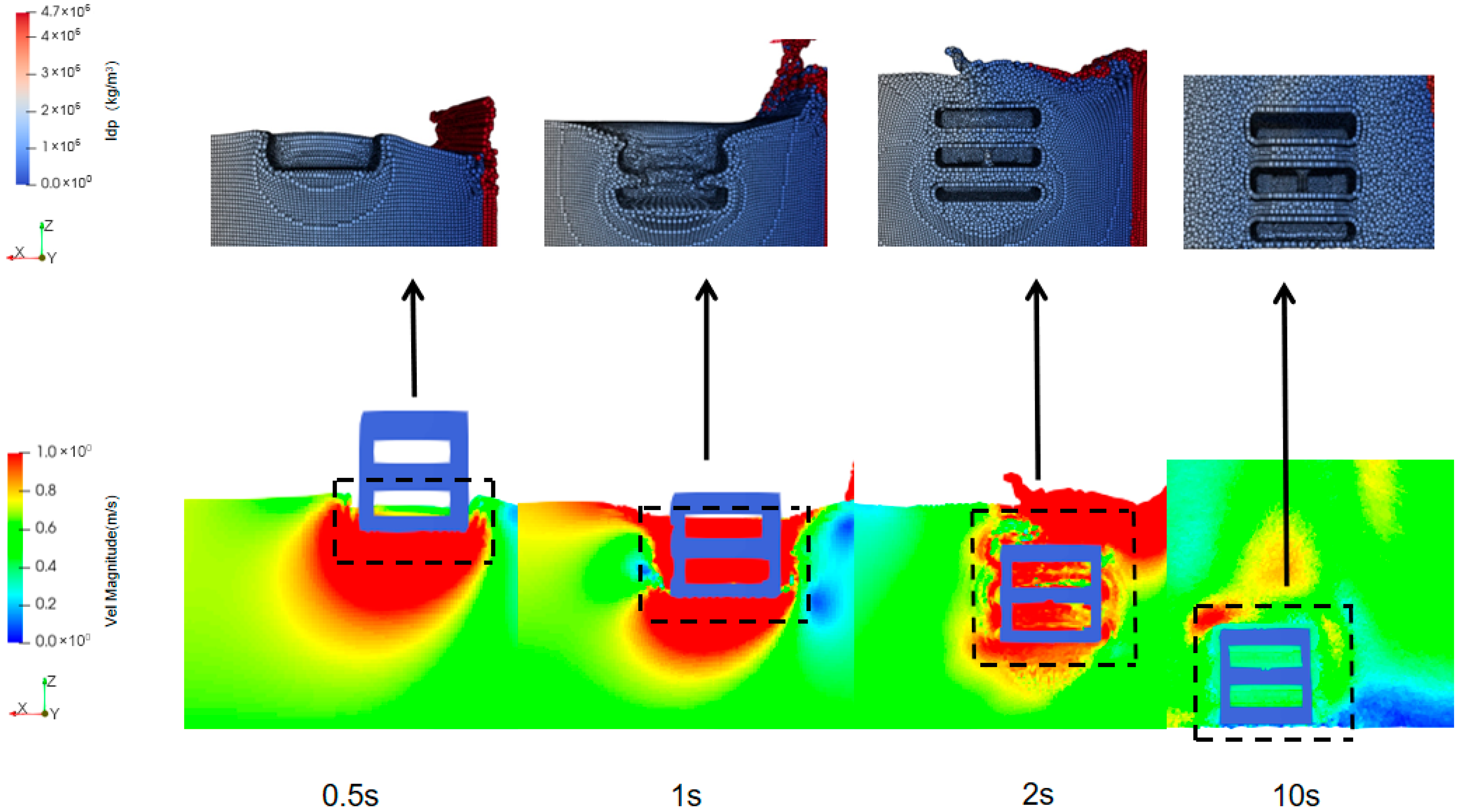
5.1. Hydrodynamic Effects During Cubic Artificial Reef Deployment
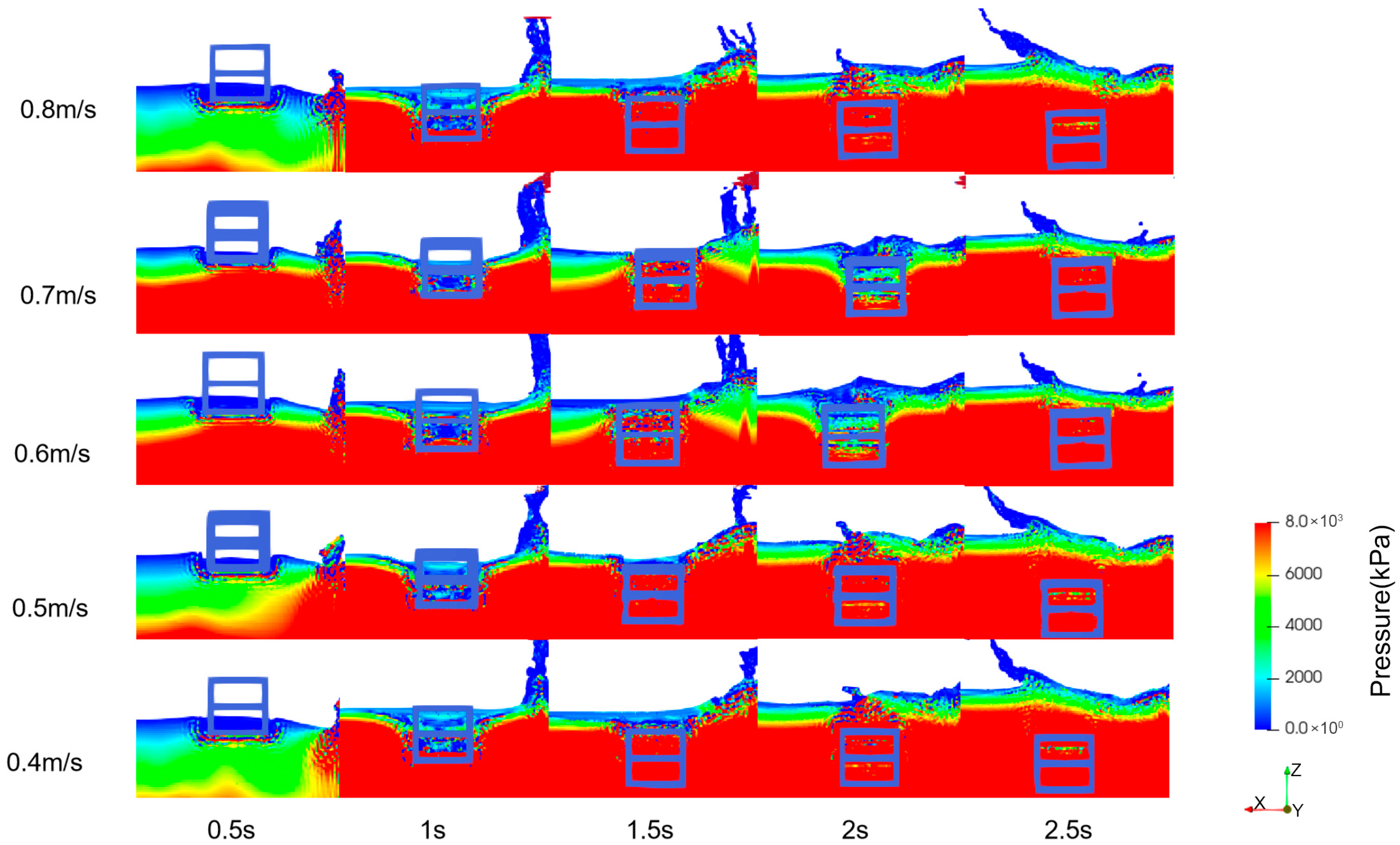
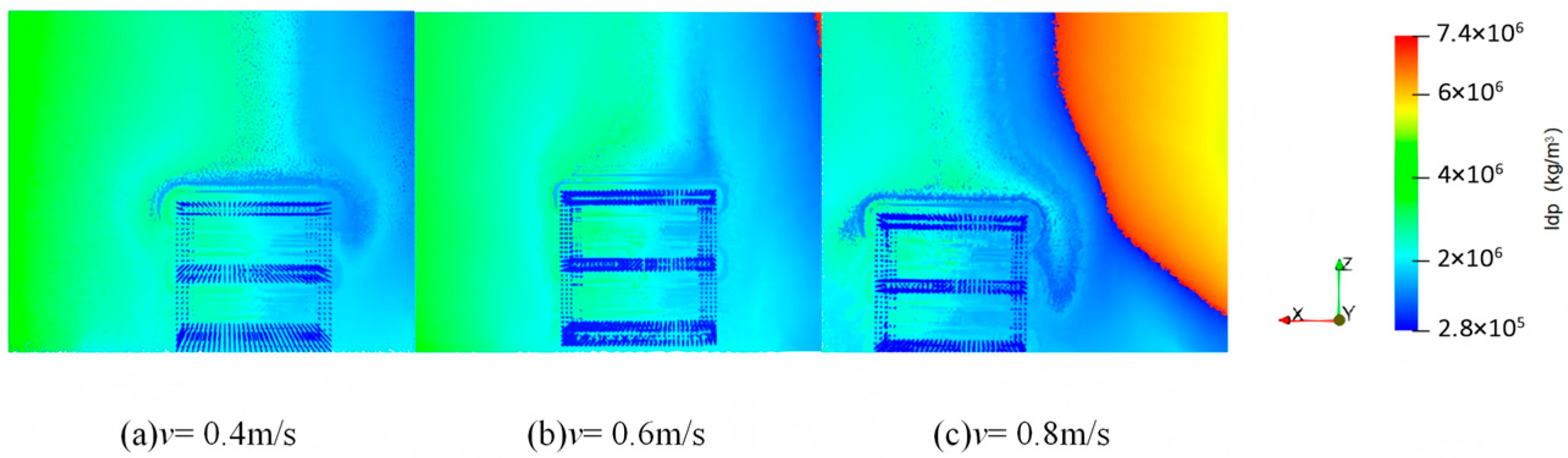
5.2. Influence of Flow Velocity on the Deployment Process of Cubic Artificial Reefs
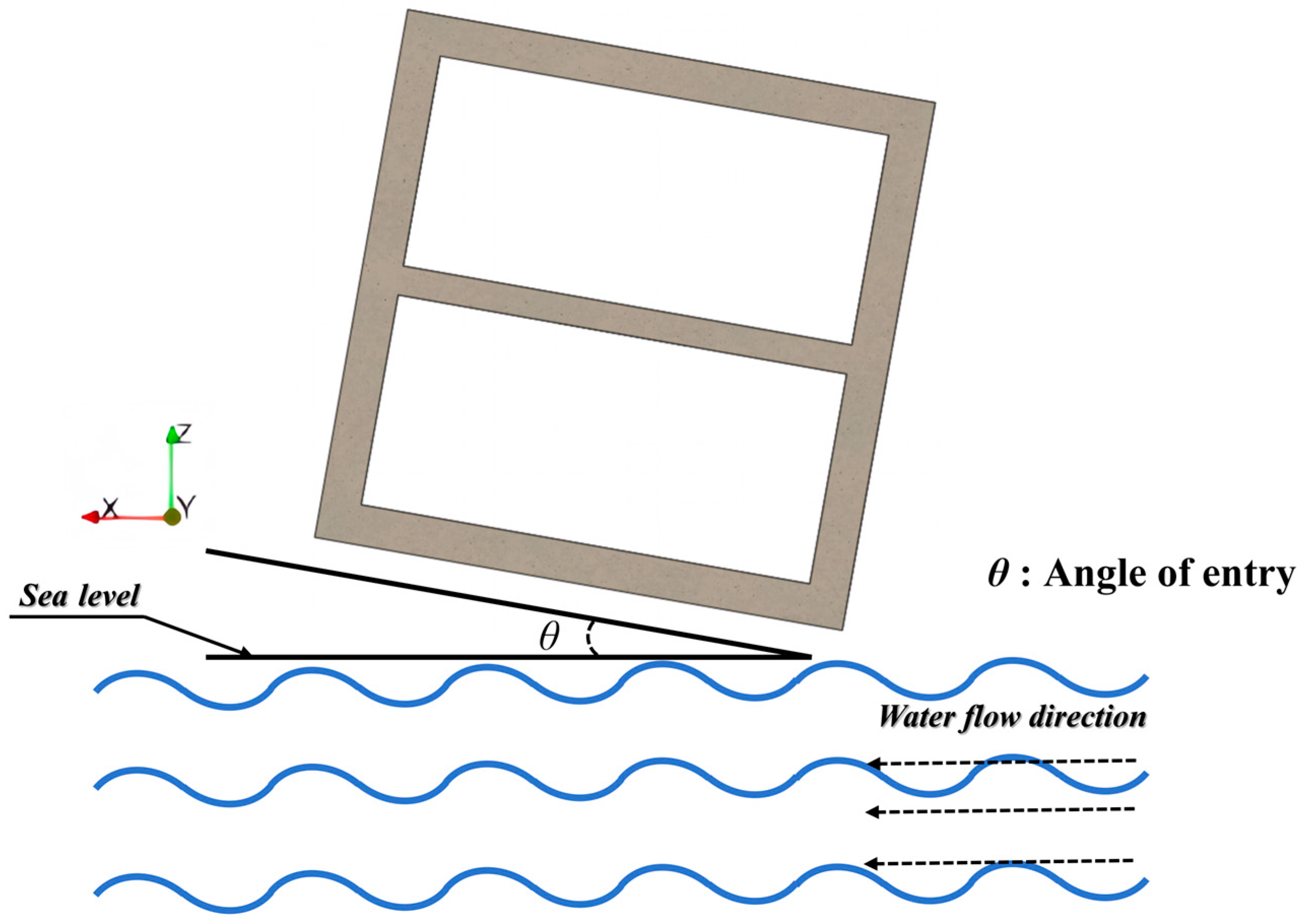
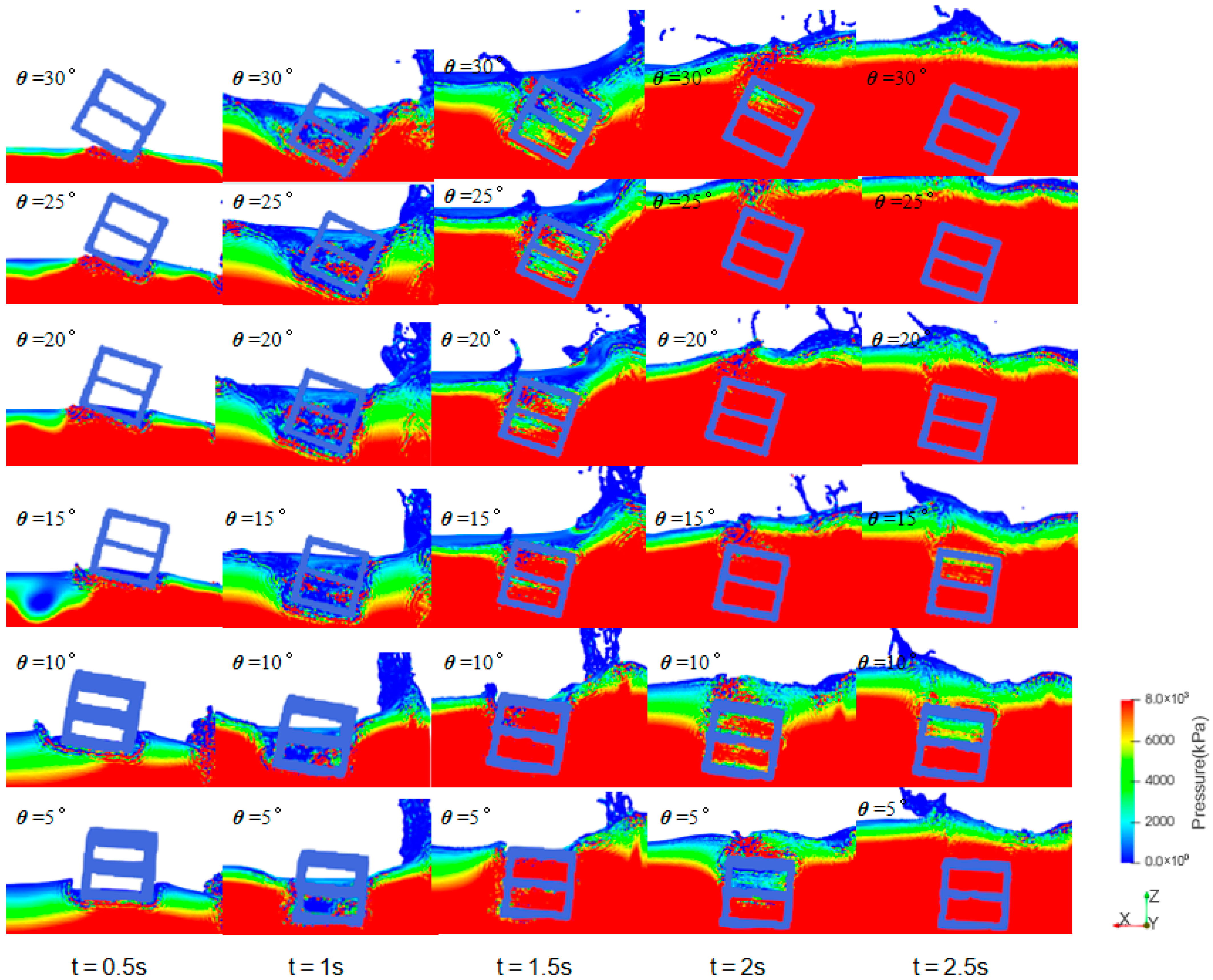
5.3. Effect of Entry Angle on Cubic Artificial Reef Deployment
6. Discussion
6.1. Flow Velocity Control: Balancing Environmental Disturbance and Structural Integrity
6.2. Optimization of Water Entry Angle: Active Attitude Control to Reduce Deployment Drag and Environmental Disturbance
7. Conclusions
- (1)
- Flow field variations during artificial reef deployment: The deployment of the cubic artificial reef induces significant disturbance effects on the surrounding flow field. Particularly during the initial deployment stage, the impact force generated as the reef enters the water causes intense water disturbance, leading to the formation of distinct vortex and recirculation zones. Furthermore, during the sinking process, flow field stratification phenomena are observed.
- (2)
- Influence of inflow velocity on artificial reef deployment performance: At inflow velocities of 0.4 m/s, the pressure distribution is relatively uniform, with minor pressure fluctuations generated during reef water entry and a gradual pressure gradient. As the inflow velocity increases (0.6 m/s and 0.8 m/s), the pressure fluctuations induced during water entry progressively intensify, forming distinct high- and low-pressure zones. Under lower flow velocity conditions (e.g., 0.4 m/s), localized regions of high particle concentration are observed. In contrast, with increasing inflow velocity (e.g., 0.6 m/s and 0.8 m/s), the particle concentration relatively decreases.
- (3)
- Influence of water entry angle on artificial reef deployment performance: As the water entry angle increases, the drag force acting on the artificial reef exhibits a trend of initial increase followed by a decrease. The drag reaches its maximum at a water entry angle of 20°, while it is minimized at an angle of 25°. Across different water entry angles, both the anti-sliding and anti-overturning safety factors of the reef exceed 1.2, indicating that the reef maintains favorable stability within this range of angles.
Author Contributions
Funding
Institutional Review Board Statement
Data Availability Statement
Acknowledgments
Conflicts of Interest
References
- Seaman, W. Artificial habitats and the restoration of degraded marine ecosystems and fisheries. Hydrobiologia 2007, 580, 143–155. [Google Scholar] [CrossRef] [Scilit]
- Mills, K.A.; Hamer, P.A.; Quinn, G.P. Artificial reefs create distinct fish assemblages. Mar. Ecol. Prog. Ser. 2017, 585, 155–173. [Google Scholar] [CrossRef] [Scilit]
- Chong, L.; Siders, A.Z.; Lorenzen, K.; Ahrens, R.N.M.; Camp, E.V. Global synthesis of effects and feedbacks from artificial reefs on socioecological systems in recreational fisheries. Fish Fish. 2023, 25, 303–319. [Google Scholar] [CrossRef] [Scilit]
- Carr, M.H.; Hixon, M.A. Artificial Reefs: The Importance of Comparisons with Natural Reefs. Fisheries 1997, 22, 28–33. [Google Scholar] [CrossRef] [Scilit]
- Li, X.Y.; Zheng, F.D. Experimental and numerical investigation of the water-entry behavior of an inverted T-shaped beam. Sci. Rep. 2024, 14, 29367. [Google Scholar] [CrossRef] [Scilit]
- Hui, S.; Faltinsen, O. Water impact of horizontal circular cylinders and cylindrical shells. Appl. Ocean. Res. 2007, 28, 299–311. [Google Scholar]
- Zhu, X.; Faltinsen, O.M.; Hu, C.H. Water entry and exit of a hori-zontal circular cylinder. J. Offshore Mech. Arct. Eng. 2007, 129, 253–264. [Google Scholar] [CrossRef] [Scilit]
- Wang, Z.; Wang, G.; You, T.; Li, X.; Wang, Z. Numerical simulation of vertical water-entry of revolving bodies. Missiles Space Veh. 2014, 5, 22–25. (In Chinese) [Google Scholar]
- Li, Y.; Ren, N.; Cai, W.; Liu, Y.; Ou, J. Experimental and numerical study on dynamic responses of a TLP-type modular floating structure system. Ocean. Eng. 2024, 313, 427. [Google Scholar] [CrossRef] [Scilit]
- Wang, H.; Tang, Z.; Chen, P.; Zhou, Y.; Feng, X.; Yu, J. Numerical investigation of water exchange in the Yangmeikeng artificial reef zone, Shenzhen. Mar. Sci. Bull. 2019, 21, 70–78. [Google Scholar]
- Zhang, X. Numerical Simulation of Free-Falling Dynamic Penetration Anchors in Water. Master’s Thesis, Dalian University of Technology, Dalian, China, 2015. (In Chinese) [Google Scholar]
- Cui, W. Analysis of Initial Penetration Depth and Stability Study of Artificial Reefs. Master’s Thesis, Shandong University, Jinan, China, 2022. (In Chinese) [Google Scholar]
- Li, X. Numerical Simulation of Flow Field Effects and Local Scouring Around Artificial Reefs Under Wave Action. Master’s Thesis, Tianjin University, Tianjin, China, 2016. (In Chinese) [Google Scholar]
- Meng, Y. Numerical Simulation Study on Motion Characteristics of Gravity-Installed Anchors in Water. Master’s Thesis, Tianjin University, Tianjin, China, 2018. (In Chinese) [Google Scholar]
- Liu, G.R.; Liu, M.B. Smoothed Particle Hydrodynamics: A Mesh-Free Particle Method; World Scientific Publishing Company: Singapore, 2003. [Google Scholar]
- Monaghan, J.J. Smoothed particle hydrodynamics. Annu. Rev. Astron. Astrophys. 1992, 30, 543–574. [Google Scholar] [CrossRef]
- Liu, M.B.; Liu, G.R.; Lam, K.Y.; Zong, Z. Smoothed particle hydrodynamics for numerical simulation of underwater explosion. Comput. Mech. 2003, 30, 106–118. [Google Scholar] [CrossRef] [Scilit]
- Gong, K.; Shao, S.D.; Liu, H.; Wang, B.; Tan, S.-K. Two-phase SPH simulation of fluid-structure interactions. J. Fluids Struct. 2016, 65, 155–179. [Google Scholar] [CrossRef] [Scilit]
- Lyu, H.G.; Sun, P.N.; Huang, X.T.; Hu, X.Y.; Zhou, J.F. SPHydro: Promoting smoothed particle hydrodynamics method toward extensive applications in ocean engineering. Phys. Fluids 2023, 35, 17116. [Google Scholar] [CrossRef] [Scilit]
- Zhao, Z.X.; Hong, Y.; Gong, Z.X.; Sun, P.N.; Zhang, A.M. Numerical analysis of cavity deformation of oblique water entry using a multi-resolution two-phase SPH method. Ocean. Eng. 2023, 269, 113456. [Google Scholar] [CrossRef] [Scilit]
- Zhao, K.; Yang, S.; Ming, F. Numerical analysis of water entry under ocean currents with smoothed particle hydrodynamics method. Phys. Fluids 2023, 35, 062103. [Google Scholar] [CrossRef] [Scilit]
- Korobkin, A.A.; Khabakhpasheva, T.I.; Maki, K.J. Hydrodynamic forces in water exit problems. J. Fluids Struct. 2017, 69, 16–33. [Google Scholar] [CrossRef] [Scilit]
- Oger, G.; Doring, M.; Alessandrini, B.; Ferrant, P. Two-dimensional SPH simulations of wedge water entries. J. Comput. Phys. 2006, 213, 803–822. [Google Scholar] [CrossRef] [Scilit]
- Oger, G.; Touze, D.L.; Alessandrini, B.; Ferrant, P. A new parallelized 3D SPH model: Resolution of water entry problems ans scalability study. Ercoftac Bull. 2008, 76, 145–149. [Google Scholar]
- Gong, K.; Wang, B.; Liu, H. Modelling water entry of a wedge by multiphase SPH method. Coast. Eng. Proc. 2011, 1, waves.10. [Google Scholar] [CrossRef] [Scilit]
- Shi, W.; Shen, Y.; Chen, J.; Jiang, Y. SPH simulations on water entry characteristics of a re-entry capsule. Eng. Anal. Bound. Elem. 2020, 119, 257–268. [Google Scholar] [CrossRef] [Scilit]
- Tang, X. Numerical Investigation of Wave Interaction with Perforated Caisson Breakwaters Using the Smoothed Particle Hydrodynamics Method. Master’s Thesis, Dalian University of Technology, Dalian, China, 2016. (In Chinese) [Google Scholar]
- Guo, H. Three-Dimensional Numerical Modeling and Hydrodynamic Performance Analysis of Twin Trawl Doors Using Smoothed Particle Hydrodynamics (SPH) Method. Master’s Thesis, Shanghai Ocean University, Shanghai, China, 2024. (In Chinese) [Google Scholar]
- Zhang, L. Dynamics Analysis of Frame-Type Concrete Artificial Reef Impact During Seabed Landing. Master’s Thesis, Dalian Ocean University, Dalian, China, 2024. (In Chinese) [Google Scholar]
- Liu, Y.; Guan, H.; Zhao, Y.; Cui, G.; Jiang, Y.; Li, Y. Hydrodynamic characteristics of artificial reefs using CFD modeling. Ocean. Eng. 2019, 182, 102–112. [Google Scholar]



| Parameter Nomenclature | Value |
|---|---|
| Cubic artificial reef length () | 2 m |
| Cubic artificial reef volume () | 1.05 m3 |
| Cubic artificial reef frontal area () | 4 m2 |
| Cubic artificial reef drag coefficient () | 2.2 |
| Cubic artificial reef density () | 2295 kg/m3 |
| Seawater density () | 1030 kg/m3 |
| Parameter | Value | Absolute Error | Error Rate |
|---|---|---|---|
| Theoretical terminal velocity | 1.69 m/s | 0.21 | 12.4% |
| Simulated terminal velocity | 1.48 m/s |
| Inflow Velocity/m·s−1 | |||||
|---|---|---|---|---|---|
| 0.4 | 0.5 | 0.6 | 0.7 | 0.8 | |
| Time/s | 8.4 | 9.2 | 10.8 | 11.6 | 12.0 |
| Flow Velocity (m/s) | 0.4 | 0.5 | 0.6 | 0.7 | 0.8 |
|---|---|---|---|---|---|
| Drag (N) | 675 | 879 | 953 | 1060 | 1256 |
| Anti-slip safety coefficient S1 | 1.95 | 1.50 | 1.38 | 1.24 | 1.05 |
| Anti-overturning safety S2 | 1.13 | 1.47 | 1.59 | 1.77 | 2.09 |
| Angle of Entry (°) | 5 | 10 | 15 | 20 | 25 | 30 |
|---|---|---|---|---|---|---|
| Drag (N) | 3410 | 3740 | 3930 | 4120 | 2180 | 3240 |
| Anti-slip safety coefficient S1 | 3.86 | 3.52 | 3.35 | 3.20 | 6.04 | 4.06 |
| Anti-overturning safety S2 | 6.44 | 5.87 | 5.58 | 5.33 | 10.07 | 6.77 |
Disclaimer/Publisher’s Note: The statements, opinions and data contained in all publications are solely those of the individual author(s) and contributor(s) and not of MDPI and/or the editor(s). MDPI and/or the editor(s) disclaim responsibility for any injury to people or property resulting from any ideas, methods, instructions or products referred to in the content. |
© 2026 by the authors. Licensee MDPI, Basel, Switzerland. This article is an open access article distributed under the terms and conditions of the Creative Commons Attribution (CC BY) license.
Share and Cite
Chu, W.; Lu, S.; Zhao, Z.; Zhang, X.; Huang, Y. Hydrodynamic Performance of Cubic Artificial Reefs During Deployment Process Based on Smoothed Particle Hydrodynamics. Fishes 2026, 11, 59. https://doi.org/10.3390/fishes11010059
Chu W, Lu S, Zhao Z, Zhang X, Huang Y. Hydrodynamic Performance of Cubic Artificial Reefs During Deployment Process Based on Smoothed Particle Hydrodynamics. Fishes. 2026; 11(1):59. https://doi.org/10.3390/fishes11010059
Chicago/Turabian StyleChu, Wenhua, Shijing Lu, Zijing Zhao, Xinyang Zhang, and Yulei Huang. 2026. "Hydrodynamic Performance of Cubic Artificial Reefs During Deployment Process Based on Smoothed Particle Hydrodynamics" Fishes 11, no. 1: 59. https://doi.org/10.3390/fishes11010059
APA StyleChu, W., Lu, S., Zhao, Z., Zhang, X., & Huang, Y. (2026). Hydrodynamic Performance of Cubic Artificial Reefs During Deployment Process Based on Smoothed Particle Hydrodynamics. Fishes, 11(1), 59. https://doi.org/10.3390/fishes11010059