


Effectiveness of Robot-Assisted Versus Conventional Occupational Therapy on Changes in Upper Extremity Function After Cervical Spinal Cord Injury (Armeo X-over Trial): Study Protocol of a Randomised Crossover Trial

 , , and
Abstract
1. Introduction
2. Materials and Methods
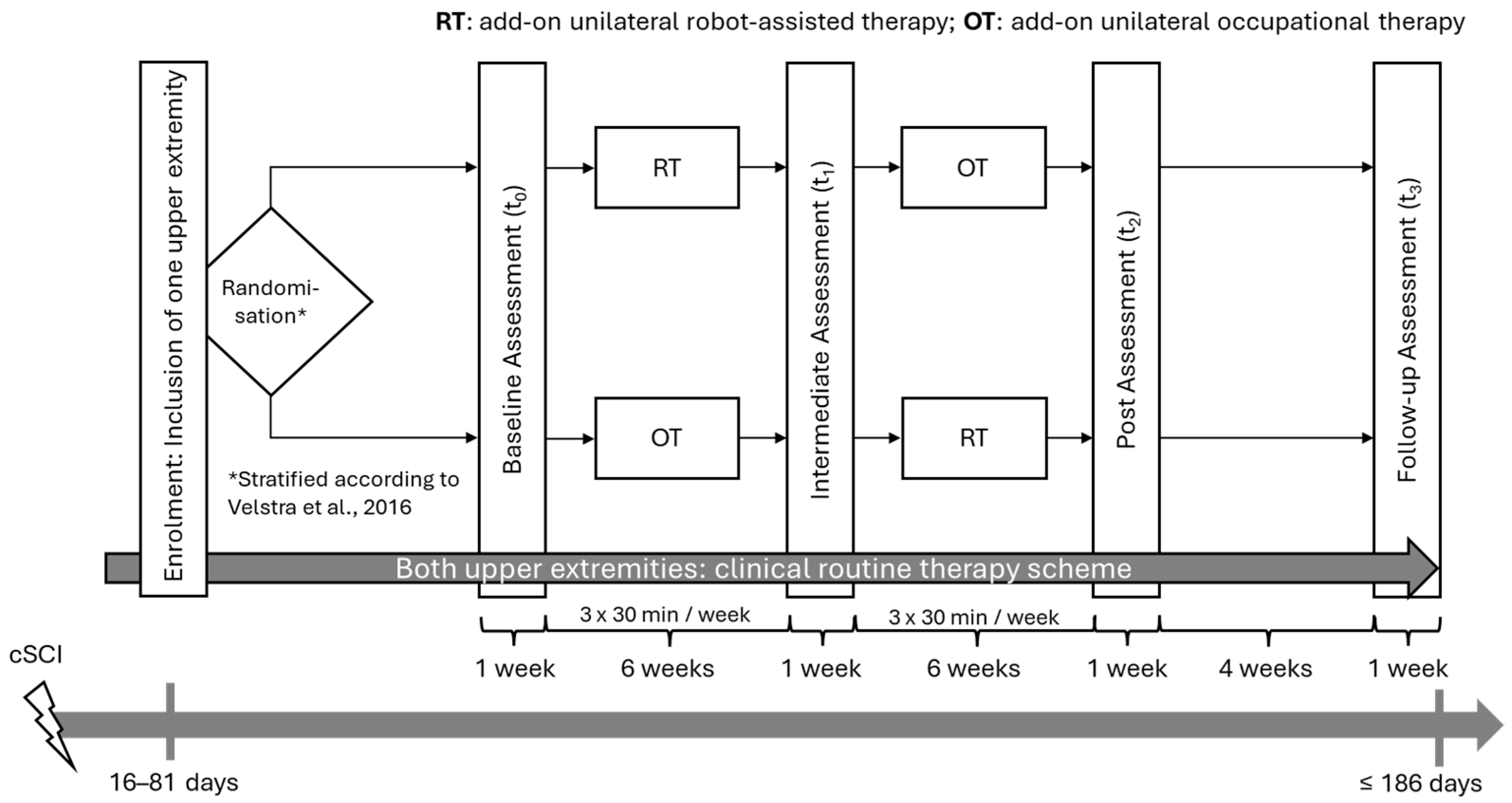
2.1. Study Design
2.2. Participants and Randomisation
2.3. Study Procedure
2.4. Study Interventions
2.4.1. Experimental Intervention RT
2.4.2. Control Intervention OT
2.5. Outcomes
2.5.1. Primary Outcome
2.5.2. Secondary Outcomes
2.5.3. Further Outcomes
2.6. Data Management and Safety Provisions
2.6.1. Data Management and Monitoring
2.6.2. Safety Provisions
2.7. Statistical Analysis Plan
2.8. Dissemination Policy
3. Strengths and Limitations
4. Outlook
Supplementary Materials
Author Contributions
Funding
Institutional Review Board Statement
Informed Consent Statement
Data Availability Statement
Acknowledgments
Conflicts of Interest
Abbreviations
| ADL | Activity of Daily Living |
| AIS | American Spinal Injury Association Impairment Scale |
| CRF | Case Report Form (pCRF paper CRF; eCRF electronic CRF) |
| cSCI | Cervical Spinal Cord Injury |
| CTU | Clinical Trial Unit |
| C1 | First cervical spinal cord segment |
| Delto | Musculus deltoideus pars acromialis |
| DoF | Degrees of Freedom |
| EHI | Edinburgh Handedness Inventory |
| EKNZ | Ethikkommission Nordwest- und Zentralschweiz |
| EMSCI | European Multicentre Study about Spinal Cord Injury |
| FDP | Flexor Digitorum Profundus Muscle |
| GAS | Goal Attainment Scale |
| GRASSP | Graded Redefined Assessment of Strength, Sensibility, and Prehension |
| GRASSP-QtG | Quantitative Grasping Subtest of GRASSP |
| iARAT | Instrumented Action Research Arm Test |
| ICF | International Classification of Functioning, Disability and Health |
| IMI | Intrinsic Motivation Inventory |
| IMU | Inertial Measurement Unit |
| ISCI PT-OT BDS | International Spinal Cord Injury Physical Therapy-Occupational Therapy Basic Data Set |
| ISNCSCI | International Standards for Neurological Classification of SCI |
| MCID | Minimal Clinically Important Difference |
| MMT | Manual Muscle Testing |
| MRC | Medical Research Council |
| NLI | Neurological Level of Injury |
| OT | Occupational Therapy |
| RCT | Randomised Controlled Trial |
| ROM | Range of Motion |
| RT | Robot-assisted Therapy |
| SCI | Spinal Cord Injury |
| SCIM III-SR | Spinal Cord Independence Measure III–Self-report |
| SPC | Swiss Paraplegic Centre |
| T1 | First thoracic spinal cord segment |
| UEMS | Upper Extremity Motor Score |
| VR | Virtual Reality |
Appendix A

| Outcome | Test | Test Description | Assessment Timepoints |
|---|---|---|---|
| Grasp performance | GRASSP-QtG, Version 1 | Six prehension tasks each graded from 0 (the task cannot be conducted at all) to 5 (the task is conducted without difficulties using the expected grasping pattern and upper extremity function is unaffected) for each arm according to the grasp used and completeness of the task within 75 s. The scores of the six tasks will be added up, giving a maximum possible QtG subtest score of 30 points for each side. | Baseline (t0), intermediate (t1), post (t2) and follow-up (t3) assessment |
| Qualitative upper extremity function | Qualitative grasping, sensation and strength subtest of GRASSP, Version 2 | The qualitative grasping subtest: three prehension ability tasks, each graded from 0 (the task cannot be conducted at all) to 4 (the task is conducted without difficulties and appropriate force) for each arm. The maximal qualitative grasping subtest score is 12 points for each side. The sensation subtest: three palmar sensations, each graded between 0 and 4. In total, up to 12 points for each side. The strength subtest: isometric MMT for 10 muscles in each arm, each graded according to the MRC scale from 0 (no muscle contraction) to 5 (normal activity to resist against maximal resistance), summing up to maximally 50 points per side. | Baseline (t0), intermediate (t1), post (t2) and follow-up (t3) assessment |
| Independence in ADL | SCIM III-SR | The first domain “Self-Care” consists of six items and the scores range from 0 to 20. The second domain “Respiration and sphincter management” includes four items; the third domain “ Mobility” contains nine items, both with scores from 0–40. Thus, the total score of SCIM III-SR ranges from 0 to 100. | Baseline (t0), intermediate (t1), post (t2) and follow-up (t3) assessment |
| Upper Extremity Motor Score | ISNCSCI-UEMS | For this, MMT of elbow flexion, wrist extension, elbow extension, 3rd distal interphalangeal flexion, and 5th finger abduction is conducted and scored. Each score is graded between 0 and 5 on the MRC scale. The maximum score for each extremity is 25. Thus, the total score of ISNCSCI-UEMS ranges from 0 to 50 for the upper extremities. | Baseline (t0), intermediate (t1), post (t2) and follow-up (t3) assessment |
| Handgrip Strength | Dynamometer | For the isometric hand and grip strength measurements, the participants apply maximum force (measured in kg) to the hand dynamometer (Baseline BIMS Digital-Dynamometer (Fabrication Enterprises Inc., White Plains, NY, USA)). | Baseline (t0), intermediate (t1), post (t2) and follow-up (t3) assessment |
| Arm control | iARAT | Four subscales (grasp, grip, pinch and gross movements), graded based on correct movement, grasp configuration and 5 s time limit. Each task is graded between 0 and 3 points, giving a maximum of 57 points. During the iARAT, IMUs (Xsens DOT, Movella Inc., Henderson, NV, USA) worn on the wrist, the upper arm, and the trunk. In addition, cameras will record the different tasks to improve their kinematic analysis. | Baseline (t0), intermediate (t1), post (t2) and follow-up (t3) assessment |
| Therapy intensity | Amount of arm movement | Measured by wearable IMUs worn on the wrist, upper arm and trunk | Three times within the first, second and third 2-week block of each 6-week intervention |
| Intrinsic Motivation | IMI | The full IMI includes 45 items distributed across seven subscales, of which the applicable items and subscales can be chosen. Each item is graded between 1 (not at all true) to 7 (very true), out of which the total score can be calculated by summarizing all points. | Once within the first, second and third 2-week block of each 6-week intervention |
| Descriptives | Diverse | Demographics; SCI characteristics, medical history, medication, handedness by EHI | Enrolment; Changes of medication during the study are documented. |
| Therapy goals | GAS | One goal is based on “body function”, one on “body structure” and the third goal on the “activities” domain according to ICF. For this, the patients can choose from a set of the most common goals as described by Kuchen, et al. [11]. The therapy goals are used to motivate patients during their therapy sessions as well as to better relate the results. | Therapy goal definition in each first therapy session, the therapy goal achievement in each last therapy session |
| Therapy content | Diverse | Clinical routine: Frequency and duration per week of each kind of therapy; and International Spinal Cord Injury Physical Therapy-Occupational Therapy Basic Data Set (ISCI PT-OT BDS). Additional OT: ISCI PT-OT BDS with adapted time durations. Additional RT: Armeocontrol, Software of ArmeoSpring | The clinical routine physical and occupational therapy is documented three times within the first, second and third 2-weeks block of each 6-week intervention, the add-on therapy content is documented in every therapy session. |
References
- Anderson, K.D. Targeting recovery: Priorities of the spinal cord-injured population. J. Neurotrauma 2004, 21, 1371–1383. [Google Scholar] [CrossRef]
- Snoek, G.J.; IJzerman, M.J.; Hermens, H.J.; Maxwell, D.; Biering-Sorensen, F. Survey of the needs of patients with spinal cord injury: Impact and priority for improvement in hand function in tetraplegics. Spinal Cord 2004, 42, 526–532. [Google Scholar] [CrossRef]
- Lynskey, J.V.; Belanger, A.; Jung, R. Activity-dependent plasticity in spinal cord injury. J. Rehabil. Res. Dev. 2008, 45, 229–240. [Google Scholar] [CrossRef]
- Singh, H.; Unger, J.; Zariffa, J.; Pakosh, M.; Jaglal, S.; Craven, B.C.; Musselman, K.E. Robot-assisted upper extremity rehabilitation for cervical spinal cord injuries: A systematic scoping review. Disabil. Rehabil. Assist. Technol. 2018, 13, 704–715. [Google Scholar] [CrossRef]
- Yozbatiran, N.; Francisco, G.E. Robot-assisted Therapy for the Upper Limb after Cervical Spinal Cord Injury. Phys. Med. Rehabil. Clin. N. Am. 2019, 30, 367–384. [Google Scholar] [CrossRef] [PubMed]
- Mehrholz, J.; Pollock, A.; Pohl, M.; Kugler, J.; Elsner, B. Systematic review with network meta-analysis of randomized controlled trials of robotic-assisted arm training for improving activities of daily living and upper limb function after stroke. J. Neuroeng. Rehabil. 2020, 17, 83. [Google Scholar] [CrossRef] [PubMed]
- Jung, J.H.; Lee, H.J.; Cho, D.Y.; Lim, J.E.; Lee, B.S.; Kwon, S.H.; Kim, H.Y.; Lee, S.J. Effects of Combined Upper Limb Robotic Therapy in Patients with Tetraplegic Spinal Cord Injury. Ann. Rehabil. Med. 2019, 43, 445–457. [Google Scholar] [CrossRef] [PubMed]
- Kim, J.; Lee, B.S.; Lee, H.J.; Kim, H.R.; Cho, D.Y.; Lim, J.E.; Kim, J.J.; Kim, H.Y.; Han, Z.A. Clinical efficacy of upper limb robotic therapy in people with tetraplegia: A pilot randomized controlled trial. Spinal Cord 2019, 57, 49–57. [Google Scholar] [CrossRef]
- Kilkki, M.M.; Poutanen, J.; Kauranen, K.; Arokoski, J.; Hiekkala, S. Effects of Technology-Assisted Rehabilitation After Spinal Cord Injury: Pilot Randomized Controlled Crossover Trial. JMIR Rehabil. Assist. Technol. 2025, 12, e78091. [Google Scholar] [CrossRef]
- Kirshblum, S.; Snider, B.; Eren, F.; Guest, J. Characterizing Natural Recovery after Traumatic Spinal Cord Injury. J. Neurotrauma 2021, 38, 1267–1284. [Google Scholar] [CrossRef]
- Kuchen, D.B.; Hubacher, B.; Ladner, A.; Velstra, I.M.; Widmer, M. Technology-Assisted Upper Limb Therapy (TAULT): Evaluation of Clinical Practice at a Specialised Centre for Spinal Cord Injury in Switzerland. Healthcare 2023, 11, 3055. [Google Scholar] [CrossRef]
- Zariffa, J.; Kapadia, N.; Kramer, J.L.; Taylor, P.; Alizadeh-Meghrazi, M.; Zivanovic, V.; Willms, R.; Townson, A.; Curt, A.; Popovic, M.R.; et al. Feasibility and efficacy of upper limb robotic rehabilitation in a subacute cervical spinal cord injury population. Spinal Cord 2012, 50, 220–226. [Google Scholar] [CrossRef] [PubMed]
- Lozano-Berrio, V.; Alcobendas-Maestro, M.; Polonio-López, B.; Gil-Agudo, A.; de la Peña-González, A.; de Los Reyes-Guzmán, A. The Impact of Robotic Therapy on the Self-Perception of Upper Limb Function in Cervical Spinal Cord Injury: A Pilot Randomized Controlled Trial. Int. J. Environ. Res. Public Health 2022, 19, 6321. [Google Scholar] [CrossRef]
- Ho, J.S.; Ko, K.S.; Law, S.W.; Man, G.C. The effectiveness of robotic-assisted upper limb rehabilitation to improve upper limb function in patients with cervical spinal cord injuries: A systematic literature review. Front. Neurol. 2023, 14, 1126755. [Google Scholar] [CrossRef]
- Chan, A.-W.; Tetzlaff, J.M.; Altman, D.G.; Laupacis, A.; Gøtzsche, P.C.; Krleza-Jeric, K.; Hrobjartsson, A.; Mann, H.; Dickersin, K.; Berlin, J.A.; et al. SPIRIT 2013 Statement: Defining Standard Protocol Items for Clinical Trials. Ann. Intern. Med. 2013, 158, 7. [Google Scholar] [CrossRef]
- Velstra, I.M.; Bolliger, M.; Krebs, J.; Rietman, J.S.; Curt, A. Predictive Value of Upper Limb Muscles and Grasp Patterns on Functional Outcome in Cervical Spinal Cord Injury. Neurorehabilit. Neural Repair 2016, 30, 295–306. [Google Scholar] [CrossRef]
- European Multicenter Study About Spinal Cord Injury. Available online: https://www.emsci.org/project/the-project/time-schedule.html (accessed on 15 July 2024).
- Rupp, R.; Biering-Sorensen, F.; Burns, S.P.; Graves, D.E.; Guest, J.; Jones, L.; Read, M.S.; Rodriguez, G.M.; Schuld, C.; Tansey-Md, K.E.; et al. International Standards for Neurological Classification of Spinal Cord Injury: Revised 2019. Top. Spinal Cord Inj. Rehabil. 2021, 27, 1–22. [Google Scholar] [CrossRef] [PubMed]
- Kalsi-Ryan, S.; Curt, A.; Fehlings, M.; Verrier, M. Assessment of the Hand in Tetraplegia Using the Graded Redefined Assessment of Strength, Sensibility and Prehension (GRASSP): Impairment Versus Function. Top. Spinal Cord Inj. Rehabil. 2009, 14, 34–46. [Google Scholar] [CrossRef]
- Kalsi-Ryan, S.; Chan, C.; Verrier, M.; Curt, A.; Fehlings, M.; Bolliger, M.; Velstra, I.M.; Team, G.C.S.S.; Team, G.L.S. The graded redefined assessment of strength sensibility and prehension version 2 (GV2): Psychometric properties. J. Spinal Cord Med. 2019, 42, 149–157. [Google Scholar] [CrossRef]
- Kalsi-Ryan, S.; Beaton, D.; Curt, A.; Duff, S.; Popovic, M.R.; Rudhe, C.; Fehlings, M.G.; Verrier, M.C. The Graded Redefined Assessment of Strength Sensibility and Prehension: Reliability and validity. J. Neurotrauma 2012, 29, 905–914. [Google Scholar] [CrossRef] [PubMed]
- Ackerman, P.; Morrison, S.A.; McDowell, S.; Vazquez, L. Using the Spinal Cord Independence Measure III to measure functional recovery in a post-acute spinal cord injury program. Spinal Cord 2010, 48, 380–387. [Google Scholar] [CrossRef] [PubMed]
- Fekete, C.; Eriks-Hoogland, I.; Baumberger, M.; Catz, A.; Itzkovich, M.; Luthi, H.; Post, M.W.; von Elm, E.; Wyss, A.; Brinkhof, M.W. Development and validation of a self-report version of the Spinal Cord Independence Measure (SCIM III). Spinal Cord 2013, 51, 40–47. [Google Scholar] [CrossRef] [PubMed]
- Yozbatiran, N.; Der-Yeghiaian, L.; Cramer, S.C. A standardized approach to performing the action research arm test. Neurorehabilit. Neural Repair 2008, 22, 78–90. [Google Scholar] [CrossRef]
- Unger, T.; Moslehian, A.S.; Peiffer, J.D.; Ullrich, J.; Gassert, R.; Lambercy, O.; Cotton, R.J.; Awai, C.E. Differentiable Biomechanics for Markerless Motion Capture in Upper Limb Stroke Rehabilitation: A Comparison with Optical Motion Capture. arXiv 2024, arXiv:2411.14992. [Google Scholar] [CrossRef]
- Brosteanu, O.; Houben, P.; Ihrig, K.; Ohmann, C.; Paulus, U.; Pfistner, B.; Schwarz, G.; Strenge-Hesse, A.; Zettelmeyer, U. Risk analysis and risk adapted on-site monitoringin noncommercial clinical trials. Clin. Trials 2009, 6, 585–596. [Google Scholar] [CrossRef]
- Fekete, C.; Gurtner, B.; Kunz, S.; Gemperli, A.; Gmunder, H.P.; Hund-Georgiadis, M.; Jordan, X.; Schubert, M.; Stoyanov, J.; Stucki, G. Inception cohort of the Swiss Spinal Cord Injury Cohort Study (SwiSCI): Design, participant characteristics, response rates and non-response. J. Rehabil. Med. 2021, 53, jrm00159. [Google Scholar] [CrossRef]
- Keusen, P.; Vuilliomenet, T.; Friedli, M.; Widmer, M. Age at Onset of Spinal Cord Injury is Associated with Increased Inpatient Care Needs, Reduced Independence at Discharge and a Higher Risk of Institutionalization after Primary Inpatient Rehabilitation. J. Rehabil. Med. 2023, 55, jrm00353. [Google Scholar] [CrossRef]
- Bourguignon, L.; Tong, B.; Geisler, F.; Schubert, M.; Rohrich, F.; Saur, M.; Weidner, N.; Rupp, R.; Kalke, Y.B.; Abel, R.; et al. International surveillance study in acute spinal cord injury confirms viability of multinational clinical trials. BMC Med. 2022, 20, 225. [Google Scholar] [CrossRef]
- Hopewell, S.; Chan, A.-W.; Collins, G.S.; Hróbjartsson, A.; Moher, D.; Schulz, K.F.; Tunn, R.; Aggarwal, R.; Berkwits, M.; Berlin, J.A.; et al. CONSORT 2025 statement: Updated guideline for reporting randomised trials. BMJ 2025, 389, e081123. [Google Scholar] [CrossRef]
- Schulz, K.F.; Altman, D.G.; Moher, D. CONSORT 2010 statement: Updated guidelines for reporting parallel group randomised trials. BMJ 2010, 340, c332. [Google Scholar] [CrossRef]
- Bertels, N.; Seelen, H.; Dembele, J.; Spooren, A. Essential training variables of arm-hand training in people with cervical spinal cord injury: A systematic review. J. Rehabil. Med. 2023, 55, jrm7147. [Google Scholar] [CrossRef] [PubMed]
| Inclusion Criteria | Exclusion Criteria |
|---|---|
|
|
Disclaimer/Publisher’s Note: The statements, opinions and data contained in all publications are solely those of the individual author(s) and contributor(s) and not of MDPI and/or the editor(s). MDPI and/or the editor(s) disclaim responsibility for any injury to people or property resulting from any ideas, methods, instructions or products referred to in the content. |
© 2026 by the authors. Licensee MDPI, Basel, Switzerland. This article is an open access article distributed under the terms and conditions of the Creative Commons Attribution (CC BY) license.
Share and Cite
Wunderlin, C.; Bürgisser, F.; Gemperli, A.; Perret, C.; Widmer, M. Effectiveness of Robot-Assisted Versus Conventional Occupational Therapy on Changes in Upper Extremity Function After Cervical Spinal Cord Injury (Armeo X-over Trial): Study Protocol of a Randomised Crossover Trial. Methods Protoc. 2026, 9, 31. https://doi.org/10.3390/mps9020031
Wunderlin C, Bürgisser F, Gemperli A, Perret C, Widmer M. Effectiveness of Robot-Assisted Versus Conventional Occupational Therapy on Changes in Upper Extremity Function After Cervical Spinal Cord Injury (Armeo X-over Trial): Study Protocol of a Randomised Crossover Trial. Methods and Protocols. 2026; 9(2):31. https://doi.org/10.3390/mps9020031
Chicago/Turabian StyleWunderlin, Chantal, Flavia Bürgisser, Armin Gemperli, Claudio Perret, and Mario Widmer. 2026. "Effectiveness of Robot-Assisted Versus Conventional Occupational Therapy on Changes in Upper Extremity Function After Cervical Spinal Cord Injury (Armeo X-over Trial): Study Protocol of a Randomised Crossover Trial" Methods and Protocols 9, no. 2: 31. https://doi.org/10.3390/mps9020031
APA StyleWunderlin, C., Bürgisser, F., Gemperli, A., Perret, C., & Widmer, M. (2026). Effectiveness of Robot-Assisted Versus Conventional Occupational Therapy on Changes in Upper Extremity Function After Cervical Spinal Cord Injury (Armeo X-over Trial): Study Protocol of a Randomised Crossover Trial. Methods and Protocols, 9(2), 31. https://doi.org/10.3390/mps9020031

