


Abstract
This study applies Pierre Bourdieu’s field theory as an analytical framework to examine the development of Peking opera along the Beijing Central Axis during the Qing Dynasty. It explores how the interaction between the court and folk fields contributed to the formation of its artistic form. From this perspective, social space is understood as a structured network of objective relations, shaped by the distribution of different forms of capital and the habitus of social actors. In the Qing Dynasty, as the core of political and cultural activities, the Peking opera field along the Beijing Central Axis was divided into two major sub-fields: the court field, centered around imperial power and subject to political discipline, and the folk field, market-oriented and following secular logic. By analyzing the differences between the two fields in terms of core power, spatial characteristics, capital distribution, and the habits of actors, this study reveals their two-way interaction achieved through the movement of artists, adaptation of repertoires, and capital conversion. The interaction between the two fields was not symmetrical: while the folk field contributed performative vitality and responsiveness to audience demand, the court provided institutional authority and symbolic legitimacy. Ultimately, in the dynamic balance between power and the market, the unique form of Peking opera, characterized by the integration of elegance and vulgarity, is refined. This study deepens our understanding of the interaction between spatial organization and artistic form, while further elucidating how power, culture, and art were structurally interconnected in the Qing Dynasty through the framework of field, capital, and habitus. In doing so, it offers both theoretical insights and empirical evidence for interdisciplinary research on the social and cultural functions of traditional art.
1. Introduction
As the ‘national opera’ of traditional Chinese drama, Peking opera’s formation and development have always been deeply embedded in the spatial structure and cultural power network of Qing-Dynasty society. From the arrival of Anhui opera troupes in Beijing in 1790 to the official naming of ‘Peking opera’ in the late Qing Dynasty and early Republic of China, this art form not only transformed from a local vocal style into a national opera genre but also developed unique artistic forms and social functions through the interaction between the imperial court and the public. When we wonder, ‘Why does the same opera genre have completely different narrative styles and symbolic features in the imperial court and the marketplace?’ When we ask ‘Is the distinction between the refined and the popular’ in Peking opera a natural differentiation of the artistic entity or an external manifestation of the social power structure?’, the traditional art history perspective can hardly provide a complete answer. Existing scholarship has provided important insights into the historical formation and artistic features of Peking opera. Early studies, such as those by Colin Mackerras, emphasize its development as a synthesis of regional theatrical traditions, particularly the integration of Anhui and Hubei opera (Mackerras 1972). Later studies expanded the field in different directions: Joshua Goldstein examined Peking opera through the relationship between performers and publics, highlighting its re-creation in urban society and the transformation of theatrical modernity (Goldstein 2007). Andrea Goldman analyzed the interaction between opera, urban culture, and state power in late imperial Beijing (Goldman 2012). Elizabeth Wichmann paid close attention to performance aesthetics, vocal expression, and the embodied techniques of Peking opera (Wichmann 1991). These studies have significantly broadened our understanding of the genre, yet most still emphasize vocal evolution, performance routines, or the genealogies of famous performers, while paying insufficient attention to the deeper relationship between artistic form and the social spatial field in which it was produced. While these works establish a solid historical foundation, they tend to approach artistic evolution as an internally driven process, paying relatively limited attention to the broader social and spatial conditions in which such evolution occurred. More recent research has shifted toward sociocultural perspectives, highlighting the role of urban theatre markets, audience participation, and commercial institutions in shaping performance practices. However, these studies often treat institutional power and market dynamics separately, lacking an integrated analytical framework capable of explaining their interaction. Bourdieu’s field theory offers a crucial theoretical tool for this question. In its theoretical framework, a ‘field’ is defined as ‘a network configuration of objective relations between positions’ (Bourdieu and Wacquant 1992). Each field has its own independent power rules, capital types, and actor habitus. These elements together shape the practical strategies of actors within the field and the morphological features of cultural products. This theory not only transcends the binary opposition between ‘artistic autonomy’ and ‘social determinism’ but also reveals the dynamic interaction mechanism between cultural production and social space. Centered around imperial power, the court field disciplines artistic production through political power and official aesthetics. In contrast, the folk field is market-oriented, adhering to secular tastes and economic logic. Owing to the differences in field rules, these two fields lead to a distinct divergence in artistic forms. Meanwhile, they achieve intertextual symbiosis through capital flow.
Building on this framework, this study examines Peking opera along the Beijing Central Axis during the Qing Dynasty. It adopts Bourdieu’s analytical triad of field, capital, and habitus to explore how artistic forms were shaped through the interaction between the court and folk fields. Focusing on key dimensions such as narrative structure, costume symbolism, and stage aesthetics, the study seeks to demonstrate how Peking opera functioned as an institutionalized cultural form through which power relations were articulated within the social structure of the Qing Dynasty. This study advances our understanding of the social and cultural functions of traditional art and, by applying Bourdieu’s field theory, demonstrates how the integration of spatial, political, and aesthetic analysis offers a more integrated account of artistic form than approaches that treat institutional power and market dynamics separately.
2. The Distinction Between the Court and the Folk Spheres
Bourdieu pointed out that a field is a network of objective relations between positions, and its operational logic is shaped by differences in elements such as core power, spatial characteristics, actor composition, and the rule system (Bourdieu 1993). The Peking opera field along the Beijing Central Axis during the Qing Dynasty is a typical illustration of this theory. Due to fundamental differences in power attributes, spatial forms, actor structures, and cultural production logics, the court and the folk spheres developed relatively independent operational systems. This distinction is specifically manifested in three dimensions: core power and spatial characteristics, actor composition and the rule system, and cultural production logic (He and You 2017).
2.1. The Divergence Between Core Power and Spatial Characteristics
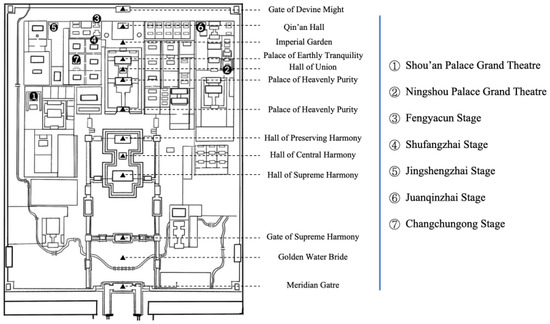
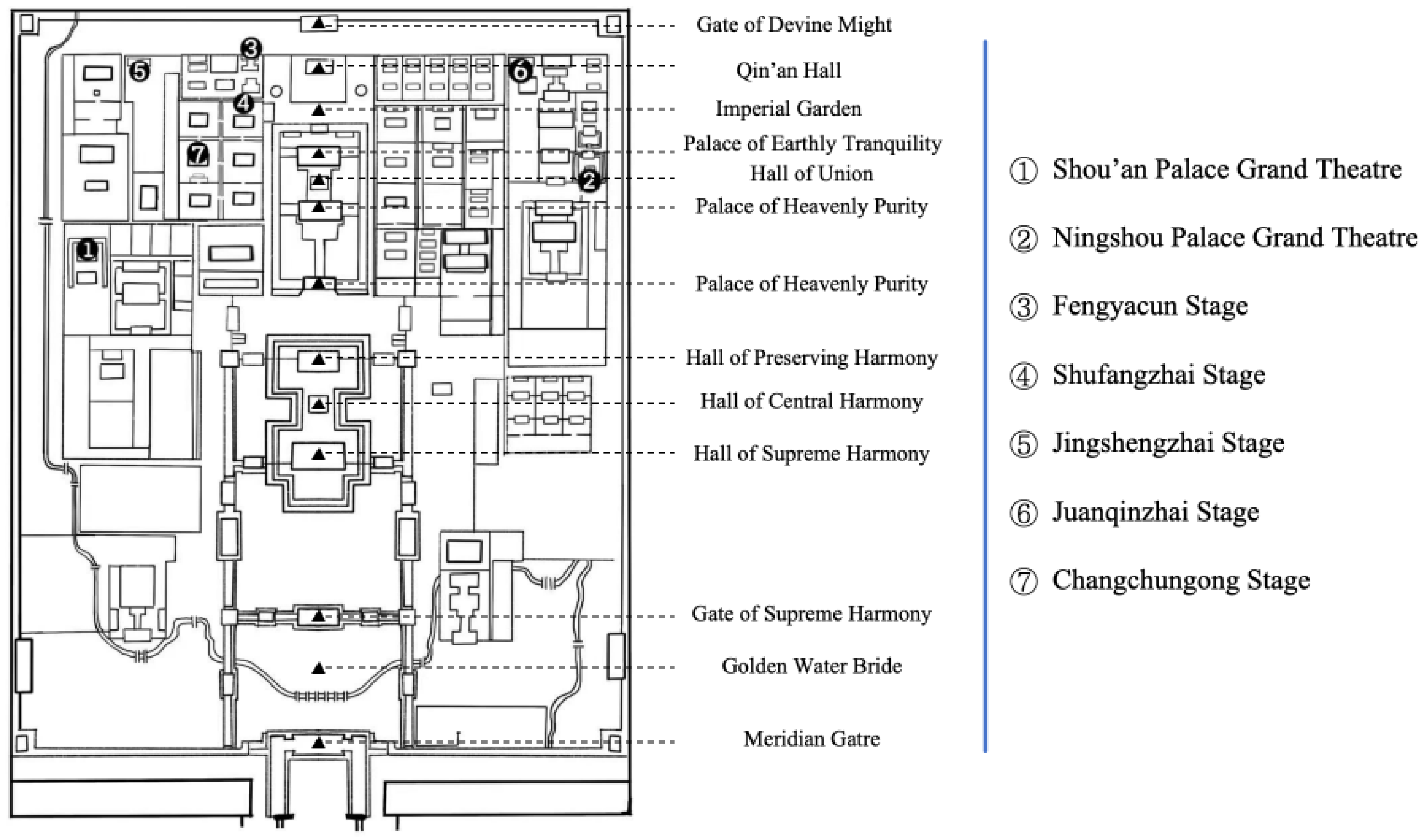
In the imperial court, ‘imperial power’ serves as the absolute core, and its spatial features are characterized by high-level enclosure and strict hierarchy. As the physical manifestation of this power center, the Forbidden City establishes a rigorously hierarchical and enclosed system (Figure 1). This is achieved through a four-layer spatial barrier consisting of a moat, city walls, city gates, and inner walls, and is further reinforced by military guards and legal regulations. Inside the Forbidden City, a longitudinal axis runs from the three front-court halls (the Hall of Supreme Harmony, the Hall of Central Harmony, and the Hall of Preserving Harmony) to the inner-court Palace of Heavenly Purity and the Imperial Garden. This axis divides the area into two functional zones: the ‘grand ceremony and ritual space’ and the ‘living quarters for the emperor and empress’. It is also a spatial projection of political power. The enclosed design reinforces the inviolability of imperial power, while the hierarchical structure emphasizes the legitimacy of the mandate of heaven for imperial rule.
Figure 1.
Distribution map of the stage areas in the imperial Beijing theatre complex.
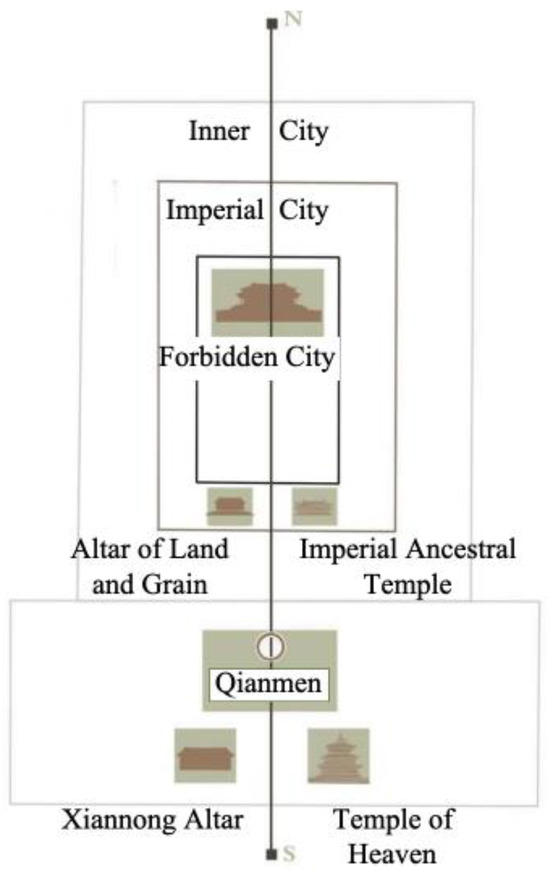
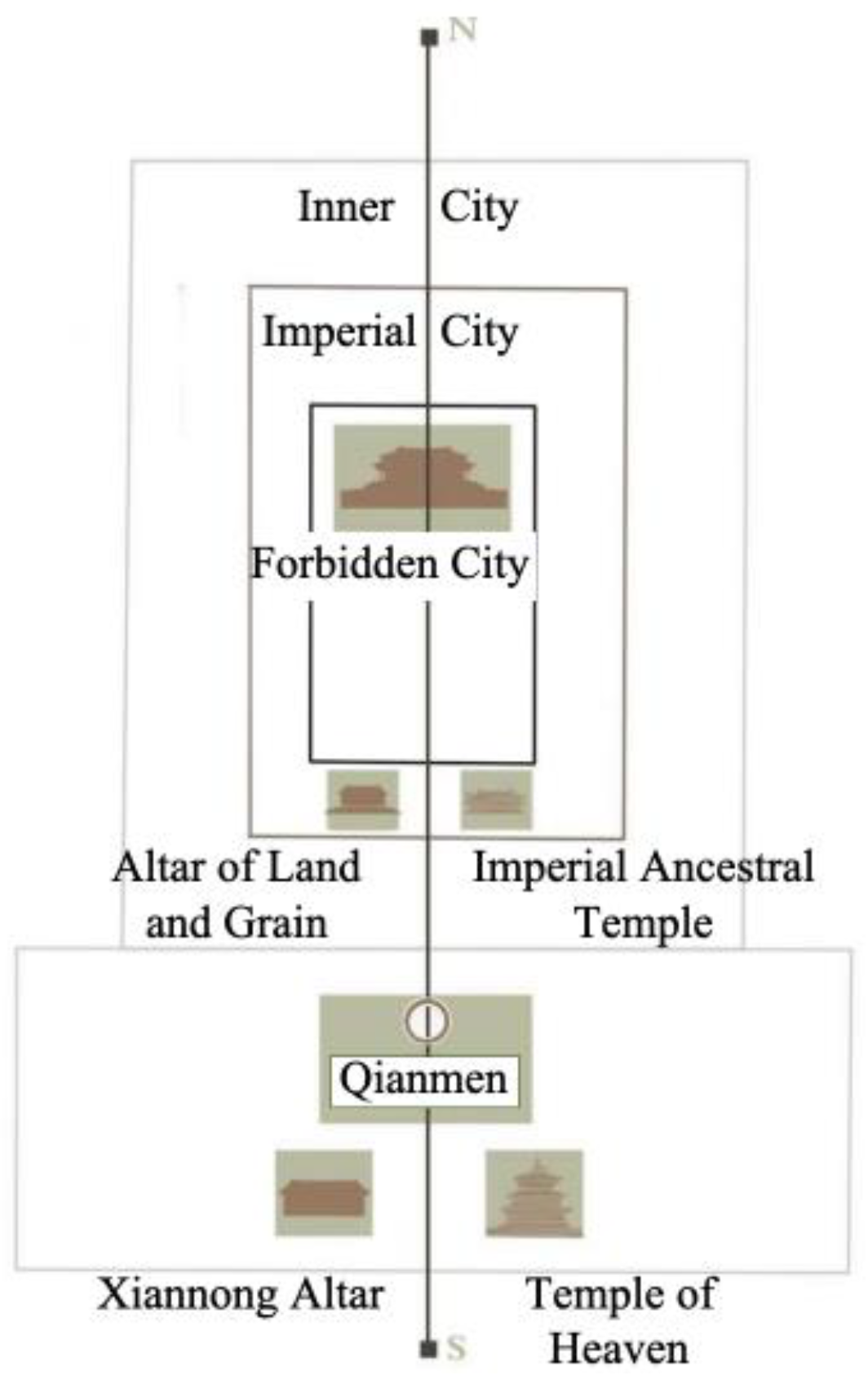
The folk domain centers around the market and local culture, featuring open mobility and aggregation in its spatial characteristics (Liang 2018). Its core area is composed of two major business districts: Tianqiao and Qianmen. Tianqiao, originally a passage for emperors to offer sacrifices to heaven, later evolved into an entertainment gathering place for the public, where folk arts such as acrobatics and folk operas were gathered. Qianmen Street starts from Yue Liang Wan in the north and ends at Tianqiao Road Intersection in the south, linking professional markets such as Xianyu Kou, Zhushi Kou, and Dashilan. It has formed a commercial hub that connects the nobility within and the common people without. This spatial design breaks the closed barriers of the palace and constructs an open domain centered on transaction and interaction through the flow of multiple actors, namely ‘merchants, consumers, and the government’ (Figure 2).
Figure 2.
Spatial layout of the central axis of Beijing during the Qing Dynasty.
This spatial arrangement was not accidental but closely related to the political logic of imperial governance. The placement of performance venues along the central axis reflects a symbolic ordering of power: performances located closer to the core of imperial authority carried stronger ritual and ideological functions, while those positioned in peripheral or transitional spaces allowed for greater flexibility and entertainment value. In this sense, the spatial distribution of Peking opera stages reveals how performance functioned as a mediating layer between political authority and cultural expression, translating abstract power into sensory and performative experience.
2.2. The Distinction Between the Composition of Actors and the Rule System
The actors in the court field consist of power dominators, management institutions and execution subjects. The power dominators, namely the emperor and the nobility, directly determine the rules of the field. Management institutions like the Nanfu and the Shengpingshu are tasked with translating the imperial will into rigid systems for play review and clothing grade regulations. The execution subjects are imperial entertainers such as court performers, who must strictly adhere to the aesthetic norms of elegance and propriety and moral instruction. The field rules are guided by political needs and stress serving as a symbol of imperial power. For instance, court plays mainly revolve around themes of good fortune, longevity, auspiciousness, loyalty, filial piety, and integrity. In content, they emphasize orthodoxy and ideological significance, featuring a grand narrative structure that transforms opera performances into ‘ritual displays of power’ (Dong 2021).
Actors in the folk field center around the market entities, cultural disseminators and consumer groups. Market entities, including folk opera troupes and theater operators, aim fundamentally at commercial profit. Cultural disseminators are itinerant artists who need to adjust their performance content to suit secular tastes. Consumer groups, composed of the gentry-merchant class and ordinary people, participate in shaping the field rules through audience-performance interaction. The field rules adhere more closely to secular logic, emphasizing entertainment and interaction. The widespread staging of popular themes like Water Margin and Romance of the Three Kingdoms not only meets the public’s imagination of chivalry and legends but also establishes a market-oriented operation model of audience taste, driving performances through mechanisms such as the star system and theater competition.
2.3. The Essential Difference in the Logic of Cultural Production
In the court domain, cultural production revolves around symbolic capital. Peking opera performances are associated with rewarding political symbols like imperial-bestowed repertoires and court costumes, and their value comes from the official certification of imperial power. On the other hand, in the folk domain, it centers on economic capital, and Peking opera art achieves value transformation through market feedback such as ‘box-office revenue’ and ‘reputation of famous actors’. This difference eventually results in a divergence in artistic forms: Court Peking opera tends towards refinement and standardization under political discipline, while folk Peking opera shows commercialization and popularization driven by the market.
The divide between the imperial court and the folk in Peking opera reflects the dual logic of ‘top-down power discipline’ and ‘bottom-up cultural growth’ in Qing Dynasty society. This divide not only confirms the core feature in Bourdieu’s field theory, which states that ‘the network of objective relations is dominated by specific power’, but also offers an interpretive framework from a field perspective for understanding the diverse evolution of Peking opera’s artistic form (Bourdieu and Wacquant 1992).
3. The Logic of Resources and Power in Different Fields Under Capital Competition
In Bourdieu’s field theory, ‘capital’ serves as the core means for actors within a field to vie for dominance and acts as the material carrier of field rules and power structures. The demarcation between the imperial-court and folk Peking opera fields in the Qing Dynasty essentially results from the differential practices of capital types, operational logics, and transformation mechanisms in these two types of fields.
3.1. Economic Capital
As the material foundation for the operation of a field, the concentration level and the entity in control of economic capital directly determine whether the field is closed or open. It follows completely different distribution logics in the court and folk fields. In the court field, economic capital is centered around ‘direct royal investment’, characterized by a high degree of concentration and non-marketization. Its sources mainly fall into three categories:
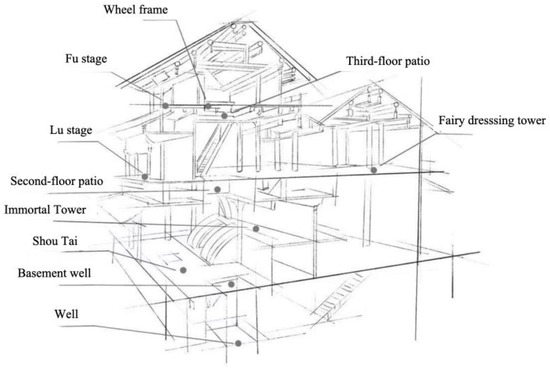
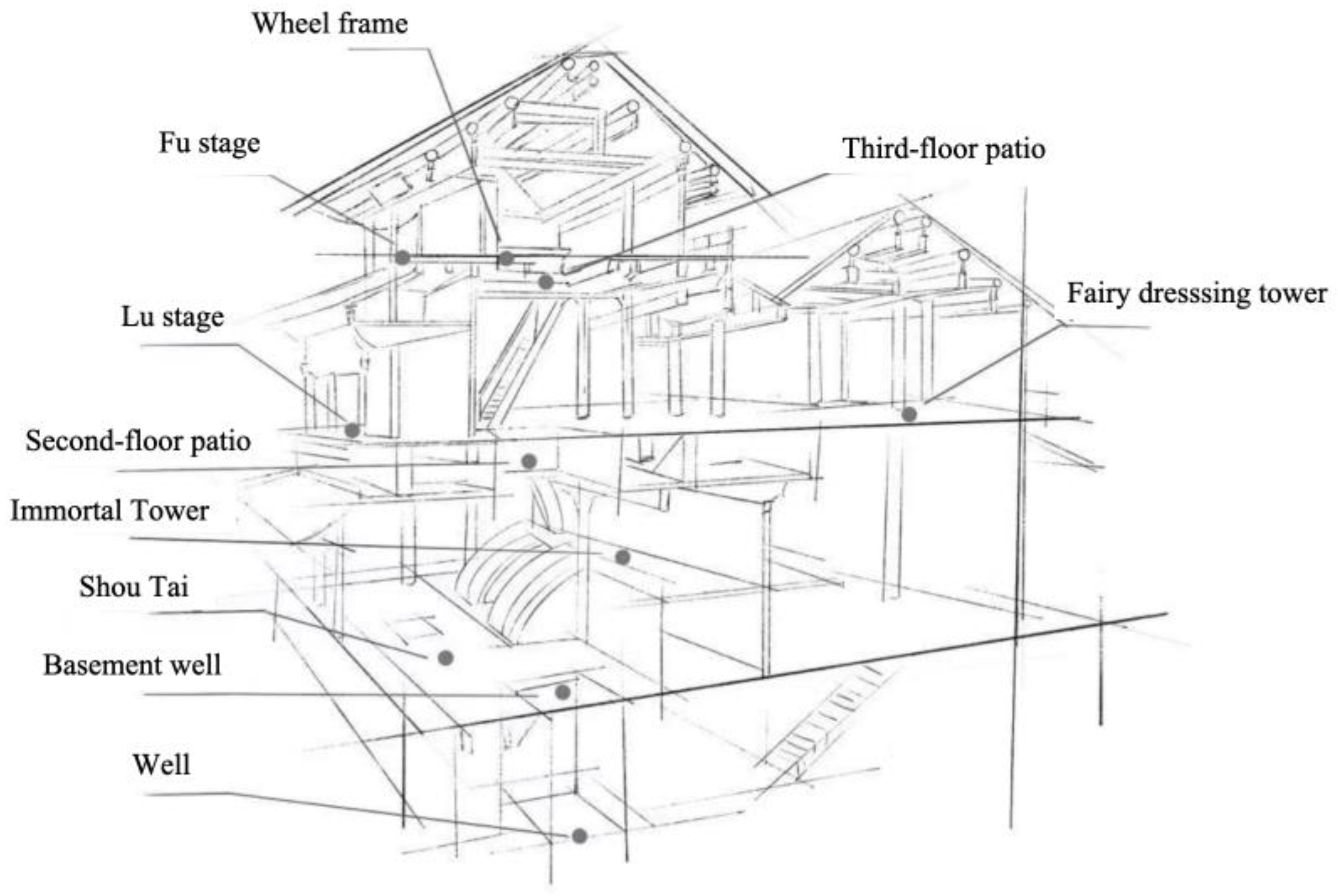
Firstly, the royal family allocates special funds for building opera stages and purchasing opera props. According to the Archives of the Imperial Household Department’s Account Settlement, ‘The construction of the grand opera stage at Changyin Pavilion in the Palace of Tranquil Longevity, as well as the indoor opera stage at Shufangzhai, was all ordered by imperial decree to be built with golden nanmu wood. The total cost of materials and labor for the carpentry work and mechanical devices (note: including cloud-suspended supports, trapdoors, and the tracks for the fairy tower) amounted to 89,600 taels of silver, to be drawn from the silver treasury of the Guangchu Si’ (National Library Press 2009) (Figure 3).
Figure 3.
The cross-sectional view of the third-floor opera hall of the Qing Palace, the Changyin Pavilion.
Secondly, fixed salaries were paid to imperial entertainers such as Court Performers. It is also recorded in the Archives of the Imperial Household Department’s Account Settlement that ‘Monthly stipends for students registered under the commoner register at the Nanfu and Jingshan were three taels of silver and three dou of white rice each; those for banner-register students were two taels of silver and two dou of rice each’ (National Library Press 2009). This far exceeds the daily payment of only dozens of wen typically received by folk opera troupes.
Thirdly, there are additional rewards during special festivals. For instance, after the performance on the Emperor’s birthday, the emperor would bestow ‘reward silver’ upon the performers. The Reward Record from the 20th year of the Guangxu reign, as detailed in Compilation of Historical Documents on Peking Opera-Qing Dynasty Volume, records the reward given to Tan Xinpei: ‘On the 12th day of the tenth month, it was the birthday celebration of the Empress Dowager Cixi. Tan Xinpei received 200 taels of silver, two bolts of python-patterned satin, and two bolts of brocade satin’ (Phoenix Publishing House 2011). The distribution of this economic capital is entirely dominated by imperial power and serves the objective of the political ritual. Essentially, it represents the transformation of economic capital into power symbols.
As an open-space field, the economic capital in the folk field necessarily relies on the flow and exchange of multiple subjects. Centered around ‘market income’, it features dispersion and liquidity. Its sources are diverse and depend on the local economic level: First, the fixed payment income from theaters. For example, theaters like Guangdelou and Sanqingyuan in Qianmen paid opera troupes a ‘daily fixed payment’. As recorded in A Panorama of Tianqiao, ‘Teahouse-theaters hired resident actors and paid a daily fixed payment of ten strings of Beijing copper coins, equivalent to one tael of Kuping silver at the prevailing price. During festivals, it might increase to twelve strings’ (Xiehua Bookstore 1914). Second, the tip for requested plays from the audience. In Tianqiao’s teahouse-theaters, ‘star-chasing’ audiences would give extra money to famous actors. When Tan Xinpei performed The Battle of Dingjun Mountain at Guanghelou in his early days, his vivid performance earned him an extra twenty-string reward of Beijing copper coins from the audience. Third, the income from extra performances at temporary events such as temple fairs and private parties. During the Spring Festival, when performing at the Dongyue Temple fair, artists could earn extra income by ‘collecting money’, where the audience would throw money on the spot. The dispersion and marketization of this economic capital directly drive the competitive logic of the private field, prompting actors within it to adjust their practical strategies accordingly.
3.2. Cultural Capital
The legitimacy of cultural capital stems from the recognition of the dominant power within the field. Its form and source of authority present a sharp contrast in the field division. The official field relies on institutional certification, while the private field relies on practical recognition.
The cultural capital in the imperial court field centers around the ‘officialized’ Peking opera formulas, and its legitimacy is endorsed by the imperial power. Specifically, it is manifested in the following aspects: Firstly, there are ‘stylized’ performance norms. These norms are approved by institutions such as the Nanfu and Shengpingshu and recorded in official classics like the Catalogue of Grand Court operas and the Outline of Costumes, thus becoming the royally certified artistic criteria. Secondly, there is an ‘imperially used’ script system. The content of the scripts is reviewed by court scholars in the Nanshufang to achieve the goals of political education and artistic discipline. According to The Beginning and End of Court Performances in the Qing Dynasty, the full version of The Golden Rules for Promoting Goodness comprises 240 acts. At the beginning, it states: ‘When simple folks around the world read this legend, they will all learn to be loyal to the king, filial to their parents, respectful to their elders, and refrain from greed and lust. They should keep these teachings in mind and uphold them with determination. The heavens will witness their intentions, and the earth gods will scrutinize their actions. There are explicit criminal laws to bind them, and invisible ghosts and gods to accompany them. Whether they are out or at home, speaking or silent, the heavens and the earth are fully aware of everything…’ (Zhang 2016). Thirdly, there is a hierarchical symbol system. For instance, in clothing patterns, only emperors are allowed to wear ‘dragon robes’, and ‘mandarin squares’ correspond to official ranks. Through the explicit regulations in The Great Qing Code, visual norms are translated into concrete expressions of ritual systems. The official nature of this cultural capital essentially represents the discipline imposed by political power on artistic production. The Peking opera repertoire is not only a performing technique but also serves as a cultural carrier of imperial legitimacy.
In contrast, the cultural capital in the folk domain centers around folk-based performing innovations, and its legitimacy comes from public recognition. Specifically, it is manifested in the following ways: Firstly, there are improvised performance adjustments. Performers modify lyrics on the spot and add daily life dialogues according to the audience’s reactions to enhance the interaction between the performers and the audience. According to Jiu Jing Suo Ji (Anecdotes of Old Beijing), the Tianqiao performer Liu Gansan often added improvised lyrics scolding corrupt officials when the audience laughed, which unexpectedly became a highlight that attracted audiences. Secondly, there are localized script adaptations. Classic stories such as Water Margin and Romance of the Three Kingdoms are simplified into ‘martial arts plays’ and ‘detective plays,’ fitting the citizens’ imagination of chivalry and legends. A Chronological Record of the Peking Opera World Since the Daoguang and Xianfeng Reigns records that ‘In 1873, the Sixi Troupe newly staged The Slope of the Wu Family. The dialogues between Xue Pinggui and Wang Baochuan mostly imitate the tones of ordinary market couples. People at that time said it was just like an ordinary couple arguing over daily necessities, and the audience burst into laughter’ (Zhou 1932).
The Sixi Troupe’s adaptation of The Slope of the Wu Family was widely popular as it closely resembled the squabbles of ordinary market-going couples. Thirdly, there was a ‘word-of-mouth’ evaluation of acting skills. Titles like ‘Living Cao Cao’ and ‘Living Wu Song’ given to actors by the public spread among the audience and established an artistically authoritative ‘public certification’. Cheng Changgeng was respected as the ‘Grand Boss’ for his ‘excellent combination of voice and emotion’, and Yu Sansheng was hailed as the ‘Founder of Laosheng’ for his ‘innovation in Pihuang’. These word-of-mouth appraisals directly influenced the actors’ bargaining power. The popular nature of this cultural capital essentially reflects the market logic driving artistic production. Peking opera innovation is not merely an aesthetic expression but also a commercial strategy to meet secular needs.
3.3. Symbolic Capital
Symbolic capital represents the ‘social prestige’ of actors within a field, and the mechanisms for its acquisition and transformation show functional differences in different fields.
In the imperial court field, symbolic capital is centered on the imperially conferred status and can be directly transformed into social status. A typical manifestation is the title of ‘Court Performer’. Artists selected to perform in the imperial court, like Cheng Changgeng and Tan Xinpei, not only obtained the honor of the imperial-used status but also could improve their social standing among the common people with this title and were respected as ‘Sir’ by the gentry class. Moreover, items bestowed by the royal family, such as yellow mandarin jackets and official hats with peacock feathers, also served as carriers of symbolic capital. Their value far exceeded that of the material itself, and they became symbols of imperial favor. According to Qing Bailing Chao, Tan Xinpei touched the emperor’s compassion with his performance of Hongyang Cave and was awarded a yellow mandarin jacket. After that, ‘whenever he performed at private parties, he would wear this jacket, and all the guests would stand up upon seeing it’ (Xu 1984). The scarcity and authority of this symbolic capital reinforced the hierarchical order in the court sphere. The artists’ pursuit of the ‘imperially bestowed’ status is essentially a fight for the dominance of the sphere, namely, the access to imperial power. The monopoly of symbolic capital is precisely the key measure for the power center to maintain the order of the sphere.
The symbolic capital in the folk sphere centers around the ‘prestige of famous actors’ and can be directly converted into the appeal of performances (Goldstein 2007). According to the record in Tianqiao Zayong, ‘Xiangshui performed Laoma Kaibang on the Yan Stage. When she sang the line ‘My husband froze to death in the wilderness’, she broke down in tears, causing the audience in the hall to shed tears as well. Since then, she gained city-wide fame and was hailed as the ‘Queen of Pingju Opera’. The theater owner paid her a daily salary of thirty taels of silver, yet still worried that the theater was too small to hold all the audience’ (Yongxingzhai Edition 1935). The mobility and popularity of this symbolic capital have spurred market competition in the folk field. Performers’ pursuit of the reputation of famous actors is essentially a scramble for the field resources, namely, ‘audience attention’. Therefore, the symbolic capital in the open field needs to achieve maximum value through mass communication.
Capital is the core of field competition. In the Qing Dynasty, the capital competition between the imperial court and the folk Peking opera fields was essentially an opposition between ‘centralized distribution dominated by political power’ and ‘decentralized flow driven by market logic’. The investment mode of economic capital, the authoritative source of cultural capital, and the transformation function of symbolic capital jointly shaped the power structure and artistic form of these two fields.
4. The Internalization Tendency and Practice of Actors Shaped by Habitus
Habitus is the internalization of the field structure in the actor’s consciousness and the history embodied in people. Through long-term practical interactions, the structural differences between the imperial court and the folk Peking opera fields in the Qing Dynasty have eventually led to the formation of the unique behavioral tendencies and cognitive patterns of the actors, namely the artists and the audiences. The closed and ritual-bound nature of the imperial court field shaped artists’ obedience to norms and the audience’s dependence on ritual. In contrast, the openness and market orientation of the folk field enabled artists to adapt more flexibly and stimulated the audience’s demand for interaction. This differentiated habitus is not only a product of field rules but also an important mechanism for the reproduction of field order.
4.1. Habitus of Performers
As the direct producers of Peking opera art, performers’ habitus most vividly reflects the shaping power of the field.
Court performers, like the Imperial Court Performers, served in a closed field dominated by imperial power for a long time. The core of their habitus is absolute obedience to norms and a precise grasp of elegant tastes, which makes them ‘ritual executors’ under institutionalized discipline. The formation of this habitus results from a threefold institutionalized discipline. First, there are the rigid constraints of institutional management. Court performers were directly managed by institutions such as the Nanfu and Shengpingshu. They had to abide by regulations like the Regulations of the Nanfu, for instance, performers from outside the palace would be given the status of the Eight Banners upon entering the palace. Administratively, they were supervised by the Ministry of Rites, and their daily training and performances were carefully recorded in archives such as the Record of Rewards and Grants Diary. Secondly, the performance routines are strictly restricted. From scriptwriting to stage movements, all aspects must adhere to the standards approved by the royal court, such as the ‘official tunes’ and ‘official melodies’. For example, the singing tones should meet the musical requirements of the Imperial Music Score, the patterns on the costumes must follow the hierarchical regulations in the Costume Outline, and even the sequence of performances was embedded in the ceremonial proceedings. The Record of Imperial Rewards in the Third Year of the Daoguang Reign records (Zhu and Ding 2014):
The above text documents the New Year’s Day ceremony in the third year of the Daoguang reign. Thirdly, there is the targeted cultivation of aesthetic taste. Court artists should be well-versed in poetry and allusions and acquainted with royal texts like Imperial Poems and Catalog of Inner-Court Grand Operas to incorporate ‘imperial elements’ into their shows. Inner-court performers often adapt the librettos based on the emperor’s improvised poems. Their sensitivity to this elegant taste turns their performances into an artistic translation of imperial will.On the first day of the first lunar month, at 4:45 a.m., people entered the door. During the morning meal at the Jinzhaoyucui Hall, A Joyous Gathering of Five Deities (performed by the inner troupe) was presented. At 6:20 a.m., soft music was played on the front stage to welcome guests. At 5:13 a.m., the front stage continued with the performances of The Three Immortals Paying a Visit (performed by the outer troupe) and Sweeping the Flowers (performed by the outer troupe). At the second quarter of the second hour of the morning, the Emperor drove to the Palace of Heavenly Purity to receive congratulations, and a play was staged on the stage. At the first quarter of the third hour of the morning, he returned to the Palace of Gathered Elegance, where the play Three Drunkennesses (performed by external actors) resumed. The inner and outer grand eunuchs, head eunuchs, official eunuchs, and official students knelt three times and kowtowed nine times in front of the stage. Then, the first half of the play Jingde Fishing (performed by external actors) was presented. At the third quarter of the third hour of the morning, the Emperor went to the outer temple to worship Buddha. At ten minutes past the first quarter of the fourth hour of the morning, the Empress reached the Palace of Gathered Elegance, and the second half of the play Jingde Fishing continued. At twenty minutes past the second quarter of the fourth hour of the morning, the Emperor arrived at the Palace of Gathered Elegance, and the stage presented the play Crossroads Slope (performed by external actors). At five minutes past the first quarter of the fifth hour of the morning, the Emperor drove to the Hall of Supreme Harmony, while on the stage, the plays Palace Flowers Announce Good News and Pepper Flowers Offer Congratulations (both performed by external actors) were staged. At the third quarter of the fifth hour of the morning, the Emperor returned to the Palace of Gathered Elegance, where the plays Blind Man Visiting the Lantern Festival (performed by external actors) and New Spring in the Valleys (partly performed by external actors) continued. The play concluded at the second quarter past 2 p.m. At the Qianqing Palace, Receiving Abundant Blessings was staged as the entertainment for the New Year’s Day banquet during the main course, and All Blessings Converge (one act) was presented during the second-stage of the banquet. The performance began at the third quarter past 1 p.m. and ended at the second quarter past 2 p.m. Keep this note on the hand-card.
Folk artists are responders to market demand in the market competition. They were regarded as inferior people. This class depends on the market for survival, and the core of its habitus lies in active adaptation to popularity and a high-level emphasis on interaction. The formation of this habitus stems from dual survival pressures: On the one hand, the drive of dispersed economic capital. The income of folk artists relies on market-based revenues such as ‘contract fees’ and ‘fees for requesting specific plays’. They need to attract audiences through methods like the ‘star system’ and ‘new play creation’. Qi Rushan recorded in The Changes of Peking Opera: ‘Previously, Peking opera troupes in Beijing had a fixed contract fee. Once agreed upon, it remained unchanged for a year, and the troupe owner’s profits or losses had nothing to do with the actors. In the early Guangxu period, Yang Yuelou returned to Beijing from Shanghai and joined the Sanqing Troupe. He was extremely popular with the audience, so he negotiated with the troupe owner to switch to a profit-sharing system.’ Yang Yuelou successfully negotiated a revenue-sharing arrangement thanks to his box-office appeal, which forced the opera troupe to adjust its cooperation model. On the other hand, there is the direct feedback from audience demand. Folk artists need to flexibly adjust their performance strategies to cater to secular tastes. They incorporate vernacular and slang in their language, simplify classic stories into ‘martial arts plays’ and ‘detective plays’ in the plot, and even add local customs or current affairs topics. For instance, during temple fair performances, they sing ‘harvest plays’ according to the farming season. This popular adaptation and emphasis on interaction are essentially the direct influence of market logic on artistic production-the artists’ habitus become mirrors of the audience’s tastes.
4.2. Audience Habitus
As the ‘meaning receivers’ in the field, the audience’s habitus also profoundly reflects the power structure and operating logic of the field.
Court audiences are ritual connoisseurs within the hierarchical order. Composed mainly of royal family members, they follow a connoisseurship-style aesthetic at the core of their habitus, which emphasizes the rigor of performance routines, the refinement of singing styles, and the solemnity of rituals. This habitus stems from the meta-field nature of the field: court Peking opera is a symbolic ritual of power, and its value lies not only in entertainment but also in strengthening the legitimacy of imperial power through elegant and proper performances. Therefore, the criteria used by court audiences to judge performances far exceed the realm of art itself. They are concerned about whether the singing styles conform to the harmonious sounds in the Imperial Score. This connoisseurship essentially serves to confirm the ritual order by being picky about the details of performance routines; the audience implicitly recognizes the authority of imperial power.
Ordinary audiences are participatory experiencers in secular life. Composed mainly of the scholar-merchant class and the general public, they follow a participatory aesthetic habitus, which values the excitement of the plot, the immersion of emotions, and the liveliness of interaction. This habitus stems from the market attribute of the field: folk Peking opera is an entertainment commodity for the common people, and its value is realized through audience-performer interaction. Therefore, the evaluation criteria of ordinary audiences are more in line with secular needs. For example, they are fond of loyalty-vs-treachery plays such as Beating Yan Song to satirize the present by referring to the past and vent their dissatisfaction with the corruption of the officialdom. They prefer mechanism plays like The Cowherd and the Weaver Girl that create visual spectacles to satisfy their aesthetic desire for novelty and difference. They even directly influence the performance content by ‘requesting specific plays’ and ‘tipping’. This kind of ‘participation’ essentially projects secular life; the audience can achieve spiritual transcendence from real-life predicaments through their feedback on the performance. As Li Yu put it, ‘Would that all souls might reach the Blissful Realm; though fleeting, such joy still sweetens each passing day’ (Li 1991).
4.3. Institutional Regulation and the Interpenetration of Court and Folk Habitus
The interpenetration and adjustment of habitus became possible through the blurred boundaries between the court and the folk field, as well as through the mobility of artists, both of which were shaped by institutional regulation. In the Qing dynasty, Peking opera, regulatory power did not remain confined to the palace. Through mechanisms such as repertoire control, aesthetic standardization, and intermediary organizations like the Shengpingshu and theatrical guilds, imperial authority extended into the folk sphere and shaped the broader ecology of performance. In this sense, the court not only exercised direct cultural discipline but also established a normative framework that structured the circulation of artists, repertoires, and performance conventions across different social domains.
Within this framework, habitus was continuously adjusted through cross-field movement. When folk artists performed in the palace, they had to temporarily adapt to the court’s ‘norm-obedience’ habitus, learning the ‘official accent,’ ‘official tune,’ and ceremonial sequence. After returning to the folk sphere, they brought these refined forms back with them. Likewise, some gentry audiences gradually developed a preference for meticulous formalities after being exposed to court Peking opera, while members of the royal family began to appreciate the lively tastes of folk theaters. During Emperor Guangxu’s reign, for example, palace performances even showed a shift toward more folk-oriented stagecraft, such as mechanical scenery. Such mutual influence gradually weakened the rigid opposition between refined and folk customs, allowing Peking opera to preserve its standardized features while also absorbing the vitality of folk culture.
The differences between court and folk Peking opera in the Qing Dynasty can thus be understood as embodied manifestations of field structure in the actors’ consciousness and practice. The norm-compliance of court artists and the ritual appreciation of court audiences reproduced the imperial power order, while the market adaptation of folk artists and the participatory experience of folk audiences sustained the vitality of folk culture. The interaction between these two fields, together with the mutual penetration of practices, ultimately gave rise to the distinctive form of integration between refined and folk elements in Peking opera.
5. Interaction of Fields and Capital Conversion
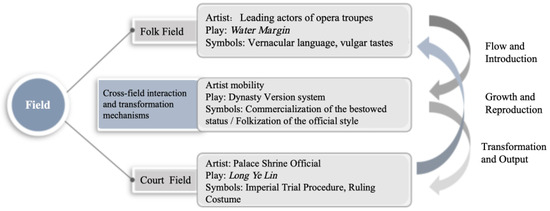
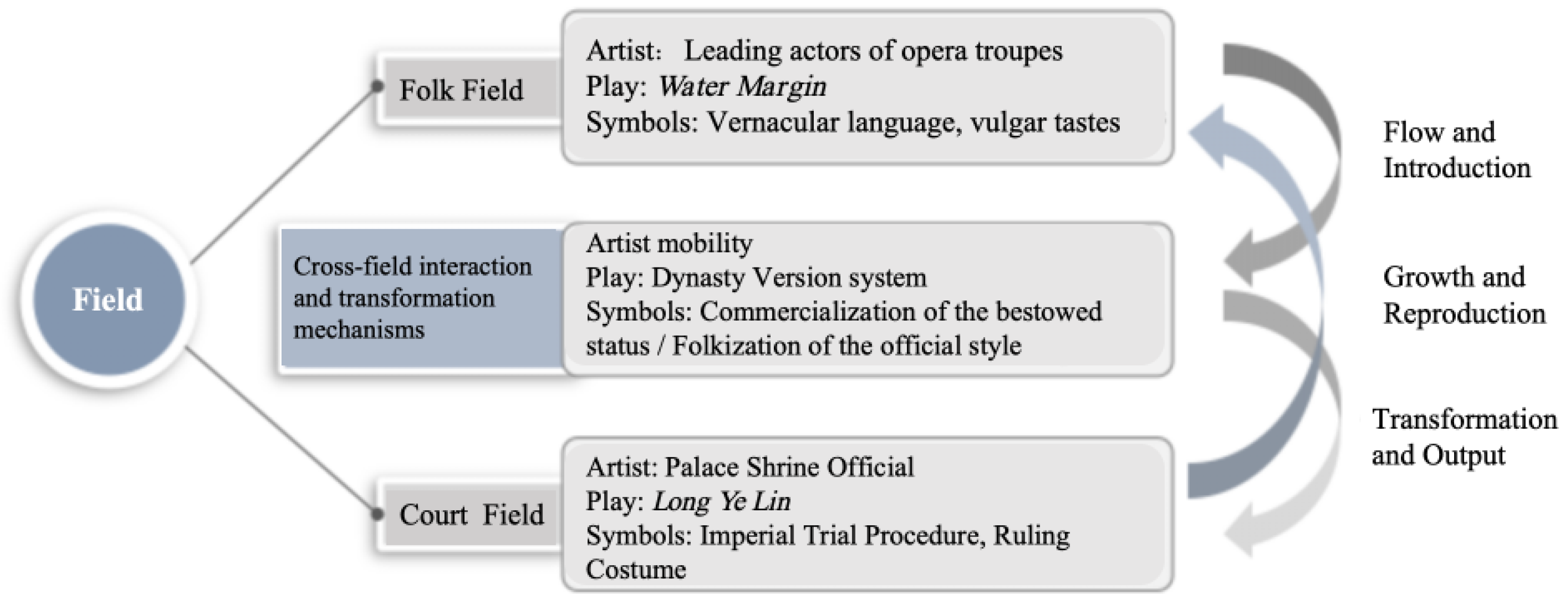
Bourdieu emphasizes that the autonomy of fields is relative, and different fields establish dynamic connections through resource flow and capital conversion. In the Qing Dynasty, despite the division between the imperial court and folk Peking opera fields due to differences in power structure, spatial characteristics, and capital logic, they were not completely isolated and closed systems. Through mechanisms such as the movement of performers, the dissemination of repertoires, and capital transformation, these two fields built a two-way interactive network where the folk field nourished the imperial court, and the imperial court reciprocated to the folk field. (Figure 4) This network promoted the cross-field conversion of economic, cultural, and symbolic capital, ultimately shaping the unique integration of elegance and vulgarity in Peking opera art.
Figure 4.
Model diagram of cross-field flow and mutual construction of court Peking opera performers, performances and symbols.
5.1. The Flow of Artists and the ‘Inner Court Offerings’ System
First, the recruitment of folk artists to serve in the palace constituted the primary channel of interaction between the two fields. The Qing Dynasty Shengpingshu, as the palace drama management organization, paid close attention to the dynamics of the folk stage and recruited outstanding artists to serve in the palace through the Pear Garden Guild Jingzhong Temple. Although these artists were not appointed for life, their popular performing experience accumulated in the folk world, such as improvisation, ‘catching jokes’ (zhuagen), and reciting in dialect, was brought into the palace, and became an important impetus for the palace Peking opera to break away from its rigid program. For example, when Yang Mingyu, a folk artist, entered the palace, he incorporated city slang and current topics into plays such as Shiqian Stealing Chickens and staged them at the court, using the chicken stealing as a metaphor for government, which not only retained the freshness of the folklore, but also met the needs of the royal family to ‘observe the common people and know the government’, making the performances more realistic and mapping. The performance is more meaningful in terms of reality mapping.
Second, repertoire adaptation and the ‘An Dian Ben’ system: popular folk repertoire was an important source of scripts for the court, which became officialized cultural capital after being elegantly adapted (Tsui 2024). The court required folk opera groups to submit their scripts to the court before performance, and the scripts were revised by the Hanlin of the Nanshufang to enhance the elegance of the language and the regularity of the plot. For example, the palace play Chang Ye Lin was adapted from the folk novel Shuo Tang Quan Zhuan. A passage in the original text reads:
The original dialogue is redundantly colloquial, such as the repetition of ‘Ran Ran Ran’, and after modification by court literati, it can be found in Chang Ye Lin. In the dialogue:‘Yaojin said: ‘Ran Ran Ran, you are actually a living god, We have been staying here doing nothing, so we should leave. I have already told you that I have entrusted Luo Cheng, in good condition, to your care. If he recovers, return him to me as a person; if it does not work, then at least return me his bones’.(Shanghai Ancient Books Publishing House 1994)
The language is more refined and standardized, the rhythm is more harmonious, and it is more in line with the aesthetic requirements of the court. The essence of this adaptation is to transform the folk ‘popular cultural capital’ into official cultural capital, making it an artistic carrier of the legitimacy of imperial power.‘Cheng Yaojin: ‘Good gah, Lao Dan, you are truly a living god. Let me tell you this: I have entrusted a perfectly well Luo Cheng to you. If he recovers, send him to Chang’an, and I will remain on good terms with you for the rest of my life. If anything goes wrong, I, Cheng, will never let this matter rest’.(National Library of China 2011)
Third, through their status as court entertainers, folk artists acquired court-sanctioned symbolic capital, thereby elevating their social standing. The cross-field circulation of this symbolic capital not only satisfies the imperial court’s demand for the vitality of folk art but also offers folk artists, eager for social mobility, a channel for ascending the social hierarchy.
5.2. From the Court to the Folk
The secularization of authoritative resources and the valorization of economic capital constitute a key mechanism in the interaction between the court and folk fields. The authority of the court field provided a form of legitimacy for the folk sphere; once subjected to processes of secular adaptation, its refined conventions and ritual symbols were transformed into both cultural and economic capital within the popular sphere.
First, the dissemination of performance conventions and the popularization of the so-called ‘official style’ (guanqiang) played a crucial role. The standardized techniques of court Peking opera were transmitted back into the folk field through performers who had served in the palace, becoming essential resources for improving the artistic level of popular troupes. For example, the highly demanding acrobatic technique of weapon-throwing in court martial plays—known as dachushou—was adopted by folk troupes and reconfigured as a form of visual spectacle designed to attract audiences. Similarly, the rhythmic and tonal discipline associated with the ‘official style’ was learned and adapted by popular performers, lending their singing a more refined quality that appealed to the aesthetic expectations of the gentry. In this sense, the popularization of these authoritative conventions represents a transformation of the court’s institutional cultural capital into market-oriented cultural capital, thereby enhancing the artistic and commercial value of folk Peking opera.
Second, the appropriation of symbolic markers—particularly those associated with imperial patronage—enabled the direct conversion of symbolic capital into economic capital. Court-bestowed symbols were strategically displayed by folk troupes as markers of prestige and authenticity. For instance, theatres frequently advertised performances with phrases such as performed by an artist formerly serving in the imperial court, using such associations to attract audiences. In addition, visual elements modeled on court aesthetics—such as imitation imperial seating arrangements—were employed to elevate the perceived status of performances and justify higher ticket prices; in venues such as Guanghe Theatre, seats designed to resemble the imperial throne commanded significantly higher prices than ordinary seating. This commercial deployment of symbolic capital effectively transformed the prestige associated with the court into tangible economic value within the popular entertainment market.
5.3. The Bidirectional Permeation of Cultural Functions
The moral edification of the court and the secular expression of the folk were merged through interaction, propelling Peking opera to become a ‘dual-meaning carrier’. On one hand, ethical repertoires from the court, such as Yue Fei’s Mother Tattooing Loyalty and The Battle of Changban, were absorbed by folk Peking opera, which leveraged the court’s authority to gain recognition from the gentry class and enhance its legitimacy. On the other hand, court repertoires were adapted by the folk through the infusion of urban tastes, blending the court’s ‘didactic function’ with the folk’s ‘entertainment function’ to cater to diverse audiences. This fusion ultimately dissolved the rigid boundaries between court and folk culture, allowing Peking opera to simultaneously embody imperial ideology and articulate the spiritual aspirations of urban dwellers. The essence of capital conversion lies in the dynamic equilibrium between power and the market. The core of field interaction is characterized by the cross-field conversion of capital, reflecting a dynamic equilibrium between the logic of power and market forces. Through processes of refinement and certification, popular resources from the folk sphere were transformed by the court into cultural capital serving imperial authority.
Conversely, the folk adapted authoritative resources from the court into economic capital via secularization and symbolic appropriation to enhance market competitiveness. This dual conversion mechanism preserved the court’s cultural hegemony, exemplified by the censorship of ‘obscene operas’ to regulate folk content, while simultaneously fostering continuous innovation in folk art. The resulting developmental paradigm of Peking opera thus emerged as power steering the course, while the market propels innovation.
The interaction between the Qing court and the folk Peking opera field was far from being a mere unidirectional transmission. Rather, it achieved the cross-field conversion of economic, cultural, and symbolic capital through mechanisms including performer mobility, repertoire adaptation, and symbolic borrowing. This dynamic not only validates Bourdieu’s theoretical framework that ‘fields establish connections through capital conversion’, but also illuminates the deeper societal forces behind Peking opera’s characteristic harmonization of refinement and popularity—representing both the imperial co-optation of folk culture and the popular reinterpretation of official culture. Ultimately, through the tension between authority and market forces, there emerged a distinctive art form that simultaneously embodied political governance and worldly sensibilities.
6. Conclusions
The designation of Peking opera as a ‘national drama’ during the Qing Dynasty did not stem organically from the evolution of its artistic form alone; rather, it was a complex cultural practice deeply embedded in networks of social power and struggles over cultural capital. Using Pierre Bourdieu’s field theory as an analytical lens, this study reveals the underlying logic of this traditional art form. Situated at the intersection of the court and folk fields, Peking opera simultaneously internalized the regulatory discipline of imperial authority and absorbed the vibrant energy of urban popular culture. It achieved cultural legitimacy through institutional refinement, yet sustained its vitality through secular, market-driven adaptation. Ultimately, its development was defined by a dynamic interplay between power and the market, convention and innovation.
However, the application of this theoretical framework is not without limitations. Due to the fragmented nature of surviving historical materials, the boundaries between these fields cannot always be traced with absolute precision, and some cultural practices may have overlapped more fluidly than a rigid field model implies. Furthermore, field theory’s emphasis on structural relations risks underestimating the roles of individual agency, emotional experience, and ritual meaning in actual performance practices. While the concepts of field, capital, and habitus illuminate the competitive logic and power dynamics that shaped Peking opera, they may not fully accommodate the ritualized bodies, affective intensities, and lived aesthetic experiences that constituted the heart of its cultural significance. In this sense, the theory’s explanatory power is most effective when applied to the structural dimensions of artistic production, yet it should be supplemented by approaches more sensitive to the experiential and performative dimensions of traditional opera. Future research could address these limitations by integrating field analysis with performance studies, ritual studies, or microhistorical approaches, thereby offering a more nuanced account of Qing-dynasty Peking opera.
Looking beyond its historical context, the field dynamics of Qing-dynasty Peking opera offer enduring insights for the present. The lifeblood of traditional art relies not only on preserving the norms that ensure cultural continuity but also on fostering the innovative capacity needed to respond to shifting social conditions. It necessitates the guidance of authoritative structures to maintain its core values, while equally depending on broad public participation to keep its cultural expression alive. This historically forged configuration—characterized by an ongoing negotiation between elite refinement and popular appeal—is not merely the foundation of Peking opera’s historical status. It also provides profound cultural wisdom for the contemporary transmission of traditional arts. Ultimately, it is only by sustaining a dynamic balance among power and market forces, tradition and innovation, and elite and popular participation that traditional art can resonate in the present and endure into the future.
Author Contributions
Conceptualization, X.Z.; methodology, X.Z.; resources, X.Z. and Y.O.; data curation, Y.O.; writing—original draft preparation, Y.O. and X.Z.; writing—review and editing, X.Z.; funding acquisition, X.Z. All authors have read and agreed to the published version of the manuscript.
Funding
This research was funded by the 2022 Youth Fund for Humanities and Social Sciences Research of the Ministry of Education grant number 22YJC760139, titled “Research on the Exploration and Living Heritage Transmission of Musical Heritage along Beijing’s Central Axis”; the 2024 Beijing Higher Education “Undergraduate Teaching Reform and Innovation Project,” titled “Curriculum Construction and Teaching Reform of ‘Beijing Central Axis Music Culture’ from the Perspective of ‘Two Creations’”; and the 2022 Outstanding Young Talent Support Program for Faculty Development in Beijing Municipal Universities.
Data Availability Statement
Data sharing is not applicable to this article as no new data were created or analyzed in this study.
Conflicts of Interest
All authors of this article have no conflict of interest.
References
- Bourdieu, Pierre. 1993. The Field of Cultural Production. New York: Columbia University Press. [Google Scholar]
- Bourdieu, Pierre, and Loïc J. D. Wacquant. 1992. An Invitation to Reflexive Sociology. Chicago: University of Chicago Press. [Google Scholar]
- Dong, Wei. 2021. The Continuation and Reconstruction of the Imperial Rites and Music Culture in Qing Dynasty by Peking Opera. Theory Horizon 9: 78–85. [Google Scholar]
- Goldman, Andrea S. 2012. Opera and the City: The Politics of Culture in Beijing, 1770–1900. Stanford: Stanford University Press. [Google Scholar]
- Goldstein, Joshua. 2007. Drama Kings: Players and Publics in the Re-Creation of Peking Opera, 1870–1937. Berkeley: University of California Press. [Google Scholar]
- He, Shixiu, and Zeshun You. 2017. Construction, Field, and Symbolic Power: Bourdieu‘s Influence on Critical Discourse Analysis. Southeast Academic Journal 6: 226–32. [Google Scholar]
- Li, Yu. 1991. Li Yu Quanji 李渔全集 [The Complete Works of Li Yu]. Hangzhou: Zhejiang Ancient Books Publishing House. [Google Scholar]
- Liang, Shu. 2018. The Formation and Development of Drama ‘Box Office’ in the Late Qing Dynasty—An Investigation on Beijing Bannermen’s Drama Activities. Social Sciences of Beijing 9: 11–22. [Google Scholar]
- Mackerras, Colin. 1972. The Rise of the Peking Opera, 1770–1870. Oxford: Clarendon Press. [Google Scholar]
- National Library of China. 2011. Chang Ye Lin 长叶林 [Long Leaf Forest]. In The National Library of China Collection of Qing Dynasty Palace Shengpingshu Archives. Beijing: Zhonghua Book Company. [Google Scholar]
- National Library Press, ed. 2009. Qingdai Neiwufu Dang‘an Huibian 清代内务府档案汇编 [Compilation of Archival Documents of the Imperial Household Department in the Qing Dynasty]. Beijing: National Library Press. [Google Scholar]
- Phoenix Publishing House, ed. 2011. Jingju Lishi Wenxian Huibian: Qingdai Juan 京剧历史文献汇编: 清代卷 [Compilation of Historical Documents on Peking Opera: Qing Dynasty Volume]. Nanjing: Phoenix Publishing House. [Google Scholar]
- Shanghai Ancient Books Publishing House, ed. 1994. Shuo Tang Quan Zhuan 说唐全传 [Complete Tales of the Tang Dynasty]. Shanghai: Shanghai Ancient Books Publishing House. [Google Scholar]
- Tsui, Jean. 2024. Affective Betrayal: Mind, Music, and Embodied Action in Late Qing China. Albany: SUNY Press. [Google Scholar]
- Wichmann, Elizabeth. 1991. Listening to Theatre: The Aural Dimension of Beijing Opera. Honolulu: University of Hawai‘i Press. [Google Scholar]
- Xiehua Bookstore, ed. 1914. Tianqiao Quanjing 天桥全景 [A Panorama of Tianqiao]. Beijing: Xiehua Bookstore. [Google Scholar]
- Xu, Ke. 1984. Qing Bailing Chao 清稗类钞 [Records of Qing Court Anecdotes]. Beijing: Zhonghua Book Company. [Google Scholar]
- Yongxingzhai Edition, ed. 1935. Tianqiao Zayong 天桥杂咏 [Miscellaneous Records of Tianqiao]. Beijing: Yongxingzhai Edition. [Google Scholar]
- Zhang, Zhao. 2016. Quanshan Jinke 劝善金科 [Golden Rules]. Ancient Editions of Chinese Dramas Series. Beijing: National Library of China Publishing House. [Google Scholar]
- Zhou, Mingtai. 1932. Daoxian Yilai Liyuan Xinian Xiaolu 道咸以来梨园系年小录 [A Brief Chronological Record of the Pear Garden Since the Daoguang and Xianfeng Reigns]. Beijing: The Commercial Press. [Google Scholar]
- Zhu, Jiajin, and Ruqin Ding. 2014. Qinggong Yanxi Kao 清宫演戲考 [A Complete Examination of Performances in the Qing Imperial Court]. Beijing: Forbidden City Publishing House. [Google Scholar]
Disclaimer/Publisher’s Note: The statements, opinions and data contained in all publications are solely those of the individual author(s) and contributor(s) and not of MDPI and/or the editor(s). MDPI and/or the editor(s) disclaim responsibility for any injury to people or property resulting from any ideas, methods, instructions or products referred to in the content. |
© 2026 by the authors. Licensee MDPI, Basel, Switzerland. This article is an open access article distributed under the terms and conditions of the Creative Commons Attribution (CC BY) license.