
Comparison of Virtual Dose Simulator and K-Factor Methods for Effective Dose Assessment in Thoracic CT


Simple Summary
Abstract
1. Introduction
2. Methods
2.1. ED: From Derivation to Implementation
2.1.1. Theoretical Framework for CT Dosimetry
- (a)
- CTDIvol (Volume-averaged Computed Tomography Dose Index): Represents the average absorbed dose in a standardized acrylic phantom (16 cm for head or 32 cm for body scans) during a single axial rotation. It accounts for scanner output and pitch but does not consider patient-specific anatomy [21].
- (b)
- CTDIw (Weighted CTDI): Combines central and peripheral phantom measurements to approximate the dose distribution across the phantom’s cross-section [21].
- (c)
- DLP (Dose-Length Product, in mGy·cm): Calculated as CTDIvol × scan length, this reflects the total radiation output of the scan. However, conversion factors (e.g., K-factors) are required to estimate organ-specific DT or effective dose (ED) [10].
2.1.2. Monte Carlo Simulation-Based Methods in CT Dosimetry
2.1.3. Virtual Dose CT Simulator
2.1.4. K-Factor-Based Method in CT Dosimetry
2.2. Study Population and Clinical Context
2.2.1. Clinical Utility of Chest CT
2.2.2. Global Utilization Patterns of Chest CT
2.2.3. Chest CT Dosimetry
2.2.4. Chest CT Population Dose Burden
2.2.5. Materials
3. Results
3.1. Ethical Framework and Data Source
3.2. Study Cohort and Imaging Data
3.3. Effective Dose Reference (EDref) Data
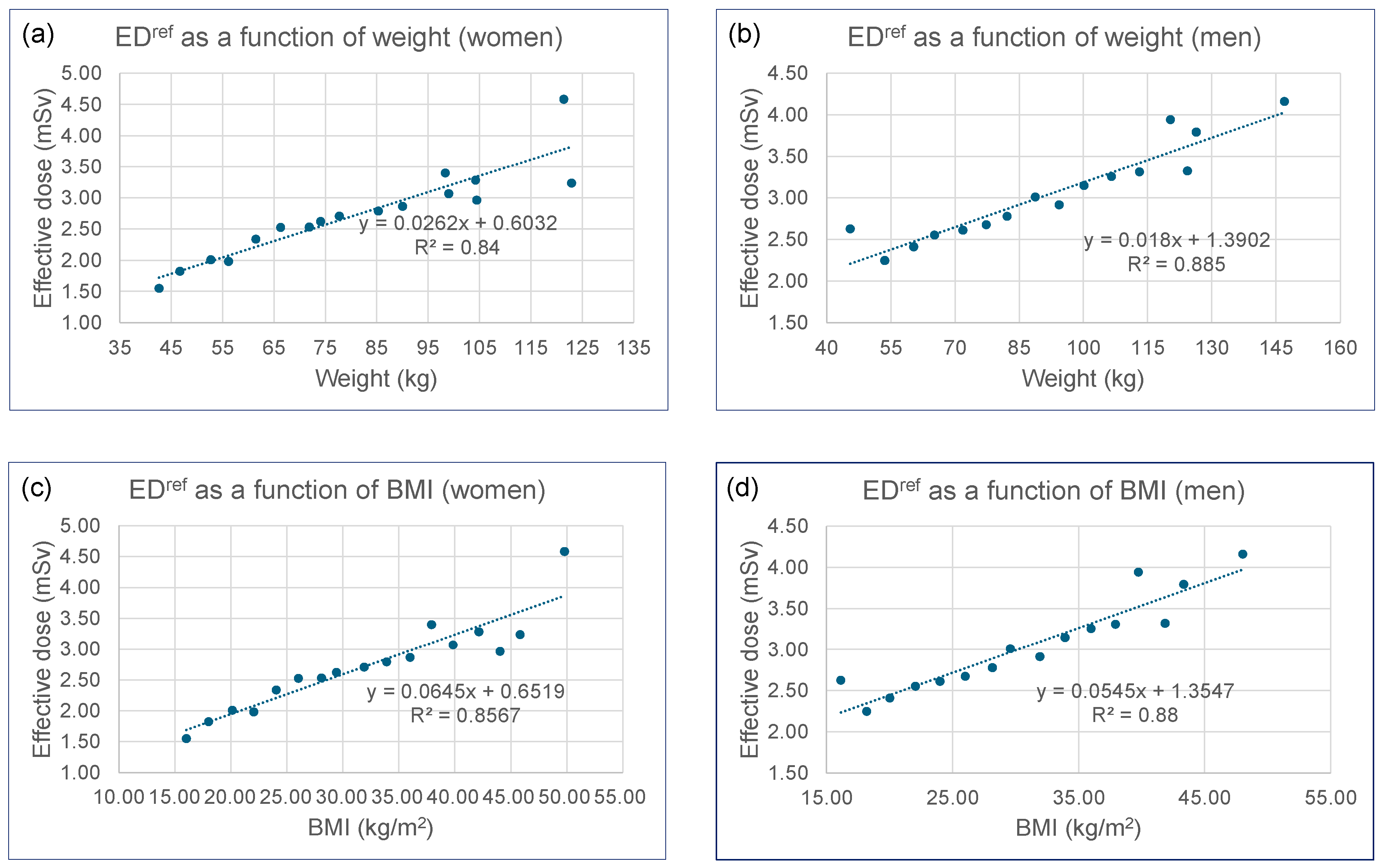
3.3.1. EDref and Patient Somatic Data
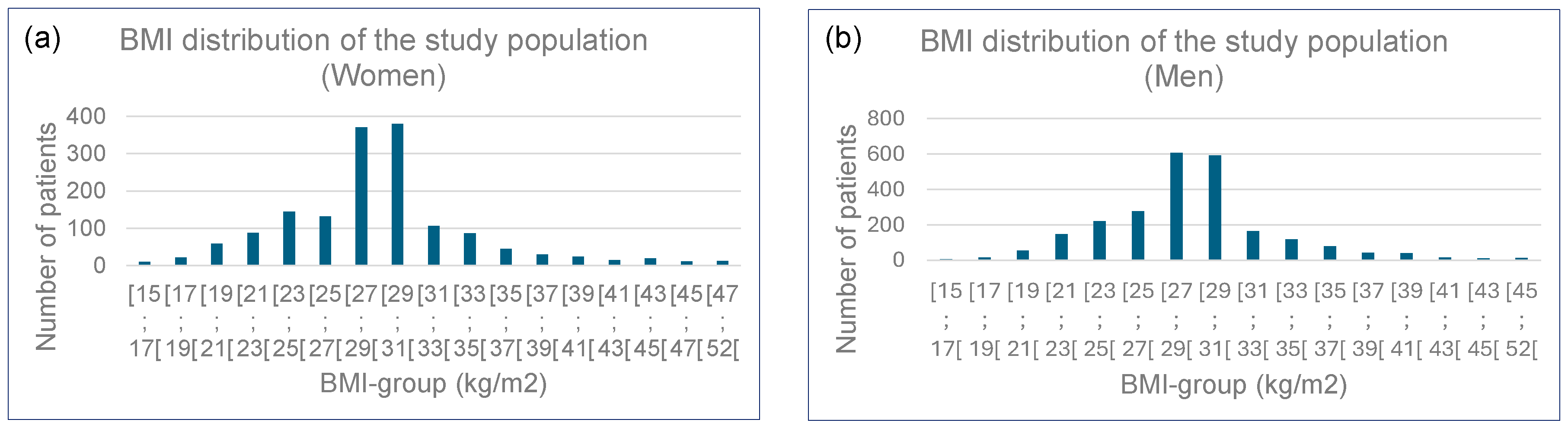
3.3.2. Distribution and Regression Robustness
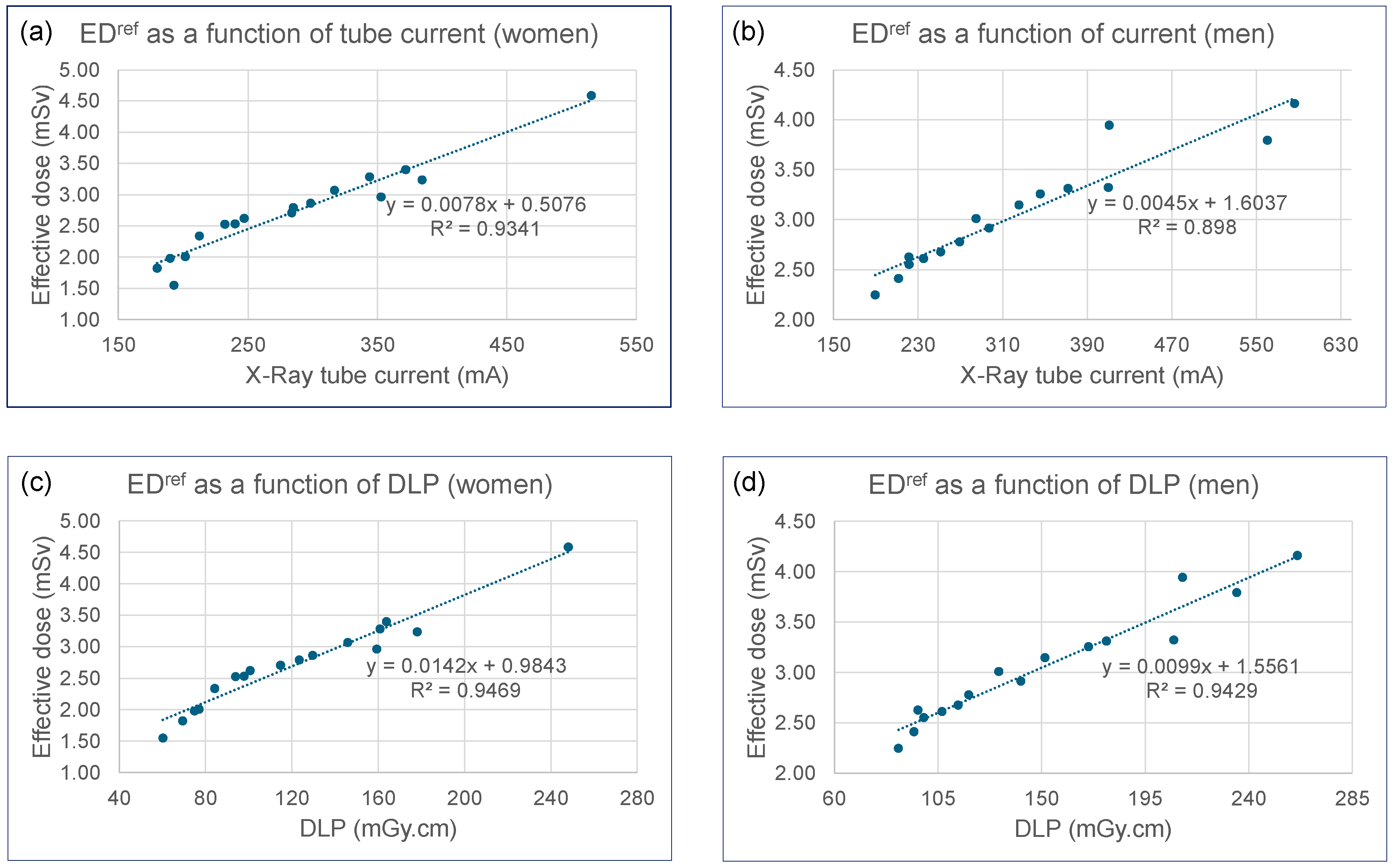
3.3.3. EDref and Exposure Parameters
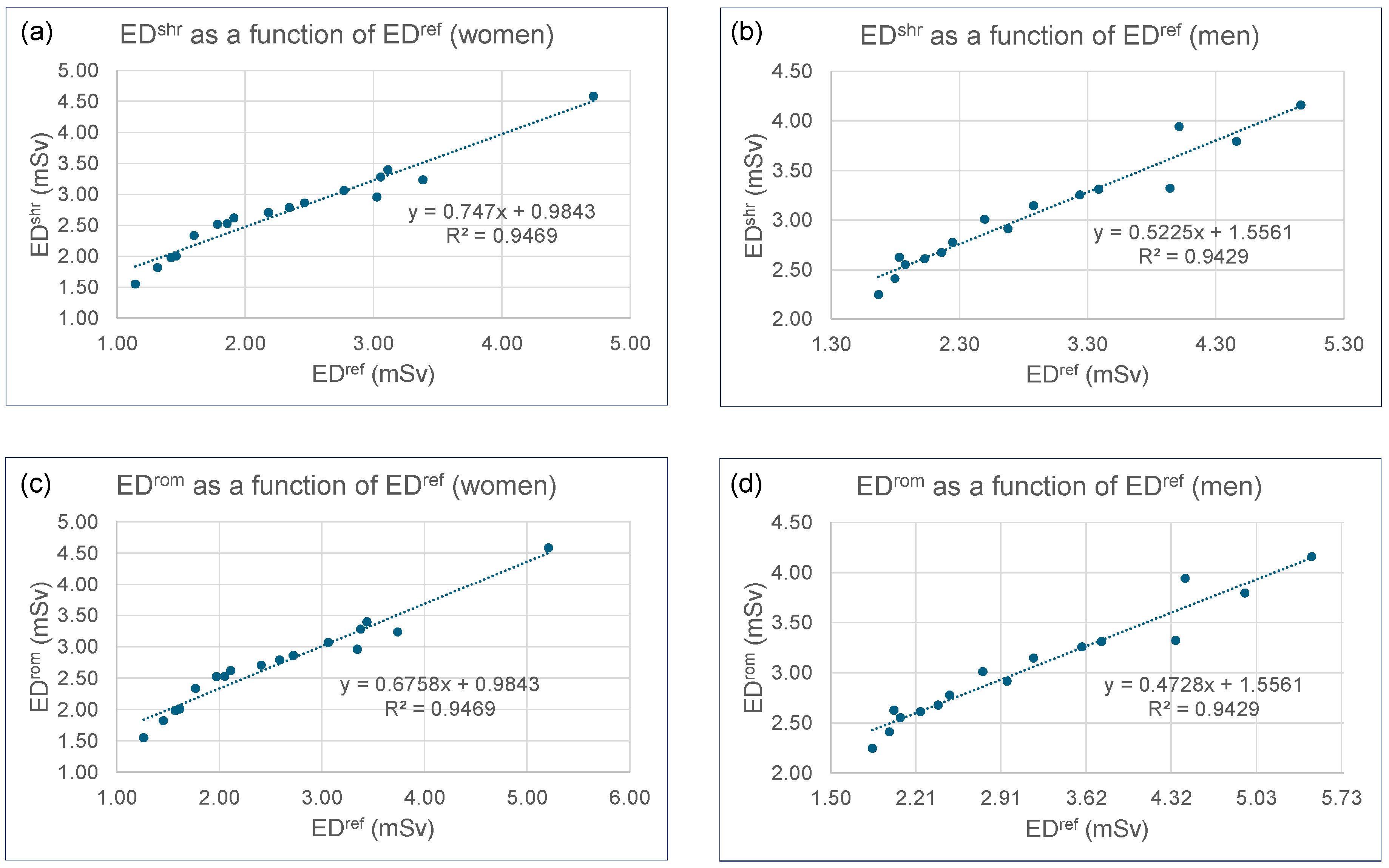
3.4. Comparison with K-Factor-Based Methods
4. Discussion
4.1. Potential Benefits of K-Factor Methods
4.2. Limitations of K-Factor Methods and Future Considerations
5. Conclusions
Funding
Institutional Review Board Statement
Informed Consent Statement
Data Availability Statement
Acknowledgments
Conflicts of Interest
References
- WHO. Ionizing Radiation and Health Effects. 2003. Available online: https://www.who.int/news-room/fact-sheets/detail/ionizing-radiation-and-health-effects (accessed on 11 June 2024).
- UNSCEAR. Sources, Effects and Risks of Ionizing Radiation. UNSCEAR 2020/2021 Report Volume I. 2021. Available online: https://www.unscear.org/unscear/uploads/documents/unscear-reports/UNSCEAR_2020_21_Report_Vol.I.pdf (accessed on 10 June 2023).
- ICRP. Managing Patient Dose in Multi-Detector Computed Tomography (MDCT). ICRP Publication 102. Ann. ICRP 2007, 37, 1–79. [Google Scholar] [CrossRef]
- IAEA. Dose Reduction in CT While Maintaining Diagnostic Confidence: A Feasibility/Demonstration Study. IAEA-TECDOC-1621, Vienna. 2009. Available online: https://www-pub.iaea.org/MTCD/Publications/PDF/TE_1621_web.pdf (accessed on 10 June 2023).
- UNSCEAR. Sources and Effects of Ionizing Radiation, United Nations Scientific Committee on the Effects of Atomic Radiation (UNSCEAR) 2008 Report, Volume I; United Nations Scientific Committee on the Effects of Atomic Radiation: Vienna, Austria, 2008. [Google Scholar] [CrossRef]
- Sodickson, A.; Baeyens, P.F.; Andriole, K.P.; Prevedello, L.M.; Nawfel, R.D.; Hanson, R.; Khorasani, R. Recurrent CT, Cumulative radiation exposure, and associated radiation-induced cancer risks from CT of adults. Radiology 2009, 251, 175–184. [Google Scholar] [CrossRef] [PubMed]
- Brenner, D.J.; Hall, E.J. Cancer risks from CT scans: Now we have data, what next? Radiology 2012, 265, 330–331. [Google Scholar] [CrossRef] [PubMed]
- ICRP. The 2007 Recommendations of the International Commission on Radiological Protection. ICRP Publication 103. Ann. ICRP 2007, 37, 1–332. [Google Scholar]
- Deak, P.D.; Smal, Y.; Kalender, W.A. Multisection CT Protocols: Sex- and Age-specific Conversion Factors Used to Determine Effective Dose from Dose-Length Product. Radiology 2010, 257, 158–166. [Google Scholar] [CrossRef]
- European Commission. European Guidelines on Quality Criteria for Computed Tomography; EUR 16262; European Commission: Brussels, Belgium, 1999.
- Martin, C. Effective dose in medicine. Ann. ICRP 2020, 49, 126–140. [Google Scholar] [CrossRef]
- Sundell, V.-M.; Kortesniemi, M.; Siiskonen, T.; Kosunen, A.; Rosendahl, S.; Büermann, L. Patient-specific dose estimates in dynamic computed tomography myocardial perfusion examination. Radiat. Prot. Dosim. 2021, 193, 24–36. [Google Scholar] [CrossRef]
- AAPM. The Measurement, Reporting, and Management of Radiation Dose in CT; AAPM Report 96; American Association of Physicists in Medicine: Alexandria, VA, USA, 2008. [Google Scholar] [CrossRef]
- Shrimpton, P.C.; Jansen, J.T.M.; Harrison, J.D. Updated estimates of typical effective doses for common CT examinations in the UK following the 2011 national review. Br. J. Radiol. 2016, 89, 20150346. [Google Scholar] [CrossRef]
- Romanyukha, A.; Folio, L.; Lamart, S.; Simon, S.L.; Lee, C. Body size-specific effective dose conversion Coefficients for CT scans. Radiat. Prot. Dosim. 2016, 172, 428–437. [Google Scholar] [CrossRef] [PubMed]
- Avramova-Cholakova, S.; Dyakov, I.; Yordanov, H.; O’Sullivan, J. Comparison of patient effective doses from multiple CT examinations based on different calculation methods. Phys. Med. 2022, 99, 73–84. [Google Scholar] [CrossRef]
- ICRP. Radiological Protection in Medicine. ICRP Publication 105. Ann. ICRP 2007, 37, 1–63. [Google Scholar]
- AAPM. Size-Specific Dose Estimates (SSDE) in Pediatric and Adult Body CT Examinations. AAPM Report 204. 2011. Available online: https://www.aapm.org/pubs/reports/rpt_204.pdf (accessed on 11 June 2023).
- ICRP. ICRP Statement on Tissue Reactions and Early and Late Effects of Radiation in Normal Tissues and Organs—Threshold Doses for Tissue Reactions in a Radiation Protection Context. Ann. ICRP 2011, 41, 1–322. [Google Scholar] [CrossRef]
- WHO. Radiation Protection of Patients (RPOP). 2021. Available online: https://www.who.int/teams/environment-climate-change-and-health/radiation-and-health/medical-exposure/ (accessed on 11 June 2023).
- AAPM. Use of Water Equivalent Diameter for Calculating Patient Size and Size-Specific Dose Estimates (SSDE) in CT. AAPM Report No. 220. 2015. Available online: https://www.aapm.org/pubs/reports/rpt_220.pdf (accessed on 11 June 2023).
- Rubinstein, R.Y.; Kroese, D.P. Simulation and the Monte Carlo Method; Wiley: Hoboken, NJ, USA, 2016. [Google Scholar] [CrossRef]
- Gelman, A.; Carlin, J.B.; Stern, H.S.; Dunson, D.B.; Vehtari, A.; Rubin, D.B. Bayesian Data Analysis; CRC Press: Boca Raton, FL, USA, 2013. [Google Scholar] [CrossRef]
- Lemieux, C. Monte Carlo and Quasi-Monte Carlo Sampling; Springer: Berlin/Heidelberg, Germany, 2009. [Google Scholar] [CrossRef]
- Turner, A.C.; Zankl, M.; DeMarco, J.J.; Cagnon, C.H.; Zhang, D.; Angel, E.; Cody, D.D.; Stevens, D.M.; McCollough, C.H.; McNitt-Gray, M.F. The feasibility of a scanner-independent technique to estimate organ dose from MDCT scans: Using CTDIvol to account for differences between scanners. Med. Phys. 2010, 37, 1816–1825. [Google Scholar] [CrossRef]
- Gao, Y.; Quinn, B.; Pandit-Taskar, N.; Behr, G.; Mahmood, U.; Long, D.; Xu, X.G.; Germain, J.S.; Dauer, L.T. Patient-specific organ and effective dose estimates in pediatric oncology. Phys. Medica 2018, 45, 146–155. [Google Scholar] [CrossRef]
- Brady, S.L.; Mirro, A.E.; Moore, B.M.; Kaufman, R.A. How to appropriately calculate effective dose for CT using either size-specific dose estimates or dose-length product. Am. J. Roentgenol. 2015, 204, 953–958. [Google Scholar] [CrossRef]
- Gould, M.K.; Donington, J.; Lynch, W.R.; Mazzone, P.J.; Midthun, D.E.; Naidich, D.P.; Wiener, R.S. Evaluation of Individuals with Pulmonary Nodules: When is it Lung Cancer? Chest 2013, 143, e93S–e120S. [Google Scholar] [CrossRef]
- Wood, D.E.; Kazerooni, E.A.; Aberle, D.; Berman, A.; Brown, L.M.; Eapen, G.A.; Ettinger, D.S.; Ferguson, J.S.; Hou, L.; Kadaria, D.; et al. NCCN Guidelines® Insights: Lung Cancer Screening, Version 1.2022. J. Natl. Compr. Cancer Netw. 2022, 20, 754–764. [Google Scholar] [CrossRef]
- Stein, P.D.; Fowler, S.E.; Goodman, L.R.; Gottschalk, A.; Hales, C.A.; Hull, R.D.; Leeper, K.V., Jr.; Popovich, J., Jr.; Quinn, D.A.; Sos, T.A.; et al. Multidetector Computed Tomography for Acute Pulmonary Embolism (PIOPED II). N. Engl. J. Med. 2006, 354, 2317–2327. [Google Scholar] [CrossRef]
- Metlay, J.P.; Waterer, G.W.; Long, A.C.; Anzueto, A.; Brozek, J.; Crothers, K.; Cooley, L.A.; Dean, N.C.; Fine, M.J.; Flanders, S.A.; et al. Diagnosis and Treatment of Adults with Community-Acquired Pneumonia: An Official Clinical Practice Guideline of the American Thoracic Society and Infectious Diseases Society of America. Am. J. Respir. Crit. Care Med. 2019, 200, e45–e67. [Google Scholar] [CrossRef]
- Donnelly, J.P.; Chen, S.C.; Kauffman, C.A.; Steinbach, W.J.; Baddley, J.W.; Verweij, P.E.; Clancy, C.J.; Wingard, J.R.; Lockhart, S.R.; Groll, A.H.; et al. Revision and Update of the Consensus Definitions of Invasive Fungal Disease from the European Organization for Research and Treatment of Cancer and the Mycoses Study Group Education and Research Consortium. Clin. Infect. Dis. 2020, 71, 1367–1376. [Google Scholar] [CrossRef]
- Smith-Bindman, R.; Miglioretti, D.L.; Johnson, E.; Lee, C.; Feigelson, H.S.; Flynn, M.; Greenlee, R.T.; Kruger, R.L.; Hornbrook, M.C.; Roblin, D.; et al. Use of Diagnostic Imaging Studies and Associated Radiation Exposure for Patients Enrolled in Large Integrated Health Care Systems, 1996–2010. JAMA 2012, 307, 2400–2409. [Google Scholar] [CrossRef]
- Smith-Bindman, R.; Wang, Y.; Chu, P.; Chung, R.; Einstein, A.J.; Balcombe, J.; Cocker, M.; Das, M.; Delman, B.N.; Flynn, M.; et al. International variation in radiation dose for computed tomography examinations: Prospective cohort study. BMJ 2019, 364, k4931. [Google Scholar] [CrossRef]
- Wirth, S.; Hebebrand, J.; Basilico, R.; Berger, F.H.; Blanco, A.; Calli, C.; Dumba, M.; Linsenmaier, U.; Mück, F.; Nieboer, K.H.; et al. European Society of Emergency Radiology: Guideline on radiological polytrauma imaging and service (short version). Insights Imaging 2020, 11, 135. [Google Scholar] [CrossRef]
- National Lung Screening Trial Research Team; Aberle, D.R.; Adams, A.M.; Berg, C.D.; Black, W.C.; Clapp, J.D.; Fagerstrom, R.M.; Gareen, I.F.; Gatsonis, C.; Marcus, P.M.; et al. Reduced Lung-Cancer Mortality with Low-Dose Computed Tomographic Screening. N. Engl. J. Med. 2011, 365, 395–409. [Google Scholar] [CrossRef]
- Kline, J.A.; Courtney, D.M.; Kabrhel, C.; Moore, C.L.; Smithline, H.A.; Plewa, M.C.; Richman, P.B.; O’neil, B.J.; Nordenholz, K. Prospective multicenter evaluation of the pulmonary embolism rule-out criteria. J. Thromb. Haemost. 2018, 6, 772–780. [Google Scholar] [CrossRef]
- De Koning, H.J.; Van Der Aalst, C.M.; De Jong, P.A.; Scholten, E.T.; Nackaerts, K.; Heuvelmans, M.A.; Lammers, J.-W.J.; Weenink, C.; Yousaf-Khan, U.; Horeweg, N.; et al. Reduced Lung-Cancer Mortality with Volume CT Screening in a Randomized Trial. N. Engl. J. Med. 2020, 382, 503–513. [Google Scholar] [CrossRef]
- Remedios, D.; France, B.; Alexander, M. Making the best use of clinical radiology: iRefer Guidelines, 8th edition. Clin. Radiol. 2017, 72, 705–707. [Google Scholar] [CrossRef]
- NCRP. Report No. 184—Medical Radiation Exposure of Patients in the United States. 2019. Available online: https://ncrponline.org/shop/reports/report-no-184-medical-radiation-exposure-of-patients-in-the-united-states-2019/ (accessed on 10 June 2023).
- ICRP. ICRP Publication 135: Diagnostic Reference Levels in Medical Imaging. Ann. ICRP 2017, 46, 1–144. Available online: https://www.icrp.org/publication.asp?id=icrp%20publication%20135 (accessed on 11 June 2023). [CrossRef]
- ECRI. Categorizing CT Systems; ECRI Institute: Plymouth Meeting, PA, USA, 2020. [Google Scholar]
- Légis Québec. S-2.2—Loi sur la Santé Publique. Available online: https://www.legisquebec.gouv.qc.ca/fr/document/lc/S-2.2/20020419 (accessed on 21 January 2024).
- World Health Organization. WHO European Regional Obesity Report 2022; Regional Office for Europe; World Health Organization: Geneva, Switzerland, 2021; Available online: https://iris.who.int/server/api/core/bitstreams/e65ae612-3723-4df5-a0e3-639dcdaa9ef8/content (accessed on 10 June 2023).
- Fryar, C.D.; Carroll, M.D.; Afful, J. Prevalence of Overweight, Obesity, and Severe Obesity Among Adults Aged 20 and over: United States, 1960–1962 Through 2017–2018; NCHS Health E-Stats; National Center for Health Statistics: Hyattsville, MD, USA, 2020. Available online: https://www.cdc.gov/nchs/data/hestat/obesity-adult-17-18/obesity-adult.htm (accessed on 3 November 2025).
- Flegal, K.M.; Graubard, B.I.; Williamson, D.F.; Gail, M.H. Excess deaths associated with underweight, overweight, and obesity. JAMA 2005, 293, 1861–1867. [Google Scholar] [CrossRef]
- Lancet. Body-Mass Index and All-Cause Mortality: Individual-Participant-Data Meta-Analysis of 239 Prospective Studies in Four Continents. Lancet 2016, 388, 776–786. Available online: https://www.thelancet.com/article/S0140-6736(16)30175-1/fulltext (accessed on 11 June 2023). [CrossRef]
- Bland, J.M.; Altman, D.G. Statistical methods for assessing agreement between two methods of clinical measurement. Lancet 1986, 327, 307–310. [Google Scholar] [CrossRef]
- Li, X.; Samei, E.; Segars, W.P.; Sturgeon, G.M.; Colsher, J.G.; Toncheva, G.; Yoshizumi, T.T.; Frush, D.P. Patient-specific radiation dose and cancer risk estimation in CT: Part, I. Development and validation of a Monte Carlo program. Med. Phys. 2010, 38, 397–407. [Google Scholar] [CrossRef] [PubMed]



| Population Investigated (n = 1553 Females + 2403 Males) | |||||||||
|---|---|---|---|---|---|---|---|---|---|
| BMI-group (kg/m2) | [15 17[ | [17 19[ | [19 21[ | [21 23[ | ... | [39 41[ | [41 43[ | [43 45[ | [45 47[ |
| Number of Females | 10 | 21 | 59 | 88 | ... | 23 | 15 | 19 | 11 |
| Number of Males | 6 | 16 | 54 | 146 | ... | 39 | 15 | 11 | 13 |
Disclaimer/Publisher’s Note: The statements, opinions and data contained in all publications are solely those of the individual author(s) and contributor(s) and not of MDPI and/or the editor(s). MDPI and/or the editor(s) disclaim responsibility for any injury to people or property resulting from any ideas, methods, instructions or products referred to in the content. |
© 2025 by the author. Licensee MDPI, Basel, Switzerland. This article is an open access article distributed under the terms and conditions of the Creative Commons Attribution (CC BY) license (https://creativecommons.org/licenses/by/4.0/).
Share and Cite
Maurice, R.L. Comparison of Virtual Dose Simulator and K-Factor Methods for Effective Dose Assessment in Thoracic CT. Tomography 2025, 11, 128. https://doi.org/10.3390/tomography11110128
Maurice RL. Comparison of Virtual Dose Simulator and K-Factor Methods for Effective Dose Assessment in Thoracic CT. Tomography. 2025; 11(11):128. https://doi.org/10.3390/tomography11110128
Chicago/Turabian StyleMaurice, Roch Listz. 2025. "Comparison of Virtual Dose Simulator and K-Factor Methods for Effective Dose Assessment in Thoracic CT" Tomography 11, no. 11: 128. https://doi.org/10.3390/tomography11110128
APA StyleMaurice, R. L. (2025). Comparison of Virtual Dose Simulator and K-Factor Methods for Effective Dose Assessment in Thoracic CT. Tomography, 11(11), 128. https://doi.org/10.3390/tomography11110128