
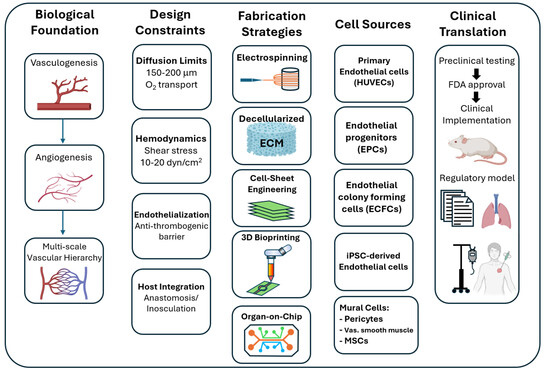
Engineering Multiscale Vasculature: Biological Principles, Design Constraints, and Advanced Biofabrication Strategies for Functional Vascular Networks


Abstract
1. Introduction
2. Physiology and Development of the Vascular Network
3. Biological Considerations for Vascular Engineering
4. Macro and Microvascular Graft Design
4.1. Electrospun Scaffolds
4.2. Decellularized Matrices
4.3. Cell-Sheet Engineering

| Strategies | Biomaterials | Properties | Cell Types | References |
|---|---|---|---|---|
| Electrospun scaffold | PCL/fibrin | Increased host microvessel density and reduced calcification, supporting enhanced cell infiltration and proliferation; neoarterial regeneration with ECM deposition and rapid endothelialization. | Cell-free | [81] |
| Electrospun scaffold | CS-g-PCL | Enhanced early angiogenesis and vascular ingrowth with improved biocompatibility in a rat femur chamber model. | Cell-free | [82] |
| Electrospun scaffold | PCL/ECM | Enhanced host endothelial and smooth muscle cell infiltration with elevated FLK-1, ICAM-1, and α-SMA expression at 2–4 weeks. | Cell-free | [83] |
| Decellularized matrices | Kidney dECM hydrogel | Promoted vascularized and more mature hPSC-derived kidney organoids in vitro and maintained vascular integrity after transplantation in mice. | hPSCs | [84] |
| Decellularized matrices | Decellularized dental pulp matrix | Retained native vasculature and angiogenic factors (VEGF-A, FGF-2) and, when seeded with hDPSCs, significantly enhanced angiogenic marker expression in vitro and vascularization in vivo. | hDPSCs | [85] |
| Decellularized matrices | Silk fibroin/decellularized vascular matrix gel | SF/DVMG hybrid scaffolds improved mechanical stability and degradation resistance while significantly enhancing endothelialization and vascular loop formation in vivo. | HUVECs | [86] |
| Cell-sheet engineering | Double-cell-sheet scaffold | Osteogenic–endothelial sheets enhanced mineralization and vascularization in vivo, with the osteogenic-over-endothelial configuration showing the best outcomes. | rADSCs | [87] |
| Cell-sheet engineering | Magnetic ASC and HUVEC cell sheets | Stratified heterotypic magnetic cell sheets (ASCs/HUVECs/ASCs) enhanced osteogenesis and angiogenesis, preserving human vascular structures and promoting vessel recruitment in the chick CAM model. | HUVECs and hADSCs | [88] |
| Cell-sheet engineering | Hypoxia-conditioned SVF-derived angiogenic cell sheets | Spontaneously formed capillary-like structures in vitro and significantly improved blood flow recovery in a mouse hind limb ischemia model. | SVF | [89] |
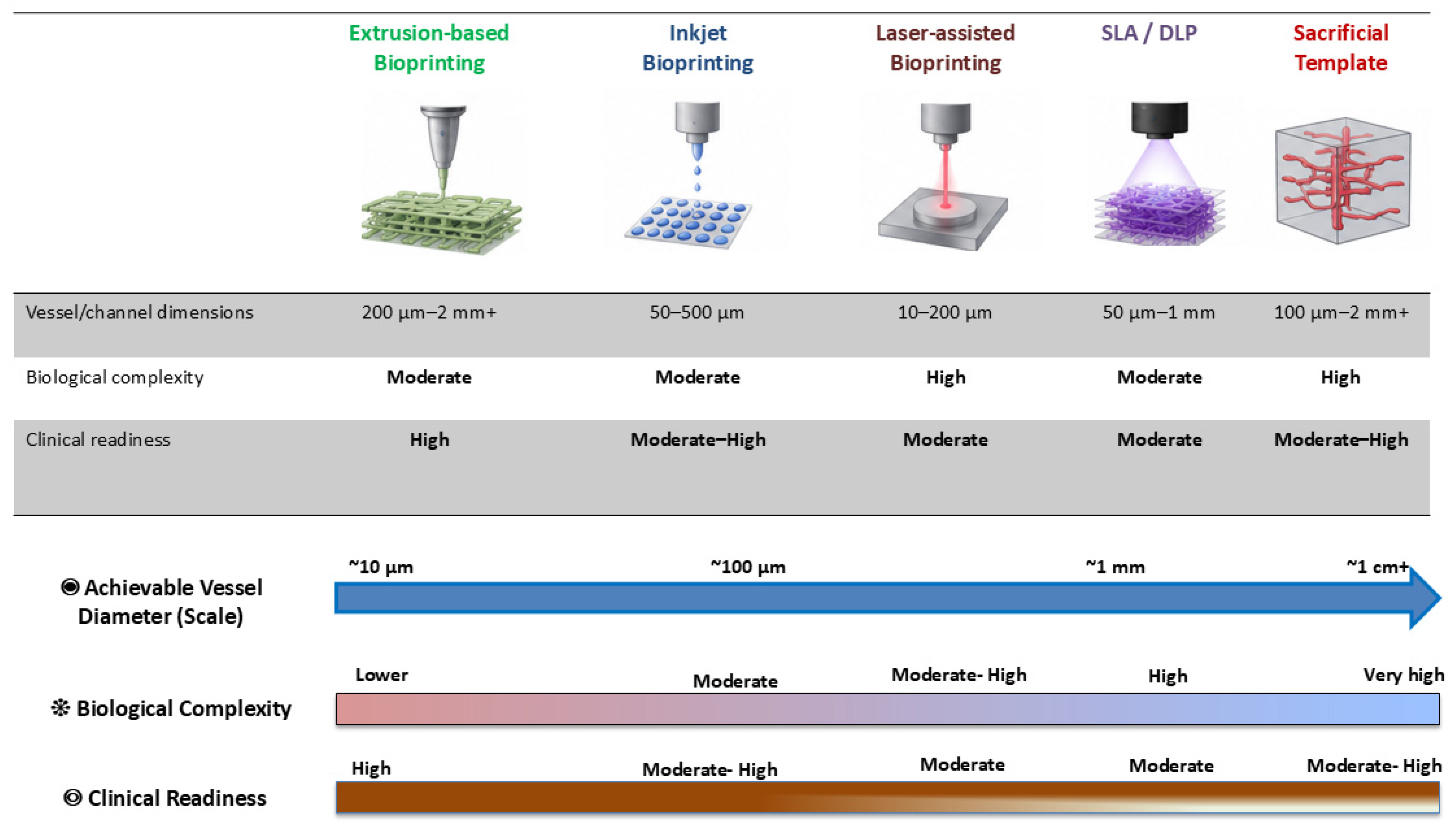
4.4. 3D Printing and Sacrificial-Template Biofabrication
| Technique | Representative Feature Resolution | Reported Vessel/Channel Scale | Material Compatibility | Biological/Technical Considerations | Major Advantages/Limitations | References |
|---|---|---|---|---|---|---|
| Extrusion-based | ~200 µm | ~200 µm to mm scale | High- and low-viscosity; cell-free, cell-laden, or cell-only inks | Broad material/cell compatibility; nozzle shear and lower resolution can limit capillary-scale printing | High scalability for larger conduits; limited direct capillary fabrication | [90,96,97,98,99] |
| Inkjet | ~10–80 µm | ~200 µm demonstrated | Primarily low-viscosity inks | Rapid microscale deposition; limited cell density and viscosity | Useful for precise patterning; less suited to thick mechanically robust constructs | [96,100] |
| Laser-assisted | ~50–70 µm | Cell-width features (~10 µm) reported | Cell suspensions; low-viscosity formulations | Nozzle-free and precise cell placement; complex equipment and scale-up | Promising for microvascular patterning; limited large-scale manufacturing | [96,101] |
| SLA | ~50–150 µm | Sub-mm to mm patterned or hollow structures | Photocrosslinkable bioinks/resins | High geometric fidelity; material selection and light exposure constrain cell-laden use | Promising where reproducibility and geometry are priorities | [93,94,95] |
| DLP | ~10–50 µm | Features down to tens of µm; larger perfusable channels also feasible | Photocrosslinkable bioinks/resins | High resolution and rapid layer exposure; photoinitiator/light dose affect viability | Strong potential for reproducible high-resolution fabrication | [102,103] |
| Sacrificial template | ~100–500 µm (typical) | ~100–500 µm and larger perfusable channels | Gelatin, alginate, agarose, Pluronic F127, sugar-based inks | Enables perfusable channels in thick matrices; removal and endothelialization add steps | Strong potential for thick vascularized tissues and multiscale networks | [15,104,105,106,107,108,109] |
Sacrificial-Template 3D Printing for Perfusable Microvascular Networks
4.5. Microvasculature-on-a-Chip
| Strategies | Biomaterials | Properties | Cell Type | References |
|---|---|---|---|---|
| 3D Printing | GelMA and PEGDA | SLA/PLP/FDM-fabricated bone constructs with sacrificial vascular channels promoted MSC-driven osteogenesis and HUVEC-mediated capillary sprouting under perfusion culture. | hBM-MSCs; HUVECs | [132] |
| 3D Printing | PCL | Deferoxamine-releasing 3D-printed scaffolds enhanced angiogenesis and osteogenesis in vitro and promoted vascular ingrowth and bone regeneration in a rat critical-sized bone defect model. | rBM-MSC; HUVECs | [133] |
| 3D Printing | TCP/PLGA | Dual-delivery 3D-printed scaffolds enabled rapid angiogenesis and enhanced bone formation via sequential release of angiogenic and osteogenic peptides in a rat bone defect model. | rBM-MSC; Rat endothelial cells | [134] |
| 3D Printing | Silk–hydroxyapatite | 3D-printed scaffolds functionalized with BMP-2, VEGF, and NGF synergistically enhanced osteogenic differentiation and supported endothelial and neural cell activity in vitro. | hBM-MSC; HUVECs and hiNSCs | [135] |
| microvasculature-on-a-chip | PDMS | Nintedanib impaired microvascular network formation by increasing vessel permeability and reducing microvessel density and diameter in a perfusable in vitro lung microvasculature model. | HUVECs; hNL-FBs | [136] |
| microvasculature-on-a-chip | PDMS | Direct inclusion of fibroblasts was essential for forming thin, interconnected, and perfusable microvascular networks, while soluble cues alone produced nonphysiological vascular morphologies in vitro. | HUVECs; hNL-FBs | [137] |
| microvasculature-on-a-chip | PDMS | Lung fibroblasts most effectively supported endothelial morphogenesis, yielding highly interconnected, perfusable microvascular networks in a microfluidic in vitro model. | HUVECs; mBM-MSC; mLFs | [138] |
5. Cell Sources for Vascularization
5.1. Endothelial Cell Sources
5.1.1. Primary Endothelial Cells
5.1.2. Endothelial Progenitor Cells (EPCs)
5.1.3. Pluripotent Stem Cell–Derived Endothelial Cells
5.2. Supporting Cells
5.3. Vascular Smooth Muscle Cells (VSMCs)
5.4. Mesenchymal Stem/Stromal Cells (MSCs)
5.5. Coculture Strategies
6. Future Directions
7. Conclusions
Author Contributions
Funding
Data Availability Statement
Conflicts of Interest
References
- Margolis, E.A.; Friend, N.E.; Rolle, M.W.; Alsberg, E.; Putnam, A.J. Manufacturing the multiscale vascular hierarchy: Progress toward solving the grand challenge of tissue engineering. Trends Biotechnol. 2023, 41, 1400–1416. [Google Scholar] [CrossRef] [Scilit] [PubMed]
- Chen, Z.; Zhu, L.-T.; Luo, Z.-H. Characterizing flow and transport in biological vascular systems: A review from physiological and chemical engineering perspectives. Ind. Eng. Chem. Res. 2024, 63, 4–36. [Google Scholar] [CrossRef] [Scilit]
- Liu, Q.; Ying, G.; Hu, C.; Du, L.; Zhang, H.; Wang, Z.; Yue, H.; Yetisen, A.K.; Wang, G.; Shen, Y.; et al. Engineering in vitro vascular microsystems. Microsyst. Nanoeng. 2025, 11, 100. [Google Scholar] [CrossRef] [Scilit] [PubMed]
- Pries, A.R.; Secomb, T.W. Making microvascular networks work: Angiogenesis, remodeling, and pruning. Physiology 2014, 29, 446–455. [Google Scholar] [CrossRef] [Scilit] [PubMed]
- Murphy, A.R.; Allenby, M.C. In vitro microvascular engineering approaches and strategies for interstitial tissue integration. Acta Biomater. 2023, 171, 114–130. [Google Scholar] [CrossRef] [Scilit] [PubMed]
- Rocco, K.A.; Maxfield, M.W.; Best, C.A.; Dean, E.W.; Breuer, C.K. In vivo applications of electrospun tissue-engineered vascular grafts: A review. Tissue Eng. Part B Rev. 2014, 20, 628–640. [Google Scholar] [CrossRef] [Scilit] [PubMed]
- Duran-Rey, D.; Crisostomo, V.; Sanchez-Margallo, J.A.; Sanchez-Margallo, F.M. Systematic Review of Tissue-Engineered Vascular Grafts. Front. Bioeng. Biotechnol. 2021, 9, 771400. [Google Scholar] [CrossRef] [Scilit] [PubMed]
- McInnes, A.D.; Moser, M.A.J.; Chen, X. Preparation and Use of Decellularized Extracellular Matrix for Tissue Engineering. J. Funct. Biomater. 2022, 13, 240. [Google Scholar] [CrossRef] [Scilit] [PubMed]
- Barbulescu, G.I.; Bojin, F.M.; Ordodi, V.L.; Goje, I.D.; Barbulescu, A.S.; Paunescu, V. Decellularized Extracellular Matrix Scaffolds for Cardiovascular Tissue Engineering: Current Techniques and Challenges. Int. J. Mol. Sci. 2022, 23, 13040. [Google Scholar] [CrossRef] [Scilit] [PubMed]
- Elomaa, L.; Lindner, M.; Leben, R.; Niesner, R.; Weinhart, M. In vitrovascularization of hydrogel-based tissue constructs via a combined approach of cell sheet engineering and dynamic perfusion cell culture. Biofabrication 2022, 15, 015004. [Google Scholar] [CrossRef] [Scilit] [PubMed]
- Ingber, D.E. Human organs-on-chips for disease modelling, drug development and personalized medicine. Nat. Rev. Genet. 2022, 23, 467–491. [Google Scholar] [CrossRef] [Scilit] [PubMed]
- Shafiee, S.; Shariatzadeh, S.; Zafari, A.; Majd, A.; Niknejad, H. Recent Advances on Cell-Based Co-Culture Strategies for Prevascularization in Tissue Engineering. Front. Bioeng. Biotechnol. 2021, 9, 745314. [Google Scholar] [CrossRef] [Scilit] [PubMed]
- Augustin, H.G.; Koh, G.Y. A systems view of the vascular endothelium in health and disease. Cell 2024, 187, 4833–4858. [Google Scholar] [CrossRef] [Scilit] [PubMed]
- Boppana, A.; Lee, S.; Malhotra, R.; Halushka, M.; Gustilo, K.S.; Quardokus, E.M.; Herr, B.W., 2nd; Borner, K.; Weber, G.M. Anatomical structures, cell types, and biomarkers of the healthy human blood vasculature. Sci. Data 2023, 10, 452. [Google Scholar] [CrossRef] [Scilit] [PubMed]
- Eltaher, H.M.; Abukunna, F.E.; Ruiz-Cantu, L.; Stone, Z.; Yang, J.; Dixon, J.E. Human-scale tissues with patterned vascular networks by additive manufacturing of sacrificial sugar-protein composites. Acta Biomater. 2020, 113, 339–349. [Google Scholar] [CrossRef] [Scilit] [PubMed]
- O’Connor, C.; Brady, E.; Zheng, Y.; Moore, E.; Stevens, K.R. Engineering the multiscale complexity of vascular networks. Nat. Rev. Mater. 2022, 7, 702–716. [Google Scholar] [CrossRef] [Scilit] [PubMed]
- Rosellini, E.; Giordano, C.; Guidi, L.; Cascone, M.G. Biomimetic Approaches in Scaffold-Based Blood Vessel Tissue Engineering. Biomimetics 2024, 9, 377. [Google Scholar] [CrossRef] [Scilit] [PubMed]
- Xia, P.; Luo, Y. Vascularization in tissue engineering: The architecture cues of pores in scaffolds. J. Biomed. Mater. Res. B Appl. Biomater. 2022, 110, 1206–1214. [Google Scholar] [CrossRef] [Scilit] [PubMed]
- Liu, Z.L.; Chen, H.H.; Zheng, L.L.; Sun, L.P.; Shi, L. Angiogenic signaling pathways and anti-angiogenic therapy for cancer. Signal Transduct. Target. Ther. 2023, 8, 198. [Google Scholar] [CrossRef] [Scilit] [PubMed]
- Fazio, A.; Neri, I.; Koufi, F.D.; Marvi, M.V.; Galvani, A.; Evangelisti, C.; McCubrey, J.A.; Cocco, L.; Manzoli, L.; Ratti, S. Signaling Role of Pericytes in Vascular Health and Tissue Homeostasis. Int. J. Mol. Sci. 2024, 25, 6592. [Google Scholar] [CrossRef] [Scilit] [PubMed]
- Warren, E.; Gerecht, S. Beyond the endothelium: The role of mural cells in vascular biology: In vitro systems to study endothelial/pericyte cell interactions. Vasc. Biol. 2023, 5, e220021. [Google Scholar] [CrossRef] [Scilit] [PubMed]
- Barnett, S.N.; Cujba, A.M.; Yang, L.; Maceiras, A.R.; Li, S.; Kedlian, V.R.; Pett, J.P.; Polanski, K.; Miranda, A.M.A.; Xu, C.; et al. An organotypic atlas of human vascular cells. Nat. Med. 2024, 30, 3468–3481. [Google Scholar] [CrossRef] [Scilit] [PubMed]
- Fleischer, S.; Tavakol, D.N.; Vunjak-Novakovic, G. From arteries to capillaries: Approaches to engineering human vasculature. Adv. Funct. Mater. 2020, 30, 1910811. [Google Scholar] [CrossRef] [Scilit] [PubMed]
- Landau, S.; Okhovatian, S.; Zhao, Y.; Liu, C.; Shakeri, A.; Wang, Y.; Ramsay, K.; Kieda, J.; Jiang, R.; Radisic, M. Bioengineering vascularization. Development 2024, 151, dev204455. [Google Scholar] [CrossRef] [Scilit] [PubMed]
- McMurtrey, R.J. Analytic Models of Oxygen and Nutrient Diffusion, Metabolism Dynamics, and Architecture Optimization in Three-Dimensional Tissue Constructs with Applications and Insights in Cerebral Organoids. Tissue Eng. Part C Methods 2016, 22, 221–249. [Google Scholar] [CrossRef] [Scilit] [PubMed]
- Ankeny, R.F.; Hinds, M.T.; Nerem, R.M. Dynamic shear stress regulation of inflammatory and thrombotic pathways in baboon endothelial outgrowth cells. Tissue Eng. Part A 2013, 19, 1573–1582. [Google Scholar] [CrossRef] [Scilit] [PubMed]
- Cheng, C.K.; Wang, N.; Wang, L.; Huang, Y. Biophysical and Biochemical Roles of Shear Stress on Endothelium: A Revisit and New Insights. Circ. Res. 2025, 136, 752–772. [Google Scholar] [CrossRef] [Scilit] [PubMed]
- Oubari, H.; Berkane, Y.; Jeljeli, M.; Lellouch, A.G.; Smadja, D.M. Engineering the Future of Stem Cells in Vascular Reconstruction: A Leap Towards Functional Endothelialized Tissue-Engineered Vascular Conduits. Stem Cell Rev. Rep. 2025, 21, 2796–2806. [Google Scholar] [CrossRef] [Scilit] [PubMed]
- van Hinsbergh, V.W. Endothelium--role in regulation of coagulation and inflammation. Semin. Immunopathol. 2012, 34, 93–106. [Google Scholar] [CrossRef] [Scilit] [PubMed]
- Hennigs, J.K.; Matuszcak, C.; Trepel, M.; Korbelin, J. Vascular Endothelial Cells: Heterogeneity and Targeting Approaches. Cells 2021, 10, 2712. [Google Scholar] [CrossRef] [Scilit] [PubMed]
- Zhong, J.; Gao, R.R.; Zhang, X.; Yang, J.X.; Liu, Y.; Ma, J.; Chen, Q. Dissecting endothelial cell heterogeneity with new tools. Cell Regen. 2025, 14, 10. [Google Scholar] [CrossRef] [Scilit] [PubMed]
- Zhao, N.; Pessell, A.F.; Zhu, N.; Searson, P.C. Tissue-Engineered Microvessels: A Review of Current Engineering Strategies and Applications. Adv. Healthc. Mater. 2024, 13, e2303419. [Google Scholar] [CrossRef] [Scilit] [PubMed]
- Lungu, C.N.; Gurau, G.; Mehedinti, M.C. Pro-Angiogenic Bioactive Molecules in Vascular Morphogenesis: Integrating Endothelial Cell Dynamics. Curr. Issues Mol. Biol. 2025, 47, 851. [Google Scholar] [CrossRef] [Scilit] [PubMed]
- Augustin, H.G.; Koh, G.Y. Organotypic vasculature: From descriptive heterogeneity to functional pathophysiology. Science 2017, 357, eaal2379. [Google Scholar] [CrossRef] [Scilit] [PubMed]
- Yin, H.; Wang, Y.; Liu, N.; Zhong, S.; Li, L.; Zhang, Q.; Liu, Z.; Yue, T. Advances in the Model Structure of In Vitro Vascularized Organ-on-a-Chip. Cyborg Bionic Syst. 2024, 5, 0107. [Google Scholar] [CrossRef] [Scilit] [PubMed]
- Uwamori, H.; Ono, Y.; Yamashita, T.; Arai, K.; Sudo, R. Comparison of organ-specific endothelial cells in terms of microvascular formation and endothelial barrier functions. Microvasc. Res. 2019, 122, 60–70. [Google Scholar] [CrossRef] [Scilit] [PubMed]
- Zhang, F.; King, M.W. Immunomodulation Strategies for the Successful Regeneration of a Tissue-Engineered Vascular Graft. Adv. Healthc. Mater. 2022, 11, e2200045. [Google Scholar] [CrossRef] [Scilit] [PubMed]
- Hibino, N.; Mejias, D.; Pietris, N.; Dean, E.; Yi, T.; Best, C.; Shinoka, T.; Breuer, C. The innate immune system contributes to tissue-engineered vascular graft performance. FASEB J. 2015, 29, 2431–2438. [Google Scholar] [CrossRef] [Scilit] [PubMed]
- Pries, A.R.; Cornelissen, A.J.; Sloot, A.A.; Hinkeldey, M.; Dreher, M.R.; Hopfner, M.; Dewhirst, M.W.; Secomb, T.W. Structural adaptation and heterogeneity of normal and tumor microvascular networks. PLoS Comput. Biol. 2009, 5, e1000394. [Google Scholar] [CrossRef] [Scilit] [PubMed]
- Kishimoto, S.; Higashi, Y. Recent advances and emerging perspectives in vascular and cardiovascular research: A 2025 update. Hypertens. Res. 2026, 49, 740–748. [Google Scholar] [CrossRef] [Scilit] [PubMed]
- Sell, S.A.; Wolfe, P.S.; Garg, K.; McCool, J.M.; Rodriguez, I.A.; Bowlin, G.L. The use of natural polymers in tissue engineering: A focus on electrospun extracellular matrix analogues. Polymers 2010, 2, 522–553. [Google Scholar] [CrossRef] [Scilit]
- de Valence, S.; Tille, J.C.; Mugnai, D.; Mrowczynski, W.; Gurny, R.; Moller, M.; Walpoth, B.H. Long term performance of polycaprolactone vascular grafts in a rat abdominal aorta replacement model. Biomaterials 2012, 33, 38–47. [Google Scholar] [CrossRef] [Scilit] [PubMed]
- Zonari, A.; Novikoff, S.; Electo, N.R.; Breyner, N.M.; Gomes, D.A.; Martins, A.; Neves, N.M.; Reis, R.L.; Goes, A.M. Endothelial differentiation of human stem cells seeded onto electrospun polyhydroxybutyrate/polyhydroxybutyrate-co-hydroxyvalerate fiber mesh. PLoS ONE 2012, 7, e35422. [Google Scholar] [CrossRef] [Scilit] [PubMed]
- He, W.; Ma, Z.; Teo, W.E.; Dong, Y.X.; Robless, P.A.; Lim, T.C.; Ramakrishna, S. Tubular nanofiber scaffolds for tissue engineered small-diameter vascular grafts. J. Biomed. Mater. Res. A 2009, 90, 205–216. [Google Scholar] [CrossRef] [Scilit] [PubMed]
- Wise, S.G.; Byrom, M.J.; Waterhouse, A.; Bannon, P.G.; Weiss, A.S.; Ng, M.K. A multilayered synthetic human elastin/polycaprolactone hybrid vascular graft with tailored mechanical properties. Acta Biomater. 2011, 7, 295–303. [Google Scholar] [CrossRef] [Scilit] [PubMed]
- Soletti, L.; Nieponice, A.; Hong, Y.; Ye, S.H.; Stankus, J.J.; Wagner, W.R.; Vorp, D.A. In vivo performance of a phospholipid-coated bioerodable elastomeric graft for small-diameter vascular applications. J. Biomed. Mater. Res. A 2011, 96, 436–448. [Google Scholar] [CrossRef] [Scilit] [PubMed]
- Naegeli, K.M.; Kural, M.H.; Li, Y.; Wang, J.; Hugentobler, E.A.; Niklason, L.E. Bioengineering Human Tissues and the Future of Vascular Replacement. Circ. Res. 2022, 131, 109–126. [Google Scholar] [CrossRef] [Scilit] [PubMed]
- Leal, B.B.J.; Wakabayashi, N.; Oyama, K.; Kamiya, H.; Braghirolli, D.I.; Pranke, P. Vascular Tissue Engineering: Polymers and Methodologies for Small Caliber Vascular Grafts. Front. Cardiovasc. Med. 2020, 7, 592361. [Google Scholar] [CrossRef] [Scilit] [PubMed]
- Buxton, B.F.; Hayward, P.A.; Newcomb, A.E.; Moten, S.; Seevanayagam, S.; Gordon, I. Choice of conduits for coronary artery bypass grafting: Craft or science? Eur. J. Cardiothorac. Surg. 2009, 35, 658–670. [Google Scholar] [CrossRef] [Scilit] [PubMed]
- Keshvardoostchokami, M.; Majidi, S.S.; Huo, P.; Ramachandran, R.; Chen, M.; Liu, B. Electrospun Nanofibers of Natural and Synthetic Polymers as Artificial Extracellular Matrix for Tissue Engineering. Nanomaterials 2020, 11, 21. [Google Scholar] [CrossRef] [Scilit] [PubMed]
- Ju, Y.M.; Choi, J.S.; Atala, A.; Yoo, J.J.; Lee, S.J. Bilayered scaffold for engineering cellularized blood vessels. Biomaterials 2010, 31, 4313–4321. [Google Scholar] [CrossRef] [Scilit] [PubMed]
- Centola, M.; Rainer, A.; Spadaccio, C.; De Porcellinis, S.; Genovese, J.A.; Trombetta, M. Combining electrospinning and fused deposition modeling for the fabrication of a hybrid vascular graft. Biofabrication 2010, 2, 014102. [Google Scholar] [CrossRef] [Scilit] [PubMed]
- Dou, W.; Wang, J.; Yao, Z.; Xiao, W.; Huang, M.; Zhang, L. A critical review of hemoperfusion adsorbents: Materials, functionalization and matrix structure selection. Mater. Adv. 2022, 3, 918–930. [Google Scholar] [CrossRef] [Scilit]
- Han, J.H.; Ko, U.H.; Kim, H.J.; Kim, S.; Jeon, J.S.; Shin, J.H. Electrospun Microvasculature for Rapid Vascular Network Restoration. Tissue Eng. Regen. Med. 2021, 18, 89–97. [Google Scholar] [CrossRef] [Scilit] [PubMed]
- Mazloomnejad, R.; Babajani, A.; Kasravi, M.; Ahmadi, A.; Shariatzadeh, S.; Bahrami, S.; Niknejad, H. Angiogenesis and Re-endothelialization in decellularized scaffolds: Recent advances and current challenges in tissue engineering. Front. Bioeng. Biotechnol. 2023, 11, 1103727. [Google Scholar] [CrossRef] [Scilit] [PubMed]
- Omid, H.; Abdollahi, S.; Bonakdar, S.; Haghighipour, N.; Shokrgozar, M.A.; Mohammadi, J. Biomimetic vascular tissue engineering by decellularized scaffold and concurrent cyclic tensile and shear stresses. J. Mater. Sci. Mater. Med. 2023, 34, 12. [Google Scholar] [CrossRef] [Scilit] [PubMed]
- Li, J.; Chen, X.; Hu, M.; Wei, J.; Nie, M.; Chen, J.; Liu, X. The application of composite scaffold materials based on decellularized vascular matrix in tissue engineering: A review. Biomed. Eng. Online 2023, 22, 62. [Google Scholar] [CrossRef] [Scilit] [PubMed]
- Schneider, K.H.; Rohringer, S.; Kapeller, B.; Grasl, C.; Kiss, H.; Heber, S.; Walter, I.; Teuschl, A.H.; Podesser, B.K.; Bergmeister, H. Riboflavin-mediated photooxidation to improve the characteristics of decellularized human arterial small diameter vascular grafts. Acta Biomater. 2020, 116, 246–258. [Google Scholar] [CrossRef] [Scilit] [PubMed]
- Mitchell, T.C.; Feng, N.L.; Lam, Y.T.; Michael, P.L.; Santos, M.; Wise, S.G. Engineering Vascular Bioreactor Systems to Closely Mimic Physiological Forces In Vitro. Tissue Eng. Part B Rev. 2023, 29, 232–243. [Google Scholar] [CrossRef] [Scilit] [PubMed]
- Lin, Y.; Lin, Y.; Hu, H.; Ma, P.; Luo, Z.; Tan, G.; Wu, Y.L. Nature-Inspired Macromolecular Biocomposites Based on Decellularized Extracellular Matrix. Macromol. Rapid Commun. 2025, 46, e2401049. [Google Scholar] [CrossRef] [Scilit] [PubMed]
- Jiang, B.; Akgun, B.; Lam, R.C.; Ameer, G.A.; Wertheim, J.A. A polymer-extracellular matrix composite with improved thromboresistance and recellularization properties. Acta Biomater. 2015, 18, 50–58. [Google Scholar] [CrossRef] [Scilit] [PubMed]
- Yang, Y.; Lei, D.; Zou, H.; Huang, S.; Yang, Q.; Li, S.; Qing, F.L.; Ye, X.; You, Z.; Zhao, Q. Hybrid electrospun rapamycin-loaded small-diameter decellularized vascular grafts effectively inhibit intimal hyperplasia. Acta Biomater. 2019, 97, 321–332. [Google Scholar] [CrossRef] [Scilit] [PubMed]
- Schneider, K.H.; Enayati, M.; Grasl, C.; Walter, I.; Budinsky, L.; Zebic, G.; Kaun, C.; Wagner, A.; Kratochwill, K.; Redl, H.; et al. Acellular vascular matrix grafts from human placenta chorion: Impact of ECM preservation on graft characteristics, protein composition and in vivo performance. Biomaterials 2018, 177, 14–26. [Google Scholar] [CrossRef] [Scilit] [PubMed]
- Patel, H. Blood biocompatibility enhancement of biomaterials by heparin immobilization: A review. Blood Coagul. Fibrinolysis 2021, 32, 237–247. [Google Scholar] [CrossRef] [Scilit] [PubMed]
- Negishi, J.; Funamoto, S.; Kimura, T.; Nam, K.; Higami, T.; Kishida, A. Porcine radial artery decellularization by high hydrostatic pressure. J. Tissue Eng. Regen. Med. 2015, 9, E144–E151. [Google Scholar] [CrossRef] [Scilit] [PubMed]
- Rickel, A.P. Cell Mechanics in Cardiovascular Disease and Electrospun Scaffold for Vascular Tissue Engineering; University of South Dakota: Vermillion, SD, USA, 2022. [Google Scholar]
- Bono, N.; Meghezi, S.; Soncini, M.; Piola, M.; Mantovani, D.; Fiore, G.B. A Dual-Mode Bioreactor System for Tissue Engineered Vascular Models. Ann. Biomed. Eng. 2017, 45, 1496–1510. [Google Scholar] [CrossRef] [Scilit]
- Yu, X.; Botchwey, E.A.; Levine, E.M.; Pollack, S.R.; Laurencin, C.T. Bioreactor-based bone tissue engineering: The influence of dynamic flow on osteoblast phenotypic expression and matrix mineralization. Proc. Natl. Acad. Sci. USA 2004, 101, 11203–11208. [Google Scholar] [CrossRef] [Scilit] [PubMed]
- Pacelli, S.; Basu, S.; Whitlow, J.; Chakravarti, A.; Acosta, F.; Varshney, A.; Modaresi, S.; Berkland, C.; Paul, A. Strategies to develop endogenous stem cell-recruiting bioactive materials for tissue repair and regeneration. Adv. Drug Deliv. Rev. 2017, 120, 50–70. [Google Scholar] [CrossRef] [Scilit] [PubMed]
- Kafili, G.; Kabir, H.; Jalali Kandeloos, A.; Golafshan, E.; Ghasemi, S.; Mashayekhan, S.; Taebnia, N. Recent advances in soluble decellularized extracellular matrix for heart tissue engineering and organ modeling. J. Biomater. Appl. 2023, 38, 577–604. [Google Scholar] [CrossRef] [Scilit] [PubMed]
- Shahin-Shamsabadi, A.; Cappuccitti, J. Anchored cell sheet engineering: A novel scaffold-free platform for in vitro modeling. Adv. Funct. Mater. 2024, 34, 2308552. [Google Scholar] [CrossRef] [Scilit]
- Sasagawa, T.; Shimizu, T.; Yamato, M.; Okano, T. Expression profiles of angiogenesis-related proteins in prevascular three-dimensional tissues using cell-sheet engineering. Biomaterials 2014, 35, 206–213. [Google Scholar] [CrossRef] [Scilit] [PubMed]
- Patel, N.G.; Zhang, G. Stacked stem cell sheets enhance cell-matrix interactions. Organogenesis 2014, 10, 170–176. [Google Scholar] [CrossRef] [Scilit] [PubMed]
- Sasagawa, T.; Shimizu, T.; Sekiya, S.; Haraguchi, Y.; Yamato, M.; Sawa, Y.; Okano, T. Design of prevascularized three-dimensional cell-dense tissues using a cell sheet stacking manipulation technology. Biomaterials 2010, 31, 1646–1654. [Google Scholar] [CrossRef] [Scilit]
- Shudo, Y.; Cohen, J.E.; Macarthur, J.W.; Atluri, P.; Hsiao, P.F.; Yang, E.C.; Fairman, A.S.; Trubelja, A.; Patel, J.; Miyagawa, S.; et al. Spatially oriented, temporally sequential smooth muscle cell-endothelial progenitor cell bi-level cell sheet neovascularizes ischemic myocardium. Circulation 2013, 128, S59–S68. [Google Scholar] [CrossRef] [Scilit] [PubMed]
- Xu, M.; Li, J.; Liu, X.; Long, S.; Shen, Y.; Li, Q.; Ren, L.; Ma, D. Fabrication of vascularized and scaffold-free bone tissue using endothelial and osteogenic cells differentiated from bone marrow derived mesenchymal stem cells. Tissue Cell 2019, 61, 21–29. [Google Scholar] [CrossRef] [Scilit] [PubMed]
- Hu, D.; Li, X.; Li, J.; Tong, P.; Li, Z.; Lin, G.; Sun, Y.; Wang, J. The preclinical and clinical progress of cell sheet engineering in regenerative medicine. Stem Cell Res. Ther. 2023, 14, 112. [Google Scholar] [CrossRef] [Scilit] [PubMed]
- von Bornstadt, D.; Wang, H.; Paulsen, M.J.; Goldstone, A.B.; Eskandari, A.; Thakore, A.; Stapleton, L.; Steele, A.N.; Truong, V.N.; Jaatinen, K.; et al. Rapid Self-Assembly of Bioengineered Cardiovascular Bypass Grafts From Scaffold-Stabilized, Tubular Bilevel Cell Sheets. Circulation 2018, 138, 2130–2144. [Google Scholar] [CrossRef] [Scilit] [PubMed]
- Rayatpisheh, S.; Heath, D.E.; Shakouri, A.; Rujitanaroj, P.O.; Chew, S.Y.; Chan-Park, M.B. Combining cell sheet technology and electrospun scaffolding for engineered tubular, aligned, and contractile blood vessels. Biomaterials 2014, 35, 2713–2719. [Google Scholar] [CrossRef] [Scilit] [PubMed]
- Kang, S.; Kim, M.K.; Lee, C.H.; Kong, H. Automation of electrothermal cell sheet manipulator for seamless tissue assembly and handling. Biomed. Microdevices 2025, 27, 52. [Google Scholar] [CrossRef] [Scilit] [PubMed]
- Zhao, L.; Li, X.; Yang, L.; Sun, L.; Mu, S.; Zong, H.; Li, Q.; Wang, F.; Song, S.; Yang, C.; et al. Evaluation of remodeling and regeneration of electrospun PCL/fibrin vascular grafts in vivo. Mater. Sci. Eng. C Mater. Biol. Appl. 2021, 118, 111441. [Google Scholar] [CrossRef] [Scilit] [PubMed]
- Gniesmer, S.; Brehm, R.; Hoffmann, A.; de Cassan, D.; Menzel, H.; Hoheisel, A.L.; Glasmacher, B.; Willbold, E.; Reifenrath, J.; Wellmann, M.; et al. In vivo analysis of vascularization and biocompatibility of electrospun polycaprolactone fibre mats in the rat femur chamber. J. Tissue Eng. Regen. Med. 2019, 13, 1190–1202. [Google Scholar] [CrossRef] [Scilit] [PubMed]
- Cuenca, J.P.; Kang, H.J.; Fahad, M.A.A.; Park, M.; Choi, M.; Lee, H.Y.; Lee, B.T. Physico-mechanical and biological evaluation of heparin/VEGF-loaded electrospun polycaprolactone/decellularized rat aorta extracellular matrix for small-diameter vascular grafts. J. Biomater. Sci. Polym. Ed. 2022, 33, 1664–1684. [Google Scholar] [CrossRef] [Scilit] [PubMed]
- Kim, J.W.; Nam, S.A.; Yi, J.; Kim, J.Y.; Lee, J.Y.; Park, S.Y.; Sen, T.; Choi, Y.M.; Lee, J.Y.; Kim, H.L.; et al. Kidney Decellularized Extracellular Matrix Enhanced the Vascularization and Maturation of Human Kidney Organoids. Adv. Sci. 2022, 9, e2103526. [Google Scholar] [CrossRef] [Scilit] [PubMed]
- Alghutaimel, H.; Yang, X.; Drummond, B.; Nazzal, H.; Duggal, M.; Raif, E. Investigating the vascularization capacity of a decellularized dental pulp matrix seeded with human dental pulp stem cells: In vitro and preliminary in vivo evaluations. Int. Endod. J. 2021, 54, 1300–1316. [Google Scholar] [CrossRef] [Scilit] [PubMed]
- Fu, Q.; Xia, B.; Huang, X.; Wang, F.; Chen, Z.; Chen, G. Pro-angiogenic decellularized vessel matrix gel modified by silk fibroin for rapid vascularization of tissue engineering scaffold. J. Biomed. Mater. Res. A 2021, 109, 1701–1713. [Google Scholar] [CrossRef] [Scilit] [PubMed]
- Zhang, H.; Zhou, Y.; Zhang, W.; Wang, K.; Xu, L.; Ma, H.; Deng, Y. Construction of vascularized tissue-engineered bone with a double-cell sheet complex. Acta Biomater. 2018, 77, 212–227. [Google Scholar] [CrossRef] [Scilit] [PubMed]
- Silva, A.S.; Santos, L.F.; Mendes, M.C.; Mano, J.F. Multi-layer pre-vascularized magnetic cell sheets for bone regeneration. Biomaterials 2020, 231, 119664. [Google Scholar] [CrossRef] [Scilit] [PubMed]
- Costa, M.; Cerqueira, M.T.; Santos, T.C.; Sampaio-Marques, B.; Ludovico, P.; Marques, A.P.; Pirraco, R.P.; Reis, R.L. Cell sheet engineering using the stromal vascular fraction of adipose tissue as a vascularization strategy. Acta Biomater. 2017, 55, 131–143. [Google Scholar] [CrossRef] [Scilit] [PubMed]
- Yeo, M.; Sarkar, A.; Singh, Y.P.; Derman, I.D.; Datta, P.; Ozbolat, I.T. Synergistic coupling between 3D bioprinting and vascularization strategies. Biofabrication 2023, 16, 012003. [Google Scholar] [CrossRef] [Scilit] [PubMed]
- Joshi, A.; Choudhury, S.; Gugulothu, S.B.; Visweswariah, S.S.; Chatterjee, K. Strategies to Promote Vascularization in 3D Printed Tissue Scaffolds: Trends and Challenges. Biomacromolecules 2022, 23, 2730–2751. [Google Scholar] [CrossRef] [Scilit] [PubMed]
- Dandoulakis, E. Advances in Bioprinting of Vascularized Tissue Constructs for Reconstructive Surgery: A Review of Breakthrough Technologies. J. Neonatal Surg. 2025, 18, 5806–5816. [Google Scholar] [CrossRef] [Scilit]
- Gugulothu, S.B.; Asthana, S.; Homer-Vanniasinkam, S.; Chatterjee, K. Trends in Photopolymerizable Bioinks for 3D Bioprinting of Tumor Models. JACS Au 2023, 3, 2086–2106. [Google Scholar] [CrossRef] [Scilit] [PubMed]
- Miri, A.K.; Mirzaee, I.; Hassan, S.; Mesbah Oskui, S.; Nieto, D.; Khademhosseini, A.; Zhang, Y.S. Effective bioprinting resolution in tissue model fabrication. Lab Chip 2019, 19, 2019–2037. [Google Scholar] [CrossRef] [Scilit] [PubMed]
- Goodarzi Hosseinabadi, H.; Dogan, E.; Miri, A.K.; Ionov, L. Digital Light Processing Bioprinting Advances for Microtissue Models. ACS Biomater. Sci. Eng. 2022, 8, 1381–1395. [Google Scholar] [CrossRef] [Scilit] [PubMed]
- Richards, D.; Jia, J.; Yost, M.; Markwald, R.; Mei, Y. 3D Bioprinting for Vascularized Tissue Fabrication. Ann. Biomed. Eng. 2017, 45, 132–147. [Google Scholar] [CrossRef] [Scilit] [PubMed]
- Kong, Z.; Wang, X. Bioprinting Technologies and Bioinks for Vascular Model Establishment. Int. J. Mol. Sci. 2023, 24, 891. [Google Scholar] [CrossRef] [Scilit] [PubMed]
- Kolesky, D.B.; Truby, R.L.; Gladman, A.S.; Busbee, T.A.; Homan, K.A.; Lewis, J.A. 3D bioprinting of vascularized, heterogeneous cell-laden tissue constructs. Adv. Mater. 2014, 26, 3124–3130. [Google Scholar] [CrossRef] [Scilit] [PubMed]
- Grigoryan, B.; Paulsen, S.J.; Corbett, D.C.; Sazer, D.W.; Fortin, C.L.; Zaita, A.J.; Greenfield, P.T.; Calafat, N.J.; Gounley, J.P.; Ta, A.H.; et al. Multivascular networks and functional intravascular topologies within biocompatible hydrogels. Science 2019, 364, 458–464. [Google Scholar] [CrossRef] [Scilit] [PubMed]
- Li, B.; Wang, Z.; Huang, C.; Xu, L.; Huang, S.; Qu, M.; Xu, Z.; Zhang, D.; Guo, B.; Jin, T.; et al. A comprehensive review on the printing efficiency, precision, and cell viability in 3D bioprinting. Med. Eng. Phys. 2025, 145, 104448. [Google Scholar] [CrossRef] [Scilit] [PubMed]
- Guillemot, F.; Souquet, A.; Catros, S.; Guillotin, B.; Lopez, J.; Faucon, M.; Pippenger, B.; Bareille, R.; Remy, M.; Bellance, S.; et al. High-throughput laser printing of cells and biomaterials for tissue engineering. Acta Biomater. 2010, 6, 2494–2500. [Google Scholar] [CrossRef] [Scilit] [PubMed]
- Bhusal, A.; Dogan, E.; Nguyen, H.A.; Labutina, O.; Nieto, D.; Khademhosseini, A.; Miri, A.K. Multi-material digital light processing bioprinting of hydrogel-based microfluidic chips. Biofabrication 2021, 14, 014103. [Google Scholar] [CrossRef] [Scilit] [PubMed]
- Zhang, Y.; Liu, Y.; Shu, C.; Shen, Y.; Li, M.; Ma, N.; Zhao, J. 3D bioprinting of the airways and lungs for applications in tissue engineering and in vitro models. J. Tissue Eng. 2024, 15, 20417314241309183. [Google Scholar] [CrossRef] [Scilit] [PubMed]
- Lee, J.; Chae, S.; Lee, H.; Kim, G.H. A 3D printing strategy for fabricating in situ topographical scaffolds using pluronic F-127. Addit. Manuf. 2020, 32, 101023. [Google Scholar] [CrossRef] [Scilit]
- Moeun, B.N.; Fernandez, S.A.; Collin, S.; Gauvin-Rossignol, G.; Lescot, T.; Fortin, M.A.; Ruel, J.; Begin-Drolet, A.; Leask, R.L.; Hoesli, C.A. Improving the 3D Printability of Sugar Glass to Engineer Sacrificial Vascular Templates. 3D Print. Addit. Manuf. 2023, 10, 869–886. [Google Scholar] [CrossRef] [Scilit] [PubMed]
- Chen, S.; Gao, Q.; Hu, Q.; Zhang, H. Preparation of a scaffold for a vascular network channel with spatially varying diameter based on sucrose. Biomed. Mater. 2023, 18, 065004. [Google Scholar] [CrossRef] [Scilit] [PubMed]
- Skylar-Scott, M.A.; Uzel, S.G.M.; Nam, L.L.; Ahrens, J.H.; Truby, R.L.; Damaraju, S.; Lewis, J.A. Biomanufacturing of organ-specific tissues with high cellular density and embedded vascular channels. Sci. Adv. 2019, 5, eaaw2459. [Google Scholar] [CrossRef] [Scilit] [PubMed]
- Son, J.; Li, S.; Jeong, W. Bioprinting Vascularized Constructs for Clinical Relevance: Engineering Hydrogel Systems for Biological Maturity. Gels 2025, 11, 636. [Google Scholar] [CrossRef] [Scilit] [PubMed]
- Ren, B.; Song, K.; Sanikommu, A.R.; Chai, Y.; Longmire, M.A.; Chai, W.; Murfee, W.L.; Huang, Y. Study of sacrificial ink-assisted embedded printing for 3D perfusable channel creation for biomedical applications. Appl. Phys. Rev. 2022, 9, 011408. [Google Scholar] [CrossRef] [Scilit] [PubMed]
- Freeman, F.E.; Pitacco, P.; van Dommelen, L.H.A.; Nulty, J.; Browe, D.C.; Shin, J.Y.; Alsberg, E.; Kelly, D.J. 3D bioprinting spatiotemporally defined patterns of growth factors to tightly control tissue regeneration. Sci. Adv. 2020, 6, eabb5093. [Google Scholar] [CrossRef] [Scilit] [PubMed]
- Rotenberg, M.Y.; Ruvinov, E.; Armoza, A.; Cohen, S. A multi-shear perfusion bioreactor for investigating shear stress effects in endothelial cell constructs. Lab Chip 2012, 12, 2696–2703. [Google Scholar] [CrossRef] [Scilit] [PubMed]
- Kinstlinger, I.S.; Miller, J.S. 3D-printed fluidic networks as vasculature for engineered tissue. Lab Chip 2016, 16, 2025–2043. [Google Scholar] [CrossRef] [Scilit] [PubMed]
- Ryma, M.; Genc, H.; Nadernezhad, A.; Paulus, I.; Schneidereit, D.; Friedrich, O.; Andelovic, K.; Lyer, S.; Alexiou, C.; Cicha, I.; et al. A Print-and-Fuse Strategy for Sacrificial Filaments Enables Biomimetically Structured Perfusable Microvascular Networks with Functional Endothelium Inside 3D Hydrogels. Adv. Mater. 2022, 34, e2200653. [Google Scholar] [CrossRef] [Scilit] [PubMed]
- Shi, J.; Wang, C.; Mei, X.; Zhang, B.; Wu, J.; Green, R.A.; Zhang, Y.S.; Shu, W. Sacrificial Biofabrication for Vascularization: Concept, Materials, Technologies, and Applications. Adv. Mater. 2026, 38, e07747. [Google Scholar] [CrossRef] [Scilit] [PubMed]
- Chae, S.; Ha, D.H.; Lee, H. 3D bioprinting strategy for engineering vascularized tissue models. Int. J. Bioprint 2023, 9, 748. [Google Scholar] [CrossRef] [Scilit] [PubMed]
- Kim, B.S.; Das, S.; Jang, J.; Cho, D.W. Decellularized Extracellular Matrix-based Bioinks for Engineering Tissue- and Organ-specific Microenvironments. Chem. Rev. 2020, 120, 10608–10661. [Google Scholar] [CrossRef] [Scilit] [PubMed]
- R, N.; Aggarwal, A.; Sravani, A.B.; Mallya, P.; Lewis, S. Organ-On-A-Chip: An Emerging Research Platform. Organogenesis 2023, 19, 2278236. [Google Scholar] [CrossRef] [Scilit] [PubMed]
- Chen, S.W.; Blazeski, A.; Zhang, S.; Shelton, S.E.; Offeddu, G.S.; Kamm, R.D. Development of a perfusable, hierarchical microvasculature-on-a-chip model. Lab Chip 2023, 23, 4552–4564. [Google Scholar] [CrossRef] [Scilit] [PubMed]
- Whitworth, C.P.; Polacheck, W.J. Vascular organs-on-chip made with patient-derived endothelial cells: Technologies to transform drug discovery and disease modeling. Expert. Opin. Drug Discov. 2024, 19, 339–351. [Google Scholar] [CrossRef] [Scilit] [PubMed]
- Malheiro, A.; Wieringa, P.; Mota, C.; Baker, M.; Moroni, L. Patterning Vasculature: The Role of Biofabrication to Achieve an Integrated Multicellular Ecosystem. ACS Biomater. Sci. Eng. 2016, 2, 1694–1709. [Google Scholar] [CrossRef] [Scilit] [PubMed]
- Norrby, K. In vivo models of angiogenesis. J. Cell. Mol. Med. 2006, 10, 588–612. [Google Scholar] [CrossRef] [Scilit] [PubMed]
- Vailhe, B.; Vittet, D.; Feige, J.J. In vitro models of vasculogenesis and angiogenesis. Lab. Investig. 2001, 81, 439–452. [Google Scholar] [CrossRef] [Scilit] [PubMed]
- Rioja, A.Y.; Tiruvannamalai Annamalai, R.; Paris, S.; Putnam, A.J.; Stegemann, J.P. Endothelial sprouting and network formation in collagen- and fibrin-based modular microbeads. Acta Biomater. 2016, 29, 33–41. [Google Scholar] [CrossRef] [Scilit] [PubMed]
- Moses, S.R.; Adorno, J.J.; Palmer, A.F.; Song, J.W. Vessel-on-a-chip models for studying microvascular physiology, transport, and function in vitro. Am. J. Physiol. Cell Physiol. 2021, 320, C92–C105. [Google Scholar] [CrossRef] [Scilit] [PubMed]
- Subramaniyan Parimalam, S.; Badilescu, S.; Sonenberg, N.; Bhat, R.; Packirisamy, M. Lab-On-A-Chip for the Development of Pro-/Anti-Angiogenic Nanomedicines to Treat Brain Diseases. Int. J. Mol. Sci. 2019, 20, 6126. [Google Scholar] [CrossRef] [Scilit] [PubMed]
- Veliz, D.S.; Lin, K.L.; Sahlgren, C. Organ-on-a-chip technologies for biomedical research and drug development: A focus on the vasculature. Smart Med. 2023, 2, e20220030. [Google Scholar] [CrossRef] [Scilit] [PubMed]
- Guarino, V.; Zizzari, A.; Bianco, M.; Gigli, G.; Moroni, L.; Arima, V. Advancements in modelling human blood brain-barrier on a chip. Biofabrication 2023, 15, 022003. [Google Scholar] [CrossRef] [Scilit] [PubMed]
- Saha, B.; Mathur, T.; Tronolone, J.J.; Chokshi, M.; Lokhande, G.K.; Selahi, A.; Gaharwar, A.K.; Afshar-Kharghan, V.; Sood, A.K.; Bao, G.; et al. Human tumor microenvironment chip evaluates the consequences of platelet extravasation and combinatorial antitumor-antiplatelet therapy in ovarian cancer. Sci. Adv. 2021, 7, eabg5283. [Google Scholar] [CrossRef] [Scilit] [PubMed]
- Maurissen, T.L.; Spielmann, A.J.; Schellenberg, G.; Bickle, M.; Vieira, J.R.; Lai, S.Y.; Pavlou, G.; Fauser, S.; Westenskow, P.D.; Kamm, R.D.; et al. Modeling early pathophysiological phenotypes of diabetic retinopathy in a human inner blood-retinal barrier-on-a-chip. Nat. Commun. 2024, 15, 1372. [Google Scholar] [CrossRef] [Scilit] [PubMed]
- Doherty, E.L.; Aw, W.Y.; Hickey, A.J.; Polacheck, W.J. Microfluidic and Organ-on-a-Chip Approaches to Investigate Cellular and Microenvironmental Contributions to Cardiovascular Function and Pathology. Front. Bioeng. Biotechnol. 2021, 9, 624435. [Google Scholar] [CrossRef] [Scilit] [PubMed]
- Liu, B.; Wang, S.; Ma, H.; Deng, Y.; Du, J.; Zhao, Y.; Chen, Y. Heart-on-a-chip: A revolutionary organ-on-chip platform for cardiovascular disease modeling. J. Transl. Med. 2025, 23, 132. [Google Scholar] [CrossRef] [Scilit] [PubMed]
- Hann, S.Y.; Cui, H.; Esworthy, T.; Zhou, X.; Lee, S.J.; Plesniak, M.W.; Zhang, L.G. Dual 3D printing for vascularized bone tissue regeneration. Acta Biomater. 2021, 123, 263–274. [Google Scholar] [CrossRef] [Scilit] [PubMed]
- Yan, Y.; Chen, H.; Zhang, H.; Guo, C.; Yang, K.; Chen, K.; Cheng, R.; Qian, N.; Sandler, N.; Zhang, Y.S.; et al. Vascularized 3D printed scaffolds for promoting bone regeneration. Biomaterials 2019, 190–191, 97–110. [Google Scholar] [CrossRef] [Scilit] [PubMed]
- Wang, C.; Lai, J.; Li, K.; Zhu, S.; Lu, B.; Liu, J.; Tang, Y.; Wei, Y. Cryogenic 3D printing of dual-delivery scaffolds for improved bone regeneration with enhanced vascularization. Bioact. Mater. 2021, 6, 137–145. [Google Scholar] [CrossRef] [Scilit] [PubMed]
- Fitzpatrick, V.; Martin-Moldes, Z.; Deck, A.; Torres-Sanchez, R.; Valat, A.; Cairns, D.; Li, C.; Kaplan, D.L. Functionalized 3D-printed silk-hydroxyapatite scaffolds for enhanced bone regeneration with innervation and vascularization. Biomaterials 2021, 276, 120995. [Google Scholar] [CrossRef] [Scilit] [PubMed]
- Zeinali, S.; Bichsel, C.A.; Hobi, N.; Funke, M.; Marti, T.M.; Schmid, R.A.; Guenat, O.T.; Geiser, T. Human microvasculature-on-a chip: Anti-neovasculogenic effect of nintedanib in vitro. Angiogenesis 2018, 21, 861–871. [Google Scholar] [CrossRef] [Scilit] [PubMed]
- Shao, H.; Young, E.W.K. Multicellular, Biochemical, and Perfusion Effects on Vessel Network Morphogenesis in a Microfluidic Vasculature-on-a-Chip. ACS Biomater. Sci. Eng. 2026, 12, 1158–1177. [Google Scholar] [CrossRef] [Scilit] [PubMed]
- Margolis, E.A.; Cleveland, D.S.; Kong, Y.P.; Beamish, J.A.; Wang, W.Y.; Baker, B.M.; Putnam, A.J. Stromal cell identity modulates vascular morphogenesis in a microvasculature-on-a-chip platform. Lab Chip 2021, 21, 1150–1163. [Google Scholar] [CrossRef] [Scilit] [PubMed]
- Dehghani, T.; Panitch, A. Endothelial cells, neutrophils and platelets: Getting to the bottom of an inflammatory triangle. Open Biol. 2020, 10, 200161. [Google Scholar] [CrossRef] [Scilit] [PubMed]
- Patel, J.; Donovan, P.; Khosrotehrani, K. Concise Review: Functional Definition of Endothelial Progenitor Cells: A Molecular Perspective. Stem Cells Transl. Med. 2016, 5, 1302–1306. [Google Scholar] [CrossRef] [Scilit] [PubMed]
- Chopra, H.; Hung, M.K.; Kwong, D.L.; Zhang, C.F.; Pow, E.H.N. Insights into Endothelial Progenitor Cells: Origin, Classification, Potentials, and Prospects. Stem Cells Int. 2018, 2018, 9847015. [Google Scholar] [CrossRef] [Scilit] [PubMed]
- Raleigh, M.J.; Pasricha, S.V.; Nauth, A.; Ward, M.R.; Connelly, K.A. Endothelial progenitor cells for diabetic cardiac and kidney disease. Stem Cells Transl. Med. 2024, 13, 625–636. [Google Scholar] [CrossRef] [Scilit] [PubMed]
- Iqbal, M.Z.; Riaz, M.; Biedermann, T.; Klar, A.S. Breathing new life into tissue engineering: Exploring cutting-edge vascularization strategies for skin substitutes. Angiogenesis 2024, 27, 587–621. [Google Scholar] [CrossRef] [Scilit] [PubMed]
- Lin, Y.; Gil, C.H.; Yoder, M.C. Differentiation, Evaluation, and Application of Human Induced Pluripotent Stem Cell-Derived Endothelial Cells. Arterioscler. Thromb. Vasc. Biol. 2017, 37, 2014–2025. [Google Scholar] [CrossRef] [Scilit] [PubMed]
- Pan, Z.; Yao, Q.; Kong, W.; Ma, X.; Tian, L.; Zhao, Y.; Zhu, S.; Chen, S.; Sun, M.; Liu, J.; et al. Generation of iPSC-derived human venous endothelial cells for the modeling of vascular malformations and drug discovery. Cell Stem Cell 2025, 32, 227–245 e229. [Google Scholar] [CrossRef] [Scilit] [PubMed]
- Takii, A.; Tanabe, Y.; Li, W.; Shiomi, H.; Inoue, A.; Muramatsu, F.; Jia, W.; Takakura, N. CD157(+) vascular endothelial cells derived from human-induced pluripotent stem cells have high angiogenic potential. Inflamm. Regen. 2025, 45, 14. [Google Scholar] [CrossRef] [Scilit] [PubMed]
- Jia, H.; Moore, M.; Wadhwa, M.; Burns, C. Human iPSC-Derived Endothelial Cells Exhibit Reduced Immunogenicity in Comparison With Human Primary Endothelial Cells. Stem Cells Int. 2024, 2024, 6153235. [Google Scholar] [CrossRef] [Scilit] [PubMed]
- Meijer, E.M.; van Dijk, C.G.M.; Kramann, R.; Verhaar, M.C.; Cheng, C. Implementation of Pericytes in Vascular Regeneration Strategies. Tissue Eng. Part B Rev. 2022, 28, 1–21. [Google Scholar] [CrossRef] [Scilit] [PubMed]
- Evensen, L.; Micklem, D.R.; Blois, A.; Berge, S.V.; Aarsaether, N.; Littlewood-Evans, A.; Wood, J.; Lorens, J.B. Mural cell associated VEGF is required for organotypic vessel formation. PLoS ONE 2009, 4, e5798. [Google Scholar] [CrossRef] [Scilit] [PubMed]
- Shen, E.M.; McCloskey, K.E. Development of Mural Cells: From In Vivo Understanding to In Vitro Recapitulation. Stem Cells Dev. 2017, 26, 1020–1041. [Google Scholar] [CrossRef] [Scilit] [PubMed]
- Shen, M.; Quertermous, T.; Fischbein, M.P.; Wu, J.C. Generation of Vascular Smooth Muscle Cells From Induced Pluripotent Stem Cells: Methods, Applications, and Considerations. Circ. Res. 2021, 128, 670–686. [Google Scholar] [CrossRef] [Scilit] [PubMed]
- Dash, B.C.; Setia, O.; Gorecka, J.; Peyvandi, H.; Duan, K.; Lopes, L.; Nie, J.; Berthiaume, F.; Dardik, A.; Hsia, H.C. A Dense Fibrillar Collagen Scaffold Differentially Modulates Secretory Function of iPSC-Derived Vascular Smooth Muscle Cells to Promote Wound Healing. Cells 2020, 9, 966. [Google Scholar] [CrossRef] [Scilit] [PubMed]
- Ulpiano, C.; da Silva, C.L.; Monteiro, G.A. Mesenchymal Stromal Cells (MSCs): A Promising Tool for Cell-Based Angiogenic Therapy. Curr. Gene Ther. 2021, 21, 382–405. [Google Scholar] [CrossRef] [Scilit] [PubMed]
- Summer, S.; Rossmanith, E.; Pasztorek, M.; Fiedler, C.; Groger, M.; Rauscher, S.; Weber, V.; Fischer, M.B. Mesenchymal stem cells support human vascular endothelial cells to form vascular sprouts in human platelet lysate-based matrices. PLoS ONE 2022, 17, e0278895. [Google Scholar] [CrossRef] [Scilit] [PubMed]
- Mykuliak, A.; Yrjanainen, A.; Maki, A.J.; Gebraad, A.; Lampela, E.; Kaariainen, M.; Pakarinen, T.K.; Kallio, P.; Miettinen, S.; Vuorenpaa, H. Vasculogenic Potency of Bone Marrow- and Adipose Tissue-Derived Mesenchymal Stem/Stromal Cells Results in Differing Vascular Network Phenotypes in a Microfluidic Chip. Front. Bioeng. Biotechnol. 2022, 10, 764237. [Google Scholar] [CrossRef] [Scilit] [PubMed]
- Schott, N.G.; Stegemann, J.P. Coculture of Endothelial and Stromal Cells to Promote Concurrent Osteogenesis and Vasculogenesis. Tissue Eng. Part A 2021, 27, 1376–1386. [Google Scholar] [CrossRef] [Scilit] [PubMed]
- Su, Y.; He, Z.; Li, J.; Chen, Q.; Wang, D.; Yang, Z.; Yuan, Y.; Chen, L.; Ye, F.; Xing, D.; et al. Synergistic promotion of bone regeneration through co-culture of endothelial cells with mesenchymal stem cells in endochondral ossification organoids. Stem Cell Res. Ther. 2025, 16, 647. [Google Scholar] [CrossRef] [Scilit] [PubMed]
- Song, Y.C.; Park, G.T.; Moon, H.J.; Choi, E.B.; Lim, M.J.; Yoon, J.W.; Lee, N.; Kwon, S.M.; Lee, B.J.; Kim, J.H. Hybrid spheroids containing mesenchymal stem cells promote therapeutic angiogenesis by increasing engraftment of co-transplanted endothelial colony-forming cells in vivo. Stem Cell Res. Ther. 2023, 14, 193. [Google Scholar] [CrossRef] [Scilit] [PubMed]
- Acimovic, I.; Chochola, V.; Herrera, J.L.; Hampl, A.; Jaros, J. 3D endothelial network formation in hydrogels improved by stromal cells and specific growth factors. Sci. Rep. 2025, 15, 41524. [Google Scholar] [CrossRef] [Scilit] [PubMed]
- Alkazemi, H.; Huang, T.; Mail, M.; Lokmic-Tomkins, Z.; Heath, D.E.; O’Connor, A.J. Spontaneous Orthogonal Alignment of Smooth Muscle Cells and Endothelial Cells Captures Native Blood Vessel Morphology in Tissue-Engineered Vascular Grafts. ACS Appl. Mater. Interfaces 2023, 15, 34631–34641. [Google Scholar] [CrossRef] [Scilit] [PubMed]
- Gupta, P.; Mandal, B.B. Tissue-engineered vascular grafts: Emerging trends and technologies. Adv. Funct. Mater. 2021, 31, 2100027. [Google Scholar] [CrossRef] [Scilit]


Disclaimer/Publisher’s Note: The statements, opinions and data contained in all publications are solely those of the individual author(s) and contributor(s) and not of MDPI and/or the editor(s). MDPI and/or the editor(s) disclaim responsibility for any injury to people or property resulting from any ideas, methods, instructions or products referred to in the content. |
© 2026 by the authors. Licensee MDPI, Basel, Switzerland. This article is an open access article distributed under the terms and conditions of the Creative Commons Attribution (CC BY) license.
Share and Cite
Eftekhari, B.; Grogan, S.P.; D’Lima, D.D. Engineering Multiscale Vasculature: Biological Principles, Design Constraints, and Advanced Biofabrication Strategies for Functional Vascular Networks. Biomimetics 2026, 11, 668. https://doi.org/10.3390/biomimetics11090668
Eftekhari B, Grogan SP, D’Lima DD. Engineering Multiscale Vasculature: Biological Principles, Design Constraints, and Advanced Biofabrication Strategies for Functional Vascular Networks. Biomimetics. 2026; 11(9):668. https://doi.org/10.3390/biomimetics11090668
Chicago/Turabian StyleEftekhari, Behnaz, Shawn P. Grogan, and Darryl D. D’Lima. 2026. "Engineering Multiscale Vasculature: Biological Principles, Design Constraints, and Advanced Biofabrication Strategies for Functional Vascular Networks" Biomimetics 11, no. 9: 668. https://doi.org/10.3390/biomimetics11090668
APA StyleEftekhari, B., Grogan, S. P., & D’Lima, D. D. (2026). Engineering Multiscale Vasculature: Biological Principles, Design Constraints, and Advanced Biofabrication Strategies for Functional Vascular Networks. Biomimetics, 11(9), 668. https://doi.org/10.3390/biomimetics11090668