
Bioinspired Computation for Identifying Joint Compliance in Biomimetic Flexible Manipulators


Abstract
1. Introduction
- Flexible-Joint Finite Element Model (FJFEM) Development: Moving from conventional rigid-joint assumptions to a bio-inspired flexible paradigm, incorporating nonlinear localized joint compliance.
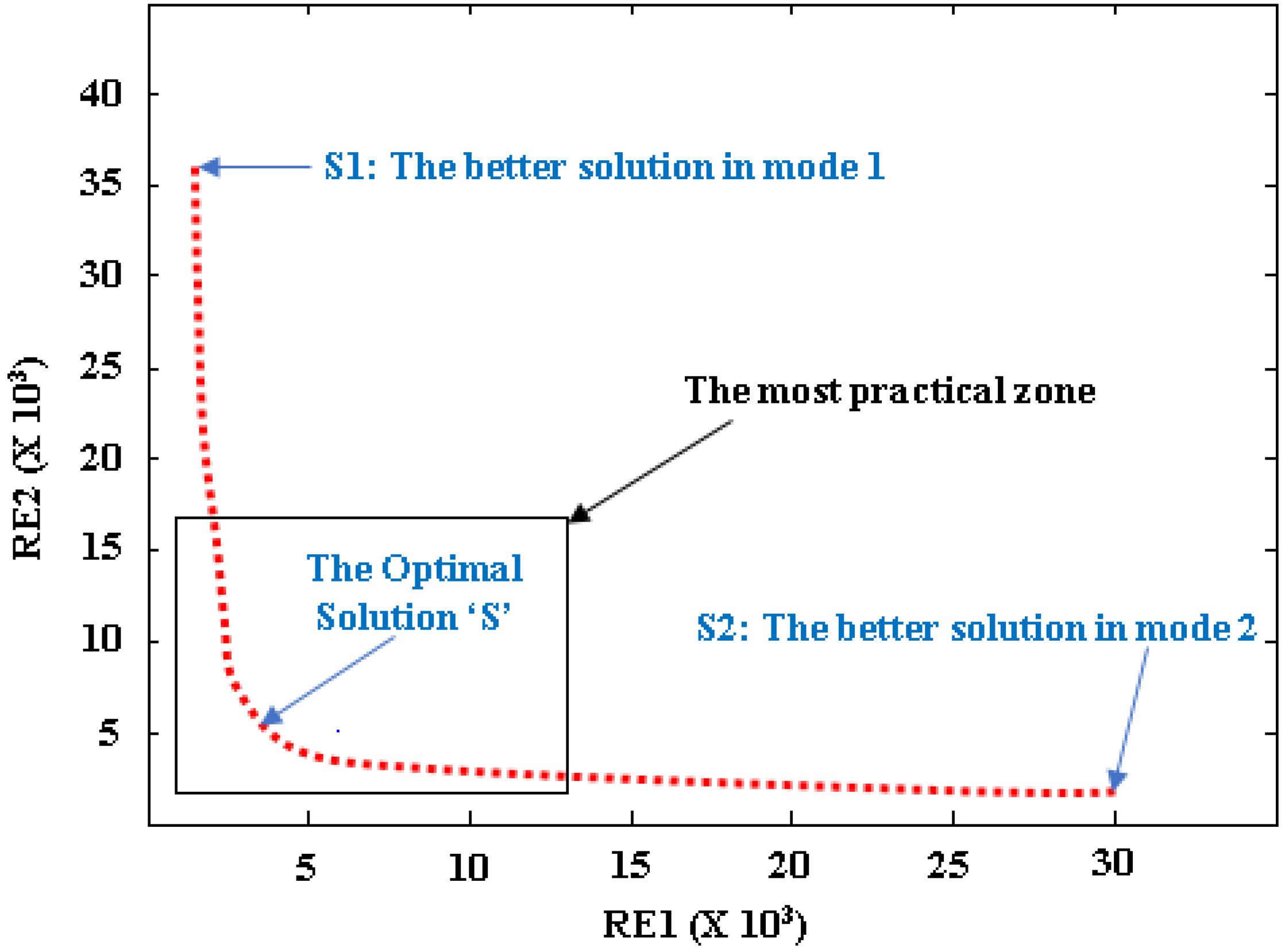
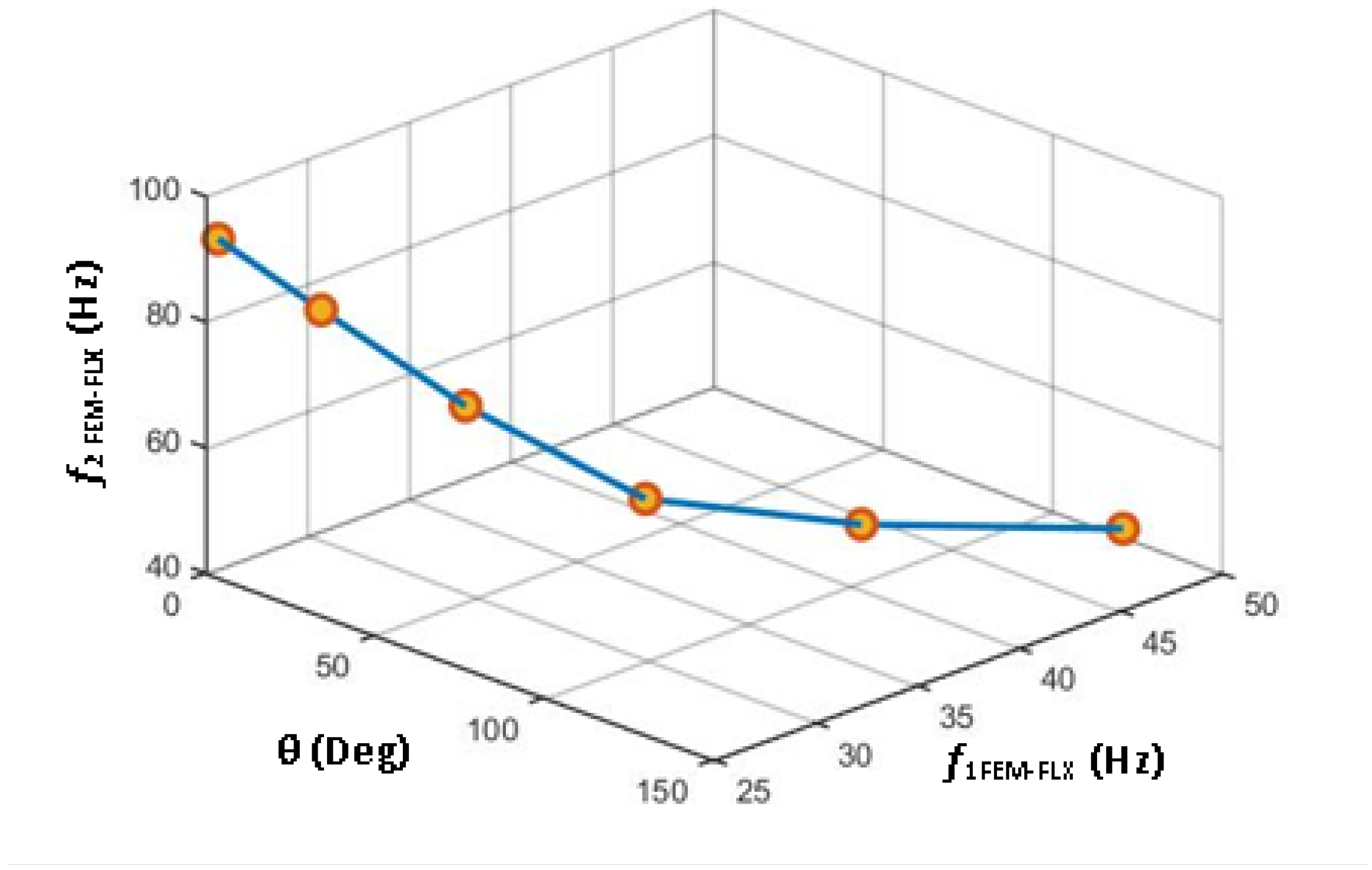
- Development of Double-Stage Genetic Algorithm (DSGA) Framework: A new two-level optimization framework. Stage I performs discrete multi-objective Pareto optimization to minimize frequency errors, while Stage II obtains a global, continuous stiffness-to-configuration mapping.
- Comparative Benchmark: The proposed DSGA offers an analytical equation under workspace for dynamic control, while the traditional methods (e.g., GA or PSO) acquire static parameters.
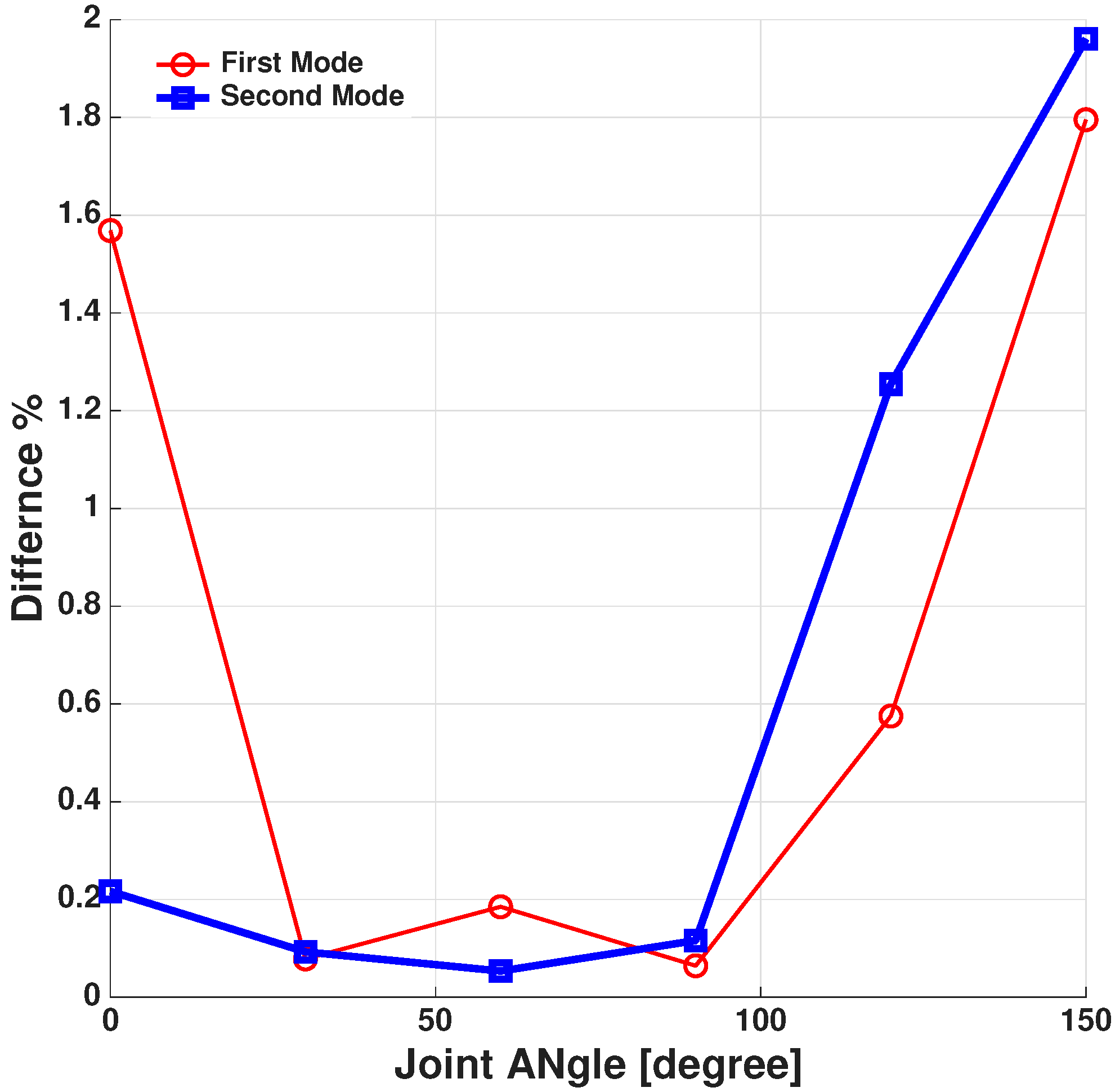
- Superior Error Reduction: Demonstrates a reduction in natural frequency prediction error from more than 72% in rigid models to less than 3.5% for all configurations.
2. Experimental Investigation
- 1.
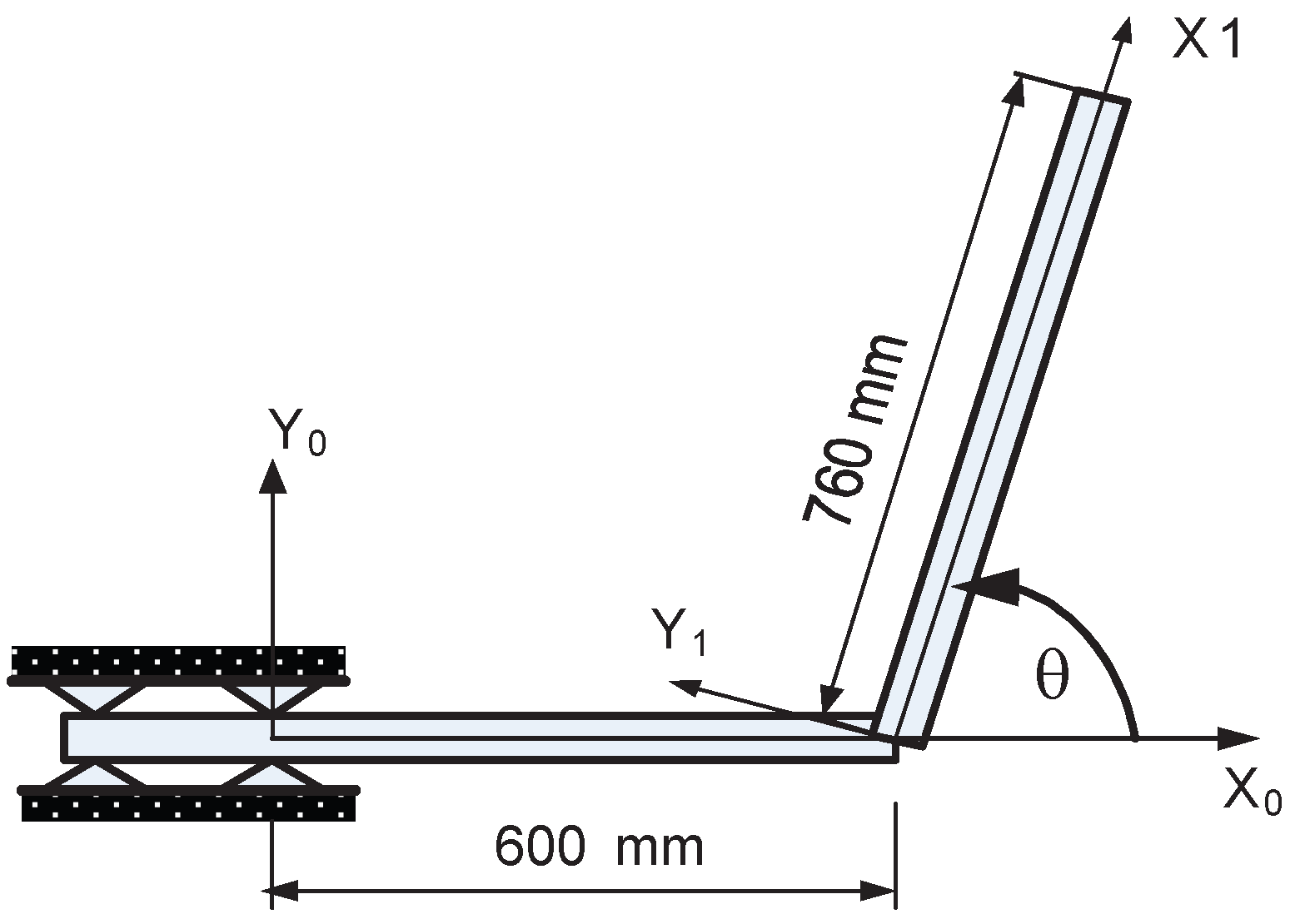
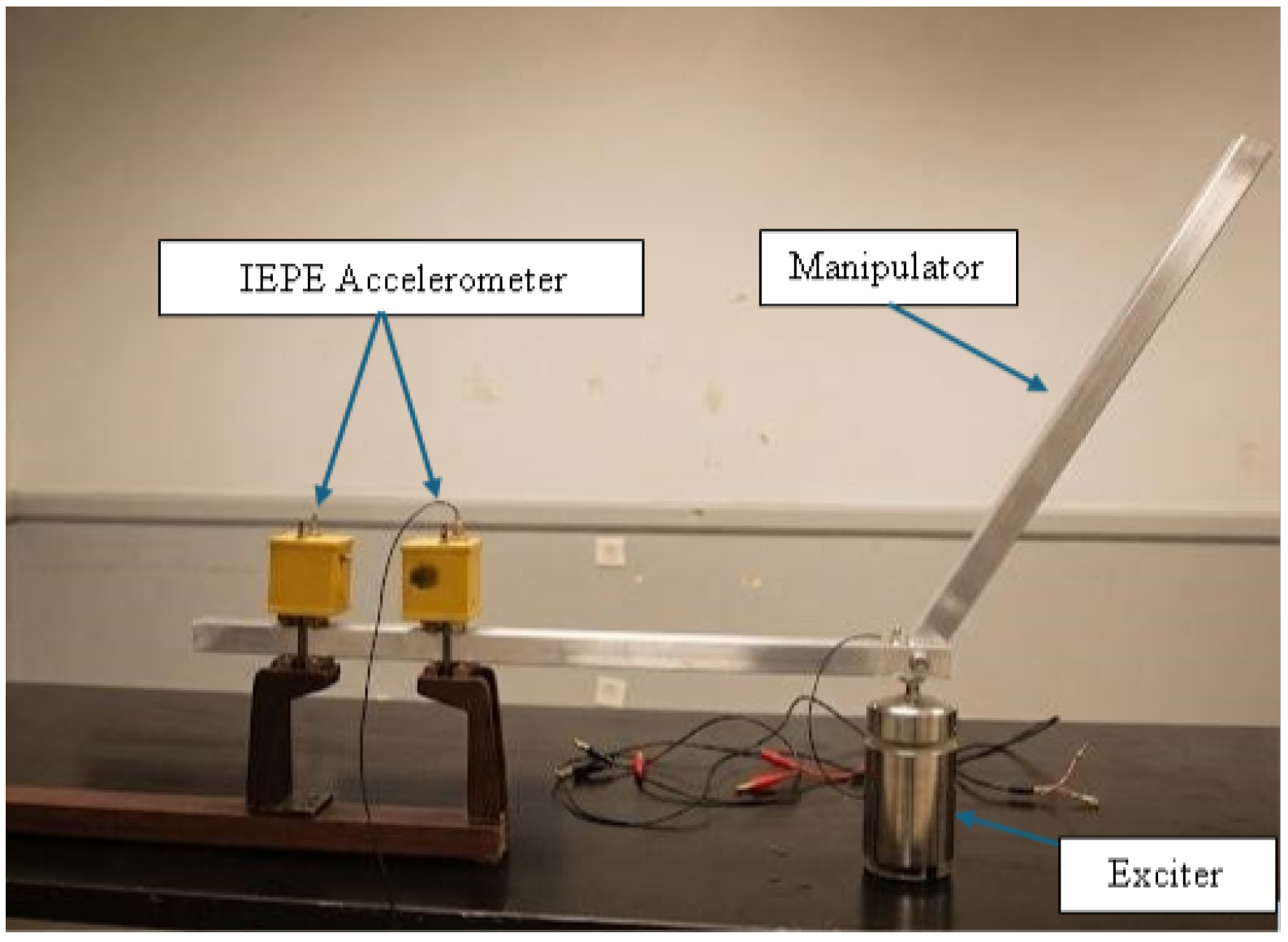
- Set Configuration: Fix the manipulator at a specific joint angle .
- 2.
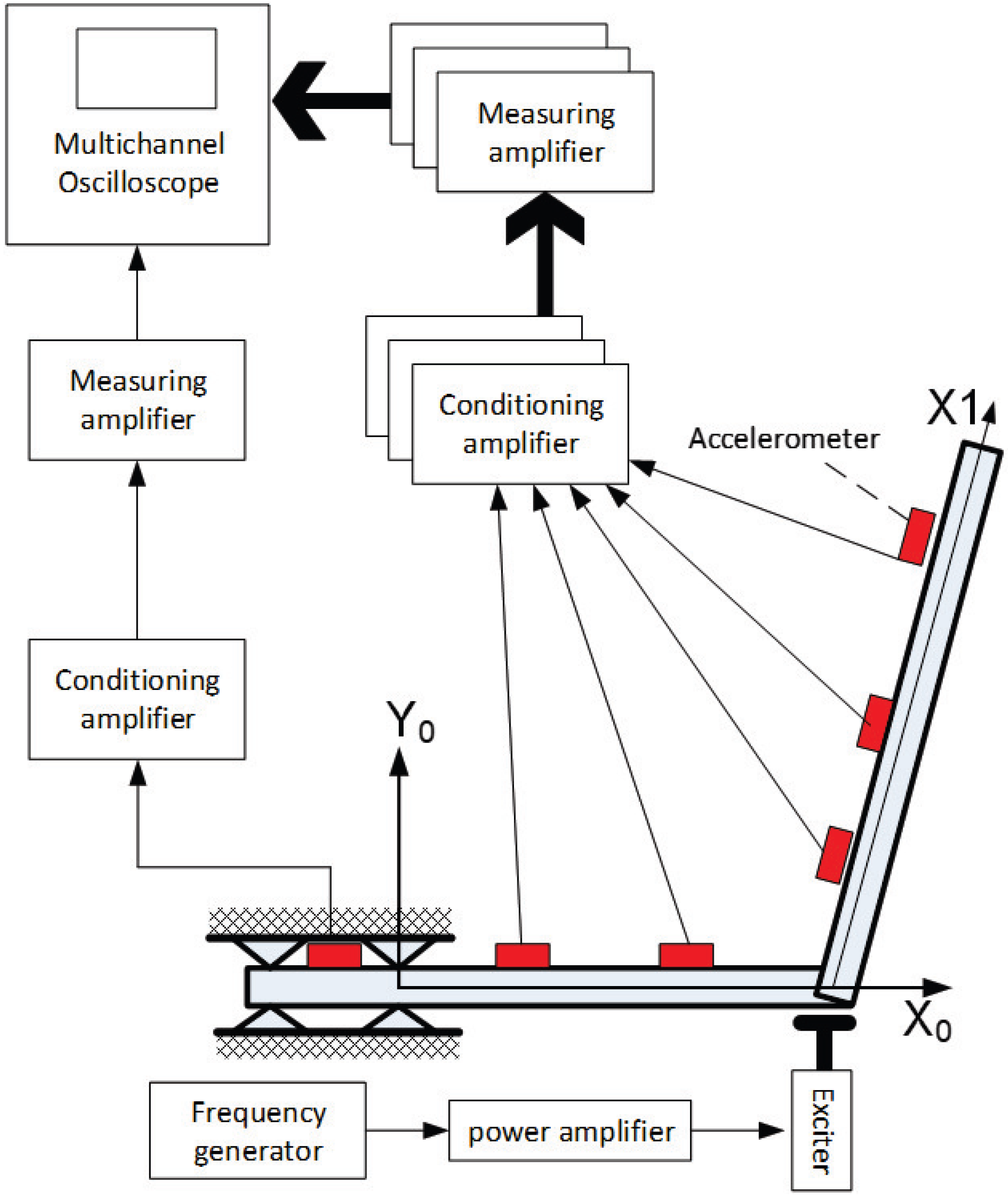
- Frequency Sweep: Excite the system across a broad frequency range.
- 3.
- Data Acquisition: Capture vibration amplitudes via accelerometers at designated locations.
- 4.
- Signal Processing: Route signals through conditioning and measuring amplifiers to the oscilloscope.
- 5.
- Peak Identification: Locate the excitation frequencies that generate maximum vibration amplitudes.
- 6.
- 7.
- Data Collection: Measure the first four natural frequencies across six manipulator configurations (summarized in Table 3).
3. Mathematical Analysis and Modeling
3.1. The Analytical Formulation (LMM)
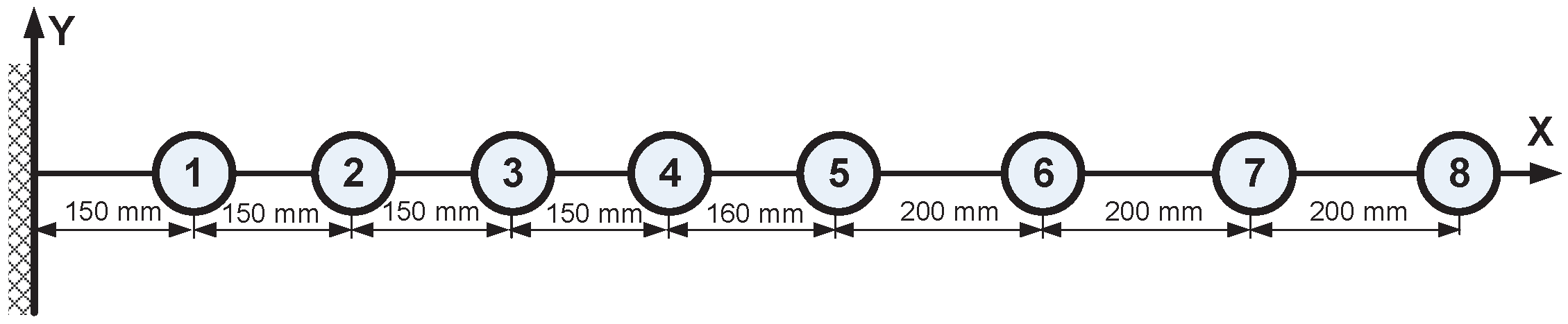
3.1.1. Lumped Mass Model (LMM) for
3.1.2. Lumped Mass Model (LMM) for
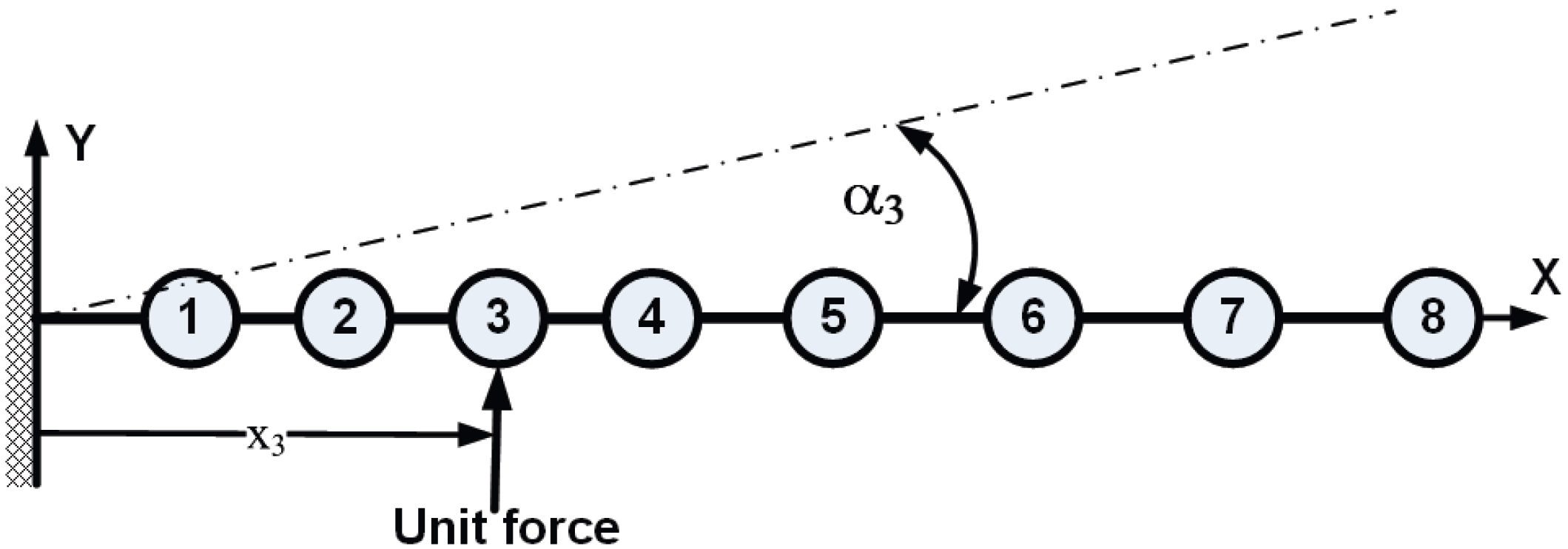
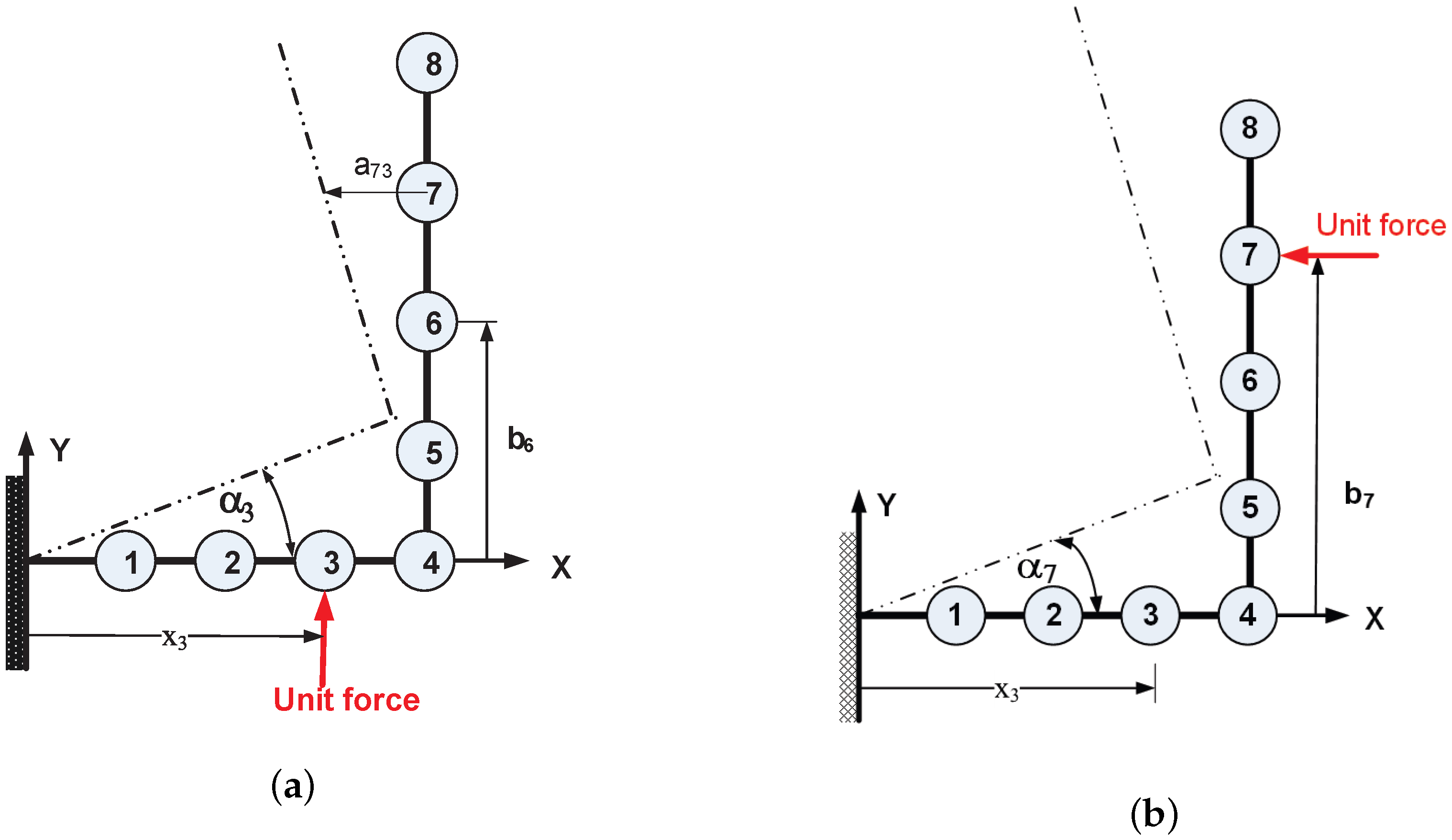
- A. Virtual Unit Force Applied on the First Link (, where )
- Deflection on the Second Link (): If is defined as shown in Figure 6a, the lateral deflection is given by
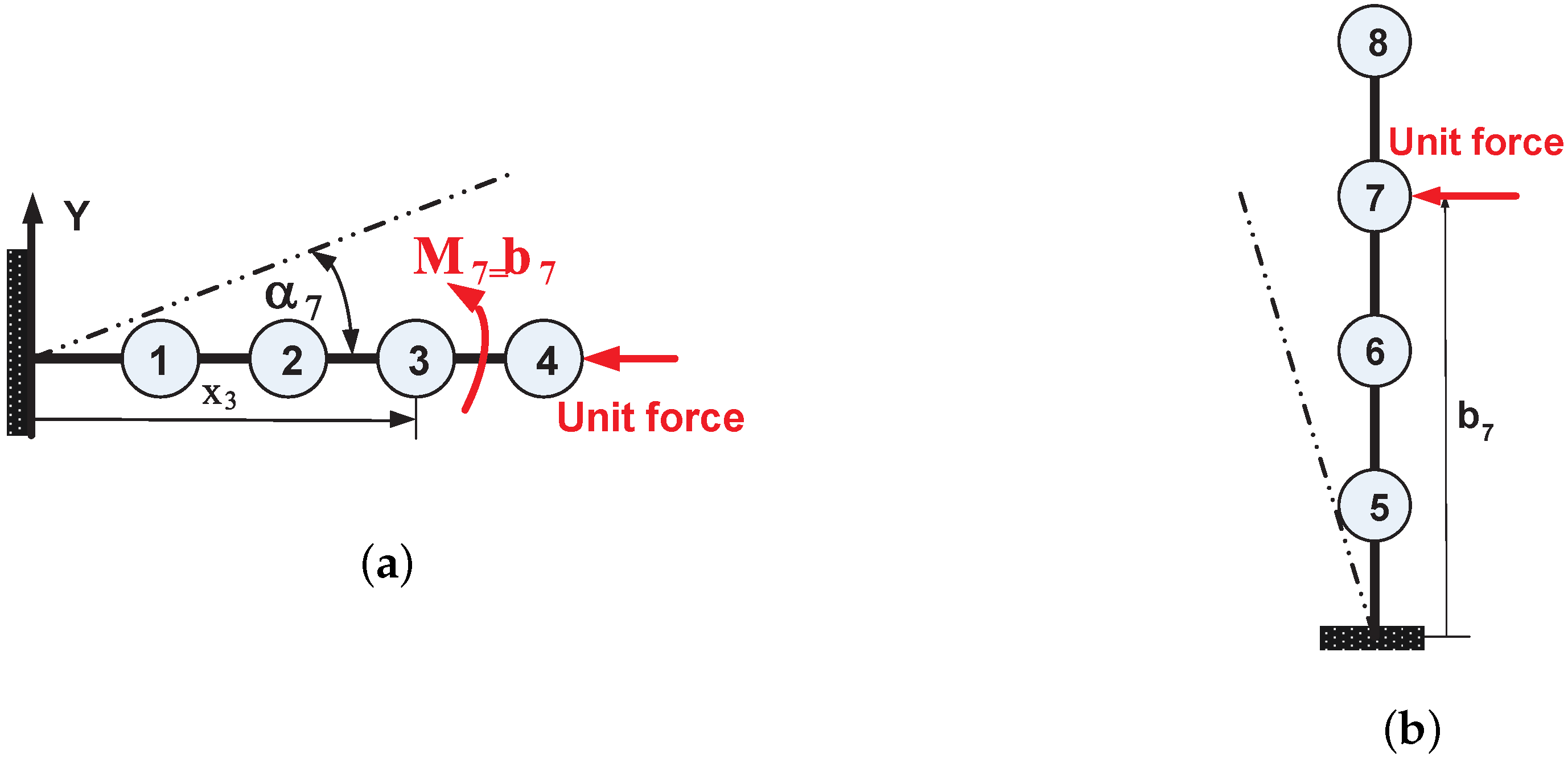
- B. Virtual Unit Force Applied on the Second Link ()
- Deflection on the First Link (): The deflection at is given by
- Deflection on the Second Link (): This case is solved via superposition of two steps.
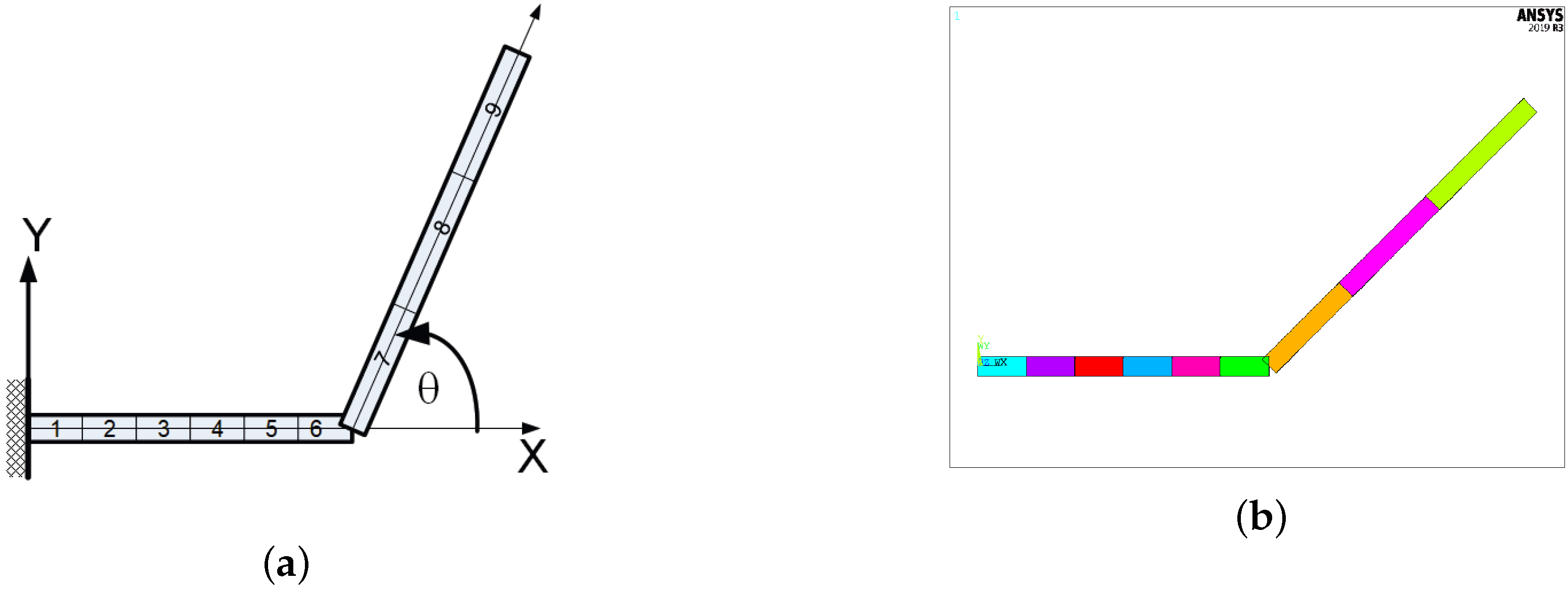
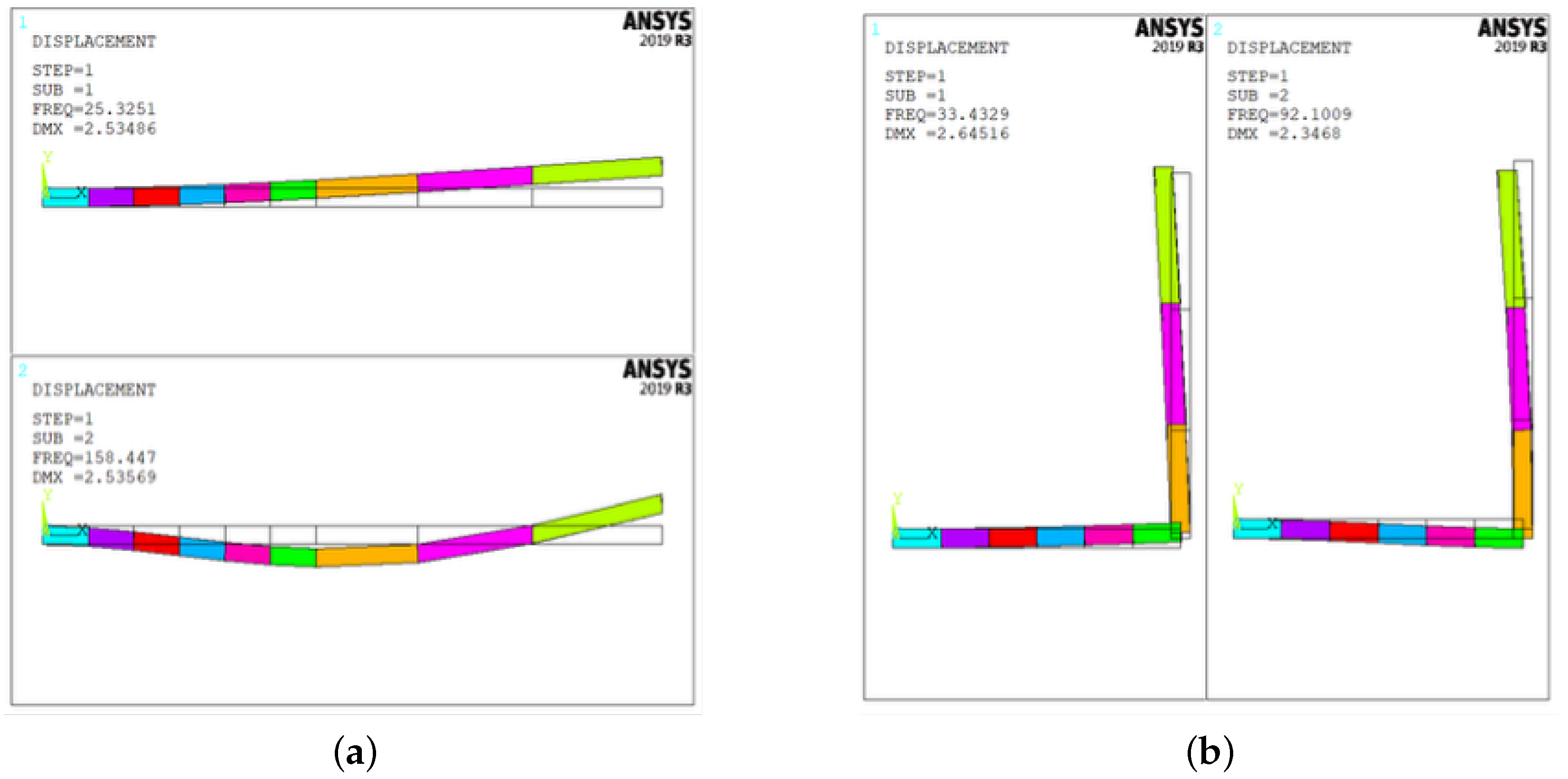
3.2. Rigid-Joint Finite Element Modeling (RJFEM)
3.3. The Need for More Investigation
- (a)
- Summary:
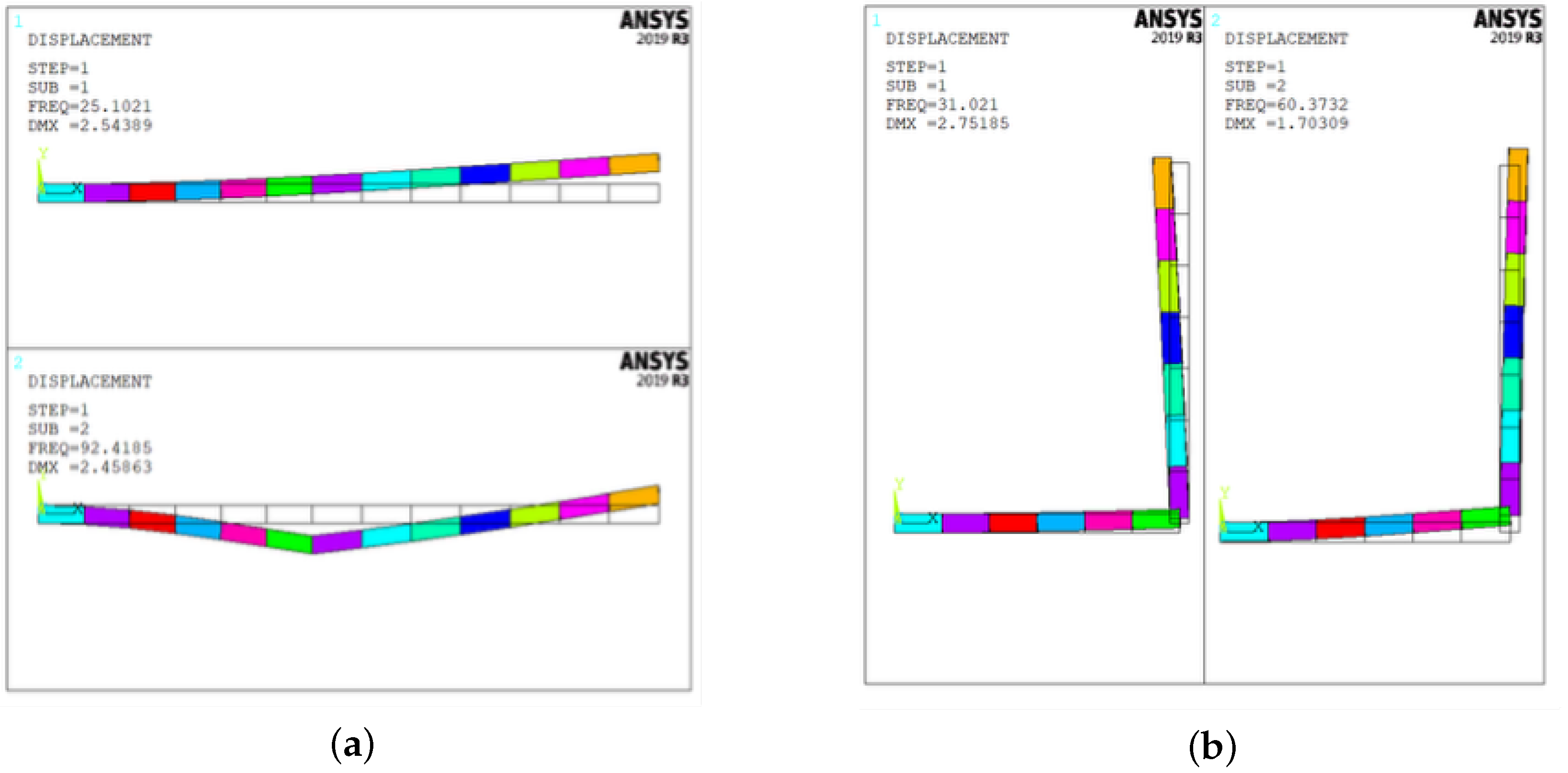
- The results obtained from the experimental work and the RJFEM give the natural frequencies for , , , and .
- The LMM gives natural frequencies only for and .
- Based on Blevins, only natural frequencies for are available.
- (b)
- Observations:
- In general, the natural frequencies depend on the manipulator configuration.
- Given the dominance of the first and second natural frequencies in dynamic analysis, this study focuses on the comparison of their behavior, as shown in the following.
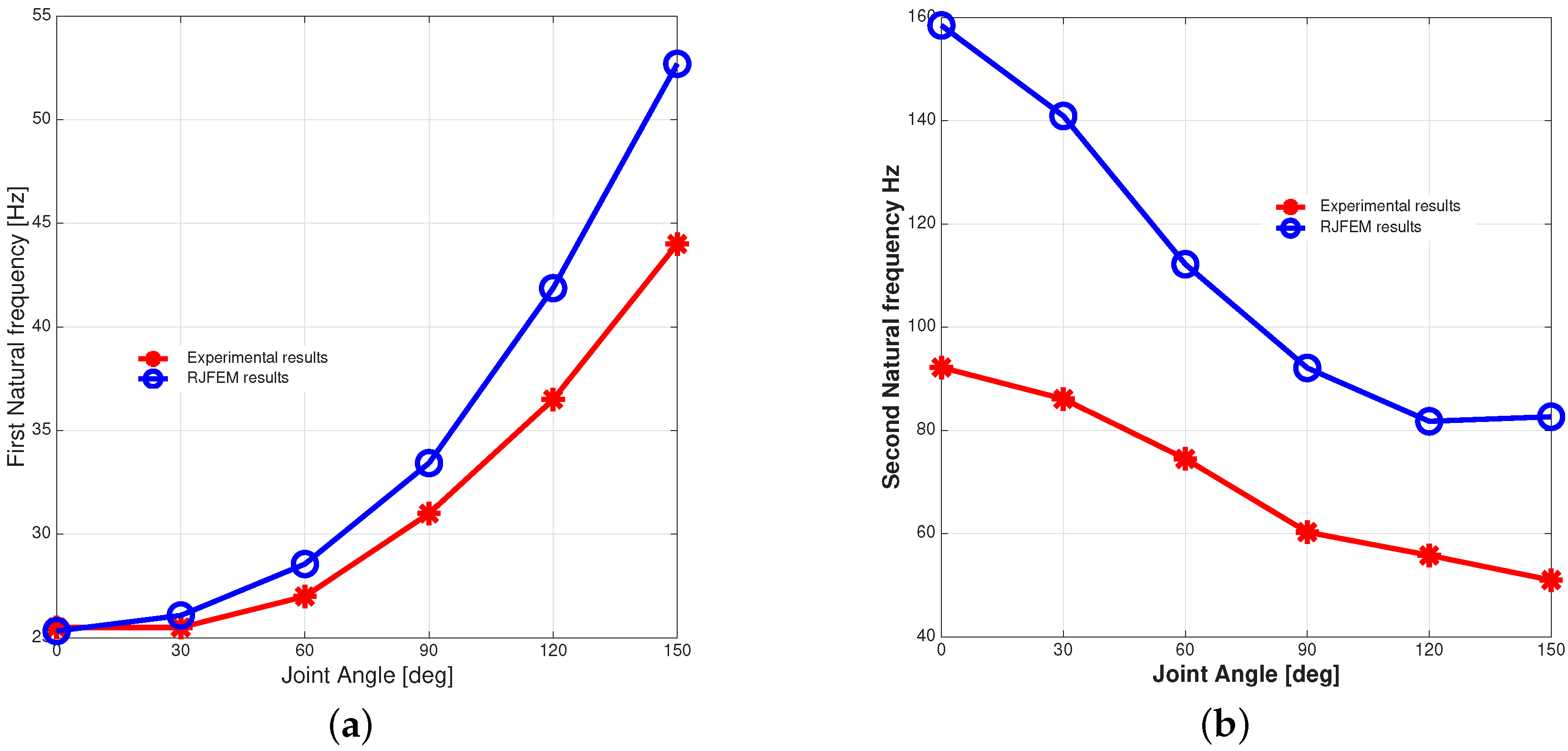
- Figure 10 shows the results from the experimental work and the RJFEM only. The figure illustrates the frequencies across all the manipulator model configurations.
- The main observation is the divergence in modal frequency behavior as the manipulator configuration changes, showing that the first natural frequency follows an upward trend while the second natural frequency exhibits a continuous decrease as the joint angle increases from to .
- Based on the validated experimental data, begins at 25.5 Hz at the fully extended position () and rises to 44 Hz at , whereas starts at a maximum of 92.2 Hz and drops significantly to 51 Hz over the same range.

- (c)
- Result Comparison:
- (i)
- For :
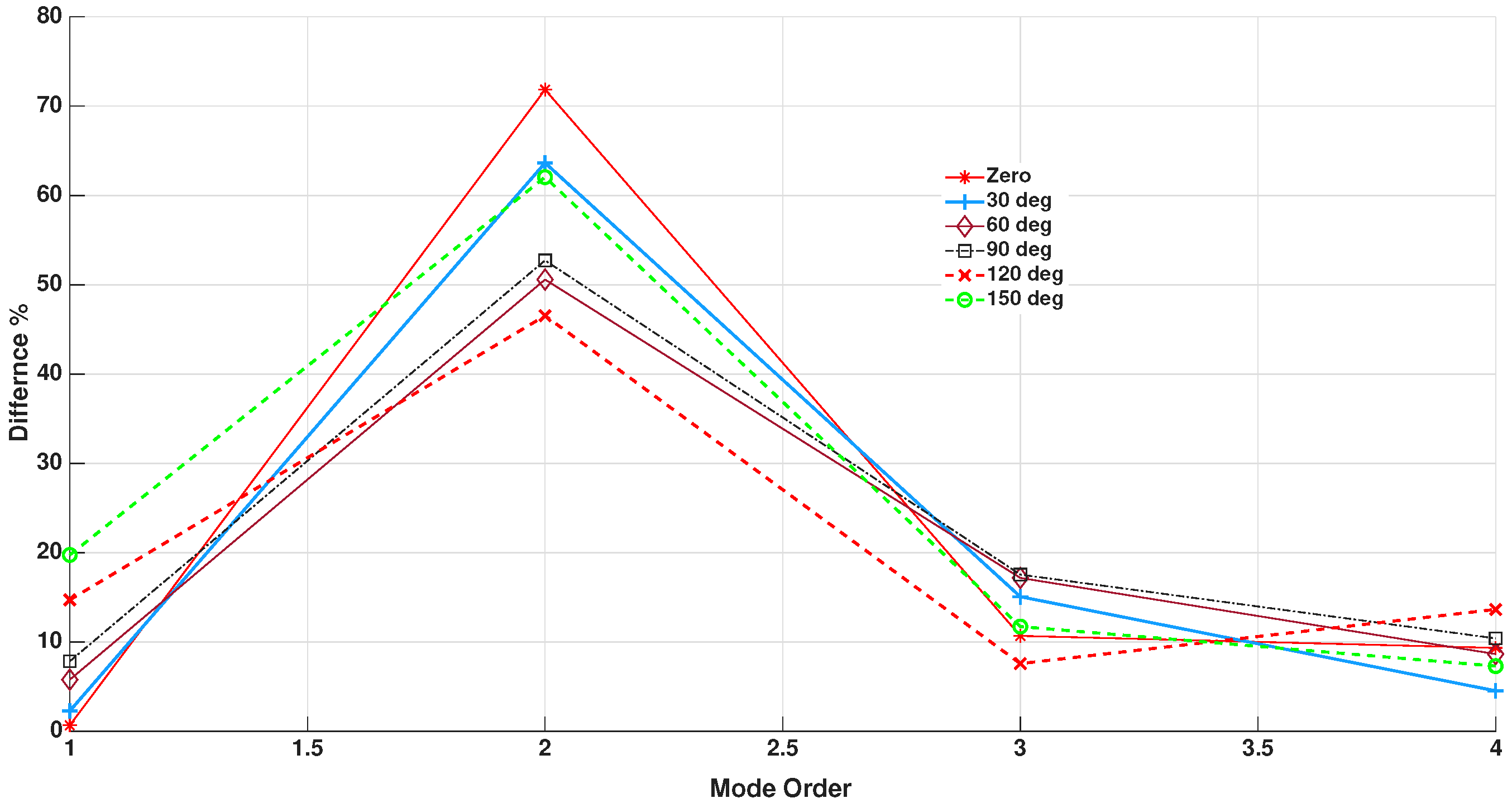
- The fundamental natural frequency: Good agreement between all obtained results (with a difference of less than 2.4% if compared to the experimental frequency).
- The second natural frequency: Good agreement between all calculated results from the style point of view. However, a considerable difference of 71.8% is observed when compared to the experimental frequency.
- The third natural frequency: A considerable difference of 11% is observed when compared to the experimental frequency.
- (ii)
- For :
- The fundamental natural frequency: No agreement between the results from the LMM and RJFEM, with a difference of about 15% if compared to the FEM (this may be due to the mass approximation made in the LMM). The difference between the RJFEM results and the experimental results approaches 7.8%.
- The second natural frequency: The difference between the RJFEM results and the experimental results approaches 53% if compared to the experimental frequency.
- (iii)
- For the other configurations of the manipulator model (other angles):
- All differences are configuration- and mode-dependent.
- The difference in the first mode differs between 0.6% and 19.75% if compared to the experimental results. Its maximum is at .
- The difference in the second mode seems to be the maximum for all configurations and differs from 46.5% to 71.85% if compared to the experimental results. Its maximum is at .
- (d)
- The need for introducing joint flexibility:
- All results out of all numerical models (for all modes and all manipulator configurations) show significant discrepancies when compared to the experimental results with different percentages.
- Based on the inverse relationship of the modal frequency behavior with the manipulator configuration, one may conclude that the system’s effective stiffness and mass distribution are highly sensitive to the geometric pose, suggesting that the structure becomes fundamentally stiffer in its primary mode as it folds, while the decline in reflects a shift in the structural integrity or nodal points of the higher-order mode.
- As the discrepancy between the rigid-joint assumption and the experimental work (where the localized flexibility and damping are inherently in the physical system) increases, the joint flexibility becomes highly pronounced at specific configurations.
- The curves given in Figure 10 also highlight the critical necessity of flexible modeling for the joint between the two links. Perhaps introducing the appropriate flexible stiffness can reduce the gap between the results.
4. Simulation Analysis
4.1. The Double-Stage Genetic Algorithm Framework (DSGAF)
| Algorithm 1 DSGAF optimization workflow. | |
| Require: Experimental frequencies , joint angles | |
| Ensure: Optimal polynomial coefficients for | |
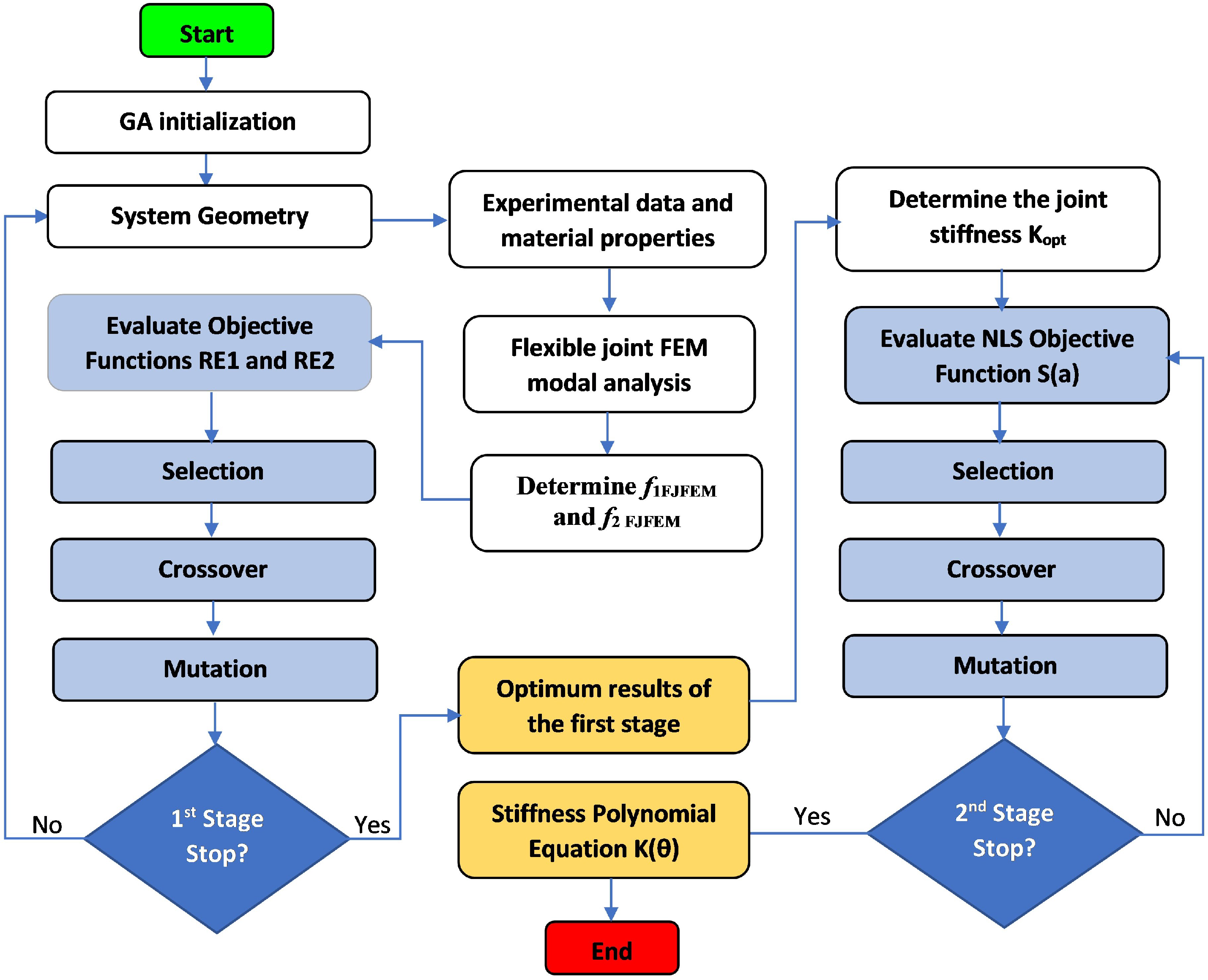
| 1: | Phase 1: Discrete Identification (Stage I) |
| 2: | for each do |
| 3: | Initialize DSGAF population using stiffness K |
| 4: | while not converged do |
| 5: | Solve FJFEM in ANSYS to obtain |
| 6: | Evaluate fitness using and |
| 7: | Apply crossover and mutation |
| 8: | end while |
| 9: | Return |
| 10: | end for |
| 11: | Phase 2: Global Surface Fitting (Stage II) |
| 12: | Initialize DSGAF for coefficients |
| 13: | Minimize the sum of squared residuals: |
| 14: | Return the continuous function |
4.1.1. Stage I: Discrete Parameter Identification (GA Search)
4.1.2. Stage II: Global Regression and Equation Derivation (GA-NLS)
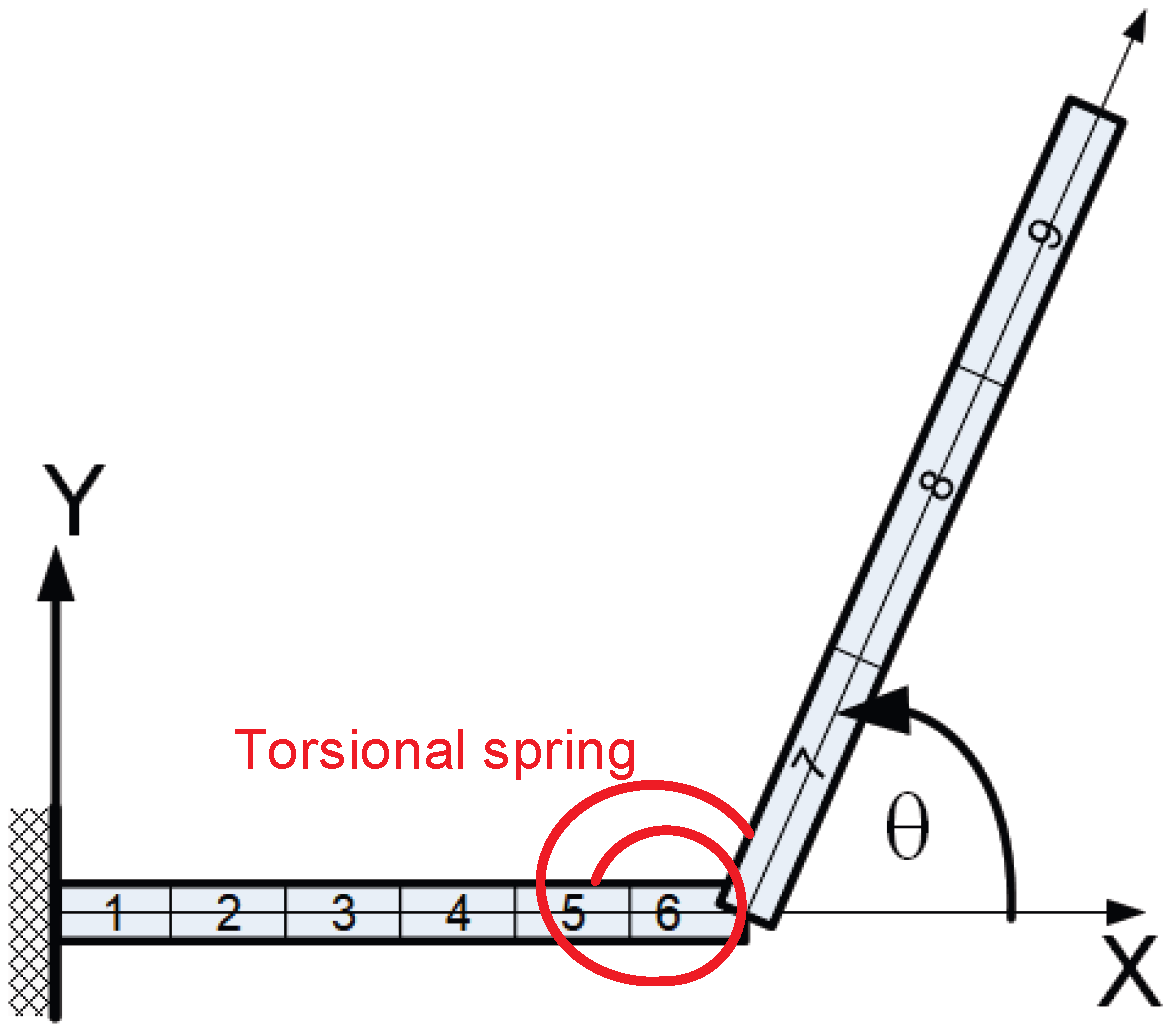
4.2. Identification of Joint Flexibility via DSGAF
5. Results and Discussion
5.1. Results and Comparative Analysis
5.2. Framework Sensitivity and Ablation Analysis
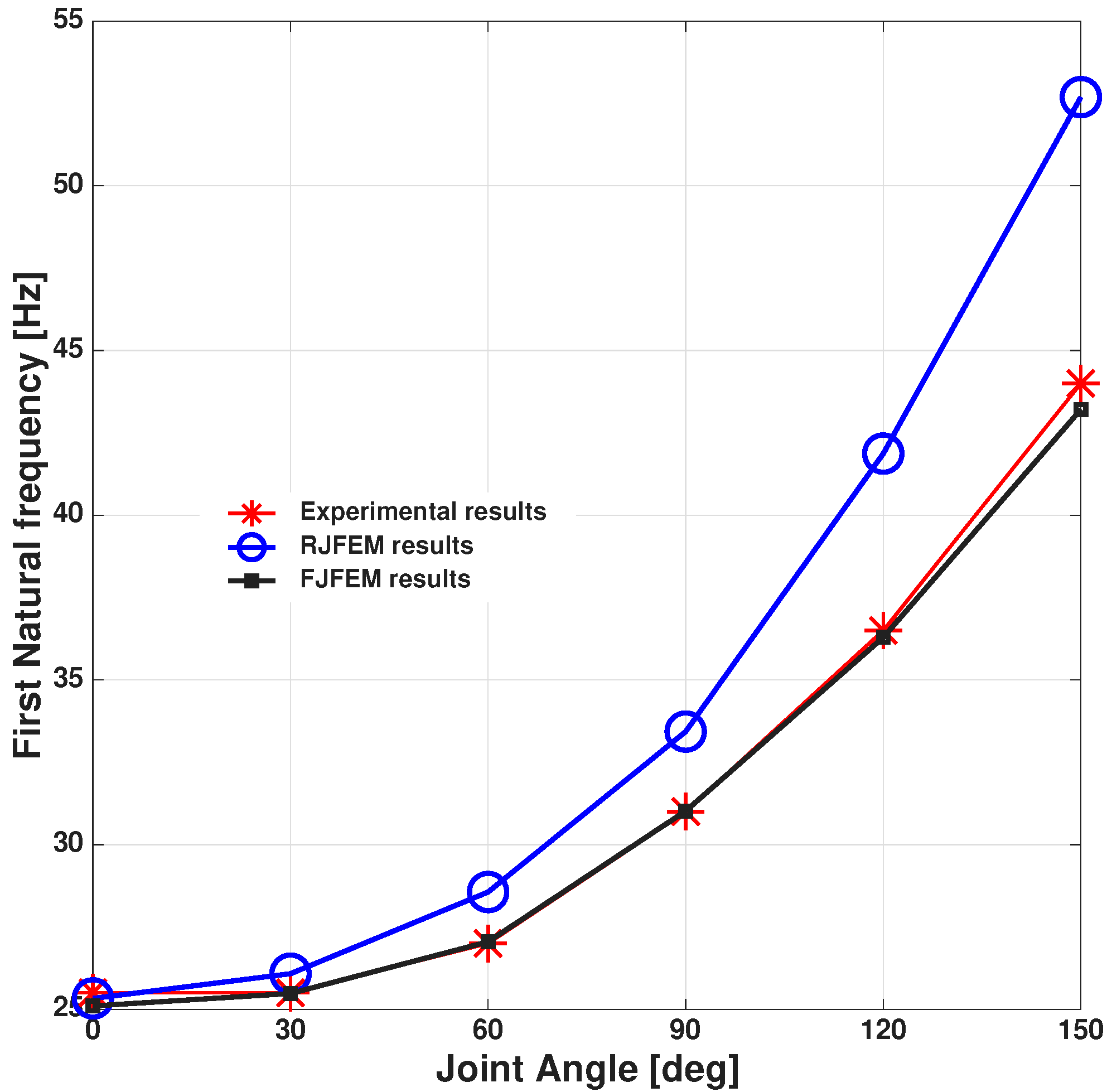
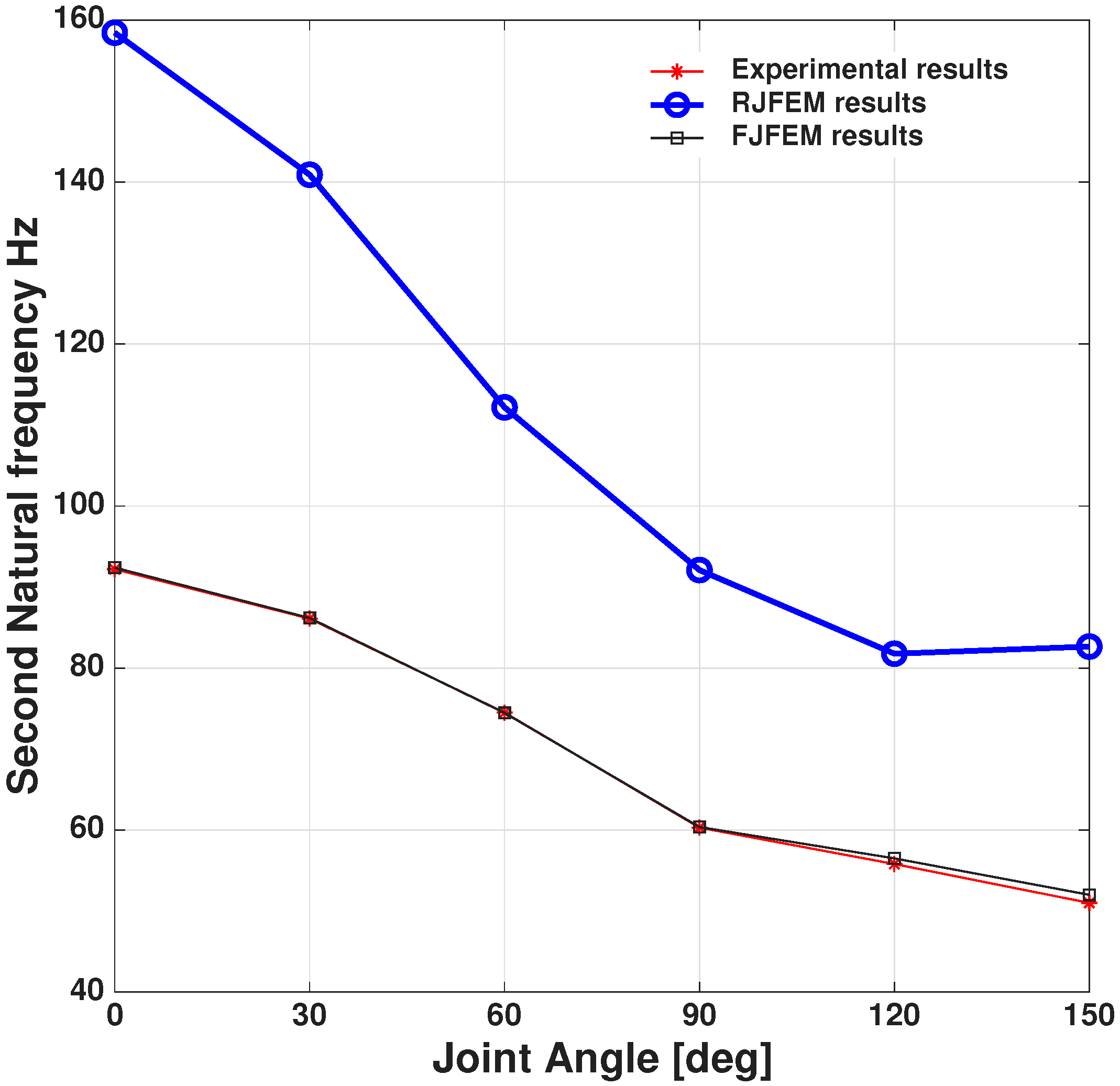
- Ablation of Joint Compliance Optimization: When the localized joint compliance parameters are ablated (returning the architecture to a conventional rigid-joint framework (RJFEM in Table 6) or an analytical model (Blevins in Table 7)), the system fails to track higher-order dynamics. This generates a peak natural frequency error of 71.85% for the second mode at (Table 6), confirming that structural link elasticity models cannot compensate for missing joint compliance.
- Sensitivity of Modal Frequencies to Stiffness K: Evaluation of the sensitivity gradient based on the optimized joint stiffness values in Table 3 reveals asymmetric modal sensitivity. While the fundamental frequency () exhibits low sensitivity to minor variations in joint stiffness across configuration changes, the second modal frequency () displays high sensitivity. A 10% deviation in K alters by up to 15.4% at extended configurations, explaining the tight tolerances (<3.5%) achieved by the dual-objective Pareto optimization loop.
- Ablation of Stage II Regression: Restricting the framework strictly to Stage I provides excellent discrete parameters (Table 3), but leaves gaps across continuous paths. Incorporating the fifth-order polynomial regression in Stage II resolves this workspace-wide continuity, translating localized sensitivities into a robust analytical function that closely matches experimental frequencies during continuous trajectory shifts (Table 5).
6. Conclusions
Author Contributions
Funding
Institutional Review Board Statement
Informed Consent Statement
Data Availability Statement
Acknowledgments
Conflicts of Interest
Nomenclature
| Symbol | Description | Abbreviation | Meaning |
| Joint angle | ANSYS | Analysis System Finite Element Solver | |
| f | Natural frequency | DSGAF | Double-Step Genetic Algorithm Framework |
| Damping factor | PSO | Particle Swarm Optimization | |
| System mass matrix | MBDE | Multi-objective hybrid differential evolution | |
| Symmetric flexibility matrix | FEM | Finite Element Method | |
| Elements of the mass matrix | RJFEM | Rigid-Joint Finite Element Model | |
| Elements of the matrix | LMM | Lumped Mass Model | |
| Deflection at the ith point | Debye parameter | ||
| Slope due to the open end at the ith point | GA | Genetic algorithm | |
| Mass per unit length of the beam | DSGA | Double-Step Genetic Algorithm | |
| E | Elasticity modulus | L | Length of the beam |
| Measured natural frequency | RE | Relative residual error | |
| FEM natural frequency | ith sum of squares residual | ||
| Fitness function | S1 | Optimal solution in model 1 | |
| Optimal fitness value | S2 | Optimal solution in model 2 |
Appendix A. Elements of the Flexibility Matrix for the Case of θ = 90°

| Case | Unit Force at , | Eq. | Unit Force at , | Eq. |
|---|---|---|---|---|
| Slope angle | (2) | (7) | ||
| Deflection on the first link | (3) | (8) | ||
| (4) | ||||
| Deflection on the second link | (5) | (10) | ||
| (11) |
References
- Azriel, R.; Degani, O.; Bechar, A. A Methodology to Characterize an Optimal Robotic Manipulator Using PSO and ML Algorithms for Selective and Site-Specific Spraying Tasks in Vineyards. Robotics 2025, 14, 58. [Google Scholar] [CrossRef]
- Farooq, S.S.; Baqai, A.A.; Shah, M.F. Optimal design of tricept parallel manipulator with particle swarm optimization using performance parameters. J. Eng. Res. 2021, 9, 378–395. [Google Scholar] [CrossRef]
- Yue, S.; Shi, Y. Manipulator Smooth Control Method Based on LSTM-XGboost and Its Optimization Model Construction. Appl. Sci. 2023, 13, 8994. [Google Scholar] [CrossRef]
- Li, S.; Gao, Z.; Yang, W.; Wang, R.; Zhang, L. Recent Advances in Dielectric Elastomer Actuator-Based Soft Robots: Classification, Applications, and Future Perspectives. Gels 2025, 11, 844. [Google Scholar] [CrossRef] [PubMed]
- Shoaib, M.; Kim, M.; Park, D.; Cheong, J. Control of a worm-wheel gear driven rescue robot with friction compensation and its experimental verification. Adv. Mech. Eng. 2023, 15, 1–12. [Google Scholar] [CrossRef]
- Feng, W.; Wu, L.; Liu, Y.; Liu, B.; Liu, Z.; Zhang, K. Dynamic Analysis of Geared Rotor System with Hybrid Uncertainties. Chin. J. Mech. Eng. 2024, 37, 112. [Google Scholar] [CrossRef]
- Tonin, A.; Semprini, M.; Kiper, P.; Mantini, D. Brain-Computer Interfaces for Stroke Motor Rehabilitation. Bioengineering 2025, 12, 820. [Google Scholar] [CrossRef] [PubMed]
- Shen, J.; Wang, Y.; Yao, M.; Liu, S.; Guo, Z.; Zhang, L.; Wang, B. Long-span delivery of differentiable hybrid robots for restoration of neural connections. Matter 2025, 8, 101942. [Google Scholar] [CrossRef]
- Sun, X.; Li, Z.; Li, C.; Zhang, H.; Liu, W.; Liu, M.; Li, L.; Gui, L. Hydrophilic hard-magnetic soft robots: A new approach for precise droplet manipulation. Nanotechnol. Precis. Eng. 2025, 8, 043012. [Google Scholar] [CrossRef]
- Xu, J.; Chen, S.; Li, S.; Liu, Y.; Wan, H.; Xu, Z.; Zhang, C. A Survey on Design and Control Methodologies of High-Torque-Density Joints for Compliant Lower-Limb Exoskeleton. Sensors 2025, 25, 4016. [Google Scholar] [PubMed]
- James, S. Vibration of Mechanical and Structural Systems; Harper Collins: New York, NY, USA, 1990. [Google Scholar]
- Wang, Z.; Xu, D.; Zhao, S.; Yu, Z.; Huang, Y.; Ruan, L.; Zhou, Z.; Wang, Q. Level-Ground and Stair Adaptation for Hip Exoskeletons Based on Continuous Locomotion Mode Perception. Cyborg Bionic Syst. 2025, 6, 0248. [Google Scholar] [CrossRef] [PubMed]
- Du, Q.; Zhang, T.; Yang, G.; Chen, C.Y.; Wang, W.; Zhang, C. A 3K Planetary Gear Train with a flexure-based anti-backlash carrier for collaborative robots. Mech. Mach. Theory 2024, 191, 105495. [Google Scholar]
- Thomson, W. Theory of Vibration with Application; Prentice-Hall: New Delhi, India, 1979. [Google Scholar]
- Subedi, D.; Tyapin, I.; Hovland, G. Dynamic Modeling of Planar Multi-Link Flexible Manipulators. Robotics 2021, 10, 70. [Google Scholar] [CrossRef]
- Aro, K.; Guevara, L.; Torres-Torriti, M.; Torres, F.; Prado, A. Robust Nonlinear Model Predictive Control for the Trajectory Tracking of Skid-Steer Mobile Manipulators with Wheel–Ground Interactions. Robotics 2024, 13, 171. [Google Scholar]
- Fang, C.; Yue, X.; Zhao, Z.; Guo, S. The Multi-Agentization of a Dual-Arm Nursing Robot Based on Large Language Models. Bioengineering 2025, 12, 448. [Google Scholar] [PubMed]
- Liu, J.; Zhao, J.; Wu, H.; Dai, Y.; Li, K. Self-Oscillating Curling of a Liquid Crystal Elastomer Beam under Steady Light. Polymers 2023, 15, 344. [Google Scholar] [CrossRef] [PubMed]
- Li, G.; Liu, Y.; Wang, D.; Li, X.; Liu, D.; Hu, Z.; Hong, B.; Li, X.; Gong, J. A Study on Ejector Structural and Operational Conditions Based on Numerical Simulation. Processes 2025, 13, 2182. [Google Scholar] [CrossRef]
- Chen, H.; Chen, B.; Xu, Z.; Ge, J.; Chen, H.; Zhong, Z. A Thermodynamic Model for Performance Prediction of an Ejector with an Adjustable Nozzle Exit Position. Processes 2025, 13, 879. [Google Scholar] [CrossRef]
- Nejlaoui, M.; Alghafis, A.; Alqahtani, N.A. Optimal Fractional Order PID Controller Design for Hydraulic Turbines Using a Multi-Objective Imperialist Competitive Algorithm. Fractal Fract. 2026, 10, 46. [Google Scholar] [CrossRef]
- Liu, J.; Li, X.; Yin, M.; Wei, L.; Wang, H. Modeling and Rotation Control Strategy for Space Planar Flexible Robotic Arm Based on Fuzzy Adjustment and Disturbance Observer. Mathematics 2024, 12, 2513. [Google Scholar] [CrossRef]
- Bauomy, H.S.; EL-Sayed, A.T. Oscillation Controlling in Nonlinear Motorcycle Scheme with Bifurcation Study. Mathematics 2025, 13, 3120. [Google Scholar] [CrossRef]
- Guo, Z.; Ju, H.; Lu, C.; Wang, K. Dynamic Modeling and Improved Nonlinear Model Predictive Control of a Free-Floating Dual-Arm Space Robot. Appl. Sci. 2024, 14, 3333. [Google Scholar] [CrossRef]
- Urrea, C.; Saa, D.; Kern, J. Automated Symbolic Processes for Dynamic Modeling of Redundant Manipulator Robots. Processes 2024, 12, 593. [Google Scholar] [CrossRef]
- Shrestha, P.; Elsisi, A.; Abdel-Monsef, S. Parametric Analysis of CFRP Flexural Strengthening of Steel I-Beams Under Monotonic Loading. J. Compos. Sci. 2025, 9, 696. [Google Scholar] [CrossRef]
- Wang, J.; Zhou, S.; Wu, J.; Qing, J.; Kang, T.; Shao, M. Dynamic Modeling and Analysis of Flexible-Joint Robots with Clearance. Sensors 2024, 24, 4396. [Google Scholar] [CrossRef] [PubMed]
- Cao, S.; Wang, F.; Li, X.; Yao, D.; Xie, M. Safety-Constrained Disturbance-Compensated Model Predictive Control for Flexible-Joint Robots. Appl. Sci. 2025, 15, 13238. [Google Scholar]
- Jiang, H.; Yang, Y.; Hua, C.; Li, X.; Lu, F. Predefined-Time Composite Fuzzy Adaptive Control for Flexible-Joint Manipulator System with High-Order Fully Actuated Control Approach. IEEE Trans. Ind. Electron. 2025, 72, 7191–7199. [Google Scholar]
- Sun, J.; Peng, C.; Zou, J.; Zhou, Q.; Wu, Y. A novel MPC-NNSMC composite control method for robotic manipulators considering uncertainties and constraints. Control Eng. Pract. 2025, 156, 106238. [Google Scholar] [CrossRef]
- Liu, J.; Yang, J.; Mao, J.; Zhu, T.; Xie, Q.; Li, Y.; Wang, X.; Li, S. Flexible Active Safety Motion Control for Robotic Obstacle Avoidance: A CBF-Guided MPC Approach. IEEE Robot. Autom. Lett. 2025, 10, 2686–2693. [Google Scholar] [CrossRef]
- Shi, R.; Jian, S.; Chen, G.; Yao, P. Research on the Design and Control Method of Robotic Flexible Magneto-Rheological Actuator. Sensors 2025, 25, 6921. [Google Scholar] [CrossRef] [PubMed]
- D’antona, A.; Farsoni, S.; Rizzi, J.; Bonfè, M. A Variable Stiffness System for Impact Analysis in Collaborative Robotics Applications with FPGA-Based Force and Pressure Data Acquisition. Sensors 2025, 25, 3913. [Google Scholar] [CrossRef] [PubMed]
- Blevins, R.D. Formulas for Natural Frequency and Mode Shape; Krieger Publishing Company: Florida, FL, USA, 1993. [Google Scholar]
- Hibbeler, R.C. Mechanics of Materials, 11th ed.; Pearson Prentice Hall: Upper Saddle River, NJ, USA, 2023. [Google Scholar]
- Documentation for ANSYS Products. Available online: https://www.ansys.com/support (accessed on 18 June 2026).
- Sharkawy, A.-N. Task Location to Improve Human–Robot Cooperation: A Condition Number-Based Approach. Automation 2023, 4, 263–290. [Google Scholar]





| Ref. | Modeling Approach | Optimization/ Identification Strategy | Configuration Dependency | Core Limitation/Key Finding |
|---|---|---|---|---|
| Ref [1] | Rigid joint | Particle swarm optimization (PSO) | No (static/fixed pose) | Neglects nonlinear compliance at varying boundaries; high rigid-body bias. |
| Ref [2] | Rigid joint | PSO | No (static/fixed pose) | Underfits boundary-dependent nonlinear dynamics due to excessive rigid bias. |
| Ref [8] | LMM/rigid joint | Neural network | No (static/fixed pose) | Ignores pose-dependent nonlinear shifts. |
| Ref [12] | Rigid-joint FEM | Learning-free environment perception method | No (static/fixed pose) | Suffers from high rigid bias. |
| Ref [15] | Distributed parameter/Timoshenko beam model | Assumed modes method with Lagrangian formulation | Nominal path position | High computational burden; requires independent runs for every physical joint angle change. |
| Ref [22] | Lagrange principle and assumed modal method | Fuzzy adjustment and disturbance observer | Nominal path position | Ignores pose-dependent nonlinear shifts. |
| Ref [27] | Equivalent spring theory | Newton–Euler method | No (nominal path position) | Neglects the real-time continuous effect of gravity-induced link deflection on joint stiffness. |
| Ref [28] | Lumped mass model | SDC–MPC method | Partial (discrete poses only) | Neglects continuous gravity-induced link deflection. |
| Ref [29] | FEM with virtual springs | CFAC scheme | Partial (discrete poses only) | Neglects continuous gravity-induced link deflection on joint stiffness. |
| Ref [33] | Variable stiffness mechanism | FPGA-based acquisition unit | Partial (discrete poses only) | Omits real-time gravity deflection on joint stiffness. |
| Proposed framework | Flexible-joint FEM (FJFEM) | Double-Stage Genetic Algorithm Framework (DSGAF) | Yes ( continuous mapping) | Successfully resolves workspace-wide compliance by synthesizing a continuous polynomial pose function. |
| Component | Model/Manufacturer | Key Technical Specifications |
|---|---|---|
| Frequency Generator | FG-8002 | Frequency range: 0.1 Hz–2 MHz; Accuracy: |
| Power Amplifier | PA-150 Series | Output Power: 150 W; Frequency response: 10 Hz–20 kHz |
| Electromagnetic Exciter | Modal Shaker Type 4809 | Force rating: 45 N sine peak; Frequency range: 10 Hz–20 kHz |
| Accelerometers | Piezoelectric Type 4371 | Sensitivity: 1 pC/ms−2; Frequency range: 1 Hz–25 kHz; mass: 2.4 g |
| Measuring Amplifiers | Type 2635 (Charge Amp) | Transducer sensitivity: 0.1 to 10 pC/unit; Lower frequency limit: 0.2 Hz |
| Oscilloscope | GDS-1052-U | Bandwidth: 50 MHz; channels: 2; Real-time sampling rate: 250 MSa/s |
| [Hz] | [Hz] | [Hz] | [Hz] | |
|---|---|---|---|---|
| 0 | 25.5 | 92.2 | 400 | 792 |
| 30 | 25.5 | 86.1 | 368 | 750 |
| 60 | 27 | 74.5 | 345 | 690 |
| 90 | 31 | 60.3 | 340 | 670 |
| 120 | 36.5 | 55.8 | 380 | 650 |
| 150 | 44 | 51 | 400 | 700 |
| Joint Angle () | Mode | Mean Experimental Frequency (Hz) | Standard Deviation (SD) | Coefficient of Variation (CV%) |
|---|---|---|---|---|
| 0° | 25.50 | 0.08 | 0.31% | |
| 92.20 | 0.35 | 0.38% | ||
| 60° | 27.00 | 0.11 | 0.41% | |
| 74.50 | 0.42 | 0.56% | ||
| 90° | 31.00 | 0.15 | 0.48% | |
| 60.30 | 0.51 | 0.85% | ||
| 150° | 44.00 | 0.22 | 0.50% | |
| 51.00 | 0.31 | 0.61% |
| [Hz] | [Hz] | [Hz] | [Hz] | |
|---|---|---|---|---|
| 0 | 24.90 | 146.70 | 417.50 | 787.40 |
| 90 | 38.50 | 143.30 | 172.30 | 224.10 |
| [Hz] | [Hz] | [Hz] | [Hz] | |
|---|---|---|---|---|
| 0 | 25.33 | 158.45 | 442.73 | 865.96 |
| 30 | 26.08 | 140.91 | 423.47 | 783.97 |
| 60 | 28.56 | 112.19 | 404.25 | 749.67 |
| 90 | 33.43 | 92.10 | 399.66 | 739.70 |
| 120 | 41.87 | 81.77 | 408.80 | 738.70 |
| 150 | 52.69 | 82.65 | 446.90 | 751.10 |
| 1st Mode | 2nd Mode | 3rd Mode | 4th Mode | |
|---|---|---|---|---|
| 1.8751 | 4.6941 | 7.8548 | 10.996 | |
| f [Hz] | 25.32 | 158.70 | 444.35 | 870.75 |
| Hyperparameter/Feature | Value/Name |
|---|---|
| Chromosome Encoding | Real Value/Floating Point |
| Population Size | 3000 Individuals |
| Selection Method | Stochastic Universal Sampling (SUS) |
| Elitism Strategy | Top 5% |
| Crossover Operator | Intermediate Crossover () |
| Mutation Operator | Adaptive Gaussian () |
| Stopping Criteria | Max Generation: 300 |
| Algorithm | Metric | Mean (%) | SD | 95% CI | Convergence Variance |
|---|---|---|---|---|---|
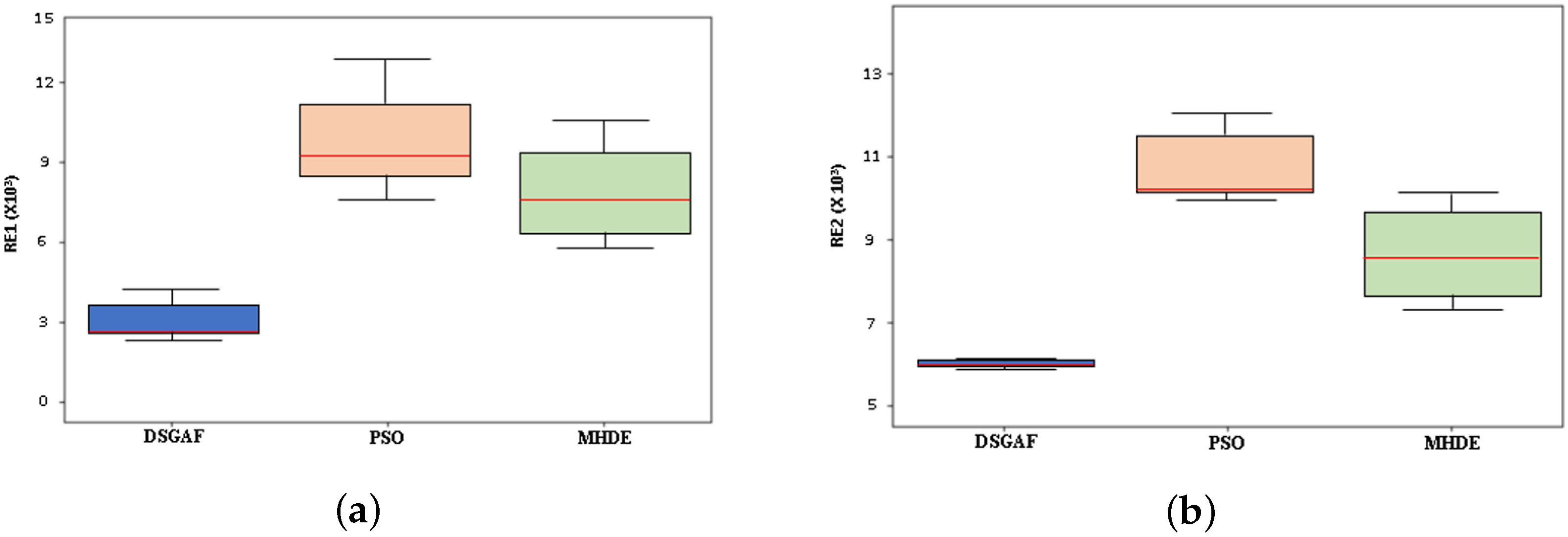
| DSGAF | 1.85 | 0.12 | [1.81, 1.89] | 0.018 | |
| 1.42 | 0.15 | [1.37, 1.47] | – | ||
| PSO | 5.24 | 1.15 | [4.83, 5.65] | 1.142 | |
| 6.11 | 1.48 | [5.58, 6.64] | – | ||
| MHDE | 3.98 | 0.78 | [3.70, 4.26] | 0.584 | |
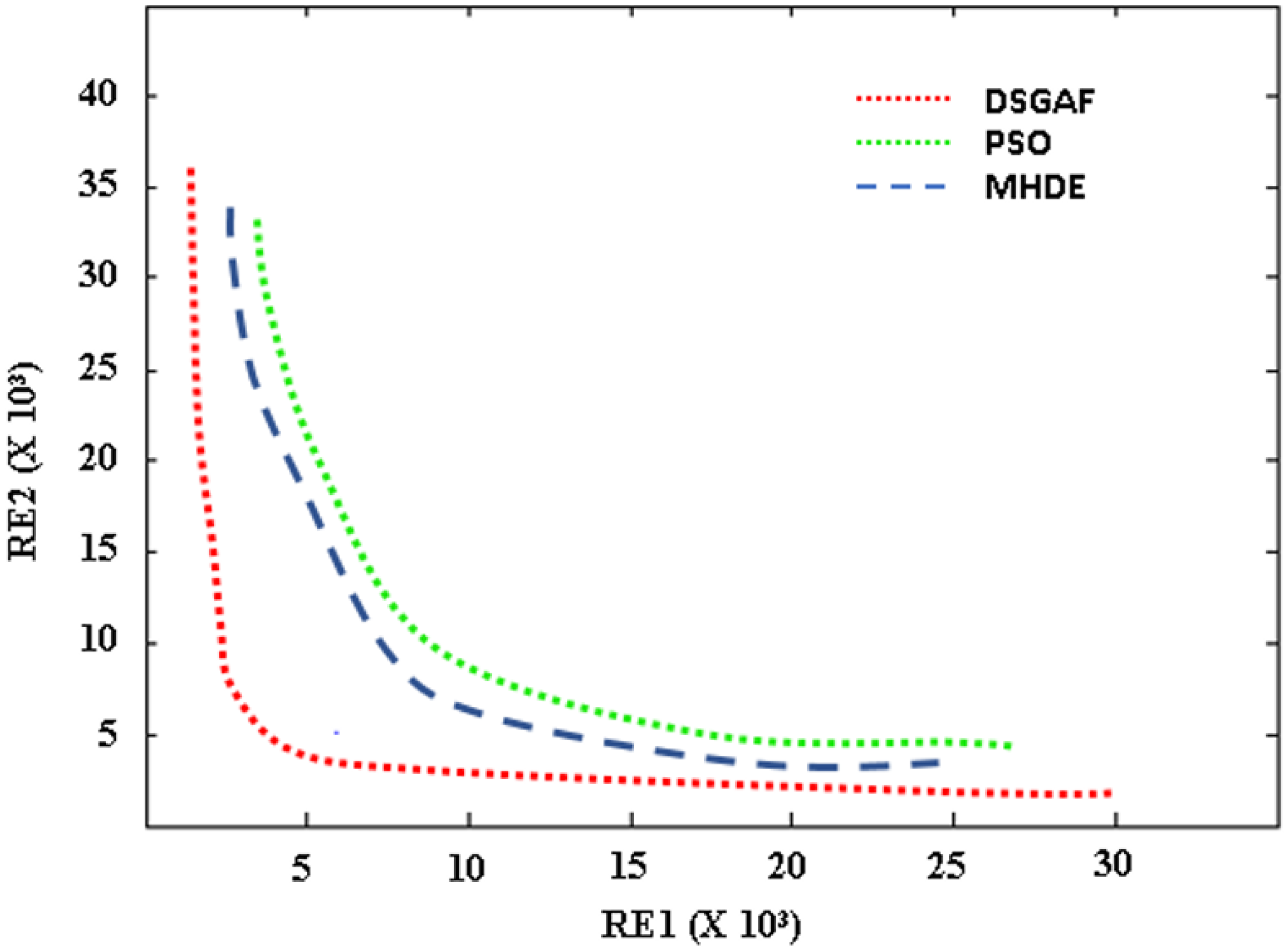
| 4.25 | 0.92 | [3.92, 4.58] | – |
Disclaimer/Publisher’s Note: The statements, opinions and data contained in all publications are solely those of the individual author(s) and contributor(s) and not of MDPI and/or the editor(s). MDPI and/or the editor(s) disclaim responsibility for any injury to people or property resulting from any ideas, methods, instructions or products referred to in the content. |
© 2026 by the authors. Licensee MDPI, Basel, Switzerland. This article is an open access article distributed under the terms and conditions of the Creative Commons Attribution (CC BY) license.
Share and Cite
Abdelraheim, A.E.; Nejlaoui, M.; Alqahtani, N.A. Bioinspired Computation for Identifying Joint Compliance in Biomimetic Flexible Manipulators. Biomimetics 2026, 11, 474. https://doi.org/10.3390/biomimetics11070474
Abdelraheim AE, Nejlaoui M, Alqahtani NA. Bioinspired Computation for Identifying Joint Compliance in Biomimetic Flexible Manipulators. Biomimetics. 2026; 11(7):474. https://doi.org/10.3390/biomimetics11070474
Chicago/Turabian StyleAbdelraheim, Abdelraheim Emad, Mohamed Nejlaoui, and Nasser Ayidh Alqahtani. 2026. "Bioinspired Computation for Identifying Joint Compliance in Biomimetic Flexible Manipulators" Biomimetics 11, no. 7: 474. https://doi.org/10.3390/biomimetics11070474
APA StyleAbdelraheim, A. E., Nejlaoui, M., & Alqahtani, N. A. (2026). Bioinspired Computation for Identifying Joint Compliance in Biomimetic Flexible Manipulators. Biomimetics, 11(7), 474. https://doi.org/10.3390/biomimetics11070474