1. Introduction
Low-light image enhancement (LLIE) is a key research area in computer vision and visual sensing, aiming to improve the visual quality and usability of images captured under weak illumination. In practice, low-light images often suffer from low brightness, poor contrast, and significant noise, which not only degrade subjective perception but also impair downstream tasks such as object detection, face recognition, and autonomous driving [
1,
2]. Developing efficient and high-quality LLIE methods is therefore crucial. These methods can improve the stability and robustness of visual sensing systems in harsh lighting environments.
Nature has evolved diverse and efficient low-light visual systems over billions of years. These biological mechanisms offer valuable bioinspired insights for optimizing artificial visual sensing technologies. Different species adopt unique strategies to adapt to low-light environments. Flying insects like Drosophila employ non-spiking graded neuronal structures to realize efficient visual processing with low energy consumption and computational overhead [
3].
Nocturnal moths are equipped with compound eyes containing special multi-scale summation units, which support high-sensitivity environmental perception in dim conditions via nonlinear spatiotemporal integration [
4]. In contrast, mammals adopt various retinal adaptation mechanisms. They maintain stable luminance perception when light changes, and they adjust rod and cone cell distribution and regulate the gain of phototransduction pathways to achieve this [
5]. These cross-species visual characteristics combine the high efficiency of insect vision with the perceptual adaptability of mammalian vision. Together, they provide an effective paradigm for balancing computational cost and sensing performance under resource-limited conditions. However, most existing low-light image enhancement methods do not systematically incorporate these key biological visual principles. As a result, they struggle to simultaneously achieve lightweight deployment and high-quality image restoration.
Early low-light image enhancement methods primarily relied on traditional image processing techniques. Histogram equalization (HE) enhances image contrast by redistributing pixel intensity values [
6,
7]; however, its global processing nature often leads to local detail loss and noise amplification, failing to exploit the cooperative local–global perception characteristics inherent in biological vision. Contrast-limited adaptive histogram equalization (CLAHE) [
8] alleviates over-enhancement to some extent, yet still falls short of achieving a synergistic optimization of noise suppression and detail preservation. Methods based on Retinex theory [
9,
10] decompose images into reflectance and illumination components. Single-scale Retinex (SSR) [
11] and multi-scale Retinex (MSR) [
12] algorithms exhibit reasonable color naturalness, but their reliance on hand-crafted priors limits generalization capability, making them inadequate for adaptively handling complex low-light degradation in the manner of biological visual systems.
With the advancement of deep learning, neural network-based low-light image enhancement has become mainstream. LLNet [
13] first applied deep autoencoders to enhance low-light images, achieving brightness improvement and noise suppression through end-to-end learning, yet its design relies primarily on data-driven optimization without explicitly modeling hierarchical structural and contrast perception in biological vision. RetinexNet [
14] combined traditional Retinex theory with convolutional networks, decomposing images into reflectance and illumination components, partially aligning with human visual perception of lighting changes. KinD [
15] and KinD++ [
16] further refined this framework with improved illumination estimation and denoising, but still focused on performance optimization, paying little attention to the efficiency and low-energy characteristics of biological vision in low-light environments. MBLLEN [
17] integrated multi-scale features via a multi-branch network, enhancing overall results, yet its high complexity contrasts with the streamlined efficiency of biological systems. Unsupervised and zero-reference approaches, such as Zero-DCE [
18] and zero-shot latent diffusion models [
19], exhibit strong generalization under limited data but lack explicit real-reference constraints, limiting structural consistency and perceptual stability for downstream vision tasks.
In recent years, Transformer architectures have introduced new advances in low-light image enhancement. SNR-Net [
20] fuses local and global features through a signal-to-noise ratio (SNR)-aware mechanism, Retinexformer [
21] employs an illumination-guided Transformer to model non-local interactions, and LYT-Net [
22] separates luminance and chrominance in the YUV color space, achieving real-time inference with only 0.045 M parameters. However, their loss functions focus primarily on pixel-level reconstruction and neglect the optimization of perceptual quality emphasized by biological vision. As a result, they exhibit notable gaps in perceptual metrics compared with larger models, which limits their applicability in human-in-the-loop visual sensing scenarios.
Motivated by biological low-light visual mechanisms, this paper proposes a perceptual quality optimization model tailored for lightweight visual sensing applications. While maintaining extremely low model complexity, the model improves low-light image enhancement performance. It achieves this through a bioinspired loss function and optimized key modules, with particular emphasis on perceptual quality and structural detail restoration. The main contributions of this work are as follows:
A luminance–chrominance collaborative enhancement framework is proposed for lightweight low-light image enhancement. The network separately models luminance restoration and chromatic noise suppression in the YUV space. Compared with traditional methods, this scheme avoids frequent image quality fluctuations, improving enhancement stability under complex low-light conditions.
A bioinspired multi-scale enhancement strategy is designed to improve contextual perception and texture reconstruction. The proposed Enhanced MSEF module combines multi-scale feature extraction and texture-aware attention while maintaining low complexity compared with alternative methods.
A lightweight perceptual optimization scheme is introduced by jointly employing GT-Mean luminance alignment and LPIPS perceptual constraints. This design improves global illumination consistency, structural fidelity, and perceptual image quality without significantly increasing model parameters, effectively eliminating uneven brightness distribution and degraded visual perception of existing methods.
To validate the practicality of the proposed model in bioinspired visual sensing scenarios, evaluations were conducted on multiple benchmark datasets. Experimental results demonstrate that, while maintaining extremely low model complexity, the method consistently improves PSNR, SSIM, and LPIPS metrics, confirming its effectiveness as a front-end enhancement module for low-light visual sensing systems, and providing technical support for reliable visual perception in complex low-light environments.
The remainder of this paper is organized as follows.
Section 2 reviews related work on low-light image enhancement and bioinspired visual mechanisms.
Section 3 presents the proposed lightweight enhancement model and its key modules.
Section 4 provides experimental settings, comparative results, and ablation studies. Finally,
Section 5 concludes the paper and discusses future research directions.
2. Related Work
In loss function design, Liao et al. [
23] proposed GT-Mean loss to alleviate luminance mismatch during model training, which helps the network focus on structural restoration. Zhang et al. [
24] developed the LPIPS metric to quantify visual similarity via deep feature distances. This metric matches well the inherent sensitivity of human vision to structural and textural features [
25,
26]. Regarding attention mechanisms, Hu et al.’s SE module [
27] achieves feature recalibration by modeling channel dependencies, and Woo et al.’s CBAM [
28] extends attention to the spatial dimension, both providing technical support for selective feature enhancement inspired by biological vision. In network design, Howard et al.’s depthwise separable convolution [
29] significantly reduces computational cost, and Ronneberger et al.’s U-Net [
30], with its encoder–decoder architecture and skip connections, demonstrates strong performance in denoising tasks. In other related fields, Hung et al. [
31] were inspired by biological dark adaptation, and used image fusion and gamma correction in order to train deep neural networks for nighttime 2D image object detection under low-light conditions. Xiao et al. [
32] proposed the ES-YOLO framework, converting RGB datasets to event-based data and integrating a hyper-redundant manipulator to detect pipeline defects in low-light environments. This work integrates these classical techniques, and introduces key biological low-light vision mechanisms, to optimize the perceptual quality of lightweight low-light enhancement models.
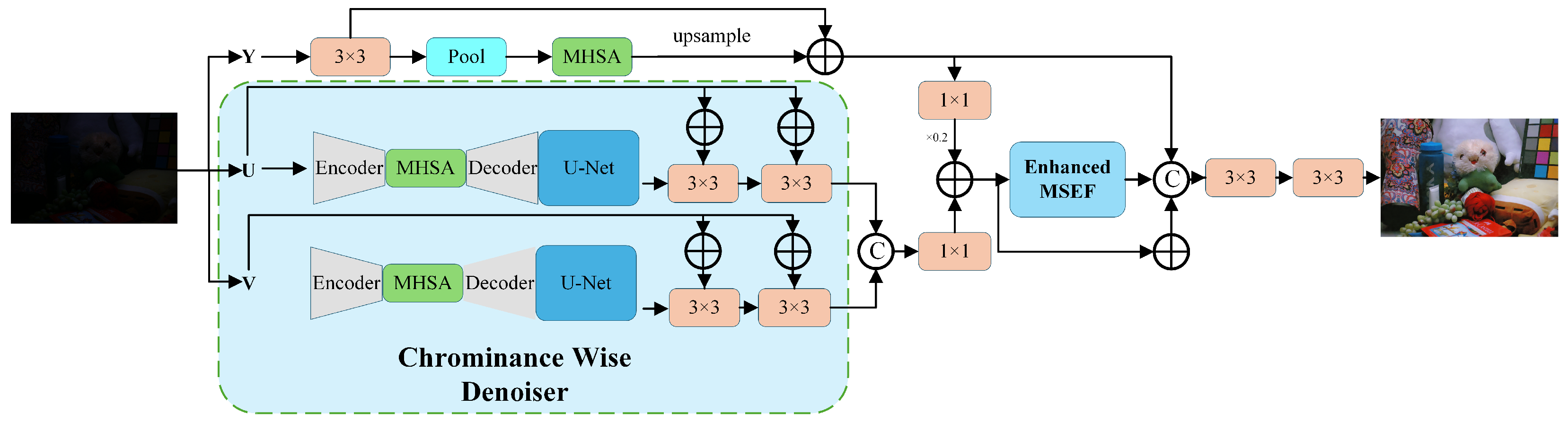
Figure 1 illustrates the overall framework of the proposed model, built upon LYT-Net [
22] as the baseline. The input image is decomposed into YUV components, where the Y branch employs pooling and MHSA operations to extract global luminance features, while the U and V branches are processed by the improved denoiser with MHSA and U-Net structures for chromatic noise suppression. The extracted features are fused through the Enhanced MSEF module for multi-scale feature aggregation and detail enhancement, followed by image reconstruction to generate the final enhanced result.
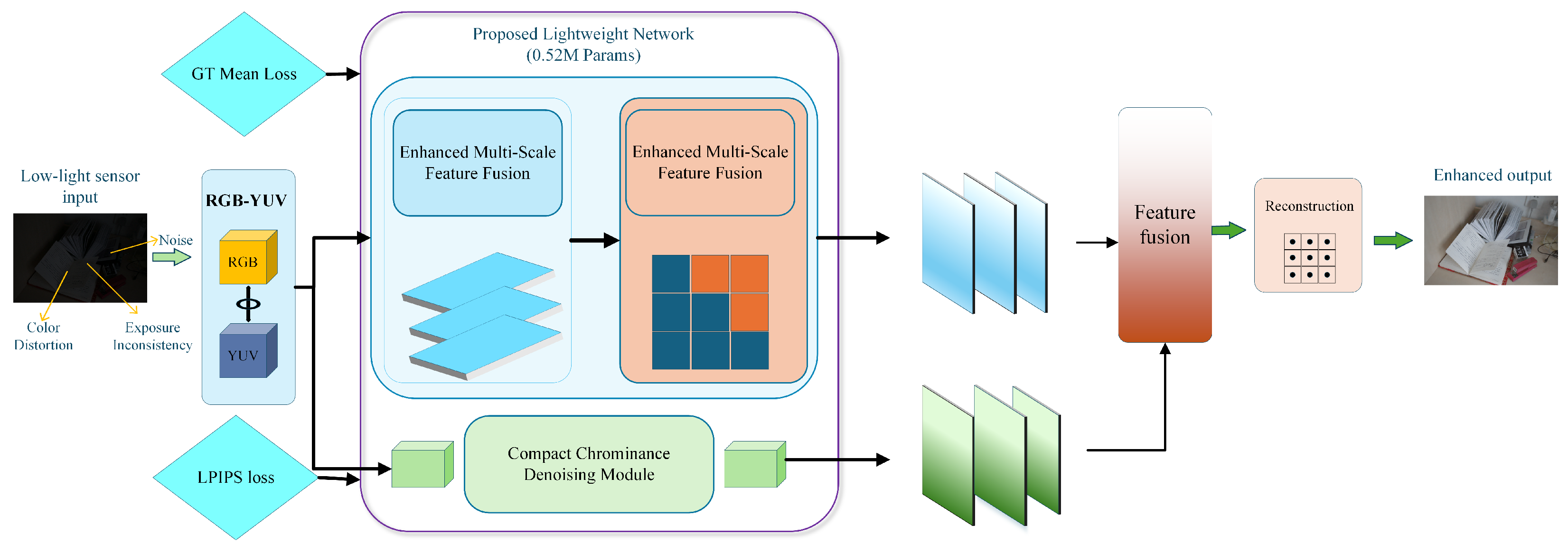
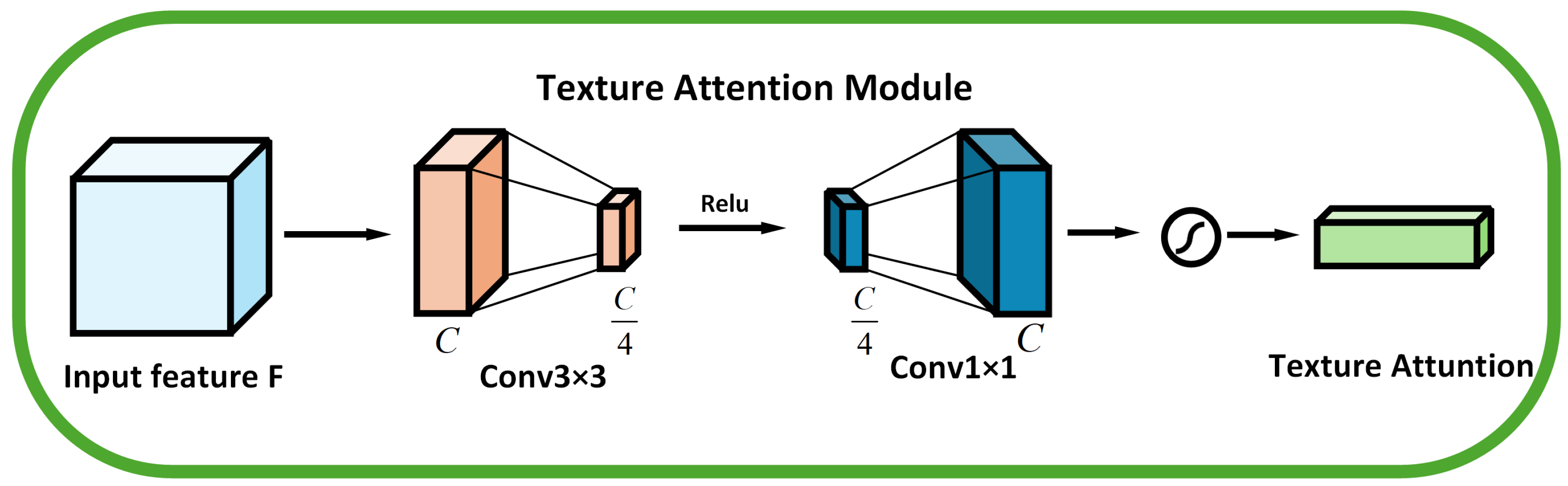
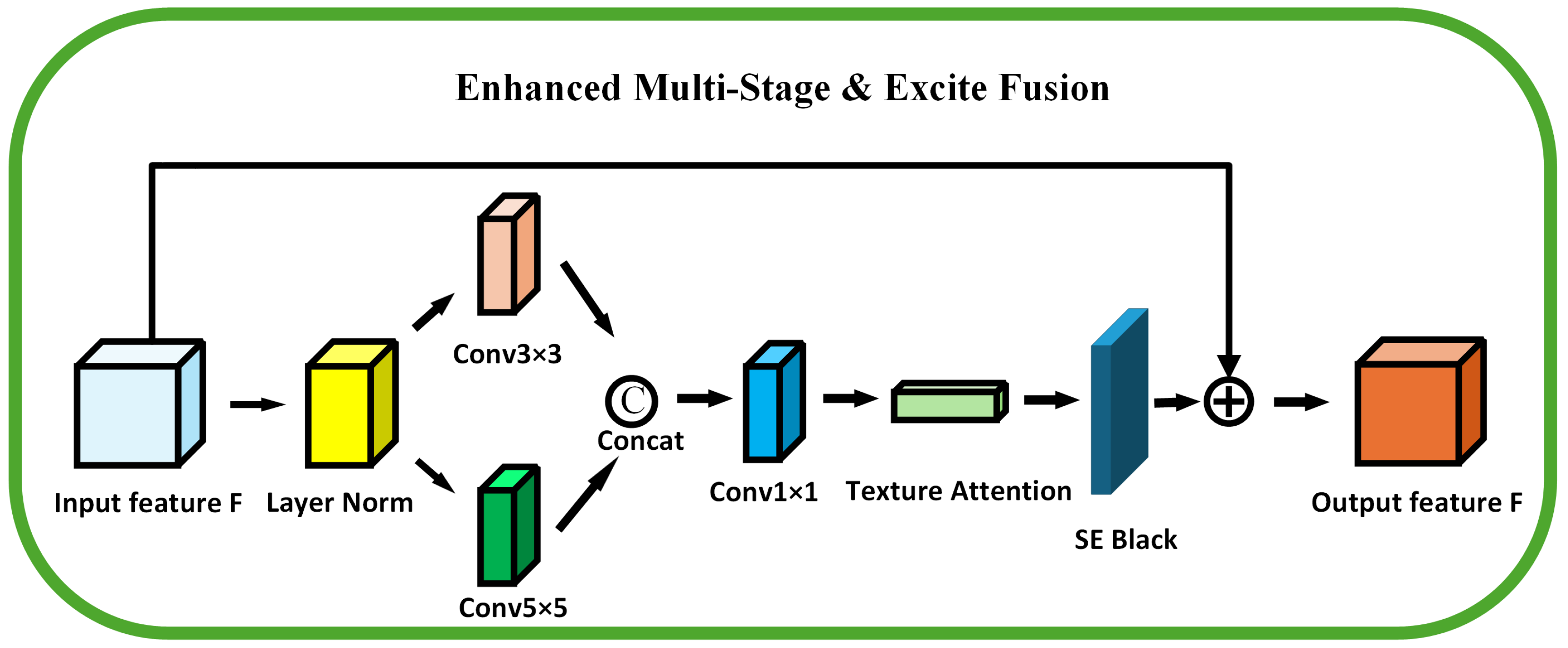
Specifically, the model adopts a dual-path luminance–chrominance structure, analogous to the separation of luminance and color processing in biological visual systems [
5], enabling more effective restoration of underexposure, noise, and color distortions in low-light sensor images. The luminance channel (Y) extracts low-level features via convolution and pooling operations, and then models global illumination relationships through a multi-head self-attention (MHSA) module, simulating the mammalian retina’s perception and adaptation to global lighting variations, in order to obtain a stable and consistent luminance representation. The chrominance channels (U, V) are denoised using the improved Chrominance-Wise Denoiser (CWD) module, which incorporates an encoder–decoder architecture combined with a soft residual output strategy. Inspired by the color constancy mechanism in biological vision, this module suppresses chrominance noise while preserving fine details and color consistency. The processed chrominance features are then fed into the Enhanced Multi-Scale Squeeze-and-Fusion (Enhanced MSEF) module, which draws on the multi-scale photoreceptor structure of moth compound eyes [
4]. Parallel 3 × 3 and 5 × 5 depthwise convolutions capture fine-grained noise and coarse-grained illumination inconsistencies, respectively. An embedded lightweight texture-aware attention mechanism, inspired by selective attention in insect vision [
3], adaptively enhances feature responses in textured regions, while an SE [
27] module further models channel dependencies to synergistically improve perceptual quality. Finally, the fused luminance (Y) and chrominance (U, V) channels are passed through the output convolution layer to generate the enhanced image, achieving balanced luminance, color fidelity, and rich structural details for low-light visual sensing enhancement. The comprehensive workflow of the proposed model is presented in
Figure 2.
4. Experiments and Discussion
4.1. Implementation Details
The proposed model is implemented using the PyTorch (2.12.0) framework and trained on a single NVIDIA RTX 4090 GPU (manufactured by NVIDIA Corporation in Santa Clara, CA, USA) with CUDA acceleration. The AdamW optimizer is adopted for network optimization with , , and a weight decay of . The initial learning rate is set to .
A warmup and cosine annealing learning rate strategy is employed during training. Specifically, the learning rate is linearly increased from 0 during the first 50 epochs and then gradually decayed to using cosine annealing.
The proposed network is trained for 2000 epochs with a batch size of 1. During training, image pairs are randomly cropped into patches. Random horizontal flipping and random rotation are adopted for data augmentation. Gradient clipping with a maximum norm of 1.0 is further employed to stabilize the training process.
The model is trained and evaluated on LOLv1, LOLv2-R, and LOLv2-S datasets, with train:test splits of 458:15, 689:100, and 900:100, respectively. Model validation is performed after each training epoch.
The ImprovedLYT architecture employs 32 channels as the base feature dimension. For fair comparison, all evaluation metrics, including PSNR, SSIM, and LPIPS, are computed under the same evaluation protocol. Specifically, GT-Mean alignment is adopted for PSNR/SSIM evaluation, while LPIPS is calculated using the AlexNet backbone (from the official LPIPS package with pre-trained ImageNet weights).
For data preprocessing, training image pairs are randomly cropped into patches. Random horizontal flipping and random rotation are applied for data augmentation to mitigate overfitting. The batch size is set to 2, and training is conducted for 2000 epochs. PSNR, SSIM, and LPIPS are used as evaluation metrics.
4.2. Comparative Study
Quantitative Results: We compare the proposed model with existing lightweight methods with a focus on performance and complexity on the LOL dataset. As shown in
Table 2, sll metrics are computed after GT-Mean correction. ↑ indicates that higher values are preferable, whereas ↓ indicates that lower values are preferable. The best results are marked in red, and the second-best in blue. In this work, we strictly focus on lightweight edge-oriented low-light enhancement tasks, so the selection of comparison methods follows the principle of consistent application scenarios and model lightweight constraints. For fair comparison, all baseline methods except LYT-NET are evaluated using their official pretrained models. LYT-NET is re-trained using its official code under the same training settings as our method. All models share the same dataset, image size and format during training and testing. Some other mainstream low-light image enhancement models may achieve better results; however, most of these superior methods come with extremely large parameter sizes ranging from 114 M [
33] to 1252 M [
34], accompanied by heavy computational overhead. Such large-scale models are primarily designed for high-performance workstations and cannot be deployed on lightweight edge devices with limited memory and computing resources. In contrast, our method is specially tailored for resource-constrained visual sensing scenarios. Therefore, we mainly select representative lightweight algorithms for fair comparison, while still listing several classic large-scale methods in Table for intuitive reference and comprehensive comparison. All methods are evaluated using identical input resolutions and dataset protocols. Our model contains only 0.52 M parameters, offering a lightweight design suitable for resource-constrained visual sensing systems. Experimental results show that the proposed method integrates bioinspired luminance adaptation, structural perception and multi-scale feature aggregation. It achieves an excellent balance between lightweight deployment, visual perceptual quality and restoration fidelity under limited computational resources. This optimization scheme effectively meets the requirements of front-end enhancement in visual sensing systems, providing efficient and accurate low-light image processing capabilities. Moreover, the quantitative results combined with subsequent multi-criteria ranking further validate the competitiveness of our method in comprehensive performance.
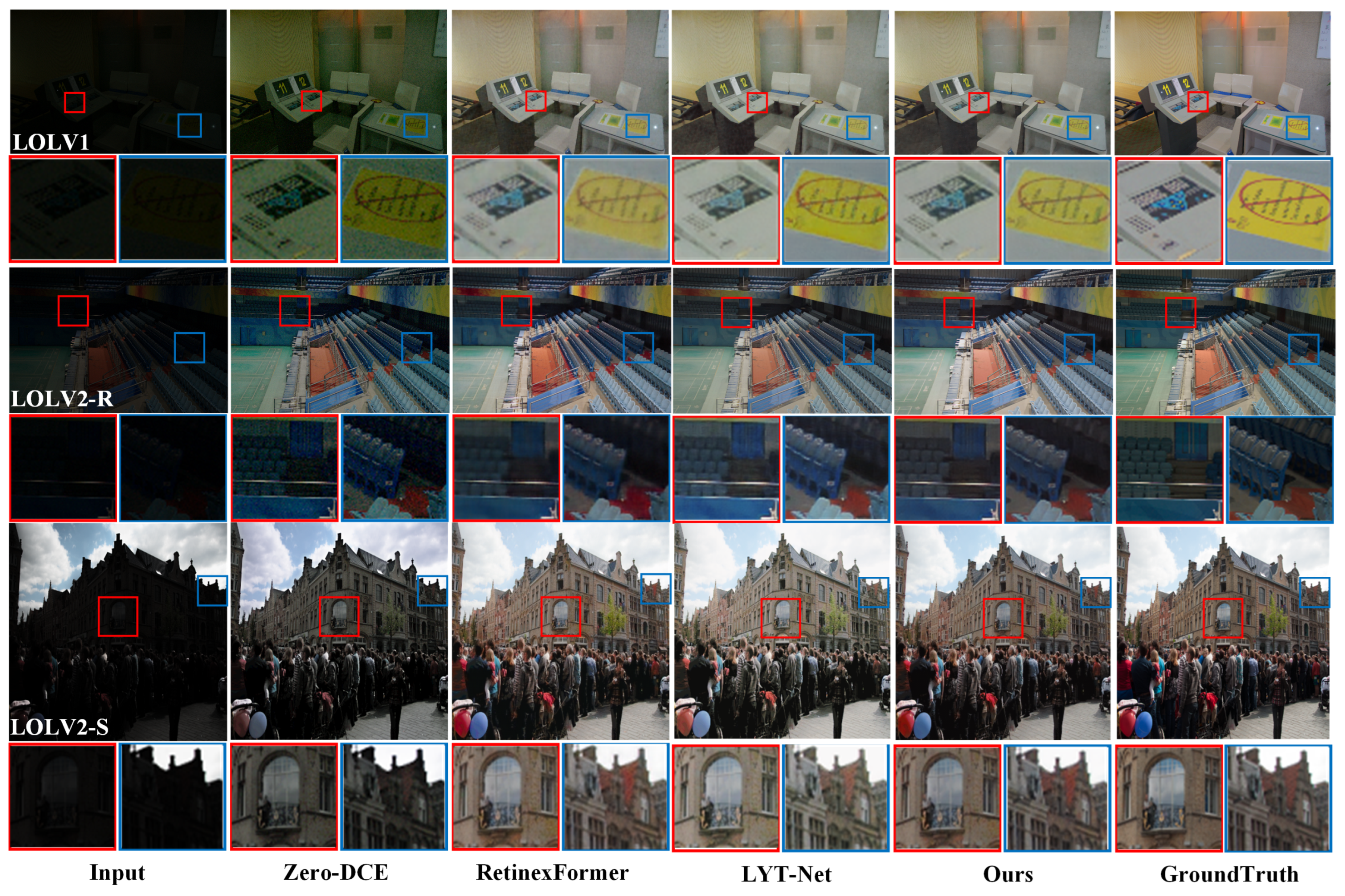
Qualitative Results: The qualitative performance of our model compared with other LLIE methods is shown in
Figure 5. For comparison, LYT-Net results are obtained under the same training environment as our model. Supervised methods such as Zero-DCE [
18] and Zero-DCE++ [
35] exhibit strong adaptability to dark conditions, but their performance in specific scenes remains inferior to other supervised models. RetinexFormer [
21] achieves notable progress in low-light restoration, yet suffers from issues such as texture blurring. LYT-Net [
22] reaches a very high overall performance but neglects structural perception. Overall, our proposed model demonstrates highly effective performance through the synergistic action of the bioinspired modules.
4.3. Multi-Criteria Analysis
To provide a comprehensive comparison across different evaluation metrics, a normalized multi-criteria analysis is conducted based on the averaged results over the LOLv1, LOLv2-R, and LOLv2-S datasets, including PSNR, SSIM, LPIPS, and model parameters. For each method, the metric values obtained on the three datasets are first averaged to reduce dataset-specific bias and provide a more reliable overall evaluation.
For metrics with higher values indicating better performance, the normalized score is computed as
For metrics with lower values indicating better performance, the inverse normalization is adopted:
The final comprehensive score is calculated as
where
N denotes the number of evaluation metrics, including PSNR, SSIM, LPIPS, and model parameters. Equal weights are adopted to avoid introducing subjective bias in the evaluation process.
As shown in
Table 3, the proposed method achieves the highest overall ranking among the compared lightweight LLIE approaches. Although several large-scale models obtain competitive results on individual metrics, their substantially higher parameter complexity limits their applicability in resource-constrained visual sensing scenarios.
Compared with LYT-NET, the proposed method achieves consistently better PSNR, SSIM, and LPIPS performance across multiple datasets while maintaining relatively low model complexity. This demonstrates that the introduced bioinspired mechanisms effectively improve structural restoration and perceptual fidelity without introducing excessive computational overhead.
Overall, the proposed model provides a balanced trade-off between enhancement quality, perceptual consistency, and lightweight deployment efficiency, demonstrating its suitability for edge-oriented low-light visual sensing applications.
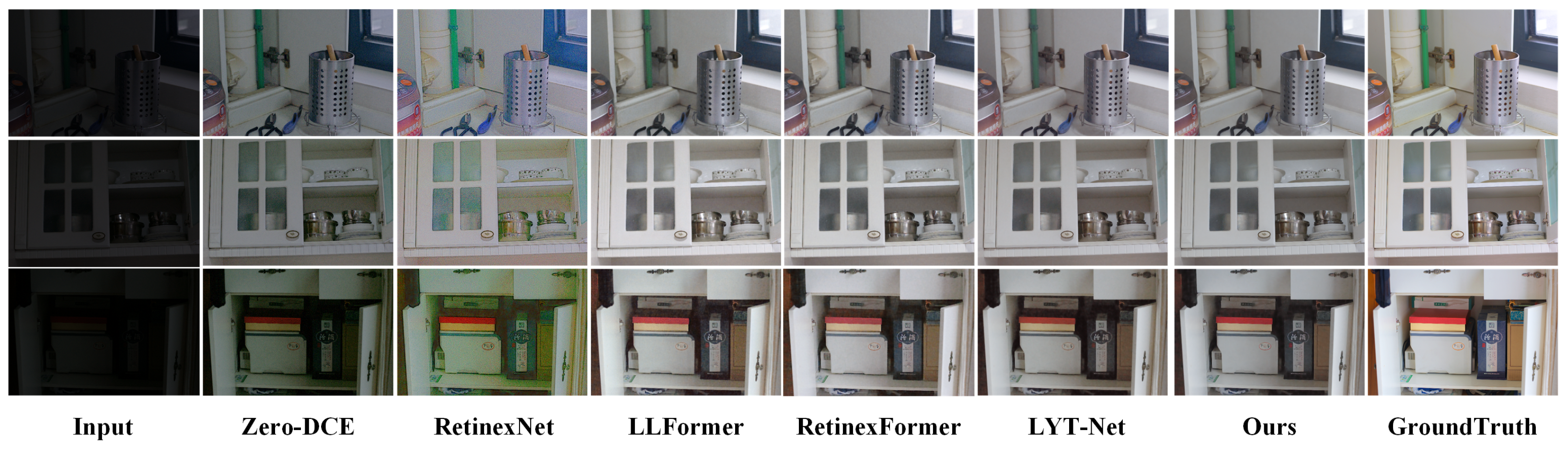
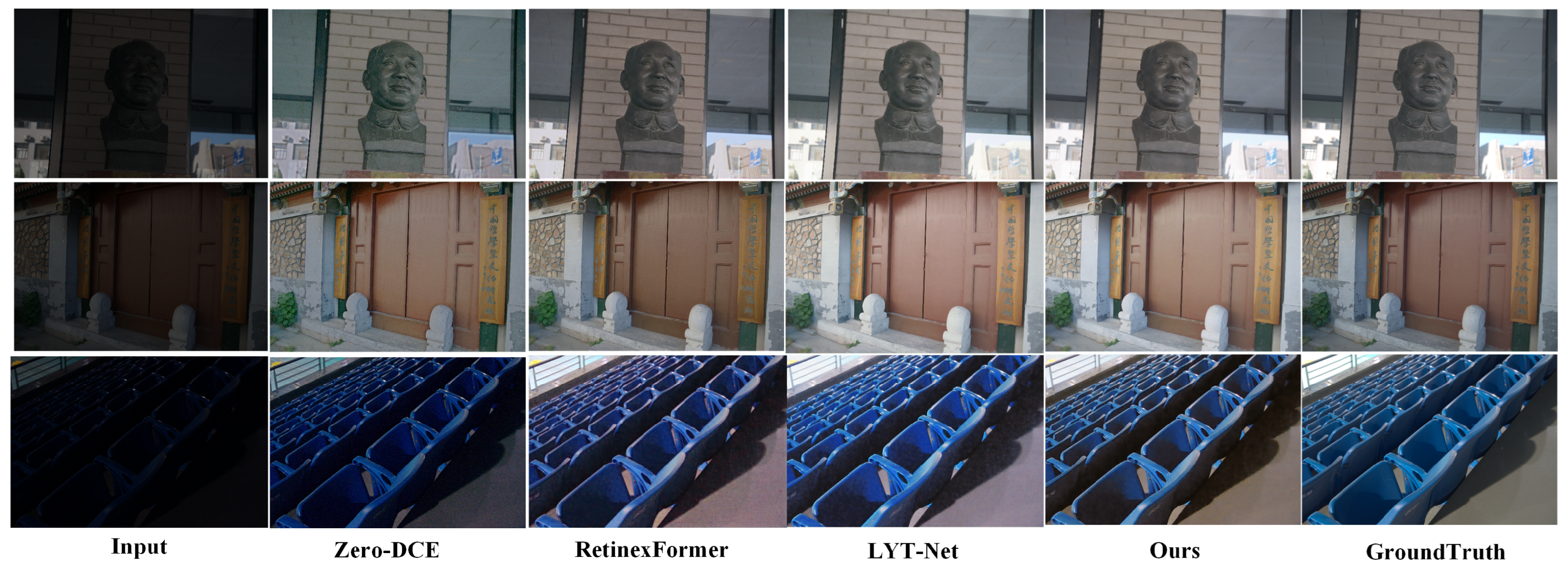
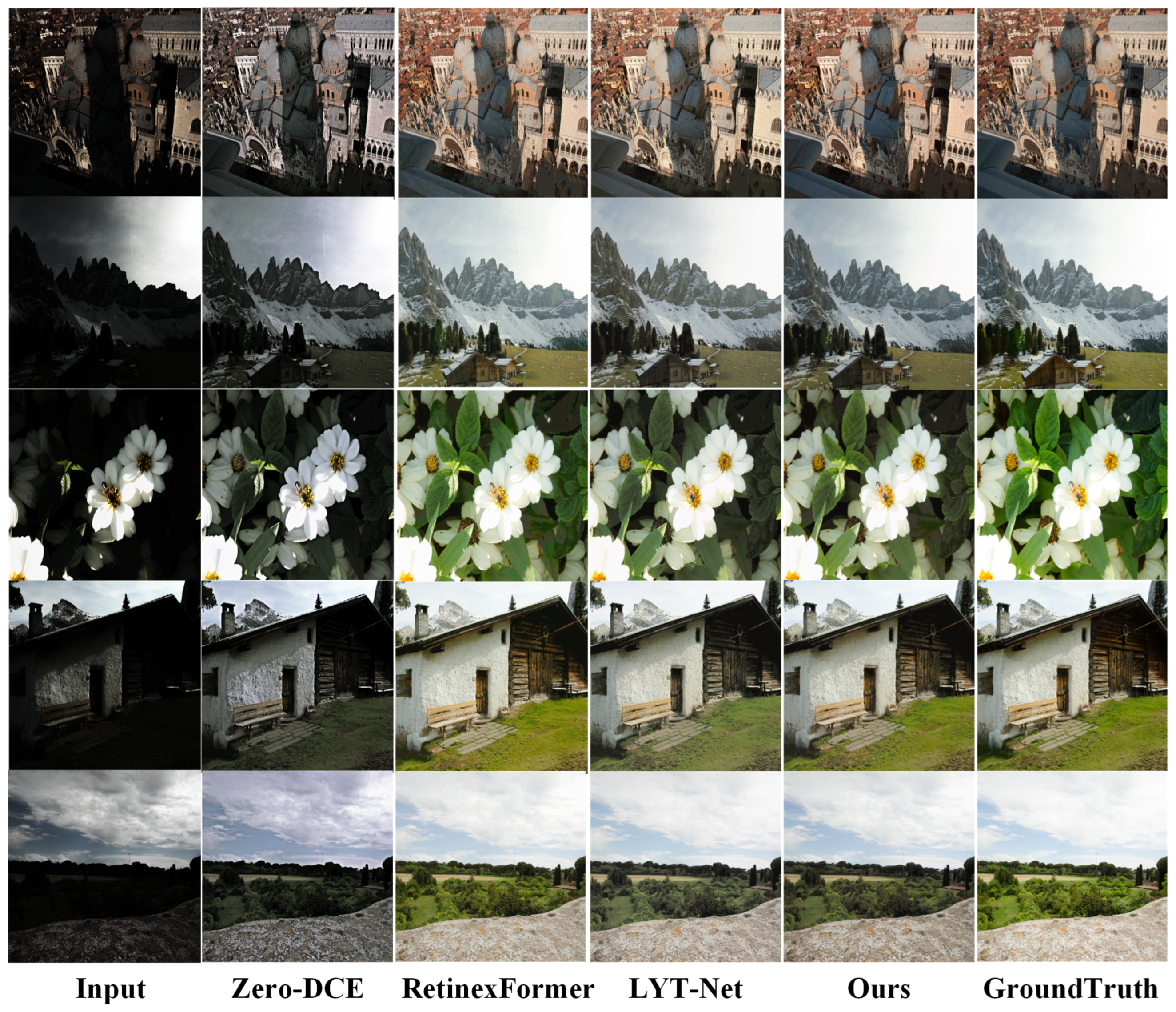
To better demonstrate the overall performance of our model across multiple datasets, we conduct qualitative comparisons on multiple images from the LOLv1, LOLv2-Real Captured, and LOLv2-Synthetic datasets against other LLIE methods. The comparative results are illustrated in
Figure 6,
Figure 7 and
Figure 8.
These overall visual comparison experiments highlight the advantages of our model in color restoration and detail preservation, demonstrating its effectiveness in low-light image enhancement. At the same time, the model achieves excellent denoising performance and produces results more consistent with human visual perception. Furthermore, the PSNR of our model on the LOLv2-S dataset is significantly higher than that of LYT-Net, further indicating its strong potential on synthetic data.
4.4. Unpaired Datasets Experiments
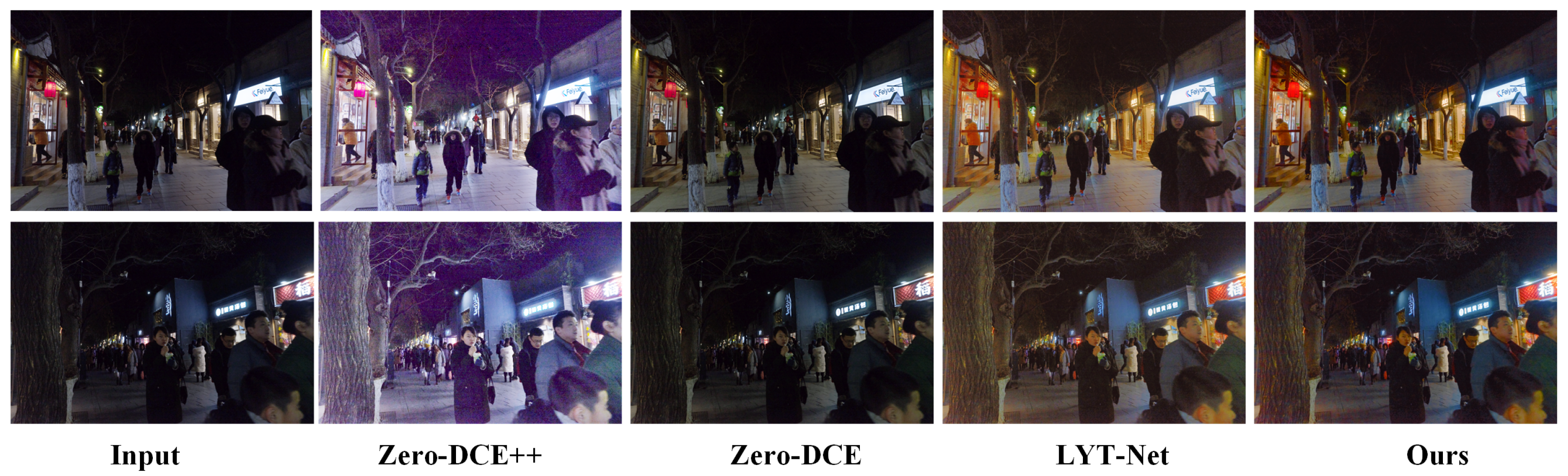
To evaluate the visual quality of restored images, we randomly select 100 real low-light samples from the Dark-face dataset for testing. We use the official pretrained models for Zero-DCE and Zero-DCE++, and other models adopt weights trained on the LOLv2-S dataset, as mentioned before. We adopt two no-reference image quality metrics, NIQE [
39] and BRISQUE [
40]. ↓ indicates that lower values are preferable. The quantitative results are listed in
Table 4, with the best results marked in red, and visual comparisons are presented in
Figure 9. The experimental results show that our method outperforms other algorithms and achieves remarkable improvements on both metrics.
4.5. Ablation Study
On the LOLv1, LOLv2-R, and LOLv2-S datasets, we conducted systematic ablation studies using model complexity, PSNR, SSIM, and LPIPS as quantitative evaluation metrics to analyze the individual contributions of the five proposed components. The ablation results on the three datasets are reported in
Table 5,
Table 6 and
Table 7. The best results are highlighted in bold.
The results show that introducing GT-Mean loss and LPIPS loss significantly improves performance across multiple enhancement metrics without increasing model complexity, enhancing brightness consistency and perceptual stability. The designed Texture Attention mechanism effectively boosts PSNR, indicating its positive role in restoring texture structures. Meanwhile, the Enhanced MSEF and Improved Denoiser contribute substantially to overall enhancement quality, albeit with a modest increase in model complexity.
5. Conclusions
This work addresses the fundamental challenge in low-light visual sensing scenarios, where lightweight enhancement models struggle to balance perceptual quality and structural detail restoration. We propose a bioinspired, low-complexity model for perceptual quality optimization. The model incorporates a GT-Mean loss that simulates the adaptive mechanisms of the biological retina, effectively mitigating optimization bias caused by sensor exposure inconsistencies. In combination with the LPIPS perceptual loss, which aligns with the human visual system’s inherent preference for structural and textural features, the model maintains strong structural and texture awareness under lightweight constraints. Furthermore, by drawing on multi-scale perception and selective attention mechanisms of insect compound eyes, we design a texture-aware attention module, an enhanced multi-scale feature fusion module, and a compact chrominance denoising module that simulates biological color constancy, collectively improving detail fidelity and color consistency. Experimental results on multiple benchmark low-light datasets, including LOLv1, LOLv2-Real, and LOLv2-Synthetic, demonstrate that the proposed method outperforms existing lightweight approaches in key metrics such as PSNR, SSIM, and LPIPS, while requiring only 0.52 M parameters, making it well-suited for resource-constrained visual sensing and edge computing scenarios.
Although the proposed method achieves a good trade-off between visual performance and lightweight deployment, it still has several limitations. Our model is mainly tested on the LOL series datasets, which fail to cover diverse real-world low-light conditions like extreme darkness, motion blur and bad weather. In addition, our approach relies heavily on paired low-light and normal-light images. Unpaired data will prevent the model from learning effective brightness and texture transformation, leading to poor enhancement and unstable outputs. The bioinspired modules improve visual quality, yet multi-scale attention and other components add extra computational cost compared with ultra-lightweight models such as LYT-Net. In addition, the GT-Mean strategy works well for global luminance adjustment but is less capable of handling severe local illumination inconsistency. Finally, this framework is built solely for image enhancement and has not been applied to downstream tasks including low-light object detection and segmentation.
Future work will improve the generalization ability of the proposed model in complex real-world low-light environments. We will also explore more efficient lightweight attention mechanisms to further reduce computational cost. In addition, the proposed framework will be extended to video low-light enhancement and downstream vision tasks, such as object detection and autonomous visual sensing.