
Comprehensive Learning Fungal Growth Optimizer for Numerical Optimization and Reservoir Production Optimization
Abstract
1. Introduction
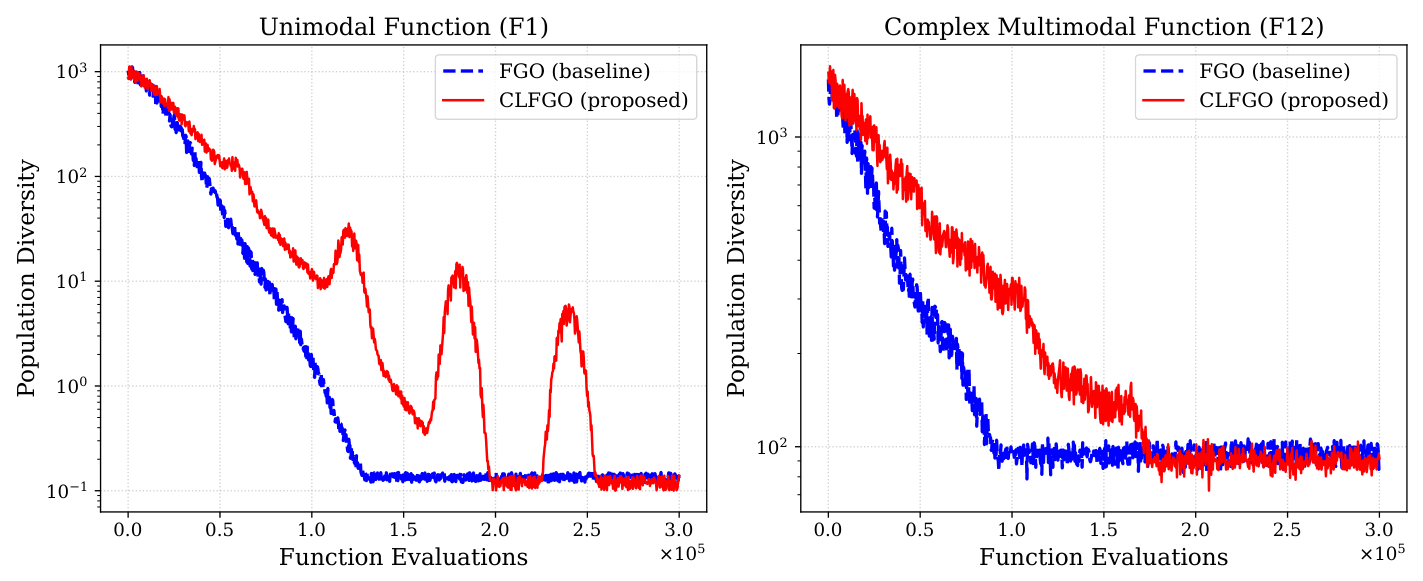
- We identify the single-source guidance tendency of FGO as a key structural reason for diversity loss and clarify that CLFGO targets problems with multimodal, hybrid, composition, or dimension-wise heterogeneous structures.
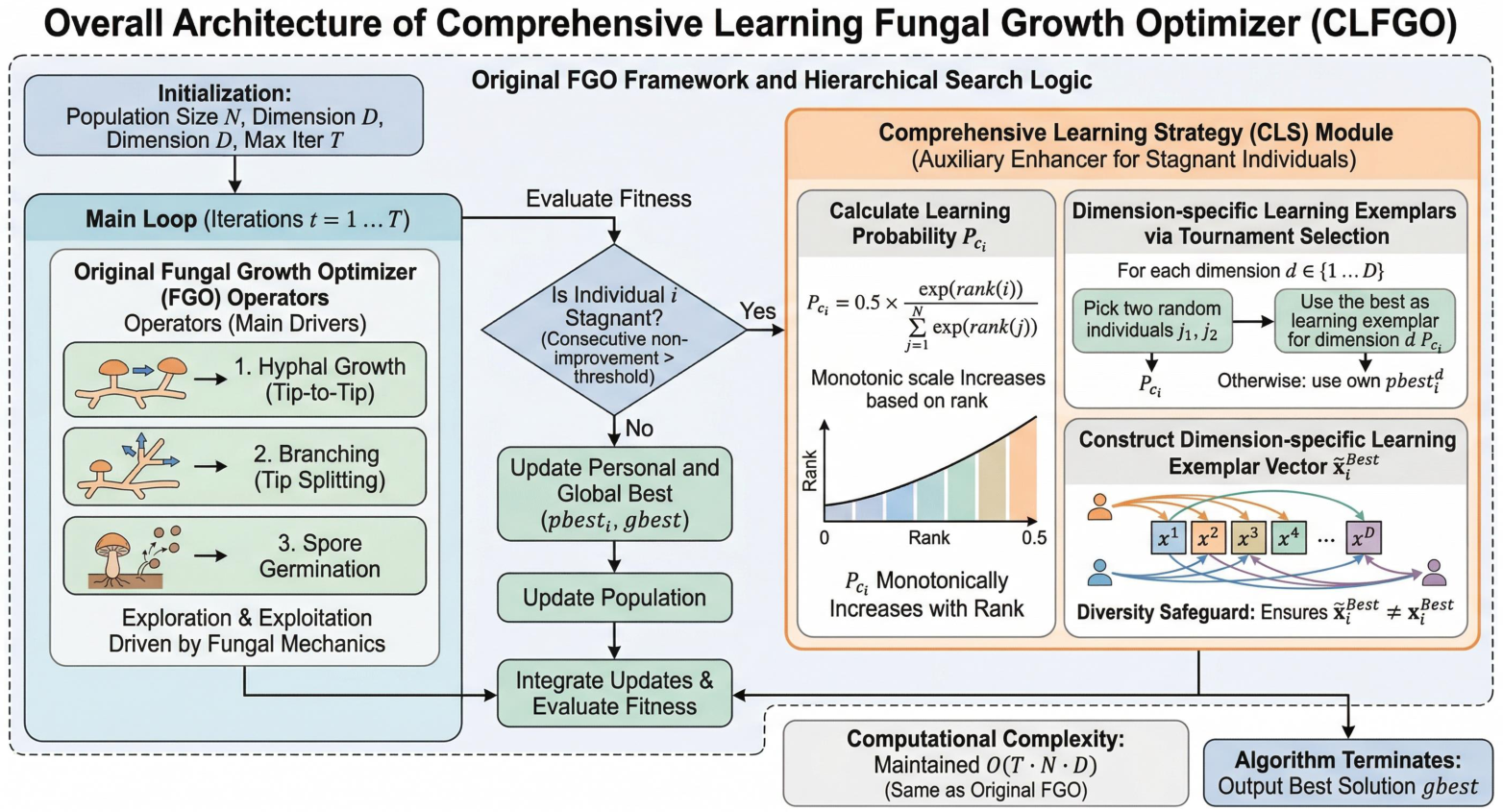
- We adapt the Comprehensive Learning strategy as a conditionally activated module in FGO, so stagnant individuals can build dimension-wise exemplars from multiple high-quality peers without replacing the original fungal growth operators.
- We revise the experimental protocol to use a strict maximum-function-evaluation budget and provide parameter settings, diagnostic convergence/diversity evidence, and time–space complexity analysis for fairer comparison.
2. Original Algorithm
2.1. Mathematical Model of FGO
- 1. Initial Population Generation: At the start, N hyphae (solutions) are randomly distributed within the D-dimensional search space bounded by lower () and upper () limits. This simulates the random germination of spores in a suitable environment.where is a vector of random numbers uniformly distributed in and ⊙ denotes the Hadamard product.
- 2. Hyphal Tip Growth: This mechanism models the elongation and directional change of a hypha. It is divided into an exploration phase and an exploitation phase, controlled by a normalized fitness probability and a decaying exploration rate . The growth rate E and direction are calculated using the fitness of solutions and random peer selection.where with , , and is the normalized fitness of the i-th solution. represents the environmental factor, is a uniformly distributed random number in , and , are randomly chosen mutually exclusive peer individuals from the current population. The exploitation phase involves chemotropism, where a hypha moves toward either a randomly selected peer or the global best solution, with an additional exploratory step to avoid premature convergence.
- 3. Hyphal Branching: This behavior enhances exploration by generating a new solution (branch) from an existing one. The new position is influenced by the difference between two randomly chosen solutions and the difference between a random solution and the global best.where , , , and is the Iverson bracket. Here, and denote randomly generated numbers in , represents the j-th dimension of the global best position, and are elements of three distinct randomly selected individuals.
- 4. Spore Germination: This mechanism re-initializes solutions in new areas to escape local optima. Initially, spores land in random positions (pure exploration). As the search progresses, they land between the global best and a random position, promoting exploitation.where is randomly chosen as or 1, t is the current iteration, and is the maximum number of iterations used to compute the normalized search progress.
2.2. Integrated Iteration
2.3. Pseudocode of the Original FGO
| Algorithm 1 Original Fungal Growth Optimizer (FGO) |
|
3. The Proposed CLFGO Algorithm
3.1. Comprehensive Learning Strategy (CLS)
3.1.1. Triggering Condition and Exemplar Vector
3.1.2. Learning Probability
3.1.3. Dimension-Wise Exemplar Selection
3.1.4. Safeguard Mechanism
3.2. Implementation Framework of CLFGO
3.3. Pseudocode of the Proposed CLFGO
| Algorithm 2 Comprehensive Learning Fungal Growth Optimizer (CLFGO) |
|
3.4. Complexity Analysis
4. Experimental Results and Analysis
4.1. Experimental Setup
4.2. Sensitivity Analysis of the Stagnation Threshold
4.3. Benchmark Functions Overview
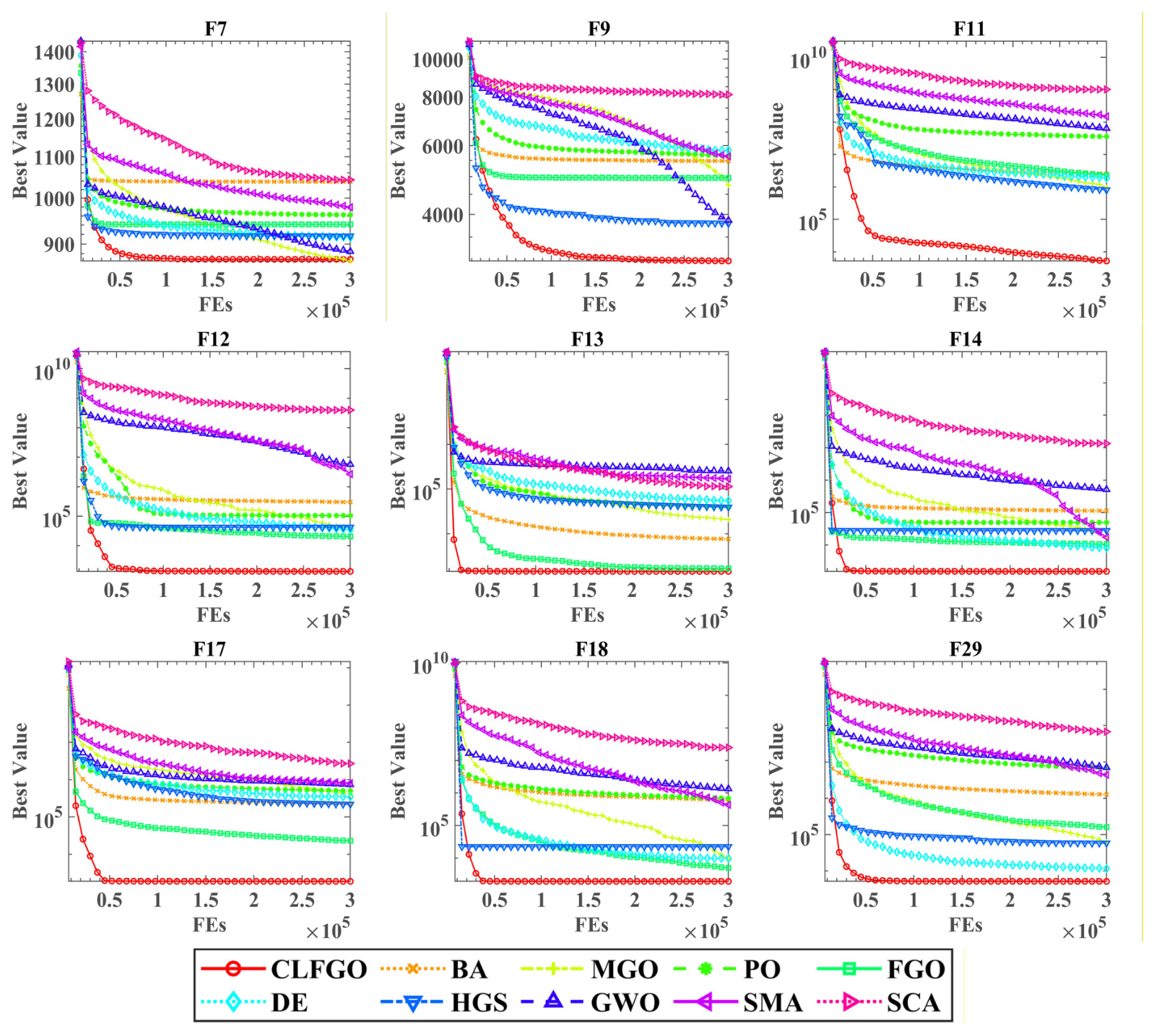
4.4. Performance Comparison with Other Algorithms
5. Application to Production Optimization
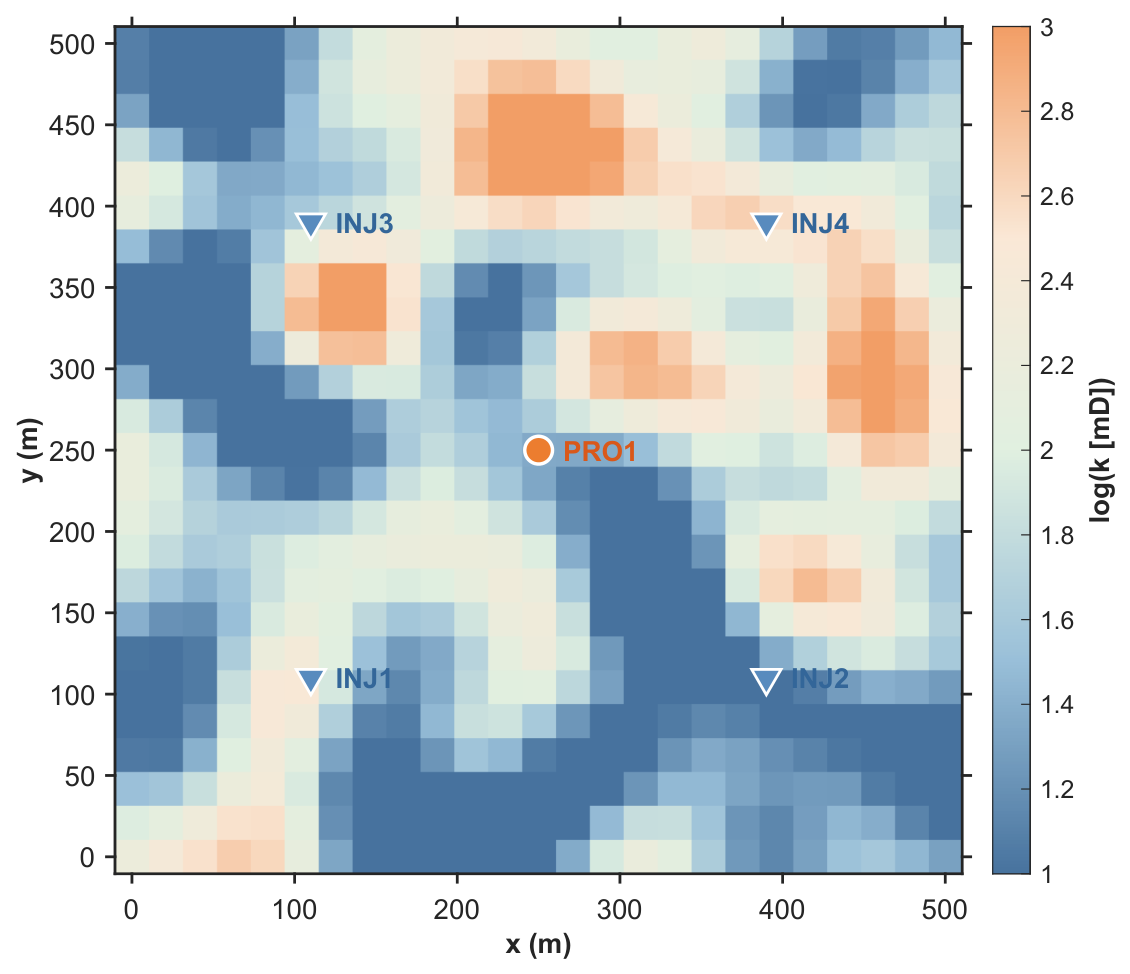
5.1. Reservoir Model Description
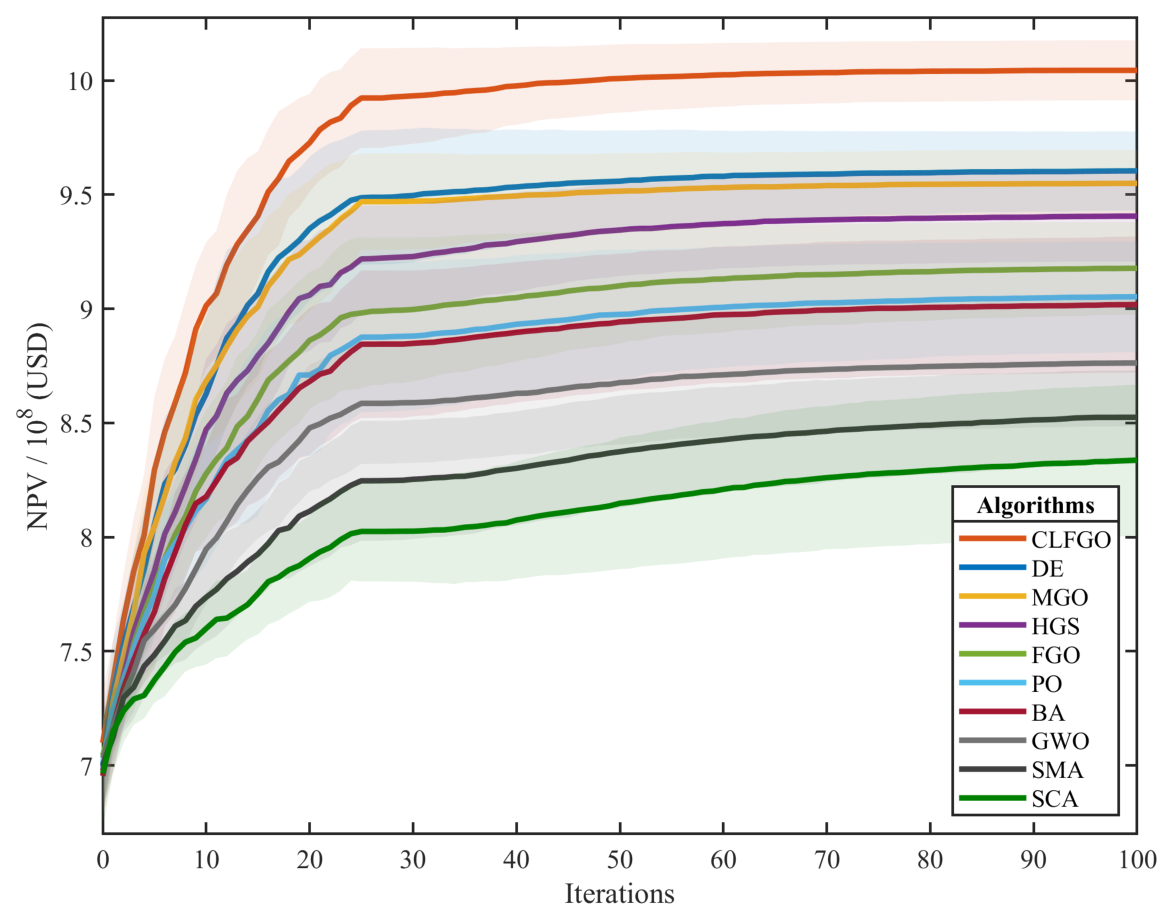
5.2. Analysis and Discussion of Experimental Results
6. Conclusions
Author Contributions
Funding
Institutional Review Board Statement
Informed Consent Statement
Data Availability Statement
Acknowledgments
Conflicts of Interest
Abbreviations
| CLFGO | Comprehensive Learning Fungal Growth Optimizer |
| FGO | Fungal Growth Optimizer |
| CL | Comprehensive Learning |
| NPV | Net Present Value |
| BHP | Bottom-Hole Pressure |
| RPO | Reservoir Production Optimization |
| CEC | Congress on Evolutionary Computation |
| DE | Differential Evolution |
| HGS | Hunger Games Search |
| PSO | Particle Swarm Optimization |
| SMA | Slime Mould Algorithm |
| PO | Parrot Optimizer |
| BA | Bat Algorithm |
| MGO | Moss Growth Optimization |
| GWO | Grey Wolf Optimizer |
| SCA | Sine Cosine Algorithm |
| NFL | No Free Lunch |
References
- Kiwiel, K.C. Methods of Descent for Nondifferentiable Optimization; Springer: Berlin/Heidelberg, Germany, 2006; Volume 1133. [Google Scholar]
- Wasley, R.; Shlash, M.A. Newton-Raphson algorithm for 3-phase load flow. In Proceedings of the Institution of Electrical Engineers; IET: London, UK, 1974; Volume 121, pp. 630–638. [Google Scholar]
- Belegundu, A.D.; Chandrupatla, T.R. Optimization Concepts and Applications in Engineering; Cambridge University Press: Cambridge, UK, 2019. [Google Scholar]
- Karki, S.; Raut, A. Computational Techniques and Emerging Technologies in the Optimization of Engineering Systems and Design Processes. J. AI-Driven Autom. Predict. Maint. Smart Technol. 2024, 9, 54–71. [Google Scholar]
- Huang, X.; Hu, H.; Wang, J.; Yuan, B.; Dai, C.; Ablameyk, S.V. Dynamic Strongly Convex Sparse Operator with Learning Mechanism for Sparse Large-Scale Multi-Objective Optimization. In Proceedings of the 2024 6th International Conference on Data-driven Optimization of Complex Systems (DOCS), Hangzhou, China, 16–18 August 2024; pp. 121–127. [Google Scholar]
- Abualigah, L.; Elaziz, M.A.; Khasawneh, A.M.; Alshinwan, M.; Ibrahim, R.A.; Al-Qaness, M.A.; Mirjalili, S.; Sumari, P.; Gandomi, A.H. Meta-heuristic optimization algorithms for solving real-world mechanical engineering design problems: A comprehensive survey, applications, comparative analysis, and results. Neural Comput. Appl. 2022, 34, 4081–4110. [Google Scholar] [CrossRef]
- Boussaïd, I.; Lepagnot, J.; Siarry, P. A survey on optimization metaheuristics. Inf. Sci. 2013, 237, 82–117. [Google Scholar] [CrossRef]
- Houssein, E.H.; Saeed, M.K.; Hu, G.; Al-Sayed, M.M. Metaheuristics for solving global and engineering optimization problems: Review, applications, open issues and challenges. Arch. Comput. Methods Eng. 2024, 31, 4485–4519. [Google Scholar] [CrossRef]
- Naser, M.; Al-Bashiti, M.K.; Tapeh, A.T.G.; Naser, A.; Kodur, V.; Hawileh, R.; Abdalla, J.; Khodadadi, N.; Gandomi, A.H.; Eslamlou, A.D. A review of benchmark and test functions for global optimization algorithms and metaheuristics. Wiley Interdiscip. Rev. Comput. Stat. 2025, 17, e70028. [Google Scholar] [CrossRef]
- Hu, H.; Shan, W.; Tang, Y.; Heidari, A.A.; Chen, H.; Liu, H.; Wang, M.; Escorcia-Gutierrez, J.; Mansour, R.F.; Chen, J. Horizontal and vertical crossover of sine cosine algorithm with quick moves for optimization and feature selection. J. Comput. Des. Eng. 2022, 9, 2524–2555. [Google Scholar] [CrossRef]
- Hu, H.; Shan, W.; Chen, J.; Xing, L.; Heidari, A.A.; Chen, H.; He, X.; Wang, M. Dynamic individual selection and crossover boosted forensic-based investigation algorithm for global optimization and feature selection. J. Bionic Eng. 2023, 20, 2416–2442. [Google Scholar] [CrossRef]
- Du, J.; Hu, H.; Wang, J. A Two-Stage Multi-Evolutionary Sampling Optimization Framework for Expensive Optimization Problems. In Proceedings of the 2025 International Conference on New Trends in Computational Intelligence (NTCI), Jinan, China, 17–19 October 2025; pp. 1–7. [Google Scholar] [CrossRef]
- Ren, X.; Wang, H.; Hu, H.; Wang, J.; Ablameyko, S.V. Weighted committee-based surrogate-assisted differential evolution framework for efficient medium-scale expensive optimization. Int. J. Mach. Learn. Cybern. 2025, 16, 6513–6530. [Google Scholar] [CrossRef]
- Blum, C.; Puchinger, J.; Raidl, G.R.; Roli, A. Hybrid metaheuristics in combinatorial optimization: A survey. Appl. Soft Comput. 2011, 11, 4135–4151. [Google Scholar] [CrossRef]
- Sastry, K.; Goldberg, D.E.; Kendall, G. Genetic algorithms. In Search Methodologies: Introductory Tutorials in Optimization and Decision Support Techniques; Springer: Berlin/Heidelberg, Germany, 2013; pp. 93–117. [Google Scholar]
- Storn, R.; Price, K. Differential evolution—A simple and efficient heuristic for global optimization over continuous spaces. J. Glob. Optim. 1997, 11, 341–359. [Google Scholar] [CrossRef]
- Vanneschi, L.; Silva, S. Particle swarm optimization. In Lectures on Intelligent Systems; Springer: Berlin/Heidelberg, Germany, 2023; pp. 105–111. [Google Scholar]
- Kennedy, J.; Eberhart, R. Particle swarm optimization. In Proceedings of the ICNN’95-International Conference on Neural Networks, Perth, WA, Australia, 27 November–1 December 1995; Volume 4, pp. 1942–1948. [Google Scholar]
- Dorigo, M.; Birattari, M.; Stutzle, T. Ant colony optimization. IEEE Comput. Intell. Mag. 2007, 1, 28–39. [Google Scholar] [CrossRef]
- Bonabeau, E.; Dorigo, M.; Theraulaz, G. Swarm Intelligence: From Natural to Artificial Systems; Number 1; Oxford University Press: Oxford, UK, 1999. [Google Scholar]
- Tu, J.; Chen, H.; Wang, M.; Gandomi, A.H. The colony predation algorithm. J. Bionic Eng. 2021, 18, 674–710. [Google Scholar] [CrossRef]
- Shan, W.; Hu, H.; Cai, Z.; Chen, H.; Liu, H.; Wang, M.; Teng, Y. Multi-strategies boosted mutative crow search algorithm for global tasks: Cases of continuous and discrete optimization. J. Bionic Eng. 2022, 19, 1830–1849. [Google Scholar] [CrossRef]
- Hu, H.; Wang, J.; Huang, X.; Ablameyko, S.V. An Integrated Online-Offline Hybrid Particle Swarm Optimization Framework for Medium Scale Expensive Problems. In Proceedings of the 2024 6th International Conference on Data-driven Optimization of Complex Systems (DOCS), Hangzhou, China, 16–18 August 2024; pp. 25–32. [Google Scholar]
- Wolpert, D.H.; Macready, W.G. No free lunch theorems for optimization. IEEE Trans. Evol. Comput. 2002, 1, 67–82. [Google Scholar] [CrossRef]
- Velasco, L.; Guerrero, H.; Hospitaler, A. A literature review and critical analysis of metaheuristics recently developed. Arch. Comput. Methods Eng. 2024, 31, 125–146. [Google Scholar] [CrossRef]
- Smit, S.K.; Eiben, A. Parameter tuning of evolutionary algorithms: Generalist vs. specialist. In Proceedings of the European Conference on the Applications of Evolutionary Computation; Springer: Berlin/Heidelberg, Germany, 2010; pp. 542–551. [Google Scholar]
- Gutjahr, W.J. Convergence analysis of metaheuristics. In Matheuristics: Hybridizing Metaheuristics and Mathematical Programming; Springer: Berlin/Heidelberg, Germany, 2009; pp. 159–187. [Google Scholar]
- Eiben, Á.E.; Hinterding, R.; Michalewicz, Z. Parameter control in evolutionary algorithms. IEEE Trans. Evol. Comput. 2002, 3, 124–141. [Google Scholar] [CrossRef]
- Ouyang, K.; Fu, S.; Chen, Y.; Cai, Q.; Heidari, A.A.; Chen, H. Escape: An optimization method based on crowd evacuation behaviors. Artif. Intell. Rev. 2024, 58, 19. [Google Scholar] [CrossRef]
- Ouyang, K.; Wei, D.; Sha, X.; Yu, J.; Zhao, Y.; Qiu, M.; Fu, S.; Heidari, A.A.; Chen, H. Beaver behavior optimizer: A novel metaheuristic algorithm for solar PV parameter identification and engineering problems. J. Adv. Res. 2025; in press. [CrossRef]
- Meng, A.B.; Chen, Y.C.; Yin, H.; Chen, S.Z. Crisscross optimization algorithm and its application. Knowl.-Based Syst. 2014, 67, 218–229. [Google Scholar] [CrossRef]
- Abdel-Basset, M.; Mohamed, R.; Abouhawwash, M. Fungal growth optimizer: A novel nature-inspired metaheuristic algorithm. Expert Syst. Appl. 2025, 250, 123456. [Google Scholar]
- Chen, S.; Montgomery, J.; Bolufé-Röhler, A. Measuring the curse of dimensionality and its effects on particle swarm optimization and differential evolution. Appl. Intell. 2015, 42, 514–526. [Google Scholar] [CrossRef]
- Liang, J.J.; Qin, A.K.; Suganthan, P.N.; Baskar, S. Comprehensive learning particle swarm optimizer for global optimization of multimodal functions. IEEE Trans. Evol. Comput. 2006, 10, 281–295. [Google Scholar] [CrossRef]
- Salgotra, R.; Singh, U.; Saha, S. Improved cuckoo search with better search capabilities for solving CEC2017 benchmark problems. In Proceedings of the 2018 IEEE Congress on Evolutionary Computation (CEC), Rio de Janeiro, Brazil, 8–13 July 2018; pp. 1–7. [Google Scholar]
- Wu, G.; Mallipeddi, R.; Suganthan, P.N. Problem Definitions and Evaluation Criteria for the CEC 2017 Competition on Constrained Real-Parameter Optimization; Nanyang Technological University: Singapore, 2017; Volume 9, p. 2017. [Google Scholar]
- Yang, X.S.; Hossein Gandomi, A. Bat algorithm: A novel approach for global engineering optimization. Eng. Comput. 2012, 29, 464–483. [Google Scholar] [CrossRef]
- Zheng, B.; Chen, Y.; Wang, C.; Heidari, A.A.; Liu, L.; Chen, H. The moss growth optimization (MGO): Concepts and performance. J. Comput. Des. Eng. 2024, 11, 184–221. [Google Scholar] [CrossRef]
- Lian, J.; Hui, G.; Ma, L.; Zhu, T.; Wu, X.; Heidari, A.A.; Chen, Y.; Chen, H. Parrot optimizer: Algorithm and applications to medical problems. Comput. Biol. Med. 2024, 172, 108064. [Google Scholar] [CrossRef]
- Yang, Y.; Chen, H.; Heidari, A.A.; Gandomi, A.H. Hunger games search: Visions, conception, implementation, deep analysis, perspectives, and towards performance shifts. Expert Syst. Appl. 2021, 177, 114864. [Google Scholar] [CrossRef]
- Mirjalili, S.; Mirjalili, S.M.; Lewis, A. Grey wolf optimizer. Adv. Eng. Softw. 2014, 69, 46–61. [Google Scholar] [CrossRef]
- Li, S.; Chen, H.; Wang, M.; Heidari, A.A.; Mirjalili, S. Slime mould algorithm: A new method for stochastic optimization. Future Gener. Comput. Syst. 2020, 111, 300–323. [Google Scholar] [CrossRef]
- Mirjalili, S. SCA: A sine cosine algorithm for solving optimization problems. Knowl.-Based Syst. 2016, 96, 120–133. [Google Scholar] [CrossRef]



| Algorithm | Main Additional Operations | Space Requirement |
|---|---|---|
| FGO | Population update and greedy selection under the evaluation budget; update arithmetic is per iteration. | Population matrix, candidate solutions, fitness values, and global best; . |
| CLFGO | FGO operations plus exemplar construction for stagnant individuals; auxiliary arithmetic is and worst-case per iteration. | FGO storage plus personal bests (), exemplar indices (), stagnation counters (N), and learning probabilities (N); still with a larger constant factor. |
| Algorithm | Runtime over 10 Runs (s) |
|---|---|
| CLFGO (Ours) | 23.4 |
| FGO | 19.8 |
| DE | 16.5 |
| MGO | 22.1 |
| HGS | 29.8 |
| PO | 37.4 |
| BA | 26.2 |
| GWO | 17.1 |
| SMA | 33.5 |
| SCA | 18.9 |
| Algorithm | Parameter Settings |
|---|---|
| CLFGO | |
| FGO | |
| DE | |
| MGO | |
| HGS | |
| PO | |
| BA | |
| GWO | (decreases linearly) |
| SMA | |
| SCA | (decreases linearly) |
| Algorithm | Best | Mean Rank | +/≈/– |
|---|---|---|---|
| CLFGO () (Proposed) | 15 | 1.85 | — |
| CLFGO () | 5 | 2.15 | 1/23/5 |
| CLFGO () | 4 | 2.25 | 1/22/6 |
| CLFGO () | 3 | 2.45 | 0/20/9 |
| CLFGO () | 2 | 4.10 | 0/10/19 |
| Function | Function Name | Class | Optimum |
|---|---|---|---|
| F1 | Shifted and Rotated Bent Cigar Function | Unimodal | 100 |
| F3 | Shifted and Rotated Zakharov Function | Unimodal | 300 |
| F4 | Shifted and Rotated Rosenbrock’s Function | Multimodal | 400 |
| F5 | Shifted and Rotated Rastrigin’s Function | Multimodal | 500 |
| F6 | Shifted and Rotated Expanded Scaffer’s F6 Function | Multimodal | 600 |
| F7 | Shifted and Rotated Lunacek Bi-Rastrigin Function | Multimodal | 700 |
| F8 | Shifted and Rotated Non-Continuous Rastrigin’s Function | Multimodal | 800 |
| F9 | Shifted and Rotated Lévy Function | Multimodal | 900 |
| F10 | Shifted and Rotated Schwefel’s Function | Multimodal | 1000 |
| F11 | Hybrid Function 1 (N = 3) | Hybrid | 1100 |
| F12 | Hybrid Function 2 (N = 3) | Hybrid | 1200 |
| F13 | Hybrid Function 3 (N = 3) | Hybrid | 1300 |
| F14 | Hybrid Function 4 (N = 4) | Hybrid | 1400 |
| F15 | Hybrid Function 5 (N = 4) | Hybrid | 1500 |
| F16 | Hybrid Function 6 (N = 4) | Hybrid | 1600 |
| F17 | Hybrid Function 6 (N = 5) | Hybrid | 1700 |
| F18 | Hybrid Function 6 (N = 5) | Hybrid | 1800 |
| F19 | Hybrid Function 6 (N = 5) | Hybrid | 1900 |
| F20 | Hybrid Function 6 (N = 6) | Hybrid | 2000 |
| F21 | Composition Function 1 (N = 3) | Composition | 2100 |
| F22 | Composition Function 2 (N = 3) | Composition | 2200 |
| F23 | Composition Function 3 (N = 4) | Composition | 2300 |
| F24 | Composition Function 4 (N = 4) | Composition | 2400 |
| F25 | Composition Function 5 (N = 5) | Composition | 2500 |
| F26 | Composition Function 6 (N = 5) | Composition | 2600 |
| F27 | Composition Function 7 (N = 6) | Composition | 2700 |
| F28 | Composition Function 8 (N = 6) | Composition | 2800 |
| F29 | Composition Function 9 (N = 3) | Composition | 2900 |
| F30 | Composition Function 10 (N = 3) | Composition | 3000 |
| Function | Landscape Class | CLFGO Mean | FGO Mean | Relative Change |
|---|---|---|---|---|
| F1 | Unimodal | lower | ||
| F13 | Hybrid | lower | ||
| F22 | Composition | higher | ||
| F30 | Composition | lower |
| F1 | F3 | F4 | ||||
| Algo. | Avg | Std | Avg | Std | Avg | Std |
| CLFGO | ||||||
| FGO | ||||||
| BA | ||||||
| MGO | ||||||
| PO | ||||||
| DE | ||||||
| HGS | ||||||
| GWO | ||||||
| SMA | ||||||
| SCA | ||||||
| F5 | F6 | F7 | ||||
| Algo. | Avg | Std | Avg | Std | Avg | Std |
| CLFGO | ||||||
| FGO | ||||||
| BA | ||||||
| MGO | ||||||
| PO | ||||||
| DE | ||||||
| HGS | ||||||
| GWO | ||||||
| SMA | ||||||
| SCA | ||||||
| F8 | F9 | F10 | ||||
| Algo. | Avg | Std | Avg | Std | Avg | Std |
| CLFGO | ||||||
| FGO | ||||||
| BA | ||||||
| MGO | ||||||
| PO | ||||||
| DE | ||||||
| HGS | ||||||
| GWO | ||||||
| SMA | ||||||
| SCA | ||||||
| F11 | F12 | F13 | ||||
| Algo. | Avg | Std | Avg | Std | Avg | Std |
| CLFGO | ||||||
| FGO | ||||||
| BA | ||||||
| MGO | ||||||
| PO | ||||||
| DE | ||||||
| HGS | ||||||
| GWO | ||||||
| SMA | ||||||
| SCA | ||||||
| F14 | F15 | F16 | ||||
| Algo. | Avg | Std | Avg | Std | Avg | Std |
| CLFGO | ||||||
| FGO | ||||||
| BA | ||||||
| MGO | ||||||
| PO | ||||||
| DE | ||||||
| HGS | ||||||
| GWO | ||||||
| SMA | ||||||
| SCA | ||||||
| F17 | F18 | F19 | ||||
| Algo. | Avg | Std | Avg | Std | Avg | Std |
| CLFGO | ||||||
| FGO | ||||||
| BA | ||||||
| MGO | ||||||
| PO | ||||||
| DE | ||||||
| HGS | ||||||
| GWO | ||||||
| SMA | ||||||
| SCA | ||||||
| F20 | F21 | F22 | ||||
| Algo. | Avg | Std | Avg | Std | Avg | Std |
| CLFGO | ||||||
| FGO | ||||||
| BA | ||||||
| MGO | ||||||
| PO | ||||||
| DE | ||||||
| HGS | ||||||
| GWO | ||||||
| SMA | ||||||
| SCA | ||||||
| F23 | F24 | F25 | ||||
| Algo. | Avg | Std | Avg | Std | Avg | Std |
| CLFGO | ||||||
| FGO | ||||||
| BA | ||||||
| MGO | ||||||
| PO | ||||||
| DE | ||||||
| HGS | ||||||
| GWO | ||||||
| SMA | ||||||
| SCA | ||||||
| F26 | F27 | F28 | ||||
| Algo. | Avg | Std | Avg | Std | Avg | Std |
| CLFGO | ||||||
| FGO | ||||||
| BA | ||||||
| MGO | ||||||
| PO | ||||||
| DE | ||||||
| HGS | ||||||
| GWO | ||||||
| SMA | ||||||
| SCA | ||||||
| F29 | F30 | |||||
| Algo. | Avg | Std | Avg | Std | ||
| CLFGO | ||||||
| FGO | ||||||
| BA | ||||||
| MGO | ||||||
| PO | ||||||
| DE | ||||||
| HGS | ||||||
| GWO | ||||||
| SMA | ||||||
| SCA | ||||||
| Overall Rank | ||||||
| Algo. | RANK | +/=/− | AVG | |||
| CLFGO | 1 | ∼ | 1.5517 | |||
| FGO | 5 | 27/1/1 | 5.3103 | |||
| BA | 9 | 27/2/0 | 7.4483 | |||
| MGO | 3 | 17/11/1 | 3.3448 | |||
| PO | 8 | 28/1/0 | 7.1034 | |||
| DE | 2 | 22/4/3 | 3.3103 | |||
| HGS | 4 | 29/0/0 | 4.6552 | |||
| GWO | 6 | 28/0/1 | 6.0345 | |||
| SMA | 7 | 29/0/0 | 7.0345 | |||
| SCA | 10 | 29/0/0 | 9.2069 | |||
| Fun | BA | MGO | PO | FGO | DE | HGS | GWO | SMA | SCA |
|---|---|---|---|---|---|---|---|---|---|
| F1 | |||||||||
| F3 | |||||||||
| F4 | |||||||||
| F5 | |||||||||
| F6 | |||||||||
| F7 | |||||||||
| F8 | |||||||||
| F9 | |||||||||
| F10 | |||||||||
| F11 | |||||||||
| F12 | |||||||||
| F13 | |||||||||
| F14 | |||||||||
| F15 | |||||||||
| F16 | |||||||||
| F17 | |||||||||
| F18 | |||||||||
| F19 | |||||||||
| F20 | |||||||||
| F21 | |||||||||
| F22 | |||||||||
| F23 | |||||||||
| F24 | |||||||||
| F25 | |||||||||
| F26 | |||||||||
| F27 | |||||||||
| F28 | |||||||||
| F29 | |||||||||
| F30 |
| Algorithm | Mean (USD) | Std | Best (USD) | Worst (USD) |
|---|---|---|---|---|
| CLFGO | ||||
| DE | ||||
| MGO | ||||
| HGS | ||||
| FGO | ||||
| PO | ||||
| BA | ||||
| GWO | ||||
| SMA | ||||
| SCA |
Disclaimer/Publisher’s Note: The statements, opinions and data contained in all publications are solely those of the individual author(s) and contributor(s) and not of MDPI and/or the editor(s). MDPI and/or the editor(s) disclaim responsibility for any injury to people or property resulting from any ideas, methods, instructions or products referred to in the content. |
© 2026 by the authors. Licensee MDPI, Basel, Switzerland. This article is an open access article distributed under the terms and conditions of the Creative Commons Attribution (CC BY) license.
Share and Cite
Gong, M.; Song, Z.; Zhang, X.; Tang, Y. Comprehensive Learning Fungal Growth Optimizer for Numerical Optimization and Reservoir Production Optimization. Biomimetics 2026, 11, 370. https://doi.org/10.3390/biomimetics11060370
Gong M, Song Z, Zhang X, Tang Y. Comprehensive Learning Fungal Growth Optimizer for Numerical Optimization and Reservoir Production Optimization. Biomimetics. 2026; 11(6):370. https://doi.org/10.3390/biomimetics11060370
Chicago/Turabian StyleGong, Mingyang, Zhenyu Song, Xiaonan Zhang, and Yi Tang. 2026. "Comprehensive Learning Fungal Growth Optimizer for Numerical Optimization and Reservoir Production Optimization" Biomimetics 11, no. 6: 370. https://doi.org/10.3390/biomimetics11060370
APA StyleGong, M., Song, Z., Zhang, X., & Tang, Y. (2026). Comprehensive Learning Fungal Growth Optimizer for Numerical Optimization and Reservoir Production Optimization. Biomimetics, 11(6), 370. https://doi.org/10.3390/biomimetics11060370