
Seamless Human–Computer Interaction Enabled by Wearable Biointerfaces and Intelligent Systems


 ,
, 
Abstract
1. Introduction
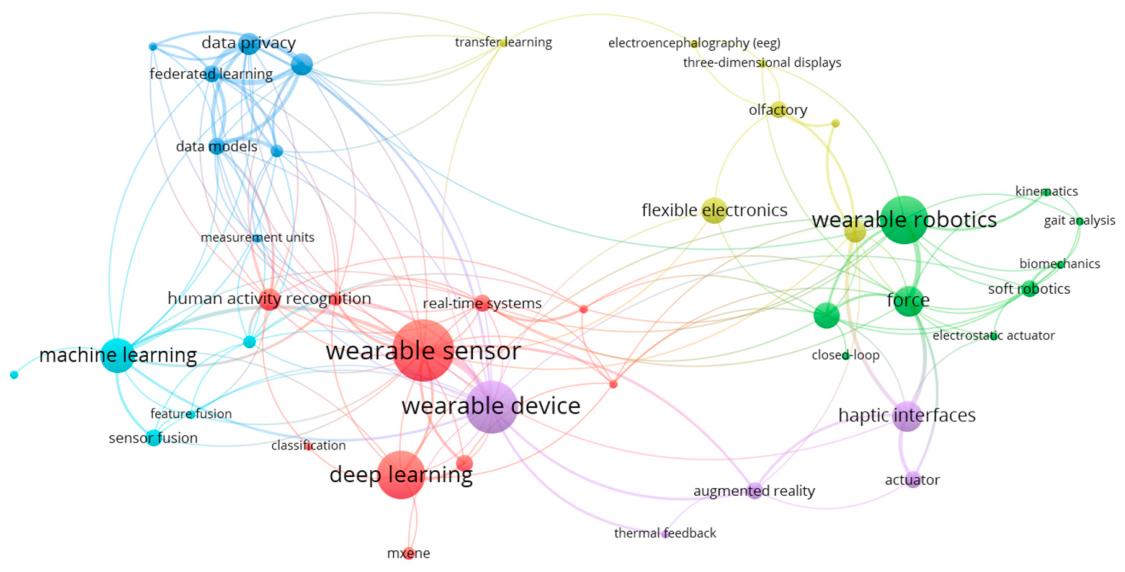
- demonstrated seamless HCI mechanisms, either utilizing flexible biosensors for human state input or employing multimodal/actuation strategies for closed-loop feedback;
- integrated ML architectures or multi-sensor data fusion strategies to achieve robust noise decoupling and precise intention decoding;
- deployed innovative sensory feedback setups or biomimetic actuation interfaces to construct an adaptive, real-time “sensing-decision-response” loop.
2. Toward Seamless Physiological and Motion-Based Inputs
2.1. Biocompatible Interfaces for Mechanical Match
2.1.1. Dynamic Conformable Interfaces for Mechanical Match

2.1.2. Ensuring Electrical Fidelity Against Interferences
2.1.3. High Biocompatibility for Long-Term Wearing
2.2. Signal Fidelity via Algorithmic Noise Decoupling
2.3. Multimodal Sensing and Data Fusion
2.3.1. Multimodal Signal Sensing and Physical Integration
2.3.2. ML-Enabled Data Fusion Strategies
2.4. Trustworthy Algorithms for Seamless HCI
2.4.1. Datasets and System Evaluation Metrics
2.4.2. Cross-User Generalization and On-Device Learning
2.4.3. Privacy and Security Perservation
2.4.4. Model Interpretability
3. Multimodal Feedback Output Technologies
3.1. Sensory Feedback
3.1.1. Haptic Feedback
Electromechanical Actuator-Based Haptic Devices

Electrotactile Devices
Thermo-Haptic Devices
3.1.2. Auditory Feedback
3.1.3. Olfactory Feedback
3.2. Actuation-Based Feedback
3.2.1. Biomimetic Musculoskeletal Interfaces for Mechanical Feedback
3.2.2. Biomimetic Neural Interfacing and Closed-Loop Feedback
4. Challenges and Future Perspectives
4.1. Material Durability and Environmental Stability
4.2. Internal Latency in Multimodal Feedback
4.3. System Integration and Power Supply
4.4. Algorithm Trustworthiness in Wearable HCI Systems
Author Contributions
Funding
Institutional Review Board Statement
Informed Consent Statement
Data Availability Statement
Acknowledgments
Conflicts of Interest
Abbreviations
| AI | Artificial intelligence |
| ANC | Active noise control |
| BCI | Brain–computer interfaces |
| BSS | Blind source separation |
| CNNs | Convolutional neural networks |
| EEG | Electroencephalogram |
| EMG | Electromyography |
| EOG | Electrooculogram |
| GANs | Generative adversarial networks |
| HAR | Human activity recognition |
| HCI | Human–computer interaction |
| HDC | Hyperdimensional computing |
| IMUs | Inertial measurement units |
| k-NN | K-nearest neighbors |
| KPCA | Kernel component analysis |
| LSTM | Long short-term memory |
| ML | Machine learning |
| MXenes | Transition metal carbides/nitrides |
| OGs | Odor generators |
| RF | Random forest |
| SOBI | Second-order blind identification |
| SVM | Support vector machines |
| TENS | Transcutaneous electrical nerve stimulation |
| 2D | Two-dimensional |
| 3D | Three=dimensional |
References
- Zhang, J.; Wang, M. Alternative Micro/Nanofabrication Approaches for Wearable Electronics. Chem. Rev. 2026, 126, 1686–1762. [Google Scholar] [CrossRef]
- Wang, X.; Liu, Z.; Zhang, T. Flexible Sensing Electronics for Wearable/Attachable Health Monitoring. Small 2017, 13, 1602790. [Google Scholar] [CrossRef] [PubMed]
- Xiao, L.; Yin, B.; Geng, Z.; Li, J.; Jia, R.; Zhang, K. Flexible Wearable Devices Based on Self-Powered Energy Supply. Nano Energy 2025, 142, 111157. [Google Scholar] [CrossRef]
- Yao, G.; Gan, X.; Lin, Y. Flexible Self-Powered Bioelectronics Enables Personalized Health Management from Diagnosis to Therapy. Sci. Bull. 2024, 69, 2289–2306. [Google Scholar] [CrossRef] [PubMed]
- Kong, L.; Li, W.; Zhang, T.; Ma, H.; Cao, Y.; Wang, K.; Zhou, Y.; Shamim, A.; Zheng, L.; Wang, X.; et al. Wireless Technologies in Flexible and Wearable Sensing: From Materials Design, System Integration to Applications. Adv. Mater. 2024, 36, 2400333. [Google Scholar] [CrossRef]
- Chen, S.; Fan, S.; Qiao, Z.; Wu, Z.; Lin, B.; Li, Z.; Riegler, M.A.; Wong, M.Y.H.; Opheim, A.; Korostynska, O.; et al. Transforming Healthcare: Intelligent Wearable Sensors Empowered by Smart Materials and Artificial Intelligence. Adv. Mater. 2025, 37, 2500412. [Google Scholar] [CrossRef] [PubMed]
- Hu, H.; Huang, H.; Li, M.; Gao, X.; Yin, L.; Qi, R.; Wu, R.S.; Chen, X.; Ma, Y.; Shi, K.; et al. A Wearable Cardiac Ultrasound Imager. Nature 2023, 613, 667–675. [Google Scholar] [CrossRef]
- Luo, X.; Yu, Q.; Yang, L.; Cui, Y. Wearable, Sensing-Controlled, Ultrasound-Based Microneedle Smart System for Diabetes Management. ACS Sens. 2023, 8, 1710–1722. [Google Scholar] [CrossRef]
- Li, L.-L.; Zhao, Y.; Pan, L.-J.; Xu, J.-B.; Shi, Y. A Direct Electrochemical Biosensor for Rapid Glucose Detection Based on Nitrogen-Doped Carbon Nanocages. Rare Met. 2024, 43, 2184–2192. [Google Scholar] [CrossRef]
- Yuan, J.; Zhang, Y.; Wei, C.; Zhu, R. A Fully Self-Powered Wearable Leg Movement Sensing System for Human Health Monitoring. Adv. Sci. 2023, 10, 2303114. [Google Scholar] [CrossRef]
- Choi, S.J.; Kim, C.H.; Kim, J.H.; Kim, K.H.; Park, S.Y.; Ko, Y.J.; Kang, H.; Kim, Y.B.; Woo, Y.M.; Seok, J.Y.; et al. Wearable Multifunctional Health Monitoring Systems Enabled by Ultrafast Flash-Induced 3D Porous Graphene. Energy Environ. Mater. 2025, 8, e70005. [Google Scholar] [CrossRef]
- Pyun, K.R.; Rogers, J.A.; Ko, S.H. Materials and Devices for Immersive Virtual Reality. Nat. Rev. Mater. 2022, 7, 841–843. [Google Scholar] [CrossRef]
- Liu, J.; Liu, H.; Liu, J.; Liu, H. Research on Flexible Sensors for Wearable Devices: A Review. Nanomaterials 2025, 15, 520. [Google Scholar] [CrossRef] [PubMed]
- Song, K.; Chang, J.-H. Smart Wristwatches Employing Finger-Conducted Voice Transmission System. IEEE Trans. Ind. Inform. 2019, 15, 965–975. [Google Scholar] [CrossRef]
- Mou, X.; Peng, X.; Wang, J. P-48: Evaluation of Field of View in Optical See-through Near Eye Displays. SID Symp. Dig. Tech. Pap. 2024, 55, 1548–1550. [Google Scholar] [CrossRef]
- Lee, L.-H.; Hui, P. Interaction Methods for Smart Glasses: A Survey. IEEE Access 2018, 6, 28712–28732. [Google Scholar] [CrossRef]
- Wu, Y.; Bai, S.; Fu, M.; Hu, X.; Zhong, W.; Ding, L.; Chen, Y. TeethFa: Real-Time, Hand-Free Teeth Gestures Interaction Using Fabric Sensors. IEEE Internet Things J. 2024, 11, 35223–35237. [Google Scholar] [CrossRef]
- Tang, C.; Xu, M.; Yi, W.; Zhang, Z.; Occhipinti, E.; Dong, C.; Ravenscroft, D.; Jung, S.-M.; Lee, S.; Gao, S.; et al. Ultrasensitive Textile Strain Sensors Redefine Wearable Silent Speech Interfaces with High Machine Learning Efficiency. npj Flex. Electron. 2024, 8, 27. [Google Scholar] [CrossRef]
- Liu, X.-Y.; Wang, W.-L.; Liu, M.; Chen, M.-Y.; Pereira, T.; Doda, D.Y.; Ke, Y.-F.; Wang, S.-Y.; Wen, D.; Tong, X.-G.; et al. Recent Applications of EEG-Based Brain-Computer-Interface in the Medical Field. Mil. Med. Res. 2025, 12, 14. [Google Scholar] [CrossRef]
- Luo, F.; Khan, S.; Huang, Y.; Wu, K. Activity-Based Person Identification Using Multimodal Wearable Sensor Data. IEEE Internet Things J. 2023, 10, 1711–1723. [Google Scholar] [CrossRef]
- Jeong, I.; Chung, W.G.; Kim, E.; Park, W.; Song, H.; Lee, J.; Oh, M.; Kim, E.; Paek, J.; Lee, T.; et al. Machine Learning in Biosignal Analysis from Wearable Devices. Mater. Horiz. 2025, 12, 6587–6621. [Google Scholar] [CrossRef]
- Cheng, H.; Keerthika Devi, R.; Huang, K.-Y.; Ganesan, M.; Ravi, S.K.; Lin, C.C. Highly Biocompatible Antibacterial Hydrogel for Wearable Sensing of Macro and Microscale Human Body Motions. Small 2024, 20, 2401201. [Google Scholar] [CrossRef]
- Wang, L.; Tian, S.; Zhu, R. A New Method of Continuous Blood Pressure Monitoring Using Multichannel Sensing Signals on the Wrist. Microsyst. Nanoeng. 2023, 9, 117. [Google Scholar] [CrossRef]
- Qi, J.; Yu, L.; Khoo, E.T.; Ng, K.W.; Gao, Y.; Kow, A.W.C.; Yeo, J.C.; Lim, C.T. Bridging the Digital–Physical Divide Using Haptic and Wearable Technologies. Nat. Electron. 2024, 7, 1098–1110. [Google Scholar] [CrossRef]
- Song, Y.; Li, Z.; Li, G.; Wang, B.; Zhu, M.; Shi, P. Multi-Sensory Visual-Auditory Fusion of Wearable Navigation Assistance for People with Impaired Vision. IEEE Trans. Autom. Sci. Eng. 2025, 22, 4724–4736. [Google Scholar] [CrossRef]
- Patel, S.; Rao, Z.; Yang, M.; Yu, C. Wearable Haptic Feedback Interfaces for Augmenting Human Touch. Adv. Funct. Mater. 2025, 36, 2417906. [Google Scholar] [CrossRef]
- Kan, M.; Zhang, L.; Liang, H.; Zhang, B.; Fang, M.; Liu, D.; Shan, S.; Chen, X. eLabrador: A Wearable Navigation System for Visually Impaired Individuals. IEEE Trans. Autom. Sci. Eng. 2025, 22, 12228–12244. [Google Scholar] [CrossRef]
- Li, F.; Chen, Z.; Yang, M.; Tian, D.; Gao, F.; Wu, X. A Robust Following Controller for Lower Limb Exoskeletons with a Decoding Human Motion Intention Network Under Small Sample Conditions. IEEE/ASME Trans. Mechatron. 2025, 30, 4802–4813. [Google Scholar] [CrossRef]
- Du, J.; Luo, S.; Shi, P. A Wearable EMG-Driven Closed-Loop TENS Platform for Real-Time, Personalized Pain Modulation. Sensors 2025, 25, 5113. [Google Scholar] [CrossRef]
- Yan, Z.; Han, B.; Du, Z.; Huang, T.; Bai, O.; Peng, A. Development and Testing of a Wearable Passive Lower-Limb Support Exoskeleton to Support Industrial Workers. Biocybern. Biomed. Eng. 2021, 41, 221–238. [Google Scholar] [CrossRef]
- Zhou, S.; Liu, Y.; Turnbull, A.; Tapparello, C.; Adeli, E.; Lin, F.V. Personalized Cognitive Enhancement for Older Adults: An Aging-Friendly Closed-Loop Human-Machine Interface Framework. Ageing Res. Rev. 2025, 112, 102877. [Google Scholar] [CrossRef]
- Chen, S.; Xu, S.; Fan, X.; Xiao, X.; Duan, Z.; Zhao, X.; Chen, G.; Zhou, Y.; Chen, J. Advances in 2D Materials for Wearable Biomonitoring. Mater. Sci. Eng. R Rep. 2025, 164, 100971. [Google Scholar] [CrossRef]
- Huang, Y.; Yan, T.; Jiang, L.; Pan, W.-G.; Wang, L.-W. Advances in Nanofiber Hydrogels: Revolutionizing Wearable Technology Applications. Renew. Sustain. Energy Rev. 2026, 227, 116484. [Google Scholar] [CrossRef]
- Liu, C.; Liu, Z.; Zhang, Y.; Qin, Y.; Zhang, M.; Jin, W.; Yuan, L. Wearable Flexible Hydrogel Optical Fibers Applied for Finger Morphology Analysis. Adv. Opt. Mater. 2025, 13, e01004. [Google Scholar] [CrossRef]
- Li, Z.; Wang, B.; Lu, J.; Xue, Y.; Wang, J.; Jia, B.; Han, G.; Zhao, Y.; Qureshi, M.A.K.; Yu, L.; et al. Highly Stretchable, Self-Healable, and Conductive Gelatin Methacryloyl Hydrogel for Long-Lasting Wearable Tactile Sensors. Adv. Sci. 2025, 12, e02678. [Google Scholar] [CrossRef]
- Hu, L.; Azhari, S.; Zhang, H.; Matsunaga, Y.; Hirotani, J.; Ashimori, A.; Kimura, K.; Miyake, T. MXene-Integrated Contact Lens: A Breakthrough in Wearable Eye Protection and Healthcare. Small Sci. 2025, 5, 2400628. [Google Scholar] [CrossRef] [PubMed]
- Li, C.; Gao, C.; Liu, W.; Sun, X.; Peng, H.-L. Laser-Processed All-Paper-Based Wearable and Biodegradable Electrochemical Sensor for Continuous Sweat pH Detection. ACS Sustain. Chem. Eng. 2025, 13, 18102–18115. [Google Scholar] [CrossRef]
- Li, Z.; Lu, J.; Ji, T.; Xue, Y.; Zhao, L.; Zhao, K.; Jia, B.; Wang, B.; Wang, J.; Zhang, S.; et al. Self-Healing Hydrogel Bioelectronics. Adv. Mater. 2024, 36, 2306350. [Google Scholar] [CrossRef]
- Li, Y.; Hu, X.; Xue, J.; Wang, J. Wearable Hydrogels for Personal Protection Applications. Macromol. Rapid Commun. 2025, 46, 2400960. [Google Scholar] [CrossRef] [PubMed]
- Amani, A.M.; Tayebi, L.; Abbasi, M.; Vaez, A.; Kamyab, H.; Chelliapan, S.; Vafa, E. The Need for Smart Materials in an Expanding Smart World: MXene-Based Wearable Electronics and Their Advantageous Applications. ACS Omega 2024, 9, 3123–3142. [Google Scholar] [CrossRef] [PubMed]
- Sun, N.; Luo, Q.; Wang, Z.; Zhang, S.; Li, X. Highly Sensitive and Flexible Piezoresistive Sensor Based on MXene/LM@PDMS Sponge for Sedentary Healthcare Monitoring. J. Alloys Compd. 2025, 1037, 182374. [Google Scholar] [CrossRef]
- Lee, K.; Gutierrez, O.L.; Bai, W. Soft, Breathable, and Recyclable MXene Fabrics for Wearable Electrophysiological Recordings. Mater. Horiz. 2025, 12, 8528–8536. [Google Scholar] [CrossRef] [PubMed]
- Lee, Y.; Kim, S.J.; Kim, Y.-J.; Lim, Y.; Chae, Y.; Lee, B.-J.; Kim, Y.-T.; Han, H.; Gogotsi, Y.; Ahn, C.W. Oxidation-Resistant Titanium Carbide MXene Films. J. Mater. Chem. A 2020, 8, 573–581. [Google Scholar] [CrossRef]
- Zhou, A.; Wu, Z.; Bai, Q.; Zhang, X.; Li, X.; Shen, H.; Li, H.; Liu, T.; Liu, S. MXene-Thermochromic Hybrid Films for Interference-Free Dual-Mode Sensing in Wearable Healthcare. Adv. Funct. Mater. 2025, 36, e22165. [Google Scholar] [CrossRef]
- Hong, S.; Park, T.; Lee, J.; Ji, Y.; Walsh, J.; Yu, T.; Park, J.Y.; Lim, J.; Benito Alston, C.; Solorio, L.; et al. Rapid Self-Healing Hydrogel with Ultralow Electrical Hysteresis for Wearable Sensing. ACS Sens. 2024, 9, 662–673. [Google Scholar] [CrossRef]
- Gu, Y.; Luo, Y.; Guo, Q.; Yu, W.; Li, P.; Wang, X.; Ye, T.; Chang, H.; Yuan, W.; Wu, H.; et al. Empowering Human-Machine Interfaces: Self-Powered Hydrogel Sensors for Flexible and Intelligent Systems. Adv. Funct. Mater. 2025, 36, e09085. [Google Scholar] [CrossRef]
- Xu, Y.; Fei, Q.; Page, M.; Zhao, G.; Ling, Y.; Stoll, S.B.; Yan, Z. Paper-Based Wearable Electronics. iScience 2021, 24, 102736. [Google Scholar] [CrossRef]
- Holman, J.B.; Oseyemi, A.E.; Koumbia, M.; Shi, Z.; Li, C.; Ding, W. The Rise of Eco-Friendly Electronics: Exploring Wearable Paper-Based Electroanalytical Devices. Mater. Sci. Eng. R Rep. 2025, 163, 100939. [Google Scholar] [CrossRef]
- Chen, X.; Li, Y.; Wang, X.; Yu, H. Origami Paper-Based Stretchable Humidity Sensor for Textile-Attachable Wearable Electronics. ACS Appl. Mater. Interfaces 2022, 14, 36227–36237. [Google Scholar] [CrossRef]
- Wei, C.; Xu, Y.; Hu, Y.; Zhang, Q.; Wei, N.; Zeng, W.; Wu, R. Ti3C2Tx MXene Paper-Based Flexible Wearable Pressure Sensor with Wide Pressure Detection Range for Human Motion Detection. J. Alloys Compd. 2025, 1017, 179126. [Google Scholar] [CrossRef]
- Gomez-Gijon, S.; Ortiz-Gómez, I.; Rivadeneyra, A. Paper-Based Electronics: Toward Sustainable Electronics. Adv. Sustain. Syst. 2025, 9, 2400486. [Google Scholar] [CrossRef]
- Wang, F.; Yu, H.; Lv, X.; Ma, X.; Qu, Q.; Wang, H.; Chen, D.; Liu, Y. MXene–MWCNT Conductive Network for Long-Lasting Wearable Strain Sensors with Gesture Recognition Capabilities. Micromachines 2025, 16, 123. [Google Scholar] [CrossRef]
- Elashmawi, W.H.; Ayman, A.; Antoun, M.; Mohamed, H.; Mohamed, S.E.; Amr, H.; Talaat, Y.; Ali, A. A Comprehensive Review on Brain–Computer Interface (BCI)-Based Machine and Deep Learning Algorithms for Stroke Rehabilitation. Appl. Sci. 2024, 14, 6347. [Google Scholar] [CrossRef]
- Nia, N.G.; Amiri, A.; Nasab, A.; Kaplanoglu, E.; Liang, Y. The Power of ANN-Random Forest Algorithm in Human Activities Recognition Using IMU Data. In Proceedings of the 2023 IEEE EMBS International Conference on Biomedical and Health Informatics (BHI), Pittsburgh, PA, USA, 15–18 October 2023; IEEE: Piscataway, NJ, USA, 2023; pp. 1–7. [Google Scholar]
- Ferreira, P.J.S.; Cardoso, J.M.P.; Mendes-Moreira, J. kNN Prototyping Schemes for Embedded Human Activity Recognition with Online Learning. Computers 2020, 9, 96. [Google Scholar] [CrossRef]
- Lin, C.; Wang, Y.; Dai, M. Robust Gesture Recognition Based on Attention-Deep Fast Convolutional Neural Network and Surface Electromyographic Signals. Front. Neurosci. 2024, 18, 1306047. [Google Scholar] [CrossRef]
- Chen, X.; Martin, A.E. Automated Gait Event Detection for Exoskeleton-Assisted Walking Using a Long Short-Term Memory Model with Ground Reaction Force and Heel Marker Data. PLoS ONE 2025, 20, e0315186. [Google Scholar] [CrossRef] [PubMed]
- Yin, J.; Wang, S.; Tat, T.; Chen, J. Motion Artefact Management for Soft Bioelectronics. Nat. Rev. Bioeng. 2024, 2, 541–558. [Google Scholar] [CrossRef] [PubMed]
- Wang, R.; Ma, Y.; Zhao, R.; Ding, J.; Li, L.; Yang, Y.; Wang, F.; Cao, Z.; Zhang, X.; Lin, X.; et al. Noise and Artifact Suppression in SQUID and Wearable OPM-MEG: A Systematic Review of Background, Physiological, and Technical Interference. NeuroImage 2025, 318, 121403. [Google Scholar] [CrossRef]
- Tan, H.; Zhou, Y.; Tao, Q.; Rosen, J.; van Dijken, S. Bioinspired Multisensory Neural Network with Crossmodal Integration and Recognition. Nat. Commun. 2021, 12, 1120. [Google Scholar] [CrossRef]
- Xiao, X.; Yin, J.; Xu, J.; Tat, T.; Chen, J. Advances in Machine Learning for Wearable Sensors. ACS Nano 2024, 18, 22734–22751. [Google Scholar] [CrossRef]
- Yu, H.; Deng, X.; Tang, J.; Yue, F. Patterns Identification Using Blind Source Separation with Application to Neural Activities Associated with Anticipated Falls. Inf. Sci. 2025, 689, 121410. [Google Scholar] [CrossRef]
- Mu, G.; Zhang, Y.; Yan, Z.; Yu, Q.; Wang, Q. Recent Advancements in Wearable Sensors: Integration with Machine Learning for Human–Machine Interaction. RSC Adv. 2025, 15, 7844–7854. [Google Scholar] [CrossRef]
- Chen, X.; Lou, Z.; Gao, X.; Yin, L.; Qin, S.; Lin, M.; Zhang, F.; Lu, Y.; Ding, S.; Liu, R.; et al. A Noise-Tolerant Human–Machine Interface Based on Deep Learning-Enhanced Wearable Sensors. Nat. Sens. 2025, 1, 39–51. [Google Scholar] [CrossRef]
- Moin, A.; Zhou, A.; Rahimi, A.; Menon, A.; Benatti, S.; Alexandrov, G.; Tamakloe, S.; Ting, J.; Yamamoto, N.; Khan, Y.; et al. A Wearable Biosensing System with In-Sensor Adaptive Machine Learning for Hand Gesture Recognition. Nat. Electron. 2021, 4, 54–63. [Google Scholar] [CrossRef]
- Tchantchane, R.; Zhou, H.; Zhang, S.; Alici, G. A Review of Hand Gesture Recognition Systems Based on Noninvasive Wearable Sensors. Adv. Intell. Syst. 2023, 5, 2300207. [Google Scholar] [CrossRef]
- Yin, K.; Hao, P.; Zhao, H.; Lou, P.; Chen, Y. High-Accuracy Lower-Limb Intent Recognition: A KPCA-ISSA-SVM Approach with sEMG-IMU Sensor Fusion. Biomimetics 2025, 10, 609. [Google Scholar] [CrossRef]
- Fall, C.L.; Quevillon, F.; Blouin, M.; Latour, S.; Campeau-Lecours, A.; Gosselin, C.; Gosselin, B. A Multimodal Adaptive Wireless Control Interface for People with Upper-Body Disabilities. IEEE Trans. Biomed. Circuits Syst. 2018, 12, 564–575. [Google Scholar] [CrossRef] [PubMed]
- John, A.; Wang, H.; Cardiff, B.; Parhi, K.K.; John, D. Multimodal Fusion for Robust Respiratory Rate Estimation in Wearable Sensing. Inf. Fusion 2025, 123, 103253. [Google Scholar] [CrossRef]
- Meng, T.; Jing, X.; Yan, Z.; Pedrycz, W. A Survey on Machine Learning for Data Fusion. Inf. Fusion 2020, 57, 115–129. [Google Scholar] [CrossRef]
- Kolanowski, K.; Świetlicka, A.; Kapela, R.; Pochmara, J.; Rybarczyk, A. Multisensor Data Fusion Using Elman Neural Networks. Appl. Math. Comput. 2018, 319, 236–244. [Google Scholar] [CrossRef]
- Toptsis, M.; Karkanis, N.; Giannakoulas, A.; Kaifas, T. A Review of Embedded Software Architectures for Multi-Sensor Wearable Devices: Sensor Fusion Techniques and Future Research Directions. Electronics 2026, 15, 295. [Google Scholar] [CrossRef]
- Zeng, F.; Guo, M.; Tan, L.; Guo, F.; Liu, X.; Zeng, F.; Guo, M.; Tan, L.; Guo, F.; Liu, X. Wearable Sensor-Based Residual Multifeature Fusion Shrinkage Networks for Human Activity Recognition. Sensors 2024, 24, 758. [Google Scholar] [CrossRef]
- Liu, K.; Gao, C.; Li, B.; Liu, W. Human Activity Recognition through Deep Learning: Leveraging Unique and Common Feature Fusion in Wearable Multi-Sensor Systems. Appl. Soft Comput. 2024, 151, 111146. [Google Scholar] [CrossRef]
- Biswas, S.; Nandy, A.; Naskar, A.K. Lightweight Multimodal Feature Fusion and Spatiotemporal Learning for Human Action Recognition on Edge Devices. IEEE Trans. Emerg. Top. Comput. Intell. 2026, 10, 982–995. [Google Scholar] [CrossRef]
- Yang, Y.; Gulbahar, Y. Multimodal Fusion and Interpretability in Human Activity Recognition: A Reproducible Framework for Sensor-Based Modeling. arXiv 2025, arXiv:2510.22410. [Google Scholar] [CrossRef]
- Yadav, S.K.; Rafiqi, M.; Gummana, E.P.; Tiwari, K.; Pandey, H.M.; Akbara, S.A. A Novel Two Stream Decision Level Fusion of Vision and Inertial Sensors Data for Automatic Multimodal Human Activity Recognition System. arXiv 2023, arXiv:2306.15765. [Google Scholar] [CrossRef]
- Singh, L.; Georgara, A.; Deshmukh, J.; Nguyen, T.V.T.; Ramchurn, S.D. Decision-Level Fusion for Robust Wearable Affect Recognition. arXiv 2026, arXiv:2605.14878. [Google Scholar] [CrossRef]
- Burzer, M.; King, T.; Riedel, T.; Beigl, M.; Röddiger, T. WHAR Datasets: An Open Source Library for Wearable Human Activity Recognition. arXiv 2025, arXiv:2508.16604. [Google Scholar] [CrossRef]
- Diaz, M.T.; Benoit, A.R.; Kearney, K.M.; Kelly, T.F.; Lindbeck, E.M.; Tappan, I.; Bowers, W.S.; Durai, L.; Nunag, J.B.; Officer, M.B.; et al. A Hand Biomechanics Dataset of Kinematics, Kinetics, Electromyography, and Imaging in Healthy Adults. Sci. Data 2026, 13, 646. [Google Scholar] [CrossRef]
- Jordao, A.; Nazare, A.C.; Sena, J.; Schwartz, W.R. Human Activity Recognition Based on Wearable Sensor Data: A Standardization of the State-of-the-Art. arXiv 2019, arXiv:1806.05226. [Google Scholar] [CrossRef]
- Luo, Y.; Chen, Y.; Salekin, A.; Rahman, T. Toward Foundation Model for Multivariate Wearable Sensing of Physiological Signals. ACM Trans. Comput. Healthc. 2026, 7, 43. [Google Scholar] [CrossRef]
- Hoang, M.L. A Review of Developments and Metrology in Machine Learning and Deep Learning for Wearable IoT Devices. IEEE Access 2025, 13, 106035–106054. [Google Scholar] [CrossRef]
- Xi, L.; Li, C.; Anari, M.S.; Rezaee, K. Integrating Wearable Health Devices with AI and Edge Computing for Personalized Rehabilitation. J. Cloud Comput. 2025, 14, 64. [Google Scholar] [CrossRef]
- Otarbay, Z.; Kyzyrkanov, A. Transfer Learning for Subject-Independent Motor Imagery EEG Classification Using Convolutional Relational Networks. Front. Neurosci. 2026, 19, 1691929. [Google Scholar] [CrossRef]
- Ruhrberg Estévez, S.; Mallah, J.; Kazieczko, D.; Tang, C.; Occhipinti, L.G. Deep Learning for Motion Classification in Ankle Exoskeletons Using Surface EMG and IMU Signals. Sci. Rep. 2025, 15, 38242. [Google Scholar] [CrossRef]
- Zhu, S.; Voigt, T.; Rahimian, F.; Ko, J. On-Device Training: A First Overview on Existing Systems. ACM Trans. Sen. Netw. 2024, 20, 118. [Google Scholar] [CrossRef]
- Wang, X.; Tang, Z.; Guo, J.; Meng, T.; Wang, C.; Wang, T.; Jia, W. Empowering Edge Intelligence: A Comprehensive Survey on On-Device AI Models. ACM Comput. Surv. 2025, 57, 228. [Google Scholar] [CrossRef]
- Quélennec, A.; Tartaglione, E.; Mozharovskyi, P.; Nguyen, V.-T. Towards On-Device Learning on the Edge: Ways to Select Neurons to Update Under a Budget Constraint. arXiv 2023, arXiv:2312.05282. [Google Scholar] [CrossRef]
- Zhang, B.; Chen, C.; Lee, I.; Lee, K.; Ong, K.-L. A Survey on Security and Privacy Issues in Wearable Health Monitoring Devices. Comput. Secur. 2025, 155, 104453. [Google Scholar] [CrossRef]
- Nguyen, D.C.; Ding, M.; Pathirana, P.N.; Seneviratne, A.; Li, J.; Vincent Poor, H. Federated Learning for Internet of Things: A Comprehensive Survey. IEEE Commun. Surv. Tutor. 2021, 23, 1622–1658. [Google Scholar] [CrossRef]
- Chen, Y.; Qin, X.; Wang, J.; Yu, C.; Gao, W. FedHealth: A Federated Transfer Learning Framework for Wearable Healthcare. IEEE Intell. Syst. 2020, 35, 83–93. [Google Scholar] [CrossRef]
- Wei, K.; Li, J.; Ding, M.; Ma, C.; Yang, H.H.; Farokhi, F.; Jin, S.; Quek, T.Q.S.; Vincent Poor, H. Federated Learning with Differential Privacy: Algorithms and Performance Analysis. IEEE Trans. Inf. Forensics Secur. 2020, 15, 3454–3469. [Google Scholar] [CrossRef]
- Favero, M.; Marchioro, T.; Schiavo, C. Federated Forests with Differential Privacy for Distributed Wearable Sensors. In Proceedings of the 2024 IEEE International Conference on Aerospace Electronics and Remote Sensing Technology (ICARES), Yogyakarta, Indonesia, 8–9 November 2024; IEEE: Piscataway, NJ, USA, 2024; pp. 1–6. [Google Scholar]
- Coser, O.; Tamantini, C.; Tortora, M.; Furia, L.; Sicilia, R.; Zollo, L.; Soda, P. Deep Learning for Human Locomotion Analysis in Lower-Limb Exoskeletons: A Comparative Study. arXiv 2025, arXiv:2503.16904. [Google Scholar] [CrossRef]
- Lundberg, S.; Lee, S.-I. A Unified Approach to Interpreting Model Predictions. arXiv 2017, arXiv:1705.07874. [Google Scholar] [CrossRef]
- Ismail Fawaz, H.; Forestier, G.; Weber, J.; Idoumghar, L.; Muller, P.-A. Deep Learning for Time Series Classification: A Review. Data Min. Knowl. Discov. 2019, 33, 917–963. [Google Scholar] [CrossRef]
- Lee, H.; Kim, D.; Park, Y.-L. Explainable Deep Learning Model for EMG-Based Finger Angle Estimation Using Attention. IEEE Trans. Neural Syst. Rehabil. Eng. 2022, 30, 1877–1886. [Google Scholar] [CrossRef]
- Leng, Y.; Sun, R. Multifunctional Biomedical Devices with Closed-Loop Systems for Precision Therapy. Adv. Healthc. Mater. 2025, 14, 2500860. [Google Scholar] [CrossRef] [PubMed]
- Corniani, G.; Saal, H.P. Tactile Innervation Densities across the Whole Body. J. Neurophysiol. 2020, 124, 1229–1240. [Google Scholar] [CrossRef]
- Fleck, J.J.; Zook, Z.A.; Clark, J.P.; Preston, D.J.; Lipomi, D.J.; Pacchierotti, C.; O’Malley, M.K. Wearable Multi-Sensory Haptic Devices. Nat. Rev. Bioeng. 2025, 3, 288–302. [Google Scholar] [CrossRef]
- Chen, J.; Teo, E.H.T.; Yao, K.; Chen, J.; Teo, E.H.T.; Yao, K. Electromechanical Actuators for Haptic Feedback with Fingertip Contact. Actuators 2023, 12, 104. [Google Scholar] [CrossRef]
- Kohls, N.D.; Colonnese, N.; Mazumdar, Y.C.; Agarwal, P. HAPSEA: Hydraulically Amplified Soft Electromagnetic Actuator for Haptics. IEEE/ASME Trans. Mechatron. 2023, 28, 1948–1956. [Google Scholar] [CrossRef]
- Wang, Q.; Li, L.; Lu, X.; Dong, X.; Guo, C.; Pan, H.; Jiang, Y.; Liu, Y.; Yuan, N.; Ding, J. Fabric Electromagnetic Actuators. Smart Mater. Struct. 2023, 33, 015007. [Google Scholar] [CrossRef]
- Leroy, E.; Hinchet, R.; Shea, H. Multimode Hydraulically Amplified Electrostatic Actuators for Wearable Haptics. Adv. Mater. 2020, 32, 2002564. [Google Scholar] [CrossRef]
- Koo, J.-H.; Schuster, J.M.; Tantiyartyanontha, T.; Kim, Y.-M.; Yang, T.-H. Enhanced Haptic Sensations Using a Novel Electrostatic Vibration Actuator with Frequency Beating Phenomenon. IEEE Robot. Autom. Lett. 2020, 5, 1827–1834. [Google Scholar] [CrossRef]
- Jin, H.; Kim, Y.; Youm, W.; Min, Y.; Seo, S.; Lim, C.; Hong, C.-H.; Kwon, S.; Park, G.; Park, S.; et al. Highly Pixelated, Untethered Tactile Interfaces for an Ultra-Flexible on-Skin Telehaptic System. npj Flex. Electron. 2022, 6, 82. [Google Scholar] [CrossRef]
- Lin, W.; Zhang, D.; Lee, W.W.; Li, X.; Hong, Y.; Pan, Q.; Zhang, R.; Peng, G.; Tan, H.Z.; Zhang, Z.; et al. Super-Resolution Wearable Electrotactile Rendering System. Sci. Adv. 2022, 8, eabp8738. [Google Scholar] [CrossRef]
- Chen, B.; Feng, Z.; Yao, F.-Z.; Zhang, M.-H.; Wang, K.; Wei, Y.; Gong, W.; Rödel, J. Flexible Piezoelectrics: Integration of Sensing, Actuating and Energy Harvesting. npj Flex. Electron. 2025, 9, 58. [Google Scholar] [CrossRef]
- Sanchez-Tamayo, N.; Yoder, Z.; Rothemund, P.; Ballardini, G.; Keplinger, C.; Kuchenbecker, K.J. Cutaneous Electrohydraulic (CUTE) Wearable Devices for Pleasant Broad-Bandwidth Haptic Cues. Adv. Sci. 2024, 11, 2402461. [Google Scholar] [CrossRef]
- Mun, H.; Jeong, S.M.; Lim, S.; Jung, S.; Kyung, K.-U. STEM: A Soft Tactile Electromagnetic Actuator for Multimodal Haptic Feedback in Virtual Environments. IEEE Robot. Autom. Lett. 2025, 10, 9798–9805. [Google Scholar] [CrossRef]
- Kourtesis, P.; Argelaguet, F.; Vizcay, S.; Marchal, M.; Pacchierotti, C. Electrotactile Feedback Applications for Hand and Arm Interactions: A Systematic Review, Meta-Analysis, and Future Directions. IEEE Trans. Haptics 2022, 15, 479–496. [Google Scholar] [CrossRef]
- Boljanić, T.; Baljić, M.; Kostić, M.; Barralon, P.; Došen, S.; Štrbac, M. Psychometric Evaluation of High-Resolution Electrotactile Interface for Conveying 3D Spatial Information. Sci. Rep. 2024, 14, 19969. [Google Scholar] [CrossRef]
- Xu, G.; Wang, H.; Zhao, G.; Fu, J.; Yao, K.; Jia, S.; Shi, R.; Huang, X.; Wu, P.; Li, J.; et al. Self-Powered Electrotactile Textile Haptic Glove for Enhanced Human-Machine Interface. Sci. Adv. 2025, 11, eadt0318. [Google Scholar] [CrossRef]
- Tanaka, Y.; Weiss, N.; Bolger-Cruz, R.C.; Hartcher-O’Brien, J.; Flynn, B.; Boldu, R.; Colonnese, N. ReaWristic: Remote Touch Sensation to Fingers from a Wristband via Visually Augmented Electro-Tactile Feedback. In Proceedings of the 2024 IEEE International Symposium on Mixed and Augmented Reality (ISMAR), Bellevue, WA, USA, 21–25 October 2024; IEEE: Piscataway, NJ, USA, 2024; pp. 951–960. [Google Scholar]
- Akhtar, A.; Sombeck, J.; Boyce, B.; Bretl, T. Controlling Sensation Intensity for Electrotactile Stimulation in Human-Machine Interfaces. Sci. Robot. 2018, 3, eaap9770. [Google Scholar] [CrossRef]
- Parida, K.; Bark, H.; Lee, P.S. Emerging Thermal Technology Enabled Augmented Reality. Adv. Funct. Mater. 2021, 31, 2007952. [Google Scholar] [CrossRef]
- Lee, S.; Jang, S.; Cha, Y. Soft Wearable Thermo+touch Haptic Interface for Virtual Reality. iScience 2024, 27, 111303. [Google Scholar] [CrossRef]
- Park, M. Recent Advances in Wearable Thermal Devices for Virtual and Augmented Reality. Micromachines 2025, 16, 383. [Google Scholar] [CrossRef]
- Lee, J.; Sul, H.; Lee, W.; Pyun, K.R.; Ha, I.; Kim, D.; Park, H.; Eom, H.; Yoon, Y.; Jung, J.; et al. Stretchable Skin-Like Cooling/Heating Device for Reconstruction of Artificial Thermal Sensation in Virtual Reality. Adv. Funct. Mater. 2020, 30, 1909171. [Google Scholar] [CrossRef]
- Woo, S.; Park, S.; Lee, C.; Zhu, G.; Park, G.; Kim, W. Realistic Thermal Haptics for Discriminating Materials with Identical Temperatures. Chem. Eng. J. 2026, 528, 172294. [Google Scholar] [CrossRef]
- Lohani, B.; Gautam, C.K.; Kushwaha, P.K.; Gupta, A. Deep Learning Approaches for Enhanced Audio Quality Through Noise Reduction. In Proceedings of the 2024 International Conference on Communication, Computer Sciences and Engineering (IC3SE), Gautam Buddha Nagar, India, 9–11 May 2024; pp. 447–453. [Google Scholar]
- Luo, Z.; Ji, J.; Wang, B.; Shi, D.; Ma, H.; Gan, W.-S. Deep Learning-Based Generative Fixed-Filter Active Noise Control: Transferability and Implementation. Mech. Syst. Signal Process. 2025, 238, 113207. [Google Scholar] [CrossRef]
- Bai, L.; Lian, S.; Li, M.; He, Y.; Rao, L.; Zeng, X.; Sun, R.; Chen, K.; Lu, J. WaveNet-Volterra Neural Network for Active Noise Control: A Fully Causal Approach. Mech. Syst. Signal Process. 2025, 241, 113486. [Google Scholar] [CrossRef]
- Zhang, Z.; Guo, X.; Lee, C. Advances in Olfactory Augmented Virtual Reality towards Future Metaverse Applications. Nat. Commun. 2024, 15, 6465. [Google Scholar] [CrossRef]
- Wang, X.; Kong, M.; Liao, J.; Hong, Y.; Liu, S.; Liu, Y. Advances in Olfactory Displays for Multisensory Immersion: Principles, Applications, and Future Directions. Sci. China Mater. 2025, 68, 4307–4327. [Google Scholar] [CrossRef]
- Tewell, J.; Ranasinghe, N. A Review of Olfactory Display Designs for Virtual Reality Environments. ACM Comput Surv. 2024, 56, 276. [Google Scholar] [CrossRef]
- Liu, Y.; Yiu, C.K.; Zhao, Z.; Park, W.; Shi, R.; Huang, X.; Zeng, Y.; Wang, K.; Wong, T.H.; Jia, S.; et al. Soft, Miniaturized, Wireless Olfactory Interface for Virtual Reality. Nat. Commun. 2023, 14, 2297. [Google Scholar] [CrossRef]
- Archer, N.S.; Bluff, A.; Eddy, A.; Nikhil, C.K.; Hazell, N.; Frank, D.; Johnston, A. Odour Enhances the Sense of Presence in a Virtual Reality Environment. PLoS ONE 2022, 17, e0265039. [Google Scholar] [CrossRef]
- Zhong, X.; Liu, W.; Xie, J.; Gu, Y.; Liu, G. Olfactory-Enhanced VR: What’s the Difference in Brain Activation Compared to Traditional VR for Emotion Induction? IEEE Trans. Affect. Comput. 2024, 15, 1331–1342. [Google Scholar] [CrossRef]
- Liu, Y.; Jia, S.; Yiu, C.K.; Park, W.; Chen, Z.; Nan, J.; Huang, X.; Chen, H.; Li, W.; Gao, Y.; et al. Intelligent Wearable Olfactory Interface for Latency-Free Mixed Reality and Fast Olfactory Enhancement. Nat. Commun. 2024, 15, 4474. [Google Scholar] [CrossRef] [PubMed]
- Matsui, A.; Amemiya, T.; Narumi, T.; Aoyama, K. Intranasal Chemosensory Lateralization Through the Multi-Electrode Transcutaneous Electrical Nasal Bridge Stimulation. IEEE Access 2023, 11, 110899–110909. [Google Scholar] [CrossRef]
- Karunanayaka, K.; Cheok, A.D.; Vedadi, S. Digital Smell: Toward Electrically Reproducing Artificial Smell Sensations. IEEE Access 2023, 11, 50659–50670. [Google Scholar] [CrossRef]
- He, X.; Huang, W.; Lin, W.; Cui, B.; Tian, X.; Bai, J.; Liu, D.; Pang, I.; Huang, H.; Lin, S.; et al. A Wearable, Dual Closed-Loop Insulin Delivery System for Precision Diabetes Management. Adv. Mater. 2026, 38, e14945. [Google Scholar] [CrossRef]
- Bonab, A.K.; Camardella, C.; Frisoli, A.; Chiaradia, D. Hybrid Soft-Rigid Elbow Exosuit: Theory, Mechatronic Design, and Experimental Assessment. IEEE Trans. Robot. 2026, 42, 912–930. [Google Scholar] [CrossRef]
- Lin, W.; Dong, H.; Gao, Y.; Wang, W.; Long, Y.; He, L.; Mao, X.; Wu, D.; Dong, W. A Systematic Review of Locomotion Assistance Exoskeletons: Prototype Development and Technical Challenges. Technologies 2025, 13, 69. [Google Scholar] [CrossRef]
- Zhang, X.; Tricomi, E.; Missiroli, F.; Lotti, N.; Ma, X.; Masia, L. Improving Walking Assistance Efficiency in Real-World Scenarios with Soft Exosuits Using Locomotion Mode Detection. In Proceedings of the 2023 International Conference on Rehabilitation Robotics (ICORR), Singapore, 24–28 September 2023; pp. 1–6. [Google Scholar]
- Carvalho, S.P.; Figueiredo, J.; Cerqueira, J.J.; Santos, C.P. Locomotion Mode Prediction in Real-Life Walking with and without Ankle–Foot Exoskeleton Assistance. Appl. Intell. 2025, 55, 546. [Google Scholar] [CrossRef]
- Hu, C.; Tricomi, E.; Rho, E.; Kim, D.; Masia, L.; Luo, S.; Gionfrida, L. Point Cloud-Based Grasping for Soft Hand Exoskeleton. IEEE Robot. Autom. Lett. 2025, 10, 11315–11322. [Google Scholar] [CrossRef]
- Brogi, C.; Secciani, N.; Bartalucci, L.; Di Iorio, F.; Meli, E.; Rinchi, M.; Allotta, B.; Ridolfi, A. An Original Hybrid-Architecture Finger Mechanism for Wearable Hand Exoskeletons. Mechatronics 2024, 98, 103117. [Google Scholar] [CrossRef]
- Wang, Q.; Chen, C.; Mu, X.; Wang, H.; Wang, Z.; Xu, S.; Guo, W.; Wu, X.; Li, W. A Wearable Upper Limb Exoskeleton System and Intelligent Control Strategy. Biomimetics 2024, 9, 129. [Google Scholar] [CrossRef]
- Yang, X.; Huang, T.-H.; Hu, H.; Yu, S.; Zhang, S.; Zhou, X.; Carriero, A.; Yue, G.; Su, H. Spine-Inspired Continuum Soft Exoskeleton for Stoop Lifting Assistance. IEEE Robot. Autom. Lett. 2019, 4, 4547–4554. [Google Scholar] [CrossRef]
- Zhang, X.; Liu, Y.-X.; Wang, R.; Gutierrez-Farewik, E.M. Soft Ankle Exoskeleton to Counteract Dropfoot and Excessive Inversion. Front. Neurorobotics 2024, 18, 1372763. [Google Scholar] [CrossRef]
- Xiang, L.; Zeng, X.; Xia, F.; Jin, W.; Liu, Y.; Hu, Y. Recent Advances in Flexible and Stretchable Sensing Systems: From the Perspective of System Integration. ACS Nano 2020, 14, 6449–6469. [Google Scholar] [CrossRef]
- Topalovic, U.; Barclay, S.; Ling, C.; Alzuhair, A.; Yu, W.; Hokhikyan, V.; Chandrakumar, H.; Rozgic, D.; Jiang, W.; Basir-Kazeruni, S.; et al. A Wearable Platform for Closed-Loop Stimulation and Recording of Single-Neuron and Local Field Potential Activity in Freely Moving Humans. Nat. Neurosci. 2023, 26, 517–527. [Google Scholar] [CrossRef]
- Mereu, F.; Cordella, F.; Paolini, R.; Scarpelli, A.; Demofonti, A.; Zollo, L.; Gruppioni, E. A Sensory Feedback Neural Stimulator Prototype for Both Implantable and Wearable Applications. Micromachines 2024, 15, 480. [Google Scholar] [CrossRef]
- Wang, D.; Zhao, S.; Li, L.; Wang, L.; Cui, S.; Wang, S.; Lou, Z.; Shen, G. All-Flexible Artificial Reflex Arc Based on Threshold-Switching Memristor. Adv. Funct. Mater. 2022, 32, 2200241. [Google Scholar] [CrossRef]
- Qu, S.; Liu, J.; Hu, J.; Sun, L.; Xu, W. Flexible DPPT-TT/PEO Fiber-Exploiting Electro-Optical Synaptic Transistor for Artificial Withdrawal Reflex Arc. Adv. Fiber Mater. 2024, 6, 401–413. [Google Scholar] [CrossRef]
- Xia, X.; Cheng, L.; Ma, M.; Zhang, H.; Han, L.; Li, H. Neurologically Inspired Transparent Interaction for Wearable Exoskeletons. IEEE/ASME Trans. Mechatron. 2025, 30, 4814–4824. [Google Scholar] [CrossRef]



| Materials | Application | Sensitivity | Stretchability | Durability | Response Time | Ref. |
|---|---|---|---|---|---|---|
| MXene | Pressure sensing | 334.1 kPa−1 0–150 kPa detection range | 80% strain (140 kPa compressive stress) | Stable after >4000 cycles (3 kPa pressure) | 0.29 s for response 0.20 s for recovery | [41] |
| Pressure-temperature sensing | 35.7 kPa−1 6.5 Pa detection limit 0–20 kPa detection range | 42.38 MPa tensile strengeth | Stable after >4400 cycles (5 kPa pressure, 8000 s) | 0.25 s for response 0.20 s for recovery (1 kPa pressure) | [44] | |
| Strain sensing | 0.05% detection limit 933 GF (180–240% strain) | 240% strain | Stable after 33,000 cycles (20% strain) | 200 ms | [52] | |
| Hydrogels | Strain sensing | 0.7 GF (0–300% strain) 1.5 GF (300–600% strain) 2.3 GF (600–866% strain) | >10,000% (original) 860% (packaged strain gauges) | Stable after >1000 cycles (electrical hysteresis < 1%) | 238 ms (5% strain, 500 mm/min loading and uploading rate) 0.12 s self-healing time | [45] |
| Curvature sensing | 1.97 µW m−1 (light intensity) 0.04 nm m−1 (light wavelength) 0–139.84 m−1 detection range | / | Slight fluctuations in output light intensity after 200 times | / | [34] | |
| Strain sensing | 1.98 GF (0–80% strain) 3.28 GF (120–160% strain) 0–160% sensing range 0.1% detection limit | 160% strain 27 kPa shear strength 130 kPa tensile strength | Stable after 800 cycles (original sensor, 20% strain) Slight decrease in detected peak value after 200 cycles (healed sensor, 20% strain) | 257 ms (original, 10% strain) 317 ms (healed, 10% strain) | [35] | |
| Paper-based materials | pH sensing | 46.01 mV pH−1 1.53–13.65 pH detection range (steps of 0.5) | / | 0.01 mV/h signal drift after 12 h Stable after 5000 bending cycles | / | [37] |
| Humidity sensing | Excellent linear response of capacitance change (65.3–97.6% RH) 6.4–97.6% of RH detection range | 5–25% biaxial strain | Stable after 1000 stretching cycles (5–25% strain) | 155 s from 6.4% to 90% RH 58 s from 90% to 6.4% RH | [49] |
| Algorithm | Suitable Signals | Typical HCI Tasks | Core Matching Rationale | Ref. |
|---|---|---|---|---|
| Support vector machines (SVM) | Sparse-channel sEMG; Feature-extracted EEG signals for BCI | Few-shot personalized calibration; discrete motor intention classification (e.g., binary gesture decoding) | Maximizes the classification margin hyperplane to prevent overfitting in small-sample and high-dimensional spaces. Highly robust for rapid, on-device personalized calibration using minimal initial data. | [53] |
| Random forest (RF) | Multimodal heterogeneous signals (e.g., fusing IMU kinematics with ECG/PPG or temperature metrics) | Multimodal Human Activity Recognition (HAR); continuous health tracking | Naturally resists noisy or missing data and handles heterogeneous features without complex normalization. Tree-based logic provides high “white-box” interpretability. | [54] |
| K-nearest neighbors (k-NN) | Low-dimensional extracted features (e.g., statistical features from IMU or simple impedance changes) | Simple static posture classification; on-device dynamic incremental learning | Operates via a “lazy learning” mechanism with no explicit training phase. Calculates distances to stored prototypes for high efficiency in on-device incremental updates and continuous personalization. | [55] |
| Convolutional neural networks (CNNs) | High-density sEMG arrays signals; multi-channel tactile/flexible sensor grids | Complex hand gesture recognition; spatial anomaly detection; fine motor decoding | Naturally extracts high-dimensional spatial topological patterns through local receptive fields and weight sharing. Inherent translation invariance for robustness against electrode displacement, sensor shifts, and skin deformation movements. | [56] |
| Long short-term memory networks (LSTM) | Continuous time-series data streams (e.g., continuous IMU kinematics or dynamic force sensors) | Continuous exoskeleton gait prediction; dynamic motion intention forecasting; sequential physiological trend tracking | Utilizes internal gating mechanisms to capture and retain long-term temporal dependencies in cyclic or continuous data streams. Predicts future states based on past temporal contexts to reduce latency in locomotion assistance | [57] |
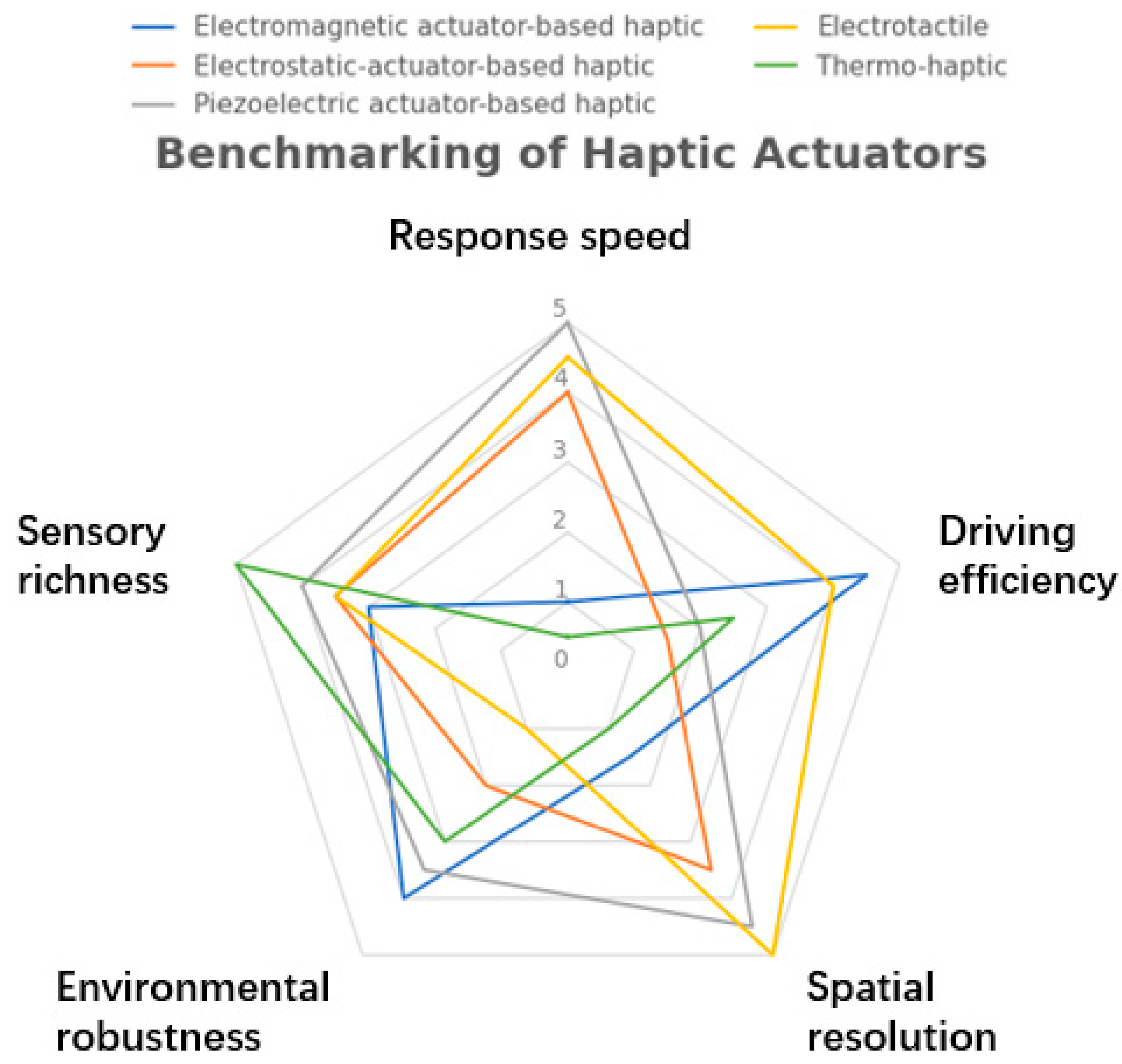
| Actuator | Driving Voltage | Driving Efficiency | Response Time | Power Use | Spatial Resolution | Ref. |
|---|---|---|---|---|---|---|
| Electrostatic actuators | Up to 1400 V | 0.3 N force 500 μm out-of-plane displacements 760 μm lateral motion | <5 ms (100 W/kg specific power) | / | <10 mm actuator design spacing | [105] |
| Electrostatic actuators | Up to 6000 V | 2.44 mm actuation stroke >2.3 N controllable force | / | 3.0 mW when holding an extended position | / | [110] |
| Electromagnetic actuators | 2 V | Up to 5.2 N 0.4 mm stroke length 10 μm vibration displacement @200 Hz | / | 1.3 W (continuous operation) 0.056% electromechanical efficiency | / | [103] |
| Electromagnetic actuators | ≤7 V (max force output) | 0.4 N @ 7 V 0.63 mm resonance displacement @ 0.1 Hz | 44.6 ms for reaching 90% max fore output | / | / | [111] |
| piezoelectric actuators | 40–60 Vpp | 2.1 m/s2 acceleration @ 60 Vpp (21 times of human vibrotactile threshold) 1.3 μm displacement @ 60 Vpp (8.5 times of human pacinian threshold) | <1.55 ms | / | 1.8 mm pitch static pressure sensor 4.8 mm pitch dynamic pressure sensor | [107] |
| Target Area | Intention Decoding & Control Strategy | Strength Augmentation | Real-World Application | Ref. |
|---|---|---|---|---|
| Hand | Geometric point cloud analysis for adaptive visual servoing control without EMG | 91 ± 2% grasp ability score | Adaptive grabbing for unknown complex geometric objects | [139] |
| Hand | Hybrid rigid-soft mechanism using differential transmission for force distribution | Exerted force up to 16.78 N | Improve wearability and comfort in daily interactive activities | [140] |
| Upper limb | KNN algorithm for motion recognition and Fuzzy PID for active control | 15% weight reduction (compare to traditional rigid exoskeletons) | Upper limb movement assistance in work settings or rehabilitation | [141] |
| Spine/lumbar | Spine-inspired passive compliance mechanism adapting to user’s trunk posture | 12 N·m extension moment at the L5-S1 joint 20–30% reduction in erector spinae activity in stoop lifting | Daily stoop lifting and squat movement assistance | [142] |
| Hip | IMU-based LMR adjusting assistance for different terrains | 10.5 ± 2.3% and 12.1% metabolic cost reduction in level walking and stair ascent | Adaptive assistance for walking on flat ground and going up and down stairs | [137] |
| Anklebone | Human–machine torque confrontation control combined with neuromusculoskeletal model | 5–7 N·m assistive torque | Gait abnormality correction and walking rehabilitation | [143] |
| Ankle-foot | LSTM neural network predicting locomotion modes using IMU and laser data | 0.66 s gait patter prediction advance 98% prediction accuracy | Zero-delay mechanical propulsion in complex real-world environments (stairs, ramps, etc.) | [138] |
Disclaimer/Publisher’s Note: The statements, opinions and data contained in all publications are solely those of the individual author(s) and contributor(s) and not of MDPI and/or the editor(s). MDPI and/or the editor(s) disclaim responsibility for any injury to people or property resulting from any ideas, methods, instructions or products referred to in the content. |
© 2026 by the authors. Licensee MDPI, Basel, Switzerland. This article is an open access article distributed under the terms and conditions of the Creative Commons Attribution (CC BY) license.
Share and Cite
Wei, H.; Hua, J.; Jiang, Y.; Zhu, W.; Cheng, W.; Shi, Y.; Pan, L. Seamless Human–Computer Interaction Enabled by Wearable Biointerfaces and Intelligent Systems. Biomimetics 2026, 11, 368. https://doi.org/10.3390/biomimetics11060368
Wei H, Hua J, Jiang Y, Zhu W, Cheng W, Shi Y, Pan L. Seamless Human–Computer Interaction Enabled by Wearable Biointerfaces and Intelligent Systems. Biomimetics. 2026; 11(6):368. https://doi.org/10.3390/biomimetics11060368
Chicago/Turabian StyleWei, Huiyu, Jiangbo Hua, Yongchang Jiang, Wenkai Zhu, Wen Cheng, Yi Shi, and Lijia Pan. 2026. "Seamless Human–Computer Interaction Enabled by Wearable Biointerfaces and Intelligent Systems" Biomimetics 11, no. 6: 368. https://doi.org/10.3390/biomimetics11060368
APA StyleWei, H., Hua, J., Jiang, Y., Zhu, W., Cheng, W., Shi, Y., & Pan, L. (2026). Seamless Human–Computer Interaction Enabled by Wearable Biointerfaces and Intelligent Systems. Biomimetics, 11(6), 368. https://doi.org/10.3390/biomimetics11060368