3.1. Modeling of the Soft Finger Bending Deformation
The configuration of the three fingers of the soft modular gripper is shown in
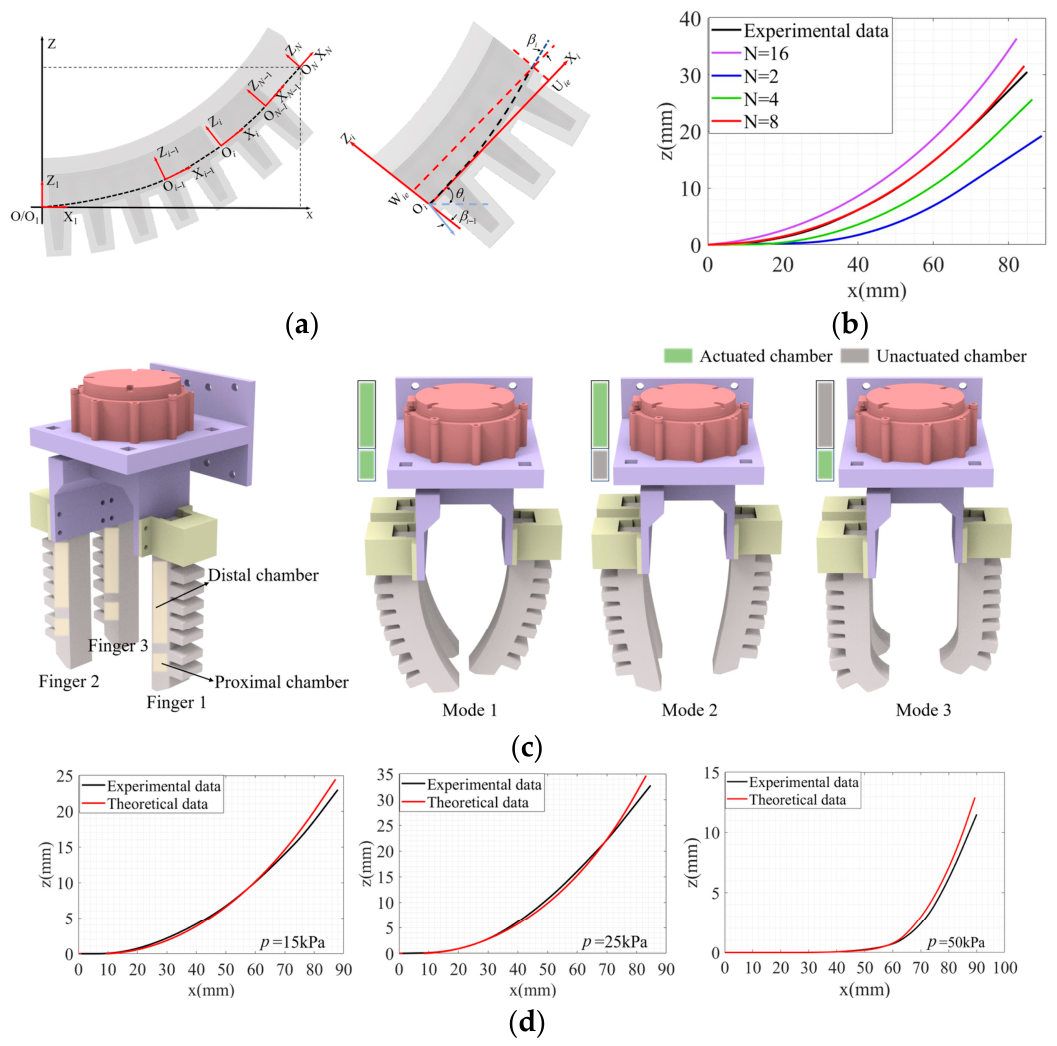
Figure 2a. Fingers 2 and 3 are arranged side by side, with a spacing of 4.6 cm between them. Finger 1 is positioned opposite to Fingers 2 and 3, aligned with the centerline of the gap between them, at a distance of 10 cm. To enable grasping control of the soft modular gripper, it is first necessary to determine its operational workspace. The fingers, made of AB silicone, exhibit nonlinear bending deformation under pneumatic actuation. Therefore, a mathematical model of the operational workspace of the soft modular gripper is required. In this paper, the deformation of the finger is modeled by combining the double-layer plate theory with the constant curvature assumption. Based on this, the D-H parameters of the soft modular gripper are established, enabling the determination of its operational workspace. As shown in
Figure 2a, establish a coordinate system at the midpoint of the fixed end of the finger at point O, and discretize the finger’s bending deformation into
N segments. The rotation angle of the
i-th discrete unit is expressed as follows:
where
is rotation angle in the fixed coordinate system (O-XYZ), and
is the rotation angle in the local coordinate system (O-X
iY
iZ
i). The initial bending angle
is assumed to be zero.
Under the assumption of Euler-Bernoulli kinematics (where the normal remain straight and perpendicular to the mid-surface before and after deformation), the plane displacement field of the
i-th element in three-dimensional space can be expressed as a polynomial function containing undetermined coefficients:
where
,
, and
represent the displacements in the X, Y, and Z directions in the fixed coordinate system, respectively. And
bi1,
bi3,
ci1, and
di2 are polynomial coefficients.
The displacement
can be calculated from the strain as follows:
Based on the theory of small deformation elasticity, the stress–strain relationship of the soft finger is expressed using the generalized Hooke’s law as follows:
Although the soft finger exhibits large bending deformation macroscopically, the finger is discretized into multiple short segments in the modeling. For each individual segment, the rotation angle and local deformation are sufficiently small, which strictly satisfies the applicable conditions of small-deformation elasticity, Euler-Bernoulli kinematics, and generalized Hooke’s law. Meanwhile, the thickness of the finger is much smaller than its in-plane dimensions, which conforms to the plane-stress assumption in classical laminated plate theory. Therefore, these assumptions are reasonable for the deformation analysis of the soft finger.
Introduce the plane stress assumption from classical laminated plate theory, which neglects the effects of transverse shear stress and normal stress, making the corresponding strain energy component zero. Assume that the driven part of the soft finger is the fluid layer, the undriven part is the constraint layer, and that the constraint layer remains unchanged during the driving process. The strain energy of the constraint layer and fluid layer for the
i-th unit is expressed as follows:
where
ECL(i) and
EFL(i) represent the strain energy of the constraint layer and the fluid layer, respectively.
Q is the stiffness matrix, which can be calculated using the elastic modulus and Poisson’s ratio.
According to the principle of energy conservation, it is assumed that the work done by the pressure is completely converted into the strain energy of the finger’s bending:
where
E(i) and
WP(i) represent the strain energy and the work done by the pressure for the
i-th segment, respectively.
ki is the coefficient in the displacement polynomial
i-th segment.
The work done by the pressure is calculated as follows:
where
P0 and
Pf represent the initial and final driving pressures, respectively. And
Vi0 and
Vif represent the initial and final driving volumes, respectively.
is air adiabatic coefficient, which is assumed to be equal to 1.4.
By combining Equations (1)–(9) and using the Rayleigh-Ritz method, the deformation centerline of the soft finger is obtained. As shown in
Figure 2b, the centerline of the soft finger’s bending at different segments, with the two chamber driving pressures set to 25 kPa, is compared with the experimentally obtained centerline. The theoretical centerline of the soft finger becomes increasingly curved as the number of segments increases. The theoretical value when the soft finger is discretized into 8 segments is the closest to the experimental result. Therefore, in calculating the soft finger’s behavior under different working modes, it is assumed that each finger is discretized into 8 segments.
As shown in
Figure 2c, the soft finger has three working modes: Mode 1 is to drive both chambers of the finger simultaneously with the same pressure; Mode 2 is to drive only the proximal end of the finger; Mode 3 is to drive only the distal end of the finger. For the three working modes, the theoretical and experimental values of the finger’s bending centerline are compared, as shown in
Figure 2d. The driving pressures for Modes 1, 2, and 3 are 15 kPa, 25 kPa, and 50 kPa, respectively. To quantitatively evaluate the modeling accuracy, the mean absolute error (MAE) and root mean square error (RMSE) are calculated. For Mode 1, the MAE is 0.41 mm and the RMSE is 0.63 mm; for Mode 2, the MAE is 0.50 mm and the RMSE is 0.78 mm; for Mode 3, the MAE is 0.26 mm and the RMSE is 0.51 mm. Theoretical values and experimental values are generally similar, allowing the derived model to be used for establishing the operational space of the soft finger.
3.2. Operational Space of the Gripper
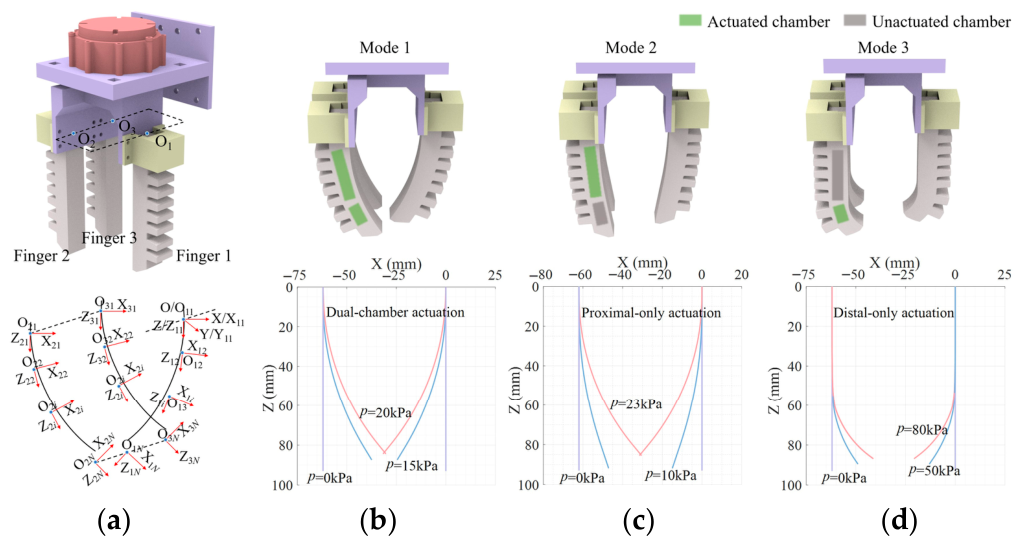
The gripper has three working modes. Therefore, a spatial coordinate system for the gripper is established, and using the D-H parameter method, the operational space for different working modes is obtained. As shown in
Figure 3a, the spatial coordinate system for the gripper is established. O
1, O
2, and O
3 represent the center points of the fixed ends of the three fingers, respectively. The global coordinate system (O-XYZ) is established at point O
1, and local coordinate systems (
) are established at each discrete point on the fingers. By using the secondary transformation coordinate system, the centerline of the soft finger can be expressed in the fixed coordinate system. The soft finger undergoes planar bending. By first rotating around the Z
i(i−1)-axis and then translating along the X
i(i−1)-axis, the coordinates of the soft finger can be transformed into the fixed coordinate system.
The centerline of the gripper in the homogeneous coordinate system is expressed as follows:
where
and
lij represent the rotation angles and translation distances for transforming the coordinates of the
i-th finger from the (
j − 1)-th joint coordinate system to the
j-th joint coordinate system.
The operational spaces of the gripper under the three working modes are illustrated in
Figure 3b–d. Through theoretical derivation, the maximum driving pressures during the gripping phase for modes 1, 2, and 3 were determined to be 20, 23, and 80 kPa, respectively. These maximum driving pressures refer to the pressures when the fingertips reach a specific position. At these pressure levels, the fingertips of the three fingers align in a straight line. If the pressure exceeds the corresponding maximum value, the gripper will lose its ability to grasp objects effectively.



 ,
,