
Federated Multi-View Unsupervised Feature Selection via Bio-Inspired Hierarchical-Cognitive Tianji’s Horse Racing Optimization and Tensor Learning


Abstract
1. Introduction
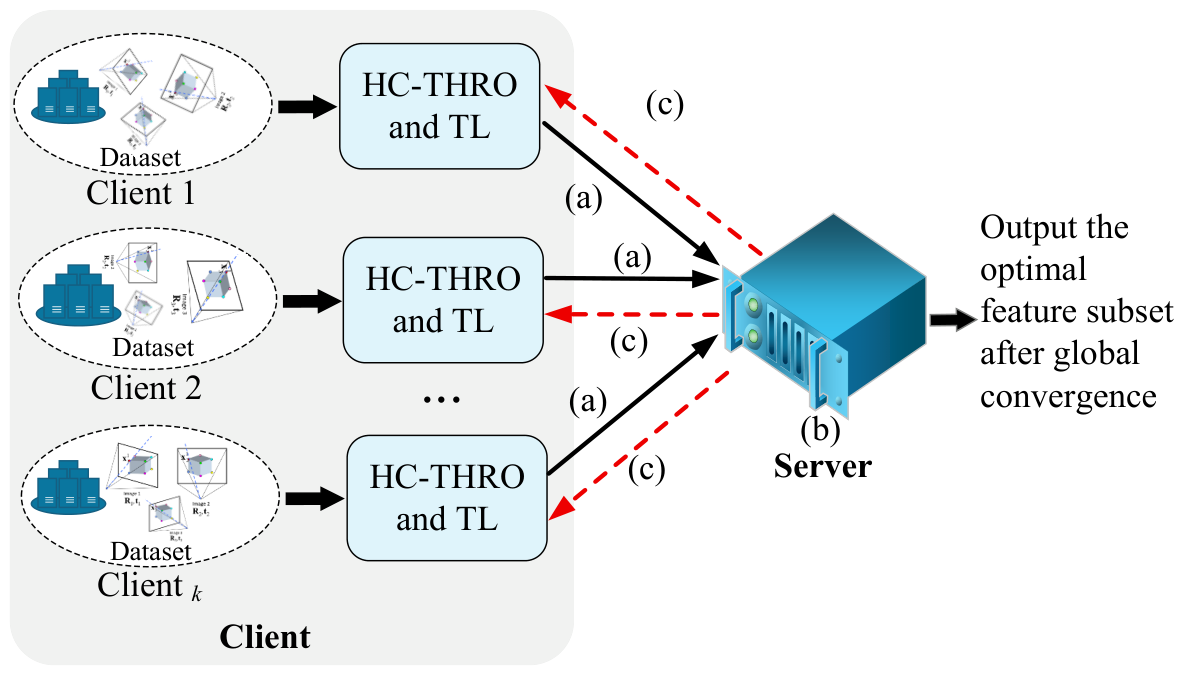
- We present Fed-MUFSHT, a privacy-preserving federated MUFS framework that enables collaborative feature selection over distributed multi-view data under the “data silo” constraint.
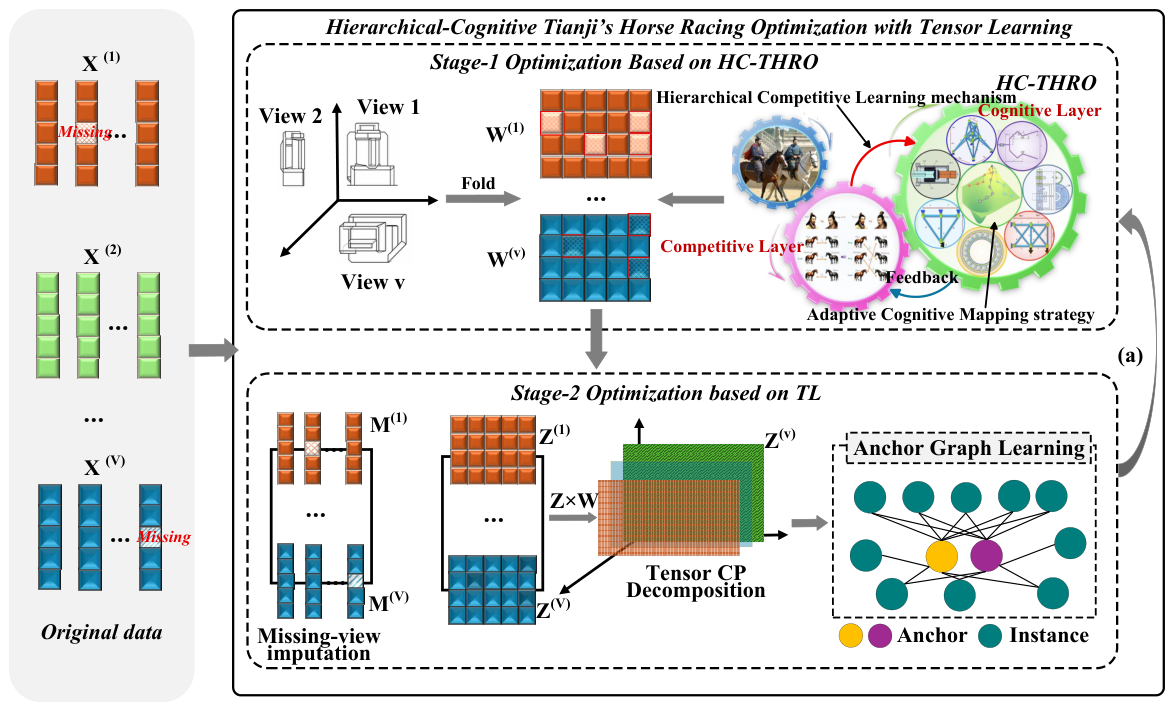
- We develop a two-stage client-side optimization scheme: (i) HC-THRO integrates hierarchical competition with cognitive adaptation to improve exploration–exploitation balance and achieve fine-grained selection in high-dimensional spaces; (ii) a CP-based TL module performs missing-view imputation and latent representation refinement to better exploit cross-view dependencies.
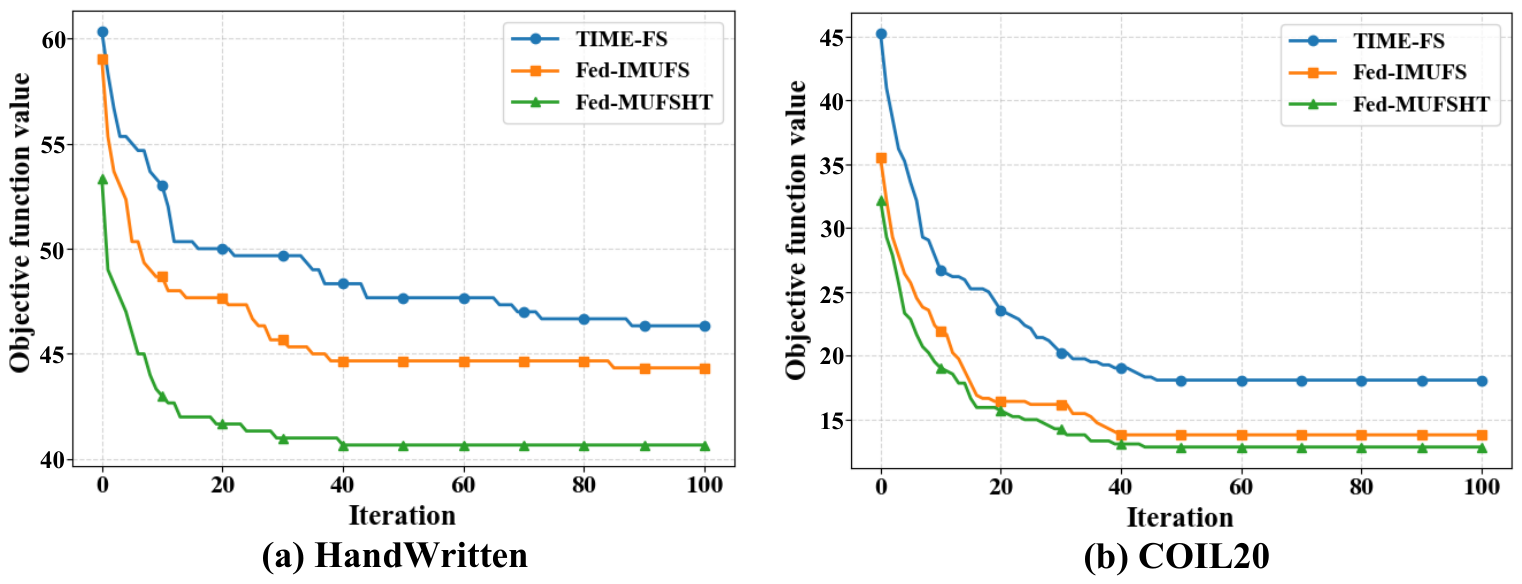
- We design an NMI-guided secure aggregation strategy with adaptive feature weighting, which stabilizes federated optimization and yields superior solution quality compared with state-of-the-art centralized and federated baselines.
2. Related Work
2.1. Single-View Unsupervised FS
2.2. Multi-View Unsupervised FS
3. The Proposed Method
3.1. Client-Side Operations
3.1.1. MUFS Matrix Initialization
3.1.2. Outer-Layer Optimization Based on HC-THRO
3.1.3. Inner-Layer Optimization Mechanism Based on Tensor Learning
3.2. Server-Side Operations
3.2.1. A Secure Aggregation Strategy Utilizing NMI and Adaptive Feature Weighting
3.2.2. Privacy Analysis
3.3. Convergence and Complexity Analysis
3.3.1. Convergence Analysis
3.3.2. Computational Cost Evaluation
3.3.3. Communication Overhead
4. Experiments
4.1. Setup Details
4.1.1. Details of Datasets
4.1.2. Discussion on Non-IID Scenarios
- (i)
- Advanced quality-aware weighting. A critical distinction lies in the weighting mechanism. While both methods use NMI scores, Fed-IMUFS employs simple linear normalization. In contrast, Fed-MUFSHT utilizes a more robust and flexible softmax function with a temperature parameter (Equation (16)). This provides more principled control over the influence of client updates. In scenarios with high statistical heterogeneity, where some local models may be of poor quality, a small can sharply increase the weight of high-performing clients while effectively silencing the detrimental ones. Conversely, a large can smooth the weights towards uniform averaging. This adaptability makes our aggregation strategy more resilient to the diverse model qualities arising from Non-IID data.
- (ii)
- Personalized model distribution. Perhaps the most fundamental advantage is our personalized model distribution strategy (Equation (18)), a feature entirely absent in Fed-IMUFS. Instead of broadcasting a single, generic global model to all clients, we provide each client k with a personalized initialization . This allows each client to retain a portion of its locally adapted knowledge while incorporating global consensus. This mechanism is crucial for mitigating “client drift” in Non-IID settings, as it prevents a generalized global model from completely overwriting specialized local knowledge, thereby preserving performance on heterogeneous local data.
4.1.3. Hardware and Runtime Platform
4.1.4. Comparative Baselines and Hyperparameters
4.1.5. Comparison Protocol
4.2. Overall Performance Analysis of Fed-MUFSHT
4.3. Ablation Study
4.4. Hyperparameter Sensitivity Analysis
4.5. Statistical Significance Analysis
5. Conclusions
Author Contributions
Funding
Institutional Review Board Statement
Informed Consent Statement
Data Availability Statement
Conflicts of Interest
References
- Hao, P.; Liu, K.; Gao, W. Uncertainty-Aware Global-View Reconstruction for Multi-View Multi-Label Feature Selection. Proc. AAAI Conf. Artif. Intell. 2025, 39, 17068–17076. [Google Scholar] [CrossRef]
- Ran, W.; Yuan, W.; Zheng, Y. You Always Recognize Me (YARM): Robust Texture Synthesis Against Multi-View Corruption. In Proceedings of the 42nd International Conference on Machine Learning, Vancouver, BC, Canada, 13–19 July 2025. [Google Scholar]
- Hu, R.; Gan, J.; Zhan, M.; Li, L.; Wei, M. Unsupervised Kernel-based Multi-view Feature Selection with Robust Self-representation and Binary Hashing. Proc. AAAI Conf. Artif. Intell. 2025, 39, 17287–17294. [Google Scholar] [CrossRef]
- Jiao, P.; Yan, P.; Zhang, J.; Zhao, Z.; Su, F.; Zhang, W. Mining User Features with Hyperbolic Representations for Diffusion Prediction. Neural Netw. 2026, 200, 108855. [Google Scholar] [CrossRef]
- Li, X.; Deng, B.; He, Y.; Chen, Q.; Zhang, Y.; Zhang, B. Wind Turbine Blade Surface Defect Detection via UAV High-Resolution Images. IEEE Sens. J. 2025, 26, 2678–2687. [Google Scholar] [CrossRef]
- Sun, T.; Xia, W.; Shu, J.; Sang, C.; Feng, M.; Xu, X. Advances and Challenges in Machine Learning for RNA-Small Molecule Interaction Modeling. J. Chem. Theory Comput. 2025, 21, 8615–8633. [Google Scholar] [CrossRef]
- Yao, Z.; Zhu, Q. A Two-Stage Wiener Process-Based Method for Bearing Remaining Useful Life Prediction Considering Measurement Uncertainty; Measurement Science and Technology: Bristol, UK, 2026. [Google Scholar]
- Liang, C.; Wang, L.; Liu, L.; Zhang, H.; Guo, F. Multi-view unsupervised feature selection with tensor robust principal component analysis and consensus graph learning. Pattern Recognit. 2023, 141, 109632. [Google Scholar] [CrossRef]
- Zhang, C.; Fang, Y.; Liang, X.; Wu, X.; Jiang, B.; Sheng, B. Efficient multi-view unsupervised feature selection with adaptive structure learning and inference. In Proceedings of the 33rd International Joint Conference on Artificial Intelligence (IJCAI-24), Jeju, Republic of Korea, 3–9 August 2024; pp. 5443–5452. [Google Scholar]
- Wei, X.; Chen, G.; Zhu, Y.; Hu, F.; Zhang, C.; Han, Z.; Wang, W. FedHGL: Cross-institutional federated heterogeneous graph learning for IoT. IEEE Internet Things J. 2024, 11, 25590–25599. [Google Scholar] [CrossRef]
- Qi, Z.; Meng, L.; Li, Z.; Hu, H.; Meng, X. Cross-silo feature space alignment for federated learning on clients with imbalanced data. Proc. AAAI Conf. Artif. Intell. 2025, 39, 19986–19994. [Google Scholar] [CrossRef]
- Ali, W.; Zhou, X.; Shao, J. Privacy-preserved and responsible recommenders: From conventional defense to federated learning and blockchain. ACM Comput. Surv. 2025, 57, 119. [Google Scholar] [CrossRef]
- Chen, G.; Li, Z.; Wang, L. Optimal consensus control of nonlinear multi-agent systems by data-driven optimistic policy iteration. J. Frankl. Inst. 2025, 362, 11. [Google Scholar] [CrossRef]
- Zhang, W.; Zhou, S.; Walsh, T.; Weiss, J.C. Fairness amidst non-IID graph data: A literature review. AI Mag. 2025, 46, e12212. [Google Scholar] [CrossRef]
- Li, Z.; Nie, F.; Bian, J.; Wu, D.; Li, X. Sparse PCA via L2,p-Norm Regularization for Unsupervised Feature Selection. IEEE Trans. Pattern Anal. Mach. Intell. 2021, 45, 5322–5328. [Google Scholar] [CrossRef]
- Xu, W.; Huang, M.; Jiang, Z.; Qian, Y. Graph-based unsupervised feature selection for interval-valued information system. IEEE Trans. Neural Netw. Learn. Syst. 2023, 35, 12576–12589. [Google Scholar] [CrossRef]
- Mi, Y.; Chen, H.; Luo, C.; Horng, S.-J.; Li, T. Unsupervised feature selection with high-order similarity learning. Knowl.-Based Syst. 2024, 285, 111317. [Google Scholar] [CrossRef]
- Fang, S.-G.; Huang, D.; Wang, C.-D.; Tang, Y. Joint multi-view unsupervised feature selection and graph learning. IEEE Trans. Emerg. Top. Comput. Intell. 2023, 8, 16–31. [Google Scholar] [CrossRef]
- Cao, Z.; Xie, X.; Li, Y. Multi-view unsupervised feature selection with consensus partition and diverse graph. Inf. Sci. 2024, 661, 120178. [Google Scholar] [CrossRef]
- Zhou, S.; Song, P.; Yu, Y.; Zheng, W. Structural regularization based discriminative multi-view unsupervised feature selection. Knowl.-Based Syst. 2023, 272, 110601. [Google Scholar] [CrossRef]
- Wang, H.; Yao, M.; Chen, Y.; Xu, Y.; Liu, H.; Jia, W.; Fu, X.; Wang, Y. Manifold-based incomplete multi-view clustering via bi-consistency guidance. IEEE Trans. Multimed. 2024, 26, 10001–10014. [Google Scholar] [CrossRef]
- Yin, J.; Wang, P.; Sun, S.; Zheng, Z. Incomplete Multi-View Clustering via Multi-Level Contrastive Learning. IEEE Trans. Knowl. Data Eng. 2025, 37, 4716–4727. [Google Scholar] [CrossRef]
- Huang, Y.; Lu, M.; Huang, W.; Yi, X.; Li, T. Time-fs: Joint learning of tensorial incomplete multi-view unsupervised feature selection and missing-view imputation. Proc. AAAI Conf. Artif. Intell. 2025, 39, 17503–17510. [Google Scholar] [CrossRef]
- Lin, C.; Yang, Y.; Kong, X.; Yang, G.; Liu, J. Dual-population hybrid prediction co-evolutionary algorithm for dynamic constrained multiobjective optimization. Expert Syst. Appl. 2026, 314, 131649. [Google Scholar] [CrossRef]
- Jia, H.; Zhou, X.; Zhang, J.; Mirjalili, S. Superb Fairy-wren Optimization Algorithm: A novel metaheuristic algorithm for solving feature selection problems. Clust. Comput. 2025, 28, 246. [Google Scholar] [CrossRef]
- El-Kenawy, E.S.M.; Rizk, F.H.; Zaki, A.M.; Mohammed, M.E. iHow optimization algorithm: A human-inspired metaheuristic approach for complex problem solving and feature selection. J. Artif. Intell. Eng. Pract. 2024, 1, 36–53. [Google Scholar] [CrossRef]
- Yu, Y.F.; Wang, Z.; Chen, X.; Feng, Q. Particle swarm optimization algorithm based on teaming behavior. Knowl.-Based Syst. 2025, 318, 113555. [Google Scholar] [CrossRef]
- Wang, T.L.; Gu, S.W.; Liu, R.J.; Chen, L.-Q.; Wang, Z.; Zeng, Z.-Q. Cuckoo catfish optimizer: A new meta-heuristic optimization algorithm. Artif. Intell. Rev. 2025, 58, 326. [Google Scholar] [CrossRef]
- He, X.; Cai, D.; Niyogi, P. Laplacian score for feature selection. In Proceedings of the Advances in Neural Information Processing Systems 18 (NIPS 2005), Vancouver, BC, Canada, 5–8 December 2005; MIT Press: Cambridge, MA, USA, 2005. [Google Scholar]
- Zhao, Z.; Liu, H. Spectral feature selection for supervised and unsupervised learning. In Proceedings of the 24th International Conference on Machine Learning, Corvallis, OR, USA, 20–24 June 2007; Association for Computing Machinery: New York, NY, USA, 2007; pp. 1151–1157. [Google Scholar]
- Shi, D.; Zhu, L.; Li, J.; Zhang, Z.; Chang, X. Unsupervised adaptive feature selection with binary hashing. IEEE Trans. Image Process. 2023, 32, 838–853. [Google Scholar] [CrossRef] [PubMed]
- Wang, C.; Wang, J.; Gu, Z.; Wei, J.M.; Liu, J. Unsupervised feature selection by learning exponential weights. Pattern Recognit. 2024, 148, 110183. [Google Scholar] [CrossRef]
- Li, T.; Qian, Y.; Li, F.; Liang, X.; Zhan, Z.H. Feature subspace learning-based binary differential evolution algorithm for unsupervised feature selection. IEEE Trans. Big Data 2025, 11, 99–114. [Google Scholar] [CrossRef]
- Fan, Z.; Xiao, Z.; Li, X.; Huang, Z.; Zhang, C. MSBWO: A Multi-Strategies Improved Beluga Whale Optimization Algorithm for Feature Selection. Biomimetics 2024, 9, 572. [Google Scholar] [CrossRef] [PubMed]
- Miao, F.; Wu, Y.; Yan, G.; Si, X. Dynamic multi-swarm whale optimization algorithm based on elite tuning for high-dimensional feature selection classification problems. Appl. Soft Comput. 2025, 169, 112634. [Google Scholar] [CrossRef]
- Pramanik, P.; Pramanik, R.; Naskar, A.; Mirjalili, S.; Sarkar, R. U-WOA: An unsupervised whale optimization algorithm based deep feature selection method for cancer detection in breast ultrasound images. In Handbook of Whale Optimization Algorithm; Academic Press: New York, NY, USA, 2024; pp. 179–191. [Google Scholar]
- Nie, F.; Zhu, W.; Li, X. Unsupervised feature selection with structured graph optimization. In Proceedings of the AAAI Conference on Artificial Intelligence, Phoenix, AZ, USA, 12–17 February 2016; Volume 30. [Google Scholar]
- Wang, Z.; Feng, Y.; Qi, T.; Yang, X.; Zhang, J.J. Adaptive multi-view feature selection for human motion retrieval. Signal Process. 2016, 120, 691–701. [Google Scholar] [CrossRef]
- Cao, Z.; Xie, X. Multi-view unsupervised complementary feature selection with multi-order similarity learning. Knowl.-Based Syst. 2024, 283, 111172. [Google Scholar] [CrossRef]
- Liu, Q.; Liu, S.; Liu, X.; Dai, J. Latent Semantics and Anchor Graph Multi-layer Learning for Multi-view Unsupervised Feature Selection. IEEE Trans. Knowl. Data Eng. 2025, 37, 6032–6045. [Google Scholar] [CrossRef]
- Yang, X.; Che, H.; Leung, M.F. Tensor-based unsupervised feature selection for error-robust handling of unbalanced incomplete multi-view data. Inf. Fusion 2025, 114, 102693. [Google Scholar] [CrossRef]
- Yu, H.W.; Wu, J.Y.; Wu, J.S.; Min, W. Confident local similarity graphs for unsupervised feature selection on incomplete multi-view data. Knowl.-Based Syst. 2025, 316, 113369. [Google Scholar] [CrossRef]
- Yuan, Y.; Wu, W.; Xu, C.-A.; Zhang, W.; Jin, C. Federated Incomplete Multi-View Unsupervised Feature Selection with Fractional Sparsity-Guided Whale Optimization and Tensor Alternating Learning. Fractal Fract. 2025, 9, 717. [Google Scholar] [CrossRef]
- Shen, Y.; Wang, H.; Wan, J.; Zhang, L.; Huang, J.; Pan, Z. SEEIR: Secure and Efficient Encrypted Image Retrieval Based on Additive Secret Sharing. IEEE Trans. Netw. Sci. Eng. 2025, 12, 3784–3796. [Google Scholar] [CrossRef]
- Zhao, Y.; Zhang, K.; Gao, L.; Chen, J. Privacy and fairness analysis in the post-processed differential privacy framework. IEEE Trans. Inf. Forensics Secur. 2025, 20, 2412–2423. [Google Scholar] [CrossRef]
- Song, B.; Khanduri, P.; Zhang, X.; Yi, J.; Hong, M. FedAvg converges to zero training loss linearly for overparameterized multi-layer neural networks. In Proceedings of the International Conference on Machine Learning; PMLR: Cambridge, MA, USA, 2023; pp. 32304–32330. [Google Scholar]
- Li, B.; Peng, Z.; Li, Y.; Li, Z.; Chen, S.; Shen, C.; Quek, T.Q. Neighborhood and Global Perturbations Supported Sharpness-Aware Minimization in Federated Learning: From Local Tweaks to Global Awareness. IEEE Trans. Netw. Sci. Eng. 2025, 13, 5000–5017. [Google Scholar] [CrossRef]
- Cao, Z.; Xie, X. Structure Learning with Consensus Label Information for Multi-View Unsupervised Feature Selection. Expert Syst. Appl. 2024, 238, 121893. [Google Scholar] [CrossRef]
- Mei, M.; Zhang, S.; Ye, Z.; Wang, M.; Zhou, W.; Yang, J.; Shen, J. A cooperative hybrid breeding swarm intelligence algorithm for feature selection. Pattern Recognit. 2026, 169, 111901. [Google Scholar] [CrossRef]
- Sun, H.; Xiong, T.; Hou, Z.; Chen, H. Federated multi-label feature selection via manifold sparse constraints and game-theoretic evolutionary ant colony optimization. J. King Saud. Univ. Comput. Inf. Sci. 2025, 38, 32. [Google Scholar] [CrossRef]



| Aspect | TIME-FS [23] | Fed-IMUFS [43] | Fed-MUFSHT (Ours) |
|---|---|---|---|
| Learning paradigm | Centralized | Federated | Federated |
| Optimization strategy | Single-stage alternating optimization (ALS) | Two-stage: WOA + Tensor alternating learning | Two-stage synergistic: HC-THRO (outer) + TL (inner) with closed-loop feedback |
| Global search mechanism | None (prone to local optima) | Sparsity-guided WOA | HC-THRO with HCL & ACM |
| Exploration–exploitation balance | Relies solely on ALS initialization | Sparsity-guided WOA operators | Dual-mechanism: HCL for inter-population competition + ACM for cognitive refinement |
| Federated aggregation | Not applicable | Standard weighted averaging | NMI-based quality-aware softmax weighting with personalized redistribution |
| Inner–outer coupling | Not applicable | Sequential (loosely coupled) | Tightly coupled: TL output refines HC-THRO fitness; HC-THRO solution initializes TL |
| Datasets | Samples | Classes | Views | Features |
|---|---|---|---|---|
| COIL20 | 1440 | 20 | 3 | 30/19/30 |
| BBCSport | 544 | 5 | 2 | 7073/6935 |
| HandWritten | 544 | 5 | 2 | 4657/1125 |
| Digit4k | 2000 | 10 | 4 | 240/216/47/64 |
| Yale | 165 | 15 | 2 | 1024/3304/6750 |
| WebKB | 2100 | 21 | 3 | 540/640/256 |
| ORL_mtv | 400 | 40 | 3 | 4096/3304/6750 |
| Caltech101 | 1474 | 7 | 6 | 48/40/254/1984/512/928 |
| Methods | BBCSport | WebKB | Digit4k | Computational Cost |
|---|---|---|---|---|
| Fed-MUFSTH | 7.30 | 35.23 | 15.40 | |
| TIME-FS | 7.90 | 16.55 | 14.14 | |
| TRCA-CGL | 16.91 | 129.37 | 38.69 | |
| SDFS | 29.65 | 197.19 | 53.45 | |
| CDMvFS | 52.03 | 529.98 | 76.38 | |
| JMVFG | 9.22 | 73.78 | 56.45 | |
| SCMvFS | 23.05 | 258.15 | 65.64 | |
| Fed-IMUFS | 8.10 | 47.01 | 16.40 |
| Datasets | Proposed | Proposed-I | Proposed-II | Proposed-III | Proposed-IV | Proposed-V | Proposed-VI | |||||||
|---|---|---|---|---|---|---|---|---|---|---|---|---|---|---|
| ACC | NMI | ACC | NMI | ACC | NMI | ACC | NMI | ACC | NMI | ACC | NMI | ACC | NMI | |
| COIL20 | 91.57 * | 97.15 * | 86.82 | 92.98 | 85.97 | 91.14 | 87.43 | 93.12 | 88.06 | 92.84 | 86.64 | 91.73 | 88.41 | 93.03 |
| BBCSport | 74.55 * | 47.12 * | 70.81 | 44.97 | 71.98 | 45.14 | 71.45 | 44.11 | 71.05 | 45.85 | 70.63 | 43.72 | 71.42 | 44.23 |
| HandWritten | 78.18 * | 46.43 * | 57.95 | 65.23 | 56.62 | 59.77 | 59.84 | 62.09 | 60.21 | 61.84 | 59.45 | 60.37 | 61.72 | 62.35 |
| Digit4k | 77.65 * | 46.64 * | 72.39 | 41.14 | 71.81 | 40.08 | 73.51 | 43.12 | 72.96 | 42.74 | 71.26 | 41.33 | 73.19 | 42.53 |
| Yale | 53.65 * | 50.64 * | 50.39 | 47.14 | 49.80 | 47.07 | 51.51 | 48.11 | 51.96 | 46.78 | 50.27 | 47.38 | 50.18 | 46.52 |
| WebKB | 87.17 * | 61.89 * | 82.46 | 55.59 | 82.81 | 54.15 | 81.27 | 58.43 | 82.15 | 55.82 | 81.27 | 52.67 | 83.66 | 56.82 |
| ORL_mtv | 60.73 * | 85.28 * | 54.82 | 80.87 | 53.07 | 81.34 | 54.47 | 80.11 | 55.62 | 81.93 | 56.54 | 82.11 | 53.07 | 79.05 |
| Caltech101 | 57.85 * | 58.42 * | 50.40 | 51.47 | 52.21 | 53.84 | 52.13 | 52.24 | 53.86 | 54.92 | 53.94 | 52.31 | 51.76 | 50.88 |
| Baselines | Better | Similar | Worse | p-Value | Significance | Effect Size |
|---|---|---|---|---|---|---|
| Proposed—TIME-FS | 6 | 1 | 1 | 1.1413 × 10⁻² | + | 0.47 |
| Proposed—TRCA-CGL | 8 | 0 | 0 | 2.7432 × 10⁻² | + | 0.71 |
| Proposed—SDFS | 8 | 0 | 0 | 4.3526 × 10⁻³ | + | 0.71 |
| Proposed—CDMvFS | 8 | 0 | 0 | 4.1812 × 10⁻⁴ | + | 0.72 |
| Proposed—JMVFG | 8 | 0 | 0 | 1.7351 × 10⁻³ | + | 0.61 |
| Proposed—SCMvFS | 8 | 0 | 0 | 4.2739 × 10⁻³ | + | 0.61 |
| Proposed—Fed-IMUFS | 7 | 1 | 0 | 3.1463 × 10⁻² | + | 0.54 |
Disclaimer/Publisher’s Note: The statements, opinions and data contained in all publications are solely those of the individual author(s) and contributor(s) and not of MDPI and/or the editor(s). MDPI and/or the editor(s) disclaim responsibility for any injury to people or property resulting from any ideas, methods, instructions or products referred to in the content. |
© 2026 by the authors. Licensee MDPI, Basel, Switzerland. This article is an open access article distributed under the terms and conditions of the Creative Commons Attribution (CC BY) license.
Share and Cite
Cheng, R.; Sun, Z.; Qi, K.; Wu, W.; Xu, L. Federated Multi-View Unsupervised Feature Selection via Bio-Inspired Hierarchical-Cognitive Tianji’s Horse Racing Optimization and Tensor Learning. Biomimetics 2026, 11, 312. https://doi.org/10.3390/biomimetics11050312
Cheng R, Sun Z, Qi K, Wu W, Xu L. Federated Multi-View Unsupervised Feature Selection via Bio-Inspired Hierarchical-Cognitive Tianji’s Horse Racing Optimization and Tensor Learning. Biomimetics. 2026; 11(5):312. https://doi.org/10.3390/biomimetics11050312
Chicago/Turabian StyleCheng, Rong, Zhiwei Sun, Kun Qi, Wangyu Wu, and Lingling Xu. 2026. "Federated Multi-View Unsupervised Feature Selection via Bio-Inspired Hierarchical-Cognitive Tianji’s Horse Racing Optimization and Tensor Learning" Biomimetics 11, no. 5: 312. https://doi.org/10.3390/biomimetics11050312
APA StyleCheng, R., Sun, Z., Qi, K., Wu, W., & Xu, L. (2026). Federated Multi-View Unsupervised Feature Selection via Bio-Inspired Hierarchical-Cognitive Tianji’s Horse Racing Optimization and Tensor Learning. Biomimetics, 11(5), 312. https://doi.org/10.3390/biomimetics11050312