
Human–Robot Interaction Strategy of Service Robot with Insufficient Capability in Self-Service Shop


Abstract
1. Introduction
2. Related Works
2.1. Service Robot in Shop
2.2. Types of Insufficient Capacity for Robot
2.3. Robot Apology in HRI
2.4. User Experience in HRI
3. Design and Experiments
3.1. The Scenario of After-Sales Service in Self-Service Shop
3.2. The Performance of a Robot’s Insufficient Capabilities
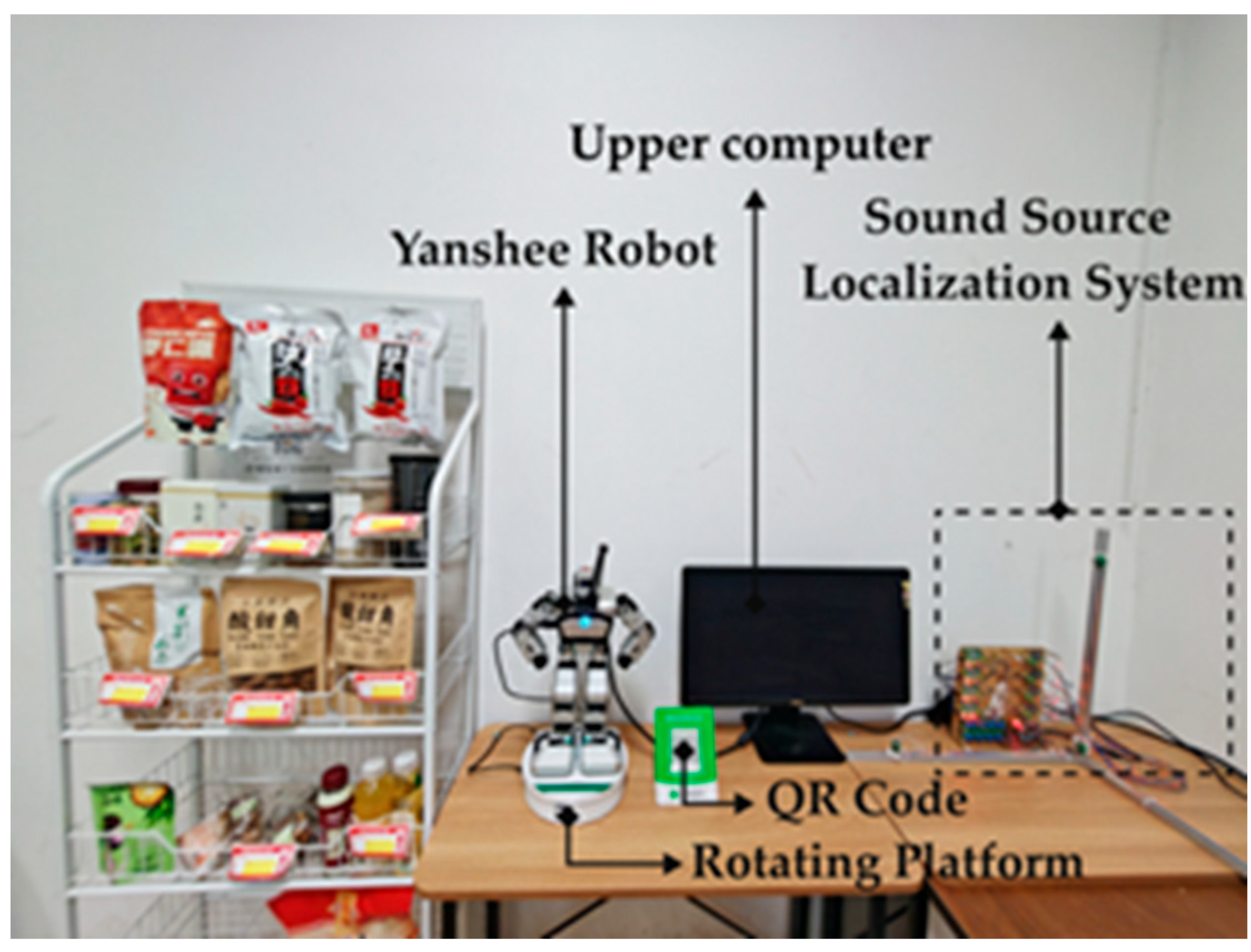
3.3. The Experimental Platform
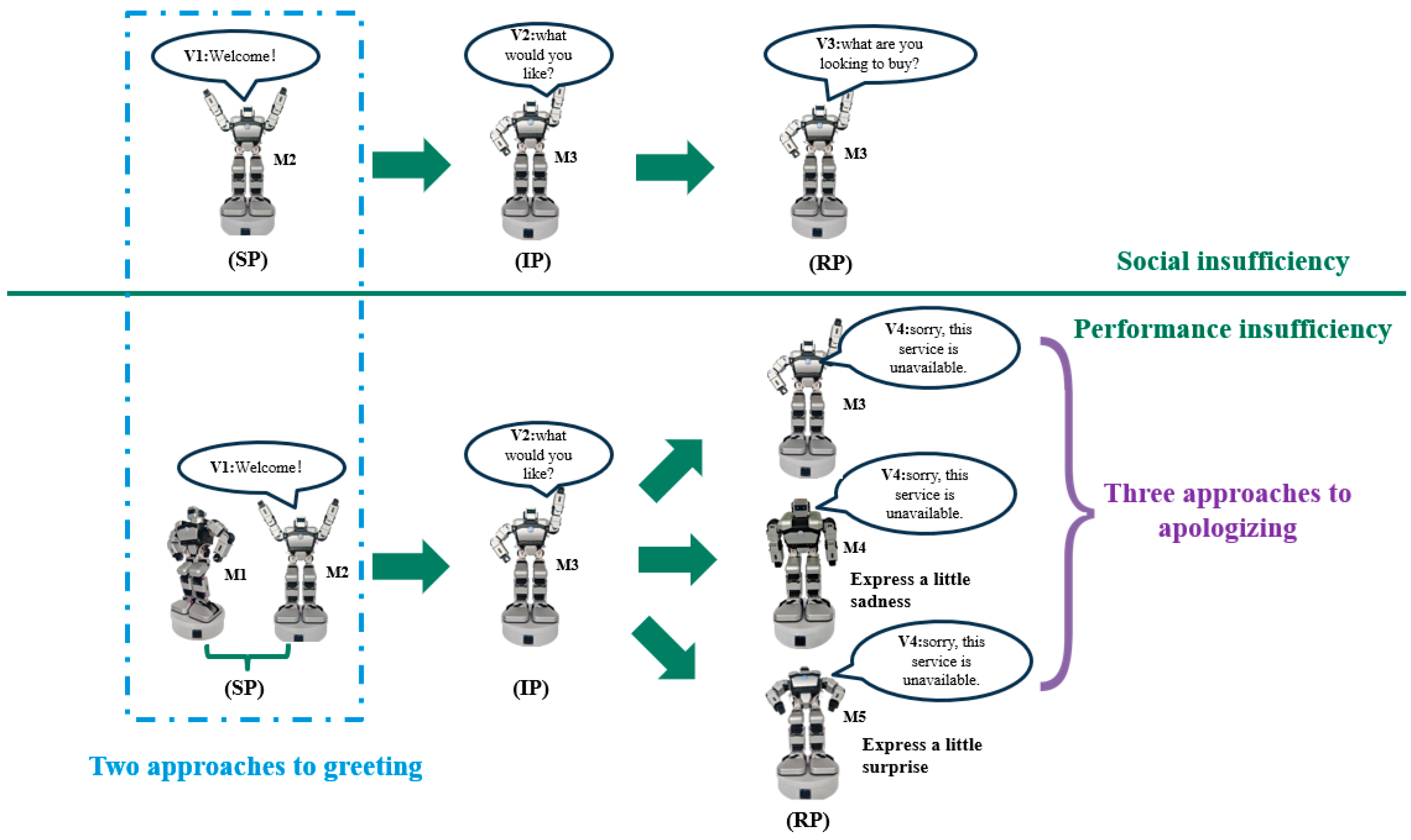
3.4. Interaction Strategies Design of Robot
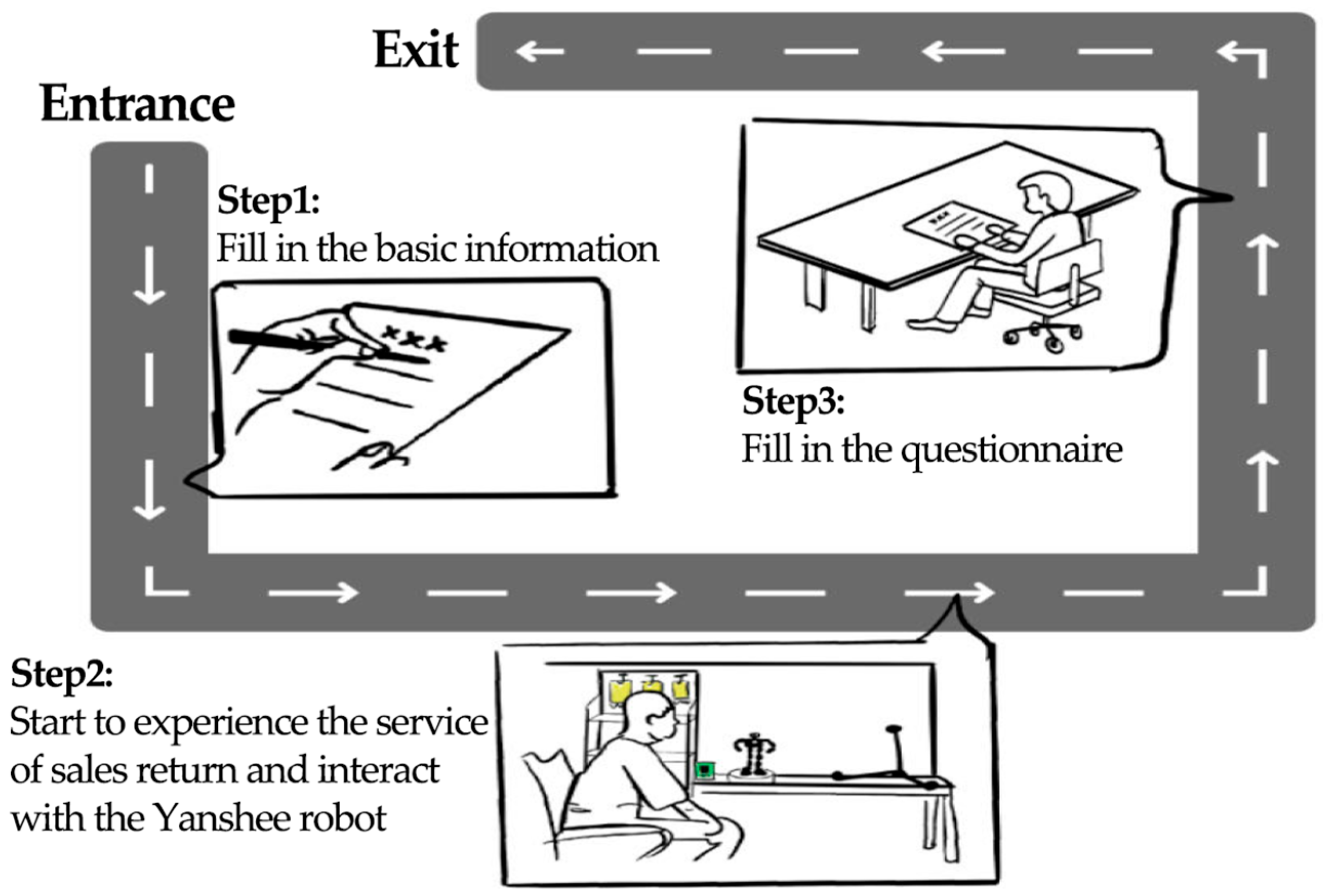
3.5. Experimental Procedure
3.6. Hypotheses
4. Results and Analysis
4.1. Reliability and Validity of Questionnaire
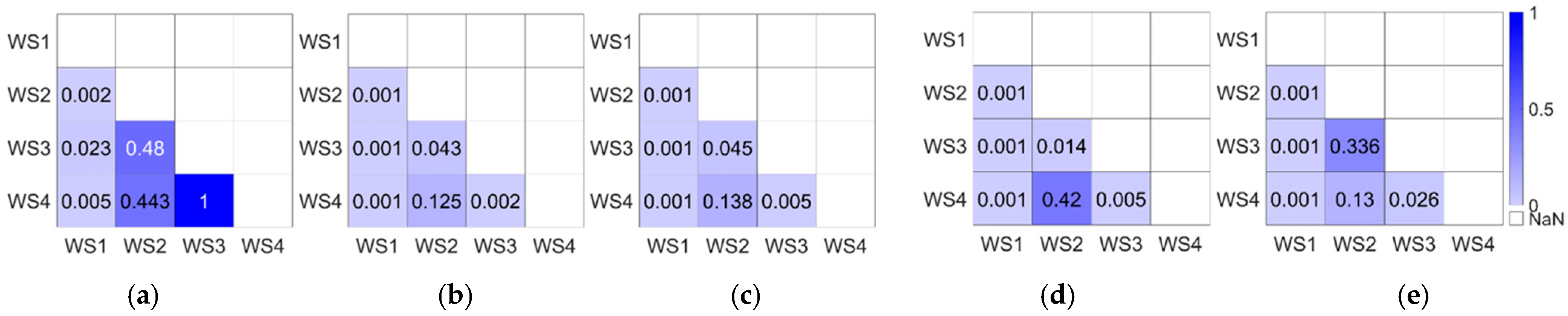
4.2. The Results of Repeated-Measures ANOVA
5. Discussion
5.1. The Impact of Different Robot’s Insufficient Capabilities on Customer Experiences
5.2. The Impact of Robot’s Apology Design on Customer Experiences in the Case of Performance Insufficiency
5.3. The Impact of Robot Turning to Face to Customers in the Cases of Robot’s Insufficient Capabilities
5.4. The Internal Relations Among the Six Customer Experiences in the Cases of Robot’s Insufficient Capabilities
5.4.1. The Results of Regression Analysis
5.4.2. The Models of Internal Relations Among the Customer Experiences in the Case of Robot with Insufficient Capabilities
5.4.3. The Discussions of Internal Relations Among the Customer Experiences in the Case of Robot with Insufficient Capabilities
6. Conclusions
- The impacts of the robot’s insufficiency on the mentioned six aspects of customer experiences are discussed. The robot’s social insufficiency shows more negative influence on fluency, comprehensibility, impression, intelligence, and willingness for future interaction compared with the robot’s performance insufficiency.
- The impacts of robot apology with empathy on the mentioned six aspects of customer experiences and the comparisons with verbal apology and verbal apology with surprised body movement are discussed. The robot’s body movements expressing empathy can obtain better experiences of comprehensibility, impression, intelligence, and willingness for future interaction. This can provide valuable insights for interaction recovery strategies in scenarios where robotic capabilities are limited.
- The robot’s social interaction cue where it turns to face customers does not affect the mentioned six aspects of customer experiences. However, it can influence the internal relations among these customer experiences.
- The internal relations between the mentioned six aspects of customer experiences are discussed. With the aim of the willingness for future interaction, these relationships can help determine the appropriate design direction.
Author Contributions
Funding
Institutional Review Board Statement
Informed Consent Statement
Data Availability Statement
Acknowledgments
Conflicts of Interest
References
- De Gauquier, L.; Brengman, M.; Willems, K. The Rise of Service Robots in Retailing: Literature Review on Success Factors and Pitfalls. In Retail Futures: The Good, the Bad and the Ugly of the Digital Transformation; Pantano, E., Ed.; Emerald Group Publishing Ltd.: Leeds, UK, 2020; pp. 15–35. [Google Scholar] [CrossRef]
- Tilston, O.; Holler, J.; Bangerter, A. Opening Social Interactions: The Coordination of Approach, Gaze, Speech, and Handshakes During Greetings. Cogn. Sci. 2025, 49, e70049. [Google Scholar] [CrossRef] [PubMed]
- Okafuji, Y.; Ozaki, Y.; Baba, J.; Nakanishi, J.; Ogawa, K.; Yoshikawa, Y.; Ishiguro, H. Behavioral Assessment of a Humanoid Robot When Attracting Pedestrians in a Mall. Int. J. Soc. Robot. 2022, 14, 1731–1747. [Google Scholar] [CrossRef] [PubMed]
- Avelino, J.; Moreno, P.; Correia, F.; Garcia-Marques, L.; Ventura, R.; Bernardino, A. Evaluating Greeting Models for Human-Robot Engagement During First Encounters. Int. J. Soc. Robot. 2025, 17, 297–314. [Google Scholar] [CrossRef]
- Shi, C.; Satake, S.; Kanda, T.; Ishiguro, H. A Robot That Distributes Flyers to Pedestrians in a Shopping Mall. Int. J. Soc. Robot. 2018, 10, 421–437. [Google Scholar] [CrossRef]
- Naito, M.; Rea, D.J.; Kanda, T. Hey Robot, Tell It to Me Straight: How Different Service Strategies Affect Human and Robot Service Outcomes. Int. J. Soc. Robot. 2023, 15, 969–982. [Google Scholar] [CrossRef]
- Kanda, T.; Shiomi, M.; Miyashita, Z.; Ishiguro, H.; Hagita, N. A Communication Robot in a Shopping Mall. IEEE Trans. Robot. 2010, 26, 897–913. [Google Scholar] [CrossRef]
- Xu, Y.; Niu, N.; Zhao, Z. Dissecting the Mixed Effects of Human-Customer Service Chatbot Interaction on Customer Satisfaction: An Explanation from Temporal and Conversational Cues. J. Retail. Consum. Serv. 2023, 74, 103417. [Google Scholar] [CrossRef]
- Chae, Y.-J.; Jeon, T.-H.; Park, S.-K.; Kim, C. Affective State Generation, Transition and Facial Expression for a Social Robot Using Texts and Personality Traits. Int. J. Soc. Robot. 2025, 17, 871–881. [Google Scholar] [CrossRef]
- Song, S.; Baba, J.; Okafuji, Y.; Nakanishi, J.; Yoshikawa, Y.; Ishiguro, H. New Comer in the Bakery Store: A Long-Term Exploratory Study Toward Design of Useful Service Robot Applications. Int. J. Soc. Robot. 2024, 16, 1901–1918. [Google Scholar] [CrossRef]
- Niemelä, M.; Heikkilä, P.; Lammi, H. A Social Service Robot in a Shopping Mall—Expectations of the Management, Retailers and Consumers. In Proceedings of the Companion of the 2017 ACM/IEEE International Conference on Human-Robot Interaction (HRI’17 Companion), Vienna, Austria, 6–9 March 2017; pp. 227–228. [Google Scholar] [CrossRef]
- Cavallo, F.; Semeraro, F.; Fiorini, L.; Magyar, G.; Sinčák, P.; Dario, P. Emotion Modelling for Social Robotics Applications: A Review. J. Bionic Eng. 2018, 15, 185–203. [Google Scholar] [CrossRef]
- Zhu, B.; Fan, X.; Gao, X.; Xu, G.; Xie, J. A Heterogeneous Attention Fusion Mechanism for the Cross-Environment Scene Classification of the Home Service Robot. Robot. Auton. Syst. 2024, 173, 104619. [Google Scholar] [CrossRef]
- Rosete, A.; Soares, B.; Salvadorinho, J.; Reis, J.; Amorim, M. Service Robots in the Hospitality Industry: An Exploratory Literature Review. In Exploring Service Science; Nóvoa, H., Drăgoicea, M., Kühl, N., Eds.; Lecture Notes in Business Information Processing; Springer International Publishing: Cham, Switzerland, 2020; Volume 377, pp. 174–194. [Google Scholar] [CrossRef]
- Giuliani, M.; Mirnig, N.; Stollnberger, G.; Stadler, S.; Buchner, R.; Tscheligi, M. Systematic Analysis of Video Data from Different Human–Robot Interaction Studies: A Categorization of Social Signals during Error Situations. Front. Psychol. 2015, 6, 931. [Google Scholar] [CrossRef]
- De Graaf, M.M.A.; Ben Allouch, S.; van Dijk, J.A.G.M. Why Do They Refuse to Use My Robot? Reasons for Non-Use Derived from a Long-Term Home Study. In Proceedings of the Companion of the 2017 ACM/IEEE International Conference on Human-Robot Interaction (HRI’17 Companion), Vienna, Austria, 6–9 March 2017; pp. 224–225. [Google Scholar] [CrossRef]
- Yam, K.C.; Bigman, Y.E.; Tang, P.M.; Ilies, R.; De Cremer, D.; Soh, H.; Gray, K. Robots at Work: People Prefer—And Forgive—Service Robots with Perceived Feelings. J. Appl. Psychol. 2021, 106, 1557–1572. [Google Scholar] [CrossRef]
- Galdelli, A.; Pietrini, R.; Mancini, A.; Zingaretti, P. Retail Robot Navigation: A Shopper Behavior-Centric Approach to Path Planning. IEEE Access 2024, 12, 50154–50164. [Google Scholar] [CrossRef]
- Nakanishi, J.; Kuramoto, I.; Baba, J.; Ogawa, K.; Yoshikawa, Y.; Ishiguro, H. Continuous Hospitality with Social Robots at a Hotel. SN Appl. Sci. 2020, 2, 452. [Google Scholar] [CrossRef]
- De Gauquier, L.; Brengman, M.; Willems, K.; Cao, H.-L.; Vanderborght, B. In or out? A Field Observational Study on the Placement of Entertaining Robots in Retailing. Int. J. Retail Distrib. Manag. 2021, 49, 846–874. [Google Scholar] [CrossRef]
- Hetherington, N.J.; Croft, E.A.; Van Der Loos, H.F.M. Hey Robot, Which Way Are You Going? Nonverbal Motion Legibility Cues for Human-Robot Spatial Interaction. IEEE Robot. Autom. Lett. 2021, 6, 5010–5015. [Google Scholar] [CrossRef]
- Zhang, X.; Lee, S.K.; Maeng, H.; Hahn, S. Effects of Failure Types on Trust Repairs in Human–Robot Interactions. Int. J. Soc. Robot. 2023, 15, 1619–1635. [Google Scholar] [CrossRef]
- Fratczak, P.; Goh, Y.M.; Kinnell, P.; Justham, L.; Soltoggio, A. Robot Apology as a Post-Accident Trust-Recovery Control Strategy in Industrial Human-Robot Interaction. Int. J. Ind. Ergon. 2021, 82, 103078. [Google Scholar] [CrossRef]
- Pompe, B.L.; Velner, E.; Truong, K.P. The Robot That Showed Remorse: Repairing Trust with a Genuine Apology. In Proceedings of the 2022 31st IEEE International Conference on Robot and Human Interactive Communication (RO-MAN), Naples, Italy, 29 August–2 September 2022; pp. 1–6. [Google Scholar] [CrossRef]
- Shiomi, M.; Hirayama, T.; Kimoto, M.; Iio, T.; Shimohara, K. Modeling of Bowing Behaviors in Apology Based on Severity. IEEE Robot. Autom. Lett. 2024, 9, 10169–10176. [Google Scholar] [CrossRef]
- Lee, M.K.; Kiesler, S.; Forlizzi, J.; Srinivasa, S.; Rybski, P. Gracefully Mitigating Breakdowns in Robotic Services. In Proceedings of the 5th ACM/IEEE International Conference on Human-Robot Interaction (HRI 2010), Osaka, Japan, 2–5 March 2010; pp. 203–210. [Google Scholar] [CrossRef]
- Oono, S.; Ishii, H.; Kihara, R.; Katagami, D.; Shuzo, M.; Maeda, E. Interaction Strategy for Robotic Apology Based on Human Orientation toward Service. Adv. Robot. 2024, 38, 226–245. [Google Scholar] [CrossRef]
- Song, J.; Gao, Y.; Huang, Y.; Chen, L. Being Friendly and Competent: Service Robots’ Proactive Behavior Facilitates Customer Value Co-Creation. Technol. Forecast. Soc. Change 2023, 196, 122861. [Google Scholar] [CrossRef]
- Kiilavuori, H.; Sariola, V.; Peltola, M.J.; Hietanen, J.K. Making Eye Contact with a Robot: Psychophysiological Responses to Eye Contact with a Human and with a Humanoid Robot. Biol. Psychol. 2021, 158, 107989. [Google Scholar] [CrossRef]
- Kelley, M.S.; Noah, J.A.; Zhang, X.; Scassellati, B.; Hirsch, J. Comparison of Human Social Brain Activity During Eye-Contact With Another Human and a Humanoid Robot. Front. Robot. AI 2021, 7, 599581. [Google Scholar] [CrossRef]
- García-Martínez, J.; Gamboa-Montero, J.J.; Castillo, J.C.; Castro-González, Á. Analyzing the Impact of Responding to Joint Attention on the User Perception of the Robot in Human-Robot Interaction. Biomimetics 2024, 9, 769. [Google Scholar] [CrossRef] [PubMed]
- Paliga, M.; Pollak, A. Development and Validation of the Fluency in Human-Robot Interaction Scale. A Two-Wave Study on Three Perspectives of Fluency. Int. J. Hum.-Comput. Stud. 2021, 155, 102698. [Google Scholar] [CrossRef]
- Wang, Y.; Kang, Q.; Zhou, S.; Dong, Y.; Liu, J. The Impact of Service Robots in Retail: Exploring the Effect of Novelty Priming on Consumer Behavior. J. Retail. Consum. Serv. 2022, 68, 103002. [Google Scholar] [CrossRef]
- Guo, L.; Liang, J.; Huang, Y.; Shang, J. The Impact of the Cuteness of Service Robots on Consumers’ Interaction Willingness. Curr. Psychol. 2024, 43, 12402–12411. [Google Scholar] [CrossRef]
- Roozen, I.; Raedts, M.; Yanycheva, A. Are Retail Customers Ready for Service Robot Assistants? Int. J. Soc. Robot. 2023, 15, 15–25. [Google Scholar] [CrossRef]
- Lee, I. Service Robots: A Systematic Literature Review. Electronics 2021, 10, 2658. [Google Scholar] [CrossRef]
- Heikkilä, P.; Lammi, H.; Niemelä, M.; Belhassein, K.; Sarthou, G.; Tammela, A.; Clodic, A.; Alami, R. Should a robot guide like a human? A qualitative four-phase study of a shopping mall robot. In Proceedings of the International Conference on Social Robotics, Madrid, Spain, 26–29 November 2019; pp. 548–557. [Google Scholar] [CrossRef]
- Jakobowsky, C.S.; Abrams, A.M.H.; Rosenthal-von Der Pütten, A.M. Gaze-Cues of Humans and Robots on Pedestrian Ways. Int. J. Soc. Robot. 2024, 16, 311–325. [Google Scholar] [CrossRef]
- Makita, K.; Brščić, D.; Kanda, T. How Should a Robot Do Indirect Handovers Politely? Int. J. Soc. Robot. 2025, 17, 1501–1515. [Google Scholar] [CrossRef]
- Edirisinghe, S.; Satake, S.; Kanda, T. Field Trial of a Shopworker Robot with Friendly Guidance and Appropriate Admonishments. ACM Trans. Hum.-Robot Interact. 2023, 12, 1–37. [Google Scholar] [CrossRef]
- Selvaggio, M.; Cognetti, M.; Nikolaidis, S.; Ivaldi, S.; Siciliano, B. Autonomy in Physical Human-Robot Interaction: A Brief Survey. IEEE Robot. Autom. Lett. 2021, 6, 7989–7996. [Google Scholar] [CrossRef]
- Liu, D.; Zhang, J.; Qi, J. Exploring Customers’ Reuse Intention to Robots under Different Service Failures: A Mind Perception Perspective. Acta Psychol. 2025, 256, 105030. [Google Scholar] [CrossRef] [PubMed]
- Liao, S.; Lin, L.; Pei, H.; Chen, Q. How Does the Status of Errant Robot Affect Our Desire for Contact?—The Moderating Effect of Team Interdependence. Ergonomics 2024, 67, 1683–1701. [Google Scholar] [CrossRef]
- Tian, L.; Oviatt, S. A Taxonomy of Social Errors in Human-Robot Interaction. ACM Trans. Hum.-Robot Interact. 2021, 10, 1–32. [Google Scholar] [CrossRef]
- Mirnig, N.; Giuliani, M.; Stollnberger, G.; Stadler, S.; Buchner, R.; Tscheligi, M. Impact of Robot Actions on Social Signals and Reaction Times in HRI Error Situations. In Proceedings of the International Conference on Social Robotics (ICSR 2015), Paris, France, 26–30 October 2015; pp. 461–471. [Google Scholar] [CrossRef]
- Lu, V.N.; Wirtz, J.; Kunz, W.H.; Paluch, S.; Gruber, T.; Martins, A.; Patterson, P.G. Service Robots, Customers and Service Employees: What Can We Learn from the Academic Literature and Where Are the Gaps? J. Serv. Theory Pract. 2020, 30, 361–391. [Google Scholar] [CrossRef]
- Choi, S.; Mattila, A.S.; Bolton, L.E. To Err Is Human(-Oid): How Do Consumers React to Robot Service Failure and Recovery? J. Serv. Res. 2021, 24, 354–371. [Google Scholar] [CrossRef]
- Wirtz, J.; Patterson, P.G.; Kunz, W.H.; Gruber, T.; Lu, V.N.; Paluch, S.; Martins, A. Brave New World: Service Robots in the Frontline. J. Serv. Manag. 2018, 29, 907–931. [Google Scholar] [CrossRef]
- Uchida, T.; Minato, T.; Koyama, T.; Ishiguro, H. Who Is Responsible for a Dialogue Breakdown? An Error Recovery Strategy That Promotes Cooperative Intentions From Humans by Mutual Attribution of Responsibility in Human-Robot Dialogues. Front. Robot. AI 2019, 6, 29. [Google Scholar] [CrossRef]
- Kim, P.H.; Dirks, K.T.; Cooper, C.D.; Ferrin, D.L. When More Blame Is Better than Less: The Implications of Internal vs. External Attributions for the Repair of Trust after a Competence- vs. Integrity-Based Trust Violation. Organ. Behav. Hum. Decis. Process. 2006, 99, 49–65. [Google Scholar] [CrossRef]
- Paliga, M. Human–Cobot Interaction Fluency and Cobot Operators’ Job Performance. The Mediating Role of Work Engagement: A Survey. Robot. Auton. Syst. 2022, 155, 104191. [Google Scholar] [CrossRef]
- Ali, S.; Green, H.N.; Iqbal, T. What Am I? Evaluating the Effect of Language Fluency and Task Competency on the Perception of a Social Robot. In Proceedings of the 2024 33rd IEEE International Conference on Robot and Human Interactive Communication (RO-MAN), Pasadena, CA, USA, 26–30 August 2024; pp. 2295–2303. [Google Scholar] [CrossRef]
- Karhu, N.; Ahtinen, A.; Siirtola, H.; Chowdhury, A.; Valokivi, H.; Kiuru, H.; Raisamo, R. Accessibility in Senior-Robot Interactions within Care Homes. In Proceedings of the 2024 IEEE-RAS 23rd International Conference on Humanoid Robots (Humanoids), Nancy, France, 22–24 November 2024; pp. 682–689. [Google Scholar] [CrossRef]
- Lu, S.; Zhong, P.; Ye, S.; Chen, B.; Sheng, Y.; Liu, R. Socialnav-fti: Field-theory-inspired social-aware navigation framework based on human behavior and social norms. In Proceedings of the 2024 IEEE/RSJ International Conference on Intelligent Robots and Systems (IROS), Abu Dhabi, United Arab Emirates, 14–18 October 2024; pp. 4808–4815. [Google Scholar] [CrossRef]
- Anastasiou, D.; Jokinen, K.; Wilcock, G. Evaluation of WikiTalk—User Studies of Human-Robot Interaction. In Human-Computer Interaction. Interaction Modalities and Techniques; Kurosu, M., Ed.; Lecture Notes in Computer Science; Springer: Berlin/Heidelberg, Germany, 2013; Volume 8007, pp. 32–42. [Google Scholar] [CrossRef]
- Qiu, H.; Li, M.; Shu, B.; Bai, B. Enhancing Hospitality Experience with Service Robots: The Mediating Role of Rapport Building. J. Hosp. Mark. Manag. 2020, 29, 247–268. [Google Scholar] [CrossRef]
- Song, X.; Gu, H.; Li, Y.; Leung, X.Y.; Ling, X. The Influence of Robot Anthropomorphism and Perceived Intelligence on Hotel Guests’ Continuance Usage Intention. Inf. Technol. Tour. 2024, 26, 89–117. [Google Scholar] [CrossRef]
- Schepers, J.; Belanche, D.; Casaló, L.V.; Flavián, C. How Smart Should a Service Robot Be? J. Serv. Res. 2022, 25, 565–582. [Google Scholar] [CrossRef]
- Latikka, R.; Turja, T.; Oksanen, A. Self-Efficacy and Acceptance of Robots. Comput. Hum. Behav. 2019, 93, 157–163. [Google Scholar] [CrossRef]
- Gao, H.; Wang, W.; Cai, M.; Wang, D.; Gao, W.; Cai, J. Unveiling the Nexus: How Perceived Intelligence Shapes the Willingness to Use Robot. Int. J. Hum.–Comput. Interact. 2025, 41, 15915–15924. [Google Scholar] [CrossRef]
- Teo, T. Modelling Technology Acceptance in Education: A Study of Pre-Service Teachers. Comput. Educ. 2009, 52, 302–312. [Google Scholar] [CrossRef]
- Hasan, B. Delineating the Effects of General and System-Specific Computer Self-Efficacy Beliefs on IS Acceptance. Inf. Manag. 2006, 43, 565–571. [Google Scholar] [CrossRef]
- Molinillo, S.; Rejón-Guardia, F.; Anaya-Sánchez, R. Exploring the Antecedents of Customers’ Willingness to Use Service Robots in Restaurants. Serv. Bus. 2023, 17, 167–193. [Google Scholar] [CrossRef]
- Hsu, L.-J.; Khoo, W.; Randall, N.; Kamino, W.; Joshi, S.; Sato, H.; Crandall, D.J.; Tsui, K.M.; Šabanović, S. Finding its voice: The influence of robot voice on fit, social attributes, and willingness to use among older adults in the US and Japan. In Proceedings of the 2023 32nd IEEE International Conference on Robot and Human Interactive Communication (RO-MAN), Busan, Republic of Korea, 28–31 August 2023; pp. 2072–2079. [Google Scholar] [CrossRef]
- Jaramillo, F.; Valenzuela, L. Building Customer Trust and Loyalty: Does Salesperson Empathy Matter? In Marketing Challenges in a Turbulent Business Environment; Groza, M.D., Ragland, C.B., Eds.; Springer International Publishing: Cham, Switzerland, 2016; pp. 611–612. [Google Scholar] [CrossRef]
- Bahadur, W.; Khan, A.N.; Ali, A.; Usman, M. Investigating the Effect of Employee Empathy on Service Loyalty: The Mediating Role of Trust in and Satisfaction with a Service Employee. J. Relatsh. Mark. 2020, 19, 229–252. [Google Scholar] [CrossRef]
- Gao, W.; Tian, Y.; Zhai, W.; Ji, Y.; Shen, S. Exploring the Impacts of Service Robot Interaction Cues on Customer Experience in Small-Scale Self-Service Shops. Sustainability 2025, 17, 10368. [Google Scholar] [CrossRef]
- Gao, W.; Shen, S.; Ji, Y.; Tian, Y. Human Perception of the Emotional Expressions of Humanoid Robot Body Movements: Evidence from Survey and Eye-Tracking Measurements. Biomimetics 2024, 9, 684. [Google Scholar] [CrossRef] [PubMed]




| Study | Robot Type | Scenario | Key Capabilities | Main Findings |
|---|---|---|---|---|
| Kanda et al. (2010) [7] | Communication robot | Shopping mall | Human detection, speech interaction, guidance, etc. | Robots can attract and guide customers, but speech recognition errors reduce engagement; human operators needed to supplement capabilities. |
| De Gauquier et al. (2021) [20] | Entertaining robot | Retail store | Entertainment, etc. | Robot placement affects customer attention and store entry; social presence positively influences shopping behavior. |
| Heikkilä et al. (2019) [37] | Social robot (Pepper) | Shopping mall | Route guidance, information providing, interaction with customers, etc. | Identified nine design implications for robot guidance behavior: help start interaction, confirm asked location, give short instructions with clear structure, inform distance to destination, use gestures and landmarks appropriately, ensure equality between retails, and stay flexible. |
| Edirisinghe et al. (2023) [40] | Shopworker robot | Retail shop | Guidance, admonishing behavior, etc. | Customers had a positive attitude toward the proposed harmonized dual-service robot and showed a high intention to use it in the future. |
| Cases | Start Phase (SP) | Inquiry Phase (IP) | Response Phase (RP) | Insufficient Capabilities |
|---|---|---|---|---|
| S1 | M2 + V1 | M3 + V2 | V3 | Social insufficiency |
| S2 | V4 | Performance insufficiency | ||
| S3 | M4 + V4 | |||
| S4 | M5 + V4 | |||
| SR1 | M1 + M2 + V1 | V3 | Social insufficiency | |
| SR2 | V4 | Performance insufficiency | ||
| SR3 | M4 + V4 | |||
| SR4 | M5 + V4 |
| Dimension | Experience | Details |
|---|---|---|
| During interaction | Fluency | How would you rate the fluency during HRI? |
| Comprehensibility | To what extent do you believe the robot can comprehend your intended meaning during HRI? | |
| After interaction | Impression | How would you rate your overall impression of HRI? |
| Intelligence | To what extent do you agree that this robot demonstrates intelligence? | |
| Interaction capability | To what extent do you believe you possess the ability to interact with the robot? | |
| Willingness for future interaction | To what extent are you willing to engage in communication with the robot in the future? |
| Experiences | S1 | S2 | S3 | S4 | SR1 | SR2 | SR3 | SR4 |
|---|---|---|---|---|---|---|---|---|
| M-Value (SD) | ||||||||
| Fluency | 8.88 (1.30) | 9.60 (1.00) | 9.28 (1.86) | 9.24 (1.39) | 8.36 (2.23) | 9.44 (1.87) | 9.36 (1.78) | 9.40 (1.58) |
| Comprehensibility | 6.44 (2.61) | 9.08 (1.41) | 9.44 (1.64) | 8.56 (2.10) | 6.04 (2.75) | 9.40 (1.44) | 9.96 (1.14) | 9.08 (1.55) |
| Impression | 7.56 (2.57) | 8.68 (1.73) | 9.16 (1.70) | 8.56 (1.85) | 7.04 (2.61) | 8.96 (1.86) | 9.40 (1.08) | 8.44 (2.02) |
| Intelligence | 7.04 (2.54) | 8.36 (1.71) | 8.92 (1.91) | 8.04 (2.25) | 6.61 (2.53) | 8.36 (2.02) | 9.20 (1.16) | 8.20 (1.96) |
| Interaction capability | 9.36 (2.16) | 9.88 (0.93) | 9.27 (1.43) | 9.64 (1.68) | 9.40 (1.68) | 9.76 (1.64) | 10.20 (1.12) | 9.56 (1.26) |
| Willingness for future interaction | 8.16 (2.58) | 9.00 (1.78) | 9.12 (1.86) | 8.60 (2.08) | 7.16 (2.64) | 8.80 (2.20) | 9.08 (2.00) | 8.52 (1.87) |
| Cases | S1 | S2 | S3 | S4 | SR1 | SR2 | SR3 | SR4 |
|---|---|---|---|---|---|---|---|---|
| Cronbach’s α | 0.910 | 0.851 | 0.884 | 0.891 | 0.931 | 0.906 | 0.712 | 0.880 |
| KMO | 0.810 | 0.674 | 0.698 | 0.744 | 0.832 | 0.827 | 0.624 | 0.672 |
| Experiences | Tests of Between-Subjects Effects | Tests of Within-Subjects Effects | ||||
|---|---|---|---|---|---|---|
| F | p | η2 | F | p | η2 | |
| Fluency | 0.104 | 0.748 | 0.002 | 4.236 | 0.007 | 0.081 |
| Comprehensibility | 0.382 | 0.539 | 0.008 | 50.738 | <0.001 | 0.514 |
| Impression | 0.005 | 0.944 | 0.000 | 16.466 | <0.001 | 0.255 |
| Intelligence | 0.063 | 0.803 | 0.001 | 22.306 | <0.001 | 0.317 |
| Interaction capability | 0.064 | 0.801 | 0.001 | 2.218 | 0.089 | 0.044 |
| Willingness for future interaction | 0.402 | 0.529 | 0.008 | 12.17 | <0.001 | 0.206 |
| Case | Dependent Variable | Model Summary | ANOVA | Independent Variable | Coefficient | ||
|---|---|---|---|---|---|---|---|
| R2 | D-W | F | Standardized Coefficients Beta | t | |||
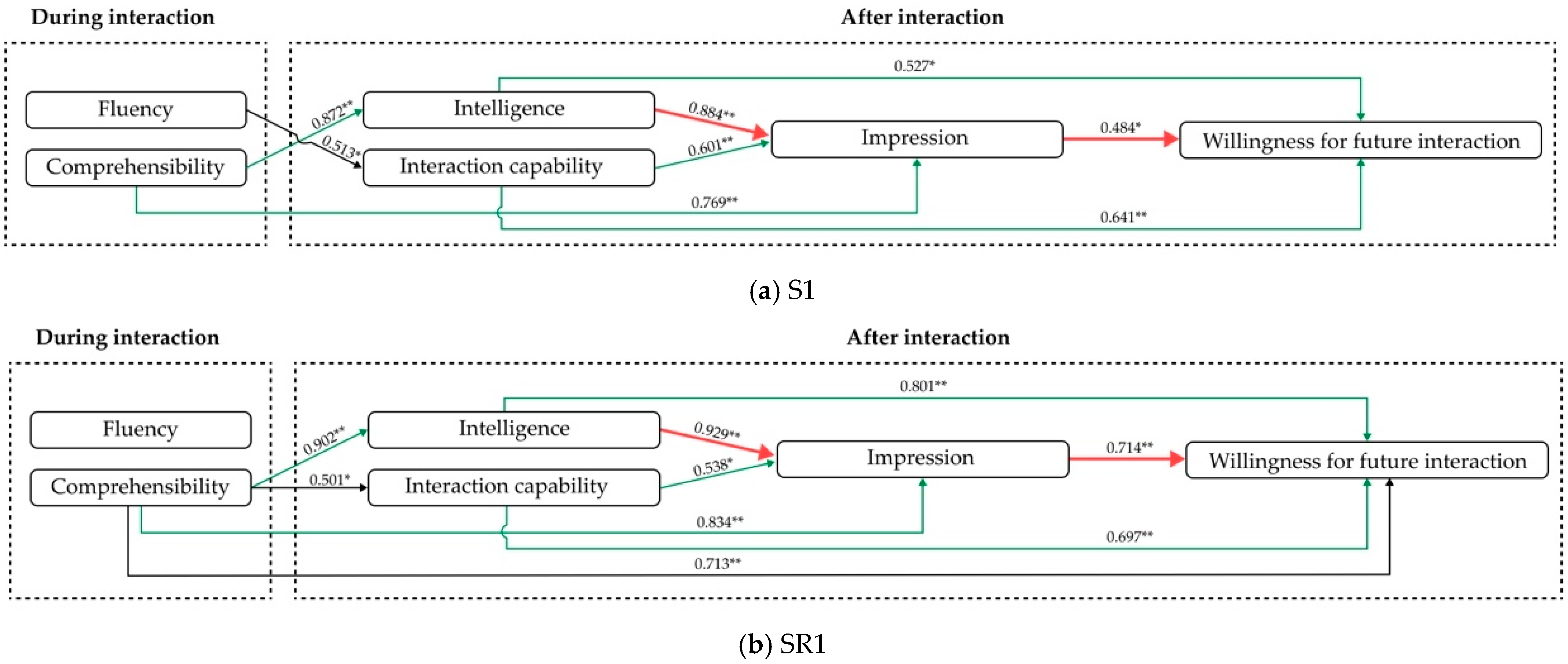
| S1 | impression | 0.767 | 1.534 | 36.193 | comprehensibility | 0.769 | 5.72 |
| intelligence | 0.766 | 2.326 | 35.943 | comprehensibility | 0.872 | 6.466 | |
| interaction capability | 0.453 | 1.69 | 9.1 | fluency | 0.513 | 2.488 | |
| SR1 | impression | 0.786 | 1.895 | 40.449 | comprehensibility | 0.834 | 6.283 |
| intelligence | 0.82 | 2.279 | 50.067 | comprehensibility | 0.902 | 7.403 | |
| interaction capability | 0.251 | 1.767 | 7.717 | comprehensibility | 0.501 | 2.778 | |
| willingness for future interaction | 0.645 | 2.085 | 20.015 | comprehensibility | 0.713 | 4.168 | |
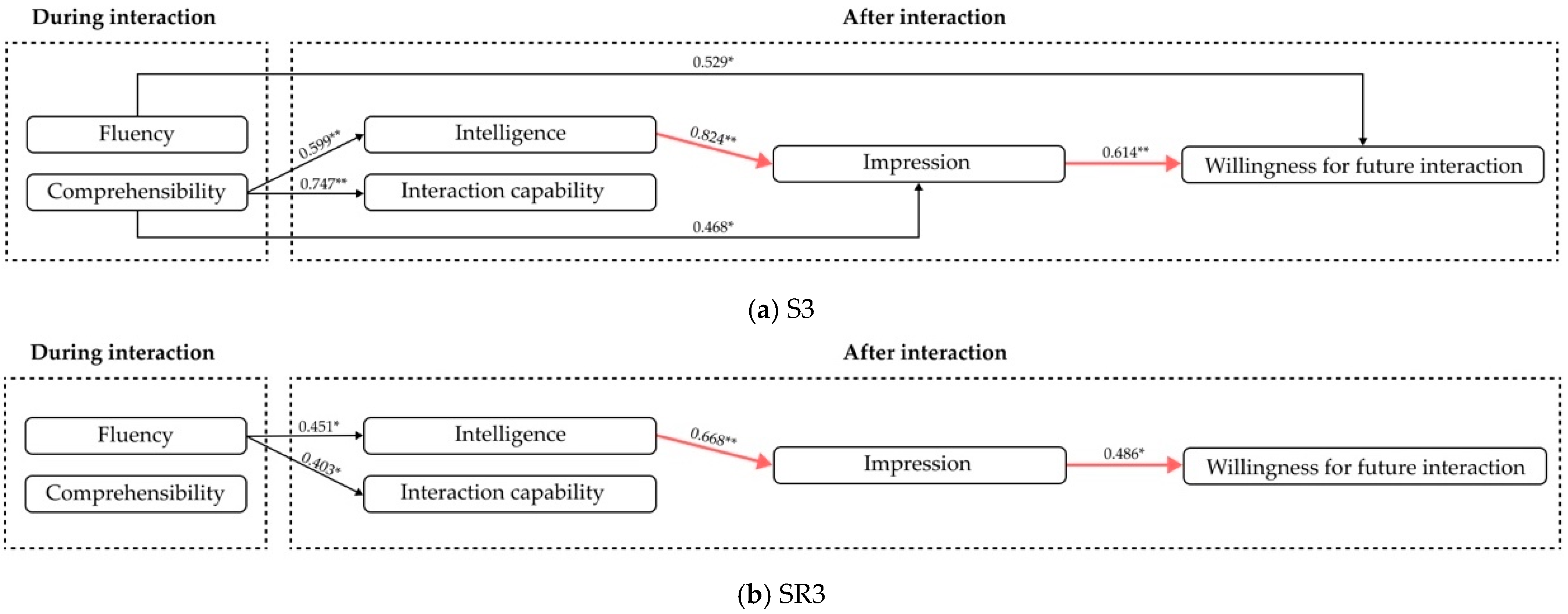
| S3 | impression | 0.547 | 1.486 | 13.273 | comprehensibility | 0.486 | 2.832 |
| intelligence | 0.548 | 2.258 | 13.355 | comprehensibility | 0.599 | 3.498 | |
| interaction capability | 0.439 | 1.64 | 8.607 | comprehensibility | 0.747 | 3.916 | |
| willingness for future interaction | 0.59 | 2.665 | 15.828 | fluency | 0.529 | 3.247 | |
| SR3 | intelligence | 0.203 | 2.004 | 5.869 | fluency | 0.451 | 2.423 |
| interaction capability | 0.162 | 2.204 | 4.453 | fluency | 0.403 | 2.11 | |
| Case | Model Summary | ANOVA | Independent Variable | Coefficient | ||
|---|---|---|---|---|---|---|
| R2 | D-W | F | Standardized Coefficients Beta | t | ||
| S1 | 0.782 | 1.639 | 82.505 | intelligence | 0.884 | 9.083 |
| 0.362 | 1.371 | 13.034 | interaction capability | 0.601 | 3.61 | |
| SR1 | 0.863 | 1.996 | 144.603 | intelligence | 0.929 | 12.025 |
| 0.289 | 2.482 | 9.353 | interaction capability | 0.538 | 3.058 | |
| S3 | 0.679 | 1.982 | 48.658 | intelligence | 0.824 | 6.976 |
| SR3 | 0.446 | 1.38 | 18.548 | intelligence | 0.668 | 4.307 |
| Case | Model Summary | ANOVA | Independent Variable | Coefficient | ||
|---|---|---|---|---|---|---|
| R2 | D-W | F | Standardized Coefficients Beta | t | ||
| S1 | 0.234 | 2 | 7.017 | impression | 0.484 | 2.649 |
| 0.278 | 1.747 | 8.851 | intelligence | 0.527 | 2.975 | |
| 0.411 | 2.062 | 16.051 | interaction capability | 0.641 | 4.006 | |
| SR1 | 0.509 | 2.471 | 23.858 | impression | 0.714 | 4.884 |
| 0.642 | 2.334 | 41.235 | intelligence | 0.801 | 6.421 | |
| 0.486 | 2.578 | 21.781 | interaction capability | 0.697 | 4.667 | |
| S3 | 0.378 | 2.212 | 13.951 | impression | 0.614 | 3.735 |
| SR3 | 0.237 | 2.081 | 7.13 | impression | 0.486 | 2.67 |
Disclaimer/Publisher’s Note: The statements, opinions and data contained in all publications are solely those of the individual author(s) and contributor(s) and not of MDPI and/or the editor(s). MDPI and/or the editor(s) disclaim responsibility for any injury to people or property resulting from any ideas, methods, instructions or products referred to in the content. |
© 2026 by the authors. Licensee MDPI, Basel, Switzerland. This article is an open access article distributed under the terms and conditions of the Creative Commons Attribution (CC BY) license.
Share and Cite
Gao, W.; He, T.; Ji, Y.; Kan, Y.; Zha, F. Human–Robot Interaction Strategy of Service Robot with Insufficient Capability in Self-Service Shop. Biomimetics 2026, 11, 213. https://doi.org/10.3390/biomimetics11030213
Gao W, He T, Ji Y, Kan Y, Zha F. Human–Robot Interaction Strategy of Service Robot with Insufficient Capability in Self-Service Shop. Biomimetics. 2026; 11(3):213. https://doi.org/10.3390/biomimetics11030213
Chicago/Turabian StyleGao, Wa, Tao He, Yang Ji, Yue Kan, and Fusheng Zha. 2026. "Human–Robot Interaction Strategy of Service Robot with Insufficient Capability in Self-Service Shop" Biomimetics 11, no. 3: 213. https://doi.org/10.3390/biomimetics11030213
APA StyleGao, W., He, T., Ji, Y., Kan, Y., & Zha, F. (2026). Human–Robot Interaction Strategy of Service Robot with Insufficient Capability in Self-Service Shop. Biomimetics, 11(3), 213. https://doi.org/10.3390/biomimetics11030213