1. Introduction
Noise emissions from turbomachinery and compact aerodynamic devices remain a critical barrier to environmental compliance and societal acceptance. Stricter community noise limits and increasingly ambitious sustainability targets push designers toward solutions that reduce both tonal and broadband components [
1,
2] without compromising aerodynamic efficiency, structural integrity, or manufacturability [
3,
4,
5]. Within this context, cascades of blades operating under turbulent inflow—typical of rotor–stator interactions, fans, compressors, or mixer–ejector configurations—are recurrent sources of broadband noise driven by unsteady loading and edge–turbulence interactions [
5,
6,
7,
8,
9,
10].
Conventional noise mitigation strategies span geometric and materials-based treatments, such as sweep and lean, skew, trailing edge thickness minimization, porous or compliant surfaces, and acoustic liners, as well as active flow control approaches based on periodic blowing or plasma actuators [
8,
11,
12,
13,
14,
15]. While effective in targeted regimes, these solutions often come with trade-offs, including added weight and complexity, efficiency penalties, narrowband effectiveness, or sensitivity to off-design operation. As a result, attention has shifted toward bio-inspired concepts that rely on flow physics mechanisms observed in nature [
4,
13,
16,
17,
18,
19] and aim for broadband efficacy with minimal actuation or maintenance overhead.
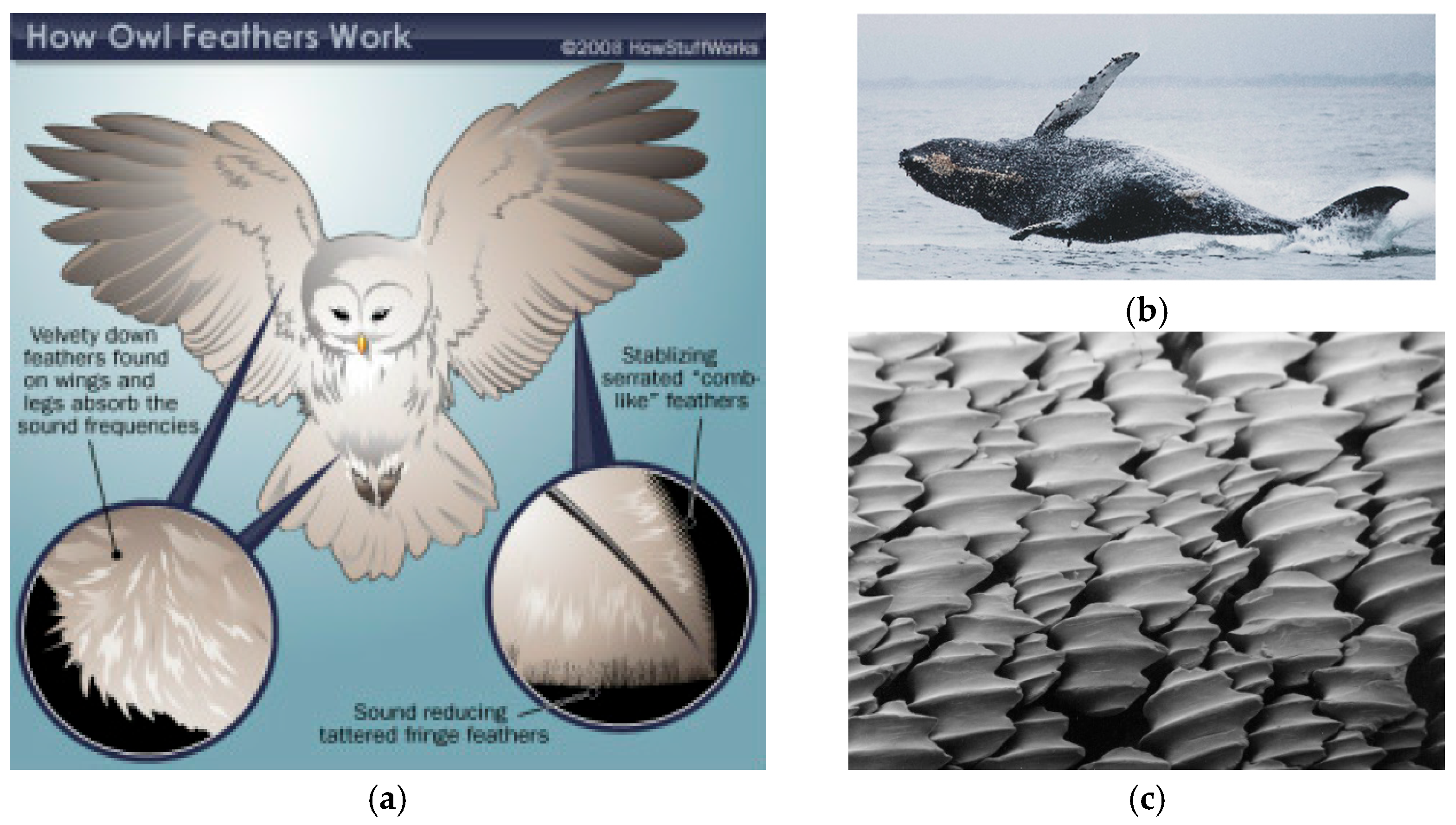
Several bio-inspired motifs have contributed to aerodynamic and aeroacoustic design. Owl-inspired trailing edge serrations [
20,
21] disrupt spanwise coherence and reduce scattering efficiency at the trailing edge. Humpback whale leading edge tubercles [
22,
23,
24] modulate stall progression and lift distribution. Shark skin riblets [
25,
26,
27] reduce drag through streamwise alignment and near-wall vortex management.
Figure 1 shows adaptations from nature that can be considered as a starting point for the design of quieter blades/stages. Building on these ideas, leading edge serrations have emerged as a promising option for mitigating inflow–edge interaction noise. In silent flight, owls rely on a multi-element edge treatment system: high amplitude, small pitch, comb-like structures near the leading edge, together with downstream micro-structures, reduce coherent scattering by promoting spanwise phase variation and broadband decorrelation of surface pressure fluctuations. From an engineering standpoint, leading edge serrations can be interpreted as a “manufacturable abstraction” of this strategy, aiming to reduce the spanwise coherence of unsteady loading before it is converted into noise. While the serration shape used in many studies (including the present one) may appear conventional, the biomimetic aspect is primarily functional rather than geometric. In practice, the spanwise-varying phase decorrelates the impingement of turbulent eddies, redistributes the relevant wavenumber content, and weakens the coherent unsteady forces responsible for sound generation. In cascades, where a turbulent jet/wake or any sort of incoming turbulence interacts with the blade row, this decorrelation is particularly valuable because it can limit the constructive build-up of unsteady loading across adjacent passages.
The advantages of leading edge serrations include their broadband noise potential attenuation, purely passive operation, and compatibility with existing cascade architectures. Nevertheless, limitations must be acknowledged. Aerodynamic penalties may arise from increased wetted area and local curvature, which affect loss coefficients and intended flow deflection [
31]. Sensitivity to Reynolds number and inflow properties, such as turbulence intensity and integral length scale, can shift the effective frequency band [
32,
33]. Structural and manufacturing complexity is expected to increase with serration amplitude and wavelength, while unintended spectral features may emerge when serration spacing interacts with coherent structures in the inflow. Successful application therefore requires a careful balance between acoustic benefit and aerodynamic cost. From a biomimetics perspective, this balance is not merely a design compromise but a functional translation constraint: the geometry must remain manufacturable and aerodynamically acceptable while still enforcing the measurable spanwise decorrelation of leading edge pressure fluctuations.
The transition from a straight-edged blade to a serrated leading edge is typically parameterized by serration amplitude (relative to chord), wavelength (relative to chord), and (local) blade skew, together with operational parameters such as Reynolds number, Mach number, incidence, turbulence intensity, and the ratio between incident turbulence length scale and serration wavelength. Prior studies suggest that the strongest decoherence benefits occur when incoming turbulence scales are commensurate with the serration wavelength, while far-field spectral trends tend to scale with Strouhal number [
34,
35]. These considerations provide motivation for systematic parametric exploration at a reduced scale before committing to full-scale implementation.
Performance assessment methods can be grouped into analytical models [
8,
25,
36,
37,
38], numerical simulations [
8,
19,
20,
21,
22,
23,
29,
32,
35,
39,
40], and experimental techniques [
7,
24,
27,
31,
33,
36]. Analytical and semi-empirical formulations for leading edge noise predict far-field spectra from wall pressure or inflow statistics and capture first-order parametric trends, while their serration-extended variants introduce spanwise phase modulation to represent decorrelation. These methods are computationally inexpensive but depend strongly on modeling assumptions. Computational approaches based on steady RANS provide reliable low-cost aerodynamics but lack fidelity for broadband spectra [
14,
19,
29,
41]. Unsteady approaches, such as URANS, SAS, DES, and LES, increasingly resolve the unsteady flow content responsible for noise radiation, with far-field prediction obtained through acoustic analogies such as Ffowcs Williams–Hawkings (FW-H). Accuracy depends on turbulence modeling, grid resolution near edges, numerical dissipation, and temporal resolution. On the experimental side, cascade wind-tunnel campaigns remain the benchmark for validation, combining steady and time-resolved pressure measurements, wake development, and far-field microphone data to quantify both aerodynamic performance and aeroacoustics output. In this context, reduced-scale testing represents a powerful and time-efficient path to evaluating serrated concepts. Results at laboratory scale can be regarded as satisfactory, and thus transferable to higher technology readiness levels, when they demonstrate consistent broadband noise reduction without unacceptable aerodynamic penalties and when they prove to be robust to variations in turbulence intensity, length scale, incidence, and Reynolds number, without introducing new adverse spectral features. When these conditions are met, small-scale findings can be scaled to full-size applications through similarity-based methods/algorithms, supported by complementary simulations or tests.
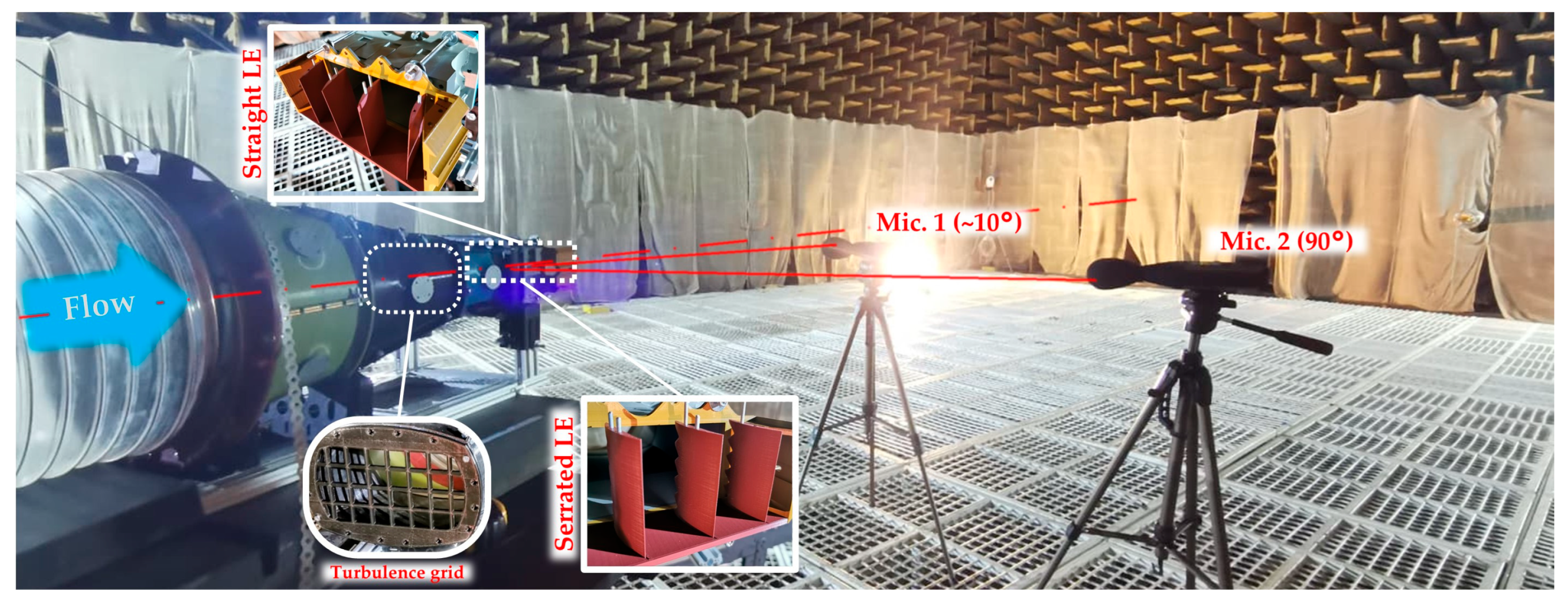
The present study addresses the numerical–experimental validation of bio-inspired leading edge serrated cascades. Reduced-scale experiments provide controlled conditions and a high spatial resolution, while a range of turbulence modeling strategies—Spalart–Allmaras, k−ω SST, k−ε, SAS, and LES (whose formulations are very well covered in [
41,
42,
43])—are evaluated in transient simulations with varying timestep resolutions. The focus is on their capability to reproduce measured spectra and to capture the dominant mechanisms of jet–blade interaction noise. Comparisons with experiments indicate that interaction noise is negligible at low frequency and clearly captured at higher frequencies (over 2 kHz). While Spalart–Allmaras and k−ω SST reproduce the low-frequency regime, SAS achieves the closest overall agreement in the mid-to-high frequency range, albeit with slight overestimation, and LES satisfactorily reproduces the baseline response at a higher computational cost. These findings highlight model-dependent trade-offs, clarify temporal resolution requirements, and confirm the relevance of numerical simulations as predictive tools for the aeroacoustic benefits of bio-inspired leading edge serrations. Beyond far-field SPL reduction, serrations are expected to modify the spanwise pressure distribution (on the leading edge). To quantify this effect, spanwise coherence and the associated coherence length are introduced. This choice is directly aligned with the biomimetic design objective, since leading edge serrations are intended to reduce spanwise coherence as the primary pathway to broadband noise suppression. The present work is intended as a preliminary validation step for the CFD workflow, setting a certain level of confidence at a reduced scale before transferring the methodology to a more representative, near-full-scale compressor/turbine configuration.
3. Results
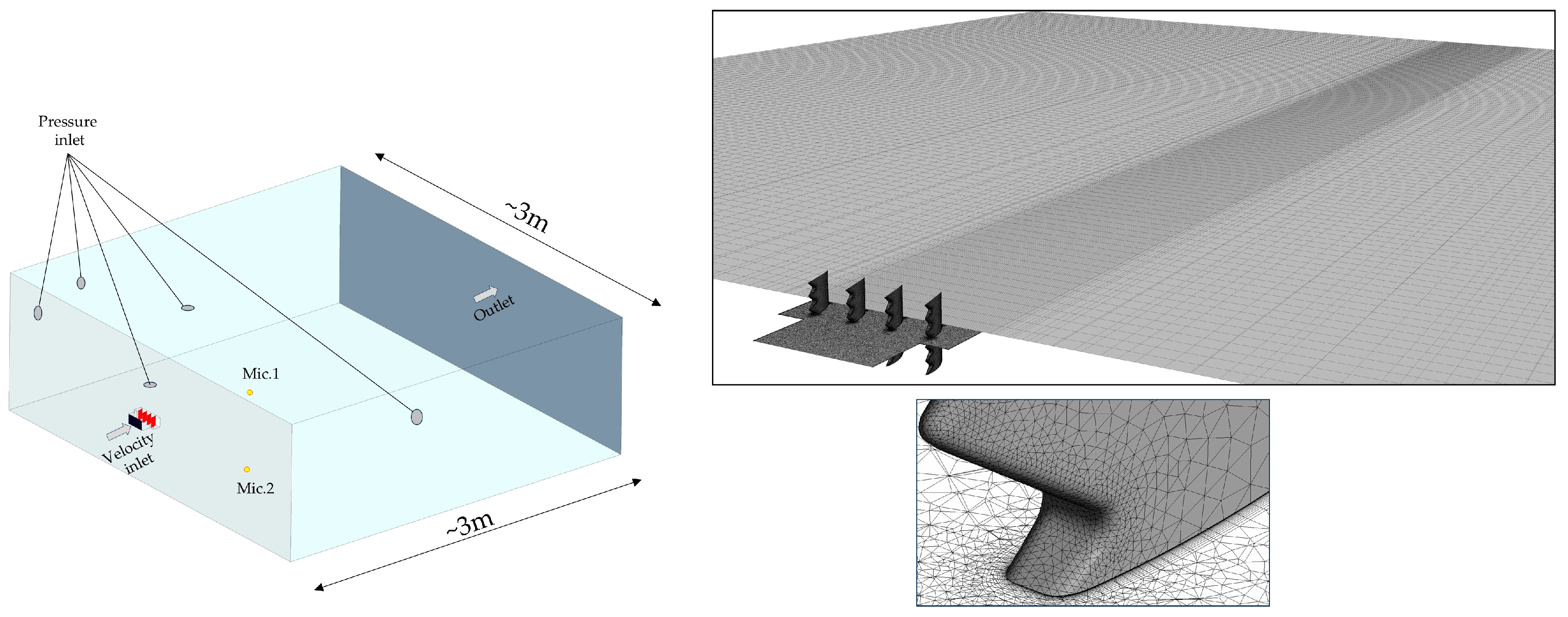
A grid convergence (mesh independence) study was performed by varying the mesh size from 0.68 M nodes and 1.71 M elements (coarse) to 5.18 M nodes and 13.4 M elements (cine) using the same setup (boundary conditions) as in
Figure 3. An intermediate (medium) grid (2.12 M nodes, 4.11 M elements)—offering the best compromise between spectral fidelity and computational cost—was adopted for the turbulence model comparison.
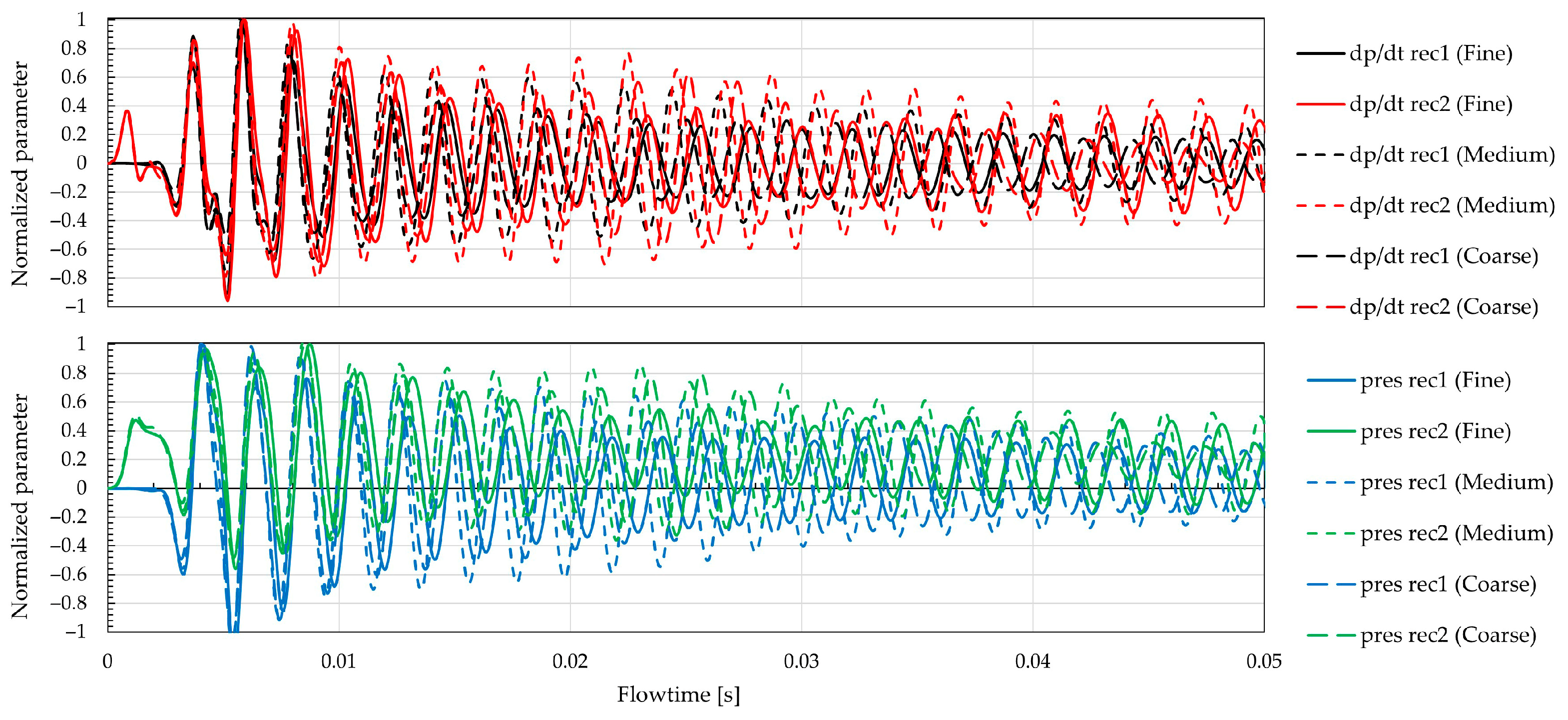
Figure 5 presents normalized time histories of the pressure time derivative
dp/
dt (top) and static pressure p (bottom) at the two numerical receivers (≈10° and 90°), from coarse to fine grids (the signals were normalized to the maximum value). After initialization, both records reach statistically stationary conditions and display periodic content that anticipates the fluid–structure interaction seen later. The phase and amplitude envelope are consistent across meshes, with modest amplitude differences—slightly larger at mic 1—suggesting that the near-observer unsteady loading is captured, while mesh effects are concentrated in the low–mid frequencies. These signals therefore indicate that the temporal resolution is adequate and that the serrated configuration promotes repeatable, spanwise-modulated fluctuations at the observers; the forthcoming SPL/PSD comparisons can thus focus on quantifying how turbulence models distort the sub-kilohertz region versus their mid-band alignment with the measurements.
Verification runs performed during mesh convergence checks (based on SPL/PSD) indicated consistent trends at both receivers: for mic1 (rec1), the coarse grid systematically overestimated the low–mid band, with a broad elevation up to 1 kHz, whereas the medium grid reproduced the experimental interaction noise spectra more faithfully over 1–5 kHz range; the fine grid did not deliver systematic improvements and introduced pronounced undulations and local peaks (notably near 1.5–3 kHz) absent from the measurements. For the lateral microphone, the coarse grid again overshot the 0.5–1 kHz region, the medium grid remained closest to the data across most of the band, and the fine grid tended to sit higher and comparatively flat with a notch near 2 kHz. These trends justify adopting the medium grid for turbulence model comparisons.
The results for baseline and serrated configurations are presented in
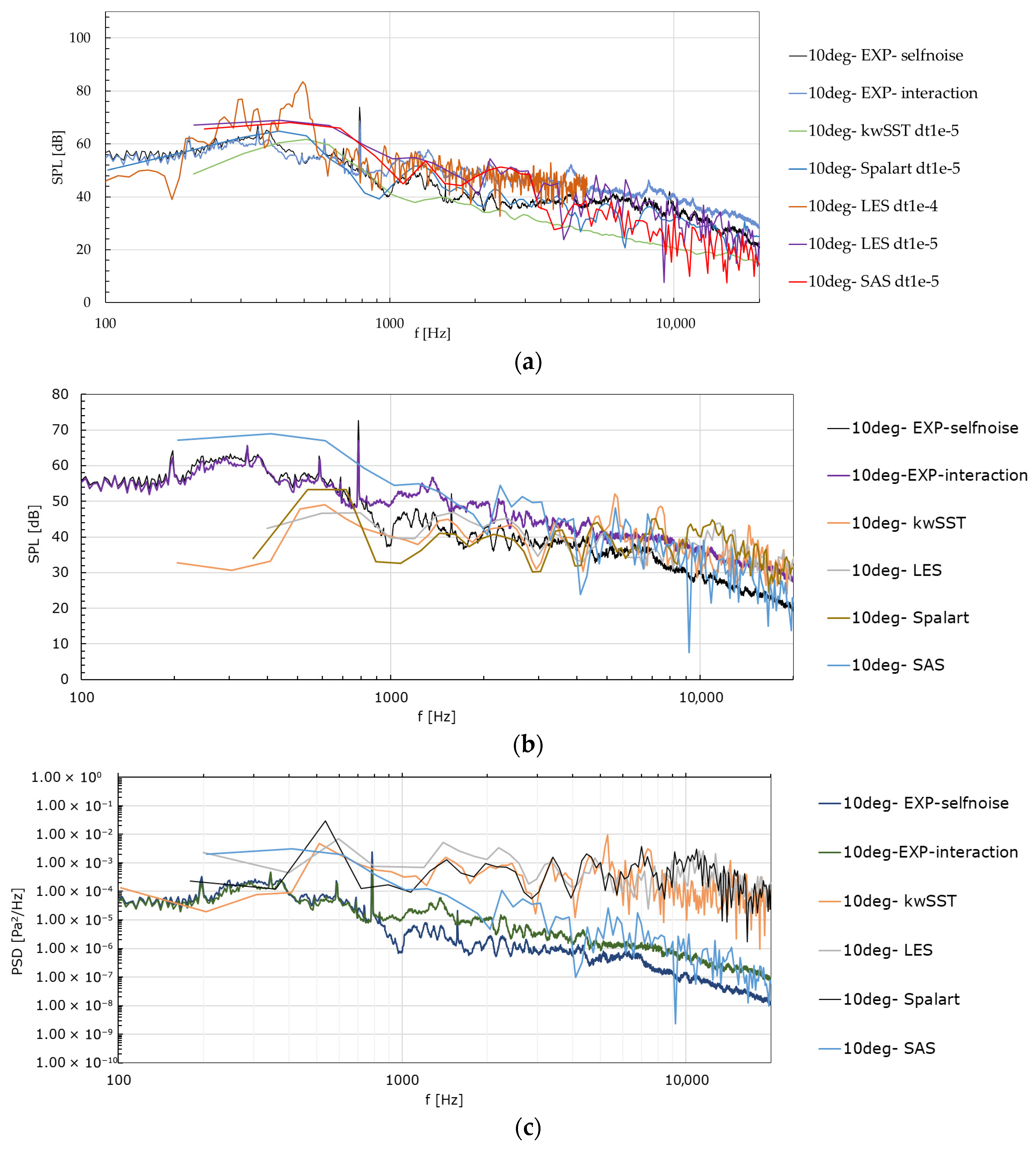
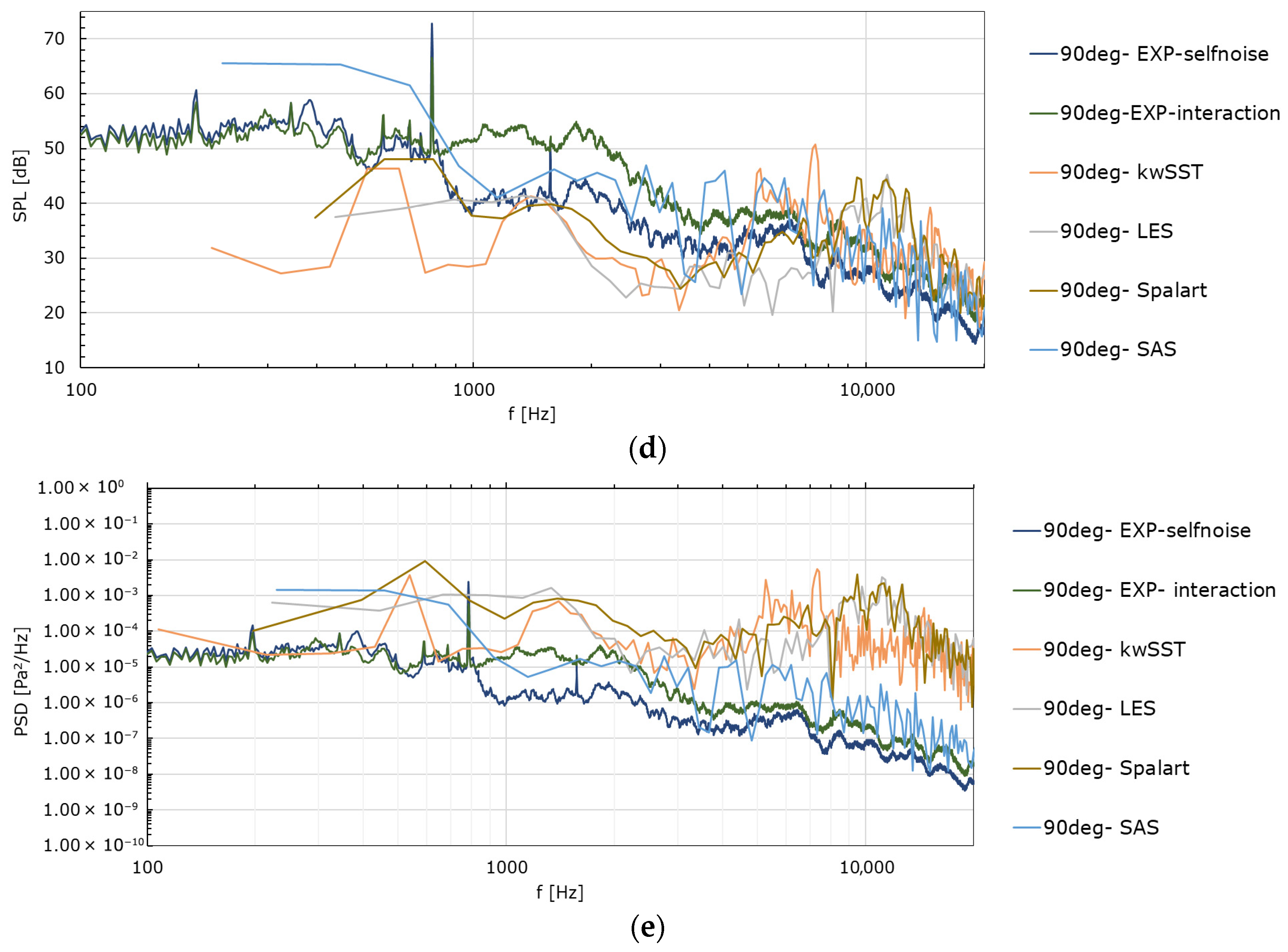
Figure 6 (run on Fluent 2021 R1). Multiple combinations of timestep sizes and turbulence models were tested, with the corresponding data extracted and processed to obtain the acoustic sound pressure level (SPL) spectrum. Unless otherwise indicated in the figure, the simulations used the medium mesh, were initialized from a stabilized solution (1 ms), and advanced for approximately 1500–1800 time steps. The SPL was derived by converting the numerically obtained PSD following the FFT. Overall, the model predictions are broadly consistent, with model-dependent features over certain frequency ranges—most notably at low frequencies (<1 kHz)—and close agreement in the band of interest (2–5 kHz), particularly for the SAS model, which is relatively inexpensive computationally.
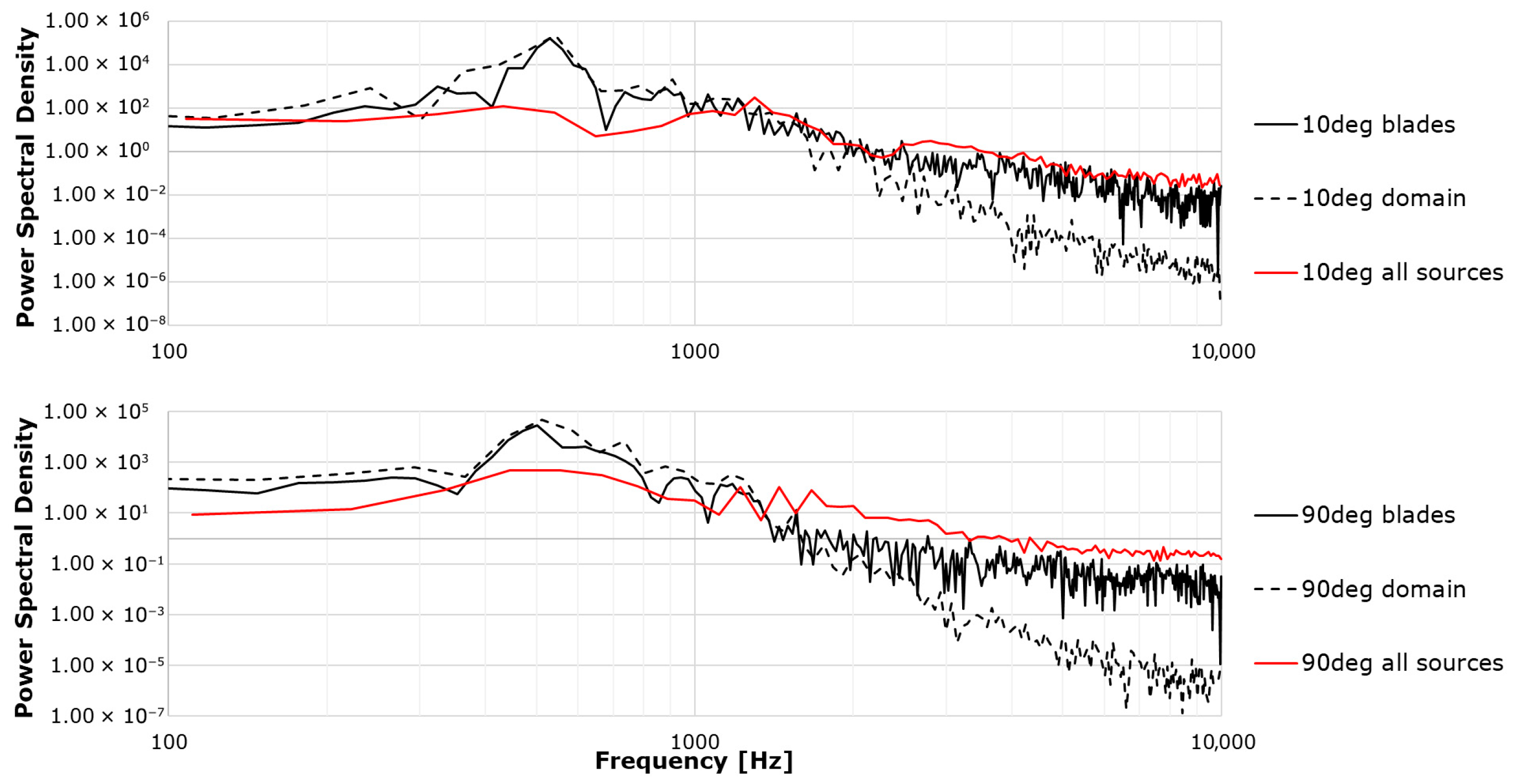
Regarding the contributors to noise, a distinction can be made between the influence of the near-blade region (mainly dipole sources) and that of the outer domain (quadrupole sources corresponding to unbounded flow); the total perceived noise results from the combined effect of both. Solely to quantify the relative contribution of each,
Figure 7 overlays the spectra computed for three acoustic source scenarios—near-blade domain, outer domain, and the combined case—sampled at the same receiver locations as in the preceding figures. For this analysis, the k−ω SST model was used with a time step of
Δt = 10
−5 s, and results were obtained after just over 500 time steps.
The PSD overlays (
Figure 7) indicate that the near-blade region controls the spectrum across almost the entire band starting from the sub kiloHertz region. The outer domain contribution decays rapidly with frequency and becomes secondary as viscous dissipation suppresses wake-borne fluctuations (which was to be expected for a relatively low Reynolds numbers). The combined spectra essentially collapse onto the near-blade curves, for both angles, confirming that aeroacoustics content is dominated by the flow physics (such as separation, unsteady loading, and local edge interactions) in the immediate vicinity of the blades. This aligns with the observation that improving near-wall resolution (y+ ≈ 1) and controlling temporal accuracy in that region are the two ingredients responsible for high spectral fidelity.
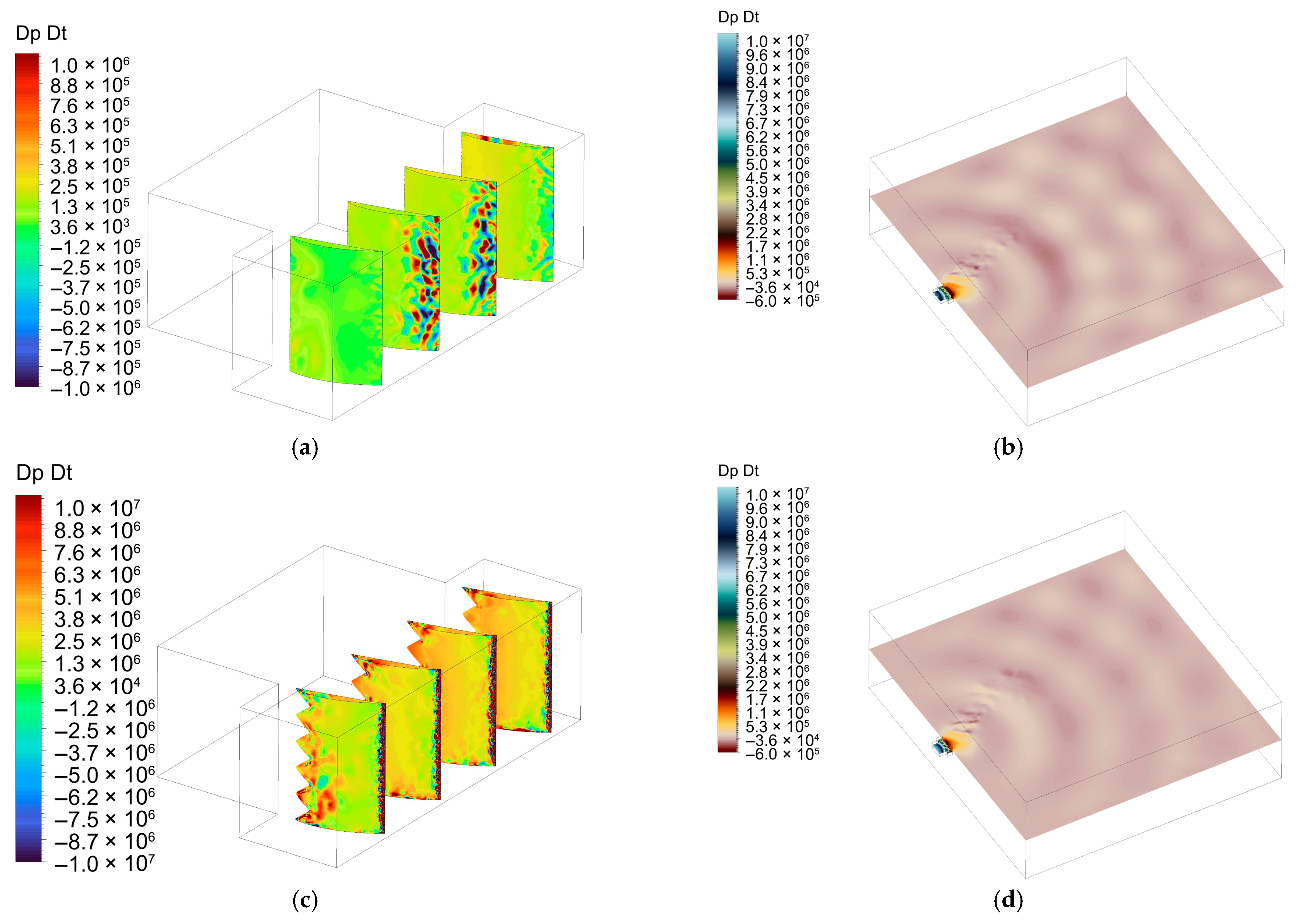
Figure 8a–d provides complementary perspectives of the same unsteady loading indicator (
dp/
dt). The blade-attached views in
Figure 8a,c highlight the spatial distribution of strong loading events along the leading edge, whereas the axial plane cuts in
Figure 8b,d show how these events travel downstream too. Compared to the baseline case (
Figure 8a,b), the serrated configuration (
Figure 8c,d) exhibits a visibly shorter spanwise continuity and reduced streamwise persistence of high-amplitude
dp/
dt patches. This spatial fragmentation is consistent with serration-induced phase modulation at the leading edge, which weakens the coherent accumulation of unsteady forces and supports the spectral reductions observed in the interaction noise band.
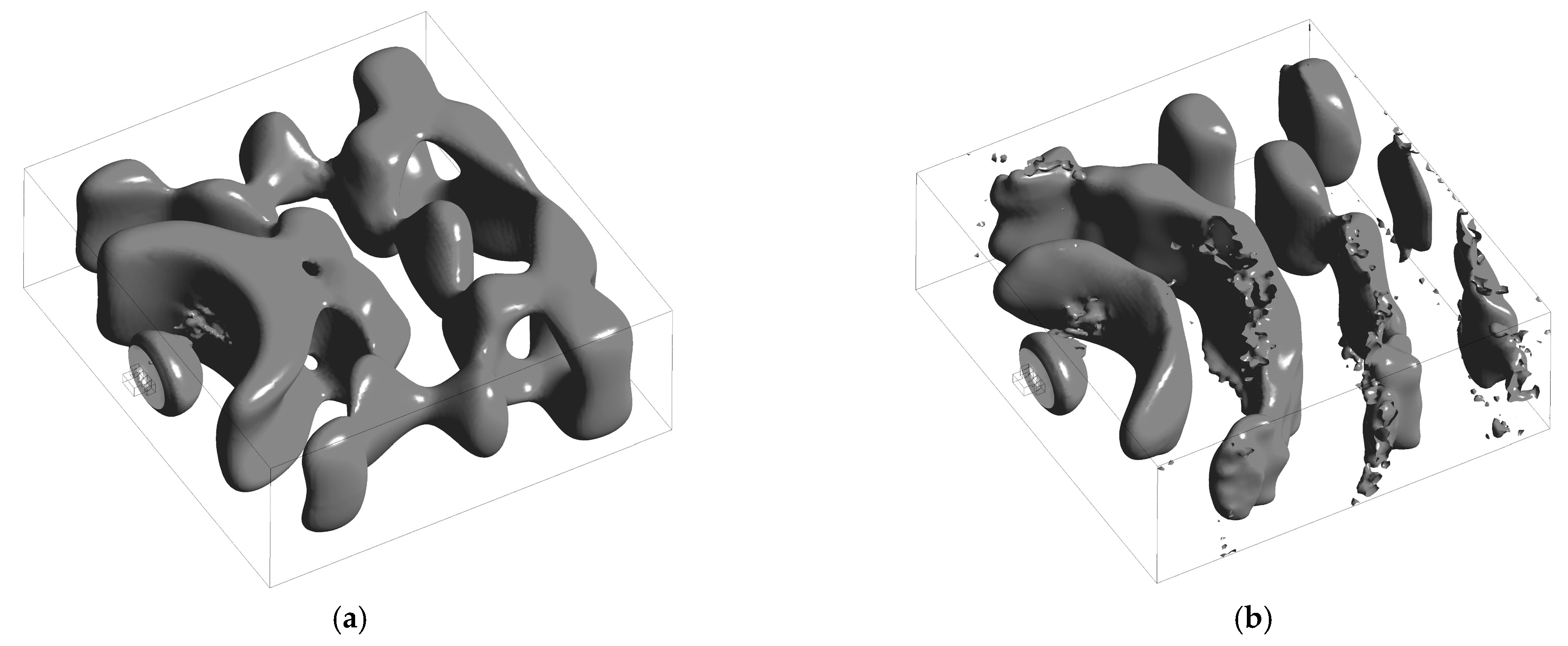
The iso-surfaces (
Figure 9) provide a three-dimensional view of the unsteady structures. In the baseline case, the
dp/
dt field forms large, contiguous lobes that extend over several passages, suggestive of spanwise-correlated loading. In the serrated case, the same threshold (
dp/
dt = 2
10
−4 Pa/s) yields narrower, broken-up lobes that are segmented by the serration influence, with noticeably reduced lateral continuity. This topological change is consistent with serration-induced phase variation at the leading edge: the impinging turbulent eddies are decorrelated in the spanwise direction, which limits the constructive accumulation of unsteady forces and promotes more rapid downstream decay of the energetic structures. The qualitative differences between iso-surfaces
Figure 9a,b thus reinforce the spectral evidence reported earlier—namely, that interaction noise content is governed by near-blade dynamics and is mitigated when spanwise coherence is disrupted.
The integrated aerodynamic loads reinforce this picture (
Table 1). For all models, the serrated configuration carries higher axial (X) and lift-like (Y) loadings than the baseline (e.g., SA and k−ω SST show an X-force of roughly 1.9–2.4 N and Y-force of ~4–5.3 N), and more modest in SAS/LES. This systematic uplift in load is compatible with the pressure distribution: stronger LE pressure gradients and spanwise modulation around the serration geometry translate into enhanced unsteady loading, which is precisely the mechanism expected to feed the measured interaction noise band. The fact that SAS and LES predict smaller load increments aligns with their tendency to distribute energy over a broader range of resolved scales, consistent with the closer spectral agreement observed in the 2–5 kHz region.
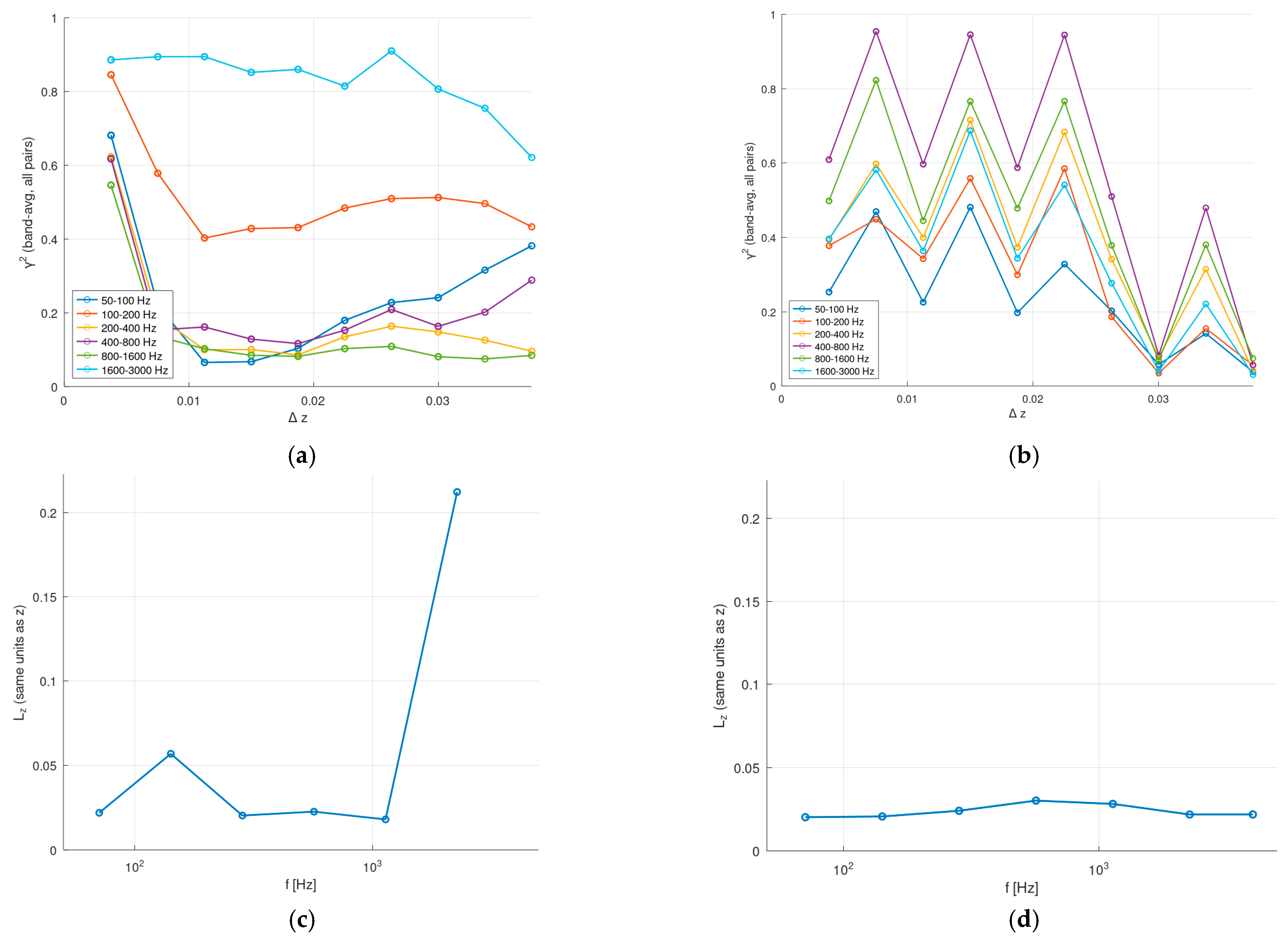
The magnitude-squared coherence
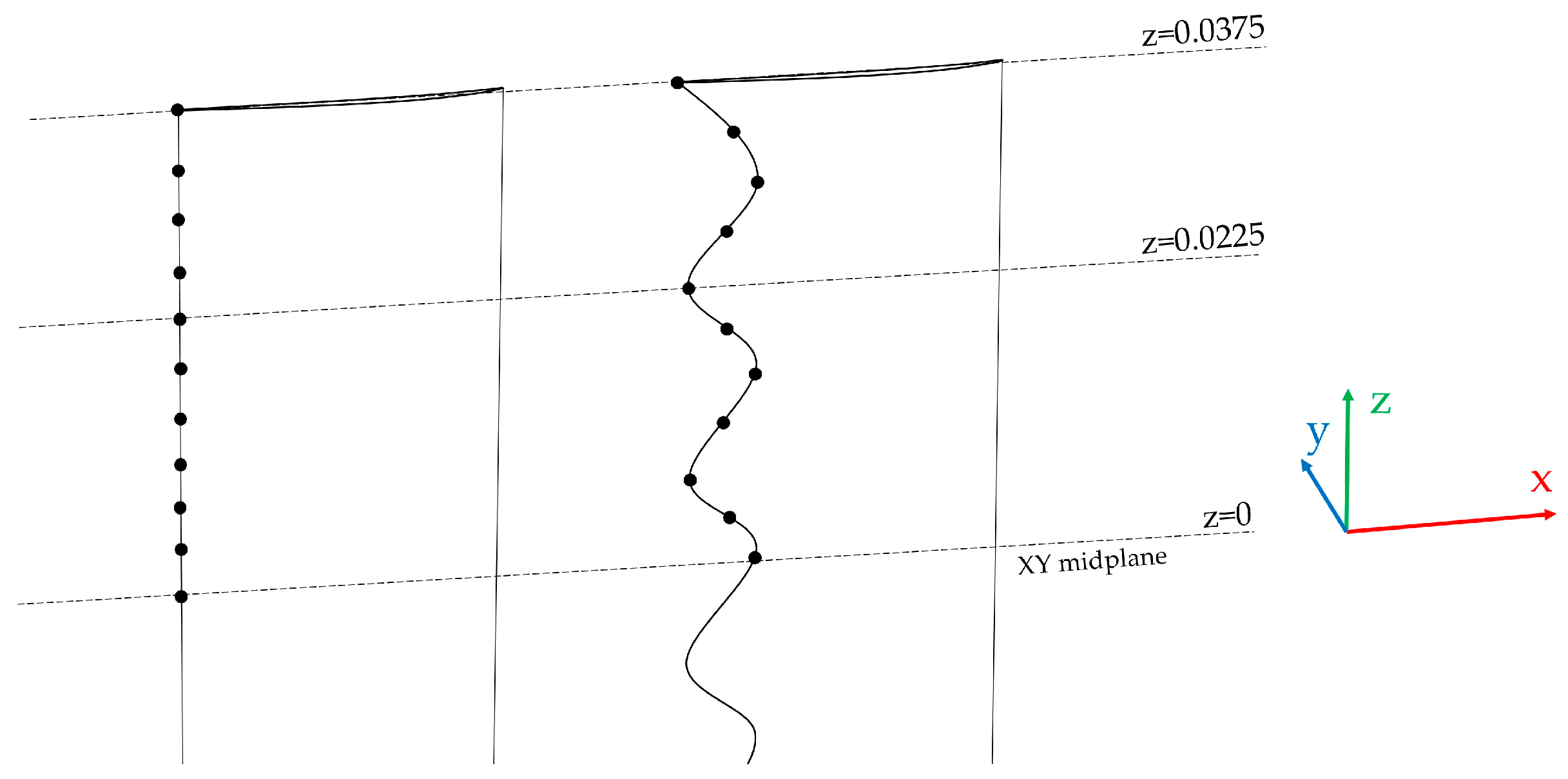
γ2 ∈ [0, 1] directly measures the fraction of linearly correlated fluctuations shared by two locations at a given frequency. Values close to 1 indicate strongly coherent, phase-consistent content, whereas values close to 0 indicate decorrelated fluctuations or content dominated by uncorrelated turbulence. Pressure fluctuations were recorded at 11 surface probes along the leading edge for both the baseline and serrated configurations (shown schematically in
Figure 4).
The extracted coherence length,
Lz, provides a single-number characterization of how quickly correlation decays along the span; a larger
Lz indicates spanwise-extended coherent structures, while a smaller
Lz implies rapid decorrelation (
Figure 10c,d). In practical terms,
Lz can be interpreted as a descriptor for the spanwise “source size” over which unsteady loading may add constructively and thus contribute efficiently to far-field radiation; in turn, a reduced
Lz is consistent with weakened spanwise content and reduced potential for coherent summation. In the baseline configuration, the generally low coherence levels suggest that the leading edge pressure field is dominated by locally generated, weakly correlated turbulent structures rather than by spanwise-extended features. In contrast, the serrated leading edge introduces a geometric modulation that can redistribute coherence: while it is intended to reduce broadband coherence of the incoming interaction, it may also imprint coherence features at specific spanwise scales associated with the serration wavelength, which can appear as localized peaks and a more repeatable fitted
Lz (as also suggested in [
46] by plotting the coherence parameter for various LE treatments). When coherence decays rapidly and remains close to zero over most spanwise separations, the fitted coherence length becomes sensitive to statistical fluctuations. This behavior is therefore interpreted as an indicator of weak spanwise organization rather than as a numerical artifact.
The results shown in
Figure 10 were obtained by post-processing the simulated pressure signals with an in-house GNU Octave code (v9.2.0), following the procedure described in the
Section 2. Each dataset covers approximately 0.5 s of simulated time (about 5000 samples at
Δt = 1 × 10
−4 s). For each probe location along the leading edge, the pressure time series was first converted to a fluctuating signal by removing its temporal mean and applying linear detrending. The auto- and cross-power spectral densities (PSD/CPSD) were then computed using Welch’s method (also called the averaged periodogram method, with Hanning windowing, 50% overlap, NFFT = 512). The magnitude-squared coherence was then evaluated for all probe pairs from these spectra. To improve statistical robustness, coherence values were band-averaged over predefined frequency intervals and further aggregated across all probes sharing the same spanwise separation
Δz using median statistics. This procedure reduces the sensitivity to narrowband spectral peaks, numerical noise, and spatial bias associated with a fixed reference location, enabling a consistent comparison between the baseline and serrated leading edge cases.
4. Discussion
The observed differences between turbulence models can be interpreted in terms of their respective treatment of unsteady scales and eddy viscosity adaptation. Models such as k−ω SST tend to retain higher modeled turbulence levels near the leading edge, which explains their elevated low-to-mid frequency content. In contrast, SAS dynamically reduces eddy viscosity in regions of resolved unsteadiness, allowing partial scale resolution and a redistribution of energy toward higher frequencies. LES further extends this trend by resolving a broader portion of the turbulent spectrum, although at a significantly higher computational cost. These distinctions clarify why models may converge in the interaction noise band (1–3 kHz) while diverging outside of it.
For the baseline case at the 10° receiver position (
Figure 6a), temporal resolution remains the decisive factor. The coarse time step (LES,
Δt = 10
−4 s) produces a noisy, poorly converged spectrum with spurious elevations around the 0.5–1.5 kHz band, whereas refining to
Δt = 10
−5 s regularizes the spectrum and brings LES closer to the experimental interaction noise slope beyond 1–2 kHz. Under the same
Δt, SAS and k−ω SST offer comparable fidelity in the mid–high band; SAS tends to run slightly high in the few-hundred-hertz region and slightly low above ~5 kHz, while k−ω SST sits marginally under the experiment below 1 kHz but tracks well toward 2–8 kHz. In short, the ranking is unchanged: with adequate
Δt, LES does not systematically outperform SAS or k−ω SST for the band of interest.
For the serrated geometry at the 10° receiver position (
Figure 6b), the models reproduce the broadband character with distinct biases by frequency. The k−ω SST model remains generally above the measurements in the 0.5–2 kHz interval, while Spalart–Allmaras follows the experimental decay more closely beyond ~2 kHz. SAS is elevated at low frequencies (<~700 Hz) and shows localized underestimation around ~1 kHz; LES aligns well in the midband once
Δt is tightened, with small deficits at the highest frequencies. The complementary PSD view (
Figure 6c) corroborates these tendencies: SAS concentrates more energy at low frequencies, k−ω SST exhibits a higher PSD plateau over 1–3 kHz, and LES/SA sit lower in that range, consistent with their closer SPL match above 2 kHz. At 90° (
Figure 6d), the angular sensitivity is evident. The k−ω SST model underestimates the 0.6–1.5 kHz hump seen in the experiment but approaches the envelope beyond ~2 kHz; SAS carries excess low-frequency levels and introduces localized peaks not present in the data; SA tracks the mid–high-frequency decay reasonably well but retains isolated over- and undershoots. LES tends to underpredict the midband yet converges toward the experimental slope at higher frequencies. The PSD comparison at 90° (
Figure 6e) confirms this picture: SAS places disproportionate energy at low frequencies, k−ω SST is comparatively elevated over ~3–10 kHz, and LES takes an intermediate position with the smallest midband overfit among the models.
Overall, the obtained SPL and PSD spectra reinforce the main conclusions: interaction noise content is captured by all unsteady models once
Δt is sufficiently small (observed for other time steps but more time-consuming); SAS and k−ω SST provide the most consistent agreement in the 2–5 kHz band that governs jet–blade interaction, with angle-dependent nuances; LES approaches the correct envelope with refined
Δt but does not deliver a systematic advantage for the present runtime envelope; and the spectral energy distributions (
Figure 6c,e) explain the observed SPL biases—low-frequency excess for SAS, 1–3 kHz elevation for k−ω SST, and comparatively balanced midband energy for LES/SA at 10°, with shifts at 90° that justify multi-angle validation.
Table 1 reports instantaneous surface-integrated blade loads (representative sample from the unsteady simulations after ~2000 time steps), not time-averaged or RMS values; therefore, they are used only as a supporting indicator, while model ranking is based primarily on spectral agreement with the measurements. Taking LES as the reference for physical fidelity, SAS is the closest model in
Table 1, with deviations relative to LES of +10.3%/−0.4% (baseline X/Y) and −2.4%/+4.4% (serrated X/Y), whereas SA and k−ω SST show larger deviations (up to ~31%). This is consistent with the expected behavior of turbulence closures for leading edge interaction noise problems: LES resolves the large energy-containing eddies that drive unsteady blade loading, while URANS eddy–viscosity models may smooth part of the inflow–blade interaction; SAS partially recovers resolved unsteady content and therefore remains closer to LES.
Regarding TKE values in regions of interest integrated on the blades, a slight increase in values compared to the reference was observed, exceeding 30%, and at the domains’ interface (exit from the blade area), these values averaged over the surface were double those of the reference in the case of serrations. The same setup can be leveraged for the following deeper—but fully complementary—analyses: wall pressure RMS maps on the blades and along the leading edge, spanwise wall pressure coherence γ2(f, Δz) to quantify the decoherence introduced by the serration pitch, and FFT-based spectra of the axial/transverse force fluctuations (CL′(f); CD′(f)) to connect energy peaks directly to the interaction noise band. These additions would further consolidate the link between near-blade pressure gradients, integrated loading, and far-field spectra, while keeping the central conclusion (leading edge serrations can be credibly assessed with numerically affordable models for early-stage design and down-selection).
The interaction noise band targeted in this work lies in the kilohertz range, where turbomachinery blades commonly have strong components and where design changes (such as leading edge serrations) are expected to alter the source coherence and effective radiating area. Therefore, reporting coherence metrics in 0.9–5 kHz, and highlighting 1.6–3 kHz as a BPF-adjacent band, provides a mechanism-oriented complement to SPL spectra. It should be noted that below 1000 Hz, the pressure fluctuates quite inconsistently in the reference case, although there is data in the literature suggesting a decoupling also for straight leading edges as the distance from the reference increases [
46,
51]. We expected a lower coherence between sources at the serration peak and root [
46], as is the case in
Figure 10b. In [
52], it is noted that the flow regime also affects the correlation parameters, especially at Reynolds numbers close to 10
5 (this issue being remedied at higher speeds).
Several tendencies emerge from the presented results. The presence of interaction noise above ~1 kHz is captured by all unsteady models, while model ranking is angle-dependent: at 10° (quasi-axial), SAS/k−ω SST track the experimental spectra well and SA often matches the high-frequency roll-off; at 90° laterally, k−ω SST is generally the closest, with SA and SAS showing localized peaks that the experiment does not consistently exhibit. Importantly, no persistent narrowband tones appear in the measurements for the serrated case, and the simulations reflect this broadband character when time integration is sufficiently resolved. Unsteady relevant parameters were plotted from representative LES cases (here at Δt = 10−4 s, t ≈ 50 ms) to visualize the fluctuating field build-up; they are not intended to replace the time-resolved spectral analysis used for quantitative validation. Nevertheless, the observed patterns—the concentration of dp/dt near the leading edge, the fragmented spanwise structure with the presence of serrations, and triggered faster downstream attenuation—are fully consistent with the SPL/PSD trends and with the mentioned aerodynamic loads. The same computational setup can be extended to time-averaged unsteady statistics (e.g., wall pressure RMS plots) and spanwise correlation along the leading edge; however, even in the present form the figures already support the central mechanism by which leading edge serrations (a bio-inspired solution) reduce the effective coherence of unsteady loading and, consequently, the broadband radiation.
Beyond the presented configuration, the main value of this work is the transferability of the validation workflow rather than a result tied to a single cascade. The same approach can be applied to other interaction noise problems—e.g., rotor–stator stages, fan/OGV systems, or compressor/turbine cascades—by preserving the key similarity parameters that govern the flow–blade mechanism (Mach and Reynolds numbers, incidence, and, most importantly, the relation between the dominant inflow length scales and the serration wavelength, together with a consistent Strouhal-based scaling of the frequency band of interest). In practice, the results provide a route for other studies: the use of a numerically affordable model (unsteady SAS or k−ω SST) with a time step sufficiently small to resolve the interaction band and to play with various serration designs/parameters and operating points/flow conditions; LES can be used for a limited set of cases where finer-scale content or detailed near-field statistics are required; coherence metrics (γ2 and the derived metrics such as coherence length) can contribute to verify that the intended mechanism—the reduced spanwise coherence of unsteady loading—is actually achieved. This combination makes it easier to down-select designs at laboratory scale and then carry the most promising candidates toward more representative turbomachinery geometries with reduced risk and fewer costly iterations.
5. Conclusions
The study shows that bio-inspired leading edge serrated cascades can be modeled with mid-cost turbulence closures, making routine broadband assessments practical. In the band where jet–blade interaction governs radiation (≈2–5 kHz), SAS and k−ω SST reproduce the experimental spectral slope and level with a consistency comparable to—and often indistinguishable from—LES under comparable runtime constraints. This means that the approach is not only feasible but operationally convenient: engineers can screen serrated designs without committing to the computational expense of full LES.
The near-blade region—unsteady separation and inflow–edge interaction—dominates radiation across most of the spectrum, while the outer-domain contribution decays rapidly with frequency, especially at the relatively low Reynolds number considered here. This explains why achieving accurate near-wall dynamics and temporal resolution leads to the largest gains in predictive fidelity and why the conclusions hold at both microphones despite their different perspectives.
A limitation of the current coherence implementation is that probe locations are described only by z; therefore, the analysis captures spanwise decorrelation but cannot isolate potential streamwise/chordwise effects introduced by local geometric features. Nevertheless, the reported metrics are sufficient to support design down-selection because they provide an interpretable, geometry-sensitive mechanism indicator in the same frequency ranges where the acoustic benefit is observed.
Taken together, the findings are relevant and encouraging for design practice. They show that leading edge serration concepts can be evaluated using computationally efficient turbulence models that reproduce the measured spectral trends in the interaction noise band, thereby enabling rapid design iteration and evidence-based down-selection. This study achieves consistent experiment–simulation agreement over the 2–5 kHz range, clarifies model performance with clear angular sensitivity, and confirms that the dominant acoustic sources are localized to the near-blade region. These results support the practical adoption of leading edge serrations in early-stage workflows and motivate targeted LES only when additional scale resolution is demonstrably required.