
Effect of Different Characters of the Pitcher Trap Syndrome in Nepenthes on Insect Trapping Efficiency: A Biomimetic Approach



Abstract
1. Introduction
2. Materials and Methods
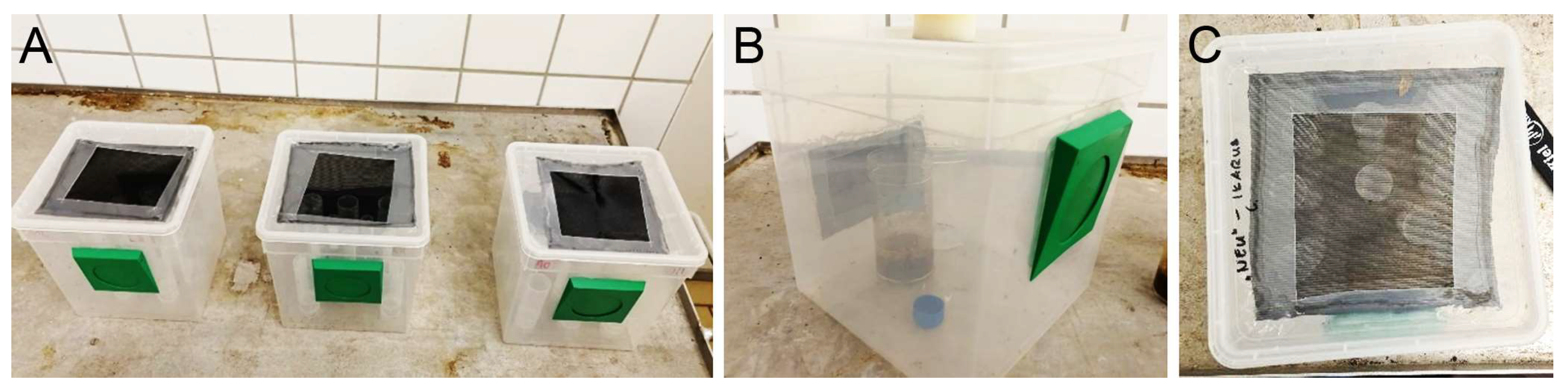
2.1. Trapping Experiments
- (a)
- Digestive fluid and (b) pitcher dimensions for
- ▪
- Diameter:
- (1)
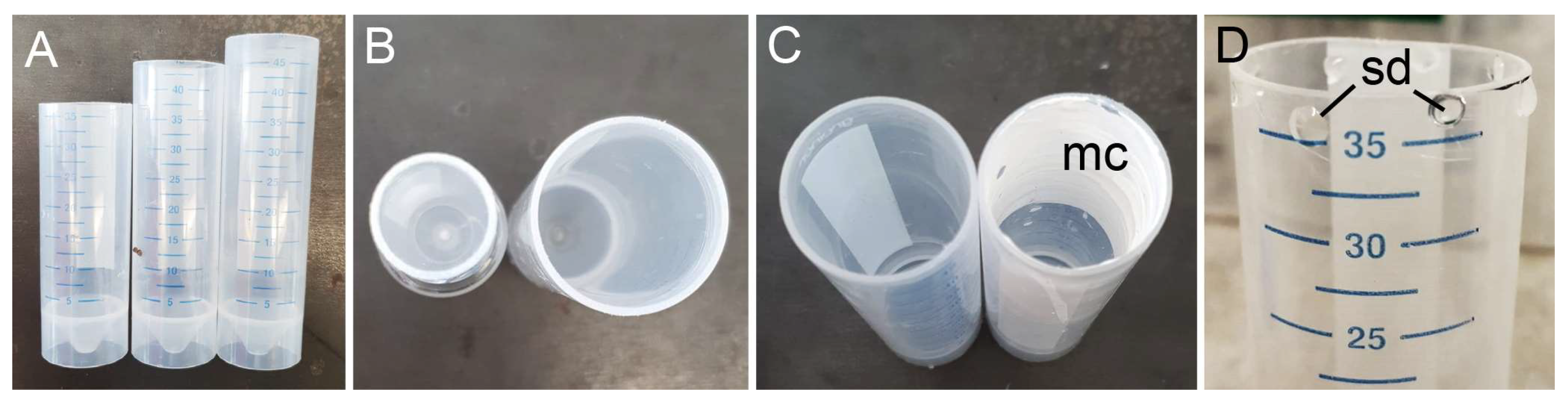
- Tubes 17 mm vs. 30 mm in diameter (both 10 cm high) filled with water;
- (2)
- Tubes 17 mm vs. 30 mm in diameter (both 10 cm high) filled with Triton;
- (3)
- Tubes 17 mm and 30 mm in diameter (both 10 cm high) filled with Domol;
- •
- Height:
- (4)
- Tubes 8 cm vs. 9 cm vs. 10 cm high (all 30 mm in diameter) filled with water;
- (5)
- Tubes 8 cm vs. 9 cm vs. 10 cm high (all 30 mm in diameter) filled with Triton;
- (6)
- Tubes 8 cm vs. 9 cm vs. 10 cm high (all 30 mm in diameter) filled with Domol;
- (c)
- Coverage of the inner pitcher surface imitated by
- •
- Calcium carbonate:
- (7)
- Tubes intact vs. painted (10 cm high, 30 mm in diameter), filled with surfactant;
- •
- Kaolin:
- (8)
- Tubes intact vs. painted (10 cm high, 30 mm in diameter), filled with surfactant.
2.2. Cryo Scanning Electron Microsopy (Cryo SEM)
2.3. Contact Angle (CA) Measurements
3. Results
3.1. Trapping Efficiency of Differently Prepared Tubes
3.1.1. Effects of the Fluid and Tube Dimensions
3.1.2. Effect of Microparticle Coatings
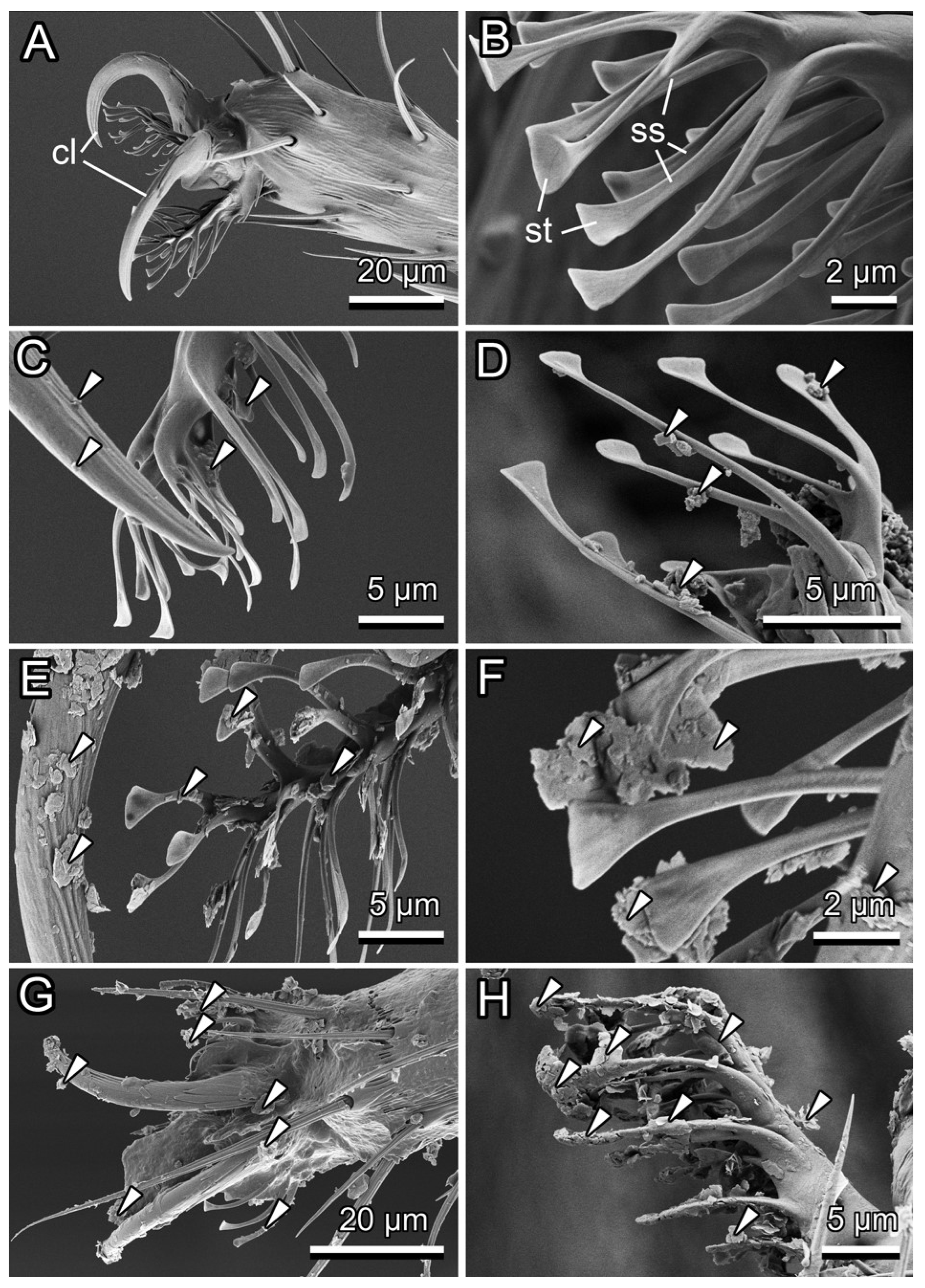
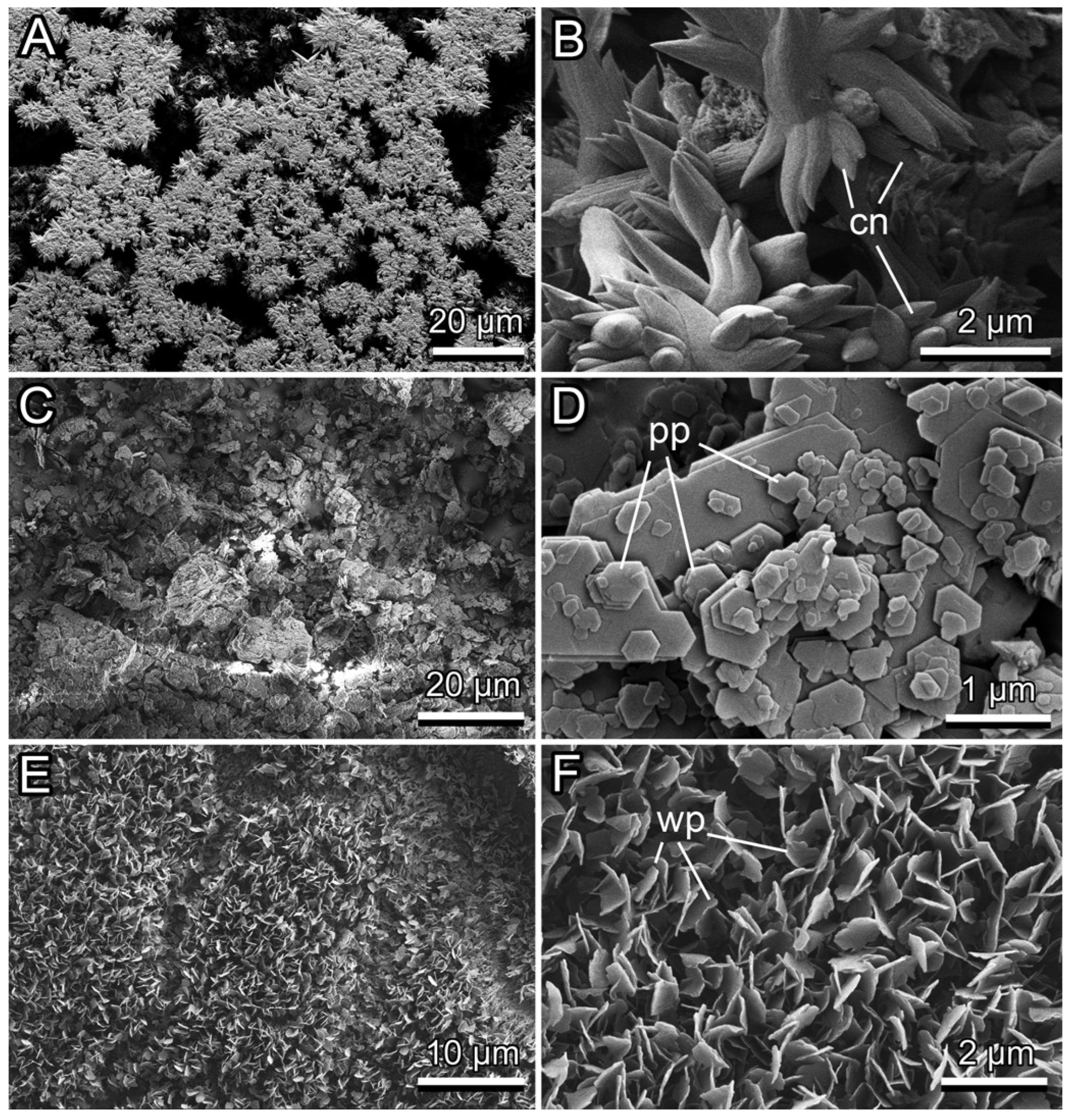
3.2. Contamination of Insect Tarsal Attachment Organs by Different Microparticle Coverages
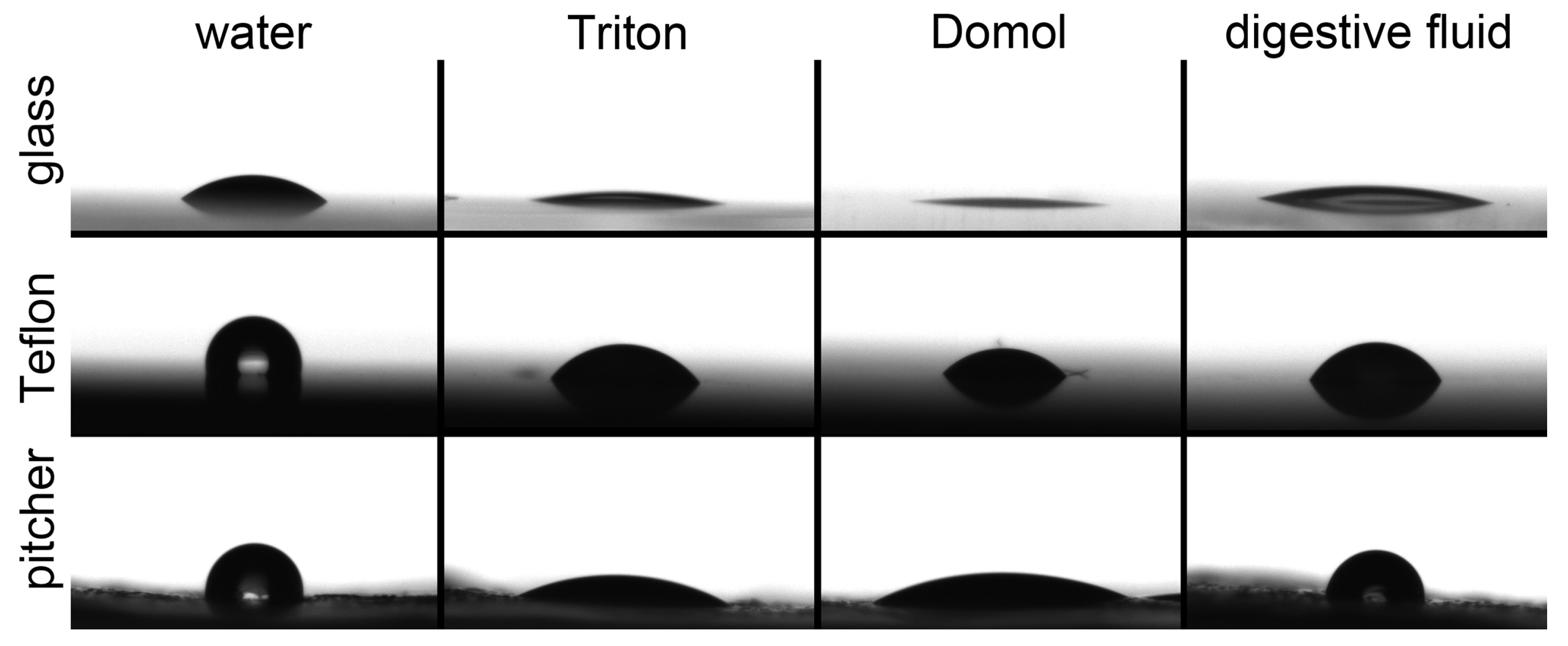
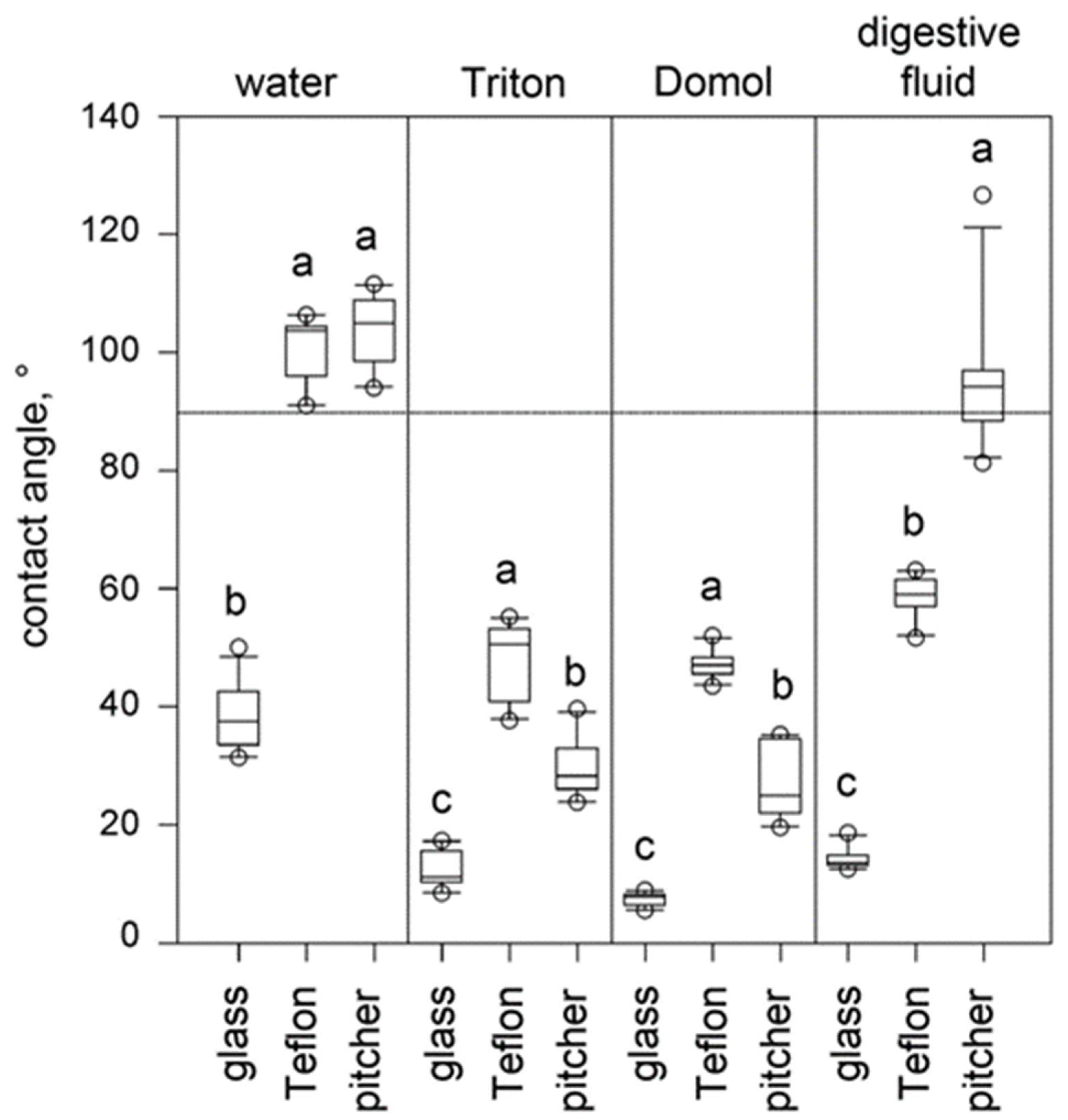
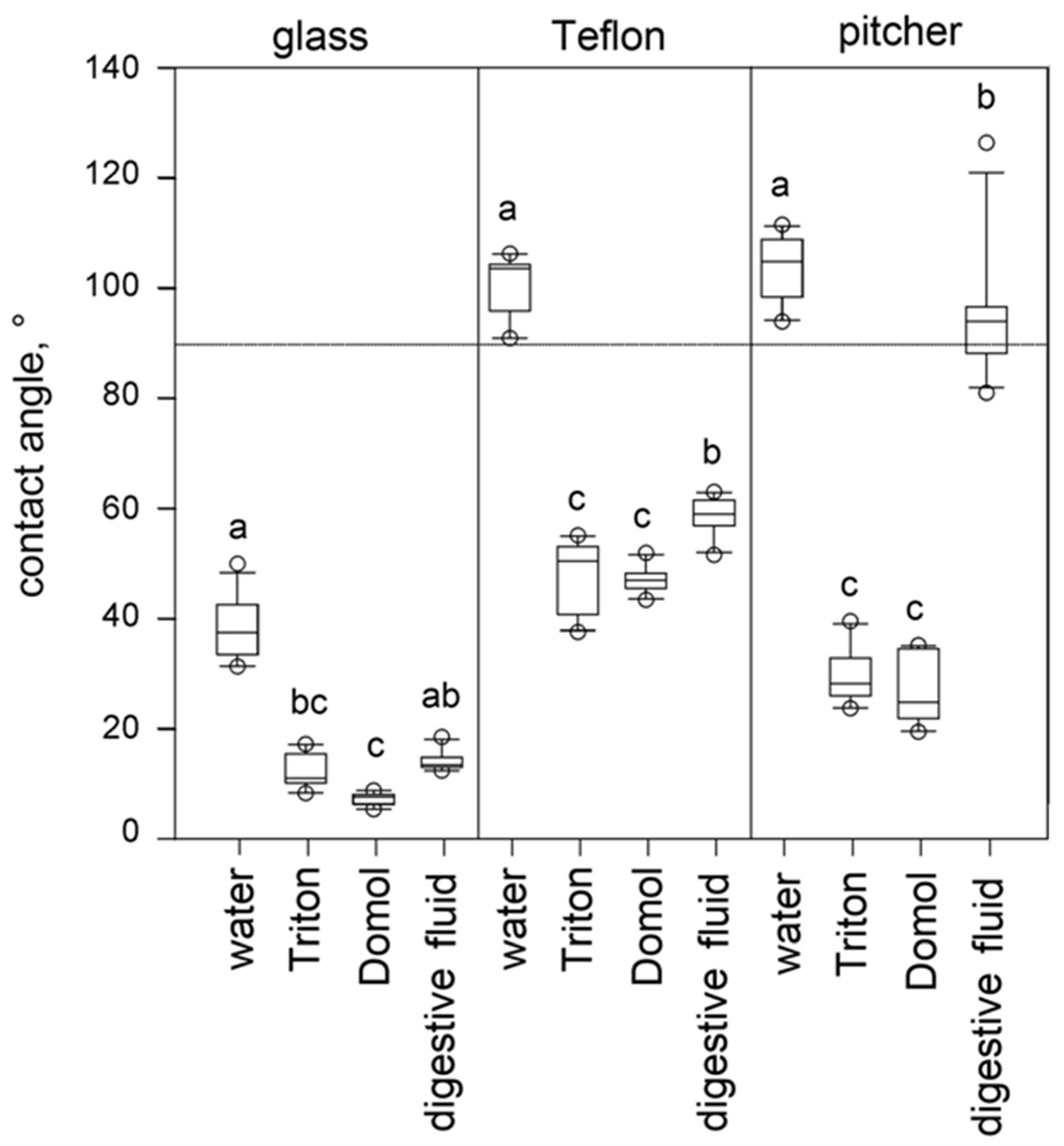
3.3. CAs of Tested Liquids on Different Surface Samples
4. Discussion
4.1. Effects of the Tube Dimensions, Inner Surface Coatings and Liquids on Insect Trapping Efficiency
4.2. Effect of Contamination of Insect Attachment Organs by Microparticles
5. Conclusions
Author Contributions
Funding
Data Availability Statement
Acknowledgments
Conflicts of Interest
Abbreviations
| CA | Contact angle |
| SEM | Scanning electron microscopy |
References
- Ellison, A.M.; Gotelli, N.J. Energetics and the evolution of carnivorous plants-Darwin’s ‘most wonderful plants in the world’. J. Exp. Bot. 2009, 60, 19–42. [Google Scholar] [CrossRef] [PubMed]
- Fleischmann, A.; Schlauer, J.; Smith, S.A.; Givnish, T.J. Evolution of carnivory in angiosperms. In Carnivorous Plants: Physiology, Ecology, and Evolution; Ellison, A.M., Adamec, L., Eds.; Oxford University Press: Oxford, UK, 2018; pp. 22–42. [Google Scholar]
- Cross, A.T.; Krueger, T.A.; Gonella, P.M.; Robinson, A.S.; Fleischmann, A.S. Conservation of carnivorous plants in the age of extinction. Glob. Ecol. Conserv. 2020, 24, e01272. [Google Scholar] [CrossRef]
- Juniper, B.E.; Robins, R.J.; Joel, D.M. The Carnivorous Plants; Academic Press: London, UK, 1989. [Google Scholar]
- Ellison, A.M.; Adamec, L. (Eds.) Carnivorous Plants: Physiology, Ecology, and Evolution; Oxford University Press: Oxford, UK, 2018. [Google Scholar]
- Bauer, U.; Di Giusto, B.; Skepper, J.; Grafe, T.U.; Federle, W. With a flick of the lid: A novel trapping mechanism in Nepenthes gracilis pitcher plants. PLoS ONE 2012, 7, e38951. [Google Scholar] [CrossRef]
- Lenz, A.-K.; Bauer, U. Pitcher geometry facilitates extrinsically powered ‘springboard trapping’ in carnivorous Nepenthes gracilis pitcher plants. Biol. Lett. 2022, 18, 20220106. [Google Scholar] [CrossRef] [PubMed]
- Chomicki, G.; Burin, G.; Busta, L.; Gozdzik, J.; Jetter, R.; Mortimer, B.; Bauer, U. Convergence in carnivorous pitcher plants reveals a mechanism for composite trait evolution. Science 2024, 383, 108–113. [Google Scholar] [CrossRef]
- Jebb, M.H.P.; Cheek, M. A skeletal revision of Nepenthes (Nepenthaceae). Blumea 1997, 42, 1–106. [Google Scholar]
- Moran, J.A.; Clarke, C.M. The carnivorous syndrome in Nepenthes pitcher plants. Plant Signal. Behav. 2010, 5, 644–648. [Google Scholar] [CrossRef]
- Clarke, C. Nepenthes of Borneo; Natural History Publications: Kota Kinabalu, Malaysia, 1997. [Google Scholar]
- Cheek, M.; Jebb, M.; Murphy, B. A classification of functional pitcher types in Nepenthes (Nepenthaceae). bioRxiv 2019, 852137. [Google Scholar] [CrossRef]
- Moran, J.A. Pitcher dimorphism, prey composition and the mechanism of prey attraction in the pitcher plant Nepenthes rafflesiana in Borneo. J. Ecol. 1996, 84, 515–525. [Google Scholar] [CrossRef]
- Moran, J.A.; Booth, W.E.; Charles, J.K. Aspects of pitcher morphology and spectral characteristics of six Bornean Nepenthes pitcher plant species: Implications for prey capture. Ann. Bot. 1999, 83, 521–528. [Google Scholar] [CrossRef]
- Di Giusto, B.; Grosbois, V.; Fargeas, E.; Marshall, D.J.; Gaume, L. Contribution of pitcher fragrance and fluid viscosity to high prey diversity in a Nepenthes carnivorous plant from Borneo. J. Biosci. 2008, 33, 121–136. [Google Scholar] [CrossRef] [PubMed]
- Clarke, C.M.; Bauer, U.; Lee, C.C.; Tuen, A.A.; Rembold, K.; Moran, J.A. Tree shrew lavatories: A novel nitrogen sequestration strategy in a tropical pitcher plant. Biol. Lett. 2009, 5, 632–635. [Google Scholar] [CrossRef] [PubMed]
- Gaume, L.; Bazile, V.; Huguin, M.; Bonhomme, V. Different pitcher shapes and trapping syndromes explain resource partitioning in Nepenthes species. Ecol. Evol. 2016, 6, 1378–1392. [Google Scholar] [CrossRef] [PubMed]
- Lloyd, F.E. The Carnivorous Plants; Ronald Press: New York, NY, USA, 1942. [Google Scholar]
- Moran, J.A.; Merbach, M.A.; Livingston, N.J.; Clarke, C.M.; Booth, W.E. Termite prey specialization in the pitcher plant Nepenthes albomarginata–evidence from stable isotope analysis. Ann. Bot. 2001, 88, 307–311. [Google Scholar] [CrossRef]
- Merbach, M.A.; Merbach, D.J.; Maschwitz, U.; Booth, W.E.; Fiala, B.; Zizka, G. Mass march of termites into the deadly trap. Nature 2002, 415, 36–37. [Google Scholar] [CrossRef]
- Juniper, B.E.; Burras, J.K. How pitcher plant trap insects. New Sci. 1962, 269, 75–77. [Google Scholar]
- Bauer, U.; Federle, W. The insect-trapping rim of Nepenthes pitchers: Surface structure and function. Plant Signal. Behav. 2009, 4, 1019–1023. [Google Scholar] [CrossRef]
- Bauer, U.; Bohn, H.F.; Federle, W. Harmless nectar source or deadly trap: Nepenthes pitchers are activated by rain, condensation and nectar. Proc. R. Soc. Lond. B 2007, 275, 259–265. [Google Scholar] [CrossRef]
- Bauer, U.; Paulin, M.; Robert, D.; Sutton, G.P. Mechanism for rapid passive-dynamic prey capture in a pitcher plant. Proc. Natl. Acad. Sci. USA 2015, 112, 13384–13389. [Google Scholar] [CrossRef]
- Bohn, H.F.; Federle, W. Insect aquaplaning: Nepenthes pitcher plants capture prey with the peristome, a fully wettable water-lubricated anisotropic surface. Proc. Natl. Acad. Sci. USA 2004, 101, 14138–14143. [Google Scholar] [CrossRef]
- Gorb, E.V.; Gorb, S.N. Functional surfaces in the pitcher of the carnivorous plant Nepenthes alata: A cryo-SEM approach. In Functional Surfaces in Biology: Adhesion Related Phenomena; Gorb, S., Ed.; Springer: Dordrecht, The Netherlands, 2009; Volume 2, pp. 205–238. [Google Scholar]
- Hooker, D.J. On the origin and development of the pitcher of Nepenthes, with the account of some new Bornean plants of the genus. Trans. Linn. Soc. 1859, 22, 415–424. [Google Scholar] [CrossRef]
- Poppinga, S.; Koch, K.; Bohn, H.F.; Barthlott, W. Comparative and functional morphology of hierarchically structured anti-adhesive surfaces in carnivorous plants and kettle trap flowers. Funct. Plant Biol. 2010, 37, 952–961. [Google Scholar] [CrossRef]
- Gorb, E.V.; Purtov, J.; Gorb, S.N. Adhesion force measurements on the two wax layers of the waxy zone in Nepenthes alata pitchers. Sci. Rep. 2014, 4, 5154. [Google Scholar] [CrossRef]
- Gaume, L.; Gorb, S.; Rowe, N. Function of epidermal surfaces in the trapping efficiency of Nepenthes alata pitchers. New Phytol. 2002, 156, 479–489. [Google Scholar] [CrossRef] [PubMed]
- Gorb, E.V.; Gorb, S.N. The effect of surface anisotropy in the slippery zone of Nepenthes alata pitchers on beetle attachment. Beilstein J. Nanotechnol. 2011, 2, 302–310. [Google Scholar] [CrossRef]
- Wang, L.; Tao, D.; Dong, S.; Li, S.; Tian, Y. Contributions of lunate cells and wax crystals to the surface anisotropy of Nepenthes slippery zone. R. Soc. Open Sci. 2018, 5, 180766. [Google Scholar] [CrossRef]
- Gorb, E.; Haas, K.; Henrich, A.; Enders, S.; Barbakadze, N.; Gorb, S. Composite structure of the crystalline epicuticular wax layer of the slippery zone in the pitchers of the carnivorous plant Nepenthes alata and its effect on insect attachment. J. Exp. Biol. 2005, 208, 4651–4662. [Google Scholar] [CrossRef]
- Benz, M.J.; Gorb, E.V.; Gorb, S.N. Diversity of the slippery zone microstructure in pitchers of nine carnivorous Nepenthes taxa. Arthropod-Plant Interact. 2012, 6, 147–158. [Google Scholar] [CrossRef]
- Scholz, I.; Bückins, M.; Dolge, L.; Erlinghagen, T.; Weth, A.; Hischen, F.; Mayer, J.; Hoffmann, S.; Riederer, M.; Riedel, M.; et al. Slippery surfaces of pitcher plants: Nepenthes wax crystals minimize insect attachment via microscopic surface roughness. J. Exp. Biol. 2010, 213, 1115–1125. [Google Scholar] [CrossRef]
- Gaume, L.; Perret, P.; Gorb, E.; Gorb, S.; Labat, J.-J.; Rowe, N. How do plant waxes cause flies to slide? Experimental tests of wax-based trapping mechanisms in three pitfall carnivorous plants. Arthropod Struct. Dev. 2004, 33, 103–111. [Google Scholar] [CrossRef]
- Gorb, E.V.; Gorb, S.N. Physicochemical properties of functional surfaces in pitchers of the carnivorous plant Nepenthes alata Blanco (Nepenthaceae). Plant Biol. 2006, 8, 841–848. [Google Scholar] [CrossRef]
- Gorb, S.N.; Voigt, D.; Gorb, E.V. Visualisation of small fluid droplets on biological and artificial surfaces using the cryo-SEM approach. In Modern Research and Educational Topics in Microscopy; Méndez-Vilas, A., Díaz, J., Eds.; Formatex: Badajoz, Spain, 2007; pp. 812–819. [Google Scholar]
- Bauer, U.; Clemente, C.J.; Renner, T.; Federle, W. Form follows function: Morphological diversification and alternative trapping strategies in carnivorous Nepenthes pitcher plants. J. Evol. Biol. 2011, 25, 90–102. [Google Scholar] [CrossRef]
- Luttge, U. Structure and function of plant glands. Annu. Rev. Plant Physiol. 1971, 22, 23–44. [Google Scholar] [CrossRef]
- Schulze, W.; Frommer, W.B.; Ward, J.M. Transporters for ammonium, amino acids and peptides are expressed in pitchers of the carnivorous plant Nepenthes. Plant J. 1999, 17, 637–646. [Google Scholar] [CrossRef] [PubMed]
- Owen, T.P.; Lennon, K.A.; Santo, M.J.; Anderson, A.Y. Pathways for nutrient transport in the pitchers of the carnivorous plant Nepenthes alata. Ann. Bot. 1999, 84, 459–466. [Google Scholar] [CrossRef]
- An, C.-I.; Fukusaki, E.-I.; Kobayashi, A. Plasma-membrane H+-ATPases are expressed in pitchers of the carnivorous plant Nepenthes alata Blanco. Planta 2001, 212, 547–555. [Google Scholar] [CrossRef]
- Chia, T.F.; Aung, H.H.; Osipov, A.N.; Goh, N.K.; Chia, L.S. Carnivorous pitcher plant uses free radicals in the digestion of prey. Redox Rep. 2004, 9, 255–261. [Google Scholar] [CrossRef]
- Mithöfer, A. Carnivorous pitcher plants: Insights in an old topic. Phytochemistry 2011, 72, 1678–1682. [Google Scholar] [CrossRef]
- Gorb, E.; Kastner, V.; Peressadko, A.; Arzt, E.; Gaume, L.; Rowe, N.; Gorb, S. Structure and properties of the glandular surface in the digestive zone of the pitcher in the carnivorous plant Nepenthes ventrata and its role in insect trapping and retention. J. Exp. Biol. 2004, 207, 2947–2963. [Google Scholar] [CrossRef]
- Gaume, L.; Forterre, Y. A viscoelastic deadly fluid in carnivorous pitcher plants. PLoS ONE 2007, 2, e1185. [Google Scholar] [CrossRef]
- Bonhomme, V.; Pelloux-Prayer, H.; Jousselin, E.; Forterre, Y.; Labat, J.; Gaume, L. Slippery or sticky? Functional diversity in the trapping strategy of Nepenthes carnivorous plants. New Phytol. 2011, 191, 545–554. [Google Scholar] [CrossRef]
- Bazile, V.; Le Moguédec, G.; Marshall, D.J.; Gaume, L. Fluid physico-chemical properties influence capture and diet in Nepenthes pitcher plants. Ann. Bot. 2015, 115, 705–716. [Google Scholar] [CrossRef] [PubMed]
- Mithöfer, A. Carnivorous plants and their biotic interactions. J. Plant Interact. 2022, 17, 333–343. [Google Scholar] [CrossRef]
- Moran, J.A.; Gray, L.K.; Clarke, C.; Chin, L. Capture mechanism in Palaeotropical pitcher plants (Nepenthaceae) is constrained by climate. Ann. Bot. 2013, 112, 1279–1291. [Google Scholar] [CrossRef] [PubMed]
- Miguel, S.; Hehn, A.; Bourgaud, F. Nepenthes: State of the art of an inspiring plant for biotechnologists. J. Biotechnol. 2018, 265, 109–115. [Google Scholar] [CrossRef]
- Neinhuis, C.; Koch, K.; Barthlott, W. Movement and regeneration of epicuticular waxes through plant cuticles. Planta 2001, 213, 427–434. [Google Scholar] [CrossRef]
- Kovalev, A.E.; Varenberg, M.; Gorb, S.N. Wet versus dry adhesion of biomimetic mushroom-shaped microstructures. Soft Matter 2012, 8, 7560–7566. [Google Scholar] [CrossRef]
- Lehmann, F.-O.; Sane, S.P.; Dickinson, M. The aerodynamic effects of wing-wing interaction in flapping insect wings. J. Exp. Biol. 2005, 208, 3075–3092. [Google Scholar] [CrossRef]
- Gorb, E.V.; Gorb, S.N. Combined effect of different flower stem features on the visiting frequency of the generalist ant Lasius niger: An experimental study. Insects 2021, 12, 1026. [Google Scholar] [CrossRef]
- Glenn, D.M.; Puterka, G.J. Particle films: A new technology for agriculture. Hortic. Rev. 2005, 31, 1–44. [Google Scholar] [CrossRef]
- Salerno, G.; Rebora, M.; Kovalev, A.; Gorb, E.; Gorb, S. Kaolin nano-powder effect on insect attachment ability. J. Pest Sci. 2020, 93, 315–327. [Google Scholar] [CrossRef]
- Salerno, G.; Rebora, M.; Piersanti, S.; Saitta, V.; Kovalev, A.; Gorb, E.; Gorb, S. Reduction in insect attachment caused by different nanomaterials used as particle films (kaolin, zeolite, calcium carbonate). Sustainability 2021, 13, 8250. [Google Scholar] [CrossRef]
- Busscher, H.; van Pelt, A.; de Boer, P.; de Jong, H.; Arends, J. The effect of the surface roughening of polymers on measured contact angle of liquids. Colloids Surf. 1984, 9, 319–331. [Google Scholar] [CrossRef]
- Erbil, H.Y. Surface tension of polymers. In CRC Handbook of Surfaces and Colloid Chemistry; Birdi, K.S., Ed.; CRC Press: Boca Raton, FL, USA, 1997; pp. 265–312. [Google Scholar]
- Buch, F.; Pauchet, Y.; Rott, M.; Mithöfer, A. Characterization and heterologous expression of a PR-1 protein from traps of the carnivorous plant Nepenthes mirabilis. Phytochemistry 2014, 100, 43–50. [Google Scholar] [CrossRef]
- Gaume, L.; Di Giusto, B. Adaptive significance and ontogenetic variability of the waxy zone in Nepenthes rafflesiana. Ann. Bot. 2009, 104, 1281–1291. [Google Scholar] [CrossRef]
- Clarke, C. Nepenthes of Sumatra & Peninsular Malaysia; Natural History Publications: Kota Kinabalu, Malaysia, 2001. [Google Scholar]
- Cheek, M.; Jebb, M. Nepenthaceae. In Flora Malesiana; Nationaal Herbarium Nederland: Leiden, The Netherlands, 2001; Volume 15. [Google Scholar]
- Kang, V.; Isermann, H.; Sharma, S.; Wilson, D.I.; Federle, W. How a sticky fluid facilitates prey retention in a carnivorous pitcher plant (Nepenthes rafflesiana). Acta Biomater. 2021, 128, 357–369. [Google Scholar] [CrossRef]
- Rembold, K.; Fischer, E.; Wetzel, M.A.; Barthlott, W. Prey composition of the pitcher plant Nepenthes madagascariensis. J. Trop. Ecol. 2010, 26, 365–372. [Google Scholar] [CrossRef]
- Gorb, S.N. Attachment Devices of Insect Cuticle; Kluwer Academic Publishers: Dordrecht, The Netherlands, 2001. [Google Scholar]
- Peressadko, A.; Gorb, S.N. Surface profile and friction force generated by insects. In Proceedings of the 1st International Industrial Conference Bionik, Hannover, Germany, 22–23 April 2004; Boblan, I., Bannasch, R., Eds.; VDI Verlag: Düsseldorf, Germany, 2004; pp. 257–263. [Google Scholar]
- Kovalev, A.; Filippov, A.E.; Gorb, S.N. Critical roughness in animal hairy adhesive pads: A numerical modeling approach. Bioinspiration Biomim. 2018, 13, 066004. [Google Scholar] [CrossRef]
- Puterka, G.J.; Glenn, D.M.; Pluta, R.C. Action of particle films on the biology and behavior of pear psylla (Homoptera: Psyllidae). J. Econ. Entomol. 2005, 98, 2079–2088. [Google Scholar] [CrossRef]
- Gorb, E.V.; Gorb, S.N. Do plant waxes make insect attachment structures dirty? Experimental evidence for the contamination hypothesis. In Ecology and Biomechanics: A Mechanical Approach to the Ecology of Animals and Plants; Herrel, A., Speck, T., Rowe, N.P., Eds.; CRC Press: Boca Raton, FL, USA, 2006; pp. 147–162. [Google Scholar]
- Gorb, E.V.; Gorb, S.N. Insect attachment on waxy plant surfaces: The effect of pad contamination by different waxes. Beilstein J. Nanotechnol. 2024, 15, 385–395. [Google Scholar] [CrossRef]
- Borodich, F.M.; Gorb, E.V.; Gorb, S.N. Fracture behaviour of plant epicuticular wax crystals and its role in preventing insect attachment: A theoretical approach. Appl. Phys. A 2010, 100, 63–71. [Google Scholar] [CrossRef]
- Borodich, F.M.; Gao, Z.; Gorb, E.V.; Gorb, S.N.; Jin, X. Wax protrusions on anti-adhesive plant surfaces and their interactions with insect adhesive pads: A mechanical interpretation. Biomimetics 2024, 9, 442. [Google Scholar] [CrossRef]




| Set- Up | Tube Type | Liquid | Tested Character | Categories | Trapped Total 1 | Trapped Per Tube 2 | Trapped Per Tube (%) 3 |
|---|---|---|---|---|---|---|---|
| 1 | 10 cm high | water | diameter | 17 mm | 3 | 0.20 | 0.07 |
| 30 mm | 23 | 1.53 | 0.51 | ||||
| 2 | 10 cm high | Triton | diameter | 17 mm | 59 | 3.93 | 1.31 |
| 30 mm | 240 | 16.00 | 5.36 | ||||
| 3 | 10 cm high | Domol | diameter | 17 mm | 40 | 2.67 | 0.89 |
| 30 mm | 241 | 16.07 | 5.36 | ||||
| 4 | 30 mm diameter | water | height | 8 cm | 3 | 0.33 | 0.11 |
| 9 cm | 5 | 0.56 | 0.19 | ||||
| 10 cm | 1 | 1.11 | 0.04 | ||||
| 5 | 30 mm diameter | Triton | height | 8 cm | 52 | 5.78 | 1.93 |
| 9 cm | 61 | 6.78 | 2.26 | ||||
| 10 cm | 129 | 14.33 | 4.78 | ||||
| 6 | 30 mm diameter | Domol | height | 8 cm | 97 | 10.78 | 3.59 |
| 9 cm | 86 | 9.56 | 3.19 | ||||
| 10 cm | 108 | 12.00 | 4.00 | ||||
| 7 | 10 cm high, 30 mm diameter | Triton | calcium carbonate coating | no | 125 | 8.33 | 2.78 |
| yes | 175 | 11.67 | 3.89 | ||||
| 8 | 10 cm high, 30 mm diameter | Domol | kaolin coating | no | 63 | 10.50 | 3.50 |
| yes | 233 | 38.83 | 12.94 |
Disclaimer/Publisher’s Note: The statements, opinions and data contained in all publications are solely those of the individual author(s) and contributor(s) and not of MDPI and/or the editor(s). MDPI and/or the editor(s) disclaim responsibility for any injury to people or property resulting from any ideas, methods, instructions or products referred to in the content. |
© 2026 by the authors. Licensee MDPI, Basel, Switzerland. This article is an open access article distributed under the terms and conditions of the Creative Commons Attribution (CC BY) license.
Share and Cite
Gorb, E.V.; Lange, M.; Jamke, A.; Gorb, S.N. Effect of Different Characters of the Pitcher Trap Syndrome in Nepenthes on Insect Trapping Efficiency: A Biomimetic Approach. Biomimetics 2026, 11, 180. https://doi.org/10.3390/biomimetics11030180
Gorb EV, Lange M, Jamke A, Gorb SN. Effect of Different Characters of the Pitcher Trap Syndrome in Nepenthes on Insect Trapping Efficiency: A Biomimetic Approach. Biomimetics. 2026; 11(3):180. https://doi.org/10.3390/biomimetics11030180
Chicago/Turabian StyleGorb, Elena V., Meike Lange, Anna Jamke, and Stanislav N. Gorb. 2026. "Effect of Different Characters of the Pitcher Trap Syndrome in Nepenthes on Insect Trapping Efficiency: A Biomimetic Approach" Biomimetics 11, no. 3: 180. https://doi.org/10.3390/biomimetics11030180
APA StyleGorb, E. V., Lange, M., Jamke, A., & Gorb, S. N. (2026). Effect of Different Characters of the Pitcher Trap Syndrome in Nepenthes on Insect Trapping Efficiency: A Biomimetic Approach. Biomimetics, 11(3), 180. https://doi.org/10.3390/biomimetics11030180