Figure 1.
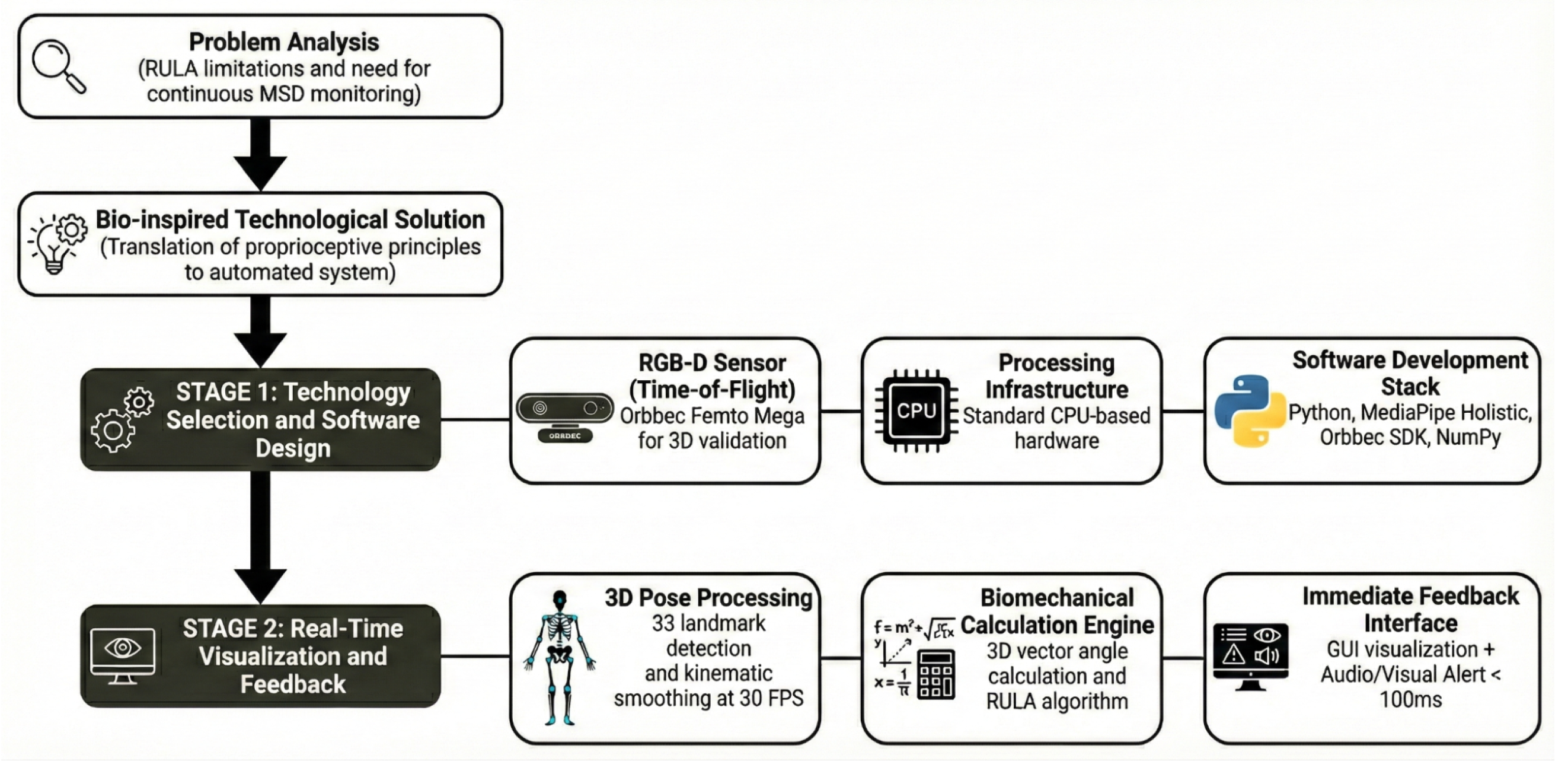
Workflow for monitoring tool development. The first stage begins with the analysis of the problem of musculoskeletal disorders (MSDs). It was observed that forced postures and repetitive movements generate a cumulative negative impact that compromises worker health. At an organizational level, this problem transcends individual health, resulting in high operating costs due to increased absenteeism, lost workdays, and reduced productive efficiency. Literature and operational environment analyses identified that the most prevalent injuries are concentrated in the upper body: back, neck, and shoulders, as well as in the tendinous and nervous units of the forearm and wrist. Based on this diagnosis, the second stage focused on creating a technological tool designed to serve as objective support for expert judgment. To this end, 2 key sub-stages were configured: (1) selection of necessary technology for monitoring software design and programming, and (2) real-time visualization capable of processing human posture and providing immediate feedback.
Figure 1.
Workflow for monitoring tool development. The first stage begins with the analysis of the problem of musculoskeletal disorders (MSDs). It was observed that forced postures and repetitive movements generate a cumulative negative impact that compromises worker health. At an organizational level, this problem transcends individual health, resulting in high operating costs due to increased absenteeism, lost workdays, and reduced productive efficiency. Literature and operational environment analyses identified that the most prevalent injuries are concentrated in the upper body: back, neck, and shoulders, as well as in the tendinous and nervous units of the forearm and wrist. Based on this diagnosis, the second stage focused on creating a technological tool designed to serve as objective support for expert judgment. To this end, 2 key sub-stages were configured: (1) selection of necessary technology for monitoring software design and programming, and (2) real-time visualization capable of processing human posture and providing immediate feedback.

Figure 2.
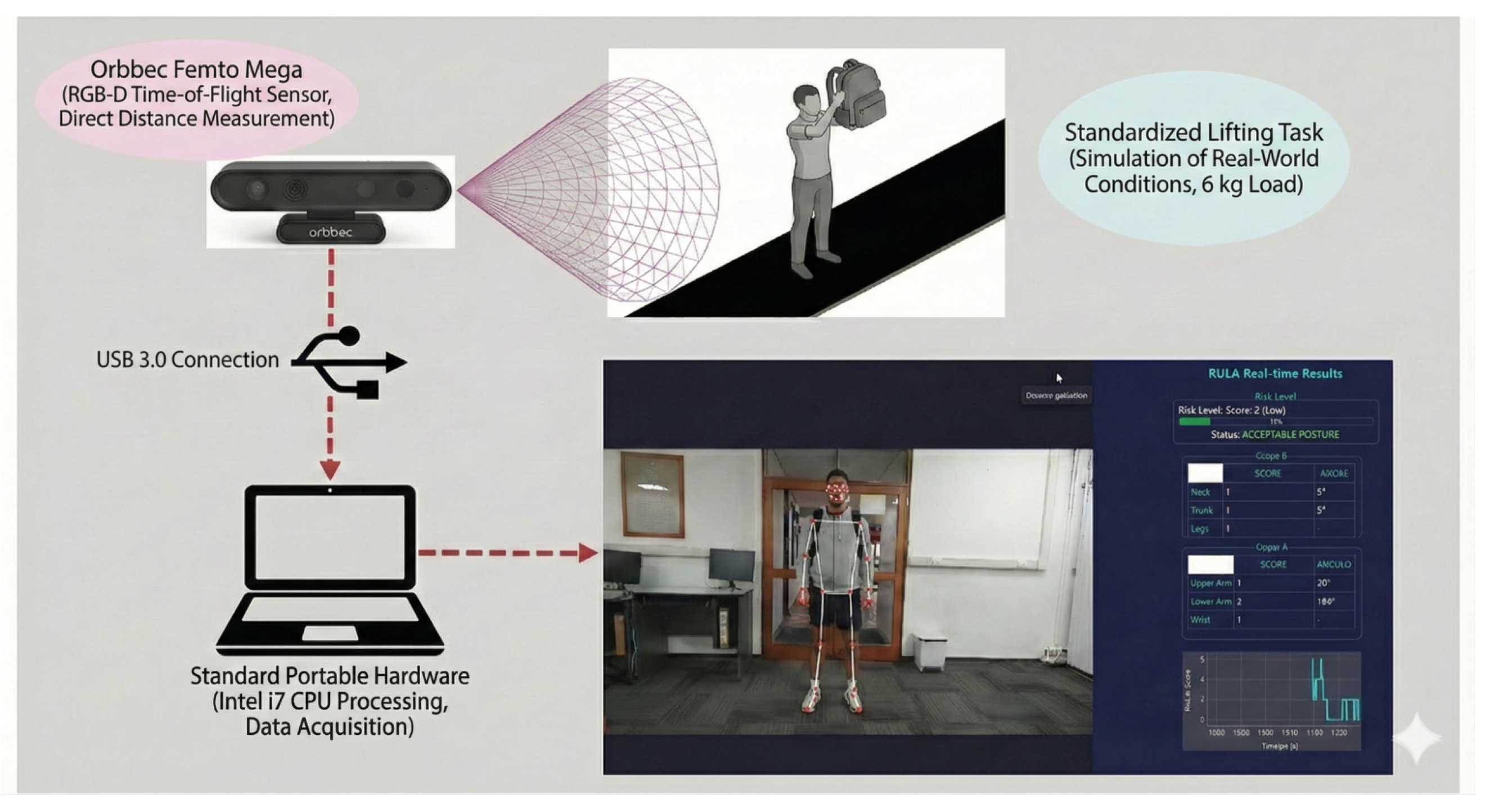
Operational diagram of the Orbbec camera and computer.
Figure 2.
Operational diagram of the Orbbec camera and computer.
Figure 3.
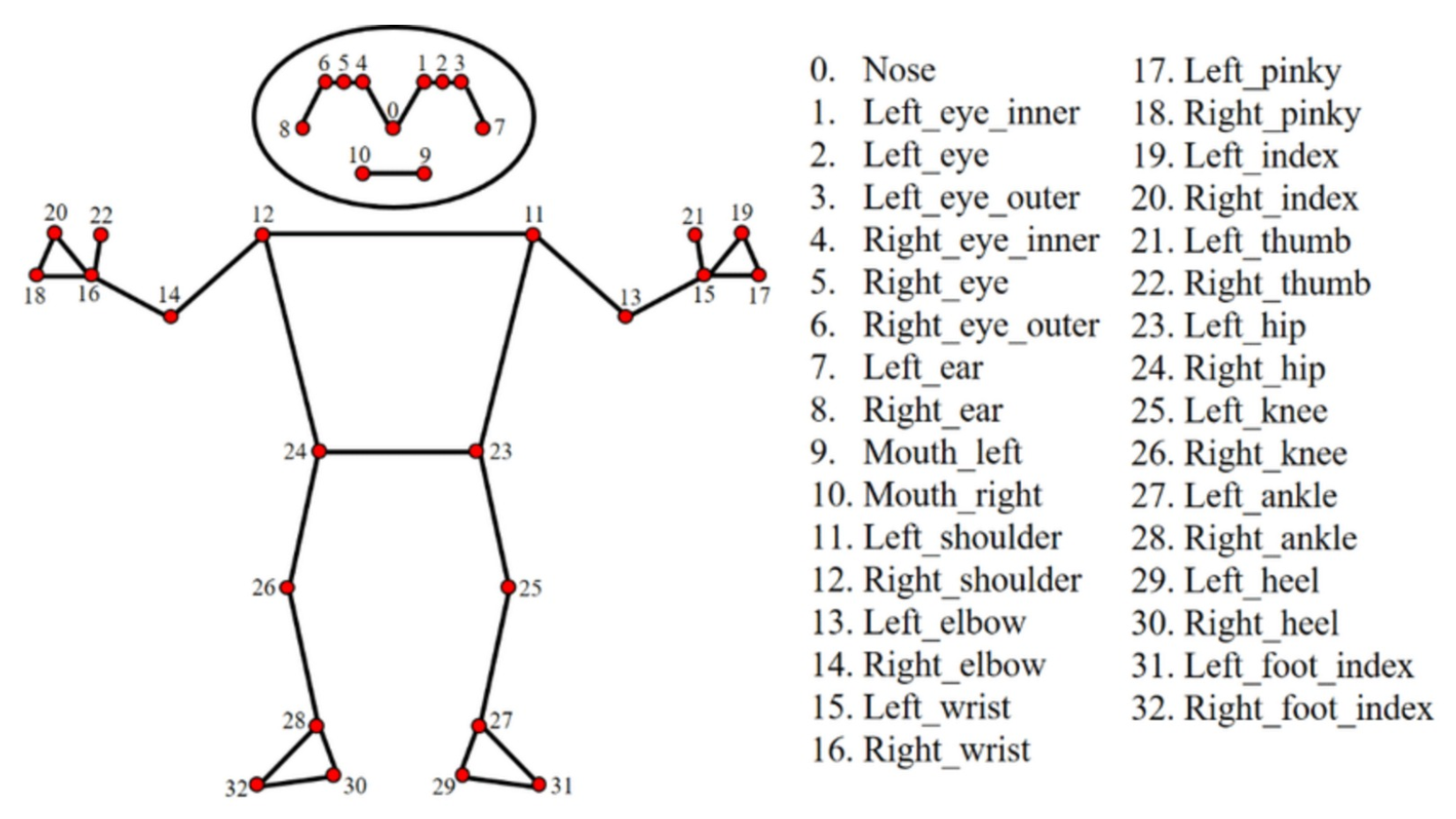
Body point numbering with MediaPipe.
Figure 3.
Body point numbering with MediaPipe.
Figure 4.
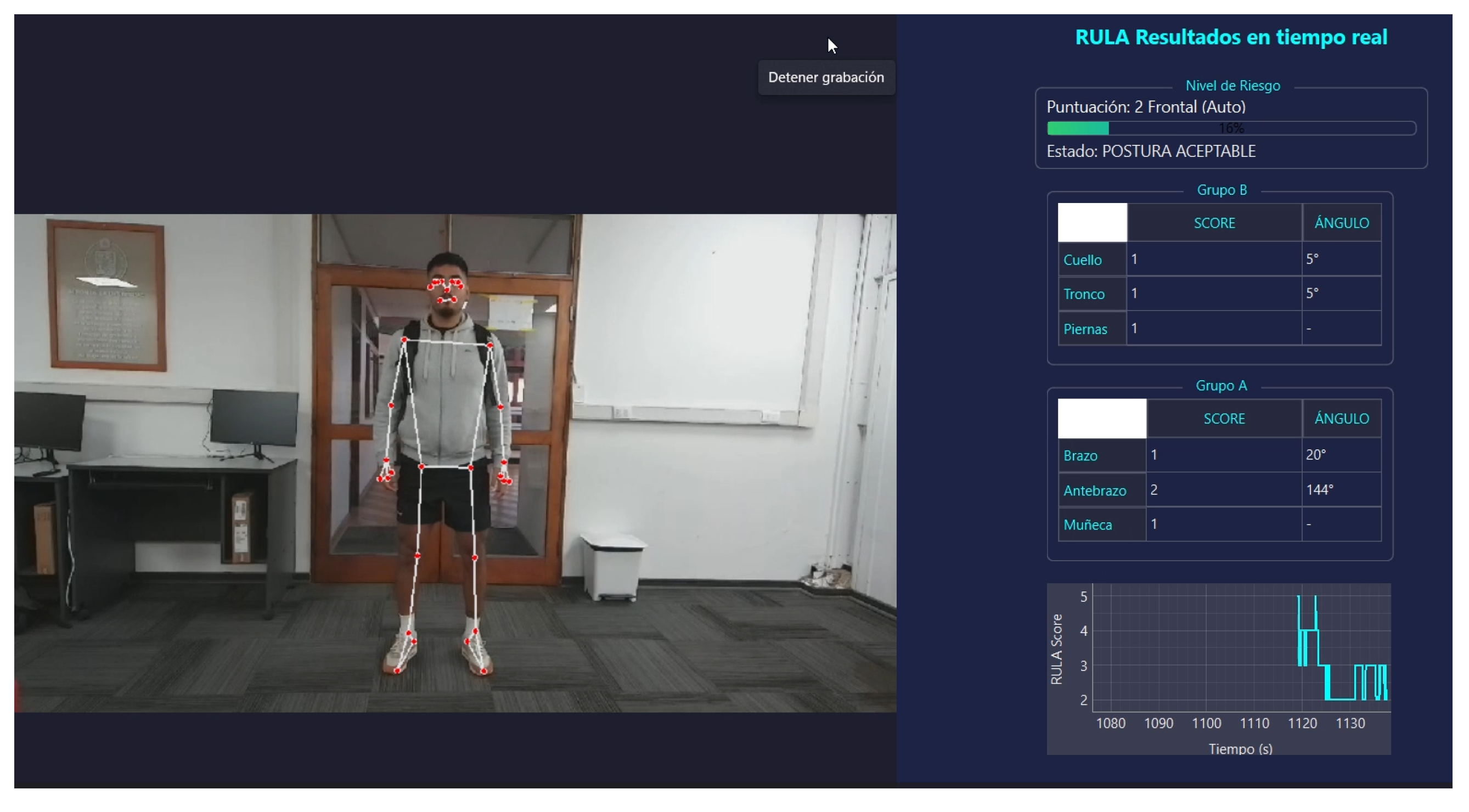
Implemented graphical user interface.
Figure 4.
Implemented graphical user interface.
Figure 5.
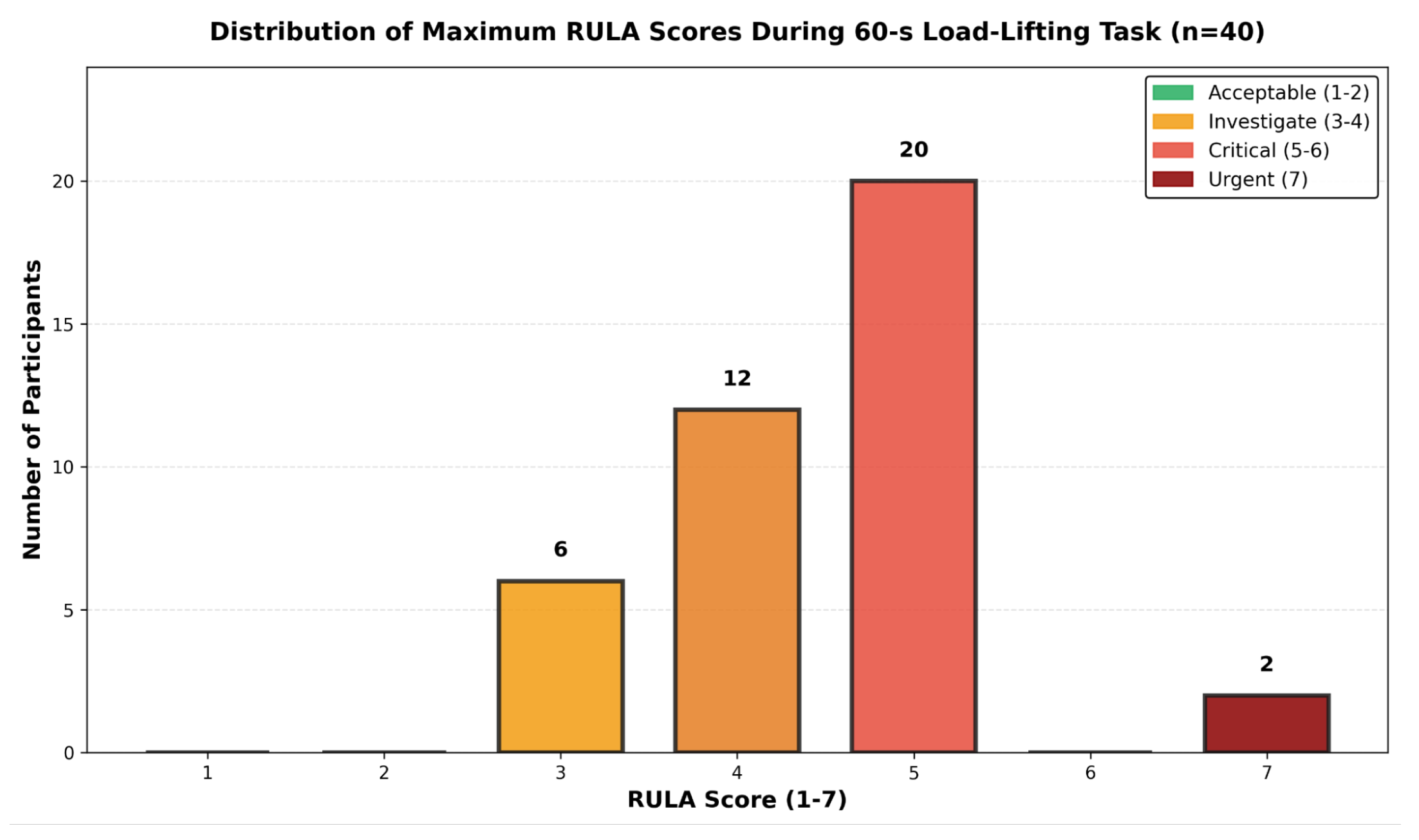
Histogram showing distribution of maximum RULA scores achieved by each participant () during 60 s load lifting tasks. X-axis: RULA score (1–7); Y-axis: frequency (participant count). Color coding: green (Scores 1–2, ), yellow (Scores 3–4, ), orange (Scores 5–6, ), and red (Score 7, ). This demonstrates a risk concentration in the 5–6 range, with 95% of participants achieving scores . This distribution emphasizes that dynamic task execution induces systematic postural risk across the anthropometric spectrum.
Figure 5.
Histogram showing distribution of maximum RULA scores achieved by each participant () during 60 s load lifting tasks. X-axis: RULA score (1–7); Y-axis: frequency (participant count). Color coding: green (Scores 1–2, ), yellow (Scores 3–4, ), orange (Scores 5–6, ), and red (Score 7, ). This demonstrates a risk concentration in the 5–6 range, with 95% of participants achieving scores . This distribution emphasizes that dynamic task execution induces systematic postural risk across the anthropometric spectrum.
Figure 6.
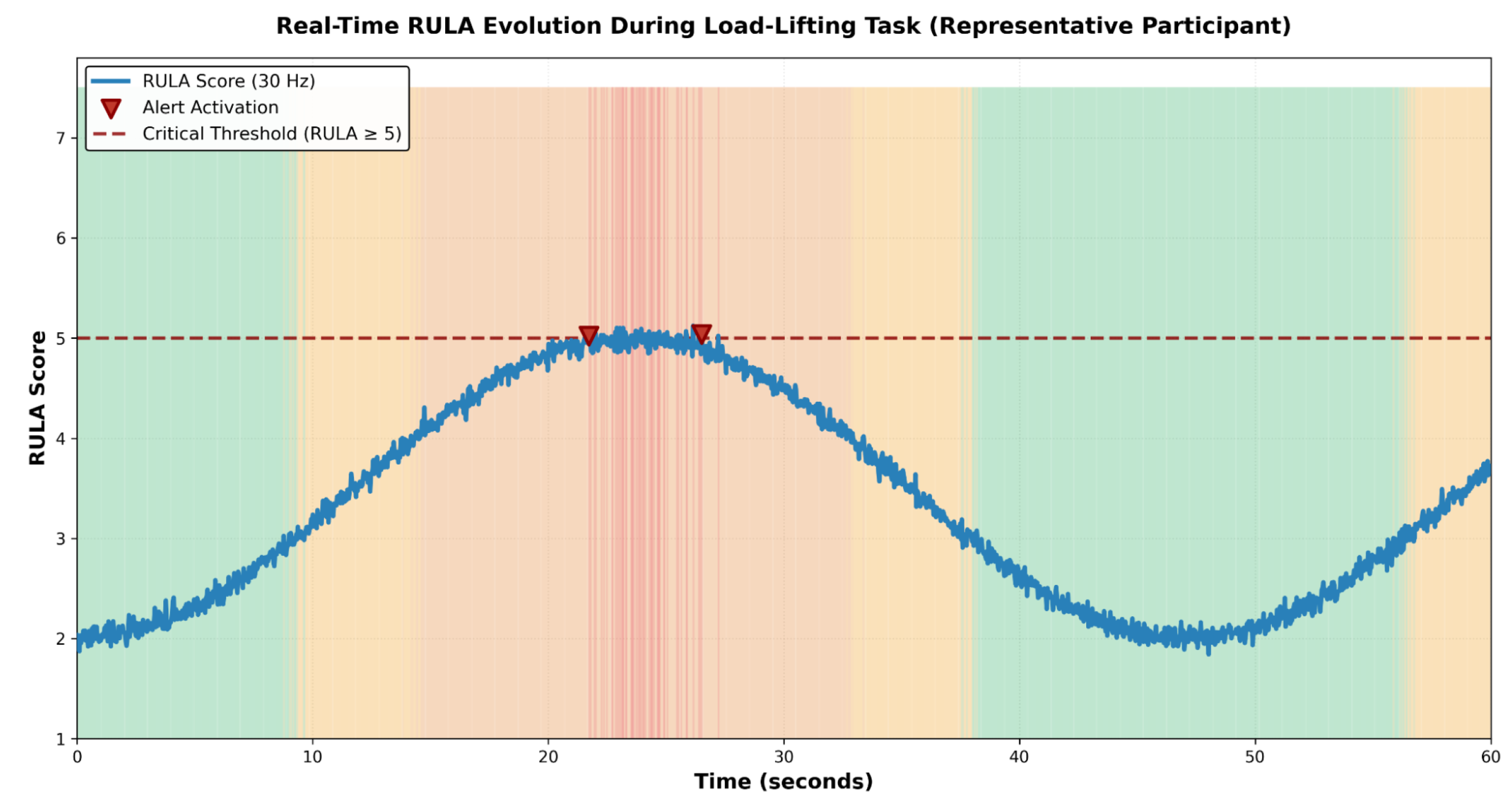
Representative time series plot of RULA score trajectory during execution of 60 s load lifting task. X-axis: Time (seconds); Y-axis: RULA score (1–7). Solid blue line shows RULA score calculated at 30 Hz sampling frequency (1800 data points per participant). Red vertical markers indicate audio alert activation events. Shaded regions: green (<3, acceptable), yellow (3–4, investigate), orange (5–6, changes needed), and red (≥7, urgent). Visible task phases: (0–5 s) initiation/acceleration phase with score elevation, (5–35 s) maximum load showing multiple alert events, (35–50 s) sustained elevation, and (50–60 s) recovery phase. For this representative participant, 18 distinct alert events triggered during 1840 ms of cumulative RULA > 5 time, demonstrating continuous monitoring sensitivity. Demonstrates close temporal correspondence between calculated risk and alert activation.
Figure 6.
Representative time series plot of RULA score trajectory during execution of 60 s load lifting task. X-axis: Time (seconds); Y-axis: RULA score (1–7). Solid blue line shows RULA score calculated at 30 Hz sampling frequency (1800 data points per participant). Red vertical markers indicate audio alert activation events. Shaded regions: green (<3, acceptable), yellow (3–4, investigate), orange (5–6, changes needed), and red (≥7, urgent). Visible task phases: (0–5 s) initiation/acceleration phase with score elevation, (5–35 s) maximum load showing multiple alert events, (35–50 s) sustained elevation, and (50–60 s) recovery phase. For this representative participant, 18 distinct alert events triggered during 1840 ms of cumulative RULA > 5 time, demonstrating continuous monitoring sensitivity. Demonstrates close temporal correspondence between calculated risk and alert activation.
Figure 7.
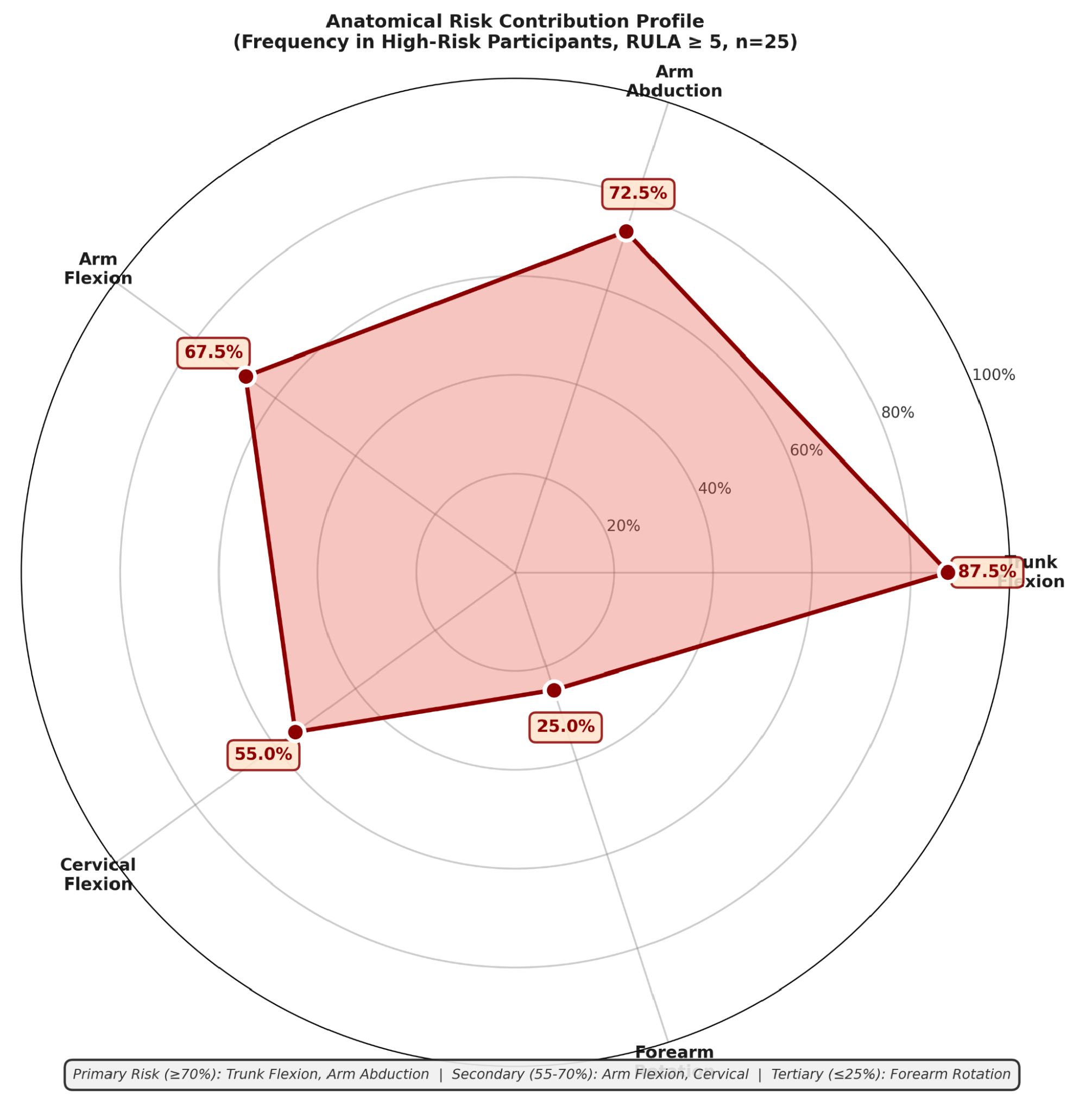
Radar/spider chart showing relative contribution of anatomical segments to postural risk. Representation of six axes: Trunk Flexion, Arm Abduction, Arm Flexion, Cervical Flexion, Forearm Rotation, and overall risk severity. Data points represent percentage of high-risk participants () where each segment contributed significantly to critical classification. Expected values: Trunk 87.5%, Arm Abduction 72.5%, Arm Flexion 68%, Cervical 55%, Forearm 25%. Shaded region bounded by connecting percentages reveals anatomical risk profile. Trunk flexion emerges as dominant contributor, indicating workstation redesign should prioritize vertical task positioning to reduce forward bending.
Figure 7.
Radar/spider chart showing relative contribution of anatomical segments to postural risk. Representation of six axes: Trunk Flexion, Arm Abduction, Arm Flexion, Cervical Flexion, Forearm Rotation, and overall risk severity. Data points represent percentage of high-risk participants () where each segment contributed significantly to critical classification. Expected values: Trunk 87.5%, Arm Abduction 72.5%, Arm Flexion 68%, Cervical 55%, Forearm 25%. Shaded region bounded by connecting percentages reveals anatomical risk profile. Trunk flexion emerges as dominant contributor, indicating workstation redesign should prioritize vertical task positioning to reduce forward bending.
Table 1.
Mapping of biological proprioceptive system to technical implementation.
Table 1.
Mapping of biological proprioceptive system to technical implementation.
| Biological Component | Function | Technical Implementation |
|---|
| Proprioceptive receptors | Continuous posture sampling | MediaPipe Holistic at 30 FPS |
| Joint angle detection | 3D orientation measurement | Vector-based angle calculation |
| Sensory–neural transmission | Latency <50 ms | Processing latency 18.3 ms (21.8 ms avg) |
| Spinal processing | Risk classification | RULA lookup table implementation |
| Motor correction command | Corrective signal generation | Audio–visual alert (<100 ms trigger) |
| Feedback loop closure | Behavioral adaptation | Continuous monitoring enables worker learning |
Table 2.
System workflow stages and technology.
Table 2.
System workflow stages and technology.
| Stage | Activity | Main Technology |
|---|
| I. 3D Capture | The optical sensor (Orbbec) captures RGB video and depth data. | Orbbec Femto Camera (RGB-D Sensor) |
| II. Pose Detection | The computer vision algorithm identifies the subject and extracts 33 key skeletal landmarks in 3D coordinates (X, Y, Z). | Google MediaPipe Holistic (BlazePose) |
| III. Pre-processing | A stability filter (Stabilizer) is applied to joint Z-coordinates to eliminate noise and camera vibrations, achieving stable data. | Exponential Smoothing Algorithm |
| IV. Biomechanical Calculation | Stable 3D coordinates are used to calculate joint angles using the Dot Product formula. | 3D Vector Algebra (Dot Product) |
| V. Ergonomic Evaluation | Calculated angles are input into the rules engine (RULA tables) to obtain the risk score (Score 1 to 7). | RULA Rules Engine (Tables A, B, C) |
| VI. Output and Feedback | Score and angles are displayed on the PC interface, activating an auditory alert if risk is high. | Graphical Interface (PyQt6) and Audio Signal (Winsound) |
Table 3.
Technical specifications and operational parameters of Orbbec Femto Mega.
Table 3.
Technical specifications and operational parameters of Orbbec Femto Mega.
| Parameter | Specification | Selection Justification |
|---|
| Sensor Technology | Time of Flight (ToF) | Superior stability vs. structured light |
| RGB Resolution | 1280 × 720 @ 30 FPS | High-resolution pose context |
| Depth Resolution | 640 × 576 @ 30 FPS (NFOV) | Adequate for joint localization |
| Depth Measurement Range | 0.2–5.0 m | Standard occupational distance |
| Depth Accuracy | 2% @ 1 m | Sub-degree angle uncertainty |
| Alignment Mode | Hardware (HW_MODE) | Real-time color-depth synchronization |
| Field of View | 70° (horizontal) | Typical workstation geometry |
| Power Requirement | USB 3.0 (<500 mA) | Field deployment without external PSU |
| Integrated SDK | pyorbbecsdk (Python) | Direct integration with analysis pipeline |
Table 4.
Demographic and anthropometric characteristics of participants ().
Table 4.
Demographic and anthropometric characteristics of participants ().
| Characteristic | Mean | SD | Range |
|---|
| Age | 21.3 years | 1.8 | 18–25 |
| Sex | 65% Female, 35% Male | | |
| Height | 171.2 cm | 8.3 | 155–192 |
| Body Mass | 71.4 kg | 12.6 | 52–98 |
| Body Mass Index (BMI) | 24.3 kg/m2 | 3.9 | 18.5–32.1 |
Table 5.
Comparison of static resting posture versus dynamic load lifting task (). Note: n represents the subset of participants exhibiting critical risk in each condition (subset count), distinct from experimental repetitions.
Table 5.
Comparison of static resting posture versus dynamic load lifting task (). Note: n represents the subset of participants exhibiting critical risk in each condition (subset count), distinct from experimental repetitions.
| Evaluation Condition | Participants at Critical Risk (n, %) | Mean RULA | Interpretation |
|---|
| Static Rest (baseline) | (7.5%) | | Posture largely acceptable |
| Dynamic Load Lifting | (62.5%) | | Majority exhibit critical risk |
| Difference | +22 participants (+55.0%) | 3.1 points | 8-fold increase in risk prevalence |
Table 6.
RULA score distribution and action-level classification ().
Table 6.
RULA score distribution and action-level classification ().
| RULA Score | Action Level | Participants | Percentage | Interpretation |
|---|
| 1–2 | Acceptable | 0 | 0% | No postural risk |
| 3 | Investigate | 6 | 15% | Possible intervention needed |
| 4 | Investigate | 12 | 30% | Task-specific investigation |
| 5–6 | Adopt Changes Soon | 20 | 50% | Changes required; intervention likely needed |
| 7 | Urgent Changes | 2 | 5% | Serious concern; urgent intervention |
| Critical (RULA ≥ 5) | | 22 | 55% | Requires immediate action |
Table 7.
Real-Time processing performance and sensor stability metrics.
Table 7.
Real-Time processing performance and sensor stability metrics.
| Performance Parameter | Mean ± SD | Unit |
|---|
| Processing Frame Rate | | FPS |
| Color Frame Capture Rate | | FPS |
| Depth Frame Capture Rate | | FPS |
| Landmark Detection Success Rate | | % |
| 3D Coordinate Jitter (w/o smoothing) | | pixels |
| 3D Coordinate Jitter (w/smoothing) | | pixels |
| Joint Angle Stability (SD within 2 s window) | | degrees |
| RULA Score Recalculation Latency | | ms |
| Alert Trigger Response Time | | ms |
Table 8.
Alert system validation: correlation between calculated risk and alert activation.
Table 8.
Alert system validation: correlation between calculated risk and alert activation.
| Metric | Mean | SD | Range |
|---|
| Pearson Correlation (Risk ↔ Alert) | 0.95 | 0.04 | 0.88–0.99 |
| Participants with | 38 | | 95% |
| Alert Activation Count per Participant | 8.4 | 5.9 | 1–24 |
| Time from Risk Onset to Alert Trigger | 42.1 | 8.3 | 31–58 ms |
| False Alarm Rate (score triggering alert) | 1.3 | 0.8 | % |
| Missed Alert Rate (score no alert) | 0.5 | 0.4 | % |
Table 9.
Anatomical segment contribution to critical postural risk ().
Table 9.
Anatomical segment contribution to critical postural risk ().
| Anatomical Segments | Body Segment | Participants Involved | % | Mean Angle/Risk Category |
|---|
| Trunk Flexion | Shoulders to Hips | 35 of 40 | 87.5% | 48.2° ± 11.6° /Primary |
| Arm Abduction | Shoulder–Elbow–Hip | 29 of 40 | 72.5% | 92.3° ± 22.1° /Primary |
| Arm Flexion | Shoulder–Elbow–Hip | 27 of 40 | 67.5% | 87.4° ± 15.3° /Secondary |
| Cervical Flexion | Ears–Shoulders | 22 of 40 | 55.0% | 44.1° ± 9.8° /Secondary |
| Forearm Sup/Pron | Elbow–Wrist | 10 of 40 | 25.0% | 38.5° ± 12.4° /Tertiary |
Table 10.
Individual participant RULA assessment results: Representative sample of 20 of 40 participants.
Table 10.
Individual participant RULA assessment results: Representative sample of 20 of 40 participants.
| ID | Action Level | Max RULA | Critical Segments | Static RULA |
|---|
| P001 | Adopt Changes | 5 | Trunk 34°, Arm 133° | 2 (Acceptable) |
| P002 | Adopt Changes | 5 | Trunk 65°, Neck 42° | 2 (Acceptable) |
| P003 | Investigate | 3 | Arm 58° | 2 (Acceptable) |
| P004 | Adopt Changes | 5 | Neck 53°, Arm 105° | 2 (Acceptable) |
| P005 | Investigate | 4 | Trunk 42°, Arm 99° | 2 (Acceptable) |
| P006 | Adopt Changes | 5 | Trunk 46°, Neck 53° | 2 (Acceptable) |
| P007 | Adopt Changes | 5 | Arm 107°, Trunk 39° | 3 (Investigate) |
| P008 | Adopt Changes | 5 | Trunk 62°, Neck 62° | 3 (Investigate) |
| P009 | Adopt Changes | 5 | Arm 97°, Trunk 49° | 3 (Investigate) |
| P010 | Adopt Changes | 5 | Neck 44°, Trunk 31° | 2 (Acceptable) |
| P011 | Adopt Changes | 5 | Trunk 60°, Arm 52° | 2 (Acceptable) |
| P012 | Adopt Changes | 5 | Trunk 54°, Neck 54° | 3 (Investigate) |
| P013 | Adopt Changes | 5 | Arm 133°, Trunk 59° | 2 (Acceptable) |
| P014 | Adopt Changes | 6 | Arm 172° (Extreme), Trunk 55° | 2 (Acceptable) |
| P015 | Adopt Changes | 5 | Trunk 30°, Neck 30° | 3 (Investigate) |
| P016 | Investigate | 4 | Arm 71°, Trunk 25° | 2 (Acceptable) |
| P017 | Adopt Changes | 5 | Trunk 52°, Neck 48° | 2 (Acceptable) |
| P018 | Investigate | 3 | Forearm 42° | 2 (Acceptable) |
| P019 | Adopt Changes | 5 | Arm 88°, Trunk 44° | 2 (Acceptable) |
| P020 | Investigate | 4 | Neck 35°, Arm 68° | 2 (Acceptable) |




 ,
,