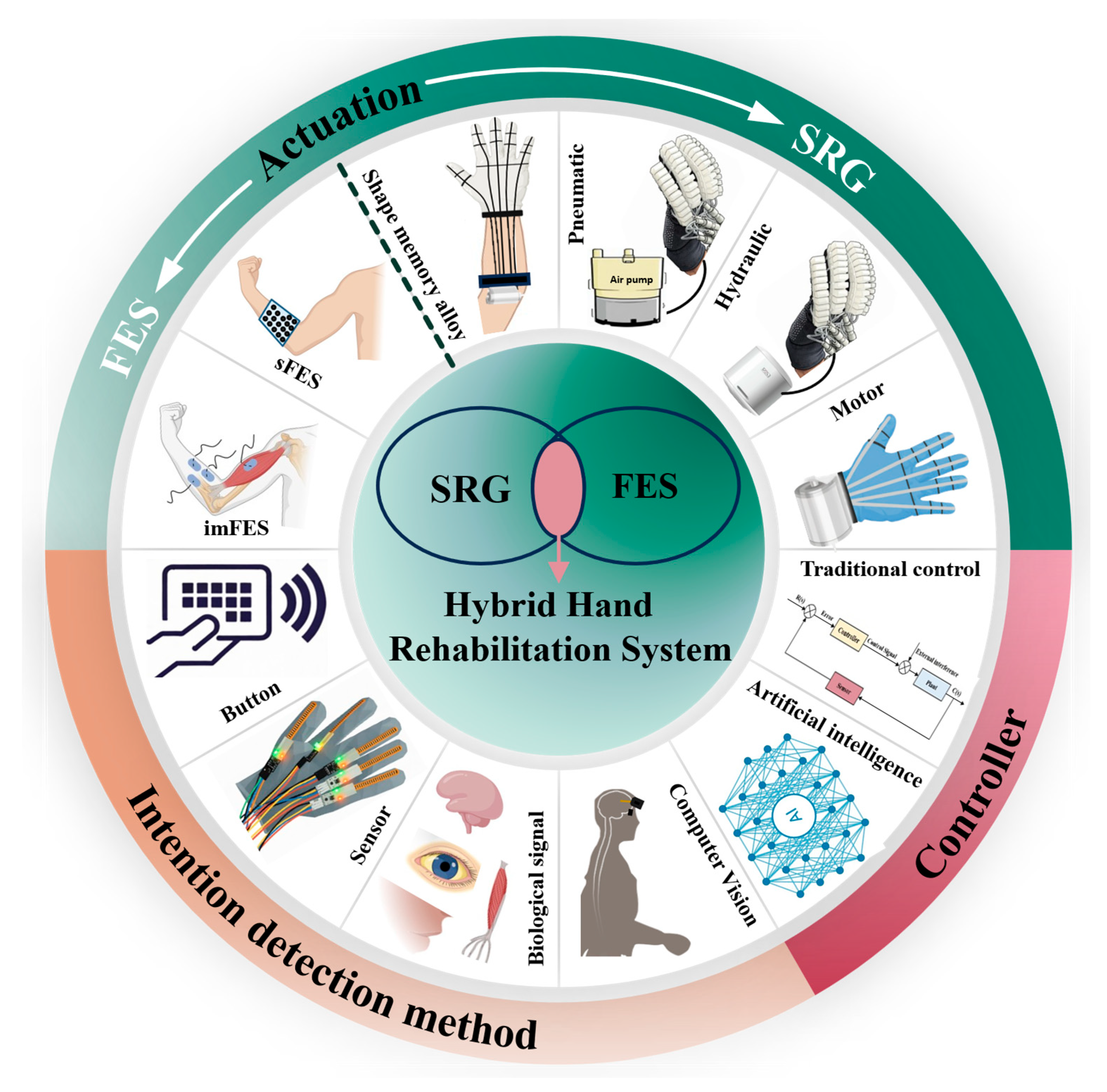


Review of Soft Robotic Gloves and Functional Electrical Stimulation Affecting Hand Function Rehabilitation for Stroke Patients
 , , and
Abstract
1. Introduction
2. Actuation Type
2.1. Actuation Types of SRGs
2.1.1. Motor Actuation
2.1.2. Hydraulic Actuation
2.1.3. Pneumatic Actuation
2.1.4. SMA Actuation
2.2. Actuation Types of FES
2.2.1. Subcutaneous FES
2.2.2. Surface FES
2.3. Actuation Types of HHRSs

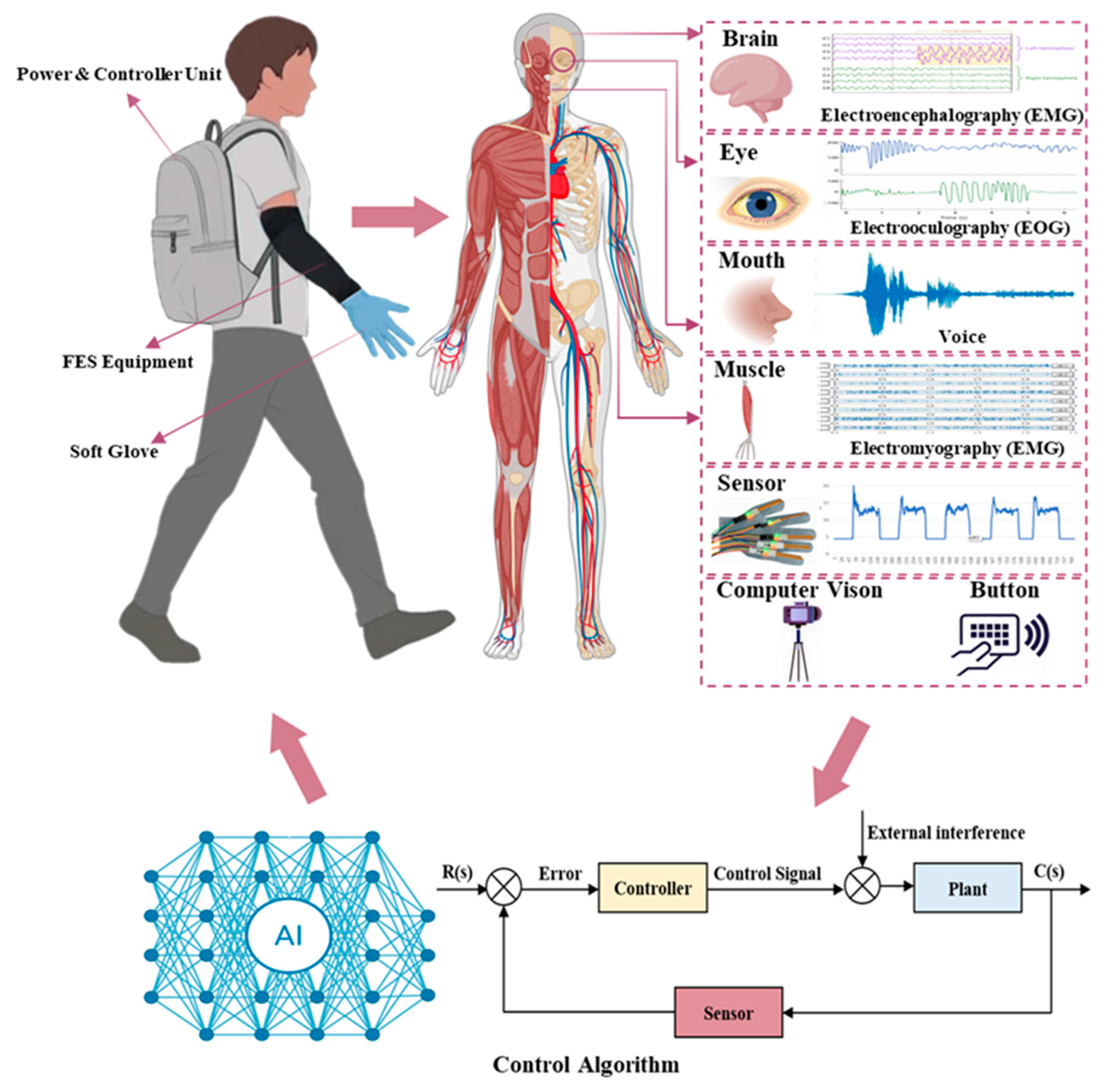
3. Patient Intention Detection
3.1. Patient Intent Detection and Control of SRGs
3.1.1. Button
3.1.2. Sensors
3.1.3. Biological Signals
3.1.4. Computer Vision

3.2. Patient Intent Detection and Control of FES
3.2.1. Button
3.2.2. Sensors
3.2.3. Biological Signals
3.2.4. Computer Vision

3.3. Patient Intent Detection and Control of HHRSs
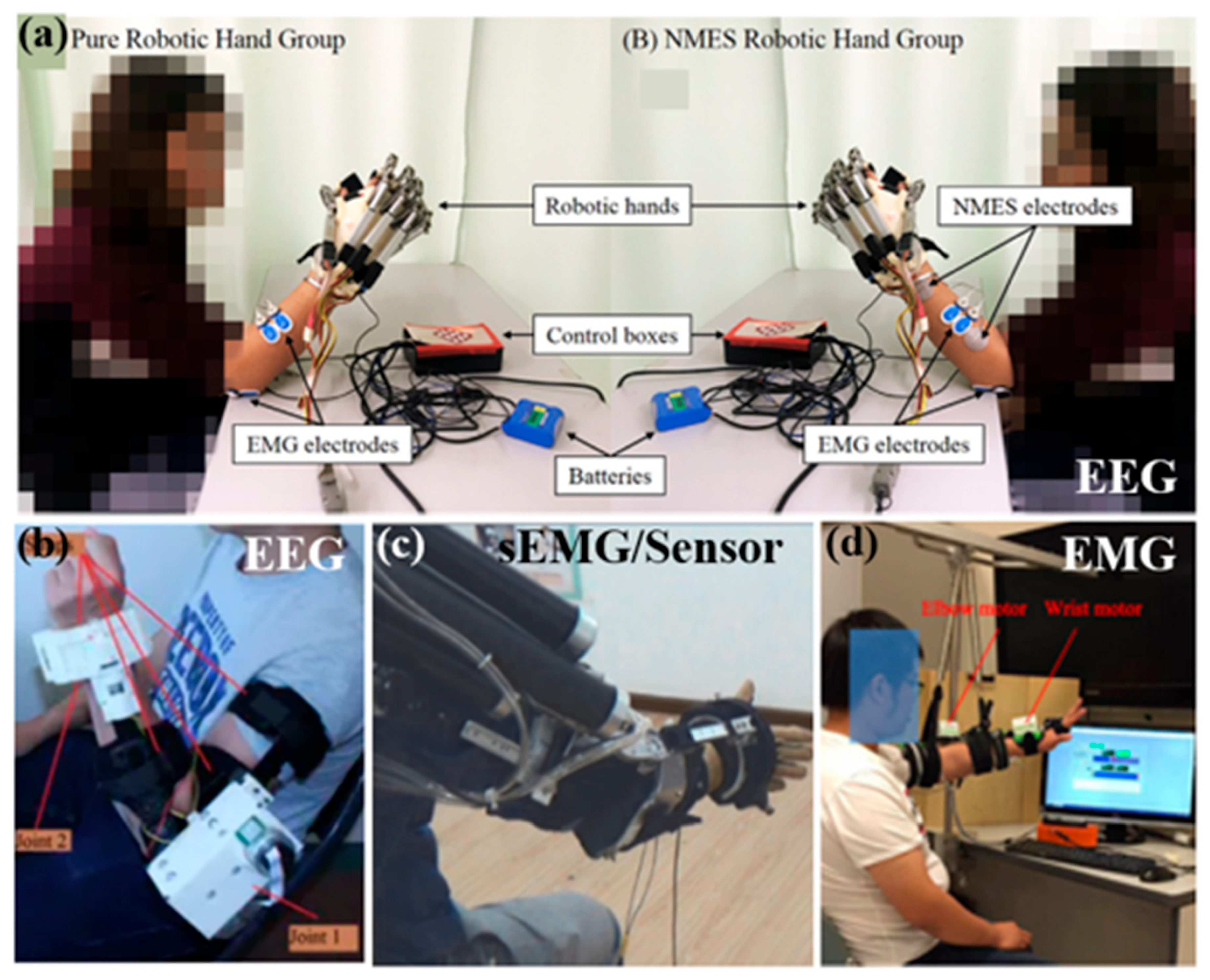
3.3.1. Sensors
3.3.2. Biological Signals

4. Control Algorithms
4.1. Control Algorithms of SRGs
4.1.1. Traditional Algorithms
4.1.2. Artificial Intelligence Algorithms

| Actuation Type | Force Transmission | User Intent Detection | Control Strategy | Active Fingers | Weight | Max Force | Reference |
|---|---|---|---|---|---|---|---|
| Hydraulic | Water | Hydraulic pressure sensor | Feedback Control | All | <3.5 Kg | 8 N | [23] |
| TSA | String | IMU | VR system | All | 290 g | 17 N | [53] |
| Motor | Tendon | Button/sEMG | PI | Index Middle Ring | 729 g | 6 N | [57] |
| Motor | Cable | sEMG | Neural Network | All | 258 g | 10 N | [65] |
| pneumatic | Air | Task-oriented/sEMG | Probabilistic model-based learning control | All | 180 g | - | [104] |
| pneumatic | Air | Magnetic field intensity | Threshold | All | 150 g | 9.8 N | [105] |
| SMA | Wire | Bending sensor- Camera/Touchable screen | PI | All | 490 g | 75 N | [112] |
| SMA | SMA | EMG | BPID (a) | All | - | 17.5 N | [115] |
| pneumatic | Air | EEG | Threshold | All | - | - | [121] |
| Motor | Cable | Pressure sensor | P | Thumb Index Middle | ≈700 g | 20 N | [168] |
| Motor | Tendon | EOG | - | Thumb Middle Ring | - | - | [189] |
| Motor | Cable | Voice-EMG | Threshold | All | <400 g | 300 N | [197] |
| Motor | Cable | EEG-EMG | LDA | All | - | - | [201] |
| Pneumatic | Air | Flexible sensor/Motion capture system | RBFNNO (b) | All | - | - | [236] |
| Motor | Cable | Pressure sensor | P | Thumb Index Middle | ≈700 g | 20 N | [23] |
4.2. Control Algorithms of FES
4.2.1. Traditional Algorithms
4.2.2. Artificial Intelligence Algorithms
| Actuation Type | User Intent Detection | Control Strategy | Function | Channel | Current [mA] | Frequency [Hz] | Reference |
|---|---|---|---|---|---|---|---|
| imFES | Button/goniometer/touch pad | Button/Touch pad | Reach, Grasp, and Release | 8 | 5–40 | - | [132] |
| imFES | EMG | Threshold | ADLs | 4 | - | - | [138] |
| sFES | Flex sensor | Auto-calibration | Grasping/Hand closing | 32 | 5–15 | 25 | [140] |
| sFES | Button | - | Grasping/Hand extension | 3 | 8–50 | 20–40 | [147] |
| sFES | EOG-Camera | GUI | ADLs | 25 | - | - | [150] |
| sFES | Ultrasound | Threshold | Motor function reconstruction | 4 | 10–21 | 30 | [203] |
| sFES | EMG/IMU/Vosion | - | Grasping | 2 | - | - | [206] |
| sFES | EEG | Threshold | Hand extension | 2 | 10–25 | 16–30 | [211] |
| sFES | EEG | NFB (a) | ADLs | - | 2 | 20 | [214] |
| sFES | sEMG | - | Grip strength | 2 | 0–15 | 50 | [217] |
| sFES | sEMG | LDA | Grasping/Hand opening/Precision grasp | 8 | - | - | [218] |
| sFES | sEMG | LDA | Grasping/Finger extension | 4 | <30 | 20–60 | [219] |
| sFES | Camera | Deep learning | Grasping | 4 | - | - | [227] |
| sFES | Camera | Closed-loop feedback | Grasping | 4 | - | 30 | [226] |
4.3. Control Algorithms of HHRSs
| Actuator | FES | Control Strategy | User Intent Detection | Function | Weight | Advantage | Disadvantage | Portability | Reference |
|---|---|---|---|---|---|---|---|---|---|
| Cable-SRG | Motion stim 8 | Button proportional | Button-Flex sensor | Finger bending motion | 56 gactuator | balanced control between FES and exoskeleton | Slow response time | No | [158] |
| Cable-SRG | STIMSHIELD | Hybrid control | Optical FMG sensor | Grasp | - | Delaying muscle fatigue | Cannot control 5 fingers individually | Yes | [159] |
| Motor-SRG | 2 channels | MIMO-FLC (a) | Flex sensor | Grasp | - | Delaying muscle fatigue | Cannot control 5 fingers individually | No | [160] |
| Breg T-Scope Elbow brace | Reha Stim I | Proportional control of predefined trajectories | EEG | Stretching and grasping of hand | 1 Kg | Wear quickly within 30 s | Predefined trajectory | Yes | [230] |
| RUPERT | Reha Stim2 | ILC | EMG | active reach-to-grasp trainings | - | active reach-to-grasp trainings | Large volume, high complexity, and high cost | - | [231] |
| Motor Upper Robot (no hand) | 4 channels | Adaptivecontrol | sEMG | Elbow and wrist flexion/extension, hand opening | 895 g | Improve the muscular coordination at the elbow, wrist and fingers | No assistance from the system for finger flexion | No | [233] |
| Elbow Robot | Rehamove3 | Impedance control-ILC | Torque sensor | Repetitive flexion of elbow joint | - | Easy to transfer to clinical | - | No | [247] |
5. Discussion
5.1. The Portability of Hybrid Hand Rehabilitation Systems
5.2. Multi-Modal Intention Detection Approaches
5.3. Multiple Rehabilitation Exercise Modes and the Ability to Switch Freely of HHRSs
5.4. Home-Based Rehabilitation
6. Conclusions
Author Contributions
Funding
Institutional Review Board Statement
Informed Consent Statement
Data Availability Statement
Conflicts of Interest
References
- Feigin, V.L.; Abate, M.D.; Abate, Y.H.; ElHafeez, S.A.; Abd-Allah, F.; Abdelalim, A.; Abdelkader, A. Global, regional, and national burden of stroke and its risk factors, 1990–2021: A systematic analysis for the Global Burden of Disease Study 2021. Lancet Neurol. 2024, 23, 973–1003. [Google Scholar] [CrossRef] [PubMed]
- Feigin, V.L.; Stark, B.A.; Johnson, C.O.; Roth, G.A.; Bisignano, C.; Abady, G.G. Global, regional, and national burden of stroke and its risk factors, 1990–2019: A systematic analysis for the Global Burden of Disease Study 2019. Lancet Neurol. 2021, 20, 795–820. [Google Scholar] [CrossRef]
- Cassidy, J.M.; Mark, J.I.; Cramer, S.C. Functional connectivity drives stroke recovery: Shifting the paradigm from correlation to causation. Brain 2022, 145, 1211–1228. [Google Scholar] [CrossRef] [PubMed]
- Dixon, D.; Johnston, M.; McQueen, M.; Court-Brown, C. The Disabilities of the Arm, Shoulder and Hand Questionnaire (DASH) can measure the impairment, activity limitations and participation restriction constructs from the International Classification of Functioning, Disability and Health (ICF). BMC Musculoskelet. Disord. 2008, 9, 114. [Google Scholar] [CrossRef] [PubMed]
- McMillan, C.R.; Binhammer, P.A. Which Outcome Measure is the Best? Evaluating Responsiveness of the Disabilities of the Arm, Shoulder, and Hand Questionnaire, the Michigan Hand Questionnaire and the Patient-Specific Functional Scale Following Hand and Wrist Surgery. Hand 2009, 4, 311–318. [Google Scholar] [CrossRef]
- Bae, J.H.; Kang, S.H.; Seo, K.M.; Kim, D.-K.; Shin, H.I.; Shin, H.E. Relationship Between Grip and Pinch Strength and Activities of Daily Living in Stroke Patients. Ann. Rehabil. Med. 2015, 39, 752–762. [Google Scholar] [CrossRef]
- Lee, J.J.; Shin, J.-H. Predicting clinically significant improvement after robot-assisted upper limb rehabilitation in subacute and chronic stroke. Front. Neurol. 2021, 12, 668923. [Google Scholar] [CrossRef]
- Jones, L.A.; Lederman, S.J. Human Hand Function; Oxford University Press: New York, NY, USA, 2006. [Google Scholar]
- Bagneschi, T.; Chiaradia, D.; Righi, G.; Popolo, G.D.; Frisoli, A.; Leonardis, D. A Soft Hand Exoskeleton With a Novel Tendon Layout to Improve Stable Wearing in Grasping Assistance. IEEE Trans. Haptics 2023, 16, 311–321. [Google Scholar] [CrossRef]
- Brokaw, E.B.; Black, I.; Holley, R.J.; Lum, P.S. Hand Spring Operated Movement Enhancer (HandSOME): A portable, passive hand exoskeleton for stroke rehabilitation. IEEE Trans. Neural Syst. Rehabil. Eng. 2011, 19, 391–399. [Google Scholar] [CrossRef]
- Wang, X.J.; Cheng, Y.; Zheng, H.D.; Li, Y.H.; Wang, C.D. Design and optimization of actuator for multi-joint soft rehabilitation glove. Ind. Robot 2021, 48, 877–890. [Google Scholar] [CrossRef]
- Lu, E.C.; Wang, R.H.; Hebert, D.; Boger, J.; Galea, M.P.; Mihailidis, A. The development of an upper limb stroke rehabilitation robot: Identification of clinical practices and design requirements through a survey of therapists. Disabil. Rehabil. Assist. Technol. 2011, 6, 420–431. [Google Scholar] [CrossRef]
- du Plessis, T.; Djouani, K.; Oosthuizen, C. A Review of Active Hand Exoskeletons for Rehabilitation and Assistance. Robotics 2021, 10, 40. [Google Scholar] [CrossRef]
- Tran, P.; Jeong, S.; Herrin, K.; Desai, J. Review: Hand Exoskeleton Systems, Clinical Rehabilitation Practices, and Future Prospects. IEEE Trans. Med. Robot. Bionics 2021, 3, 606–622. [Google Scholar] [CrossRef]
- Schiele, A.; van der Helm, F.C.T. Kinematic design to improve ergonomics in human machine interaction. IEEE Trans. Neural Syst. Rehabil. Eng. 2006, 14, 456–469. [Google Scholar] [CrossRef]
- Almenara, M.; Cempini, M.; Gómez, C.; Cortese, M.; Martín, C.; Medina, J.; Vitiello, N.; Opisso, E. Usability test of a hand exoskeleton for activities of daily living: An example of user-centered design. Disabil. Rehabil. Assist. Technol. 2017, 12, 84–96. [Google Scholar] [CrossRef] [PubMed]
- Chu, C.Y.; Patterson, R.M. Soft robotic devices for hand rehabilitation and assistance: A narrative review. J. Neuroeng. Rehabil. 2018, 15, 9. [Google Scholar] [CrossRef] [PubMed]
- Nuckols, K.; Hohimer, C.J.; Glover, C.; de Lucena, D.S.; Moyo, W.; Wagner, D.; Cloutier, A.; Lin, D.J.; Walsh, C.J. Effects of a Soft Robotic Glove using a High Repetition Protocol in Chronic Stroke: A Pilot Study. In Proceedings of the 2020 8th IEEE RAS/EMBS International Conference for Biomedical Robotics and Biomechatronics (BioRob), New York, NY, USA, 29 November–2 December 2020; IEEE: New York, NY, USA, 2020; pp. 428–433. [Google Scholar]
- Thimabut, W.; Terachinda, P.; Kitisomprayoonkul, W. Effectiveness of a Soft Robotic Glove to Assist Hand Function in Stroke Patients: A Cross-Sectional Pilot Study. Rehabil. Res. Pract. 2022, 2022, 3738219. [Google Scholar] [CrossRef] [PubMed]
- Ko, M.J.; Chuang, Y.C.; Ou-Yang, L.J.; Cheng, Y.Y.; Tsai, Y.L.; Lee, Y.C. The Application of Soft Robotic Gloves in Stroke Patients: A Systematic Review and Meta-Analysis of Randomized Controlled Trials. Brain Sci. 2023, 13, 900. [Google Scholar] [CrossRef]
- Lai, J.; Song, A.; Wang, J.; Lu, Y.; Wu, T.; Li, H.; Xu, B.; Wei, X. A Novel Soft Glove Utilizing Honeycomb Pneumatic Actuators (HPAs) for Assisting Activities of Daily Living. IEEE Trans. Neural Syst. Rehabil. Eng. 2023, 31, 3223–3233. [Google Scholar] [CrossRef]
- Mayouf, T.; Al-Jubouri, M. The Effect of Soft Robotic Glove on the Flexion and Extension of Hand for Stroke Patients: A Clinical Trial. Georgian Med. News 2025, 361, 104–108. [Google Scholar]
- Polygerinos, P.; Wang, Z.; Galloway, K.C.; Wood, R.J.; Walsh, C.J. Soft robotic glove for combined assistance and at-home rehabilitation. Robot. Auton. Syst. 2015, 73, 135–143. [Google Scholar] [CrossRef]
- Leng, J.S.; Sun, J.; Guan, Q.H.; Liu, Y.J. Status of and trends in soft pneumatic robotics. Sci. Sin. Technol. 2020, 50, 897–934. [Google Scholar] [CrossRef]
- Zhou, Y.; Yang, S.; Li, D.; Li, W.; Yang, C.; Huo, H.; Cai, S.; Zhu, X.; Zheng, R.; Dong, X.; et al. Peripheral electrical stimulation on motor function and activities of daily living after stroke: A systematic review and network meta-analysis. Arch. Phys. Med. Rehabil. 2025, 106, 1258–1266. [Google Scholar] [CrossRef]
- Cardoso, L.R.L.; Bochkezanian, V.; Forner-Cordero, A.; Melendez-Calderon, A.; Bo, A.P.L. Soft robotics and functional electrical stimulation advances for restoring hand function in people with SCI: A narrative review, clinical guidelines and future directions. J. Neuroeng. Rehabil. 2022, 19, 66. [Google Scholar] [CrossRef] [PubMed]
- Milosevic, M.; Marquez-Chin, C.; Masani, K.; Hirata, M.; Nomura, T.; Popovic, M.R.; Nakazawa, K. Why brain-controlled neuroprosthetics matter: Mechanisms underlying electrical stimulation of muscles and nerves in rehabilitation. Biomed. Eng. OnLine 2020, 19, 81. [Google Scholar] [CrossRef] [PubMed]
- Luo, S.; Xu, H.; Zuo, Y.; Liu, X.; All, A.H. A Review of Functional Electrical Stimulation Treatment in Spinal Cord Injury. NeuroMolecular Med. 2020, 22, 447–463. [Google Scholar] [CrossRef]
- Thrasher, T.A.; Zivanovic, V.; McIlroy, W.; Popovic, M.R. Rehabilitation of reaching and grasping function in severe hemiplegic patients using functional electrical stimulation therapy. Neurorehabilit. Neural Repair 2008, 22, 706–714. [Google Scholar] [CrossRef]
- Doucet, B.M.; Lam, A.; Griffin, L. Neuromuscular electrical stimulation for skeletal muscle function. Yale J. Biol. Med. 2012, 85, 201–215. [Google Scholar]
- Peckham, P.H.; Knutson, J.S. Functional electrical stimulation for neuromuscular applications. Annu. Rev. Biomed. Eng. 2005, 7, 327–360. [Google Scholar] [CrossRef]
- Popovic, M.R.; Keller, T.; Papas, I.P.I.; Dietz, V.; Morari, M. Surface-stimulation technology for grasping and walking neuroprostheses. IEEE Eng. Med. Biol. Mag. 2001, 20, 82–93. [Google Scholar] [CrossRef]
- Lynch, C.L.; Popovic, M.R. Functional electrical stimulation. IEEE Control Syst. Mag. 2008, 28, 40–50. [Google Scholar] [CrossRef]
- Dunkelberger, N.; Schearer, E.M.; O’Malley, M.K. A review of methods for achieving upper limb movement following spinal cord injury through hybrid muscle stimulation and robotic assistance. Exp. Neurol. 2020, 328, 113274. [Google Scholar] [CrossRef] [PubMed]
- Patel, B.; Bachkaniwala, A. A Review on Combined Effect of Functional Electrical Stimulation and Robotic Hand Glove for Hand Rehabilitation in Post-Stroke Patients. Int. J. Health Sci. Res. 2023, 13, 146–151. [Google Scholar] [CrossRef]
- Stewart, A.M.; Pretty, C.G.; Adams, M.; Chen, X.Q. Review of Upper Limb Hybrid Exoskeletons. IFAC-PapersOnLine 2017, 50, 15169–15178. [Google Scholar] [CrossRef]
- Sarac, M.; Solazzi, M.; Frisoli, A. Design requirements of generic hand exoskeletons and survey of hand exoskeletons for rehabilitation, assistive, or haptic use. IEEE Trans. Haptics 2019, 12, 400–413. [Google Scholar] [CrossRef] [PubMed]
- Takaoka, M.; Suzumori, K.; Wakimoto, S.; Iijima, K.; Tokumiya, T. Fabrication of Thin McKibben Artificial Muscles with Various Design Parameters and Their Experimental Evaluations. In The 5th International Conference on Manufacturing, Machine Design and Tribology (ICMDT2013), Kyoto, Japan, 20–22 April 2013; Trans Tech Publications Ltd.: Stafa, Switzerland, 2013; p. 82. [Google Scholar]
- Kapadia, N.; Moineau, B.; Popovic, M.R. Functional electrical stimulation therapy for retraining reaching and grasping after spinal cord injury and stroke. Front. Neurosci. 2020, 14, 718. [Google Scholar] [CrossRef]
- Khan, M.A.; Fares, H.; Ghayvat, H.; Brunner, I.C.; Puthusserypady, S.; Razavi, B.; Lansberg, M.; Poon, A.; Meador, K.J. A systematic review on functional electrical stimulation based rehabilitation systems for upper limb post-stroke recovery. Front. Neurol. 2023, 14, 1272992. [Google Scholar] [CrossRef]
- King, C.E.; Wang, P.T.; McCrimmon, C.M.; Chou, C.C.Y.; Do, A.H.; Nenadic, Z. The feasibility of a brain-computer interface functional electrical stimulation system for the restoration of overground walking after paraplegia. J. Neuroeng. Rehabil. 2015, 12, 80. [Google Scholar] [CrossRef]
- Gherman, B.; Zima, I.; Vaida, C.; Tucan, P.; Pisla, A.; Birlescu, I.; Machado, J.; Pisla, D. Robotic Systems for Hand Rehabilitation—Past, Present and Future. Technologies 2025, 13, 37. [Google Scholar] [CrossRef]
- Villoslada, A.; Flores, A.; Copaci, D.; Blanco, D.; Moreno, L. High-displacement flexible Shape Memory Alloy actuator for soft wearable robots. Robot. Auton. Syst. 2015, 73, 91–101. [Google Scholar] [CrossRef]
- Zhou, X.; Fu, H.; Shentu, B.; Wang, W.; Cai, S.; Bao, G. Design and Control of a Tendon-Driven Robotic Finger Based on Grasping Task Analysis. Biomimetics 2024, 9, 370. [Google Scholar] [CrossRef] [PubMed]
- Nycz, C.J.; Bützer, T.; Lambercy, O.; Arata, J.; Fischer, G.S.; Gassert, R. Design and Characterization of a Lightweight and Fully Portable Remote Actuation System for Use With a Hand Exoskeleton. IEEE Robot. Autom. Lett. 2016, 1, 976–983. [Google Scholar] [CrossRef]
- Liu, H.; Wu, C.; Lin, S.; Chen, Y.; Hu, Y.; Xu, T.; Yuan, W.; Li, Y. Finger Flexion and Extension Driven by a Single Motor in Robotic Glove Design. Adv. Intell. Syst. 2023, 5, 2200274. [Google Scholar] [CrossRef]
- Kim, S.-H.; Jeong, U.; Cho, K.-J. Multiparameter Remote Contact Force Sensor With Embedded Bend Sensing for Tendon-Driven Hand Robots. IEEE/ASME Trans. Mechatron. 2024, 29, 557–566. [Google Scholar] [CrossRef]
- Treratanakulwong, T.; Kaminaga, H.; Nakamura, Y. Low-Friction Tendon-Driven Robot Hand with Carpal Tunnel Mechanism in the Palm by Optimal 3D Allocation of Pulleys. In Proceedings of the 2014 IEEE International Conference on Robotics and Automation (ICRA), Hong Kong, China, 31 May–5 June 2014; IEEE: New York, NY, USA, 2014; pp. 6739–6744. [Google Scholar]
- Morecki, A.; Busko, Z.; Gasztold, H.; Jaworek, K. Synthesis and Control of the Anthropomorphic Two-Handed Manipulator. In Proceedings of the 10th International Symposium on Industrial Robots, Milan, Italy, 5–7 May 1980; IFS (Publications) Ltd.: Bedford, UK, 1980; pp. 461–474. [Google Scholar]
- Becker, J.C.; Thakor, N.V. A Study of the Range of Motion of Human Fingers with Application to Anthropomorphic Designs. IEEE Trans. Biomed. Eng. 1988, 35, 110–117. [Google Scholar] [CrossRef]
- Jeong, U.; In, H.-K.; Cho, K.-J. Implementation of various control algorithms for hand rehabilitation exercise using wearable robotic hand. Intell. Serv. Robot. 2013, 6, 181–189. [Google Scholar] [CrossRef]
- Tran, P.; Elliott, D.; Herrin, K.; Bhatia, S.; Desai, J.P. Evaluation of the FLEXotendon glove-III through a human subject case study. Biomed. Eng. Lett. 2023, 13, 153–163. [Google Scholar] [CrossRef]
- Li, F.; Chen, J.; Zhou, Z.; Xie, J.; Gao, Z.; Xiao, Y.; Dai, P.; Xu, C.; Wang, X.; Zhou, Y. Lightweight Soft Robotic Glove with Whole-Hand Finger Motion Tracking for Hand Rehabilitation in Virtual Reality. Biomimetics 2023, 8, 425. [Google Scholar] [CrossRef]
- Bombara, D.; Fowzer, S.; Zhang, J. Compliant, Large-Strain, and Self-Sensing Twisted String Actuators. Soft Robot. 2020, 9, 72–88. [Google Scholar] [CrossRef]
- Tsabedze, T.; Hartman, E.; Abrego, E.; Brennan, C.; Zhang, J. TSA-BRAG: A Twisted String Actuator-powered Biomimetic Robotic Assistive Glove. In Proceedings of the 2020 International Symposium on Medical Robotics (ISMR), Atlanta, GA, USA, 18–20 November 2020; pp. 159–165. [Google Scholar]
- Tsabedze, T.; Hartman, E.; Zhang, J. A compact, compliant, and biomimetic robotic assistive glove driven by twisted string actuators. Int. J. Intell. Robot. Appl. 2021, 5, 381–394. [Google Scholar] [CrossRef]
- Ismail, R.; Ariyanto, M.; Setiawan, J.D.; Hidayat, T.; Paryanto; Nuswantara, L.K. Design and testing of fabric-based portable soft exoskeleton glove for hand grasping assistance in daily activity. HardwareX 2024, 18, e00537. [Google Scholar] [CrossRef]
- Chen, X.; Gong, L.; Wei, L.; Yeh, S.-C.; Da Xu, L.; Zheng, L.; Zou, Z. A Wearable Hand Rehabilitation System With Soft Gloves. IEEE Trans. Ind. Inform. 2021, 17, 943–952. [Google Scholar] [CrossRef]
- Liu, Z.W.; Zhao, L.; Yu, P.; Yang, T.; Li, N.; Yang, Y.; Liu, L.Q. A Wearable Bionic Soft Exoskeleton Glove for Stroke Patients. In Proceedings of the 2018 IEEE 8th Annual International Conference on CYBER Technology in Automation, Control, and Intelligent Systems (CYBER), Tianjin, China, 19–23 July 2018; IEEE: New York, NY, USA, 2018; pp. 932–937. [Google Scholar]
- Wei, W.; Qu, Z.; Wang, W.; Zhang, P.; Hao, F. Design on the Bowden Cable-Driven Upper Limb Soft Exoskeleton. Appl. Bionics Biomech. 2018, 2018, 1925694. [Google Scholar] [CrossRef] [PubMed]
- Dinh, B.K.; Xiloyannis, M.; Cappello, L.; Antuvan, C.W.; Yen, S.-C.; Masia, L. Adaptive backlash compensation in upper limb soft wearable exoskeletons. Robot. Auton. Syst. 2017, 92, 173–186. [Google Scholar] [CrossRef]
- Jeong, U.; In, H.; Lee, H.; Kang, B.; Cho, K. Investigation on the control strategy of soft wearable robotic hand with slack enabling tendon actuator. In Proceedings of the 2015 IEEE International Conference on Robotics and Automation (ICRA), Seattle, WA, USA, 26–30 May 2015; pp. 5004–5009. [Google Scholar]
- Randazzo, L.; Iturrate, I.; Perdikis, S.; Millan, J.d.R. mano: A Wearable Hand Exoskeleton for Activities of Daily Living and Neurorehabilitation. IEEE Robot. Autom. Lett. 2018, 3, 500–507. [Google Scholar] [CrossRef]
- Silva, R.C.; Lourenço, B.G.; Ulhoa, P.H.F.; Dias, E.A.F.; da Cunha, F.L.; Tonetto, C.P.; Villani, L.G.; Vimieiro, C.B.S.; Lepski, G.A.; Monjardim, M.; et al. Biomimetic Design of a Tendon-Driven Myoelectric Soft Hand Exoskeleton for Upper-Limb Rehabilitation. Biomimetics 2023, 8, 317. [Google Scholar] [CrossRef]
- Burns, M.K.; Pei, D.; Vinjamuri, R. Myoelectric Control of a Soft Hand Exoskeleton Using Kinematic Synergies. IEEE Trans. Biomed. Circuits Syst. 2019, 13, 1351–1361. [Google Scholar] [CrossRef]
- Bützer, T.; Lambercy, O.; Arata, J.; Gassert, R. Fully Wearable Actuated Soft Exoskeleton for Grasping Assistance in Everyday Activities. Soft Robot. 2021, 8, 128–143. [Google Scholar] [CrossRef]
- Lin, L.G.; Zhang, F.H.; Yang, L.; Fu, Y.L. Design and modeling of a hybrid soft-rigid hand exoskeleton for poststroke rehabilitation. Int. J. Mech. Sci. 2021, 212, 106831. [Google Scholar] [CrossRef]
- Nazari, V.; Pouladian, M.; Zheng, Y.P.; Alam, M. A compact and lightweight rehabilitative exoskeleton to restore grasping functions for people with hand paralysis. Sensors 2021, 21, 6900. [Google Scholar] [CrossRef]
- Gull, M.A.; Bai, S.; Bak, T. A review on design of upper limb exoskeletons. Robotics 2020, 9, 16. [Google Scholar] [CrossRef]
- Zatopa, A.; Walker, S.; Menguc, Y. Fully Soft 3D-Printed Electroactive Fluidic Valve for Soft Hydraulic Robots. Soft Robot. 2018, 5, 258–271. [Google Scholar] [CrossRef]
- Maciejasz, P.; Eschweiler, J.; Gerlach-Hahn, K.; Jansen-Troy, A.; Leonhardt, S. A survey on robotic devices for upper limb rehabilitation. J. Neuroeng. Rehabil. 2014, 11, 3. [Google Scholar] [CrossRef] [PubMed]
- Yap, H.K.; Lim, J.H.; Nasrallah, F.; Yeow, C.H. Design and Preliminary Feasibility Study of a Soft Robotic Glove for Hand Function Assistance in Stroke Survivors. Front. Neurosci. 2017, 11, 547. [Google Scholar] [CrossRef]
- Yue, Z.; Zhang, X.; Wang, J. Hand Rehabilitation Robotics on Poststroke Motor Recovery. Behav. Neurol. 2017, 2017, 3908135. [Google Scholar] [CrossRef] [PubMed]
- Ryu, D.; Moon, K.-W.; Nam, H.; Lee, Y.; Chun, C.; Kang, S.; Song, J.-B. Micro hydraulic system using slim artificial muscles for a wearable haptic glove. In Proceedings of the 2008 IEEE/RSJ International Conference on Intelligent Robots and Systems, Nice, France, 22–26 September 2008; IEEE: New York, NY, USA, 2008; pp. 3028–3033. [Google Scholar]
- Polygerinos, P.; Galloway, K.C.; Sanan, S.; Herman, M.; Walsh, C.J. EMG Controlled Soft Robotic Glove for Assistance During Activities of Daily Living. In Proceedings of the 2015 IEEE International Conference on Rehabilitation Robotics (ICORR), Singapore, 11–14 August 2015; IEEE: New York, NY, USA, 2015; pp. 55–60. [Google Scholar]
- Polygerinos, P.; Galloway, K.C.; Savage, E.; Herman, M.; O’Donnell, K.; Walsh, C.J. Soft Robotic Glove for Hand Rehabilitation and Task Specific Training. In Proceedings of the 2015 IEEE International Conference on Robotics and Automation (ICRA), Seattle, WA, USA, 26–30 May 2015; IEEE: New York, NY, USA, 2015; pp. 2913–2919. [Google Scholar]
- Phan, P.T.; Thai, M.T.; Hoang, T.T.; Lovell, N.H.; Do, T.N. HFAM: Soft Hydraulic Filament Artificial Muscles for Flexible Robotic Applications. IEEE Access 2020, 8, 226637–226652. [Google Scholar] [CrossRef]
- Molteni, F.; Gasperini, G.; Cannaviello, G.; Guanziroli, E. Exoskeleton and End-Effector Robots for Upper and Lower Limbs Rehabilitation: Narrative Review. PM&R 2018, 10, S174–S188. [Google Scholar] [CrossRef]
- Koizumi, S.; Chang, T.H.; Nabae, H.; Endo, G.; Suzumori, K.; Mita, M.; Saitoh, K.; Hatakeyama, K.; Chida, S.; Shimada, Y.; et al. Soft Robotic Gloves with Thin McKibben Muscles for Hand Assist and Rehabilitation. In Proceedings of the 2020 IEEE/SICE International Symposium on System Integration (SII), Honolulu, HI, USA, 12–15 January 2020; IEEE: New York, NY, USA, 2020; pp. 93–98. [Google Scholar]
- Tang, D.; Lv, X.; Zhang, Y.; Qi, L.; Shen, C.; Shen, W. A Review on Soft Exoskeletons for Hand Rehabilitation. Recent Pat. Eng. 2024, 18, 52–73. [Google Scholar] [CrossRef]
- Fischer, H.C.; Triandafilou, K.M.; Thielbar, K.O.; Ochoa, J.M.; Lazzaro, E.D.C.; Pacholski, K.A.; Kamper, D.G. Use of a Portable Assistive Glove to Facilitate Rehabilitation in Stroke Survivors With Severe Hand Impairment. IEEE Trans. Neural Syst. Rehabil. Eng. 2016, 24, 344–351. [Google Scholar] [CrossRef]
- Tiboni, M.; Amici, C. Soft Gloves: A Review on Recent Developments in Actuation, Sensing, Control and Applications. Actuators 2022, 11, 232. [Google Scholar] [CrossRef]
- Takahashi, N.; Takahashi, H.; Koike, H. Soft Exoskeleton Glove Enabling Force Feedback for Human-Like Finger Posture Control with 20 Degrees of Freedom. In Proceedings of the 2019 IEEE World Haptics Conference (WHC), Tokyo, Japan, 9–12 July 2019; IEEE: New York, NY, USA, 2019; pp. 217–222. [Google Scholar]
- Takahashi, N.; Furuya, S.; Koike, H. Soft Exoskeleton Glove with Human Anatomical Architecture: Production of Dexterous Finger Movements and Skillful Piano Performance. IEEE Trans. Haptics 2020, 13, 679–690. [Google Scholar] [CrossRef] [PubMed]
- Gariya, N.; Kumar, S.; Shaikh, A.; Prasad, B.; Nautiyal, H. A review on soft pneumatic actuators with integrated or embedded soft sensors. Sens. Actuators A Phys. 2024, 372, 115364. [Google Scholar] [CrossRef]
- Li, H.; Cheng, L.; Li, Z.; Xue, W. Active Disturbance Rejection Control for a Fluid-Driven Hand Rehabilitation Device. IEEE/ASME Trans. Mechatron. 2021, 26, 841–853. [Google Scholar] [CrossRef]
- McCall, J.V.; Buckner, G.D.; Kamper, D.G. Soft pneumatic actuators for pushing fingers into extension. J. Neuroeng. Rehabil. 2024, 21, 146. [Google Scholar] [CrossRef]
- Mikkonen, R.; Koivikko, A.; Vuorinen, T.; Sariola, V.; Mäntysalo, M. Inkjet-Printed, Nanofiber-Based Soft Capacitive Pressure Sensors for Tactile Sensing. IEEE Sens. J. 2021, 21, 26286–26293. [Google Scholar] [CrossRef]
- Wang, X.; Cheng, Q.; Wang, Z.; Lu, Y.; Zhang, Z.; Zhao, X. A Pneumatic Soft Glove System Based on Bidirectional Bending Functionality for Rehabilitation. Biomimetics 2025, 10, 129. [Google Scholar] [CrossRef]
- Hashem, R.; Stommel, M.; Cheng, L.K.; Xu, W. Design and Characterization of a Bellows-Driven Soft Pneumatic Actuator. IEEE/ASME Trans. Mechatron. 2021, 26, 2327–2338. [Google Scholar] [CrossRef]
- Polygerinos, P.; Lyne, S.; Wang, Z.; Nicolini, L.F.; Mosadegh, B.; Whitesides, G.M.; Walsh, C.J. Towards a soft pneumatic glove for hand rehabilitation. In Proceedings of the 2013 IEEE/RSJ International Conference on Intelligent Robots and Systems, Tokyo, Japan, 3–7 November 2013; IEEE: New York, NY, USA, 2013; pp. 1512–1517. [Google Scholar]
- Lunman, S.; Strandrot Frid, A.; Andersson, S.; Gråhn, F.; Heijkenskjöld, A.; Lind, Z. Pneumatic Soft Robotic Glove for Hand Rehabilitation. Bachelor Thesis, Chalmers University of Technology, Gothenburg, Sweden, 2023. [Google Scholar]
- Tejada, J.C.; Toro-Ossaba, A.; Valencia, S.; Gallego, N.; Jaramillo-Tigreros, J.J.; Hernandez-Martinez, E.G.; López-González, A.; Rodriguez Serrezuela, R. Soft Robotic Hand Exoskeleton with Enhanced PneuNet-Type Pneumatic Actuators for Rehabilitation and Movement Assistance. J. Robot. 2024, 2024, 5815358. [Google Scholar] [CrossRef]
- Sandoval-Castro, X.Y.; Cortes-Gonzalez, J.G.; Ruiz-Torres, M.F.; Castillo-Castaneda, E.; Laribi, M.A. Enhancing dexterity: Soft pneumatic actuation utilizing granular jamming for a human finger flexo-extension. Wearable Technol. 2025, 6, e15. [Google Scholar] [CrossRef]
- Rakhtala, S.M.; Ghayebi, R. Real time control and fabrication of a soft robotic glove by two parallel sensors with MBD approach. Med. Eng. Phys. 2022, 100, 103743. [Google Scholar] [CrossRef]
- Sanchez, V.; Walsh, C.J.; Wood, R.J. Textile Technology for Soft Robotic and Autonomous Garments. Adv. Funct. Mater. 2020, 31, 2008278. [Google Scholar] [CrossRef]
- Fu, C.; Xia, Z.; Hurren, C.; Nilghaz, A.; Wang, X. Textiles in soft robots: Current progress and future trends. Biosens. Bioelectron. 2022, 196, 113690. [Google Scholar] [CrossRef]
- Lim, D.Y.; Lai, H.S.; Yeow, R.C. A bidirectional fabric-based soft robotic glove for hand function assistance in patients with chronic stroke. J. Neuroeng. Rehabil. 2023, 20, 120. [Google Scholar] [CrossRef] [PubMed]
- Yap, H.K.; Khin, P.M.; Koh, T.H.; Sun, Y.; Liang, X.; Lim, J.H.; Yeow, C.H. A Fully Fabric-Based Bidirectional Soft Robotic Glove for Assistance and Rehabilitation of Hand Impaired Patients. IEEE Robot. Autom. Lett. 2017, 2, 1383–1390. [Google Scholar] [CrossRef]
- Chen, R.; Leonardis, D.; Frisoli, A.; Chiaradia, D. A Powerful Customized Fabric-Based Soft Robotic Glove for Assistance and Rehabilitation. In Proceedings of the 2025 International Conference On Rehabilitation Robotics (ICORR), Chicago, IL, USA, 12–16 May 2025; IEEE: New York, NY, USA, 2015; pp. 669–674. [Google Scholar]
- Maldonado-Mejía, J.C.; Múnera, M.; Diaz, C.A.R.; Wurdemann, H.; Moazen, M.; Pontes, M.J.; Vieira Segatto, M.E.; Monteiro, M.E.; Cifuentes, C.A. A fabric-based soft hand exoskeleton for assistance: The ExHand Exoskeleton. Front. Neurorobot. 2023, 17, 1091827. [Google Scholar] [CrossRef] [PubMed]
- Suulker, C.; Skach, S.; Althoefer, K. Soft Robotic Fabric Actuator With Elastic Bands for High Force and Bending Performance in Hand Exoskeletons. IEEE Robot. Autom. Lett. 2022, 7, 10621–10627. [Google Scholar] [CrossRef]
- Yap, H.; Ng, H.; Yeow, C. High-force soft printable pneumatics for soft robotic applications. Soft Robot. 2016, 3, 144–158. [Google Scholar] [CrossRef]
- Tang, Z.Q.; Heung, H.L.; Shi, X.Q.; Tong, R.K.Y.; Li, Z. Probabilistic Model-Based Learning Control of a Soft Pneumatic Glove for Hand Rehabilitation. IEEE Trans. Biomed. Eng. 2022, 69, 1016–1028. [Google Scholar] [CrossRef]
- Shi, X.; Yang, C.; Lee, P.C.; Xie, D.; Ye, Z.; Li, Z.; Tong, R.K. An interactive soft robotic hand-task training system with wireless task boards and daily objects on post-stroke rehabilitation. Wearable Technol. 2025, 6, e4. [Google Scholar] [CrossRef]
- Do, P.T.; Vo, D.T.; Le, H.P. A Soft Pneumatic Robotic Glove for Hand Rehabilitation After Stroke. In Proceedings of the 2021 20th International Conference on Advanced Robotics (ICAR), Ljubljana, Slovenia, 6–10 December 2021; IEEE: New York, NY, USA, 2021; pp. 7–12. [Google Scholar]
- Ritonga, S.A. Herianto Comparative Analysis of Custom-Designed Soft Pneumatic Actuators for Human Thumb Movement in Post-Stroke Rehabilitation. J. Inov. Teknol. Dan Rekayasa 2023, 8, 257–264. [Google Scholar]
- Bhat, A.; Jaipurkar, S.S.; Low, L.T.; Yeow, R.C.-H. Reconfigurable Soft Pneumatic Actuators Using Extensible Fabric-Based Skins. Soft Robot. 2023, 10, 923–936. [Google Scholar] [CrossRef] [PubMed]
- Wang, H. Application of Intelligent Materials in the Control System. J. Comput. Theor. Nanosci. 2015, 12, 2830–2836. [Google Scholar] [CrossRef]
- Yuan, J.; Neri, W.; Zakri, C.; Merzeau, P.; Kratz, K.; Lendlein, A. Shape memory nanocomposite fibers for untethered high-energy microengines. Science 2019, 365, 155–158. [Google Scholar] [CrossRef] [PubMed]
- Xie, Q.; Meng, Q.; Yu, W.; Wu, Z.; Xu, R.; Zeng, Q.; Zhou, Z.; Yang, T.; Yu, H. Design of a SMA-based soft composite structure for wearable rehabilitation gloves. Front. Neurorobot. 2023, 17, 1047493. [Google Scholar] [CrossRef] [PubMed]
- Sui, M.; Ouyang, Y.; Jin, H.; Chai, Z.; Wei, C.; Li, J.; Xu, M.; Li, W.; Wang, L.; Zhang, S. A soft-packaged and portable rehabilitation glove capable of closed-loop fine motor skills. Nat. Mach. Intell. 2023, 5, 1149–1160. [Google Scholar] [CrossRef]
- Hadi, A.; Alipour, K.; Kazeminasab, S.; Elahinia, M. ASR glove: A wearable glove for hand assistance and rehabilitation using shape memory alloys. J. Intell. Mater. Syst. Struct. 2017, 29, 1575–1585. [Google Scholar] [CrossRef]
- Serrano, D.; Copaci, D.; Arias, J.; Moreno, L.E.; Blanco, D. SMA-Based Soft Exo-Glove. IEEE Robot. Autom. Lett. 2023, 8, 5448–5455. [Google Scholar] [CrossRef]
- Copaci, D.; Cerro, D.S.D.; Guadalupe, J.A.; Lorente, L.M.; Rojas, D.B. sEMG-Controlled Soft Exo-Glove for Assistive Rehabilitation Therapies. IEEE Access 2024, 12, 43506–43518. [Google Scholar] [CrossRef]
- Yao, Z.; Linnenberg, C.; Argubi-Wollesen, A.; Weidner, R.; Wulfsberg, J.P. Biomimetic design of an ultra-compact and light-weight soft muscle glove. Prod. Eng. 2017, 11, 731–743. [Google Scholar] [CrossRef]
- Kim, M.-S.; Heo, J.-K.; Rodrigue, H.; Lee, H.-T.; Pané, S.; Han, M.-W.; Ahn, S.-H. Shape Memory Alloy (SMA) Actuators: The Role of Material, Form, and Scaling Effects. Adv. Mater. 2023, 35, 2208517. [Google Scholar] [CrossRef]
- Dupont, P.E.; Nelson, B.J.; Goldfarb, M.; Hannaford, B.; Menciassi, A.; O’Malley, M.K.; Simaan, N.; Valdastri, P.; Yang, G.Z. A decade retrospective of medical robotics research from 2010 to 2020. Sci. Robot. 2021, 6, eabi8017. [Google Scholar] [CrossRef] [PubMed]
- Asgari, M.R.; Dehvan, F.; Ghorbani, R.; Samaei, A.; Binesh, M.; Rahaei, F.; Soleimani, M. Upper extremity motor function and hand muscular power in patients with stroke: A pilot study. Koomesh 2024, 19, 438–447. [Google Scholar]
- Marquez-Chin, C.; Popovic, M.R. Functional electrical stimulation therapy for restoration of motor function after spinal cord injury and stroke: A review. Biomed. Eng. OnLine 2020, 19, 34. [Google Scholar] [CrossRef] [PubMed]
- Guo, N.; Wang, X.; Duanmu, D.; Huang, X.; Li, X.; Fan, Y.; Li, H.; Liu, Y.; Yeung, E.H.K.; To, M.K.T.; et al. SSVEP-Based Brain Computer Interface Controlled Soft Robotic Glove for Post-Stroke Hand Function Rehabilitation. IEEE Trans. Neural Syst. Rehabil. Eng. 2022, 30, 1737–1744. [Google Scholar] [CrossRef]
- Popović, D.B. Advances in functional electrical stimulation (FES). J. Electromyogr. Kinesiol. 2014, 24, 795–802. [Google Scholar] [CrossRef]
- Höhler, C.; Hermsdörfer, J.; Jahn, K.; Krewer, C. The assistive potential of functional electrical stimulation to support object manipulation in functional upper extremity movements after stroke: A randomized cross-over study. J. Cent. Nerv. Syst. Dis. 2024, 16, 11795735241247812. [Google Scholar] [CrossRef]
- Herman, P.A.; Prasad, G.; McGinnity, T.M. Designing an Interval Type-2 Fuzzy Logic System for Handling Uncertainty Effects in Brain–Computer Interface Classification of Motor Imagery Induced EEG Patterns. IEEE Trans. Fuzzy Syst. 2017, 25, 29–42. [Google Scholar] [CrossRef]
- Popovic, M.R.; Masani, K.; Micera, S. Functional Electrical Stimulation Therapy: Recovery of Function Following Spinal Cord Injury and Stroke. In Neurorehabilitation Technology; Reinkensmeyer, D.J., Dietz, V., Eds.; Springer International Publishing: Cham, Switzerland, 2016; pp. 513–532. [Google Scholar]
- Knutson, J.S.; Chae, J. Functional electrical stimulation (FES) for upper limb function after stroke. In Implantable Neuroprostheses for Restoring Function; Kilgore, K., Ed.; Elsevier: Amsterdam, The Netherlands, 2015; pp. 307–329. [Google Scholar]
- Koutsou, A.D.; Moreno, J.C.; del Ama, A.J.; Rocon, E.; Pons, J.L. Advances in selective activation of muscles for non-invasive motor neuroprostheses. J. Neuroeng. Rehabil. 2016, 13, 56. [Google Scholar] [CrossRef]
- Chae, J.; Hart, R. Intramuscular hand neuroprosthesis for chronic stroke survivors. Neurorehabilit. Neural Repair 2003, 17, 109–117. [Google Scholar] [CrossRef]
- Chae, J.; Harley, M.Y.; Hisel, T.Z.; Corrigan, C.M.; Demchak, J.A.; Wong, Y.T.; Fang, Z.P. Intramuscular electrical stimulation for upper limb recovery in chronic hemiparesis an exploratory randomized clinical trial. Neurorehabilit. Neural Repair 2009, 23, 569–578. [Google Scholar] [CrossRef]
- Shi, Y.; Liu, R.; He, L.; Feng, H.; Li, Y.; Li, Z. Recent development of implantable and flexible nerve electrodes. Smart Mater. Med. 2020, 1, 131–147. [Google Scholar] [CrossRef]
- Quandt, F.; Hummel, F.C. The influence of functional electrical stimulation on hand motor recovery in stroke patients: A review. Exp. Transl. Stroke Med. 2014, 6, 9. [Google Scholar] [CrossRef] [PubMed]
- Burridge, J.H.; Turk, R.; Merrill, D.; Dibb, B.; Hughes, A.-M.; Sparrow, O.; Roberts, H.; Davis, R. A Personalized Sensor-Controlled Microstimulator System for Arm Rehabilitation Poststroke. Part 2: Objective Outcomes and Patients’ Perspectives. Neuromodul. Technol. Neural Interface 2011, 14, 80–88. [Google Scholar] [CrossRef] [PubMed]
- Ajiboye, A.B.; Willett, F.R.; Young, D.R.; Memberg, W.D.; Murphy, B.A.; Miller, J.P.; Walter, B.L.; Sweet, J.A.; Hoyen, H.A.; Keith, M.W.; et al. Restoration of reaching and grasping movements through brain-controlled muscle stimulation in a person with tetraplegia: A proof-of-concept demonstration. Lancet 2017, 389, 1821–1830. [Google Scholar] [CrossRef] [PubMed]
- Davis, R.; Sparrow, O.; Cosendai, G.; Burridge, J.H.; Wulff, C.; Turk, R.; Schulman, J. Poststroke upper-limb rehabilitation using 5 to 7 inserted microstimulators: Implant procedure, safety, and efficacy for restoration of function. Arch. Phys. Med. Rehabil. 2008, 89, 1907–1912. [Google Scholar] [CrossRef]
- Knutson, J.S.; Chae, J.; Hart, R.L.; Keith, M.W.; Hoyen, H.A.; Harley, M.Y.; Hisel, T.Z.; Bryden, A.M.; Kilgore, K.L.; Peckham, H. Implanted neuroprosthesis for assisting arm and hand function after stroke: A case study. J. Rehabil. Res. Dev. 2012, 49, 1505–1516. [Google Scholar] [CrossRef]
- Handa, Y. Current topics in clinical FES in Japan. J. Electromyogr. Kinesiol. 1997, 7, 269–274. [Google Scholar] [CrossRef]
- Fattal, C.; Teissier, J.; Geffrier, A.; Fonseca, L.; William, L.; Andreu, D.; Guiraud, D.; Azevedo-Coste, C. Restoring hand functions in people with tetraplegia through multi-contact, fascicular, and auto-pilot stimulation: A proof-of-concept demonstration. J. Neurotrauma 2022, 39, 627–638. [Google Scholar] [CrossRef]
- Hahne, J.M.; Farina, D.; Jiang, N.; Liebetanz, D. A Novel Percutaneous Electrode Implant for Improving Robustness in Advanced Myoelectric Control. Front. Neurorobot. 2016, 10, 114. [Google Scholar] [CrossRef]
- Kilgore, K.L.; Bhadra, N. Reversible nerve conduction block using kilohertz frequency alternating current. Neuromodulation 2014, 17, 242–255; discussion 254–245. [Google Scholar] [CrossRef]
- Usman, H.; Zhou, Y.; Metcalfe, B.; Zhang, D.G. A Functional Electrical Stimulation System of High-Density Electrodes With Auto-Calibration for Optimal Selectivity. IEEE Sens. J. 2020, 20, 8833–8843. [Google Scholar] [CrossRef]
- Wolf, D.N.; Schearer, E.M. Holding Static Arm Configurations With Functional Electrical Stimulation: A Case Study. IEEE Trans. Neural Syst. Rehabil. Eng. 2018, 26, 2044–2052. [Google Scholar] [CrossRef] [PubMed]
- Eraifej, J.; Clark, W.; France, B.; Desando, S.; Moore, D. Effectiveness of upper limb functional electrical stimulation after stroke for the improvement of activities of daily living and motor function: A systematic review and meta-analysis. Syst. Rev. 2017, 6, 40. [Google Scholar] [CrossRef] [PubMed]
- Popović, D.; Stojanović, A.; Pjanović, A.; Radosavljević, S.; Popović, M.; Jović, S.; Vulović, D. Clinical evaluation of the bionic glove. Arch. Phys. Med. Rehabil. 1999, 80, 299–304. [Google Scholar] [CrossRef] [PubMed]
- Micera, S.; Keller, T.; Lawrence, M.; Morari, M.; Popovic, D.B. Wearable Neural Prostheses. IEEE Eng. Med. Biol. Mag. 2010, 29, 64–69. [Google Scholar] [CrossRef]
- Prochazka, A.; Gauthier, M.; Wieler, M.; Kenwell, Z. The bionic glove: An electrical stimulator garment that provides controlled grasp and hand opening in quadriplegia. Arch. Phys. Med. Rehabil. 1997, 78, 608–614. [Google Scholar] [CrossRef]
- Kawashima, N.; Popovic, M.R.; Zivanovic, V. Effect of intensive functional electrical stimulation therapy on upper-limb motor recovery after stroke: Case study of a patient with chronic stroke. Physiother. Can. 2013, 65, 20–28. [Google Scholar] [CrossRef]
- Popovic, M.R.; Thrasher, T.A.; Zivanovic, V.; Takaki, J.; Hajek, V. Neuroprosthesis for retraining reaching and grasping functions in severe hemiplegic patients. Neuromodulation 2005, 8, 58–72. [Google Scholar] [CrossRef]
- Hebert, D.A.; Bowen, J.M.; Ho, C.; Antunes, I.; O’Reilly, D.J.; Bayley, M. Examining a new functional electrical stimulation therapy with people with severe upper extremity hemiparesis and chronic stroke: A feasibility study. Br. J. Occup. Ther. 2017, 80, 651–659. [Google Scholar] [CrossRef]
- Gritsenko, V.; Prochazka, A. A functional electric stimulation-assisted exercise therapy system for hemiplegic hand function. Arch. Phys. Med. Rehabil. 2004, 85, 881–885. [Google Scholar] [CrossRef]
- Wang, Y.; Duan, F.; Wang, Y. Multi-point surface FES hand rehabilitation system for stroke patients based on eye movement control. Adv. Robot. 2021, 35, 1198–1208. [Google Scholar] [CrossRef]
- Mohan, A.; Knutson, J.S.; Cunningham, D.A.; Widina, M.; O’Laughlin, K.; Arora, T.; Li, X.; Sakaie, K.; Wang, X.; Uchino, K.; et al. Contralaterally Controlled Functional Electrical Stimulation Combined with Brain Stimulation for Severe Upper Limb Hemiplegia-Study Protocol for a Randomized Controlled Trial. Front. Neurol. 2022, 13, 869733. [Google Scholar] [CrossRef] [PubMed]
- He, S.; Huang, S.; Huang, L.; Xie, F.; Xie, L. LiDAR-Based Hand Contralateral Controlled Functional Electrical Stimulation System. IEEE Trans. Neural Syst. Rehabil. Eng. 2023, 31, 1776–1785. [Google Scholar] [CrossRef] [PubMed]
- Halawani, A.; Aljabri, A.; Bahathiq, D.M.; Morya, R.E.; Alghamdi, S.; Makkawi, S. The efficacy of contralaterally controlled functional electrical stimulation compared to conventional neuromuscular electrical stimulation for recovery of limb function following a stroke: A systematic review and meta-analysis. Front. Neurol. 2024, 15, 1340248. [Google Scholar] [CrossRef]
- Fu, M.J.; Harley, M.Y.; Hisel, T.; Busch, R.; Wilson, R.; Chae, J.; Knutson, J.S. Ability of people with post-stroke hemiplegia to self-administer FES-assisted hand therapy video games at home: An exploratory case series. J. Rehabil. Assist. Technol. Eng. 2019, 6, 2055668319854000. [Google Scholar] [CrossRef]
- Durham, S.; Taylor, S. Functional Electrical Stimulation (FES). In Electrophysical Agents: Evidence-Based Practice, 13th ed.; Elsevier: Amsterdam, The Netherlands, 2020; p. 328. [Google Scholar]
- Hodgins, L.; Freeman, C.T. A hybrid orthosis combining functional electrical stimulation and soft robotics for improved assistance of drop-foot. Med. Eng. Phys. 2023, 115, 103979. [Google Scholar] [CrossRef]
- Huang, Y.H.; Nam, C.Y.; Li, W.M.; Rong, W.; Xie, Y.N.; Liu, Y.C.; Qian, Q.Y.; Hu, X.L. A comparison of the rehabilitation effectiveness of neuromuscular electrical stimulation robotic hand training and pure robotic hand training after stroke: A randomized controlled trial. Biomed. Signal Process. Control 2020, 56, 101723. [Google Scholar] [CrossRef]
- Hartopanu, S.; Poboroniuc, M.S.; Serea, F.; Irimia, D.C.; Livint, G. New Issues on FES and Robotic Glove Device to Improve the Hand Rehabilitation in Stroke Patients. In Proceedings of the The 6th International Conference on Modern Power System 2015, Cluj Napoca, Romania, 21–24 May 2015; IEEE: New York, NY, USA, 2015; pp. 123–127. [Google Scholar]
- Neto, A.R.; Fajardo, J.; Ferman, V.; Fujiwara, E.; Rohmer, E. A Hybrid Control Strategy for Tendon-actuated Robotic Glove and Functional Electrical Stimulation—A Preliminary Study. In Proceedings of the IEEE 4th International Conference on Advanced Robotics and Mechatronics (ICARM), Toyonaka, Japan, 3–5 July 2019; IEEE: New York, NY, USA, 2019; pp. 244–249. [Google Scholar]
- Agnanto, D.; Arifin, A.; Babgei, A.F. Multi-input Multi-output Fuzzy Logic Controller for Hybrid Exoskeleton and Functional Electrical Stimulation for Hand Movements Rehabilitation of Hemiparesis Patients. In Proceedings of the 2021 International Seminar on Intelligent Technology and Its Applications (ISITIA), Surabaya, Indonesia, 21–22 July 2021; IEEE: New York, NY, USA, 2021; pp. 272–277. [Google Scholar]
- Korzeniewska, E.; Krawczyk, A.j.; Mróz, J.; Wyszyńska, E.; Zawiślak, R. Applications of Smart Textiles in Post-Stroke Rehabilitation. Sensors 2020, 20, 2370. [Google Scholar] [CrossRef]
- Nam, C.; Rong, W.; Li, W.; Cheung, C.; Ngai, W.; Cheung, T.; Pang, M.; Li, L.; Hu, J.; Wai, H.; et al. An Exoneuromusculoskeleton for Self-Help Upper Limb Rehabilitation After Stroke. Soft Robot. 2022, 9, 14–35. [Google Scholar] [CrossRef]
- Kavianirad, H.; Missiroli, F.; Endo, S.; Masia, L.; Hirche, S. Toward Dexterous Hand Functional Movement: Wearable Hybrid Soft Exoglove-FES Study. In Proceedings of the 2024 10th IEEE RAS/EMBS International Conference for Biomedical Robotics and Biomechatronics (BioRob), Heidelberg, Germany, 1–4 September 2024; IEEE: New York, NY, USA, 2024; pp. 1346–1351. [Google Scholar]
- Islam, M.R.U.; Bai, S. Effective Multi-Mode Grasping Assistance Control of a Soft Hand Exoskeleton Using Force Myography. Front. Robot. AI 2020, 7, 567491. [Google Scholar] [CrossRef]
- Santos, R.; Correia, R.; Mazin, Y.; Andrade, H.; Quinaz, F. A Pilot Study of an Innovative Hand Exoskeleton: Nuada Glove. Cureus 2023, 15, e47411. [Google Scholar] [CrossRef] [PubMed]
- Chen, W.; Li, G.; Li, N.; Wang, W.; Yu, P.; Wang, R.; Xue, X.; Zhao, X.; Liu, L. Soft Exoskeleton With Fully Actuated Thumb Movements for Grasping Assistance. IEEE Trans. Robot. 2022, 38, 2194–2207. [Google Scholar] [CrossRef]
- Hosseini, M.; Sengül, A.; Pane, Y.; Schutter, J.D.; Bruyninck, H. ExoTen-Glove: A Force-Feedback Haptic Glove Based on Twisted String Actuation System. In Proceedings of the 2018 27th IEEE International Symposium on Robot and Human Interactive Communication (RO-MAN), Nanjing, China, 27–31 August 2018; IEEE: New York, NY, USA, 2018; pp. 320–327. [Google Scholar]
- Lin, M.; Paul, R.; Abd, M.; Jones, J.; Dieujuste, D.; Chim, H.; Engeberg, E.D. Feeling the beat: A smart hand exoskeleton for learning to play musical instruments. Front. Robot. AI 2023, 10, 1212768. [Google Scholar] [CrossRef] [PubMed]
- Kottink, A.I.R.; Nikamp, C.D.M.; Bos, F.P.; Sluis, C.K.V.; Broek, M.V.D.; Onneweer, B.; Stolwijk-Swüste, J.M.; Brink, S.M.; Voet, N.B.M.; Rietman, J.S.; et al. Therapy effect on hand function after home use of a wearable assistive soft-robotic glove supporting grip strength. PLoS ONE 2024, 19, e0306713. [Google Scholar] [CrossRef]
- Scherer, H.; Iberite, F.; Caserta, G.; Boccardo, N.; Carpaneto, J.; Gruppioni, E.; Micera, S.; Proietti, T. An Ultrathin and Lightweight Soft Inflatable Actuator for Natural Tactile Sensory Feedback. Adv. Intell. Syst. 2025, 7, 2500263. [Google Scholar] [CrossRef]
- Kim, M.K.; Parasuraman, R.N.; Wang, L.; Park, Y.; Kim, B.; Lee, S.J.; Lu, N.; Min, B.-C.; Lee, C.H. Soft-packaged sensory glove system for human-like natural interaction and control of prosthetic hands. NPG Asia Mater. 2019, 11, 43. [Google Scholar] [CrossRef]
- Glauser, O.; Wu, S.H.; Panozzo, D.; Hilliges, O.; Sorkine-Hornung, O. A Stretch-Sensing Soft Glove for Interactive Hand Pose Estimation. In SIGGRAPH ’19: ACM SIGGRAPH 2019 Emerging Technologies; Association for Computing Machinery: New York, NY, USA, 2019. [Google Scholar]
- Ozlem, K.; Gumus, C.; Yilmaz, A.F.; Tuncay Atalay, A.; Atalay, O.; Ince, G. Cloud-Based Control System with Sensing and Actuating Textile-Based IoT Gloves for Telerehabilitation Applications. Adv. Intell. Syst. 2025, 7, 2400894. [Google Scholar] [CrossRef]
- Song, K.; Kim, S.H.; Jin, S.; Kim, S.; Lee, S.; Kim, J.S.; Park, J.M.; Cha, Y. Pneumatic actuator and flexible piezoelectric sensor for soft virtual reality glove system. Sci. Rep. 2019, 9, 8988. [Google Scholar] [CrossRef]
- Fiska, V.; Mitsopoulos, K.; Mantiou, V.; Petronikolou, V.; Antoniou, P.; Tagaras, K.; Kasimis, K.; Nizamis, K.; Tsipouras, M.G.; Astaras, A.; et al. Integration and Validation of Soft Wearable Robotic Gloves for Sensorimotor Rehabilitation of Human Hand Function. Appl. Sci. 2025, 15, 5299. [Google Scholar] [CrossRef]
- Jia, H.; Yu, S.; Yin, S.; Liu, L.; Yi, C.; Xue, K.; Li, F.; Yao, D.; Xu, P.; Zhang, T. A Model Combining Multi Branch Spectral-Temporal CNN, Efficient Channel Attention, and LightGBM for MI-BCI Classification. IEEE Trans. Neural Syst. Rehabil. Eng. 2023, 31, 1311–1320. [Google Scholar] [CrossRef]
- Baldi, T.L.; Scheggi, S.; Meli, L.; Mohammadi, M.; Prattichizzo, D. GESTO: A Glove for Enhanced Sensing and Touching Based on Inertial and Magnetic Sensors for Hand Tracking and Cutaneous Feedback. IEEE Trans. Hum.-Mach. Syst. 2017, 47, 1066–1076. [Google Scholar] [CrossRef]
- Li, F.; Chen, J.; Ye, G.; Dong, S.; Gao, Z.; Zhou, Y. Soft Robotic Glove with Sensing and Force Feedback for Rehabilitation in Virtual Reality. Biomimetics 2023, 8, 83. [Google Scholar] [CrossRef] [PubMed]
- Liu, C.; Guo, K.; Lu, J.; Yang, H. A review on the application of intelligent control strategies for post-stroke hand rehabilitation machines. Adv. Mech. Eng. 2023, 15, 16878132221148018. [Google Scholar] [CrossRef]
- Capsi-Morales, P.; Barsakcioglu, D.Y.; Catalano, M.G.; Grioli, G.; Bicchi, A.; Farina, D. Merging motoneuron and postural synergies in prosthetic hand design for natural bionic interfacing. Sci. Robot. 2025, 10, eado9509. [Google Scholar] [CrossRef] [PubMed]
- Frolov, A.A.; Mokienko, O.; Lyukmanov, R.; Biryukova, E.; Kotov, S.; Turbina, L.; Nadareyshvily, G.; Bushkova, Y. Post-stroke Rehabilitation Training with a Motor-Imagery-Based Brain-Computer Interface (BCI)-Controlled Hand Exoskeleton: A Randomized Controlled Multicenter Trial. Front. Neurosci. 2017, 11, 400. [Google Scholar] [CrossRef]
- Teo, W.P.; Chew, E. Is motor-imagery brain-computer interface feasible in stroke rehabilitation? PM&R 2014, 6, 723–728. [Google Scholar] [CrossRef]
- Li, M.; Xu, G.; Xie, J.; Chen, C. A review: Motor rehabilitation after stroke with control based on human intent. Proc. Inst. Mech. Eng. Part H J. Eng. Med. 2018, 232, 344–360. [Google Scholar] [CrossRef]
- Gopalakrishnan, R.; Cunningham, D.A.; Hogue, O.; Schroedel, M.; Campbell, B.A.; Baker, K.B.; Machado, A.G. Electrophysiological Correlates of Dentate Nucleus Deep Brain Stimulation for Poststroke Motor Recovery. J. Neurosci. 2024, 44, e2149232024. [Google Scholar] [CrossRef]
- Cheng, N.; Phua, K.S.; Lai, H.S.; Tam, P.K.; Tang, K.Y.; Cheng, K.K.; Yeow, R.C.H.; Ang, K.K.; Guan, C.T.; Lim, J.H. Brain-Computer Interface-Based Soft Robotic Glove Rehabilitation for Stroke. IEEE Trans. Biomed. Eng. 2020, 67, 3339–3351. [Google Scholar] [CrossRef]
- Araujo, R.S.; Silva, C.R.; Netto, S.P.N.; Morya, E.; Brasil, F.L. Development of a Low-Cost EEG-Controlled Hand Exoskeleton 3D Printed on Textiles. Front. Neurosci. 2021, 15, 661569. [Google Scholar] [CrossRef]
- Pichiorri, F.; Morone, G.; Petti, M.; Toppi, J.; Pisotta, I.; Molinari, M.; Paolucci, S.; Inghilleri, M.; Astolfi, L.; Cincotti, F.; et al. Brain-computer interface boosts motor imagery practice during stroke recovery. Ann. Neurol. 2015, 77, 851–865. [Google Scholar] [CrossRef]
- Zhang, Y.; Gao, Y.; Zhou, J.; Zhang, Z.; Feng, M.; Liu, Y. Advances in brain-computer interface controlled functional electrical stimulation for upper limb recovery after stroke. Brain Res. Bull. 2025, 226, 111354. [Google Scholar] [CrossRef] [PubMed]
- Noronha, B.; Dziemian, S.; Zito, G.A.; Konnaris, C.; Faisal, A.A. “Wink to grasp”—comparing eye, voice & EMG gesture control of grasp with soft-robotic gloves. In Proceedings of the 2017 International Conference on Rehabilitation Robotics (ICORR), London, UK, 17–20 July 2017; IEEE: New York, NY, USA, 2017; pp. 1043–1048. [Google Scholar]
- Zhang, L.B.; Soselia, D.; Wang, R.L.; Gutierrez-Farewik, E.M. Estimation of Joint Torque by EMG-Driven Neuromusculoskeletal Models and LSTM Networks. IEEE Trans. Neural Syst. Rehabil. Eng. 2023, 31, 3722–3731. [Google Scholar] [CrossRef] [PubMed]
- Feng, N.; Shi, Q.; Wang, H.; Gong, J.; Liu, C.; Lu, Z. A soft robotic hand: Design, analysis, sEMG control, and experiment. Int. J. Adv. Manuf. Technol. 2018, 97, 319–333. [Google Scholar] [CrossRef]
- Esmatloo, P.; Deshpande, A.D. The Effects of EMG-Based Classification and Robot Control Method on User’s Neuromuscular Effort during Real-Time Assistive Hand Exoskeleton Operation. In Proceedings of the 2021 43rd Annual International Conference of the IEEE Engineering in Medicine & Biology Society (EMBC), Mexico, 1–5 November 2021; IEEE: New York, NY, USA, 2021; p. 7515. [Google Scholar]
- Putcha, A.; Nguyen, T.; Smith, R.; Choffin, R.; Bai, W. Intelligent Systems for Muscle Tracking: A Review on Sensor-Algorithm Synergy. Adv. Intell. Syst. 2023, 5, 2200351. [Google Scholar] [CrossRef]
- Sierotowicz, M.; Lotti, N.; Nell, L.; Missiroli, F.; Alicea, R.; Zhang, X.; Xiloyannis, M.; Rupp, R.; Papp, E.; Krzywinski, J.; et al. EMG-Driven Machine Learning Control of a Soft Glove for Grasping Assistance and Rehabilitation. IEEE Robot. Autom. Lett. 2022, 7, 1566–1573. [Google Scholar] [CrossRef]
- Witkowski, M.; Cortese, M.; Cempini, M.; Mellinger, J.; Vitiello, N.; Soekadar, S.R. Enhancing brain-machine interface (BMI) control of a hand exoskeleton using electrooculography (EOG). J. Neuroeng. Rehabil. 2014, 11, 165. [Google Scholar] [CrossRef]
- Chen, X.; Lohlein, S.; Nassour, J.; Ehrlich, S.K.; Berberich, N.; Cheng, G. Visually-guided Grip Selection for Soft-Hand Exoskeleton. In Proceedings of the 2021 43rd Annual International Conference of the IEEE Engineering in Medicine & Biology Society (EMBC), Mexico, 1–5 November 2021; IEEE: New York, NY, USA, 2021; pp. 4713–4716. [Google Scholar]
- Thielbar, K.; Triandafilou, K.; Fischer, H.; O’Toole, J.; Corrigan, M.; Ochoa, J.; Stoykov, M.; Kamper, D. Benefits of Using a Voice and EMG-Driven Actuated Glove to Support Occupational Therapy for Stroke Survivors. IEEE Trans. Neural Syst. Rehabil. Eng. 2017, 25, 297–305. [Google Scholar] [CrossRef]
- Chen, W.; Li, G.; Li, M.; Wang, W.; Li, P.; Xue, X.; Zhao, X.; Liu, L. LLM-Enabled Incremental Learning Framework for Hand Exoskeleton Control. IEEE Trans. Autom. Sci. Eng. 2025, 22, 2617–2626. [Google Scholar] [CrossRef]
- Cordella, F.; Scotto Di Luzio, F.; Bravi, M.; Santacaterina, F.; Bressi, F.; Zollo, L. Hand motion analysis during robot-aided rehabilitation in chronic stroke. J. Biol. Regul. Homeost. Agents 2020, 35, 45–52. [Google Scholar]
- Chen, W.; Yu, P.; Li, G.; Wang, W.; Yao, C.; Liu, L. Multi-modal Intent Recognition Method for the Soft Hand Rehabilitation Exoskeleton. In Proceedings of the 2020 39th Chinese Control Conference (CCC), Shenyang, China, 27–29 July 2020; IEEE: New York, NY, USA, 2020; pp. 3789–3794. [Google Scholar]
- Jo, S.; Jung, J.H.; Yang, M.J.; Lee, Y.; Jang, S.J.; Feng, J.; Heo, S.H.; Kim, J.; Shin, J.H.; Jeong, J.; et al. EEG-EMG hybrid real-time classification of hand grasp and release movements intention in chronic stroke patients. In Proceedings of the 2022 International Conference on Rehabilitation Robotics (ICORR), Rotterdam, The Netherlands, 25–29 July 2022; IEEE: New York, NY, USA, 2022; pp. 1–6. [Google Scholar]
- Zhang, J.; Wang, B.; Zhang, C.; Xiao, Y.; Wang, M.Y. An EEG/EMG/EOG-Based Multimodal Human-Machine Interface to Real-Time Control of a Soft Robot Hand. Front. Neurorobot. 2019, 13, 7. [Google Scholar] [CrossRef] [PubMed]
- Cao, Y.; Lu, Y.; Wang, W.; Xu, P.; Yang, X.; Zhang, S.; Wu, M.; Gong, X.; Sun, S. Development of a wearable ultrasound–FES integrated rehabilitation and motor-functional reconstruction system for post-stroke patients. Biomed. Signal Process. Control 2025, 100, 106846. [Google Scholar] [CrossRef]
- Ring, H.; Rosenthal, N. Controlled study of neuroprosthetic functional electrical stimulation in sub-acute post-stroke rehabilitation. J. Rehabil. Med. 2005, 37, 32–36. [Google Scholar] [CrossRef] [PubMed]
- Crepaldi, M.; Thorsen, R.; Jonsdottir, J.; Scarpetta, S.; De Michieli, L.; Salvo, M.D.; Zini, G.; Laffranchi, M.; Ferrarin, M. FITFES: A Wearable Myoelectrically Controlled Functional Electrical Stimulator Designed Using a User-Centered Approach. IEEE Trans. Neural Syst. Rehabil. Eng. 2021, 29, 2142–2152. [Google Scholar] [CrossRef]
- Le Guillou, R.; Froger, J.; Morin, M.; Couderc, M.; Cormier, C.; Azevedo-Coste, C.; Gasq, D. Specifications and functional impact of a self-triggered grasp neuroprosthesis developed to restore prehension in hemiparetic post-stroke subjects. Biomed. Eng. OnLine 2024, 23, 129. [Google Scholar] [CrossRef]
- Parnandi, A.; Uddin, J.; Nilsen, D.M.; Schambra, H.M. The Pragmatic Classification of Upper Extremity Motion in Neurological Patients: A Primer. Front. Neurol. 2019, 10, 996. [Google Scholar] [CrossRef]
- O’Dwyer, S.B.; O’Keeffe, D.T.; Coote, S.; Lyons, G.M. An electrode configuration technique using an electrode matrix arrangement for FES-based upper arm rehabilitation systems. Med. Eng. Phys. 2006, 28, 166–176. [Google Scholar] [CrossRef]
- Tacca, N.; Dunlap, C.; Donegan, S.P.; Hardin, J.O.; Meyers, E.; Darrow, M.J.; Colachis, S., IV; Gillman, A.; Friedenberg, D.A. Wearable high-density EMG sleeve for complex hand gesture classification and continuous joint angle estimation. Sci. Rep. 2024, 14, 18564. [Google Scholar] [CrossRef]
- Wessberg, J.; Stambaugh, C.R.; Kralik, J.D.; Beck, P.D.; Laubach, M.; Chapin, J.K.; Kim, J.; Biggs, S.J.; Srinivasan, M.A.; Nicolelis, M.A.L. Real-time prediction of hand trajectory by ensembles of cortical neurons in primates. Nature 2000, 408, 361–365. [Google Scholar] [CrossRef]
- Biasiucci, A.; Leeb, R.; Iturrate, I.; Perdikis, S.; Al-Khodairy, A.; Corbet, T.; Schnider, A.; Schmidlin, T.; Zhang, H.; Bassolino, M.; et al. Brain-actuated functional electrical stimulation elicits lasting arm motor recovery after stroke. Nat. Commun. 2018, 9, 2421. [Google Scholar] [CrossRef]
- Bhattacharyya, S.; Hayashibe, M. Brain–computer interface–functional electrical stimulation: From control to neurofeedback in rehabilitation. In Bioelectronics and Medical Devices; Pal, K., Kraatz, H.-B., Khasnobish, A., Bag, S., Banerjee, I., Kuruganti, U., Eds.; Woodhead Publishing: Cambridge, UK, 2019; pp. 779–792. [Google Scholar]
- Chen, L.; Gu, B.; Wang, Z.; Zhang, L.; Xu, M.; Liu, S.; He, F.; Ming, D. EEG-controlled functional electrical stimulation rehabilitation for chronic stroke: System design and clinical application. Front. Med. 2021, 15, 740–749. [Google Scholar] [CrossRef]
- Bastos-Filho, T.; Gonzalez-Cely, A.X.; Mehrpour, S.; Souza, F.; Villa-Parra, A.C.; Cabral, F. Rehabilitation of Chronic Stroke Using Neurofeedback, Functional Electrical Stimulation and Cerebrospinal Direct Current Stimulation. In Proceedings of the 2025 International Conference On Rehabilitation Robotics (ICORR), Chicago, IL, USA, 12–16 May 2025; IEEE: New York, NY, USA, 2021; pp. 1203–1208. [Google Scholar]
- Mukaino, M.; Ono, T.; Shindo, K.; Fujiwara, T.; Ota, T.; Kimura, A.; Liu, M.; Ushiba, J. Efficacy of brain-computer interface-driven neuromuscular electrical stimulation for chronic paresis after stroke. J. Rehabil. Med. 2014, 46, 378–382. [Google Scholar] [CrossRef]
- Tabernig, C.B.; Lopez, C.A.; Carrere, L.C.; Spaich, E.G.; Ballario, C.H. Neurorehabilitation therapy of patients with severe stroke based on functional electrical stimulation commanded by a brain computer interface. J. Rehabil. Assist. Technol. Eng. 2018, 5, 2055668318789280. [Google Scholar] [CrossRef] [PubMed]
- Zeng, J.; Zhou, Y.; Yang, Y.; Liu, H. Hand Grip Force Enhancer Based on sEMG- Triggered Functional Electrical Stimulation. In Proceedings of the 2019 IEEE 9th Annual International Conference on CYBER Technology in Automation, Control, and Intelligent Systems (CYBER), Suzhou, China, 29 July–2 August 2019. [Google Scholar]
- Toledo-Peral, C.L.; Gutiérrez-Martínez, J.; Mercado-Gutiérrez, J.A.; Martín-Vignon-Whaley, A.I.; Vera-Hernández, A.; Leija-Salas, L. sEMG Signal Acquisition Strategy towards Hand FES Control. J. Healthc. Eng. 2018, 2018, 2350834. [Google Scholar] [CrossRef] [PubMed]
- Bi, Z.; Wang, Y.; Wang, H.; Zhou, Y.; Xie, C.; Zhu, L.; Wang, H.; Wang, B.; Huang, J.; Lu, X.; et al. Wearable EMG Bridge—A Multiple-Gesture Reconstruction System Using Electrical Stimulation Controlled by the Volitional Surface Electromyogram of a Healthy Forearm. IEEE Access 2020, 8, 137330–137341. [Google Scholar] [CrossRef]
- Park, S.E. Effects of eye movement with functional electrical stimulation on balance in stroke patients with neglect syndrome. J. Phys. Ther. Sci. 2016, 28, 1577–1581. [Google Scholar] [CrossRef]
- Bolhasani, E.; Aboutalebi, S.H.; Merrikhi, Y. Computational Models of Multisensory Integration with Recurrent Neural Networks: A Critical Review and Future Directions. Adv. Intell. Syst. 2025, 8, 2500147. [Google Scholar] [CrossRef]
- Galbert, A.; Buis, A. Active, actuated, and assistive: A scoping review of exoskeletons for the hands and wrists. Can. Prosthet. Orthot. J. 2024, 7, 43827. [Google Scholar] [CrossRef]
- Simonsen, D.; Irani, R.; Nasrollahi, K.; Hansen, J.; Spaich, E.G.; Moeslund, T.B.; Andersen, O.K. Validation and Test of a Closed-Loop Tele-rehabilitation System Based on Functional Electrical Stimulation and Computer Vision for Analysing Facial Expressions in Stroke Patients. In Replace, Repair, Restore, Relieve—Bridging Clinical and Engineering Solutions in Neurorehabilitation; Biosystems & Biorobotics; Springer: Cham, Switzerland, 2014; Volume 7, pp. 741–750. [Google Scholar]
- Alimanova, M.; Borambayeva, S.; Kozhamzharova, D.; Kurmangaiyeva, N.; Ospanova, D.; Tyulepberdinova, G.; Gaziz, G.; Kassenkhan, A. Gamification of Hand Rehabilitation Process Using Virtual Reality Tools: Using Leap Motion for Hand Rehabilitation. In Proceedings of the 2017 First IEEE International Conference on Robotic Computing (IRC), Taichung, Taiwan, 10–12 April 2017; IEEE: New York, NY, USA, 2017; pp. 336–339. [Google Scholar]
- Santamaría-Vázquez, M.; Ortiz-Huerta, J.H.; Martín-Odriozola, A.; Saiz-Vazquez, O. Improvement of Motor Imagination and Manual Ability Through Virtual Reality and Selective and Nonselective Functional Electrical Stimulation: Protocol for a Randomized Controlled Trial. JMIR Res. Protoc. 2024, 13, e63329. [Google Scholar] [CrossRef]
- Lin, C.; Cheng, K.H.; Pan, W.; Sun, J.; Gou, G.; Fu, J.; Leng, Y.; Fu, C. Adaptive Closed-Loop Functional Electrical Stimulation System With Visual Feedback for Enhanced Grasping in Neurological Impairments. IEEE Trans. Med. Robot. Bionics 2025, 7, 678–686. [Google Scholar] [CrossRef]
- Bhagat, N.A.; Ruppa, M. Using Object Detection to Select Grasp Type & Control Functional Electrical Stimulation for Hand Rehabilitation. In Proceedings of the 10th International Conference on Signal Processing and Integrated Networks (SPIN), Noida, India, 23–24 March 2023; IEEE: New York, NY, USA, 2023; pp. 538–542. [Google Scholar]
- Zhao, G.; Zeng, Q.; Huo, B.; Zhao, X.; Zhang, D. FES-Based Hand Movement Control via Iterative Learning Control with Forgetting Factor. In Proceedings of the Intelligent Robotics and Applications: 15th International Conference, ICIRA 2022, Harbin, China, 1–3 August 2022; Springer: Cham, Switzerland, 2022; pp. 281–292. [Google Scholar]
- Popescu, D.; Ivanescu, M.; Popescu, R.; Petrisor, A.; Popescu, L.-C.; Bumbea, A.-M. Post-stroke Hand Rehabilitation Using a Wearable Robotic Glove. In Innovation in Medicine and Healthcare 2016; Smart Innovation, Systems and Technologies; Springer: Cham, Switzerland, 2016; pp. 259–268. [Google Scholar]
- Elnady, A.M.; Zhang, X.; Xiao, Z.G.; Yong, X.Y.; Randhawa, B.K.; Boyd, L.; Menon, C. A single-session preliminary evaluat on of an affordable BCI-controlled arm exoskeleton and motor-proprioception platform. Front. Hum. Neurosci. 2015, 9, 168. [Google Scholar] [CrossRef] [PubMed]
- Tu, X.; Han, H.; Huang, J.; Li, J.; Su, C.; Jiang, X.; He, J. Upper Limb Rehabilitation Robot Powered by PAMs Cooperates with FES Arrays to Realize Reach-to-Grasp Trainings. J. Healthc. Eng. 2017, 2017, 1282934. [Google Scholar] [CrossRef] [PubMed]
- Ambrosini, E.; Ferrante, S.; Zajc, J.; Bulgheroni, M.; Baccinelli, W.; d’Amico, E.; Schauer, T.; Wiesener, C.; Russold, M.; Gfoehler, M.; et al. The combined action of a passive exoskeleton and an EMG-controlled neuroprosthesis for upper limb stroke rehabilitation: First results of the RETRAINER project. In Proceedings of the 2017 International Conference on Rehabilitation Robotics (ICORR), London, UK, 17–20 July 2017; IEEE: New York, NY, USA, 2017; pp. 56–61. [Google Scholar]
- Rong, W.; Li, W.; Pang, M.; Hu, J.; Wei, X.; Yang, B.; Wai, H.; Zheng, X.; Hu, X. A Neuromuscular Electrical Stimulation (NMES) and robot hybrid system for multi-joint coordinated upper limb rehabilitation after stroke. J. Neuroeng. Rehabil. 2017, 14, 34. [Google Scholar] [CrossRef] [PubMed]
- Ivanescu, M.; Popescu, N.; Popescu, D. Delay Time Fractional-Order Model for the Soft Exoskeleton Glove Control. IEEE Trans. Hum.-Mach. Syst. 2021, 51, 740–745. [Google Scholar] [CrossRef]
- Liu, L.; Li, J.; Ouyang, R.; Zhou, D.; Fan, C.; Liang, W.; Li, F.; Lv, Z.; Wu, X. Multimodal brain-controlled system for rehabilitation training: Combining asynchronous online brain-computer interface and exoskeleton. J. Neurosci. Methods 2024, 406, 110132. [Google Scholar] [CrossRef]
- Zhou, Z.; Ai, Q.; Li, M.; Meng, W.; Liu, Q.; Xie, S.Q. The Design and Adaptive Control of a Parallel Chambered Pneumatic Muscle-Driven Soft Hand Robot for Grasping Rehabilitation. Biomimetics 2024, 9, 706. [Google Scholar] [CrossRef]
- Zhang, J.; Zou, X.; Li, Z.; Chan, C.P.Y.; Lai, K.W.C. Liquid-Metal-Based Multichannel Strain Sensor for Sign Language Gesture Classification Using Machine Learning. ACS Appl. Mater. Interfaces 2025, 17, 6957–6968. [Google Scholar] [CrossRef]
- Secciani, N.; Topini, A.; Ridolfi, A.; Meli, E.; Allotta, B. A Novel Point-in-Polygon-Based sEMG Classifier for Hand Exoskeleton Systems. IEEE Trans. Neural Syst. Rehabil. Eng. 2020, 28, 3158–3166. [Google Scholar] [CrossRef]
- Exell, T.; Freeman, C.; Meadmore, K.; Hughes, A.-M.; Hallewell, E.; Burridge, J. Optimisation of hand posture stimulation using an electrode array and iterative learning control. J. Autom. Control 2013, 21, 1–5. [Google Scholar] [CrossRef]
- Hughes, A.M.; Hallewell, E.; Kutlu, M.; Meadmore, K.; Freeman, C. Electrical stimulation and iterative learning control combined with real objects and simulated tasks to assist motor recovery in the upper extremity post-stroke. In Proceedings of the 2014 IEEE 19th International Functional Electrical Stimulation Society Annual Conference (IFESS), Kuala Lumpur, Malaysia, 17–19 September 2014; IEEE: New York, NY, USA, 2014; pp. 1–5. [Google Scholar]
- Wolf, D.N.; Schearer, E.M. Simple Quasi-Static Control of Functional Electrical Stimulation-Driven Reaching Motions. In Proceedings of the 2019 9th International IEEE/EMBS Conference on Neural Engineering (NER), San Francisco, CA, USA, 20–23 March 2019; IEEE: New York, NY, USA, 2019; pp. 211–214. [Google Scholar]
- Guo, X.; Wang, P.; Chen, X.; Hao, Y. Revolutionizing motor dysfunction treatment: A novel closed-loop electrical stimulator guided by multiple motor tasks with predictive control. Med. Eng. Phys. 2024, 129, 104184. [Google Scholar] [CrossRef]
- Xu, F.; Miao, Y.; Sun, Y.; Guo, D.; Xu, J.; Wang, Y.; Li, J.; Li, H.; Dong, G.; Rong, F.; et al. A transfer learning framework based on motor imagery rehabilitation for stroke. Sci. Rep. 2021, 11, 19783. [Google Scholar] [CrossRef]
- Hartopanu, S.; Poboroniuc, M.; Serea, F.; Livint, G. Towards human arm rehabilitation in stroke patients by means of a hybrid FES&robotic glove. In Proceedings of the 2014 International Conference and Exposition on Electrical and Power Engineering (EPE), Iasi, Romania, 16–18 October 2014; IEEE: New York, NY, USA, 2014; pp. 148–152. [Google Scholar]
- Crema, A.; Mancuso, M.; Frisoli, A.; Salsedo, F.; Raschellà, F.; Micera, S. A Hybrid NMES-Exoskeleton for real objects interaction. In Proceedings of the 2015 7th International IEEE/EMBS Conference on Neural Engineering (NER), Montpellier, France, 22–24 April 2015; IEEE: New York, NY, USA, 2015; pp. 663–666. [Google Scholar]
- Takenaka, K.; Shima, K.; Shimatani, K. Investigation of Motor Learning Effects Using a Hybrid Rehabilitation System Based on Motion Estimation. Sensors 2024, 24, 3496. [Google Scholar] [CrossRef]
- Dalla Gasperina, S.; Ferrari, F.; Gandolla, M.; Pedrocchi, A.; Ambrosini, E. Hybrid Cooperative Control of Functional Electrical Stimulation and Robot Assistance for Upper Extremity Rehabilitation. IEEE Trans. Biomed. Eng. 2024, 71, 2642–2650. [Google Scholar] [CrossRef]
- Resquín, F.; Cuesta Gómez, A.; Gonzalez-Vargas, J.; Brunetti, F.; Torricelli, D.; Molina Rueda, F.; Cano de la Cuerda, R.; Miangolarra, J.C.; Pons, J.L. Hybrid robotic systems for upper limb rehabilitation after stroke: A review. Med. Eng. Phys. 2016, 38, 1279–1288. [Google Scholar] [CrossRef]
- Aubin, P.M.; Sallum, H.; Walsh, C.; Stirling, L.; Correia, A. A pediatric robotic thumb exoskeleton for at-home rehabilitation: The Isolated Orthosis for Thumb Actuation (IOTA). In Proceedings of the 2013 IEEE 13th International Conference on Rehabilitation Robotics (ICORR), Seattle, WA, USA, 24–26 June 2013; IEEE: New York, NY, USA, 2013; pp. 1–6. [Google Scholar]
- Mankins, J.C. Technology readiness assessments: A retrospective. Acta Astronaut. 2009, 65, 1216–1223. [Google Scholar] [CrossRef]


| Group | Reference | Intended Population | Affected Function | Main Conclusion |
|---|---|---|---|---|
| SRG | [14] | Stroke and SCI | Hand | Hand exoskeletons have limitations in terms of DOF, sensing ability, and control algorithms |
| [20] | Stroke | Hand | SRG can improve the functional ability of upper limbs in stroke patients | |
| [37] | Stroke | Hand | Design choices meeting each requirement were identified, but quantitative analysis could not be performed | |
| [38] | Stroke and SCI | Hand | Soft gloves have great potential but require further advances in actuation–sensing–control integration. | |
| FES | [27] | Stroke and SCI | Upper-limb Hand | BCI-controlled FES can be more effective than FES alone in rehabilitation |
| [39] | Stroke and SCI | Hand | Transcutaneous multi-channel FES of the upper extremity is safe in SCI and stroke patients | |
| [40] | stroke | Shoulder Elbow Wrist Hand | Verified the feasibility and effectiveness of an FES-based upper limb stroke rehabilitation system | |
| [41] | Stroke and SCI | Lower-limb Upper-limb Hand | FES therapy can effectively restore motor function in patients with stroke and SCI and holds promising potential | |
| HHRS | [26] | SCI | Hand | Soft robotics and FES wearable devices are promising for hand function recovery, yet face some limitations |
| [35] | Stroke | Hand | Robotic gloves and FES are more effective than traditional therapies in improving specific tasks in post-stroke patients | |
| [36] | Stroke | Shoulder Elbow Hand | Hybrid exoskeletons are benefit for post-stroke hand rehabilitation but are still in early development |
| Actuation Type | Definition | Advantages | Disadvantages | Response | Durability | Actuators |
|---|---|---|---|---|---|---|
| Motor | Convert electrical energy into mechanical energy, providing rotational or linear motion to drive the deformation of flexible structures | (1) Precise control capabilities (2) Suitable for complex motion (3) Simple structure (4) Pollution-free (5) Rapid signal response (6) High load capacity | (1) The motor’s inherent rigidity limits the deformation capability of flexible structures (2) Heavyweight (3) Bulky size (4) High inertia | Quickly | High | Tendon, String, Cable, Spring |
| Hydraulic | Driving the deformation or motion of soft structures by controlling fluid pressure and flow | (1) High power output and wide-range motion control (2) suitable for heavy-duty applications | (1) Requiring sealing and leak-proof design (2) Liquid supply and discharge necessitate consideration of environmental and safety concerns (3) Bulky size (4) High noise levels | Quickly | High | Rubber, Spring, Artificial muscle, Fabric, Silicone |
| Pneumatic | Using pressurized air to cause finger’s actuators flexion or extension | (1) Stepless speed regulation (2) Wide range of DOF and range of motion (ROM) (3) Lightweight (4) High safety (5) Portable (6) Low cost (7) Simple structure | (1) Requires precise pressure and flow control systems (2) Difficult to control accurately (3) Suitable for low-power drives | Medium | Medium | Fabric, silicone Rubber, Pneumatic artificial muscle, etc. |
| SMA | By controlling the temperature of the SMA, its shape can be altered and maintained | (1) Simple drive and control systems (2) safety and comfort (3) Rapid response (4) High-efficiency shape transformation | (1) High cost (2) Complex manufacturing and high integration (3) Accurate temperature control | Slowly | Low | - |
Disclaimer/Publisher’s Note: The statements, opinions and data contained in all publications are solely those of the individual author(s) and contributor(s) and not of MDPI and/or the editor(s). MDPI and/or the editor(s) disclaim responsibility for any injury to people or property resulting from any ideas, methods, instructions or products referred to in the content. |
© 2026 by the authors. Licensee MDPI, Basel, Switzerland. This article is an open access article distributed under the terms and conditions of the Creative Commons Attribution (CC BY) license.
Share and Cite
Wang, X.; Fang, Y.; Zhang, Z.; Zhao, X.; Xiong, D.; Li, J. Review of Soft Robotic Gloves and Functional Electrical Stimulation Affecting Hand Function Rehabilitation for Stroke Patients. Biomimetics 2026, 11, 104. https://doi.org/10.3390/biomimetics11020104
Wang X, Fang Y, Zhang Z, Zhao X, Xiong D, Li J. Review of Soft Robotic Gloves and Functional Electrical Stimulation Affecting Hand Function Rehabilitation for Stroke Patients. Biomimetics. 2026; 11(2):104. https://doi.org/10.3390/biomimetics11020104
Chicago/Turabian StyleWang, Xiaohui, Yilin Fang, Zhaowei Zhang, Xingang Zhao, Dezhen Xiong, and Junlin Li. 2026. "Review of Soft Robotic Gloves and Functional Electrical Stimulation Affecting Hand Function Rehabilitation for Stroke Patients" Biomimetics 11, no. 2: 104. https://doi.org/10.3390/biomimetics11020104
APA StyleWang, X., Fang, Y., Zhang, Z., Zhao, X., Xiong, D., & Li, J. (2026). Review of Soft Robotic Gloves and Functional Electrical Stimulation Affecting Hand Function Rehabilitation for Stroke Patients. Biomimetics, 11(2), 104. https://doi.org/10.3390/biomimetics11020104