
Compressive Strength Optimization of 3D-Printed Voronoi Trabecular Bone Using the Taguchi Method




Abstract
1. Introduction
2. Materials and Methods
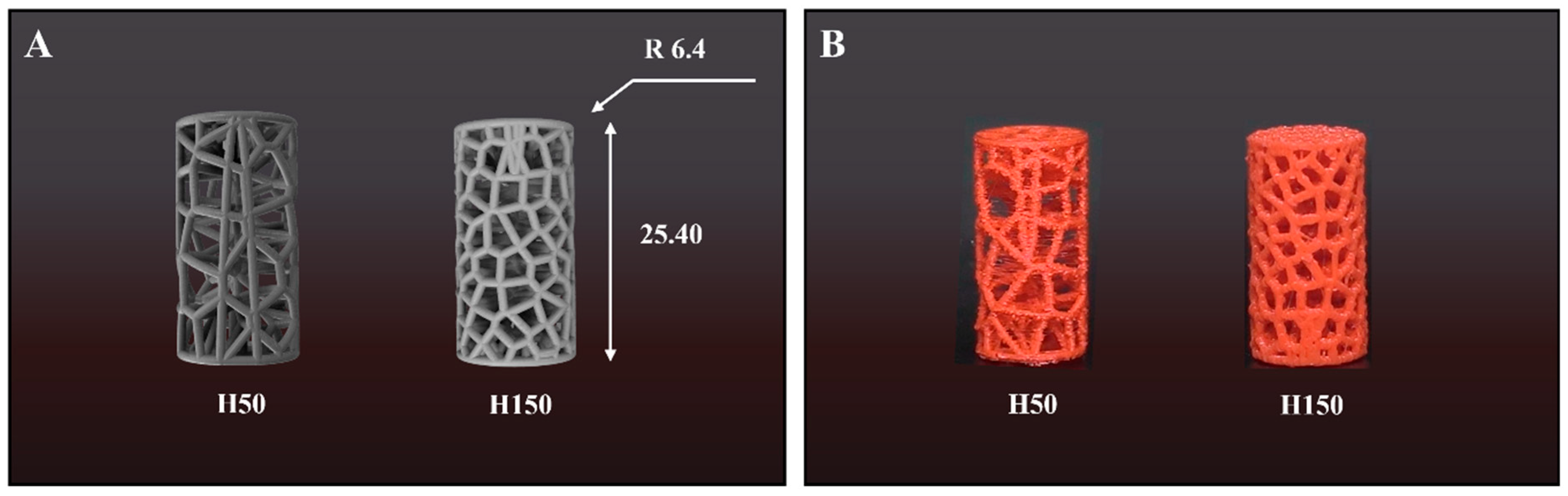
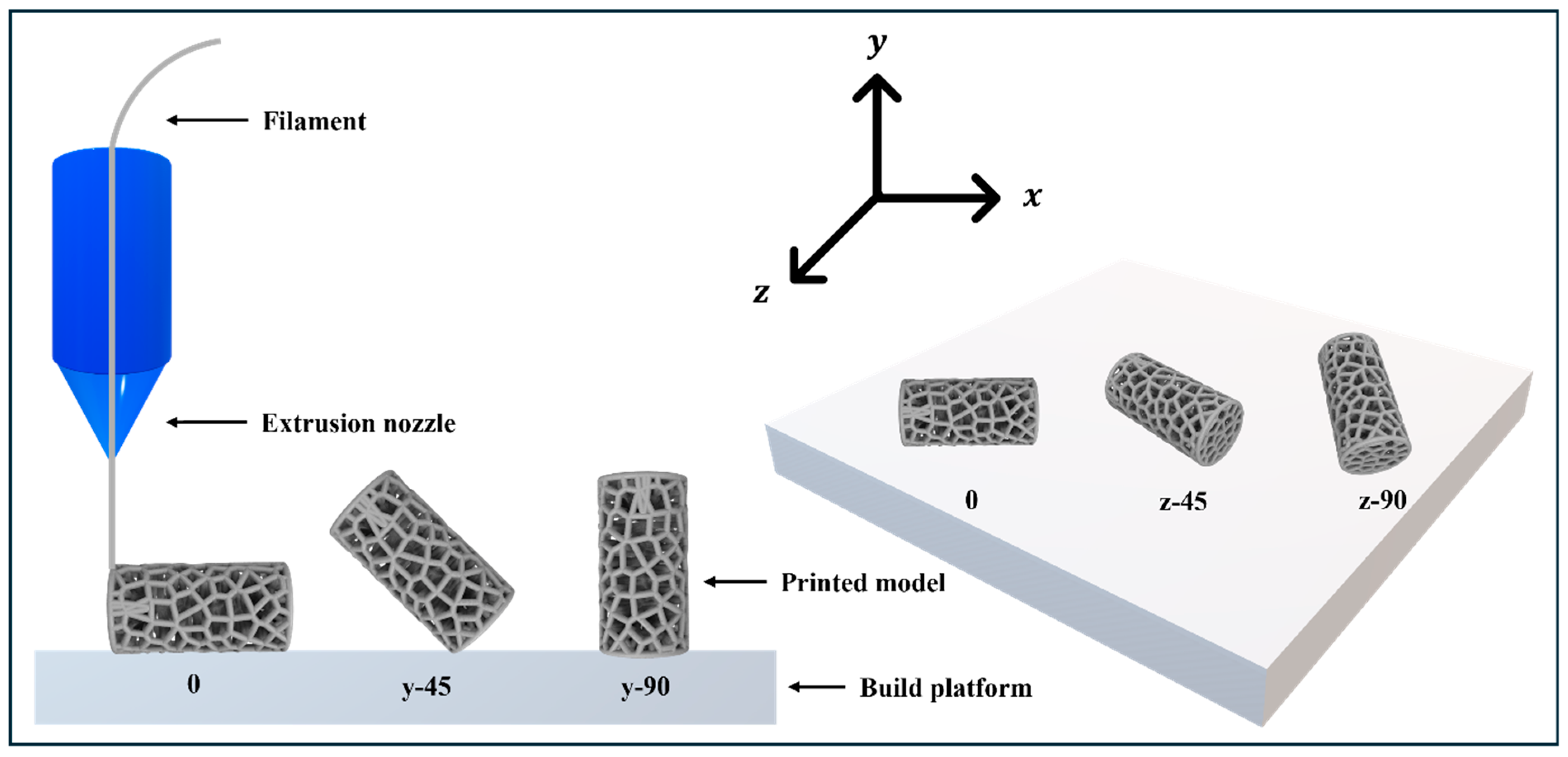
2.1. Design and Fabrication
2.2. Experiment
3. Results and Discussion
3.1. Signal-to-Noise Ratio Optimization
3.2. Theoretical Compressive Strength Based on Gibson–Ashby Model
3.3. Experimental Compressive Strength and S/N Analysis
3.4. Comparison with Natural Trabecular Bone
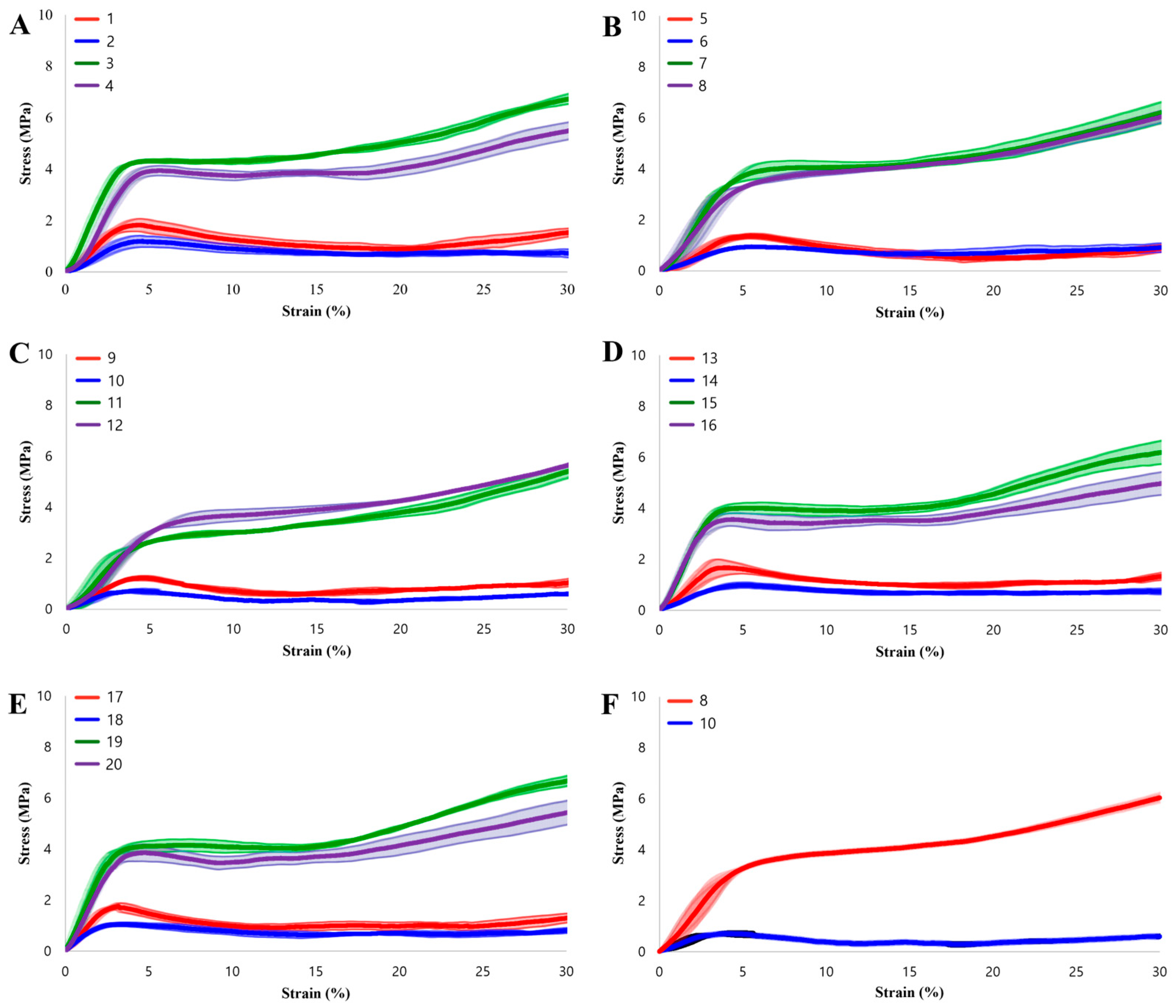
- Female Tibia (1.75 ± 1.16 MPa): The H50 structures demonstrated exceptional precision in replicating the female tibia. Specimen 13 achieved a mean strength of 1.7668 MPa, resulting in a negligible deviation of 0.0168 MPa. Similarly, specimen 17 and specimen 1 showed minimal deviations of 0.0221 MPa and 0.0366 MPa, respectively. This confirms that the H50 design parameter is ideal for substituting the female tibia.
- Female Femur (2.89 ± 1.31 MPa) and Male Tibia (2.59 ± 1.39 MPa): The H150 structures showed suitability for these intermediate load-bearing bones. Specimen 11 (150) recorded a strength of 3.1088 MPa. As detailed in Table 8, this specimen aligns closely with the female femur (deviation of 0.2188 MPa) and the male tibia (deviation of 0.5188 MPa), indicating its versatility for multiple anatomical applications.
- Male Femur (6.79 ± 2.91 MPa): For the highest load-bearing target, specimen 8 (H150) exhibited the maximum experimental strength of 4.4128 MPa. While it still shows a deviation of 2.3772 MPa from the male femur mean, it falls within the standard deviation range, suggesting potential applicability for specific patient cases requiring moderate load support.
3.5. Parameter Effect Analysis and Optimal Conditions
4. Conclusions
Author Contributions
Funding
Institutional Review Board Statement
Informed Consent Statement
Data Availability Statement
Conflicts of Interest
Abbreviations
| AM | Additive manufacturing |
| FDM | Fused deposition modeling |
| PLA | Polylactic acid |
| S/N | Signal-to-noise |
| CT | Computed tomography |
| GRA | Gray relational analysis |
| CAD | Computer-aided design |
References
- Wu, D.; Spanou, A.; Diez-Escudero, A.; Persson, C. 3D-Printed PLA/HA Composite Structures as Synthetic Trabecular Bone: A Feasibility Study Using Fused Deposition Modeling. J. Mech. Behav. Biomed. Mater. 2020, 103, 103608. [Google Scholar] [CrossRef] [PubMed]
- Popov, V.V.; Muller-Kamskii, G.; Kovalevsky, A.; Dzhenzhera, G.; Strokin, E.; Kolomiets, A.; Ramon, J. Design and 3D-Printing of Titanium Bone Implants: Brief Review of Approach and Clinical Cases. Biomed. Eng. Lett. 2018, 8, 337–344. [Google Scholar] [CrossRef] [PubMed]
- Khosla, S.; Hofbauer, L.C. Osteoporosis Treatment: Recent Developments and Ongoing Challenges. Lancet Diabetes Endocrinol. 2017, 5, 898–907. [Google Scholar] [CrossRef]
- Yoon, Y.-J.; Moon, S.K.; Hwang, J. 3D Printing as an Efficient Way for Comparative Study of Biomimetic Structures—Trabecular Bone and Honeycomb. J. Mech. Sci. Technol. 2014, 28, 4635–4640. [Google Scholar] [CrossRef]
- Barak, M.M.; Black, M.A. A Novel Use of 3D Printing Model Demonstrates the Effects of Deteriorated Trabecular Bone Structure on Bone Stiffness and Strength. J. Mech. Behav. Biomed. Mater. 2018, 78, 455–464. [Google Scholar] [CrossRef] [PubMed]
- Aurenhammer, F. Voronoi Diagrams—A Survey of a Fundamental Geometric Data Structure. ACM Comput. Surv. 1991, 23, 345–405. [Google Scholar] [CrossRef]
- Du, Q.; Faber, V.; Gunzburger, M. Centroidal Voronoi Tessellations: Applications and Algorithms. SIAM Rev. 1999, 41, 637–676. [Google Scholar] [CrossRef]
- Erwig, M. The Graph Voronoi Diagram with Applications. Networks 2000, 36, 156–163. [Google Scholar] [CrossRef]
- Bhate, D.; Penick, C.A.; Ferry, L.A.; Lee, C. Classification and Selection of Cellular Materials in Mechanical Design: Engineering and Biomimetic Approaches. Designs 2019, 3, 19. [Google Scholar] [CrossRef]
- Fantini, M.; Curto, M. Interactive Design and Manufacturing of a Voronoi-Based Biomimetic Bone Scaffold for Morphological Characterization. Int. J. Interact. Des. Manuf. 2018, 12, 585–596. [Google Scholar] [CrossRef]
- Du, Y.; Liang, H.; Xie, D.; Mao, N.; Zhao, J.; Tian, Z.; Wang, C.; Shen, L. Design and Statistical Analysis of Irregular Porous Scaffolds for Orthopedic Reconstruction Based on Voronoi Tessellation and Fabricated via Selective Laser Melting (SLM). Mater. Chem. Phys. 2020, 239, 121968. [Google Scholar] [CrossRef]
- Mwema, F.M.; Akinlabi, E.T. Basics of Fused Deposition Modelling (FDM). In Fused Deposition Modeling: Strategies for Quality Enhancement; Mwema, F.M., Akinlabi, E.T., Eds.; Springer International Publishing: Cham, Switzerland, 2020; pp. 1–15. ISBN 978-3-030-48259-6. [Google Scholar]
- Seo, S.; Kang, M.; Han, M.-W. Shape Memory Alloys Patches to Mimic Rolling, Sliding, and Spinning Movements of the Knee. Biomimetics 2024, 9, 255. [Google Scholar] [CrossRef]
- Karna, S.K.; Sahai, R. An Overview on Taguchi Method. Int. J. Eng. Math. Sci. 2012, 1, 11–18. [Google Scholar]
- Kim, N.P.; Cho, D.; Zielewski, M. Optimization of 3D Printing Parameters of Screw Type Extrusion (STE) for Ceramics Using the Taguchi Method. Ceram. Int. 2019, 45, 2351–2360. [Google Scholar] [CrossRef]
- Sharma, K.; Kumar, K.; Singh, K.R.; Rawat, M.S. Optimization of FDM 3D Printing Process Parameters Using Taguchi Technique. IOP Conf. Ser. Mater. Sci. Eng. 2021, 1168, 012022. [Google Scholar] [CrossRef]
- Chen, L.; Moon, S.K. In-Situ Defect Detection in Laser-Directed Energy Deposition with Machine Learning and Multi-Sensor Fusion. J. Mech. Sci. Technol. 2024, 38, 4477–4484. [Google Scholar] [CrossRef]
- Mitra, A. The Taguchi Method. WIREs Comput. Stat. 2011, 3, 472–480. [Google Scholar] [CrossRef]
- Verim, Ö.; Saeed, O.; Eid, M.H.; Mahmoud, S.F.; Saleh, D.I.; Elwakeel, A.E. Investigation of the Effects of 3D Printing Parameters on Mechanical Tests of PLA Parts Produced by MEX 3D Printing Using Taguchi Method. Sci. Rep. 2025, 15, 15008. [Google Scholar] [CrossRef] [PubMed]
- Winarso, R.; Slamet, S.; Wibowo, R.; Arrohman, S.; Hudaya, A.Z.; Ismail, R.; Jamari; Bayuseno, A.P. Optimization of 3D Printed Voronoi Microarchitecture Bone Scaffold Using Taguchi-Grey Relational Analysis. Bioprinting 2025, 47, e00402. [Google Scholar] [CrossRef]
- DeStefano, V.; Khan, S.; Tabada, A. Applications of PLA in Modern Medicine. Eng. Regen. 2020, 1, 76–87. [Google Scholar] [CrossRef]
- Hikmat, M.; Rostam, S.; Ahmed, Y.M. Investigation of Tensile Property-Based Taguchi Method of PLA Parts Fabricated by FDM 3D Printing Technology. Results Eng. 2021, 11, 100264. [Google Scholar] [CrossRef]
- Raju, R.; Varma, M.M.M.; Kumar Baghel, P. Optimization of Process Parameters for 3D Printing Process Using Taguchi Based Grey Approach. Mater. Today Proc. 2022, 68, 1515–1520. [Google Scholar] [CrossRef]
- Lokesh, N.; Praveena, B.A.; Sudheer Reddy, J.; Vasu, V.K.; Vijaykumar, S. Evaluation on Effect of Printing Process Parameter through Taguchi Approach on Mechanical Properties of 3D Printed PLA Specimens Using FDM at Constant Printing Temperature. Mater. Today Proc. 2022, 52, 1288–1293. [Google Scholar] [CrossRef]
- Sumalatha, M.; Rao, J.N.M.; Reddy, B.S. Optimization of Process Parameters in 3d Printing-Fused Deposition Modeling Using Taguchi Method. IOP Conf. Ser. Mater. Sci. Eng. 2021, 1112, 012009. [Google Scholar] [CrossRef]
- Aslan, E.; Akincioğlu, G. Tribological Characterization of Two Different Elastic Polymers Produced via FDM. In Proceedings of the International Symposium on Lightweight and Sustainable Polymeric Materials (LSPM23), Bangkok, Thailand, 17 February 2023; Springer: Singapore, 2023; pp. 189–200. [Google Scholar]
- Toktaş, İ.; Akıncıoğlu, S. Investigation of Tribological Properties of Industrial Products with Different Patterns Produced by 3D Printing Using Polylactic Acid. Rapid Prototyp. J. 2024, 31, 371–378. [Google Scholar] [CrossRef]
- Şirin, Ş.; Aslan, E.; Akincioğlu, G. Effects of 3D-Printed PLA Material with Different Filling Densities on Coefficient of Friction Performance. Rapid Prototyp. J. 2022, 29, 157–165. [Google Scholar] [CrossRef]
- Akıncıoğlu, G.; Aslan, E. Investigation of Tribological Properties of Amorphous Thermoplastic Samples with Different Filling Densities Produced by an Additive Manufacturing Method. GJES 2022, 8, 540–546. [Google Scholar]
- Taguchi, G.; Phadke, M.S. Quality Engineering through Design Optimization. In Quality Control, Robust Design, and the Taguchi Method; Dehnad, K., Ed.; Springer: Boston, MA, USA, 1989; pp. 77–96. ISBN 978-1-4684-1472-1. [Google Scholar]
- Gibson, L.J.; Ashby, M.F. Cellular Solids: Structure and Properties, Cambridge Solid State Science Series; 2nd ed.; Cambridge University Press: Cambridge, UK, 1997; ISBN 978-0-521-49911-8. [Google Scholar]
- Zhong, H.; Song, T.; Li, C.; Das, R.; Gu, J.; Qian, M. The Gibson-Ashby Model for Additively Manufactured Metal Lattice Materials: Its Theoretical Basis, Limitations and New Insights from Remedies. Curr. Opin. Solid State Mater. Sci. 2023, 27, 101081. [Google Scholar] [CrossRef]
- Jalali, S.K.; Beigrezaee, M.J.; Misseroni, D.; Pugno, N.M. A Modified Gibson-Ashby Model for Functionally Graded Lattice Structures. Mech. Mater. 2024, 188, 104822. [Google Scholar] [CrossRef]
- Zhong, H.; Das, R.; Gu, J.; Qian, M. Low-Density, High-Strength Metal Mechanical Metamaterials beyond the Gibson-Ashby Model. Mater. Today 2023, 68, 96–107. [Google Scholar] [CrossRef]
- Kornievsky, A.; Nasedkin, A. Numerical Investigation of Mechanical Properties of Foams Modeled by Regular Gibson–Ashby Lattices with Different Internal Structures. Materialia 2022, 26, 101563. [Google Scholar] [CrossRef]
- Molinari, A.; Klarin, J.; Johansson, F.; Benedetti, M.; Fontanari, V.; Magalini, E.; Luchin, V.; Zappini, G. Mechanical Properties of Porous Structures Produced by Selective Laser Melting of a Ti6Al4V Alloy Powder. J. Jpn. Soc. Powder Powder Metall. 2018, 65, 481–485. [Google Scholar] [CrossRef]
- Niu, Z.; Lu, S. Prediction of Compressibility and Mechanical Properties of Porous Structures Based on Gibson-Ashby Model. Int. Core J. Eng. 2023, 9, 42–47. [Google Scholar] [CrossRef]
- Gao, C.; Peng, S.; Feng, P.; Shuai, C. Bone Biomaterials and Interactions with Stem Cells. Bone Res. 2017, 5, 17059. [Google Scholar] [CrossRef] [PubMed]
- Ma, C.; Du, T.; Niu, X.; Fan, Y. Biomechanics and Mechanobiology of the Bone Matrix. Bone Res. 2022, 10, 59. [Google Scholar] [CrossRef]
- Raffa, M.L.; Nguyen, V.-H.; Hernigou, P.; Flouzat-Lachaniette, C.-H.; Haiat, G. Stress Shielding at the Bone-Implant Interface: Influence of Surface Roughness and of the Bone-Implant Contact Ratio. J. Orthop. Res. 2021, 39, 1174–1183. [Google Scholar] [CrossRef] [PubMed]
- von Wilmowsky, C.; Moest, T.; Nkenke, E.; Stelzle, F.; Schlegel, K.A. Implants in Bone: Part II. Research on Implant Osseointegration. Oral Maxillofac. Surg. 2014, 18, 355–372. [Google Scholar] [CrossRef]
- Kwak, D.-S.; Nam, Y.-S.; Oh, T.Y.; Han, S.-H. P-09 the Mechanical Properties of Trabecular Bone in Knee Joint. In Proceedings of the Asian Pacific Conference on Biomechanics: Emerging Science and Technology in Biomechanics 2007.3; The Japan Society of Mechanical Engineers: Tokyo, Japan, 2007; p. S97. [Google Scholar] [CrossRef]
- Loh, Q.L.; Choong, C. Three-Dimensional Scaffolds for Tissue Engineering Applications: Role of Porosity and Pore Size. Tissue Eng. Part B Rev. 2013, 19, 485–502. [Google Scholar] [CrossRef]
- Afrose, M.F.; Masood, S.H.; Iovenitti, P.; Nikzad, M.; Sbarski, I. Effects of Part Build Orientations on Fatigue Behaviour of FDM-Processed PLA Material. Prog. Addit. Manuf. 2016, 1, 21–28. [Google Scholar] [CrossRef]
- Mukasheva, F.; Adilova, L.; Dyussenbinov, A.; Yernaimanova, B.; Abilev, M.; Akilbekova, D. Optimizing Scaffold Pore Size for Tissue Engineering: Insights across Various Tissue Types. Front. Bioeng. Biotechnol. 2024, 12, 1444986. [Google Scholar] [CrossRef]
- Murphy, C.M.; Haugh, M.G.; O’Brien, F.J. The Effect of Mean Pore Size on Cell Attachment, Proliferation and Migration in Collagen–Glycosaminoglycan Scaffolds for Bone Tissue Engineering. Biomaterials 2010, 31, 461–466. [Google Scholar] [CrossRef] [PubMed]
- Wang, X.; Lou, T.; Zhao, W.; Song, G.; Li, C.; Cui, G. The Effect of Fiber Size and Pore Size on Cell Proliferation and Infiltration in PLLA Scaffolds on Bone Tissue Engineering. J. Biomater. Appl. 2016, 30, 1545–1551. [Google Scholar] [CrossRef] [PubMed]




| Number of Pores | Distance (mm) | Thickness (mm) | Porosity (%) |
|---|---|---|---|
| 50 | 0.1 | 0.4 | 75.6 |
| 150 | 0.1 | 0.4 | 54.6 |
| Property | PLA |
|---|---|
| 3.2 GPa | |
| 49 MPa |
| Parameter | Level | ||||
|---|---|---|---|---|---|
| 1 | 2 | 3 | 4 | 5 | |
| A: Build orientation (°) | 0° (flat) | 45° on Y-axis | 90° on Y-axis (On-edge) | 45° on Z-axis | 90° on Z-axis |
| B: Extruder temperature (°C) | 200 | 220 | - | - | - |
| C: Layer height (mm) | 0.1 | 0.2 | - | - | - |
| D: Number of pores | H50 | H150 | - | - | - |
| Num | A | B | C | D |
|---|---|---|---|---|
| 1 | 0 | 200 | 0.1 | H50 |
| 2 | 0 | 220 | 0.2 | H50 |
| 3 | 0 | 200 | 0.2 | H150 |
| 4 | 0 | 220 | 0.1 | H150 |
| 5 | y-45 | 200 | 0.1 | H50 |
| 6 | y-45 | 220 | 0.2 | H50 |
| 7 | y-45 | 200 | 0.2 | H150 |
| 8 | y-45 | 220 | 0.1 | H150 |
| 9 | y-90 | 200 | 0.1 | H50 |
| 10 | y-90 | 220 | 0.2 | H50 |
| 11 | y-90 | 200 | 0.2 | H150 |
| 12 | y-90 | 220 | 0.1 | H150 |
| 13 | z-45 | 200 | 0.1 | H50 |
| 14 | z-45 | 220 | 0.2 | H50 |
| 15 | z-45 | 200 | 0.2 | H150 |
| 16 | z-45 | 220 | 0.1 | H150 |
| 17 | z-90 | 200 | 0.1 | H50 |
| 18 | z-90 | 220 | 0.2 | H50 |
| 19 | z-90 | 200 | 0.2 | H150 |
| 20 | z-90 | 220 | 0.1 | H150 |
| Property | H50 | H150 |
|---|---|---|
| Relative density | 0.2440 | 0.4540 |
| 0.1910 GPa | 0.6590 GPa | |
| 1.7700 MPa | 4.4970 MPa | |
| 1.7700 MPa | 4.4970 MPa |
| Num | Mean Compressive Strength (MPa) | The Standard Deviation of the Mean Value | S/N Ratio (dB) |
|---|---|---|---|
| 1 | 1.7866 | 0.2354 | 17.6050 |
| 2 | 1.1859 | 0.2356 | 14.0392 |
| 3 | 4.2774 | 0.1198 | 31.0516 |
| 4 | 4.0544 | 0.1940 | 26.4047 |
| 5 | 1.3827 | 0.1341 | 20.2659 |
| 6 | 0.9424 | 0.0665 | 23.0235 |
| 7 | 4.1911 | 0.2205 | 25.5853 |
| 8 | 4.4128 | 0.1397 | 29.9882 |
| 9 | 1.2208 | 0.1169 | 20.3748 |
| 10 | 0.7099 | 0.0752 | 19.5042 |
| 11 | 3.1088 | 0.0489 | 36.0737 |
| 12 | 3.7623 | 0.1311 | 29.1293 |
| 13 | 1.7668 | 0.3757 | 13.4471 |
| 14 | 0.9783 | 0.1124 | 18.7907 |
| 15 | 3.9631 | 0.2205 | 25.0913 |
| 16 | 3.6362 | 0.2570 | 23.0152 |
| 17 | 1.7721 | 0.1391 | 22.1053 |
| 18 | 1.0778 | 0.0838 | 22.1856 |
| 19 | 4.0425 | 0.2031 | 25.9800 |
| 20 | 3.9849 | 0.3473 | 21.2116 |
| Sex | Bone | Compressive Strength (MPa) | Elastic Modulus (MPa) |
|---|---|---|---|
| Male | Femur | 6.79 ± 2.91 | 360.61 ± 159.40 |
| Tibia | 2.59 ± 1.39 | 108.80 ± 52.88 | |
| Female | Femur | 2.89 ± 1.31 | 150.89 ± 70.65 |
| Tibia | 1.75 ± 1.16 | 73.45 ± 55.06 |
| Num | Deviation from the Target Value | |||
|---|---|---|---|---|
| Male Femur (6.79 ± 2.91 MPa) | Male Tibia (2.59 ± 1.39 MPa) | Female Femur (2.89 ± 1.31 MPa) | Female Tibia (1.75 ± 1.16 MPa) | |
| 1 | 5.0034 | 0.8034 | 1.1034 | 0.0366 |
| 2 | 5.6041 | 1.4041 | 1.7041 | 0.5641 |
| 3 | 2.5126 | 1.6874 | 1.3874 | 2.5274 |
| 4 | 2.7351 | 1.4650 | 1.1650 | 2.3050 |
| 5 | 5.4073 | 1.2073 | 1.5073 | 0.3673 |
| 6 | 5.8476 | 1.6476 | 1.9476 | 0.8075 |
| 7 | 2.5963 | 1.6037 | 1.3037 | 2.4437 |
| 8 | 2.3772 | 1.8228 | 1.5228 | 2.6628 |
| 9 | 5.5692 | 1.3692 | 1.6692 | 0.5292 |
| 10 | 6.0801 | 1.8801 | 2.1801 | 1.0401 |
| 11 | 3.6813 | 0.5188 | 0.2188 | 1.3588 |
| 12 | 3.0277 | 1.1723 | 0.8723 | 2.0123 |
| 13 | 5.0232 | 0.8232 | 1.1232 | 0.0168 |
| 14 | 5.8117 | 1.6117 | 1.9117 | 0.7717 |
| 15 | 2.8270 | 1.3731 | 1.0731 | 2.2131 |
| 16 | 3.1539 | 1.0462 | 0.7462 | 1.8862 |
| 17 | 5.0179 | 0.8179 | 1.1179 | 0.0221 |
| 18 | 5.7122 | 1.5122 | 1.8122 | 0.6722 |
| 19 | 2.7475 | 1.4525 | 1.1525 | 2.2925 |
| 20 | 2.7974 | 1.4026 | 1.1026 | 2.2426 |
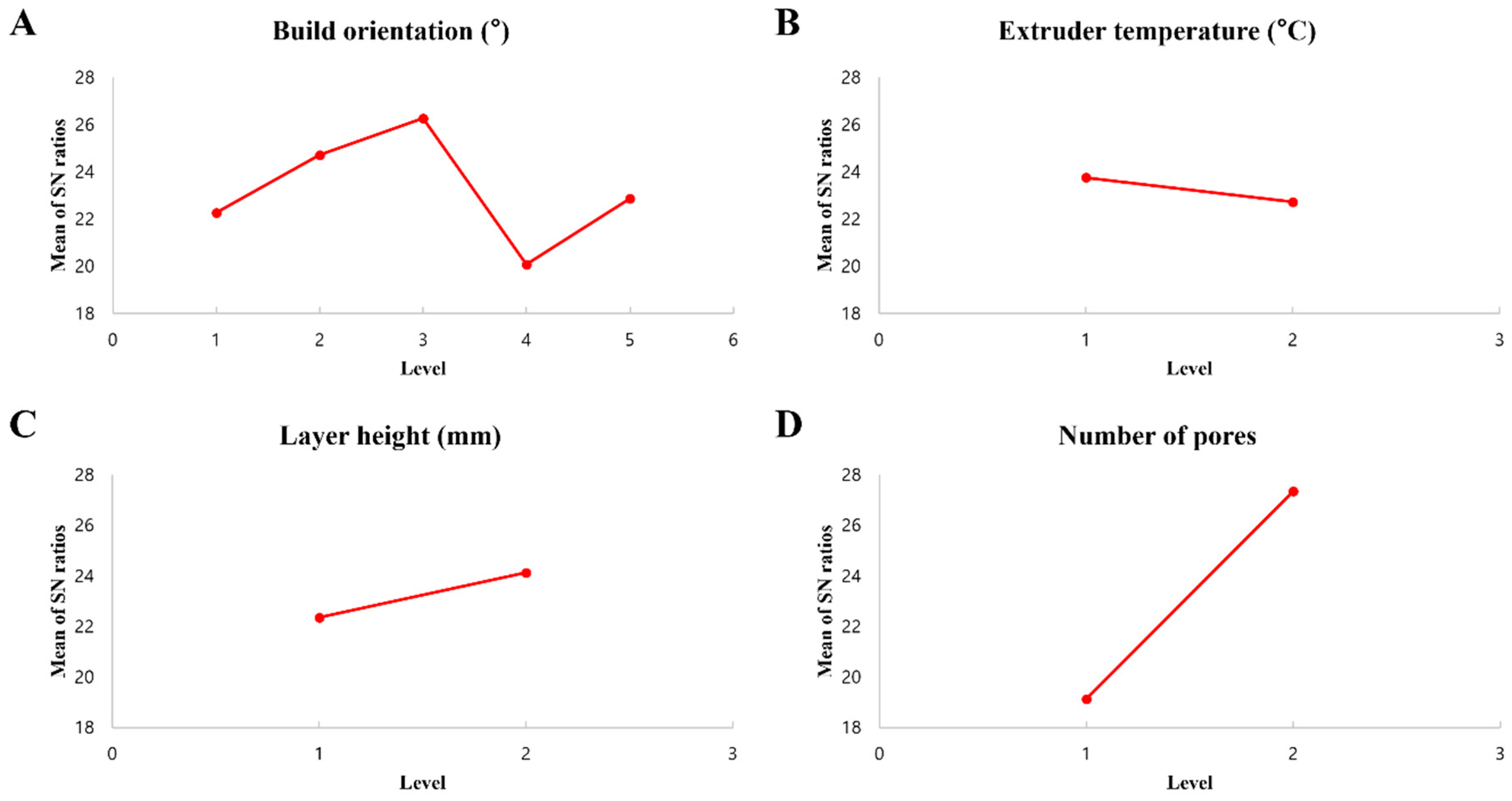
| Level | Build Orientation | Extruder Temperature | Layer Height | Number of Pores |
|---|---|---|---|---|
| 1 | 22.2751 | 23.7580 | 22.3547 | 19.1341 |
| 2 | 24.7157 | 22.7292 | 24.1325 | 27.3531 |
| 3 | 26.2705 | - | - | - |
| 4 | 20.0861 | - | - | - |
| 5 | 22.8706 | - | - | - |
| Delta | 6.1844 | 1.0288 | 1.7778 | 8.2190 |
| Ranking | 2 | 4 | 3 | 1 |
| DF | Adj SS | Adj MS | F-Value | p-Value | Contribution (%) | |
|---|---|---|---|---|---|---|
| Build orientation | 4 | 89.51 | 22.38 | 1.75 | 0.204550 | 14.86 |
| Extruder temperature | 1 | 5.29 | 5.29 | 0.41 | 0.532547 | 0.88 |
| Layer height | 1 | 15.80 | 15.80 | 1.23 | 0.288533 | 2.62 |
| Number of pores | 1 | 337.76 | 337.76 | 26.36 | 0.000247 | 56.09 |
| Residual error | 12 | 153.77 | 12.81 | - | - | 25.54 |
| Total | 19 | 602.13 | - | - | - | 100 |
Disclaimer/Publisher’s Note: The statements, opinions and data contained in all publications are solely those of the individual author(s) and contributor(s) and not of MDPI and/or the editor(s). MDPI and/or the editor(s) disclaim responsibility for any injury to people or property resulting from any ideas, methods, instructions or products referred to in the content. |
© 2025 by the authors. Licensee MDPI, Basel, Switzerland. This article is an open access article distributed under the terms and conditions of the Creative Commons Attribution (CC BY) license.
Share and Cite
Seo, S.; Lee, J.-H.; Kang, M.; Park, E.; Han, M.-W. Compressive Strength Optimization of 3D-Printed Voronoi Trabecular Bone Using the Taguchi Method. Biomimetics 2026, 11, 20. https://doi.org/10.3390/biomimetics11010020
Seo S, Lee J-H, Kang M, Park E, Han M-W. Compressive Strength Optimization of 3D-Printed Voronoi Trabecular Bone Using the Taguchi Method. Biomimetics. 2026; 11(1):20. https://doi.org/10.3390/biomimetics11010020
Chicago/Turabian StyleSeo, Suyeon, Ju-Hee Lee, Minchae Kang, Eunsol Park, and Min-Woo Han. 2026. "Compressive Strength Optimization of 3D-Printed Voronoi Trabecular Bone Using the Taguchi Method" Biomimetics 11, no. 1: 20. https://doi.org/10.3390/biomimetics11010020
APA StyleSeo, S., Lee, J.-H., Kang, M., Park, E., & Han, M.-W. (2026). Compressive Strength Optimization of 3D-Printed Voronoi Trabecular Bone Using the Taguchi Method. Biomimetics, 11(1), 20. https://doi.org/10.3390/biomimetics11010020