1. Introduction
Water monitoring is a critical component of environmental protection and resource management, with a growing global demand to assess water resources due to increasing scarcity and associated environmental challenges. Recent advances in remote sensing have enabled the use of satellite imagery to identify, analyze, and monitor water bodies on a large scale, including areas that are difficult to access. Accurate segmentation of water bodies from satellite imagery is essential for applications such as flood detection, water resource management, and environmental monitoring, and the development of efficient and precise segmentation techniques is vital for timely and reliable decisions [
1].
Traditionally, water monitoring relied on labor-intensive ground surveys and aerial photography, which are time-consuming and limited in coverage. Classical methods using handcrafted features or specific feature extraction techniques have been employed for water body segmentation [
2,
3]. Recently, deep learning approaches, particularly semantic segmentation models, have demonstrated superior performance in identifying water body boundaries in satellite imagery [
4,
5]. However, challenges remain due to complex background clutter and the fact that water bodies are often partially obscured, limiting segmentation accuracy and hindering accurate estimation of water body extent. Moreover, water bodies captured by satellites exhibit considerable diversity in type and scale, ranging from lakes, rivers, and reservoirs to coastal seas. In addition, satellite imagery spans a wide variety of geographic regions and environmental conditions, including differences in terrain, climate, and seasonal variations; this diversity poses significant challenges for segmentation models. As a result, achieving robust cross-domain performance in satellite water body segmentation remains a critical and open problem.
In recent years, the Segment Anything Model (SAM) has gained widespread attention due to its remarkable performance in image segmentation tasks [
6]. Trained on more than one billion images, SAM is capable of generating high-quality masks and demonstrates excellent generalization ability, which is particularly important in the field of satellite water body segmentation. This is because acquiring large amounts of labeled data for specific scenes can be extremely challenging. However, SAM requires prompts (such as points, boxes, and masks) to function, which makes it unsuitable for direct use in semantic segmentation tasks. Several studies have explored the application of SAM in specific domains, such as medical image segmentation and remote sensing image segmentation [
7,
8], showing promising results. This led us to consider whether SAM could help us tackle the complex task of segmenting satellite water bodies.
To address the challenges of cross-domain water body segmentation, we propose DASAM, a domain-adaptive Segment Anything Model for satellite imagery. The core of DASAM is a contrastive learning module that aligns features between synthetic images augmented with source–domain and style, enabling robust generalization without requiring annotations in the target domain. SAM is treated as a largely frozen backbone, while a lightweight semantic segmentation model generates coarse masks, point prompts, and bounding box prompts to provide prior knowledge. An adapter module is incorporated into SAM’s image encoder using a residual design, allowing selective parameter updates to focus on water body regions. Additionally, features from the lightweight model are fused with SAM’s encoder features to enrich semantic information for the decoder, further enhancing segmentation performance.
In summary, our contributions are as follows:
- (1)
We introduce a contrastive learning module built within SAM to align features between source–domain and style-augmented synthetic images, enabling robust cross-domain water body segmentation without requiring target-domain annotations.
- (2)
We incorporate a lightweight semantic segmentation model and insert two adapters into SAM’s image encoder, combining this with a prompt-based structure and feature map fusion to provide prior knowledge and enhance the model’s focus on water body regions.
- (3)
Extensive experiments on the China GF-2 dataset and cross-domain evaluations on GLH-water and Sentinel-2 datasets demonstrate that DASAM outperforms existing methods in segmentation accuracy and generalization.
2. Related Works
2.1. Segmentation Methods for Satellite Water Body Images
Before the advent of deep learning, early methods for satellite water body segmentation were largely similar to those used for natural images, typically involving pixel classification with theoretically grounded classifiers and subsequent feature extraction to derive the final segmentation [
9,
10,
11,
12,
13]. For example, some studies segmented water bodies based on water pixels using spectral analysis [
14,
15,
16]. Another study used a variety of machine learning classifiers to classify water bodies in satellite imagery [
17]. However, there are significant differences between natural images and satellite images, including variations in the data acquisition process, resolution, and spectral bands. Consequently, the accuracy of these traditional methods was often insufficient, providing limited value for water resource monitoring applications.
For classification-based tasks, the widespread adoption of convolutional neural networks (CNNs) has led many studies to use various CNN-based models to classify water bodies in satellite images [
18,
19,
20,
21]. However, this approach tends to overlook the precise delineation of water body boundaries, particularly in complex or heterogeneous environments where water bodies are difficult to distinguish from other land features. Moreover, models trained on one satellite dataset often struggle to generalize to images from different sensors, resolutions, geographic regions, or environmental conditions, limiting their applicability in diverse real-world scenarios.
On the other hand, segmentation-based approaches aim to generate precise boundaries of water bodies by segmenting the entire image into regions of interest. CNNs have also shown strong performance in this regard. For example, some studies have used multiscale fusion modules within CNN architectures to improve water body segmentation in satellite images [
22,
23,
24]. Another study utilized a deconvolutional neural network and proposed a new loss function called edge-weighted loss to improve segmentation performance [
25]. Recently, some researchers have coupled Transformer networks with CNNs to improve the segmentation accuracy of satellite water body imagery [
26]. Nonetheless, a common limitation in existing water body segmentation research is insufficient focus on or accuracy in delineating boundaries, as well as limited robustness and generalization across different satellite domains and environmental conditions.
2.2. Applications of SAM
SAM’s powerful zero-shot generalization capability has made it highly popular for image segmentation tasks since its introduction. Many fields have begun to explore their application, such as medical image segmentation [
27,
28], remote sensing image segmentation [
29,
30], and agriculture [
31,
32].
Researchers have explored various strategies to adapt SAM for downstream tasks. One widely used approach is adapter-based fine-tuning, where lightweight modules are inserted into SAM’s image encoder to enable task-specific adaptation without updating the full backbone. Representative examples include SAM-Adapter [
33], which adapts SAM for underperformed scenes, and Medical SAM Adapter [
34], which specializes SAM for medical image segmentation. Encoder-level fine-tuning methods, exemplified by Convolution Meets LoRA [
35], directly update the image encoder to better capture task-specific features, which can enhance segmentation accuracy but may reduce zero-shot generalization. Prompt-based strategies, such as UVSAM [
36], demonstrate that combining a small semantic segmentation model with SAM’s mask decoder via prompt generation can effectively segment complex urban–village boundaries from satellite imagery. Some studies, such as the approach by Nanni et al. [
37], explore the potential of using SAM as a segmentator to enhance the performance of existing segmentation models. In this work, SAM is provided with checkpoints extracted from masks produced by mainstream segmentators, and the segmentation masks from SAM and the specialized models are then fused. This fusion of logit masks allows consistent improvement across heterogeneous datasets, including challenging tasks such as camouflage object segmentation and fine-grained object segmentation.
Compared with existing SAM-based segmentation approaches, DASAM leverages contrastive learning to explicitly align features across domains. While fusion-based approaches, such as those proposed by Nanni et al., can improve performance on heterogeneous datasets, they may still struggle with domain shifts. In contrast, DASAM’s domain-adaptive design ensures robustness across multiple satellite datasets while capturing fine-grained spatial details through its prompt enhancement and encoder adapters, enabling stronger cross-domain generalization without requiring multiple model fusions.
3. Materials and Methods
3.1. Overview
In this section, we present DASAM, a framework designed for cross-domain water body segmentation in satellite imagery by enhancing SAM with domain contrastive learning and lightweight adaptation mechanisms.
SAM is a large-scale image segmentation framework composed of three primary components: an image encoder, a prompt encoder, and a mask decoder. Its core concept is to perform segmentation efficiently via a prompt-driven mechanism. Specifically, the image encoder uses a Vision Transformer (ViT) to extract features and generate image embeddings. The prompt encoder processes both sparse prompts and dense prompts derived from masks. The mask decoder then integrates the image and prompt embeddings to generate the final segmentation mask.
SegFormer is a lightweight semantic segmentation model with an encoder–decoder architecture, designed for efficiency in resource-constrained environments [
38]. The encoder, built on the Transformer architecture, extracts global contextual features through multiple layers of self-attention. The decoder, composed entirely of multilayer perceptrons, upsamples the encoded feature maps to restore spatial resolution and produce the final segmentation output.
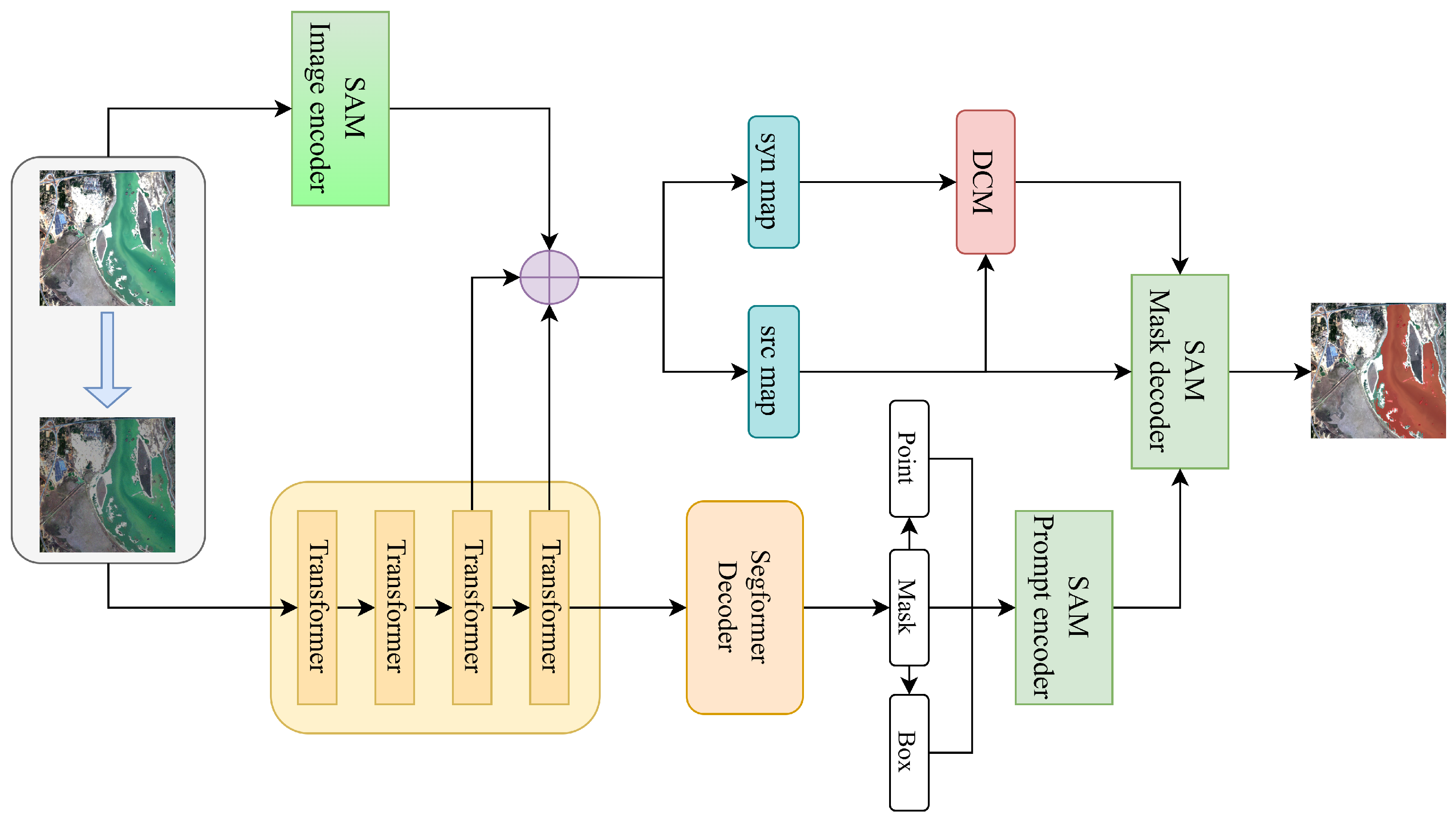
As illustrated in
Figure 1, given a source image, we generate a synthetic style augmented image using color perturbation combined with noise injection to simulate domain variation. The color perturbation is implemented using a ColorJitter transformation with brightness, contrast, and saturation ranges set to ±0.4 and a hue variation of ±0.1. To further simulate the sensor-level domain variations, we add Gaussian noise with zero mean and a standard deviation of 0.05. Both source and synthetic images are processed simultaneously by two parallel encoders, namely the SAM image encoder and a SegFormer-based lightweight segmentation network. The SegFormer branch has two main functions. First, it provides semantic prior knowledge by producing segmentation masks from the source domain, which are used to generate prompts such as points, boxes, and masks for SAM’s prompt encoder. Second, it provides domain-aware feature maps that are fused with those extracted by SAM’s encoder to enhance feature representation and improve segmentation quality. To address cross-domain inconsistency, we introduce a Domain Contrastive Module (DCM) as shown in
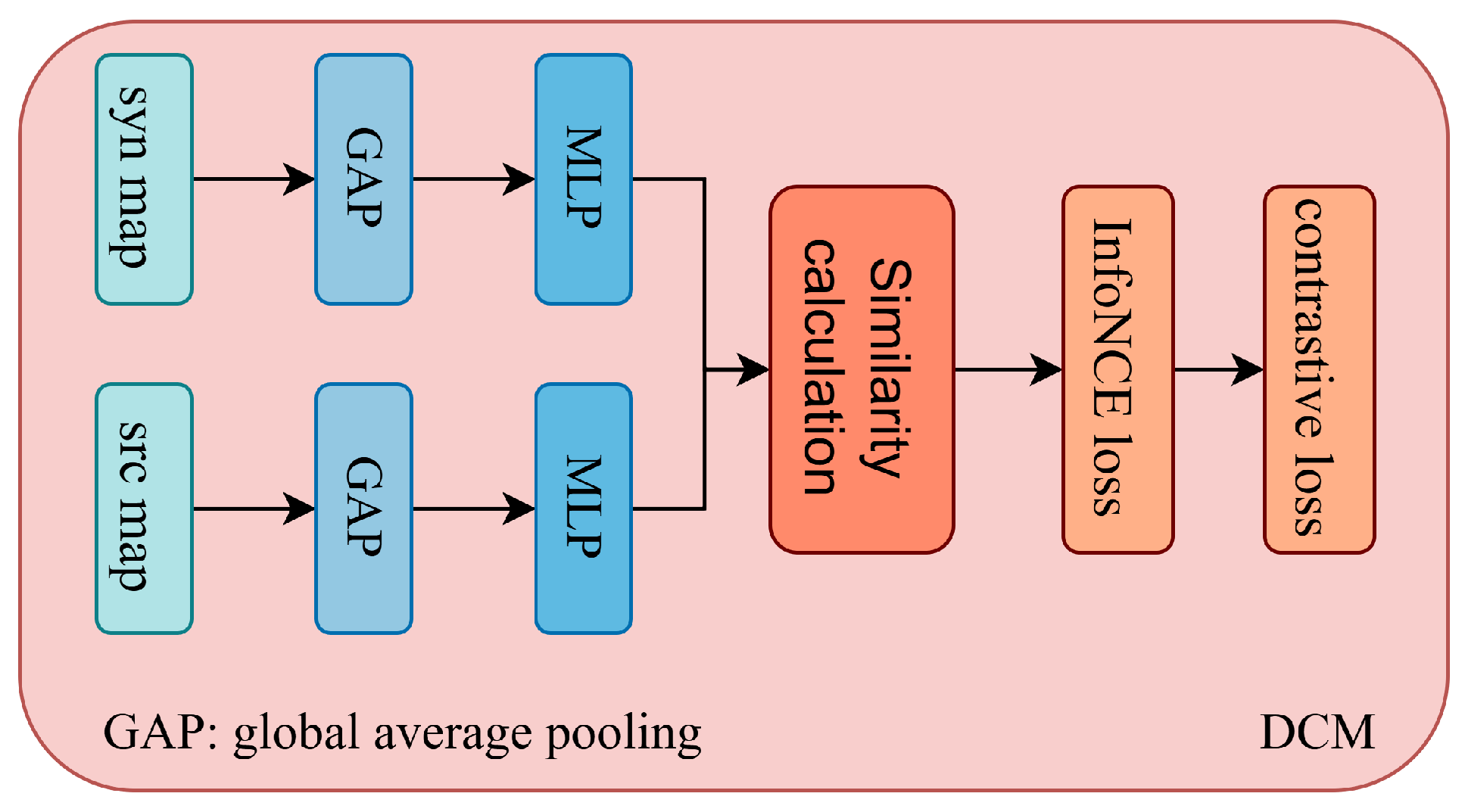
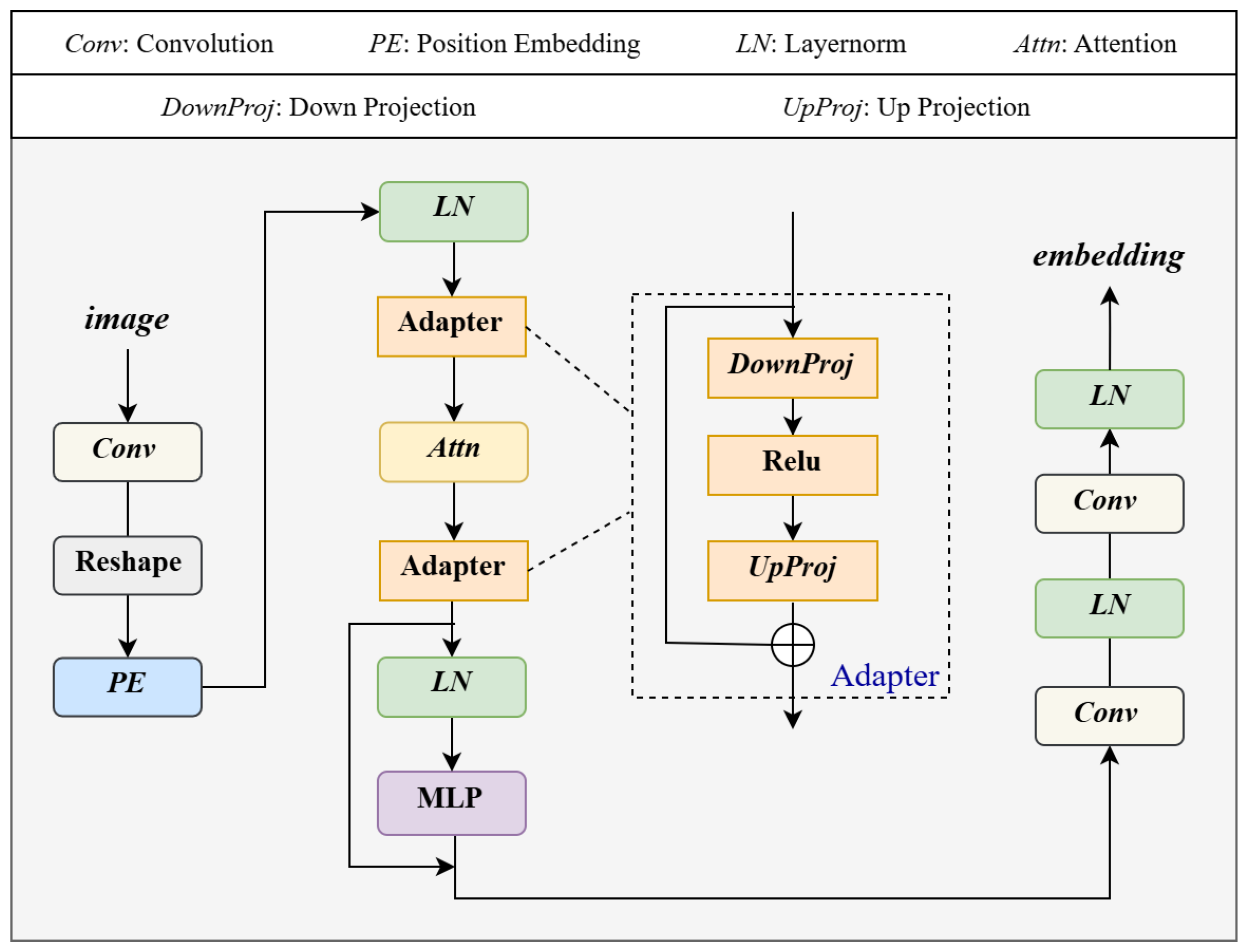
Figure 2. The DCM receives the fused feature pairs from the source and synthetic domains and optimizes an InfoNCE loss to encourage alignment of semantically similar representations across domains. This design enables DASAM to achieve strong generalization without requiring any annotations from the target domain. In addition, two adapter modules are inserted into the SAM image encoder, as illustrated in
Figure 3. During training, the original SAM parameters remain frozen to preserve its inherent generalization capability, while only the adapter parameters are updated. The entire framework is trained on the GF-2 satellite water body dataset with a joint objective that combines segmentation loss and domain contrastive loss. The following subsections describe each component in detail.
3.2. Prompt
In this section, we primarily use the SegFormer model to provide prompts for SAM, including point, box, mask, and feature map prompts. Below, we provide a detailed explanation of these two types of prompts.
3.2.1. Feature Map Prompt
A satellite water body image from the source domain is denoted by
, and its synthetic counterpart, enhanced with style, is denoted by
. Each image is processed by the SegFormer encoder, which consists of four Transformer layers with a downsampling stride of 2. The feature maps extracted from the last two Transformer layers for the source image are written as
and
, and for the synthetic image as
and
. The same pair of images is also fed into SAM’s image encoder to produce feature maps
and
, which are aligned in both spatial resolution and channel dimension with the SegFormer feature maps. For each domain, the SegFormer and SAM features are integrated through a normalized additive fusion operation, formulated as
Here, denotes the l-th Transformer layer in SegFormer, represents SAM’s image encoder, and indicates the normalized additive fusion operation. The normalized additive fusion equalizes the statistical distributions of all input feature maps via batch normalization before merging them through element-level summation. The fused feature maps and effectively integrate domain-specific contextual information with general visual priors from SAM. Both fused representations are subsequently utilized for downstream tasks. The source–domain fused feature is used as the input to SAM’s decoder, while the paired fused features and are jointly forwarded to the DCM to promote cross-domain alignment via an InfoNCE-based objective.
3.2.2. Point, Box, and Mask Prompts
For the source–domain image
, the SegFormer model produces an initial segmentation mask, denoted as
. This mask provides semantic guidance for prompt generation. From
, we obtain its corresponding bounding box
, which supplies spatial localization information. We randomly sample four points from the mask to form
, including three foreground points and one background point, to represent both positive and negative spatial cues. These prompts are subsequently encoded by SAM’s prompt encoder, generating dense and sparse prompt embeddings for mask prediction. The process is expressed as
Finally, these prompts are combined with the fused feature map from the source domain to guide SAM’s decoder, producing the final segmentation result
:
3.3. Adapter
In this study, to enhance SAM’s performance in satellite water body imagery segmentation tasks, we incorporate two adapter modules into SAM’s image encoder. The adapter modules improve the model’s segmentation ability by adjusting the dimensionality of the feature representations. Specifically, we insert an adapter module before and after the Attention module in SAM’s image encoder, with identical configurations for both adapter modules.
The adapter module transforms input features
X through a bottleneck structure involving linear downsampling, the ReLU activation function
, and upsampling, with the result integrated via residual connection to yield
. This residual design mitigates gradient vanishing while facilitating effective feature adaptation, formulated as
Here, and are the weight and bias for the downsampling operation, and and are the weight and bias for the upsampling operation.
3.4. Domain Contrastive Module
To address the distribution gap between the source and synthetic domains, we introduce a Domain Contrastive Module that performs feature-level alignment through contrastive learning. The goal of this module is to encourage the model to learn domain-invariant representations while maintaining semantic consistency across different domains.
Given a batch of source–domain images
and their corresponding style-augmented synthetic images
, each synthetic image is generated by applying color perturbation and noise injection to its source counterpart. Therefore, each source image has a one-to-one correspondence with a synthetic image. After extraction and fusion of the features, we obtain the fused feature maps
and
. These feature maps are passed through a global average pooling (GAP) layer to produce compact representations for contrastive learning. The pooled features are expressed as
To improve the separability of representations, we apply a projection head
that maps the pooled features into a lower-dimensional contrastive embedding space. The projection head is implemented as a two-layer multilayer perceptron with ReLU activation, which transforms the 256 dimensional pooled features into 128-dimensional embeddings:
Assume a batch of
B image pairs, where
and
represent the projected features of the source and synthetic domains, respectively. The pair
forms a positive sample pair, while all other combinations act as negative pairs. The similarity between two feature vectors is defined using cosine similarity with a temperature parameter
:
where
is the temperature coefficient that controls the concentration level of the similarity distribution.
InfoNCE loss [
39] is a contrastive learning loss that encourages positive pairs of features to be close in the feature space while pushing apart negative pairs. In our study, DCM employs a bidirectional InfoNCE loss that aligns the source and synthetic representations in both directions. For the source-to-synthetic direction, each source feature
is compared with all synthetic features
, and the positive pair is defined as the corresponding synthetic feature
. The corresponding loss is expressed as
Similarly, for the synthetic-to-source direction, each synthetic feature
treats its corresponding source feature
as the positive pair, and the loss is:
The overall contrastive loss is the average of the two directional losses, written as
This bidirectional contrastive formulation enforces mutual alignment between the source and synthetic domains, allowing the model to learn shared representations that are invariant to domain-specific variations. The detailed architectural configuration and hyperparameters of the DCM are summarized in
Table 1.
3.5. Loss Function
The overall training objective combines segmentation loss and contrastive loss to achieve both accurate water body segmentation and robust domain generalization. For the segmentation task, we employ a combination of Focal loss
[
40] and Dice loss
[
41]. Focal loss addresses class imbalance by downweighting easy examples and focusing on hard negatives, while Dice loss directly optimizes the overlap between predictions and ground truth, making it particularly suitable for imbalanced segmentation tasks. The segmentation loss
and total loss
are formulated as
where
is a balancing coefficient that controls the relative contribution of the two losses. The segmentation loss is computed from the SAM’s decoder output on the source–domain mask, while the contrastive loss is computed on pooled features from both domains. This joint optimization enables the model to achieve accurate water body segmentation and robust domain generalization simultaneously.
3.6. Dataset
The primary dataset used for model fine-tuning is the GF-2 satellite water body image dataset, which is derived from the Gaofen Image Dataset (GID) [
42]. The GID dataset comprises high-resolution remote sensing images collected from over 60 cities across China using the GF-2 satellite and annotated with six land cover categories: buildings, farmland, forest, grassland, water body, and background. To adapt the dataset for binary water body segmentation, these categories were reclassified into two classes: water body and background. Images with incorrect annotations and those without any visible water body were removed. Each image has a spatial resolution of 1 m per pixel, and all images were resized to 1024 × 1024 pixels to ensure uniform input dimensions. The final dataset contains 7350 images, each paired with a corresponding binary mask. We randomly divided the dataset into training, validation, and test sets using a ratio of 6:2:2.
To further evaluate the generalization capability of the fine-tuned model, two additional satellite water body datasets, which were not involved in any training or validation, were used for external testing. These datasets vary in spatial resolution, acquisition sensors, and geographic coverage, providing a comprehensive assessment of the model’s robustness across diverse conditions.
3.6.1. GLH-Water Dataset
The GLH-water dataset [
43] is a globally distributed collection of very high-resolution satellite images designed for surface water segmentation. It contains 250 images acquired from diverse locations worldwide, each with a ground sampling distance of 0.3 m and a spatial size of 12,800 × 12,800 pixels, and includes manually annotated labels for water bodies. A comparison of the GLH-water dataset with the GF-2 dataset reveals several significant differences. The GLH-water dataset provides higher spatial resolution, a more diverse geographic distribution, and a wider variety of water body types and landscape contexts. These characteristics make it particularly suitable for evaluating the cross-domain generalization ability of the DASAM.
For this study, 10% of the dataset was randomly selected for testing. Each image was divided into 1024 × 1024 pixel patches, resulting in 144 tiles per original image, to match the input format of the model while preserving high-resolution details.
3.6.2. Sentinel-2 Satellite Water Body Image Dataset
The Sentinel-2 Satellite Water Body Image Dataset [
44] comprises 2841 Sentinel-2 satellite images, each of which is accompanied by a binary mask that distinguishes between water and non-water regions. These masks were generated using the Normalized Water Difference Index, with an elevated threshold applied to improve the detection of water bodies. Compared with the GF-2 dataset, the main differences lie in sensor type, spatial resolution, and mask generation method. Sentinel-2 images have a coarser spatial resolution, and their water masks are derived from spectral indices rather than manual annotation. Additionally, the dataset captures a variety of environmental and atmospheric conditions, resulting in diverse appearances of water bodies. These differences make the dataset particularly suitable for evaluating the zero-shot generalization of the fine-tuned SAM, as it tests the model’s robustness to variations in sensor characteristics, resolution, and water body representation.
Similarly, 10% of this dataset was held out for zero-shot testing to evaluate the model’s performance on unseen spectral and spatial characteristics. Prior to this, all images were subjected to preprocessing and resized to 1024 × 1024 pixels in order to ensure compatibility with the model input configuration.
Although the Sentinel-2 and GLH-water images are resized to standardized 1024 × 1024 patches before being fed into the model, this preprocessing step does not adversely affect the segmentation quality. For Sentinel-2 imagery, the original spatial resolution is substantially coarser than the network’s receptive field, meaning that resizing primarily serves to standardize input dimensions rather than alter the semantic structure of water bodies. For the GLH-water dataset, each 12,800 × 12,800 scene is partitioned into 1024 × 1024 patches. This strategy is widely adopted in high-resolution remote sensing segmentation, as it preserves the local spatial structure of water bodies while avoiding the distortions that would occur if the entire scene were aggressively downsampled. The resizing is applied uniformly within each tile and does not modify the relative geometry of water–land boundaries.
The incorporation of these two external datasets enables a systematic evaluation of the generalization performance of the DASAM model. The disparities in spatial resolution, geographic distribution, and imaging conditions across these datasets allow for a comprehensive analysis of the model’s robustness and adaptability in diverse real-world satellite water body segmentation scenarios.
3.7. Comparative Methods and Evaluation Metrics
To evaluate the effectiveness of the proposed method in satellite water body segmentation, we compared our model against several representative segmentation approaches, including DeepLabv3+ [
45], Segformer, PVTv2 [
46], SAM-Adapter, and UVSAM.
We adopted four widely used evaluation metrics to assess segmentation performance: F1 score (F1), recall, precision, and Intersection over Union (IoU). A true positive is a water body pixel in the ground truth that is correctly identified by the model. A false positive is a non-water pixel that the model mistakenly labels as water. These values were used to compute precision, recall, and F1. IoU was calculated as the ratio between the intersection and the union of the predicted water body mask and the corresponding ground truth mask. The specific formulas for each metric are as follows:
where
,
, and
are the number of correct water body detection pixels, incorrect water body detection pixels, and undetected water body pixels, respectively.
3.8. Training Details
All experiments were implemented using the PyTorch 2.0.1 (Meta AI, Menlo Park, CA, USA) deep learning framework on a high-performance computing server equipped with dual Intel Xeon Platinum 8350C CPUs and an NVIDIA A100-SXM4-80GB GPU. The model was trained for 100 epochs with a batch size of 16. We employed the AdamW optimizer along with a cosine annealing learning rate scheduler to gradually reduce the learning rate during training. The initial learning rate was set to , with a weight decay of . A linear warm-up phase was applied for the first 5000 steps to stabilize the optimization process. Mixed precision training (FP16) was utilized to accelerate computation and reduce memory consumption; the peak GPU memory usage was approximately 52.7 GB. Based on our experimental results, training one epoch took approximately 577 s, while the inference time for a single image is about 0.34 s.
To evaluate the influence of the temperature parameter on the effectiveness of the DCM, we conducted a hyperparameter analysis on the temperature in the InfoNCE loss. Specifically, we evaluated temperature values of 0.05, 0.10, 0.15, and 2.0, and the results are reported in
Table 2. A smaller temperature encouraged the model to emphasize harder negative samples, which strengthened discrimination but also introduced instability. This behavior was reflected in our experimental results. Although
produced a slightly higher IoU than
, its F1 score decreased more noticeably. As the temperature increased beyond 0.10, both IoU and F1 showed a consistent downward trend. Considering the overall balance between accuracy and stability, we adopted
as the default setting for the DCM.
4. Results
4.1. Comparison with Other Methods
To provide a more reliable assessment of model performance, we further estimated the statistical variability of DASAM by performing 1000 bootstrap resamplings on the test set. The results show that the IoU of DASAM exhibits a narrow 95% confidence band ranging from 0.829 to 0.836, while the F1 has a corresponding band from 0.907 to 0.913. These intervals indicate that the performance of DASAM remains stable across different resampled subsets of the data. Combined with the quantitative results in
Table 3, these findings confirm that DASAM maintains the strongest overall performance among all compared models. Specifically, DASAM achieves the highest IoU of 0.832, slightly surpassing PVTv2 by 0.3% and SegFormer by 0.9%. The F1 reaches 0.909, representing the best result among all competitors. In terms of precision, DASAM attains 0.924, ranking second only to SegFormer, while maintaining a competitive recall of 0.894. Although its recall is marginally lower than PVTv2, DASAM provides a more favorable balance between precision and recall, indicating stronger robustness in reducing false positives while preserving segmentation completeness.
Table 4 further presents the validation results, where DASAM consistently achieves the highest IoU of 0.829 and F1 of 0.905 among all models. Similar to the test set, DASAM sustains strong performance across all key metrics, highlighting the effectiveness of our contrastive domain alignment strategy in enhancing model generalization.
4.2. Qualitative Results
In this section, to further validate the effectiveness of the proposed method, we conducted a qualitative comparison of segmentation results between DASAM and several baseline models.
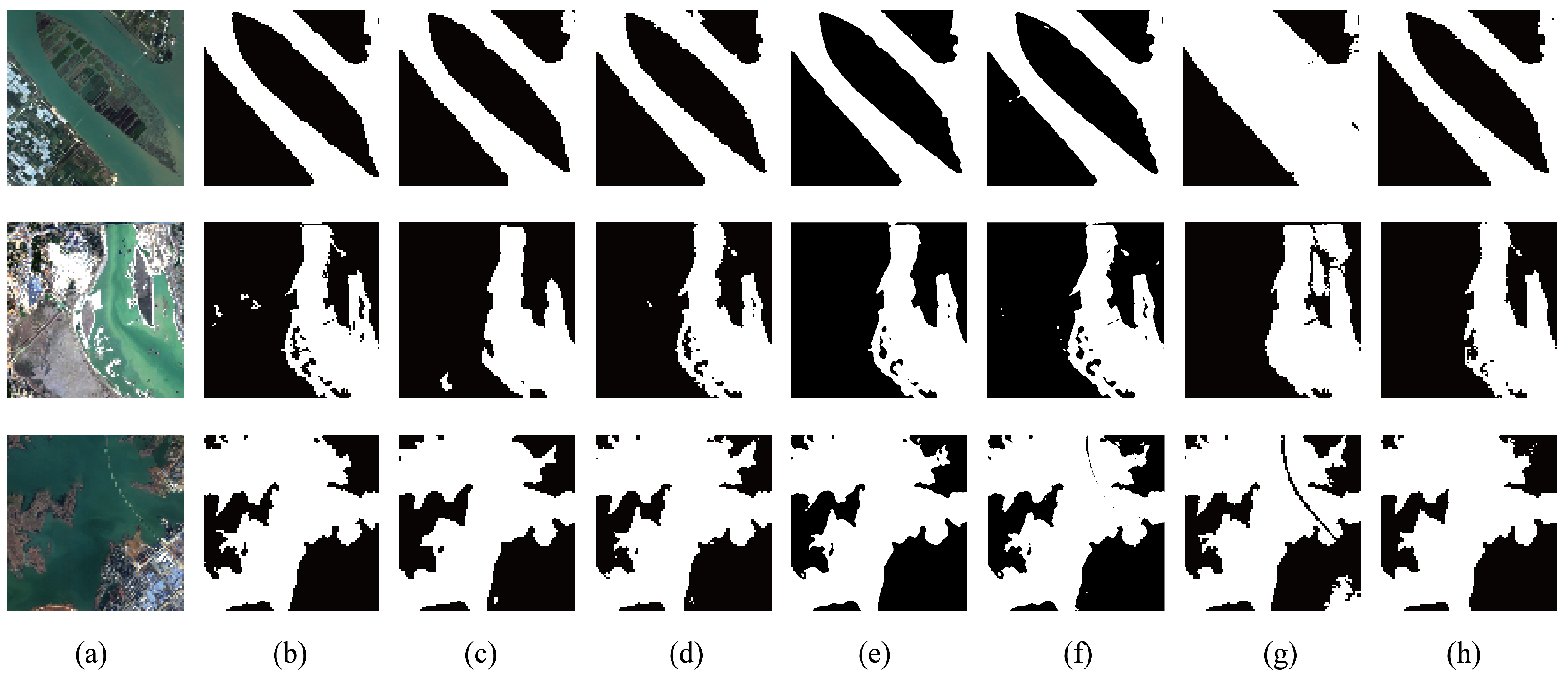
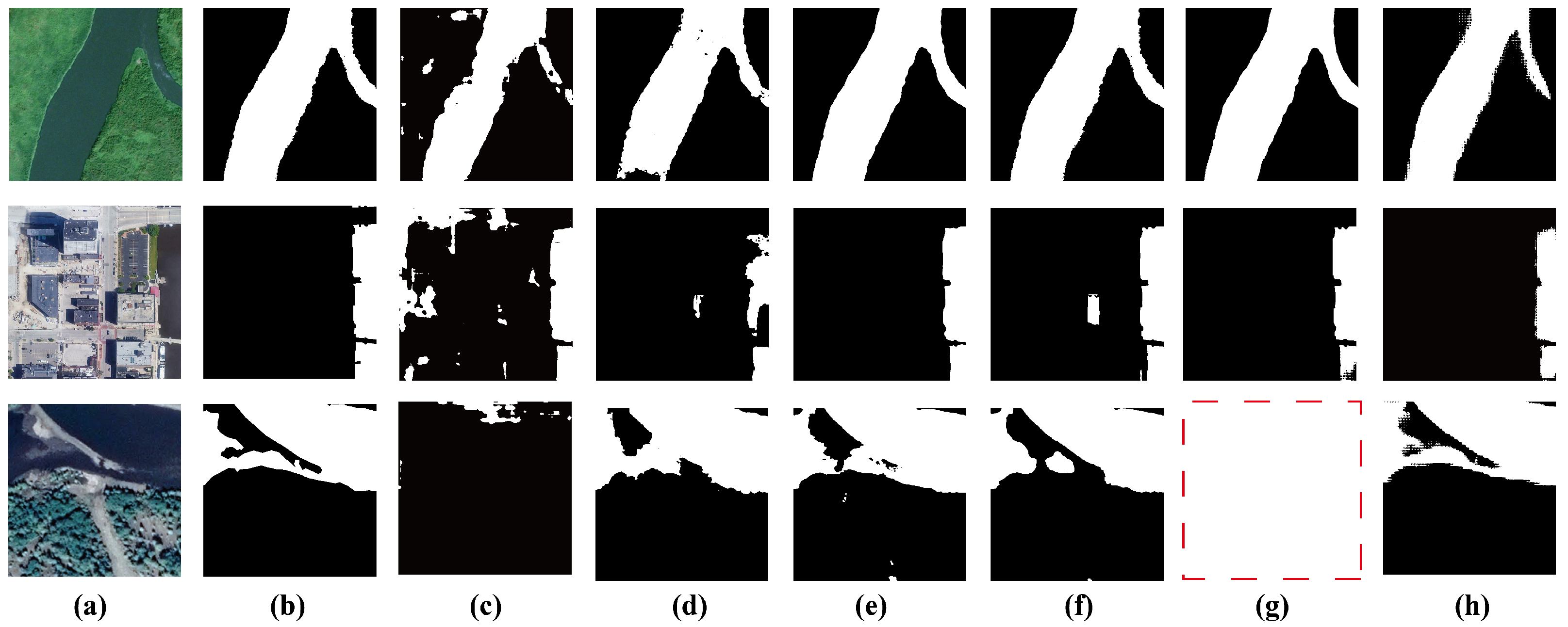
Figure 4 presents three representative satellite water body images along with the corresponding segmentation outputs. As illustrated, DASAM consistently achieves superior visual performance in most cases.
In the first row of
Figure 4, the narrow water channels exhibit high spectral similarity to surrounding buildings, making accurate segmentation particularly challenging. However, DASAM precisely delineates the water boundaries while effectively suppressing false positives and false negatives. In contrast, UVSAM shows significant segmentation errors in these areas. In the second row, the water body is surrounded by artificial structures and bare soil, the latter introducing additional interference due to its high spectral reflectance. Similarly, the third row features a water body with complex, irregular boundaries. Most baseline methods fail to capture these fine-grained details; for instance, SAM-Adapter and UVSAM produce blurred boundaries, while Segformer and PVTv2 generate excessive false positives. In comparison, DASAM accurately captures boundary structures and produces smooth, coherent segmentation maps, demonstrating superior boundary detection capabilities and overall robustness.
4.3. Ablation Study
To validate the effectiveness of each module and design choice in the DASAM framework, we conducted a series of ablation experiments to evaluate the performance of different variants on the GF-2 satellite water body dataset.
Table 5 presents the performance of different DASAM variants in terms of IoU, F1, recall, and precision. The results clearly demonstrate that removing any single module leads to a decline in segmentation performance, indicating that each component contributes critically to the overall architecture.
Specifically, removing point prompts reduces IoU by 2.8% and F1 by 7.4%. This highlights their importance in providing precise positional cues. The utility of point prompts is especially evident in complex scenes, where they help mitigate undersegmentation and preserve fine water body structures. Box prompts contribute substantially to model performance, yielding a 22.7% improvement in IoU by providing global spatial constraints that guide the mask decoder toward target regions and effectively suppress false positives. Although mask prompts have a relatively smaller impact, their removal still reduces IoU by 1.0%. This suggests that dense mask embeddings help refine boundary delineation and complement the global contextual understanding.
The DCM proves essential for robust feature learning, as its removal results in a 7.1% decrease in IoU and a 6.8% reduction in F1 score. This significant performance drop underscores DCM’s crucial role in learning domain-invariant representations through contrastive alignment between source and synthetic domains. The module enhances model generalization by reducing the distribution gap across different satellite imaging conditions, thereby improving segmentation consistency in varied scenarios.
In addition, the feature fusion module enhances the smoothness and continuity of segmentation results. Its removal causes a 2.5% decline in IoU and a 0.4% decrease in F1, indicating its role in semantic aggregation and cross-scale feature alignment. The adapter module yields the most significant improvements, increasing IoU by 6.2% and the F1 by 5.7%. This is because it effectively integrates fine-grained spatial details with global contextual information.
4.4. Generalization Evaluation
To further validate the robustness and generalization ability of the proposed DASAM model, two additional datasets with distinct characteristics were employed for evaluation.
As shown in
Table 6, the proposed DASAM achieves the best overall performance on the GLH-water dataset, demonstrating its strong cross-domain generalization capability. Specifically, DASAM achieves the highest IoU of 0.484 and F1 of 0.652, outperforming all baseline models by a significant margin. Although its recall of 0.509 is slightly lower than that of UVSAM, its precision of 0.908 is substantially higher than all baselines. This indicates that DASAM effectively suppresses false positives and maintains stable segmentation quality under diverse imaging conditions.
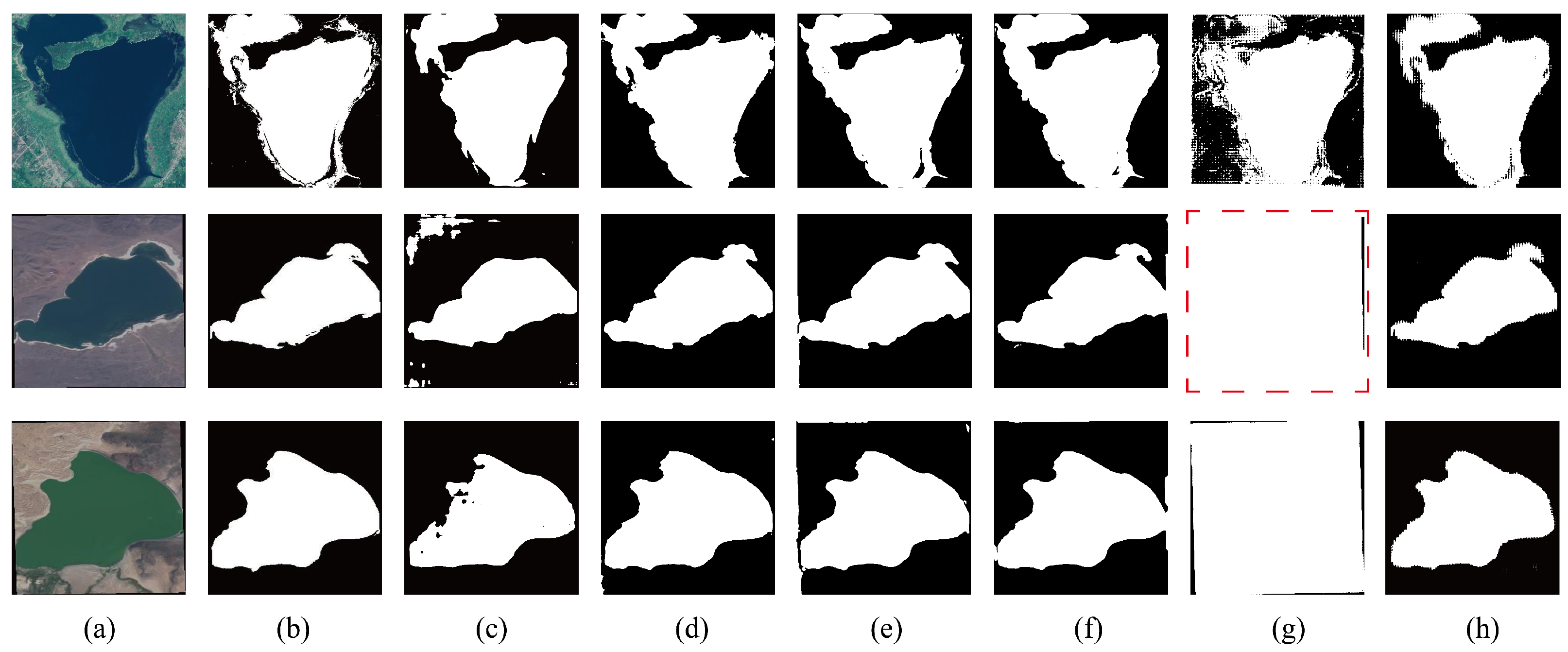
The visual results in
Figure 5 further substantiate the quantitative findings. The GLH-water dataset encompasses diverse geographic and environmental contexts, including natural rivers, agricultural zones, and urban–river intersections, which differ substantially from the GF-2 training data. In natural river scenes, most models generate relatively consistent segmentation, while DeepLabv3+ and Segformer produce fragmented and discontinuous predictions. In the second example, where the river adjacent to agricultural land appears darker and spectrally distinct from the training water samples, DASAM maintains precise and continuous water boundaries. In contrast, SAM-Adapter exhibits evident over-segmentation, misclassifying large non-water regions as water, while Segformer suffers from pronounced under-segmentation. These visual observations are consistent with the quantitative metrics; UVSAM yields higher recall but lower precision, while DASAM demonstrates the opposite pattern. In the third example, depicting complex urban–river scenes where shadows and dark construction materials share spectral similarities with water, segmentation becomes more challenging. Nevertheless, DASAM still produces coherent and accurate delineations, while UVSAM shows extensive false positives, and Segformer and PVTv2 misclassify several shadowed regions.
Following the evaluation on the GLH-water dataset, the model performance was further assessed on the Sentinel-2 dataset to examine generalization across domains with greater spectral and spatial similarity to the GF-2 training data. As shown in
Table 7, all models achieve improved segmentation metrics compared with their performance on the GLH-water dataset, indicating that Sentinel-2 shares more consistent water body characteristics with the training domain. Nevertheless, DASAM still achieves the best overall performance, achieving an IoU of 0.537 and an F1 of 0.699, surpassing PVTv2, the second-best model, by 2.5% in IoU.
The visual comparisons in
Figure 6 further confirm these results. In the first example, where both the water and background features closely resemble those in the training data, all models deliver visually plausible predictions, while DASAM exhibits more precise boundary delineation. The second and third examples depict mixed land–lake scenes, with deeper and lighter water tones, respectively, presenting increased intra-class variation. DASAM maintains robust segmentation quality under these conditions, accurately distinguishing water regions with minimal false positives. By contrast, DeepLabv3+ and UVSAM again suffer from severe over-segmentation, labeling most of the image as water, which corresponds to their high recall but low precision. In addition, both PVTv2 and SAM-Adapter produce scattered false positives in non-water areas, particularly in darker or shadowed regions, suggesting their limited adaptability to subtle spectral variations.
Overall, the cross-dataset evaluation on GLH-water and Sentinel-2 demonstrates that DASAM achieves consistently strong generalization across diverse spatial patterns and spectral domains. Even in challenging conditions, such as urban–river intersections, cultivated areas with complex textures, or lakes exhibiting significant spectral shifts, DASAM maintains stable segmentation accuracy and preserves boundary integrity. These results highlight the model’s capacity to effectively transfer its learned representation to unseen remote sensing scenarios, validating its robustness and adaptability for real-world water body extraction tasks.
5. Discussion
Our experimental results demonstrate the effectiveness of DASAM in enhancing SAM’s capability for satellite water body extraction across diverse domains. The SegFormer provides comprehensive prompts that effectively guide SAM to focus on water regions. This prompt-enhanced mechanism enriches the semantic priors of the framework and improves its adaptability to complex spatial structures.
The adapter module enables efficient domain adaptation while keeping SAM’s pretrained encoder intact, reducing computational cost and mitigating overfitting on limited remote sensing data. The feature fusion between SegFormer and SAM encoders enables DASAM to combine global context with fine-grained details, which is crucial for delineating irregular or fragmented water boundaries. Our analysis suggests that this design helps maintain generalizable structural priors while selectively adjusting high-level semantic cues relevant to water bodies, striking an effective balance between adaptability and stability.
Another critical component of DASAM is the DCM, which explicitly aligns feature distributions between source and synthetic domains. This mechanism is particularly beneficial for cross-domain robustness. Satellite images vary dramatically across sensors, seasons, and acquisition conditions. By enforcing domain-invariant representation learning, the DCM mitigates such discrepancies and leads to consistently improved performance on GLH and Sentinel-2 datasets. This result highlights the capability of contrastive alignment to address spectral and appearance differences that traditional supervised segmentation cannot easily overcome.
Despite these strengths, several limitations remain. Although the SegFormer prompting strategy enhances semantic focus, its performance may degrade when the initial coarse segmentation from SegFormer is inaccurate, particularly in scenes with extreme turbidity or thin river networks. In addition, the current contrastive learning objective operates only on synthetic domain pairs; extending it to real multi-domain scenarios could further improve robustness. Future work may explore more efficient prompting mechanisms and broader domain alignment strategies that incorporate additional sensing modalities such as SAR imagery. Moreover, integrating uncertainty estimation into the pipeline may further enhance reliability for practical hydrological monitoring applications.
6. Conclusions
This study presents DASAM, a domain-adaptive SAM framework tailored for robust satellite water body segmentation. By integrating a SegFormer-based prompt generator, encoder adapters, multi-scale feature fusion, and a novel domain contrastive module, DASAM effectively learns domain-invariant representations while capturing both global context and local details. The contrastive learning strategy aligns feature distributions across domains, enabling the model to maintain consistent performance under varying satellite imaging conditions.
On the GF-2 dataset, the model achieves an IoU of 0.832 and an F1 score of 0.909, demonstrating clear advantages over both classical baselines. The ablation study further verifies the contribution of each component, with noticeable performance declines observed whenever any module is removed. In particular, the DCM plays a central role in the framework; removing it results in a substantial drop in IoU from 0.832 to 0.761, underscoring its critical importance in enabling domain-adaptive representation learning. These consistent numerical reductions collectively indicate that DASAM benefits from the synergistic interplay among structured prompting, cross-encoder feature fusion, and contrastive domain alignment.
DASAM also exhibits strong generalization capability when transferred to unseen satellite imagery. On the GLH-water dataset, the model achieves an IoU of 0.484 and an F1 of 0.652, outperforming all compared methods by a clear margin. Similar improvements are observed on the Sentinel-2 dataset, where DASAM attains an IoU of 0.537 and an F1 of 0.699, again surpassing existing baselines. These cross-domain results highlight that one of the key contributions of this work lies in the ability of DASAM to maintain stable segmentation performance despite substantial variations in sensor characteristics, spectral properties, and scene distributions, demonstrating its robustness and practical value for real-world hydrological monitoring.
Overall, DASAM offers a practical and extensible framework for adapting large foundation models to remote sensing applications, effectively addressing the domain shift challenge in satellite imagery analysis, and future work will explore extensions to multi-temporal and multimodal settings to further enhance robustness under diverse Earth observation environments.
Author Contributions
Conceptualization, L.Y. and P.L.; methodology, L.Y.; software, L.Y.; validation, L.Y., G.Z. and H.Z.; formal analysis, L.Y.; investigation, L.Y.; resources, P.L.; data curation, L.Y.; writing—original draft preparation, L.Y.; writing—review and editing, P.L. and C.Z.; visualization, L.Y.; supervision, P.L.; project administration, P.L.; funding acquisition, P.L. All authors have read and agreed to the published version of the manuscript.
Funding
This research was funded by the Liaoning Applied Basic Research Program Fund, project name: Research on 3D Target Detection and Tracking Methods for Intelligent Assisted Driving Applications (No. 2023JH2/101300239).
Institutional Review Board Statement
Not applicable.
Informed Consent Statement
Not applicable.
Data Availability Statement
The code presented in this study are available on request from the corresponding author due to copyright restrictions imposed by the funding agency and The GF-2 satellite water body image dataset can be accessed at
https://pan.baidu.com/s/1Mrm5JXA0INCG1dXKSOSStA?pwd=j8hi (accessed on 5 December 2025).
Acknowledgments
The authors would like to thank the project team for their support and the anonymous reviewers for their constructive feedback. During the preparation of this manuscript, the authors used ChatGPT 5.0 (OpenAI, San Francisco, CA, USA) for the purposes of language and grammar refinement. The authors have reviewed and edited the output and take full responsibility for the content of this publication. The tool was employed solely for linguistic improvements, without influencing the scientific content, data analysis, or conclusions of this work.
Conflicts of Interest
The authors declare no conflicts of interest.
Abbreviations
The following abbreviations are used in this manuscript:
| SAM | Segment Anything Model |
| VIT | Vision Transformer |
| DCM | Domain Contrastive Module |
| GAP | Global Average Pooling |
| CNNs | Convolutional neural networks |
References
- Gautam, S.; Singhai, J. Critical review on deep learning methodologies employed for water-body segmentation through remote sensing images. Multimed. Tools Appl. 2023, 83, 1869–1889. [Google Scholar] [CrossRef] [Scilit]
- Dandawate, Y.H.; Kinkledar, S. Rivers and Coastlines Detection in Multispectral Satellite Images Using Level Set Method and Modified Chan–Vese Algorithm. In Proceedings of the 2013 2nd International Conference on Advanced Computing, Networking and Security, Mangalore, India, 15–17 December 2013; pp. 41–46. [Google Scholar]
- Duan, L.; Hu, X. Multiscale refinement network for Water-Body segmentation in High-Resolution satellite imagery. IEEE Geosci. Remote Sens. Lett. 2019, 17, 686–690. [Google Scholar] [CrossRef] [Scilit]
- Rahaman, M.; Hillas, M.M.; Tuba, J.; Ruma, J.F.; Ahmed, N.; Rahman, R.M. Effects of label noise on performance of remote sensing and Deep Learning-Based Water Body Segmentation models. Cybern. Syst. 2021, 53, 581–606. [Google Scholar] [CrossRef] [Scilit]
- Kadhim, I.J.; Premaratne, P. A Novel Deep Learning Framework for Water Body Segmentation from Satellite Images. Arab. J. Sci. Eng. 2023, 48, 10429–10440. [Google Scholar] [CrossRef] [Scilit]
- Kirillov, A.; Mintun, E.; Ravi, N.; Mao, H.; Rolland, C.; Gustafson, L.; Xiao, T.; Whitehead, S.; Berg, A.C.; Lo, W.-Y.; et al. Segment Anything. In Proceedings of the 2023 IEEE/CVF International Conference on Computer Vision (ICCV), Paris, France, 1–6 October 2023; pp. 4015–4026. [Google Scholar]
- Huang, Y.; Yang, X.; Liu, L.; Zhou, H.; Chang, A.; Zhou, X.; Chen, R.; Yu, J.; Chen, J.; Chen, C.; et al. Segment anything model for medical images? Med. Image Anal. 2023, 92, 103061. [Google Scholar] [CrossRef] [Scilit]
- Osco, L.P.; Wu, Q.; De Lemos, E.L.; Gonçalves, W.N.; Ramos, A.P.M.; Li, J.; Marcato, J. The Segment Anything Model (SAM) for remote sensing applications: From zero to one shot. Int. J. Appl. Earth Obs. Geoinf. 2023, 124, 103540. [Google Scholar] [CrossRef] [Scilit]
- Frazier, P.S.; Page, K.J. Water body detection and delineation with Landsat TM data. Photogramm. Eng. Remote Sens. 2000, 66, 1461–1467. [Google Scholar]
- Yang, X.; Qin, Q.; Grussenmeyer, P.; Koehl, M. Urban surface water body detection with suppressed built-up noise based on water indices from Sentinel-2 MSI imagery. Remote Sens. Environ. 2018, 219, 259–270. [Google Scholar] [CrossRef] [Scilit]
- Zhang, K.; Zhang, W.; Liu, C.; Li, J. Visual Features for Long-Range Terrain Perception. Robot 2015, 37, 369–376. [Google Scholar]
- Tian, J.; Wang, Z. Static Shadow Detection: A Survey. Inf. Control 2015, 44, 215–222. [Google Scholar]
- Özelkan, E. Water Body Detection Analysis Using NDWI Indices Derived from Landsat-8 OLI. Pol. J. Environ. Stud. 2019, 29, 1759–1769. [Google Scholar] [CrossRef] [Scilit]
- Zhou, Y.; Luo, J.; Shen, Z.; Hu, X.; Yang, H. Multiscale water body extraction in urban environments from satellite images. IEEE J. Sel. Top. Appl. Earth Obs. Remote Sens. 2014, 7, 4301–4312. [Google Scholar] [CrossRef] [Scilit]
- Kaplan, G.; Avdan, U. Object-based water body extraction model using Sentinel-2 satellite imagery. Eur. J. Remote Sens. 2017, 50, 137–143. [Google Scholar] [CrossRef] [Scilit]
- Zhao, L.; Yu, H.; Zhang, L. Water body extraction in urban region from high resolution satellite imagery with near-infrared spectral analysis. In Proceedings of the International Symposium on Photoelectronic Detection and Imaging 2009, Beijing, China, 17–19 June 2009; p. 74710A. [Google Scholar]
- Wei, X.; Xu, W.; Bao, K.; Hou, W.; Su, J.; Li, H.; Miao, Z. A water body extraction methods comparison based on FengYun satellite data: A case study of Poyang Lake region, China. Remote Sens. 2020, 12, 3875. [Google Scholar] [CrossRef] [Scilit]
- Gharbia, R. Deep learning for automatic extraction of water bodies using satellite imagery. J. Indian Soc. Remote Sens. 2023, 51, 1511–1521. [Google Scholar] [CrossRef] [Scilit]
- Abid, N.; Shahzad, M.; Malik, M.I.; Schwanecke, U.; Ulges, A.; Kovács, G.; Shafait, F. UCL: Unsupervised Curriculum Learning for water body classification from remote sensing imagery. Int. J. Appl. Earth Obs. Geoinf. 2021, 105, 102568. [Google Scholar] [CrossRef] [Scilit]
- Nagaraj, R.; Kumar, L.S. LWAMNNet: A novel deep learning framework for surface water body extraction from LISS-III satellite images. Earth Sci. Inform. 2023, 17, 561–592. [Google Scholar] [CrossRef] [Scilit]
- Wu, J.; Huang, X.; Xu, N.; Zhu, Q.; Zorn, C.; Guo, W.; Wang, J.; Wang, B.; Shao, S.; Yu, C. Combining satellite imagery and a deep learning algorithm to retrieve the water levels of small reservoirs. Remote Sens. 2023, 15, 5740. [Google Scholar] [CrossRef] [Scilit]
- Zhang, X.; Li, J.; Hua, Z. MRSE-NET: Multiscale Residuals and SE-Attention Network for water body segmentation from satellite images. IEEE J. Sel. Top. Appl. Earth Obs. Remote Sens. 2022, 15, 5049–5064. [Google Scholar] [CrossRef] [Scilit]
- Yuan, K.; Zhuang, X.; Schaefer, G.; Feng, J.; Guan, L.; Fang, H. Deep-Learning-Based Multispectral Satellite Image Segmentation for Water Body Detection. IEEE J. Sel. Top. Appl. Earth Obs. Remote Sens. 2021, 14, 7422–7434. [Google Scholar] [CrossRef] [Scilit]
- Zhang, Z.; Lu, M.; Ji, S.; Yu, H.; Nie, C. Rich CNN Features for Water-Body Segmentation from Very High Resolution Aerial and Satellite Imagery. Remote Sens. 2021, 13, 1912. [Google Scholar] [CrossRef] [Scilit]
- Miao, Z.; Fu, K.; Sun, H.; Sun, X.; Yan, M. Automatic Water-Body segmentation from High-Resolution satellite images via deep networks. IEEE Geosci. Remote Sens. Lett. 2018, 15, 602–606. [Google Scholar] [CrossRef] [Scilit]
- Kang, J.; Guan, H.; Ma, L.; Wang, L.; Xu, Z.; Li, J. WaterFormer: A coupled transformer and CNN network for waterbody detection in optical remotely-sensed imagery. ISPRS J. Photogramm. Remote Sens. 2023, 206, 222–241. [Google Scholar] [CrossRef] [Scilit]
- Mazurowski, M.A.; Dong, H.; Gu, H.; Yang, J.; Konz, N.; Zhang, Y. Segment anything model for medical image analysis: An experimental study. Med. Image Anal. 2023, 89, 102918. [Google Scholar] [CrossRef] [Scilit] [PubMed]
- Ma, J.; He, Y.; Li, F.; Han, L.; You, C.; Wang, B. Segment anything in medical images. Nat. Commun. 2024, 15, 654. [Google Scholar] [CrossRef] [Scilit] [PubMed]
- Wang, D.; Zhang, J.; Du, B.; Xu, M.; Liu, L.; Tao, D.; Zhang, L. SAMRS: Scaling-up remote sensing segmentation dataset with Segment Anything Model. Adv. Neural Inf. Process. Syst. 2023, 36, 8815–8827. [Google Scholar]
- Chen, K.; Liu, C.; Chen, H.; Zhang, H.; Li, W.; Zou, Z.; Shi, Z. RSPrompter: Learning to prompt for remote sensing instance segmentation based on visual foundation model. IEEE Trans. Geosci. Remote Sens. 2024, 62, 1–17. [Google Scholar] [CrossRef] [Scilit]
- Sun, J.; Yan, S.; Alexandridis, T.; Yao, X.; Zhou, H.; Gao, B.; Huang, J.; Yang, J.; Li, Y. Enhancing Crop Mapping through Automated Sample Generation Based on Segment Anything Model with Medium-Resolution Satellite Imagery. Remote Sens. 2024, 16, 1505. [Google Scholar] [CrossRef] [Scilit]
- Li, Y.; Wang, D.; Yuan, C.; Li, H.; Hu, J. Enhancing Agricultural Image Segmentation with an Agricultural Segment Anything Model Adapter. Sensors 2023, 23, 7884. [Google Scholar] [CrossRef] [Scilit]
- Chen, T.; Zhu, L.; Deng, C.; Cao, R.; Wang, Y.; Zhang, S.; Li, Y.; Liu, Y.; Wang, Y.; Mao, P. SAM-Adapter: Adapting Segment Anything in Underperformed Scenes. In Proceedings of the 2023 IEEE/CVF International Conference on Computer Vision (ICCV), Paris, France, 1–6 October 2023; pp. 3367–3375. [Google Scholar]
- Wu, J.; Wang, Z.; Hong, M.; Ji, W.; Fu, H.; Xu, Y.; Xu, M.; Jin, Y. Medical SAM adapter: Adapting segment anything model for medical image segmentation. Med. Image Anal. 2025, 102, 103547. [Google Scholar] [CrossRef] [Scilit]
- Zhong, Z.; Tang, Z.; He, T.; Fang, H.; Yuan, C. Convolution Meets LoRA: Parameter Efficient Finetuning for Segment Anything Model. arXiv 2024, arXiv:2401.17868. [Google Scholar] [CrossRef] [Scilit]
- Zhang, X.; Liu, Y.; Lin, Y.; Liao, Q.; Li, Y. UV-SAM: Adapting Segment Anything Model for Urban Village Identification. Proc. AAAI Conf. Artif. Intell. 2024, 38, 22520–22528. [Google Scholar] [CrossRef] [Scilit]
- Nanni, L.; Fusaro, D.; Fantozzi, C.; Pretto, A. Improving Existing Segmentators Performance with Zero-Shot Segmentators. Entropy 2023, 25, 1502. [Google Scholar] [CrossRef] [Scilit]
- Wang, W.; Xie, E.; Yu, Z.; Anandkumar, A.; Alvarez, J.M.; Luo, P. SegFormer: Simple and Efficient Design for Semantic Segmentation with Transformers. Adv. Neural Inf. Process. Syst. 2021, 34, 12077–12090. [Google Scholar]
- Oord, A.v.d.; Li, Y.; Vinyals, O. Representation learning with contrastive predictive coding. arXiv 2018, arXiv:1807.03748. [Google Scholar]
- Lin, T.-Y.; Goyal, P.; Girshick, R.; He, K.; Dollar, P. Focal loss for dense object detection. IEEE Trans. Pattern Anal. Mach. Intell. 2018, 42, 318–327. [Google Scholar] [CrossRef] [Scilit]
- Milletari, F.; Navab, N.; Ahmadi, S.A. V-Net: Fully Convolutional Neural Networks for Volumetric Medical Image Segmentation. In Proceedings of the 2016 Fourth International Conference on 3D Vision (3DV), Stanford, CA, USA, 25–28 October 2016; pp. 565–571. [Google Scholar]
- Tong, X.; Xia, G.; Lu, Q.; Shen, H.; Li, S.; You, S.; Zhang, L. Land-cover classification with high-resolution remote sensing images using transferable deep models. Remote Sens. Environ. 2020, 237, 111322. [Google Scholar] [CrossRef] [Scilit]
- Li, Y.; Dang, B.; Li, W.; Zhang, Y. GLH-water: A large-scale dataset for global surface water detection in large-size very-high-resolution satellite imagery. In Proceedings of the AAAI Conference on Artificial Intelligence, Vancouver, BC, Canada, 20–27 February 2024; Volume 38, pp. 22213–22221. [Google Scholar]
- Satellite Images of Water Bodies. Available online: https://www.kaggle.com/datasets/franciscoescobar/satellite-images-of-water-bodies (accessed on 12 September 2025).
- Chen, L.-C.; Zhu, Y.; Papandreou, G.; Schroff, F.; Adam, H. Encoder-Decoder with Atrous Separable Convolution for Semantic Image Segmentation. In Proceedings of the Computer Vision—ECCV 2018, Munich, Germany, 8–14 September 2018; pp. 833–851. [Google Scholar]
- Wang, W.; Xie, E.; Li, X.; Fan, D.; Song, K.; Liang, D. PVT v2: Improved Baselines with Pyramid Vision Transformer. Comput. Vis. Media 2022, 8, 415–424. [Google Scholar] [CrossRef] [Scilit]
Figure 1.
Overview of the proposed DASAM framework. Blue arrows represent the source-to-synthetic domain transformation via style augmentation, while purple circles indicate feature fusion operations.
Figure 1.
Overview of the proposed DASAM framework. Blue arrows represent the source-to-synthetic domain transformation via style augmentation, while purple circles indicate feature fusion operations.
Figure 2.
Structure of the DCM, which aligns feature distributions between source and synthetic domains through contrastive learning.
Figure 2.
Structure of the DCM, which aligns feature distributions between source and synthetic domains through contrastive learning.
Figure 3.
Modified architecture of SAM’s image encoder. The structure incorporates adapter modules to enable parameter-efficient fine-tuning, keeping the original pretrained weights frozen.
Figure 3.
Modified architecture of SAM’s image encoder. The structure incorporates adapter modules to enable parameter-efficient fine-tuning, keeping the original pretrained weights frozen.
Figure 4.
The visualization results: (a) Raw image, (b) Ground truth, (c) DeepLabv3+, (d) Segformer, (e) PVTv2, (f) SAM-Adapter, (g) UVSAM, (h) DASAM.
Figure 4.
The visualization results: (a) Raw image, (b) Ground truth, (c) DeepLabv3+, (d) Segformer, (e) PVTv2, (f) SAM-Adapter, (g) UVSAM, (h) DASAM.
Figure 5.
The GLH-water Dataset visualization results: (a) Raw image, (b) Ground truth, (c) DeepLabv3+, (d) Segformer, (e) PVTv2, (f) SAM-Adapter, (g) UVSAM, (h) DASAM.
Figure 5.
The GLH-water Dataset visualization results: (a) Raw image, (b) Ground truth, (c) DeepLabv3+, (d) Segformer, (e) PVTv2, (f) SAM-Adapter, (g) UVSAM, (h) DASAM.
Figure 6.
The Sentinel-2 Water Body Image Dataset visualization results: (a) Raw image, (b) Ground truth, (c) DeepLabv3+, (d) Segformer, (e) PVTv2, (f) SAM-Adapter, (g) UVSAM, (h) DASAM.
Figure 6.
The Sentinel-2 Water Body Image Dataset visualization results: (a) Raw image, (b) Ground truth, (c) DeepLabv3+, (d) Segformer, (e) PVTv2, (f) SAM-Adapter, (g) UVSAM, (h) DASAM.
Table 1.
Architectural configuration of the proposed DCM.
Table 1.
Architectural configuration of the proposed DCM.
| Component | Setting |
|---|
| Input feature map | 256 channels |
| GAP | 256-d vector |
| MLP | 256 → 128 |
| Similarity function | Cosine similarity |
| Temperature | 0.1 |
| Loss function | Bidirectional InfoNCE |
Table 2.
Performance under different temperature values in the InfoNCE objective.
Table 2.
Performance under different temperature values in the InfoNCE objective.
| Temperature | IoU | F1 |
|---|
| 0.05 | 0.834 | 0.903 |
| 0.10 | 0.832 | 0.909 |
| 0.15 | 0.830 | 0.906 |
| 0.20 | 0.823 | 0.897 |
Table 3.
Performance comparison between DASAM and other models on the test set. Bold numbers indicate the best results, while underlined numbers indicate the second-best results.
Table 3.
Performance comparison between DASAM and other models on the test set. Bold numbers indicate the best results, while underlined numbers indicate the second-best results.
| Methods | IoU | F1 | Recall | Precision |
|---|
| DeepLabv3+ | 0.798 | 0.884 | 0.853 | 0.918 |
| SegFormer | 0.823 | 0.904 | 0.884 | 0.925 |
| PVTv2 | 0.829 | 0.907 | 0.905 | 0.909 |
| SAM-Adapter | 0.806 | 0.892 | 0.895 | 0.889 |
| UVSAM | 0.764 | 0.854 | 0.815 | 0.897 |
| DASAM | 0.832 | 0.909 | 0.894 | 0.924 |
Table 4.
Performance comparison between DASAM and other models on the validation set. Bold numbers indicate the best results, while underlined numbers indicate the second-best results.
Table 4.
Performance comparison between DASAM and other models on the validation set. Bold numbers indicate the best results, while underlined numbers indicate the second-best results.
| Methods | IoU | F1 | Recall | Precision |
|---|
| DeepLabv3+ | 0.795 | 0.882 | 0.844 | 0.924 |
| Segformer | 0.821 | 0.901 | 0.875 | 0.930 |
| PVTv2 | 0.825 | 0.904 | 0.896 | 0.912 |
| SAM-Adapter | 0.813 | 0.897 | 0.894 | 0.900 |
| UVSAM | 0.768 | 0.854 | 0.813 | 0.900 |
| DASAM | 0.829 | 0.905 | 0.883 | 0.929 |
Table 5.
Ablation study of DASAM variants on the GF-2 satellite water body dataset. Bold numbers indicate the best results.
Table 5.
Ablation study of DASAM variants on the GF-2 satellite water body dataset. Bold numbers indicate the best results.
| Variants | IoU | F1 | Recall | Precision |
|---|
| w/o Point | 0.804 | 0.835 | 0.843 | 0.827 |
| w/o Box | 0.605 | 0.773 | 0.676 | 0.902 |
| w/o Mask | 0.822 | 0.903 | 0.884 | 0.923 |
| w/o Fusion | 0.807 | 0.905 | 0.921 | 0.890 |
| w/o Adapter | 0.770 | 0.852 | 0.859 | 0.845 |
| w/o DCM | 0.761 | 0.841 | 0.813 | 0.872 |
| DASAM | 0.832 | 0.909 | 0.894 | 0.924 |
Table 6.
Performance comparison between DASAM and other models on the GLH-water Dataset. Bold numbers indicate the best results.
Table 6.
Performance comparison between DASAM and other models on the GLH-water Dataset. Bold numbers indicate the best results.
| Methods | IoU | F1 | Recall | Precision |
|---|
| DeepLabv3+ | 0.232 | 0.337 | 0.416 | 0.344 |
| Segformer | 0.432 | 0.603 | 0.607 | 0.599 |
| PVTv2 | 0.383 | 0.554 | 0.484 | 0.648 |
| SAM-Adapter | 0.377 | 0.574 | 0.521 | 0.638 |
| UVSAM | 0.281 | 0.491 | 0.880 | 0.340 |
| DASAM | 0.484 | 0.652 | 0.509 | 0.908 |
Table 7.
Performance comparison between DASAM and other models on the Sentinel-2 satellite water body image dataset. Bold numbers indicate the best results.
Table 7.
Performance comparison between DASAM and other models on the Sentinel-2 satellite water body image dataset. Bold numbers indicate the best results.
| Methods | IoU | F1 | Recall | Precision |
|---|
| DeepLabv3+ | 0.460 | 0.631 | 0.721 | 0.560 |
| Segformer | 0.503 | 0.669 | 0.675 | 0.664 |
| PVTv2 | 0.512 | 0.677 | 0.768 | 0.606 |
| SAM-Adapter | 0.487 | 0.615 | 0.663 | 0.574 |
| UVSAM | 0.271 | 0.427 | 0.747 | 0.299 |
| DASAM | 0.537 | 0.699 | 0.665 | 0.737 |
| Disclaimer/Publisher’s Note: The statements, opinions and data contained in all publications are solely those of the individual author(s) and contributor(s) and not of MDPI and/or the editor(s). MDPI and/or the editor(s) disclaim responsibility for any injury to people or property resulting from any ideas, methods, instructions or products referred to in the content. |
© 2025 by the authors. Licensee MDPI, Basel, Switzerland. This article is an open access article distributed under the terms and conditions of the Creative Commons Attribution (CC BY) license (https://creativecommons.org/licenses/by/4.0/).