
Brain Tumour Classification Model Based on Spatial Block–Residual Block Collaborative Architecture with Strip Pooling Feature Fusion


Abstract
1. Introduction
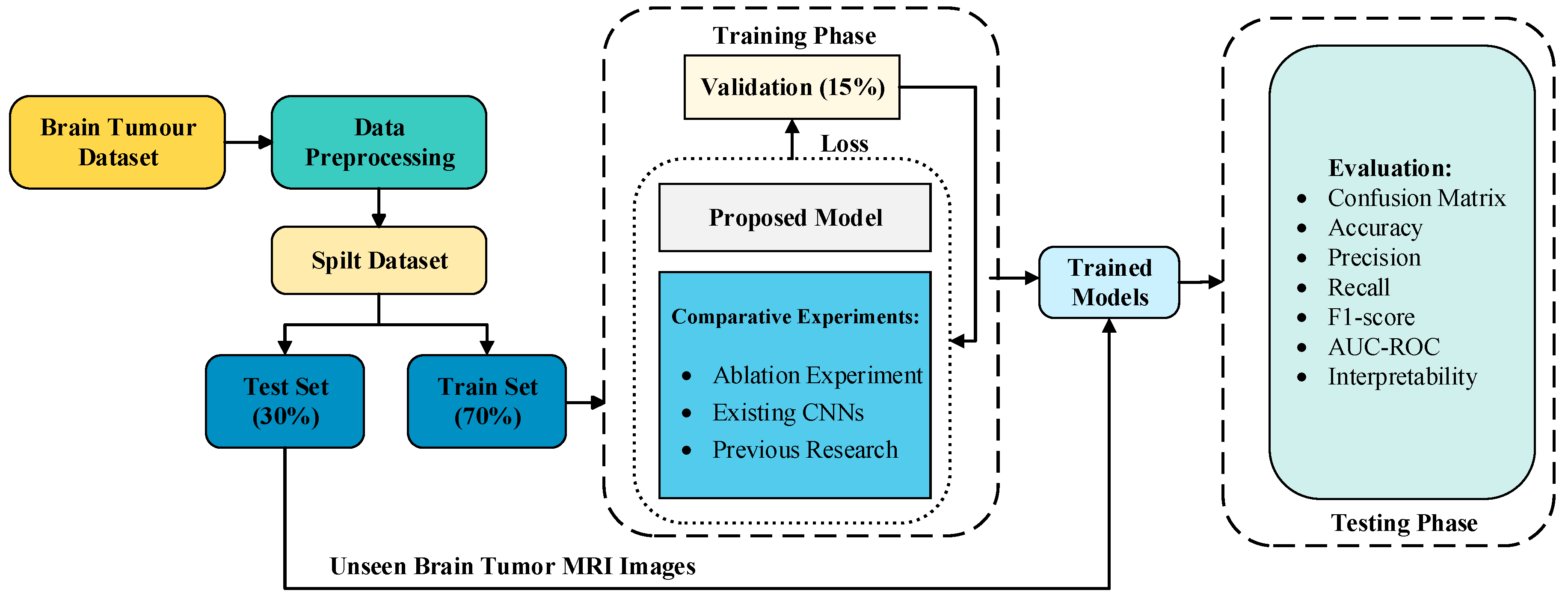
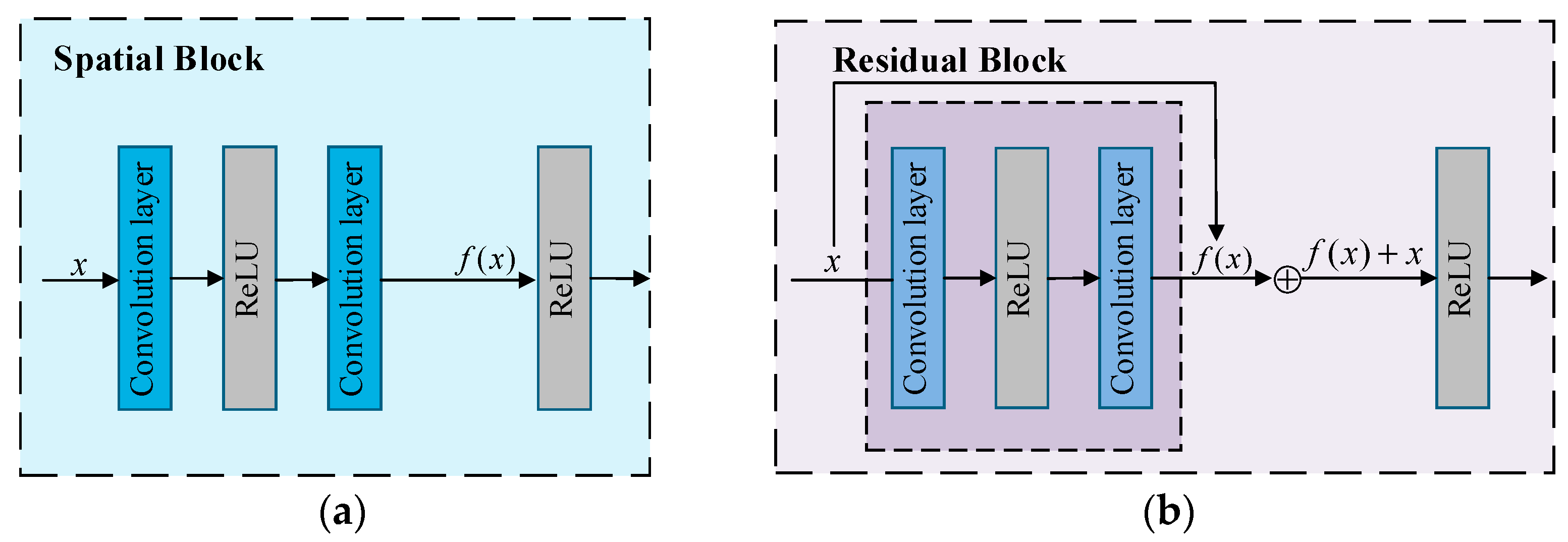
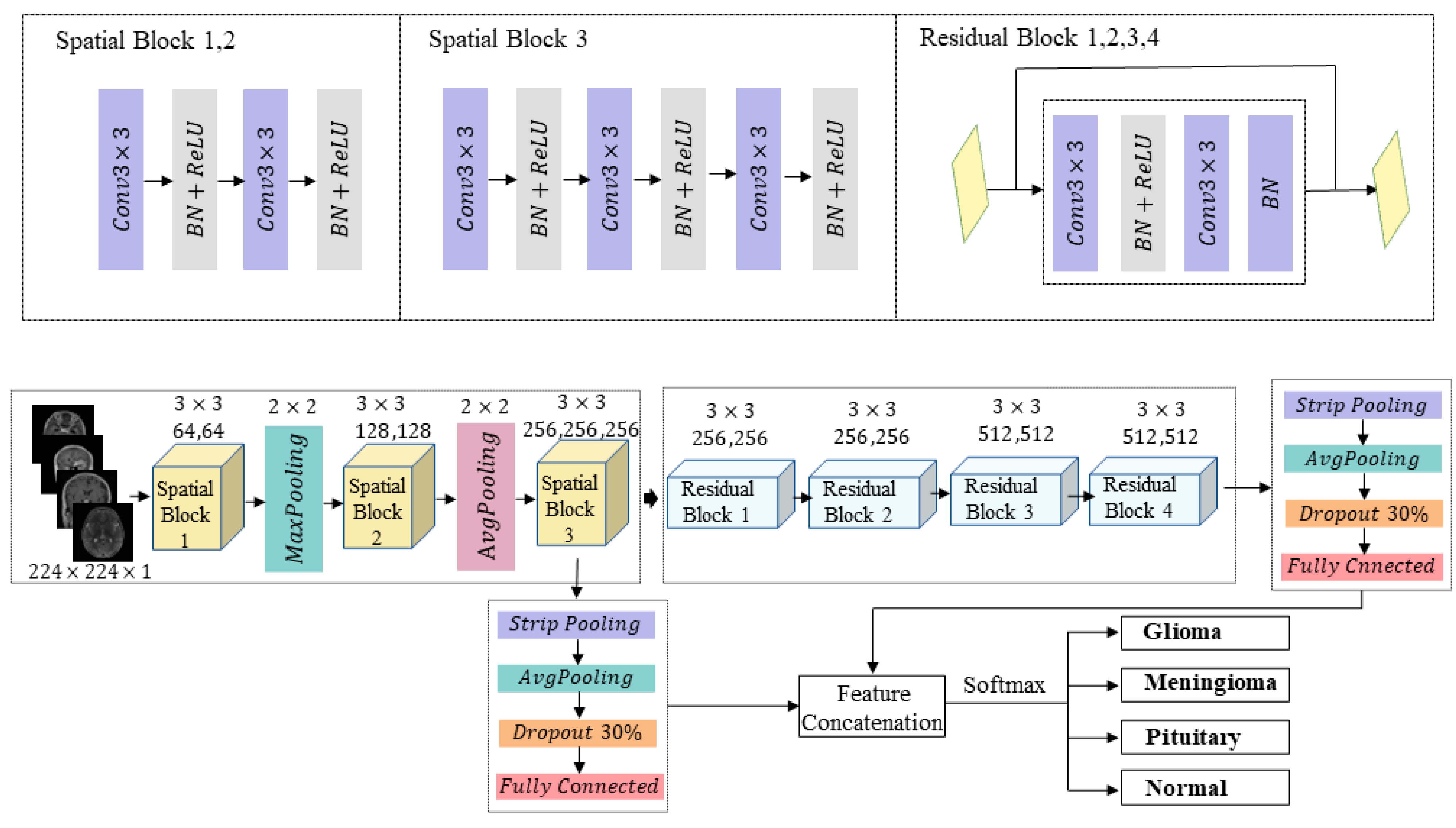
- The model’s low-level component comprises three spatial blocks: To enhance local fine-grained features in brain tumor regions, three spatial blocks are introduced, each containing a 3 × 3 convolutional layer, batch normalization, and a ReLU activation function.
- The model’s deep-level component comprises four residual blocks: To enhance the model’s ability to extract global features while mitigating gradient vanishing, four residual blocks are introduced, each containing two 3 × 3 convolutional layers.
- Propose a novel architecture: By introducing an innovative striped pooling combination structure, the outputs from the end of the low-level spatial blocks and the end of the deep-level residual blocks are concatenated and fused. This design enhances the extraction of both global and local features, improving classification accuracy.
- Eliminate dependency on tumor masks: Our proposed model does not rely on tumor masks, enhancing its feasibility and universality in clinical practical applications.
2. Related Work
3. Methodology
3.1. Architectural Components of the Brain Tumor Classification Model
3.1.1. Spatial Blocks and Residual Blocks
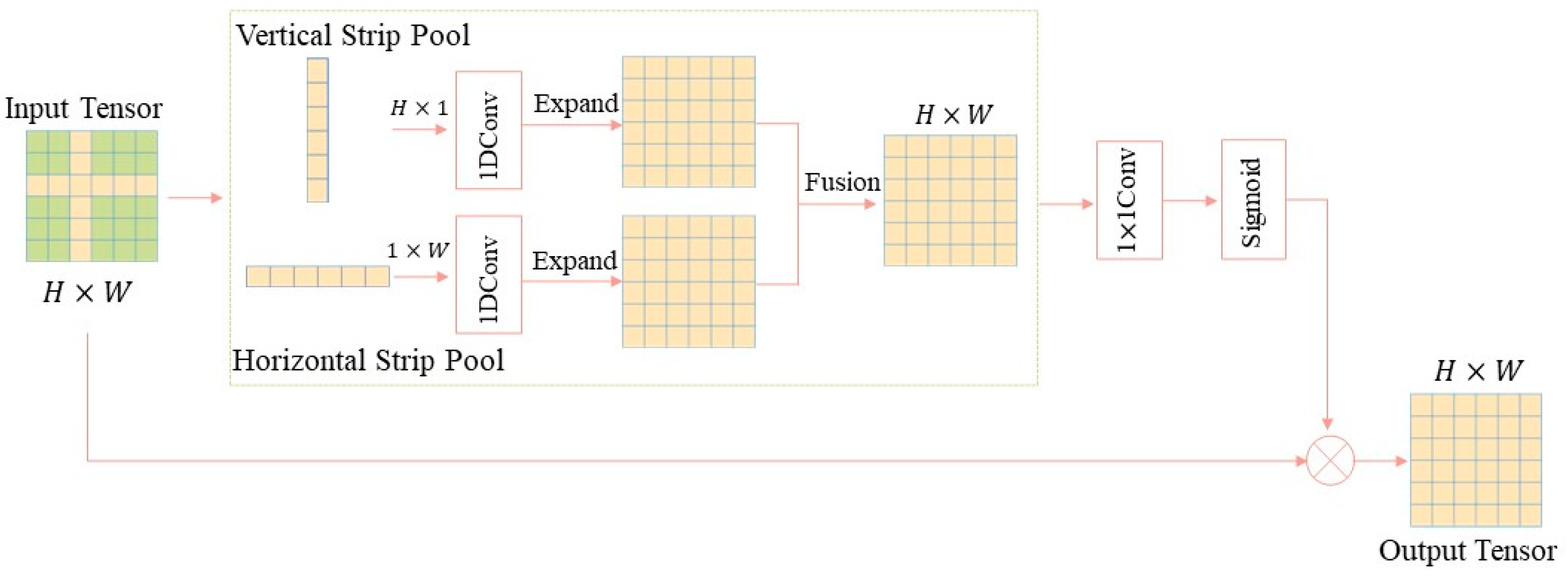
3.1.2. Strip Pooling
3.2. Overall Model Architecture
3.3. Model Hyperparameter Settings
4. Experiments and Analysis
4.1. Datasets
4.2. Data Preprocessing
4.3. Evaluation Indicators
4.4. Performance Comparison of Different Optimizers
4.5. Ablation Studies
4.6. Performance Comparison with Baseline Methods
4.7. Performance Comparison with Existing Convolutional Neural Network Models
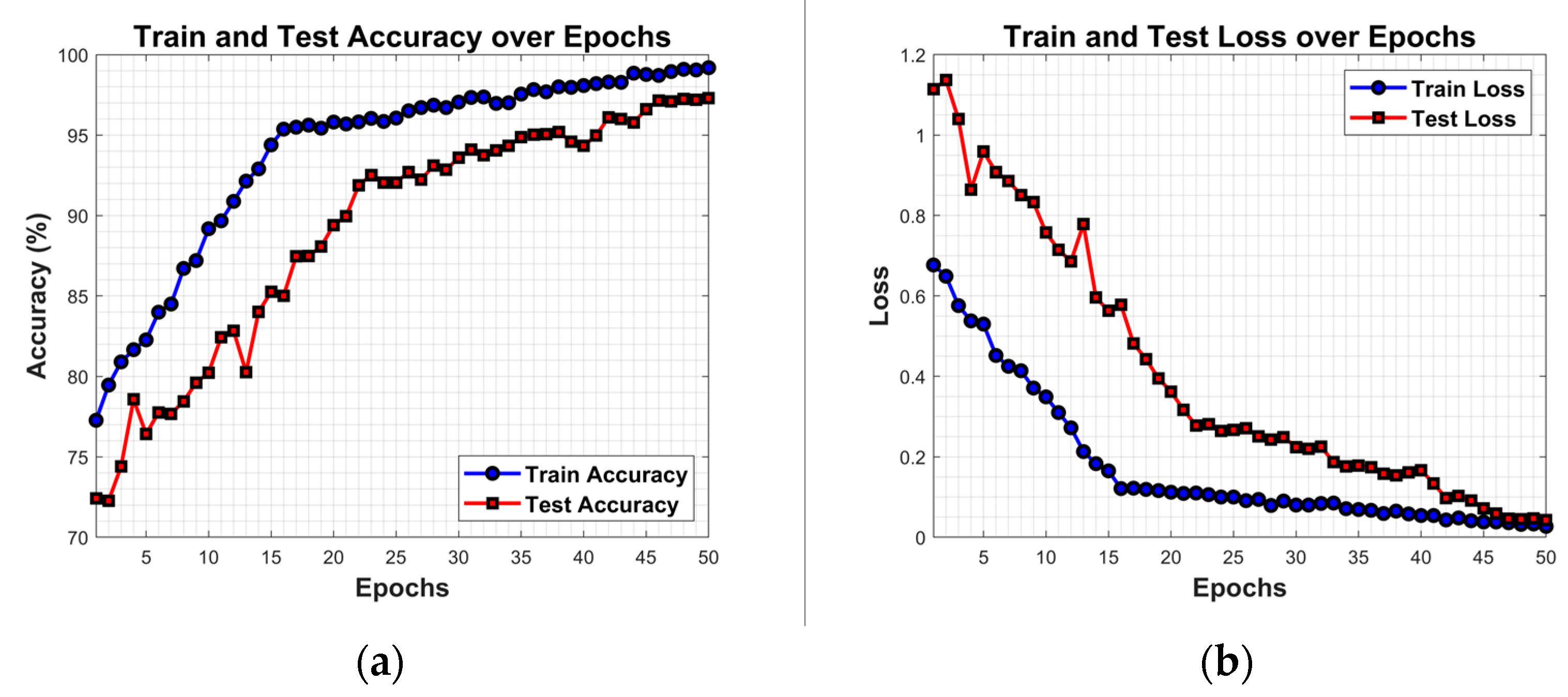
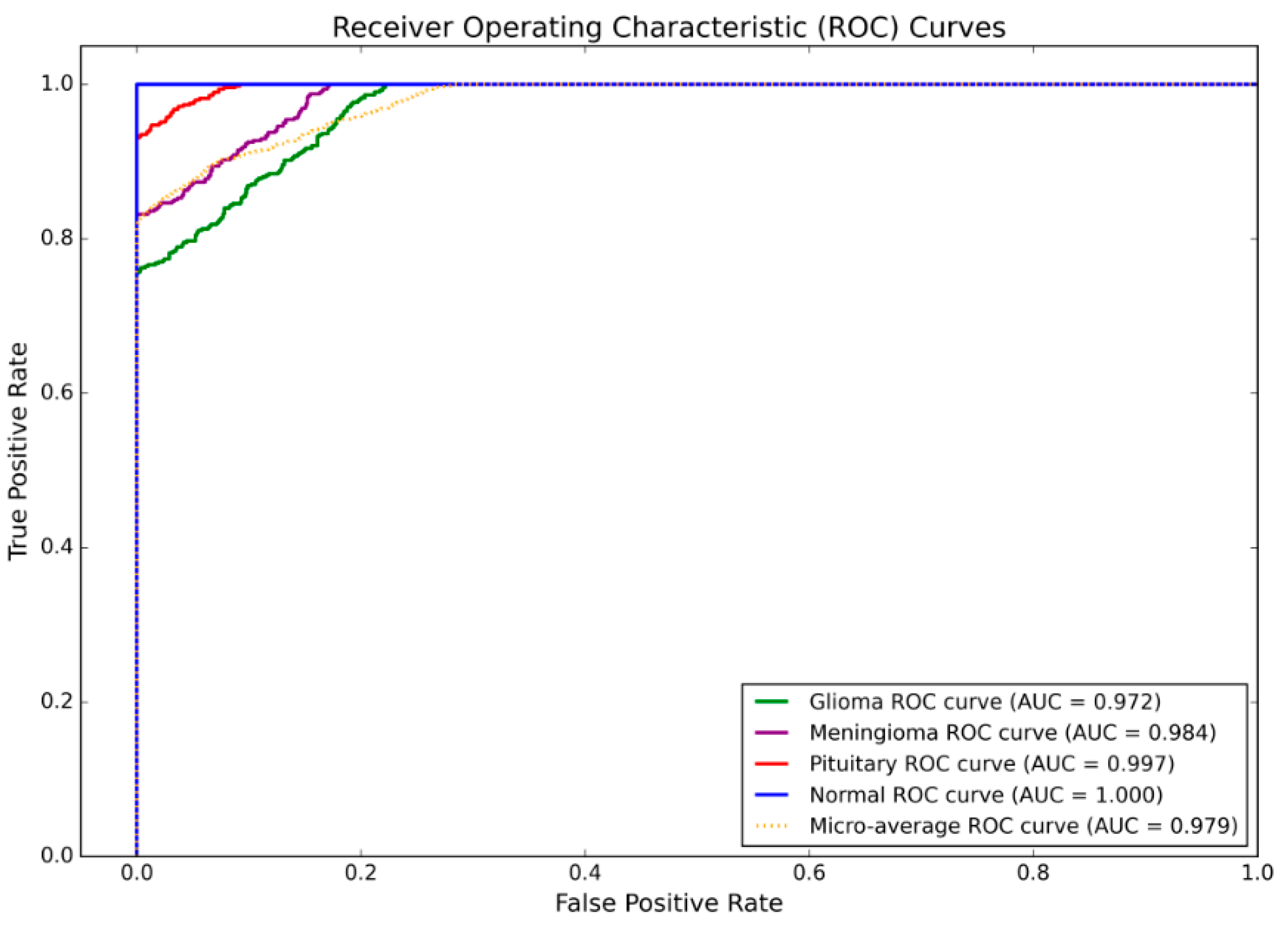
4.8. Analysis of Model Performance
4.9. Performance Comparison with Other Studies
5. Conclusions
Author Contributions
Funding
Institutional Review Board Statement
Informed Consent Statement
Data Availability Statement
Acknowledgments
Conflicts of Interest
References
- Mitusova, K.; Peltek, O.O.; Karpov, T.E.; Muslimov, A.R.; Zyuzin, M.V.; Timim, A.S. Overcoming the blood–brain barrier for the therapy of malignant brain tumor: Current status and prospects of drug delivery approaches. J. Nanobiotechnol. 2022, 20, 412. [Google Scholar] [CrossRef]
- Masood, M.; Nazir, T.; Nawaz, M.; Mehmood, A.; Rashid, J.; Kwon, H.Y.; Mahmood, T.; Hussain, A. A novel deep learning method for recognition and classification of brain tumors from MRI images. Diagnostics 2021, 11, 744. [Google Scholar] [CrossRef] [PubMed]
- Pichaivel, M.; Anbumani, G.; Theivendren, P. An Overview of Brain Tumor; IntechOpen: London, UK, 2022. [Google Scholar]
- Kristensen, B.W.; Priesterbach-Ackley, L.P.; Petersen, J.K.; Wesseling, P. Molecular pathology of tumors of the central nervous system. Ann. Oncol. 2019, 30, 1265–1278. [Google Scholar] [CrossRef] [PubMed]
- Sharif, M.I.; Khan, M.A.; Alhussein, M.; Aurangzeb, K.; Raza, M. A decision support system for multimodal brain tumor classification using deep learning. Complex Intell. Syst. 2022, 8, 3007–3020. [Google Scholar] [CrossRef]
- Di Marco, N.; di Palma, A.; Frosini, A. A study on the predictive strength of fractal dimension of white and grey matter on MRI images in Alzheimer’s disease. Ann. Math. Artif. Intell. 2024, 92, 201–214. [Google Scholar] [CrossRef]
- Khan, M.A.; Khan, A.; Alhaisoni, M.; Alqahtani, A.; Alsubai, S.; Alharbi, M.; Malik, N.A.; Damaševičius, R. Multimodal brain tumor detection and classification using deep saliency map and improved dragonfly optimization algorithm. Int. J. Imaging Syst. Technol. 2023, 33, 572–587. [Google Scholar] [CrossRef]
- Saba, L.; Biswas, M.; Kuppili, V.; Godia, E.C.; Suri, H.S.; Edla, D.R.; Omerzu, T.; Laird, J.R.; Khanna, N.N.; Mavrogeni, S. The present and future of deep learning in radiology. Eur. J. Radiol. 2019, 114, 14–24. [Google Scholar] [CrossRef]
- Khalid, S.; Khalil, T.; Nasreen, S. A survey of feature selection and feature extraction techniques in machine learning. In Proceedings of the 2014 Science and Information Conference, London, UK, 27–29 August 2014; pp. 372–378. [Google Scholar]
- Buchlak, Q.D.; Esmaili, N.; Leveque, J.C.; Farrokhi, F.; Piccardi, M. Machine learning applications to neuroimaging for glioma detection and classification: An artificial intelligence augmented systematic review. J. Clin. Neurosci. 2021, 89, 177–198. [Google Scholar] [CrossRef]
- Sengupta, S.; Anastasio, M.A. A test statistic estimation-based approach for establishing self-interpretable cnn-based binary classifiers. IEEE Trans. Med. Imaging 2024, 43, 1753–1765. [Google Scholar] [CrossRef]
- Ramakrishna, M.T.; Pothanaicker, K.; Selvaraj, P.; Khan, S.B.; Venkatesan, V.K.; Alzahrani, S.; Alojail, M. Leveraging EfficientNetB3 in a Deep Learning Framework for High-Accuracy MRI Tumor Classification. Comput. Mater. Contin. 2024, 81, 867. [Google Scholar] [CrossRef]
- Zhu, Z.; He, X.; Qi, G.; Li, Y.; Cong, B.; Liu, Y. Brain tumor segmentation based on the fusion of deep semantics and edge information in multimodal MRI. Inf. Fusion 2023, 91, 376–387. [Google Scholar] [CrossRef]
- Zhu, Z.; Sun, M.; Qi, G.; Li, Y.; Gao, X.; Liu, Y. Sparse dynamic volume TransUNet with multi-level edge fusion for brain tumor segmentation. Comput. Biol. Med. 2024, 172, 108284. [Google Scholar] [CrossRef]
- Geetha, M.; Srinadh, V.; Janet, J.; Sumathi, S. Hybrid archimedes sine cosine optimization enabled deep learning for multilevel brain tumor classification using mri images. Biomed. Signal Process. Control. 2024, 87, 105419. [Google Scholar] [CrossRef]
- Celik, M.; Inik, O. Development of hybrid models based on deep learning and optimized machine learning algorithms for brain tumor Multi-Classification. Expert Syst. Appl. 2024, 238, 122159. [Google Scholar] [CrossRef]
- Şahin, E.; Özdemir, D.; Temurtaş, H. Multi-objective optimization of ViT architecture for efficient brain tumor classification. Biomed. Signal Process. Control. 2024, 91, 105938. [Google Scholar] [CrossRef]
- Rammurthy, D.; Mahesh, P.K. Whale Harris hawks optimization based deep learning classifier for brain tumor detection using MRI images. J. King Saud Univ. Comput. Inf. Sci. 2022, 34, 3259–3272. [Google Scholar] [CrossRef]
- Islam, M.K.; Ali, M.S.; Miah, M.S.; Rahman, M.M.; Alam, M.S.; Hossain, M.A. Brain tumor detection in MR image using superpixels, principal component analysis and template based K-means clustering algorithm. Mach. Learn. Appl. 2021, 5, 100044. [Google Scholar] [CrossRef]
- Majib, M.S.; Rahman, M.M.; Sazzad, T.M.S.; Khan, N.I.; Dey, S.K. Vgg-scnet: A vgg net-based deep learning framework for brain tumor detection on mri images. IEEE Access 2021, 9, 116942–116952. [Google Scholar] [CrossRef]
- Shah, H.A.; Saeed, F.; Yun, S.; Park, J.H.; Paul, A.; Kang, J.M. A robust approach for brain tumor detection in magnetic resonance images using finetuned efficientnet. IEEE Access 2022, 10, 65426–65438. [Google Scholar] [CrossRef]
- Loganayagi, T.; Sravani, M.; Maram, B.; Rao, T.V.M. Hybrid Deep Maxout-VGG-16 model for brain tumour detection and classification using MRI images. J. Biotechnol. 2025, 405, 124–138. [Google Scholar] [CrossRef]
- Toğaçar, M.; Ergen, B.; Cömert, Z. Tumor type detection in brain MR images of the deep model developed using hypercolumn technique, attention modules, and residual blocks. Med. Biol. Eng. Comput. 2021, 59, 57–70. [Google Scholar] [CrossRef]
- Vankdothu, R.; Hameed, M.A. Brain tumor MRI images identification and classification based on the recurrent convolutional neural network. Meas. Sens. 2022, 24, 100412. [Google Scholar] [CrossRef]
- Senan, E.M.; Jadhav, M.E.; Rassem, T.H.; Aljaloud, A.S.; Mohammed, B.A.; Al-Mekhlafi, Z.G. Early diagnosis of brain tumour mri images using hybrid techniques between deep and machine learning. Comput. Math. Methods Med. 2022, 2022, 8330833. [Google Scholar] [CrossRef] [PubMed]
- Islam, M.N.; Azam, M.S.; Islam, M.S.; Kanchan, M.H.; Parvez, A.S.; Islam, M.M. An improved deep learning-based hybrid model with ensemble techniques for brain tumor detection from MRI image. Inform. Med. Unlocked 2024, 47, 101483. [Google Scholar] [CrossRef]
- Mahmud, M.I.; Mamun, M.; Abdelgawad, A. A deep analysis of brain tumor detection from mr images using deep learning networks. Algorithms 2023, 16, 176. [Google Scholar] [CrossRef]
- Abdusalomov, A.B.; Mukhiddinov, M.; Whangbo, T.K. Brain tumor detection based on deep learning approaches and magnetic resonance imaging. Cancers 2023, 15, 4172. [Google Scholar] [CrossRef] [PubMed]
- Jader, R.F.; Kareem, S.W.; Awla, H.Q. Research Article Ensemble Deep Learning Technique for Detecting MRI Brain Tumor. Appl. Comput. Intell. Soft Comput. 2024, 2024, 6615468. [Google Scholar]
- Mishra, L.; Verma, S. Graph attention autoencoder inspired CNN based brain tumor classification using MRI. Neurocomputing 2022, 503, 236–247. [Google Scholar] [CrossRef]
- Islam, M.M.; Talukder, M.A.; Uddin, M.A.; Akhter, A.; Khalid, M. Brainnet: Precision brain tumor classification with optimized efficientnet architecture. Int. J. Intell. Syst. 2024, 2024, 3583612. [Google Scholar] [CrossRef]
- Demir, F.; Akbulut, Y.; Taşcı, B.; Demir, K. Improving brain tumor classification performance with an effective approach based on new deep learning model named 3ACL from 3D MRI data. Biomed. Signal Process. Control. 2023, 81, 104424. [Google Scholar] [CrossRef]
- Ullah, M.S.; Khan, M.A.; Almujally, N.A.; Alhaisoni, M.; Akram, T.; Shabaz, M. BrainNet: A fusion assisted novel optimal framework of residual blocks and stacked autoencoders for multimodal brain tumor classification. Sci. Rep. 2024, 14, 5895. [Google Scholar] [CrossRef]
- Arora, Y.; Gupta, S.K. Brain tumor classification using weighted least square twin support vector machine with fuzzy hyperplane. Eng. Appl. Artif. Intell. 2024, 138, 109450. [Google Scholar] [CrossRef]
- Alyami, J.; Rehman, A.; Almutairi, F.; Fayyaz, A.M.; Roy, S.; Saba, T.; Alkhurim, A. Tumor localization and classification from MRI of brain using deep convolution neural network and Salp swarm algorithm. Cogn. Comput. 2024, 16, 2036–2046. [Google Scholar] [CrossRef]
- Gürsoy, E.; Kaya, Y. Brain-gcn-net: Graph-convolutional neural network for brain tumor identification. Comput. Biol. Med. 2024, 180, 108971. [Google Scholar] [CrossRef]
- Ravinder, M.; Saluja, G.; Allabun, S.; Alqahtani, M.S.; Abbas, M.; Othman, M.; Soufiene, B.O. Enhanced brain tumor classification using graph convolutional neural network architecture. Sci. Rep. 2023, 13, 14938. [Google Scholar] [CrossRef]
- Pacal, I. A novel Swin transformer approach utilizing residual multi-layer perceptron for diagnosing brain tumors in MRI images. Int. J. Mach. Learn. Cybern. 2024, 15, 3579–3597. [Google Scholar] [CrossRef]
- Li, Z.; Zhou, X. A Global-Local Parallel Dual-Branch Deep Learning Model with Attention-Enhanced Feature Fusion for Brain Tumor MRI Classification. Comput. Mater. Contin. 2025, 83, 739. [Google Scholar] [CrossRef]
- Hou, Q.; Zhang, L.; Cheng, M.M.; Feng, J. Strip pooling: Rethinking spatial pooling for scene parsing. In Proceedings of the IEEE/CVF Conference on Computer Vision and Pattern Recognition, Seattle, WA, USA, 13–19 June 2020; pp. 4003–4012. [Google Scholar]
- Pratticò, D.; Carlo, D.D.; Silipo, G.; Laganà, F. Hybrid FEM-AI Approach for Thermographic Monitoring of Biomedical Electronic Devices. Computers 2025, 14, 344. [Google Scholar] [CrossRef]
- Loshchilov, I.; Hutter, F. Decoupled weight decay regularization. arXiv 2017, arXiv:1711.05101. [Google Scholar]
- Cheng, J. Brain Tumor Dataset [DB/OL]. Figshare. 2024. Available online: https://figshare.com/articles/dataset/brain_tumor_dataset/1512427/8 (accessed on 26 August 2024).
- Nickparvar, M. Brain Tumor MRI Dataset [DB/OL]. Kaggle. 2021. Available online: https://www.kaggle.com/datasets/masoudnickparvar/brain-tumor-mri-dataset (accessed on 26 August 2024).
- Laganà, F.; Pellicanò, D.; Arruzzo, M.; Pratticò, D.; Pullano, S.A.; Fiorillo, A.S. FEM-Based Modelling and AI-Enhanced Monitoring System for Upper Limb Rehabilitation. Electronics 2025, 14, 2268. [Google Scholar] [CrossRef]
- Vincent, O.R.; Folorunso, O. A descriptive algorithm for sobel image edge detection. Proc. Informing Sci. IT Educ. Conf. (InSITE) 2009, 40, 97–107. [Google Scholar]
- Laganà, F.; Faccì, A.R. Parametric optimisation of a pulmonary ventilator using the Taguchi method. J. Electr. Eng. 2025, 76, 265–274. [Google Scholar] [CrossRef]
- Zheng, L.Y. Research and Implementation of Brain Tumor Image Classification Based on Deep Learning; University of Electronic Science and Technology: Chengdu, China, 2021. [Google Scholar]
- Latif, G.; Ben Brahim, G.; Iskandar, D.A.; Bashar, A.; Alghazo, J. Glioma Tumors’ classification using deep-neural-network-based features with SVM classifier. Diagnostics 2022, 12, 1018. [Google Scholar] [CrossRef] [PubMed]
- Chitnis, S.; Hosseini, R.; Xie, P. Brain tumor classification based on neural architecture search. Sci. Rep. 2022, 12, 19206. [Google Scholar] [CrossRef]
- Dutta, T.K.; Nayak, D.R.; Zhang, Y.-D. Arm-net: Attention-guided residual multiscale CNN for multiclass brain tumor classification using MR images. Biomed. Signal Process. Control 2024, 87, 105421. [Google Scholar] [CrossRef]





| Reference | Model/Approach | Dataset | Accuracy (%) |
|---|---|---|---|
| [2] | Mask-RCNN | Kaggle and Figshare | 98.34% |
| [15] | SCAOA | BRATS 2020 and Figshare | 93% |
| [21] | EfficientNet-B0 | Brats2015 | 98.87% |
| [23] | BrainMRNet | Figshare | 96.73% |
| [25] | AlexNet + SVM | Figshare | 95.10% |
| [28] | YOLOv7 | Kaggle | 99.5% |
| [30] | GATE-CNN | —— | 98.27% |
| [33] | ResNet-50 | BraTS2021 | 98% |
| Hyperparameter | Value |
|---|---|
| Batch Size | 32 |
| Learning Rate | 0.0001 |
| Optimizer | AdamW |
| Loss Function | Cross-Entropy |
| Epochs | 50 |
| Activation Functions | ReLU, Softmax |
| Dropout Rate | 0.3 |
| Tumour Type | Training Set (70%) | Test Set (30%) | Total (100%) |
|---|---|---|---|
| Meningioma | 1135 | 486 | 1621 |
| Glioma | 1152 | 493 | 1645 |
| Pituitary | 1230 | 527 | 1757 |
| Normal | 1400 | 600 | 2000 |
| Total | 4917 | 2106 | 7023 |
| Optimizer | Learning Rate | Batch Size | Accuracy | Precision | Recall | F1 Score | Loss |
|---|---|---|---|---|---|---|---|
| AdamW | 0.0001 | 32 | 97.29% | 0.9721 | 0.9713 | 0.9716 | 0.043 |
| Adam | 0.0001 | 16 | 96.11% | 0.9592 | 0.9587 | 0.9588 | 0.078 |
| RMSprop | 0.001 | 32 | 94.63% | 0.9445 | 0.9437 | 0.9439 | 0.226 |
| SGD | 0.0001 | 64 | 94.97% | 0.9479 | 0.9469 | 0.9472 | 0.131 |
| Model | Spatial Block 1, 2, 3 | Strip Pooling 1 | Residual Blocks 1, 2, 3, 4 | Strip Pooling 2 | Accuracy |
|---|---|---|---|---|---|
| A | ✓ | 90.36% | |||
| B | ✓ | ✓ | 91.54% | ||
| C | ✓ | 93.39% | |||
| D | ✓ | ✓ | 93.92% | ||
| E | ✓ | ✓ | 95.11% | ||
| F(Ours) | ✓ | ✓ | ✓ | ✓ | 97.29% |
| Model | Category | Precision | Recall | F1 Score | Overall Accuracy |
|---|---|---|---|---|---|
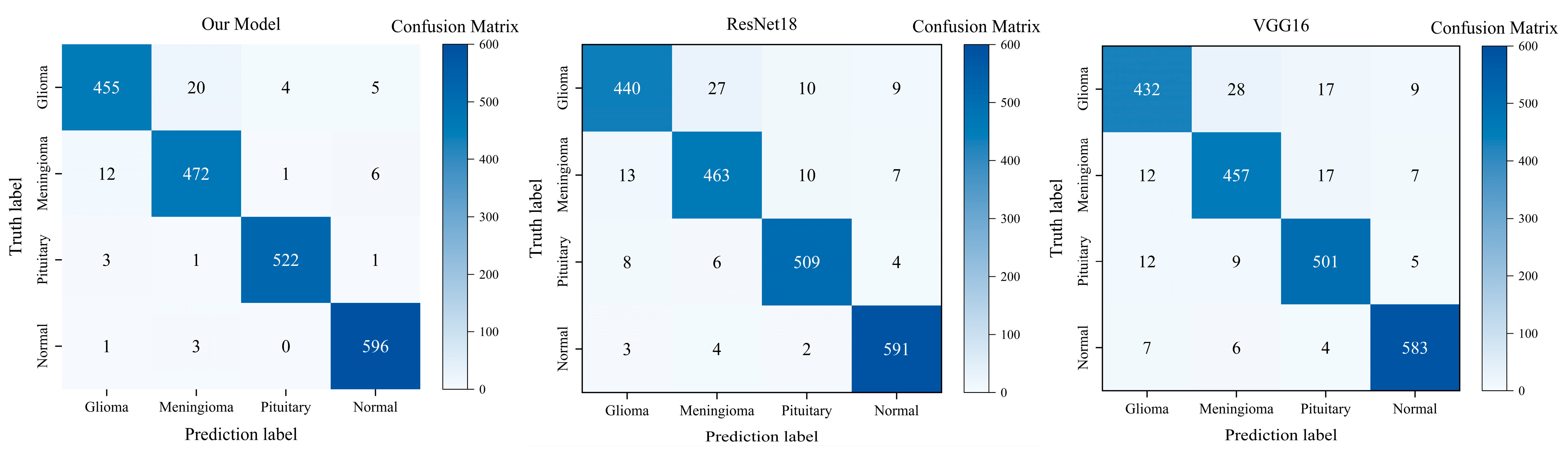
| VGG16 | Glioma | 0.9330 | 0.8889 | 0.9104 | 93.65% |
| Meningioma | 0.9140 | 0.9270 | 0.9204 | ||
| Pituitary adenoma | 0.9295 | 0.9507 | 0.9400 | ||
| Normal | 0.9652 | 0.9717 | 0.9684 | ||
| ResNet18 | Glioma | 0.9483 | 0.9053 | 0.9263 | 95.11% |
| Meningioma | 0.9260 | 0.9391 | 0.9325 | ||
| Pituitary adenoma | 0.9586 | 0.9658 | 0.9622 | ||
| Normal | 0.9673 | 0.9850 | 0.9761 | ||
| Our Model | Glioma | 0.9660 | 0.9401 | 0.9529 | 97.29% |
| Meningioma | 0.9516 | 0.9613 | 0.9564 | ||
| Pituitary adenoma | 0.9905 | 0.9905 | 0.9905 | ||
| Normal | 0.9803 | 0.9933 | 0.9868 |
| Model | Accuracy (95% CI) | Precision (95% CI) | Recall (95% CI) | F1 Score (95% CI) |
|---|---|---|---|---|
| Inception-V3 | 91.55% (89.03–93.43%) | 0.9115 (0.905–0.923) | 0.9112 (0.903–0.919) | 0.9112 (0.903–0.919) |
| Xception | 89.36% (87.67–90.91%) | 0.8893 (0.881–0.898) | 0.8889 (0.878–0.898) | 0.8889 (0.879–0.899) |
| GoogleNet | 91.07% (90.46–91.64%) | 0.9073 (0.900–0.914) | 0.9062 (0.899–0.913) | 0.9064 (0.899–0.913) |
| MobileNet-V3 | 92.35% (91.73–92.89%) | 0.9200 (0.913–0.929) | 0.9199 (0.914–0.927) | 0.9199 (0.914–0.926) |
| DenseNet121 | 95.30% (94.77–95.72%) | 0.9520 (0.949–0.953) | 0.9517 (0.947–0.956) | 0.9518 (0.946–0.956) |
| Our Model | 97.29% (96.96–97.60%) | 0.9721 (0.969–0.974) | 0.9713 (0.970–0.973) | 0.9716 (0.966–0.973) |
Disclaimer/Publisher’s Note: The statements, opinions and data contained in all publications are solely those of the individual author(s) and contributor(s) and not of MDPI and/or the editor(s). MDPI and/or the editor(s) disclaim responsibility for any injury to people or property resulting from any ideas, methods, instructions or products referred to in the content. |
© 2025 by the authors. Licensee MDPI, Basel, Switzerland. This article is an open access article distributed under the terms and conditions of the Creative Commons Attribution (CC BY) license (https://creativecommons.org/licenses/by/4.0/).
Share and Cite
Tang, M.; Zhou, X.; Li, Z. Brain Tumour Classification Model Based on Spatial Block–Residual Block Collaborative Architecture with Strip Pooling Feature Fusion. J. Imaging 2025, 11, 427. https://doi.org/10.3390/jimaging11120427
Tang M, Zhou X, Li Z. Brain Tumour Classification Model Based on Spatial Block–Residual Block Collaborative Architecture with Strip Pooling Feature Fusion. Journal of Imaging. 2025; 11(12):427. https://doi.org/10.3390/jimaging11120427
Chicago/Turabian StyleTang, Meilan, Xinlian Zhou, and Zhiyong Li. 2025. "Brain Tumour Classification Model Based on Spatial Block–Residual Block Collaborative Architecture with Strip Pooling Feature Fusion" Journal of Imaging 11, no. 12: 427. https://doi.org/10.3390/jimaging11120427
APA StyleTang, M., Zhou, X., & Li, Z. (2025). Brain Tumour Classification Model Based on Spatial Block–Residual Block Collaborative Architecture with Strip Pooling Feature Fusion. Journal of Imaging, 11(12), 427. https://doi.org/10.3390/jimaging11120427