
Mechanochemical Recycling of Tire-Derived Styrene–Butadiene Rubber Using a Regeneration Agent
 , and
, and
Abstract
1. Introduction
2. Results
2.1. Rheometric Properties
2.2. Swelling and Crosslink Density
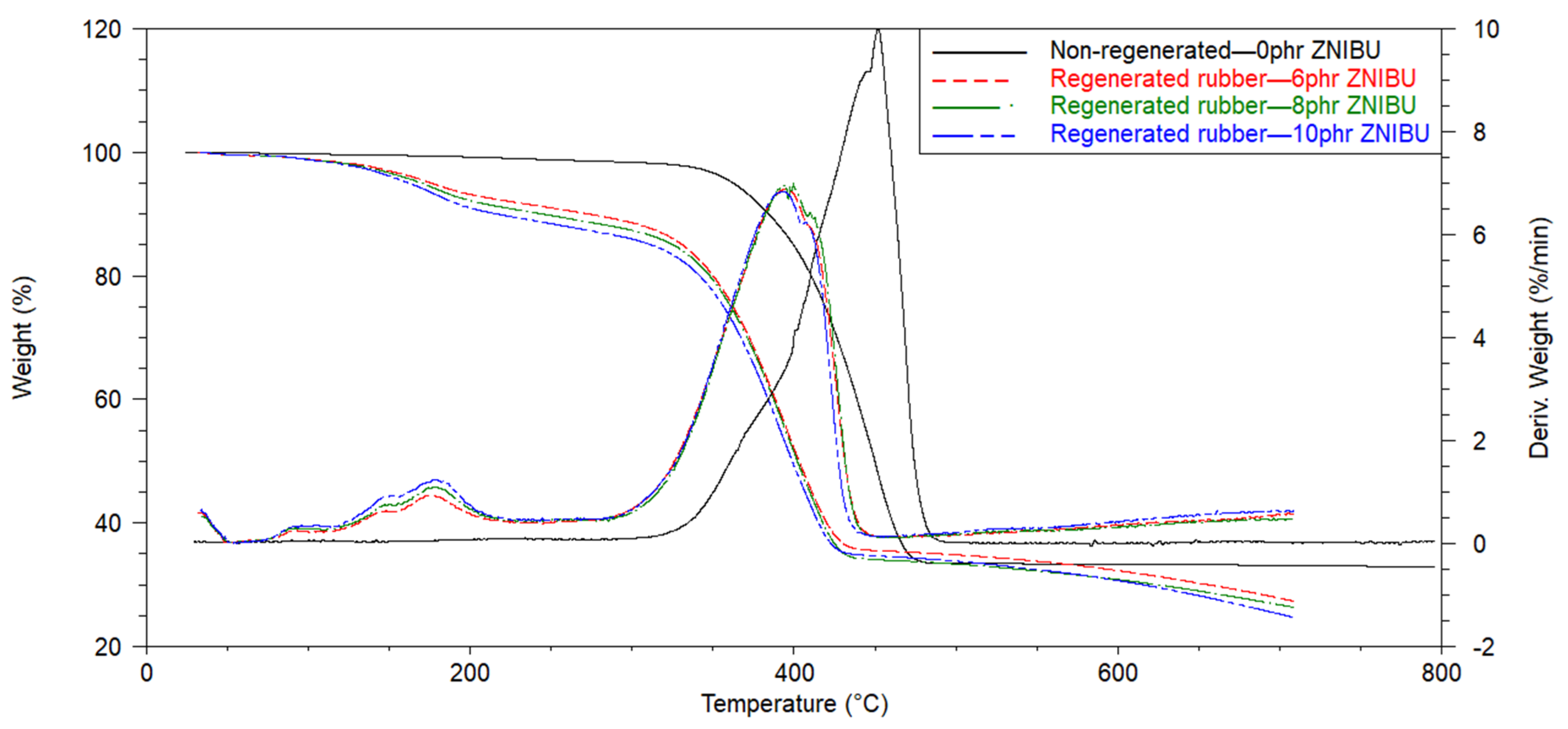
2.3. Thermal Properties
2.4. Mechanical Properties
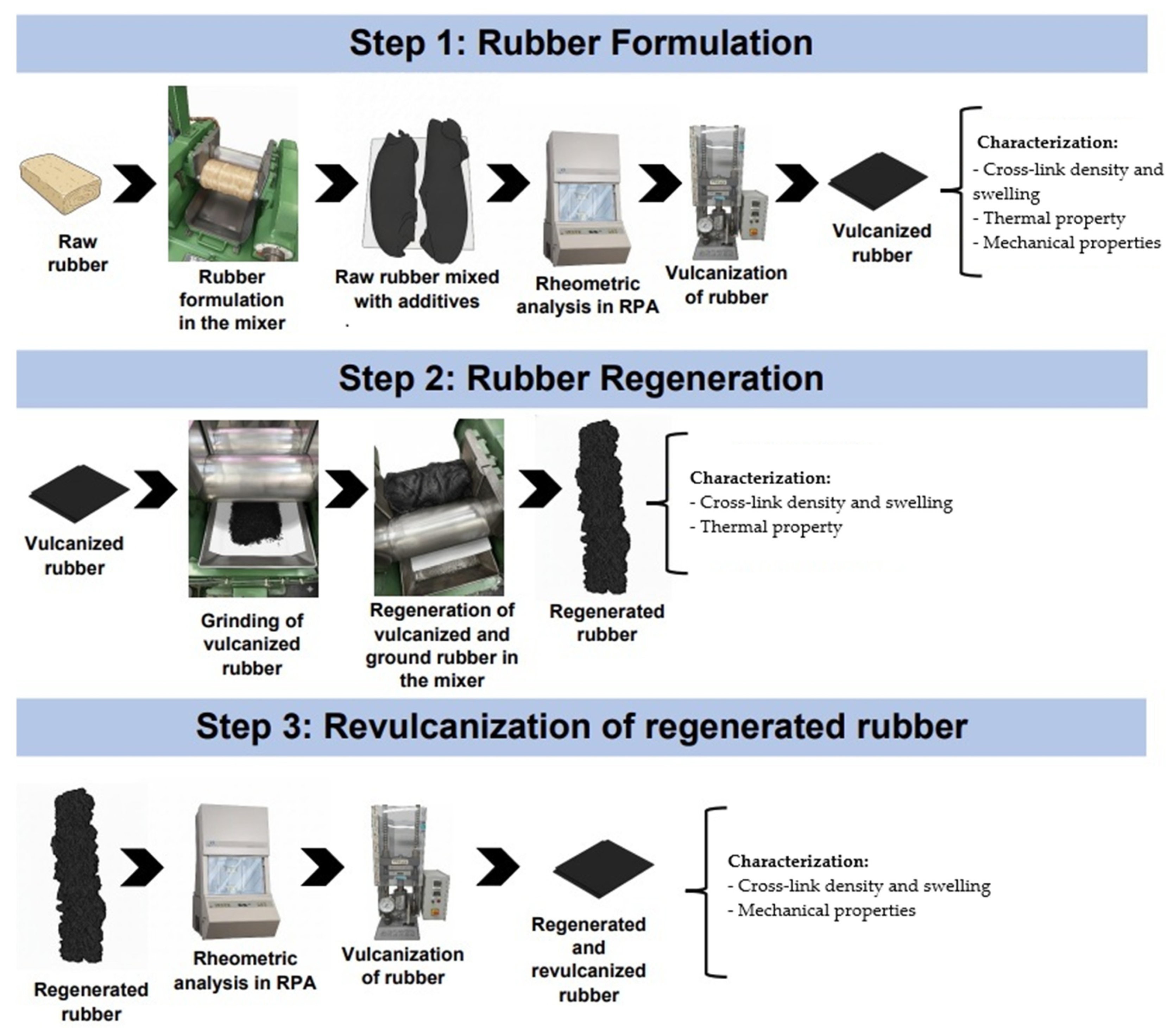
3. Materials and Methods
3.1. Formulation of the Original SBR Composition
3.2. Rheometric Analysis of the Material
3.3. Vulcanization in a Hydraulic Press
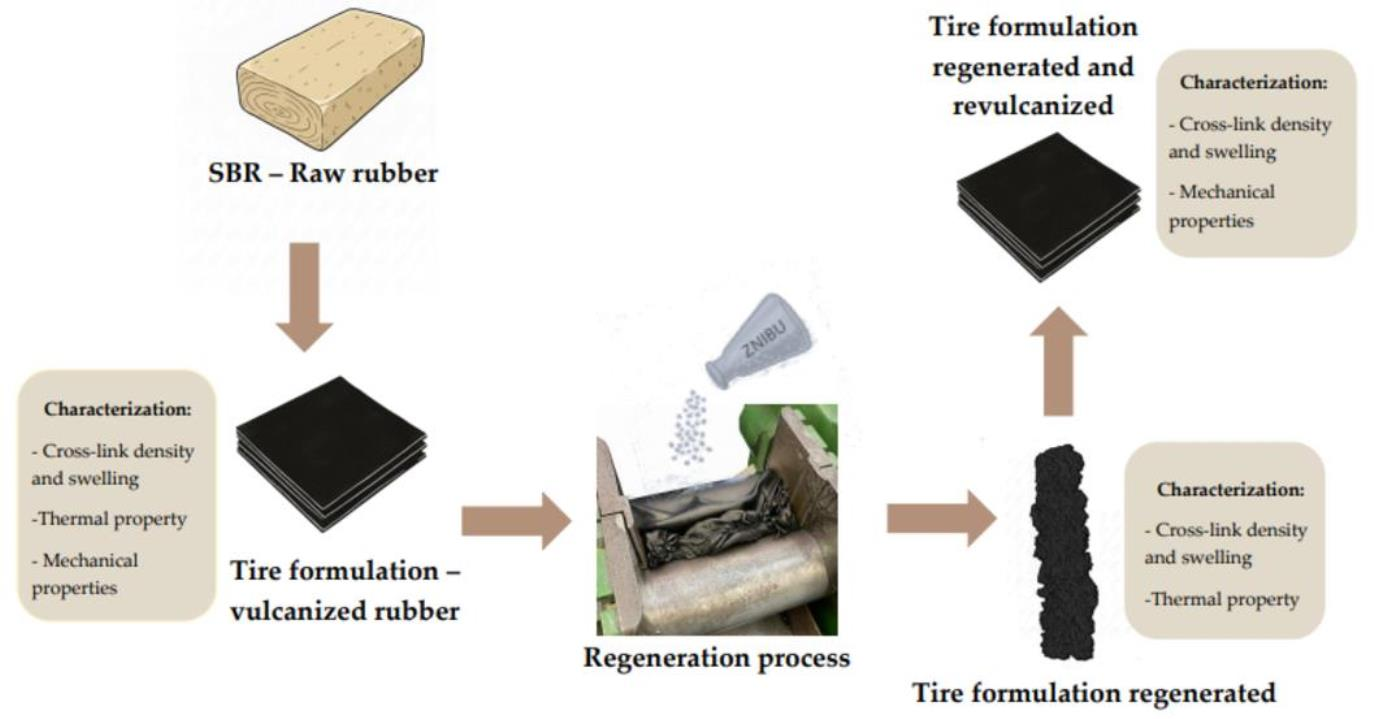
3.4. Regeneration of Vulcanized Rubber
3.5. Characterization of the Regenerated Rubber
3.5.1. Swelling Analysis
3.5.2. Thermogravimetric Analysis
3.6. Characterization of Vulcanized Samples
3.6.1. Hardness
3.6.2. Tear Strength
3.6.3. Tensile Strength
4. Conclusions
Author Contributions
Funding
Data Availability Statement
Conflicts of Interest
Abbreviations
| SBR | Styrene–butadiene rubber |
| ZNIBU | Zinc (II) dithiocarbamate complex |
| T90 | Optimal curing time |
| Ts1 | Scorch time |
| MH | Maximum torque |
| ML | Minimum torque |
References
- Hashamfirooz, M.; Dehghani, M.H.; Khanizadeh, M.; Aghaei, M.; Bashardoost, P.; Hassanvand, M.S.; Hassanabadi, M.; Momeniha, F. A systematic review of the environmental and health effects of waste tires recycling. Heliyon 2025, 11, e41909. [Google Scholar] [CrossRef]
- Guo, L.; Wang, C.; Dejun, L.; Ren, D.; Zhai, T.; Zun, S.; Liu, H. Rubber reclamation with high bing-breaking selectivity using a low-temperature mechano-chemical devulcanization method. J. Clean. Prod. 2021, 279, 123266. [Google Scholar] [CrossRef]
- Chen, Q.; Xu, F.; Zong, P.; Song, F.; Wang, B.; Tian, Y.; Wu, F.; Zhao, X.; Qiao, Y. Influence of CaO on the thermal kinetics and formation mechanism of high value-added products during waste tire pyrolysis. J. Hazard. Mater. 2022, 436, 129220. [Google Scholar] [CrossRef] [PubMed]
- Jiang, H.; Shao, J.; Zhu, Y.; Yu, J.; Cheng, W.; Yang, H.; Zhang, X.; Chen, H. Production mechanism of high-quality carbon black from high-temperature pyrolysis of waste tire. J. Hazard. Mater. 2023, 443, 130350. [Google Scholar] [CrossRef] [PubMed]
- Kumar, D.; Pei, Y.; Han, B.; Khoo, S.Y.; Norton, M.; Adams, S.D.; Kouzani, A.Z. Comparative analysis of waste tyre treatment technologies: Environmental and economic perspectives. Renew. Sustain. Energy Rev. 2025, 216, 115691. [Google Scholar] [CrossRef]
- Ramezani, H.; Scarpa, F.; Zhang, Q.; Ji, W.; Khorramshokouh, A.; Rochat, S.; Eloi, J.C.; Harniman, R.L.; Thakur, V.K. Green and sustainable devulcanization of ground tire rubber, using choline chloride-urea deep eutectic solvent. RSC Sustain. 2024, 2, 1663–1675. [Google Scholar] [CrossRef]
- Mark, J.; Erman, B.; Roland, M. The Science and Technology of Rubber, 4th ed.; Elsevier: Amsterdam, The Netherlands, 2013. [Google Scholar]
- Goevert, D. The value of different recycling Technologies for waste rubber tires in the circular economy—A review. Front. Sustain. 2024, 4, 1282805. [Google Scholar] [CrossRef]
- Kahawalage, A.C.; Melagen, M.C.; Tokheim, L.A. Opportunities and challenges using SRF as an alternative fuel in the cement industry. Clean. Waste Syst. 2023, 4, 100072. [Google Scholar] [CrossRef]
- Castañón, A.M.; San Miquel, L.; Bascompta, M.; Fuente, A.V.; Contreras, V.; Ferández, F.G. Used tires as fuel in clinker production: Economic and environmental implications. Sustainability 2021, 13, 10455. [Google Scholar] [CrossRef]
- Heydari, A.; Fazeli, A.; Hallajisani, A. Enhanced tire oil production through hydrothermal liquefaction using devulcanition agentes. Process Saf. Environ. Prot. 2025, 193, 876–886. [Google Scholar] [CrossRef]
- Siriboon, J.; Magaraphan, R. Devulcanization and functionalization of ground tire rubber for the novel metal sheet roof with strong sound absorber and termal insulation. Clean. Eng. Technol. 2025, 24, 100927. [Google Scholar] [CrossRef]
- Colom, X.; Marín, M.; Saeb, M.R.; Formela, K.; Cañavate, J. Recycling devulcanized EPDM to improve engineering properties of SBR rubber compounds. RCR Adv. 2024, 23, 200227. [Google Scholar] [CrossRef]
- Zhang, T.; Asaro, L.; Gratton, M.; Hocine, N.A. An overview on waste rubber recycling by microwave devulcanization. J. Environ. Manag. 2024, 353, 120122. [Google Scholar] [CrossRef] [PubMed]
- Campos, R.P.; Fernández, J.F.; Cabrera, J.M. Real-time monitoring of ground-tire rubber microwave devulcanization with thermal and electrochemical sensors. Measurement 2023, 223, 113781. [Google Scholar] [CrossRef]
- Colom, X.; Cañavate, J.; Formela, K.; Shadman, A.; Saeb, M.R. Assessment of the devulcanization process of EPDM waste from roofing systems by combined thermomechanical/microwave procedures. Polym. Degrad. Stab. 2021, 183, 109450. [Google Scholar] [CrossRef]
- Backstal, L.; Berchem, T.; Schmetz, Q.; Richel, A. Devulcanisation and reclaiming of tires and rubber by physical and chemical processes: A review. J. Clean. Prod. 2019, 236, 117574. [Google Scholar] [CrossRef]
- Chittella, H.; Yoon, L.W.; Ramarad, S.; Lai, Z.W. Rubber waste management: A review on methods, mechanism and prospects. Polym. Degrad. Stab. 2021, 194, 109761. [Google Scholar] [CrossRef]
- Saputra, R.; Walvekar, R.; Khalid, M.; Mubarak, N.M.; Sillanpaa, M. Current progress in waste tire rubber devulcanization. Chemosphere 2021, 265, 129033. [Google Scholar] [CrossRef]
- Gao, L.; Liang, Y.; Wang, Q.; Wu, X.; Guo, R.; Huang, J.; Zhou, L.; Jin, H.; Zhu, Y. Exposure assessment of xanthate vulcanization accelerators in human urine. Ecotoxicol. Environ. Saf. 2025, 302, 118590. [Google Scholar] [CrossRef]
- Fu, Z.; Jin, H.; Guo, R.; Mao, W. Human urinary occurrence of dithiocarbamate vulcanization accelerators and their exposure estimation. Emerg. Contam. 2025, 11, 100499. [Google Scholar] [CrossRef]
- Moreno, P.H.H.; Visconte, L.L.Y.; Silva, A.L.N.; Tavares, E.C.; Pacheco, E.B.A.V.P.; Lopes, T.C. Breakage of sulfur crosslinks in styrene-butadiene rubber by zinc(II) dithiocarbimate derivative. Colloid Polym. Sci. 2017, 295, 2081–2089. [Google Scholar] [CrossRef]
- Oliveira, I.; Cunha, L.; Visconte, L.; Oliveira, M.; Rubinger, M. The evaluation of bis(4methylphenylsufonydithiocarbimato)zincate (II) (ZNIBU) activity in the vulcanization of NBR compounds and its effect on their mechanical properties. Chem. Chem. Technol. 2010, 4, 237–241. [Google Scholar] [CrossRef]
- Santos, L.F.V.; Mariano, R.M.; Pacheco, E.B.A.V.; Canto, L.B.; Visconte, L.L.Y.; Oliveira, M.R.L.; Rubinger, M.M.M. Avaliação do bis(4-metilfenilditiocarbimato)zincato(II) de tetrabutilamônio como acelerador no processo de vulcanização do elastômero polibutadieno. Polímeros 2011, 21, 268–273. [Google Scholar] [CrossRef]
- Alejo, S.M.C.; Meza, K.T.; Valencia, M.R.V.; Rodriguez, A.J.A.; Espinoza, C.J.M. Tire ground rubber biodegradation by a consortium isolated from an aged tire. Microorganisms 2022, 10, 1414. [Google Scholar] [CrossRef]
- Mariano, R.M.; Oliveira, M.R.L.; Rubinger, M.M.M.; Visconte, L.L.Y. Synthesis spectroscopic characterization and devulcanization activity of a new compound containing the anion bis(4-methylphenylsufonyldithiocarbimato)zincate(II). Eur. Polym. J. 2007, 43, 4522–4530. [Google Scholar] [CrossRef]
- Abdelsalam, A.A.; Araby, S.; El-Sabbagh, S.H.; Abdelmoneim, A.; Hassan, M.A. Effect of carbon black loading on mechanical and rheological properties of natural rubber/styrene-butadiene rubber/nitrile butadiene rubber blends. J. Thermoplast. Compos. Mater. 2019, 34, 497–516. [Google Scholar] [CrossRef]
- Guerra, B.B.; Furtado, C.R.G.; Coutinho, F.M.B. Avaliação reológica de elastômeros e suas composições. Polímeros Ciência Tecnol. 2004, 14, 289–295. [Google Scholar] [CrossRef][Green Version]
- Yan, T.; Wang, K.J.; Zhao, X.Y.; Gao, Y.Y. Effect of cross-linking density on non-linear viscoelasticity of vulcanized SBR: A MD simulation and experimental study. Int. J. Mol. Sci. 2023, 24, 9970. [Google Scholar] [CrossRef]
- Alam, M.N.; Kumar, V.; Park, S.S. Advances in rubber compounds using ZnO and MgO as co-cure activators. Polymers 2022, 14, 5289. [Google Scholar] [CrossRef]
- Goldshtein, V.; Kopylov, M. Method and Composition for Devulcanization of Waste Rubber. US Patent EP1401932A1, 21 May 2021. [Google Scholar]
- Ruhman, A.A.; Kasanzev, V.F.; Alenitchev, V.N.; Neduzhly, S.A.; Faust, T. Magnetostriction-Based Ultrasound in Rubber Devulcanization and Related Processes. US Patent 6545060B1, 8 April 2003. [Google Scholar]
- Zhao, J.; Yang, R.; Iervolino, R.; Barbera, S. Investigation of crosslinking in the thermooxidative aging of nitrile-butadiene rubber. J. Appl. Polym. Sci. 2014, 132, 41319. [Google Scholar] [CrossRef]
- Senna, A.M.; Menezes, A.J.; Botaro, V.R. Estudo da densidade de ligações cruzadas em géis superabsorventes obtidos do acetato de celulose. Polímeros 2012, 23, 608–614. [Google Scholar] [CrossRef]
- Barbosa, R.; Ambrósio, J.D. Devulcanization of natural rubber compounds by extrusion using thermoplastics and characterization of revulcanized compounds. J. Polym. Res. 2019, 26, 182. [Google Scholar] [CrossRef]
- Kruzelak, J.; Cibulkova, Z.; Dzuganova, M.; Simon, P. Crosslink density, physicomechanical properties and themooxidative stability of calcium lignosulfonate filled composites based on nbr and sbr. Emergent Mater. 2025, 8, 1–16. [Google Scholar] [CrossRef]
- Keya, K.; Li, Z.; Xu, L.; Xia, W. Exploring cross-link density and additive effects on mechanical and morphological behaviors of cross-linked polymers. Macromol. Mater. Eng. 2024, 310, 2400383. [Google Scholar] [CrossRef]
- Ghowsi, M.A.; Jamshidi, M. Recycling waste nitrile rubber (NBR) and improving mechanical properties of revulcanized rubber by an efficient chemo-mechanical devulcanization. Adv. Ind. Eng. Polym. Res. 2023, 6, 255–264. [Google Scholar] [CrossRef]
- ASTM D3191-10; Standard Practice for Field Sampling of Bituminous Paving Mixtures. ASTM International: West Conshohocken, PA, USA, 2020.
- ASTM D2084-81; Standard Test Method for Rubber Property—Vulcanization Using Oscillating Disk Cure Meter. ASTM International: West Conshohocken, PA, USA, 1981.
- ASTM D3182-07; Standard Practice for Rubber—Materials, Equipment, and Procedures for Mixing Standard Compounds. ASTM International: West Conshohocken, PA, USA, 2007.
- Pacheco, E.B.A.V.; Visconte, L.L.Y.; Furtado, C.R.G.; Neto, J.R.A. Recycling of rubber: Mechano-chemical regeneration. In Advanced Materials Research; Wythers, M.C., Ed.; Nova Science Publishers: New York, NY, USA, 2012; Available online: https://www.researchgate.net/publication/319269280_Recycling_of_rubber_mechano-chemical_regeneration (accessed on 18 October 2025).
- Furtado, C.R.G.; Pacheco, E.B.A.V.; Neto, J.R.A.; Visconte, L.L.Y. Processo Para a Reciclagem de Elastômeros Vulcanizados, Composições Desses Elastômeros e Artigos Moldados; PI0704070-9A2; Instituto Nacional da Propriedade Industrial (INPI): Rio de Janeiro, Brazil, 2007. [Google Scholar]
- Alves, L.C.; Rubinger, M.M.M.; Tavares, E.C.; Janczak, J.; Pacheco, E.B.A.V.; Visconte, L.L.Y.; Oliveira, M.R.L. Syntheses, spectroscopic characterization, crystal structure and natural rubber vulcanization activity of new disulfides derived from sulfonyl-dithiocarbimates. J. Mol. Struct. 2013, 1048, 374–380. [Google Scholar] [CrossRef]
- Cunha, L.M.G.; Rubinger, M.M.M.; Oliveira, M.R.L.; Tavares, E.C.; Sabino, J.R.; Pacheco, E.B.A.V.; Visconte, L.L.Y. Syntheses, crystal structure and spectroscopic characterization of bis(dithiocarbimato)zinc(II) complexes: A new class of vulcanization accelerators. Inorganica Chim. Acta 2012, 30, 89–96. [Google Scholar] [CrossRef]
- Tavares, E.C.; Oliveira, M.R.L.; Janczak, J.; Vieira, C.G.; Alves, L.C.; Castro, R.A.; Vieira, L.M.M.; Lindemann, R.H.; Perpétuo, G.J.; Visconte, L.L.Y.; et al. Syntheses, structural and spectroscopic characterization of novel zinc(II)-bis(trithiocarbimato) complexes and bis(N-methylsulfonyldithiocarbimate)-sulfide. Polyhedron 2012, 1, 147–155. [Google Scholar] [CrossRef][Green Version]
- Hirayama, D.; Saron, C. Moagem e desvulcanização por micro-ondas da borracha estireno-butadieno (SBR). Rev. Eletrônica Mater. Process. 2012, 2, 43–48. Available online: https://remap.revistas.ufcg.edu.br/index.php/remap/article/view/268 (accessed on 18 October 2025).
- Neto, J.R.A.; Visconte, L.L.Y.; Tavares, M.I.B.; Pacheco, E.B.A.V.P.; Furtado, C.R.G. Regeneration of vulcanized compounds based on butadiene-styrene copolymer. Int. J. Polym. Mater. 2007, 56, 575–587. [Google Scholar] [CrossRef]
- Gabriel, C.F.S.; Nunes, R.C.R.; Sousa, A.M.F. Development and Characterization of NBR Compositions in Latex Bales with Mica Somasif ME100TM. Master’s Thesis, Federal University of Rio de Janeiro, Rio de Janeiro, Brazil, 2018; 148p. [Google Scholar]
- Escocio, V.A.; Visconte, L.L.Y.; Nunes, R.C.R. Natural Rubber Hybrids with Mica. Master’s Thesis, Federal University of Rio de Janeiro, Rio de Janeiro, Brazil, 2006; 103p. [Google Scholar]
- ASTM D2240-05; Standard Test Method for Rubber Property—Durometer Hardness. ASTM International: West Conshohocken, PA, USA, 2005.
- ASTM D624-86; Standard Test Method for Tear Strength of Conventional Vulcanized Rubber and Thermoplastic Elastomers. ASTM International: West Conshohocken, PA, USA, 1986.
- DIN 53504; Testing of Rubber—Determination of Tensile Stress–Strain Properties. Deutsches Institut für Normung: Berlin, Germany, 1994.



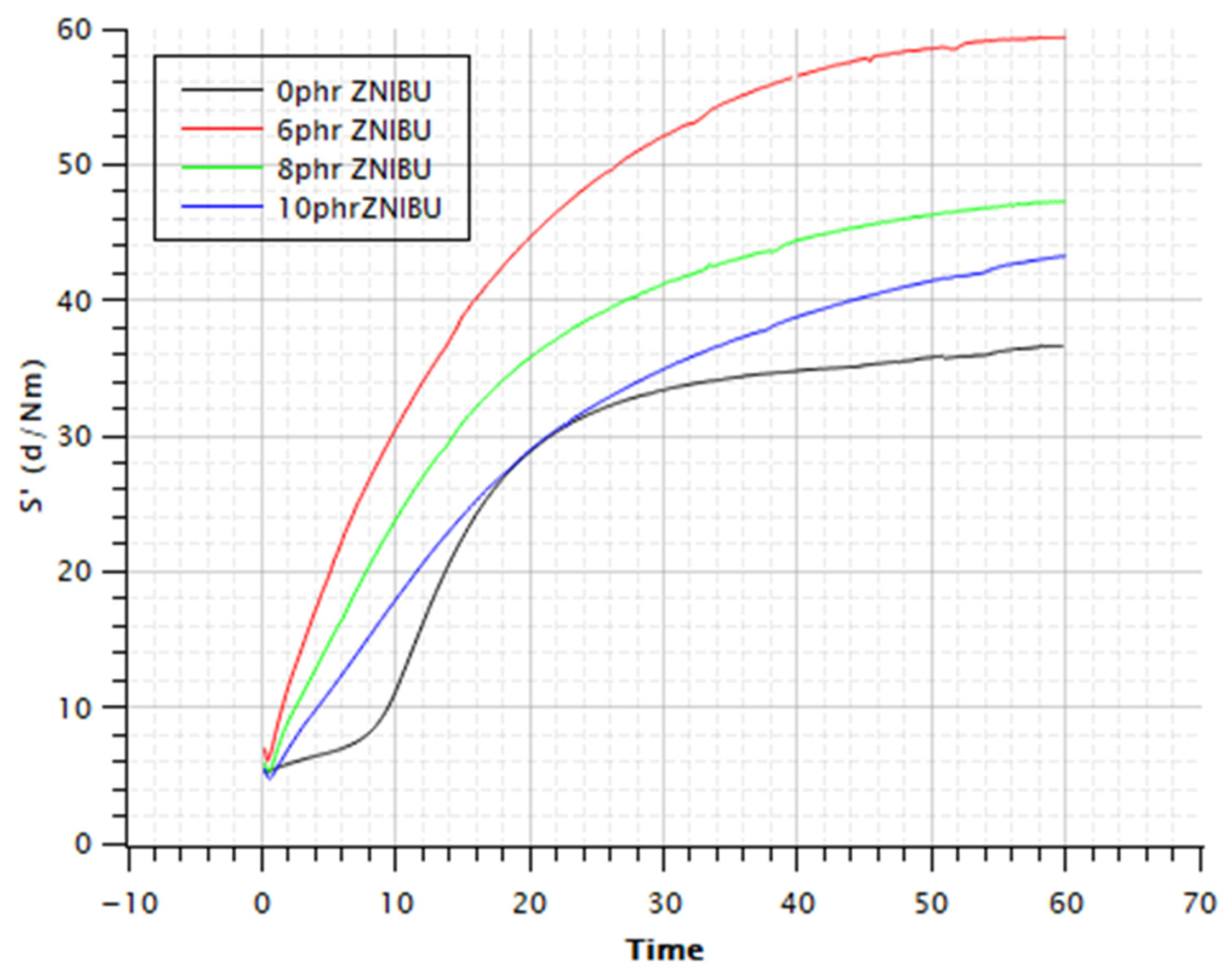
| ZNIBU Concentration (phr) | Optimal Curing Time—t90 (min) | Scorch Time—tS1 (min) | Maximum Torque—MH (dN·m) | Minimum Torque—ML (dN·m) | Torque Variation—∆M (dN·m) |
|---|---|---|---|---|---|
| 0.0 * | 26.2 | 3.2 | 35.1 | 5.2 | 29.9 |
| 6.0 | 33.6 | 1.2 | 59.4 | 6.0 | 53.4 |
| 8.0 | 36.2 | 1.4 | 47.9 | 5.2 | 42.7 |
| 10.0 | 42.2 | 1.2 | 43.3 | 4.7 | 38.6 |
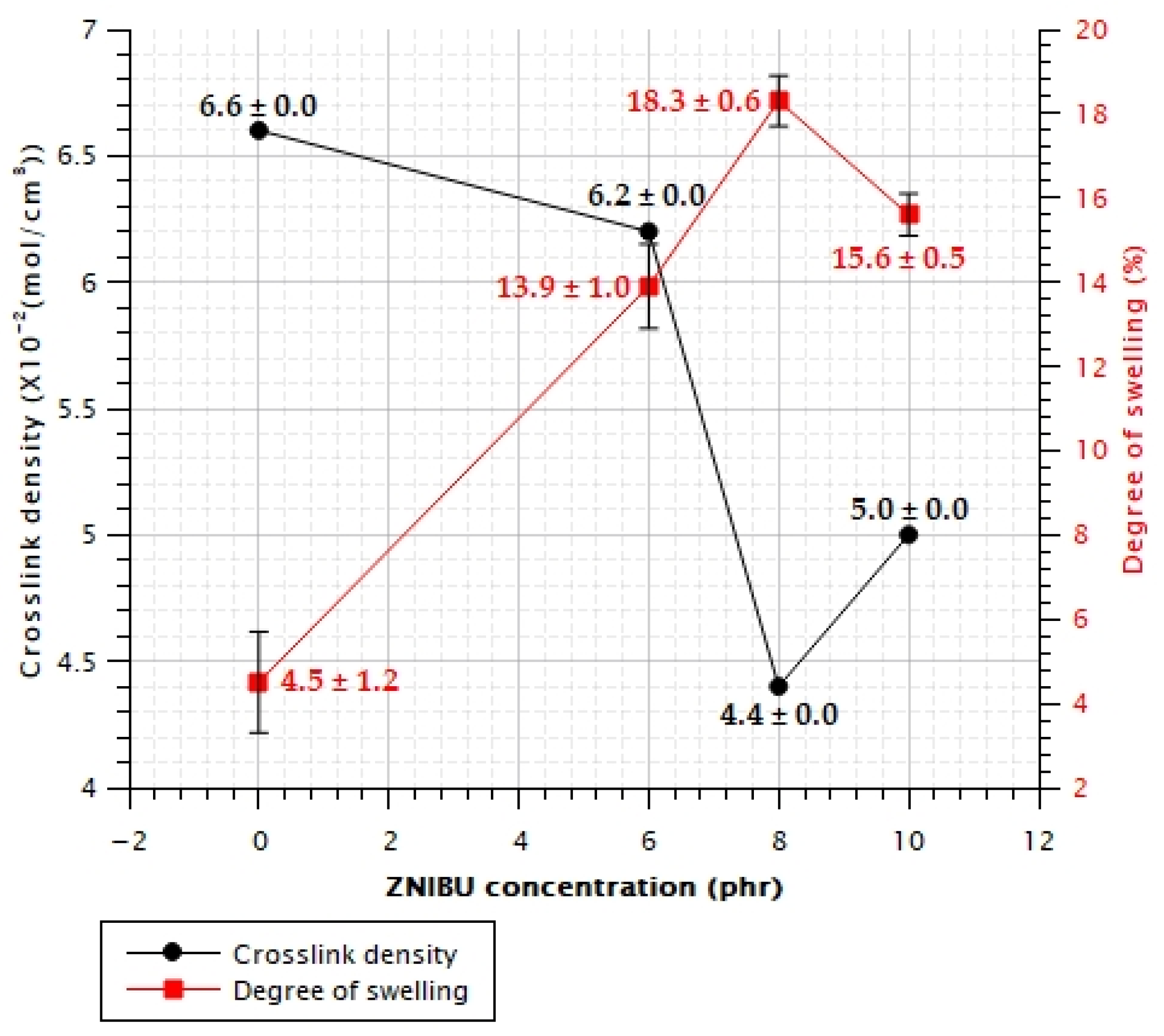
| ZNIBU Concentration (phr) | Degree of Regeneration (%) |
|---|---|
| 0.0 * | 0.0 |
| 6.0 | 5.9 |
| 8.0 | 33.6 |
| 10.0 | 23.9 |
| ZNIBU Concentration (phr) | Maximum Degradation Temperature (°C) |
|---|---|
| 0.0 * | 451.91 |
| 6.0 | 395.1 |
| 8.0 | 399.6 |
| 10.0 | 394.0 |
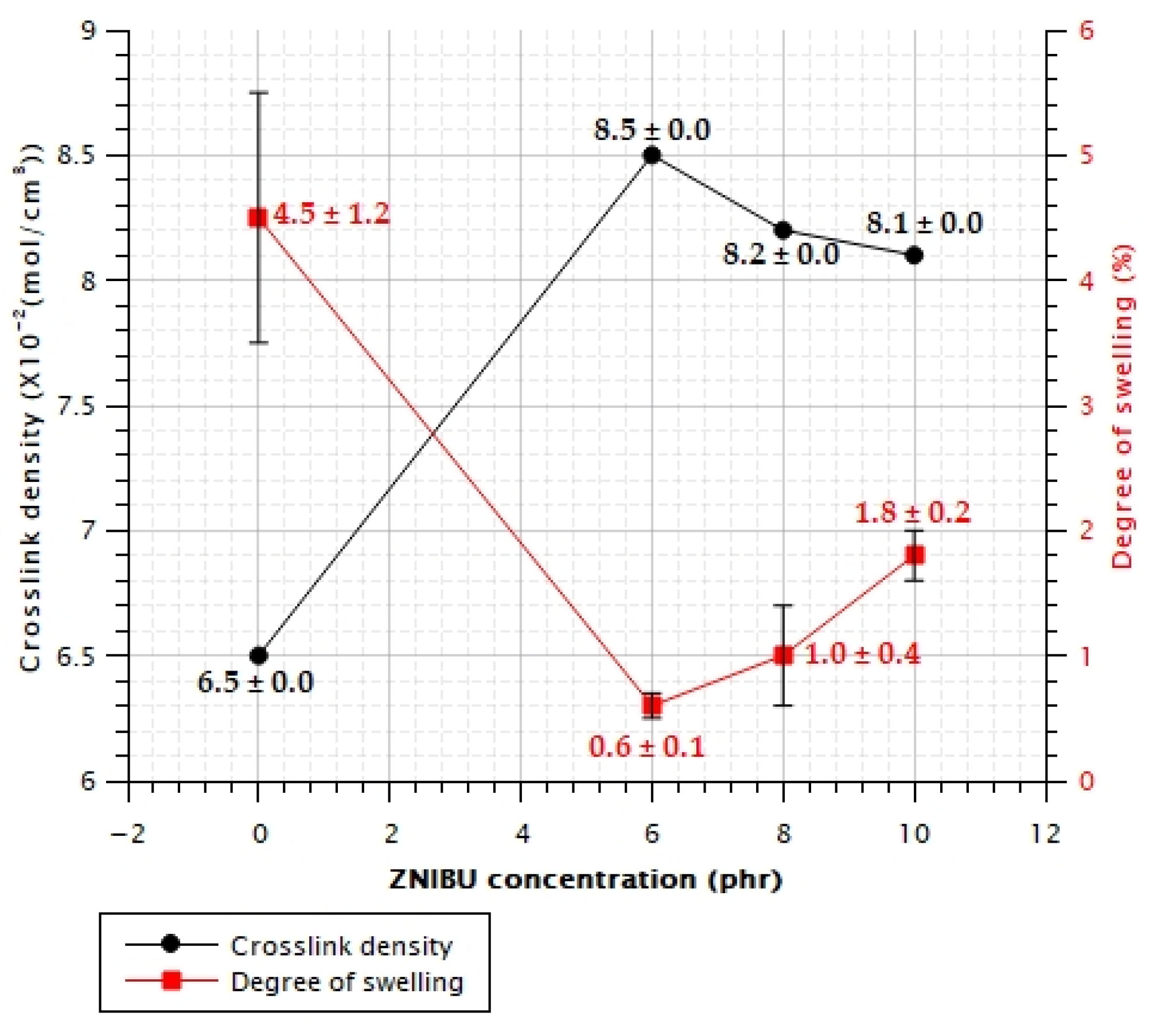
| ZNIBU Concentration (phr) | Hardness (Shore A) | Tear Strength (N/mm) | Rupture Stress (MPa) | Elongation at Break (%) |
|---|---|---|---|---|
| 0.0 * | 68.0 ± 1.7 | 67.6 ± 6.9 | 22.9 ± 1.7 | 324.3 ± 17.8 |
| 6.0 | 85.0 ± 1.3 | 18.1 ± 1.5 | 10.6 ± 1.0 | 47.9 ± 2.3 |
| 8.0 | 83.0 ± 0.5 | 16.8 ± 1.7 | 11.15 ± 0.4 | 55.1 ± 2.0 |
| 10.0 | 81.0 ± 1.2 | 19.0 ± 4.6 | 6.44 ± 0.3 | 54.8 ± 1.8 |
Disclaimer/Publisher’s Note: The statements, opinions and data contained in all publications are solely those of the individual author(s) and contributor(s) and not of MDPI and/or the editor(s). MDPI and/or the editor(s) disclaim responsibility for any injury to people or property resulting from any ideas, methods, instructions or products referred to in the content. |
© 2026 by the authors. Licensee MDPI, Basel, Switzerland. This article is an open access article distributed under the terms and conditions of the Creative Commons Attribution (CC BY) license.
Share and Cite
de Oliveira, M.S.; Visconte, L.L.Y.; Pacheco, E.B.A.V. Mechanochemical Recycling of Tire-Derived Styrene–Butadiene Rubber Using a Regeneration Agent. Recycling 2026, 11, 37. https://doi.org/10.3390/recycling11020037
de Oliveira MS, Visconte LLY, Pacheco EBAV. Mechanochemical Recycling of Tire-Derived Styrene–Butadiene Rubber Using a Regeneration Agent. Recycling. 2026; 11(2):37. https://doi.org/10.3390/recycling11020037
Chicago/Turabian Stylede Oliveira, Matheus Silva, Leila Lea Yuan Visconte, and Elen Beatriz Acordi Vasques Pacheco. 2026. "Mechanochemical Recycling of Tire-Derived Styrene–Butadiene Rubber Using a Regeneration Agent" Recycling 11, no. 2: 37. https://doi.org/10.3390/recycling11020037
APA Stylede Oliveira, M. S., Visconte, L. L. Y., & Pacheco, E. B. A. V. (2026). Mechanochemical Recycling of Tire-Derived Styrene–Butadiene Rubber Using a Regeneration Agent. Recycling, 11(2), 37. https://doi.org/10.3390/recycling11020037