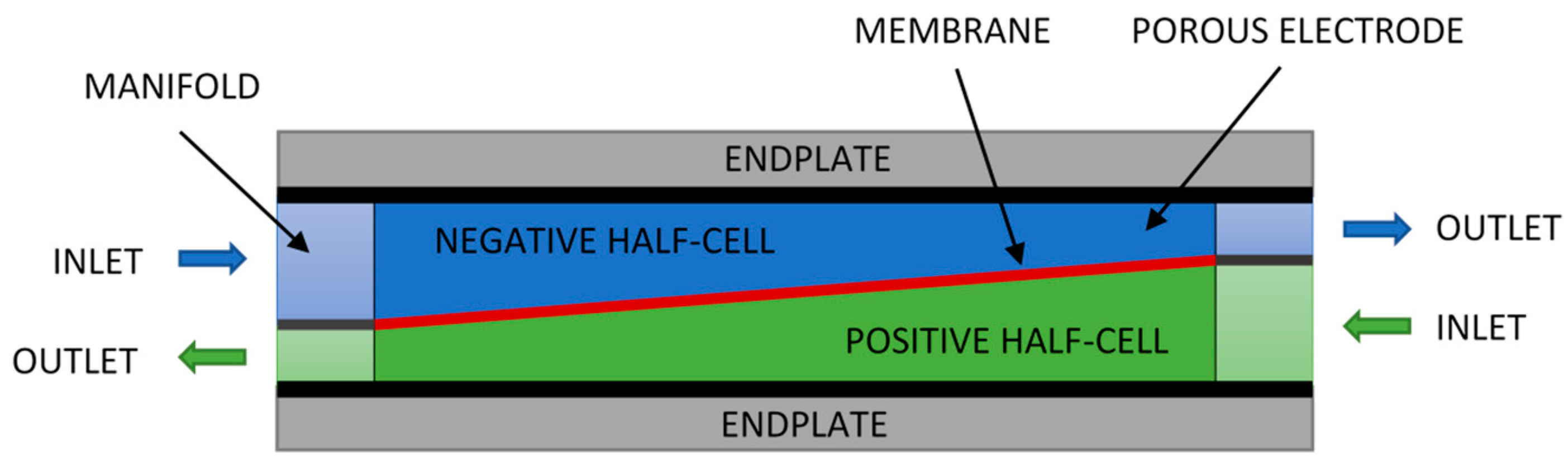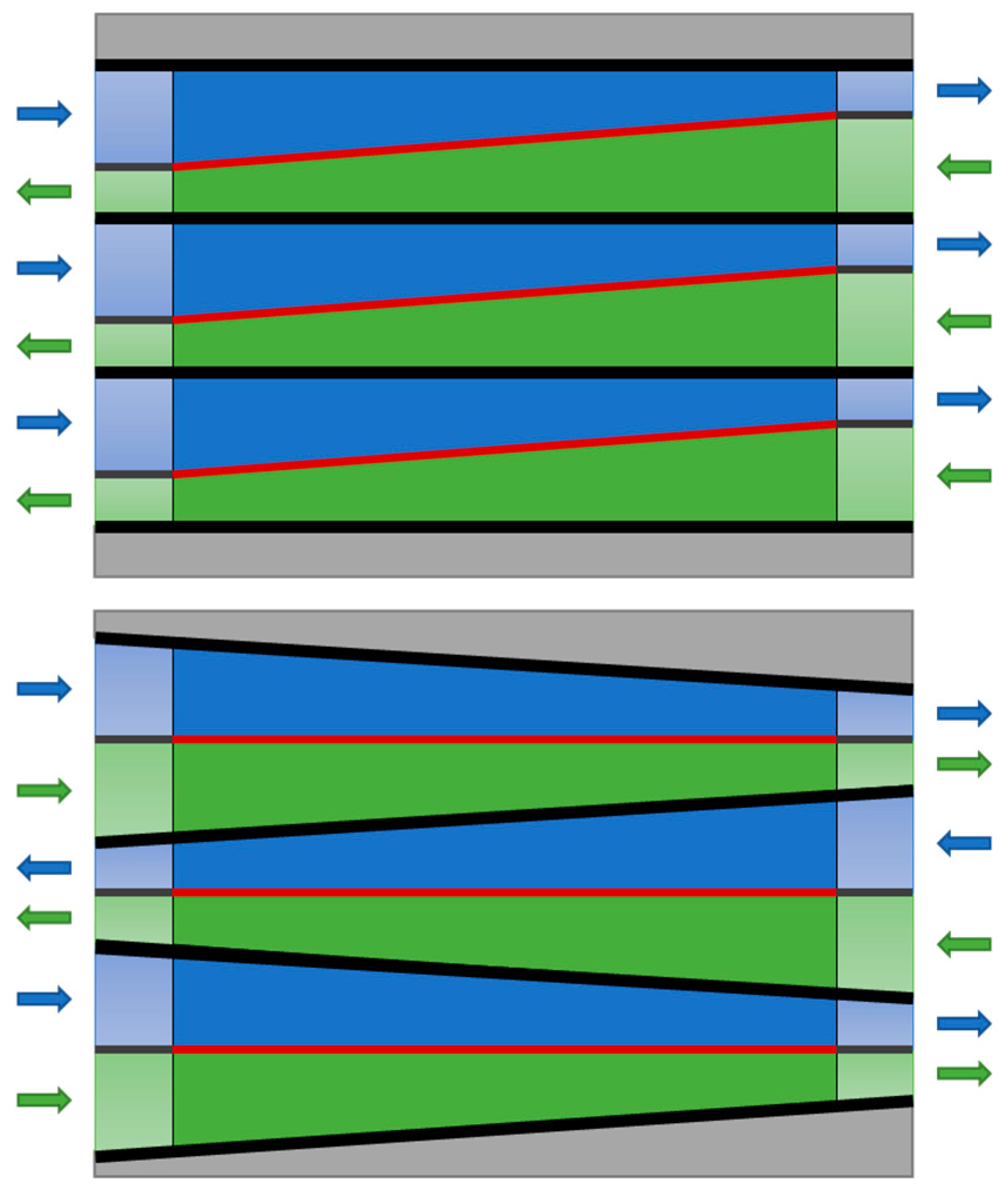
Variable Porous Electrode Compression for Redox Flow Battery Systems




Abstract
1. Introduction
2. Results
2.1. Reactant Concentration and Limiting Current Density
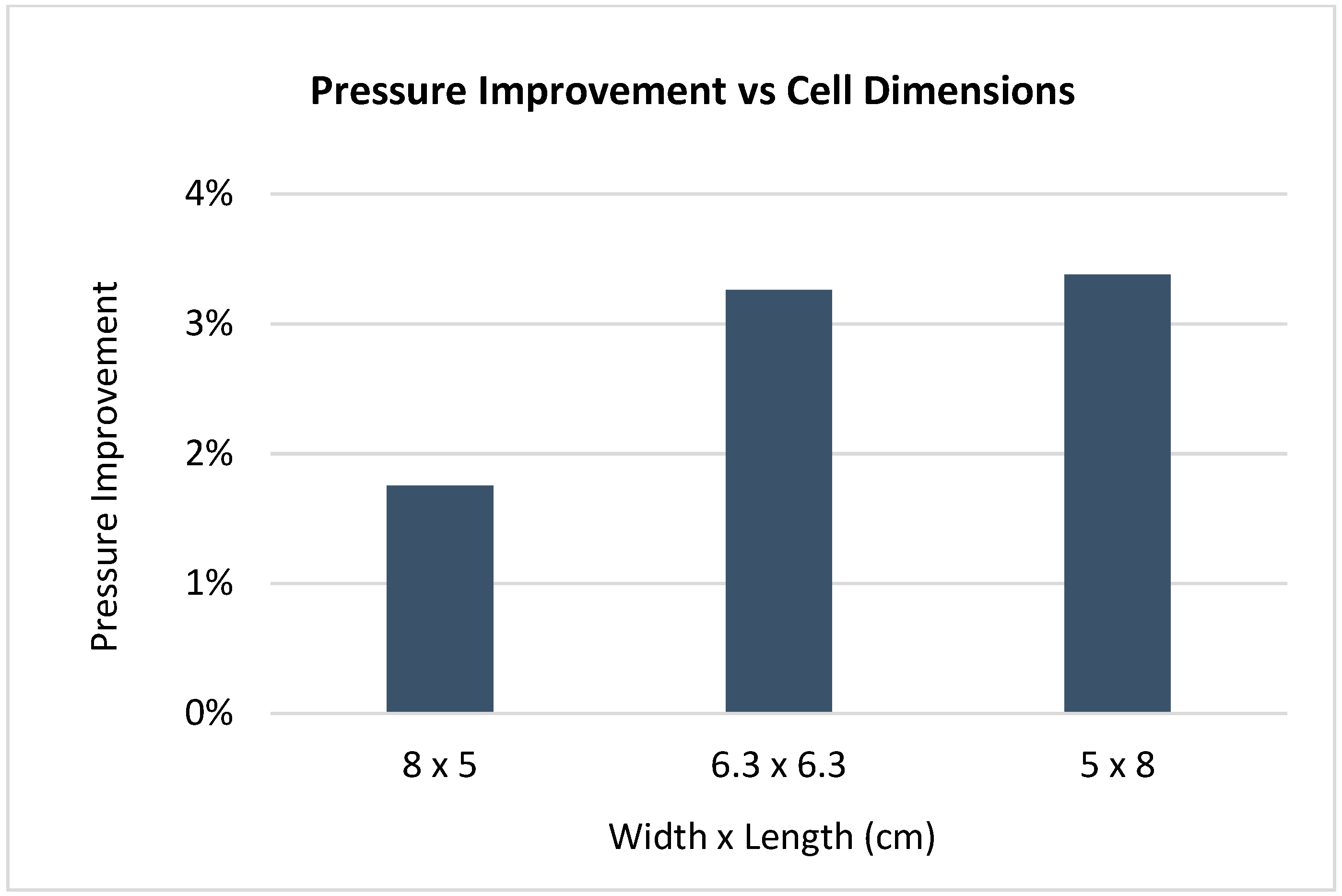
2.2. Effect of Cell Dimensions
3. Discussion
4. Materials and Methods
Author Contributions
Funding
Conflicts of Interest
References
- Ryan, J.; Eckhouse, B. The Age of the Giant Battery is Almost upon Us, Bloomberg. Available online: https://www.bloomberg.com/news/articles/2017-02-21/big-batteries-coming-of-age-prompt-bankers-to-place-their-bets (accessed on 28 September 2018).
- Conca, J. Vanadium-Flow Batteries: The Energy Storage Breakthrough We’ve Needed. Available online: https://www.forbes.com/sites/jamesconca/2016/12/13/vanadium-flow-batteries-the-energy-storage-breakthrough-weve-needed/#7077b6885bde (accessed on 28 September 2018).
- Skyllas-Kazacos, M.; Menictas, C.; Lim, T. Redox flow batteries for medium to large scale energy storage. In Electricity Transmission, Distribution and Storage Systems; Melhem, Z., Ed.; Woodhead Publishing: Cambridge, UK, 2013; pp. 398–441. [Google Scholar]
- Tang, A.; Bao, J.; Skyllas-Kazacos, M. Studies on pressure losses and flow rate optimization in vanadium redox flow battery. J. Power Sources 2014, 248, 154–162. [Google Scholar] [CrossRef]
- Shah, A.A.; Watt-Smith, M.J.; Walsh, F.C. A dynamic performance model for redox-flow batteries involving soluble species. Electrochim. Acta 2008, 53, 8087–8100. [Google Scholar] [CrossRef]
- Shah, A.A.; Al-Fetlawi, H.; Walsh, F.C. Dynamic modelling of hydrogen evolution effects in the all-vanadium redox flow battery. Electrochim. Acta 2010, 55, 1125–1139. [Google Scholar] [CrossRef]
- Shah, A.A.; Tangirala, R.; Singh, R.; Wills, R.G.A.; Walsh, F.C. A Dynamic Unit Cell Model for the All-Vanadium Flow Battery. J. Electrochem. Soc. 2011, 158, A671–A677. [Google Scholar] [CrossRef]
- You, D.; Zhang, H.; Chen, J. A simple model for the vanadium redox battery. Electrochim. Acta 2009, 54, 6827–6836. [Google Scholar] [CrossRef]
- Ma, X.; Zhang, H.; Xing, F. A three-dimensional model for negative half cell of the vanadium redox flow battery. Electrochim. Acta 2011, 58, 238–246. [Google Scholar] [CrossRef]
- Knehr, K.W.; Agar, E.; Dennison, C.R.; Kalidindi, A.R.; Kumbur, E.C. A Transient Vanadium Flow Battery Model Incorporating Vanadium Crossover and Water Transport through the Membrane. J. Electrochem. Soc. 2012, 159, A1446–A1459. [Google Scholar] [CrossRef]
- Ke, X.; Alexander, J.I.D.; Prahl, J.M.; Savinell, R.F. Flow distribution and maximum current density studies in redox flow batteries with a single passage of the serpentine flow channel. J. Power Sources 2014, 270, 646–657. [Google Scholar] [CrossRef]
- Jyothi Latha, T.; Jayanti, S. Ex-situ experimental studies on serpentine flow field design for redox flow battery systems. J. Power Sources 2014, 248, 140–146. [Google Scholar] [CrossRef]
- Xu, Q.; Zhao, T.S.; Leung, P.K. Numerical investigations of flow field designs for vanadium redox flow batteries. Appl. Energy 2013, 105, 47–56. [Google Scholar] [CrossRef]
- Zheng, Q.; Xing, F.; Li, X.; Liu, T.; Lai, Q.; Ning, G.; Zhang, H. Dramatic performance gains of a novel circular vanadium flow battery. J. Power Sources 2015, 277, 104–109. [Google Scholar] [CrossRef]
- Yue, M.; Zheng, Q.; Zhang, H.; Li, X.; Ma, X. Flow field design and optimization of high power density vanadium flow batteries: A novel trapezoid flow battery. AIChE J. 2017, 64, 13–18. [Google Scholar] [CrossRef]
- Park, S.K.; Shim, J.; Yang, J.H.; Jin, C.S.; Lee, B.S.; Lee, Y.S.; Shin, K.H.; Jeon, J.D. The influence of compressed carbon felt electrodes on the performance of a vanadium redox flow battery. Electrochim. Acta 2014, 116, 447–452. [Google Scholar] [CrossRef]
- Oh, K.; Won, S.; Ju, H. Numerical study of the effects of carbon felt electrode compression in all-vanadium redox flow batteries. Electrochim. Acta 2015, 181, 13–23. [Google Scholar] [CrossRef]
- Zheng, Q.; Zhang, H.; Xing, F.; Ma, X.; Li, X.; Ning, G. A three-dimensional model for thermal analysis in a vanadium flow battery. Appl. Energy 2014, 113, 1675–1685. [Google Scholar] [CrossRef]


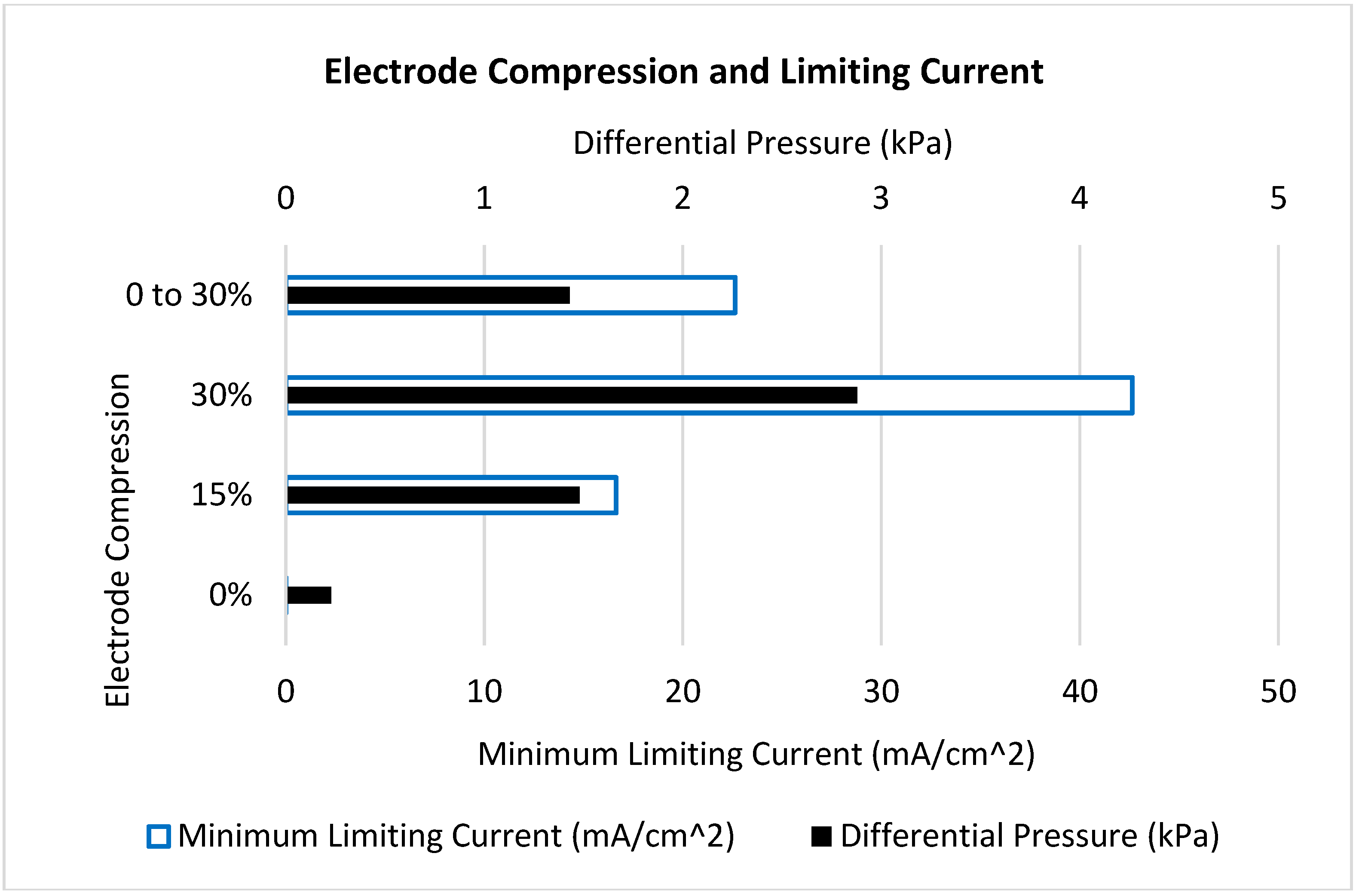

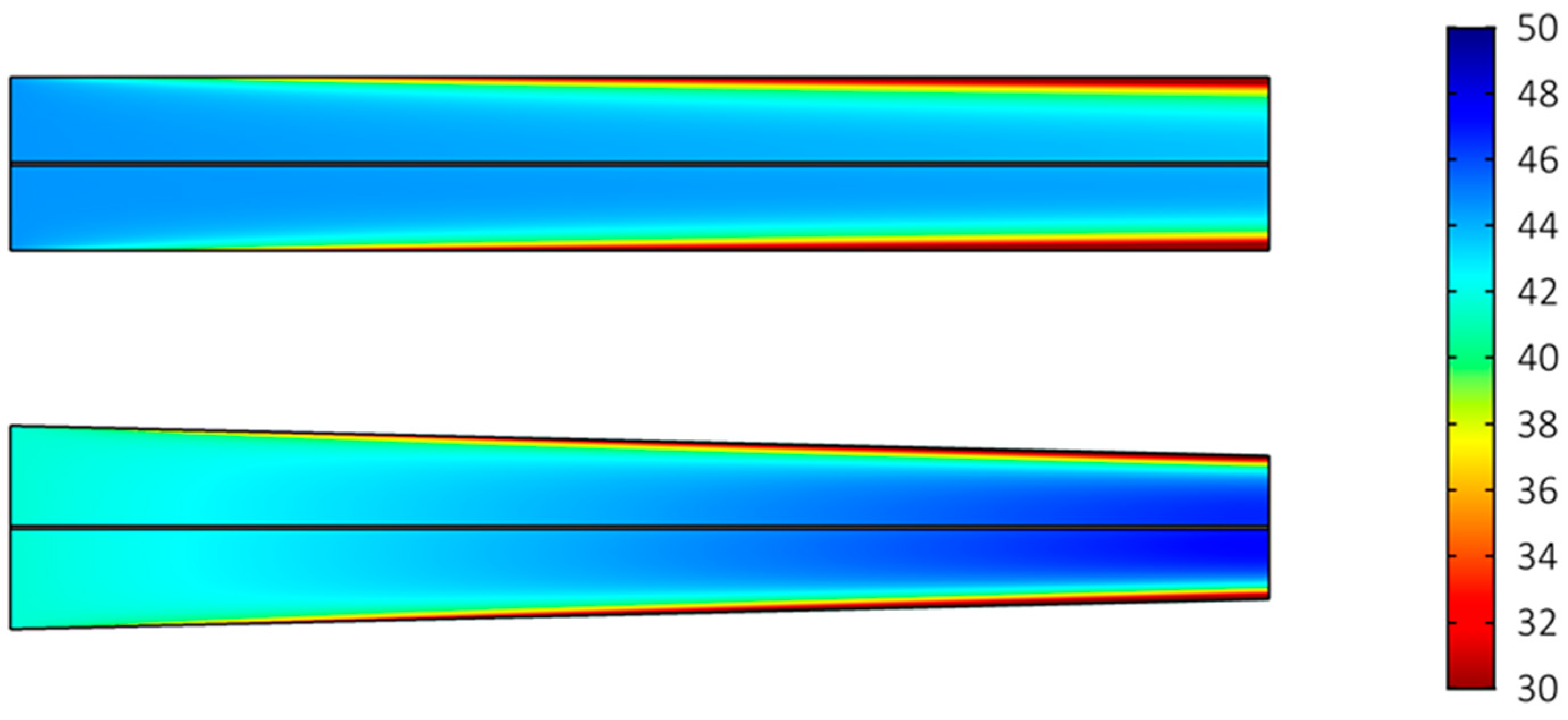
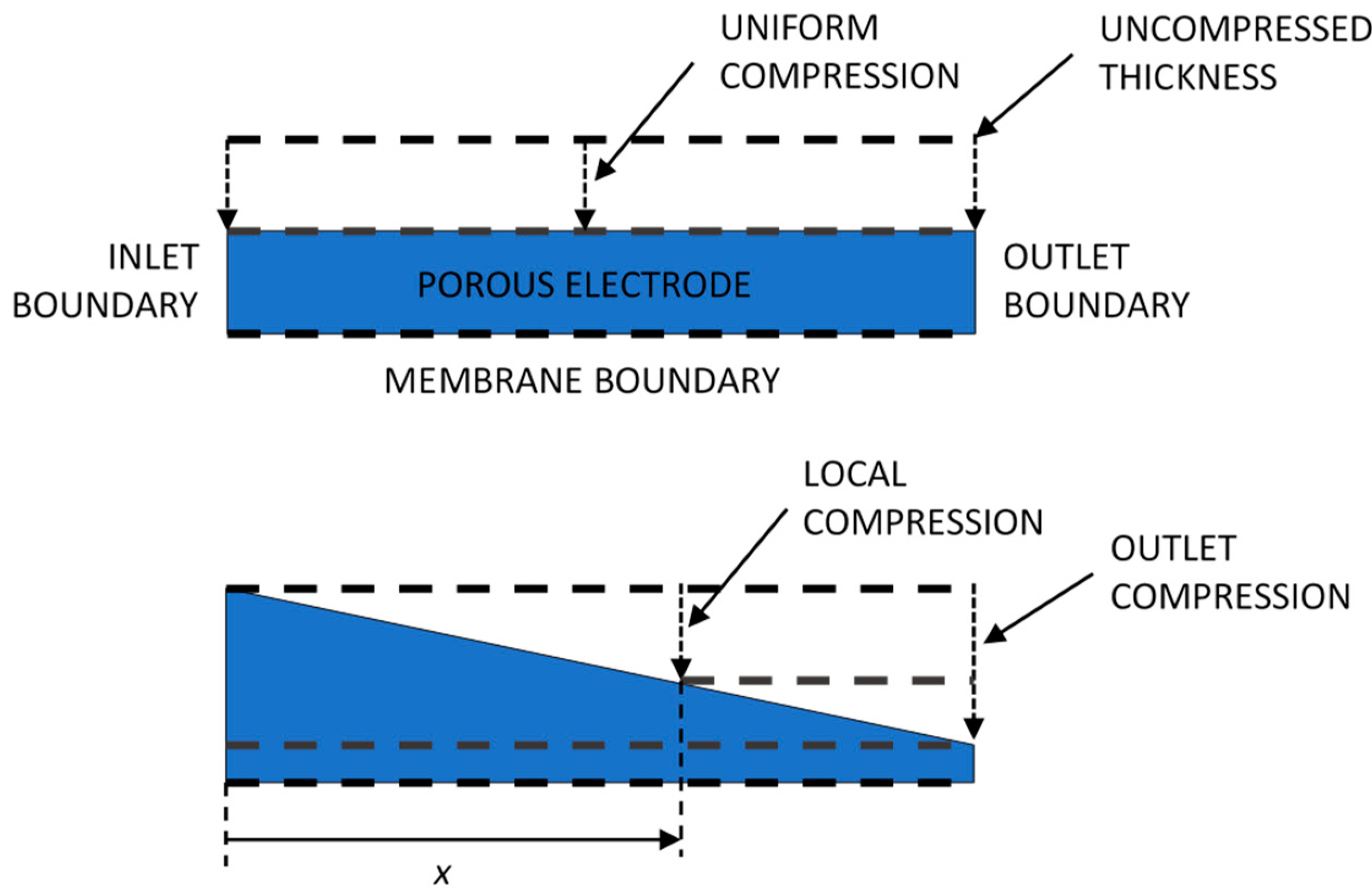
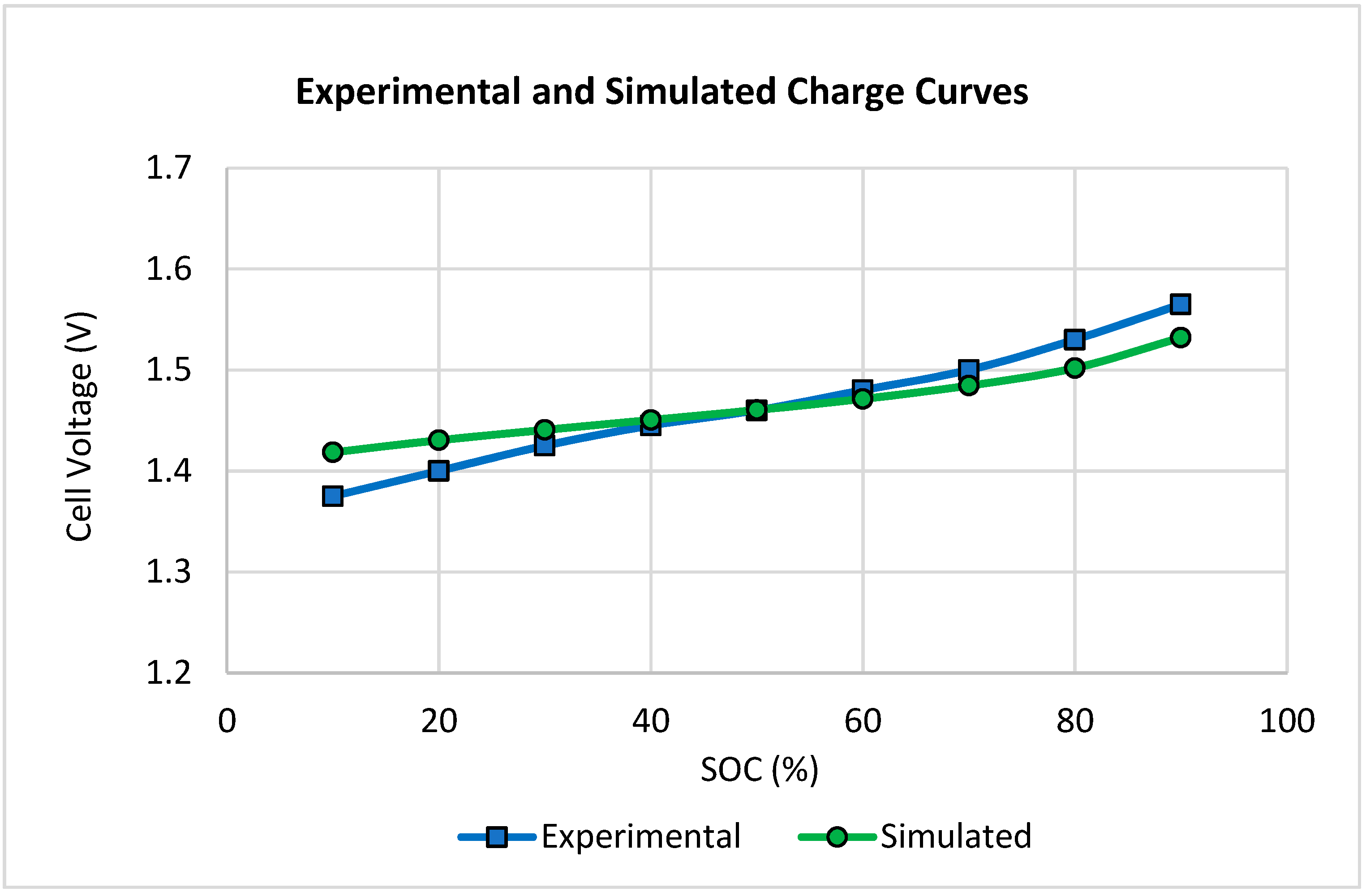

| Case | Geometry | Electrode Compression | Min. V3+ Concentration (mol m−3) | Min. Limiting Current (mA cm−2) | Differential Pressure (kPa) | Cell Voltage (V) |
|---|---|---|---|---|---|---|
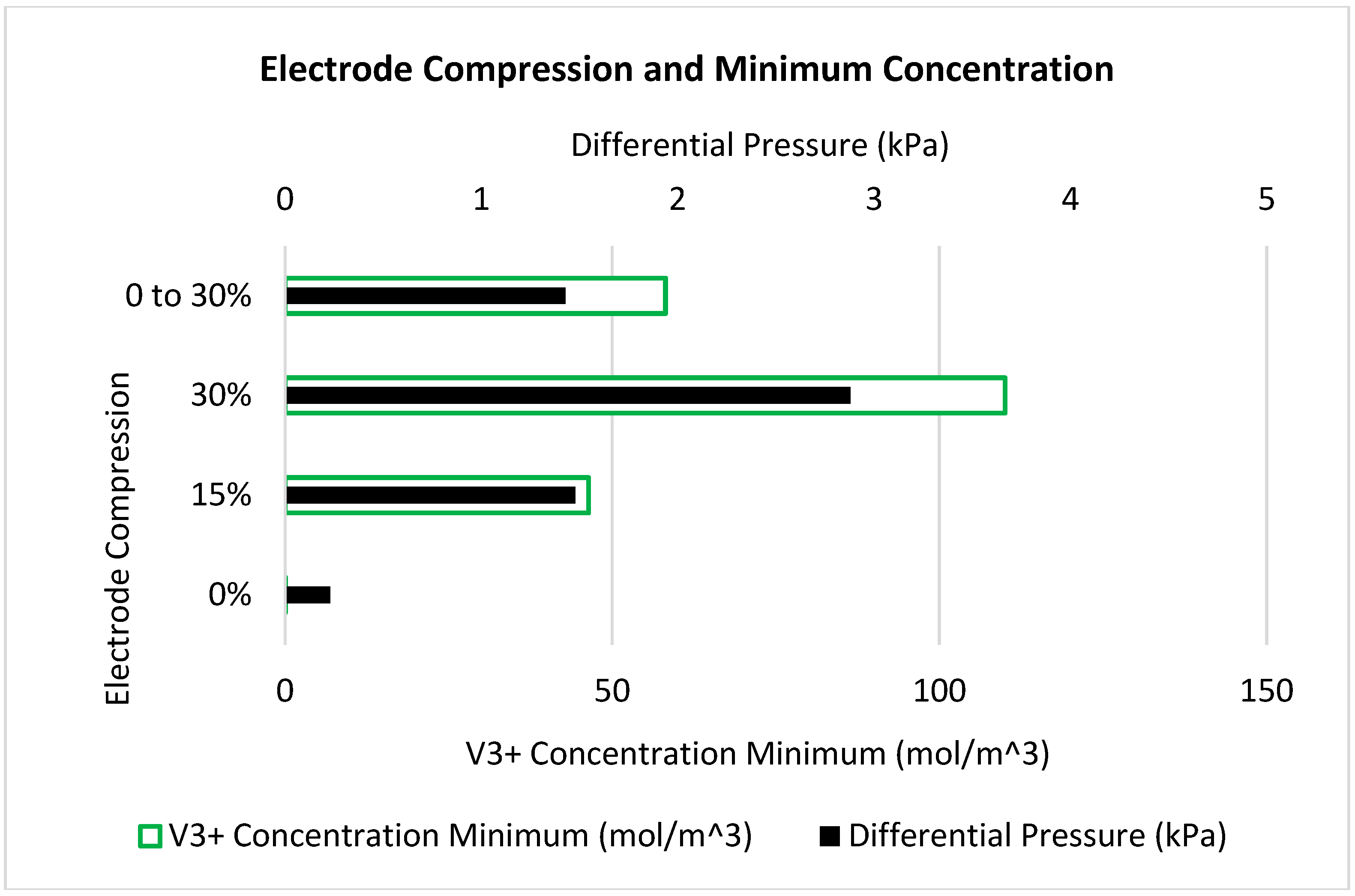
| 1 | Uniform | 0% | 0 | 0 | 0.23 | 1.92 |
| 2 | Uniform | 15% | 46 | 17 | 1.48 | 1.72 |
| 3 | Uniform | 30% | 110 | 43 | 2.88 | 1.59 |
| 4 | Reducing | 0 to 30% | 58 | 23 | 1.43 | 1.69 |
| Dependent Variable | Improvement |
|---|---|
| Minimum V3+ Concentration (mol m−3) | 25% |
| Minimum Limiting Current (mA cm−2) | 36% |
| Differential Pressure (kPa) | 3% |
| Cell Voltage (V) | 1% |
| Thickness | Compression | Conductivity | Porosity | |
|---|---|---|---|---|
| mm | mm | % | S/m | |
| 4.0 | 0.0 | 0% | 5.9 | 0.95 |
| 3.6 | 0.4 | 10% | 14.3 | 0.90 |
| 3.2 | 0.8 | 20% | 20.0 | 0.89 |
| 2.8 | 1.2 | 30% | 50.0 | 0.87 |
| Parameter | Symbol | Value | Unit |
|---|---|---|---|
| Inlet velocity | 26 × 10−3 | m/s | |
| Outlet pressure | 0 | Pa | |
| Temperature | 280 | K | |
| Current density | 1600 | A m−2 | |
| State of Charge | 90 | - | |
| Cell width | 0.05 | m | |
| Cell length | 0.08 | m | |
| Membrane thickness | 0.123 × 10⁻³ | m |
| Parameter | Symbol | Value | Unit |
|---|---|---|---|
| Dynamic viscosity (negative electrolyte) | 0.0025 | Pa s | |
| Dynamic viscosity (positive electrolyte) | 0.005 | Pa s | |
| Density (negative electrolyte) | 1300 | kg m−3 | |
| Density (positive electrolyte) | 1350 | kg m−3 | |
| Mean pore radius | 50.3 × 10⁻⁶ | m | |
| Kozeny-Carman constant | 180 | – |
| Parameter | Symbol | Value | Unit |
|---|---|---|---|
| V2+ diffusion coefficient | 2.4 × 10⁻¹⁰ | m2 s−1 | |
| V3+ diffusion coefficient | 2.4 × 10⁻¹⁰ | m2 s−1 | |
| VO2+ diffusion coefficient | 3.9 × 10⁻¹⁰ | m2 s−1 | |
| VO2+ diffusion coefficient | 3.9 × 10⁻¹⁰ | m2 s−1 | |
| Proton diffusion coefficient | 9.312 × 10⁻⁹ | m2 s−1 | |
| Initial vanadium concentration | 1500 | mol m−3 | |
| Initial proton concentration (negative) | 4500 | mol m−3 | |
| Initial proton concentration (positive) | 6000 | mol m−3 | |
| Standard reaction rate constant (negative) | 1.7 × 10⁻⁷ | m s−1 | |
| Standard reaction rate constant (positive) | 6.8 × 10⁻⁷ | m s−1 | |
| Anodic transfer coefficient | 0.5 | – | |
| Cathodic transfer coefficient | 0.5 | – | |
| Equilibrium potential: V2+/V3+ | −0.255 | V | |
| Equilibrium potential: VO2+/VO2+ | 1.004 | V |
© 2018 by the authors. Licensee MDPI, Basel, Switzerland. This article is an open access article distributed under the terms and conditions of the Creative Commons Attribution (CC BY) license (http://creativecommons.org/licenses/by/4.0/).
Share and Cite
Gurieff, N.; Timchenko, V.; Menictas, C. Variable Porous Electrode Compression for Redox Flow Battery Systems. Batteries 2018, 4, 53. https://doi.org/10.3390/batteries4040053
Gurieff N, Timchenko V, Menictas C. Variable Porous Electrode Compression for Redox Flow Battery Systems. Batteries. 2018; 4(4):53. https://doi.org/10.3390/batteries4040053
Chicago/Turabian StyleGurieff, Nicholas, Victoria Timchenko, and Chris Menictas. 2018. "Variable Porous Electrode Compression for Redox Flow Battery Systems" Batteries 4, no. 4: 53. https://doi.org/10.3390/batteries4040053
APA StyleGurieff, N., Timchenko, V., & Menictas, C. (2018). Variable Porous Electrode Compression for Redox Flow Battery Systems. Batteries, 4(4), 53. https://doi.org/10.3390/batteries4040053